




In December 1995 in a beige brick mosque with a mint-green roof in the western suburbs of Detroit, mourners from the local Shi‘i community gathered. Their religious leader, Imam Mohamad Jawad Chirri, had died one year earlier after serving the community for forty-five years. The guest of honour to commemorate the first anniversary of Chirri’s death was Muhammad Mahdi Shams al-Din (1936–2001), an Iraqi born Lebanese ‘ālim (religious scholar) and the leader of the Supreme Islamic Shi‘i Council (al-Majlis al-Islāmī al-Shī‘ī al-A‘lā) in Lebanon. Shams al-Din had travelled a long way to address the Detroit Shi‘i community, which was testament to the high esteem with which Chirri was held among the Shi‘i leadership in Lebanon, as well as the importance of diaspora communities for buttressing the Lebanese sectarian political system. Shams al-Din’s eulogy celebrated Chirri as a mujāhid (a fighter for Islam) and a ‘great Islamic thinker’ who had arrived in the ‘western lands’ when they were shrouded in ignorance of Islam (majāhīl). By dedicating his life to Islam in America, by building the Islamic Centre of America where Shams al-Din was delivering his speech, the leader of the Supreme Islamic Shi‘i Council (SISC) compared Chirri to successive generations of high-profile Islamic reformers, including Jamal al-Din al-Afghani (1838–97), Muhammad ‘Abduh (1849–1905), Ibn Badis (1889–1940), Imam Khomeini (1902–89), Muhammad Baqir al-Sadr (1935–80), and Musa Sadr (1928–78).Footnote 1 This was an eclectic and geographically dispersed list. The last three names—Khomeini, Baqir Sadr, and Musa Sadr—were the three most influential figures in the mid-twentieth century Shi‘i revival in Iran, Iraq, and Lebanon respectively.
Shams al-Din rounded off his speech with a personal reflection on Chirri’s influence, which is worth quoting at length:
Mohamad Jawad Chirri was one of the great leaders of the modern Islamic movement (al-ḥarakat al-islāmiyya) among the Shi‘i Muslims. The recent Islamic movement is not old. The Islamic Jihad movement in its Shi‘i guise has a long history. Was not its first hero Jamal al-Din al-Afghani? But the Shi‘i Islamic movement as a revivalist movement (al-ḥarakat al-iḥyā’iyya) is a recent phenomenon. The Shi‘a are new to it. Shaykh Mohamad Jawad Chirri was one of its progenitors, one of its first seeds, and we can read this in his books from before the 1950s. While the Islamic movement was emerging, while we were instigating it in our youth … beset by fear and besieged, before and after 1958 in Iraq, in the dark days of unbelief (kufar) and the bloodiest days of lynching under Marxist leftist rule, there was Shaykh Mohamad Jawad Chirri. We were establishing the journal al-Aḍwā’ and writing its introductory articles called ‘our mission’ (risālatunā) with the martyr Imam Muhammad Baqir al-Sadr. One of our sources of inspiration (al-ilhām) was Shaykh Mohamad Jawad Chirri, here in the non-Islamic lands (majāhil) of the United States and Africa pursuing and expanding the light by building this centre and this generation and fostering through them the undulating waves through which the light has spread.Footnote 2
This was high praise indeed. Muhammad Baqir al-Sadr was arguably the most consequential Shi‘i thinker of the twentieth century. In the late 1950s and 1960s he worked with fellow scholars in the Shi‘i scholarly city of Najaf to develop an Islamic political response to the leftist political currents holding sway in Iraq following the 1958 revolution against monarchical rule. The fruits of his labours included two economic and philosophical tomes titled Our Economy (Iqtiṣādunā) and Our Philosophy (Falsafatunā), the political journal al-Aḍwā’, and several legal and political treaties. Baqir al-Sadr’s work formed the intellectual basis for the Shi‘i Islamic political movement in Iraq, known as Hizb al-Da‘wa, and many of the Islamic constitutional ideas which underpinned the Iranian revolution of 1979.Footnote 3
Shams al-Din’s assertion that Chirri was one of Baqir al-Sadr’s ‘inspirations’ is good indication of the real and symbolic importance of global entanglements for the Shi‘i cultural and political revival of the mid-twentieth century.Footnote 4 Of course, his remarks no doubt included a healthy dose of exaggeration. Baqir al-Sadr and his associates may have met Chirri when the latter visited and lectured in Najaf in 1963. But there is no evidence that they knew anything concrete about the proliferation of Shi‘ism in the United States as they struggled to forge their religion into a radical ideological alternative to socialism in post-monarchical Iraq. This was a eulogy, and Shams al-Din would have thought it appropriate to embellish the American imam’s influence to reassure his aggrieved congregation that their leader had truly been a great man. Yet even if we accept a degree of rhetorical embellishment, the fact that Shams al-Din’s eulogy had meaning at all is an important signifier. It points to the salience of connections beyond the Middle East, beyond even the traditional Shi‘i milieus of South and Central Asia, for understanding transformations in the institutional, ideological, and political manifestations of the faith post-1945.
Chirri, who migrated to the United States to act as religious leader for the Muslim community in Detroit in the late 1940s, was part of what might be called the global Shi‘i revival. A contested ideological phenomenon, the Shi‘i revival is celebrated by adherents such as Shams al-Din and Chirri as a modernist anti-sectarian religious-political awakening. The harnessing of Shi‘i Islamic ethics and laws as universal remedies to the problems of the modern world. Less sympathetic observers tell a different story. Concerned with understanding the growth of Shi‘i militancy in Lebanon and Iraq and the political fall-out from the 1979 Islamic Revolution in Iran, they frame the Shi‘i revival as the regional and transnational diffusion of a radical and sectarian Shi‘i politics from the 1970s onwards.Footnote 5
Drawing from Chirri’s publications and his fragmented archival trail in Lebanon, Iraq, and the United States, this article takes a different approach. It substitutes macro metanarratives of religious revival with a micro account of revivalist activism, ‘following’ Chirri across the various global nodes of Shi‘i-Lebanese social and religious life.Footnote 6 Rather than conceiving of the Shi‘i revival in ideological or diffusionist terms, it aims to ‘de-centre’ Shi‘i history through arguing that revivalism manifests as clusters of institutional projects emerging in the 1950s.Footnote 7 While these projects interacted with the centralized authority structures of the Najafi marja‘iyya and radical Shi‘i movements taking shape in the Middle East, they were rarely dictated by them.
Telling the story of the Shi‘i revival ‘without a centre’ is not only relevant to the field of Shi‘i and Islamic history. By highlighting the autonomous agency of hypermobile individuals and the contingent nature of their activism and thought, the article acts as a case study for how global micro-history can overcome some of the persistent shortfalls with comparative or overly macro global historical methodologies.Footnote 8 Rather than ignoring or avoiding so-called ‘small spaces’, the micro-historical approach connects discrete localities, leaning into contradictions and inconsistencies across and over time.Footnote 9 It helps resist some of the stubborn historiographical binaries which the subdiscipline of global religious history aims to challenge: between East and West; modernity and tradition; the universal and sectarian; homeland and diaspora.
Mohamad Jawad Chirri and the global Shi‘i revival
For the Shi‘i Muslim community in the United States, Chirri has garnered a reputation as a heroic paternalistic figure: the spiritual saviour of the wayward Muslim diaspora and a prophet of Islam in America. Today, the website for the Islamic Centre of America displays a well-produced video commemorating sixty years since the centre’s founding in 1963. The video narrates ‘the beautiful dream of an inspiring man who could not speak or understand English that gave birth to an organisation that kept growing to become what is today the largest mosque in North America’. The man in question was Chirri, and the video frames the story of the Islamic Centre of America as his personal quest to breathe the spirit of Islam into the heart of American society. Archive footage depicts Chirri preaching to large crowds of onlookers. His dress is modest and relatable: a dark lounge suit and black trench coat. Only a pristine white turban gives away his identity as a Shi‘i shaykh.Footnote 10 While Chirri faced many challenges along the way, including the reluctance of the older and more traditional members of the Detroit Muslim community to accept his leadership, the heroic narrative sees his initial hijra, or migration, as an origins moment for Islam in America. It resonates in the ‘collective memory of the Shi‘a of Dearborn’ as a ‘re-enactment of a great Islamic historical event’, the Prophet’s own hijra from Mecca to Medina in 622.Footnote 11
The evocation of the notion of hijra to explain the life’s work of Chirri is based on a number of assumptions about time, space, and connections in the field of modern Shi‘i history and global religious history which this article sets out to challenge. The first of these is the sharp analytical distinction between the mahjar (place of migration) and mashriq (the Arab world), or the diaspora and ‘home country’. The historiographical tendency to frame these categories as self-contained contexts is common to studies of global and transnational political-religious phenomena. For example, historians and anthropologists of Islam in America have discussed the ways that figures such as Chirri ‘Americanized Islam’, while analysing strategies of cultural resilience versus integration and the socio-economic factors underpinning these.Footnote 12 Meanwhile, in a brief historical appraisal of Chirri within the story of Lebanese Shi‘ism, Max Weiss has framed the migrating imam’s activism and writing as part of the gradual process of Shi‘i subject formation and politicization within the post-colonial Lebanese nation state.Footnote 13 Analysing Chirri solely within his pre- or post-migratory environment divides time and space into neat halves which rarely survive empirical scrutiny. By locating Chirri in the transnational Shi‘i scholarly networks connecting Lebanon, Iraq, and the mahjar, this article posits a framework for reimagining global religious-political agency beyond the rigid discursive categories of diaspora and homeland.
The transnational and transregional nature of Shi‘ism has roots in the early modern period when mobile Shi‘i scholars from across the Middle East flocked to Iran to support the Safavid state’s confessionalization drive. Shi‘i doctrines and rituals subsequently spread across central and south Asia.Footnote 14 Since the 1980s, scholarship on Shi‘i transnationalism has been chiefly concerned with understanding two interconnected phenomena: first, the development and centralization of Shi‘i authority networks stemming from the institution of the marja‘iyya, the most senior Shi‘i scholar and divine source of emulation;Footnote 15 second, the origins and proliferation of radical Shi‘i political movements. The salience of these two phenomena stems from a historical truism: Shi‘i scholarly centralization in the southern Iraqi shrine cities in the nineteenth century relied on expansive scholarly and familial networks which have proved remarkably resilient and politically expedient to this day.Footnote 16 Historians have pointed to the endurance and expansion of these networks into new geographies as a result of migration, exile, and institutional expansion. In her study of the marāja‘ Muhsin al-Hakim (1889–1970) and Abu al-Qasim al-Khoei (1899–1992), Elvire Corboz shows how religious authority in modern Shi‘ism relies on cadres of religious representatives (wakīl, pl. wukalā), charitable associations, and political institutions.Footnote 17
Literature on the mid-century Shi‘i religious and political revival has pointed to the same transnational Shi‘i scholarly networks for facilitating the ‘diffusion’ of modern Shi‘i political and social movements globally. The modern global history of Shi‘ism has been understood according to ‘a centre periphery pattern’, with revivalist currents emanating out from the Shi‘i heartlands of southern Iraq to the Gulf, Lebanon, South Asia, and beyond from the 1960s. Chibli Mallat has provocatively dubbed such networks the ‘Shi‘i international’.Footnote 18 These movements informed and complemented revolutionary currents which came to fruition with the Islamic Revolution in Iran. Within the diffusionist framework, the 1979 revolution is a key turning point, a sign of both the success of the mid-century Shi‘i revival and the onset of a new era of political-religious proliferation.
While Chirri and his community were undoubtedly affected by 1979, the Lebanese-American imam does not fit into the paradigms for understanding transnational Shi‘ism sketched above. He was not a wakīl of the Najafi marja‘, nor an envoy of the ‘Shi‘i international’, nor a disciple of the Islamic Revolution. Chirri nevertheless exploited transnational interpersonal and financial networks to institutionalize and expand Shi‘ism in the United States between the 1950s and 1990s. His motivations included reformist political and social ideas cultivated in the scholarly environment of 1930s Najaf, but also professional concerns: the need to make a living and survive as a religious leader in the competitive religious market place of the United States. Throughout his career, Chirri expressed loyalty to a host of patrons in Lebanon, Iraq, and Iran. Yet he consistently resisted being pulled into the purview of either the Iranian state or the Najafi marja‘iyya, batting off an effort by the al-Khoei Foundation to exert control over the Islamic Centre of America in 1989.Footnote 19
That Chirri operated independently of the authority structures underpinning modern Shi‘i revivalism is one reason why the hagiography of his hijra is so well developed. He was undeniably something of a pioneer. Yet Chirri’s exceptional nature should not prevent us from using him as a case study to problematize hub-and-spoke or diffusionist approaches in global history. With their tendency to map the myriad connections structuring complex religious-political phenomena, such approaches risk reifying normative structures by reproducing networks of authority and ideological fault lines which existed only in theory but not in practice. As Corboz herself notes, there is also the ‘the little-known topic of a cleric working on the ground to organize the affairs of religious communities located away from the heartlands of Shi‘ism’.Footnote 20 The cleric Corboz is referencing was Mahdi al-Hakim (1935–88), who briefly toyed with a social and religious reform project for the Shi‘i community in Pakistan in 1970. Al-Hakim was following the path of a cadre of Shi‘i activists, such as Musa Sadr in 1960s Lebanon and Shaykh al-Zayn (b. 1945) in 1970s Senegal.Footnote 21 Chirri was one of the first scholars to opt for this kind of work when he migrated to the United States in 1949. Unearthing the religious and political subjectivities of clerics ‘working on the ground’ means following them across diverse geographies. It means focusing on the ‘fluidity and volatility’ of their motivations, activities, and political ideas.Footnote 22 Such an approach not only allows us to re-evaluate the structures of modern Islamic revivalist movements, but can also act as a framework of analysis for scholars of modern global religious-political phenomena more generally.
Jabal ‘Amil, Najaf, and back again
Chirri was born in the small village of Kherbet Selem near Tibnin in the mountainous region of Jabal ‘Amil. There is some historical uncertainty about the precise year of his birth. According to his records of naturalization in the United States, he was born on 1 October 1905.Footnote 23 According to the headstone on his grave, he was born in 1915. And according to the testimony of his son, Adnan, he was born on 15 October 1913.Footnote 24 While the balance of probability would appear to favour one of the two later dates, the discrepancy is significant for our understanding of his youth and upbringing. If he was born in 1905, Chirri would likely have been able to remember, albeit fleetingly, the Ottoman state into which he was born and the turbulent years of hardship and scarcity following the outbreak of the First World War in 1914. A later birth would have seen him coming of age, not in the dying days of the empire, but in the early years of the French Mandate over Lebanon. It was in this time that the ambiguously defined region of Jabal ‘Amil was being reconfigured into a national periphery: the Lebanese ‘South’.
Two parallel webs of global entanglements shaped Jabal ‘Amil’s confrontation with modernizing change in the early twentieth century. Chirri’s birth corresponded with the first substantial wave of economic migration out of Jabal ‘Amil. Spurred primarily by economic contractions, ‘Amili migrants from the market towns of the interior – Nabatiyya, Tibnin, and Bint Ijbayl – and the Mediterranean port city of Tyre began setting sail for North and South America and West Africa in the last decade of the nineteenth century. Exact numbers are difficult to ascertain, but it is possible that as many as 15 per cent of the total population of Tyre were living abroad in 1921.Footnote 25 Chirri grew up in a world filled with both anxieties and hopes about how the emigratory phenomenon would affect his underdeveloped homeland. In the 1910s, roads in Jabal ‘Amil remained scarce, agriculture was unproductive in comparison to the prosperous Mount Lebanon to the north, and power remained with wealthy feudal lords (al-zu‘amā’).Footnote 26 The intelligentsia of the region were men from merchant or ulama families who had profited from modernizing processes such as Ottoman land reform or modern schooling. They deplored emigration as a moral, economic, and political danger.Footnote 27 Yet while their discourse of local patriotism no doubt seeped into the young Chirri’s mind as he grappled with the political and economic turmoil of the Ottoman Empire’s messy demise, he was also exposed to transregional connections of an altogether more positive nature: the comings and goings of scholars, including his teacher, to and from the central nodes of Shi‘i learning in southern Iraq;Footnote 28 the neo-classical poetry and prose writings of Najafi scholars in his local journals; and the crystallization of a Shi‘i-centric publishing network linking southern Lebanon with Najaf and Baghdad.
Chirri was closely associated with two influential scholarly families in Jabal ‘Amil who were integrated into these transregional Shi‘i networks. Perhaps the most senior ‘Amili scholar of the period, Muhsin al-Amin (1867–1952) had established himself in Damascus after completing years of study in Najaf. A keen advocate of Sunni-Shi‘i unity and the rationalization of Shi‘i traditions, he later instigated a controversial reform campaign against the practice of flagellations during the annual ‘Ashura mourning ceremonies.Footnote 29 Chirri’s first teacher in Jabal ‘Amil was Muhsin al-Amin’s brother, Hasan al-Amin, and he went on to organize mourning ceremonies for both Hasan and Muhsin in Detroit when they died in 1948 and 1952 respectively.Footnote 30 Chirri also maintained a life-long friendship with Muhsin al-Amin’s son, also called Hasan, who left Lebanon for a tour of the diaspora the same year as Chirri. The second scholar, who acted as something of a patron for Chirri when he migrated to the United States, was ‘Abd al-Husayn Sharaf al-Din al-Musawi (1872–1957). An ecumenical activist in interwar Tyre and a rival of Muhsin al-Amin for the position of leadership among the ‘Amili Shi‘a, Sharaf al-Din also kept a keen eye on religious development further afield. When Chirri relocated to the United States, he dispatched a letter of support to the migrating imam. Chirri’s emigration, he confided, had calmed his anxieties about the ‘dark fate’ of the ‘new generation of our kinsmen brought up in this land [America] … detached from their history, language and beliefs’.Footnote 31
Sometime in the 1930s, Chirri inserted himself into the transregional networks of Shi‘i religious culture, setting off on the gruelling fifteen-hour-long Nairn Company bus journey from the eastern Mediterranean seaboard to Najaf.Footnote 32 Lying about 160 kilometres south of Baghdad, Najaf was an inhospitable but cosmopolitan desert town during this period. Built around the shrine of Imam ‘Ali, it was a dense patchwork of residential alleyways, markets, and madrasas, packed with scores of aspirational scholars from Iran, South Asia, and the Middle East. Chirri described his years in Najaf fondly, as a ‘sweet period … overflowing with love’, in which he cultivated ‘strong ties’ with fellow scholars.Footnote 33 Yet life in Najaf for ‘Amili students was tough in the interwar period. The informal nature of the religious education system made it difficult for young scholars to make ends meet. According to Chirri’s friend, Muhammad Jawad Mughniyya, the majority of the sixty or seventy ‘Amili students studying in the city in the 1930s were living in poverty.Footnote 34
Chirri’s fifteen years in Najaf corresponded with a moment of intellectual and institutional transformation in the city. The period between the 1920s and the 1940s is sometimes interpreted as one of dormancy for the Najafi seminaries, a lull between the restive constitutional and anti-colonial enthusiasm of the 1910s and the radical Islamist activism of the 1960s.Footnote 35 Such periodization ignores the subtler cultural and intellectual innovations of the interwar years. They were characterized by a rapidly expanding press and publishing industry and the emergence of several reform civil society projects designed to remedy the holy city’s intellectual isolation and streamline the archaic Najafi curriculum. ‘Amili students such as Muhsin Sharara, Muhammad Sharara, Husayn Muruwwa, and Muhammad Jawad al-Mughniyya were prominent within these reformist currents. They found their most enduring institutional form with the establishment of the Muntada al-Nashr in 1935.Footnote 36 An educational and publishing initiative, the Muntada aspired to harmonize traditional Islamic sciences with modern disciplines such as psychology, sociology, and nature sciences. Organized under the leadership of Muhammad Rida al-Muzaffar and Muhammad Taqi al-Hakim, it established a network of schools in Najaf and Iraq and laid the groundwork for the Kuliyyat al-Fiqh, an Islamic higher-education organization which taught modern disciplines to ḥawza students.Footnote 37 Chirri became an honorary member of the society in 1946 after al-Hakim positively reviewed his first monograph, The Succession in the Islamic Constitution (al-Khilāfa fī al-Dustūr al-Islāmī).Footnote 38 About fifteen years later, during one of his regular tours of the Middle East after relocating to the United States, the Michigan-based imam was hosted by al-Muzaffar in Najaf. Addressing a lecture at the Kulliyat al-Fiqh, he assured his audience that his unconventional appearance – he was clean shaven – was on account of his ‘Da‘wa [proselytizing] activities in America’.Footnote 39
Chirri returned to Lebanon from Najaf sometime in the early or mid-1940s. In Lebanon, he worked with his friend and fellow scholar Muhammad Jawad al-Mughniyya to advocate for an Islamic religious revival and the social uplift of the ‘Amili peasantry in the newly independent Lebanese State. Both Chirri and Mughniyya travelled regularly around Jabal ‘Amil and southern Lebanon, lecturing at the Kuliyyat al-Maqāsid al-Islāmiyya in Saida and the Munaẓẓamat al-Ṭalā’i‘ (the Vanguard Organization).Footnote 40 In this way, they foretold the work that Musa Sadr undertook in the 1960s, of seeking to raise a shared political consciousness among the Shi‘i population and so undermine the stranglehold which the powerful landowning elites exerted on the peasant classes.Footnote 41 A jointly signed broadside which set out their socio-religious programme and advertised their oratory services was titled ‘A Call to the ‘Amili People and the Faithful’. It listed the various injustices meted out to the ‘‘Amili peasant’, who was the ‘fundamental element in the national life of the country’. Chirri and Mughniyya’s antidote to the peasants’ misery was national and regional unity, especially unity of action between the ulama and the ‘educated youth’. The two young scholars framed themselves as harbingers of the nation. A bridge between the Westernized intellectual classes and the conservative ulama, they were paternalist figures guiding the peasants to self-organize and safeguard their rights.Footnote 42
Chirri’s intellectual production in the late 1940s reflected the subjectivity of a Shi‘i social reformer and Arab nationalist, determined to confront the political and cultural threat of secular ideologies taking hold among Shi‘i populations across Lebanon and Iraq. As Max Weiss has argued, he was operating in a transitional moment, between ‘previous reformist impulses’ concerned with education and the reform of Shi‘i popular practices, on the one hand, and the ‘more radicalized struggles for sectarian rights yet to come’.Footnote 43 Neither a moderate or a revolutionary, his speeches and writings prioritized a liberally inscribed rights-based agenda which linked progress and modernization to morality, faith, and ‘equity among the people in terms of rights and obligations’.Footnote 44 He explained the social and economic underdevelopment of the Arab world in relation to the persistence of excessive egoism (al-anāniyya) and tribal solidarities (al-‘aṣbiyya al-qabīliyya), the antitheses of the ‘universal humanist Islamic principles’ affirming freedom and the rights of man. ‘Our social illnesses’, he declared, ‘are in the main psychological and educational, rather than the result of external material factors. Their only treatment is to look to the high religious example.’Footnote 45 Chirri’s refutation of the ‘external material factors’ for explaining Lebanon’s social ills was a broadside directed at radical leftist political ideologies. Yet while Chirri’s critique of what he dubbed the ‘new philosophies in life’ would morph into an assertive anti-communism after his migration to the United States, his thinking in the 1940s also borrowed some of the energy of mid-century radical thought in the Arab world.Footnote 46
Published in 1946, Chirri’s first monograph, The Succession in the Islamic Constitution, framed Islam as a ‘revolutionary’ and ‘reformatory ideology’ intent upon eradicating all differences of race, tribe, and class.Footnote 47 The book was essentially a work of kalām (the rational study of Islamic theology) designed to prove the Shi‘i interpretation of the Prophetic succession with reference to modern theories of government. While it argued for the legitimacy of democratic governance in the absence of a divinely appointed ruler, its main thesis was that the ‘exceptional’ social and political circumstances of the years immediately following the Islamic revelation mandated the appointment of a ruler to succeed the Prophet as head of the Islamic community.Footnote 48 The book thus sought to prove that the Shi‘i notion of Prophetic succession through divine appointment (Imamate) was not only verified by scripture, but was also the most rational notion in early Islamic political thought. His argumentation revealed the intermingling of revolutionary discourses and themes into modern Shi‘i political thought. Chirri directly equated the early Islamic government with a post-revolutionary regime akin to communism or national socialism.Footnote 49 Similarly revolutionary themes informed Chirri’s engagement in the popular anti-colonial Arab nationalist politics of the 1940s Middle East. In 1948, he likened the Iraqi Wathba (uprising) against the government’s plans to renew the Anglo-Iraqi Treaty to Imam Husayn’s rebellion against the Umayyad state.Footnote 50 A few months later he was applauding the Arab Jihad against the Zionist project in Palestine, describing their struggle as a ‘divine mission’ and prophesizing that it would engender the ‘global spiritual message for which the Arab nation was created’.Footnote 51
Emigration and (hyper)mobility
It was in the wake of the First Arab–Israeli War and the Nakba that Chirri accepted the offer to relocate to the United States. We do not know whether Chirri first arrived via aeroplane or ship, but the late 1940s and early 1950s marked the beginning of a new era of transcontinental mobility, where long-distance commercial air travel made what might be called hypermobility a feasible option for those seeking to mobilize on a transnational scale. Air travel could be awe inspiring, but it could also be a stark reminder of the smallness of the world and the unusual synergies veiled behind continental divides. Hasan al-Amin, one of Chirri’s friends and colleagues who also left Lebanon for a tour of the Americas in 1949, remembered the air passage from Damascus to Rio, flying via Paris and Dakar:
Sunset came while we were above land. We crossed to the sea and the ghosts of Agadir appeared on the shore, lights glimmering. Then it became dark and we were above the Atlantic. The plane’s course had been smooth up to now, but suddenly it changed and began moving up and down with jolts which alone were enough to incite fear, let alone when they happened above the Atlantic. I felt the most extreme awe of the air and the sea, while we were in our unstable plane moving anxiously over the sea.Footnote 52
The next morning, as his plane descended into South America, Amin thought he was having a hallucination:
At six o’clock we were cutting through the clouds. The greenery, buildings and waters of South America appeared to us. We were approaching the city of Recife, the first American land we saw. The greenery was stretching as far as the eye could see. The buildings were spread in rows across the lowlands, hills and plains. We were above Recife with water and vegetation permeating the city from each direction. Then we began our descent and trees came into view. It occurred to me that I was looking at palm trees. Where was I? I had left palm trees behind me in Iraq where they had given me such pleasure and warmed my heart. Was it nostalgia bringing these date palms into vision, some imagination transporting me to my beloved Baghdad? No, they were palm trees, real American palms, not a hallucination.Footnote 53
While the familiar site of date palms on the lush eastern seaboard of Brazil was comforting for Amin, it is hard to imagine how Chirri would have felt following his arrival in the industrial heartlands of the American Midwest. Chirri was invited to the United States by a group of young Shi‘i migrants associated with the Arab Hashemi Club in Detroit, a Shi‘i community centre and mosque established in the 1930s.Footnote 54 The mostly ‘Amili migrants associated with the club had expressed their desire for a properly trained religious leader to the Lebanese politician Adil Osseiran while he was touring the United States in 1947. Osseiran put them in contact with Chirri, who accepted the invitation to migrate the following year.Footnote 55
The reasons Chirri accepted the invitation are hard to ascertain. He was no doubt genuinely concerned about the religious sensibilities of the Shi‘i diaspora and convinced of his ability to restore their authentic religious culture. While Chirri was emerging as a high-profile scholar in Lebanon, he may have realized by the late 1940s that it was unlikely he would be able to match the scholarly output of his friend and colleague Muhammad Jawad Mughniyya or possessed the scholastic potential to assume the role of religious leader in Lebanon when Muhsin al-Amin and ‘Abd al-Husayn Sharaf al-Din, the Lebanese marāja’ of his day, died. In this context, the prospect of life in the United States, the world’s emerging superpower, was an exciting opportunity. It was a way to make a name for himself independently of the Lebanese Shi‘i hierarchy. He could be the ‘pioneer’ scholar to transport Islam into the New World, to plant its seed in the fertile ground of American society which was, unlike Europe, more ‘liberal’ in its views towards Islam and less implicated in the colonial subjugation of Muslim lands.Footnote 56
Chirri’s first ten years in America were highly unstable. He had nowhere to live and barely spoke a word of English on his arrival. While he no doubt found comfort in the vibrant Lebanese cultural and social scene of the western suburbs of Detroit, many members of the community he aspired to lead saw him as an outsider. Lebanese and Syrian migration to the United States had been substantially curtailed by the 1924 US Immigration Act, which meant that the majority of the Michigan Shi‘i community were either from an older generation born in Ottoman Syria or second-generation migrants.Footnote 57 Only a handful had experienced life in post-Ottoman Lebanon and lived through the institutional and political developments of the 1920s and 1930s which fed into Chirri’s modernist religious subjectivity. While this group supported the incoming imam, they were, at least initially, a minority.Footnote 58
The older generation of migrants who had been born in Ottoman Syria were often pious and traditional. But they were confused by Chirri’s modernist Islamic proclivities, his criticism of their supposedly defective morality and religiosity, and his desire to professionalize the role of religious leader.Footnote 59 In a succession of paternalistic articles published within weeks of his arrival in the Detroit-based Arabic language weekly Nahḍat al-‘Arab, Chirri and his local supporters expressed concerns about the religious deficiencies of the Shi‘i Lebanese diaspora. They warned that their ‘material success alone’ was not enough to endow them with ‘high and pristine morality’.Footnote 60 Local resentments were only exacerbated when Chirri set about (re)inaugurating the local Shi‘i mosque – the Hashemi Hall – as an official prayer space and reminding the community of the imperative that they undertake their ‘religious obligations’.Footnote 61 For the older members of the community, Chirri’s arrival felt like an imposition, a way for him to ‘make a living off the backs of the people in the name of religion while he was not able to work in the factories like the rest of us’.Footnote 62 Chirri’s critics lauded the community-based and voluntary religious activism of Khalil Bazzi, a self-taught religious leader who had been providing religious services in the diaspora since the 1910s and refused to take a penny for his work.Footnote 63
At the other end of the social spectrum, the children of the first generation of migrants were losing their religious identity, could barely speak Arabic, and were drifting into the amorphous mass of American society. Chirri found himself misunderstood and boxed in from all sides: an outsider to the Protestant American mainstream and a self-entitled ‘mercenary’ (al-murtaziq) to some of the very people he had come to save.Footnote 64 The antagonism Chirri faced in Detroit was so intense that he opted to migrate again, this time on a smaller scale, to take up work as religious leader for the much smaller Shi‘i community in Michigan City, Indiana. He returned to Detroit in 1955 at the bequest of his supporters from the Dearborn community, before embarking on a tour of North Africa and the Middle East between 1958 and 1959.Footnote 65
Chirri’s first tour of the Middle East marked a transition in his life after ten static years in the United States. Between 1958 and 1963, he was a hypermobile activist, darting between Egypt, Lebanon, and Iraq, as well as Sierra Leone, Ghana, and Nigeria, to raise money for his project to build a new Shi‘i mosque in Detroit.Footnote 66 He returned to West Africa several times in the 1960s and 1970s, and accompanied a delegation of Detroit Muslims to Iran in 1980. Chirri’s visits to West Africa were made possible through his personal and professional connections with members of the Lebanese diaspora in Sierra Leone. A destination of choice for migrants from Tibnin and Bint Ijbayl, Sierra Leone was home to Lebanese migrants from the two main market towns closest to Chirri’s home village of Kherbet Selem.Footnote 67 In Africa, Chirri presented himself as a religious and political envoy, encouraging the diaspora to build a community hospital for the Sierra Leonean community and, on one occasion, publicly denouncing the British High Commissioner for the ‘injustices’ of colonialism.Footnote 68 The Lebanese diaspora were a source of funding for Chirri’s institutional ambitions in America. Chirri in turn was a useful interlocutor, the kind of well-connected community leader who might be able to help out should deteriorating economic conditions on the Atlantic’s eastern seaboard precipitate plans to migrate west.Footnote 69
Chirri’s visits back and forth from Lebanon after 1960 were regular, in part because all of his family remained in the country after he left in 1949. While his sons joined him in the USA in 1959, his daughter Fatima did not cross the Atlantic until much later. His brother Muhammad Baqir Chirri worked in Beirut as editor of the Shi‘i-aligned political journal al-Kifāḥ (The Struggle) throughout the 1960s. Chirri’s letters back and forth to his family are awash with the hopes, concerns, and tender reflections on family life: of anxieties about his mother’s health, potential suitors for Chirri’s daughter Fatima, and concerns about the safety of his family in the event of war with Israel.Footnote 70 Yet his correspondence, especially with Muhammad Baqir, also includes discussion of Lebanese politics, Shi‘i institutional developments in Lebanon, humanitarian financial regimes, and draft articles for publication in the home country. The fragments of Chirri’s correspondence preserved at the University of Michigan provide a snapshot of an entangled network of contacts across the Shi‘i Islamic and Lebanese diasporic world, a frenetic travel agenda, hasty replies scribbled before departures across the Atlantic, and a host of ‘sorry I missed you’. If any one state could be posited as having defined Mohamad Jawad Chirri’s life, it was a predisposition for movement, travel, and transnational communication, rather than a single bifurcating hijra.
Geopolitics, competitive institution building, and financial networks
The main reason Chirri travelled and maintained transnational connections was to secure support for his project to build and expand an Islamic institution in the United States. Building a Shi‘i mosque in America had been a priority for Chirri since his arrival in 1949. It was a concern which reflected the vision of his patrons within the Lebanese Shi‘i establishment. In a letter of support for Chirri, the mujtahid ‘Abd al-Husayn Sharaf al-Din encouraged the migrating imam to create a network of mosques and prayer spaces ‘tied together through an annual general conference, which would link the dispersed units under the horizon of the religion as a whole’.Footnote 71 Similar institutional visions of networks of mosques, educational modernization, horizonal and vertical collaboration, and the bureaucratization of religious life were a hallmark of the mid-century Shi‘i revival.
The late 1950s in Iraq saw the proliferation and expansion of religious libraries, schools, cultural centres, and Islamic reform initiatives, most of which received tacit or explicit blessing from the most senior scholar in Najaf, the marja‘ Muhsin al-Hakim.Footnote 72 The first Iraqi Shi‘i Islamic political party, Hizb al-Da‘wa, was set up by Muhammad Baqir al-Sadr and his associates during the same period.Footnote 73 Meanwhile in Lebanon, Musa Sadr’s campaign to unite and enfranchise the Shi‘a led him to inaugurate Bayt al-Fatāt in 1962, a civil society charitable initiative which would eventually blossom into the Sadr Foundation.Footnote 74 Sadr’s work culminated with the establishment in 1969 of the Supreme Islamic Shi‘i Council (SISC) and in 1974 of the Amal movement. The SISC was the primary body for representing the interests of the Shi‘a in the Lebanese state while Amal was the first Shi‘i political party in Lebanon.Footnote 75 Sadr’s institutional initiatives were matched by his main clerical rival. Sayyid Muhammad Hussein Fadlallah (1935–2010) began establishing religious, social, and educational initiatives for the mostly deprived Shi‘i population of Bourj Hammoud in 1966.Footnote 76 The impetus for the expansion of institutional initiatives in Lebanon and Iraq reflected the requirements of state integration, especially in the Lebanese context where national politics was organized along ethno-religious lines.Footnote 77 To paraphrase Nile Green’s characterization of nineteenth-century Bombay, Shi‘i activists were locked into an increasingly ‘competitive religious [and ideological] marketplace’, forced to both fend off the popular challenge of secular ideologies while also struggling against competing denominational and religious currents in diverse national contexts.Footnote 78
Chirri’s founding of the Islamic Centre of Detroit in 1963 pre-dated the establishment of the SISC in Lebanon by six years. Much like the Lebanese and Iraqi initiatives, Chirri’s mosque project was a response to perceived institutional and ideological threats to Shi‘ism in the mid-twentieth century. The Shi‘i community in Dearborn was grappling with the very American challenge of integration and identity formation in the Protestant-dominated Midwest, in the shadow of anti-Black discrimination and bouts of racialized urban violence. Yet such challenges were not entirely divorced from those experienced by the mostly minority Shi‘i communities of the Middle East at the same time. This was especially true in Lebanon, where Shi‘i institutionalization and community formation was taking place, as Weiss has pointed out, ‘in the shadow’ of a pre-existing Sectarian system which had hitherto excluded them as a community.Footnote 79 Chirri’s paternalistic salvation narrative vis-à-vis the wayward Michigan diaspora was a specific mahjar trope, but it mirrored the prevailing discourse promoted by Shi‘i religious activists in the Middle East about the waning of faith and religious observance. In both contexts, there was sense of a temporal and existential emergency, fear that Shi‘ism and its religious establishment would be rendered obsolete by competing ideologies and ‘new philosophies of life’.Footnote 80 According to Chirri, while other creeds were rising to the challenge of this threat, Shi‘ism was lagging behind in an increasingly crowded religious market place where everything from secular, Christian, and Sunni religious currents had the potential to undermine his influence.
During his four-year self-exile from Dearborn between 1950 and 1955, Chirri stood by idly as competing mosque projects, mostly organized by Sunni congregations, sprang up around him.Footnote 81 Of these, it was the Islamic Centre of Washington DC which gave him most cause for worry. Inaugurated in 1957, the Islamic Centre of Washington DC had the backing of a number of mostly Sunni Arab Islamic states and was conveniently located in an area of the capital designated almost exclusively for embassies and consulates.Footnote 82 While Chirri was publicly supportive of the project, it represented a threat to his institutional ambitions because its location and influential backers put it in close proximity to power and, therefore, gave it unparalleled capacity to represent Islam to American state and society. It was in part out of a desire to compete with the Washington mosque that Chirri and his associates established the Islamic Centre Foundation Society in 1956. The Society’s mission was to build an Islamic Centre in Detroit.Footnote 83
While Chirri was aware that building a mosque in Detroit would require substantial financial support, likely from a Muslim state, he equally realized the fund-raising potential of familial and community networks linking Beirut, West Africa, and North America.Footnote 84 For decades the mahjar had been involved in financing nationalist and religious social and political projects in Lebanon and Syria.Footnote 85 Fund-raising was the principal reason for Chirri’s friend Hasan Amin’s extended tour of South and North America between 1949 and 1950. Amin, whose description of crossing the Atlantic opened the last section of this article, was on a mission to collect funds for the expansion of an educational reform initiative established by his father in 1902, the Muḥsiniyya schools in Damascus.Footnote 86 The fund-raising journey took him from Damascus to Brazil and on through Argentina and Chilli. He finally arrived at Dearborn in April 1950 to a lavish reception at the Hashemi Hall and a generous haul of donations from the Lebanese diaspora.Footnote 87 The son of a Lebanese marja‘, Amin’s warm welcome in Dearborn reflected his family’s high social status. But as a close personal friend of Chirri, it also reflected the importance of interpersonal relations for sustaining transnational financial and charitable connections.
Such connections worked in multiple directions, linking Lebanese communities dotted across North America, West Africa, and the Middle East. Resident in Beirut, Chirri’s brother, Muhammad Baqir, was able to serve as a financial intermediary between the dispersed nodes of global Shi‘ism. In 1959, a Lebanese businessman in Nigeria denoted money for the construction of the Detroit mosque via the Beirut Bank. Muhammad Baqir cashed the cheque for $280 and subsequently transferred the necessary funds to the treasurer of the Islamic Centre Foundation Society in Detroit. In a note thanking the businessman written from Sierra Leano in October 1959, Chirri requested a list of the names and addresses of the Lebanese community in Lagos and Ibadan, no doubt in order to expand his fund-raising efforts there.Footnote 88
Chirri’s efforts to secure state funds for the Islamic Centre of Detroit were designed to appeal to the geopolitical ambitions of political actors in the Middle East. His first appeal was directed towards the only Arab state with a Shi‘i majority: monarchical Iraq. In 1955, he addressed a report on ‘the situation of the Muslims in America’ to several Iraqi politicians.Footnote 89 The report noted the fragmented nature of the Muslim diaspora but highlighted how ‘the great industrial city of Detroit’ contained the largest number of Muslims. These migrants were at sea, devoid of religious institutions, and drifting ‘far from the spirit of Islam’. Meanwhile, the Christian religious establishment in America was thriving, deploying the ‘most modern means to publicise their religion’, investing millions of dollars in new churches, and establishing religious schools. The only solution that would prevent ‘us losing generations of Muslims’ was to establish ‘a noble Islamic mosque’ in Detroit. This would not only serve a defensive purpose, but would enable the new generation of Muslims to spread the message of Islam ‘even among the Americans’.Footnote 90 The Washington mosque was proof of this, because it had attracted ‘tens and hundreds’ of Americans to hear about Islam and Arabism (al-‘urūba).
The only criticism which the report offered towards the Washington Mosque was its location. There were more Muslims in Detroit and so it was logical that it too needed a mosque to serve the needs of the community. Such neutral framing reflected Chirri’s broad audience; he had the report distributed to a wide cross-section of the Iraqi political elite. This included Sunni politicians such as Nuri Said, Jamil al-Midfa‘i, and Amjad al-Zahawi, as well as some of the country’s leading Shi‘i statesmen: Muhammad Rida al-Shabibi, Ja‘far al-Shabibi, and ‘Ali al-Sharqi.Footnote 91 In his personal representations to the Shi‘i religious establishment, his true feelings about the Washington mosque project came through more clearly.
By seeking to raise money for his Detroit mosque project in Najaf, Chirri drew on the networks of scholars who constituted what would later be known as the Shi‘i international. His old friend and fellow student, ‘Ali Kashif al-Ghita, was a well-connected scholar from a prestigious Najafi clerical family whose father may have been one of Chirri’s teachers in Najaf.Footnote 92 When Chirri wrote to ‘Ali to request support from the Najafi clerical establishment for the mosque project, he not only stressed the benefits that such a project would incur for the soft-power politics of Iraq, but also the specific denominational benefits for Shi‘ism. There were both Sunni and Shi‘i Muslims in Detroit, he began, but the Shi‘i were more numerous. One of Chirri’s missions in the diaspora was to ‘end the sectarian fragmentation among the Muslims and unite them under the flag of the Quran’. Unfortunately, his success in this direction was limited due to the ‘rootedness of the fragmentation in the public mind, especially among the Sunnis’. He provided no evidence to support this aspersion beyond the fact that matters had been made worse by the Washington mosque project, an Egyptian state enterprise according to Chirri, which would always be run by a scholar from al-Azhar. The ‘Egyptians and Saudis in particular’, he noted ‘were supporting the Washington mosque and trying to use their support to append prayer spaces and Islamic organisations to the administrative direction of this mosque and, indirectly, to al-Azhar.’ Chirri stressed that the Washington project, if successful, would shape the course of Islam in America for the future, presumably by pushing it towards greater Egyptian and Sunni influence. An Iraqi-backed Shi‘i mosque, he concluded, would put matters right by ‘returning the Muslims to the path of unity in the future and reducing the ascendency of the other side (rujḥān al-kuffa al-ukhrā), which was standing today in the way of unity’.Footnote 93
By asserting that the fate of Islam in America was on the table in this way, Chirri was inserting the diaspora into emergent geopolitical rivalries between republican Egypt and monarchical Iraq, especially in light of the 1952 Egyptian revolution. His letter evidenced the extent to which revivalist action was predicated on a commitment to enhancing Sunni–Shi‘i unity. Yet it equally revealed a tension running through revivalist discourse: the challenge of calling for Islamic unity while simultaneously aspiring to build and expand specifically Shi‘i institutions created the need to tar the ‘other side’ with the sectarian label.
Those familiar with the subsequent history of the Islamic Centre of America will recognize that there was a heavy dose of pragmatism in Chirri’s geopolitical posturing. Despite a number of letters, ‘Ali Kashif al-Ghita refused to back the project.Footnote 94 His negative response likely stemmed from the Najafi ḥawza’s financial and institutional weakness in the mid-1950s, when it was being sidelined by the expanding Shi‘i ḥawza in Qom under the marja‘iyya of Husayn Burujardi (1875–1961). That there is no evidence Chirri considered appealing to Qom for patronage is a good indication of his enduring Arab nationalist political sensibilities. Forced to look elsewhere, he instead turned to the very same government whose involvement in the Washington mosque project had provoked his consternation.
In 1959, during his first tour of North Africa and the Middle East, Chirri met with the president of Egypt, Gamal ‘Abd al-Nasser, and secured Egyptian financial support for the Detroit Mosque. The historic meeting between Nasser, Chirri, and the Shaykh al-Azhar, Mahmud Shaltut, has been widely publicized. It is one of the most well-known moments of Chirri’s career. The popular narrative runs thus: Chirri arrived in Cairo to request funds from Nasser for his mosque project as well as to impress upon him the ‘injustices’ (maẓālim) being meted out on the Shi‘a. He told Nasser that he needed to allay the concerns of the Iraqi Shi‘a about the prospects of being overwhelmed by the Sunni majority if he wanted to succeed in joining Iraq to the United Arab Republic. The only way to achieve this was for the Shaykh al-Azhar to declare Ja‘farī Shi‘ism a recognized Islamic jurisprudential tradition.Footnote 95 Chirri then met with the Shaykh al-Azhar and had a frank discussion about the differences between the Sunni and Shi‘i law schools. He asked Shaltut whether he ‘sincerely believed that the Ja‘fari Shi‘i mazhab [law school] is as sound and acceptable to God as any one of the four mazhabs’. Shaltut replied ‘I sincerely do’, and Chirri subsequently suggested that he release a fatwa to that effect, which he did.Footnote 96 Chirri left Cairo with a cheque for $90,000 to begin building his mosque.
The accuracy of Chirri’s narrative of the encounter is dubious. In reality, the Jam‘iyyat al-Taqrīb at al-Azhar, an ecumenical initiative established in 1947 to bridge divisions between Sunnism and Shi‘ism, had been pushing for the release of the famous fatwa for some time. Shaltut had previously confirmed that Ja‘farī jurisprudence would be integrated into al-Azhar.Footnote 97 Chirri may have been one of the first people to send a telegram congratulating Shaltut on the fatwa, which was in turn quickly published in his brother’s newspaper, al-Kifāḥ. But the true impetus for the initiative was a result of pressure from the Jam‘iyyat al-Taqrīb, Husayn Burujardi of the Qom ḥawza, and the Egyptian government.Footnote 98 Whatever the exact course of events, the fatwa and Nasser’s funding for Chirri’s mosque project reflected the geopolitical priorities of the Egyptian state as it tried to present itself as a unifying force in the revolutionary Arab public sphere of the 1950s and 1960s. Chirri had used these geopolitical concerns to further the course of the Shi‘i institutional revival. This was not an example of what Lorenzo Vidino has dubbed ‘Embassy Islam’, the process whereby powerful Muslim states created networks of diasporic Islamic institutions to promote their ‘political, financial and security interests’.Footnote 99 Chirri’s efforts instead point to the autonomous agency of hypermobile Shi‘i activists, travelling, lobbying, and exploiting geopolitical cleavages to their own advantage.
Nasser’s donation laid the financial foundations for Chirri’s mosque project. Over the next four years, and after considerable financial sacrifice from several members of the Detroit Shi‘i community, the Islamic Centre of Detroit was opened on Joy road, on land original owned by the Ford Motor Company (see Figure 1).Footnote 100 Hasan Amin described the inauguration of the mosque as a ‘dream come true’.Footnote 101 Throughout the ensuing decades, Chirri continued to court a diverse network of potential funders for the expansion of the mosque project with varying degrees of success, dispatching requests to figures as diverse as Robert Kennedy and Muamar Gaddafi.Footnote 102 Sometime in the 1980s, the centre began to refer to itself as the Islamic Centre of America and in 2005 it relocated to a new, much larger purpose-built complex on Ford Road, Dearborn. Today, the Islamic Centre of America is purported to be the largest mosque in the United States. According to Chirri’s son Adnan, his father always aspired to relocate the mosque to its current location.Footnote 103 Tucked in between an Armenian and Orthodox church on one of the main arteries of Dearborn, it is an imposing and ornate structure, a physical manifestation of the demographic weight of the Muslim and Shi‘i community in the city.
The original building of the Islamic Centre of Detroit on Joy Road. Source: Husayn Makled Papers, BHL.

Chirri’s success in founding the Islamic Centre of America enhanced his public profile across the Atlantic. In 1969, a Lebanese politician from Jabal ‘Amil, Zayn Abdul Latif, asked Chirri if he had ‘any desire’ to act as the head of the SISC in Beirut.Footnote 104 The position, inaugurated by Musa Sadr and later taken up my Muhammad Mahdi Shams al-Din, was tantamount to that of the corporate leader of the entire Shi‘i community in the Lebanese state. That Chirri was considered a possible candidate in the late 1960s is good evidence of the extent to which Shi‘i institutional initiatives in the home country and diaspora were mutually entangled historical processes. For a mixture of personal and ideological reasons, Chirri refused the offer. The request should be understood in the context of internal Shi‘i political rivalries in Lebanon, where some ulama and political elites were apprehensive about the unrivalled power Musa Sadr would accrue if he took on the leadership of the new organization.Footnote 105 Chirri was a good ‘compromise candidate’.Footnote 106 His loyalty to Sadr was one reason why he refused the invitation, as well as the fact he likely had no desire to move permanently or semi-permanently back to Lebanon. At the same time, he was sceptical about the long-term implications of institutionalizing the SISC as a specifically Shi‘i corporate body because, as he confided in personal correspondence with his brother, such a move risked ‘making permanent the division between the Muslims in Lebanon’. Rather than an autonomous Shi‘i council, Chirri preferred a ‘single united council for all of the Muslims as a first step towards the hoped-for unity’, as well as the cancellation of the monopoly of the Sunnis over the coveted position of ‘Mufti of the Republic’.Footnote 107
Chirri’s concerns about the reifying influence of legal-political confessional institutionalization were echoed by Sadr’s principal political revival in 1960s Lebanon. Hussein Fadlallah rejected the SISC on the basis of his commitment to ‘Islamic universalism’.Footnote 108 Chirri and Fadlallah’s warnings have been vindicated by scholars of intra-Islamic sectarianism in the Middle East.Footnote 109 Yet while incisive, their remarks equally point to the politically contingent nature of sectarian discourse within Shi‘i revivalist thought. The sectarian appeal could be expedient, such as when Chirri petitioned ‘Ali Kashif al-Ghita and the Najaf ḥawza for money to build his American mosque. But it could equally be inconvenient, as came through when Chirri was lobbying Nasser or earnestly debating the institutional future of the Shi‘a in Lebanon.
Conclusion: Political advocacy and humanitarianism before and after 1979
From its inception to the present day, the Islamic Centre of America has served as more than a mosque and community centre. It has sought to represent Islam in general, and Shi‘ism in particular, within the American public sphere, while slotting into a global network of Islamic organizations involved in advocacy and humanitarianism on issues ranging from Muslim persecution in the Philippines, Iraqi government suppression of the Shi‘i religious establishment, and, most significantly, Palestine. The Islamic Centre of America collaborated with international humanitarian agencies to coordinate the provision of sixteen tons of aid to Jordan after the 1967 war, while the Dearborn diaspora is today one of the biggest contributors to the Sadr Foundation.Footnote 110 Such large-scale charitable networks eclipse the piecemeal fund-raising efforts initiated with Hasan Amin’s visit to the Hashemi Hall in 1950. While Middle Eastern geopolitics dictated that the decades of the 1970s and 1980s included multiple ‘moments of activism’ or political participation for the centre, it would be a misreading of its political development to suppose that the institutional, humanitarian, and advocacy work undertaken by Chirri in the 1950s and 1960s represented a ‘quietist’ or accommodationist stance.Footnote 111
Chirri maintained his interest in politics throughout his years based in America. While the books and articles he published in English between the 1960s and 1980s were in part intended to demystify and depoliticize Islam for a sceptical American readership, they equally drew from his earlier writings, sometimes through directly translating passages. They framed Islam and its moral teachings as a ‘reformatory ideology’ aligned with liberal principles and hostile to communism.Footnote 112 Chirri’s approach to politics was strategic. He leveraged his position as a representative of Islam and an American patriot to shape American public discourse. As the US–Israeli alliance strengthened in the wake of the 1967 war and the subsequent Lebanese civil war, Chirri publicly criticized the representation of the conflict in the US public sphere. His scattered writings and lecture notes on Palestine, Israel, and Lebanon, some of which may never have been publicly released or orated, displayed a determined pragmatism: he encouraged Israeli withdrawal from all the territory it had occupied outside of the 1947 UN Partition Plan and discouraged Arab states from recognizing Israel on the basis that it must first become a ‘secular state’ in accordance with the ‘great American model where all nationalities … are united and living in peace’.Footnote 113
The 1979 Islamic Revolution in Iran provided context for a shift in the strategic direction of the Islamic Centre of America’s humanitarian and political advocacy towards more specifically Shi‘i causes. The revolution was enthusiastically welcomed by Chirri as a blessing for the ‘free world’ in the face of communism.Footnote 114 Chirri’s representational ambitions were fulfilled in the revolution’s wake: he became an interlocutor for the American government; according to another heroic motif, he was the only man who could put President Carter’s mind at rest about the fate of the American hostages.Footnote 115 The ensuing war between Iran and Iraq pushed Chirri and the Islamic Centre of America to pick a side in an increasingly polarized Middle Eastern regional geopolitics. As more and more Shi‘i activists were arrested or murdered by the Ba‘thist regime, Chirri’s advocacy became increasingly linked to the Iranian Shi‘i struggle against the Iraqi state, while he expressed his desire that a revolution in Iraq would follow in due course.Footnote 116 By the mid-1980s, the Islamic Centre of America was busy working with the Iranian Embassy to collect medical supplies to distribute on the front line, while Chirri’s publications were highlighting the unique contribution of the Iranian and Lebanese Shi‘a to the struggle against Israel.Footnote 117 All these developments were accompanied by the gradual emergence of a more aesthetically orthodox religious culture in the community. The lounge suits were put away, replaced by robes and beards. Gender segregation became more common and the hijab more widely worn.Footnote 118
While 1979 was a turning point in the aesthetic representation of Shi‘ism and in stoking what might be called the sectarianization of geopolitics and humanitarianism in the Middle East, one argument of this article is that the salience of 1979 should not be overstated. Overemphasizing its effect on global Shi‘ism belies a culture of political, social, and religious activism, as well as genealogies of revivalist thought linking Najaf, Lebanon, the USA, and West Africa, which preceded it. Chirri was very much a part of what Sabrina Mervin has identified as those ‘more discrete currents’ of Shi‘i revivalism which pre-dated the revolution and offered ‘alternative answers … more humanist than political’ to the revolutionary radicalism of Khomeini or Muhammad Baqir al-Sadr.Footnote 119 The crux of his project was institutional, rather than ideological, and it was sustained through global entanglements accelerated and tightened through the possibilities of hypermobility in the mid-twentieth century. Revivalism was, in this regard, less a coherent ideological project diffused through the ‘Shi‘i international’ than a new mode of engaging in the global public sphere, a new set of behaviours, activities, and priorities structured by inter- and intra-religious and ideological competition across the dispersed nodes of global Shi‘ism. As with any comparable project, the global Shi‘i revival had its pioneer clerics ‘working on the ground’, those heroic figures of whom Mohamad Jawad Chirri was one alongside the esteemed triumvirate of Khomeini, Baqir al-Sadr, and Musa Sadr.
It is fitting, in this regard, to end this article with a brief nod to the synergies between Chirri and Musa Sadr, the ‘vanished Imam’ who led the Shi‘i political and religious revival in Lebanon until his disappearance in 1978. The credibility of the stories included in Muhammad Baqir’s recollections of his brother’s relationship with Sadr are hard to substantiate, although the two men met at least once (see Figure 2). Sadr was apparently planning a visit to Dearborn shortly before his disappearance.Footnote 120 Yet both in terms of their life narrative and their hagiography, Sadr and Chirri had much in common. Both men were bestowed with the adulating, if not somewhat controversial, title of ‘imam’, usually reserved for the twelve infallible Imams in Twelver Shi‘ism.Footnote 121 Both undertook something of a hijra in their lives, which defined their careers and added to their mysterious, charismatic appeal. Both were forced to overcome cultural challenges in the communities they sought to save, with Chirri struggling to learn English and Sadr striving to master Lebanese Arabic dialect. Committed to the social, religious, and political uplift of their communities – conceived both as a local ‘minority’ and a transnational religious congregation – both men relied on global financial and religious networks to fund and support their institutional agendas.Footnote 122 They were also beholden to the technological breakthroughs of their time, exploiting the new-found ease of national and international travel via motorcar and aeroplane and the communication opportunities of television and radio broadcasting.Footnote 123 Both were civic actors and organizers, institution builders from the bottom up, more than they were intellectuals or ‘great systematic thinkers’.Footnote 124 And while both exploited the interpersonal networks of transnational Shi‘ism and toyed with the revolutionary Shi‘i Islamic ideologies which came to the fore in the 1970s, neither allowed these phenomena to dictate their pragmatic religious or political agendas.
Mohamad Jawad Chirri with Musa Sadr. Source: Husayn Makled Papers, BHL.
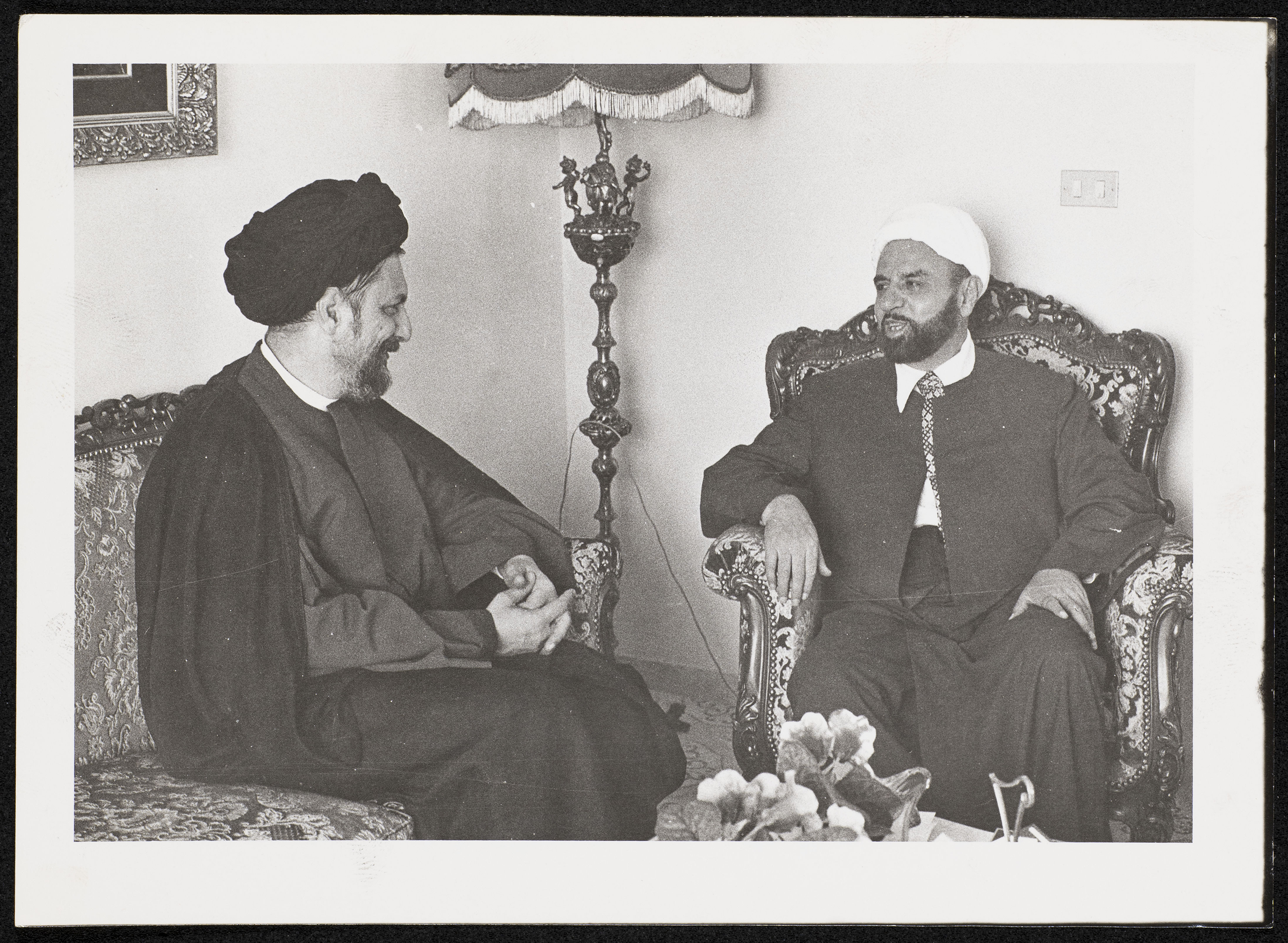
Figure 2 Long description
Two men are seated in a richly decorated room. The man on the left, wearing a black robe and turban, is engaged in conversation with the man on the right, who is dressed in a suit and tie with a white cap. They are seated on ornate chairs, and a lamp with a decorative base stands between them. The room features intricate wall decorations and a framed picture on the wall.
Acknowledgements
For welcoming me to Dearborn and the Islamic Centre of America, I would like to thank Adnan Chirri, Eide Alawan, Albert Harp, and Kamil Mahmud Bazzi. I am indebted to Sally Howell for her guidance during my fieldwork in Michigan. For commenting on earlier drafts of this article, I am grateful to West Bland, Orçun Can Okan, Cyma Farah, John-Paul Ghobrial, Joe Leidy, and Fergus Nicoll. Thanks must also go to four anonymous peer reviewers. This article draws on research carried out as part of the project Moving Stories: Sectarianisms in the Global Middle East, which is based at the University of Oxford under the direction of Professor John-Paul Ghobrial and supported by funding from the European Research Council.
Financial support
European Research Council Consolidator Grant under the European Union’s Horizon 2020 research and innovation programme (grant agreement no. 101001717).
Competing Interests
The author declares none.
Christopher Cooper-Davies is a post-doctoral researcher in the Faculty of History at the University of Oxford, working on the ERC-funded project ‘Moving Stories: Sectarianisms in the Global Middle East’.


 Open access

