




1. Introduction
Marriage is often seen as a union between two individuals. However, a marriage connects not only two people, but also two families, and in the case that these individuals and families are of a different cultural, ethnic, racial, linguistic, religious, geographic, or socio-economic background, also two different groups or communities.Footnote 1 Such marriages between individuals of different backgrounds are known as out-group marriages, or simply mixed marriages, and are in most societies not the norm. Human beings tend to choose a marriage partner within their own group.Footnote 2 In-group marriages are usually preferred and encouraged by individuals, their parents, and the larger communities, while out-group marriages are often discouraged or even forbidden by the state, religion, ideology, or culture.Footnote 3 This is mainly because mixed marriages blur the boundary between the self and the other.Footnote 4
While mixed marriages are not the norm, they are important as they contribute to social cohesion in society and lower the likelihood of (violent) conflict between groups by making sure that personal networks of individuals and families run across group boundaries, thereby connecting various communities, in a way that bridges connect islands. Such connections are of a binding nature, and decrease the risk of antagonism, as they foster positive cross-community contact and create joint interests that transcend social groups.Footnote 5
If the share of mixed marriages declines, a society faces potential disintegration in its social structure. Such a development is likely to go hand in hand with polarisation and conflict and might even lead to secessions. Multinational states that fell apart in the past, such as Czechoslovakia and Yugoslavia, were indeed marked by low degrees of intermarriage between the various ethnic communities that they consisted of.Footnote 6 Thus the share of mixed marriages provides us with a unique measurement of the degree to which various communities in a society are integrated, and how integration or disintegration evolves over time. Moreover, marriage partner choice can also be used as an indicator of processes of group formation and social inclusion and exclusion, as it shows which types of individuals are more in-group orientated and who acts more as a bridge builder, by marrying a partner from another community.Footnote 7
This study provides insight into the historical process of state formation and the social integration of Flemings and Walloons in Belgium by studying partner selection in Flemish municipalities along the language border to Wallonia during the nineteenth and early-twentieth century. In most European countries, local and regional marriage markets turned into national marriage markets during the course of the nineteenth and early-twentieth centuries, as the rise of nation states led to the integration of various regions and provinces. So, individuals from various parts of the country became part of one imagined community, thereby blurring local and regional cultural differences.Footnote 8 At the same time there was a massive expansion of opportunities to meet, thanks to the construction of railroads, and the rise of, amongst others, national education, (sports) associations, media and the army.
However, there is reason to believe that the transition from local and regional to national marriage markets in Belgium took a different road.Footnote 9 Since the foundation of the Belgian Kingdom in 1830, a linguistic dispute between the French-speaking Walloon and the predominantly Dutch-speaking Flemish community caused a division between Flanders and Wallonia. Ultimately, at the end of the twentieth century, several state reforms turned Belgium from a unitary into a federal state.Footnote 10 The linguistic, demographic, cultural, social, and economic dissimilarities between Wallonia and Flanders seem to have stimulated in-group over out-group contact in contemporary Belgian marriage and remarriage markets. Today, both Flemings and Walloons are more likely to marry an immigrant than a fellow Belgian from across the language border.Footnote 11
This study aims to obtain insight into the unique Belgian state building process by examining the degree to which mixed ethno-linguistic marriages between Flemings and Walloons were contracted. The share of mixed ethno-linguistics marriages provides us with an indicator of the social distance between the two communities and the degree to which they were integrated with each other. We refer to Flemings and Walloons as ethno-linguistic communities as their ethnic identity is based first and foremost on their shared common language and the territory in which they live, and thus not on, for instance, race, as is often the case in the context of the US or colonial settings.Footnote 12 However, it is important to note that not every individual experienced their identity diametrically opposed to that of the other ethno-linguistic community, as, for instance, some individuals were bilingual and could thus have identified with both the Flemish and Walloon community or neither of them.
This paper will first describe the historical context to map out the social-political background of the division between Flemings and Walloons in the nineteenth and beginning of the twentieth centuries. After the discussion of theories regarding marriage partner selection and previous research on mixed marriages, we will formulate several hypotheses that will be tested using descriptive and multivariate analysis on a brand-new dataset of marriage certificates. The overall research is guided by two research questions.
The first research question focusses on the geo-political dimension: have the language struggles, the unequal economic development of Flanders and Wallonia, and the rise of the Flemish national movement caused both groups to drift apart or were nineteenth- and early twentieth-century Flemings and Walloons already two separate ethno-linguistic communities that were hardly integrated with each other? Developments in mixed marriages over time will be explored to answer this research question. If changes in political regimes, language struggles, and economic divergence, caused a rift between Flemings and Walloons, we expect a significant decrease in mixed marriages during the nineteenth and early-twentieth century, when these events and processes unfolded. If we find, by contrast, that the degree of inter-marriage between Walloons and Flemings was low and remained low throughout the whole research period, we can conclude that Flemings and Walloons were two separate ethno-linguistic groups that have always maintained social distance between each other.
The second research question is related to the interactions between Flemings and Walloons on the micro-level and crossing the social border: who acted as bridge-builders between the ethno-linguistic communities and who preferred to remain within their own ethno-linguistic groups? Multivariate analyses will be conducted for this part of the research. More specifically, we will use binomial logistic regression models to estimate whether gender, socio-economic status, literacy, migration status, age of the bride and groom, as well as age differences between spouses were associated with out-group versus in-group marriages. In this way, we determine which Flemish individuals were more likely to marry someone from across the Belgian language border, and who was less likely to do so.
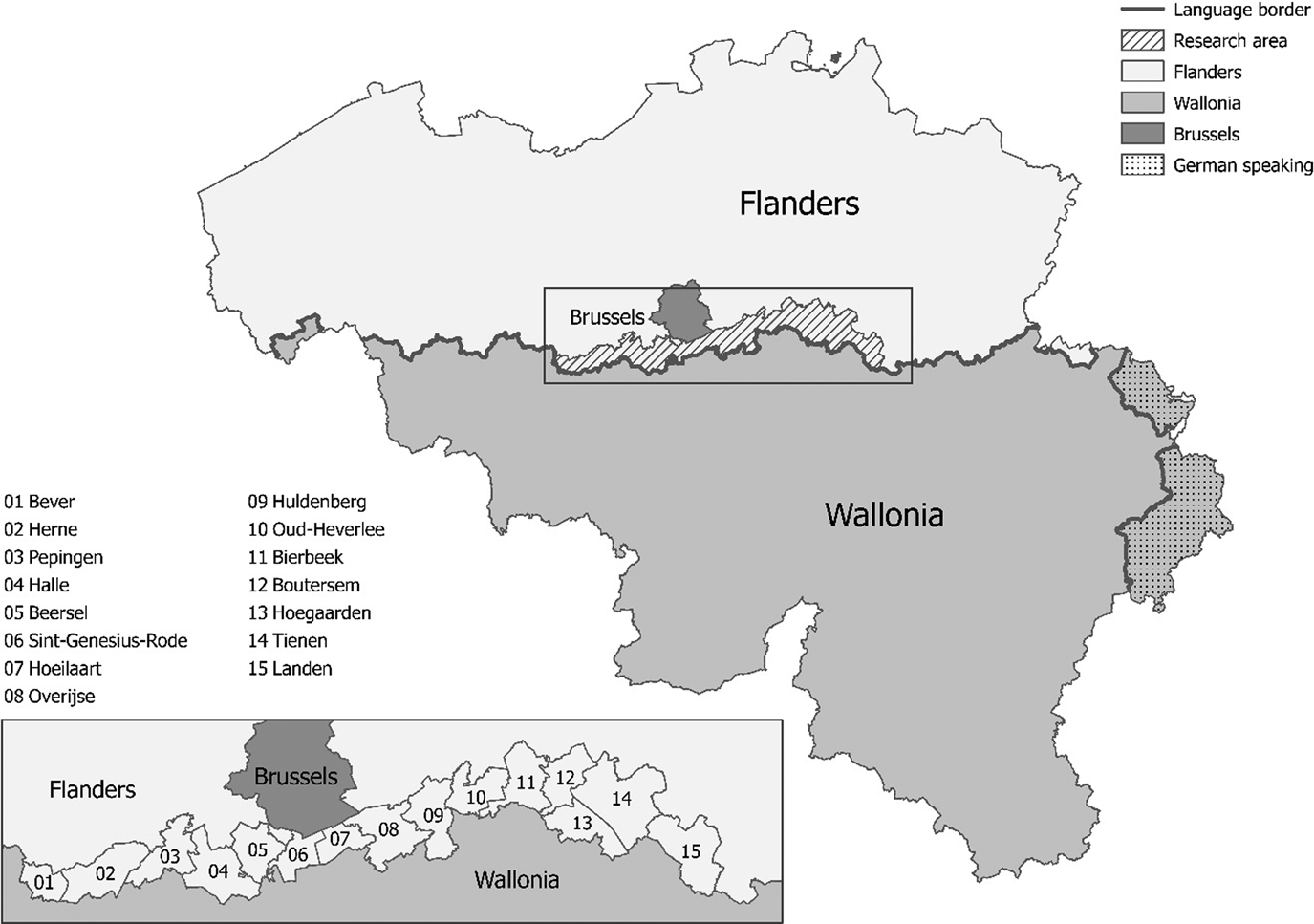
While numerous studies have investigated the complicated nation building process in Belgium from a political perspective, this study tries to add new insights to the existing literature using mixed marriages as a genuine socio-demographic indicator of social interaction and cohesion between Flemings and Walloons. We focus on mixed ethno-linguistic marriages in Flemish municipalities that were situated at the language border (see Figure 1); because of the proximity to Wallonia, Flemings who lived in these municipalities had, in principle, plenty of opportunities to meet a potential Walloon partner. Consequently, if we find that mixed marriages between Flemings and Walloons were sparse in these municipalities, it reflects a pronounced preference of Flemings and Walloons to marry within their own group, indicating that the social distance between the two communities was large and both groups mostly avoided each other. Since there might be also geographic differences in the tendency to engage in mixed marriages, we will also compare the share of mixed ethno-linguistic marriages between the various municipalities along the language border.
Map of examined municipalities
Source: Humanities Lab, Faculty of Arts, Radboud University, ©Thijs Hermsen, with permission.
2. Historical context
The area that became the Belgian state was annexed by France in 1794, but after the defeat of Napoleon in 1815 the Congress of Vienna decided to unite the region with the Northern Netherlands into the United Kingdom of the Netherlands. Religious and linguistic differences between the Northern and Southern provinces of the United Kingdom soon became apparent with Catholicism strong in the south and Protestantism strong in the north. Moreover, the linguistic (promoting Dutch over French) and educational policies of King William I evoked more and more resistance in the southern areas.Footnote 13 Unrest grew in the Southern provinces, ultimately resulting in the establishment of the independent Kingdom of Belgium in 1830.
The territory of the newly established Belgian kingdom consisted of two ethno-linguistic communities ever since the rise of the Romance-Germanic language border in Gallo-Roman times. In Flanders, the Northern part of the Belgian kingdom, Flemish dialects were spoken, and in Wallonia, the Southern part of the country, people spoke French.Footnote 14 However, as a result of a targeted Frenchification policy, Flemish became increasingly marginalised in the early days of the Belgian kingdom and French turned into the exclusive language in administration, education, justice, the army and the newspapers.Footnote 15 Although Flemings were the numerical majority in Belgium, the Flemish language was relegated to informal settings. At the same time, Brussels, the capital of Belgium that was situated on Flemish territory, but close to French-speaking Wallonia, turned gradually from an almost exclusively Dutch-speaking city into a bilingual and later a predominantly French-speaking city.Footnote 16 Frenchification was facilitated by the fact that the upcoming middle and higher classes in both Wallonia and Flanders preferred French over Dutch.Footnote 17
During the nineteenth century, the already existing socio-economic imbalance between Dutch-speaking Flemings and French-speaking Walloons increased, as Wallonia quickly industrialised and urbanised, while Flanders remained mainly rural and agricultural.Footnote 18 French thus had become the language of education, public life, and social promotion, while Dutch, in practice a set of Flemish dialects, was associated with a more disadvantaged, lower-class position.Footnote 19
The increasingly marginalised and disadvantaged position of Flemings in Belgium was met by counter-reaction. In the nineteenth century, the Flemish Movement was founded by a select group of Flemish intellectuals. While initially the movement was cultural in nature, it soon turned into a pressure group that aimed for the political and social emancipation of the Flemish ethno-linguistic community.Footnote 20 During the twentieth century, the Flemish Movement achieved several political successes, for instance, defining the linguistic territories and official bilingualism in education, administration, law, the army, and most importantly, bilingualism in Brussels, which sought to stop the process of Frenchification in the capital. Despite the collaboration of parts of the Flemish Movement with the German occupier during the First and Second World Wars, which heavily discredited the movement, the Flemish Movement remained an influential political force. In a similar vein, the counterpart of the Flemish Movement – the Walloon Movement – strengthened during the second half of the twentieth century.Footnote 21 As the economic centre of Belgium gradually shifted from the south towards the north, Walloons increasingly feared for their position. The French-speaking community always had been a numeric minority, but at the end of the twentieth century, they had become an economic minority as well.Footnote 22
The Flemish fear of the further Frenchification of Flemish territory surrounding Brussels and the Walloon fear for the position of their community caused them to agree on fixing the linguistic border in 1963 by law. By using the principle of territoriality (the geographical location determines the language of the territory) four linguistic territories were created: the Dutch-speaking territory of Flanders, the mainly French-speaking territory of Wallonia, the bilingual French-Dutch territory of Brussels and a German-speaking territory in the Eastern part of Wallonia.Footnote 23 Municipalities with a considerable share of a linguistic minority became municipalities with language ‘facilities’, which allowed them to communicate with public authorities in their own language.Footnote 24 From the 1970s onwards, several state reforms have decentralized the Belgian state and have created a high degree of autonomy for the regions and linguistic communities. The reforms turned Belgium at the end of the twentieth century from a unitary into a federal state, with a high degree of political autonomy for each linguistic community/region.Footnote 25
Flanders and Wallonia have clearly drifted, politically, socio-economically, and culturally apart and this is reflected in an exceptionally low percentage of mixed marriages between Flemings and Walloons. In 2020, 0.7 per cent of all marriages contracted in Belgium were between an individual who lived in Flanders and someone who lived in Wallonia prior to the marriage.Footnote 26 However, the question is when this historical process of separation started? Was it when the Flemish Movement emerged? When the French ruling elite started its Frenchification policy during the early years of the Belgian kingdom? During the years of United Kingdom of the Netherlands when the Walloons became increasingly dissatisfied with the rule of King William I, who promoted Dutch over French? Or did Frenchification begin even earlier, during the French occupation? Or, alternatively, have Flemings and Walloons always avoided each other and is the political drifting away of Flanders and Wallonia merely a correction of an age-old social reality? Have Wallonia and Flanders always been two separate ethno-linguistic communities with little social interaction? Lastly, were there groups within the Flemish community that were more likely to marry across the language border, and if so, who were they and what characteristics can be associated with these groups?
3. Partner selection in the nineteenth and early twentieth centuries
For centuries, marriage partner selection was predominantly driven by instrumental incentives such as economic and political motivations. However, during the late eighteenth century, under the influence of the Enlightenment, romantic love became gradually a new cultural ideal and it seems that over the course of the nineteenth century romantic motives started to become an increasingly important factor in partner selection, while the relative weight of instrumental factors started to decline.Footnote 27 Researchers have argued contradictorily on the effect of romantic love in the nature of relationships. On the one hand, romantic love would transcend differences and boundaries, which could have led to an increase of heterogeneous marriages. Others, by contrast, argue that marriage became perceived as a union between two equals, which resulted in an increase of homogeneous relationships.Footnote 28
Although the rise of romantic love went hand in hand with more individualisation in partner selection, marriage was not the simple outcome of love between two random individuals. Partner selection can be seen as a process that consciously and unconsciously filters potential partners from a pool of people.Footnote 29 Marco van Leeuwen, Ineke Maas and Kees Mandemakers argued that this limitation of choice operates on three levels. The first level consists of the preferences of the individual: do the persons share interests and are they for instance physically attracted towards each other? The second level contains the influence of the social context, such as the family, friends and (social) organisations, which contributes to the third level: meeting opportunities. Within this filtering process, people and their surroundings have particular preferences, such as age, religion, culture or social background, that influence the nature of preferred relationships (homogeneous or heterogeneous).Footnote 30
Where romantic love can be mostly associated with changes in the choices of individuals, modernisation theorists, such as Susan Cotts Watkins, argue that the nineteenth-century processes of nation building and industrialisation predominantly affected the other two levels: the social context and meeting opportunities. The idea of the nation-state and the rise of national media caused people from more distant areas to feel related, as they were no longer only habitants of a specific town or province, but of a whole nation-state. Moreover, the nation-state created new social contexts, for example, the army, education or national (sport) associations, where people from different backgrounds met.Footnote 31 At the same time, industrialisation further increased opportunities for individuals to meet, for instance by the creation of new workplaces or the rise and expansion of communication and transport networks. On the one hand, these processes may have resulted in an increase of heterogeneous relationships, as people came more easily into contact with individuals from other communities.Footnote 32 On the other hand, as Hans Knippenberg and Ben de Pater argue, integration processes also tend to bring differences between people, such as religion or language, to the foreground.Footnote 33 Integration, and thereby homo- or heterogenisation, therefore strongly depends on spatial dimensions in a society: whenever major differences turn up, people tend to choose in-group over out-group marriages.
As hetero- or homogeneity can appear on several levels, such as the ethnic, geographic, socio-economic, cultural, or linguistic levels, relationships may consist of both heterogeneous and homogeneous characteristics. Furthermore, dissimilarities on one level tend to stimulate a stronger preference for similarities on another.Footnote 34 In social and psychological sciences, this is explained by ‘social exchange theory’: individual behaviour of people is seen as a constant analysis of costs and benefits, in which costs are experienced as less disadvantaged if they are opposed by sufficient advantage in other domains.Footnote 35 Differences between persons therefore do not immediately need to avert a relationship provided that similarities or advantages on other levels compensate these disadvantages for both partners. Peter Ekamper, Frans van Poppel and Kees Mandemakers showed, for example, that the higher classes were more likely to marry geographical heterogeneously, as the higher classes lived more scattered.Footnote 36 The advantages of a status homogeneous marriage thus might have lifted the ‘costs’ of the geographical heterogeneity.
Partner selection is thus a complicated process, to which numerous factors consciously or unconsciously contribute. No definite answer can be given to the question whether relationships became more heterogeneous or homogeneous during the nineteenth century. The romanticisation of marriage may have individualised partner choice, which may have led to more heterogeneity. However, as people tend to find partners who mirror their characteristics or interests, relationships may have become more homogeneous in nature during the nineteenth century. Modernisation may also have had a twofold outcome: the increase of meeting opportunities may have resulted in more out-group marriage contacts, while differences within society may also have resulted in the preference for in-group over out-group contact. As heterogeneity in one domain stimulates homogeneity in the other, social exchange theory can give more insight into the motivations of partner choice in (ethno-linguistic) heterogeneous marriages.
4. Language borders and marriage markets
Both visible and invisible borders can influence local marriage markets, as they affect meeting opportunities and may cause social in- or exclusion. Watkins studied changes in demographic behaviour in Western Europe in the nineteenth and twentieth centuries in light of the process of nation-building. She argued that market integration, state formation and nation building – all institutional processes – influenced daily life and ultimately individual behaviour, such as nuptiality and fertility.Footnote 37 Due to the national framing of, for instance, education and media, meeting opportunities increasingly became imbedded within a national context. The former provincial boundaries eroded in the new nation-states and the national borders became the new rigid borders between communities.Footnote 38 Willibrord Rutten studied this context of nation-building developments in marriage patterns in municipalities along the Dutch-Belgian border after the separation of the province of Limburg into Dutch and Belgian parts. He concluded that this split by a national border caused the local marriage market to grow apart into two (almost) separate marriage markets. He also accredited the change to more nationally framed meeting opportunities as the cause of the separation of the marriage market along the new national border.Footnote 39
Watkins argued that in pre-modern Western European societies, demographic diversity was visible on the provincial level. The creation of the imagined nation-state in the nineteenth century caused the national marriage markets to converge, which resulted in demographic diversity on a national level. There are, however, a few exceptions. Belgium, for example, was a nation divided by politics and language, which reduced contact between ethno-linguistic communities and is therefore expected to have resulted in more demographic diversity within the country, due to the language border. Watkins argued that the two regions became economically united through the construction of railways during the second half of the nineteenth and early twentieth centuries, which is supposed to have resulted in some level of integration.Footnote 40 The contrary developments within the Belgian state, integration on the economic level and disintegration on the political and linguistic level, might have had a twofold outcome: on the one hand, this process of nation-building might have converged the Flemish and Walloon marriage markets into one Belgian market, but the lack of uniformity in politics and language might also have averted this convergence and even have stimulated segregation of Flemings and Walloons.
Bilingualism or multilingualism in communities does not always result in segregated marriage markets. Shifting political contexts can emphasise existing linguistic borders within nations. Heidy Müller studied contact between the four linguistic communities in Switzerland. She argued that before 1914, divisions in contact were mainly defined by confessional differences. During the First World War, however, the French-speaking Swiss community sympathised with the Belgians and French and the German-speaking community with the Germans. Due to the World War, attention shifted from the confessional differences towards differences between ethno-linguistic communities in the country, which resulted in scarce contact between the ethno-linguistic groups in contemporary Switzerland.Footnote 41
Next to shifting political contexts, changing socio-economic balances may also reinforce differences between ethno-linguistic communities and may therefore avert or stimulate out-group contact. In the case of Belgium, social differences between the French- and Dutch-speaking communities increased, as French became more associated with higher status and public life, while Dutch increasingly had become the language of the lower classes.Footnote 42 Richard Bourhis referred to this situation as ‘diglossia’, which consists of bilingualism in a society with particular preferences in the use of language in different contexts.Footnote 43 Susan Gal also emphasised the link between bilingualism and the socio-economic position of a language. She studied the case of the Austrian bilingual community of Oberwart and argued that the Hungarian language in the community became perceived as the language of peasants, which caused especially women to prefer a marriage with German-speaking men. Due to the lack of potential partners, Hungarian-speaking men turned towards other local marriage markets, where women were willing to marry Hungarian-speaking men. However, the offspring of these linguistic heterogeneous marriages were often raised in German, as the mother only spoke German and the father spoke Hungarian and German. The case of Oberwart thus shows that the socio-economic position of a language can cause changes in partner selection, which ultimately can result in the shrinking of an ethno-linguistic community in a society.Footnote 44
The example of Oberwart showcases that next to socio-economic associations, gender differences may also play a role in the tendency to marry ethno-linguistically heterogeneous. In this context, Marlou Schrover argued, for instance, that female Finnish migrants in nineteenth-century United States were more likely to marry out-group, despite the fact that they had plenty of Finnish men to choose from, as marriage with American men helped them to adapt new identities.Footnote 45 As the ascribed social status of a woman thus is intertwined with the status of her spouse it is possible that the changes of a linguistic heterogeneous marriage for Dutch-speaking Belgians in the municipalities along the language border differed by gender. For a French-speaking woman, a marriage with a Dutch-speaking man might have resulted in a decline of her social position, however, the social status of a French-speaking man may not have been affected by the social status of his bride.
Another invisible border which played a role in the marriage market was the migration status of an individual. Paul Puschmann et al. showed, for example, that migrants in the cities of Antwerp, Rotterdam, and Stockholm in the period of 1850–1930 often faced marginalisation in the marriage market, which resulted in more in-group marriages over out-group marriages.Footnote 46 Consequently, the social imbalance between Flemings and Walloons might have strengthened the marginalisation of migrants in local marriage markets. Paul Puschmann and Koen Matthijs argued, moreover, that the social inclusion of Flemish migrants in Brussels was complicated by the developing language conflict. The ‘costs’ of their migrant background could not be lifted by their social status as Flemings were perceived as lower-ranked, which increased their marginalisation in the marriage market.Footnote 47
Existing research on language borders and marriage markets thus have focused on shifting political contexts, differences in social status of the language, gender differences and migration background. In the case of Belgium, a twofold outcome in the development of the national marriage market is possible: on the one hand, the process of nation-building may have resulted in a converging trend in the national marriage market and thus an increase of marriages between French- and Dutch-speaking persons. However, the increasing differences in social positions between the ethno-linguistic communities may have complicated this process and may have resulted in a preference for in-group contact over out-group contact.
5. Hypotheses
Regarding the question of whether the share of mixed Flemish-Walloon marriages in the Flemish border municipalities increased or decreased, two competitive hypotheses have been put forward. Following modernisation theory, a converging trend within the national marriage market is expected as the result of increased nationally imbedded meeting opportunities. In the context of the Belgian nation-building process, hypothesis 1a reads as follows: the share of marriages between Flemings and Walloons in the Flemish border municipalities increased during the nineteenth and early twentieth centuries because of the nation-building process. However, the development of a national marriage market may have been thwarted in Belgium due to the conflict over language between the two main ethno-linguistic communities in the new state. The unequal status of the language and the ethno-linguistic communities therefore might have resulted in mutual antagonism and the creation or consolidation of two separate marriage markets, which leads to hypothesis 1b: the share of Flemish-Walloon marriages within the Flemish border municipalities decreased during the nineteenth and early-twentieth centuries as a result of evolving conflict over language between the French- and Dutch-speaking communities.
Next to temporal developments, this research aims to gain insight in factors that might have influenced the tendency to marry across the language border. Gal and Schrover showed that women tend to marry more often out of their own group than men, if it ensures a certain benefit such as in social status or a new identity. As women partly received their ascribed status through their partner, Flemish women might have been more likely to marry a Walloon partner. Walloon women, by contrast, might have had less of a tendency to find Flemish partners, as the lower social status of the Flemish ethno-linguistic community might have resulted in a decline in their own social status. Given these gender differences, hypotheses 2 states as follows: Flemish women were, compared to Flemish men, more likely to marry Walloons from across the language border.
Next to gender, the social status of the individual might have played a role in the tendency to marry across the language border and the success rate of finding a suchlike desired partner. From the perspective of a Walloon, a Fleming with a higher social status might have lifted the idea of a socially ‘downwards’ marriage, which might have made them a more attractive partner, compared to other Flemings. Moreover, the Flemings from the higher social classes often used French as their main language and therefore had greater opportunities than other Flemings to meet and partner with a Walloon. Other social classes, as for example Flemish farmers, were less attractive partners from the perspective of Walloons, as they had less benefits to balance out the socially downwards marriage. These lower-class Flemings might also have been more bound to the grounds they lived and worked on, which lowered their meeting opportunities and their tendency to marry a more distant partner. As a result, hypothesis 3 argues as follows: Flemings from the higher social classes were more likely to marry a fellow Belgian from across the language border, compared to Flemings from the lower social strata.
The last hypothesis relates to the migration status of an individual. Migrants often faced marginalisation in local marriage markets, which stimulated in-group over out-group contact and resulted in two separated marriage markets: a native one and migrant one. Compared to native Flemings, Flemings with a migrant background might have been more likely to engage in a marriage with a Walloon partner in the Flemish border municipalities as the Walloons who lived in these municipalities were also migrants. This results in hypothesis 4: as a result of marginalisation of migrants in local marriage markets, Flemings with a migrant background had higher odds of marrying Walloon partners compared to native Flemings in the border municipalities.
6. Data and methodology
This paper is based on data from the Demogen Vlaams-Brabant database that has been constructed in the context of the crowdsourcing project DEMOGEN coordinated by the Belgian State Archive and KU Leuven.Footnote 48 The database consists of data from all marriage certificates from the area that is now known as the Belgian province of Flemish Brabant. French revolutionists implemented civil marriage with standardised marriage certificates in 1792. These certificates contain socio-demographical information such as place and date of birth, place of residence, age, and occupation (of the groom, bride, and their parents). The marriage certificates, however, do not contain information about the religion of the individuals, which could thus not be studied in this research. However, since the first Belgian census of 1846 showed that 99.8 per cent of the population, both in Wallonia and Flanders, was Roman Catholic, it is safe to assume that religion was not an important factor when it came to mixed marriages between Walloons and Flemings.Footnote 49
This research only focusses on marriages that took place in municipalities along the Northern, Dutch-speaking side of the French-Dutch language border.Footnote 50 Due to geographical closeness, the opportunities for meeting a person from the other ethno-linguistic community were in these municipalities considerably higher than elsewhere in Flanders. The share of marriages between Flemings and Walloons therefore is more likely to reflect particular preferences in partner choices in these local marriage markets, rather than meeting opportunities. However, as the database only contains marriage certificates from the Flemish side of the language border, results from this study relate only to marriage partner selection in the Dutch-speaking communities. We thus do not gain insight in Flemish-Walloon marriages that were contracted across the language border in the Southern Walloon municipalities.
The dependent variable in the multivariate analyses focusses on the type of marriage that took place, distinguishing between Flemish-Walloon and Flemish-Flemish (reference category) marriages. As the marriage certificates do not contain information on the language or the ethnicity/identity of individuals, we rely on a proxy: if a person was born on the northern side of the language border, the person is classified as a Fleming. A person born on the southern side of this language border is marked as a Walloon. By making use of this proxy, it is possible that in some cases, individuals might have been ascribed to an ethno-linguistic community they may not have (fully) identified with. For instance, the dichotomous categorisation into Walloons and Flemings does not consider the possibility that some individuals were in practice bi- or even multilingual and some may not have identified as either Fleming or Walloon, but only as Belgian. Nevertheless, we still believe that this dichotomous categorisation of ethno-linguistic communities makes sense for most people that lived in the area under study. Dividing the population into two major groups required that the birthplaces of both the groom and bride were registered on the marriage certificate. Marriages with unknown birthplaces (n = 5,409) were removed from the dataset. Individuals born in Brussels were neither Flemish nor Walloon and became increasingly bilingual, with Flemish migrants increasingly adopting French, over the course of the nineteenth century, so they were excluded from the analysis.Footnote 51 By only selecting years which included at least 100 marriage certificates, the sample that had been created consists of 78,854 marriage certificates over the period between 1798 and 1938.
Next to the place of birth, the following variables for both the groom and bride have been selected from the database for this study: date of birth (or age if noted), date of marriage, marital status, occupation, and the presence of a signature as a proxy of literacy. Next, social status of the marrying individuals has been constructed by coding the occupational titles into HISCO and recoding them into HISCLASS.Footnote 52 To determine the social status of the bride we used her own occupation instead of her father's as the registration of the occupational titles for women was more complete (36.4 per cent missing) compared to that of their fathers (44.9 per cent missing), because occupations of the fathers were not registered if they had died at the time of marriage. Migration status was determined by comparing the individuals’ birthplace and residence at marriage. In case both were the same, the person was labelled as ‘native’; in case the locations were different as ‘migrant’; in case the residence was not stated as ‘unknown’. Finally, the variables ‘type of migration groom’ and ‘type of migration bride’ were constructed, distinguishing between natives (non-migrants) and four types of migration: rural-to-rural, rural-to-urban, urban-to-rural and urban-to-urban migration. If a place had 10,000 or more inhabitants by 1900 it was categorised as urban, otherwise as rural.
First, this paper analyses trends in the share of the different types of marriages over time, followed by analysis of differences in the prevalence of mixed marriages between the various Flemish border municipalities included in the analyses. Subsequently, basic descriptive analyses will be presented, focusing on gender, social status, and migration. Finally, the paper shows separate logistic regression models for the brides and grooms. These models include the following variables: social status groom, social status bride, migration status groom, migration status bride, literacy groom, literacy bride, age groom, age bride, age groom squared, age bride squared, age differences, type of migration groom and type of migration bride.Footnote 53 The aim of the latter analysis is to determine which individual characteristics were associated with in-group versus out-group marriages.
7. Temporal developments
This section will examine temporal developments in the share of mixed marriages between Flemings and Walloons in the Flemish border municipalities. Figure 2 shows the distribution of four types of marriages over time: mixed Flemish-Walloon marriages, Walloon-Walloon marriages, and marriages between two Flemish partners. The fourth category contains all other types of marriages, such as with a partner from Brussels or a foreign country. As it turns out, most of the marriage certificates contained marriages between two Flemish partners. In the municipalities along the linguistic border, Flemings clearly never had a strong tendency to marry Walloons. The share of mixed marriages fluctuated between five and ten per cent and peaked between 1810 and 1819. A gradual decrease in the share of Flemish-Walloon marriages started already during the period of the Kingdom of the Netherlands and continued until the 1870s.
The percentual distribution of marriage types 1798–1938 (N = 78,854)
Source: Demogen Vlaams-Brabant (2021). Algemeen Rijksarchief België, afdeling Leuven.

In the light of the language struggles and divergent economic developments, a further decrease of mixed marriages from the 1880s onwards was expected, as Flemish opposition towards the French language and the social position of the French linguistic community explicitly became formulated by the foundation of the Flemish Movement. However, Figure 2 shows an opposite development: between 1870 and 1889 the share of Flemish-Walloon marriages in the border municipalities increased slightly. According to Watkins, economic integration can be a factor of national unity and can balance out the political disintegration. As industry in Wallonia expanded in the latter part of the nineteenth century, more Flemings worked in municipalities across the language border, which increased contact between the two communities and may have led to an increase in mixed marriages.Footnote 54 If so, one expects the increase in mixed marriages to have taken place predominantly in the lower classes, as Flemish laborers worked in the Walloon industries. To investigate this, Table 1 shows the relative distribution of types of marriages per social class of the grooms. During the entire research period, 6.2 per cent of the grooms from the class ‘Unskilled (farm) workers’ and 6.4 per cent of ‘Unspecified unskilled workers’ engaged in a Flemish-Walloon marriage, and no significant increase took place within these categories. The table shows, by contrast, that the increase in the share of mixed marriages among Flemish grooms mainly took place in the higher classes (from 17.1 per cent in 1870–1879 to 20.5 per cent in 1880–1889) instead of the expected lower classes.
The percentual share of types of marriages per social class of the groom

Source: Demogen Vlaams-Brabant (2021). Algemeen Rijksarchief België, afdeling Leuven.
The increase in mixed marriages in these Flemish higher classes potentially was a reaction to the emergence of the Flemish Movements. In the latter half of the nineteenth century, during the first years of the Flemish Movement, the movement consisted of predominantly Flemish intellectuals with the cultural emancipation of the Dutch language as its primary goal. However, while this political movement was broadly supported by lower-class Flemings, the reaction of Flemish higher classes might have been opposite, because many higher-placed Flemings already used French as their main language, as it was the language in which they were educated. For some, the use of the French language had been a vehicle for upward social mobility and it was a way to distinguish themselves from lower class Flemings. As the emancipation of the Dutch language, the aim of the Flemish Movement, was not in the interest of the French speaking Flemish elite, they became increasingly oriented towards the Walloons, as signified by the increasing share of mixed marriages in this specific group.
If we review mixed marriages between Flemings and Walloons over the entire research period, the overall trend is downward, reaching an absolute low of 4.2 per cent in the period 1931–1938 and mixed marriages had become a rarity. We therefore reject hypothesis 1a and confirm hypothesis 1b: the share of Flemish-Walloon marriages within the Flemish border municipalities decreased during the nineteenth and early twentieth centuries because of the evolving conflict over language between the French and Dutch-speaking communities. Unlike the argument of modernisation theory, local and regional marriage markets in Belgium did not develop into one single national market. Rather, the marriage market was split right at the language border.
8. Geographical differences
In order to examine variations in contact and social distance between the two ethno-linguistic communities on a local level, the degree of mixed marriages has been studied per border municipality and the marriages have been categorised into four more detailed categories: (1) marriages between two Flemings from the concerned municipality, (2) marriages containing a Flemish partner from the concerned municipality and a partner from a directly adjacent Flemish municipality, and (3) marriages that consisted of a Flemish partner from the concerned municipality and a partner from a directly adjacent Walloon municipality. The category ‘Other’ (4) consists of marriages that took place in the concerned border municipality with for example a partner from another Belgian province or non-adjacent municipality. By examining only marriages between partners from directly adjacent municipalities, certain aversions or preferences in local marriage markets can be investigated in greater detail. After all, from a purely geographic perspective, the chances of meeting a person from a directly adjacent Flemish municipality or directly adjacent Walloon municipality were similar, unless Flemings and Walloons purposefully avoided crossing the language border.
Table 2 shows the relative distribution of the four types of marriages. The figures make clear that there was a sharp division between the Flemish and Walloon communities in the Flemish border municipalities. Roughly half of the population married with a partner born in the same municipality. The people that married a partner from outside their own municipality had a strong preference to marry someone from an adjacent Flemish municipality (between 15.7 and 36.0 per cent) versus an adjacent Walloon municipality (between 0.1 and 11.4 per cent). The results show a strong preference for in-group marriages compared to out-group marriages. The share of Flemish-Walloon marriages was lowest in the municipalities of Beersel, Bierbeek, Boutersem and Tienen: less than one per cent of all marriages took place with a partner from a directly adjacent Walloon municipality. The highest proportions of mixed marriages were observed in Bever, Hoegaarden and Landen (11.4, 7.8 and 6.8 per cent respectively). Moreover, the figures show that women were, compared to men, less likely to marry a partner from a neighbouring municipality as higher shares of marriages are found with a groom from a different municipality. This difference, however, could be caused by the fact that women were more likely to marry in the place where they were born.
The percentual share of types of marriages per Flemish border municipality 1798–1938

Source: Demogen Vlaams-Brabant (2021). Algemeen Rijksarchief België, afdeling Leuven.
The small proportions of marriages across the language border in some of the municipalities can be explained through their geographical location; the municipality of Boutersem, for example, contains a very small area that directly borders with a Walloon municipality (Figure 1). The higher proportions of mixed marriages in the municipalities of Bever, Hoegaarden and Landen can be explained by their historical context: these municipalities belonged or had belonged to respectively the French-speaking provinces of Hainaut (Bever) and Liège (Hoegaarden and Landen), although they were situated north of the language border. As Bever consisted of a relatively large French-speaking minority, the municipality became a so-called ‘facility municipality’ later in the twentieth century, with French facilities in the Dutch-speaking municipality.Footnote 55 Given this particular historical context, the division between the French-speaking Walloon and Dutch-speaking Flemish communities was less sharp in these particular municipalities, resulting in a higher degree of contact with adjacent Walloon municipalities and less mutual aversion, and thus a higher share of mixed marriages.
9. Gender, social status, and migration status
Next to the different historical context of the municipalities, individual factors such as gender differences, social status or migration status might have influenced the likelihood of Flemings to marry a partner from across the language border. To examine potential gender differences, the origins of partners of Flemish grooms and brides are displayed in Table 3. The table shows that of all marriages, 5.0 per cent consisted of a Flemish bride with a Walloon groom, versus 2.3 per cent of marriages with a Flemish groom and Walloon bride. These results confirm hypothesis 2: Flemish women were, compared to Flemish men, more likely to marry with a Walloon. However, the results may be biased by the fact that couples usually married in the municipality of residence of the bride.Footnote 56 We therefore expect that more Flemish men than Flemish women who engaged in a mixed marriage contracted the marriage in a Walloon province. Since we do not have marriage data from the adjacent Walloon municipalities but observe that we have more marriage certificates on Flemish brides than on Flemish grooms (74,219 versus 71,311), the gender results need to be interpreted with caution. After all, a higher share of mixed marriages among Flemish men compared to Flemish women in adjacent Walloon municipalities might balance out the observed over-representation of Flemish women in the mixed marriages in the Flemish border municipalities.
Origins of partners of Flemish grooms and brides in percentages 1798–1938 (N = 78,854)

Source: Demogen Vlaams-Brabant (2021). Algemeen Rijksarchief België, afdeling Leuven.
Next to gender, the social status of the individual might have had an influence on the likelihood of marrying across the language border. Table 4 shows the distribution of the types of marriages by social class for the groom and bride. The largest differences in the proportions were found in the status of the groom: in the highest social class, 14.8 per cent of the marriages were mixed versus 4.8 per cent in the class ‘Farmers’. The highest shares of mixed marriages were also found in the two highest social classes for brides, although the differences between the social classes among the brides were smaller compared to those of the groom. Hypothesis 3 can thus be confirmed: Flemings from the higher social classes were more likely to marry a fellow Belgian from across the language border, compared to Flemings from the lower social strata.
The percentual share of types of marriages per social class of the groom and bride 1798–1938 (N = 78,854)

Source: Demogen Vlaams-Brabant (2021). Algemeen Rijksarchief België, afdeling Leuven.
An exploration of the professions of Flemings from higher classes and married to a Walloon partner shows that they can be roughly divided into two groups. The first group consists of professions with a higher degree of mobility or professions that encountered mobile people, such as trade persons, hoteliers, or captains. These people had increased meeting opportunities, which increased their chances of meeting a potential partner from the other community. Secondly, individuals with professions related to the Belgian state such as sergeants in the army or overseers of railway systems engaged in mixed Flemish-Walloon marriages more frequently. Employment by the state could have connected these individuals more to the overarching Belgian identity, instead of being exclusively bound to their own Flemish community. Perhaps, these individuals were more open to engage in out-group contact with fellow Belgians.
Social exchange theory can give deeper insights to the results of Table 4: since the Flemish community was perceived as lower ranked compared to the Walloon community, a Flemish individual had to offer other ‘benefits’ to balance out the loss of status resulting from a mixed ethno-linguistic marriage from the perspective of the Walloon partner. Higher social status in a Flemish partner can compensate for this imbalance and thereby increase the likelihood of a mixed marriage. At the same time, the higher Flemish classes often used French as their main language, which must have facilitated contact with potential Walloon partners. Speaking a common language also created common ground, promoting mutual understanding and a deepening of the relationship between two individuals. For these individuals the language border was thus no obstacle.
Both women and men from the class of ‘Farmers’ had the smallest proportions of mixed marriages. On the one hand, this was due to their status in the case of traditional small-scale subsistence farming, which made them less attractive partners from the perspective of the Walloon individual in an age of modernisation. On the other hand, persons from this social class were also less inclined to marry geographically exogenously as they were more bound to real estate and did not want the land they owned to be overly divided and separated. The latter applied especially to individuals who had larger and more modern farms.
Migration status has been examined in addition to gender and social status. The migration status of the individual has been determined by comparing birthplace and current residence. If the place of residence was equal to the birthplace, the person has been classified as a native. The category ‘Other’ consists of all other movements such as interprovincial migration in provinces other than the Flemish-Brabant. Results in Table 5 show that the final hypothesis arguing that migrants would be more likely to engage in a mixed marriage, is not confirmed. Among Flemish males, migrants had a slightly higher share of Flemish-Walloon marriages compared to native Flemings (2.7 versus 2.4 per cent respectively). Flemish migrant women were, however, somewhat less likely to marry Walloons compared to Flemish natives (4.6 versus 5.5 per cent). One specific group of Flemish migrants, however, did have a higher tendency to marry out-group: individuals that were born in Flanders and had moved to Walloon territory. 5.6 per cent of these female migrants and 9.0 per cent of male migrants married Walloon partners. These Flemish-born migrants had very high chances of meeting Walloon partners, as they lived in Walloon places. Moreover, as they lived in French-speaking areas, it is likely that these individuals could speak French, which facilitated contact with potential Walloon partners. The largest share of Walloon migrants that married in the Flemish border municipality, married Flemish partners. However, considerable numbers of Walloon migrants married fellow Walloons in the examined municipalities (12.4 per cent of the grooms and 22.9 per cent of the brides). This indicates a preference for in-group contact compared to out-group contact with Flemings.
The percentual share of types of marriages per migration status 1798–1938 (N = 78,854)

Source: Demogen Vlaams-Brabant (2021). Algemeen Rijksarchief België, afdeling Leuven.
Moreover, the shares of Flemish-Walloon marriages among female migrants are higher than male migrants. Schrover has argued that women could use out-group marriages to adopt a new identity. A marriage with Walloon partners thus gave Flemish women access to the Walloon ethno-linguistic community. However, as mentioned before, women were more likely to marry in the place where they were born. Flemish men that married in Walloon municipalities with Walloon brides could not be studied in this research. Future research should include the marriage certificates from the Walloon side of the border to study the complete picture.
10. Multivariate analyses
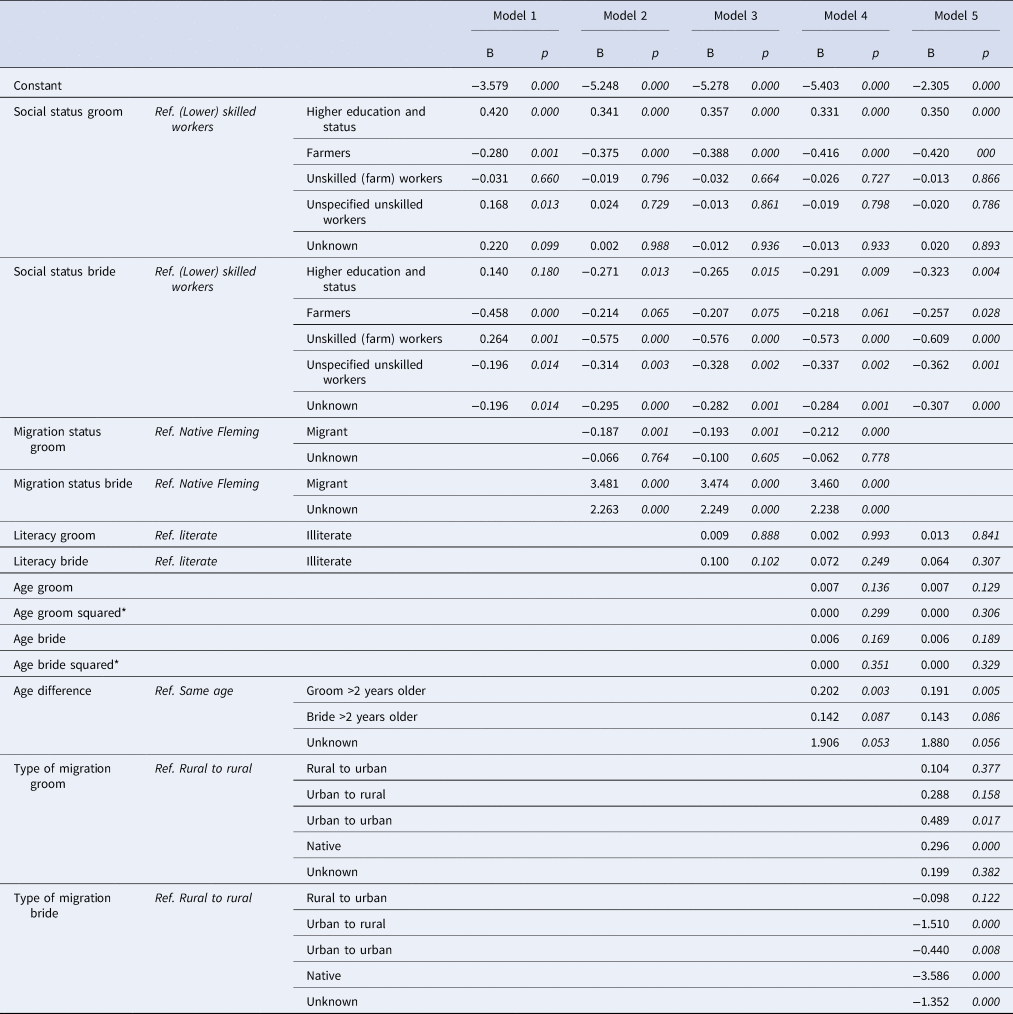
To further examine factors such as social and migration status, but also the role of education (literacy) and age, it will be tested which Flemish individuals were more likely to marry outside their own group (Flemish-Walloon) versus inside their own group (exclusively Flemish) by using binomial logistic regression. The dependent variable measures out-group marriages versus in-group marriages (reference category) from the perspectives of the Flemish groom and bride. The independent variables are social status, migration status, literacy, age, and age differences between the partners. Model 1 only includes the social status of the groom and bride. Model 2 includes the migration status of both partners. The next model contains information on the literacy of the partners, model 4 was expanded to include variables measuring age of the partners and age differences between them, to control for changing structures in age at marriage during the nineteenth century, and the last model includes diffent types of migration. The reference categories of categorical data were chosen by their size: the largest groups were chosen as references. The data sample contained more marriages with a Flemish bride, compared to the number of marriages with a Flemish groom, due to the fact that during the research period persons often married in the place of residence of the bride.
Most of the odds in Tables 6 and 7 were negative: Flemings in the Flemish border municipalities had a stronger tendency for an in-group marriage with a fellow Fleming compared to an out-group marriage with a Walloon from across the language border. Controlled for the other effects, Flemish men from the highest social class had the highest odds of an out-group marriage compared to an in-group marriage (0.420, Table 6). The results for the highest social class among the females were not significant. However, from the perspective of the Flemish bride, grooms from the highest social classes had the highest odds (0.855, Table 7) for a Flemish-Walloon marriage, compared to an exclusive Flemish marriage.
Logistic regression Flemish groom 1798–1938 (N = 69,716)
Source: Demogen Vlaams-Brabant (2021). Algemeen Rijksarchief België, afdeling Leuven.
*The squared-age is used to examine a possible non-linear effect of age.
Logistic regression Flemish bride 1798–1938 (N = 71,856)

Source: Demogen Vlaams-Brabant (2021). Algemeen Rijksarchief België, afdeling Leuven.
*The squared-age is used to examine a possible non-linear effect of age.
The results from the regression moreover show negative odds for Flemish migrants, both for the groom and bride (−0.187, Table 6 and −0.355, Table 7) to enter a Flemish-Walloon marriage versus an exclusive Flemish marriage, compared to non-migrants. The results for the effects of literacy were not significant in the regression of the Flemish groom. From the perspective of the Flemish bride, illiteracy caused negative odds for a marriage with a Walloon versus marriages with a Fleming, compared to both literate grooms and brides. The results of the fourth model, that contained the age of the groom and bride and age differences between the partners produced few statistically significant results. Flemish brides with an older partner had slightly positive odds on a mixed marriage versus an in-group marriage, compared to marriages with a partner of the same age.
11. Conclusion
This research focused on mixed marriages between Flemings and Walloons in Flemish municipalities along the border with Wallonia in the long-nineteenth century to study developments in the social distance and cohesion between the two ethno-linguistic communities. Modernisation theory argues that market integration, state formation and nation building interact with individual level demographic behaviour. In Western European countries the national framing of meeting opportunities and the rise of one imagined community with one national identity caused local marriage markets to converge into one national marriage market. The case of Belgium has shown, however, an exception to this trend. Instead of an expected integration of marriage markets, the national Belgian marriage market was split in two almost separate marriage markets, dividing the Flemish and Walloon communities at the language border.
The results of this study show that during the nineteenth and early twentieth centuries, the share of mixed Flemish-Walloon marriages gradually decreased, despite the geographical closeness of potential Walloon partners in the Flemish border municipalities. We found that almost half of the population in the examined municipalities married a partner from outside their own locality. However, the analyses show that there was a strong preference for partners from a directly adjacent Flemish municipality, compared to partners from a directly adjacent Walloon municipality. There were, however, some geographical differences. In municipalities that belonged to Walloon provinces in the past, the share of mixed marriages was somewhat higher. In those municipalities the social distance between Flemings and Walloons was smaller.
Next, we focused on characteristics of individuals that engaged in mixed Flemish-Walloon marriages. Flemings from the higher social classes had higher chances of an out-group marriage compared to other Flemings. In line with social exchange theory, the higher social status of these Flemings balanced out the overall lower-perceived social position of individuals from the Flemish community, making them more attractive partners compared to other Flemings from the Walloon perspective. Moreover, the Flemish higher social classes were mostly French speaking, which facilitated contact with potential Walloon partners. The social status of the Flemish individual may also have played a larger role for men than for women, as the shares of mixed marriages differed more between the social classes of Flemish men compared to Flemish women. However, as only data on the Flemish side of the language border was available, results regarding gender differences must be interpreted with caution, as couples tended to marry in the municipality where the bride resided.
Lastly, we hypothesised that marginalisation of migrants in marriage markets increased their likelihood to marry Walloons, who also were migrants in the Flemish municipalities. Results showed that Flemish individuals who had lived in Wallonia at some time in their lives engaged more often in a marriage with Walloons. Moreover, female migrants had, compared to men, a slightly higher tendency to marry Walloons, which was possibly a way for women to adopt a new identity and to become part of the Walloon ethno-linguistic community. However, most Flemings with a migration background married in-group with fellow Flemings in the examined municipalities. Migration status thus did not seem to have played a decisive role in the likeliness of a Fleming to engage in a mixed ethno-linguistic marriage with a Walloon.
This study showed that already before the creation of the Belgian nation state, Flemings and Walloons mostly lived next to instead of with each other, which is reflected in the low share of mixed ethno-linguistic marriages between the two communities at the start of the research period. Nineteenth-century political and economic developments therefore are not at the root of the separation of Flemings and Walloons. Yet, despite the unification of Flanders and Wallonia in a unitary state, intimate contact between the two ethno-linguistic communities remained scarce. Moreover, political antagonism in the form of the language struggle, and unequal socio-economic developments in Flanders and Wallonia seem to have further complicated the relationship between the two ethno-linguistic communities.
By examining the interaction between state formation and mixed ethno-linguistic marriages, this study linked political processes on the macro-level to demographic behaviour on the micro-level. The low degree of intimate contact between Flemings and Walloons appears to have been both a cause and a consequence of the complicated state building process in Belgium. In 1830, at the time of the creation of the unitarian Belgian state, the two communities already lived predominantly separated lives. The nineteenth century developments, however, did not stimulate integration of the communities. On the contrary, they caused the groups to drift even further apart, which eventually resulted in several state reforms that turned Belgium from a unitary into a federal state, with a high level of autonomy for the regions and very little (marriage) contact between Flemings and Walloons in the present day.
Competing interests
None.


 Open access

