


Ridge Eshme in the southern Ferghana Valley, Kyrgyzstan, showing the site of Obishir-5, as seen from the east; photograph: Aida Abdykanova. (For further information, see Shnaider et al. in December's Project Gallery.)

A view of the Palaeolithic site of Ushbulak-1 in eastern Kazakhstan, showing the eastern part of the Shiliktinskaya Valley, the southern slope of the Saur ridge and the vicinity of Mount Shakpaktas (Kremnevaya). (For further information, see Shunkov et al. in December's Project Gallery.)

One of the recurrent patterns in the Eurasian past is the tension between the steppe and the sown—between the nomadic peoples occupying the grassland belt from the Ukraine to China, and the settled farmers living along their southern margins. Peoples of the steppe have featured regularly in recent issues of Antiquity: the bronze-working traditions of the eastern steppes (Hsu et al. 2016)Footnote 1 , Andronovo settlement in Xinjiang (Jia et al. 2017)Footnote 2 , the Yamnaya people of the western steppes (Heyd 2017; Kristiansen 2017) Footnote 3,Footnote 4 , or animal husbandry in the southern oases (Lhuillier et al. 2017)Footnote 5 . The more nomadic the lifestyle, the fewer the archaeological traces one might expect to find; but for some steppe peoples, those traces are nonetheless spectacular. And for none is that truer than for the Scythians, subject of the current major exhibition at the British Museum.
In historical terms, the Scythians are best known to us through the writings of Herodotus. He may have encountered them in the area north of the Black Sea in the fifth century BC. Archaeologically, however, the Scythians emerged from obscurity only in the early eighteenth century when Tsar Peter the Great assembled a collection of artefacts, many of them of gold, from the kurgans, or burial mounds, of Siberia. They are now star archaeological exhibits at the State Hermitage Museum in St Petersburg. It is with these that the British Museum exhibition begins, displaying several examples from Tsar Peter's Siberian Collection loaned by the Hermitage. This historical prologue is then followed by the main part of the exhibition, divided into themes illustrating key aspects of Scythian life: rock art and deer stones (see Allard & Erdenebaatar 2005)Footnote 6 , personal appearance (drawing heavily on the famous Pazyryk finds), everyday life (including food remains), mounted warriors, and death and burial.
What stands out above all is the preservation. Everyone will have their own favourites, but the felt figure of a swan from Pazyryk 5, with black beak and wing tips, white body and red tail, is particularly memorable. Many of the objects are familiar from published photographs, but still have the capacity to surprise: the gold deer plaque fromKostromskaya, for example, is much larger (at over 0.3m) than expected. More prosaically, there are lumps of preserved cheese, a wooden mallet and a wooden drinking bowl, reminding us that Scythian archaeology is not only about mounted warriors and golden belt fastenings. A particularly intriguing insight comes from the felt rings used to support round-based pots. If you have ever wondered how round-based pots were kept upright, cloth or basketry rings certainly offer one solution.
Horse headdress of felt, leather and wood; Pazyryk 2; late fourth to early third century BC (© The State Hermitage Museum, St Petersburg, 2017; photograph: V Terebenin).
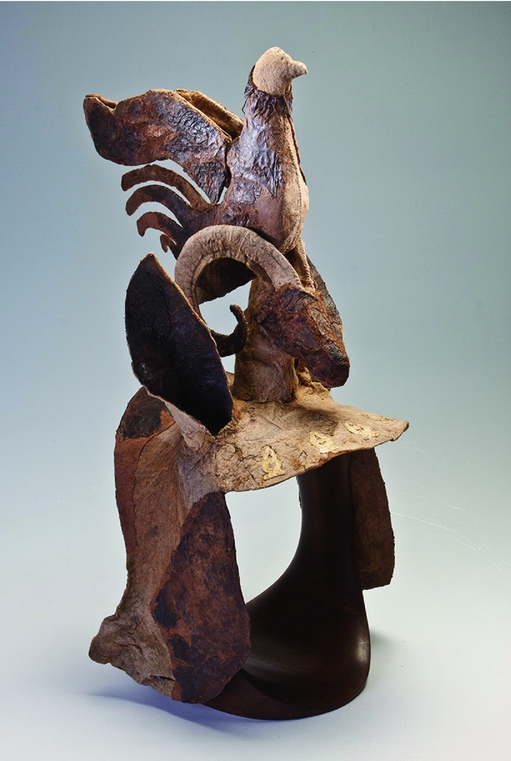
The exhibition is well designed and, unlike some recent exhibitions, benefits from clear labelling at a font size that can be read. Alongside the ‘serious’ labels are others intended for younger visitors with more catchy (and mainly alliterative) headings such as ‘Buckle bling’, ‘Frozen fashion’ and (for the cheese) ‘Best before: 300 BC’. There is also a video loop with newsreel footage of some of the key excavations, which serves to remind us of the difficult conditions in whichmuch of the archaeology was done. One short sequence, for instance, shows local women pouring boiling water into the Pazyryk graves to melt the permafrost.
For all that we learn about the Scythians from these displays, there are significant gaps. The tomb assemblages reveal a powerful elite, able to assemble a rich array of grave furnishings and to command the resources to build large burial mounds containing elaborate timber chambers. That rather begs the question of how and where the bulk of the population lived, and how this nomadic society was held together. Your typical Scythian was not, presumably, an aristocratic mounted warrior wearing elaborate gold dress fittings. And what about the craftsmen who made these impressive objects?
Two final sections of the exhibition broaden the horizons geographically and chronologically. The first covers cultural contacts between the Scythians and their neighbours, showing the impact of Achaemenid art, finds of Chinese patterned silk and Indian cotton, and Scythian graves outside the Greek Black Sea colony of Nymphaeum. The second leads us in time beyond the Scythians to subsequent centuries when new steppe peoples rose to dominance. The most striking exhibits here are from the burial ground of Oglakhty in the Minusinsk basin, with log-built burial chambers containing human mummies and curious ‘dummies’ stuffed with straw. Once again the excellent preservation is both striking in itself and provides new opportunities for research and analysis: stable isotope study of the human hair has confirmed that these were nomadic peoples with strong seasonal shifts in diet and seasonal movement between different areas (Shishlina et al. 2016)Footnote 7 .
This is one of two sections of the exhibition that display human remains (a mummified head and tattooed skin from Pazyryk appear in an earlier case). A notice at the beginning warns the visitor that human remains are on show, and archaeologists will not be surprised. Most visitors are probably intrigued, but it does raise again the question of the sensitivity of displays of this kind. Are they always justified?
This is a fascinating exhibition and an excellent opportunity to view material normally only to be seen in the Hermitage museum. Much of the famous Pazyryk material is here, alongside finds from more recent excavations at sites such as Arzhan in Tuva (2000–2004) and Taldy-2 in Kazakhstan (2009–2010). All in all, an impressive line-up and a fitting follow-on to the Celts: art and identity two years agoFootnote 8 . There is also (as for the Celts) a splendidly illustrated exhibition catalogue. If you have not already been, it is most definitely worth a visit.
A violent past
One aspect of the Scythians that cannot escape attention is the prevalence of conflict. Weapons (especially arrowheads) feature prominently in the British Museum exhibition and the fact that this was not all for show is driven home by the mummified head of the Pazyryk chieftain who had been killed by an axe-blow and scalped before burial. Even the powerful were not immune to violent death. The violence of prehistory is pursued in two papers in the current issue of Antiquity. The first of these (pp. 1515–28) analyses the Thames Beater, a Neolithic wooden club retrieved from the River Thames at Chelsea. Experiments by Meaghan Dyer and Linda Fibiger revealed the very serious injuries that this simple but fearsome implement may have inflicted, and which matched cranial injuries from Neolithic sites in continental Europe. A millennium or so later, violence may have become more organised and deadly. Harald Meller makes the case in a second paper (pp. 1529–45) for the presence of standing armies controlled by elites in the central European Bronze Age, arguing from the evidence of graves and bronze hoards. The growing scale of these conflicts finds graphic reflection in the Late Bronze Age battlefield of Tollense, where as many as 6000 combatants may have been engaged. As readers may recall, preliminary study of Tollense was reported in Antiquity back in 2011 (Jantzen et al.)Footnote 9 . The scale of prehistoric violence is now hard to dispute, and these papers illustrate just how far we have moved away from the peaceful image of early societies widely envisaged only a few decades ago.
The end of an era?
Recent Antiquity editorials have noted a number of archaeological anniversaries falling in 2017. They include the appointment of Christian Jurgensen Thomsen to the Royal Commission for the Preservation of Antiquities (later the National Museum of Antiquities) in Copenhagen in 1817, which led to the Three Age System; and the discovery of the Minoan settlement of Akrotiri in 1967. Another important anniversary also falls this year. Twenty-five years ago, the dusty settlement mound of Çatalhöyük in the Konya plain of southern Turkey was already well known in archaeological circles. James Mellaart had excavated there in 1958 and then for four seasons from 1961–1965, revealing a settlement of tightly clustered rooms, some with impressive frescoes and moulded sculptures, and with a long sequence of occupation. There was no doubt that this was a key site for understanding the Neolithic transition, but many questions were left unanswered. Hence it was in 1993 that Ian Hodder returned to Çatalhöyük to initiate an ambitious and extensive series of excavations that finally came to a close this summer. Working more slowly than Mellaart and with the benefit of new techniques, it became one of the most important (perhaps the most important) archaeological projects of recent years. Over the two and a half decades, the team has produced 20 monographs of data (11 already out, the rest in the works) and nearly 500 other publications. Çatalhöyük has also achieved UNESCO World Heritage listing. It has naturally featured regularly in the pages of Antiquity, most recently in a review of the reflexive methodology and 3D recording for which the excavations have become famous (Berggren et al. 2015)Footnote 10 .
We can be sure that Çatalhöyük will not disappear from our pages any time soon, and the wealth of evidence that has been unearthed will go on providing material for future studies for many years to come. But there is inevitably the feeling that the close of the 25-year project marks the end of an era, and Ian Hodder himself looks back with some regret:
I will miss the site and its endless fascination, but above all I will miss the team of over 150 people who came to work together and be a summer family for so many years. From all over the world, but including many local Turkish participants, they have devoted big chunks of their lives and energies to the project, integrating across sub-disciplines and cultural differences, and finding solutions to challenges as they came up. It has been good, but also fun.
One feature of the project (and a lesson for archaeology more widely) has been the effort devoted to conserving the excavated remains, and Ian adds that although the fieldwork is now at an end, the site can still be visited. Furthermore, the project team will be coming together again next summer to continue working on the publication. It has altogether been an outstanding achievement.
Archaeological projections
Maps are a key tool of archaeological research and publication, but how far does the way we map things affect how we interpret them? They may at first sight appear quite innocuous, lulling us into a sense of familiarity and acceptance. But map projections can of course differ widely in how different land areas are stretched and distorted to fit a rectangular two-dimensional frame.
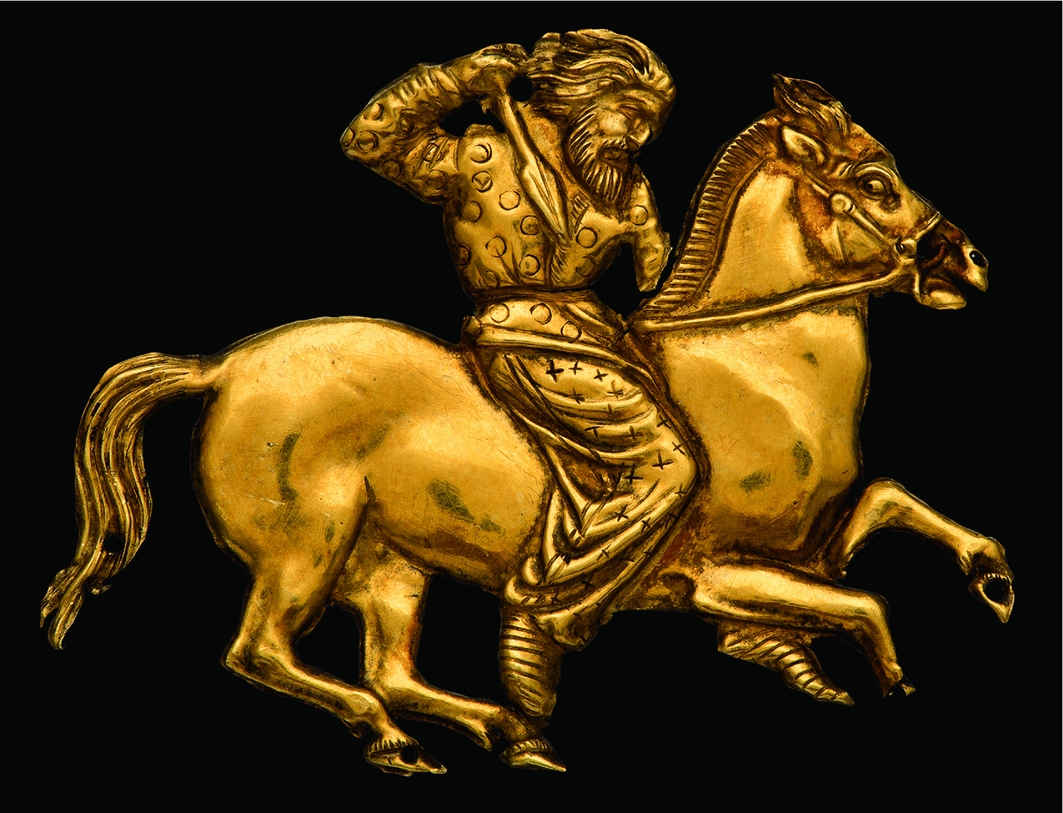
Gold plaque depicting a Scythian rider with a spear in his right hand; second half of the fourth century BC; Kul’ Oba (© The State Hermitage Museum, St Petersburg, 2017; photoograph: V Terebenin).
Readers who are concerned about the issue will be aware of the controversy generated by the appearance of the Peters world map projection in the 1970s. It is in fact 50 years ago this year since Arno Peters first discussed it at a meeting of the Hungarian Academy of Science in 1967Footnote 11 (hence the anniversary), although he did not present his world map to the public until 1973Footnote 12 . His aim was to create a new map with an equal area projection, where the various land masses of the world were displayed at their correct relative sizes. The standard Mercator projection, by contrast, portrays Greenland at the same size as China, although the latter covers four times the land areaFootnote 13 . Most traditional map projections overemphasise land areas in northern (and southern) latitudes at the expense of equatorial regions; hence Europe is exaggerated and Africa diminished, which has a profound and subtle effect on our impression of world geography.
The Peters projection was not without its problems, one of them being that an almost identical map had been published by Scotsman James Gall back in 1885. Then again, it gave what seem unfamiliar and peculiar shapes to continents and other landmasses. The Gall-Peters projection generated considerable controversy and much legitimate criticism. Today, with the benefit of Google Earth and the spinning 3D globe, the issues it raised may seem anachronistic; but we still rely heavily on two-dimensional mapping in publications, whether printed or online. How far do these abstractions influence the way we think? Do they always affect the importance we give to different regions?
Regional balance is one of the questions we always consider in assembling an issue of Antiquity. Inevitably, we receive variable numbers of papers from different parts of the globe, and the intensity of research and the footprint of the human past differs considerably from one region to another. But as a journal of world archaeology, part of our mission is to seek out high-quality research from under-represented places. That was the challenge set by O.G.S. Crawford in founding Antiquity 90 years ago, and one of the objectives I have kept in mind as editor over the past five years.
Those five years bring my tenure to completion, and this December issue is the last to appear under my editorship. In handing over to the new team, I would like to record what a privilege and pleasure it has been to guide and develop the journal, and how exciting it has been to be so close to so many new discoveries and interpretations. I hope I have succeeded in passing on some sense of that excitement to our readers. In signing off, I would also like to thank all those who have given time and attention to Antiquity, whether as authors, reviewers or readers. Special mention goes to the members of the Editorial Advisory Board, the Antiquity Trustees and the journals division of Cambridge University Press, who now publish Antiquity on our behalf. And last but not least, my thanks go to the staff of the Antiquity office, at the same time wishing them every success in the years to come; for Antiquity is not leaving Durham but continuing under Rob Witcher who has already been playing a key role as Reviews Editor. I am sure that in our increasingly international world, Antiquity will continue to go from strength to strength.


