





Metabolic syndrome (MetS), a condition characterised by the presence of several adiposity-related cardiometabolic abnormalities, is a prominent precursor of many chronic diseases(Reference Grundy, Cleeman and Daniels1). In fact, MetS now mirrors obesity in its prevalence and recognition as a public health priority, with recent estimates suggesting that > 40 % of USA adults have MetS(Reference Liang, Or and Tsoi2). With the continuous rise in obesity, an ageing USA population more susceptible to cardiometabolic diseases(3) and the increased rate of MetS amongst young adults(Reference Hirode and Wong4), it is unsurprising that integrating MetS screening techniques into routine care remains challenging for overwhelmed healthcare systems. Nevertheless, routine health screenings are critical for identifying those at elevated risk.
Screening for MetS typically involves evaluating individual risk factors such as abdominal obesity, hypertension, hyperglycaemia and dyslipidaemia. However, acquiring these diagnostic biomarkers is often challenged by cost, availability, technician dependence and access, particularly for those in rural and low socio-economic communities. Consequently, anthropometric measures are frequently used as primary indicators of cardiometabolic complications, given the relationship between MetS development and increasing adiposity. While BMI has historically been used to assess cardiometabolic health status due to its convenience, its oversimplified nature has led to a lack of clinical consensus. More recently, combining BMI with proxies of central adiposity, such as absolute and/or relative waist circumference, has been the preferred approach, as it may better represent fat distribution patterns indicative of cardiometabolic dysfunction(Reference Medina Inojosa, Somers and Lara-Breitinger5). However, these proxies often depend on access to trained personnel, measurement location and intra/interrater reliability. As a result, many desire more detailed body composition assessments, which have well-demonstrated associations with chronic disease(Reference Sedlmeier, Baumeister and Weber6). Unfortunately, the most widely accepted methods are expensive and typically unavailable outside of research environments, and many consumer-level devices are inaccessible and often require patients to incur additional costs. Although most healthcare systems have begun addressing accessibility concerns through the rapid adoption of digital health services, most anthropometric methods cannot provide remote assessments without a technician present, and self-assessments are often inaccurate(Reference Carranza Leon, Jensen and Hartman7). Given the limited clinical acceptance and feasibility of these approaches, it is essential to identify accessible, non-invasive, time- and cost-efficient anthropometric tools capable of evaluating MetS both remotely and at point-of-care.
A potential solution may lie in recent adaptations of 3-dimensional (3D) body scanning. Specifically, 3D scanning uses light emission and detection techniques to create a 3D avatar capable of automating hundreds of anthropometric measurements. While prior studies highlight the potential of this method as a MetS screening tool(Reference Jaeschke, Steinbrecher and Hansen8,Reference Bennett, Liu and Quon9) , it remains limited by the same drawbacks as many previously described strategies. However, since most smartphones are equipped with the high-quality imaging and machine learning capabilities necessary for these assessments, 3D scanning procedures have now been optimised for smartphone applications. Although integration of this technique into smartphone applications represents a promising advancement in remote and automated cardiometabolic health screenings, the ability of smartphone-derived anthropometrics to effectively evaluate MetS remains unclear. Therefore, this study aimed to determine whether anthropometrics obtained from a smartphone application could be used to predict both MetS and its severity.
Methods
Participants
A total of 281 participants aged 18–65 years were prospectively recruited through a combination of convenience and snowball sampling methods (i.e. in-person and online word-of-mouth) and completed this cross-sectional evaluation. Participants were excluded if they were < 18 years or > 65 years; pregnant or breast-feeding/lactating. The age range for study eligibility was established based on the American Aging Association’s guidelines for clinically meaningful age groupings in the context of disease(Reference Geifman, Cohen and Rubin10). Moreover, this age group is at the highest risk for developing MetS, particularly among individuals in the younger subcategories(Reference Hirode and Wong4). Because the MetS severity (MetSindex) equations used in this study are unavailable for Asian individuals(Reference Gurka, Lilly and Oliver11), Asian participants were also not included in this analysis. This study was conducted according to the guidelines laid down in the Declaration of Helsinki, and all procedures involving human subjects were approved by the University of Southern Mississippi Institutional Review Board (IRB#22-1012/23-0446). Written informed consent was obtained from all subjects.
Procedures
Participants arrived at the laboratory for testing after an ≥ 8-h overnight fast from food, beverage and supplements/medications and after abstention from exercise for ≥ 24-h. Participants were instructed to wear tight form-fitting athletic clothing and to remove any external metal or accessories prior to testing. After sitting for a minimum of 5-min, systolic and diastolic blood pressure were collected using an automated digital blood pressure monitor. Afterwards, participants underwent several anthropometric evaluations including measurements of height, weight, waist circumference at the superior iliac crest using traditional tape measure and automated anthropometric assessments using a freely downloadable 3D smartphone application (MeThreeSixty®, Size Stream, Cary, NC) that provides users with both the images and anthropometric data free of charge (additional metrics provided via a $4·99 USD/month subscription at time of this study). Finally, capillary blood was collected to assess fasting blood glucose, HDL-cholesterol and TAG.
Anthropometric smartphone application
Body composition, circumferences, surface areas and volumes were measured using a smartphone scanning application, and the procedures used to collect these measurements have been described in detail elsewhere(Reference Graybeal, Brandner and Tinsley12–Reference Tinsley, Rodriguez and Siedler16). Notably, the measurements produced by this smartphone application have well-demonstrated precision(Reference Graybeal, Brandner and Tinsley12,Reference Graybeal, Brandner and Tinsley13,Reference Tinsley, Rodriguez and Siedler16,Reference Smith, McCarthy and Dechenaud17) and have shown to agree with criterion methods(Reference Graybeal, Brandner and Tinsley12–Reference McCarthy, Tinsley and Yang15,Reference Smith, McCarthy and Dechenaud17) . Importantly, the mobile application used in this study has demonstrated acceptable agreement and test-retest reproducibility across multiple smartphone models(Reference Graybeal, Brandner and Tinsley13), including various Apple® devices equipped with body scanning capabilities(Reference Graybeal, Brandner and Compton14). For these assessments, participants were required to wear only tight-form fitting athletic clothing and to tie their hair up so that it was not present below the shoulder line. After entering the participant’s descriptive information into the application, the smartphone (iPhone 14 Pro Max, Apple®, Cupertino, CA) was placed into a stationary tripod at a standardised height, and the smartphone’s orientation was confirmed by the application. Participants were then instructed to stand on top of a foot guide at a standardised distance from the smartphone. Once positioned, the application prompted participants to situate themselves into two poses: (1) the A pose, which required participants to face the smartphone, widen their feet and laterally raise their arms and (2) the side pose, which required participants to turn to the side, bring their feet together and place their hands to their sides. The smartphone’s front facing camera captured a single image during each pose. All scans were conducted in a designated area featuring a neutral-colored backdrop (grey) and no external light sources (e.g. window light) nor light at the participants back. Importantly, according to the manufacturer, raw image files are neither stored on the device nor uploaded to the cloud to protect user privacy.
Blood biomarkers and metabolic syndrome assessments
The procedures for the collection of blood biomarkers and the determination of MetS and MetSindex have been published elsewhere(Reference Stavres, Aultman and Brandner18–Reference Stavres, Vallecillo-Bustos and Newsome22). In summary, ∼40 μl of capillary blood were collected via fingerstick, placed into to a single-use testing cassette and inserted into a validated capillary blood analyser(Reference Dale, Jensen and Krantz23) (Cholestech LDX, Abbot, Abbott Park, IL) for the analysis of HDL-cholesterol (%CV: 3·3–4·9), TAG (%CV: 1·6–3·6) and fasting blood glucose (%CV: 4·5–6·2). Importantly, this capillary blood analyser does not report HDL-cholesterol for HDL-cholesterol < 15 mg/dl (n 3) nor TAG measurements > 650 mg/dl (n 3) and does not report TAG for TAG > 650 mg/dl nor TAG < 45 mg/dl (n 39). As such, HDL-cholesterol and TAG below these thresholds were recorded as 15 mg/dl and 45 mg/dl, respectively, and TAG > 650 mg/dl were recorded as 650 mg/dl. Because all participants with TAG > 650 mg/dl were classified as having MetS, irrespective of their HDL classification, HDL-cholesterol values for these participants were recorded as the median HDL-cholesterol of sex, race/ethnicity and MetS matched participants. Quality assurance tests were performed in compliance with the manufacturer’s standards.
MetS classification was determined using the ATP III criterion(Reference Grundy, Cleeman and Daniels1), which includes possessing any three of the following five risk factors: (1) fasting blood glucose ≥ 100 mg/dl; (2) systolic blood pressure ≥ 130 mmHg or diastolic blood pressure ≥ 85 mmHg; (3) TAG ≥ 150 mg/dl; (4) waist circumference ≥ 88 cm for females and ≥ 102 cm for males and (5) HDL-cholesterol < 50 mg/dl for females and < 40 mg/dl for males. Participants that were currently being prescribed medications for the treatment of hypertension, hyperglycaemia and/or dyslipidaemia (n 17) were classified as meeting the criteria for the treated risk factor. The only other medications reported by participants with the potential to meaningfully influence cardiometabolic outcomes were muscle relaxants (n 3) and over-the-counter anti-inflammatory drugs (n 12). However, as part of the overnight fasting protocol, participants were instructed to abstain from taking these medications until after their study visit. Because these medications were used on an as-needed basis for personal or prescribed reasons and are not considered in the formal diagnostic criteria for MetS, they were not included in model development. Nonetheless, their prevalence is reported here to provide transparency and contextual clarity.
The primary outcome variable in the current study was MetSindex, defined as an expansion of the simple dichotomous classification system (i.e. MetS positive or negative) into a continuous value whose magnitude represents the severity and progression of MetS. MetSindex scores were calculated from the aforementioned risk factors for each participant using the sex and race specific equations put forth by Gurka et al. (Reference Gurka, Lilly and Oliver11). Interpreted as a z-score, positive and negative MetSindex values represent greater and lesser MetS severity and progression, respectively, and these values have shown to be associated with additional markers of cardiometabolic dysfunction(Reference Gurka, Lilly and Oliver11).
Model development
A new MetSindex prediction equation was developed using least absolute shrinkage and selection operator (LASSO) regression procedures(Reference McCarthy, Tinsley and Yang15) after employing the demographic and smartphone-derived anthropometric predictor variables listed hereafter. Demographic predictor variables included: age, height, weight, sex, race (White/Black), ethnicity (Hispanic/non-Hispanic), medication use (prescribed or not prescribed medication to treat hypertension, hyperglycaemia and/or dyslipidaemia) and smoking status. Anthropometric predictor variables produced by the smartphone application included: circumferences (cm) of the head, collar, neck, halter, shoulder, chest, bust (designated as HingedBust in the application), upper arms, biceps, forearms, wrists, thighs, knees, calves, ankles and vertical trunk; lengths (in cm) of the arms, outside legs and central trunk; surface areas (cm2) and volumes (cm3) of the whole-body, arms, legs and torso and appendage-to-trunk circumference index (ATI), defined as the sum of left and right upper arm, thigh, and calf circumferences divided by the stomach circumference(Reference Harty, Sieglinger and Heymsfield24). Circumferences and lengths collected from the right and left sides were averaged to produce a single estimate, whereas right and left surface areas and volumes were summed. To evaluate whether smartphone-derived anthropometric measurements offered additional predictive value beyond demographic variables alone, we first developed a baseline model using only demographic predictors via LASSO regression. This was followed by the construction of a comprehensive model incorporating both demographic and smartphone anthropometric variables.
Statistical analyses
Using a medium effect size (f2:0·25) and five predictor variables, power analyses for multiple linear regression revealed that fifty-seven participants would yield 80 % power at an α = 0·05. To create and assess a newly developed MetSindex prediction equation, a training dataset comprised of 80 % of the sample (n 226) and a testing dataset containing the remaining 20 % (n 55) were produced using random sampling techniques in R(25). LASSO regression was then used to fit models in the training dataset using the glmnet package in R(Reference Friedman, Hastie and Tibshirani26). Importantly, LASSO regression works by identifying the predictor variables that decrease prediction error while simultaneously shrinking the coefficients of extraneous variables towards zero so that they are effectively omitted from the model(Reference Tibshirani27); ultimately producing the most parsimonious model that minimises multicollinearity and model overfitting. To determine the LASSO shrinkage technique, the best λ value was calculated using 10-fold cross-validation with the one se rule(Reference McCarthy, Tinsley and Yang15).
After the MetSindex prediction model was developed in the training sample, the model was used to predict MetSindex in the testing sample. The performance of the smartphone-predicted MetSindex was evaluated against the actual MetSindex in the testing sample using paired t tests, equivalence tests, coefficients of determination (R2), Deming regression, Bland–Altman analyses, root mean squared error, se of the estimate, and concordance correlation coefficients. Because MetSindex is interpreted as a z-score, the equivalence regions were defined as ±0·34 to represent approximately one-third of a standard deviation, which have been used to assess z-score values in prior studies(Reference Graybeal, Swafford and Compton28). The agreement between smartphone-predicted MetSindex and the line-of-identity using Deming regression was determined if the 95 % confidence intervals for the intercept and slope contained the values 0 and 1, respectively. The 95 % limits of agreement and proportional biases were determined using Bland-Altman and linear regression techniques.
Additionally, the ability of the retained smartphone variables to correctly predict MetS classification was evaluated using binomial logistic regression with a cutoff point of 0·5 (MetS negative: < 0·5; MetS positive: ≥ 0·5). The true positive and true negative proportions of smartphone-predicted MetS were compared with the proportions determined by the actual diagnostic procedures using the receiver operating characteristic area under the curve (AUC), chi-square tests with corrections for continuity, R2 McFadden, and sensitivity, specificity, accuracy, and positive (LR+) and negative (LR-) likelihood ratios. Acceptable accuracy of the smartphone-predicted MetS classification was defined as having a both an AUC ≥ 0·70 and having a summed sensitivity and specificity of ≥ 1·50(Reference Graybeal, Compton and Swafford29–Reference Power, Fell and Wright31). Variance inflation factors were used to assess the multicollinearity of the final LASSO and logistic regression models (all Variance inflation factors ≤6·24). Statistical significance was accepted at P < 0·05.
Results
Metabolic syndrome severity
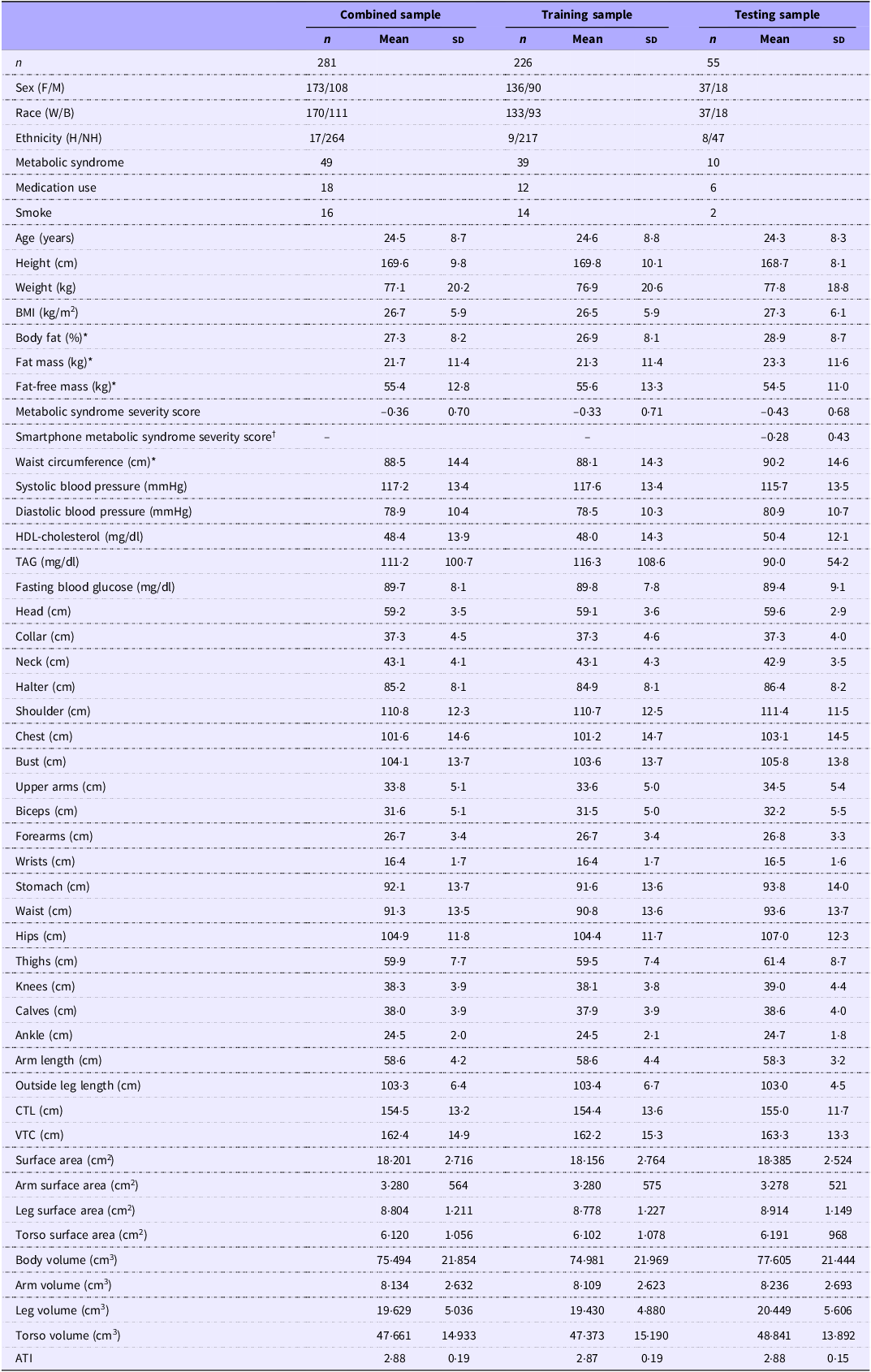
Descriptive characteristics of the participants in the combined, training, and testing samples are presented in Table 1. The initial model, which included only demographic predictors (intercept: −0·2925), retained age (β = 0·0028), medication use (β = 0·2692), height (β = −0·0113), and weight (β = 0·0234). However, this model performed worse overall (R2 = 0·63; 95 % limits of agreement = 0·82; AUC = 0·84; joint sensitivity and specificity = 1·48) compared with the full model that incorporated both demographic and smartphone-derived anthropometric variables (reported below). Notably, when LASSO regression was applied to the complete model, age and height were excluded, while the coefficients for medication use and weight were substantially reduced, indicating that the additional anthropometric features provided stronger predictive value.
Descriptive characteristics of the combined, training and testing samples

Data are presented as n or mean (standard deviation).
All body circumferences from the right and left sides were averaged to produce a single estimate. Appendicular surface areas and volumes were calculated as the sum of the right and left sides. For ATI, all variables were collected using smartphone-derived measurements. Medication use was defined as being prescribed medication to treat hypertension, hyperglycaemia and/or dyslipidaemia. Smoking was defined as currently smoking or vaping.
F, female; M, male; W, White; B, Black; H, Hispanic; NH, non-Hispanic; CTL, centre trunk length; VTC, vertical trunk circumference; ATI, appendage-to-trunk circumference index.
*Estimates produced using smartphone application; †estimates produced using the newly developed smartphone prediction model.
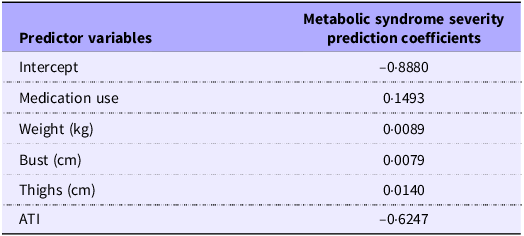
The coefficients of the retained variables using LASSO regression in the complete model are presented in Table 2. Retained variables included medication use, weight, bust circumference, thigh circumference, and ATI, which produced the following equation:
LASSO regression model coefficients predicting metabolic syndrome severity from smartphone-derived anthropometrics

LASSO, least absolute shrinkage and selection operator; ATI, appendage-to-trunk circumference index.
All data are presented as the unstandardised coefficients for each variable within the corresponding body composition prediction model. The coefficients of all other predictor variables were shrunk to ‘0’ and are therefore not included in the final model equations nor the table.
‘Medication use’ was defined as 1 = prescribed medication to treat hypertension, hyperglycaemia and/or dyslipidaemia or 0 = no prescribed these medications. For ATI, all variables were collected using smartphone-derived measurements and was defined as the sum of left and right upper arm, thigh and calf circumferences divided by the stomach circumference.
Smartphone-predicted MetS index : −0·8880 + 0·1493(medication use = 1; 0 = no medication use) + 0·0089(weight) + 0·0079(bust circumf.) + 0·0140(thigh circumf.) – 0·6247(ATI).
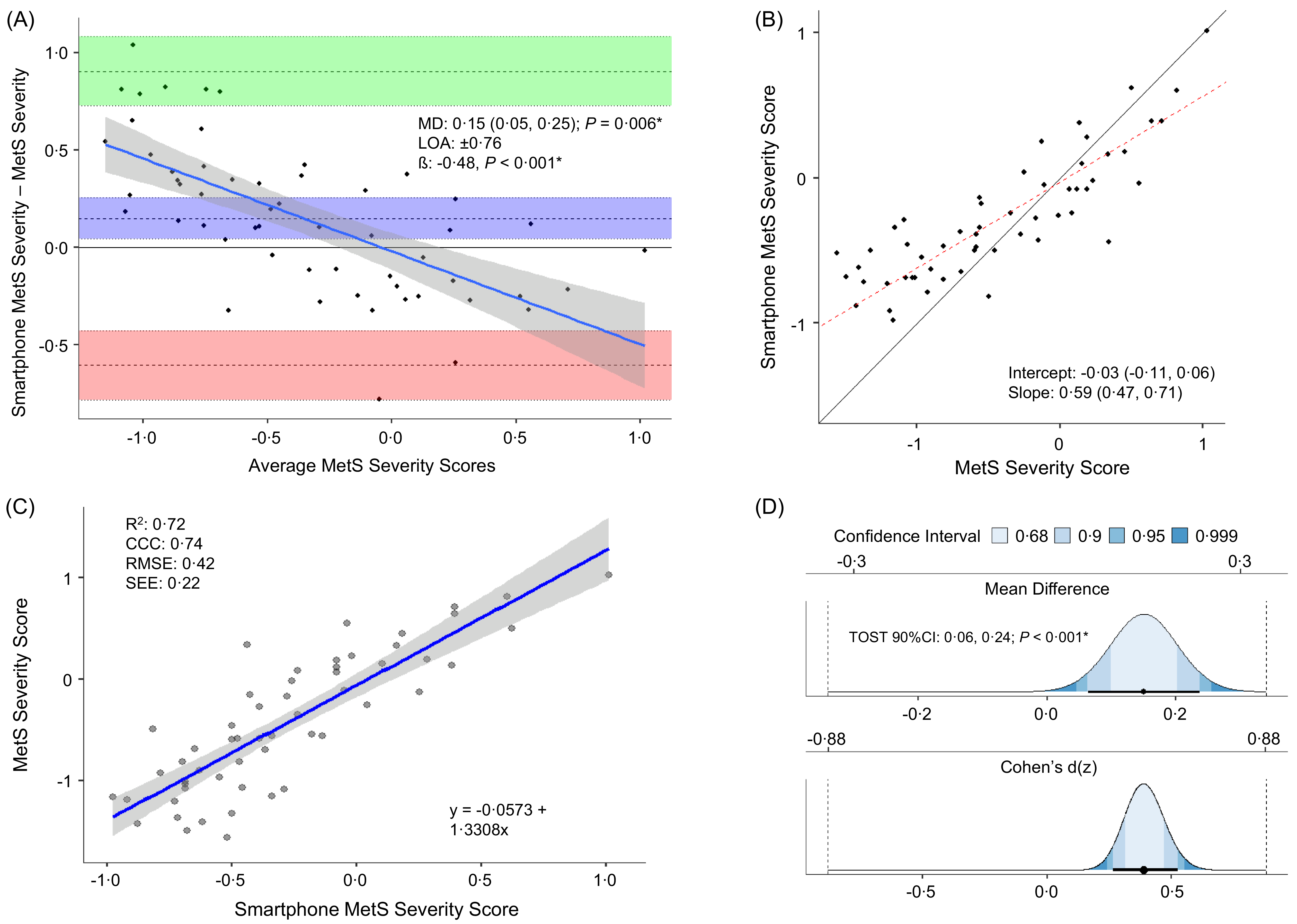
The equation presents unstandardised coefficients for the predictors retained in the final model. All other predictor variables, as detailed in the preceding sections, had their coefficients shrunk to 0, effectively excluding them from the model. Figure 1(a)–(d) illustrates the agreement between the newly developed smartphone MetSindex prediction equation and the actual MetSindex in the testing sample. Paired t tests revealed significant differences between smartphone-predicted and actual MetSindex (P = 0·006; Figure 1(a)), though smartphone-predicted MetSindex demonstrated equivalence with actual MetSindex (Figure 1(d)). Online Supplemental Table 1 presents the prevalence and risk factors of MetS across MetSindex groups, as defined by these equivalence bounds, to further support the results of our equivalence testing procedures. R2, concordance correlation coefficient, root mean squared error and se of the estimate values (Figure 1(c)) revealed good agreement between methods, and 95 % limits of agreement were moderate. Proportional biases (P < 0·001; Figure 1(a)) and differences in the slope (but not intercept) from the line-of-identity were observed (Figure 1(b)).
(a)–(d) Bland–Altman (a), Deming regression (b), simple regression (c) and equivalence plots demonstrating the agreement between smartphone-predicted MetSindex and the actual MetSindex in the testing sample (n 55). For the Bland–Altman plots (a), the upper and lower dashed lines represent the 95 % LOA, the middle-dashed line represents the MD between the smartphone-predicted MetSindex and the actual MetSindex and the solid blue line and its corresponding shaded area represents the regression line and its 95 % CI, respectively. For the Demming regression plots (b), the solid black line represents the line of identity and the red dashed line represents the regression line. For the simple regression plot (c), the solid blue line and its corresponding shaded area represents the regression line and its 95 % CI, respectively. For the equivalence plots, the average MD (top) and effect size MD (bottom) are presented, where the blue shaded regions represent the TOST CI displayed in the CI legend, the black circles and intersecting horizontal lines represent the MD and the TOST 90 % CI, respectively, and the vertical dashed lines indicate the equivalence regions. β, proportional bias coefficient; CCC, concordance correlation coefficient; LOA, 95 % limits of agreement; MD, mean difference calculated as the smartphone-predicted MetSindex minus the actual MetSindex.; MetSindex, metabolic syndrome (MetS) severity score; R2, coefficient of determination; RMSE, root mean square error; TOST, values from the TOSTER package in R. * statistically significant at P < 0·050.

Metabolic syndrome classification
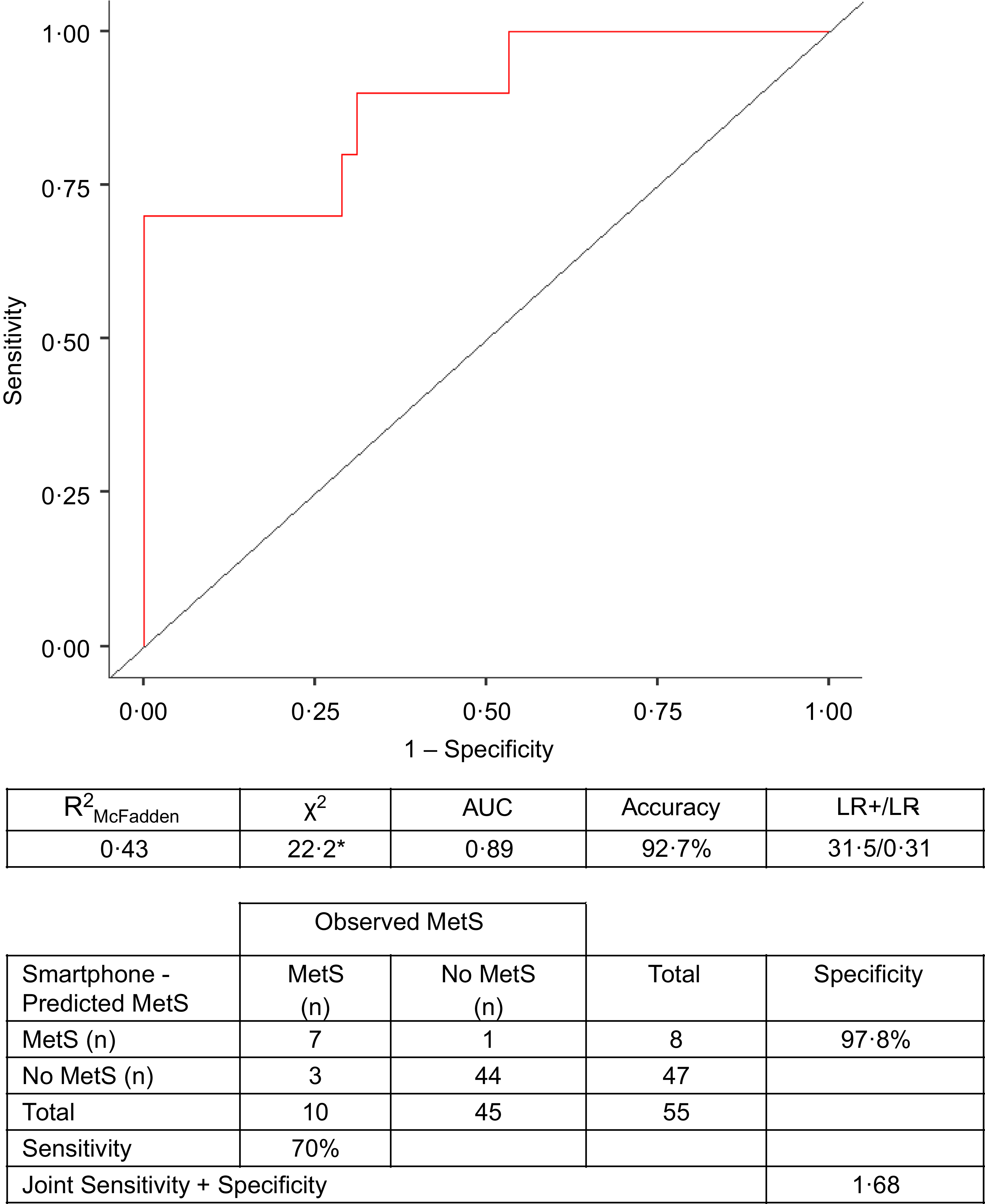
The receiver operating characteristic plots and associated contingency tables of Figure 2 demonstrate the ability of the retained smartphone variables to accurately diagnose MetS compared with the traditional diagnostic standards. The true prevalence of MetS was 18·2 %, whereas the apparent prevalence of smartphone-predicted MetS was 14·5 %. χ 2 tests for the overall model were significant (P < 0·001), and smartphone-predicted MetS had a diagnostic accuracy of 92·7 %, with sensitivity (70 %), specificity (97·8 %; joint sensitivity + specificity: 1·68), and LR+ (31·5) and LR− (0·31) indicating acceptable diagnostic performance. Moreover, the model AUC (0·89) and R2 McFadden (0·43) revealed excellent model performance.
An ROC curve and corresponding AUC demonstrating the ability of the predictor variables retained during LASSO regression to predict conventional MetS classification relative to actual MetS status in the testing sample (n 55). Positive and negative MetS cases are presented for both smartphone-predicted and actual MetS, as well as the sensitivity, specificity, and accuracy of smartphone-predicted MetS status. R2 McFadden, χ2, and LR+ and LR- are also tabulated. LASSO, least absolute shrinkage and selection operator; LR+, positive likelihood ratio; LR-, negative likelihood ratio; MetS, metabolic syndrome; R2 McFadden, McFadden pseudo coefficient of determination; ROC, receiver-operating characteristic. * statistically significant at P < 0·050.

Discussion
After developing a MetSindex prediction model using LASSO regression and cross-validating this model in an independent subset of participants, our evaluations revealed that smartphone-acquired anthropometrics can provide accurate estimates of MetS severity and progression. While the ability to predict a continuous MetSindex score from a smartphone application may improve diagnostic flexibility and better inform clinicians of MetS progression, the absence of diagnostic cut-offs may complicate clinical decision-making and limit the implementation of this technique at scale. Therefore, we also assessed whether smartphone-derived anthropometrics could accurately predict MetS classification, and our model demonstrated good-to-excellent ability to identify MetS in accordance with traditional diagnostic standards. These findings affirm that both MetS and its severity can be accurately determined using a smartphone application.
The ability of 3D body scanners to deliver accurate estimates of conventional anthropometrics is well established(Reference Rumbo-Rodríguez, Sánchez-SanSegundo and Ferrer-Cascales32). However, ongoing advancements in artificial intelligence and digital imaging now offer new opportunities to leverage the predictive power of these automated anthropometrics to produce more clinically significant outcomes. For example, 3D scanners have accurately predicted measurements such as appendicular lean mass(Reference McCarthy, Tinsley and Yang15) and MetS(Reference Bennett, Liu and Quon9) based on the established relationship between key anthropometrics and both muscularity(Reference Al-Gindan, Hankey and Govan33) and chronic disease(Reference Lee and Yim34). In fact, prior studies have demonstrated that body volumes obtained from 3D scanners predict MetS more accurately than traditional anthropometric assessments(Reference Medina Inojosa, Somers and Lara-Breitinger5), which is likely attributed to the advanced landmarking procedures that can eliminate human error while simultaneously automating more elaborate measurements. However, given the existing limitations of 3D scanning, manufacturers have begun to couple 3D scanners with smartphone equivalents, which have demonstrated a similar ability to predict MetS(Reference Medina Inojosa, Somers and Lara-Breitinger5).
Our findings align with previous studies that employed both 3D(Reference Medina Inojosa, Somers and Lara-Breitinger5,Reference Bennett, Liu and Quon9) and smartphone(Reference Medina Inojosa, Somers and Lara-Breitinger5) scanning techniques for predicting MetS classification. However, to our knowledge, only one study has assessed whether a smartphone application can predict the prevalence and severity of MetS(Reference Medina Inojosa, Somers and Lara-Breitinger5). Although the predictive power of our smartphone scanning model for detecting binary MetS status was nearly identical to other methods(Reference Medina Inojosa, Somers and Lara-Breitinger5,Reference Bennett, Liu and Quon9) , our model exhibited markedly greater accuracy in predicting MetSindex (Reference Medina Inojosa, Somers and Lara-Breitinger5). While the improved performance of our model could be due to the technological differences between applications, it could also result from variations in the strength of the predictor variables. For example, other applications use body volume estimates to predict MetS, which have shown comparable performance to traditional circumferences collected from similar regions(Reference Jaeschke, Steinbrecher and Hansen8). However, previous studies have shown that the prediction of MetS(Reference Bennett, Liu and Quon9) and MetS risk factors(Reference Ng, Sommer and Wong35) improves most when using automated circumferences. Since body circumferences appear to be stronger predictors of binary MetS status, and MetSindex is simply an extension of this status, the systematic selection and omission of body circumferences and volumes, respectively, likely accounts for the performance differences between applications.
Importantly, since waist circumference is a risk factor for MetS and is included in MetSindex, we chose to exclude closely related raw circumferences as predictor variables. This allowed us to avoid potential biases and addressed the challenges of predicting MetSindex from abdominal circumferences in Black adults(Reference Graybeal, Compton and Swafford21). Despite excluding these variables, we still observed acceptable model performance using only circumferences of the bust, thighs and ATI. Recent investigations using artificial intelligence to predict diabetes and hypertension from biometric data have shown that thigh circumference enhances model specificity more than BMI; likely because it can better discern young adults with greater muscularity from those with higher body fat(Reference Smith, Criminisi and Sorek36). While it is reasonable to assume that bust circumference was included as a marker of upper body adiposity in the absence of raw abdominal measurements, bust circumference may also uniquely contribute to MetS. Exploratory analyses of the present dataset revealed that bust, but not waist circumference (r: –0·09, 0·00; P > 0·050), was significantly associated with systolic blood pressure (r: 0·30, P = 0·029) and HDL-cholesterol (r: –0·27, P = 0·047) after adjusting for both age and BMI. Interestingly, HDL-cholesterol is inversely associated with estradiol(Reference Furberg, Jasienska and Bjurstam37), which contributes to fat accumulation in breast tissue(Reference Zhao, Hu and Xu38). Greater fat accumulation could stimulate aromatase activity, and elevated conversion of androgens-to-estrogens may increase bust size(Reference Prisant and Chin39) whilst exerting vasoconstrictive responses that increase systolic blood pressure(Reference Fardoun, Dehaini and Shaito40). Despite the historical reliance on abdominal measurements to assess cardiometabolic abnormalities, our findings suggest that individual components of MetS could be more effectively captured using alternative anthropometrics, and mobile scanning presents an emerging opportunity to automate anthropometrics that have traditionally been difficult to obtain.
There are a few limitations that warrant discussion. While our sample was diverse, we were unable to evaluate Asian adults, as MetSindex is currently unavailable for this group. The average age of our sample was also relatively young. However, the prevalence of MetS in our sample matches the national prevalence for this age range and reflects the age group experiencing the most rapid increase in MetS(Reference Hirode and Wong4). Although age was included as a continuous predictor in the initial LASSO regression model, it was not retained in the final model, suggesting that it did not contribute additional predictive value beyond the selected variables. Similarly, sex was included as a predictor but was excluded during model selection. While future models evaluating the performance of smartphone-derived anthropometrics for predicting MetSIndex within sex-specific subgroups may be warranted, the sample sizes in our study were insufficient to support adequately powered stratified analyses and may have introduced bias into subgroup-specific models. Future studies seeking to improve these models should consider employing age- and sex-stratified models. The use of prescription medication to treat specific MetS risk factors may have lowered MetSindex for these participants. However, we accounted for this during LASSO, and medication use was retained as a variable in the final model. Because diastolic blood pressure is not included in MetSindex, unique hypertensive MetS phenotypes may have been overlooked(Reference Graybeal, Compton and Swafford21). The prediction model in our study exhibited significant proportional biases and differences from the line-of-identity, which, in the context of chronic disease diagnosis, may lead to underestimation of risk among high-risk individuals. However, such biases, particularly underestimation, are commonly reported in studies validating novel anthropometric and body composition methods. Despite this, our model demonstrated excellent classification accuracy for MetS, supporting its potential utility in risk stratification. Still, users and practitioners should employ caution when using this technique. Because the mobile application used in our study has well-established test-retest reliability(Reference Graybeal, Brandner and Tinsley12,Reference Graybeal, Brandner and Tinsley13,Reference Tinsley, Rodriguez and Siedler16,Reference Smith, McCarthy and Dechenaud17) , we did not collect duplicate measures of the smartphone-derived anthropometric variables and therefore cannot report test-retest reproducibility for these features (thigh, ATI and bust circumference) within the context of this study. However, previous studies have demonstrated the reproducibility of the thigh and chest circumferences produced by this mobile application, as well as the circumferences used to calculate ATI(Reference Graybeal, Brandner and Compton14,Reference Smith, McCarthy and Dechenaud17) . Although, to our knowledge, no studies have specifically evaluated the test-retest reproducibility of bust measurements using this mobile application, unpublished pilot data from our laboratory in an independent sample of female participants demonstrated acceptable agreement between smartphone-derived and tape-measured bust measurements (R² = 0·82; mean difference = 3·07 cm). Additionally, other studies have reported acceptable agreement between smartphone-derived and MRI-based breast volume estimates(Reference Behrens, Huebner and Häberle41). Together, these findings support the reliability and/or validity of the anthropometric variables retained in our prediction model. Finally, our findings are specific to the application used in our study.
In conclusion, smartphone scanning applications can accurately assess MetS prevalence and severity, supporting its use in remote settings. While longitudinal studies are needed to determine its effectiveness in monitoring changes, our findings highlight the predictive power of automated anthropometrics and present new possibilities for health screening beyond clinical environments.
Supplementary material
For supplementary material/s referred to in this article, please visit https://doi.org/10.1017/S000711452510576X.
Acknowledgements
We would like to thank Ryan Aultman, Ta’Quoris Newsome and Anabelle Vallecillo-Bustos for their assistance with data collection and Dr. Megan Renna and Dr. Tanner Thorsen for their role in resource obtainment.
This work was supported by the National Institute of General Medical Sciences of the National Institutes of Health under grant number NOT-GM-23-034 (FAIN#U54GM115428).
A. J. G. designed the work and supervised the study. A. J. G. and J. S. provided essential resources; A. J. G., C. F. B., G. M. T. and J. S. helped conceptualise the study; A. J. G. primarily performed the statistical analyses and G. M. T. assisted with the analyses. C. F. B., A. T. C., S. H. S., M. F. J., M. G. K. and H. H. collected the data; C. F. B. drafted the initial manuscript; all authors reviewed the manuscript for intellectual content, approved the manuscript and have agreed to be accountable for the work.
The funding agency (National Institute of General Medical Sciences) had no role in the study design, collection, analysis or interpretation of the data, writing the manuscript or the decision to submit the paper for publication. G. M. T has received support for his research laboratory, in the form of research grants or equipment loan or donation, from manufacturers of body composition assessment devices, including Size Stream LLC; Naked Labs Inc.; Prism Labs Inc.; RJL Systems; MuscleSound; and Biospace, Inc. None of these entities played a role in the present manuscript. There are no other competing interests to declare.


 Open access

