


Introduction
‘The problem is that the international directors write the proposals, but they don't know [the field]. They never involve any of the [local] managers. And then the donors come and the directors are not here. … The directors have crazy ideas and dreams, and I have to solve it on the ground.’ (Deni, an Indonesian conservation project manager, 8 April 2019)
The biodiversity conservation sector increasingly embraces the concept of reflexivity, which involves a cultivated practice of critical reflection by conservation professionals on the social, institutional and political conditions of their work (Montana et al., Reference Montana, Elliott, Ryan and Wyborn2020; Wyborn et al., Reference Wyborn, Montana, Kalas, Clement, Davila and Knowles2021; Pienkowski et al., Reference Pienkowski, Kiik, Catalano, Hazenbosch, Izquierdo-Tort and Khanyari2023). The anticipated benefits of reflexivity are manifold, such as enabling conservation professionals, both scientists and practitioners, ‘to cope with complexities in the field, facilitate institutional change, drive innovation, work effectively in teams, learn from past events, or benefit from the experiences of other scientists’ (Beck et al., Reference Beck, Elliott, Booher, Renn and Montgomery2021, p. 2). Reflexivity can help conservation professionals improve impact through more innovative and inclusive approaches (Boyce et al., Reference Boyce, Bhattacharyya and Linklater2022) and lead professionals to challenge existing objectives, especially where they conflict with social justice concerns (Borie et al., Reference Borie, Gustafsson, Obermeister, Turnhout and Bridgewater2020).
In response to the increasing calls for incorporating reflexivity in conservation (Swart et al., Reference Swart, Zevenberg, Ho, Cortina, Reed and Derak2018; Kelley & Dietl, Reference Kelley and Dietl2022; Koot et al., Reference Koot, Hebinck and Sullivan2023), scholars have been trying to map out its different forms. For example, Beck et al. (Reference Beck, Elliott, Booher, Renn and Montgomery2021) identified four tenets for reflexivity in conservation science that are also relevant for practitioners: looking inward to the scientist's personal values, looking outward to collaborative partnerships, looking back to the history of conservation science and looking forward to the discipline's desired impact. Similarly, Pienkowski et al. (Reference Pienkowski, Kiik, Catalano, Hazenbosch, Izquierdo-Tort and Khanyari2023, p. 1) identified six different themes that practitioners typically address in processes of reflexivity: ‘values, emotional struggles, social identities, training, cultural backgrounds, and experiences of success and failure’.
Although qualitative conservation social scientists have already started to reflect in their writings on how their positionality, values and perspectives have impacted their research design and relationships (Bennett et al., Reference Bennett, Roth, Klain, Chan, Christie and Clark2017; Moon et al., Reference Moon, Blackman, Adams, Colvin, Davila and Evans2019; Montana et al., Reference Montana, Elliott, Ryan and Wyborn2020; Beck et al., Reference Beck, Elliott, Booher, Renn and Montgomery2021; Staddon et al., Reference Staddon, Byg, Chapman, Fish, Hague and Horgan2021), in conservation practice it has remained challenging to institutionalize reflexivity (Boyce et al., Reference Boyce, Bhattacharyya and Linklater2022; Pienkowski et al., Reference Pienkowski, Kiik, Catalano, Hazenbosch, Izquierdo-Tort and Khanyari2023). Amongst practitioners, there are many examples of informal reflexivity, as exemplified by the opening quote of this paper from Deni. However, there have been ‘comparatively fewer cases where reflexive practices were explicitly integrated into institutional or group processes’ (Pienkowski et al., Reference Pienkowski, Kiik, Catalano, Hazenbosch, Izquierdo-Tort and Khanyari2023, p. 10). Furthermore, as Staddon (Reference Staddon2021, p. 9) found amongst community forestry practitioners in Nepal, conservation professionals are often not able to work with their critical insights, as their organizations may not support critique, and donors and funders tend to value quantitative over qualitative evidence. The same issues pertained to Deni: he formulated an astute critique of conservation but seemed powerless to act on it. How then can we work with such critiques?
We suggest that one way forward is to encourage what we call co-reflexivity between conservation professionals and social scientists from various fields and disciplines. Co-reflexivity involves a process of collaboratively developing critical yet constructive perspectives on and approaches to conservation to enhance the conservation–social sciences relationship. This method is thus a relational practice that pushes the idea of reflexivity beyond self-reflection in two ways. Firstly, self-awareness results here not only from individual self-reflection, but is also actively encouraged, developed and shaped through shared reflections with others. Secondly, in addition to considering how identities, values and preferences influence perspectives, evaluations, actions and relations, co-reflexivity takes into account the ways contextual factors such as historical trajectories, political conditions and the physical environment impact conservation practice.
Social scientists have the methodological tools to reveal and validate the qualitative insights resulting from shared reflections because reflexivity is a central aspect of their training. They can situate these reflections in the literature to draw empirical comparisons and demonstrate that conservationists' experiences are usually valid, sometimes widely shared and possibly important to overcoming conservation challenges. In turn, conservation professionals can provide grounding, validation and fine-tuning for the concepts and theories developed by social scientists. In this way, co-reflexivity could help social scientists deal with the challenges they face because of knowledge hierarchies within conservation organizations (Claus, Reference Claus2022).
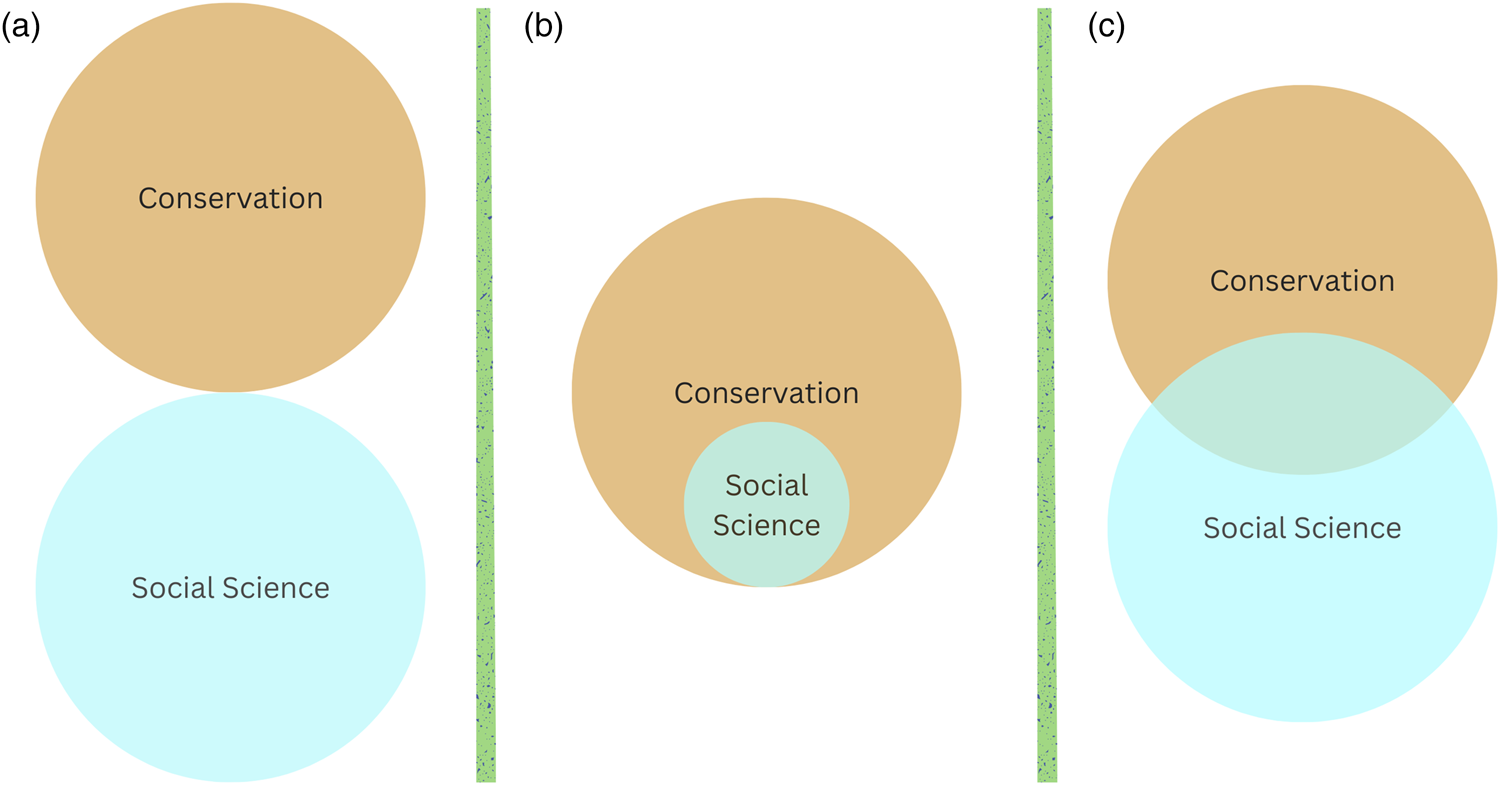
The idea of co-reflexivity builds on growing efforts to establish productive interdisciplinary dialogues between critical social scientists and conservationists (Eghenter, Reference Eghenter, Walters, McCay and West2008; Peterson et al., Reference Peterson, Russel, West and Brosius2010; Chua et al., Reference Chua, Harrison, Fair, Milne, Palmer and Rubis2020; Fair et al., Reference Fair, Schreer, Keil, Kiik and Rust2023). Co-reflexivity, we contend, provides a promising alternative to the dichotomy between ‘social science for or on conservation’ (Sandbrook et al., Reference Sandbrook, Adams, Büscher and Vira2013, p. 1487), in which social research is either used to support existing models and goals of conservation, or social scientists provide at times overly critical accounts of conservation that are not necessarily oriented towards constructive impact. Although it can be a matter of disciplinary and personal ethics for critical social scientists, such as political ecologists, to distance themselves from conservation to better contest the sector's colonial legacy of social injustice and racialized dispossession (Brockington et al., Reference Brockington, Duffy and Igoe2008; Milne, Reference Milne2022; Fair et al., Reference Fair, Schreer, Keil, Kiik and Rust2023), a rigid dichotomy between co-production and critique can reinforce a problematic ‘separation of critical thought from action’ (Perry, Reference Perry2022, p. 350). Moreover, we argue, the distinction between social science for or on conservation insufficiently accommodates the aspirations of many critical social scientists to contribute actively to conservation efforts (Massarella et al., Reference Massarella, Nygren, Fletcher, Büscher, Kiwango and Komi2021; Claus, Reference Claus2022; Fair et al., Reference Fair, Schreer, Keil, Kiik and Rust2023) and the increasing (if largely informal) tendencies for critical introspection amongst conservation professionals (Pienkowski et al., Reference Pienkowski, Kiik, Catalano, Hazenbosch, Izquierdo-Tort and Khanyari2023). Taking up the call for critical social science to go beyond just critiquing conservation professionals and instead ‘to offer solidarity and support in promoting knowledge practices that recognize and resist injustices’ (Staddon, Reference Staddon2021, p. 13), we seek to demonstrate the potential of what we call social science with conservation, in which social scientists and conservation professionals co-produce critique (Fig. 1).
Schematic representation of three social science–conservation relations. (a) Social science on conservation: social science engages with conservation without aligning its interests, leading to important but confrontational critiques. (b) Social science for conservation: social science is embedded in and directly contributes to conservation practice but loses its critical potential. (c) Social science with conservation: social scientists work with conservation practitioners to investigate questions of shared interest and co-produce critique.
We illustrate this through an exploration of the project model, the dominant mode of operation in conservation as well as many other sectors, which organizes activity into distinct, target-oriented and temporally bounded units that can be funded, implemented and evaluated separately (Lundin, Reference Lundin2016). Through ‘sustained conversations’ (West & Brockington, Reference West and Brockington2006, p. 614), a form of collaboration in which social scientists and conservation professionals engage in genuine reflection over an extended period of time, we put insights from social science research on project-based conservation into dialogue with conservation professionals' experiences, analyses and responses to project work. Given the significance of the project model in conservation and beyond, we hope our paper will stimulate further exploration of this topic whilst simultaneously serving as a case study on how co-reflexivity can facilitate productive engagements between conservation and social science.
Here we first describe the process of co-reflexivity through which this paper emerged and the data on which the analysis draws. Subsequently, we outline the basic tenets of the project model and how it structures and restricts conservation practices. We then showcase three critical perspectives on the project model developed through co-reflexivity. Finally, we discuss the implications of our analysis and possible ways forward.
Methods
Our analysis builds on a process of joint reflection and co-writing on the structures and effects of the project model in conservation. We first discussed our experiences with project-based conservation at a panel at the Royal Anthropological Institute's Anthropology and Conservation Conference in 2021. Through four online group meetings over 15 months and ongoing co-writing facilitated by VS and PT, we created ‘safe spaces’ that were ‘temporarily removed from funding obligations, media and public scrutiny, and other pressures’ (Chua et al., Reference Chua, Harrison, Fair, Milne, Palmer and Rubis2020, p. 54) to collectively reflect on the project model, read and comment on each other's work, analyse our experiences and decide what (not) to write. Thinking from and across our different subject positions as conservation practitioners (PT, BA, GC-S, CE), conservation scientists (BA, GC-S, SS) and social scientists (VS, PT, SF, CE) helped us to identify various challenges and pitfalls of project-based conservation. Many of us have spanned multiple roles at various times, which helped us in this process. None of the co-authors originate from the countries we write about. Although we invited researchers and practitioners from these countries to participate, their inability to do so reflects the continuing inequalities of international academia.
We integrate three sources of data. The first is a set of personal reflections by conservation practitioners on the project model's institutional constraints. These autoethnographic accounts stem from research and work experiences and highlight the informal reflexive processes that already occur in conservation. Those of us who are conservation practitioners and conservation scientists have each been involved in project-based conservation for between 1 and 25 years. Secondly, we draw on social scientific research conducted by VS, PT and SF on conservation projects in Indonesia and Haiti. This ethnographic fieldwork included participant observation and interviews and spanned 37 months during 2011–2021. To avoid harming our organizations and interlocutors, we have anonymized exact research locations, projects and organizations and use gender-neutral pronouns. Thirdly, we refer to the social science literature on project-based conservation and development practice to connect and contextualize our reflections and empirical insights.
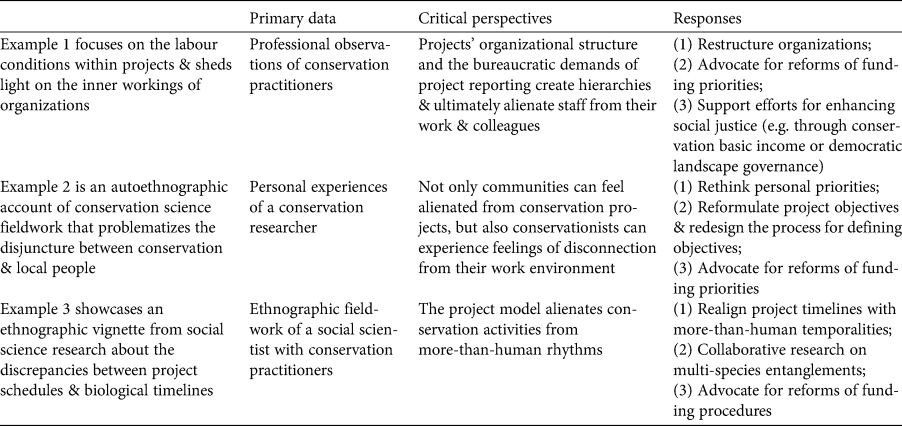
We bring these different materials together in three examples (Table 1) to support two principal arguments regarding reflexivity. Firstly, conservation practitioners already reflect on the broader power relationships that surround them and, secondly, these reflections are bolstered and find larger meaning through cross-disciplinary collaboration. Beyond benefitting our analysis, our engagement helped foster an ethos of empathy and understanding towards conservation professionals in the social scientists amongst us. Although initially aiming to advance critiques of project-based conservation, we realized the broader value of our approach, which we conceptualized as co-reflexivity.
Summary of the three examples of co-reflexivity presented in this paper.
Case description: the project model in conservation
Similar to the development and humanitarian sectors, conservation donors tend to fund discrete sets of predefined activities rather than supporting governmental or organizational budgets. Historically, results-based financing gained prominence as a way for donors to control the use of funds in contexts where they lacked trust in public institutions (Sayer & Wells, Reference Sayer, Wells, McShane and Wells2004). In a foundational step, Robert McNamara changed the procedures of the U.S. Department of Defense to link budgeting with planning in the 1960s, which partly spread across other USA federal agencies and the World Bank (Krause, Reference Krause2014). Neoliberal economic reasoning furthered critiques of direct budgetary support as funders sought to sidestep the perceived inefficiency of recipient governments and hold grantees accountable. These principles then moved into the aid and conservation sectors and had profound impacts (Milne, Reference Milne2022).
Projects cut complex realities into simplified, manageable problems removed from their particular contexts. This favours technical, depoliticized and often ad hoc solutions over more fundamental, systemic changes (Li, Reference Li2016). The short-term nature of projects also hinders long-term planning and makes it difficult for conservation practitioners to develop long-lasting, trusting relationships (Adams et al., Reference Adams, Hodge, Macgregor and Sandbrook2016). Additionally, the pressure to deliver quick results hampers the prioritization of reflexivity (Staddon, Reference Staddon2021). Moreover, having a fixed list of activities prevents conservation projects from adapting to local realities (Sayer & Wells, Reference Sayer, Wells, McShane and Wells2004; Lyons, Reference Lyons2013). Finally, competition for funding incentivizes success narratives through visible and documentable outputs (Büscher, Reference Büscher2014; Krause, Reference Krause2014). This encourages the manipulation of evaluations (Mosse, Reference Mosse2005; Wahlén, Reference Wahlén2014; Freeman & Schuller, Reference Freeman and Schuller2020), leads to missed opportunities to learn from failures (Catalano et al., Reference Catalano, Lyons-White, Mills and Knight2019) and impedes the institutionalization of reflexivity.
Several attempts have been made to overcome the restrictions of project-based funding. Some funders and organizations work within theories of change to account for the long-term, complex and contested dynamics through which conservation outcomes are achieved (Rice et al., Reference Rice, Sowman and Bavinck2020). Adaptive management and integrated landscape approaches also seek to alter the fixed nature of inputs and outcomes through a more iterative approach (Williams, Reference Williams2011; Sayer et al., Reference Sayer, Sunderland, Ghazoul, Pfund, Sheil and Meijaard2013). Furthermore, donors and conservation organizations have in recent years started to emphasize the cultivation of long-term funding networks and relationships (Sauls & López Illescas, Reference Sauls and López Illescas2023). Nevertheless, projects still remain the dominant basis for conservation funding.
The literature on the project model rarely integrates the reflections and analyses of conservation professionals, with some notable exceptions (Lyons, Reference Lyons2013; Wahlén, Reference Wahlén2014). This could be because of methodological hurdles that social scientists face when engaging with conservation professionals, such as the difficulty of gaining access to organizations and the high levels of mobility of their staff (Kiik, Reference Kiik2019; Milne, Reference Milne2022; Saif et al., Reference Saif, Staddon and Keane2023). However, conservation professionals may find their methodological toolkits and professional incentives are not conducive to a critical analysis of bureaucratic structures. We argue, however, that there is potential for social scientists and conservation professionals to reflect jointly on how the project model structures and limits conservation efforts and to formulate responses to overcome some of the challenges involved in this model, as the following examples of co-reflexivity illustrate.
Three co-critiques of the project model in conservation
Example 1: The alienation of project implementers
Rooted in beliefs about the intrinsic value of nature, many conservationists are at least partly driven by ideological reasons (Sandbrook et al., Reference Sandbrook, Scales, Vira and Adams2011), such as giving back to the natural world or learning from Indigenous Peoples how to mend our relationship with nature. Despite their heterogeneous values (Sandbrook et al., Reference Sandbrook, Scales, Vira and Adams2011; Palmer, Reference Palmer2020), conservationists often share a feeling that they have a moral responsibility to save nature. Such personal motivations benefit conservation efforts because they foster connections amongst staff. However, the reality of working in conservation often feels removed from these motivations. A lot of energy goes into the production of project documents to satisfy bureaucratic requirements (cf. Freeman & Schuller, Reference Freeman and Schuller2020). This has profound effects on the subjectivities of conservation staff, as revealed by the following shared reflections of two authors, who have both been working for conservation NGOs in Indonesia for over a decade.
The administrative structures of projects create distances between the people who design projects and those who implement them. The often local project implementers have little control over project design, which is determined mainly by office-based staff, often from other regions or countries, who write proposals and manage grants. This division of labour is useful for managing international project funds, which requires specific skills, such as report writing and English language expertise. A downside, however, is that project implementers can become alienated from their work, especially when projects don't entirely make sense in the field.
Instead of working creatively towards a shared goal, we have observed that some colleagues seem merely interested in hitting their given targets and are quick to leave organizations for better opportunities. Retaining staff is thus a challenge for organizations. On the other hand, project implementers complain about short-term contracts, low payment, insufficient budget, unrealistic goals and strict timelines. Often, they fail to see how their labour contributes to fulfilling their ideals. This can lead to a crisis of identity, where project implementers question their role, asking questions such as ‘What is my purpose here?’.
Rather than blaming our colleagues, we sought to understand their challenges. We suspected that internal divisions of labour within conservation organizations can undermine local staff's sense of ownership and lead to a lack of loyalty to the organization, a lack of understanding of project aims and a lack of unity, transparency and trust between staff. Therefore, one of us has been trying to close the gap between designers and implementers, by giving the latter more skills and opportunities to contribute to project design and thereby setting the conditions for more meaningful work. (Professional observations of two conservation practitioners)
These reflections speak to emerging social science research into the identity positions of ‘the local-national professionals at conservation's heart’ (cf. Sundberg, Reference Sundberg2004; Kiik, Reference Kiik2019, p. 410), their opinions on strategic and ethical questions (Sandbrook et al., Reference Sandbrook, Scales, Vira and Adams2011; Palmer, Reference Palmer2020) and their ideological and practical motivations for engaging in conservation (cf. Cepek, Reference Cepek2011). These dynamics are not unique to conservation organizations. Research on other organizations confirms that organizational structures can alienate staff (Riles, Reference Riles2007) and problematizes the lack of support received by the so-called implementariat (Peters, Reference Peters2020) or eco-precariat (Neimark, Reference Neimark2023).
Given their shared interests in how project structures and their inherent power imbalances reshape conservation identities and work ethics, there are opportunities for productive dialogue between conservation practitioners and social scientists. For one, the social science critiques of organizational hierarchies can help legitimize attempts by conservation workers to restructure organizations from the inside out. Social science, moreover, reminds us to consider the broader political, economic, social and environmental conditions faced by local conservation staff. Project implementers often work in challenging physical environments, sometimes with dangerous animals (Münster, Reference Münster2016; Parreñas, Reference Parreñas2018) and often on low-paying and insecure contracts (Sodikoff, Reference Sodikoff2009). Frequently, they occupy an awkward mediating position between the divergent expectations of international conservation, national politics and local communities (Lowe, Reference Lowe2013; Haenn, Reference Haenn2016; Chua et al., Reference Chua, Fair, Schreer, Stępień and Thung2021). As Goodman (Reference Goodman2020) has pointed out, field staff often value and are vitally dependent on personal relationships with project beneficiaries, shaping how they relate to their work. Finally, the supposed beneficiaries of aid projects are often also expected to perform labour to receive aid. The acknowledgement, support and compensation that these beneficiary-workers (Carruth & Freeman, Reference Carruth and Freeman2021) receive are even less adequate than those received by formally employed project implementers.
These insights raise pertinent questions about how best to respond to the alienation of project implementers. In the case above, the organization trained implementers in project design, which required them to learn management skills, take ownership of activities and budgets and understand their responsibilities to various stakeholders whilst ensuring that organizational goals and donor expectations were met. However, is it viable to expect all conservation professionals to commit to the conservation mission in the same way, or is it more realistic to acknowledge that people come to conservation with heterogeneous motivations and obligations? Moreover, can the project model genuinely function without implementers, or are these divisions of labour an unavoidable aspect of what Sodikoff (Reference Sodikoff2009, p. 444) referred to as conservation's ‘institutional dependence on cheap agrarian labor’? Wider societal conditions point to the limits of redesigning organizational structures, suggesting the additional need for both more modest strategies of properly rewarding and protecting conservation labourers, and more radical societal transformations, such as promoting the conservation basic income and more democratic forms of landscape governance (cf. Büscher & Fletcher, Reference Büscher and Fletcher2020).
Example 2: Disjunctures between conservation and community
Many conservation projects rely on the support of local communities. However, conservation professionals often struggle to engage with community life, as the following autoethnographic account shows. The reflection stems from one of the authors, who has worked for 10 years as a biological researcher in Indonesia. Looking back on their relationship with the communities where they carried out their research, the anecdote reveals how project procedures can create a sense of disconnection from communities.
Back in 2005, funders had allotted money to study the local orangutan population. Simultaneously, there was funding to implement some educational and community development programming. But the 2-year timelines did not allow time to sit, listen and build up authentic relations with local people. Instead, I felt pressure to treat villages as stopover sites, in which to arrange everything for the ‘real work’ in the forest. On one such stopover, another conservation worker, who had been in the village a bit longer, got annoyed and said that I sent everything into disarray: ‘You just come in like a tornado.’ The comment stuck with me, as I cared about the place and hated that my behaviour did not reflect that. While I had close relationships with the people I worked with in the forest, I realized that I knew little about people in the village. This sense of disconnect between my work and the issues on the ground became a really thorny and insurmountable issue. I was not even beginning to address the root causes of the problems I was seeing. I felt powerless and alienated from the larger goal of conservation. In response, I slowed down and paid more attention to the aims of the communities as well as the bigger social, economic and political contexts of my work. Sharing and developing these critical reflections with my co-authors has been very influential for re-imagining my role as a conservationist, researcher and director of projects. It has led me to actively address the deeper, root causes of conservation problems—from starting to read the political ecology literature to changing my research and conservation activities. (Personal reflections of a conservation researcher)
The social science literature indicates this is not an isolated case but can be seen as a structural effect of the project model. The short-term nature of projects impedes working with the rhythms of a place, fostering meaningful relationships or understanding the complexities of communities (Li, Reference Li2016). Moreover, even when staff care about communities, the relationships that do develop are often terminated when projects end. Simplifications and project exits are usually built into proposals, as funders prefer clear deliverables, budgets and timelines (Perez, Reference Perez2010), and the question of what will happen after the project is rarely answered satisfactorily (Sayer & Wells, Reference Sayer, Wells, McShane and Wells2004).
Alienation between communities and conservation workers is a serious concern, not least because of local expectations of long-term relations of mutual care, benefit-sharing and reciprocity (VS; Chua et al., Reference Chua, Fair, Schreer, Stępień and Thung2021). Although scientists increasingly see such relationships as indispensable for effective conservation (Adams et al., Reference Adams, Hodge, Macgregor and Sandbrook2016; Toomey, Reference Toomey2020; Staddon et al., Reference Staddon, Byg, Chapman, Fish, Hague and Horgan2021), there have been numerous documented cases of conflicts between NGOs and communities because of conflicting land claims, restricted resource access or a perceived lack of inclusion, transparency and benefit-sharing (West, Reference West2006; Griffin et al., Reference Griffin, Jones and Robertson2019). Sometimes communities experience projects as impositions from outside or view them as ways for NGOs to capture international funds (Cepek, Reference Cepek2011). Community members who feel alienated from conservation projects may actively resist (Brockington, Reference Brockington2004), lack the motivation to participate (Perez, Reference Perez2010; Schreer, Reference Schreer2023 ) or use projects as an opportunity for personal monetary gain.
This example also highlights that conservation professionals are already critically reflecting on the project model (cf. Tallack & Bruno-van Vijfeijken, Reference Tallack and Bruno-van Vijfeijken2022). Researchers could themselves realize, sometimes through informal encounters, that project requirements pressure them to oversimplify complex questions and neglect relationships on which their work depends. In this case, the result was a feeling of alienation from the community and a sense of deep regret about this situation and, in response, an attempt to think and act beyond the boundaries of projects by slowing down research activities, taking community concerns more seriously, designing locally meaningful projects and developing critical thinking about conservation.
Example 3: Disconnects from more-than-human temporalities
During their ethnographic research on soil conservation in Haiti in 2012, one author spent time with NGO workers, who reflected on the difficult choices they have to make within the constraints of the project model. The research found that the restrictions on timelines and activities discussed above caused disconnects with non-humans, including the very trees and ecosystems that conservation projects seek to protect.
After the 2010 earthquake, there was an increase of funding for humanitarian, environmental and development projects in the countryside. Channelled through the United Nations (UN), European donor funding was envisioned as a long-term initiative but reached the countryside in the form of a variety of projects for sub-contractors. Reflections from two agronomists demonstrate the problems of project funding on the ground, which they openly expressed to the social science researcher because of their independent background.
During a meeting in the local UN office, a Haitian agronomist noted that the UN's funding timeframes were too short. A sub-contracting organization aimed to boost rural incomes by planting fruit trees but, because of the long period of time necessary for trees to grow, fruit to form and markets to develop, he calculated that it would take 10 years to see results. But, he said, the financing for projects occurs for 6 months, or 3 years at the most.
Similarly, another Haitian NGO was caught between the demands of seasonal plantings and the constraints of project financing. The NGO was promised a second year of funding, but the process had been delayed. When they finally got administrative approval, the seasonal planting time had passed. Without the funding to support their extension workers, efforts to replant hillsides and graft trees were put on hold, awaiting the next funding cycle. During the weekly meetings, the technical director often threw up his hands in exasperation, lamenting how the system was oriented not to agricultural needs but to administrative ones. (Findings of ethnographic research)
The demand for greater attention to be given to non-human life-forms shared by these professionals has also been a rallying point for social scientists. Scholars have noted the mismatches between the short timescales at which people are used to thinking and acting and the much longer timescales in which ecosystems operate (Metcalf et al., Reference Metcalf, Mohr, Yung, Metcalf and Craig2015), but also more fundamental mismatches between the ‘abstract time-reckoning’ of capitalism and ‘concrete experiences of time’ based in biological, geological and planetary rhythms (Bear, Reference Bear2014, p. 3; Gibson & Warren, Reference Gibson and Warren2020).
One challenge that this literature raises for conservation is how best to account for more-than-human rhythms within project frameworks. The above examples show how financialized project time can take priority over arboreal time. As Bear (Reference Bear2014, p. 19) theorized, this ‘centrality of [capitalist] time is a symptom of inequalities in social relationships’. In this case, the inequalities between funders, conservation and aid workers and the trees and plants they cultivate made the aid workers powerless to change project timelines.
Responding to these challenges, the field of multi-species studies has argued that the fundamental entanglements between people and other living beings are best attended to through new ‘engagements and collaborations with scientists, farmers, hunters, indigenous peoples, activists, and artists’ (van Dooren et al., Reference van Dooren, Kirksey and Münster2016, p. 5). To these, we add collaborations between social scientists and conservation professionals. Such collaborations could, for example, document and raise awareness about the importance of non-human labour in implementing conservation projects (Fair & McMullen, Reference Fair and McMullen2023) or about the ways in which non-human entities should be taken seriously as stakeholders of conservation efforts (Tryggestad et al., Reference Tryggestad, Justesen and Mouritsen2013). This would strengthen the position of professionals such as the Haitian agronomist in negotiations with donors, potentially reshaping the temporal (and other) boundaries of projects to accommodate non-human life.
Discussion
Our reflections on the project model demonstrate the value of cross-disciplinary engagement between conservation professionals and social scientists. Even though the project model could be considered a relatively abstract issue, so ubiquitous that it is difficult to discern, we have shown that conservation professionals do reflect on its effects and work to overcome its limitations.
Conservation professionals can help to ground, validate and refine academic analyses of the project model (and, by extension, analyses of conservation at large), and yet their experiences are under-represented in the literature on the project model. This omission is a missed opportunity to learn from a rich, if largely informal and undocumented, body of intellectual work. In return, social scientists can provide professionals with the space and time to explore critical questions about the power relations, organizational structures and socio-political contexts of their work. The practice of co-reflexivity can validate and deepen these reflections by putting them in dialogue with each other, connecting them with social science concepts, theories and case studies, and organizing them in an analytical way. However, as our limited set of examples demonstrates, there is a wide diversity of conservation professionals, and their capacities to engage with social science and enact change vary in ways that may not be completely resolved by co-reflexivity.
Our process of thinking and writing together has identified several important questions for further research with both theoretical and practical relevance. How does the project model shape organizational structures? How do these influence conservation subjectivities and impede reflexivity? How is it possible to redesign organizational structures to empower local-national staff? How do projects' fixed aims and timeframes structure relations between conservation professionals and communities? How do these relations transcend or transform the project model? How do project structures affect the living world beyond people?
Addressing questions such as these through a practice of co-reflexivity could help to formulate responses to the project model. For example, co-producing critique could empower professionals to voice and act on their concerns more actively. With a clearer view of the economic, political and social structures at play, they could champion organizational reforms, insist on more integrated and realistic project designs or even occasionally prioritize local needs and relationships over project deliverables. In addition, documenting processes of reflexivity can strengthen the evidence base required to convince funders to allow more time for meaningful connections to unfold. For instance, case studies could show how project structures undermine relationships or how conservation professionals work around these restrictions to form productive relationships with colleagues, communities and non-human entities.
Co-reflexivity, as a form of social science with conservation in which the two meet on equal footing, can thus highlight critical insights and questions with the potential to catalyse beneficial changes in the conservation sector. This can be a starting point for other forms of collaborative research. Social scientists and conservationists could, for example, take up the work of critical action intellectuals (Ojha et al., Reference Ojha, Nightingale, Gonda, Muok, Eriksen, Khatri and Paudel2022), who mobilize their research to transform environmental governance. Alternatively, co-reflexivity could help identify opportunities to expand repertoires of interdisciplinary research for conservation (Caudron et al., Reference Caudron, Vigier and Champigneulle2012) by addressing more sensitive topics. Such collaborations would be well placed to produce insights into the experiences of local-national conservation professionals that anthropological approaches have struggled to capture (Kiik, Reference Kiik2019) as well as to provide important lessons for conservation practice on topics that individual conservation professionals by themselves may not be able to address (Staddon, Reference Staddon2021).
Future co-reflexivity could include interdisciplinary panels in academic conferences, such as at the 2021 Royal Anthropological Institute's Anthropology and Conservation Conference. A limitation we encountered, however, was that local-national staff could not participate in our panel because of financial and bureaucratic hurdles even though their experiences are crucial for understanding project-based conservation. To overcome this limitation, larger organizations could hire social scientists to facilitate processes of co-reflexivity internally, or donors could fund reflexive processes with staff from multiple smaller organizations. Additionally, in view of the important role of funders in facilitating change in conservation (Blackwatters et al., Reference Blackwatters, Betsill, Enrici, Le Cornu, Basurto and Gruby2023), future work could engage funders in processes of co-reflexivity. Finally, further integrating social science modules into conservation science curricula is essential to acquaint students with reflexivity and set a foundation to engage in productive interdisciplinary dialogues.
Our call for social science with conservation does not diminish the need for nuanced social science on and for conservation. Social science on conservation remains necessary not least because conservation professionals and social scientists working with conservation may be restricted in their critique by their relationships with NGOs, governments and donors (cf. Staddon, Reference Staddon2021; Fair et al., Reference Fair, Schreer, Keil, Kiik and Rust2023). Additionally, social science for conservation must continue to evolve to advise policymakers and practitioners on the social dimensions of conservation (Miller et al., Reference Miller, Scales and Mascia2023), although conservation social scientists are not exempt from the need to promote critical awareness of problematic aspects of conservation. Rather than supplanting these areas of engagement, we propose that the co-production of critique by doing social science with conservation represents an additional step towards more effective and equitable forms of both conservation and social science.
Author contributions
VS and PT contributed equally and led the writing. Conceptualization: all authors; fieldwork: VS, PT, SF; analysis: all authors; writing: VS, PT, SF, NBA, GC-S, SS; revision: VS, PT, SF, CE.
Acknowledgements
We thank the editor and anonymous reviewers for their helpful suggestions; our colleagues at Brunel University London and the University of Cambridge for their input and our university counterparts (Universitas Indonesia and Universitas Muhammadiyah Palangkaraya) in Indonesia for hosting our research; our conservation partners in Indonesia for their support (Borneo Nature Foundation, the General Director of the Biodiversity Conservation Agency of the Natural Resources and Ecosystem Conservation (KSDAE), the General Director of the Ministry of Environment and Forestry of the Republic of Indonesia, the Bukit Baka Bukit Raya National Park authorities, the Gunung Palung National Park authorities and the Forestry Management Unit–South Ketapang (Dinas Kehutanan Provinsi KalBar)); and those who shared their stories and perspectives during the course of our research and work. VS's research was funded by the European Research Council under the European Union's Horizon 2020 research and innovation programme (grant agreement no. 758494). PT received funding from the Arcus Foundation's Great Apes Program (G-PGM-1607-1886) and Brunel University London. GC-S received support from Arcus Foundation, the U.S. Fish and Wildlife Service, Oak Foundation, The Orangutan Project and Orangutan Outreach. SF's research was supported by funding from the Advanced Consortium on Cooperation, Conflict, and Complexity at the Earth Institute at Columbia University and the School of International Service at American University. SS received funding from The Leakey Foundation and Nacey Maggioncalda Foundation. The opinions expressed here are those of the authors, not their institutions.
Conflicts of interest
None.
Ethical Standards
Our research abided by the Oryx guidelines on ethical standards. Prior to fieldwork, ethical approval from our respective universities and relevant government authorities was obtained. Research in Indonesia was carried out under RISTEK permit numbers 5/SIP/FRP/E5/Dit.KI/I/2019 (VS) and 1/E5/E5.4/SIP.EXT/2020 (PT).
Data availability
The data presented in the manuscript are not accessible because of privacy restrictions.


 Open access

