


Overweight, obesity and unhealthy diets are leading contributors to the burden of disease in Australia and internationally(1). In 2016, more than 1·9 billion adults were overweight worldwide while 650 million adults and 41 million children were obese(2–4). In 2014, the global economic impact of obesity was an estimated $US 2 trillion(Reference Dobbs, Sawers and Thompson5). In Australia, 63·4 % of adults are overweight or obese, signifying that it is statistically ‘normal’ to be an unhealthy weight(Reference Falbe, Thompson and Becker6). Furthermore, overweight and obesity affects 25 % of children between the ages of 2 and 17 years(Reference Crowle and Turner7). The WHO has labelled childhood obesity a serious public health challenge, as obesity in early life often tracks into adulthood, increasing the risk of non-communicable diseases(Reference Dharmasena and Capps8).
Childhood obesity has many complex and interconnected determinants, including the increasingly obesogenic nature of food supply chains and environments(Reference Swinburn, Sacks and Hall9,Reference Butland, Jebb and Kopelman10) . A ‘package’ of policy interventions is needed to prevent and attenuate these systemic drivers of obesity, including a strong role for legislative and regulatory action by governments(Reference Swinburn, Egger and Raza11,Reference Magnusson12) . This includes regulating the marketing of junk foods (ultra-processed foods and beverages high in saturated/trans-fats, sugars and salt, and low in essential nutrients) to children(Reference Dixon, Scully and Wakefield13–16). Over the last two decades, junk-food marketing targeting children has received increased attention by public health researchers, advocates and policy makers as a factor contributing to childhood obesity(Reference Jolly17). While an initial focus was on marketing in print and broadcast media (in 2006, 81 % of food advertisements broadcast on television were for junk foods(Reference Chapman, Nicholas and Supramaniam18)), digital formats have become an increasingly prevalent and unregulated source of junk-food marketing directed at children(Reference Vassallo, Kelly and Zhang19,Reference Kelly, Vandevijvere and Freeman20) . Evidence suggests that marketing subconsciously persuades children to desire unhealthy products(Reference Dixon, Scully and Wakefield13,Reference Carter, Patterson and Donovan21) . As children have a limited understanding of marketing, they are vulnerable to commercial manipulation(Reference Jolly17). A key strategy used by food marketers is promoting ‘pester power’ (children’s influence on parental buying habits through unrelenting demands) to undermine parental authority(Reference McDermott, O’Sullivan and Stead22,Reference Marshall, O’Donohoe and Kline23) .
Despite expert consensus that legislative action is required to address this issue, it has been met with a government preference for industry self-regulation, indicative of weak political commitment(Reference Baker, Gill and Friel24,Reference Hallal, Andersen and Bull25) . One reason for this is the contested nature of junk-food marketing – there are many actors invested with competing interests, beliefs and worldviews(Reference Rittel and Webber26,Reference Cullerton, Donnet and Lee27) . Understanding how junk-food marketing is interpreted, portrayed and contested by various stakeholders can help to understand why political commitment for the issue is low, and may further inform communication strategies for public health nutrition (PHN) advocates to generate political priority in the future. This includes the capacity to adapt messages to specific audiences, advocate for evidence-informed policy change and effectively appeal to the beliefs and priorities of policy makers(Reference Baker, Hawkes and Wingrove28). One approach for understanding how contested problems like junk-food marketing are politically ‘constructed’ is framing analysis. Framing (the process by which issues are interpreted and communicated through social discourse) involves highlighting desirable aspects of a problem while obscuring those deemed undesirable(Reference Goffman29–Reference Oliver and Johnston31). Frames can be analysed to identify trends in issue portrayals over time and to compare how topical issues are constructed by different stakeholders(Reference Chong and Druckman32). Through effective framing, political actors can increase the salience of an issue (i.e. making it noticeable, meaningful and memorable to external audiences), mobilise supporters and counter opposition(Reference Entman33–Reference Shiffman35). In this regard, understanding framing processes can help to explain why some issues come to be considered worthy of political commitment and policy enactment, whereas others are ignored(Reference Shiffman35).
Arguably the most important group of stakeholders with the power to respond to this issue are parliamentarians; members of Australian political parties elected to either the House of Representatives or the Senate. As they have the power to propose, champion and enact policy responses, understanding how they interpret and portray the issue is vital(Reference Baggott36,Reference Friel37) . Parliamentarians do not develop frames and messaging strategies in isolation; they are often influenced by other members and the ideologies of their political parties, speech writers, policy advisers, the media, industries, think-tanks and interest groups, among others(Reference Halligan38–Reference Dorfman, Wallack and Woodruff40). Despite their influence, few studies internationally have explored how parliamentarians frame PHN issues. A small number of studies on the political framing of food insecurity in Canada demonstrate that although a diversity of opposing causes and solutions frames are deployed by parliamentarians, the framing of some key issues (including poverty) is universal and uncontested(Reference Patterson, McIntyre and Anderson41–Reference McIntyre, Lukic and Patterson43). However, these studies also show that conflicting frames and opposing symbolic devices deployed by opposing parties contributes to the intractability of PHN problems, thereby resulting in a lack of political commitment for legislative change(Reference McIntyre, Patterson and Mah44). Otherwise, current literature on the framing of child obesity and junk-food marketing focuses on the media(Reference Henderson, Coveney and Ward45–Reference Gollust, Niederdeppe and Barry47).
Acknowledging these gaps, the aim of the present study was to understand how Australian parliamentarians interpret, portray and contest (i.e. frame) junk-food marketing to children. We address the following research questions: how do Australian parliamentarians frame the issue of junk-food marketing to children and how do their portrayals reflect underlying political party ideologies? In achieving this aim, the study may inform communication strategies of PHN advocates.
Methods
Study design
The present study used a theory-guided framing analysis to identify frames used by Australian parliamentarians in parliamentary speeches and variations in those frames across political parties. Transcripts were accessed from the Australian Commonwealth Government’s Parliamentary Hansards. The study followed four steps: (i) development of a theoretical framework to guide the analysis; (ii) data collection involving a search and extraction of parliamentary transcripts; (iii) content analysis to identify political party affiliations of parliamentarians, time periods of debates and document types; and (iv) coding of transcripts and identification of frames.
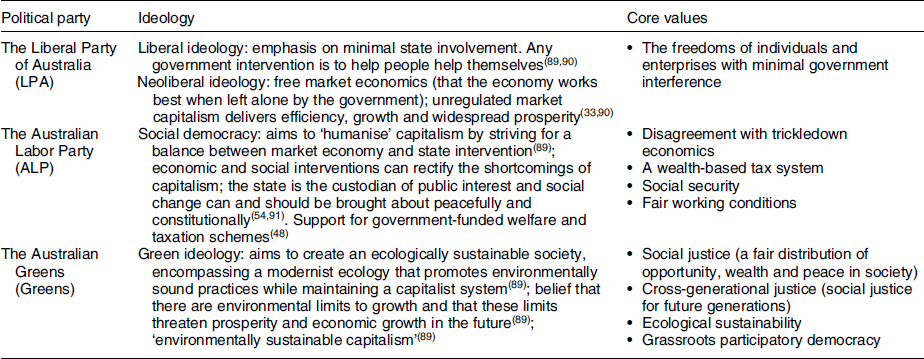
The scope of the present study is limited to parliamentarians from Australia’s three major parties: The Liberal Party of Australia (LPA), The Australian Labor Party (ALP) and The Australian Greens (Greens). Due to limited representation in the sample, The National Party of Australia, The Australian Democrats and independent parliamentarians were not analysed. The ideologies and core values of the three major parties are shown in Table 1. Australia has a liberal-democratic federal system of government comprising the Australian Commonwealth Government, state/territory and local governments. The Australian Commonwealth Government proposes and enacts policy and legislation through a bicameral Parliamentary legislature (House of Representatives and Senate) and Executive led by the Prime Minister and Cabinet elected on a three-year term. The Australian Public Service administers policy with responsibilities for making, monitoring and enforcing policy and regulation(Reference Parkin, Summers and Woodward48). The Australian Communications and Media Authority has responsibility for regulating advertising(Reference Baker, Gill and Friel24).
Australian political party ideologies
Theoretical background
To understand how junk-food marketing is constructed, we adopted a constructivist approach. Constructivism emphasises the power of ideas in political discourse, stressing the role of underlying worldviews, belief systems and discourse(Reference Benford and Snow34,Reference Shiffman35,Reference Reichenbach49) . In this perspective, material factors alone (e.g. mortality/morbidity) are unlikely to explain why some health problems attract political priority while others are neglected(Reference Shiffman35,Reference Shiffman and Smith50–Reference Sabatier52) . Rather, policy problems are ‘constructed’ through discourse in ways that reflect the underlying ideologies, causal beliefs and strategic objectives of different actors and coalitions(Reference Benford and Snow34,Reference Shiffman35,Reference Reichenbach49,Reference Shiffman and Smith50,Reference Snow and Benford53) .
Framing theory, grounded in constructivism, elaborates on the way ideas are interpreted, communicated and subsequently understood in public discourse(Reference Goffman29–Reference Oliver and Johnston31,Reference Entman33,Reference Benford and Snow34,Reference Béland54,Reference Béland55) . Empirical and theoretical studies identify four ways in which political actors use framing to further their political objectives: (i) by defining the nature, scope and severity of a policy problem, thereby increasing its social salience(Reference Stone30,Reference Koon, Hawkins and Mayhew56) ; (ii) by inferring causality in terms of who/what is to blame for the problem(Reference Stone30,Reference Entman33,Reference Snow and Benford53) ; (iii) by establishing who is responsible for resolving the problem, reducing the accountability of some actors while increasing the obligation of others(Reference Stone30,Reference Entman33) ; and (iv) by using prognostic framing – proposing and justifying solutions to address the causes of a problem most effectively, including policy interventions(Reference Entman33,Reference Snow and Benford53) .
Two dominant frames are apparent in the framing literature on obesity: individualistic and systemic(Reference Oliver and Johnston31,Reference Dorfman, Wallack and Woodruff40,Reference Barry, Brescoll and Gollust46,Reference Gollust, Niederdeppe and Barry47,Reference Coleman, Thorson and Wilkins57–Reference Snow, Benford, Morris and Mueller66) . When framed individualistically, obesity is defined as an issue that affects only those who choose an unhealthy lifestyle(Reference Dorfman, Wallack and Woodruff40,Reference Barry, Brescoll and Gollust46,Reference Gollust, Niederdeppe and Barry47,Reference Coleman, Thorson and Wilkins57–Reference Shugart65) while the cause of obesity is people consuming too many kilojoules combined with physical inactivity(Reference Jeong, Gilmore and Bleakley59,Reference Patchett, Yeatman and Johnson64,Reference Ulijaszek and McLennan67) . Responsibility for resolving the issue belongs to the individual(Reference Barry, Brescoll and Gollust46,Reference Gollust, Niederdeppe and Barry47,Reference Coleman, Thorson and Wilkins57–Reference Jeong, Gilmore and Bleakley59,Reference Lawrence62,Reference Ortiz, Zimmerman and Adler63) and personal changes in dietary intake and physical activity are portrayed as the primary solution(Reference Dorfman, Wallack and Woodruff40,Reference Gollust, Niederdeppe and Barry47,Reference Coleman, Thorson and Wilkins57,Reference Hilton, Patterson and Teyhan58,Reference Johnson60–Reference Shugart65) . In the systemic frame, obesity is framed as an epidemic, driven by multiple interconnected causes, including the increasingly obesogenic nature of food and physical activity environments(Reference Hilton, Patterson and Teyhan58,Reference Jeong, Gilmore and Bleakley59,Reference Patchett, Yeatman and Johnson64) . Responsibility for fixing the problem lies with a wide set of actors beyond the individual, including the government and food industry(Reference Hilton, Patterson and Teyhan58,Reference Jeong, Gilmore and Bleakley59,Reference Khayatzadeh-Mahani, Ruckert and Labonte61,Reference Lawrence62,Reference Patchett, Yeatman and Johnson64) . Solutions focus on modifying obesogenic environments, including extensive policy and legislative intervention(Reference Hilton, Patterson and Teyhan58,Reference Jeong, Gilmore and Bleakley59,Reference Khayatzadeh-Mahani, Ruckert and Labonte61,Reference Lawrence62,Reference Patchett, Yeatman and Johnson64) . These competing interpretations and portrayals of obesity among stakeholders are a major impediment to achieving political consensus on how to resolve the issue(Reference Baker, Hawkes and Wingrove28).
Frames and framing processes are embedded within wider ideological contexts – organised sets of principles and causal beliefs that manifest within political parties, policy-making institutions and in society-at-large(Reference Béland54,Reference Béland55) . Understanding the underlying ideology of political actors can elucidate why they deploy certain frames over others(Reference Dorfman, Wallack and Woodruff40,Reference Coleman, Thorson and Wilkins57,Reference Shugart65,Reference Benatar68–Reference Rushton and Williams71) .
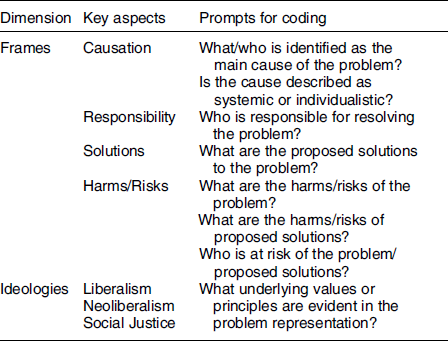
Framework
Informed by a search of key literature on obesity framing and the theory outlined in the previous section, we developed a theoretical framework (Table 2) adapted from the ‘framing matrix’ approach(Reference Kwan72,Reference Jenkin, Signal and Thomson73) . Initially developed by Kwan(Reference Kwan72) (p. 32), Jenkin et al. adopted this framing matrix to identify and compare the framing of obesity by industry stakeholders and PHN advocates(Reference Jenkin, Signal and Thomson73) (p. 1025). We adapted this framework to include ideologies, adding greater context to the analysis and results. The ideologies included are based on the underlying values of Australian political parties to which the parliamentarians belong (Table 1).
Theoretical framework used to guide the framing analysis
Data collection and content analysis
A purposive search of the Australian Commonwealth Government’s Parliamentary Hansard was conducted in June 2018 using the search term ‘obesity’ for transcripts between 1 January 2000 and 8 June 2018. Data were collected from the year 2000 onwards as this year marked a rise in the salience of obesity and, subsequently, political attention to the issue(Reference Baker, Gill and Friel24). The search included transcripts from both The House of Representatives and The Senate Hansards. A total of 930 transcripts were retrieved. Procedural texts, notices and administrative documents were removed from the data set as they lacked content for analysis, leaving 867 transcripts. Prominent issues debated in relation to obesity included inter alia junk-food marketing to children, the general health of the population and establishment/abolition of the Australian National Preventative Health Agency.
Ultimately, the present study explored junk-food marketing to children as it was the most prevalent issue raised throughout the transcripts (n 95). Upon review of the transcripts, sixteen were removed as they mentioned junk-food marketing only briefly, leaving a final data set of seventy-nine transcripts for analysis. A summary of the search process is shown in Fig. 1.
Summary of the search process for transcripts from the Australian Government’s Parliamentary Hansards relating to parliamentary debates on junk-food marketing to children

Data analysis
Transcripts were uploaded to the qualitative analysis software NVivo version 11. Transcripts were read and coded by the primary author (C.R.), using the theoretical framework in Table 2. Prompts were developed to assist in the systematic coding of the transcripts. An abductive process was used to ensure results were not constrained by the initial framework(Reference Walton74). This allowed for testing and modification of the framework as themes emerged from the data(Reference Kovács and Spens75). Codes were added/modified over repeated and continuous analysis of documents(Reference Glaser76). Prior to and throughout the coding process, emerging results and refinement of key concepts and codes were discussed and clarified by all authors. The final interpretation of results was guided through iterative team discussions.
Results
To contextualise the findings, Fig. 2 displays a timeline of the frequency of debate transcripts. Each time point demonstrates increased attention to the issue and was associated with the tabling (or a proposal for tabling) either legislation or a legislative amendment on junk-food marketing to children. In June 2004, the ALP promised to introduce legislation to ban junk-food marketing to children if it won the election, sparking debate over the issue. Increased attention at other time points corresponded with unsuccessful proposals for legislation by the Greens. Another important policy time point was the release of major reports by the House Standing Committee Inquiry on Obesity and by the National Preventative Health Taskforce respectively in June 2009. The former called for further research on the role of junk-food marketing in childhood obesity and the latter for legislative intervention.
The frequency of transcripts debating junk-food marketing to children from the Australian Government’s Parliamentary Hansards, 2000–2018.  , The Liberal Party of Australia (LPA) in power;
  , The Australian Labor Party (ALP) in power; *discussion prompted by the ALP; †discussion prompted by The Australian Greens (Greens)

Overall, clear contrasts were evident in how parliamentarians from different political parties framed the issue of junk-food marketing. The framework in Table 3 demonstrates these findings, which are discussed in further detail below.
Comparison of the framing of junk-food marketing to children by parliamentarians from major Australian political parties

Framing functions
Causation
Stark disparities existed in how parliamentarians from different political parties framed the causes of obesity, both in children and generally. LPA parliamentarians emphasised the role of the individual, attributing causation to personal choice, poor diets and increasingly sedentary lifestyles. As stated by Senator Guy Barnett, ‘we in Australia, sadly, have seriously unhealthy habits and we refuse to change’. Some LPA parliamentarians framed marketing as a ‘non-cause’, denying that a causal relationship existed between marketing and childhood obesity.
In contrast, Greens parliamentarians framed the causes of childhood obesity as systemic, including the key role of junk-food marketing. While they referred to overconsumption as a cause, it was expressed as a negative consequence of junk-food marketing and was used to discredit the argument that a decline in physical activity was the principal cause of obesity. ALP parliamentarians partook in both causal framings of obesity. While some ALP parliamentarians used a systemic causal framing, others within the party adopted an individualistic framing, stating for example that, ‘we know it is individual choice that is the essential element in making responsible decisions when it comes to diet and lifestyle’ (MP Dana Wortley, ALP, 2011).
Although parliamentarians universally referred to obesity as a ‘complex’ problem, the use of this frame differed between parties. Parliamentarians from both the LPA and the ALP used the complex nature of childhood obesity to delegitimise the role of junk-food marketing legislation, arguing that legislation targeting only one problem was too simple for such a complicated issue. Metaphors used to emphasise this point included that there was ‘no silver bullet’ and ‘no magic fix’. Greens parliamentarians and certain ALP parliamentarians inferred that the complexity of childhood obesity was exacerbated by Australia’s ‘obesogenic environment’(Reference Swinburn, Egger and Raza11). While acknowledging that such a complex issue required multiple solutions, marketing legislation was heralded as necessary.
Harms/risks
Parliamentarians from all political parties agreed upon the risks associated with childhood obesity. These included that childhood obesity tracks into adulthood, that there are serious health implications associated with obesity and that the financial costs of obesity are significant. Figurative language used to describe obesity as harmful was evident across all parties, including phrases such as ‘a vicious cycle’ and ‘a real tragedy’. By far, the most common descriptor for obesity was as ‘an epidemic’ (mentioned sixty-three times across all debates), portraying it as a serious risk to Australian society. Additionally, LPA Senator Guy Barnett suggested that childhood obesity could affect the number of people who are eligible to join Australia’s defence forces in the future.
Responsibility
Greens parliamentarians portrayed the government as the primary stakeholder responsible for attenuating childhood obesity and junk-food marketing. As stated by Senator Bob Brown:
‘When it comes to making sure that somebody intervenes to stop hundreds of millions of dollars of ads contributing to those children becoming fatter, we are the ones responsible … You cannot shake that off and say, “it’s not our responsibility”. It is.’ (Sen. Bob Brown, Greens, 2006)
ALP and LPA parliamentarians held a wider variety of stakeholders responsible. Although both parties acknowledged that the government had some role to play, this referred to government interventions already in place and the government’s ability to do things other than legislate. As the below statement suggests, responsibility is disseminated from one stakeholder to many:
‘This is something that is the responsibility of us as individuals to address. Parents must also take on this issue to look after the interests of their children. It is also an issue for all levels of government … and for all key stakeholders.’ (Sen. Guy Barnett, LPA, 2004)
Although ALP parliamentarians acknowledged that the government has a role to play, the framing of this role changed over time. In 2004, the responsibility of the government was emphasised as integral, yet later it was mixed with industry and individual responsibility:
‘As the caretakers of our next generation, we have a responsibility to legislate for advertising changes that provide children with positive health messages and the knowledge and skills to put them into practice.’ (MP Catherine King, ALP, 2004)
‘We must develop strategic partnerships across the community to ensure that, at all levels of government, industry, business, unions, the non-government sector, research institutions and anywhere else, anyone who wants to be involved in this process should be involved in sharing the responsibility and sharing the knowledge.’ (Sen. Claire Moore, ALP, 2011)
Parliamentarians from both the LPA and ALP assigned responsibility for reducing childhood obesity to the food industry. As one LPA MP stated, ‘Frankly, I find it curious that the food industry does not accept that its advertising influences what children eat and drink and that those choices contribute to the rising incidence of obesity’ (MP Bruce Bilson, LPA, 2003). Furthermore, both parties also strongly attributed responsibility to parents, for example:
‘The question of what children eat is ultimately the responsibility of their parents, and it is about time that the leader of the opposition stood up for parental responsibility.’ (PM John Howard, LPA, 2004)
‘If we reflect on some of the speakers who have risen this morning, they have made a relevant point, a point that I can relate to – that is, parental responsibility.’ (Sen. Mark Furner, ALP, 2011)
Solutions
LPA parliamentarians de-emphasised legislative intervention, stressing instead the need for solutions focusing on individuals, schools, doctors and voluntary initiatives by the food industry. Comparatively, Greens parliamentarians emphasised the need for government intervention exclusively. ALP parliamentarians were supportive of all solutions at least once throughout the debates.
The primary disagreement between parties was the approach to regulating junk-food marketing. Legislation was the only solution supported by Greens parliamentarians. Although ALP parliamentarians also proposed junk-food marketing legislation in 2004, they did not support the Greens’ subsequent bills, arguing that ‘very little would be achieved by passing this bill, and it would only serve to distract us from acknowledging the seriousness of the issue’ (MP Helen Polley, ALP, 2009). LPA parliamentarians opposed all bills relating to the regulation or banning of junk-food marketing, referring to the proposed legislation as a ‘non-solution’ and suggesting on numerous occasions that legislation would contribute to a ‘nanny state’. A ‘slippery slope’ metaphor was used to draw comparisons between junk-food advertising legislation and bans on marketing alcohol, coffee and pain killers. The party’s stance was clearly enunciated in an emotive statement from then Prime Minister John Howard:
‘I have to say that his proposal to impose arbitrary, draconian and sweeping ban on advertising in not only child-specific programmes but also general television programmes where predominantly the audience is likely to be children is one of the most ham-fisted, ill-conceived policies that any leader of a political party has produced in recent months.’ (PM John Howard, LPA, 2004)
LPA parliamentarians argued that the bill would impose a risk to business’s ability to generate revenue, would negatively impact free-to-air television and that the loss of revenue would impact negatively on the Australian economy.
In contrast to marketing regulations, LPA parliamentarians and certain ALP parliamentarians recommended parental regulation of children’s diet and exercise, stating that ‘part of the deal you sign up to as a parent is being responsible for the dirty work … [The solution] will be for parents to self-regulate in the family home’ (Sen. Simon Birmingham, LPA, 2009). Additionally, both ALP and LPA parliamentarians promoted ‘living a healthier lifestyle’ as integral, suggesting that: ‘obesity leads to an imbalance between energy consumed and energy expended. A more active, healthy lifestyle is the answer’ (Sen. Guy Barnett, LPA, 2011). LPA and ALP parliamentarians also endorsed increased consumer education, including ‘lifestyle prescriptions’ from general practitioners, social media and advertising campaigns promoting exercise and improved diet, and updated dietary guidelines. Comparatively, Greens parliamentarians argued that education alone was a ‘non-solution’, stating that:
‘Successive governments have run advertising and information campaigns to improve diets and increase physical activity with the aim of preventing or reducing obesity and improving our health. Despite these campaigns, obesity rates have continued to rise.’ (Sen. Rachel Siewert, Greens, 2011)
Improved food and exercise programmes in schools were also strongly supported as a solution by ALP and LPA parliamentarians. Examples included tuck shop ‘smart cards’ which rewarded children for making healthy choices, cooking courses and activity programmes. Both parties also endorsed industry self-regulation. LPA parliamentarians promoted self-regulation as a solution, while ALP parliamentarians focused on co-regulation between government and industry. Again, Greens parliamentarians suggested that industry self-regulation was a ‘non-solution’, arguing that ‘research … found that one in five advertisements in children’s programmes were for high-fat, sugar and salt products. Self-regulation is clearly not working to effectively protect children’ (Sen. Rachel Siewert, Greens, 2011).
While causation, responsibility and solutions proposed by Greens and LPA parliamentarians remained consistent across party members and over the course of the debates, framing by ALP parliamentarians changed over time. Between 2004 and 2011, there was a gradual shift from ‘hard’ government involvement (legislation) and systemic causation to individualism and parental involvement as the primary solution.
Ideologies
The frames used by different parliamentarians were consistent with their political party ideologies. A strong libertarian ideology was evident in the way LPA parliamentarians framed childhood obesity and the marketing of junk foods, emphasising individual responsibility and minimal government intervention. As stated by John Howard:
‘I think governments have to be very reluctant to embrace too willingly the nanny state in banning this, that or the other. The question of what children eat is ultimately the responsibility of their parents.’ (PM John Howard, LPA, 2004)
The only government involvement endorsed was to help people to help themselves, for example through media campaigns. Neoliberalism was also evident in LPA framing. Industry self-regulation was congratulated and supported, and the risks to industry and the economy of a marketing ban were noted. For example:
‘This, of course, does not in any way address the impact once you start banning things, that the loss of revenue would have on the very effective and high-quality free-to-air television system that we have in this country … heaven help the principle of freedom of expression in a commercial context if the member for Lalor ever gets her hands on the health portfolio.’ (PM John Howard, LPA, 2004)
Democratic socialism was evident in ALP parliamentarians’ framing. An acknowledgment that the government has some responsibility to reverse childhood obesity was apparent. As stated by Catherine King, ‘we do not disagree with the fact that parents have responsibility for their children’s upbringing. But, equally, governments have a responsibility to tackle public health issues’ (MP Catherine King, ALP, 2004). However, not all ALP framing of obesity reflected this ideology. Particular framings had libertarian undertones, including: ‘we know that it is individual choice that is the essential element in making responsible decisions when it comes to diet and lifestyle’ (Sen. Dana Wortley, ALP, 2011). Other statements epitomised social justice, acknowledging the disproportionate impacts of obesity on the disadvantaged, including:
‘Children from poorer families are more likely to be obese, because fatty food is cheaper … outer metropolitan areas of Sydney are disproportionately affected due to their relative socio-economic standing.’ (MP Chris Hayes, ALP, 2006)
Comparatively, Greens parliamentarians’ framing of the issue had very strong undertones of social justice, emphasising the need for the government to protect children from factors that undermine their agency and health, including the predatory role of ‘Big Food’ companies. As stated by Senator Brown, ‘If we do not pass these amendments, the senate becomes responsible for passing up the option and the responsibility to stop this abhorrent practice of large corporations pushing junk-food at kids in an era where obesity is rampant’ (Sen. Bob Brown, Greens, 2006).
Discussion
The present study aimed to understand how Australian parliamentarians interpret, portray and contest the issue of junk-food marketing to children. The results demonstrate distinct differences in framing between parties, particularly the LPA and the Greens. The causes of childhood obesity are framed by LPA parliamentarians as individualistic, resulting from a lack of parental responsibility and too many kilojoules and not enough physical activity, thereby de-emphasising the role of junk-food marketing. Greens parliamentarians framed the causes as systemic, resulting from an obesogenic environment, including the predatory marketing practices of junk-food companies. The ALP engaged with both individualistic and systemic frames, with an increasingly individualistic emphasis as time progressed. Harms associated with junk-food marketing were universally framed, encompassing health risks, economic costs and the risk of childhood obesity tracking into adulthood. Although the framing of these harms was consistent across all parties, and used to raise the salience of the problem, this did not result in shared political commitment for legislation. This suggests, however, that the framing of such harms is unlikely to be contested in future. Research by Gollust et al. suggests that health-care costs and health implications frames can increase discussion about the problem and the need for policy and legislative change(Reference Gollust, Niederdeppe and Barry47).
LPA and some ALP parliamentarians portrayed childhood obesity as a parental responsibility, while still holding the food industry accountable for reducing obesity rates. Comparatively, Greens and other ALP parliamentarians (at varying time points, and primarily in opposition) held the government and food industry as primarily responsible. This finding is consistent with previous studies on media framing of childhood obesity, demonstrating that the emphasis on parental responsibility for attenuating obesity is a pervasive frame(Reference Henderson, Coveney and Ward45–Reference Gollust, Niederdeppe and Barry47,Reference Hawkins and Linvill77) . Shifting responsibility from parents to governments and industry may require a reframing of the issue’s risks by PHN advocates. As suggested by Nathanson, political priority for an issue can be increased by framing the risks of an issue as involuntary, universal and knowingly created, compared with an issue that only affects individuals who act voluntarily(Reference Nathanson78).
Solutions proposed by the LPA included industry self-regulation, individuals leading healthier lifestyles, parental responsibility for children’s food choices and education. For the Greens, the only solution proposed was government legislation to ban junk-food marketing to children. The ALP engaged in all prescriptive frames. These findings are consistent with previous research, including an analysis of Australian policy papers on junk-food marketing to children(Reference Jolly17). Consistent with the findings of McIntyre et al. in their study on the framing of food insecurity in the Canadian context(Reference McIntyre, Patterson and Anderson42), the solutions proposed by parliamentarians from each party generally reflected how they framed the cause.
ALP framing was inconsistent. When in power, ALP parliamentarians were supportive of a wide range of approaches focused outside government regulation, including describing the causes, responsibility and solutions as more individualistic. When in opposition, they were more likely to support legislative action against junk-food marketing. This finding suggests that those in power are less likely to respond to (or use) framing that recommends government intervention, consistent with findings from Patterson et al.(Reference Patterson, McIntyre and Anderson41). Possible explanations for this juxtaposition include government’s fear of ‘rocking the boat’ prior to an election and losing voters or increased pressure from lobby groups to minimise legislative restrictions on industry activities once in power(Reference Henderson, Coveney and Ward45,Reference Bawn and Somer‐Topcu79) . This fluctuation in ALP framing could also demonstrate that individualistic ideas are strongly institutionalised in the Australian context, persisting regardless of who is in power. Studies demonstrating individualised and lifestyle/behavioural approaches to obesity in both Australia and the UK having persisted irrespective of government political orientation(Reference Henderson, Coveney and Ward45,Reference Ulijaszek and McLennan67) . It is also important to note that although contrasting frames were identified among the three political parties, it is the frames that align with the party in power that are most likely to determine political commitment for an issue and thus may be the most important audience for advocacy efforts.
Generally, the present study demonstrated that parliamentarian framing was consistent with underlying party values. The LPA presented frames with clear liberal and neoliberal undertones, while the Greens’ framing of the issue exemplified a core value of social justice. ALP parliamentarians framed the issue from a social democratic perspective, yet frames grounded in liberalism and social justice were also evident. The contrast between social justice and liberalism/neoliberalism is evident in previous studies, key differences of which are explored by Dorfman et al.(Reference Dorfman, Wallack and Woodruff40). Market justice (a core value in neoliberalism) was associated with self-discipline, individualism, benefits based on personal effort and limited government intervention(Reference Dorfman, Wallack and Woodruff40). These values were evident in the framing of obesity by LPA parliamentarians. Comparatively, social justice was characterised by shared responsibility, strong obligation to the collective good and necessary government interventions(Reference Dorfman, Wallack and Woodruff40). A factor contributing to this political inertia and preference for industry self-regulation may be the powerful influence of food industry groups in undermining political priority for regulatory interventions(Reference Baker, Gill and Friel24). The food industry has a vested interested in maintaining the ability to market its products regardless of potential health consequences(Reference King, Hebden and Grunseit80). This influence manifests as substantial access to and networks with policy makers and considerable financial capital for advertising, lobbying and creation of self-regulatory codes(Reference Baker, Gill and Friel24,Reference Cullerton, Donnet and Lee81) .
The insights from the present study, as well as the use of the framework, have the potential to aid advocacy communications calling for stronger intervention on junk-food marketing and child obesity. First, the findings demonstrate that framing the harms associated with childhood obesity is likely to be politically uncontested, thus emphasising the importance of these frames for raising the political salience of the problem. As previous research suggests, although evidence should accompany such advocacy messages, ultimately these harms should be framed in ways that resonate with specific audiences(Reference Farrer, Marinetti and Cavaco82). Second, parliamentarians may advocate more strongly for policy change when in opposition, although their commitment to act on these changes if elected may decline(Reference Patterson, McIntyre and Anderson41). Third, advocates might consider framing solutions dynamically in ways that resonate with the underlying ideologies of parliamentarians and their parties. For example, others have suggested that when a conservative party is in power, proposing that increasing obesity levels may reduce workforce productivity, increase health-care costs and decrease the number of citizens eligible to join defence forces may improve the tractability of policy interventions to mitigate obesity(Reference McLaughlin and Wittert83–Reference Klarenbach, Padwal and Chuck85). Future research could examine other PHN issues (e.g. sustainable food systems, food labelling) to test the validity of the framework for issues beyond childhood obesity.
Strengths and limitations
The present study has several strengths. First, to the best of our knowledge, it is the first Australian study to analyse how parliamentarians frame a PHN problem. Second, validity was enhanced through the use of a theoretically informed and systematically developed coding schema, adapted from a previously tested and validated framing matrix, ensuring that important framing elements were identified(Reference Kovács and Spens75,Reference Golafshani86,Reference Mills, Durepos and Wiebe87) . Third, a framework was developed to elucidate the political framing of complex PHN problems, which may help to inform advocacy efforts aimed at attenuating obesity. Due to the reproducible nature of the study, and the applicability of the discussed frames to other problems, the framework has the potential to be applied to other PHN issues.
The study has a number of limitations. First, the exploration of a single issue makes the findings difficult to generalise beyond the Australian context(Reference Mays and Pope88). Although there is the potential for the framework to be applicable to other PHN issues, the present study has addressed only the issue of junk-food marketing to children. Further application of the framework in other contexts, including different countries and addressing other problems, is needed to test the framework’s validity. Second, parliamentary transcripts from minor parties including the Democrats, the Nationals and independent parliamentarians were excluded from the analysis due to their low representation in the sample, although these parties may at times wield significant influence in government. Another limitation is that the study does not consider the role of interest groups in influencing the frames deployed by parliamentarians, including public health advocates, industry, academics and media. Finally, more research is needed to inform the development of framing strategies and messaging by advocacy groups, including action-oriented research that directly engages advocates themselves.
Conclusion
The present study aimed to understand how parliamentarians from Australia interpret, portray and contest junk-food marketing to children, as a significant contributor to childhood obesity. The results demonstrate that junk-food marketing is a highly contested issue, especially in relation to the causes of the problem, who and what is responsible for resolving it, and the ideal solutions.
Contrasts were evident in how parliamentarians from different political parties framed the problem. LPA parliamentarians framed the issue as individualistic, emphasising minimal government regulation, personal responsibility and the freedom of the food industry to advertise. These frames reflect the party’s core values of liberalism and neoliberalism. Greens parliamentarians framed the issue as systemic, highlighting the need for government intervention, reflecting the core party value of social justice. ALP parliamentarians portrayed obesity using a broader range of frames, suggesting multiple, contrasting core values. Their inconsistent framing suggests that framing is dynamic and can change over time, and may reflect whether the party is in opposition or in government.
Understanding the various frames and ideologies of these significant political actors may provide useful information for PHN advocates. The present study findings suggest that PHN advocates might adopt framing strategies that emphasise the uncontested harms of junk-food marketing and consider framing the problem in ways that resonate with the underlying ideology of parliamentarians from different political parties. However, further action-oriented research is needed to understand and develop these strategies in conjunction with advocates themselves. The framework developed for the current analysis could help to inform this line of participatory research. Public health problems like obesity are complex, with numerous stakeholders who construct the issue differently. These frames must be identified, understood, critiqued and re-aligned if positive change for the health of society is to be accomplished.
Acknowledgements
Financial support: Funding for the publication of this research was provided by the School of Exercise and Nutrition Science at Deakin University, which had no additional role in the design, analysis or writing of this article. Conflict of interest: The authors declare no conflicting interests. Authorship: The research question and the study design of the project were formulated through discussions between all authors. C.R. undertook this research project as part of an honour’s thesis, including the data collection, analysis and manuscript preparation. P.B., M.L. and K.C. were active supervisors on this work, including providing methodological and philosophical expertise, interpretation of results, critical review and revision of the manuscript. Ethics of human subject participation: No ethics approval was required as the study used secondary data only.



