


The African Court on Human and Peoples’ Rights (also referred to as the African Court) is the third regional court created for the purpose of interpreting and applying international human rights law, and it is an organ of the African Union (AU). The creation and working of the African Court contribute to the development of human rights law on the continent and the broader international justice regime. By examining the ACtHPR, this chapter examines the book’s theoretical argument in the case of an international court with a broad strategic space. In contrast to the CCJ, the African Court has subtle constraints because of its moderately high formal independence and politically fragmented membership. Based on the hypotheses presented in Chapter 2, this leads us to expect minimal deference by the ACtHPR.
This chapter analyzes the ACtHPR’s decision-making to determine whether this expectation bears out empirically. It reveals that the ACtHPR has proven itself willing to uphold the protection of human rights while deferring to states in limited circumstances. Its decisions frequently reject the states’ exercise of authority. This is seen in the Court’s tendence to rule in favor of applicants, to embrace legal interpretation that put forward legal standards that most states do not meet and reject respondent’s arguments, and by using less deferential modes of reasoning. Moreover, it uses its full range of remedial powers and has not shied away from using intrusive orders, even though it typically opts for the less intrusive remedies. The chapter links these patterns of deference to the African Court’s formal independence and the political fragmentation of its membership. Moreover, the Court’s minimal deference is facilitated by practices of persuasive argumentation and public legitimation, which help to build and maintain the ACtHPR’s strategic space. The Court, however, has shown more deference in the wake of state resistance and as political fragmentation changes.
This chapter begins by providing a brief overview of the creation of the African Court and its ideational setting. Drawing from original data, the chapter then presents the Court’s mandate and workload before identifying the extent to which the Court defers to states. The chapter then turns to its explanatory account of the ACtHPR’s tendency to not defer. It considers the Court’s support networks and illustrates how several impediments hinder the capacity of support networks to adequately strengthen the Court and account for its minimal deference. It then traces the relationship between judicial deference on the one hand and formal independence, political fragmentation, and adaptive practices on the other. Last, the chapter reviews the key findings.
The ACtHPR’s Ideational Setting: Colonial Legacies, Political Norms, and Legal Culture
The ideational setting of the ACtHPR has key similarities to that of the EACJ and CCJ. Namely, the origins of the African Court are tied to the colonial past of its member states and the Organization of African Unity (OAU). Inspired by the idea of Pan-Africanism, the OAU was created in 1963 by the newly independent African states. Its founding purposes included the promotion of “African unity and solidarity” and cooperation “to achieve a better life for the peoples of Africa” and “having due regard to the … Universal Declaration of Human Rights”; at the same time, it aimed “to defend their sovereignty, their territorial integrity and independence.”Footnote 1 The OAU operated by a strict adherence to the principle of noninterference,Footnote 2 and it acted as a “mutual admiration club” where members “were expected to see nothing, hear nothing, and say nothing,” especially when it came to human rights.Footnote 3 Though its mandate did not include cooperation on and commitments to human rights, beliefs in African solidarity lead to it promote self-determination and the liberation of African peoples’ from colonial and white minority rule.Footnote 4 This dual set of political norms – noninterference and solidarity – meant the OAU condemned “the abuse of the rights of Africans by non-Africans, such as in the case of apartheid,” but refrained from questioning how African governments treated their own citizens.Footnote 5
External and internal pressures challenged the norm of noninterference in favor of greater commitment to regional cooperation on human rights. Intraregional factors pushed the OAU to address human rights, such as glaring repression and abuse throughout the 1970s, notably in Uganda under Idi Amin, the Central African Empire under Emperor Bokassa, and Equatorial Guinea under Marcia Nguema.Footnote 6 There was also Tanzania’s invasion of Uganda in 1979, which marked the first time an OAU state invaded another member state. This action set a precedent for interference into domestic affairs for the purpose of human protection, as some accounts suggested that Tanzania acted out of concern for Ugandans facing the repressive rule of Amin.Footnote 7 Democratization (even if short-lived) in some African states in the late 1970s, including Ghana and Nigeria, also provided some impetus for cooperation on human rights.Footnote 8 Last, in the face of economic turmoil and regime instability, some states desired regional cooperation on human rights to win favor with discontented domestic publics.Footnote 9 Pressure came from African transnational civil society actors and epistemic communities, such as African jurists, who actively mobilized for the creation of an African human rights charter and mechanisms for the realization of these rights. These actors participated in several seminars and colloquia spanning the 1960s and 1970s, calling for and offering proposals for an African human rights instrument.Footnote 10
External pressures also challenged commitments to noninterference, calling for African states to improve human rights. By some accounts, the United States and its allies used ideological tools, including human rights, during the Cold War to fight against communism and to maintain American hegemony.Footnote 11 Notably, under President Jimmy Carter the United States placed heightened emphasis on human rights as a requirement for foreign aid.Footnote 12 International organizations, especially the UN, and international NGOs like the International Commission of Jurists also put pressure on African states to improve human rights.Footnote 13
Under these pressures, the OAU Assembly of Heads of State and Government in 1979Footnote 14 called upon the OAU’s Secretary General Edem Kodjo to convene a meeting of African experts to draft a human rights instrument.Footnote 15 Kodjo organized a meeting of twenty African experts in Dakar, Senegal in late 1979. Senegalese Supreme Court Judge Kéba Mbaye presided over the meeting, which drafted a proposed charter that was to be reviewed by an intergovernmental conference in March 1980. When it became clear that this conference would not convene, Kodjo called on President Jawara of The Gambia to invite the OAU’s Ministers of Justice to Banjul for the purpose of drafting a human rights charter. The Gambia hosted this Ministerial Conference in June 1980, but the draft charter was stalled by its opponents. The OAU Council of Ministers (composed of foreign ministers) called upon the Ministerial Conference of Justice ministers to reconvene. The Ministerial Conference met again in Banjul in January 1981 and adopted the draft charter. The draft was then submitted to the Council of Ministers and the OAU Assembly. The latter adopted the African Charter on Human and Peoples’ RightsFootnote 16 (often referred to as the Banjul Charter) without debate in 1981.Footnote 17
The Banjul Charter, which entered into force in 1986, was inspired by the European and Inter-American human rights conventions. It nonetheless stands out in some regards. It uniquely articulated duties and obligations. It also espouses both individual and collective rights, and adds a host of economic, social, and cultural rights to the enumerated civil and political rights.Footnote 18 More importantly, the Charter represented the strengthening of a political norm of regional cooperation on human rights, while also affirming the norm of noninterference. As many commentators have noted, the Charter is less intrusive than its European and Inter-American counterparts. First, the Charter has “claw-back” provisions, or escape clauses that effectively weaken the states’ human rights obligations while preserving sovereignty. Unlike other human rights instruments which permit derogation of rights under limited circumstances, such as a national emergency, the African Charter allowed states to deviate from rights guarantees so long as it was prescribed by law.Footnote 19 For example, Article 6 of the Charter establishes that “Every individual shall have the right to liberty and to the security of his person. No one may be deprived of his freedom except for reasons and conditions previously laid down by law” (emphasis added).Footnote 20 Several other articles similarly qualify states’ obligations. Second, the Charter established the African Commission on Human Rights (ACmHPR) to monitor state compliance,Footnote 21 but the ACmHPR was structurally weak and subservient to states.Footnote 22 For example, the Commission’s judgments could not be publicized without their adoption by the Assembly.Footnote 23 Also, the Charter did not include a court.
A court was not realized for nearly two more decades, during which time it became increasingly clear that the ACmHPR was weak and ineffective.Footnote 24 Meanwhile, the European human rights system moved away from a dual supervisory mechanism in the 1990s (the European Court entirely replaced the European Commission on Human Rights in 1998), and the Inter-American Court came to overshadow its sister commission. These developments made clear that the African system was not only out of step with the other regions but that a judicial mechanism could be an effective and respected institutional solution for addressing human rights.Footnote 25 At the same time, African states were embracing international courts to facilitate international cooperation. Many states accepted the contentious jurisdiction of the International Court of Justice, and subregional international courts, from SADC to ECOWAS, were established.Footnote 26 The newfound reliance on courts among African states is significant because these states previously rejected a human rights court, claiming that African cultural modes of dispute resolution did not resonate with a court.Footnote 27
Democratization following the end of the Cold War gave rise to stronger popular movements calling for state accountability and human rights.Footnote 28 NGOs, civil society, and the international community put pressure on leaders to create a human rights court. Pleas for a court were voiced at several conferences in the early 1990s, some coinciding with the ACmHPR’s meetings, from organizations like the African Bar AssociationFootnote 29 and the International Commission of Jurists.Footnote 30 Some of the calls included detailed proposals, such as a draft protocol commissioned by the International Commission of Jurists in 1993.Footnote 31 In fact, the International Commission of Jurists presented a draft protocol to the OAU Secretary General in 1994, requesting the Secretary General add it to the agenda for the Assembly meeting to be held in June 1994.Footnote 32 At that meeting, the Assembly adopted a resolution requesting the Secretary General convene a meeting of government experts to consider the creation of an African Court.Footnote 33
Accordingly, a meeting of government experts, held in Cape Town in September 1995, discussed a draft protocol prepared by the Secretary General, the ACmHPR, and International Commission of Jurists.Footnote 34 Following the meeting, the “Cape Town draft” was circulated among member states. The Council of Ministers postponed consideration of the Cape Town draft when it met in July 1996 because few member states had commented on the draft. The Council instead invited member states to comment. At its next meeting in February 1997 in Tripoli, the Council of Ministers – again due to the limited responses – renewed its request that states comment on the draft and decided to convene a second meeting of government experts in April 1997. This meeting was held in Nouakchott, Mauritania, and it was attended by delegates from nineteen member states and the ACmHPR. At the meeting, a revised draft protocol called the “Nouakchott Protocol” was adopted, which was supposed to be presented to the Assembly for adoption at its meeting in June 1997. But when the Council of Ministers met at the end of May, it decided to delay the presentation of the Nouakchott Protocol to the Assembly, hoping to obtain more state support for the draft protocol. Consequently, the Council of Ministers called for a third meeting of government experts. Held in Addis Ababa, Ethiopia, in December 1997, this third meeting was open to government experts and diplomats and forty-five OAU member states were represented. The meeting concluded on December 11 with a finalized draft and a unanimous recommendation that the final draft protocol be adopted by the meeting of Ministers of Justice and Attorney Generals. That meeting was held the following day, approved the draft and recommended its final adoption. When the Council of Ministers met in February 1998, it approved the draft protocol and recommended its adoption to the Assembly. The Assembly met in Ouagadougou, Burkina Faso, in June 1998, where it adopted the protocol without discussion and formally approved the protocol establishing the African Court.Footnote 35
The drawn-out process of adopting the African Charter and establishing the African Court represents a persistent tension of political norms: the norm supporting regional cooperation on human rights was long challenged by the strong norm of noninterference or the preservation of sovereignty. Colonialism had fueled a strong norm of noninterference as well as a limited (yet evolving) understanding of how African solidarity translated into a commitment to human rights. The balancing of these two norms tipped in favor of better regional cooperation on human rights, among other things, at the turn of the millennium. This shift can also be seen in the dissolution of the OAU and the constitution of the AU and its norm of “nonindifference.”Footnote 36
Another important legacy of colonialism that has bearing on the ACtHPR’s ideational setting relates to legal culture. Colonialism contributed to the complex nature of legal pluralism on the continent.Footnote 37 Pluralism is reflected in the mix of state legal orders across and within AU member states. Common law, civil law, and hybrid systems were introduced by colonial oppressors and retained during independence. Islamic law is also part of several states legal systems. Additionally, customary or traditional law is an integral part of African legal order(s). State courts are not the sole mode of dispute settlement pursued by local and regional actors; customary modes of dispute settlement are frequently utilized.Footnote 38
Despite variation, legal culture across the region is also often characterized by judicial insecurity. “Judicial insecurity mainly comes from the decay in justice due to the slowness of the cases, the unpredictability of the courts, the corruption of the judicial system, and the difficulty in enforcing the Judgments.”Footnote 39 Those who wield power often interfere with the judiciary through informal means.Footnote 40 Consequently, “African judiciaries – and formal institutions in general – are often considered irrelevant because informality is said to dominate in African politics.”Footnote 41 There is also a tendency for there to be a poor empirical legitimacy for constitutionalism.Footnote 42 For instance, trust in courts, on average among survey respondents across thirty-six African states, is lower than it is for religious leaders, the army, traditional leaders, and the executive.Footnote 43
To summarize, the ACtHPR’s ideational environment should been seen in light of the colonial history of its member states, persistent tensions between noninterference and regional solidarity, and cooperation. Moreover, legal culture is often characterized by complex pluralism, judicial insecurity, and a lack of faith in the state legal order. This setting largely parallels those of the other courts studied in this book.
The African Court at Work
Following the adoption of the African Court Protocol at Ouagadougou, ratifications trickled in, and the Protocol finally entered into force on January 25, 2004, after the requisite fifteen states had ratified it.Footnote 44 The ACtHPR officially began operating in Addis Ababa, Ethiopia, in November 2006 and set up its seat in Arusha, Tanzania, in August 2007. Tanzania was likely selected as the seat of the Court in part because the International Criminal Tribunal of Rwanda had been situated there since 1995. As the ACmHPR was located in The Gambia (Banjul) and other AU institutions were in other regions,Footnote 45 the Assembly decided the Court should be housed in the Eastern region.Footnote 46 The ACtHPR received its first application in 2008 and issued its first decision in 2009. Prior to 2008, the ACtHPR dealt primarily with administrative issues, including developing the structure of the Registrar, hiring staff, formulating staff regulations, and drafting the rules of procedure for the Court.Footnote 47
The African Court Protocol gives the ACtHPR contentious jurisdiction over the interpretation and application of the African Charter, the African Court Protocol, and any other relevant human rights instruments ratified by the concerned states, for those states that have ratified the African Court Protocol.Footnote 48 As of January 2023, thirty-four states have ratified the African Court Protocol.Footnote 49 It also has advisory jurisdiction; any AU member state, any AU organ, or any African organization recognized by the African Union can request an advisory opinion of the Court on a legal matter pertaining to the African Charter or any other relevant human rights instruments.Footnote 50
The ACmHPR, state parties to the African Court Protocol, and any African intergovernmental organization may submit applications the African Court. In addition, individuals and NGOs with ACmHPR observer status may file applications against states that have made a declaration, according to Article 34(6), accepting the right of direct access for individuals and NGOs.Footnote 51 As of mid-2025, twelve states have made Article 34(6) declarations: Benin, Burkina Faso, Côte d’Ivoire, The Gambia, Ghana, Guinea Bissau, Malawi, Mali, Niger, Rwanda, Tanzania, and Tunisia. As will be discussed in later detail, five of these states have rescinded these declarations (Benin, Côte d’Ivoire, Rwanda, Tanzania, and Tunisia). Consequently, as of May 2025, the Court can accept declarations from seven states: Burkina Faso, The Gambia, Ghana, Guinea Bissau, Malawi, Mali, and Niger.
The empirical analysis that follows is based on an original dataset of the ACtHPR’s contentious cases. It includes all casesFootnote 52 finalized by the Court from its first decision in 2009 to the end of 2020.Footnote 53 Advisory opinions are excluded, but referrals from the ACmHPR are included. As with the EACJ and CCJ, the unit of analysis is cases, not judgments or rulings, because the Court can issue more than one ruling in any given case. For example, sometimes a merits judgment is followed by a separate ruling on reparations. Overall, the data are based on ninety-one finalized cases. I begin by describing some general patterns about the Court’s caseload based on this data before exploring deference.
The Court’s caseload has steadily increased. Figure 6.1 illustrates the number of finalized cases per year. While the yearly number of judgments pales in comparison to the European Court of Human Rights’ current docket, its caseload is sizeable for a nascent court. If we compare the ACtHPR’s caseload over the decade following its first decision to that of the ECtHR, the former has been far busier. The ECtHR issued its first judgment in 1961, and by 1971, it had issued decisions in only ten cases.Footnote 54 As Madsen describes,
after ten years of operation, [the ECtHR] had only delivered ten judgments, and of these only a handful found violations of the ECHR. The Court was in fact out of business for a period of five years between 1960 and 1965 after it had been involved in the two cases in 1959 of Lawless and De Becker, and finding violation in neither.Footnote 55
We might also compare the ACtHPR to the Inter-American Court of Human Rights in its early years. The IACtHR opened its doors in 1979 and issued its first contentious judgment in 1988,Footnote 56 and by the end of 1998, it had received a total of twenty-seven submissions for contentious cases.Footnote 57 Of course, several factors underlie these differences, but they nonetheless help to put the African Court in context. Like its peer institutions, the African Court’s early years are defined by a slow, but not insignificant, pace of growth.
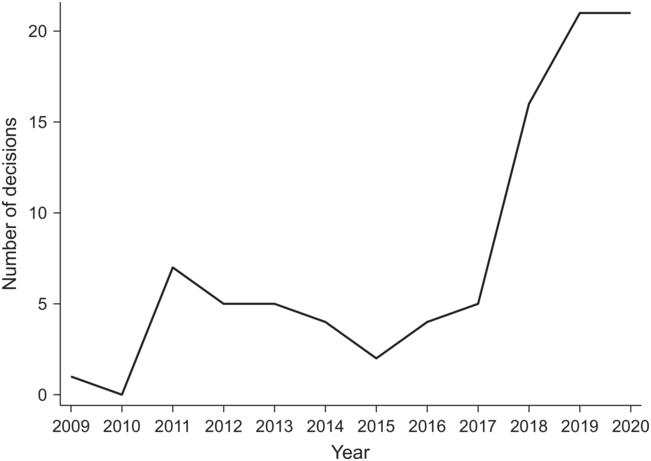
Figure 6.1 Long description
A line graph with the vertical axis labeled number of decisions ranging from 0 to 20 in increments of 5. The horizontal axis spans from 2009 to 2020. The line starts at 1 in 2009, dips to 0 in 2010, and peaks at 7 in 2011. It remains steady around 5 until 2014, then drops to 2 in 2015. After a gradual rise from 2016 to 2017, the count climbs sharply to 16 in 2018 and peaks at 21 in 2019 and 2020.
For the foreseeable future, the caseload of the Court is likely to remain low. It received seventeen applications in 2021, seven in 2022, ten in 2023, and 15 in 2024 – a substantial decrease from the sixty-six and forty-eight received in 2019 and 2020, respectively.Footnote 58 Recent withdrawals of Article 34(6) declarations, especially that of Tanzania, explain much of the decline in applications. Of the cases in the data used here, 44 percent were against Tanzania. Table 6.1 reports the number of cases by respondent. As can be seen, only six states have faced more than two applications. Two of these have been the respondent in more than ten cases (Tanzania and Rwanda), both of which have withdrawn their declarations permitting individual and NGO direct access.
| Respondent | Number of finalized cases | Percent of finalized cases |
|---|---|---|
| African Commission on Human Rights | 1 | 1.10 |
| African Union | 2 | 2.20 |
| Algeria | 1 | 1.10 |
| Benin | 5 | 5.49 |
| Burkina Faso | 2 | 2.20 |
| Cameroon and Nigeria | 1 | 1.10 |
| Côte d’Ivoire | 4 | 4.40 |
| Gabon | 1 | 1.10 |
| Ghana | 3 | 3.30 |
| Kenya | 1 | 1.10 |
| Libya | 2 | 2.20 |
| Malawi | 2 | 2.20 |
| Mali | 7 | 7.69 |
| Morocco | 1 | 1.10 |
| Mozambique | 1 | 1.10 |
| Pan African Parliament | 1 | 1.10 |
| Republic of Sudan | 1 | 1.10 |
| Rwanda | 11 | 12.09 |
| Senegal | 1 | 1.10 |
| South Africa | 2 | 2.20 |
| Tanzania | 40 | 43.96 |
| Tunisia | 1 | 1.10 |
| Total | 91 | 100.00 |
The alleged violations have been diverse to date, covering most rights or obligations included in the African Charter. Table 6.2 summarizes the number of allegations by article of the African Charter. The most frequently alleged violations pertain to Article 7 (due process rights), which has been alleged in a majority of finalized cases. Also frequently alleged are violations of rights to equal protection (Article 3), and freedom from nondiscrimination (Article 2), and freedom from cruel or inhuman or degrading treatment or punishment (Article 5).
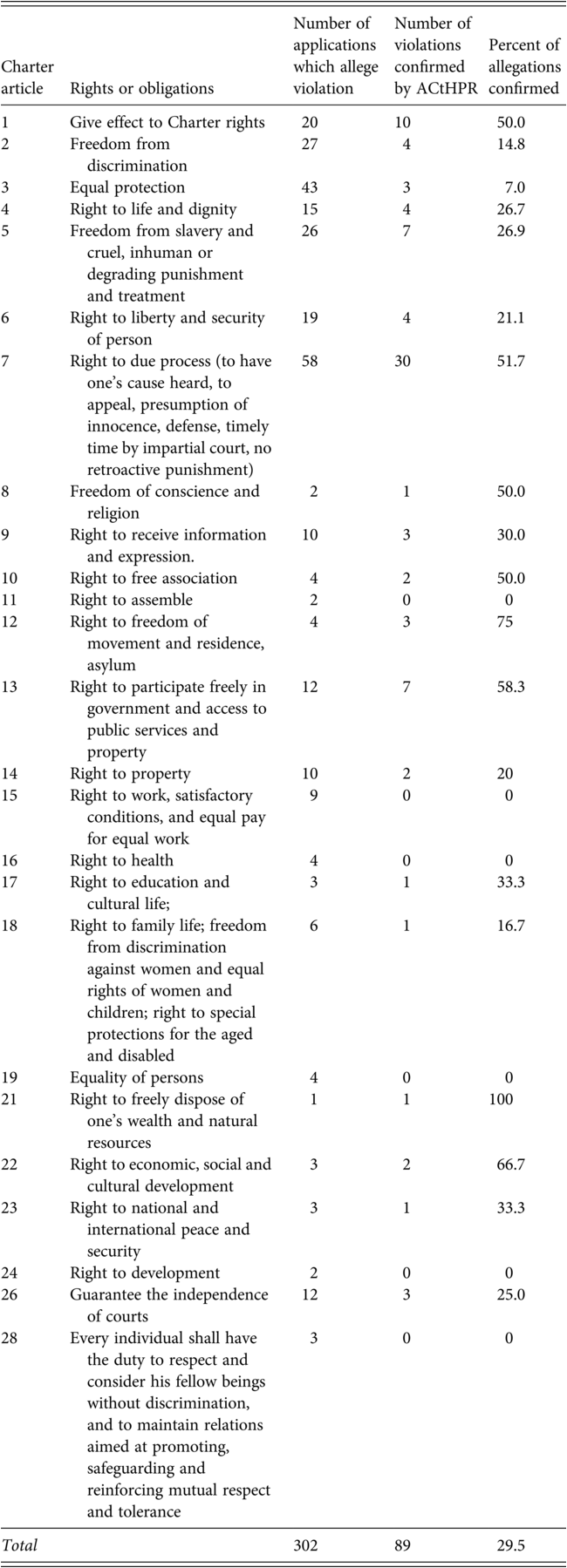
Table 6.2 Long description
The table features alleged and confirmed African Charter violations from 2009 to 2020. The table is organized by Charter article number, listing the corresponding rights or obligations. For each article, it shows the number of applications which allege a violation, the number of violations confirmed by the African Court on Human and Peoples’ Rights A C H P R, and the percentage of allegations confirmed.
Regarding Article 1, to give effect to charter rights, 20 applications alleged a violation, 10 were confirmed, representing 50.0%.
Regarding Article 2, freedom from discrimination, 27 applications alleged a violation, 4 were confirmed, representing 14.8%.
Regarding Article 3, equal Protection, 43 applications alleged a violation, 3 were confirmed, representing 7.0%.
Regarding Article 4, right to life and dignity, 15 applications alleged a violation, 4 were confirmed, representing 26.7%.
Regarding Article 5, freedom from slavery, cruel, inhuman or degrading punishment and treatment, 26 applications alleged a violation, 7 were confirmed, representing 26.9%.
Regarding Article 6, right to liberty and security of person, 19 applications alleged a violation, 4 were confirmed, representing 21.1%.
Regarding Article 7, rights to due process to have one’s cause heard, to appeal, presumption of innocence, defense, timely trial by an impartial court, no retroactive punishment, 58 applications alleged a violation, 30 were confirmed, representing 51.7%.
Regarding Article 8, freedom of conscience and religion, 2 applications alleged a violation, 1 was confirmed, representing 50.0%.
Regarding Article 9, right to receive information and expression, 10 applications alleged a violation, 3 were confirmed, representing 30.0%.
Regarding Article 10, right to free association, 4 applications alleged a violation, 2 were confirmed, representing 50.0%.
Regarding Article 11, right to assemble, 2 applications alleged a violation, 0 were confirmed, representing 0%.
Regarding Article 12, right to freedom of movement and residence, asylum, 4 applications alleged a violation, 3 were confirmed, representing 75%.
Regarding Article 13, right to participate freely in government and access to public services and property, 12 applications alleged a violation, 7 were confirmed, representing 58.3%.
Regarding Article 14, property rights, 10 applications alleged a violation, 2 were confirmed, representing 20%.
Regarding article 15, right to work, satisfactory conditions, and equal pay for equal work, 9 applications alleged a violation, 0 were confirmed, representing 0%.
Regarding article 16, right to health, 4 applications alleged a violation, 0 were confirmed, representing 0%.
Regarding article 17, right to education and cultural life, 3 applications alleged a violation, 1 was confirmed, representing 33.3%.
Regarding article 18, right to family life, freedom from discrimination against women and equal rights of women and children, right to special protections for the aged and disabled, 6 applications alleged a violation, 1 was confirmed, representing 16.7%.
Regarding article 19 equality of persons, 4 applications alleged a violation, 0 were confirmed, representing 0%.
Regarding article 21, right to freely dispose of one’s wealth and natural resources, 1 application alleged a violation, 1 was confirmed, representing 100%.
Regarding article 22, right to economic, social and cultural development, 3 applications alleged a violation, 2 were confirmed, representing 66.7%.
Regarding article 23, right to national and international peace and security, 3 applications alleged a violation, 1 was confirmed, representing 33.3%.
Regarding article 24, right to development, 2 applications alleged a violation, 0 were confirmed, representing 0%.
Regarding article 26, guarantee the independence of courts, 12 applications alleged a violation, 3 were confirmed, representing 25.0%.
Regarding article 28, every individual shall have the duty to respect and consider their fellow beings without discrimination, and to maintain relations aimed at promoting, safeguarding, and reinforcing mutual respect and tolerance. 3 applications alleged a violation, 0 were confirmed, representing 0%.
In total, 302 applications alleged violations, 89 were confirmed, representing 29.5%.
Note: Articles that have not been alleged are not included in this table. Figures are based on a simple count of whether an article is alleged to have been violated or a violation of the article is found. It does not count based on rights (e.g., Article 7 is counted only once when it is cited for the right to counsel and right to appeal).
As we would expect, not all alleged violations are confirmed by the Court. Article 7 violations have been confirmed by the Court more than any other alleged violation. In many cases this pertained to the right to legal counsel. The other articles with the highest number of confirmed violations are related to Articles 1, 5, and 13 (right to freely participate in government). We might also consider the percentage of allegations confirmed by the Court. The most frequently confirmed violations are not necessarily the ones that have been alleged the most. The Court has tended to rule in favor of applicants on the right to economic, social, and cultural development and the right to free movement, residence, and asylum, despite having been alleged in only a small number of cases. Another important pattern we can observe is that the most commonly alleged violations are confirmed most of the time, with the exception of Article 5. There are also a number of rights that have been alleged more than ten times, yet confirmed by the Court less than a third of those times. These include Articles 2, 3, 4, 5, 6, and 26.
Judicial Deference by the African Court
How has the Court responded to its applications so far? Does it tend to defer to states or not? In what ways does deference manifest in the Court’s decisions? The data reveal that the ACtHPR decisions are characterized by minimal deference. This can be seen in case outcomes, legal interpretation and reasoning, and remedial orders. In this section, I detail each of these.
Case Outcomes
The ACtHPR’s case outcomes indicate its tendency to not defer. Table 6.3 summarizes case outcomes. As described in Chapter 2, deference is conceived as the acceptance of the state’s exercise of authority and can take the form of abstention by the ACtHPR or its validation of the state’s exercise of authority. Deference is therefore represented by case outcomes in which the Court (1) dismisses the application as inadmissible or outside its jurisdiction (i.e., abstention), or (2) the merits of the application are reviewed but no violation is found (i.e., validation). The total deference rate includes all outcomes falling within either of these two categories. The ACtHPR’s total deference rate is 54 percent. The total deference rate, however, misrepresents deference because many dismissals, especially in the first five years, arose from poor quality applications. They therefore do not indicate abstention by the Court but rather a simple, straightforward application of the rules. Viljoen claims, “no fewer than 55 per cent of the cases submitted in the first five years have been submitted manifestly without any legal basis.”Footnote 59 In fact, Justice Fatsah Ouguergouz filed separate opinions in several of these early rulings, arguing that the lack of jurisdiction or admissibility was so clear cut that the Court need not have deliberated over them, but the applications instead should have been administratively dismissed.Footnote 60
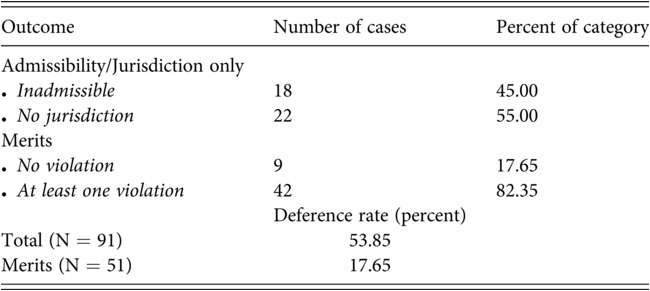
Table 6.3 Long description
The table summarizes the case outcomes of the African Court on Human and Peoples’ Rights A C H P R from 2009 to 2020. The table presents the outcome category, the number of cases within that category, and the percentage of the category that each outcome represents.
For admissibility or jurisdiction only, Inadmissible cases numbered 18, representing 45.00%. No jurisdiction cases numbered 22, representing 55.00%.
For merits, no violation cases numbered 9, representing 17.65%. At least one violation case numbered 42, representing 82.35%.
The total number of cases is 91, with a deference rate of 53.85%. For cases considered on their merits where N equals 51, the deference rate is 17.65%.
Note: Total deference rate = (no violation + inadmissible + no jurisdiction) ÷ Total N. Merits deference rate = no violation ÷ Merits N.
Fifty-one applications (or 56 percent) were assessed on the merits. The Court declared at least one violation in 82 percent of these. In other words, the Court deferred in only 18 percent of merits judgments.
The picture becomes slightly different when we look at the yearly deference rate (Figure 6.2). As mentioned, the first few years are misleading due to the early rulings on jurisdiction and admissibility. Nevertheless, Figure 6.2 shows that merits deference rate has changed over time. In the first five years of issuing merits judgments, the Court ruled against states in all cases and therefore had a 0 percent merits deference rate. This rate, however, increased beginning in 2018. Being cautious not to over interpret these numbers, they nonetheless suggest the Court tends not to defer, even though deference increased in the few years leading up to 2020.
ACtHPR’s deference rate by year (2009–2020).
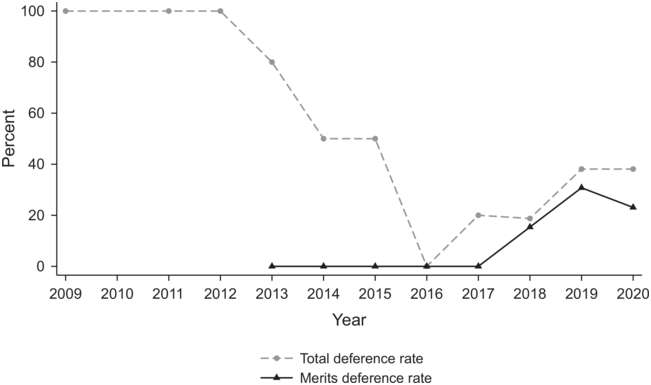
Figure 6.2 Long description
A line graph with the vertical axis labeled percent, ranges from 0 to 100 in increments of 20. The horizontal axis spans from 2009 to 2020. The total deference rate, represented by a dashed line, remains at 100 percent from 2009 to 2012, then declines to 80 in 2013, 50 in 2014 and 2015, reaches 0 in 2016, and rises gradually to 40 by 2020. The merits deference rate, represented by a solid line with triangles, stays at 0 from 2013 to 2017, then gradually rises from 2014, reaches 30 in 2019, before dropping slightly to 25 in 2020.
Legal Interpretations and Reasoning
A more complete picture of deference requires us to look beyond case outcomes and to examine the ACtHPR’s legal interpretation and reasoning. Like case outcomes, the ACtHPR’s legal interpretations reflect minimal deference. Three key aspects of its jurisprudence illustrate nondeference. First, the Court has eschewed restrictive, “work-to-rule” interpretations of its material and temporal jurisdiction, typically rejecting what respondent parties have argued. The African Court Protocol gives the ACtHPR jurisdiction over the African Charter, the Court Protocol “and any other relevant Human Rights instrument ratified by the States concerned.”Footnote 61 The Court determined the meaning of this last clause in the case of APDH v Côte d‘Ivoire.Footnote 62 It decided that the African Charter on DemocracyFootnote 63 and the ECOWAS Democracy ProtocolFootnote 64 are “human rights instruments” within its jurisdiction. This interpretation was broad as neither instrument is restricted to human rights, nor do they apply to all states subject to the Court. In the case of the ECOWAS Democracy Protocol, it also falls within the jurisdiction of another international court. Consequently, the interpretation adopted by the ACtHPR effectively expanded its jurisdiction to cover any legal instrument that has bearing on human rights or contains provisions relevant to human rights, regardless of its principal focus, so long as it had been ratified by the respondent state, irrespective of its status among other member states or whether the instrument itself recognizes the Court as the relevant judicial authority over that instrument.
On this question, restrictive interpretations that would better preserve state sovereignty were plausible. For example, Heyns argued that Article 3 could be interpreted as only those “treaties that make express provision for adjudication by the African Human Rights Court.”Footnote 65 Viljoen suggests that stricter interpretation of Article 3 would take “the term ‘states concerned’ as all the state parties to the Protocol, and not only the state against which the complaint is brought.”Footnote 66 Thus, while the Court could have availed itself of these possible interpretations, it rejected them and took a broader approach, proving “itself willing to exercise its material jurisdiction to the fullest possible extent.”Footnote 67 As one former judge explained, the Court’s approach on these questions should be viewed as broad, liberal, and purposive.Footnote 68
Similarly on jurisdiction, the African Court’s addressed a crucial question about its temporal jurisdiction in Mtikila v Tanzania: Was the Court’s jurisdiction for any given state determined by the date upon which that state ratified the African Charter or the date upon which the African Court Protocol entered into force for said state?Footnote 69 In Mtikila, the alleged violation began in 1993. Meanwhile Tanzania acceded to the African Charter in 1986 and to the African Court Protocol in 2006. If the Court interpreted its temporal jurisdiction based on the date of accession to the Court Protocol, the alleged violations would have been outside the Court’s jurisdiction. The Court, however, decided that the temporal jurisdiction was based on the date of ratification of the African Charter, contrary to the position put forward by the respondent state. Tanzania took the view that the jurisdiction was based on its ratification of the Protocol in 2006.Footnote 70 The judges themselves were divided on this issue. The written separate opinions contended a narrower, more sovereignty preserving, interpretation was not only feasible but also more sound. In his separate opinion, Justice Ouguergouz argued that the Court had erred, as the temporal jurisdiction when addressing an individual petition should be the date upon which the state made its Article 34(6) declaration.Footnote 71 Justice Niyungeko’s separate opinion said the Court’s interpretation of its temporal jurisdiction was “difficult to grasp” and “simply inconceivable.”Footnote 72 The ACtHPR rejected a narrow, restrictive interpretation of its temporal jurisdiction, effectively enabling applicants to petition for allegations that occurred prior to a state’s accession to the African Court Protocol.
Second, the ACtHPR has adopted broad interpretations of admissibility requirements, expanding applicants’ access to justice. These interpretations went beyond a work-to-rule or restrictive approach. The Court often refuses to validate states’ preferred interpretations and does not abstain in effect from “making law.” The African Court Protocol requires applicants to exhaust domestic remedies, unless those remedies are unduly prolonged, for an application to be admissible.Footnote 73 States in various cases have argued that nonjudicial remedies should apply. The Court has rejected this position and found that the Protocol is concerned with ordinary, judicial remedies that are available, effective, and sufficient.Footnote 74 States have also argued that applicants must have personally exhausted remedies, even if previous litigation has proven remedies are ineffective. The Court rejected this argument also. Chenwi confirms this finding, arguing that the ACtHPR’s has taken a “flexible approach” that facilitates victims’ access to justice.Footnote 75
To be admissible, applications must be submitted to the ACtHPR within a “reasonable” time following the exhaustion of domestic remedies. The African Court interprets this requirement broadly, determining that a case-by-case assessment is necessary to determine whether the applicant seized the Court within a “reasonable” time. Rather than declare a fixed time limit,Footnote 76 the Court considers factors such as applicants’ education, imprisonment, indigence, and access to a lawyer to determine whether the application was filed within a reasonable timeframe. This puts the Court at odds with other human rights courts, which have fixed-time limits of six months.Footnote 77 In fact, respondent states have argued for a six-month time limit.Footnote 78 The Court has deemed applications admissible in instances where filing occurred more than three years after exhausting domestic remedies.Footnote 79 Overall, the Court abstained from a work-to-rule approach.
Third, the African Court’s interpretation on substantive rights has eschewed conservative or restrictive interpretations. These interpretations signaled the Court’s refusal to validate states’ preferred interpretations: meaning their laws would not pass muster with the Court. The Court has also applied more intense scrutiny, such as balancing, finding that states have not met its criteria necessary for upholding their actions or laws. This can be observed in several areas. One such area relates to due process rights of Article 7, which has been among the most frequently claimed rights before the African Court (see Table 6.2). As Makunya argues, the Court has played a “continuous role…in ‘humanising’ criminal law and procedures.”Footnote 80 For instance, the Court has found violations for failures to provide legal aid and for unreasonable delays in criminal proceedings.Footnote 81 When reviewing the Court’s case law, Mujuzi concludes that “the Court is expanding the elements of the right to a fair trial under Article 7 of the African Charter.”Footnote 82 The Court has also advanced protections for speech. For example, in Konaté v Burkina Faso the Court examined whether criminal charges and sentencing were proportionate to the state’s interests to regulate against defamation of public officials.Footnote 83 The Court found that custodial measures were not proportionate. In Umuhoza v Rwanda, the Court came to a similar conclusion, finding that criminal sanctions for speech violated the African Charter.Footnote 84 While this interpretation may be in line with international human rights jurisprudence elsewhere, the judgment was the first time the African Court ruled on free speech. Moreover, several AU states have criminal defamation laws that are actively in force.Footnote 85 Thus, with this interpretation, the Court implies that it would refuse to validate laws that exist in a large share of states. The ACtHPR also applied balancing in these decisions to determine whether a state’s action or law is acceptable.
The African Court, along with other subregional courts, has become an important venue for opposition politicians and activists to challenge ruling governments,Footnote 86 reflecting the African Court’s role in the judicialization of mega politics.Footnote 87 It has addressed several issues at the core of domestic governance and politics, including electoral management, the process for constitutional amendment, and the independence of domestic judiciaries. The Court took nondeferential approaches on these issues.
The Court has addressed domestic election management in several cases. The Court’s first case to assess laws on electoral management was Mtikila v Tanzania,Footnote 88 and it determined that laws barring independents from running for political office do not serve a legitimate aim. The Court’s decision rested in part on a broad reading of the freedom of association, arguing that right of association is negated by a law which indirectly mandates an individual associate or belong to a political party in order to enjoy another right.Footnote 89 Mtikila represents nondeference because it withheld validation of Rwanda’s law, and more importantly signaled to other states with similar laws barring nonpartisans from running for public office that their laws would not pass muster.Footnote 90 In other words, the Court’s decision resembled an encroachment into the lawmaking authority of states.
The African Court has also considered the independence of election management bodies (EMB). In APDH v Côte d’Ivoire,Footnote 91 the Court was asked whether the state’s national electoral commission accorded with the state’s obligation to maintain an independent and impartial EMB, as guaranteed by Article 17 of the African Charter on Democracy and Article 3 of the ECOWAS Democracy Protocol. The Court ruled that the composition of Côte d’Ivoire’s EMB was imbalanced in favor of the government and therefore contravened its human rights obligations. Following legal reforms in 2019, the Court revisited Côte d’Ivoire’s EMB in Suy Bi Gohore Emile & Others.Footnote 92 At that time, the Court found that the national electoral commission was adequately balanced, but Côte d’Ivoire violated its obligations because the local election commissions remained imbalanced in their composition. Benin’s electoral laws, which were amended after President Patrice Talon took power in 2016, have also been considered by the African Court. As in the cases dealing with Côte d’Ivoire, the African Court addressed the composition of the state’s EMB in XYZ (59) v Benin.Footnote 93 It determined that one of Benin’s election bodies, the Conseil d’orientation et de supervision de la Liste électorale permanent informatisée, was composed in favor of the government in contravention of Article 17 of the African Charter on Democracy and Article 3 of the ECOWAS Democracy Protocol. The Court reiterated this finding in Ajavon (62) v Benin.Footnote 94 The Court’s decisions on EMBs represent nondeference because, like Mtikila, it adopted a legal standard that many African states would not meet,Footnote 95 and therefore would appear to encroach on the lawmaking authority of states. At the same time, these decisions do not resemble a work-to-rule approach, which would entail taking the strictest, most sovereignty preserving reading of the law to resolve ambiguity.
The African Court has also addressed domestic judicial independence. In Ajavon (62) v Benin, the Court ruled that the composition of Benin’s High Judicial Council, a body which disciplines judges, violated Article 26 of the African Charter on the duty to guarantee an independent judiciary.Footnote 96 According to legal reforms in 2018, Benin’s president is a member of the judicial council, along with two members of government, and appoints an additional six members by his/her sole discretion. The Court found that the president’s authority to directly appoint individuals to the judicial council constitutes executive interference with the judiciary. It further argued that the fact that the president sits on the council alongside members of government is “clear proof that the judiciary is not independent.”Footnote 97 This decision followed an earlier judgment in 2019 by the African Court, in which it ruled that the executive had interfered in the functioning of the judiciary in a criminal case against Mr. Ajavon.Footnote 98 The Court went further in XYZ (10) v Benin, ruling that Benin had violated Article 26 of the African Charter because the president and the Bureau of the National Assembly had sole discretion to renew the terms of judges to the Constitutional Court.Footnote 99 Like the previous examples, these interpretations by the African Court indicate nondeference because many AU member states would not meet the Court’s standards on judicial independence.Footnote 100
The Court has also addressed the process of amending national constitutions. Namely, in XYX (10) v Benin, the Court ruled that Benin had violated the principle of “national consensus,” as espoused in Article 10(2) of the African Charter on Democracy, when amending its constitution.Footnote 101 Benin’s National Assembly, according to the ACtHPR, did not include opposition voices as it was not constituted through free and fair elections, nor was the public directly or indirectly consulted; consequently, the impugned constitutional amendment was contrary to Benin’s obligations. The Court reaffirmed this position in Houngue Eric Noudehouenou v BeninFootnote 102 and its 2020 judgment in Ajavon (62) v Benin;Footnote 103 jointly these cases raised the bar for states when amending constitutions. Along with other decisions in which the African Court has assessed the compatibility of constitutional provisions with human rights law, these decisions are noteworthy indications of nondeferential legal interpretation because they reflect the Court’s refusal to abstain and its willingness to assess the legality of state constitutions – a power not always granted to domestic constitutional courts.Footnote 104
The Court’s interpretations on the so-called “claw-back clauses” also represent nondeference by effectively expanding human rights protections. “Through its case-law, the Court has mitigated some of the starker deficiencies of the African Charter (compared to the American and European human rights conventions). Most notably, beginning with its first merits judgment in Mtikila, the Court has softened the impact of so-called ‘clawback clauses’ in the African Charter through recourse to proportionality analysis – effectively establishing a ‘restriction on restrictions’.”Footnote 105 The Court’s treatment of these clauses reduces states’ discretion to derogate from their human rights obligations and thereby expands human rights protections for ordinary citizens. In other words, it rejects unfettered exercise of state authority when it comes to derogation.
In sum, the ACtHPR has tended toward nondeference in its legal interpretations. This tendency pervades its decisions on jurisdiction, on admissibility, and on the merits. Its interpretations are often in contrast to restrictive, work-to-rule approaches that would better preserve sovereignty, go against interpretations that respondent states argue for, and set higher legal standards than many member states otherwise have. This is not to say that the Court’s rulings are broad for international human rights law in general. Rather, they represent nondeference because they resemble an encroachment into states’ authority to make law and clearly signal the Court’s refusal to abstain from exercising its own authority.
There are exceptions to the Court’s tendency not to defer. For example, the Court has raised the bar on admissibility criteria, requiring applicants to provide more robust evidence on admissibility. In Anthony & Kisite v Tanzania, the Court ruled the application was not admissible because it had not been filed in a reasonable time. Diverging from its earlier jurisprudence, which did not require substantial evidence of an applicant’s inability (e.g., illiteracy, indigency) to seize the Court in a timely manner, the Court argued in Anthony “that although the Applicants are also incarcerated and thus restricted in their movement, they have not asserted or provided any proof that they are illiterate, lay, or had no knowledge of the existence of the Court. The Applicants have simply described themselves as ‘indigent’.”Footnote 106 While the Court tried to reconcile this position with its earlier rulings, the decision in Anthony is less pro-private litigant than previous decisions, restricts access to the Court, and ultimately abstains from intervening into the case. Moreover, Anthony was not a one-off. A further three applications against Tanzania were rejected for similar reasons – the applicants had not adequately proven their indigency.Footnote 107 Instances like these are “wins” for states and help to illustrate the differences between deference and nondeference. Even though instances of the former do exist, the Court’s legal interpretations by and large reflect the latter.
Remedies
Remedial orders also shed light on deference. The African Court Protocol provides that “[i]f the Court finds that there has been violation of a human or peoples’ rights, it shall make appropriate orders to remedy the violation, including the payment of fair compensation or reparation.”Footnote 108 Based on this provision, the ACtHPR frequently grants remedies to wronged parties. Table 6.4 summarizes the Court’s remedial orders. In particular, the data reveal three main patterns to its remedial orders.
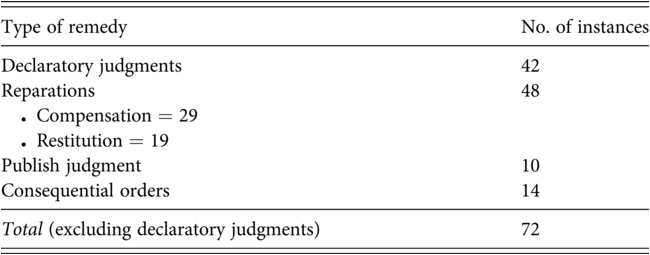
Table 6.4 Long description
The table summarizes the remedies issued by the African Court on Human and Peoples’ Rights from 2009 to 2020. The table lists the type of remedy and the corresponding number of instances.
For declaratory judgments, there were 42 instances.
Regarding reparations, there were 48 instances in total. Of these, 29 instances were for compensation, and 19 instances were for restitution.
A published judgment occurred in 10 instances.
Consequential orders were issued in 14 instances.
The total number of instances, excluding declaratory judgments, is 72.
Note: Judgments can have more than one remedy type. The coding included up to four per case. Reparation rulings were pending in two cases and therefore are excluded in the data. These figures exclude the Court’s decisions on whether costs are awarded. Typically, the Court orders that parties bear their own costs of the litigation.
First, the Court relies more on nonintrusive remedies than on intrusive remedies. Nonintrusive remedies, like declaratory judgments and to a lesser extent reparations, represent deference because the Court shows more acceptance of the state’s authority to determine how to right wrongs. Declaratory orders by themselves reflect a court’s abstention from the determination of remedies. In contrast, intrusive remedies such as consequential orders are nondeferential because they reject the state’s authority to decide on remedies and can go so far as to mandate changes in law or policy. As Table 6.4 shows, excluding declaratory judgments, the ACtHPR has granted seventy-two different remedial orders, and several judgments include more than one remedy. Reparations have been ordered the greatest number of times and represent two-thirds of all remedies. Compensation is the most common order for reparations (and comprises 40 percent of all remedies). In its first opportunity to rule on remedies, the Court denied compensation to the victims, arguing that applicants must demonstrate a causal link between a violation and damages.Footnote 109 This judgment, however, expressed the ACtHPR’s openness to granting compensation in the future. It “may, therefore, be seen as a positive step in the development of the award of damages by the African Court, as seen in Zongo, where the African Court took the foundations laid in Mtikila to proceed to award damages to the applicants – the first such award by the African Court.”Footnote 110 Since these early decisions, compensation has been applied for pecuniary damages (i.e., economic losses) and nonpecuniary damages (pain and suffering, mental anguish, etc.) for both direct and indirect victims.Footnote 111
Reparations also include orders of restitution. Restitution has been ordered in nineteen cases (26 percent of all remedies), including orders to release a victim from prison,Footnote 112 to reopen trials or investigations,Footnote 113 to expunge convictions,Footnote 114 and more. Nonintrusive remedies also include orders for states to publish the Court’s judgment in official legal publications.
Second, the African Court orders intrusive remedies but when it does so, it grants some discretion to states on the precise nature of the remedy. The ACtHPR issued consequential orders in fourteen different cases, or in one-third of all cases where a violation was found. These orders typically require the state to change the law. In Konaté v Burkina Faso the Court ordered Burkina Faso to amend its law to remove criminal sanctions for libel.Footnote 115 This case involved Konaté, an editor of a newspaper, who was criminally charged for libel and defamation against public officials. Konaté alleged that this violated the freedom of speech as provided by, inter alia, Article 9 of the African Charter. The Court found that custodial sentences for libel, except in exceptional circumstances, violate free speech and ordered Burkina Faso to amend its law accordingly. Similarly, in Mtikila v Tanzania the Court determined that Tanzania’s law, which barred individuals from running for public office as independents, violated the right to free participation in government, the freedom of association, and equality.Footnote 116 The Court ordered Tanzania, “to take constitutional, legislative and all other necessary measures within a reasonable time to remedy the violations found by the Court.”Footnote 117 Another example where the Court ordered the respondent state to revise its law occurred in APDH v Côte d’Ivoire.Footnote 118 In this case, the Court found that Côte d’Ivoire’s law pertaining to its Independent Election Commission violated its obligations to establish an independent and impartial electoral body and to ensure equal protection of citizens’ rights to participate freely in government. The state was ordered to make the law compliant with these obligations. Other examples include orders for Mali to amend its Persons and Family CodeFootnote 119 and Tanzania to amend legislation to provide individuals with judicial remedies in citizenship disputes.Footnote 120 Finally, in all the cases reviewed, the Court ordered provisional measures in seven cases.
The Court couples its intrusive remedies with subtle deference by giving states discretion to determine the exact nature of the solution. As Mbori states, “the remedial orders of the African Court have tended to be limited in scope, finding human rights violations but leaving a wide margin of appreciation for states to determine how best to remedy these violations.”Footnote 121 One interviewee confirmed the Court tries to show some deference or to partially abstain even on consequential orders, saying, “we must not unduly direct states to do this or that, without giving them an opportunity to seek for themselves other ways to address the situation.”Footnote 122 The coupling of subtle deference with intrusive remedies is best exemplified in Thomas v Tanzania.Footnote 123 In 1998, Thomas was convicted of armed robbery and sentenced to thirty years’ imprisonment. The Court found Thomas’ rights to defense, to legal counsel, and a fair trial were violated. Thomas pleaded with the Court to order his immediate release from prison. The Court refused (by a split decision), finding that orders to release prisoners could only occur under very specific and/or compelling circumstances, which had not been demonstrated by Thomas. The Court found that the typical recourse for the violations of the kind Thomas experienced was to reopen the case or a retrial, but as the sentence “served so far has been about 20 years out of 30 years, both remedies would result in prejudice and occasion a miscarriage of justice.”Footnote 124 At the same time, the Court ordered Tanzania to “take appropriate measures to remedy the violations taking into account the above factors.”Footnote 125 Thus, while the Court did not order his release, it barred the state from retrying Thomas, effectively leaving the state no option but to release him.Footnote 126 The Court took a similar approach in Abubakari v Tanzania.Footnote 127
Third, the ACtHPR frequently combines different types of remedy in any given case. In forty-one of the forty-two applications where the Court found violation(s), it issued at least one remedy in addition to the declaratory judgment. In half of all cases where violation(s) are identified, the Court awarded two remedies in addition to the declaratory judgment. In ten of the cases (or 24 percent) where it declared violation(s), the Court ordered three additional types of remedies. Decisions that combine remedies are generally less deferential than when there are lone remedies.
In sum, we can see that the African Court balances deference and nondeference in its remedial order. While it has not cowered from using intrusive remedies, it applies them with caution and instead prefers nonintrusive remedies, often through a combination of remedies. Given the Court’s tendencies toward nondeference on legal interpretation and case outcomes, remedial orders that are nonintrusive enable the Court to reconcile decision-making that favors applicants’ access to justice and the protection of human rights while acknowledging its political context.
Explaining the African Court’s Decision-Making
The ACtHPR’s decision-making is characterized by minimal deference, as seen in case outcomes, legal interpretation and reasoning, and, to a lesser degree, remedies. What accounts for the Court’s tendency toward minimal deference?
The Role of Support Networks
The logic of support networks suggests that nondeference arises from the strength, opportunities, and activity of a court’s support network. More specifically, this theoretical account would expect minimal deference to follow from broad opportunities for supporters to access to the Court, efforts by the Court to mobilize its supporters, and/or an active use of the Court by its proponents. In this section, I look at whether the empirical evidence corresponds to this expectation. It reveals that access opportunities, while available and despite efforts of the Court, are limited in important ways and a variety of barriers prevent would-be supporters from actively realizing these opportunities. Consequently, the African Court’s tendency to not defer is difficult to reconcile with the logic of a support network.
From the beginning, a host of civil society and professional organizations have been proponents of the Court. Some of these actors were influential in its creation, while others have developed since the adoption of the African Court Protocol, like the African Court Coalition.Footnote 128 Other important support comes from the Pan-African Lawyers’ Union and the East African Law Society.
The Court features various channels of access for would-be supporters, and it actively encourages such supporters to utilize these channels. Importantly, the ACtHPR features direct access for private actors. Individuals and NGOs (with ACmHPR observer status) can directly petition the Court, so long as the state has ratified the Court Protocol and declared its acceptance of the right of direct petition, according to Article 34(6). The African Court openly urges states to submit Article 34(6) declarations. Also, as described earlier, the Court’s jurisprudence on jurisdiction and admissibility is generally pro-private litigant and expands opportunities of direct access. The Court has also developed a legal aid scheme to support direct access. The scheme includes a roster of pro-bono counsel and a legal aid fund, which provides legal representation and aid to applicants.Footnote 129 In several instances, the Court has called upon its partners in the legal aid scheme to act as legal counsel for an applicant. I have recorded fifteen instances of this occurring, or 16 percent of all cases in the data.Footnote 130 Moreover, a large portion of the Court’s cases are litigated with the help of NGOs, such as PALU or the EALS. My data reveal that NGOs have acted as legal representation in about one-third of all cases (see Table 6.5).
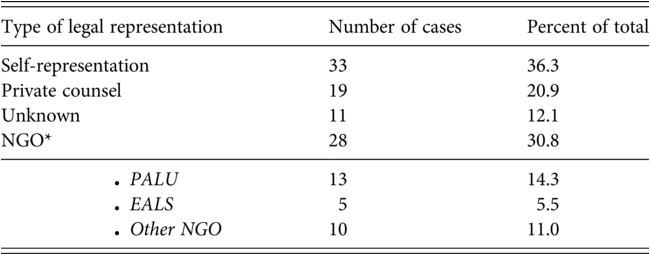
Table 6.5 Long description
The table features the legal representation of applicants before the African Court on Human and Peoples’ Rights by type. The table shows the type of legal representation, the number of cases with that representation, and the percentage of the total cases.
Self-representation occurred in 33 cases, representing 36.3% of the total.
Private counsel represented applicants in 19 cases, representing 20.9% of the total.
The type of legal representation was unknown in 11 cases, representing 12.1% of the total.
Non-governmental organizations represented applicants in 28 cases, representing 30.8% of the total.
The Pan African Lawyers’ Union represented applicants in 13 cases, representing 14.3% of the total.
The East African Law Society represented applicants in 5 cases, representing 5.5% of the total.
Other N G Os represented applicants in 10 cases, representing 11.0% of the total.
* These figures include representation as part of the Court’s legal aid scheme.
Note: Legal representation is coded based on information provided in the Court’s judgments.
Despite these points for optimism, “the Court does not provide an avenue for a large number of human rights and civil liberties NGOs across Africa to challenge rights violations.”Footnote 131 Direct access has significant limitations. It depends on states’ willingness to accept direct access through an Article 34(6) declaration. In mid 2025, only seven states out of the thirty-four that had ratified the Court Protocol have Article 34(6) declarations in force. Also, not all decisions by the Court encourage potential applicants to seek recourse through the Court. For example, the ACtHPR has generally refrained from awarding costs to successful litigants. My data reveal that the Court has awarded costs to only four out of forty-two successful applicants, but the African Court’s legal aid scheme does partially make up for this shortcoming. In addition, broader legal and societal factors constrain the support that the Court might otherwise derive from private actors. Cases making their way to the African Court face three critical obstacles: For most Africans, conceiving grievances as a legal dispute is remote, access to justice domestically is limited for many Africans because proximity to lawyers and courts as well as high costs can be prohibitive, and the structural deficiencies of domestic judiciaries (poor resources, weak independence, corruption, etc.) impair litigation as a means of redress.Footnote 132 These obstacles make access to domestic justice “illusory,” in Viljoen’s terms, and by extension access to the African Court because domestic remedies must be exhausted. Added to this, the Court is not widely known or understood even among the legal community.Footnote 133 While applications by private actors have so far been the lifeline of the ACtHPR, the full potential of direct access to empower the Court is a long way off.
Another channel of access for would-be supporters is through referrals from and interactions with supranational actors. Most relevant is the ACmHPR. The Court has sought to strengthen its ties with the Commission. For example, the two institutions have tried to harmonize their rules of procedure, and in 2010 they agreed to hold a joint annual meeting,Footnote 134 the first of which was held in July 2012.Footnote 135 They also collaborate on some of their promotional and educational activities.Footnote 136
The ACmHPR can lend support to the Court through its ability to refer cases to the Court. The Commission can refer its merits decisions to the Court if a state fails to comply.Footnote 137 This essentially enables the Commission to convert its nonbinding recommendations into a binding decision.Footnote 138 As of mid-2024, the Court had not yet received any referrals of this nature.Footnote 139 The ACmHPR has political and legal reasons to be reluctant to refer its merits decisions to the Court. First, it is not clear whether such referrals would result in the Court’s de novo review of the complaint, whereby the Court would de facto assess the Commission’s decisions and risk delegitimizing the ACmHPR.Footnote 140 Second, once a case is referred to the Court, the disputing parties become the Commission and the respondent state, leaving the original complainant (i.e., the victim) as a nonparty to the dispute. Thus, the victim could be denied due representation and participation in contravention of the principle of equality of arms.Footnote 141
The Commission can also refer its requests for interim measures to the Court.Footnote 142 Complainants to the Commission can seek interim measures, where the ACmHPR would request the state to suspend action while the matter is reviewed. The Commission can only issue nonbinding interim measures. If states do not implement these measures, the Commission can refer it to the Court, essentially asking the Court to transform its nonbinding interim measures into binding provisional orders. The Commission has previously made two such referrals.Footnote 143 In both instances, the Court first ruled on the provisional measure and subsequently examined the merits of the cases. The Commission can also refer situations to the Court which the former views as a serious or massive violation of human rights,Footnote 144 or at any stage of its proceedings.Footnote 145 Under this latter provision, the Commission has referred one additional case.Footnote 146
Across the board, ACmHPR referrals to the ACtHPR have thus far been rare. This rarity speaks to the Commission’s limited capacity to act as a strong interlocutor for the Court. In part, this is because the ACmHPR can only refer cases against states that have ratified the African Court Protocol. Moreover, the Commission faces its own constraints, including limited autonomy and scarce resources.Footnote 147
A final channel of access that might be utilized by court supporters is the Court’s advisory jurisdiction. AU member states, AU organs, or “any African organization recognized by the African Union” may request an advisory opinion on “any legal matter relating to the African Charter or any other relevant human right instrument.”Footnote 148 By mid-2024, the Court had received and finalized fifteen requests for advisory opinions.Footnote 149 Of these, one was withdrawn, ten were dismissed for not properly falling within the Court’s advisory jurisdiction, and the Court delivered opinions in four.Footnote 150 This number is low, especially of delivered opinions, in comparison to the IACtHR.Footnote 151 Standing for advisory jurisdiction has been called into question in two regards. First, what constitutes an “African organization,” and second, what constitutes recognition. On the first question, the Court has determined that an organization can be intergovernmental or nongovernmental if it is registered in at least one African state. As for “recognition,” the African Court interpreted this to mean that recognition is conferred by the AU itself, not by any organ of the AU. This excludes NGOs that have observer status with the ACmHPR, unless they have also been recognized by the broader AU, from the African Court’s advisory jurisdiction. In the end, this view significantly narrows the number of NGOs that can utilize the Court’s advisory jurisdiction,Footnote 152 at least in the short term.
Overall, legal and practical factors limit the opportunities for private and supranational actors to access and support the ACtHPR. Consequently, the activity of would-be supporters is lower than would be expected by the support network logic, given the Court’s minimal deference. However, their activity is not negligible. Indeed, as shown above, roughly one-third of cases involve NGOs. This raises the question of whether cases involving the support networks are more commonly associated with nondeference, as the support network explanation would expect. I assess this by examining whether there is systematic difference in case outcomes and remedies depending on whether the applicant’s legal representation has repeated experience at the ACtHPR or an NGO participates in the litigation. Repeat counsel is defined as lawyer or legal association (e.g., firm) who served as legal counsel in at least one prior case before the ACtHPR; most repeat counsel are NGOs. NGO participation includes any case where an NGO is the applicant, serves as legal counsel (e.g., PALU), or submits an amicus curiae brief in the dispute. The findings are mixed (Table 6.6). In terms of case outcomes, applicants receive favorable outcomes (reflecting nondeference) more often when their case is presented by a repeat lawyer or if an NGO participates in some capacity. For instance, applicants represented by repeat lawyers won 90 percent of the time in contrast to 34 percent when not represented by a repeat lawyer. Similarly, applicants won on the merits more often if their case was argued by a repeat lawyer or if an NGO participated in the case. These differences correspond with theoretical expectations about the role of support networks.
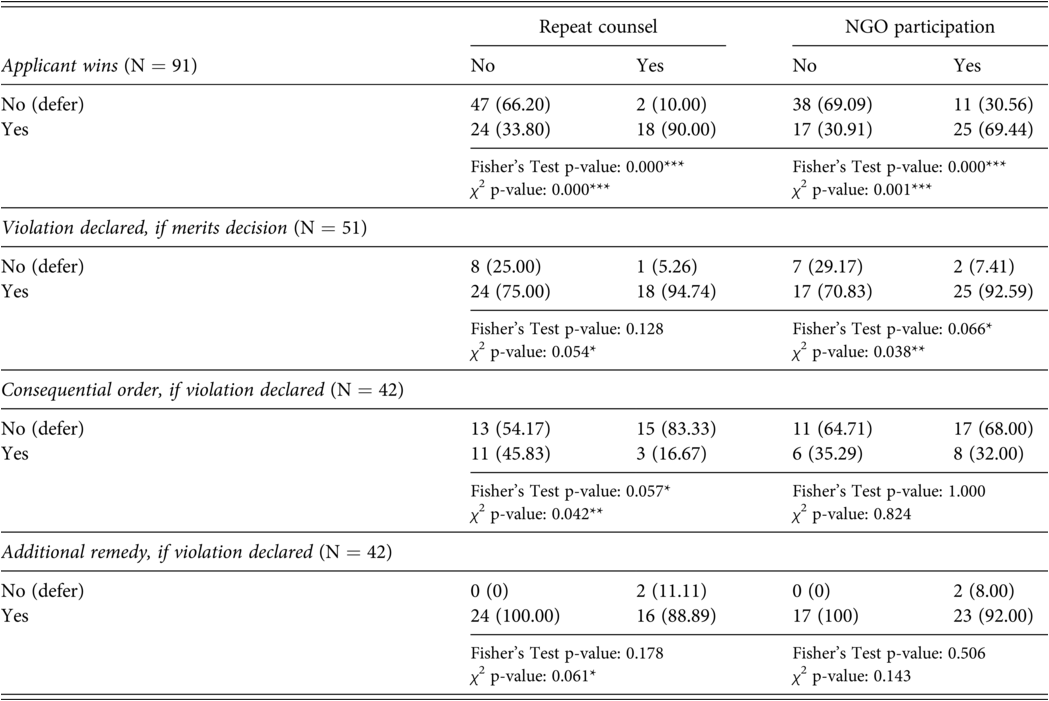
Table 6.6 Long description
The table features the cross-tabulations of the African Court on Human and Peoples’ Rights deference by support network. It examines the relationship between whether applicants win if a violation is declared, a consequential order is issued, and whether an additional remedy is delivered, and two support network variables of repeat counsel, with categories of no or yes, and N G O participation, also with categories of no or yes. The table provides data for all applications and for merit decisions, including the number of cases and row percentages within each cell. Below each cross-tabulation, Fisher’s exact test p-value and Chi-squared p-value are reported.
Applicant wins where N equals 91
No , applicant does not win, reflecting deference
In the category of repeat counsel, no accounts for 47 cases, representing 66.20% of cases without repeat counsel, and yes accounts for 2 cases, representing 10.00% of cases with repeat counsel.
In the category of N G O participation, no accounts for 38 cases, representing 69.09% of cases without NGO participation, and yes accounts for 11 cases, representing 30.56% of cases with NGO participation.
Yes
In the category of repeat counsel, no accounts for 24 cases, representing 33.80% without repeat counsel, and yes accounts for 18 cases, representing 90.00% of cases with repeat counsel.
In the category of N G O participation, no accounts for 17 cases, representing 30.91% of cases without NGOs, and yes accounts for 25 cases, representing 69.44% of cases with NGOs.
Statistical test results show that for repeat counsel, Fisher’s Test p-value is 0.000, and Chi-squared p-value is 0.000. For N G O participation, Fisher’s Test p-value is 0.000, and Chi-squared p-value is 0.001.
Violation declared, if the merits decision is where N equals 51
No violation declared, reflecting deference
In the category of repeat counsel, no accounts for 8 cases, representing 25.00% of cases without repeat counsel, and yes accounts for 1 case, representing 5.26% of cases with repeat counsel.
In the category of N G O participation, no accounts for 7 cases, representing 29.17% of cases with no NGOs, and yes accounts for 2 cases, representing 7.41% of cases with NGOs.
Yes
In the category of repeat counsel, no accounts for 24 cases, representing 75.00% of cases without repeat counsel, and yes accounts for 18 cases, representing 94.74% of cases with repeat counsel.
In the category of N G O participation, no accounts for 17 cases, representing 70.83% of cases without NGOs, and yes accounts for 25 cases, representing 92.59% of cases with NGOs.
Statistical test results show that for repeat counsel, Fisher’s Test p-value is 0.128, and Chi-squared p-value is 0.054. For N G O participation, Fisher’s Test p-value is 0.066, and Chi-squared p-value is 0.038.
Consequential order, if a violation is declared where N equals 42
No consequential order, reflecting deference
In the category of repeat counsel, no accounts for 13 cases, representing 54.17% of cases without repeat counsel, and yes accounts for 15 cases, representing 83.33% of cases with repeat counsel.
In the category of N G O participation, no accounts for 11 cases, representing 64.71% without NGOs, and yes accounts for 17 cases, representing 68.00% of cases with NGOs.
Yes, consequential order issued, reflecting nondeference
In the category of repeat counsel, no accounts for 11 cases, representing 45.83% of cases without repeat counsel, and yes accounts for 3 cases, representing 16.67% of cases with repeat counsel.
In the category of N G O participation, no accounts for 6 cases, representing 35.29% of cases without NGOs, and yes accounts for 8 cases, representing 32.00% of cases with NGOs.
Statistical test results show that for repeat counsel, Fisher’s Test p-value is 0.057, and Chi-squared p-value is 0.042. For N G O participation, Fisher’s Test p-value is 1.000, and Chi-squared p-value is 0.824.
Additional remedy, if violation declared where N equals 42
No additional remedy ordered, reflecting deference
In the category of repeat counsel, no accounts for 0 cases, representing 0% of cases, no repeat counsel, and yes accounts for 2 cases, representing 11.11% of cases with repeat counsel.
In the category of N G O participation, no accounts for 0 cases, representing 0% of cases without NGOs, and yes accounts for 2 cases, representing 8.00% of cases with NGOs.
Yes, additional remedy ordered
In the category of repeat counsel, no accounts for 24 cases, representing 100.00% of cases without repeat counsel, and yes accounts for 16 cases, representing 88.89% of cases with repeat counsel.
In the category of N G O participation, no accounts for 17 cases, representing 100% , and yes accounts for 23 cases, representing 92.00%.
Statistical test results show that for repeat counsel, Fisher’s Test p-value is 0.178, and Chi-squared p-value is 0.061. For N G O participation, Fisher’s Test p-value is 0.506, and Chi-squared p-value is 0.143.
Note: *p<0.10, ** p<0.05, *** p<0.001. In each cross-tabulation, the first number is the frequency and the second number (in parentheses) is the column percentage.
The data on remedies, however, do not align with the support network logic. According to this logic, consequential orders or any remedy in addition to a declaratory judgment should be more common when a repeat lawyer represents the applicant or an NGO participates than if these actors are not involved. Table 6.6 depicts the relationship between remedial orders and the involvement of repeat lawyers or NGOs. Consequential orders and additional remedies are less frequently issued when repeat counsel or an NGO participates. For instance, consequential orders were delivered in 17 percent of cases argued by repeat lawyers in contrast to 46 percent where there was no repeat lawyer. This finding is important because case outcomes are an insufficient measure of deference. Rather, when deference is measured by remedial orders, the data suggest that deference occurred more often – not less – when a support network was involved in the legal cases.
In sum, private actors and NGOs have been crucial to litigation before the African Court. Yet, the ACtHPR’s minimal deference, or its tendency to reject the state’s exercise of authority, cannot be adequately explained by its support networks. Case outcomes are more often favorable to applicants when supporters participate in litigation, but remedies that are more intrusive, such as consequential orders, are less common when supporters participate. Additionally, there are significant barriers to the support network’s ability to access and use the Court. Given these impediments that the Court’s support network faces, we would expect the Court to defer more often than it does.
The Structural Determinants of the African Court’s Strategic Space
The previous discussion shows the limitations of the support networks logic as an account of the observed minimal deference in the case of the ACtHPR. In contrast, I have posited that two structural factors – formal independence and political fragmentation – shape the Court’s strategic space. Combined, these two factors produce a broad strategic space for the ACtHPR, enabling minimal deference.
Formal Independence
As Chapter 3 illustrated, the ACtHPR’s formal independence is above the average of all international courts. In this section, I review the rules that constitute the Court’s formal independence. I also show how these rules affect the perceived legitimacy of the Court and reduce the credibility and plausibility of collective state resistance. Table 6.7 summarizes the rules that enhance independence as well as those that hamper it.
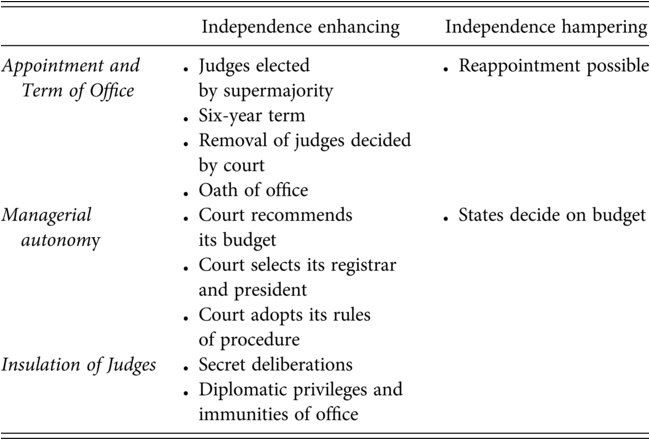
Table 6.7 Long description
The table outlines the rules constituting the formal independence of the African Court on Human and Peoples’ Rights. The table is divided into two main categories, including the factors enhancing independence instead the factors hampering independence, further broken down by specific aspects of the commission’s operation.
1. Appointment and term of office.
In the independence-enhancing, judges are elected by a supermajority. Judges serve a six-year term. Removal of judges is decided by a court. Judges are required to take an oath of office.
In independence hampering, reappointment is possible.
2. Managerial autonomy
In independence enhancing, the court recommends its budget. The court selects its registrar and president. The court adopts its rules of procedure.
In independent hampering, states decide on the budget.
3. Insulation of judges
In independence enhancing, Deliberations are kept secret. Judges are granted diplomatic privileges and immunities of office.
Several rules governing the appointment and terms of office of judges enhance the ACtHPR’s formal independence. The Court is composed of eleven judges.Footnote 153 They are nominated by state parties to the African Court Protocol. To be qualified, a nominee must be a national of an AU member state and “of high moral character and of recognized practical, judicial or academic competence and experience in the field of human and peoples’ rights.”Footnote 154 Each state may propose up to three candidates, at least two of whom must be nationals of that state.Footnote 155 The Assembly of the AU votes by secret ballot on all of the nominees.Footnote 156 Judges are elects by a two-thirds supermajority when consensus cannot be reached.Footnote 157 In practice, the two-thirds rule applies.Footnote 158 Selection by a supermajority, compared to unanimity, prevents any one state from vetoing appointments (meaning judges do not have to win the approval of all states). Judges serve a six-year term, which is the same as the average term length for all ICs and thus is neither particularly short nor inordinately long. The process for removing judges from office also enhances independence, as it prevents states from punishing judges through removal. Rather, the African Court on its own initiative can remove or suspend a judge by a unanimous decision.Footnote 159 The Assembly of the AU, however, can set aside this decision.Footnote 160 To date, no judge has been successfully removed from the Court. To my knowledge, there have been two instances where the Court reviewed allegations against a judge. In one instance, the Court found there had been no breach of the terms of office, and in the other, the judge resigned before a determination was made.Footnote 161 Last, judges must take an oath of office declaring to perform their duties faithfully and impartially.Footnote 162
On the other hand, independence is weakened because judges may be reelected to serve a second term.Footnote 163 The possibility of reelection reduces formal independence because it may cause judges to make decisions favorable to states to guarantee reappointment.Footnote 164 In practice, several judges have been reappointed to the ACtHPR. Interviewees suggest that reappointment decisions, even if affected by the votes and opinions of individual judges, are influenced by other factors, such as change in government, judges’ decisions to not stand for reelection, as well as the requirement that overall composition of the Court represent all legal traditions and regions of the AU and reflect a gender balance.Footnote 165
The African Court’s formal independence is enhanced by rules that provide it with managerial autonomy. In particular, the Court has control over the selection of its registrar,Footnote 166 president, and vice-president.Footnote 167 The Court also determines its own rules of procedure.Footnote 168 States, however, maintain control over the Court’s budget, and judges express concern that this limits the Court’s independence.Footnote 169 The Assembly of the AU approves the budget of the Court, so states have the final say on both the size and allocation of resources. While the Court does not have final control over its resources, formal rules do require that it is at least consulted by the AU.Footnote 170 The Court prepares a preliminary budget and presents it to the AU,Footnote 171 and in practice, the AU controls the size of the budget but reserves decisions on the allocation of resources for the Court.Footnote 172
Rules that insulate judges from political pressure also enhance the ACtHPR’s independence. On the one hand, judges “enjoy, from the moment of their election and throughout their term of office, the immunities extended to diplomatic agents in accordance with international law” and “at no time shall the judges of the Court be held liable for any decision or opinion issued in the exercise of their functions.”Footnote 173 Likewise, deliberations of the Court are to remain private.Footnote 174
While this is distinct from independence, I note safeguards to impartiality. Judges are barred from participating in activities that are incompatible with the independence or impartiality of their office,Footnote 175 including holding “political, diplomatic or administrative positions functions or government legal advisers.”Footnote 176 Judges must recuse themselves from hearing cases in which they were previously involved or in which they have a conflict of interest.Footnote 177 Also, judges are not allowed to hear cases if they are a national of the respondent state.Footnote 178 On the other hand, the AU Assembly determines the remuneration of judges,Footnote 179 which can be viewed as an independence hampering rule because salaries of judges could become a potential avenue for states to punish judges.
Overall, there are several independence-enhancing safeguards. These provisions are more numerous than those that reduce independence. They also cover the main aspects of the Court’s governance – the selection and tenure of judges, their terms of office, and managerial autonomy. Together they make collective state resistance politically challenging to implement. Moreover, they have an impact on how the Court is perceived. Several interviewees confirm that they view the Court as independent. One interviewee stated that “the integrity of the judges and their willingness and commitment to remain independent … to not be influenced” has been crucial to the Court’s operation.Footnote 180 Some interviewees pointed to specific provisions as ensuring greater independence. For example, one judge felt that the independence benefited from the requirement that judges not preside over cases in which their national state was the respondent.Footnote 181 Largely, interviewees view the Court as able to operate independently, without fear of political retribution from states. As one interviewee explains, the Court generally “does not care about the states when giving a legal decision.”Footnote 182 This is not to say that judges are not cognizant of politics. The judges know that fellow international courts – like the SADC Tribunal – have faced political backlash from states. For example, one judge explains, states “are the ones that set us up and may decide to shut us down; it’s a possibility, one of these examples is SADC. So that lays back in the mind of judges; you have to be careful.”Footnote 183 Formal independence is generally high for the Court, but, as this quote illustrates, it does not completely alleviate political constraints. Rather, it seems to supply it with a certain reservoir of legitimacy that helps to broaden its strategic space and therefore impacts its decision-making.
Political Fragmentation
As I have argued, political fragmentation also shapes a court’s strategic space and, therefore, its decision-making. H2 implies that we would observe minimal deference when a court’s membership is politically fragmented. The AU fits this characterization. Most importantly, the AU members are divided on the jurisdiction of the Court itself. For example, only thirty-four (out of fifty-five) AU member states have ratified the African Court Protocol.
A second implication of H2 is that we should observe higher than normal political fragmentation on issues where the Court has been nondeferential. I assess this implication by comparing political fragmentation on human rights overall against fragmentation on specific rights where the Court did not defer. As in the previous chapters, I measure fragmentation as the heterogeneity of member states’ preference. I infer preferences from state practice based on V-Dem data.Footnote 184 Heterogeneity is measured by calculating the coefficient of variation for all AU member states in any given year. The COV is a statistical measure of variability, which is standardized as a percentage (0–100) to compare across indicators.Footnote 185 Higher values indicate greater heterogeneity of preferences.
I selected six issues on which the Court has been nondeferential, albeit to varying degrees. They are rule of law, high court independence, election management body autonomy, access to justice, free expression, and electoral democracy.Footnote 186 These issues are among the more commonly litigated rights before the African Court (see Table 6.2). I compare fragmentation on these rights issues against fragmentation on civil liberties overall. I use the V-Dem civil liberties index to capture overall human rights preferences; this index is an aggregate measure of physical violence, political civil liberties, and private civil liberties.Footnote 187
Figure 6.3 depicts the coefficients of variation for the civil liberties index alongside the six selected rights. It shows that heterogeneity for all six selected rights where the Court has been nondeferential is higher compared to heterogeneity on civil liberties overall. This corresponds with the observable implication mentioned above: Political fragmentation is higher than normal on issues where the ACtHPR has not deferred.
AU political fragmentation on select issues.
Note: Calculations and illustration by author.
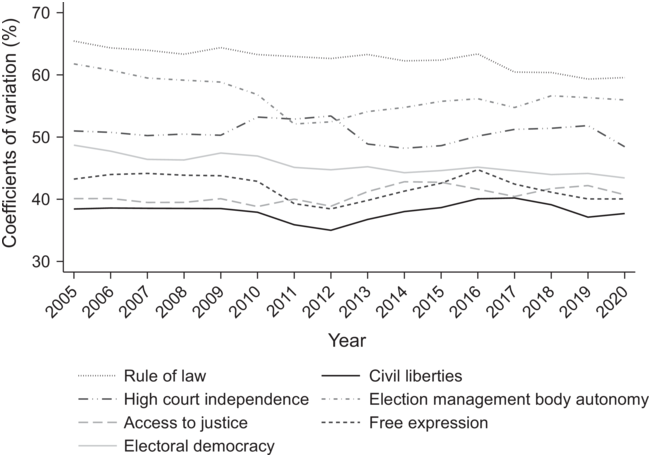
Figure 6.3 Long description
A line graph with the vertical axis labeled coefficients of variation (percent) ranges from 30 to 70 in increments of 10. The horizontal axis spans from 2005 to 2020. Seven lines represent different variables. The rule of law stays highest near 65. High court independence trends near 50 with mild fluctuations. Election management body autonomy starts near 60, drops after 2010, and stabilizes near 50. Free expression fluctuates between 45 and 50. Electoral democracy trends slightly above 40. Access to justice and civil liberties remain lowest, with civil liberties dipping to 35 in 2012 and fluctuating near 38 through 2020.
To elaborate with an example, the African Court has found violations in 52 percent of cases alleging violations of due process rights (see Table 6.2). Two indicators in Figure 6.3 relate to due process rights, namely, the rule of law and access to justice. Fragmentation on the rule of law and access to justice across all years is higher than it is for civil liberties overall, suggesting that nondeference arises when states are more fragmented than normal. The difference is especially large when comparing the rule of law and civil liberties. As another example, we can see a similar pattern related to election management and Article 13 (right to freely participate in government). On Article 13, the Court found violations in 58 percent of the instances where it was invoked by applicants. At the same time, fragmentation on electoral democracyFootnote 188 and electoral management body autonomy, especially the latter, is markedly higher than it is for civil liberties overall. Thus, this evidence supports H2 as preference heterogeneity is higher for issues where the Court has been less inclined to defer.
H2 has a third observable implication: When fragmentation decreases, we should see an increase in deference. Temporal patterns on deference are consistent with this observable implication. Figure 6.2 shows that civil liberty heterogeneity peaked in 2016, then decreased slightly. The rule of law and freedom of expression did the same. At the same time, the ACtHPR began to defer more since 2016–17 (see Figure 6.2). Taken together, the evidence supports the proposition that political fragmentation enables nondeference.
Past Resistance
The ACtHPR’s strategic space benefits from robust formal safeguards to independence alongside political fragmentation, which together help to explain the Court’s minimal deference. I have also argued that past resistance can narrow a court’s strategic space and lead to more deference (H5). The ACtHPR has faced instances of unilateral state resistance, shedding further light on temporal dynamics in the Court’s decision-making. Namely, the ACtHPR’s deference rose soon after an episode of exit. Rwanda withdrew its Article 34(6) declaration granting direct access to the Court for individuals and NGOs on February 24, 2016.Footnote 189 The withdrawal notice was received by the Court while prehearing procedures were ongoing in the Umuhoza v Rwanda.Footnote 190 The applicant, Umuhoza, is a leader of an opposition party who on various occasions made public comments allegedly denying or downplaying the Rwandan genocide. She was prosecuted and convicted in 2012 for, among other crimes, “minimizing” the genocide. She petitioned the ACtHPR, claiming she was denied a fair trial. As it became clear that the Court would proceed with the application, Rwanda withdrew its declaration.Footnote 191 The withdrawal notice stated that the Government “never envisaged” that a “[g]enocide convict who is a fugitive from justice” would be able to secure the right to be heard by virtue of its declaration. In parallel, the Court had other high-profile applications against Rwanda on its docket, which likely factored into Rwanda’s decision also.Footnote 192
Despite Rwanda’s exit, the Court declared that Rwanda violated Umuhoza’s right to a defense and that even if the state had a legitimate purpose in restricting free expression, criminal conviction was not proportionate as the state “could have adopted other less restrictive measures to attain the same objectives.”Footnote 193 The Court demonstrated some restraint, however, ruling against Umuhoza on some claims and exercising restraint on remedies as it did not mandate a change in the law.Footnote 194 Also, Rwanda has shown resistance by not participating in some of the proceedings of the Court, leading to default judgments.Footnote 195 This episode, along with slight decreases in preference heterogeneity, coincides with the upward trend in the ACtHPR’s deference in 2016–17 (Figure 6.2).
Four other states followed Rwanda and submitted withdrawal notices.Footnote 196 Tanzania submitted on November 14, 2019, followed by Benin in March 2020, and Côte d’Ivoire in April 2020. These withdrawals significantly reduce direct access. While these unilateral forms of state resistance arose for slightly different reasons, they nonetheless have harmed the Court’s legitimacy.Footnote 197 In other words, it has narrowed the Court’s otherwise broad strategic space and encouraged greater caution by the Court. Yet, it is also notable that while these exits have no doubt been harmful to the Court, some states have submitted declarations after others rescinded theirs, namely The Gambia, Niger, and Guinea-Bissau.
The ACtHPR’s Adaptive Practices
As I have shown, the African Court’s minimal deference has been aided by its safeguards to independence and political fragmentation, which together endow the Court with a broad strategic space and subtle constraints. Past resistance and some decline in political fragmentation overlap with increases in deference. However, deference is not the Court’s only response to its constraints. The theoretical argument presented by this book suggests that courts can adopt practices that help to reconstitute their strategic space. I find that the African Court employs persuasive argumentation and public legitimation to boost its nondeferential decision-making. Yet, these practices take on unique forms due to the Court’s broad strategic space and subtle constraints.
Persuasive Argumentation
The ACtHPR uses persuasive argumentation, but it relies more on its citation practices than it does speaking with a single voice to boost the persuasiveness of its judgments. Table 6.8 summarizes the African Court’s citation practices. It shows that among the ACtHPR’s citations, it places greater emphasis on its own jurisdiction. On average, the Court cites 4.96 external references in its judgments compared to 8.59 references to its own judgments. Put differently, the Court cites on average slightly more than one external judgment for every two of its own. This general pattern resonates with the theoretical argument, which claims that courts with broad strategic space will be less reliant on persuasive argumentation in the form of external citations (H3). It also suggests that armed with a broad strategic space, the Court is able to focus more on constructing compelling arguments through references to its own jurisprudence.
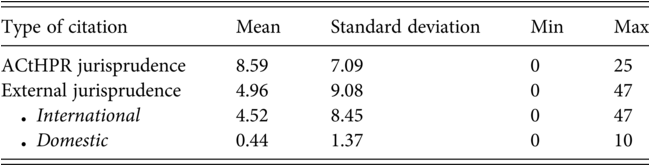
Table 6.8 Long description
The table features descriptive statistics on the African Court on Human and Peoples’ Rights, citation practices. The table shows the mean, standard deviation, minimum value, and maximum value for different types of citations.
For A C H P R jurisprudence, the mean number of citations is 8.59, with a standard deviation of 7.09. The minimum number of citations is 0, and the maximum is 25.
For external jurisprudence, the mean number of citations is 4.96, with a standard deviation of 9.08. The minimum number of citations is 0, and the maximum is 47.
Regarding international citations, the mean number is 4.52, with a standard deviation of 8.45. The minimum number of citations is 0, and the maximum is 47.
Regarding domestic citations, the mean number is 0.44, with a standard deviation of 1.37. The minimum number of citations is 0, and the maximum is 10.
Note: All ninety-one cases are included. The coding records citations made by the Court itself in its reasoning. It excludes citations raised by the parties to the dispute (unless it is later cited by the Court) or citations that are referred to as part of the factual background of the application, such as domestic proceedings concerning the application. Some applications have more than one relevant ruling/judgment. A citation is counted only once, even if it appears more than once in a single judgment or in different judgments related to the same application.
Despite this general trend, external references are featured in half of all the ACtHPR’s judgments (not shown). The Court relies on external jurisprudence especially when it ventures into new territory or makes a far-reaching decision. The two judgments with the highest number of external citations are Zongo v Burkina FasoFootnote 198 (forty-seven citations) and Thomas v TanzaniaFootnote 199 (thirty-five citations). Both decisions are noteworthy for their nondeference. Other judgments with many external references are: Rashidi v Tanzania (nineteen citations),Footnote 200 Rajabu v Tanzania (twenty citations),Footnote 201 Nganyi v Tanzania (twenty-one),Footnote 202 Konaté v Burkina Faso (twenty-seven),Footnote 203 Ajavon (13) v Benin (twenty-eight),Footnote 204 Mtikila v Tanzania (twenty-nine),Footnote 205 and Ajavon (62) v Benin (thirty-two).Footnote 206 These judgments are also notable for their nondeference. For example, in Rashidi, the Court addressed whether a body-cavity search, conducted in the presence of the applicant’s children, violated the right to integrity of person and dignity.Footnote 207 By drawing up the ECtHR’s jurisprudence, the Court determined the search was degrading and an affront to dignity. Further, the ACtHPR relied on decisions of the Inter-American Commission of Human Rights to argue that the search was inappropriate because it was not necessary for achieving the state’s interest as less invasive alternatives were available. Rashidi was the first case where the ACtHPR addressed this issue, ruling that the body-cavity search was a violation of not only Article 5 (which the applicant alleged) but also Article 4 of the African Charter (which the applicant did not allege). Moreover, the judgment included an intrusive remedy, ordering the state to reform its policies on body-cavity searches to avoid any future violations. Rajabu similarly suggests that external references are more common when the Court rejects the state’s exercise of authority.Footnote 208 In this case, the Court found that a mandatory death sentence for the crime of murder is an arbitrary deprivation of the right to life (Article 4) and death by hanging is cruel and degrading (Article 5). Rajabu was the first case in which the Court assessed a death penalty on the merits.Footnote 209 The Court ordered that the state repeal the relevant penal code. In constructing its decision, the Court cited jurisprudence of the European and Inter-American human rights courts. It also cited human rights bodies, including the UN Human Rights Committee and the African and Inter-American human rights commissions. The Court argued, “there is extensive and well-established international human rights case-law on the criteria to apply in assessing arbitrariness of a sentence of death.”Footnote 210 It drew on this case law to establish its position on how arbitrariness was to be determined. The Court later argued that its reasoning on arbitrariness “is affirmed by relevant international case law. Furthermore, domestic courts in some African countries have adopted the same interpretation in finding the mandatory imposition of the death penalty arbitrary and in violation of due process.”Footnote 211 In addition to rooting its findings in international law, it argued that its interpretation was consistent with that of other member states’ judiciaries, having cited high courts from Kenya, Malawi, and Uganda.
Table 6.8 shows that the Court cites domestic jurisprudence less than international jurisprudence. The Ajavon (62) judgment in 2020 stands out because it features a high number of references to international and domestic jurisprudence. The African Court pointed to rulings of Benin’s Constitutional Court which had similarly determined the amendment to the composition of the higher judicial council violated principles of judicial independence,Footnote 212 and it based its interpretation of the national consensus on the Constitutional Court’s own interpretation and application of national consensus.Footnote 213
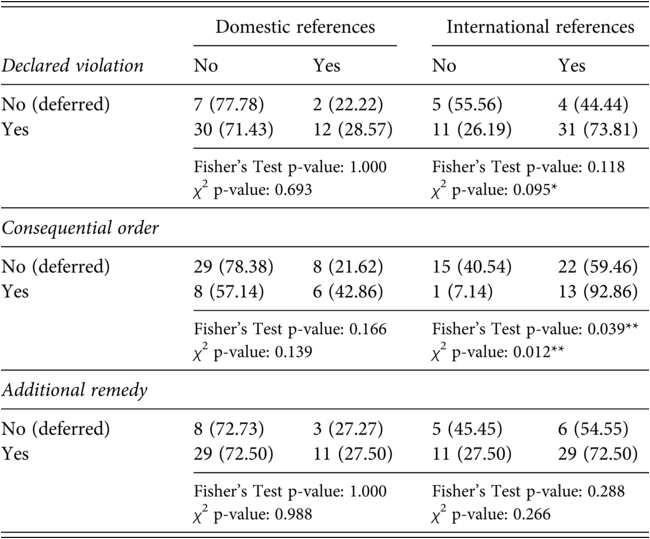
Table 6.9 Long description
The table features a cross-tabulation of the African Court on Human and Peoples’ Rights, citation practices by deference, considering merits only. It examines the relationship between whether a violation was declared, no or yes, and the citation of domestic and international references, no or yes. The table also includes data on consequential orders and additional remedies when a violation was declared and the citation of these reference types. Within each cell, the number of cases and the row percentages are provided. Below each cross-tabulation, Fisher’s exact test p-value and Chi-squared p-value are reported.
1. Declared violation
Domestic references:
For no declared violation, reflecting deference, no domestic references account for 7 cases, representing 77.78% of no violation, and yes domestic references account for 2 cases, representing 22.22% of no violation.
For yes declared violations, no domestic references account for 30 cases, representing 71.43%, and yes domestic references account for 12 cases, representing 28.57%.
Statistical test results show that Fisher’s Test p-value is 1.000, and Chi-squared p-value is 0.693.
International references:
For no declared violation, no international references account for 5 cases, representing 55.56% of no violations, and yes international references account for 4 cases, representing 44.44% of no declared violations.
For yes declared violations, no international references account for 11 cases, representing 26.19% of declared violations, and yes international references account for 31 cases, representing 73.81% of declared violations.
Statistical test results show that Fisher’s Test p-value is 0.118, and the Chi-squared p-value is 0.095.
2. Consequential order
Domestic references:
For no consequential, no domestic references account for 29 cases, representing 78.38%, and yes domestic references account for 8 cases, representing 21.62%.
For the yes, a consequential is ordered, no domestic references account for 8 cases, representing 57.14%, and yes domestic references account for 6 cases, representing 42.86%.
Statistical test results show that Fisher’s Test p-value is 0.166, and the Chi-squared p-value is 0.139.
International references:
For no consequential order issued, no international references account for 15 cases, representing 40.54%, and yes international references account for 22 cases, representing 59.46%.
For the yes, a consequential is ordered, no international references account for 1 case, representing 7.14%, and yes international references account for 13 cases, representing 92.86%.
Statistical test results show that Fisher’s Test p-value is 0.039, and the Chi-squared p-value is 0.012.
3. Additional remedy
Domestic references:
For no additional remedy, no domestic references account for 8 cases, representing 72.73%, and yes domestic references account for 3 cases, representing 27.27%.
For yes, an additional remedy is ordered, no domestic references account for 29 cases, representing 72.50%, and yes domestic references account for 11 cases, representing 27.50%.
Statistical test results show that Fisher’s Test p-value is 1.000, and Chi-squared p-value is 0.988.
International references:
For no additional remedy, no international references account for 5 cases, representing 45.45%, and yes international references account for 6 cases, representing 54.55%.
For yes, an additional remedy is ordered, no international references account for 11 cases, representing 27.50%, and yes international references account for 29 cases, representing 72.50%.
Statistical test results show that Fisher’s Test p-value is 0.288, and the Chi-squared p-value is 0.266.
Note: N = 51. *p<0.10, ** p<0.05, *** p<0.001. In each cross-tabulation, the first number is the frequency and the second number (in parentheses) is the row percentage.
While the Court relies more on its own jurisprudence, the above examples give some indication that persuasive argumentation, especially by citing international jurisprudence, might be more common when the Court’s does not defer to states. Table 6.9 takes a closer look at the relationship between deference and the Court’s citations practices. It reveals that external references are more commonly found in decisions that reflect nondeference, in terms of both case outcomes and remedies, than in decisions of deference. This relationship is stronger for international references than domestic references. For example, the Court’s decisions featured at least one international citation in 44 percent of cases in which the Court found no violation (deferral) in contrast to 74 percent when it did find a violation. The contrast is less stark for domestic references, which were included in 22 percent of declarations of no violation but 29 percent of declared violations. The patterns are similar for remedies. An international reference can be found in 93 percent of decisions with consequential orders compared to 60 percent of decisions without consequential orders. A domestic reference is also found in a larger portion of decisions with consequential orders compared to those without consequential orders. An international or domestic reference was included in 73 and 28 percent, respectively, of decisions with any remedy in addition to a declaratory order. External references are featured less often when there is no additional remedy (55 percent for international and 27 percent for domestic references). Thus, while the Court shows less persuasive argumentation through external citations than the CCJ (which will be discussed further in Chapter 7), it does use external citations more when it does not defer than when it does. These findings align with the theoretical arguments developed in Chapter 2 – persuasive argumentation through external citations facilitates nondeference.
Also, the Court does not rely heavily on unanimous decisions as a means of persuasive argumentation. In other words, the Court openly expresses disagreement on the bench, reflecting its broad strategic space. According to my data, one-quarter of the Court’s judgments have been non-unanimous. Also, judges write separate and dissenting opinions.Footnote 214 Twenty-one cases in my data have written dissents, and separate opinions were published in thirty-nine cases. Similarly, there is little evidence that unanimous judgments are systematically used to bolster nondeference. My data reveal no strong relationship between unanimous decisions and deference (see Table A6.1). These findings are not surprising because the Court enjoys a broad strategic space (H3). Overall, the broad strategic space corresponds with the Court’s high use of its own jurisprudence to reason its judgments and is willingness to express dissent and disagreement. Nonetheless, the evidence does show that external jurisprudence is instrumental to nondeference, especially when the Court ventures into new territory.
Public Legitimation
An examination of the Court’s strategic plans, annual activity reports,Footnote 215 “off-the-bench” activities like speeches and presentations by the judges,Footnote 216 as well as the Court’s public communication (e.g., press releases) and interview material, reveals that the African Court has developed practices of public legitimation to construct its strategic space. Specifically, the Court engages in a range of activities that target its public audience with portrayals of its rightfulness.
The Court is attuned to the public’s awareness of it. For example, one interviewee explained: “we are sensitive to the public’s perception about the Court, especially the image of the Court.”Footnote 217 Poor public knowledge of the Court has been an ongoing concern. Its strategic plan for 2011–14 pointed to the lack of awareness as one of its weaknesses.Footnote 218 In 2011, during a “sensitization” visit – when representatives of the Court travel to member states to pay courtesy calls, speak with national leaders, civil society, and human rights communities – the then President of the Court, Justice Gérard Niyungeko explained to his audience in Ghana that the Court “is not well known by the African people.”Footnote 219 Similarly, Justice Akuffo’s report on the Court to a summit of constitutional, regional, and supreme court justices noted, “there is an overall lack of awareness about the very existence of the Court among Africans across the board.”Footnote 220 These concerns also received attention in the Court’s 2016–20 Strategic Plan, seeing the lack of public awareness as a “threat” to the Court. The most recent strategic plan repeats this concern.
The Court recognizes its own ability to shape its public image. As one interviewee expressed, “The Court must take care of its own public relations…we’ve come along to accept that.”Footnote 221 This has been the Court’s view from its early days. During the Court’s 2011 sensitization visit to Ghana, Judge Gérard Niyungeko, for example, explained that “It is precisely to raise awareness about itself that the Court decided to embark on a series of promotional activities, comprising the organization of sensitization seminars in a number of countries, with a view to popularize the Court.”Footnote 222 Judge Akuffo’s 2012 report on the ACtHPR similarly illustrated the Court’s agency in addressing its public image, claiming, “the Court has taken the unusual policy decision to strategically improve its visibility and accessibility to all relevant stakeholders by undertaking activities that inform them of its existence, its mandate and how it may be utilized.”Footnote 223
More recently, President Judge Sylvain Oré urged the Court’s staff to use publicity to counter existing negative impressions made by states and improve public opinion.Footnote 224 Accordingly, the Court adopted “outreach and coordination” as one of its four main goals for its 2016–20 Strategic Plan, with the aim of “build[ing] the Court’s reputation and profile as a veritable pillar in the African Human Rights architecture and improve awareness of the Court by engaging stakeholders.”Footnote 225 When announcing this strategic plan, President Oré claimed, “We have to intensify our efforts to increase the visibility of the Court so that more people and stakeholders understand the existence of the Court and hope that in return they will presurize [sic] their States to ratify and or deposit declarations.”Footnote 226 The 2021–25 Strategic Plan similarly made greater awareness a central goal and identified several strategic actions to carry out for this purpose.Footnote 227
The Court has adopted a range of public-oriented “off-the-bench” activities. “Sensitization” visits are one such activity. Among the objectives stated for sensitization are “raising public awareness about the Court … [and] encouraging the public to utilise the Court in settling human rights disputes.”Footnote 228 Other activities range from essay contests,Footnote 229 participating in various regional events, like the 2010 Decade of the African WomenFootnote 230 and the commemoration of African Human Rights Day.Footnote 231 The Court also relies on media and technology to “reach out to those people who are not here [in Arusha].”Footnote 232 The Court has provided media training on how to cover the Court. In 2013, for instance, the Court organized a conference for the media. It “was attended by a total of 67 journalists and media practitioners from thirty (30) African countries and 10 Judges of the African Court. At the end of the two-day conference, the participants adopted conclusions on how to work to enhance the visibility of the Court in particular and promote human rights as a whole.”Footnote 233 Also, the Court distributes promotional materials (posters, pamphlets, videos, etc.),Footnote 234 and it maintains a website and social media profiles (e.g., Twitter, Facebook) to have a public presence.
The Court’s outreach and communication not only target a public audience, but also convey norm-referential and value-laden narratives. For example, the Court advertises that one of its core values is “fair and impartial application and interpretation” of human rights law.Footnote 235 The Court conveys or displays these values through its off-the-bench activities.Footnote 236 When Judge Niyungeko spoke to the Pan-African Parliament, he explained, “the Court pledges to discharge its role as the judicial pillar of the African Union with independence, justice and fairness.”Footnote 237 The Court makes other norm-referential representations, like how its adheres to rules of admissibility and the exhaustion of local remedies. For example, during the moot court competition, the Court emphasized its respect for these rules.Footnote 238
A prominent narrative signals the Court’s commitment to its founding political purpose: the protection of human rights and effective justice for these rights. For example, the theme of the Court’s 2011 sensitization visit to Ghana was: “Your new partner in the reinforcement of the protection of human rights in Africa.”Footnote 239 At the Third Continental Judicial Dialogue, President Oré explained: “to render a more effective justice in Africa is no longer an option. It is imperative!”Footnote 240 The Court’s promotion of other human rights institutions helps to portray its commitment to human rights, putting it before institutional allegiance. When addressing audiences where the Court does not have jurisdiction, one interviewee explained that efforts are made to point to other institutional opportunities for the protection of human rights, such as the ACmHPR or Court of Justice for ECOWAS.Footnote 241 The Court also highlights its complementarity with the ACmHPR.Footnote 242 The prominence of parallel human rights institutions in the Court’s outreach and communication signals its broad commitment to human rights and its overall political purpose.
The Court’s messaging is also people-centered, frequently speaking to its promotion of the African people and their values and aspirations. When addressing the ACmHPR, Justice Augustino Ramadhani said, “The noble mission of our two sister organs is to serve the common man and woman of Africa …. So, let us make his and her life better in so doing we are making sure that our tomorrow will be better also.”Footnote 243 In another statement, Oré expressed how human rights reflect a common African goal: “it is our struggle, our common responsibility for an Africa which places human rights at the heart of the African Union reforms and as the key to socio-economic and human development.”Footnote 244 On another occasion, Oré asserted how the Court is “neither a Court for the States nor a Court of the Judges, but rather a Court for all African citizens.”Footnote 245 He claimed that “to build a more worthy, more humane and more prosperous Africa” is a “common struggle.”Footnote 246
Thus, the ACtHPR practices public legitimation. Many of its “off-the-bench” activities and communications are public-oriented and feature narratives of the Court’s respect for its political purpose and its people-centeredness. To examine the intensity of these narratives in the Court’s public communication, I look at the Court’s Facebook profile. Using a web-scraping tool, I extract the ACtHPR’s Facebook posts from 2012 to 2020.Footnote 247 A total of 897 posts were extract. Using the words or phrases commonly found in the Court’s political purpose and people-centeredness narratives, I identify their prominence in Facebook posts. Table 6.10 displays the words and phrases used for this analysis, as well as the number and percentage of posts that feature them. It illustrates that these narratives are minimally present on the African Court’s Facebook page, suggesting a relatively limited degree of public legitimation through social media. In fact, many posts have short texts and instead rely on visual imagery, like photos and videos. Less than 7 percent of posts feature narratives about the Court’s people-centeredness or political purpose. People-centeredness appears more than messaging about its political purposes, although the difference is modest.
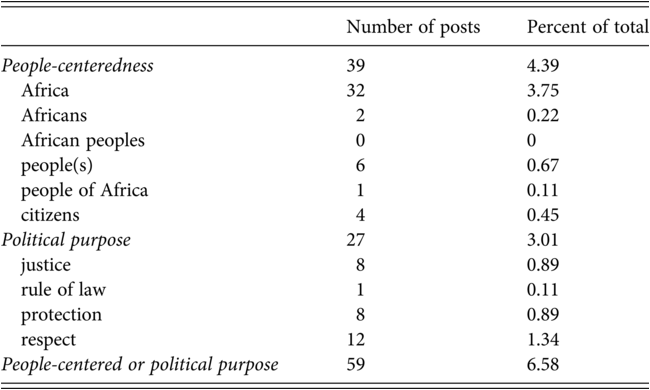
Table 6.10 Long description
The table features public legitimation narratives in the African Court on Human and Peoples’ Rights, Facebook posts. The table lists legitimation words and phrases along with the number of posts in which they are used and the % of the total posts that include each word or phrase.
1. People-centeredness
This category is used in 39 posts, representing 4.39% of the total.
The word Africa is used in 32 posts, representing 3.75% of the total.
The word Africans is used in 2 posts, representing 0.22% of the total.
The phrase African peoples is used in 0 posts, representing 0% of the total.
The word or phrase people or peoples is used in 6 posts, representing 0.67% of the total.
The phrase people of Africa is used in 1 post, representing 0.11% of the total.
The word citizens is used in 4 posts, representing 0.45% of the total.
2. Political purpose:
This category is used in 27 posts, representing 3.01% of the total.
The word justice is used in 8 posts, representing 0.89% of the total.
The phrase rule of law is used in 1 post, representing 0.11% of the total.
The word protection is used in 8 posts, representing 0.89% of the total.
The word respect is used in 12 posts, representing 1.34% of the total.
3. People-centered or political purpose
This combined category is used in 59 posts, representing 6.58% of the total.
Notes: Additional terms – e.g., democracy, fair(ness), equality, dignity – were checked but were absent. “Public” is excluded because it is often used to announce that hearings are public. Equivalent French terms are also included, although very few posts are in French. All terms and phrases are case sensitive.
The public legitimation narratives declined beginning in 2017 (see Table A6.2). This decline coincides with a decrease in deference (see Figure 6.2). Based on the logic of H4, we would expect public legitimation to decline as nondeference declines. While the temporal data are limited and should be read with caution, the observed pattern is congruent with the theoretical expectation.
To briefly summarize the African Court’s adaptive practices, the analysis reveals that the Court has adopted practices of persuasive argumentation and public legitimation. However, these practices take on a unique form due to the Court’s broad strategic space. Its persuasive argumentation is focused more on making the Court’s jurisprudence coherent as external references have been less prominent in its decisions, and it does not systematically rely on unanimous judgments to bolster nondeferential decisions. Public legitimation can also be seen through its “off-the-bench” activities and outreach. These activities are frequently public-oriented and norm referential. The messages appear to place more emphasis on the Court’s people-centeredness than on its commitment to its political purpose.
Conclusion
Four main findings emerge from this analysis of the ACtHPR. First, the ACtHPR, much like the EACJ and CCJ, evolved from and operates within the context of colonial legacies. Importantly, a lasting impact of colonialism is a dualism of a norm of political independence and noninterference alongside a norm embracing regional cooperation on human rights. Additionally, the African Court’s ideational setting includes a legal culture defined by complex legal pluralism, judicial insecurity, and a lack of confidence in state legal order.
Second, the African Court defers to a limited extent, showing a willingness to reject states’ exercise of authority in case outcomes, interpretation and reasoning, and through remedies. More than the other courts studied in this book, the ACtHPR declares states to be in violation of their obligations. Its legal interpretations frequently reject states preferred interpretations and encroach on states’ authority to make law by establishing legal standards that would otherwise not be met by many member states. The Court’s interpretations and legal reasoning, in other words, demonstrate the Court’s refusal to abstain from exercising its own authority. The Court has, however, exercised more caution in its remedial orders; it generally reserves intrusive remedies for a limited number of applications, but it readily provides for reparations to victims. The ACtHPR’s decision-making, therefore, can be described as minimally deferential, even though deference increased toward the end of the time under analysis (2017 onward).
Third, the Court’s tendency to not defer is difficult to explain based on the role of its support network. While there is a support network from which the Court draws strength, it is wanting in several ways and faces impediments. The key channels through which support networks would be able to preserve the Court are troubled. Supranational actors, namely, the ACmHPR, have made limited use of their capacity to refer applications to the Court. Private actors also face legal and practical barriers to accessing the Court. Moreover, when the support network is involved in litigation, the Court may be less likely to defer on the merits, but it is more likely to abstain from ordering intrusive remedies.
Fourth, the ACtHPR’s nondeference and rejection of states’ exercise of authority are significantly shaped by its high formal independence and political fragmentation, which endows it with a broad strategic space. Interview material supports the proposition that the Court’s formal independence contributes to stakeholders’ views of the Court. Where political fragmentation is greater, we see the Court favoring nondeference. Also, nondeference lessened as the Court experienced a wave of unilateral exits. Even with this resistance, however, the African Court retains a relatively broad strategic space. This broad strategic space sheds light on the Court’s adaptive practices. Specifically, the African Court’s persuasive argumentation does not hinge on having unanimous judgments and external citations. Rather, it appears to focus its reasoning on the internal coherence of its jurisprudence. In addition, while the Court works to legitimate itself publicly, the Court appears to be less dependent on narratives about its respect for its political purpose and opts for more messaging about its people-centeredness. Overall, the analysis reveals the Court is minimally deferential because it faces only subtle constraints. Chapter 7 revisits these findings once more while exploring how the EACJ, CCJ, and ACtHPR compare.
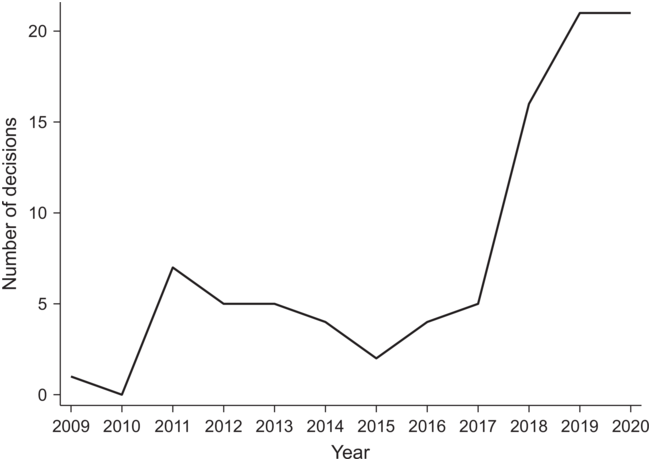
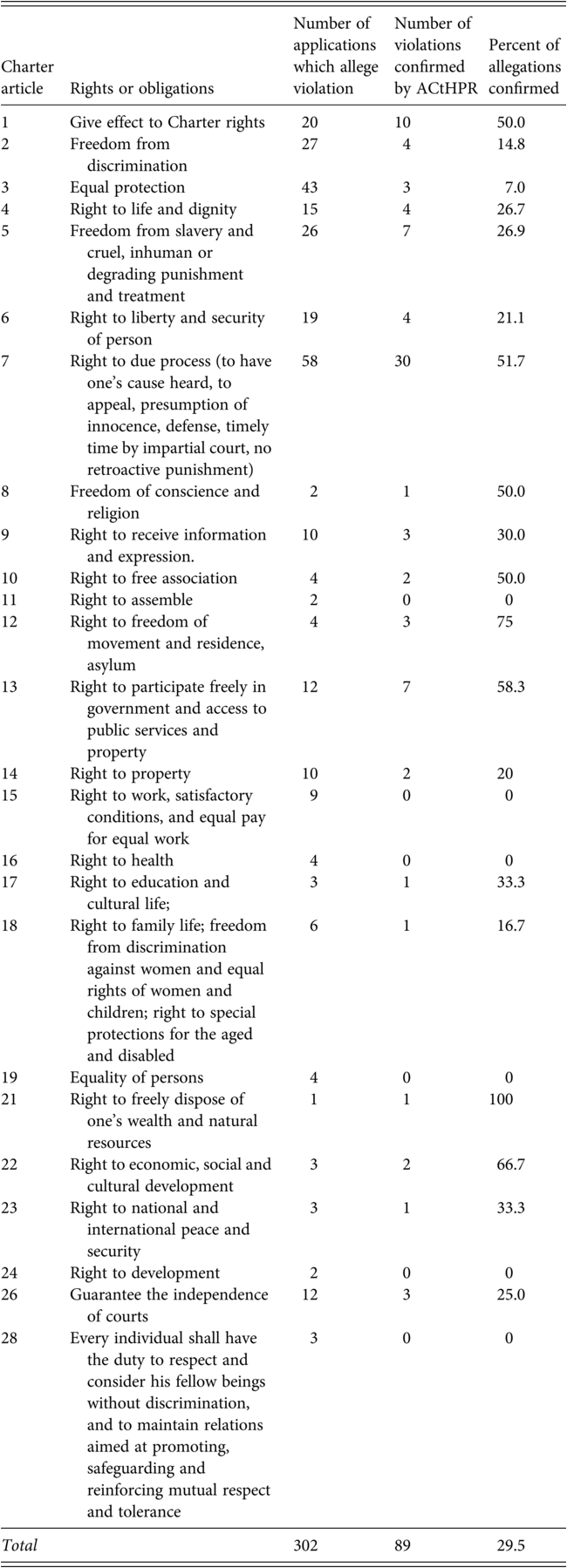
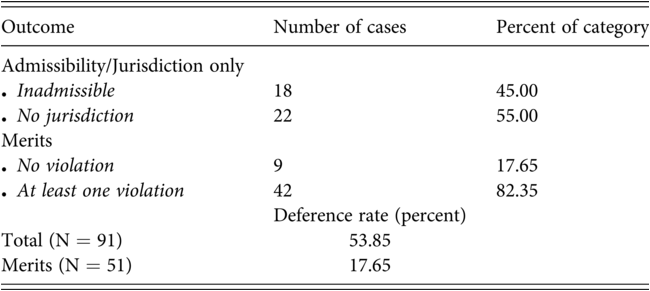
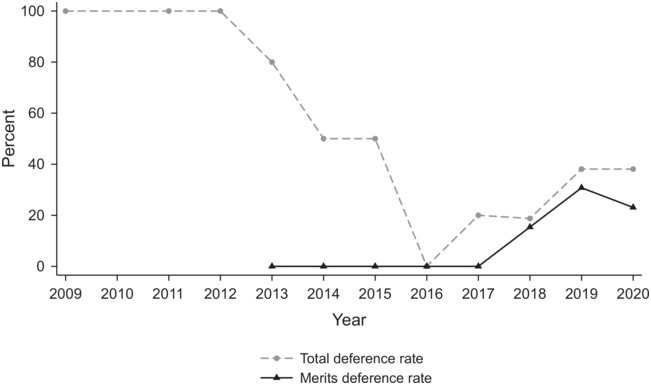
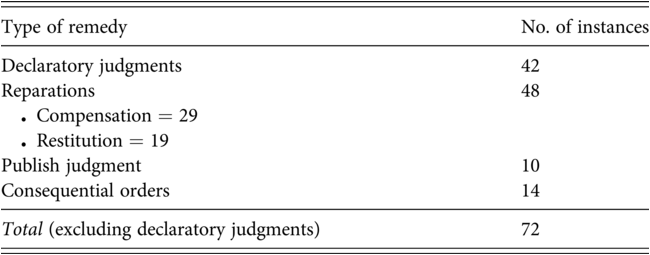
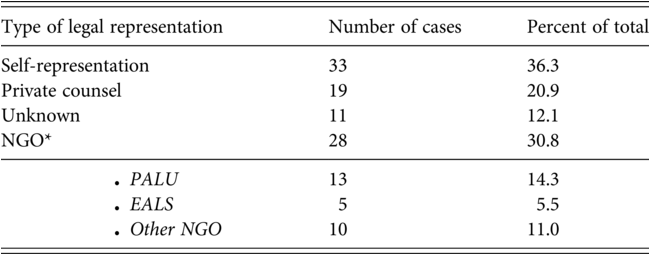
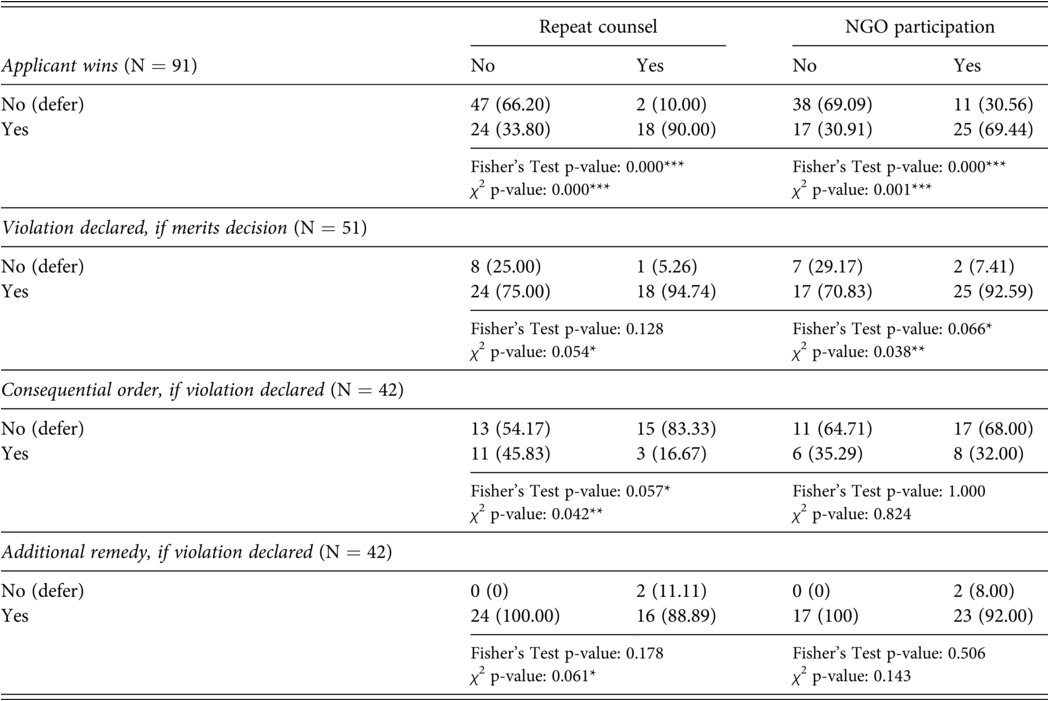
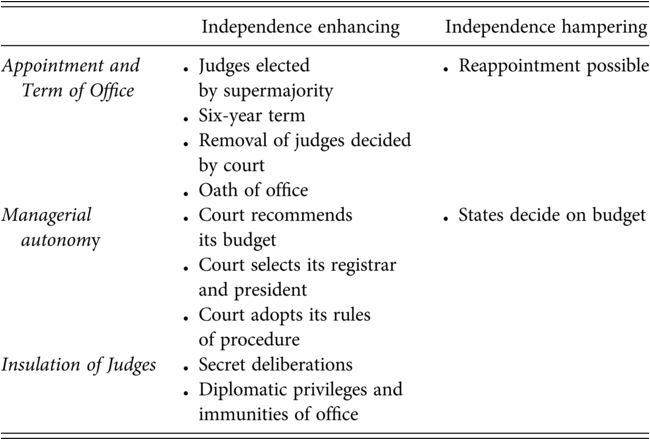
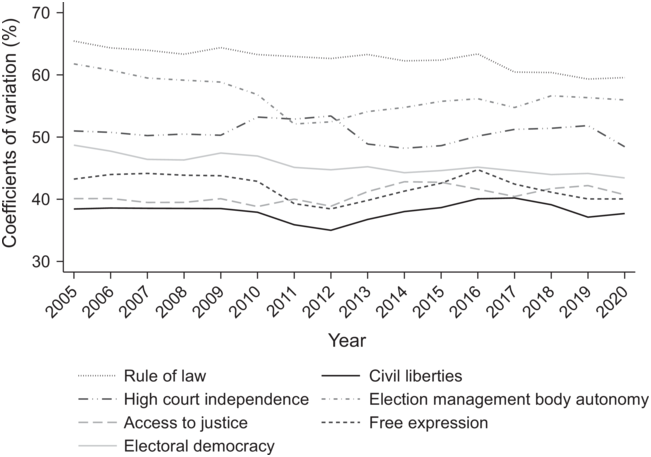
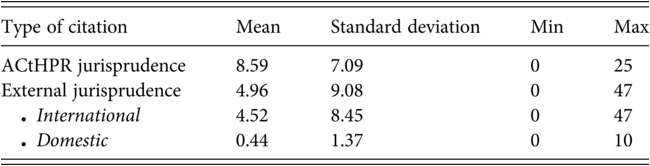
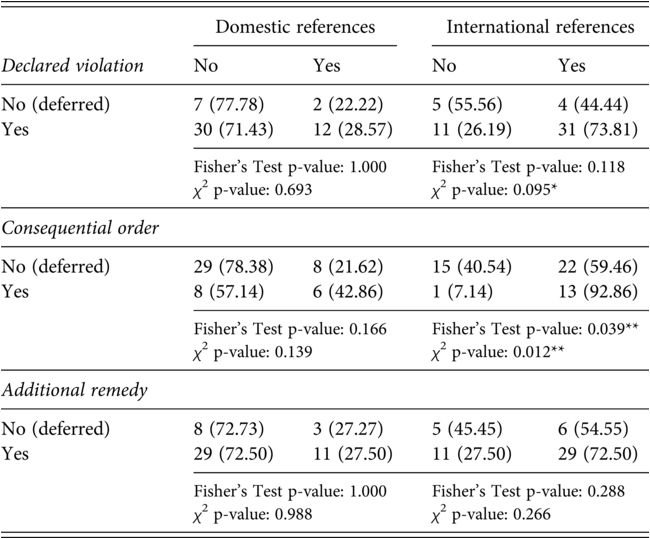
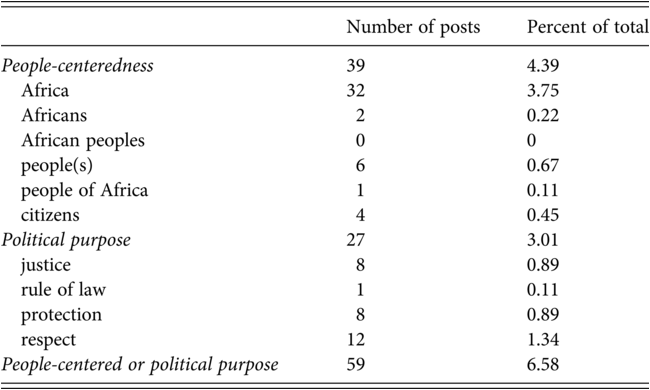

 Open access