







1 Introduction and main result
The mathematical analysis of spectral and dynamical properties of dilute Bose gases has seen tremendous progress in the past decades after the first experimental observation of Bose-Einstein condensates in trapped atomic gases [Reference Anderson, Ensher, Matthews, Wieman and Cornell2, Reference Davis, Mewes, Andrews, van Druten, Durfee, Kurn and Ketterle24]. In this work, we model such experimental setups by considering N bosons moving in $\mathbb {R}^3$
with energies described by
$\mathbb {R}^3$
with energies described by
 $$ \begin{align} H^{\text{trap}}_N = \sum_{j=1}^N \left( -\Delta_{x_j} + V_{\text{ext}} (x_j) \right) + \sum_{1\leq i<j\leq N} N^2 V(N(x_i -x_j)), \end{align} $$
which acts on a dense subspace of $ L^2_s(\mathbb {R}^{3N})$
, the subspace of
$ L^2_s(\mathbb {R}^{3N})$
, the subspace of $ L^2(\mathbb {R}^{3N})$
that consists of wave functions that are invariant under permutation of the particle coordinates. We assume the two body interaction
$ L^2(\mathbb {R}^{3N})$
that consists of wave functions that are invariant under permutation of the particle coordinates. We assume the two body interaction $V\in L^1(\mathbb {R}^3) $
to be pointwise nonnegative, radially symmetric and of compact support. The trapping potential
$V\in L^1(\mathbb {R}^3) $
to be pointwise nonnegative, radially symmetric and of compact support. The trapping potential $V_{\text {ext}}\in L_{\text {loc}}^\infty (\mathbb {R}^3) $
is assumed to be locally bounded and to satisfy
$V_{\text {ext}}\in L_{\text {loc}}^\infty (\mathbb {R}^3) $
is assumed to be locally bounded and to satisfy $ \lim _{|x|\to \infty } V_{\text {ext}}(x) =\infty $
.
$ \lim _{|x|\to \infty } V_{\text {ext}}(x) =\infty $
.
The scaling $ V_N = N^2V(N.)$
characterizes the Gross-Pitaevskii scaling which can be understood as a joint thermodynamic and low density limit as
$ V_N = N^2V(N.)$
characterizes the Gross-Pitaevskii scaling which can be understood as a joint thermodynamic and low density limit as $N\to \infty $
(see, for example, [Reference Lieb, Seiringer, Solovej and Yngvason37] for a detailed introduction). It ensures that the rescaled potential
$N\to \infty $
(see, for example, [Reference Lieb, Seiringer, Solovej and Yngvason37] for a detailed introduction). It ensures that the rescaled potential $V_N$
has a scattering length
$V_N$
has a scattering length $ \mathfrak {a} (V_N) = N^{-1} \mathfrak {a} (V)$
of order
$ \mathfrak {a} (V_N) = N^{-1} \mathfrak {a} (V)$
of order $O(N^{-1})$
so that both the kinetic and potential energies in (1.1) are typically of size
$O(N^{-1})$
so that both the kinetic and potential energies in (1.1) are typically of size $O(N)$
w.r.t. low energy states. In fact, it is well known [Reference Lieb, Seiringer and Yngvason38] that the scattering length
$O(N)$
w.r.t. low energy states. In fact, it is well known [Reference Lieb, Seiringer and Yngvason38] that the scattering length $ \mathfrak {a} \equiv \mathfrak {a}(V)$
completely characterizes the influence of the interaction on the leading order contribution to the ground state energy
$ \mathfrak {a} \equiv \mathfrak {a}(V)$
completely characterizes the influence of the interaction on the leading order contribution to the ground state energy $ E_N = \inf \text {spec} ( H^{\text {trap}}_N)$
:
$ E_N = \inf \text {spec} ( H^{\text {trap}}_N)$
:
 $$ \begin{align} \lim_{N\to\infty} \frac{E_N}{N} = \inf_{\varphi\in L^2(\mathbb{R}^3)} \mathcal{E}_{\text{GP}}^{\text{trap}}(\varphi) \equiv e^{\text{trap}}_{\text{GP}}. \end{align} $$
Here, $ \mathcal {E}^{\text {trap}}_{\text {GP}}$
denotes the Gross-Pitaevskii energy functional defined by
$ \mathcal {E}^{\text {trap}}_{\text {GP}}$
denotes the Gross-Pitaevskii energy functional defined by
 $$ \begin{align} \mathcal{E}_{\text{GP}}^{\text{trap}}(\varphi) = \int_{\mathbb{R}^3} dx\, \Big( \vert \nabla \varphi(x) \vert^2 + V_{\text{ext}}(x) \vert \varphi(x)\vert^2 + 4\pi\mathfrak{a} \vert \varphi(x)\vert^4 \Big) \end{align} $$
and the scattering length $\mathfrak {a}$
of the potential V is characterized by
$\mathfrak {a}$
of the potential V is characterized by
 $$ \begin{align} \mathfrak{a} = \frac1{8\pi}\inf \bigg\{ \int_{\mathbb{R}^3} dx\,\big( 2|\nabla f(x)|^2 + V(x)|f(x)|^2\big): \lim_{|x|\to\infty}f(x)=1 \bigg\}.\end{align} $$
By standard variational arguments, the functional (1.3) admits a unique positive, normalized minimizer, denoted in the sequel by $ \varphi _{\text {GP}}$
, and it turns out that the normalized ground state
$ \varphi _{\text {GP}}$
, and it turns out that the normalized ground state $ \psi _N$
of
$ \psi _N$
of $ H^{\text {trap}}_N$
exhibits complete Bose-Einstein condensation into
$ H^{\text {trap}}_N$
exhibits complete Bose-Einstein condensation into $ \varphi _{\text {GP}}$
: if
$ \varphi _{\text {GP}}$
: if $ \gamma _N^{(1)} =\text {tr}_{2,\ldots ,N} |\psi _N\rangle \langle \psi _N|$
denotes the one-particle reduced density of
$ \gamma _N^{(1)} =\text {tr}_{2,\ldots ,N} |\psi _N\rangle \langle \psi _N|$
denotes the one-particle reduced density of $\psi _N$
, then [Reference Lieb and Seiringer35]
$\psi _N$
, then [Reference Lieb and Seiringer35]
 $$ \begin{align} \lim_{N\to\infty} \langle \varphi_{\text{GP}}, \gamma_N^{(1)}\varphi_{\text{GP}}\rangle = 1. \end{align} $$
Physically, the identity (1.5) means that the fraction of particles occupying the condensate state $ \varphi _{\text {GP}}$
tends to one in the limit
$ \varphi _{\text {GP}}$
tends to one in the limit $N\to \infty $
. Mathematically, it is equivalent to the convergence of
$N\to \infty $
. Mathematically, it is equivalent to the convergence of $ \gamma _N^{(1)}$
to the rank-one projection
$ \gamma _N^{(1)}$
to the rank-one projection $|\varphi _{\text {GP}}\rangle \langle \varphi _{\text {GP}}| $
in trace class which implies that one body observables are asymptotically completely determined by
$|\varphi _{\text {GP}}\rangle \langle \varphi _{\text {GP}}| $
in trace class which implies that one body observables are asymptotically completely determined by $\varphi _{\text {GP}}$
.
$\varphi _{\text {GP}}$
.
It should be noted that the convergence in (1.5) holds true more generally for approximate ground states $ \psi _N$
that satisfy
$ \psi _N$
that satisfy $ N^{-1}\langle \psi _N,H^{\text {trap}}_N \psi _N\rangle \leq e^{\text {trap}}_{\text {GP}} + o(1)$
for an error
$ N^{-1}\langle \psi _N,H^{\text {trap}}_N \psi _N\rangle \leq e^{\text {trap}}_{\text {GP}} + o(1)$
for an error $o(1)\to 0$
as
$o(1)\to 0$
as $N\to \infty $
. This has been proved in [Reference Lieb and Seiringer36] and later been revisited with different tools in [Reference Nam, Rougerie and Seiringer43]. Moreover, very recent developments have lead to a significantly improved quantitative understanding of (1.2) and (1.5): generalizing previously obtained results in the translation invariant setting [Reference Boccato, Brennecke, Cenatiempo and Schlein4, Reference Boccato, Brennecke, Cenatiempo and Schlein5, Reference Boccato, Brennecke, Cenatiempo and Schlein6, Reference Boccato, Brennecke, Cenatiempo and Schlein7, Reference Adhikari, Brennecke and Schlein1], the works [Reference Nam, Napiórkowski, Ricaud and Triay42, Reference Brennecke, Schlein and Schraven16] determine the optimal convergence rates in (1.2) and (1.5) while [Reference Nam and Triay44, Reference Brennecke, Schlein and Schraven17] go a step further and determine the low energy excitation spectrum of
$N\to \infty $
. This has been proved in [Reference Lieb and Seiringer36] and later been revisited with different tools in [Reference Nam, Rougerie and Seiringer43]. Moreover, very recent developments have lead to a significantly improved quantitative understanding of (1.2) and (1.5): generalizing previously obtained results in the translation invariant setting [Reference Boccato, Brennecke, Cenatiempo and Schlein4, Reference Boccato, Brennecke, Cenatiempo and Schlein5, Reference Boccato, Brennecke, Cenatiempo and Schlein6, Reference Boccato, Brennecke, Cenatiempo and Schlein7, Reference Adhikari, Brennecke and Schlein1], the works [Reference Nam, Napiórkowski, Ricaud and Triay42, Reference Brennecke, Schlein and Schraven16] determine the optimal convergence rates in (1.2) and (1.5) while [Reference Nam and Triay44, Reference Brennecke, Schlein and Schraven17] go a step further and determine the low energy excitation spectrum of $ H^{\text {trap}}_N$
up to errors
$ H^{\text {trap}}_N$
up to errors $o(1)\to 0$
that vanish in the limit
$o(1)\to 0$
that vanish in the limit $ N\to \infty $
. In particular, the main results of [Reference Nam and Triay44, Reference Brennecke, Schlein and Schraven17] imply that the ground state and elementary excitation energies of
$ N\to \infty $
. In particular, the main results of [Reference Nam and Triay44, Reference Brennecke, Schlein and Schraven17] imply that the ground state and elementary excitation energies of $ H^{\text {trap}}_N$
depend on the interaction up to second order only through its scattering length, in accordance with Bogoliubov’s predictions [Reference Bogoliubov9]. It is remarkable that this even remains true up to the third-order contribution to the ground state energy of size
$ H^{\text {trap}}_N$
depend on the interaction up to second order only through its scattering length, in accordance with Bogoliubov’s predictions [Reference Bogoliubov9]. It is remarkable that this even remains true up to the third-order contribution to the ground state energy of size $ \log N/N$
, as recently shown for translation invariant systems in [Reference Caraci, Olgiati, Saint Aubin and Schlein21].
$ \log N/N$
, as recently shown for translation invariant systems in [Reference Caraci, Olgiati, Saint Aubin and Schlein21].
In view of experimental observations of Bose-Einstein condensates, it is natural to study the dynamics of initially trapped Bose-Einstein condensates and to ask whether the system continues to exhibit BEC once the trap is released. Based on the preceding remarks, it is particularly interesting to consider an approximate ground state $ \psi _N$
of
$ \psi _N$
of $ H_N^{\text {trap}}$
and to analyze its time evolution after releasing the trap
$ H_N^{\text {trap}}$
and to analyze its time evolution after releasing the trap $ V_{\text {ext}}$
. We model this situation by studying the Schrödinger dynamics
$ V_{\text {ext}}$
. We model this situation by studying the Schrödinger dynamics
 $$\begin{align*}t\mapsto \psi_{N,t}=e^{-i H_N t}\psi_N \end{align*}$$
generated by the translation invariant Hamiltonian $H_N$
, which is given by
$H_N$
, which is given by
 $$ \begin{align} H_N = \sum_{j=1}^N -\Delta_{x_j} + \sum_{1\leq i<j\leq N} N^2 V(N(x_i -x_j)). \end{align} $$
As in the spectral setting, it turns out that also the dynamics is determined to leading order by the Gross-Pitaevskii theory: if $ \gamma _{N,t}^{(1)} =\text {tr}_{2,\ldots ,N} |\psi _{N,t}\rangle \langle \psi _{N,t}|$
denotes the reduced one-particle density with regard to the evolved state
$ \gamma _{N,t}^{(1)} =\text {tr}_{2,\ldots ,N} |\psi _{N,t}\rangle \langle \psi _{N,t}|$
denotes the reduced one-particle density with regard to the evolved state $ \psi _{N,t}$
, then [Reference Erdős, Schlein and Yau25, Reference Erdős, Schlein and Yau26, Reference Erdős, Schlein and Yau27, Reference Erdős, Schlein and Yau28]
$ \psi _{N,t}$
, then [Reference Erdős, Schlein and Yau25, Reference Erdős, Schlein and Yau26, Reference Erdős, Schlein and Yau27, Reference Erdős, Schlein and Yau28]
 $$ \begin{align} \lim_{N\to\infty} \langle \varphi_{t}, \gamma_{N,t}^{(1)}\varphi_{t}\rangle = 1 \end{align} $$
for all $t\in \mathbb {R}$
, where
$t\in \mathbb {R}$
, where $ t\mapsto \varphi _t$
solves the time-dependent Gross-Pitaevskii equation
$ t\mapsto \varphi _t$
solves the time-dependent Gross-Pitaevskii equation
 $$ \begin{align} i\partial_t \varphi_t = -\Delta \varphi_t + 8\pi \mathfrak{a} |\varphi_t|^2 \varphi_t. \end{align} $$
Like in the spectral setting, the convergence (1.7) can be quantified with an explicit rate as shown first in [Reference Pickl45], later in a Fock space setting in [Reference Benedikter, de Oliveira and Schlein3] and, generalizing the main strategy of [Reference Benedikter, de Oliveira and Schlein3], with optimal convergence rate in [Reference Brennecke and Schlein15]. Moreover, quite recently, the dynamical understanding has been further improved in [Reference Caraci, Oldenburg and Schlein20], which provides a quasi-free approximation of the many body dynamics $ t\mapsto \psi _{N,t}$
with regard to the
$ t\mapsto \psi _{N,t}$
with regard to the $ L_s^2(\mathbb {R}^{3N})$
-norm. Comparable norm approximations were previously only available in scaling regimes that interpolate between the mean field and Gross-Pitaevskii regimes, but excluding the latter; for more details on this, see, for example, [Reference Grillakis, Machedon and Margetis29, Reference Grillakis, Machedon and Margetis30, Reference Chen23, Reference Lewin, Nam and Schlein34, Reference Mitrouskas, Petrat and Pickl39, Reference Boccato, Cenatiempo and Schlein8, Reference Nam and Napiórkowski40, Reference Nam and Napiórkowski41, Reference Kuz33, Reference Brennecke, Nam, Napiórkowski and Schlein14, Reference Bossmann, Pavlovic, Pickl and Soffer10, Reference Bossmann, Petrat, Pickl and Soffer11].
$ L_s^2(\mathbb {R}^{3N})$
-norm. Comparable norm approximations were previously only available in scaling regimes that interpolate between the mean field and Gross-Pitaevskii regimes, but excluding the latter; for more details on this, see, for example, [Reference Grillakis, Machedon and Margetis29, Reference Grillakis, Machedon and Margetis30, Reference Chen23, Reference Lewin, Nam and Schlein34, Reference Mitrouskas, Petrat and Pickl39, Reference Boccato, Cenatiempo and Schlein8, Reference Nam and Napiórkowski40, Reference Nam and Napiórkowski41, Reference Kuz33, Reference Brennecke, Nam, Napiórkowski and Schlein14, Reference Bossmann, Pavlovic, Pickl and Soffer10, Reference Bossmann, Petrat, Pickl and Soffer11].
Although the norm approximation provided in [Reference Caraci, Oldenburg and Schlein20] is of independent interest, the results of [Reference Caraci, Oldenburg and Schlein20] unfortunately do not suffice, yet, to effectively compute important observables such as the time evolved number of excitations orthogonal to the condensate $\varphi _t$
or their energy in terms of the quasi-free dynamics, up to errors that vanish in the limit
$\varphi _t$
or their energy in terms of the quasi-free dynamics, up to errors that vanish in the limit $N\to \infty $
(see also Remark 5) below for a related comment). This likely requires stronger a priori estimates on the full many body evolution
$N\to \infty $
(see also Remark 5) below for a related comment). This likely requires stronger a priori estimates on the full many body evolution $ t\mapsto \psi _{N,t}$
than those proved in [Reference Brennecke and Schlein15], which are an important ingredient in the proof of [Reference Caraci, Oldenburg and Schlein20]. Since the arguments of [Reference Brennecke and Schlein15] are rather involved, it thus seems first of all worthwhile to revisit and streamline its proof. This is our main motivation and, inspired by recent simplifications in the spectral setting [Reference Brietzke, Fournais and Solovej18, Reference Hainzl31, Reference Hainzl, Schlein and Triay32, Reference Brooks19, Reference Brennecke, Brooks, Caraci and Oldenburg12], we provide a novel and, compared to previous derivations, substantially shorter proof of (1.7). To this end, we combine some algebraic ideas as introduced in [Reference Brooks19] with some of the main ideas of [Reference Brennecke and Schlein15]. Our main result is as follows.
$ t\mapsto \psi _{N,t}$
than those proved in [Reference Brennecke and Schlein15], which are an important ingredient in the proof of [Reference Caraci, Oldenburg and Schlein20]. Since the arguments of [Reference Brennecke and Schlein15] are rather involved, it thus seems first of all worthwhile to revisit and streamline its proof. This is our main motivation and, inspired by recent simplifications in the spectral setting [Reference Brietzke, Fournais and Solovej18, Reference Hainzl31, Reference Hainzl, Schlein and Triay32, Reference Brooks19, Reference Brennecke, Brooks, Caraci and Oldenburg12], we provide a novel and, compared to previous derivations, substantially shorter proof of (1.7). To this end, we combine some algebraic ideas as introduced in [Reference Brooks19] with some of the main ideas of [Reference Brennecke and Schlein15]. Our main result is as follows.
Theorem 1.1. Let $ V\in L^1(\mathbb {R}^3)$
be nonnegative, radial and of compact support, and let
$ V\in L^1(\mathbb {R}^3)$
be nonnegative, radial and of compact support, and let $V_{\text {ext}}\in L_{\text {loc}}^\infty (\mathbb {R}^3) $
be such that
$V_{\text {ext}}\in L_{\text {loc}}^\infty (\mathbb {R}^3) $
be such that $ \lim _{|x|\to \infty } V_{\text {ext}}(x) =\infty $
. Let
$ \lim _{|x|\to \infty } V_{\text {ext}}(x) =\infty $
. Let $\psi _N\in L^2_s(\mathbb {R}^{3N})$
be normalized with one-particle reduced density
$\psi _N\in L^2_s(\mathbb {R}^{3N})$
be normalized with one-particle reduced density $\gamma ^{(1)}_N $
and assume that
$\gamma ^{(1)}_N $
and assume that
 $$ \begin{align} \begin{aligned} o_1(1) & = \big| N^{-1}\langle \psi_N, H^{\text{trap}}_N \psi_N \rangle - e^{\text{trap}}_{\text{GP}} \big| \to 0, \;\;\;\;o_2(1) = 1 - \langle \varphi_{\text{GP}} , \gamma^{(1)}_N \varphi_{\text{GP}} \rangle \to 0, \end{aligned} \end{align} $$
in the limit $N \to \infty $
, where
$N \to \infty $
, where $\varphi _{\text {GP}}$
denotes the unique positive, normalized minimizer of the Gross-Pitaevskii functional (1.3). Assume furthermore that
$\varphi _{\text {GP}}$
denotes the unique positive, normalized minimizer of the Gross-Pitaevskii functional (1.3). Assume furthermore that $\varphi _{\text {GP}} \in H^4 (\mathbb {R}^3)$
.
$\varphi _{\text {GP}} \in H^4 (\mathbb {R}^3)$
.
Then, if $t\mapsto \psi _{N,t} = e^{-i H_N t} \psi _N$
denotes the Schrödinger evolution and
$t\mapsto \psi _{N,t} = e^{-i H_N t} \psi _N$
denotes the Schrödinger evolution and $\gamma _{N,t}^{(1)}$
its reduced one-particle density, there are constants
$\gamma _{N,t}^{(1)}$
its reduced one-particle density, there are constants $C,c> 0$
such that
$C,c> 0$
such that
 $$ \begin{align} 1 - \langle \varphi_t , \gamma^{(1)}_{N,t} \varphi_t \rangle \leq C \left[ o_1(1) + o_2(1) + N^{-1} \right] \exp \, (c \exp \, (c|t|)) \end{align} $$
for all $t \in \mathbb {R}$
, where
$t \in \mathbb {R}$
, where $t\mapsto \varphi _t$
denotes the solution of the time dependent Gross-Pitaevskii equation (1.8) with initial data
$t\mapsto \varphi _t$
denotes the solution of the time dependent Gross-Pitaevskii equation (1.8) with initial data $\varphi _{|t=0} = \varphi _{\text {GP}}$
.
$\varphi _{|t=0} = \varphi _{\text {GP}}$
.
Remarks.
-
1. Theorem 1.1 was previously shown in [Reference Brennecke and Schlein15, Theorem 1.1] under the slightly stronger assumption $ V\in L^3(\mathbb {R}^3)$
. Our main contribution is a novel and short proof, valid for
$ V\in L^1(\mathbb {R}^3)$
, which is outlined in detail in Section 2. The same method can be used with straightforward modifications to provide a simplified proof of [Reference Brennecke and Schlein15, Theorem 1.2], which considers more general initial data related to the translation invariant Gross-Pitaevskii energy functional. Since our focus in the present paper is to provide a short proof of the main results of [Reference Brennecke and Schlein15], we focus for simplicity of the presentation only on the physically more relevant initial data considered in Theorem 1.1.
$ V\in L^3(\mathbb {R}^3)$
. Our main contribution is a novel and short proof, valid for
$ V\in L^1(\mathbb {R}^3)$
, which is outlined in detail in Section 2. The same method can be used with straightforward modifications to provide a simplified proof of [Reference Brennecke and Schlein15, Theorem 1.2], which considers more general initial data related to the translation invariant Gross-Pitaevskii energy functional. Since our focus in the present paper is to provide a short proof of the main results of [Reference Brennecke and Schlein15], we focus for simplicity of the presentation only on the physically more relevant initial data considered in Theorem 1.1. -
2. Under suitable conditions on
$ V$
and
$ V_{\text {ext}}$
, the main results of [Reference Nam, Napiórkowski, Ricaud and Triay42, Reference Brennecke, Schlein and Schraven16, Reference Nam and Triay44, Reference Brennecke, Schlein and Schraven17] imply that the assumptions (1.9) are satisfied for low energy states with an explicit rate. Applying these results to the ground state of
$ H^{\text {trap}}_N$
, one finds that
$ o_1(1)=O(N^{-1})$
and
$ o_2(1)=O(N^{-1})$
, so that the overall convergence rate in (1.10) is of order
$ O(N^{-1})$
. The quasi-free approximation obtained in [Reference Caraci, Oldenburg and Schlein20] implies that this rate is optimal in N. -
3. As mentioned earlier, we adapt recent ideas from [Reference Brooks19] (see also [Reference Brietzke, Fournais and Solovej18]), which analyzes the spectrum of Bose gases for translation invariant systems, to the dynamical setting. To illustrate further the usefulness of the method – in particular, in the context of Theorem 1.1 – we sketch in Appendix D an elementary proof of (1.9) with optimal rate for the ground state
$\psi _N$
of
$H_N^{\text {trap}}$
if
$ \|V\|_1$
is sufficiently small. This is analogous to the main result of [Reference Boccato, Brennecke, Cenatiempo and Schlein4] in the translation invariant setting. Note that [Reference Nam, Napiórkowski, Ricaud and Triay42] provides a different proof for
$V\in L^1(\mathbb {R}^3)$
under the milder assumption that
$ \mathfrak {a}$
is small and that [Reference Brennecke, Schlein and Schraven16] proves a similar result for
$V\in L^3(\mathbb {R}^3)$
without smallness assumption on
$ \mathfrak {a}$
. Compared to Appendix D, these results have required, however, substantially more work. -
4. As already pointed out in [Reference Brennecke and Schlein15], the assumption that
$\varphi _{\text {GP}} \in H^4 (\mathbb {R}^3)$
follows, for example, from suitable growth and regularity assumptions on
$ V_{\text {ext}}$
, based on the Euler-Lagrange equation for
$ \varphi _{\text {GP}}$
and elliptic regularity arguments. Since we are not aware of a precise condition on
$V_{\text {ext}}$
that guarantees the improved regularity of
$\varphi _{\text {GP}}$
, we explicitly assume
$\varphi _{\text {GP}} \in H^4 (\mathbb {R}^3)$
for simplicity. -
5. One can use [Reference Nam and Triay44, Reference Brennecke, Schlein and Schraven17] to compute
$1- \langle \varphi _{\text {GP}}, \gamma _N^{(1)}\varphi _{\text {GP}}\rangle =O(N^{-1})$
in the ground state of
$ H_N^{\text {trap}}$
explicitly, up to subleading errors of order
$ o(N^{-1})$
as
$N\to \infty $
. This follows from arguments presented in [Reference Boccato, Brennecke, Cenatiempo and Schlein7] (in fact, based on [Reference Boccato, Brennecke, Cenatiempo and Schlein7], one can derive second order expressions for reduced particle densities at low temperature in the trace class topology [Reference Brennecke, Lee and Nam13]). In contrast to that, it remains an interesting open question whether the time evolved condensate depletion
$ 1 - \langle \varphi _t , \gamma ^{(1)}_{N,t} \varphi _t \rangle $
is similarly determined by the quasi-free evolution derived in [Reference Caraci, Oldenburg and Schlein20]. The methods developed in the present paper may be helpful in this context, and we hope to address this point in some future work.


In Section 2, we outline the strategy of our proof and we conclude Theorem 1.1 based on a technical auxiliary result, Proposition 2.1, which is proved in Section 3. Standard results on the variational problem (1.4) and its minimizer, on the solution of the time-dependent Gross-Pitaevskii equation (1.8) and on basic Fock space operators, are summarized for completeness in Appendices A, B and C. Similar results as in Appendices A, B and C have been explained in great detail in several previous and related works on the derivation of effective dynamics; see, in particular, [Reference Benedikter, de Oliveira and Schlein3, Reference Boccato, Cenatiempo and Schlein8, Reference Brennecke and Schlein15, Reference Brennecke, Nam, Napiórkowski and Schlein14].
2 Outline of strategy and proof of Theorem 1.1
In this section, we explain the proof of Theorem 1.1. Our approach is based on ideas previously developed in [Reference Brennecke and Schlein15], which we now briefly recall and which are most conveniently formulated using basic Fock space operators. To this end, let us start with the identity
 $$ \begin{align} 1- \langle \varphi_t, \gamma_{N,t}^{(1)}\varphi_t\rangle = N^{-1 }\langle \mathcal{N}_{\bot \varphi_t} \rangle_{\psi_{N,t}}, \end{align} $$
where $\mathcal {N}_{\bot \varphi _t}$
denotes the number of excitations orthogonal to
$\mathcal {N}_{\bot \varphi _t}$
denotes the number of excitations orthogonal to $\varphi _t$
, that is,
$\varphi _t$
, that is,
 $$ \begin{align} \mathcal{N}_{\bot \varphi_t} = N - a^{*}(\varphi_t)a(\varphi_t), \end{align} $$
and where, in the rest of this paper, we abbreviate expectations of observables $\mathcal {O}$
in
$\mathcal {O}$
in $ L^2_s(\mathbb {R}^{3N})$
by
$ L^2_s(\mathbb {R}^{3N})$
by $ \langle \mathcal O\rangle _{\phi _N} = \langle \phi _N, \mathcal O\phi _N\rangle $
. In (2.2), the operators
$ \langle \mathcal O\rangle _{\phi _N} = \langle \phi _N, \mathcal O\phi _N\rangle $
. In (2.2), the operators $ a^{*}(f), a(g) $
, for
$ a^{*}(f), a(g) $
, for $f,g \in L^2(\mathbb {R}^3)$
denote the bosonic creation and annihilation operators that are defined by
$f,g \in L^2(\mathbb {R}^3)$
denote the bosonic creation and annihilation operators that are defined by
 $$\begin{align*}\begin{aligned} (a^{*} (f) \Psi)^{(n)} (x_1, \dots , x_n) &= \frac{1}{\sqrt{n}} \sum_{j=1}^n f(x_j) \Psi^{(n-1)} (x_1, \dots , x_{j-1}, x_{j+1} , \dots , x_n), \\ (a (g) \Psi)^{(n)} (x_1, \dots , x_n) &= \sqrt{n+1} \int \overline{g} (x) \Psi^{(n+1)} (x,x_1, \dots , x_n), \end{aligned} \end{align*}$$
for all $ \Psi = (\Psi _0, \Psi _1,\ldots )\in \mathcal {F} = \mathbb {C}\oplus \bigoplus _{n=1}^\infty L^2_s(\mathbb {R}^{3n}) $
– in particular for
$ \Psi = (\Psi _0, \Psi _1,\ldots )\in \mathcal {F} = \mathbb {C}\oplus \bigoplus _{n=1}^\infty L^2_s(\mathbb {R}^{3n}) $
– in particular for $\psi _N\in L_s^2(\mathbb {R}^{3N})\hookrightarrow \mathcal {F}$
. Note that
$\psi _N\in L_s^2(\mathbb {R}^{3N})\hookrightarrow \mathcal {F}$
. Note that $ a^{*}(f)a(g):L_s^2(\mathbb {R}^{3N})\to L_s^2(\mathbb {R}^{3N})$
is bounded and preserves the number of particles N, for every
$ a^{*}(f)a(g):L_s^2(\mathbb {R}^{3N})\to L_s^2(\mathbb {R}^{3N})$
is bounded and preserves the number of particles N, for every $f,g\in L^2(\mathbb {R}^3)$
. Moreover, we have the commutation relations
$f,g\in L^2(\mathbb {R}^3)$
. Moreover, we have the commutation relations
 $$\begin{align*}[a(f), a^{*}(g)] =\langle f,g\rangle, \hspace{0.5cm} [a(f), a(g)]=0,\hspace{0.5cm} [a^{*}(f), a^{*}(g)] =0\end{align*}$$
for all $f,g\in L^2(\mathbb {R}^3)$
. Further results on the creation and annihilation operators and their distributional analogues
$f,g\in L^2(\mathbb {R}^3)$
. Further results on the creation and annihilation operators and their distributional analogues $ a_x, a^{*}_y$
, for
$ a_x, a^{*}_y$
, for $x,y\in \mathbb {R}^3$
, defined through
$x,y\in \mathbb {R}^3$
, defined through
 $$ \begin{align} a(f) = \int dx\, \overline{f} (x) a_x , \quad a^{*} (g) = \int dy\, g(y) a_y^{*} , \end{align} $$
are collected in Appendix B.
Based on (2.1) and the assumption on $o_1(1)$
in (1.9), a natural first attempt to prove Theorem 1.1 might consist in trying to control the growth of the number of excitations
$o_1(1)$
in (1.9), a natural first attempt to prove Theorem 1.1 might consist in trying to control the growth of the number of excitations $ \mathcal {N}_{\bot \varphi _t}$
based on Gronwall’s lemma. However, when examining the derivative
$ \mathcal {N}_{\bot \varphi _t}$
based on Gronwall’s lemma. However, when examining the derivative
 $$\begin{align*}\partial_t \big \langle \mathcal{N}_{\bot \varphi_t} \big\rangle_{\psi_{N,t}} = \big \langle [iH_N, \mathcal{N}_{\bot \varphi_t}] \big\rangle_{\psi_{N,t}} - 2\text{Re}\, \big\langle a^{*}(\partial_t \varphi_t)a(\varphi_t) \big\rangle_{\psi_{N,t}}, \end{align*}$$
one soon realizes that $ [H_N, \mathcal {N}_{\bot \varphi _t}]$
contains several contributions of size
$ [H_N, \mathcal {N}_{\bot \varphi _t}]$
contains several contributions of size $ O(N)$
. This is actually not very surprising and a consequence of the fact that
$ O(N)$
. This is actually not very surprising and a consequence of the fact that $ \psi _{N,t}$
contains short scale correlations related to (1.4): heuristically,
$ \psi _{N,t}$
contains short scale correlations related to (1.4): heuristically, $ \psi _{N,t}$
can be thought of as a wave function
$ \psi _{N,t}$
can be thought of as a wave function
 $$ \begin{align} \psi_{N,t} \approx C \prod_{1\leq i <j \leq N} f(N(x_i-x_j)) \varphi_t^{\otimes N}, \end{align} $$
where C is a normalization constant and $ f $
solves the zero energy scattering equation
$ f $
solves the zero energy scattering equation
 $$ \begin{align} -2\Delta f + Vf =0 \end{align} $$
with $\lim _{|x|\to \infty }f(x) = 1$
. Notice that f minimizes the functional on the r.h.s. in (1.4) and that
$\lim _{|x|\to \infty }f(x) = 1$
. Notice that f minimizes the functional on the r.h.s. in (1.4) and that $ f(N.)$
solves the zero energy scattering equation with rescaled potential
$ f(N.)$
solves the zero energy scattering equation with rescaled potential $V_N$
. Further properties of f and related functions are summarized in Appendix C.
$V_N$
. Further properties of f and related functions are summarized in Appendix C.
Although the correlations $ f(N(x_i-x_j))$
live on a short length scale of order
$ f(N(x_i-x_j))$
live on a short length scale of order $O(N^{-1})$
, basic computations imply that the orthogonal excitations in states as in (2.4) carry a large energy of size
$O(N^{-1})$
, basic computations imply that the orthogonal excitations in states as in (2.4) carry a large energy of size $O(N)$
, prohibiting a naive control of
$O(N)$
, prohibiting a naive control of $ \mathcal {N}_{\bot \varphi _t}$
. However, if one could factor out these correlations, one would remain with a state closer to
$ \mathcal {N}_{\bot \varphi _t}$
. However, if one could factor out these correlations, one would remain with a state closer to $\varphi _t^{\otimes N}$
. In this case, the number and energy of the excitations around
$\varphi _t^{\otimes N}$
. In this case, the number and energy of the excitations around $\varphi _t$
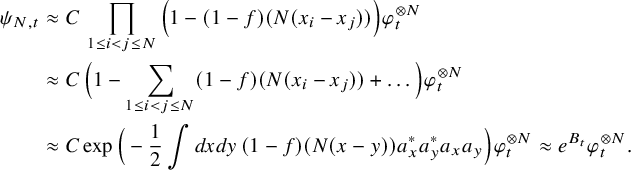
should be easier to control. Motivated by this heuristics, the main idea of [Reference Brennecke and Schlein15] is to approximate
$\varphi _t$
should be easier to control. Motivated by this heuristics, the main idea of [Reference Brennecke and Schlein15] is to approximate $ \psi _{N,t}$
by
$ \psi _{N,t}$
by
 $$ \begin{align} \begin{aligned} \psi_{N,t} & \approx C \, \prod_{1\leq i<j\leq N} \Big(1 - (1-f)(N(x_i-x_j))\Big) \varphi_t^{\otimes N}\\ & \approx C \, \Big( 1 - \sum_{1\leq i <j \leq N} (1-f)(N(x_i-x_j))+\ldots \Big) \varphi_t^{\otimes N}\\ &\approx C \exp \Big( - \frac12\int dxdy\, (1-f)(N(x-y)) a^{*}_x a^{*}_y a_x a_y \Big) \varphi_t^{\otimes N} \approx e^{B_t} \varphi_t^{\otimes N}. \end{aligned} \end{align} $$
This incorporates the expected correlation structure into the product state $ \varphi _t^{\otimes N}$
by applying a unitary, generalized Bogoliubov transformation
$ \varphi _t^{\otimes N}$
by applying a unitary, generalized Bogoliubov transformation $ e^{B_t}$
with exponent
$ e^{B_t}$
with exponent
 $$\begin{align*}B_t = -\frac12 \int dxdy\,\Big( (1-f)(N(x-y)) \varphi_t(x)\varphi_t(y) a^{*}_x a^{*}_y a(\varphi_t)a(\varphi_t) - \text{h.c.}\Big). \end{align*}$$
In other words, we expect the state $e^{-B_t}\psi _{N,t}\approx \varphi _t^{\otimes N}$
to behave approximately like a product state, and the main result of [Reference Brennecke and Schlein15] is to establish this intuition rigorously. Ignoring minor technical details, this is achieved by controlling the number and energy of excitations around
$e^{-B_t}\psi _{N,t}\approx \varphi _t^{\otimes N}$
to behave approximately like a product state, and the main result of [Reference Brennecke and Schlein15] is to establish this intuition rigorously. Ignoring minor technical details, this is achieved by controlling the number and energy of excitations around $ \varphi _t$
w.r.t. the fluctuation dynamics
$ \varphi _t$
w.r.t. the fluctuation dynamics $ \mathcal {U}_{N,t} = e^{-B_t} e^{-iH_Nt} $
that satisfies
$ \mathcal {U}_{N,t} = e^{-B_t} e^{-iH_Nt} $
that satisfies
 $$\begin{align*}i\partial_t \,\mathcal{U}_{N,t} = \mathcal S_{N,t} \, \mathcal{U}_{N,t} = \Big( e^{-B_t} H_N e^{B_t} +(i\partial_t e^{-B_t})e^{B_t} \Big ) \,\mathcal{U}_{N,t}. \end{align*}$$
As turns out, the energy of the excitations is comparable to $\mathcal {S}_{N,t}^{\prime } =\mathcal {S}_{N,t}- c_{N,t}$
for a suitable constant
$\mathcal {S}_{N,t}^{\prime } =\mathcal {S}_{N,t}- c_{N,t}$
for a suitable constant $ c_{N,t}$
, so that the main result of [Reference Brennecke and Schlein15] can be recast as a Gronwall bound
$ c_{N,t}$
, so that the main result of [Reference Brennecke and Schlein15] can be recast as a Gronwall bound
 $$ \begin{align} \partial_t \big \langle \mathcal{S}_{N,t}^{\prime} + \mathcal{N}_{\bot \varphi_t} \big\rangle_{\mathcal{U}_{N,t}\psi_N} \lesssim \big \langle \mathcal{S}_{N,t}^{\prime} + \mathcal{N}_{\bot \varphi_t} \big\rangle_{\mathcal{U}_{N,t}\psi_N}. \end{align} $$
Although conceptually straightforward, the main difficulty of the above strategy consists in the fact that the action of $ e^{-B_t}(\cdot )e^{B_t}$
, that is needed to compute
$ e^{-B_t}(\cdot )e^{B_t}$
, that is needed to compute $ \mathcal {S}_{N,t}$
, is not explicit. The novelty of [Reference Brennecke and Schlein15] has therefore been to analyse
$ \mathcal {S}_{N,t}$
, is not explicit. The novelty of [Reference Brennecke and Schlein15] has therefore been to analyse $ e^{-B_t}(\cdot )e^{B_t}$
in detail, providing an explicit description of
$ e^{-B_t}(\cdot )e^{B_t}$
in detail, providing an explicit description of $ \mathcal {S}_{N,t}$
in terms of a convergent commutator series expansion. This can be used to explicitly evaluate the commutator
$ \mathcal {S}_{N,t}$
in terms of a convergent commutator series expansion. This can be used to explicitly evaluate the commutator $ [\mathcal {S}_{N,t}, \mathcal {N}_{\bot \varphi _t}]$
that occurs on the left-hand side in (2.7), and this is crucial to close the Gronwall argument.
$ [\mathcal {S}_{N,t}, \mathcal {N}_{\bot \varphi _t}]$
that occurs on the left-hand side in (2.7), and this is crucial to close the Gronwall argument.
The drawback of this method is that the series expansions are rather involved and produce a large number of irrelevant error terms. It would therefore be quite desirable to extract only the relevant terms without the need for operator exponential expansions, similarly as in [Reference Brooks19, Reference Brennecke, Brooks, Caraci and Oldenburg12] in the spectral setting. Our key observation in this regard is that (2.7) is essentially equivalent to controlling the modified energy and excitation operators
 $$ \begin{align} \begin{aligned} &\big \langle e^{B_t}\big( \mathcal{S}_{N,t}^{\prime} + \mathcal{N}_{\bot \varphi_t} \big) e^{-B_t}\, \big\rangle_{\psi_{N,t}} \approx \big \langle \mathcal{H}_N \big\rangle_{\psi_{N,t} } + \big\langle \mathcal Q_{\text{ren}} \big\rangle_{\psi_{N,t} }+ \big\langle \mathcal{N}_{\text{ren}} \big\rangle_{\psi_{N,t} }, \end{aligned} \end{align} $$
where we have inserted heuristically several approximations from [Reference Brennecke and Schlein15]. In (2.8), we set
 $$ \begin{align} \mathcal{H}_{N} = H_N - Ne_{\text{GP}} - \big(a^{*}(\varphi_t) a(Q_t i\partial_t \varphi_t)+\text{h.c.}\big) + \langle i\partial_t \varphi_t,\varphi_t\rangle\mathcal{N}_{\bot \varphi_t} \end{align} $$
and $ e_{\text {GP}} \equiv \mathcal {E}_{\text {GP}}(\varphi _t) $
for the translation invariant energy functional
$ e_{\text {GP}} \equiv \mathcal {E}_{\text {GP}}(\varphi _t) $
for the translation invariant energy functional $\mathcal {E}_{\text {GP}}$
, defined by
$\mathcal {E}_{\text {GP}}$
, defined by
 $$\begin{align*}\mathcal{E}_{\text{GP}} (\varphi) = \int dx\, \Big( \vert \nabla \varphi(x) \vert^2 + 4\pi\mathfrak{a} \vert \varphi(x)\vert^4 \Big).\end{align*}$$
Recall that $ e_{\text {GP}} $
is a conserved quantity if
$ e_{\text {GP}} $
is a conserved quantity if $t\mapsto \varphi _t$
is a sufficiently regular solution of (1.8), in particular under the assumptions on
$t\mapsto \varphi _t$
is a sufficiently regular solution of (1.8), in particular under the assumptions on $\varphi _{\text {GP}} $
in Theorem 1.1 (see Proposition A.1).
$\varphi _{\text {GP}} $
in Theorem 1.1 (see Proposition A.1).
In (2.8), we have furthermore introduced renormalized excitation operators
 $$ \begin{align}\begin{aligned} \mathcal{N}_{\text{ren}} &= \mathcal{N}_{\bot \varphi_t} + \int dx dy \, \Big( k_t (x,y) a^{*}(Q_{t,x}) a^{*}(Q_{t,y}) \frac{a(\varphi_t)}{\sqrt{N} }\frac{a(\varphi_t)}{\sqrt N} + \text{h.c.}\Big) , \\ \mathcal Q_{\text{ren}} &= \frac12\int dx dy\, i \partial_t k_t (x,y) a^{*}(Q_{t,x}) a^{*}(Q_{t,y}) \frac{a(\varphi_t)}{\sqrt{N} }\frac{a(\varphi_t)}{\sqrt N} +\text{h.c.} \end{aligned} \end{align} $$
in terms of orthogonal excitation fields $ a^{*}(Q_{t,x}), a(Q_{t,y})$
, defined as follows: denoting by
$ a^{*}(Q_{t,x}), a(Q_{t,y})$
, defined as follows: denoting by $Q_t$
the projection
$Q_t$
the projection $ Q_t = 1-|\varphi _t \rangle \langle \varphi _t |$
onto the orthogonal complement of
$ Q_t = 1-|\varphi _t \rangle \langle \varphi _t |$
onto the orthogonal complement of $\varphi _t$
, we set
$\varphi _t$
, we set
 $$ \begin{align} a^{*}(Q_t f) = \int dx\, f(x) a^{*}(Q_{t,x}), \hspace{0.5cm} a(Q_t g) = \int dx\, \overline g (x) a^{*}(Q_{t,x}). \end{align} $$
It is then straightforward to verify that $\mathcal {N}_{\bot \varphi _t} = \int dx \,a^{*}(Q_{t,x})a(Q_{t,x})$
and that
$\mathcal {N}_{\bot \varphi _t} = \int dx \,a^{*}(Q_{t,x})a(Q_{t,x})$
and that
 $$\begin{align*}\begin{aligned} a^{*}(Q_{t,x}) &= a^{*}_x - \overline \varphi_t(x) a^{*}(\varphi_t), \;\;\;\; a(Q_{t,y}) = a_y - \varphi_t(y) a(\varphi_t), \\ [a(Q_{t,x}), a^{*}(Q_{t,y}) ] &= [a_x, a^{*}(Q_{t,y}) ]= Q_t(x,y), \;\; [a(Q_{t,x}), a^{*}(\varphi_t) ] = (Q_t \varphi)(x) = 0, \end{aligned} \end{align*}$$
where $ Q_t(x,y) = \delta (x,y)- \varphi _t(x)\overline {\varphi _t}(y)$
denotes the integral kernel of
$ Q_t(x,y) = \delta (x,y)- \varphi _t(x)\overline {\varphi _t}(y)$
denotes the integral kernel of $Q_t$
.
$Q_t$
.
Finally, fixing some $\chi \in C_c^\infty (B_{2r}(0))$
with
$\chi \in C_c^\infty (B_{2r}(0))$
with $ \chi _{| B_{r}(0)}\equiv 1$
, we define the kernel
$ \chi _{| B_{r}(0)}\equiv 1$
, we define the kernel $k_t$
by
$k_t$
by
 $$ \begin{align} \begin{aligned} &(x,y) \mapsto k_t(x,y) = N(1-f)(N(x-y))\chi(x-y) \varphi_t(x)\varphi_t(y) \in L^2(\mathbb{R}^3\times \mathbb{R}^3). \end{aligned} \end{align} $$
Notice that $\mathcal {H}_N, \mathcal {N}_{\text {ren}}$
and
$\mathcal {H}_N, \mathcal {N}_{\text {ren}}$
and $ \mathcal {Q}_{\text {ren}}$
are time-dependent. For simplicity, we suppress this dependence in our notation. Moreover, we remark that the cutoff
$ \mathcal {Q}_{\text {ren}}$
are time-dependent. For simplicity, we suppress this dependence in our notation. Moreover, we remark that the cutoff $\chi $
in the definition of
$\chi $
in the definition of $k_t$
is for technical reasons only (we ignored this technicality in the heuristic arguments outlined above). Basic properties of the kernel
$k_t$
is for technical reasons only (we ignored this technicality in the heuristic arguments outlined above). Basic properties of the kernel $ k_t$
are collected in Appendix C.
$ k_t$
are collected in Appendix C.
We assume throughout the remainder that the radius $r>0$
, related to
$r>0$
, related to $\chi \in C_c^\infty (B_{2r}(0))$
in (2.12), is chosen sufficiently small, but fixed (independently of N). As explained below in Lemma 3.1, this implies thatFootnote 1 for some
$\chi \in C_c^\infty (B_{2r}(0))$
in (2.12), is chosen sufficiently small, but fixed (independently of N). As explained below in Lemma 3.1, this implies thatFootnote 1 for some $C>0$
and every
$C>0$
and every $t\in \mathbb {R}$
, it holds true that
$t\in \mathbb {R}$
, it holds true that
 $$ \begin{align} C^{-1} (\mathcal{N}_{\bot\varphi_t} +1) \leq ( \mathcal{N}_{\text{ren}} +1 ) \leq C ( \mathcal{N}_{\bot\varphi_t} +1), \hspace{0.5cm} \pm \mathcal{Q}_{\text{ren}}\leq C e^{C|t|} ( \mathcal{N}_{\text{ren}} +1 ). \end{align} $$
Having introduced all objects that are relevant in the sequel, let us briefly comment on the heuristics underlying the approximation (2.8). What [Reference Brennecke and Schlein15] has shown rigorously is that transformations $ e^{B_t} $
as above act on creation and annihilation operators approximately like standard Bogoliubov transformations. It then turns out that
$ e^{B_t} $
as above act on creation and annihilation operators approximately like standard Bogoliubov transformations. It then turns out that $ e^{-B_t} (\cdot ) e^{B_t}$
regularizes certain singular contributions to
$ e^{-B_t} (\cdot ) e^{B_t}$
regularizes certain singular contributions to $ H_N $
, and these renormalizations are essentially obtained from the contributions linear in
$ H_N $
, and these renormalizations are essentially obtained from the contributions linear in $B_t$
when expanding
$B_t$
when expanding $ e^{-B_t} a_x e^{B_t} \approx a_x + [ a_x, B_t ] $
. In (2.8), we simply inserted this linear approximation on the level of
$ e^{-B_t} a_x e^{B_t} \approx a_x + [ a_x, B_t ] $
. In (2.8), we simply inserted this linear approximation on the level of $ L^2_s(\mathbb {R}^{3N})$
.
$ L^2_s(\mathbb {R}^{3N})$
.
Finally, let us point out that it is straightforward to compute the time derivative of the right-hand side in (2.8) explicitly – in strong contrast to the computation of the left-hand side in (2.7). This naturally raises the question whether a Gronwall bound can be proved directly on the right-hand side of (2.8), avoiding the use of operator exponential expansions altogether, similarly as in [Reference Brietzke, Fournais and Solovej18, Reference Brooks19, Reference Brennecke, Brooks, Caraci and Oldenburg12] in the spectral setting. On the technical level, this is our main contribution, and it leads to the following result.
Proposition 2.1. Let $ \mathcal {H}_N$
be as in (2.9) and set
$ \mathcal {H}_N$
be as in (2.9) and set $ \psi _{N,t}= e^{-iH_Nt}\psi _N$
for
$ \psi _{N,t}= e^{-iH_Nt}\psi _N$
for $t\in \mathbb {R}$
and initial data
$t\in \mathbb {R}$
and initial data $\psi _N\in L^2_s(\mathbb {R}^{3N})$
as in Theorem 1.1. Then, for suitable constants
$\psi _N\in L^2_s(\mathbb {R}^{3N})$
as in Theorem 1.1. Then, for suitable constants $c, C>0$
which are independent of
$c, C>0$
which are independent of $t\in \mathbb {R}$
, we have that
$t\in \mathbb {R}$
, we have that
 $$\begin{align*}\mathcal{N}_{\bot\varphi_t} \leq \mathcal{H}_N + \mathcal{Q}_{\text{ren}} + Ce^{C|t|} ( \mathcal{N}_{\text{ren}} +1)\end{align*}$$
as well as the Gronwall bound
 $$\begin{align*}\partial_t \, \big \langle \mathcal{H}_N +\mathcal{Q}_{\text{ren}} + Ce^{C|t|} (\mathcal{N}_{\text{ren}} +1) \big\rangle_{\psi_{N,t} } \leq c \,e^{c |t|} \, \big \langle \mathcal{H}_N + \mathcal{Q}_{\text{ren}} + Ce^{C|t|} ( \mathcal{N}_{\text{ren}} +1) \big\rangle_{\psi_{N,t} }.\end{align*}$$
Assuming the validity of Proposition 2.1, whose proof is explained in detail in the next Section 3, we conclude this section with the proof of Theorem 1.1.
Proof of Theorem 1.1
This was already explained in [Reference Brennecke and Schlein15]; we recall the main steps. Without loss of generality, assume $t\geq 0$
. By (2.1), note that (1.10) is equivalent to
$t\geq 0$
. By (2.1), note that (1.10) is equivalent to
 $$ \begin{align} \big\langle \mathcal{N}_{\bot\varphi_t} \big\rangle_{\psi_{N,t} } \leq C \big( 1+N o_1(1) + N o_2(1) \big) \exp(c \exp c\,t). \end{align} $$
By Proposition 2.1, Gronwall’s lemma and the bound (2.13), we know that
 $$\begin{align*}\begin{aligned} \big\langle \mathcal{N}_{\bot\varphi_t} \big\rangle_{\psi_{N,t} } \leq \big \langle \mathcal{H}_N +\mathcal{Q}_{\text{ren}} + Ce^{Ct} ( \mathcal{N}_{\text{ren}}+1) \big\rangle_{\psi_{N,t} } & \leq c_t \,\big \langle (\mathcal{H}_{N} +\mathcal{Q}_{\text{ren}} +C\mathcal{N}_{\text{ren}}+1)_{|t=0} \big\rangle_{\psi_{N} }\\ & \leq c_t \, \big \langle (\mathcal{H}_{N}+\mathcal{Q}_{\text{ren}})_{|t=0} + \mathcal{N}_{\bot \varphi_{\text{GP} } } + 1 \big\rangle_{\psi_{N} } \end{aligned} \end{align*}$$
for some time-dependent constant $c_t \leq C \exp (c\,\exp (c\,t))$
. Here, the last step used (2.13). Hence, it is enough to analyze
$c_t \leq C \exp (c\,\exp (c\,t))$
. Here, the last step used (2.13). Hence, it is enough to analyze $ \langle (\mathcal {H}_N)_{|t=0}\rangle _{\psi _{N} } $
,
$ \langle (\mathcal {H}_N)_{|t=0}\rangle _{\psi _{N} } $
, $ \langle (\mathcal {Q}_{\text {ren}})_{|t=0}\rangle _{\psi _{N} }$
and
$ \langle (\mathcal {Q}_{\text {ren}})_{|t=0}\rangle _{\psi _{N} }$
and $ \langle \mathcal {N}_{\bot \varphi _{\text {GP} } } \rangle _{\psi _{N} } $
. Using once again (2.1), we have that
$ \langle \mathcal {N}_{\bot \varphi _{\text {GP} } } \rangle _{\psi _{N} } $
. Using once again (2.1), we have that
 $$\begin{align*}\big\langle \mathcal{N}_{\bot \varphi_{\text{GP} } } \big\rangle_{\psi_{N} } = N\big ( 1 - \langle \varphi_{\text{GP}} , \gamma^{(1)}_N \varphi_{\text{GP}} \rangle \big) = N o_2(1) \end{align*}$$
and, by (2.13), that
 $$\begin{align*}\langle (\mathcal{Q}_{\text{ren}})_{|t=0}\rangle_{\psi_{N} }\leq C \big\langle \mathcal{N}_{\bot \varphi_{\text{GP} } } +1\big\rangle_{\psi_{N} } = C\big (1+ N o_2(1) \big). \end{align*}$$
By (2.9), however, we have that
 $$\begin{align*}\big\langle (\mathcal{H}_N)_{|t=0} \big\rangle_{\psi_{N} } & = \big\langle H_N \!-\! Ne_{\text{GP}} - \! \big(a^{*}(\varphi_t) a(Q_t i\partial_t \varphi_t)+\text{h.c.}\big)_{|t=0} \!+\! \langle i\partial_t \varphi_t,\varphi_t\rangle_{|t=0} \,\mathcal{N}_{\bot \varphi_{\text{GP}}}\big\rangle_{\psi_{N}}\\ & = \big\langle H_N \!-\! Ne_{\text{GP}} - \! \big(a^{*}(\varphi_t) a(Q_t i\partial_t \varphi_t)+\text{h.c.}\big)_{|t=0}\big\rangle_{\psi_{N}} \!+\! \langle i\partial_t \varphi_t,\varphi_t\rangle_{|t=0} \,N o_2(1) \end{align*}$$
and, by (1.8), that $\langle i\partial _t \varphi _t,\varphi _t\rangle _{|t=0} = e_{\text {GP}}+ 4\pi \mathfrak {a}\|\varphi _{\text {GP}}\|_4^4 =O(1) $
. Since we assume that
$\langle i\partial _t \varphi _t,\varphi _t\rangle _{|t=0} = e_{\text {GP}}+ 4\pi \mathfrak {a}\|\varphi _{\text {GP}}\|_4^4 =O(1) $
. Since we assume that $\varphi _{\text {GP}}$
minimizes the Gross-Pitaevskii functional
$\varphi _{\text {GP}}$
minimizes the Gross-Pitaevskii functional $\mathcal {E}_{\text {GP}}^{\text {trap}}$
, it solves the Euler-Lagrange equation
$\mathcal {E}_{\text {GP}}^{\text {trap}}$
, it solves the Euler-Lagrange equation
 $$\begin{align*}\big( -\Delta + V_{\text{ext}} + 8\pi\mathfrak{a}|\varphi_{\text{GP}}|^2\big) \varphi_{\text{GP}} = \mu_{\text{GP}} \varphi_{\text{GP}}, \hspace{0.5cm} \mu_{\text{GP}}= e_{\text{GP}}+ 4\pi\mathfrak{a}\|\varphi_{\text{GP}}\|_4^4. \end{align*}$$
Combining this with (1.8), we then find
 $$\begin{align*}\begin{aligned} & - \big\langle \big(a^{*}(\varphi_t) a(Q_t i\partial_t \varphi_t)+ a^{*}(Q_t i\partial_t \varphi_t)a(\varphi_t)\big)_{|t=0}\big\rangle_{\psi_{N}} \\ &\;= 2\text{Re} \, \big\langle a^{*}(\varphi_{\text{GP}}) a(V_{\text{ext}}\varphi_{\text{GP}}) \big\rangle_{\psi_{N}} - 2 \langle \varphi_{\text{GP}}, V_{\text{ext}}\varphi_{\text{GP}} \rangle \big \langle a^{*}(\varphi_{\text{GP}}) a^{*}(\varphi_{\text{GP}}) \big\rangle_{\psi_{N}} \\ &\; = 2 N\text{Re} \langle \varphi_{\text{GP}}, \gamma_N^{(1)} V_{\text{ext}}\varphi_{\text{GP}}\rangle - 2 N \langle \varphi_{\text{GP}}, V_{\text{ext}} \varphi_{\text{GP}} \rangle + \langle \varphi_{\text{GP}}, V_{\text{ext}}\varphi_{\text{GP}}\rangle N o_2(1), \end{aligned}\end{align*}$$
where $ \langle \varphi _{\text {GP}}, V_{\text {ext}}\varphi _{\text {GP}}\rangle \leq e_{\text {GP}}=O(1)$
. Now, if we replace
$ \langle \varphi _{\text {GP}}, V_{\text {ext}}\varphi _{\text {GP}}\rangle \leq e_{\text {GP}}=O(1)$
. Now, if we replace $ V_{\text {ext}}$
by
$ V_{\text {ext}}$
by $ V^{\prime }_{\text {ext}} = V_{\text {ext}}+\Lambda $
for some sufficiently large
$ V^{\prime }_{\text {ext}} = V_{\text {ext}}+\Lambda $
for some sufficiently large $\Lambda>0$
so that
$\Lambda>0$
so that $V^{\prime }_{\text {ext}}\geq 0$
, by the assumption that
$V^{\prime }_{\text {ext}}\geq 0$
, by the assumption that $V_{\text {ext}}\in L^\infty _{\text {loc}}(\mathbb {R}^3)$
with
$V_{\text {ext}}\in L^\infty _{\text {loc}}(\mathbb {R}^3)$
with $ \lim _{|x|\to \infty }V_{\text {ext}}=\infty $
, and use that
$ \lim _{|x|\to \infty }V_{\text {ext}}=\infty $
, and use that $ 0\leq (\gamma _N^{(1)}\big )^2\leq \gamma _N^{(1)}\leq 1$
, Cauchy-Schwarz implies
$ 0\leq (\gamma _N^{(1)}\big )^2\leq \gamma _N^{(1)}\leq 1$
, Cauchy-Schwarz implies
 $$\begin{align*}\begin{aligned} 2\text{Re} \,\langle \varphi_{\text{GP}}, \gamma_N^{(1)} V_{\text{ext}}\varphi_{\text{GP}}\rangle &\leq \langle \varphi_{\text{GP}}, \gamma_N^{(1)} V^{\prime}_{\text{ext}}\gamma_N^{(1)}\varphi_{\text{GP}}\rangle + \langle \varphi_{\text{GP}}, V^{\prime}_{\text{ext}} \varphi_{\text{GP}} \rangle- 2\Lambda\langle \varphi_{\text{GP}}, \gamma_N^{(1)} \varphi_{\text{GP}}\rangle\\ &\leq \langle \varphi_{\text{GP}}, \gamma_N^{(1)} V^{\prime}_{\text{ext}}\gamma_N^{(1)}\varphi_{\text{GP}}\rangle -\Lambda + \langle \varphi_{\text{GP}}, V_{\text{ext}} \varphi_{\text{GP}} \rangle +2 \Lambda \, o_2(1)\\ & \leq \text{tr}\,\big|V^{\prime}_{\text{ext}}\big|^{1/2} \big(\gamma_N^{(1)}\big)^2 \big|V^{\prime}_{\text{ext}}\big|^{1/2} -\Lambda+ \langle \varphi_{\text{GP}}, V_{\text{ext}} \varphi_{\text{GP}} \rangle +2 \Lambda \, o_2(1)\\ & \leq \text{tr}\, \gamma_N^{(1)} V_{\text{ext}} + \langle \varphi_{\text{GP}}, V_{\text{ext}} \varphi_{\text{GP}} \rangle +2 \Lambda \, o_2(1). \end{aligned}\end{align*}$$
This shows that
 $$\begin{align*}\big\langle (\mathcal{H}_N)_{|t=0} \big\rangle_{\psi_{N} }\leq \big\langle H_N^{\text{trap}}\big\rangle_{\psi_N} - Ne_{\text{GP}}^{\text{trap}} + CN o_2(1) \leq C \big( N o_1(1)+N o_2(1) \big). \end{align*}$$
Collecting the previous bounds, we obtain (2.14) and thus (1.10).
3 Renormalized Hamiltonian and proof of Proposition 2.1
The goal of this section is to prove Proposition 2.1. Our proof is based on several lemmas that collect important properties of the operators $ \mathcal {H}_N, \mathcal {N}_{\text {ren}}$
and
$ \mathcal {H}_N, \mathcal {N}_{\text {ren}}$
and $ \mathcal {Q}_{\text {ren}}$
, defined in (2.9) and (2.10), respectively. We start with the proof of the bound (2.13) and the derivation of the leading order contributions to
$ \mathcal {Q}_{\text {ren}}$
, defined in (2.9) and (2.10), respectively. We start with the proof of the bound (2.13) and the derivation of the leading order contributions to $ \partial _t \, \mathcal {N}_{\text {ren}}$
and
$ \partial _t \, \mathcal {N}_{\text {ren}}$
and $ \partial _t \mathcal {Q}_{\text {ren}}$
.
$ \partial _t \mathcal {Q}_{\text {ren}}$
.
Lemma 3.1. Let $\mathcal {N}_{\text {ren}}, \mathcal {Q}_{\text {ren}} $
be as in (2.10) and choose
$\mathcal {N}_{\text {ren}}, \mathcal {Q}_{\text {ren}} $
be as in (2.10) and choose $\chi \in C_c^\infty (B_{2r}(0))$
,
$\chi \in C_c^\infty (B_{2r}(0))$
, $ \chi _{| B_{r}(0)}\equiv 1$
in (2.12) so that
$ \chi _{| B_{r}(0)}\equiv 1$
in (2.12) so that $r>0$
is small enough. Then, for some
$r>0$
is small enough. Then, for some $C>0$
and every
$C>0$
and every $t\in \mathbb {R}$
, we have
$t\in \mathbb {R}$
, we have
 $$ \begin{align} C^{-1} (\mathcal{N}_{\bot\varphi_t} +1) \leq ( \mathcal{N}_{\text{ren}}+1) \leq C ( \mathcal{N}_{\bot\varphi_t} +1),\hspace{0.5cm} \pm \mathcal{Q}_{\text{ren}}\leq C e^{C|t|} ( \mathcal{N}_{\text{ren}} +1 ) \end{align} $$
and
 $$ \begin{align}\begin{aligned} \pm \big( \partial_t \,\mathcal{N}_{\text{ren}} - \big[ - \big(a^{*}(\varphi_t) a(Q_t \partial_t \varphi_t)-\text{h.c.}\big) + \langle \partial_t \varphi_t,\varphi_t\rangle\mathcal{N}_{\bot \varphi_t}, \mathcal{N}_{\text{ren}} \big]\big)&\leq Ce^{C|t|} (\mathcal{N}_{\text{ren}} + 1), \\ \pm \big( \partial_t \mathcal{Q}_{\text{ren}} - \big[ - \big(a^{*}(\varphi_t) a(Q_t \partial_t \varphi_t)-\text{h.c.}\big) + \langle \partial_t \varphi_t,\varphi_t\rangle\mathcal{N}_{\bot \varphi_t}, \mathcal{Q}_{\text{ren}} \big]\big)&\leq Ce^{C|t|} (\mathcal{N}_{\text{ren}} + 1). \end{aligned} \end{align} $$
Proof. We recall that
 $$\begin{align*}\begin{aligned} \mathcal{N}_{\text{ren}} & = \mathcal{N}_{\bot \varphi_t} + \int dx dy \, \Big( k_t (x,y) a^{*}(Q_{t,x}) a^{*}(Q_{t,y}) \frac{a(\varphi_t)}{\sqrt{N} }\frac{a(\varphi_t)}{\sqrt N} + \text{h.c.}\Big). \end{aligned}\end{align*}$$
By Lemma C.1, we have that $\sup _{t\in \mathbb {R}} \| k_{t}\|\leq C r^{1/2} $
. If we combine this with the trivial bound
$\sup _{t\in \mathbb {R}} \| k_{t}\|\leq C r^{1/2} $
. If we combine this with the trivial bound $0\leq a^{*}(\varphi _t)a(\varphi _t)\leq N$
and the operator bounds of Lemma B.1, we obtain
$0\leq a^{*}(\varphi _t)a(\varphi _t)\leq N$
and the operator bounds of Lemma B.1, we obtain
 $$\begin{align*}\mathcal{N}_{\bot \varphi_t} (1 - C r^{1/2}) - Cr^{1/2} \leq \mathcal{N}_{\text{ren}} \leq \mathcal{N}_{\bot \varphi_t} (1+ C r^{1/2}) + Cr^{1/2} \end{align*}$$
for some $C>0$
independent of
$C>0$
independent of $r>0$
and
$r>0$
and $t\in \mathbb {R}$
. The bound for
$t\in \mathbb {R}$
. The bound for $\mathcal {Q}_{\text {ren}}$
follows similarly.
$\mathcal {Q}_{\text {ren}}$
follows similarly.
To prove (3.2), we first analyze $ \partial _t \,\mathcal {N}_{\text {ren}}$
, based on the above decomposition of
$ \partial _t \,\mathcal {N}_{\text {ren}}$
, based on the above decomposition of $\mathcal {N}_{\text {ren}}$
. Using (3.1) and the bounds in Lemmas B.1 and C.1, observe that all operators occurring in
$\mathcal {N}_{\text {ren}}$
. Using (3.1) and the bounds in Lemmas B.1 and C.1, observe that all operators occurring in $ \partial _t \,\mathcal {N}_{\text {ren}}$
that only contain the fields
$ \partial _t \,\mathcal {N}_{\text {ren}}$
that only contain the fields $ a^\sharp (Q_{t,x})$
or normalized factors
$ a^\sharp (Q_{t,x})$
or normalized factors $ a^\sharp (\varphi _t)/ \sqrt {N}$
,
$ a^\sharp (\varphi _t)/ \sqrt {N}$
, $a^\sharp (\partial _t \varphi _t)/ \sqrt {N}$
can be bounded by
$a^\sharp (\partial _t \varphi _t)/ \sqrt {N}$
can be bounded by $ Ce^{C|t|} (\mathcal {N}_{\text {ren}} + 1)$
. The remaining contributions must contain at least one factor
$ Ce^{C|t|} (\mathcal {N}_{\text {ren}} + 1)$
. The remaining contributions must contain at least one factor $ a^\sharp (\varphi _t)$
(without the
$ a^\sharp (\varphi _t)$
(without the $1/{\sqrt N}$
normalization). Using that
$1/{\sqrt N}$
normalization). Using that
 $$ \begin{align} \begin{aligned} \partial_t Q_t &= - \big( | \varphi_t \rangle \langle Q_t \partial_t \varphi_t | +\text{h.c.}\big) - 2\text{Re}\langle\partial_t \varphi_t,\varphi_t\rangle | \varphi_t \rangle \langle \varphi_t | = - \big( | \varphi_t \rangle \langle Q_t \partial_t \varphi_t | +\text{h.c.}\big), \end{aligned}\end{align} $$
we thus find
 $$\begin{align*}\begin{aligned} \partial_t \, \mathcal{N}_{\text{ren}} & = - 2 \int dx dy \, \Big( \overline{ Q_t \partial_t \varphi_t}(x) k_t (x,y) a^{*}(\varphi_t) a^{*}(Q_{t,y}) \frac{a(\varphi_t)}{\sqrt{N} }\frac{a(\varphi_t)}{\sqrt N} + \text{h.c.}\Big) \\ &\hspace{0.5cm}-\big( a^{*}(\varphi_t) a(\partial_t \varphi_t) +\text{h.c.}\big) + \mathcal{E}_1, \end{aligned}\end{align*}$$
up to an error $\mathcal {E}_1$
bounded by
$\mathcal {E}_1$
bounded by $ \pm \mathcal {E}_1 \leq Ce^{C|t|} (\mathcal {N}_{\text {ren}} + 1)$
. We proceed in the same way to extract the main contributions to the commutator on the l.h.s. in (3.2), using that
$ \pm \mathcal {E}_1 \leq Ce^{C|t|} (\mathcal {N}_{\text {ren}} + 1)$
. We proceed in the same way to extract the main contributions to the commutator on the l.h.s. in (3.2), using that
 $$\begin{align*}\begin{aligned} [\mathcal{N}_{\bot\varphi_t}, a^{*}(Q_{t,x}) a(\varphi_t) ] &= a^{*}(Q_{t,x}) a(\varphi_t), \;\; [\mathcal{N}_{\bot\varphi_t}, a^{*}(\varphi_t) a(\varphi_t) ] = 0. \end{aligned}\end{align*}$$
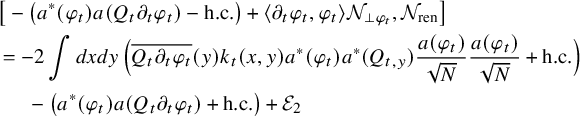
Then, the same argument as above yields
 $$\begin{align*}\begin{aligned} & \big[ - \big(a^{*}(\varphi_t) a(Q_t \partial_t \varphi_t)-\text{h.c.}\big) + \langle \partial_t \varphi_t,\varphi_t\rangle\mathcal{N}_{\bot \varphi_t}, \mathcal{N}_{\text{ren}}\big]\\ & = - 2 \int dx dy \, \Big( \overline{ Q_t\partial_t \varphi_t}(y) k_t (x,y) a^{*}(\varphi_t) a^{*}(Q_{t,y}) \frac{a(\varphi_t)}{\sqrt{N} }\frac{a(\varphi_t)}{\sqrt N} + \text{h.c.}\Big) \\ &\hspace{0.5cm}-\big( a^{*}(\varphi_t) a(Q_t\partial_t \varphi_t) +\text{h.c.}\big) + \mathcal{E}_2 \end{aligned}\end{align*}$$
up to an error $ \pm \mathcal {E}_2 \leq Ce^{C|t|} (\mathcal {N}_{\text {ren}} + 1)$
. Comparing this with
$ \pm \mathcal {E}_2 \leq Ce^{C|t|} (\mathcal {N}_{\text {ren}} + 1)$
. Comparing this with $\partial _t \, \mathcal {N}_{\text {ren}}$
and using that
$\partial _t \, \mathcal {N}_{\text {ren}}$
and using that
 $$\begin{align*}a^{*}(\varphi_t) a(\partial_t \varphi_t) + a^{*}(\partial_t \varphi_t) a(\varphi_t) = a^{*}(\varphi_t) a( Q_t \partial_t \varphi_t) +a^{*}(Q_t\partial_t \varphi_t) a(\varphi_t), \end{align*}$$
which follows from $ \text {Re}\langle \partial _t\varphi _t, \varphi _t\rangle =0 $
by mass conservation, this proves the first bound in (3.2). For the analogous bound on
$ \text {Re}\langle \partial _t\varphi _t, \varphi _t\rangle =0 $
by mass conservation, this proves the first bound in (3.2). For the analogous bound on $\mathcal {Q}_{\text {ren}}$
, we proceed in the same way and find
$\mathcal {Q}_{\text {ren}}$
, we proceed in the same way and find
 $$\begin{align*}\begin{aligned} \partial_t \mathcal{Q}_{\text{ren}}&\! = - \int dx dy \, \Big( \overline{ Q_t\partial_t \varphi_t}(x) i\partial_t k_t (x,y) a^{*}(\varphi_t) a^{*}(Q_{t,y}) \frac{a(\varphi_t)}{\sqrt{N} }\frac{a(\varphi_t)}{\sqrt N} + \text{h.c.}\Big) +\mathcal{E}_3\\ & = \big[ - \big(a^{*}(\varphi_t) a(Q_t \partial_t \varphi_t)-\text{h.c.}\big) + \langle \partial_t \varphi_t,\varphi_t\rangle\mathcal{N}_{\bot \varphi_t}, \mathcal{Q}_{\text{ren}} \big] + \mathcal{E}_4, \end{aligned}\end{align*}$$
up to errors $ \mathcal {E}_3, \mathcal {E}_4$
bounded by
$ \mathcal {E}_3, \mathcal {E}_4$
bounded by $ \pm \mathcal {E}_3\leq Ce^{C|t|} (\mathcal {N}_{\text {ren}} + 1)$
,
$ \pm \mathcal {E}_3\leq Ce^{C|t|} (\mathcal {N}_{\text {ren}} + 1)$
, $\pm \mathcal {E}_4\leq Ce^{C|t|} (\mathcal {N}_{\text {ren}} + 1)$
.
$\pm \mathcal {E}_4\leq Ce^{C|t|} (\mathcal {N}_{\text {ren}} + 1)$
.
The next lemma is the first of two key ingredients in the proof of Proposition 2.1. It compares the operator $\mathcal {H}_{N}$
, defined in (2.9), to a renormalized Hamiltonian
$\mathcal {H}_{N}$
, defined in (2.9), to a renormalized Hamiltonian $ \mathcal {H}_{\text {ren}}$
, which equals the sum of the kinetic and potential energies of orthogonal excitations relative to renormalized annihilation and creation operators,
$ \mathcal {H}_{\text {ren}}$
, which equals the sum of the kinetic and potential energies of orthogonal excitations relative to renormalized annihilation and creation operators, $ b_{x} , c_{xy} $
and their adjoints
$ b_{x} , c_{xy} $
and their adjoints $ b_x^{*}, c_{xy}^{*}$
, which are defined by
$ b_x^{*}, c_{xy}^{*}$
, which are defined by
 $$ \begin{align}\begin{aligned} b_{x} &= a(Q_{t,x}) + \int dz\, (Q_t\otimes Q_t k_t) (x,z) \,a^{*}_z \,\frac{a(\varphi_t)}{\sqrt{N} }\frac{a(\varphi_t)}{\sqrt N}, \\ c_{xy} & = a(Q_{t,x})a(Q_{t,y}) + (Q_t\otimes Q_t k_t) (x,y)\, \frac{a(\varphi_t)}{\sqrt{N} }\frac{a(\varphi_t)}{\sqrt N}. \end{aligned} \end{align} $$
Note that this is analogous to [Reference Brooks19, Eq. (11) & (12)]. In terms of these new fields, we set
 $$ \begin{align} \begin{aligned} \mathcal{K}_{\text{ren}} & = \int dx\, b^{*}_{x} (-\Delta_x) b_{x}, \;\; \mathcal{V}_{\text{ren}} = \frac12 \int dx dy\, N^2V(N(x-y)) c_{xy} ^{*} c_{xy} \end{aligned}\end{align} $$
as well as $ \mathcal {H}_{\text {ren}} = \mathcal {K}_{\text {ren}} + \mathcal {V}_{\text {ren}}$
. Note that
$ \mathcal {H}_{\text {ren}} = \mathcal {K}_{\text {ren}} + \mathcal {V}_{\text {ren}}$
. Note that $\mathcal {H}_{\text {ren}}\geq 0$
since both
$\mathcal {H}_{\text {ren}}\geq 0$
since both $ \mathcal {K}_{\text {ren}}\geq 0$
and
$ \mathcal {K}_{\text {ren}}\geq 0$
and $ \mathcal {V}_{\text {ren}}\geq 0$
. Note, moreover, that
$ \mathcal {V}_{\text {ren}}\geq 0$
. Note, moreover, that $ \mathcal {N}_{\text {ren}}$
equals
$ \mathcal {N}_{\text {ren}}$
equals $ \int dx\, b^{*}_x b_x$
, up to a correction which is quadratic in
$ \int dx\, b^{*}_x b_x$
, up to a correction which is quadratic in $k_t$
.
$k_t$
.
Lemma 3.2. The operator $\mathcal {H}_{N}$
, defined in (2.9), satisfies
$\mathcal {H}_{N}$
, defined in (2.9), satisfies
 $$ \begin{align} \frac12 \mathcal{H}_{\text{ren}} - Ce^{C|t|} (\mathcal{N}_{\text{ren}} +1) \leq \mathcal{H}_{N} \leq 2\, \mathcal{H}_{\text{ren}} + Ce^{C|t|} (\mathcal{N}_{\text{ren}} +1). \end{align} $$
Moreover, we have that
 $$ \begin{align} \begin{aligned} \pm \big[ i \mathcal{H}_N, \mathcal{N}_{\text{ren}}\big] &\leq C\,\mathcal{H}_{\text{ren}} + Ce^{C|t|} (\mathcal{N}_{\text{ren}} +1). \end{aligned} \end{align} $$
Proof. We begin with the operator bounds in (3.6). The proof consists essentially of two main steps. First, we split $\mathcal {H}_{N}$
into several parts according to condensate and orthogonal excitation contributions to the energy. In terms of the
$\mathcal {H}_{N}$
into several parts according to condensate and orthogonal excitation contributions to the energy. In terms of the $ a_x, a^{*}_y$
, the Hamiltonian
$ a_x, a^{*}_y$
, the Hamiltonian $H_N$
reads
$H_N$
reads
 $$\begin{align*}H_N = \int dx\, a_x^{*} (-\Delta_x) a_x + \frac12 \int dxdy\, N^2V(N(x-y)) a^{*}_x a^{*}_y a_x a_y. \end{align*}$$
We split $ a_x = a(Q_{t,x}) + \varphi _t(x) a(\varphi _t)$
,
$ a_x = a(Q_{t,x}) + \varphi _t(x) a(\varphi _t)$
, $ a^{*}_y = a^{*}(Q_{t,y}) + \overline \varphi _t(y) a^{*}(\varphi _t)$
, insert this into
$ a^{*}_y = a^{*}(Q_{t,y}) + \overline \varphi _t(y) a^{*}(\varphi _t)$
, insert this into $H_N$
and then expand
$H_N$
and then expand $\mathcal {H}_{N}$
into the sum
$\mathcal {H}_{N}$
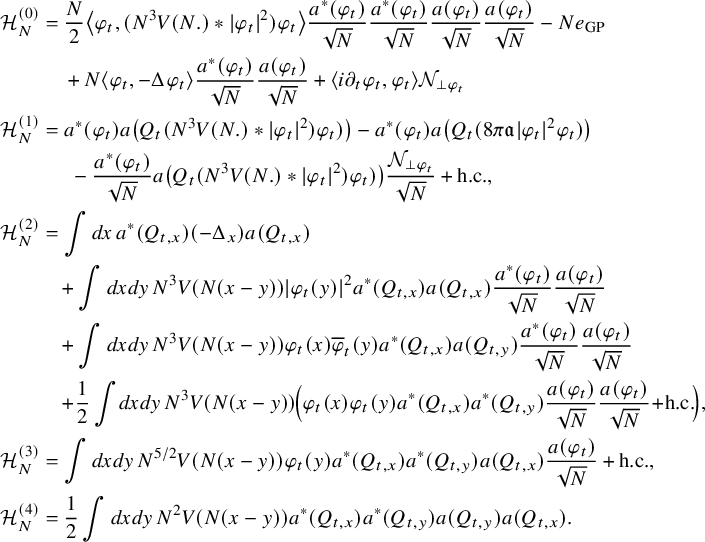
into the sum $ \mathcal {H}_{N} = \sum _{j=0}^4 \mathcal {H}_{N}^{(j)}$
, where
$ \mathcal {H}_{N} = \sum _{j=0}^4 \mathcal {H}_{N}^{(j)}$
, where
 $$ \begin{align}\begin{aligned} \mathcal{H}_{N}^{(0)}&= \frac N2 \big\langle \varphi_t, (N^3V(N.) \ast|\varphi_t|^2) \varphi_t \big\rangle \frac{a^{*}(\varphi_t)}{\sqrt{N}}\frac{a^{*}(\varphi_t)}{\sqrt{N}} \frac{a(\varphi_t)}{\sqrt{N}}\frac{a(\varphi_t)}{\sqrt{N}} -Ne_{\text{GP}} \\ &\hspace{0.4cm} + N \langle \varphi_t, -\Delta \varphi_t\rangle \frac{a^{*}(\varphi_t)}{\sqrt{N}} \frac{a(\varphi_t)}{\sqrt{N}} + \langle i\partial_t \varphi_t,\varphi_t\rangle\mathcal{N}_{\bot \varphi_t} \\ \mathcal{H}_{N}^{(1)}&= a^{*}(\varphi_t) a \big(Q_t ( N^3V (N.) \ast|\varphi_t|^2) \varphi_t) \big)- a^{*}(\varphi_t) a \big(Q_t ( 8\pi \mathfrak{a} |\varphi_t|^2 \varphi_t) \big)\\ &\hspace{0.5cm} - \frac{a^{*}(\varphi_t)}{\sqrt{N}} a \big(Q_t ( N^3V(N.) \ast|\varphi_t|^2) \varphi_t) \big) \frac{\mathcal{N}_{\bot \varphi_t} }{\sqrt{N}} +\text{h.c.}, \\ \mathcal{H}_{N}^{(2)} &= \int dx\, a^{*}(Q_{t,x}) (-\Delta_x) a(Q_{t,x}) \\ &\hspace{0.3cm} +\int dx dy \, N^3 V(N(x-y)) |\varphi_t (y)|^2 a^{*}(Q_{t,x}) a (Q_{t,x}) \frac{a^{*}(\varphi_t)}{\sqrt{N}}\frac{a(\varphi_t)}{\sqrt{N}} \\ &\hspace{0.3cm}+\int dx dy \, N^3 V(N(x-y)) \varphi_t (x) \overline{\varphi}_t (y) a^{*}(Q_{t,x}) a(Q_{t,y}) \frac{a^{*}(\varphi_t)}{\sqrt{N}}\frac{a(\varphi_t)}{\sqrt{N}} \\ &\hspace{0.3cm} +\! \frac12\int \!dx dy\, N^3V(N(x-y)) \!\Big( \varphi_t (x)\varphi_t(y) a^{*}(Q_{t,x}) a^{*}(Q_{t,y}) \frac{a(\varphi_t)}{\sqrt{N}}\frac{a(\varphi_t)}{\sqrt{N}}\!+\!\text{h.c.} \!\Big), \\ \mathcal{H}_{N}^{(3)} &= \int dx dy \, N^{5/2} V(N(x-y)) \varphi_t (y) a^{*}(Q_{t,x}) a^{*}(Q_{t,y}) a(Q_{t,x}) \frac{a(\varphi_t)}{\sqrt{N}} + \text{h.c.} , \\ \mathcal{H}_{N}^{(4)} &= \frac1{2}\int dx dy\, N^2V(N(x-y)) a^{*}(Q_{t,x}) a^{*}(Q_{t,y}) a(Q_{t,y}) a(Q_{t,x}). \\ \end{aligned} \end{align} $$
Here, we normalized the $a^\sharp (\varphi _t)$
by a factor
$a^\sharp (\varphi _t)$
by a factor $\sqrt {N}$
, anticipating that
$\sqrt {N}$
, anticipating that $ \langle a^{*}(\varphi _t)a(\varphi _t)\rangle _{\psi _{N,t}}\approx N$
.
$ \langle a^{*}(\varphi _t)a(\varphi _t)\rangle _{\psi _{N,t}}\approx N$
.
In the second step, we extract $ \mathcal {K}_{\text {ren}}$
and
$ \mathcal {K}_{\text {ren}}$
and $\mathcal {V}_{\text {ren}}$
from
$\mathcal {V}_{\text {ren}}$
from $\mathcal {H}_{N}$
, up to errors controlled by
$\mathcal {H}_{N}$
, up to errors controlled by $ \mathcal {H}_{\text {ren}}$
and
$ \mathcal {H}_{\text {ren}}$
and $\mathcal {N}_{\text {ren}}$
. The error estimates are mostly straightforward applications of Cauchy-Schwarz in combination with the results of Appendices B and C. Below, we outline the key steps since most of the bounds have already been explained at length in, for example, [Reference Benedikter, de Oliveira and Schlein3, Reference Boccato, Cenatiempo and Schlein8, Reference Brennecke and Schlein15].
$\mathcal {N}_{\text {ren}}$
. The error estimates are mostly straightforward applications of Cauchy-Schwarz in combination with the results of Appendices B and C. Below, we outline the key steps since most of the bounds have already been explained at length in, for example, [Reference Benedikter, de Oliveira and Schlein3, Reference Boccato, Cenatiempo and Schlein8, Reference Brennecke and Schlein15].
Now, as shown below, the main contributions to $ \mathcal {H}_{N}^{(0)} $
and
$ \mathcal {H}_{N}^{(0)} $
and $ \mathcal {H}_{N}^{(1)}$
are cancelled, so let us switch directly to
$ \mathcal {H}_{N}^{(1)}$
are cancelled, so let us switch directly to $\mathcal {H}_{N}^{(2)} $
which contains
$\mathcal {H}_{N}^{(2)} $
which contains $\mathcal {K}_{\text {ren}}$
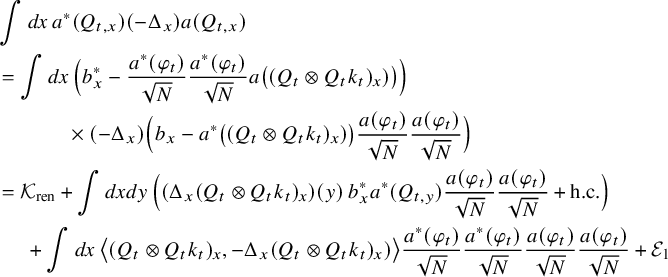
. Abbreviating in the following
$\mathcal {K}_{\text {ren}}$
. Abbreviating in the following
 $$ \begin{align*}j_x(\cdot) = j(x, \cdot) = j(\cdot, x)\end{align*} $$
for symmetric kernels $ j\in L^2(\mathbb {R}^3\times \mathbb {R}^3)$
, we rewrite
$ j\in L^2(\mathbb {R}^3\times \mathbb {R}^3)$
, we rewrite
 $$\begin{align*}\begin{aligned} &\int dx\, a^{*}(Q_{t,x}) (-\Delta_x) a(Q_{t,x}) \\ & = \int dx\, \Big(b^{*}_{x} - \frac{a^{*}(\varphi_t)}{\sqrt{N} }\frac{a^{*}(\varphi_t)}{\sqrt N} a\big(( Q_t\otimes Q_t k_t)_{x}) \big) \Big) \\ &\hspace{1.2cm} \times(-\Delta_x) \Big(b_{x} - a^{*}\big(( Q_t\otimes Q_t k_t)_{x}) \big) \frac{a(\varphi_t)}{\sqrt{N} }\frac{a(\varphi_t)}{\sqrt N}\Big)\\ & = \mathcal{K}_{\text{ren}} + \int dx dy\, \Big( (\Delta_x( Q_t\otimes Q_t k_t)_{x})(y) \,b^{*}_{x} a^{*}(Q_{t,y}) \frac{a(\varphi_t)}{\sqrt{N} }\frac{a(\varphi_t)}{\sqrt N} +\text{h.c.}\Big)\\ &\hspace{0.5cm} + \int dx\, \big\langle ( Q_t\otimes Q_t k_t)_{x} , -\Delta_x ( Q_t\otimes Q_t k_t)_{x} ) \big\rangle \frac{a^{*}(\varphi_t)}{\sqrt{N}}\frac{a^{*}(\varphi_t)}{\sqrt{N}} \frac{a(\varphi_t)}{\sqrt{N}}\frac{a(\varphi_t)}{\sqrt{N}} + \mathcal{E}_1 \end{aligned} \end{align*}$$
for an error $\mathcal {E}_1\geq 0$
which is bounded by
$\mathcal {E}_1\geq 0$
which is bounded by
 $$\begin{align*}\begin{aligned} \mathcal{E}_1 &= \int dx\, \frac{a^{*}(\varphi_t)}{\sqrt{N} }\frac{a^{*}(\varphi_t)}{\sqrt N} a^{*}(\nabla_x( Q_t\otimes Q_t k_t)_{x}) a(\nabla_x ( Q_t\otimes Q_t k_t)_{x}) \frac{a(\varphi_t)}{\sqrt{N} }\frac{a(\varphi_t)}{\sqrt N} \\ &\leq \int dx\, a^{*}(\nabla_x( Q_t\otimes Q_t k_t)_{x}) a(\nabla_x( Q_t\otimes Q_t k_t)_{x}) = \!\int dx dy\, g_t(x,y) a^{*}(Q_{t,x}) a(Q_{t,y})\\ & \leq Ce^{C|t|} (\mathcal{N}_{\text{ren}} +1). \end{aligned} \end{align*}$$
Here, we used Lemma 3.1, Lemma B.1 and Lemma C.1, implying $\|g_t\|\leq Ce^{C|t|}$
for
$\|g_t\|\leq Ce^{C|t|}$
for
 $$\begin{align*}\begin{aligned} g_t(x,y) &= \int dz\, (\nabla_2 Q_t\otimes Q_t k_t) (x,z) (\nabla_2 \overline{Q_t\otimes Q_t k_t}) (y, z). \end{aligned}\end{align*}$$
By Lemma C.1, we also find
 $$\begin{align*}\begin{aligned} \int dxdy\, \Big|& (\Delta_1k_t)(x,y) + \frac12 N^3(Vf)(N(x-y)) \varphi_t(x)\varphi(y) \\ & +2 N^2\big(\nabla (1-f)\big)(N(x-y))\cdot \nabla \varphi_t(x)\varphi_t(y)\chi(x-y) \Big|^2\leq C, \end{aligned}\end{align*}$$
and this can be used to show that
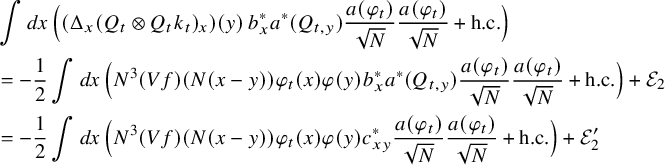 $$\begin{align*}\begin{aligned} &\int dx\, \Big( (\Delta_x( Q_t\otimes Q_t k_t)_{x})(y) \,b^{*}_{x} a^{*}(Q_{t,y}) \frac{a(\varphi_t)}{\sqrt{N} }\frac{a(\varphi_t)}{\sqrt N} +\text{h.c.}\Big)\\ & = -\frac12 \int dx\, \Big( N^3(Vf)(N(x-y)) \varphi_t(x)\varphi(y) b^{*}_{x} a^{*}(Q_{t,y} ) \frac{a(\varphi_t)}{\sqrt{N} }\frac{a(\varphi_t)}{\sqrt N} +\text{h.c.}\Big) + \mathcal{E}_{2}\\ & = -\frac12 \int dx\, \Big( N^3(Vf)(N(x-y)) \varphi_t(x)\varphi(y) c^{*}_{xy} \frac{a(\varphi_t)}{\sqrt{N} }\frac{a(\varphi_t)}{\sqrt N} +\text{h.c.}\Big) + \mathcal{E}^{\prime}_{2} \end{aligned}\end{align*}$$
for two errors $\mathcal {E}_{2}, \mathcal {E}_{N,t}^{\prime }$
which, for every
$\mathcal {E}_{2}, \mathcal {E}_{N,t}^{\prime }$
which, for every $\delta>0$
and some
$\delta>0$
and some $C>0$
, are controlled by
$C>0$
, are controlled by
 $$\begin{align*}\pm \mathcal{E}_{2} \leq \delta \mathcal{K}_{\text{ren}} + C \delta^{-1} e^{C|t|} (\mathcal{N}_{\text{ren}} +1), \;\;\;\pm \mathcal{E}_{2}^{\prime} \leq \delta \mathcal{K}_{\text{ren}} + C \delta^{-1} e^{C|t|} (\mathcal{N}_{\text{ren}} +1).\end{align*}$$
Here, we used that
 $$\begin{align*}\begin{aligned} & \pm \Big( \int dx dy\, N^2(\nabla (1-f)\big)(N(x-y))\cdot \nabla \varphi_t(x)\varphi_t(y)\chi(x-y) \,b^{*}_{x} a^{*}(Q_{t,y} ) \frac{a(\varphi_t)}{\sqrt{N} }\frac{a(\varphi_t)}{\sqrt N} \\ & \hspace{0.7cm} + \int dx dy\, N (1-f)(N(x-y)) \nabla \varphi_t(x)\varphi_t(y)\chi(x-y) \cdot \nabla_x b^{*}_{x} a^{*}(Q_{t,y} ) \frac{a(\varphi_t)}{\sqrt{N} }\frac{a(\varphi_t)}{\sqrt N} \Big)\\ & \leq C e^{C|t|} (\mathcal{N}_{\text{ren}} +1) \end{aligned}\end{align*}$$
by integration by parts, Cauchy-Schwarz and Lemma C.1, and that
 $$\begin{align*}\begin{aligned} &\Big| \int dx dy\, N (1-f)(N(x-y)) \nabla \varphi_t(x)\varphi_t(y)\chi(x-y) \cdot \langle \phi_N, \nabla_x b^{*}_{x} a^{*}(Q_{t,y} ) \frac{a(\varphi_t)}{\sqrt{N} }\frac{a(\varphi_t)}{\sqrt N} \phi_N\rangle \Big|\\ &\leq C \langle \mathcal{K}_{\text{ren}}\rangle_{\phi_N}^{1/2} \langle \, \mathcal{N}_{\text{ren}} +1 \rangle_{\phi_N}^{1/2} \end{aligned} \end{align*}$$
for every $\phi _N\in L^2_s(\mathbb {R}^{3N})$
. Finally, Lemma C.1 and
$\phi _N\in L^2_s(\mathbb {R}^{3N})$
. Finally, Lemma C.1 and $ a^{*}(\varphi _t)a(\varphi _t)= N-\mathcal {N}_{\bot \varphi _t}$
imply that
$ a^{*}(\varphi _t)a(\varphi _t)= N-\mathcal {N}_{\bot \varphi _t}$
imply that
 $$\begin{align*}\begin{aligned} & \int dx\, \big\langle ( Q_t\otimes Q_t k_t)_{x} , -\Delta_x ( Q_t\otimes Q_t k_t)_{x} ) \big\rangle \frac{a^{*}(\varphi_t)}{\sqrt{N}}\frac{a^{*}(\varphi_t)}{\sqrt{N}} \frac{a(\varphi_t)}{\sqrt{N}}\frac{a(\varphi_t)}{\sqrt{N}}\\ & = \frac N2 \int dx dy \, N^3\big(Vf (1-f)\big) (N(x-y)) |\varphi_t(x)|^2 |\varphi_t(y)|^2 + \mathcal{E}_{3}, \end{aligned} \end{align*}$$
where $ \pm \mathcal {E}_{3} \leq Ce^{C|t|} $
. Combining all this with the simple estimates
$ \pm \mathcal {E}_{3} \leq Ce^{C|t|} $
. Combining all this with the simple estimates
 $$\begin{align*}\begin{aligned} &\pm \int dx dy \, N^3 V(N(x-y)) |\varphi_t (y)|^2 a^{*}(Q_{t,x}) a (Q_{t,x}) \frac{a^{*}(\varphi_t)}{\sqrt{N}}\frac{a(\varphi_t)}{\sqrt{N}} \leq Ce^{C|t|} (\mathcal{N}_{\text{ren}} +1),\\ &\pm\int dx dy \, N^3 V(N(x-y)) \varphi_t (x) \overline{\varphi}_t (y) a^{*}(Q_{t,x}) a(Q_{t,y}) \frac{a^{*}(\varphi_t)}{\sqrt{N}}\frac{a(\varphi_t)}{\sqrt{N}} \leq Ce^{C|t|} (\mathcal{N}_{\text{ren}} +1), \end{aligned}\end{align*}$$
which follow from Cauchy-Schwarz and Lemma 3.1, and the fact that
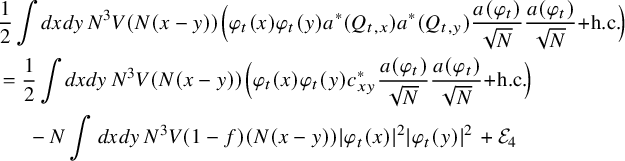 $$\begin{align*}\begin{aligned} &\frac12\int \!dx dy\, N^3V(N(x-y)) \Big( \varphi_t (x)\varphi_t(y) a^{*}(Q_{t,x}) a^{*}(Q_{t,y}) \frac{a(\varphi_t)}{\sqrt{N}}\frac{a(\varphi_t)}{\sqrt{N}}\!+\!\text{h.c.} \!\Big) \\ & = \frac12\int \!dx dy\, N^3V(N(x-y)) \Big( \varphi_t (x)\varphi_t(y) c^{*}_{xy} \frac{a(\varphi_t)}{\sqrt{N}}\frac{a(\varphi_t)}{\sqrt{N}}\!+\!\text{h.c.} \!\Big)\\ &\hspace{0.5cm} - N \int dx dy \, N^3 V(1-f) (N(x-y)) |\varphi_t(x)|^2 |\varphi_t(y)|^2 \, + \mathcal{E}_{4} \end{aligned}\end{align*}$$
for an error $ \pm \mathcal {E}_{4} \leq Ce^{C|t|} $
, which can be proved as above, we arrive at
$ \pm \mathcal {E}_{4} \leq Ce^{C|t|} $
, which can be proved as above, we arrive at
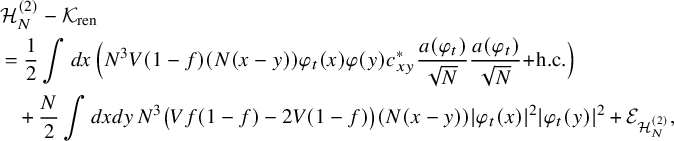 $$ \begin{align} \begin{aligned} &\mathcal{H}_{N}^{(2)}-\mathcal{K}_{\text{ren}} \\ & = \frac12 \int dx\, \Big( N^3V(1-f)(N(x-y)) \varphi_t(x)\varphi(y) c^{*}_{xy} \frac{a(\varphi_t)}{\sqrt{N} }\frac{a(\varphi_t)}{\sqrt N}\! +\!\text{h.c.}\Big)\\ &\hspace{0.3cm} + \frac N2 \int dx dy \, N^3 \big( Vf (1-f) - 2 V(1-f) \big) (N(x-y)) |\varphi_t(x)|^2 |\varphi_t(y)|^2 + \mathcal{E}_{\mathcal{H}_{N}^{(2)}} , \end{aligned} \end{align} $$
where $\pm \mathcal {E}_{\mathcal {H}_{N}^{(2)}}\leq \delta \mathcal {K}_{\text {ren}} + \delta ^{-1}C e^{C|t|} (\mathcal {N}_{\text {ren}} +1)$
.
$\pm \mathcal {E}_{\mathcal {H}_{N}^{(2)}}\leq \delta \mathcal {K}_{\text {ren}} + \delta ^{-1}C e^{C|t|} (\mathcal {N}_{\text {ren}} +1)$
.
In the next step, we extract $\mathcal {V}_{\text {ren}}$
from
$\mathcal {V}_{\text {ren}}$
from $ \mathcal {H}_{N}^{(4)}$
. Here, we simply rewrite
$ \mathcal {H}_{N}^{(4)}$
. Here, we simply rewrite
 $$ \begin{align}\begin{aligned} a^{*}(Q_{t,x})a^{*}(Q_{t,y})& = c^{*}_{xy} - \frac{a^{*}(\varphi_t)}{\sqrt{N} }\frac{a^{*}(\varphi_t)}{\sqrt N} \, \overline{ Q_t\otimes Q_t k_t}(x,y), \end{aligned}\end{align} $$
and inserting this into $\mathcal {H}_{N}^{(4)}$
yields with similar arguments as above the decomposition
$\mathcal {H}_{N}^{(4)}$
yields with similar arguments as above the decomposition
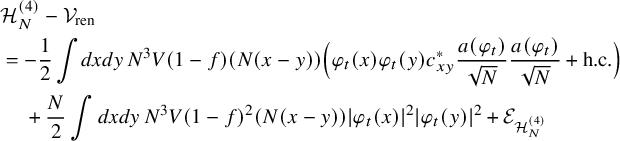 $$ \begin{align} \begin{aligned} &\mathcal{H}_{N}^{(4)} -\mathcal{V}_{\text{ren}} \\ &= -\frac12 \int \!dx dy\, N^3 V(1-f) (N(x-y)) \Big( \varphi_t(x)\varphi_t(y) c^{*}_{xy}\frac{a(\varphi_t)}{\sqrt{N} }\frac{a(\varphi_t)}{\sqrt N} +\text{h.c.}\Big)\\ &\hspace{0.4cm} + \frac N2 \int dx dy \, N^3 V(1-f)^2 (N(x-y)) |\varphi_t(x)|^2 |\varphi_t(y)|^2 + \mathcal{E}_{\mathcal{H}_{N}^{(4)}} \end{aligned}\end{align} $$
for an error $ \mathcal {E}_{\mathcal {H}_{N}^{(4)}}$
which is controlled by
$ \mathcal {E}_{\mathcal {H}_{N}^{(4)}}$
which is controlled by $\pm \mathcal {E}_{\mathcal {H}_{N}^{(4)}}\leq \delta \mathcal {V}_{\text {ren}} + \delta ^{-1}C e^{C|t|} (\mathcal {N}_{\text {ren}} +1)$
for every
$\pm \mathcal {E}_{\mathcal {H}_{N}^{(4)}}\leq \delta \mathcal {V}_{\text {ren}} + \delta ^{-1}C e^{C|t|} (\mathcal {N}_{\text {ren}} +1)$
for every $ \delta>0$
and some constant
$ \delta>0$
and some constant $C>0$
. Finally, inserting (3.10) into
$C>0$
. Finally, inserting (3.10) into $ \mathcal {H}_{N}^{(3)}$
, we obtain analogously
$ \mathcal {H}_{N}^{(3)}$
, we obtain analogously
 $$ \begin{align} \begin{aligned} \mathcal{H}_{N}^{(3)} & = -\Big( a^{*}(\varphi_t) a\big (Q_{t} ( N^3 V(1-f)(N.)\ast |\varphi_t|^2\varphi_t )\big) + \text{h.c.} \Big) \!+ \! \mathcal{E}_{\mathcal{H}_{N}^{(3)}} \end{aligned}\end{align} $$
for an error $ \mathcal {E}_{\mathcal {H}_{N}^{(3)}}$
controlled by
$ \mathcal {E}_{\mathcal {H}_{N}^{(3)}}$
controlled by $ \pm \mathcal {E}_{\mathcal {H}_{N}^{(3)}}\leq \delta \mathcal {V}_{\text {ren}} + \delta ^{-1}C e^{C|t|} (\mathcal {N}_{\text {ren}} +1) $
.
$ \pm \mathcal {E}_{\mathcal {H}_{N}^{(3)}}\leq \delta \mathcal {V}_{\text {ren}} + \delta ^{-1}C e^{C|t|} (\mathcal {N}_{\text {ren}} +1) $
.
To conclude the proof, it now remains to combine the decompositions in (3.9), (3.11), (3.12) with $ \mathcal {H}_{N}^{(0)}$
and
$ \mathcal {H}_{N}^{(0)}$
and $\mathcal {H}_{N}^{(1)}$
, defined in (3.8). Before doing so, let us observe that
$\mathcal {H}_{N}^{(1)}$
, defined in (3.8). Before doing so, let us observe that
 $$\begin{align*}\mathcal{H}_{N}^{(1)} = \Big( a^{*}(\varphi_t) a\big (Q_{t} ( N^3 V(1-f)(N.)\ast |\varphi_t|^2\varphi_t) \big) +\text{h.c.}\Big) + \mathcal{E}_{\mathcal{H}_{N}^{(1)}} \end{align*}$$
for an error $ \mathcal {E}_{\mathcal {H}_{N}^{(1)}}$
controlled by
$ \mathcal {E}_{\mathcal {H}_{N}^{(1)}}$
controlled by $ \pm \mathcal {E}_{\mathcal {H}_{N}^{(1)}}\leq C e^{C|t|} (\mathcal {N}_{\text {ren}} +1) $
. This readily follows from the regularity of
$ \pm \mathcal {E}_{\mathcal {H}_{N}^{(1)}}\leq C e^{C|t|} (\mathcal {N}_{\text {ren}} +1) $
. This readily follows from the regularity of $ \varphi _t$
(see Proposition A.1) and the identity
$ \varphi _t$
(see Proposition A.1) and the identity $\|Vf\|_1 = 8\pi \mathfrak {a}$
. Combining this observation with the the identity
$\|Vf\|_1 = 8\pi \mathfrak {a}$
. Combining this observation with the the identity $a^{*}(\varphi _t) a(\varphi _t) = N-\mathcal {N}_{\bot \varphi _t}$
, the fact that
$a^{*}(\varphi _t) a(\varphi _t) = N-\mathcal {N}_{\bot \varphi _t}$
, the fact that
 $$\begin{align*}\langle \varphi_t, -\Delta \varphi_t\rangle = e_{\text{GP}} - 4\pi\mathfrak{a} \| \varphi_t \|^4_4 = e_{\text{GP}} - \frac12 \big\langle \varphi_t, (N^3Vf(N.)\ast |\varphi_t|^2)\varphi_t\big\rangle +O(1) \end{align*}$$
and the decompositions (3.9), (3.11) and (3.12), we conclude that
 $$ \begin{align}\begin{aligned} \mathcal{H}_{N} & = \mathcal{H}_{\text{ren}} + \mathcal{E}_{\mathcal{H}_{N}}, \end{aligned} \end{align} $$
for an error $\pm \mathcal {E}_{\mathcal {H}_{N}}\leq \delta \mathcal {H}_{\text {ren}} + C\delta ^{-1} e^{C|t|} (\mathcal {N}_{\text {ren}} +1) $
. Choosing
$\pm \mathcal {E}_{\mathcal {H}_{N}}\leq \delta \mathcal {H}_{\text {ren}} + C\delta ^{-1} e^{C|t|} (\mathcal {N}_{\text {ren}} +1) $
. Choosing $\delta =\frac 12$
concludes (3.6).
$\delta =\frac 12$
concludes (3.6).
Let us now switch to the commutator estimate (3.7). Based on the decomposition of $\mathcal {H}_N$
in (3.13), it is useful to split this into two steps and to show separately that
$\mathcal {H}_N$
in (3.13), it is useful to split this into two steps and to show separately that
 $$ \begin{align} \pm \big[ i \mathcal{H}_{\text{ren}}, \mathcal{N}_{\text{ren}}\big] \leq C\mathcal{H}_{\text{ren}} + Ce^{C|t|} (\mathcal{N}_{\text{ren}} +1) , \end{align} $$
and
 $$ \begin{align} \pm \big[ i \mathcal{E}_{\mathcal{H}_{N}}, \mathcal{N}_{\text{ren}}\big] \leq C\mathcal{H}_{\text{ren}} + Ce^{C|t|} (\mathcal{N}_{\text{ren}} +1). \end{align} $$
Proving these bounds requires only a slight variation of the arguments used to derive (3.6). We therefore focus on the key ideas for (3.14) and omit the details for (3.15).
Let us start with $ [i\mathcal {K}_{\text {ren}}, \mathcal {N}_{\text {ren}}] $
. The key identity that we need is
$ [i\mathcal {K}_{\text {ren}}, \mathcal {N}_{\text {ren}}] $
. The key identity that we need is
 $$\begin{align*}\begin{aligned} \big[ b_x, \mathcal{N}_{\text{ren}} \big] &= \big[ a(Q_{t,x}) + N^{-1}a^{*}\big( (Q_t\otimes Q_t k_t)_x \big) a(\varphi_t)a(\varphi_t), \mathcal{N}_{\bot\varphi_t} \big] \\ &\hspace{0.5cm} + N^{-1}\int dz \, \big[ a(Q_{t,x}) , a^{*}\big( (Q_t\otimes Q_tk_t)_z \big) a^{*}_z a(\varphi_t)a(\varphi_t) + \text{h.c.} \big], \\ &\hspace{0.5cm} + N^{-2}\int dz \, \big[ a^{*}\big( (Q_t\otimes Q_t k_t)_x \big) a(\varphi_t)a(\varphi_t), a^{*}(\varphi_t)a^{*}(\varphi_t) a\big( (Q_t\otimes Q_tk_t)_z \big) a_z \big] , \\ & = b_x - 2 N^{-2} \int dz\, \big \langle (Q_t\otimes Q_t k_t)_x, (Q_t\otimes Q_t k_t)_z \big \rangle a_z a^{*}(\varphi_t)a^{*}(\varphi_t) a(\varphi_t)a(\varphi_t) \\ &\hspace{0.5cm} + 2 N^{-2} a^{*}\big( (Q_t\otimes Q_t k_t)_x \big) \int dz\, a\big( (Q_t\otimes Q_tk_t)_z \big) a_z (2 a^{*}(\varphi_t) a(\varphi_t)+1 ). \end{aligned}\end{align*}$$
Since $\big [ b_x^{*}, \mathcal {N}_{\text {ren}} \big ] = - \big [ b_x, \mathcal {N}_{\text {ren}} \big ]^{*}$
, this implies that
$\big [ b_x^{*}, \mathcal {N}_{\text {ren}} \big ] = - \big [ b_x, \mathcal {N}_{\text {ren}} \big ]^{*}$
, this implies that $\big [i \mathcal {K}_{\text {ren}}, \mathcal {N}_{\text {ren}}\big ]$
vanishes up to corrections that are quadratic in the kernel
$\big [i \mathcal {K}_{\text {ren}}, \mathcal {N}_{\text {ren}}\big ]$
vanishes up to corrections that are quadratic in the kernel $ Q_t\otimes Q_t k_t$
. As shown already in the previous step, such correction terms only produce regular terms so that a similar analysis as for (3.6) implies that
$ Q_t\otimes Q_t k_t$
. As shown already in the previous step, such correction terms only produce regular terms so that a similar analysis as for (3.6) implies that $ \pm [ i \mathcal {K}_{\text {ren}}, \mathcal {N}_{\text {ren}}] \leq C\,\mathcal {K}_{\text {ren}} + Ce^{C|t|} (\mathcal {N}_{\text {ren}} +1)$
; we omit the details. Similar remarks apply to
$ \pm [ i \mathcal {K}_{\text {ren}}, \mathcal {N}_{\text {ren}}] \leq C\,\mathcal {K}_{\text {ren}} + Ce^{C|t|} (\mathcal {N}_{\text {ren}} +1)$
; we omit the details. Similar remarks apply to $ [ i \mathcal {V}_{\text {ren}}, \mathcal {N}_{\text {ren}}]$
. Here, we use additionally the identity
$ [ i \mathcal {V}_{\text {ren}}, \mathcal {N}_{\text {ren}}]$
. Here, we use additionally the identity
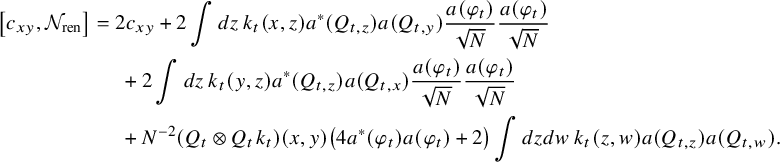 $$\begin{align*}\begin{aligned} \big[ c_{xy} ,\mathcal{N}_{\text{ren}} \big] &= 2 c_{xy} + 2 \int dz \, k_t (x,z) a^{*}(Q_{t,z}) a(Q_{t,y}) \frac{a(\varphi_t)}{\sqrt{N} }\frac{a(\varphi_t)}{\sqrt N} \\ &\hspace{0.5cm} + 2 \int dz \, k_t (y,z) a^{*}(Q_{t,z}) a(Q_{t,x}) \frac{a(\varphi_t)}{\sqrt{N} }\frac{a(\varphi_t)}{\sqrt N}\\ &\hspace{0.5cm} + N^{-2} (Q_t\otimes Q_t k_t) (x,y) \big (4a^{*}(\varphi_t)a(\varphi_t) +2\big) \int dz dw \, k_t (z,w) a(Q_{t,z}) a(Q_{t,w}). \end{aligned}\end{align*}$$
Arguing as above, we then find that $\pm [ i \mathcal {V}_{\text {ren}}, \mathcal {N}_{\text {ren}}]\leq C\,\mathcal {V}_{\text {ren}} + Ce^{C|t|} (\mathcal {N}_{\text {ren}} +1)$
.
$\pm [ i \mathcal {V}_{\text {ren}}, \mathcal {N}_{\text {ren}}]\leq C\,\mathcal {V}_{\text {ren}} + Ce^{C|t|} (\mathcal {N}_{\text {ren}} +1)$
.
The next lemma is our last ingredient needed for the proof of Proposition 2.1. It is similar to the previous Lemma 3.2 and collects important properties related to $ \mathcal {Q}_{\text {ren}}$
.
$ \mathcal {Q}_{\text {ren}}$
.
Lemma 3.3. Let $\mathcal {H}_{N}$
be as in (2.9) and let
$\mathcal {H}_{N}$
be as in (2.9) and let $ \mathcal {Q}_{\text {ren}} $
be as in (2.10). Then, for some constant
$ \mathcal {Q}_{\text {ren}} $
be as in (2.10). Then, for some constant $C>0$
and for every
$C>0$
and for every $t\in \mathbb {R}$
, we have that
$t\in \mathbb {R}$
, we have that
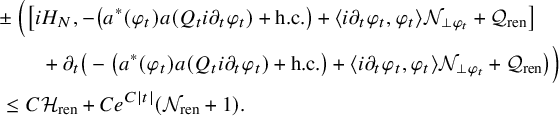 $$\begin{align*}\begin{aligned} &\pm \Big( \big [ i H_N, - \big(a^{*}(\varphi_t) a(Q_t i\partial_t \varphi_t)+\text{h.c.}\big) + \langle i\partial_t \varphi_t,\varphi_t\rangle\mathcal{N}_{\bot \varphi_t} + \mathcal{Q}_{\text{ren}}\big] \\ &\hspace{0.8cm} + \partial_t \big( - \big(a^{*}(\varphi_t) a(Q_t i\partial_t \varphi_t)+\text{h.c.}\big) + \langle i\partial_t \varphi_t,\varphi_t\rangle\mathcal{N}_{\bot \varphi_t} + \mathcal{Q}_{\text{ren}} \big)\Big) \\ &\;\leq C \mathcal{H}_{\text{ren}} + Ce^{C|t|} (\mathcal{N}_{\text{ren}} +1). \end{aligned}\end{align*}$$
Proof. The proof is based on the same ideas and operator bounds as Lemma 3.1 and Lemma 3.2. For this reason, we only outline the key steps. Based on the second bound in (3.2) of Lemma 3.1, we first observe that it suffices to prove that
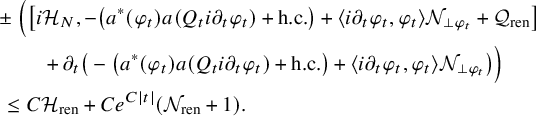 $$ \begin{align}\begin{aligned} &\pm \Big( \big [ i \mathcal{H}_N, - \big(a^{*}(\varphi_t) a(Q_t i\partial_t \varphi_t)+\text{h.c.}\big) + \langle i\partial_t \varphi_t,\varphi_t\rangle\mathcal{N}_{\bot \varphi_t} + \mathcal{Q}_{\text{ren}}\big] \\ &\hspace{0.8cm} + \partial_t \big( - \big(a^{*}(\varphi_t) a(Q_t i\partial_t \varphi_t)+\text{h.c.}\big) + \langle i\partial_t \varphi_t,\varphi_t\rangle\mathcal{N}_{\bot \varphi_t} \big)\Big) \\ &\;\leq C \mathcal{H}_{\text{ren}} + Ce^{C|t|} (\mathcal{N}_{\text{ren}} +1). \end{aligned}\end{align} $$
Now, we have to compute the contributions on the r.h.s. explicitly and, in view of (3.16), it is enough to do this up to errors that are controlled by $ \mathcal {H}_{\text {ren}}$
and
$ \mathcal {H}_{\text {ren}}$
and $\mathcal {N}_{\text {ren}}$
. We first set
$\mathcal {N}_{\text {ren}}$
. We first set
 $$\begin{align*}\mathcal X = - \big(a^{*}(\varphi_t) a(Q_t i\partial_t \varphi_t)+\text{h.c.}\big) + \langle i\partial_t \varphi_t,\varphi_t\rangle\mathcal{N}_{\bot \varphi_t}, \end{align*}$$
and find with (3.3) that
 $$ \begin{align}\begin{aligned} \partial_t \mathcal X & = \Big(\langle i\partial_t \varphi_t,\varphi_t\rangle a^{*}(\varphi_t)a(Q_t\partial_t\varphi_t) - a^{*}(\varphi_t)a(Q_t i\partial_t^2\varphi_t) +\text{h.c.}\Big) + \mathcal{E}_{\partial_t \mathcal X}, \end{aligned} \end{align} $$
where, trivially, $ \pm \partial _t \mathcal {E}_{\partial _t \mathcal X} = \pm \big (\partial _t \langle i\partial _t \varphi _t,\varphi _t\rangle \big ) \mathcal {N}_{\bot \varphi _t}\leq Ce^{C|t| } \mathcal {N}_{\text {ren}} $
, by Lemma 3.1. In the next step, a tedious but straightforward computation shows that
$ \pm \partial _t \mathcal {E}_{\partial _t \mathcal X} = \pm \big (\partial _t \langle i\partial _t \varphi _t,\varphi _t\rangle \big ) \mathcal {N}_{\bot \varphi _t}\leq Ce^{C|t| } \mathcal {N}_{\text {ren}} $
, by Lemma 3.1. In the next step, a tedious but straightforward computation shows that
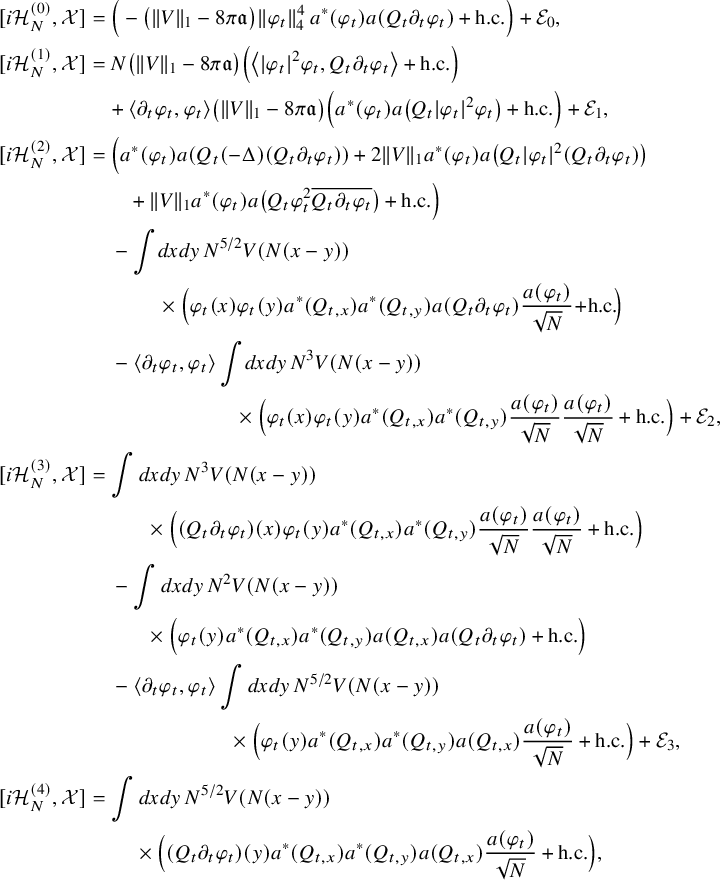 $$\begin{align*}[i\mathcal{H}_{N}^{(0)}, \mathcal X ] &= \Big( - \big( \| V \|_1 - 8\pi\mathfrak{a}\big) \|\varphi_t\|_4^4 \, a^{*}(\varphi_t) a(Q_t \partial_t \varphi_t)+\text{h.c.}\Big) + \mathcal{E}_0, \\ [i\mathcal{H}_{N}^{(1)}, \mathcal X ]&= N \big( \| V \|_1 - 8\pi\mathfrak{a}\big) \Big( \big\langle |\varphi_t|^2\varphi_t, Q_t \partial_t \varphi_t\big \rangle +\text{h.c.}\Big) \\ &\hspace{0.35cm} + \langle \partial_t \varphi_t,\varphi_t\rangle \big( \| V \|_1 - 8\pi\mathfrak{a}\big) \Big( a^{*}(\varphi_t) a\big(Q_t |\varphi_t|^2 \varphi_t\big) +\text{h.c.}\Big) + \mathcal{E}_1,\\ [i\mathcal{H}_{N}^{(2)}, \mathcal X ] &= \Big( a^{*}(\varphi_t) a (Q_t(-\Delta) ( Q_t \partial_t \varphi_t) ) + 2 \| V \|_1a^{*}(\varphi_t) a\big(Q_t |\varphi_t|^2( Q_t \partial_t \varphi_t) \big) \\ &\hspace{0.7cm} + \| V \|_1 a^{*}(\varphi_t) a \big( Q_t \varphi_t^2 \overline{ Q_t \partial_t\varphi_t}\big) + \text{h.c.}\Big)\\ &\hspace{0.4cm} - \int \!dx dy\, N^{5/2}V(N(x-y)) \\ &\hspace{1.2cm}\times\Big( \varphi_t (x)\varphi_t(y) a^{*}(Q_{t,x}) a^{*}(Q_{t,y}) a(Q_t \partial_t \varphi_t) \frac{a(\varphi_t)}{\sqrt{N}}\!+\!\text{h.c.} \!\Big) \\ &\hspace{0.4cm} - \langle \partial_t \varphi_t,\varphi_t\rangle \int \!dx dy\, N^3V(N(x-y)) \\ & \hspace{2.5cm} \times \Big( \varphi_t (x)\varphi_t(y) a^{*}(Q_{t,x}) a^{*}(Q_{t,y}) \frac{a(\varphi_t)}{\sqrt{N}}\frac{a(\varphi_t)}{\sqrt{N}} + \text{h.c.} \Big) + \mathcal{E}_2, \\ [i\mathcal{H}_{N}^{(3)}, \mathcal X ] &= \int dx dy \, N^{3} V(N(x-y)) \\ & \hspace{1cm}\times \Big( (Q_{t}\partial_t \varphi_t)(x) \varphi_t (y) a^{*}(Q_{t,x}) a^{*}(Q_{t,y}) \frac{a(\varphi_t)}{\sqrt{N}}\frac{a(\varphi_t)}{\sqrt{N}} + \text{h.c.}\Big) \\ &\hspace{0.4cm} - \int dx dy \, N^{2} V(N(x-y)) \\ & \hspace{1cm}\times \Big( \varphi_t (y) a^{*}(Q_{t,x}) a^{*}(Q_{t,y}) a(Q_{t,x}) a(Q_t \partial_t \varphi_t) + \text{h.c.}\Big) \\ &\hspace{0.4cm}-\langle \partial_t \varphi_t,\varphi_t\rangle \int dx dy \, N^{5/2} V(N(x-y)) \\ &\hspace{2.4cm}\times \Big( \varphi_t (y) a^{*}(Q_{t,x}) a^{*}(Q_{t,y}) a(Q_{t,x}) \frac{a(\varphi_t)}{\sqrt{N}} + \text{h.c.}\Big)+ \mathcal{E}_3 , \\ [i\mathcal{H}_{N}^{(4)}, \mathcal X ] &= \int dx dy\, N^{5/2}V(N(x-y))\\ &\hspace{0.8cm} \times \Big ( (Q_{t}\partial_t \varphi_t)(y) a^{*}(Q_{t,x}) a^{*}(Q_{t,y}) a(Q_{t,x}) \frac{a(\varphi_t)}{\sqrt{N} } +\text{h.c.} \Big),\end{align*}$$
where, for all $j \in \{0,1,2,3\}$
, the errors
$j \in \{0,1,2,3\}$
, the errors $ \mathcal {E}_j$
are bounded by
$ \mathcal {E}_j$
are bounded by
 $$\begin{align*}\pm \mathcal{E}_j\leq Ce^{C|t|}(\mathcal{N}_{\text{ren}} + 1). \end{align*}$$
This decomposition and the related error bounds are a direct consequence of (3.8) and basic estimates as in the proof of the previous lemmas. If we expand $ Q_t = 1- |\varphi _t\rangle \langle \varphi _t|$
and use that
$ Q_t = 1- |\varphi _t\rangle \langle \varphi _t|$
and use that $\text {Re}\, \langle \partial _t\varphi _t, \varphi _t\rangle =0$
, the sum of the different contributions equals
$\text {Re}\, \langle \partial _t\varphi _t, \varphi _t\rangle =0$
, the sum of the different contributions equals
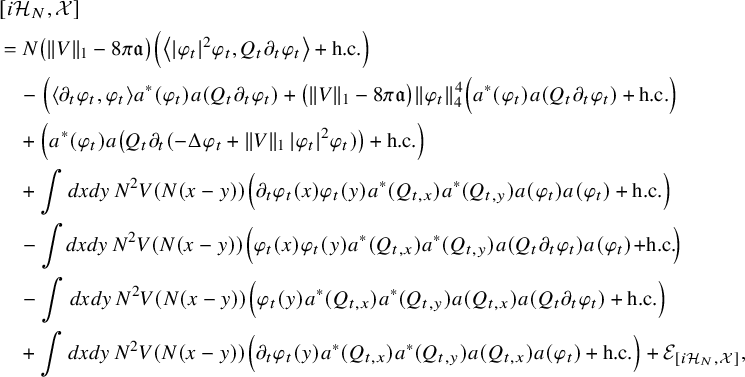 $$ \begin{align}\begin{aligned} &[i\mathcal{H}_{N} , \mathcal X ] \\ & = N \big( \| V \|_1 - 8\pi\mathfrak{a}\big) \Big( \big\langle |\varphi_t|^2\varphi_t, Q_t \partial_t \varphi_t\big \rangle +\text{h.c.}\Big) \\ & \hspace{0.35cm} - \Big( \langle \partial_t\varphi_t, \varphi_t\rangle a^{*}(\varphi_t) a( Q_t \partial_t \varphi_t ) + \big( \|V\|_1- 8\pi\mathfrak{a}\big) \|\varphi_t\|_4^4 \Big( a^{*}(\varphi_t) a( Q_t \partial_t \varphi_t ) +\text{h.c.}\Big) \\ & \hspace{0.35cm} + \Big( a^{*}(\varphi_t) a\big( Q_t \partial_t ( -\Delta \varphi_t + \|V\|_1 \, |\varphi_t|^2 \varphi_t) \big) +\text{h.c.}\Big) \\ & \hspace{0.35cm} +\int dx dy \, N^{2} V(N(x-y)) \Big( \partial_t \varphi_t(x) \varphi_t (y) a^{*}(Q_{t,x}) a^{*}(Q_{t,y}) a(\varphi_t) a(\varphi_t) + \text{h.c.}\Big) \\ & \hspace{0.35cm}- \int \!dx dy\, N^{2}V(N(x-y)) \Big( \varphi_t (x)\varphi_t(y) a^{*}(Q_{t,x}) a^{*}(Q_{t,y}) a(Q_t \partial_t \varphi_t) a(\varphi_t) \!+\!\text{h.c.} \!\Big) \\ &\hspace{0.35cm} - \int dx dy \, N^{2} V(N(x-y)) \Big( \varphi_t (y) a^{*}(Q_{t,x}) a^{*}(Q_{t,y}) a(Q_{t,x}) a(Q_t \partial_t \varphi_t) + \text{h.c.}\Big) \\ &\hspace{0.35cm}+\int dx dy\, N^{2}V(N(x-y)) \Big ( \partial_t \varphi_t(y) a^{*}(Q_{t,x}) a^{*}(Q_{t,y}) a(Q_{t,x}) a(\varphi_t) +\text{h.c.} \Big) +\mathcal{E}_{[ i\mathcal{H}_{N} , \mathcal X ]}, \end{aligned}\end{align} $$
up to an error $\mathcal {E}_{[i\mathcal {H}_{N} , \mathcal X ]}$
that is bounded by
$\mathcal {E}_{[i\mathcal {H}_{N} , \mathcal X ]}$
that is bounded by $ \mathcal {E}_{[i\mathcal {H}_{N} , \mathcal X ]}\leq Ce^{C|t|}(\mathcal {N}_{\text {ren}} + 1)$
.
$ \mathcal {E}_{[i\mathcal {H}_{N} , \mathcal X ]}\leq Ce^{C|t|}(\mathcal {N}_{\text {ren}} + 1)$
.
Now, observe that the last four terms on the right-hand side of (3.18) are structurally similar to the last contribution to $ \mathcal {H}_N^{(2)}$
and, respectively, to
$ \mathcal {H}_N^{(2)}$
and, respectively, to $\mathcal {H}_N^{(3)}$
, defined in (3.8). We can therefore proceed similarly as in Lemma 3.2 and extract their main contributions by comparing them to
$\mathcal {H}_N^{(3)}$
, defined in (3.8). We can therefore proceed similarly as in Lemma 3.2 and extract their main contributions by comparing them to $ \mathcal {H}_{\text {ren}}$
. To this end, we substitute (3.10) into the r.h.s. of (3.18) and observe that normal ordering causes cancellations between the terms on the first and fourth lines, the second and fifth lines, and between the terms on the third and last lines. Combined with (1.8) and (3.17), we then arrive at
$ \mathcal {H}_{\text {ren}}$
. To this end, we substitute (3.10) into the r.h.s. of (3.18) and observe that normal ordering causes cancellations between the terms on the first and fourth lines, the second and fifth lines, and between the terms on the third and last lines. Combined with (1.8) and (3.17), we then arrive at
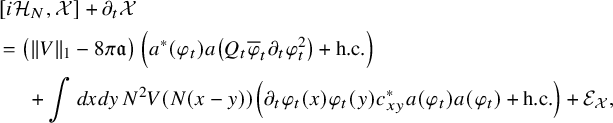 $$ \begin{align} \begin{aligned} &[i\mathcal{H}_{N} , \mathcal X ] +\partial_t \mathcal X \\ & = \big( \|V\|_1- 8\pi\mathfrak{a}\big) \,\Big( a^{*}(\varphi_t) a\big( Q_t \overline{ \varphi}_t \partial_t \varphi_t^2 \big) +\text{h.c.}\Big) \\ &\hspace{0.5cm} +\int dx dy \, N^{2} V(N(x-y)) \Big( \partial_t \varphi_t(x) \varphi_t (y) c^{*}_{xy} a(\varphi_t) a(\varphi_t) + \text{h.c.}\Big) + \mathcal{E}_{ \mathcal X }, \end{aligned}\end{align} $$
up to an overall error which is bounded by $ \pm \mathcal {E}_{\mathcal X}\leq C \mathcal {V}_{\text {ren}} + Ce^{C|t|} (\mathcal {N}_{\text {ren}} +1) $
.
$ \pm \mathcal {E}_{\mathcal X}\leq C \mathcal {V}_{\text {ren}} + Ce^{C|t|} (\mathcal {N}_{\text {ren}} +1) $
.
It remains to compare the right-hand side in (3.19) with $ [ i \mathcal {H}_N, \mathcal {Q}_{\text {ren}}] $
. Based on (3.8), a similar computation shows that
$ [ i \mathcal {H}_N, \mathcal {Q}_{\text {ren}}] $
. Based on (3.8), a similar computation shows that $ \pm [i \mathcal {H}_{N}^{(0)}, \mathcal {Q}_{\text {ren}} ] \leq Ce^{C|t|}(\mathcal {N}_{\text {ren}} + 1)$
and that
$ \pm [i \mathcal {H}_{N}^{(0)}, \mathcal {Q}_{\text {ren}} ] \leq Ce^{C|t|}(\mathcal {N}_{\text {ren}} + 1)$
and that
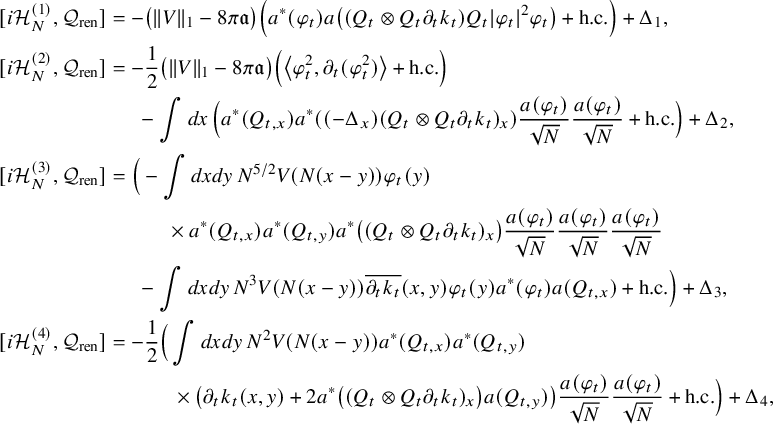 $$\begin{align*}\begin{aligned} [i\mathcal{H}_{N}^{(1)}, \mathcal{Q}_{\text{ren}} ]&= - \big( \|V\|_1- 8\pi\mathfrak{a} \big)\Big( a^{*}(\varphi_t ) a \big( (Q_t\otimes Q_t \partial_t k_t )Q_t |\varphi_t|^2\varphi_t\big) +\text{h.c.}\Big) + \Delta_1 ,\\ [i\mathcal{H}_{N}^{(2)}, \mathcal{Q}_{\text{ren}} ] &= - \frac12 \big(\|V\|_1-8\pi\mathfrak{a}\big) \Big( \big \langle \varphi_t^2, \partial_t (\varphi^2_t) \big\rangle + \text{h.c.} \Big)\\ &\hspace{0.5cm}- \int dx\, \Big( a^{*}(Q_{t,x}) a^{*} ( (-\Delta_x) ( Q_t\otimes Q_t \partial_t k_t)_x) \frac{a(\varphi_t)}{\sqrt{N}}\frac{a(\varphi_t)}{\sqrt{N}} + \text{h.c.} \Big)+ \Delta_2 , \\ [i\mathcal{H}_{N}^{(3)}, \mathcal{Q}_{\text{ren}} ] &= \Big( - \int dx dy \, N^{5/2} V(N(x-y)) \varphi_t (y) \\ &\hspace{1cm} \times a^{*}(Q_{t,x}) a^{*}(Q_{t,y})a^{*}\big(( Q_t\otimes Q_t \partial_t k_t)_x\big) \frac{a(\varphi_t)}{\sqrt{N}}\frac{a(\varphi_t)}{\sqrt{N}}\frac{a(\varphi_t)}{\sqrt{N}} \\ &\hspace{0.5cm} - \int dx dy \, N^{3} V(N(x-y)) \overline{ \partial_t k_t } (x,y) \varphi_t (y) a^{*}(\varphi_t) a(Q_{t,x}) + \text{h.c.}\Big) + \Delta_3, \\ [i\mathcal{H}_{N}^{(4)}, \mathcal{Q}_{\text{ren}} ] &= - \frac12 \Big( \int dx dy\, N^2V(N(x-y))a^{*}(Q_{t,x}) a^{*}(Q_{t,y}) \\ &\hspace{1.1cm}\times \big( \partial_t k_t(x,y) + 2 a^{*}\big( ( Q_t\otimes Q_t \partial_t k_t)_x\big) a(Q_{t,y}) \big) \frac{a(\varphi_t)}{\sqrt{N}}\frac{a(\varphi_t)}{\sqrt{N}} + \text{h.c.} \Big) + \Delta_4 , \end{aligned} \end{align*}$$
up to further error terms $ \Delta _j$
that are controlled by
$ \Delta _j$
that are controlled by $\pm \Delta _j\leq Ce^{C|t|}(\mathcal {N}_{\text {ren}} + 1)$
.
$\pm \Delta _j\leq Ce^{C|t|}(\mathcal {N}_{\text {ren}} + 1)$
.
To combine the different contributions to $ [ i \mathcal {H}_N, \mathcal {Q}_{\text {ren}}] $
, we proceed as before. That is, we substitute (3.10) and bring all terms into normal order. One then finds that
$ [ i \mathcal {H}_N, \mathcal {Q}_{\text {ren}}] $
, we proceed as before. That is, we substitute (3.10) and bring all terms into normal order. One then finds that
 $$\begin{align*}[ i \mathcal{H}_{N}^{(1)} + i \mathcal{H}_{N}^{(3)}, \mathcal{Q}_{\text{ren}} ] = - \big( \|V\|_1- 8\pi\mathfrak{a}\big) \,\Big( a^{*}(\varphi_t) a\big( Q_t \overline{ \varphi}_t \partial_t \varphi_t^2 \big) +\text{h.c.}\Big) + \mathcal{E}_{[i \mathcal{H}_{N}^{(1)} + i\mathcal{H}_{N}^{(3)}, \mathcal{Q}_{\text{ren}} ]}, \end{align*}$$
where $ \mathcal {E}_{[i\mathcal {H}_{N}^{(1)} + i\mathcal {H}_{N}^{(3)}, \mathcal {Q}_{\text {ren}} ]} \leq C \mathcal {H}_{\text {ren}} + Ce^{C|t|} (\mathcal {N}_{\text {ren}} +1)$
. Similarly, based on the zero energy scattering equation (2.5), the identities (3.10) and
$ \mathcal {E}_{[i\mathcal {H}_{N}^{(1)} + i\mathcal {H}_{N}^{(3)}, \mathcal {Q}_{\text {ren}} ]} \leq C \mathcal {H}_{\text {ren}} + Ce^{C|t|} (\mathcal {N}_{\text {ren}} +1)$
. Similarly, based on the zero energy scattering equation (2.5), the identities (3.10) and
 $$\begin{align*}\partial_t k_t (x,y) = N(1-f)(N(x-y)) \chi(x-y) \big( (\partial_t \varphi_t) (x) \varphi_t (y)+ \varphi_t(x) (\partial_t \varphi_t)(y)\big) \end{align*}$$
as well as the kernel properties of Lemma C.1, one readily finds that
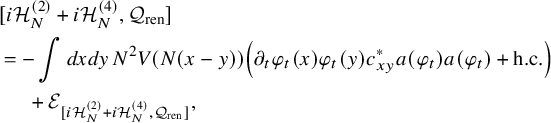 $$\begin{align*}\begin{aligned} &[i\mathcal{H}_{N}^{(2)} + i\mathcal{H}_{N}^{(4)}, \mathcal{Q}_{\text{ren}} ] \\ & = - \int dx dy \, N^{2} V(N(x-y)) \Big( \partial_t \varphi_t(x) \varphi_t (y) c_{xy}^{*} a(\varphi_t) a(\varphi_t) + \text{h.c.}\Big) \\ &\hspace{0.5cm}+ \mathcal{E}_{[i\mathcal{H}_{N}^{(2)} + i\mathcal{H}_{N}^{(4)}, \mathcal{Q}_{\text{ren}} ]}, \end{aligned}\end{align*}$$
for an error $ \mathcal {E}_{[i \mathcal {H}_{N}^{(2)} + i \mathcal {H}_{N}^{(4)}, \mathcal {Q}_{\text {ren}} ]} \leq C \mathcal {H}_{\text {ren}} + Ce^{C|t|} (\mathcal {N}_{\text {ren}} +1)$
. This shows that
$ \mathcal {E}_{[i \mathcal {H}_{N}^{(2)} + i \mathcal {H}_{N}^{(4)}, \mathcal {Q}_{\text {ren}} ]} \leq C \mathcal {H}_{\text {ren}} + Ce^{C|t|} (\mathcal {N}_{\text {ren}} +1)$
. This shows that
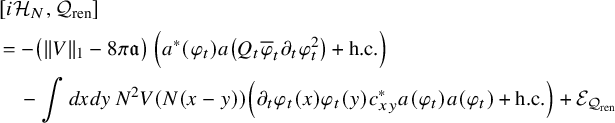 $$ \begin{align}\begin{aligned} &[i\mathcal{H}_{N} , \mathcal{Q}_{\text{ren}} ] \\ & = - \big( \|V\|_1- 8\pi\mathfrak{a}\big) \,\Big( a^{*}(\varphi_t) a\big( Q_t \overline{ \varphi}_t \partial_t \varphi_t^2 \big) +\text{h.c.}\Big) \\ & \hspace{0.35cm} - \int dx dy \, N^{2} V(N(x-y)) \Big( \partial_t \varphi_t(x) \varphi_t (y) c^{*}_{xy} a(\varphi_t) a(\varphi_t) + \text{h.c.}\Big) + \mathcal{E}_{ \mathcal{Q}_{\text{ren}} } \end{aligned}\end{align} $$
for $ \pm \mathcal {E}_{ \mathcal {Q}_{\text {ren}} } \leq C \mathcal {H}_{\text {ren}} + Ce^{Ct} (\mathcal {N}_{\text {ren}} +1) $
. By direct comparison of (3.19) and (3.20), we get
$ \pm \mathcal {E}_{ \mathcal {Q}_{\text {ren}} } \leq C \mathcal {H}_{\text {ren}} + Ce^{Ct} (\mathcal {N}_{\text {ren}} +1) $
. By direct comparison of (3.19) and (3.20), we get
 $$\begin{align*}[i\mathcal{H}_{N} , \mathcal X ] +\partial_t \mathcal X + [i\mathcal{H}_{N} , \mathcal{Q}_{\text{ren}} ] = \mathcal{E}_{\mathcal X} + \mathcal{E}_{ \mathcal{Q}_{\text{ren}} }.\\[-37pt] \end{align*}$$
We conclude this section with the proof of Proposition 2.1. This is now a simple corollary of Lemma 3.2 and Lemma 3.3.
Proof of Proposition 2.1
The first bound in Proposition 2.1 follows directly from Lemma 3.1 and Lemma 3.2, so let us focus on the Gronwall bound. Without loss of generality, consider $t\geq 0$
. We then compute
$t\geq 0$
. We then compute
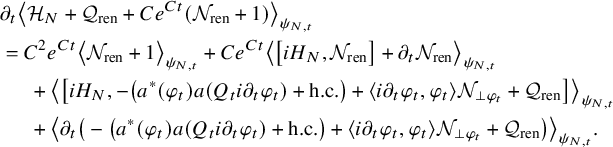 $$ \begin{align}\begin{aligned} &\partial_t \big \langle \mathcal{H}_N + \mathcal{Q}_{\text{ren}} + Ce^{Ct} (\mathcal{N}_{\text{ren}} +1) \big\rangle_{\psi_{N,t} } \\ & = C^2e^{Ct} \big \langle \mathcal{N}_{\text{ren}} +1 \big\rangle_{\psi_{N,t} } +Ce^{Ct} \big \langle \big[i H_N, \mathcal{N}_{\text{ren}} \big] + \partial_t \mathcal{N}_{\text{ren}} \big\rangle_{\psi_{N,t} } \\ &\hspace{0.5cm}+ \big \langle \big [ iH_N, - \big(a^{*}(\varphi_t) a(Q_t i\partial_t \varphi_t)+\text{h.c.}\big) + \langle i\partial_t \varphi_t,\varphi_t\rangle\mathcal{N}_{\bot \varphi_t} + \mathcal{Q}_{\text{ren}}\big] \big\rangle_{\psi_{N,t} } \\ &\hspace{0.5cm} + \big \langle \partial_t \big( - \big(a^{*}(\varphi_t) a(Q_t i\partial_t \varphi_t)+\text{h.c.}\big) + \langle i\partial_t \varphi_t,\varphi_t\rangle\mathcal{N}_{\bot \varphi_t} +\mathcal{Q}_{\text{ren}}\big) \big\rangle_{\psi_{N,t} }. \end{aligned}\end{align} $$
By (2.9) and Lemma 3.2, the second term on the r.h.s. in (3.21) is controlled by
 $$\begin{align*}\begin{aligned} &\big| \big \langle \big[ i H_N, \mathcal{N}_{\text{ren}} \big] + \partial_t \mathcal{N}_{\text{ren}} \big\rangle_{\psi_{N,t} } - \big \langle \big[i \mathcal{H}_N, \mathcal{N}_{\text{ren}} \big] \big\rangle_{\psi_{N,t} } \big|\\ &\hspace{0.5cm}\leq ce^{ct}\big \langle\mathcal{H}_{\text{ren}} + C e^{Ct} (\mathcal{N}_{\text{ren}} +1)\big\rangle_{\psi_{N,t} } \leq ce^{ct} \big \langle \mathcal{H}_N +\mathcal{Q}_{\text{ren}} + Ce^{Ct} (\mathcal{N}_{\text{ren}} +1) \big\rangle_{\psi_{N,t} }, \end{aligned}\end{align*}$$
and based on the same lemma and (2.13), we also obtain that
 $$\begin{align*}\begin{aligned} \big| \big \langle \big[i \mathcal{H}_N, \mathcal{N}_{\text{ren}} \big] \big\rangle_{\psi_{N,t} } \big| \leq ce^{ct} \big \langle \mathcal{H}_N +\mathcal{Q}_{\text{ren}} + Ce^{Ct} (\mathcal{N}_{\text{ren}} +1) \big\rangle_{\psi_{N,t} }. \end{aligned}\end{align*}$$
Similarly, Lemma 3.3 implies directly that
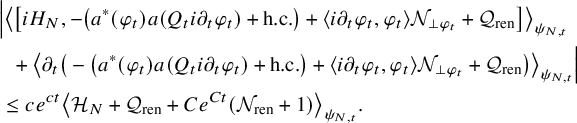 $$\begin{align*}\begin{aligned} & \Big| \big \langle \big [ i H_N, - \big(a^{*}(\varphi_t) a(Q_t i\partial_t \varphi_t)+\text{h.c.}\big) + \langle i\partial_t \varphi_t,\varphi_t\rangle\mathcal{N}_{\bot \varphi_t} + \mathcal{Q}_{\text{ren}}\big] \big\rangle_{\psi_{N,t} } \\ &\hspace{0.2cm} + \big \langle \partial_t \big( - \big(a^{*}(\varphi_t) a(Q_t i\partial_t \varphi_t)+\text{h.c.}\big) + \langle i\partial_t \varphi_t,\varphi_t\rangle\mathcal{N}_{\bot \varphi_t}+ \mathcal{Q}_{\text{ren}}\big) \big\rangle_{\psi_{N,t} }\Big| \\ &\leq ce^{ct} \big \langle \mathcal{H}_N + \mathcal{Q}_{\text{ren}}+ Ce^{Ct} (\mathcal{N}_{\text{ren}} +1) \big\rangle_{\psi_{N,t} }.\\[-20pt] \end{aligned}\end{align*}$$
A Properties of the Gross-Pitaevskii equation
The next proposition collects basic properties of the solution of the time-dependent Gross-Pitaevskii equation (1.8). Its proof follows essentially from standard arguments; we refer to [Reference Benedikter, de Oliveira and Schlein3, Appendix A] and [Reference Cazenave22, Chapters 3 to 6] for the details.
Proposition A.1. Consider the time dependent Gross-Pitaevskii equation (1.8). Then,
-
1. Well-Posedness. For every
$\varphi \in H^1(\mathbb {R}^3)$
with
$\| \varphi \|_2 = 1$
, there exists a unique global solution
$t \to \varphi _t \in C(\mathbb {R}, H^1(\mathbb {R}^3))$
of (1.8) with initial data
$ \varphi $
. We have that
$\| \varphi _t \|_2 = 1$
and that
$ \mathcal {E}_{\text {GP}}(\varphi _t) = \mathcal {E}_{\text {GP}}(\varphi )$
for all
$t \in \mathbb {R}$
. In particular, we have that
$$\begin{align*}\sup_{t\in\mathbb{R}} \| \varphi_t \|_{H^1} \leq C, \hspace{0.5cm} \sup_{t\in\mathbb{R}} \| \varphi_t \|_{4} \leq C. \end{align*}$$
-
2. Higher Regularity. If
$ \varphi \in H^m(\mathbb {R}^3)$
for some
$m \geq 2$
, then
$\varphi _t \in H^m(\mathbb {R}^3)$
for every
$t\in \mathbb {R}$
. Moreover, there exists
$C>0$
, depending on m and on
$\|\varphi \|_{H^m}$
, and
$c>0$
, depending on m and
$\| \varphi \|_{H^1}$
, such that for all
$t\in \mathbb {R}$
, we have
$$\begin{align*}\| \varphi_t \|_{H^m} \leq Ce^{c|t|}. \end{align*}$$
-
3. Regularity of Time Derivatives. If
$\varphi \in H^4(\mathbb {R}^3)$
, there exists
$C>0$
, depending on
$\| \varphi \|_{H^4}$
, and
$c>0$
, depending on
$ \| \varphi \|_{H^1}$
, such that for all
$t \in \mathbb {R}$
, we have that
$$\begin{align*}\| \partial_t \varphi_t \|_{H^2} \leq Ce^{c|t|},\;\; \| \partial_t^2 \varphi_t \|_{H^2} \leq Ce^{c|t|}. \end{align*}$$


B Basic Fock space operators
In this section, we collect a few standard results on the creation and annihilation operators defined in Section 1. The proof of the following lemma is straightforward and follows with the same arguments as in, for example, [Reference Benedikter, de Oliveira and Schlein3, Section 2] or [Reference Brennecke and Schlein15, Section 2].
Lemma B.1. Let $ f, g \in L^2(\mathbb {R}^{3}), h \in L^2(\mathbb {R}^3\times \mathbb {R}^3)$
and let the
$ f, g \in L^2(\mathbb {R}^{3}), h \in L^2(\mathbb {R}^3\times \mathbb {R}^3)$
and let the $ a_x, a^{*}_y$
and
$ a_x, a^{*}_y$
and $ a(Q_{t,x}), a^{*}(Q_{t,y})$
be defined as in (2.3) and (2.11), respectively. Then, in
$ a(Q_{t,x}), a^{*}(Q_{t,y})$
be defined as in (2.3) and (2.11), respectively. Then, in $L^2_s(\mathbb {R}^{3N})$
we have that
$L^2_s(\mathbb {R}^{3N})$
we have that
 $$\begin{align*}0\leq \mathcal{N}_{\bot \varphi_t} = N - a^{*}(\varphi_t)a(\varphi_t) = \int dx\, a^{*}(Q_{t,x}) a(Q_{t,x}) \leq \int dx\, a^{*}_x a_x = N. \end{align*}$$
Moreover, for every $ \phi _N\in L^2_s(\mathbb {R}^{3N})$
, we have that
$ \phi _N\in L^2_s(\mathbb {R}^{3N})$
, we have that
 $$\begin{align*}\begin{aligned} \| a(f)\phi_N\| & \leq \| f\| \sqrt N \|\phi_N\|, \;\;\; \| a^{*}(f)\phi_N\| \leq \| f\| \sqrt {N+1} \|\phi_N\|, \\ \| a(Q_t f)\phi_N\| & \leq \| f\| \| \mathcal{N}_{\bot \varphi_t}^{1/2}\phi_N \|, \;\;\; \| a^{*}(Q_t f)\phi_N\| \leq \| f\| \| (\mathcal{N}_{\bot \varphi_t}+1)^{1/2}\phi_N\|, \\ \end{aligned}\end{align*}$$
and that
 $$\begin{align*}\big| \langle a^{*}(f) a(g)\rangle_{\phi_N} \big| \leq N \| f\| \| g\|\|\phi_N\|^2 , \; \big| \langle a^{*}(Q_tf) a(Q_tg)\rangle_{\phi_N} \big|\leq \langle \| Q_t f\| \| Q_tg\|\mathcal{N}_{\bot \varphi_t}\rangle_{\phi_N}.\end{align*}$$
Similarly, if we set $ h_{x}(y) = h(x,y)$
, then we have that
$ h_{x}(y) = h(x,y)$
, then we have that
 $$\begin{align*}\begin{aligned} \int dx \, \big| \big\langle a^{*}_x a^{*} (h_x) \big \rangle_{\phi_N} \big| & \leq N \|h \| \|\phi_N\|^2, \int dx \, \big| \big\langle a^{*}(Q_{t,x}) a^{*} (Q_t h_x) \big \rangle_{\phi_N} \big| \leq \| h \| \langle \mathcal{N}_{\bot \varphi_t}\rangle_{\phi_N}\\ \int dx \, \big| \big\langle a^{*}_x a (h_x) \big \rangle_{\phi_N} \big| &\leq N \|h \| \|\phi_N\|^2, \int dx \, \big| \big\langle a^{*}(Q_{t,x}) a (Q_t h_x) \big \rangle_{\phi_N} \big| \leq \|h \| \langle \mathcal{N}_{\bot \varphi_t}\rangle_{\phi_N}. \end{aligned} \end{align*}$$
C Properties of the scattering kernel
The goal of this section is to collect basic properties of the solution f of the zero energy scattering equation (2.5) and of the correlation kernel $k_t$
, defined in (2.12). It is well known (see [Reference Lieb, Seiringer, Solovej and Yngvason37, Appendix C]) that under our assumptions on
$k_t$
, defined in (2.12). It is well known (see [Reference Lieb, Seiringer, Solovej and Yngvason37, Appendix C]) that under our assumptions on $V\in L^1(\mathbb {R}^3)$
, we have that
$V\in L^1(\mathbb {R}^3)$
, we have that $0 \leq f \leq 1$
, that f is radially symmetric and radially increasing and that for every
$0 \leq f \leq 1$
, that f is radially symmetric and radially increasing and that for every $x\in \mathbb {R}^3$
outside of the support of V, it holds true that
$x\in \mathbb {R}^3$
outside of the support of V, it holds true that
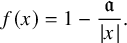 $$ \begin{align} f(x) = 1- \frac{\mathfrak{a}}{|x|}. \end{align} $$
In particular, we have that $ 0\leq (1-f)(x) \leq C|x|^{-1} $
and, if
$ 0\leq (1-f)(x) \leq C|x|^{-1} $
and, if $\text {supp}(V)\subset B_R(0)$
, that
$\text {supp}(V)\subset B_R(0)$
, that
 $$\begin{align*}\int_{\mathbb{R}^3} dx\, V(x) f(x) = 2 \int_{B_R(0) } dx\, (\Delta f)(x) = 2 \int_{ \partial B_R(0) } dS(x) \, (\nabla f)(x) \cdot \frac{x}{|x|} = 8\pi \mathfrak{a}. \end{align*}$$
Lemma C.1. Let $k_t$
be defined as in (2.12), where
$k_t$
be defined as in (2.12), where $ t\mapsto \varphi _t \in C^1(\mathbb {R}, H^1(\mathbb {R}^3))$
denotes the unique solution of the time-dependent Gross-Pitaevskii equation with
$ t\mapsto \varphi _t \in C^1(\mathbb {R}, H^1(\mathbb {R}^3))$
denotes the unique solution of the time-dependent Gross-Pitaevskii equation with $\varphi _{t=0}\in H^4(\mathbb {R}^3)$
and where
$\varphi _{t=0}\in H^4(\mathbb {R}^3)$
and where $\chi \in C_c^\infty (B_{2r}(0))$
with
$\chi \in C_c^\infty (B_{2r}(0))$
with $ \chi _{| B_{r}(0)}\equiv 1$
. Then,
$ \chi _{| B_{r}(0)}\equiv 1$
. Then, $k_t$
satisfies the following properties:
$k_t$
satisfies the following properties:
-
1. We have that
$ k_t \in L^2(\mathbb {R}^3\times \mathbb {R}^3)$
with for some constant
$$\begin{align*}\sup_{t\in\mathbb{R} }\| k_t\| \leq Cr^{1/2}\;\; \text{ and } \;\;\| k_{t,x} \| \leq C |\varphi_t(x)| \leq Ce^{C|t|} \end{align*}$$
$C>0$
that is independent of
$r>0$
and
$t\in \mathbb {R}$
. Similarly, we have The same bounds hold true if we replace
$$\begin{align*}\begin{aligned} \| \partial_t k_t \| &\leq C e^{C|t|} \;\; \text{ and } \;\;\| \partial_t k_{t,x} \| \leq C \big( |\varphi_t(x)| + |\partial_t \varphi_t(x)| \big) \leq Ce^{C|t|}, \\ \| \partial_t^2 k_t \| &\leq C e^{C|t|} \;\; \text{ and } \;\;\| \partial_t^2 k_{t,x} \| \leq C \big( |\varphi_t(x)| + |\partial_t \varphi_t(x)|+ |\partial_t^2 \varphi_t(x)| \big) \leq Ce^{C|t|}. \\ \end{aligned}\end{align*}$$
$ k_t $
by
$Q_t\otimes Q_t k_t$
for
$Q_t = 1- |\varphi _t\rangle \langle \varphi _t|$
.
-
2. Define
$ f_t(x,y) $
by Then
$$\begin{align*}\begin{aligned} f_t(x,y) & = (-\Delta_1 k_t) (x,y) - \frac 12 N^3(Vf)(N(x-y)) \varphi_t(x)\varphi_t(y) \\ &\hspace{0.5cm} - 2 N^2 (\nabla f)(N(x-y)) \cdot \nabla_1\big(\chi(x-y) \varphi_t(x) \varphi_t(y)\big). \end{aligned}\end{align*}$$
$ f_t, \partial _t f_t \in L^2(\mathbb {R}^3\times \mathbb {R}^3)$
with
$$\begin{align*}\sup_{t\in\mathbb{R} } \| f_t\| \leq C, \;\; \| \partial_t f_t\| \leq C e^{C|t|}. \end{align*}$$
-
3. Define
$ g_t(x,y) = \int dz \, (\nabla _2 k_t)(x,z) (\nabla _2 \overline k_t)(y,z) $
. Then
$ g_t, \partial _t g_t \in L^2(\mathbb {R}^3\times \mathbb {R}^3)$
with The same bounds hold true if in the definition of
$$\begin{align*}\| g_t\| \leq C e^{C|t|}, \;\; \| \partial_t g_t\| \leq C e^{C|t|}. \end{align*}$$
$ g_t$
we replace
$ k_t $
by
$Q_t\otimes Q_t k_t$
.


Proof. We sketch the main steps of the proof for the bounds involving $k_t$
; similar properties have previously been used in [Reference Benedikter, de Oliveira and Schlein3, Reference Brennecke and Schlein15]. Below, we use without further notice that
$k_t$
; similar properties have previously been used in [Reference Benedikter, de Oliveira and Schlein3, Reference Brennecke and Schlein15]. Below, we use without further notice that $ \| \varphi _t \|_\infty , \| \partial _t \varphi _t \|_\infty , \| \partial _t^2\varphi _t \|_\infty \leq Ce^{C|t|} $
and that
$ \| \varphi _t \|_\infty , \| \partial _t \varphi _t \|_\infty , \| \partial _t^2\varphi _t \|_\infty \leq Ce^{C|t|} $
and that $ \|\varphi _t\| =\|\varphi _{t=0}\|$
,
$ \|\varphi _t\| =\|\varphi _{t=0}\|$
, $ \sup _{t\in \mathbb {R}} \| \nabla \varphi _t \|\leq C, \sup _{t\in \mathbb {R}}\| \varphi _t \|_4\leq C $
by Proposition A.1 and
$ \sup _{t\in \mathbb {R}} \| \nabla \varphi _t \|\leq C, \sup _{t\in \mathbb {R}}\| \varphi _t \|_4\leq C $
by Proposition A.1 and $ H^2(\mathbb {R}^3)\hookrightarrow L^\infty (\mathbb {R}^3) $
.
$ H^2(\mathbb {R}^3)\hookrightarrow L^\infty (\mathbb {R}^3) $
.
Part $a)$
follows from
$a)$
follows from
 $$\begin{align*}\|k_t\|^2 \leq \int dxdy\, \frac{|\chi(x-y)|^2}{|x-y|^2} |\varphi_t(x)|^2|\varphi_t(y)|^2 \leq C \|\varphi_t\|_4^4 \int_{|x|\leq 2r }\frac{1}{|x|^2}\leq C r \end{align*}$$
uniformly in $t\in \mathbb {R}$
and, using Hardy’s inequality, from
$t\in \mathbb {R}$
and, using Hardy’s inequality, from
 $$\begin{align*}\|k_{t,x}\|^2 \leq |\varphi_t(x)|^2 \int dy\, \frac{|\chi(x-y)|^2}{|x-y|^2} |\varphi_t(y)|^2 \leq C |\varphi_t(x)|^2 \| \nabla \varphi_t (\cdot +x)\| \leq C |\varphi_t(x)|^2. \end{align*}$$
The bounds on the time derivatives of $ k_t$
are proved in the same way. This remark applies also to part
$ k_t$
are proved in the same way. This remark applies also to part $b)$
which follows after noting that
$b)$
which follows after noting that
 $$\begin{align*}\begin{aligned} f_t(x,y) & = N(1-f)(N(x-y)) (-\Delta_1) \big(\chi(x-y) \varphi_t(x) \varphi_t(y) \big). \end{aligned}\end{align*}$$
This uses the zero energy scattering equation and that N is w.l.o.g. large enough so that $ V(N.) \chi (.)\equiv V(N.)$
. Finally, to prove part
$ V(N.) \chi (.)\equiv V(N.)$
. Finally, to prove part $c)$
, we compute
$c)$
, we compute
 $$\begin{align*}\begin{aligned} (\nabla_2 k_t)(x,z) &= N^2 \nabla f (N(x-z)) \chi(x-z)\varphi_t(x)\varphi_t(z) \\ &\hspace{0.5cm}+ N(1-f)(N(x-z)) \nabla_2\big( \chi(x-z) \varphi_t(x)\varphi_t(z)\big). \end{aligned}\end{align*}$$
Setting $ h(x,z) = \nabla _2\big ( \chi (x-z) \varphi _t(x)\varphi _t(z)\big )$
, we then note by Hardy’s inequality that
$ h(x,z) = \nabla _2\big ( \chi (x-z) \varphi _t(x)\varphi _t(z)\big )$
, we then note by Hardy’s inequality that
 $$\begin{align*}\begin{aligned} &\int dxdy\,\bigg| \int dz \,N f (N(x-z))N f(N(y-z)) h(x,z) h(y,z) \bigg|^2 \\ &\leq \! C \! \int dxdy dz_1 dz_2 \, \frac{ \prod_{j=1}^2| | \varphi_t(z_j)|^2+ | \nabla \varphi_t(z_j)|^2 | }{|x-z_1||y-z_1||x-z_2||y-z_2|}| \varphi_t(x)|^2 | \varphi_t(y)|^2\leq C e^{C|t|}, \end{aligned}\end{align*}$$
and, similarly, that
 $$\begin{align*}\begin{aligned} &\int dxdy\,\bigg| \int dz \,N^2 \nabla f (N(x-z)) N f(N(y-z))\chi(x-z)\varphi_t(x)\varphi_t(z) h(y,z) \bigg|^2 \\ &\leq C \int dxdy du_1du_2 dz_1 dz_2 \, N^3V(Nu_1)N^3V(Nu_2) \\ &\hspace{1cm}\times \frac{ | \varphi_t(x)|^2 | \varphi_t(y)|^2 \varphi_t(z_1)|^2 || \varphi_t(z_2)|^2+ | \nabla \varphi_t(z_2)|^2||}{|x-z_1-u_1|^2 |y-z_1| |x-z_2-u_2|^2|y-z_2|}\\ &\leq C e^{C|t|}. \end{aligned}\end{align*}$$
Here, we used that $N^2 \nabla f (Nx) = -\frac 1{8\pi } \int dy\, \frac {x-y}{|x-y|^3} N^3V(Ny) $
for
$N^2 \nabla f (Nx) = -\frac 1{8\pi } \int dy\, \frac {x-y}{|x-y|^3} N^3V(Ny) $
for $a.e.$ $x\in \mathbb {R}^3$
, which follows from
$x\in \mathbb {R}^3$
, which follows from $ (-2 \Delta + N^2 V(N.))f(N.) =0$
. Finally, by integration by parts, we use that
$ (-2 \Delta + N^2 V(N.))f(N.) =0$
. Finally, by integration by parts, we use that
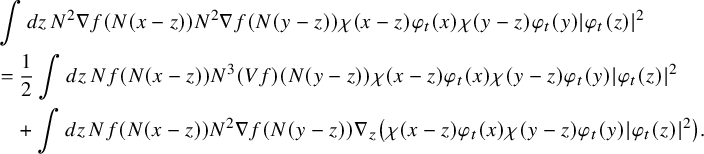 $$\begin{align*}\begin{aligned} &\int dz \,N^2 \nabla f (N(x-z)) N^2 \nabla f(N(y-z)) \chi(x-z)\varphi_t(x) \chi(y-z)\varphi_t(y) | \varphi_t(z)|^2\\ & = \frac12 \int dz \,N f (N(x-z)) N^3 (Vf)(N(y-z)) \chi(x-z)\varphi_t(x) \chi(y-z)\varphi_t(y) | \varphi_t(z)|^2 \\ &\hspace{0.35cm} + \int dz \,N f (N(x-z)) N^2 \nabla f(N(y-z)) \nabla_z\big( \chi(x-z)\varphi_t(x) \chi(y-z)\varphi_t(y) | \varphi_t(z)|^2\big). \end{aligned}\end{align*}$$
Then, proceeding as before, we find that
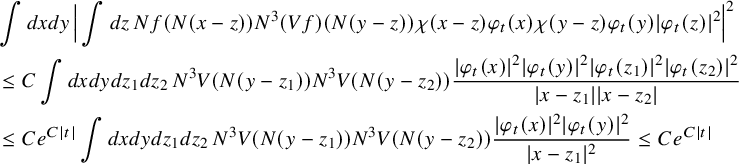 $$\begin{align*}\begin{aligned} &\int dxdy\,\Big| \int dz \,N f (N(x-z)) N^3 (Vf)(N(y-z)) \chi(x-z)\varphi_t(x) \chi(y-z)\varphi_t(y) | \varphi_t(z)|^2\Big|^2\\ &\leq C \int dx dy dz_1 dz_2 \, N^3 V(N(y-z_1))N^3 V(N(y-z_2)) \frac{|\varphi_t(x)|^2|\varphi_t(y)|^2| \varphi_t(z_1)|^2| \varphi_t(z_2)|^2 }{|x-z_1| |x-z_2|}\\ &\leq C e^{C|t|} \int dx dy dz_1 dz_2 \, N^3 V(N(y-z_1))N^3 V(N(y-z_2)) \frac{|\varphi_t(x)|^2|\varphi_t(y)|^2 }{|x-z_1|^2 }\leq C e^{C|t|} \end{aligned}\end{align*}$$
and that
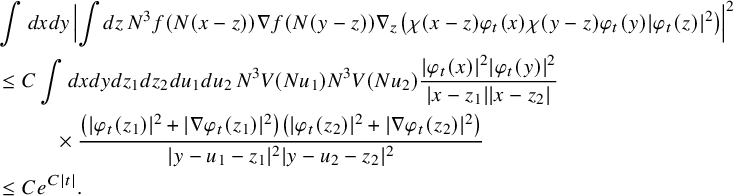 $$\begin{align*}\begin{aligned} &\int dxdy\,\Big| \!\int \! dz \,N^3 f (N(x-z)) \nabla f(N(y-z)) \nabla_z\big( \chi(x-z)\varphi_t(x) \chi(y-z)\varphi_t(y) | \varphi_t(z)|^2\big)\Big|^2\\ &\leq C \int dx dy dz_1 dz_2 du_1 du_2 \, N^3 V(Nu_1 )N^3 V(N u_2 ) \frac{|\varphi_t(x)|^2|\varphi_t(y)|^2 }{|x-z_1| |x-z_2|}\\ &\hspace{1cm} \times \frac{ \big ( | \varphi_t(z_1)|^2 + | \nabla \varphi_t(z_1)|^2\big)\big ( | \varphi_t(z_2)|^2 + | \nabla \varphi_t(z_2)|^2\big) }{|y-u_1-z_1|^2 |y-u_2-z_2|^2} \\ &\leq C e^{C|t|}. \end{aligned}\end{align*}$$
Combining the above, this implies the bounds on $g_t$
and
$g_t$
and $\partial _t g_t$
is bounded similarly.
$\partial _t g_t$
is bounded similarly.
D Complete BEC for small interaction potentials
The purpose of this appendix is to illustrate that the methods developed in this paper are also useful in the spectral setting. The following result generalizes the main result of [Reference Boccato, Brennecke, Cenatiempo and Schlein4] to the trapped setting in $\mathbb {R}^3$
; compared to [Reference Boccato, Brennecke, Cenatiempo and Schlein4], its proof is substantially simpler.
$\mathbb {R}^3$
; compared to [Reference Boccato, Brennecke, Cenatiempo and Schlein4], its proof is substantially simpler.
Proposition D.1. Let $ V\in L^1(\mathbb {R}^3)$
be nonnegative, radial, compactly supported and such that
$ V\in L^1(\mathbb {R}^3)$
be nonnegative, radial, compactly supported and such that $\|V\|_1$
is small enough. Let
$\|V\|_1$
is small enough. Let $V_{\text {ext}}\in L_{\text {loc}}^\infty (\mathbb {R}^3) $
be such that
$V_{\text {ext}}\in L_{\text {loc}}^\infty (\mathbb {R}^3) $
be such that $ \lim _{|x|\to \infty } V_{\text {ext}}(x) =\infty $
with at most exponential growth in
$ \lim _{|x|\to \infty } V_{\text {ext}}(x) =\infty $
with at most exponential growth in $|x|$
as
$|x|$
as $|x|\to \infty $
. Then, there exists a constant
$|x|\to \infty $
. Then, there exists a constant $C>0$
, that only depends on V, such that for every
$C>0$
, that only depends on V, such that for every $ \psi _N$
,
$ \psi _N$
, $ \|\psi _N\|=1$
, that satisfies
$ \|\psi _N\|=1$
, that satisfies
 $$\begin{align*}\langle \psi_N, H_N^{\text{trap}} \psi_N\rangle \leq N e_{\text{GP}}^{\text{trap}} + \Lambda, \end{align*}$$
we have that the one particle density $ \gamma _N^{(1)} $
associated to
$ \gamma _N^{(1)} $
associated to $\psi _N$
satisfies
$\psi _N$
satisfies
 $$\begin{align*}1- \langle \varphi_{\text{GP}}, \gamma_N^{(1)}\varphi_{\text{GP}}\rangle\leq C N^{-1}( 1+ \Lambda). \end{align*}$$
Remarks.
-
D1) It is well known [Reference Lieb, Seiringer and Yngvason38] that
$ \inf \text {spec}(H_N^{\text {trap}}) = N e_{\text {GP}}^{\text {trap}} + o(N) $
as
$N\to \infty $
. In particular, Proposition D.1 applies to the ground state
$\psi _N$
of
$H_N^{\text {trap}}$
. -
D2) Based on [Reference Lieb, Seiringer and Yngvason38], it is well known that under our assumptions, we have that
$\varphi _{\text {GP}} $
decays exponentially fast to zero as
$|x|\to \infty $
, with arbitrary rate. In particular, we have that
$ V_{\text {ext}} \varphi _{\text {GP}} \in L^p(\mathbb {R}^3)$
for every
$ p\geq 1$
.


Proof of Proposition D.1
Using the Euler-Lagrange equation for $\varphi _{\text {GP}}$
, that is,
$\varphi _{\text {GP}}$
, that is,
 $$\begin{align*}-\Delta + V_{\text{ext}} + 8\pi\mathfrak{a}|\varphi_{\text{GP}}|^2 \varphi_{\text{GP}} = \mu_{\text{GP}} \varphi_{\text{GP}}, \hspace{0.5cm} \mu_{\text{GP}}= e_{\text{GP}}+ 4\pi\mathfrak{a}\|\varphi_{\text{GP}}\|_4^4, \end{align*}$$
the proof follows from a slight variation of the arguments presented in Section 3. Indeed, proceeding as in (3.8), it is straightforward to verify that $ H_N^{\text {trap}} = \sum _{j=0}^4 H_{N,j}^{\text {trap}}$
, where
$ H_N^{\text {trap}} = \sum _{j=0}^4 H_{N,j}^{\text {trap}}$
, where
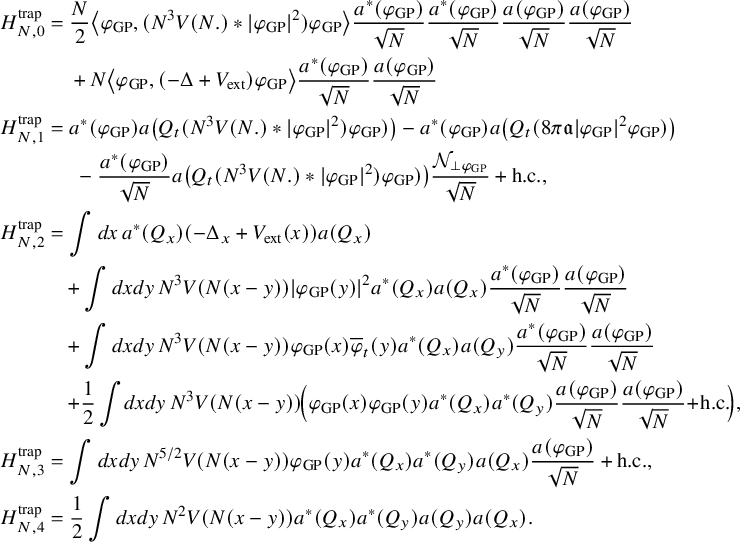 $$\begin{align*} H_{N,0}^{\text{trap}}&= \frac N2 \big\langle \varphi_{\text{GP}}, (N^3V(N.) \ast|\varphi_{\text{GP}}|^2) \varphi_{\text{GP}} \big\rangle \frac{a^{*}(\varphi_{\text{GP}})}{\sqrt{N}}\frac{a^{*}(\varphi_{\text{GP}})}{\sqrt{N}} \frac{a(\varphi_{\text{GP}})}{\sqrt{N}}\frac{a(\varphi_{\text{GP}})}{\sqrt{N}} \\ &\hspace{0.4cm} + N \big\langle \varphi_{\text{GP}}, (-\Delta + V_{\text{ext}}) \varphi_{\text{GP}} \big\rangle \frac{a^{*}(\varphi_{\text{GP}})}{\sqrt{N}} \frac{a(\varphi_{\text{GP}})}{\sqrt{N}} \\ H_{N,1}^{\text{trap}}&= a^{*}(\varphi_{\text{GP}}) a \big(Q_t ( N^3V (N.) \ast|\varphi_{\text{GP}}|^2) \varphi_{\text{GP}}) \big)- a^{*}(\varphi_{\text{GP}}) a \big(Q_t ( 8\pi \mathfrak{a} |\varphi_{\text{GP}}|^2 \varphi_{\text{GP}}) \big)\\ &\hspace{0.5cm} - \frac{a^{*}(\varphi_{\text{GP}})}{\sqrt{N}} a \big(Q_t ( N^3V(N.) \ast|\varphi_{\text{GP}}|^2) \varphi_{\text{GP}}) \big) \frac{\mathcal{N}_{\bot \varphi_{\text{GP}}} }{\sqrt{N}} +\text{h.c.}, \\ H_{N,2}^{\text{trap}} &= \int dx\, a^{*}(Q_{x}) (-\Delta_x + V_{\text{ext}}(x)) a(Q_{x}) \\ &\hspace{0.3cm} +\int dx dy \, N^3 V(N(x-y)) |\varphi_{\text{GP}} (y)|^2 a^{*}(Q_{x}) a (Q_{x}) \frac{a^{*}(\varphi_{\text{GP}})}{\sqrt{N}}\frac{a(\varphi_{\text{GP}})}{\sqrt{N}} \\ &\hspace{0.3cm}+\int dx dy \, N^3 V(N(x-y)) \varphi_{\text{GP}} (x) \overline{\varphi}_t (y) a^{*}(Q_{x}) a(Q_{y}) \frac{a^{*}(\varphi_{\text{GP}})}{\sqrt{N}}\frac{a(\varphi_{\text{GP}})}{\sqrt{N}} \\ &\hspace{0.3cm} +\! \frac12\int \!dx dy\, N^3V(N(x-y)) \!\Big( \varphi_{\text{GP}} (x)\varphi_{\text{GP}}(y) a^{*}(Q_{x}) a^{*}(Q_{y}) \frac{a(\varphi_{\text{GP}})}{\sqrt{N}}\frac{a(\varphi_{\text{GP}})}{\sqrt{N}}\!+\!\text{h.c.} \!\Big), \\ H_{N,3}^{\text{trap}} &= \int dx dy \, N^{5/2} V(N(x-y)) \varphi_{\text{GP}} (y) a^{*}(Q_{x}) a^{*}(Q_{y}) a(Q_{x}) \frac{a(\varphi_{\text{GP}})}{\sqrt{N}} + \text{h.c.} , \\ H_{N,4}^{\text{trap}}&= \frac1{2}\int dx dy\, N^2V(N(x-y)) a^{*}(Q_{x}) a^{*}(Q_{y}) a(Q_{y}) a(Q_{x}). \end{align*}$$
Here, we set $ Q_{x} = (Q_{t,x})_{|t=0}$
compared to our previous notation. Similarly, we continue to use the notation
$ Q_{x} = (Q_{t,x})_{|t=0}$
compared to our previous notation. Similarly, we continue to use the notation $ b_x, b^{*}_y, \mathcal {N}_{\text {ren}}, \mathcal {H}_{\text {ren}}, k \equiv (k_t)_{|t=0}$
, etc., understanding implicitly that this refers to
$ b_x, b^{*}_y, \mathcal {N}_{\text {ren}}, \mathcal {H}_{\text {ren}}, k \equiv (k_t)_{|t=0}$
, etc., understanding implicitly that this refers to $t=0$
so that all operators are related to
$t=0$
so that all operators are related to $\varphi _{\text {GP}}$
. Now, to control
$\varphi _{\text {GP}}$
. Now, to control $H_N^{\text {trap}}$
relative to
$H_N^{\text {trap}}$
relative to $ \mathcal {H}_{\text {ren}}$
and
$ \mathcal {H}_{\text {ren}}$
and $\mathcal {N}_{\text {ren}}$
, a simple generalization of the arguments in Section 3 shows that
$\mathcal {N}_{\text {ren}}$
, a simple generalization of the arguments in Section 3 shows that
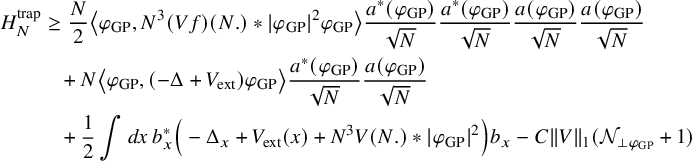 $$\begin{align*}\begin{aligned} H_N^{\text{trap}} & \geq \frac{N} 2 \big\langle \varphi_{\text{GP}}, N^3(Vf)(N.)\ast | \varphi_{\text{GP}} |^2\varphi_{\text{GP}} \big\rangle \frac{a^{*}(\varphi_{\text{GP}})}{\sqrt{N}}\frac{a^{*}(\varphi_{\text{GP}})}{\sqrt{N}} \frac{a(\varphi_{\text{GP}})}{\sqrt{N}}\frac{a(\varphi_{\text{GP}})}{\sqrt{N}}\\ &\hspace{0.3cm} + N \big\langle \varphi_{\text{GP}}, (-\Delta + V_{\text{ext}}) \varphi_{\text{GP}} \big\rangle \frac{a^{*}(\varphi_{\text{GP}})}{\sqrt{N}} \frac{a(\varphi_{\text{GP}})}{\sqrt{N}} \\ &\hspace{0.3cm} + \frac12 \int dx \, b^{*}_x \Big(-\Delta_x + V_{\text{ext}}(x) + N^3V(N.)\ast | \varphi_{\text{GP}} |^2 \Big) b_x - C \|V\|_1 (\mathcal{N}_{\bot \varphi_{\text{GP}}}+1 ) \end{aligned} \end{align*}$$
for some universal $C>0$
. Notice that this uses
$C>0$
. Notice that this uses $ \mathcal {V}_{\text {ren}}\geq 0$
. Using the regularity of
$ \mathcal {V}_{\text {ren}}\geq 0$
. Using the regularity of $\varphi _{\text {GP}}\in H^1(\mathbb {R}^3)$
, the property
$\varphi _{\text {GP}}\in H^1(\mathbb {R}^3)$
, the property $0\leq f\leq 1$
, the identity
$0\leq f\leq 1$
, the identity $a^{*}(\varphi _{\text {GP}})a(\varphi _{\text {GP}}) = N- \mathcal {N}_{\bot \varphi _{\text {GP}}} $
and that
$a^{*}(\varphi _{\text {GP}})a(\varphi _{\text {GP}}) = N- \mathcal {N}_{\bot \varphi _{\text {GP}}} $
and that $ \mathcal {N}_{\bot \varphi _{\text {GP}}}$
and
$ \mathcal {N}_{\bot \varphi _{\text {GP}}}$
and $\mathcal {N}_{\text {ren}}$
are of comparable size by Lemma 3.1, we get
$\mathcal {N}_{\text {ren}}$
are of comparable size by Lemma 3.1, we get
 $$\begin{align*}\begin{aligned} &H_N^{\text{trap}} -Ne_{\text{GP}}^{\text{trap}}\\ & \geq \frac12 \int dx \, b^{*}_x \big(-\Delta_x + V_{\text{ext}}(x) + 8\pi\mathfrak{a} | \varphi_{\text{GP}} |^2 -\mu_{\text{GP}} \big) b_x - C \|V\|_1(\mathcal{N}_{\bot \varphi_{\text{GP}}}\!+1 ). \end{aligned} \end{align*}$$
Here, we chose the radius $r>0$
in the definition of (2.12) w.l.o.g. comparable to
$r>0$
in the definition of (2.12) w.l.o.g. comparable to $\|V\|_1$
. Finally, standard results imply that
$\|V\|_1$
. Finally, standard results imply that $h_{\text {GP}} = -\Delta + V_{\text {ext}}(x) + 8\pi \mathfrak {a} | \varphi _{\text {GP}} |^2 -\mu _{\text {GP}} $
is gapped above its ground state energy, for some gap
$h_{\text {GP}} = -\Delta + V_{\text {ext}}(x) + 8\pi \mathfrak {a} | \varphi _{\text {GP}} |^2 -\mu _{\text {GP}} $
is gapped above its ground state energy, for some gap $2 \lambda _{\text {GP}}>0$
. By the Euler-Lagrange equation,
$2 \lambda _{\text {GP}}>0$
. By the Euler-Lagrange equation, $ \varphi _{\text {GP}}$
is its unique positive ground state (with zero ground state energy) so that
$ \varphi _{\text {GP}}$
is its unique positive ground state (with zero ground state energy) so that
 $$\begin{align*}\begin{aligned} H_N^{\text{trap}} \geq Ne_{\text{GP}}^{\text{trap}} + \lambda_{\text{GP}} \, \mathcal{N}_{\text{ren}} - C \|V\|_1 (\mathcal{N}_{\bot \varphi_{\text{GP}}}+1 ) \geq Ne_{\text{GP}}^{\text{trap}} + \delta\, \mathcal{N}_{\bot \varphi_{\text{GP}} } - C \|V\|_1- C, \end{aligned} \end{align*}$$
for $ \delta = \lambda _{\text {GP}}-C \|V\|_1>0 $
, if
$ \delta = \lambda _{\text {GP}}-C \|V\|_1>0 $
, if $\|V\|_1$
is small enough. By (2.1), this implies the claim.
$\|V\|_1$
is small enough. By (2.1), this implies the claim.
Acknowledgements
C. B. thanks M. Brooks for pointing out a simplification of Lemma 3.2 (of the manuscript’s first version) by introducing additionally the operator valued distributions $c_{xy}, c_{xy}^{*}$
.
$c_{xy}, c_{xy}^{*}$
.
Competing interest
The authors have no competing interests to declare that are relevant to the content of this article.
Funding statement
This research was supported by Deutsche Forschungsgemeinschaft (DFG, German Research Foundation) under Germany’s Excellence Strategy – GZ 2047/1, Projekt-ID 390685813.
Data availability statement
Data sharing is not applicable to this article as no new data were created or analyzed in this study.
Ethical standards
The research meets all ethical guidelines, including adherence to the legal requirements of the study country.


 Open access

