




1. Introduction
The present paper examines the intonational characteristics of yes-no questions in Galician (Galego; glg), a Romance language closely related to Portuguese and spoken in Northwestern Spain. Galician has over two million speakers (Instituto Galego de Estatística 2024; Xunta de Galicia 2025). It is an institutional language in the autonomous community of Galicia, and it is also spoken in western areas of the provinces of Asturias, Zamora, and Leon (Eberhard, Simons & Fennig Reference Eberhard, Simons and Fennig2025). Galician is in contact with both Galician Spanish, the Spanish spoken in this region, and with Castilian Spanish, the variety of Spanish spoken in the central region of Spain including Madrid and its surrounding areas. This Spanish variety enjoys standard status at a national level, and, as such, exposure to this variety occurs through mass media and national-level institutional channels (Fernández Rei Reference Fernández Rei2016).
The Galician language has co-existed with Spanish in Northwest Spain since the early Middle Ages (Ramallo Reference Ramallo2007). It enjoyed a time of literary and social prestige which declined around the 15th century, when Spanish was named the official language of Galicia (Porto Dapena Reference Porto Dapena1977). Like other regional languages in Spain, Galician was banned during Francisco Franco’s dictatorship from 1939 to 1975. It obtained co-official status with Spanish in Galicia in 1981. In 1983, the Linguistic Normalization Law declared it a vehicular language for instruction and allowed for the creation of the first Spanish-Galician bilingual schools. Galician revitalization has continued since, although it is still associated with the rural, lower class while Spanish is most closely associated with higher education and higher economic status (Porto Dapena Reference Porto Dapena2001; Monteagudo Reference Monteagudo2019; O’Rourke & Dayán-Fernández Reference O’Rourke and Dayán-Fernández2024).
Franco’s dictatorship created a generational gap in Galicia between speakers who learned Galician at home but were not allowed to speak it in public, and those who learned it in school but did not use it at home. Older people in this region are more likely to speak Galician exclusively as their daily language, while younger people are more likely to speak only Spanish. Despite this generational gap, Galician-Spanish bilingualism is almost universal in the autonomous community of Galicia, with 98% of the population understanding Galician, and over 88% knowing how to speak it (Instituto Galego de Estatística 2024).
Vernacular Galician variants co-exist with Normative Galician, a standardized dialect created to facilitate instruction in this language and that is primarily used in academic environments. Although normative Galician is rejected by some, who consider it artificial, its implementation in schools has increased the number of speakers of Galician and the literacy rates among its users (Regueira Reference Regueira2009; Mariño Paz Reference Mariño Paz2017). Bilingual education from the 1980s has also given rise to neofalantes or ‘new speakers’, who grew up speaking Spanish at home and learned Galician at school, usually in their adolescence (O’Rourke & Ramallo Reference O’Rourke and Ramallo2015).
Although Galician is not as well investigated as Spanish or Portuguese, recent scholarship focuses on its syntax (Gupton Reference Gupton2014, Reference Gupton, Gupton and Gielau2021) and its phonetic and phonological characteristics (Martínez-Gil Reference Martínez-Gil1993; Regueira Reference Regueira1996; Martínez-Celdrán & Regueira Reference Martínez-Celdrán and Luis Regueira2008; Colina Reference Colina2013). Galician has 21 contrastive consonants and 7 contrastive vowels. As in Spanish, stress can fall on the final, penultimate or antepenultimate syllable: alá [a.ˈla] ‘over there’, home [ˈɔ.me] ‘man’, lóxico [ˈlɔ.ʃi.ko] ‘logical’ (Regueira Reference Regueira1996: 121). The intonation of statements in Galician shares many similarities with that of standard Castilian Spanish, i.e., a tendency for final falling intonation (Navarro Tomás Reference Navarro Tomás1944; Carril Reference Carril1973). On the other hand, while yes-no questions in standard Castilian Spanish tend to end in rising contours, in Galician they are often reported to have final falling contours (see for example López-Bobo & Cuevas-Alonso Reference López-Bobo, Cuevas-Alonso, Prieto and Roseano2010).
Our study focuses on the intonation of information-seeking yes-no questions in Galician, i.e., pragmatically neutral questions requiring a yes or no answer, as exemplified in (1).

This can shed light on both the possibility of intonational transfer from Spanish, and the tendency for yes-no questions to have final falling contours in the languages and dialects of the Spanish Northwest (Canellada Reference Canellada1984; López-Bobo & Cuevas-Alonso Reference López-Bobo, Cuevas-Alonso, Prieto and Roseano2010; López-Bobo et al. Reference López-Bobo, Cuevas-Alonso, Arias and Bleorţu2012). Although there are some existing studies investigating yes-no question intonation in Galician, most of them are impressionistic (e.g., García Mouton Reference García Mouton1994; Regueira Reference Regueira2000) or analyze just a few examples per participant (e.g., Sobrino Pérez Reference Sobrino Pérez1999; Fernández Rei Reference Fernández Rei2019). In addition, most of the participants in these studies are young and female (see Section 3 for further discussion).
Our analysis is framed in the Autosegmental-Metrical (AM) model (Pierrehumbert Reference Pierrehumbert1980; Pierrehumbert & Beckman Reference Pierrehumbert and Beckman1988; Ladd Reference Ladd2008). In this model, intonation is due to the anchoring of High (H) and Low (L) tones to metrically strong syllables and the edges of phonological domains. This study follows the conventions of the Spanish Tones and Breaks Indices framework (SP_ToBI), used for the annotation and analysis of Spanish intonation (Beckman et al. Reference Beckman, Díaz-Campos, McGory and Morgan2006; Estebas-Vilaplana & Prieto Reference Estebas-Vilaplana and Prieto2008; Hualde & Prieto Reference Hualde, Prieto, Frota and Prieto2015), since no ToBI model has yet been developed for Galician.
We focus specifically on the nuclear configuration, comprising the nuclear pitch accent and the final boundary tone, since this tends to be the most important part of the sentence for the perception of questions versus statements (see for example Face Reference Face2008). In addition, we investigate the impact of gender, age and language dominance, since little is known about the possible effects of these factors on Galician intonation, and they can shed light on the potential influence of Spanish into Galician.
The remainder of the paper is organized as follows. Given that Galician is in contact with Spanish, Section 2 provides relevant background on language contact and intonation. Section 3 reviews previous research on the intonation of yes-no questions in Galician, Galician Spanish, and Castilian Spanish. Section 4 outlines the research questions and hypotheses of our study, and Section 5 describes its methodology. Sections 6 and 7 present our findings and discuss them in detail, respectively. Finally, Section 8 offers some concluding remarks.
2. Language contact and intonation
Language contact can lead to different linguistic outcomes, and several frameworks have been proposed to explain them. One of them is Thomason & Kaufman (Reference Thomason and Kaufman1988), who adopt a historical and sociolinguistic perspective emphasizing societal language dominance. Thomason & Kaufman distinguish between two scenarios: (i) borrowing in situations of language maintenance, where the minority language is maintained but influenced by the majority language, and (ii) interference through shift, where speakers shift to the majority language and transfer elements from their first language. The type of cross-linguistic influence that arises varies depending on these scenarios. In situations of language maintenance and casual contact, borrowing is mostly lexical. Structural borrowing (i.e., borrowing of phonological and syntactic features) occurs only with more intense contact. On the other hand, in cases of interference through shift, structural interference (including phonological interference) is more common than lexical interference.
The outcomes of contact are influenced by both social factors (including intensity of contact, number of speakers, and speaker attitudes) and linguistic ones (such as typological similarity, markedness, and degree of integration within the system). Focusing on the latter, the more similar the languages are, the more cross-linguistic influence is expected. Moreover, unmarked features are learned earlier and transferred more easily. Finally, less integrated linguistic subsystems (e.g., syntax) are more sensitive to cross-linguistic influence than more integrated ones (e.g., inflectional morphology).
Another framework is the one proposed by Van Coetsem (Reference Van Coetsem1988), who emphasizes individual linguistic dominance, i.e., the relative proficiency a speaker has in each language. Based on speaker agentivity, Van Coetsem’s framework distinguishes between borrowing and imposition. In borrowing, speakers incorporate elements of a weaker source language into their dominant recipient language, while in imposition, speakers transfer elements of the dominant source language into the weaker recipient language. An example of phonological imposition is when Spanish-dominant speakers merge the Galician mid-vowel contrast /e/ vs. /ɛ/ and produce a Spanish-like [e] instead (Amengual & Chamorro Reference Amengual and Chamorro2015). Van Coetsem’s imposition resembles Thomason & Kaufman’s interference through shift, as both involve transfer of structural features. However, Van Coetsem’s framework offers a more precise explanation for intra-group variation by focusing on individual language dominance rather than societal dominance.
Although both Thomason & Kaufman (Reference Thomason and Kaufman1988) and Van Coetsem (Reference Van Coetsem1988) discuss cross-linguistic influence in phonology, neither explicitly addresses suprasegmental features. Matras (Reference Matras, Matras and Sakel2007, Reference Matras2020) argues that prosody is more sensitive to cross-linguistic influence than segmental features. One reason is that unlike segmental features, prosody works at the level of the utterance and not the word. Since prosody is not as tied to lexical meaning, it is more sensitive to cross-linguistic influence. Second, speakers have less control over prosody, because it is neuro-physiologically different from segmental phonology. This allows for unconscious cross-linguistic influence. Finally, prosody is salient and often serves as a marker of identity. As Matras (Reference Matras2020) points out, speakers may replicate prosodic patterns from another language variety due to an emotional connection with it, for example, when they have a partner who uses that variety.
Recent studies confirm that intonation can be affected by language contact, both in typologically similar languages (e.g., Colantoni & Gurlekian Reference Colantoni and Gurlekian2004 for Italian and Spanish; Simonet Reference Simonet2011 for Catalan and Spanish) and distant ones (e.g., Elordieta & Romera Reference Elordieta and Romera2020a for Basque and Spanish; Muntendam & Torreira Reference Muntendam, Torreira, Armstrong, Henriksen and del Mar Vanrell2016, and O’Rourke Reference O’Rourke2005 for Quechua and Spanish; Queen Reference Queen2001 for Turkish and German; Van Rijswijk, Muntendam & Dijkstra Reference Van Rijswijk, Muntendam and Dijkstra2017 for Turkish and Dutch). This article investigates potential cross-linguistic influence in intonation between two typologically similar languages: Galician and Spanish. We use cross-linguistic influence as a general term that includes borrowing and interference (Thomason & Kaufman Reference Thomason and Kaufman1988) as well as imposition (Van Coetsem Reference Van Coetsem1988). In this contact situation, Galician is the societally minority language, whereas Spanish is the majority language. To account for variation among our participants, we consider individual linguistic dominance using the Bilingual Language Profile (BLP; Birdsong, Gertken & Amengual Reference Birdsong, Gertken and Amengual2012). The next section describes previous studies on the intonation of yes-no questions in Galician, as well as in Galician Spanish and Castilian Spanish.
3. Intonation of yes-no questions in Galician, Galician Spanish, and Castilian Spanish
3.1 Galician
Early studies on Galician intonation include Carril (Reference Carril1973), Porto Dapena (Reference Porto Dapena1977) and Sobrino Pérez (Reference Sobrino Pérez1999). Carril (Reference Carril1973) describes Galician statements and yes-no questions as having a final fall and longer duration of the last stressed syllable. Unlike statements, yes-no questions begin with an elevated pitch. Porto Dapena (Reference Porto Dapena1977) also indicates, based on impressionistic data, that neutral yes-no questions are realized with a final falling contour. Sobrino Pérez (Reference Sobrino Pérez1999) examines yes-no questions in the southwestern Baixo Minho region. Based on data from 8 participants (4 male and 4 female), she documents different intonational patterns from those previously reported. Specifically, while yes-no questions have a final fall, they vary in the contour of the last stressed syllable (low, falling, or rising). Sobrino Pérez (Reference Sobrino Pérez1999) notes that rising pitch contours are more common in female participants.
More recent studies on Galician intonation include Fernández Rei & Escourido (Reference Fernández Rei, Pernas and Turculet2008) and Fernández Rei (Reference Fernández Rei2016, Reference Fernández Rei2019). Fernández Rei & Escourido (Reference Fernández Rei, Pernas and Turculet2008) investigate yes-no question intonation in eight towns along the Galician coast. Based on a sample of 72 yes-no questions from eight female participants, Fernández Rei & Escourido (Reference Fernández Rei, Pernas and Turculet2008) report final falls and varied nuclear pitch accents, like Sobrino Pérez (Reference Sobrino Pérez1999). Specifically, rising (L+H*) pitch accents are more common in the Rías Baixas region, and falling (H+L*) pitch accents in other areas. Fernández Rei (Reference Fernández Rei2016), analyzing 44 yes-no questions from 22 speakers, describes similar findings. Fernández Rei (Reference Fernández Rei2019), based on a sample of 56 tokens from 22 young female participants, describes a prevalence of falling pitch accents and low boundary tones (H+L* L%). Fernández Rei (Reference Fernández Rei2019) interprets this as the standard, unmarked intonation pattern for yes-no questions in Galician.
3.2 Galician Spanish
Galician Spanish is a distinct variety of Spanish that is acquired as a first language by many Galicians. The intonation of yes-no questions in this dialect has been explored in a few recent sources, including Pérez Castillejo (Reference Pérez Castillejo2012), Fernández Rei (Reference Fernández Rei2016, Reference Fernández Rei2019), and Pérez Castillejo & de la Fuente Iglesias (Reference Pérez Castillejo and Iglesias2024).
Pérez Castillejo’s (Reference Pérez Castillejo2012) study of 24 Spanish-dominant bilinguals in the urban centers A Coruña and Santiago reports varied nuclear configurations in neutral yes-no questions for Galician Spanish. These include rising contours (L* H%, L+H* H%), a circumflex contour (L+H* HL%) and a falling contour (H+L* L%). Pérez Castillejo notes that the rising contour L+H* H% is like that of neutral yes-no questions in Castilian Spanish (Estebas-Vilaplana & Prieto Reference Estebas-Vilaplana, Prieto, Prieto and Roseano2010). She also observes an effect of exposure to Galician at home, with participants whose parents used Galician at home using more falling and circumflex contours.
Fernández Rei (Reference Fernández Rei2016), focusing on data from 22 young female participants, indicates that yes-no questions tend to be realized as H+L* L% in Galician Spanish, which the author attributes to direct transfer from Galician. Similar results are reported in Fernández Rei (Reference Fernández Rei2019).
In a study of 28 Galician-Spanish bilinguals, Pérez Castillejo & de la Fuente Iglesias (Reference Pérez Castillejo and Iglesias2024) find final falls (L%) prevalent in information-seeking yes-no questions in Galician Spanish (51%). Other options, including final rises (H%), were also found. The authors consider that final rises are due to increased contact with Castilian Spanish in recent years. In addition, they report a preference for falling pitch accents (H+L*) in Galician Spanish over other realizations, including low (L*) and rising accents (L+H*). In sum, previous research on Galician Spanish reports different intonation contours, which largely appear to depend on the bilingual profile of the participants.
3.3 Castilian Spanish
As indicated in Section 1, Galician is in contact not only with Galician Spanish, but also with Castilian Spanish, the standard national dialect in Spain. Neutral yes-no questions in this dialect tend to be characterized by a final rise (Navarro Tomás Reference Navarro Tomás1944; Quilis Reference Quilis1988, Reference Quilis1993; Sosa Reference Sosa1999; Prieto Reference Prieto and Face2004; Face Reference Face2004, Reference Face2006). Other final contours, including falls, are more commonly associated with non-neutral yes-no questions in this dialect, including confirmation or anti-expectational yes-no questions (see for example Navarro Tomás Reference Navarro Tomás1944; Estebas-Vilaplana & Prieto Reference Estebas-Vilaplana, Prieto, Prieto and Roseano2010; Aguilar et al. Reference Aguilar, Roseano, Vanrell, De-la-Mota and Prieto2024).
4. The current study
As previously indicated, Galician is in contact with both Galician Spanish and Castilian Spanish. In addition, previous research suggests that some of the intonational variation found for neutral yes-no questions in Galician might stem from differences in gender, age, and language dominance. In this study, we examine the intonational characteristics of yes-no questions in a more varied group of Galician speakers, balanced for age, gender, and language dominance. We also analyze a substantially larger number of yes-no questions than in previous studies. Our main research questions are:
-
(i). What are the main intonational characteristics of nuclear configurations in yes-no questions in Galician?
-
(ii). What is the impact of language dominance, gender and age on these characteristics?
Regarding our first research question, consistent with previous studies (Section 3.1), we expect a prevalence of final falling contours for Galician yes-no questions. As for our second research question, we hypothesize that Galician yes-no questions will show interference (in Thomason and Kaufman’s terms) or imposition (in van Coetsem’s terms) of Spanish intonational patterns, given the societal dominance of the latter as a majority language. We expect to find inter-speaker variability based on individual language dominance (van Coetsem 1988), with increased Spanish influence into Galician intonation in Spanish-dominant speakers, as reflected in more final rising contours. For Galician-dominant speakers, we expect more final falling contours, in line with Pérez Castillejo’s (Reference Pérez Castillejo2012) findings. In addition, we predict that older speakers will prefer falling intonation in yes-no questions, unlike younger speakers, since the former tend to use Galician more frequently and have higher proficiency rates in this language than the latter (Instituto Galego de Estatística 2024). As for gender, following Sobrino Pérez (Reference Sobrino Pérez1999), we hypothesize that female Galician speakers will have more rising nuclear pitch accents than male speakers.
5. Methodology
5.1 Participants
The participants for this study were recruited from two areas in Galicia: A Coruña and Chantada (Figure 1). A Coruña is an urban area where around 25% of inhabitants speak Galician regularly, while Chantada is a rural village with an aging population, where over 62% of inhabitants do (Instituto Galego de Estatística 2024). To the best of our knowledge, no prior study has examined the intonation of yes-no questions in the Chantada area.
Map of Galicia showing A Coruña and Chantada.

Participants’ ages ranged from 21 to 62 years (mean = 37.4 years). They were balanced for gender (10 males and 10 females) and all were Galician speakers with varied degrees of bilingualism in Spanish.Footnote 1 All participants completed the Bilingual Language Profile (BLP) (Birdsong, Gertken & Amengual Reference Birdsong, Gertken and Amengual2012) in Galician or Spanish. The BLP includes questions on language history, use, proficiency, and attitudes towards both languages. Based on these answers, the BLP calculates a language dominance score for each participant. For this study, participants with a positive dominance score were classified as Spanish-dominant (10 participants), and those with a negative dominance score were classified as dominant in Galician (10 participants). Table A1 in the Appendix provides more details on each participant’s gender, age, bilingual type, provenance, educational level, and BLP scores.
Participants also self-rated their Galician and Spanish proficiency for speaking, reading, understanding and writing, on a scale ranging from 0 ‘not very good’ to 6 ‘very good’. As shown in Table 1, proficiency was on average rated higher for Spanish than for Galician in all language skills. In addition, proficiency was rated higher for reading and understanding than speaking and writing for both languages.
Self-reported proficiency in Galician and Spanish

5.2 Task and materials
The experimental task used in this study was a dialogue game, chosen to elicit semi-spontaneous speech. It was adapted from previous research (Van Rijswijk & Muntendam Reference Van Rijswijk and Muntendam2014; Muntendam & Torreira Reference Muntendam, Torreira, Armstrong, Henriksen and del Mar Vanrell2016) and was designed to elicit statements, yes-no questions and wh-questions. The discussion in this article is limited to yes-no questions.
For this task, each participant received a stack of question-and-answer cards. Participants were randomly assigned to be either participant A or participant B and asked and answered questions in turn. Whenever participant A asked if participant B had the image in their question card, participant B would answer ‘yes’ or ‘no’ depending on which answer card they had. These questions were considered to be neutral yes-no questions, as the participants did not have a specific answer in mind.Footnote 2 All participants asked and answered the same questions.
Cards eliciting yes-no questions depicted either (i) an object with an interrogation mark, (ii) a color with an interrogation mark, or (iii) a colored object with an interrogation mark. All cards were organized in a specific order so that each question card was followed by an answer card. Figures 2–4 show, on the left, examples of question card types, and on the right, examples of answer cards. Examples (2–4) provide the corresponding questions and answers.


Question card depicting an object (left) and its answer card (right).

Question card depicting a color (left) and its answer card (right).

Question card depicting a colored object (left) and its answer card (right).


Twenty target items and four colors were used in the design of the materials to elicit 80 yes-no questions per participant: 20 with a noun as in (2), 20 with an adjective as in (3), and 40 with a noun and adjective as in (4).
The selection of target items took into consideration imageability, i.e., the items needed to refer to objects that could be easily depicted. In addition, voiceless consonants and words with final stress were avoided to facilitate the analysis of intonational contours. All target words were polysyllabic (two syllables: 38/80 or 47.5% of the items; three syllables: 25/80 or 31.25% of items; four syllables: 17/80 or 21.25% of items). Most target items had penultimate stress (77/80 or 96.25% of items), while the remainder had antepenultimate stress (3/80 or 3.75% of items). In addition, most target items ended in open syllables (62/80 or 77.5% of items). Thirty question card distractors were also included. They were placed between yes-no questions to prevent participants from asking similar question types in a row. A list of the images used in the experiment and all yes-no questions elicited is provided in Figure A1 and Table A2 in the Appendix.Footnote 3
5.3 Experimental procedures
All recordings took place in a quiet room in A Coruña or Chantada with a Zoom H4N Pro Digital Multitrack recorder set at 44Hz in mono. Participants performed the task in pairs; all knew their task partner,Footnote 4 which allowed them to be more comfortable during the experiment. Participants first completed the BLP and played a practice game before the experimental task.
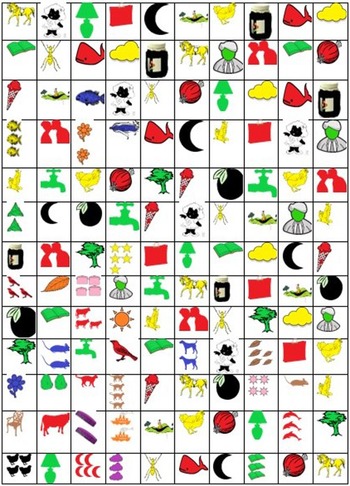
During the experiment, participants were recorded while taking turns asking and answering questions as they flipped through the cards in order. As they played the game, they had to cross out objects from a sheet so that they could keep track of what objects their partner already mentioned (Figure A1 in the Appendix). Two cardboard folders were placed as dividers between them to avoid revealing their cards. The winner of the game was the participant who first filled out the entire object sheet. The game was completed both in Spanish and Galician; six pairs of participants chose to play the game first in Galician and four pairs in Spanish. A ten-minute break took place in between the two games. On average, each experimental session lasted approximately one hour.
5.4 Data analysis
A total of 1,600 Galician yes-no questions were collected (80 questions x 20 participants). Recordings were segmented into individual files, which were annotated and analyzed using Praat (Boersma & Weenink Reference Boersma and Weenink2025). The intonation analysis followed the Spanish ToBI guidelines (Beckman et al. Reference Beckman, Díaz-Campos, McGory and Morgan2006; Estebas-Vilaplana & Prieto Reference Estebas-Vilaplana and Prieto2008; Aguilar et al. Reference Aguilar, Roseano, Vanrell, De-la-Mota and Prieto2024; Hualde & Prieto Reference Hualde, Prieto, Frota and Prieto2015, inter alia). and was based on a combination of auditory (listening) and visual (acoustic) criteria. The latter involved the visual inspection of the spectrogram together with the pitch contour and relied on pitch measurements to ascertain tonal distinctions when they were not clear. Specifically, following O’Rourke (Reference O’Rourke2005, Reference O’Rourke and Díaz-Campos2006), a minimum difference of 7 Hz was used to distinguish between a plateau versus a rise or fall. Data from participant 14 was discarded because of the prevalence of sentence-final devoicing. In addition, 297 tokens from other participants (18.6% of the data) were discarded because of errors, hesitations, or final devoicing. This resulted in 1,223 yes-no questions from 19 participants submitted to acoustic and statistical analysis.
For this article, we focus on the analysis of nuclear configurations, i.e., the nuclear pitch accent corresponding to the last stressed syllable in the intonational phrase, and the boundary tone. Following Aguilar et al. (Reference Aguilar, Roseano, Vanrell, De-la-Mota and Prieto2024), in our analysis, we distinguished among the nuclear pitch accents and boundary tones described in Tables 2 and 3, respectively.
Description of the pitch accents used in the analysis, following the Spanish ToBI labeling system (https:// sp-tobi.upf.edu/labelling_system)

Pitch settings for the analysis of intonation were set from 75 Hz to 200 Hz for men, and from 100 Hz to 500 Hz for women. Unclear cases were discussed among the three authors; if no agreement was reached, the token was discarded. Examples of prosodic annotation for the yes-no questions in the study appear in Section 6. Praat pictures were created using a script from Elvira-García (Reference Elvira-García2022).
Description of the boundary tones used in the analysis, following the Spanish ToBI labeling system (https://sp-tobi.upf.edu/labelling_system)

Statistical analysis involved a multinomial logistic regression analysis with the package nnet in R (R Core Team 2022). We started out with a model with nuclear configuration as dependent variable, gender as fixed effect, and subject and item as random effects. Other factors (age and language dominance) were added one by one. Language dominance was based on the participants’ BLP score, with negative scores indicating dominance in Galician and positive scores indicating dominance in Spanish. For age, we divided our participants in two groups: a younger one (21–48 years old; 14 participants), and an older one (50–62 years old; 5 participants). The older group is expected to use Galician more often than the younger group (Section 4).Footnote 5 We included language dominance and age as categorical variables in the multinomial regression analysis, as we had relatively few participants. We checked for interactions between variables and chose the model that best fitted the data based on AIC, the loglikelihood measures of fit, and the anova function in R. The final model included Gender (0 = ‘female’, 1 = ‘male’), Age (0 = ‘younger’, 1 = ‘older’), and Language Dominance (0 = ‘Galician-dominant’, 1 = ‘Spanish-dominant’) as fixed effects, and Subject and Item as random effects. Random slopes were not included as they did not result in a better fit of the model. Data visualizations were created with the ggplot2 package (Wickham Reference Wickham2016).
6. Results
This section presents our findings on the intonation of yes-no questions in Galician. Section 6.1 reports our overall results. Section 6.2 discusses the effects of gender, age and language dominance, and Section 6.3 focuses on individual differences.
6.1 Overall results
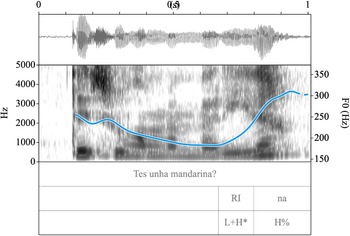
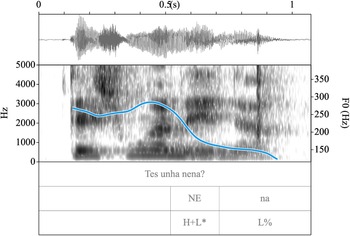
43% of yes-no questions analyzed were realized with a final rise, and 57% with a final fall. Three main nuclear contours were attested. The most prevalent consisted of a rising nuclear pitch accent followed by a high boundary tone (L+H* H%) (44% of the data). The second most frequent contour involved a falling nuclear pitch accent and a low boundary tone (H+L* L%) (36% of the data). In addition, a low-rising nuclear contour (L* H%) occurred in 9% of the data. Figures 5–7 provide waveforms, spectrograms and pitch contours for these three nuclear configurations. The remaining 12% of the data involved alternative intonational patterns, all of them occurring in 3% or fewer realizations (Figure 8). Because of their limited occurrence, alternative nuclear configurations were grouped as ‘other’ in the statistical analysis.
Final rise (L+H* H%). Tes unha mandarina? ‘Do you have a tangerine?’ P9.

Final fall (H+L* L%). Tes unha nena ‘Do you have a girl?’ P6.

Final low-rise (L* H%). Tes algo negro? ‘Do you have something black?’ P5.

Distribution of nuclear configurations in Galician yes-no questions.

6.2 Effects of gender, age, and language dominance
Tables 4-6 display the frequency of the main nuclear configurations split by gender, age, and language dominance, respectively.Footnote 6 As shown in Table 4, women showed a preference for falling contours, while men favored rising contours. Men also showed a higher prevalence of low rising and alternative nuclear configurations.
Nuclear configurations by gender

Nuclear configurations by age

Nuclear configurations by language dominance

Older Galician speakers favored falling contours, while younger Galician speakers preferred rising ones (Table 5). Younger participants also used more low rising and alternative nuclear configurations.
Finally, as shown in Table 6, Spanish-dominant participants showed a prevalence for rising nuclear configurations, and Galician-dominant participants for falling nuclear configurations. Galician-dominant participants also used more low rising nuclear configurations, whereas Spanish-dominant participants used more alternative nuclear configurations.
As indicated in Section 5, the statistical analysis involved a multinomial logistic regression analysis with nuclear configuration (H+L* L%, L* H%, L+H* H%, and ‘other’) as the dependent variable, and Gender (0=‘female’, 1=‘male’), Age (0=‘younger group’, 1=‘older group’) and Language dominance (0=‘Galician-dominant’, 1=‘Spanish-dominant’) as fixed effects. Subject and Item were included as random effects. We used the relevel function in R to compare each contour with the others. The results of the multinomial logistic regression analysis are presented in three tables, as the baseline is different for each. Tables 7–9 show the results of the multinomial logistic regression analysis for the three most common nuclear configurations in our data. As seen in these tables, several three-way interactions yielded either extremely large coefficients or standard errors of zero, indicating quasi-complete separation. This is due to the small number of tokens in some of the cross-tabulated categories. For instance, Table A3 shows zero occurrences of falling contours (H+L* L%) among older Spanish-dominant men. Because the model assigns near-absolute probabilities to these outcomes based on sparse data, these values should be interpreted as indicators of strong group trends rather than precise probability estimates.
Results of the multinomial logistic regression analysis with H+L* L% as the reference.

Results of the multinomial logistic regression analysis with L* H% as the reference.

Results of the multinomial logistic regression analysis with L+H* H% as the reference.

Multinomial regression revealed significant effects of gender, age, and language dominance on nuclear configurations, as well as significant interactions. To interpret the data, we calculated the odds ratios (OR) using the formula exp(B). These values represent the factor by which the odds of a specific contour increase or decrease (i.e., ‘times higher/lower odds’) relative to the reference category. For ease of interpretation, these ratios are reported below as the magnitude of change (e.g., 2.8 times higher odds) rather than percentage increases.
Regarding gender, men had 2.8 times higher odds of using L* H% (OR = 2.8; p = .002) and 86.8 times higher odds of using L+H* H% (OR = 86.8; p < .001) rather than H+L* L% compared to women (Table 7). In addition, the odds of using H+L* L% rather than L* H% were 0.36 times as high for men (OR = 0.36; p < .001) compared to women, whereas the odds of using L+H* H% rather than L* H% were 31 times higher for men (OR = 31; p < .001) compared to women (Table 8). Finally, men had 0.01 times the odds of producing H+L* L% (OR = 0.01; p < .001), and 0.03 times the odds of producing L* H% (OR = 0.03; p < .001) rather than L+H* H% compared to women (Table 9).
As for age, the odds of using L* H% rather than H+L* L% were 0.09 times as high for the older group (OR = 0.09; p = .001) compared to the younger group, whereas the odds of using L+H* H% rather than H+L* L% were 33.6 times higher for the older group (OR = 33.6; p < .001) (Table 7). Moreover, the older group had 11.3 times higher odds of producing H+L* L% rather than L* H% (OR = 11.3; p = .001) and 377.7 times higher odds of producing L+H* H% rather than L* H% (OR = 377.7 p < .001) compared to the younger group (Table 8). Finally, the odds of producing H+L* L% rather than L+H* H% were 0.03 times as high for the older group (OR = 0.03; p < .001) compared to the younger group, and the odds of producing L* H% rather than L+H* H% were effectively zero for the older group (OR < 0.001; p < .001) (Table 9).
Regarding language dominance, the Spanish-dominant group had 20.7 times higher odds of producing L* H% rather than H+L* L% (OR = 20.7; p = 0.008) and 5,710.1 times higher odds of using L+H* H% rather than H+L* L% (OR = 5,710.1; p < .001) compared to the Galician-dominant group (Table 7). Furthermore, the odds of using H+L* L%, rather than L* H%, were 0.05 times as high for the Spanish-dominant group (OR = 0.05; p < .001) compared to the Galician-dominant group, whereas the odds of using L+H* H% rather than L* H% were 276.4 times higher for the Spanish-dominant group (OR = 276.4; p < .001) compared to the Galician-dominant group (Table 8). Finally, the Spanish-dominant participants had odds of producing H+L* L% and L* H% that were effectively zero compared to the L+H* H% contour (OR < 0.001; p < .001 for both), representing a near-categorical preference for the latter in this group (Table 9).
Tables 7–9 also show several significant two-way and three-way interactions. To better interpret them and for the purpose of data visualization, we created mosaic plots (Figures 9–11). Figure 9 shows a mosaic plot for nuclear configuration by gender and age. The Pearson residuals (expressed in standard deviations) in the figure indicate the departure from independence. Older women frequently produced H+L* L% (as indicated by the size of the box and the Pearson residuals), whereas both younger and older men did not. The L* H% contour was particularly produced by younger men, and not by older women. Finally, L+H* H% was also frequently produced by younger men, but not by older men and younger women.
Mosaic plot of nuclear configuration by Gender (0 = ‘female’, 1 = ‘male’) and Age (0 = ‘younger’, 1 = ‘older’).

Mosaic plot of nuclear configurations by Gender (0 = ‘female’, 1 = ‘male’) and Language Dominance (0 = ‘Galician-dominant’, 1 = ‘Spanish-dominant’).

Mosaic plot of nuclear configurations by Age (0 = ‘younger’, 1 = ‘older’) and Language Dominance (0 = ‘Galician-dominant’, 1 = ‘Spanish-dominant’).

Figure 10 shows the interaction between Gender and Language Dominance. H+L* L% is particularly employed by Galician-dominant women, and not by Galician-dominant and especially Spanish-dominant men. The L* H% contour was frequent in Galician-dominant men, but not in Spanish-dominant women. Finally, the L+H* H% was frequently produced by Spanish-dominant men, but not by Galician-dominant men and especially not by Galician-dominant women.
Finally, Figure 11 shows a mosaic plot for the interaction between Age and Language Dominance. The figure clearly shows that especially younger and older Galician-dominant speakers and to some extent older Spanish-dominant speakers produced H+L* L%, and that younger Spanish-dominant speakers did not. The L* H% contour was frequently produced by younger Galician-dominant speakers, but not by older Spanish-dominant speakers. Finally, the L+H* H% was frequently used by younger Spanish-dominant speakers, and not by Galician-dominant speakers, especially not by the younger ones.
To visualize the three-way interactions, we created a mosaic plot with the different nuclear configurations by gender, age and language dominance (Figure 12; see also Table A3 in the Appendix). As shown in this figure, the H+L* L% contour was mostly used by Galician-dominant younger and older women and Spanish-dominant older women. The L* H% contour was pervasive in Galician-dominant men, particularly if older. Finally, the L+H* H% contour was preferred by Spanish-dominant younger men.
Mosaic plot of nuclear configuration by Gender (0 = ‘female’, 1 = ‘male’), Language Dominance (0 = ‘Galician-dominant’, 1 = ‘Spanish-dominant’), and Age (0 = ‘younger’, 1 = ‘older’).

The statistical analyses reported so far consider language dominance as a categorical variable. We also ran an analysis considering the BLP dominance score as a continuous variable, to test whether language dominance could be predicted by the nuclear configuration produced. Figure 13 shows the predicted values of the BLP score based on the nuclear configuration used. As shown in this figure, the use of the contours H+L* L% and L* H% predict dominance in Galician, whereas L+H* H% and alternative final contours predict dominance in Spanish.
Predicted values of the Bilingual Language Profile (BLP) score by nuclear configuration (negative BLP score: Galician dominance; positive BLP score: Spanish dominance).

6.3 Individual Results
Table 10 shows the amount of inter-speaker and intra-speaker variation in our data. Seven of the 19 participants in our study produced the rising contour L+H* H% in over 54% of yes-no questions. Except for participant 17, all were Spanish-dominant. Eight participants used the falling contour H+L* L% in at least 44% of questions. Most of these participants were Galician-dominant (participants 4, 6, and 16 were exceptions). Two participants (one Spanish-dominant and one Galician-dominant) favored L* H%, and one (Galician-dominant) produced L* H% and L+H* H% contours with practically the same frequency. The remaining participant (participant 15), who was young, male, and Galician-dominant, mostly produced alternative configurations, followed by H+L* L%. This participant was the study’s only self-identified neofalante.
Nuclear configurations produced by each participant (in %)

Some participants (7, 8, 12 and 15) produced up to ten different intonation patterns, and their most frequent final contours accounted only for 20–45% of their data. These four participants were relatively young men (between 23 and 44 years old), and all were simultaneous bilinguals. Three of them were Galician-dominant and had a college education, and one was Spanish-dominant with a high school education. Their BLP dominance scores were close to the middle of the scale (between −11 and 67; Table A1), which could possibly explain the lack of a strong preference for one contour.
As mentioned in Section 5, our participants came from two different places: Chantada and A Coruña. We did not include place of origin in our analysis, because only five participants were from Chantada (participants 2, 11, 17, 6, and 10) and these were all older and female speakers. As shown in Table 10, three of the participants from Chantada (2, 11, and 6) used H+L* L% and two (17 and 10) produced L+H* H%. Place of origin (A Coruña vs. Chantada) did not seem to have an effect, but we will return to the place of origin of our participants in the next section.
7. Discussion
7.1 Intonational characteristics of Galician yes-no questions
Our study investigated two main research questions. The first one focused on the main intonational characteristics of Galician yes-no questions. We found that, largely consistent with previous studies, the prevalent intonational pattern involved final falls (57%; cf. with 43% of rises). Final falls are also frequent for yes-no questions in other dialects and languages in North-West Spain, including Asturian, Cantabrian Spanish, Basque, and Basque Spanish (see for example López-Bobo & Cuevas-Alonso Reference López-Bobo, Cuevas-Alonso, Prieto and Roseano2010; Robles Puente Reference Robles Puente and Alvord2011, Reference Robles Puente2012; López-Bobo et al. Reference López-Bobo, Cuevas-Alonso, Arias and Bleorţu2012; Elordieta & Romera Reference Elordieta and Romera2020b; González & Reglero Reference González, Reglero, Colomina-Almiñana and Sessarego2020; Delgado Fernández Reference Delgado Fernández2024). In addition, the most common nuclear configurations were L+H* H% (44%), followed by H+L* L% (36%) and L* H% (9%). These three contours have been documented for Galician in previous studies (Porta Dapena 1977; Sobrino Pérez Reference Sobrino Pérez1999; Fernández Rei & Escourido Reference Fernández Rei, Pernas and Turculet2008; Fernández Rei Reference Fernández Rei2019).
Our data showed a higher proportion of rising contours than previously attested, together with fewer realizations of the ‘default’ contour H+L* L% (cf. Fernández Rei Reference Fernández Rei2019). It is possible that this is connected to the sociolinguistic characteristics of our participant dataset. First, we had a balanced sample of male and female participants; previous studies, except for Sobrino Pérez (Reference Sobrino Pérez1999), focused primarily on female participants. Second, most participants in our study were from the city of A Coruña, where Spanish is used more frequently than in other Galician regions studied before (Instituto Galego de Estatística 2024). Third, our participants seemingly had more (and earlier) exposure to Spanish than those in previous studies. Specifically, ten were simultaneous bilinguals and six had Spanish as their L1.Footnote 7 In contrast, the participants in Sobrino Pérez (Reference Sobrino Pérez1999) had Galician as their L1, and Fernández Rei (Reference Fernández Rei2016, Reference Fernández Rei2019) included bilingual participants with Galician as L1 and neofalantes with Galician Spanish as their L1. Finally, the participants in our study had a relatively high level of education; all had completed high school, and several had studied at university. In contrast, the participants in Sobrino Pérez (Reference Sobrino Pérez1999) completed trade school, or had studies equivalent to 8th grade. We will discuss the effect of social factors in more detail in the next section.
Previous research on Galician intonation also documented the circumflex contour L+H* HL% in yes-no questions in southwestern Galicia (Baixo Minho region; Fernández Rei 2007; Pérez Castillejo Reference Pérez Castillejo2012). This contour was only attested in 2% of our data. None of the participants in our study were from this region. Further studies should investigate the use of the circumflex contour in other Galician dialects.
7.2 The impact of language dominance, gender, and age
Our second research question focused on the impact of three social factors: language dominance, gender, and age. For language dominance, we found that falling and low-rising contours were more common in Galician-dominant speakers, while rising and alternative contours were more frequent in Spanish-dominant speakers. This suggests cross-linguistic influence at the suprasegmental level from Spanish (the majority language) into Galician (the minority language). This is consistent with both interference through shift (Thomason & Kaufman Reference Thomason and Kaufman1988) and imposition from the dominant language onto the weaker language (Van Coetsem Reference Van Coetsem1988). Although previous studies have not measured language dominance per se, our findings align with those in Pérez Castillejo (Reference Pérez Castillejo2012), who reports that participants whose parents did not speak Galician at home produced more final rising contours.
Regarding gender, we found that female participants produced more final falls, while male participants preferred final rising, low rising and alternative contours. Most previous studies on Galician intonation focus on data from female participants. One exception is Sobrino Pérez (Reference Sobrino Pérez1999), who found that a rising nuclear pitch accent in combination with a low boundary tone (which corresponds to L+H* L% in Spanish ToBi) was more frequent among women than men in the Baixo Miño area. We found that this contour occurred in only 3% of our data. The women in our study showed a preference for H+L* L%, which has been suggested to be the default or standard nuclear configuration in Galician yes-no questions (Fernández Rei Reference Fernández Rei2019).
Regarding age, we found that our older participants used more falling contours, while younger speakers produced more rising, low-rising, and alternative contours.Footnote 8 The fact that younger speakers used more rising contours and showed more intonational variability is probably connected to their increased use of Spanish compared to older speakers (Instituto Galego de Estatística 2024).
We also found several interactions among the social factors investigated. First, gender and language dominance interacted: Galician-dominant women preferred final falling contours, while Spanish-dominant men preferred rising ones. Second, age and gender interacted: older women produced more falling contours, while younger men used low-rising contours more frequently. Third, there was an interaction between age and language dominance, with older Spanish-dominant speakers preferring falling contours, younger Galician-dominant speakers favoring low-rising contours, and younger Spanish-dominant speakers preferring rising ones. Finally, a three-way interaction was found for age, gender and language dominance: low-rising contours were preferred by Galician-dominant men, rising contours by young Spanish-dominant men, and falling contours by Galician-dominant women and older Spanish-dominant women.
The fact that rising contours, which are typical in Castilian neutral yes-no questions (Navarro Tomás Reference Navarro Tomás1944; Aguilar et al. Reference Aguilar, Roseano, Vanrell, De-la-Mota and Prieto2024), were prevalent in young, Spanish-dominant males but rare in older, Galician-dominant females, points to a change in progress in the intonation of Galician yes-no questions. This is consistent with the rise in the use of Spanish in younger generations in Galicia (Instituto Galego de Estatística 2024), and with an increased cross-linguistic influence of Spanish into Galician (cf. Fernández Rei Reference Fernández Rei2016). We expect that in the future the final rising contour will continue to make inroads in the intonation of Galician yes-no questions. As a result, the nuclear configuration H+L* L%, which is considered unmarked for Galician yes-no questions, might be changing its pragmatic meaning and losing its status as the default yes-no question contour. To further explore the change into final rising contours, future research should explore the relative prestige of competing nuclear configurations in Galician.
8. Conclusion
This study set out to investigate the intonation of information-seeking yes-no questions in Galician, as well as the effects of gender, age, and language dominance. The study contributes to the study of intonation in an under-investigated language and to the effects of social factors in language contact situations. Ours is the first study to examine the intonation patterns of yes-no questions produced by a balanced sample of Galician speakers taking into consideration gender, age, and language dominance. In addition, it is the largest scale study available on Galician intonation, taking into consideration both the number of speakers and tokens analyzed, and detailed statistical analyses. Our findings point toward shift-induced interference or imposition of Spanish intonation patterns into Galician by Spanish-dominant speakers and a change in progress toward more final rising contours.
Further studies could examine additional intonational characteristics of yes-no questions in Galician, including the realization of prenuclear accents, and compare neutral yes-no questions to those conveying other pragmatic uses, including requests, confirmations, and surprise. Future studies should also include participants from other regional areas and tasks with different levels of formality. Finally, the participants in this study were relatively highly educated and were split into two age groups: younger (21–48 years old) and older (50–62 years old). Future studies should consider focusing on a wider age range and including different educational levels.
Acknowledgements
We thank the participants of the study for their generosity with their time, Mariola Iglesias for help with participant recruitment, and Russell Almond for his input on the statistics and data visualization. We are also grateful to the audience at the Intonation, Language Contact and Social Factors conference organized by the University of the Basque Country and the two anonymous JIPA reviewers for their helpful feedback. Any remaining errors are our own. This research was funded by a Graduate Research Travel Grant awarded to the first author by the Winthrop King Institute at Florida State University.
Appendix
Participant information

Note: * indicates that the participant was removed from the analysis.
Object sheet for yes-no question elicitation task.

Experimental materials: yes-no questions.

Nuclear configuration by age, gender and language dominance









 Open access

