





Introduction
Summer squash and watermelon are high-value cucurbits crops. In 2020, production of squash in the United States totaled 345 million kg on 18,000 harvested hectares, with a value of $218 million. Watermelon production in the United States totaled 1.7 billion kg on 39,000 harvested hectares, with a value of $575 million. Midwestern states are among the top cucurbit-producing states. Michigan ranked first among the top squash-producing states and Indiana ranked fifth among the top watermelon-producing states (USDA-NASS 2021).
Summer squash and watermelon are usually transplanted into raised beds that are covered with polyethylene mulch. Row spacing ranges from 1.2 to 1.8 m for summer squash and 1.8 to 3.7 m for watermelon. In-row spacing ranges from 46 to 61 cm for summer squash, and 90 to 180 cm for watermelon (Phillips Reference Phillips2021). Polyethylene mulch successfully aids with in-row weed control (Bonanno Reference Bonanno1996; Skidmore et al. Reference Skidmore, Wilson, Williams and Bessin2019). However, row-middle weeds must be controlled using other strategies. Summer squash marketable yield was reduced by 11% and 19% in 2013 and 2014, respectively, and average muskmelon (Cucumis melo L.) individual fruit weight was reduced from 2.0 to 1.7 kg when no in-row weed control strategy (plasticulture) was applied (Tillman et al. Reference Tillman, Nair, Gleason and Batzer2015a, Reference Tillman, Nair, Gleason and Batzer2015b). Weeds also interfere with these manually harvested crops by exposing laborers to allergens (Gadermaier et al. Reference Gadermaier, Dedic, Obermeyer, Frank, Himly and Ferreira2004; Piotrowska-Weryszko et al. Reference Piotrowska-Weryszko, Weryszko-Chmielewska, Melnychenko, Konarska, Mylenka, Prokopiv and Bożek2021), increasing accidents (de Oliveira Procópio et al. Reference de Oliveira Procópio, da Silva, Ferreira, da Silva, Galon, Santos, Borém and Caldas2015), or complicating the harvesting process (Arana et al. Reference Arana, Meyers, Guan and Johnson2022a).
Several technologies can be used to control row-middle weeds, including plant-based mulches and cultivators. However, they are usually cost-ineffective and labor-intensive (i.e., moving vines before cultivating) for vegetable growers (Peruzzi et al. Reference Peruzzi, Martelloni, Frasconi, Fontanelli, Pirchio and Raffaelli2017; Wilhoit et al. Reference Wilhoit, Stombaugh, Pomery and Williams2012). Therefore, herbicides are generally integrated with plasticulture for row-middle weed management. Farmers have widely accepted and adopted herbicide use due to the lower production costs and higher yields that herbicides provide (Gianessi and Reigner Reference Gianessi and Reigner2007).
In Indiana, only a few herbicides are registered for preemergence (PRE) use in summer squash and watermelon, including those as classified by the Weed Science Society of America (WSSA) in Group 3 (ethalfluralin and trifluralin), Group 13 (clomazone), and Group 15 (S-metolachlor), and bensulide (which has an unknown mode of action). Watermelon farmers in Indiana can also use WSSA Group 2 (halosulfuron and imazosulfuron), Group 3 (dimethyl tetrachloroterephthalate [DCPA] and pendimethalin), Group 5 (terbacil), and Group 14 (flumioxazin) (Phillips Reference Phillips2021). Due to the low number of PRE herbicide groups available for use in these vegetable crops, farmers have to rely on the same herbicides each year or on postemergence applications. Thus, reliance on a few herbicides contributes considerably to the increase in selection pressure for herbicide-resistant weed populations (Evans et al. Reference Evans, Tranel, Hager, Schutte, Wu, Chatham and Davis2016). If more soil-residual herbicide groups are registered for use for each crop, farmers could then integrate soil-residual herbicide mixtures to delay herbicide resistance (Beckie and Reboud Reference Beckie and Reboud2009; Busi et al. Reference Busi, Powles, Beckie and Renton2020). Soil-residual herbicides, which remain adsorbed to soil particles for moderate to long time, are encouraged because they can delay herbicide resistance (Busi et al. Reference Busi, Powles, Beckie and Renton2020).
Fomesafen, a protoporphyrinogen oxidase inhibitor herbicide (WSSA Group 14), is registered for PRE use in cucurbits in some Midwestern states but not in Indiana. It is registered for use in squash production in Illinois, Kansas, Michigan, Minnesota, and Ohio at rates from 140 to 280 g ai ha−1 and in watermelon production in Kansas and Missouri at rates from 175 to 280 g ai ha−1. In Indiana, there is no Group 14 herbicide registered for PRE use with squash crops. Flumioxazin, a WSSA Group 14 herbicide, is registered for PRE use in watermelon and cantaloupe in Indiana with a Special Local Needs label as authorized under §24(c) of the Federal Insecticide, Fungicide, and Rodenticide Act. However, flumioxazin broadcast-applied over the top of polyethylene can cause watermelon yield loss (Meyers et al. Reference Meyers, Guan, Egel and Nowaskie2021), probably because it slowly dissipates from the polyethylene mulch (Grey et al. Reference Grey, Vencill, Webster and Culpepper2009), thus increasing the chance of the herbicide contacting the crop and causing damage. Specialty crop farmers in Indiana prefer to spray over the top of plastic due to lack of hooded spray equipment. To support the registration of fomesafen for use in summer squash and watermelon through a §24(c) label, it is advisable to have in-state crop tolerance data. A tolerant crop would not exhibit toxicity symptoms or develop symptoms but recover afterward (Pitty Reference Pitty1995; Seefeldt et al. Reference Seefeldt, Jensen and Fuerst1995). Our objective was to evaluate the biological effect of several rates of fomesafen on two summer squash and watermelon cultivars grown in plasticulture.
Materials and Methods
In 2020 and 2021, four summer squash and two triploid watermelon dose-response trials were conducted at the Meigs Horticulture Research Farm (MEIGS), Lafayette, Indiana; the Pinney Purdue Agricultural Center (PPAC), Wanatah, Indiana; and the Southwest Purdue Agricultural Center (SWPAC), Vincennes, Indiana. Fields were prepared with tillage prior to the formation of raised beds 2 m apart at MEIGS, and 1.8 m apart at PPAC and SWPAC. Raised beds were prepared with subsurface drip tape and covered with black polyethylene mulch. GPS coordinates, soil information, and raised bed formation dates are listed in Table 1. Crop fertilization, irrigation, disease, and insect management practices followed current recommendations (Phillip Reference Phillips2021). Seeds for summer squash and watermelon (Rupp Seeds, Inc. Wauseon, OH) were planted into trays and grown either at the Purdue University Horticulture Greenhouses, MEIGS greenhouse, or SWPAC greenhouses (Table 2).
GPS coordinates, soil data, and raised bed formation dates for the three experimental locations. a

a Abbreviations: MEIGS, Meigs Horticulture Research Farm; PPAC, Pinney Purdue Agricultural Center; SWPAC, Southwest Purdue Agricultural Center.
Summer squash and watermelon seedling establishment. a

a Abbreviations: MEIGS, Meigs Horticulture Research Farm; PPAC, Pinney Purdue Agricultural Center; SWPAC, Southwest Purdue Agricultural Center.
b Summer squash cultivars ‘Blonde Beauty’ and ‘Spineless Beauty’ (2020) or ‘Liberty’ (2021) seeds were planted into 72-cell trays. Triploid watermelon cultivars ‘Exclamation’ and ‘Fascination’, and diploid ‘Wingman’ pollenizer seeds were planted into 50-cell trays.
The experiment had a split-plot arrangement with four replications. Main plots consisted of fomesafen rate (Table 3); subplots were cultivar randomly placed within each main plot. Summer squash cultivars were ‘Blonde Beauty’ yellow straightneck squash and either ‘Spineless Beauty’ (2020) or ‘Liberty’ (2021) zucchini. Watermelon cultivars were ‘Exclamation’ and ‘Fascination’. Subplots consisted of a single row 4.9 m long for summer squash, two rows 7.4 m long for watermelon at MEIGS, and three rows 4.9 m long for watermelon at SWPAC. To help control weeds, the entire trial received an application of S-metolachlor (Dual Magnum®; Syngenta Crop Protection, LLC, Greensboro, NC) before being transplanted, except for the watermelon trial at MEIGS, which received a blanket application of halosulfuron at 40 g ai ha−1 (Sandea®; Canyon Group LLC C/O Gowan Company, Yuma, AZ) and ethafluralin at 1.4 kg ai ha−1 plus clomazone at 420 g ai ha−1 (Strategy®; Loveland Products, Inc. Greeley, CO). S-metolachlor rates were 1.1 kg ai ha−1 for summer squash at MEIGS 2020 and PPAC 2021 and watermelon at SWPAC, 1.8 kg ai ha−1 for summer squash at MEIGS 2021, and 1.6 kg ai ha−1 for summer squash at PPAC 2020.
Fomesafen treatment description and summer squash and watermelon transplanting dates. a

a Abbreviations: MEIGS, Meigs Horticulture Research Farm; PPAC, Pinney Purdue Agricultural Center; SWPAC, Southwest Purdue Agricultural Center.
b Fomesafen rates: 0× (0 g ai ha−1 nontreated control), 1×, 2×, 3×, and 4×.
c Equipment was calibrated to deliver 187 L ha−1; source of nozzle tips: Spraying Systems Co., Wheaton, IL.
Fomesafen (Reflex®; Syngenta Crop Protection) was broadcast-applied over the top of black polyethylene mulch and respective row middles with an output of 187 L ha−1. This application method was chosen because it represents the preferred application method of Indiana vegetable farmers, and the authors believed it would create the best opportunity to observe an adverse crop response. One day (summer squash trials) and 6 to 7 d (watermelon trials) after spraying fomesafen, planting holes were made on the black polyethylene mulch and seedlings were hand-transplanted. In each subplot, eight summer squash seedlings were transplanted 60 cm apart, and 12 triploid watermelon seedlings were transplanted 1.2 m apart. In the watermelon trials, 6 pollenizer watermelon seedlings per subplot were also transplanted to achieve a 1:2 pollenizer-to-triploid watermelon ratio. Fomesafen application information and summer squash and watermelon transplanting dates and methods are presented in Table 3.
Data collection included visual crop injury using a scale of 0% (no injury) to 100% (crop death) relative to the 0 g ha−1 nontreated control at 2 and 4 wk after transplanting (WATr) for the summer squash trials. In 2021, summer squash plant stand was collected at 2 and 4 WATr. In the watermelon trial, injury was collected 2, 4, and 6 WATr, and weed control at 4 WATr on a scale of 0% (no control) to 100% (complete control) relative to the nontreated control. After the 4 WATr weed control rating in the watermelon trials, weeds were removed either by hand or with hoes or cultivators to maintain plots weed-free for the remainder of the trial period. Weeds in the summer squash trials were removed as necessary throughout the season.
Summer squash harvest was initiated on June 23, 2020, and July 2, 2021, at MEIGS; and July 23, 2020, and July 21, 2021, at PPAC. The six plants in the middle of each subplot were harvested twice per week for 4 wk (eight harvests total). All fruit ≥8 cm long was harvested and graded into mature (darker green/yellow, thickened skin), immature (lighter green/yellow, thin skin), and cull (misshapen or rotten). The number of fruits per category was counted and weighed together. Total marketable yield was calculated by adding the total weight of each of the eight harvests pooled across mature and immature fruits.
Summer squash total marketable yield data were converted to a percent of the nontreated control using Equation 1:
 $$Percent\, of \,control = {B \over M} \times 100$$
where M is the average of the nontreated control variable value pooled across the four repetitions within a location-year for each summer squash cultivar, and B is the variable value of each data point for each summer squash location-year.
Watermelon fruits were harvested once per week for 4 wk, beginning July 28, 2021, at SWPAC and August 11, 2021, at MEIGS. Fruits were picked when the tendril that developed from the same node as the fruit peduncle was necrotic, and the ground spot was yellow. The weight of each fruit was recorded and classified as marketable (≥4 kg) or non-marketable (<4 kg). Total marketable yield and fruit number were calculated as the sum of all four harvests.
Data were subjected to statistical analysis using R software (RStudio®; PBC, Boston, MA). Data were first analyzed for each location-year with a linear model and subjected to ANOVA to determine whether the models were significant for each trial. If models were significant, data were combined across locations for each year to check whether the normality of the data was affected and to determine whether statistically interactions (P ≤ 0.05) existed between fomesafen rate, summer squash or watermelon cultivar, and location for each response variable. If the normality of the data was affected or interactions between the explanatory variables were found, data are presented separately. Summer squash response variables were injury at 2 and 4 WATr, 2021 plant stand at 2 and 4 WATr, fruit number per harvest, total marketable yield as a percent of the nontreated control, and cull fruit number. Watermelon response variables were injury at 2, 4, and 6 WATr; weed control 4 WATr; and total marketable yield and fruit number.
Summer squash and watermelon visual injury and weed control data from the watermelon trials were arcsine-square root–transformed for analysis and are presented as back-transformed data. These data analyses excluded data from the nontreated control due to zero variance.
All data were subjected to a Tukey’s honestly significant difference test performed at a P ≤ 0.05 significance level. Summer squash total marketable yield data, which showed a response to fomesafen, were fit a three-parameter log-logistic model using Equation 2:
 $$3P{\rm{\;}}log - logistic = {d \over {1 + Exp{\rm{\;}}\left[ {b\left( {log{\rm{\;}}x - log{\rm{\;}}e} \right)} \right]}}$$
where d is the upper limit, b is the growth rate, e is the inflection point, and x is the fomesafen rate in grams per hectare (g ha−1). The fit of each nonlinear model was analyzed with a lack-of-fit test, where a P > 0.05 indicated that the nonlinear model provided an adequate description of the data.
Results and Discussion
Injury
Summer Squash
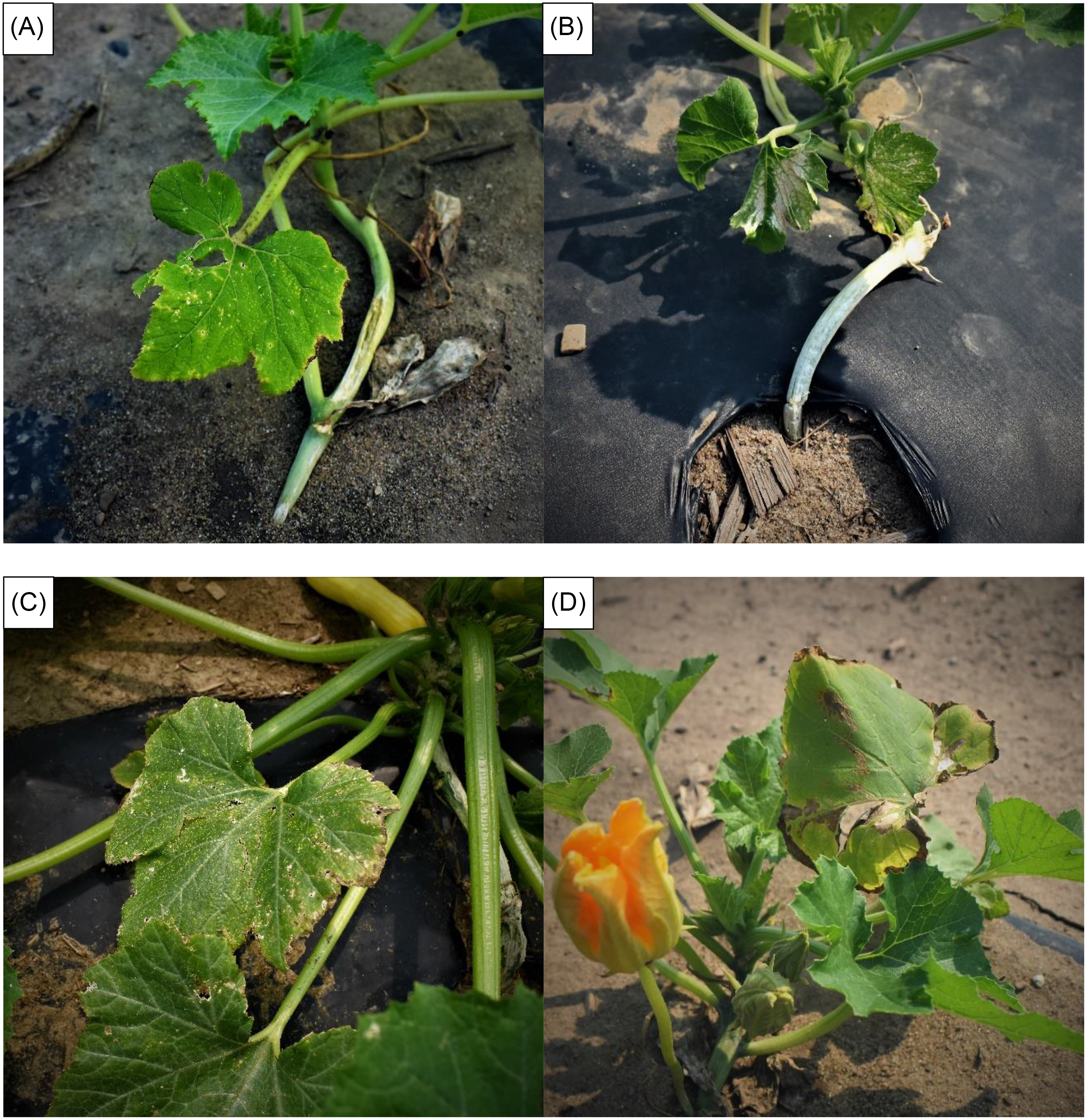
Visual injury included necrotic margins, chlorosis, brown and white spots, and stunting (Figures 1 and 2). Due to a significant fomesafen rate-by-location interaction, injury data were analyzed separately by location for both years. Due to a lack of a fomesafen rate-by-cultivar interaction, injury was pooled across cultivars within each location-year. Except for PPAC in 2020, when there was no visible crop injury, summer squash injury increased with increasing fomesafen rate at 2 WATr. Injury at 2 WATr increased from 8% to 18% at the MEIGS location in 2020, from 3% to 19% at MEIGS in 2021, and from 5% to 28% at PPAC in 2021 (Table 4). By 4 WATr, there was no visible crop injury at MEIGS in 2020. Injury at PPAC in 2020 was present only at the highest fomesafen rate (14% with 1,048 g ha−1 fomesafen). Injury trends 4 WATr at the MEIGS location in 2021 and at PPAC in 2021 were similar to observations made 2 WATr. Overall, injury from the lowest fomesafen rates used (262 and 280 g ha−1) was minimal (≤9%) at 2 and 4 WATr. In 2021, plant stand at 2 and 4 WATr was not significantly affected by fomesafen rate in any trial. Summer squash plant stand per plot in 2021 averaged 7.9 (MEIGS) and 7.6 (PPAC) at 2 WATr, and 7.7 (MEIGS) and 7.3 (PPAC) at 4 WATr (data not shown).
Summer squash injury symptoms 2 and 4 wk after transplanting (WATr) at the Pinney Purdue Agricultural Center in 2021. A) ‘Blonde Beauty’ yellow squash leaf chlorosis, necrotic leaf margins, and white spots on the stem at a fomesafen rate of 280 g ai ha−1 and B) ‘Liberty’ zucchini white spots on leaf and stem at a fomesafen rate of 560 g ha−1 at 2 WATr. C) ‘Blonde Beauty’ yellow squash leaf chlorosis and brown and white spots, and necrotic leaf margins; and D) ‘Liberty’ zucchini necrotic leaf margins and brown and white spots on leaves at a fomesafen rate of 280 g ha−1 at 4 WATr.
Summer squash stunting at 4 wk after transplanting in the Pinney Purdue Agricultural Center in 2021. A) ‘Liberty’ zucchini and B) ‘Blonde Beauty’ yellow squash nontreated control (0 g ha−1) vs. the highest fomesafen rate (1,120 g ha−1).

Summer squash injury with standard error at increasing fomesafen rates in 2020 and 2021 at 2 and 4 wk after transplantation, pooled across summer squash cultivars ‘Blonde Beauty’ yellow straightneck squash, and ‘Spineless Beauty’ (2020) or ‘Liberty’ (2021) zucchini. a-c

a Abbreviations: MEIGS, Meigs Horticulture Research Farm; PPAC, Pinney Purdue Agricultural Center; WATr, weeks after transplantation.
b Means were separated using Tukey’s honestly significant difference test at P ≤ 0.05. Means followed by the same letter are not significantly different.
c Standard error appears in parentheses.
Summer squash injury trends at each location-year were related to rainfall before transplanting and during the growing season (Figure 3). It rained after fomesafen was sprayed but before summer squash seedlings were transplanted both at the PPAC location in 2020 and at MEIGS in 2021, potentially washing off some of the herbicide from the polyethylene mulch to the row-middles. Injury at both location-years was likely a function of rainfall amount prior to transplantation. There was minimal injury at PPAC in 2020, probably because the total rain before transplant (34 mm) washed most of the fomesafen off the polyethylene mulch except for the highest rate. At MEIGS in 2021, rainfall was less than 9 mm. Although this rainfall likely washed off some of the fomesafen residue from the polyethylene mulch, it did not wash off as much as the 34 mm at PPAC in 2020. Injury at 2 and 4 WATr was attributed to the residual herbicide splashing from the polyethylene mulch, or from soil particles on the polyethylene mulch or in the row middles (Arana et al. Reference Arana, Meyers, Johnson and Guan2022b; Park and Hamill Reference Park and Hamill1993; Peachey et al. Reference Peachey, Doohan and Koch2012; Teasdale Reference Teasdale1985) onto the summer squash leaves close to the ground. At MEIGS in 2020, it did not rain before plants were transplanted, but the cumulative rain following transplant was 10 mm over the next 2 wk. With so little rain, the herbicide likely did not gravitate through the soil into the summer squash root zone via the planting hole, but it probably splashed from the polyethylene mulch onto the leaves.
Precipitation at fomesafen application date and over time, and indication of summer squash injury rating dates at 2 and 4 wk after transplanting (WATr) at the Meigs Horticulture Research Farm (MEIGS) and the Pinney Purdue Agricultural Center (PPAC). Summer squash transplanting was performed 1 d after application at all location-years.

Dissimilar to the other location-years, summer squash injury was more serious at PPAC in 2021, possibly because it did not rain before transplant, and from to 2 to 8 d after transplant, it rained a total of 109 mm. Therefore, the herbicide was not washed off the polyethylene mulch before transplant and was washed into the crop’s root zone with the rain, thereby increasing injury. In addition, at the PPAC location, beds were often covered with soil (Figure 2), which was probably moved by the wind. Thus, because it rained regularly, it is likely that fomesafen splashed from the soil onto the leaves with the rain.
Similar to our results, Reed et al. (Reference Reed, Boyd, Wilson and Dittmar2018) reported 3% injury in hybrid ‘Sunburst’ yellow scallop squash (C. pepo) 2 wk after treatment (WAT) when using fomesafen at 420 g ha−1 under various plastic mulches. Peachey et al. (Reference Peachey, Doohan and Koch2012) reported that fomesafen used at 280 g ha-1 did not affect the emergence of direct-seeded ‘Tigress’ and ‘Elite’ zucchini or ‘Yellow Crookneck’ summer squash (C. pepo) but did cause, respectively, 0%, 30%, and 30% injury 2 WAT and 0%, 33%, and 16% injury 4 WAT. Reed et al. (Reference Reed, Boyd, Wilson and Dittmar2018) and Peachey et al. (Reference Peachey, Doohan and Koch2012) reported that injury was transient.
Watermelon
Visual injury included bronzing (Figure 4) and stunting. Due to a lack of fomesafen rate-by-cultivar interaction, injury was analyzed across cultivars (Table 5). However, combining data across locations hindered the normality of the data, thus the visual injury data were analyzed by location. At 2 WATr, as the fomesafen rate increased from 210 to 840 g ha−1, injury increased from 2% to 10% at SWPAC and from 5% to 17% at MEIGS. At 4 WATr, injury increased from 2% to 13% with increasing fomesafen rate at MEIGS, but at SWPAC injury was not affected by fomesafen rate (injury ranged from 3% to 6%). Injury at SWPAC declined slightly between 2 and 4 WATr, while injury at MEIGS did not decline between 2 and 4 WATr. At 6 WATr no injury was observed. Overall, injury from the 210 g ha−1 fomesafen rate was minimal (≤5%) at 2 and 4 WATr.
Bronzing symptom on A) ‘Exclamation’ and B) ‘Fascination’ watermelon cultivars at a fomesafen rate of 560 g ai ha−1 at 2 wk after transplanting at the Southwest Purdue Agricultural Center in 2021.

Watermelon injury with standard error at increasing fomesafen rates in 2021 at 2 and 4 wk after transplantation, pooled across watermelon cultivars ‘Exclamation’ and ‘Fascination’.a–c

a Abbreviations: MEIGS, Meigs Horticulture Research Farm; SWPAC, Southwest Purdue Agricultural Center; WATr, weeks after transplantation.
b Means were separated using Tukey’s honestly significant difference test P ≤ 0.05. Means followed by the same letter are not significantly different.
c Standard error appears in parentheses.
Cumulative rain before transplantation was 5 mm at SWPAC and 27 mm at MEIGS (Figure 5). It did not rain in the 6 d following transplant at the SWPAC location, thus the chances of the herbicide entering through the planting hole and reaching the watermelon root zone were minimal. However, after that, it rained 53 mm over 6 d before the 2 WATr rating. At the MEIGS location it rained 5 mm over 4 d before the 2 WATr injury rating and 95 mm over 5 d before the 4 WATr. We presume that rain washed the herbicide into the watermelon root zone through the planting hole resulting in the injury symptoms we observed.
Precipitation between fomesafen application and watermelon transplanting dates, and over time to indicate the date of watermelon injury ratings at 2 and 4 wk after transplanting (WATr) at the Southwest Purdue Agricultural Center (SWPAC) and Meigs Horticulture Research Farm (MEIGS).

Likewise, Johnson and Talbert (Reference Johnson and Talbert1993) reported 11% injury 3 wk after seeding watermelon into bare ground soils immediately or 1 wk after incorporating fomesafen at 280 g ha−1. Bertucci et al. (Reference Bertucci, Jennings, Monks, Jordan, Schultheis, Louws and Waldschmidt2018) reported <2% injury symptoms at 3 WAT when 175 g ha−1 of fomesafen was applied under the plastic 1 d before transplanting triploid watermelon.
Weed Control
Because combining data across locations hindered the normality of the data, weed control data in the watermelon trials were analyzed by location. At 4 WATr, as the fomesafen rate increased from 210 to 840 g ha−1, weed control increased from 76% to 91% at the SWPAC location and ranged from 96% to 100% at MEIGS (Table 6) relative to the 0 g ha−1 fomesafen rate treatments, which received S-metolachlor at SWPAC, or a mix of halosulfuron, ethalfluralin, and clomazone at MEIGS. At SWPAC, fomesafen fully controlled carpetweed (Mollugo verticillata L.) and morningglory species (Ipomoea spp. L.), and it partially controlled common lambsquarters (Chenopodium album L.), pigweeds (Amaranthus spp. L.), and dandelion (Taraxacum officinale F. H. Wigg.). At the MEIGS location, carpetweed, common purslane (Portulaca oleracea L), Eastern black nightshade (Solanum ptychanthum Dunal), giant ragweed (Ambrosia trifida L.), morningglory species, velvetleaf (Abutilon theophrasti Medik.), and grass species were all controlled by use of fomesafen. The increased weed control at the MEIGS location was most likely because herbicides in four groups (Groups 2, 3, 13, and 14) were used rather than only two (Groups 14 and 15), which were used at the SWPAC location. This demonstrates the importance of soil residual herbicide mixtures, which aid in delaying herbicide resistance (Beckie and Reboud Reference Beckie and Reboud2009; Busi et al. Reference Busi, Powles, Beckie and Renton2020)
Weed control with standard error at increasing fomesafen rates in 2021 at 4 wk after transplantation, pooled across watermelon cultivars ‘Exclamation’ and ‘Fascination’.a–c

a Abbreviations: MEIGS, Meigs Horticulture Research Farm; SWPAC, Southwest Purdue Agricultural Center.
b Means were separated using Tukey’s honestly significant difference test P ≤ 0.05. Means followed by the same letter are not significantly different.
c Standard error appears in parentheses.
Yield
Summer Squash
Yield data analyzed by location-year showed that the effect of fomesafen rate was not significant, except at PPAC in 2021. Data were pooled across cultivars due to a lack of fomesafen-by-cultivar interaction at PPAC in 2021. Fomesafen delayed harvest at PPAC in 2021. A significant decrease in fruit number occurred on the first (F9,30 = 5.09, P = 0.0003) and second (F9,30 = 4.95, P = 0.0004) harvests, when fomesafen was applied compared to harvests from the nontreated control (Table 7). Harvestable fruits were developed only at the 0, 280, and 560 g ha−1 rates at the first harvest. All rates differed from those from the nontreated control. The average fruit number the nontreated control was five per six plants, but it was only two fruits per six plants for the 280 and 560 g ha−1 rates. Harvestable fruits developed in all the treatments at the second harvest, in which only the 840 and 1,120 g ha−1 rates differed from the nontreated control. The average fruit number from the nontreated control plants was seven fruits per six plants, and just three and two fruits per six plants for the 840 and 1,120 g ha−1 rates, respectively. Accordingly, marketable yield loss was significant and fit a three-parameter log-logistic model (Equation 2). The total marketable yield from the nontreated control plants at PPAC in 2021 was 20 kg per six plants. As the fomesafen rate increased from 280 to 1,120 g ha−1, the predicted marketable yield decreased from 95% to 60% compared with that of the nontreated control (Figure 6). Fomesafen did not significantly affect the marketable yield at the other location-years.
Summer squash fruit number for the first two harvests with standard error at increasing fomesafen rates at the Pinney Purdue Agricultural Center in 2021, pooled across summer squash cultivars ‘Blonde Beauty’ yellow straightneck squash and ‘Liberty’ zucchini.a, b

a Means were separated using Tukey’s honestly significant difference test P ≤ 0.05. Means followed by the same letter are not significantly different.
b Standard error appears in parentheses.
Effect of fomesafen rate on summer squash marketable yield as a percent of the nontreated control at the Pinney Purdue Agricultural Center in 2021, described with a three-parameter log-logistic model [
 $$d/\left( {1 + Exp\left[ {b\left( {logx - loge} \right)} \right]} \right)$$
]. Parameters for
$$d/\left( {1 + Exp\left[ {b\left( {logx - loge} \right)} \right]} \right)$$
]. Parameters for $b = 2,\;d = 99,\;and\;e = 1402$
; lack-of-fit P = 0.582.
$b = 2,\;d = 99,\;and\;e = 1402$
; lack-of-fit P = 0.582.

At the MEIGS location in 2020, there was a significant effect of cultivar across all treatments, when summer squash marketable yield averaged 13 and 18 kg per six plants for ‘Blonde Beauty’ and ‘Spineless Beauty’, respectively. Summer squash marketable yield pooled across cultivars and rates averaged 24 kg per six plants at PPAC in 2020 and 27 kg per six plants at MEIGS in 2021. Fomesafen rate did not increase the number of cull fruits (data not shown). Similar to our results, Peachey et al. (Reference Peachey, Doohan and Koch2012) and Reed et al. (Reference Reed, Boyd, Wilson and Dittmar2018) reported no significant summer squash yield loss when 280 g ha−1 of fomesafen was applied PRE over the top bare ground, and 420 g ha−1 before planting under various plastic mulches, respectively.
Watermelon
Watermelon yield was not significantly affected by any fomesafen rate. Yield averaged 258 kg 27 m−2 at MEIGS and 166 kg 27 m−2 at SWPAC, and fruit number averaged 42 and 27, respectively, pooled across all fomesafen rates and both cultivars. Although weeds were not removed until 4 WATr, we believe that the weeds that were present did not affect the watermelon yield because weed control was greater than 76%, weed population in the untreated control treatments was low, and the weeds were small and distant from the watermelon canopy area. Similar to our results, Bertucci et al. (Reference Bertucci, Jennings, Monks, Jordan, Schultheis, Louws and Waldschmidt2018) reported no yield or fruit number losses when 175 g ha−1 fomesafen was applied under polyethylene mulch 1 d before transplanting triploid watermelon.
Although the study results we reviewed differ from ours in herbicide application (over the top of bare ground and incorporated vs. over the top of polyethylene mulch), planting (seeds vs. seedlings), and timing (1 d before transplanting vs. 6 to 7 d before transplanting), the results reported by others support ours because summer squash and watermelon showed only minor damage when fomesafen was used at the lowest rates, and injury was transient. Plasticulture may reduce the risk of injury due to less direct contact of the herbicide with the crops’ roots and leaves if rain washes off the herbicide from the polyethylene mulch to the middle rows.
Currently, there is no evidence to quantify fomesafen dissipation from polyethylene mulch over time. Other herbicides such as 2,4-D, glyphosate, and paraquat either entirely wash off from polyethylene mulch with rain (Culpepper et al. Reference Culpepper, Grey and Webster2009; Grey et al. Reference Grey, Vencill, Webster and Culpepper2009; Hand et al. Reference Hand, Eason, Randell, Grey, Richburg, Coolong and Culpepper2021), or they bind to the polyethylene mulch but wash off over time (e.g., flumioxazin and halosulfuron; Grey et al. Reference Grey, Vencill, Webster and Culpepper2009, Reference Grey, Culpepper, Li and Vencill2018; Randell et al. Reference Randell, Vance and Culpepper2019), or they irreversibly bind to the polyethylene mulch (e.g., carfentrazone; Culpepper et al. Reference Culpepper, Grey and Webster2009; Grey et al. Reference Grey, Vencill, Webster and Culpepper2009). Presumably, fomesafen rapidly washes off polyethylene mulch. However, as the fomesafen concentration increases, more water is needed to wash it off. The fomesafen molecule used in these trials is a sodium salt, a highly water-soluble molecule (600,000 mg/L at 25 C; Shaner Reference Shaner2014), which explains its movement with rainwater. Experiments to determine the behavior of fomesafen on polyethylene mulch and other mulches are recommended. Moreover, fomesafen could have also dissipated from the polyethylene mulch due to photodecomposition. Fomesafen decomposes rapidly under relatively low sunlight conditions (Shaner Reference Shaner2014).
In conclusion, fomesafen caused necrosis, chlorosis, brown and white spots, and stunting on summer squash, and bronzing and stunting of watermelon. Fomesafen rates that increased from 280 to 1,120 g ha−1 delayed summer squash harvest and decreased marketable yield from 95% to 60% compared with that of the nontreated control plants at one of four location-years, PPAC in 2021. Fomesafen did not cause marketable yield loss at the other summer squash trials or watermelon trials. Presumably, the rain before transplanting washed off the herbicide from the polyethylene mulch, reducing the risk of the herbicide reaching the crops’ root zone after transplanting. At PPAC in 2021, it did not rain before summer squash was transplanted, and it rained a total of 109 mm from 2 to 8 d after transplanting, thereby increasing the movement of fomesafen into the planting hole.
Overall, crop safety was excellent when fomesafen at 262 and 280 g ha−1 was broadcasted over the top of the polyethylene mulch 1 d before summer squash was transplanted, and 6 to 7 d before triploid watermelon was transplanted when the herbicide was used at a rate of 210 g ha−1. Fomesafen applied at these rates caused minimal injury, and the crops recovered over time. Also, these rates did not significantly affect summer squash or triploid watermelon yield, and weed control was greater. Rainfall before transplanting may be necessary to wash off the herbicide from the polyethylene mulch and to reduce the risk of the herbicide entering through the planting hole and reaching the crop root zone if excessive rain occurs. Even though we applied fomesafen in a way that growers prefer to use it (over the top of the polyethylene mulch and respective row middles before transplanting), we acknowledge that fomesafen applied only to the row middles is preferable to mitigate the risk of crop injury while reducing the amount of herbicide applied on a broadcast-equivalent basis.
Acknowledgments
We thank Tristand Tucker, Paul Howard, Gary Tragesser, Julie Smiddy, Dennis Nowaskie, Bill Davis, Ange Thompson, Jacob Imbus, Jessica Conner, Brandi Woolam, Nathaly Vargas, Laura Rodríguez, and Luz Cardona for their assistance. We also thank Syngenta Crop Protection, LLC for supplying herbicides used in this study and Rupp Seeds, Inc. for providing summer squash and watermelon seeds used in the study. The Indiana State Department of Agriculture (ISDA) funded this project through grant A337-19-SCBG-19-003. Its contents are solely the authors’ responsibility and do not necessarily represent the official views of the ISDA. This work is supported by the U.S. Department of Agriculture–National Institute of Food and Agriculture, Hatch project 7000862. No conflicts of interest have been declared.


 Open access

