




Introduction
The study of craft production is fundamental to archaeological investigations of the role of material culture in day-to-day, social and ritual life and is central to the explication of socio-cultural evolution (Costin Reference Costin, Maschner and Chippindale2005). Yet the relationships between craft production and complex societies are diverse and can only be well understood within discrete environmental and social contexts (Childe Reference Childe1950; Brumfiel & Earle Reference Brumfiel and Earle1987; Sinopoli Reference Sinopoli2003; Flad Reference Flad2007; Hou et al. Reference Hou, Campbell, Li, Zhang, Li and He2018; Wang et al. Reference Wang, Campbell, Fang, Hou and Li2022). The Longshan period (c. 2500–1800 BC) in central China was a formative stage of state formation and civilisation, associated with a population increase, the emergence of walled settlements, newly introduced resources and technologies, a higher level of craft production and intensified social stratification (Liu et al. Reference Liu, Chen, Lee, Wright and Rosen2004; Liu & Chen Reference Liu and Chen2012; Zhao Reference Zhao and Underhill2013). Many scholars have discussed craft production and social development during this period, including lithics (Bennett Reference Bennett2002; Zhai Reference Zhai2012, Reference Zhai2019) and pottery (Underhill Reference Underhill and Underhill2002; Dai Reference Dai2010; Womack et al. Reference Womack, Liu and Di2021), but studies of bone-artefact production—also of great significance for a better understanding of the process of social complexity (Arnold & Munns Reference Arnold and Munns1994; Emery & Aoyama Reference Emery and Aoyama2007; Olsen Reference Olsen, St-Pierre and Walker2007; Choyke & Bartosiewicz Reference Choyke and Bartosiewicz2009)—are scarce (Brunson et al. Reference Brunson, He and Dai2016; Li Reference Li2022; Yin et al. Reference Yin, Luan and Doyon2022).
Recent studies have revealed many large-scale bone workshops at Bronze Age urban sites in China (Campbell et al. Reference Campbell, Li, He and Jing2011; Li et al. Reference Li, He and Campbell2011; Chen & Li Reference Chen and Zhipeng2016; Zhao Reference Zhao2017; He & Li Reference He and Zhipeng2022). These workshops played a key role in maintaining the economic strength of governments in the early states. During the Erlitou period (c. 1750–1500 BC), metal tools began to be used for bone-working and cattle bones became the main raw material worked (Chen & Li Reference Chen and Zhipeng2016). Cattle were introduced into central China approximately 4500 years ago in the Late Neolithic and by the Bronze Age (about 3800 years ago) they were being utilised for a variety of tasks: providing subsistence resources, such as meat, performing important ritual functions including divination and sacrifice and supplying bones for raw materials (Brunson et al. Reference Brunson, Lander, Schneider, Wright and Ginja2022). But little is known about how cattle were first integrated into local Neolithic bone-working system in the Longshan period and how their bones came to replace the use of other raw materials in the Bronze Age. This lack of knowledge largely stems from two archaeological caveats: 1) worked bone is relatively rare and is usually mixed in with refuse from a variety of other activities, meaning that it is easily overlooked; and 2) previous studies have tended to focus on primary patterns of meat consumption or on secondary products (Li et al. Reference Li, Brunson and Lingling2014; Brunson et al. Reference Brunson, He and Dai2016; Xie et al. Reference Xie, Shevchenko, Wang, Shevchenko, Wang and Yang2016; Lin et al. Reference Lin, Luan, Fang, Xu, Zhao and Barker2018; You & Wu Reference You and Wu2021). “Non-subsistence post-mortem products” (Brunson Reference Brunson2015: 23) such as worked bone are understudied.
Large quantities of animal bones, some bearing bone-working traces, systematically collected during recent excavations of the Late Neolithic Pingliangtai site offer a reliable corpus for analysis. Here, we employ multiple methods—including zooarchaeology, experimental replication and microscopic observation of worked bone and spatial analysis of materials and products—to investigate the nature of bone-artefact production in the Late Neolithic of central China and to examine how that production was transformed in Bronze Age societies.
Pingliangtai site and research materials
The Pingliangtai site, which covers approximately 10ha, is located on the eastern part of the Yellow-Huai River floodplain in central China (Figure 1A). Two seasons of extensive excavations were carried out in the south-eastern area of the site in 2016 and 2019 (Figure 1B). The excavations revealed that the site was occupied over three non-successive phases: 1) a Late Neolithic walled town (c. 2200–1800 BC) with a rammed-earth wall and encircling moat, within which several long row houses, ash pits, kilns, drainage ditches and pipes and roads were discovered (Figure 1C); 2) a Late Shang–Western Zhou settlement (c. 1250–771 BC) with only a few ash pits; 3) a historic cemetery belonging to the Chu and Han periods (278 BC–AD 220) during which a dense arrangement of tombs was placed directly on top of the earlier deposits.
A) Location of Pingliangtai and other sites mentioned in this article; B) layout of Pingliangtai; C) layout of Late Neolithic features at Pingliangtai (figure by Xiaochen Pei and Chunxia Li).

During the excavations, sieving with 10mm meshes allowed the collection of a large quantity of pottery sherds, shells and animal bones. Worked bones were then identified from among the other animal bones in the laboratory. Most of the animal remains, including the worked bones, were unearthed from the Longshan ash pits or house middens. Some of the worked bones from later deposits such as Bronze Age ash pits or historical tomb fills showed typical Longshan bone-working characteristics; AMS radiocarbon dating confirms that they belong to the Longshan period but had been mixed into the later deposits. These displaced worked bones are also included in this research (see online supplementary material (OSM)). In total, 959 worked bones (including 844 bones, 100 antlers and 15 teeth) with clear traces of bone-working and evident Longshan characteristics were selected for this research. Unless otherwise specifically stated, the term ‘worked bone’ here includes bones, antlers and teeth.
Methods
With reference to classic studies on craft production, such as Schiffer (Reference Schiffer1975), Leroi-Gourhan (Reference Leroi-Gourhan1964) and Costin (Reference Costin, Feinman and Price2001), four methods are employed in our research.
Zooarchaeology
Zooarchaeological analysis—including species identification, taxonomic abundance and element composition by number of identified specimens (NISP) counting and skeletal part frequencies by calculation of minimum number of animal units (MAU) (Binford Reference Binford1984)—is used to investigate raw material selection. Worked bones lacking diagnostic anatomical features are difficult to identify and can only be classified by size; for these specimens a new method is employed to help identify the products (see OSM for details).
Zhao (Reference Zhao2017) proposes using the worked utility index (WUI) of taxa or elements to describe the relative intensity of the usage of a certain type of bone material:
 $$WUI = \displaystyle{{worked\;specimens} \over {total\;specimens\;of\;a\;certain\;category\;}} \times 100$$
However, the calculation of WUI is strongly related to the representation of animal body parts at a site, which is subject to both natural factors and human activities before, during and after deposition (Lyman Reference Lyman1984, Reference Lyman1994; O'Connell et al. Reference O'Connell, Hawkes and Jones1988; Marshall & Pilgram Reference Marshall and Pilgram1991). Therefore, in this study we propose the metapodial (if not specifically written as metacarpal or metatarsal, metapodial includes metacarpal, metatarsal, and bones that could not definitively be identified to either of them) worked utility index (mpWUI), which combines the WUI and metapodial MAU (mpMAU, i.e. the minimum number of metapodials) to assess the intensity of selecting metapodials.
 $$mpWUI = \displaystyle{{worked\;mpMAU} \over {total\;mpMAU\;of\;a\;certain\;animal\;}} \times 100$$
Processing template of bone artefacts
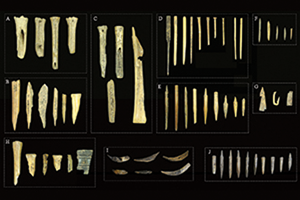
The worked bones can be categorised into materials (blanks, preforms and offcuts) and products (semi-finished and finished) (Table 1, Figures 2 & 3) according to the concept of refitting analysis (Averbouh Reference Averbouh, Choyke and Bartosiewicz2001) and the processing marks of worked bones and then the processing templates (Deetz Reference Deetz1967) can be reconstructed.
Bone materials and products excavated at Pingliangtai. Worked bone (A) and antler (B) offcuts (1 & 1’), blanks (2 & 2′), preforms (3 & 3′) and products (4 & 4′) (figure by Xiaochen Pei).

Bone, antler and teeth products, shell tools and stone tools excavated at Pingliangtai. Bone products: A) chisels; B) awls; C) spatulas; D) hairpins and needles; E) arrowheads; F) gorge hooks; G) other products; and H) broken products. Other finds include: I) animal teeth; J) antler arrowheads; K) other antler products; L) oracle bones for divination; M) shell tools (1–4 are knives, 5 is an arrowhead); and N) stone tools (6, axe; 7, adze; 8, blade; 9–10, arrowheads; 11–13, chisels) (figure by Xiaochen Pei).

Number of worked bones at Pingliangtai.

*Most of the unidentified products are probably bone spatula or chisel.
Experimental replication and microscopic observation
Tools are crucial to bone-working and to determine the efficiency of production.
Before the introduction of metal tools, stone tools were important tools for bone-working, but the scarcity of stone tools found at Pingliangtai, contrasted with the large number of shell tools, especially the shell knives (Table 2), indicates the probability that shell knives were used for bone cutting. We designed replication experiments to cut modern sika deer and cattle metapodials with shell knives made from Hyriopsis cumingii, a common freshwater shellfish which was abundant at Pingliangtai. A Keyence VHX-2000 microscope was then used to observe the working traces on the replicas and to compare these with the Pingliangtai examples.
Number of stone and shell tools from the excavation of 2016 at Pingliangtai.

Spatial analysis
To understand the organisation of bone-artefact production at Pingliangtai, spatial analysis was used to illustrate the distribution of blanks, preforms, offcuts, and semi-finished and finished products within the context of the Longshan settlement.
Results
Selection of raw materials
Among the total of 959 worked bones, 64.8% could be identified to taxon and 65.5% to skeletal element. Large cervids were the most frequently used raw material source (26.3%), followed by medium cervids (21.4%), cattle (6.4%) and small cervids (2.9%). Bones from other species, such as pig and dog, were only occasionally used (less than 1% for each species) (Figure 4A & Table S6). Long bones appear to have been preferentially selected for working, and 49.5% of the worked bones were metapodials (Figure 4B). Antlers were another important raw material, accounting for 10.4% of the total (although selection of antlers differs from that of bones, see OSM). Use of other skeletal elements was low (less than 2% for each element).
Species and skeletal element composition of worked bones at Pingliangtai. A) species composition; B) skeletal element composition; C–H) skeletal element distributions of different animal species (figure by Xiaochen Pei).

Zooarchaeological analysis indicates that a large proportion of faunal remains at Pingliangtai came from cervids (49% by NISP) (Table S5). Metapodials represent a larger component of the bones from large cervids than they do for any other fauna (Figure S5), suggesting an intentional selection of large cervid metapodials for bone-working.
To compare the differences in raw materials from different animals, we calculate the frequency of different skeletal elements by dividing the number of a specific worked skeletal element of an animal by the total number of worked bones from that animal, and then compare these frequencies among different animals. Frequencies of metapodials were highest for cattle (77%, Figure 4E) and cervids (large: 81.3%, medium: 89.8% and small: 64.3%, Figure 4F–H), indicating strong selection in raw material use. Frequencies of the use of cattle radius (4.9%), femur (4.9%) and tibia (8.2%) were also higher than cervids, meaning that more elements of cattle were used for bone-working.
The mpWUI values are also highest for both large cervids and cattle (93.6% and 82.1%, Table 3), while medium and small cervid bones were used less frequently or only occasionally (mpWUI values of 35.3% and 3.7%, respectively). The intensive use of cattle bones for bone-working suggests that, despite being a newly introduced animal during Longshan period and probably limited in number, cattle quickly became an important resource, paralleling the traditional large cervid, for bone-working.
MpWUI of cattle and cervids at Pingliangtai.

Production process of bone artefacts
Generally, production of worked bone at Pingliangtai proceeded through three steps: 1) ‘reduction’ to produce blanks and leave offcuts; 2) ‘shaping’ to produce preforms and leave waste; and 3) ‘finishing’ to produce semi-finished and finished products. An optional fourth ‘decoration’ step involved the marking of products. Here, we use the Longshan worked bones (bones only) to explain the five main processing templates observed at Pingliangtai (Figure 5) (for the production process of antlers and teeth see OSM, Figures S6–S8). Specific templates were generally used for specific raw materials and to produce specific products (Figure 6 and see OSM).
Templates A–E for the production process of bone artefacts at Pingliangtai. The textboxes of Templates A and B describe the bone-working steps of the products; red arrows point at the work traces (figure by Xiaochen Pei).

Percentage of bone-working templates broken down by raw material (A) and product types (B) (for more information see OSM) (figure by Xiaochen Pei).

Template A, the most complex, was used to process the metapodials of cervids and cattle. Bone arrowheads, needles and hairpins were usually made through this template. Template B was mainly applied to medium cervid metapodials to produce bone chisels and spatulas. Template C, the simplest, was used to produce bone awls by simply grinding one end of the bone shaft or fragment. Templates D and E were only occasionally used. Template D was only applied on the ribs of large animals, and template E was applied in the reuse of damaged bone artefacts (e.g. to make bone awls out of broken arrowheads and spatulas). In considering the bone-tool manufacture continuum (Choyke Reference Choyke1997), templates A and E are at the end of the continuum that produces carefully planned tools, whereas template C is at the other end, producing expedient tools. Templates B and D are in the middle, with template B showing more complexity than template D.
Tools for bone-working
Our experiments and microscopic observations imply that the tools for bone-working at Longshan Pingliangtai included shells (Hyriopsis cumingii)—one of the most frequent finds at the site—and perhaps some stone tools. Parallel striations on Pingliangtai offcuts and blanks (Figure 7A & C) are consistent with marks made by H. cumingii shells during the experimental reproduction of bone artefacts (Figure 7E & G). The blunt V-shaped profile of cuts made using these shell knives (Figure 7F) are similar to those seen on the Pingliangtai offcuts (Figure 7B), and use wear on the Pingliangtai shell knives (Figure 7D) was also found on the replicates (Figure 7H). Another technical characteristic of shell cutting on bones was the half-range process, whereby cutting occurred only on the flatter plantar side of a metapodial, to about half the depth of the shaft, before the distal end was forcefully removed, leaving scars on the remaining shaft (Figure 2A, no. 1).
Micro bone-working traces on artefacts. A, B & E, F) cutting traces on distal metapodial offcut; C & G) cutting traces on blanks; D & H) use-wear on shell knives; I) chopping traces on distal radius offcut; J) chopping traces on distal metapodial offcut; K) chiselling traces on preformed blanks; L) grinding traces on semi-finished product. A–D and I–L are archaeological specimens from Pingliangtai, E–H are replicas from experiments. Scale bars are 2000μm (figure by Xiaochen Pei).

Chopping and chiselling traces also appeared on a few offcuts (Figure 7I & J) and preforms (Figure 7K), indicating that heavy stone tools and chisels (Figure 3N, nos. 6 & 7, 12 & 13) were also used for bone-working. The proportion of chopping traces made by stone tools is higher on cattle than cervid bones (Figure 8A).
A) Distribution of cutting and chopping traces on bone offcuts from different animal species; B) distribution of arrowhead thickness with estimated thickness of different animal bones overlaid (figure by Xiaochen Pei).

Grinding traces (Figure 7L) may come from grinding stones like those found at Erlitou and Yuntang (Figures S10 & S12) (Ma et al. Reference Ma, Xingtao and Yanfeng2015; Chen & Li Reference Chen and Zhipeng2016; Zhao Reference Zhao2017). The bone polishing process could be accomplished with water and organic materials such as cloth, bark and hide, which are difficult to detect archaeologically (LeMoine Reference LeMoine1994). Carving and drilling on several decorated products were perhaps performed using small stone tools.
In situ spatial patterns of bone-artefact production
Figure 9 illustrates the distribution of worked bone and antler including offcuts, blanks, preforms, and semi-finished and finished products in the excavation area, showing that they were primarily scattered in the middens around the Longshan row-houses. There is a weak positive correlation (R2 = 0.33) (right-hand graph in Figure 9) between the type and number of worked bone and antler artefacts based on the statistics for each trench, which indicates that there was no settlement-level spatial heterogeneity of labour division and no centralised production or disposal space for bone-working. Worked bones from all stages of production appear around almost all houses and are commonly mixed with other refuse from a variety of daily activities. Protracted use and disturbance from activities in later time periods has left the row-houses heavily damaged, but worked bones may still be seen to concentrate in the north and south middens and in ash pits outside the houses, especially F22, F23, F43 and F49 (red numbers in Figure 9). The full process of bone-artefact production is therefore likely to have taken place at each separate house, meaning that bone-working activities at Pingliangtai were probably conducted at a household level.
The spatial distribution of worked bones and antlers at Pingliangtai. Most worked bones were found in the north and south middens and pits outside houses, especially F22, F23, F49 and F43, which are marked in red (figure by Xiaochen Pei).

Discussion
Bone-working traditions, local subsistence and a new raw material
In central China, the earliest bone artefacts can be traced to the early hominin Lingjing site (Xuchang County, Henan) dated to 125 000–105 000 BP (Doyon et al. Reference Doyon, Li, Li and d'Errico2018). Since the Palaeolithic, cervid bones, antlers and teeth—by-products of hunting and carcass processing—were used to make tools. Metapodials, which are long, straight and dense, were favoured over other bones (Russell Reference Russell, Choyke and Bartosiewicz2001a & Reference Russell, Choyke and Bartosiewiczb; Christensen & Tejero Reference Christensen, Tejero, Balasse, Brugal and Dauphin2015). Zooarchaeological studies at the Neolithic Dadiwan site (c. 5800–2800 BC, Yangshao period, Figure 1A) demonstrate that cervid metapodials were the main raw material used for awls and arrowheads (Yu Reference Yu2009). Dadiwan represents sustainable millet-pig agriculture in the Yellow River Valley (Yang et al. Reference Yang2022), where the hunting of cervids was obviously a supplementary though indispensable part of Yangshao subsistence. Pingliangtai Longshan societies followed the earlier Yangshao bone-working traditions in using cervid metapodials, which were also regular raw materials in the Bronze Age (Li Reference Li2018; Li et al. Reference Li, Zhang, Chen, Wang and Qian2021) (Table S8).
The processing templates of worked bones (bones only) at Pingliangtai were designed around the mechanical properties of different bones to achieve the best fit for the shapes and functions of finished products. Notably, most bone products were made through templates A and B, which were carefully planned with respect to the selection of specific raw materials, standardisation of production steps and techniques, and the high degree of modification, reflecting the formal conventions of bone-working at the Pingliangtai site. Similar characteristics are also found at contemporaneous Longshan sites—for example in the standardisation of production steps applied to certain types of bone artefacts at the Taosi and Zhoujiazhuang sites in the middle Yellow River (Brunson Reference Brunson2015)—suggesting that Longshan societies had developed a mature and prescribed procedure for bone-artefact production.
The frequency of arrowheads and their preforms at Pingliangtai is relatively high (nearly 15% in bone products and 90% in preforms, see Table 1). Arrowheads were used in local hunting activities, for example in the hunting of cervids, the most common faunal category at Pingliangtai (49% on NISP). Bone spatulas and chisels were also found in large proportions at Pingliangtai (36% of bone products, see Table 1), probably because they could be used to scrape the flesh from shellfish (Griffitts & Bonsall Reference Griffitts, Bonsall, Choyke and Bartosiewicz2001; Waselkov et al. Reference Waselkov, Price, Stenson, Hadden, Dinh, Wild, Thurber, Rhodes and St-Pierre2021), which were also consumed in large quantities at Pingliangtai (Figure S4). These bone artefacts were also commonly employed as cutlery in the Neolithic and Bronze Ages in China (Wang Reference Wang1990). Cervids and molluscs were not only eaten but also used for bone-working to produce tools such as bone arrowheads, spatulas, chisels and shell knives, which in turn were used to capture and process these animals. This formed a sustainable circular economic system for both primary (food) and non-subsistence post-mortem (bone raw material) products within the local subsistence economy, in contrast to specialised bone workshops during the Bronze Age, such as Tiesanlu and Yuntang (Figure 1A), whose products were widely re-distributed (Campbell et al. Reference Campbell, Li, He and Jing2011; Zhao Reference Zhao2017).
Nevertheless, as a key period of cultural and technological transition, several elements of bone-working that emerged in the Longshan period were greatly developed in the Bronze Age (Liu & Chen Reference Liu and Chen2012). Cattle, the major raw material for bone-working during the Bronze Age (Table S7) and for divination after the Erligang Culture (c. 1600–1400 BC) (Okamura Reference Okamura2004), began to be employed for bone-working and their scapulae were used for divination (Figure 3L) at Pingliangtai in the Longshan period soon after their introduction to central China. Furthermore, cattle were quickly embedded into the local Longshan bone-working system. Cattle share the traditional large cervid production technology, including processing template and the preference for metapodial, demonstrating technical continuity from the Yangshao period. Chopping traces made by stone tools are more frequent on cattle bones than on those of cervids (Figure 8A), showing that different tools and techniques were attempted at Pingliangtai based on the differences in raw material when faced with a new raw material. Additionally, the high mpWUI of cattle and the manufacture of some arrowheads from cattle bones (based on our measurements, Figure 8B; see also OSM), suggest that cattle bones were used to meet the needs of local subsistence. Compared with cervids, cattle have at least two advantages as a new raw material: 1) their bones have thicker shafts suitable for making a wider range of tools (e.g. arrowheads); and 2) as a livestock rather than a hunted animal (Lin Reference Lin2022), the raising of cattle could be expanded, and more skeletal elements can be easily used, providing a stable source of raw materials. However, no socioeconomic changes occurred until the Bronze Age when metal tools and specialised workshops began to emerge.
Bone-artefact production in the development of social complexity
Increased craft specialisation has been regarded as a key indicator for the development of social complexity (Brumfiel & Earle Reference Brumfiel and Earle1987; Costin Reference Costin1991). Lithic and pottery production began to be specialised in some regions of central China during the Longshan period to meet the increasing need for inter-regional exchange (Zhai Reference Zhai2012; Liu et al. Reference Liu, Zhai, Chen and Underhill2013) or the greater demand for feasting and ritual food consumption (Underhill Reference Underhill and Underhill2002). Similarly, specialised bone-artefact production can also be found at some large settlement centres such as Shimao on the Loess Plateau (Figure 1A) where bone products—mainly needles—were both used locally and circulated to other areas (Li Reference Li2022). In contrast to Pingliangtai, bone-artefact production at Shimao—with sheep bones as the main raw material and needles as the dominant products (Figure 10)—shows the possibility of specialisation requiring mature and large-scale animal husbandry around city centres where labour was concentrated.
The composition of bone artefacts at Shimao, Pingliangtai (PLT), Tiesanlu and Yuntang (note: the percentage of hairpins at Tiesanlu may include some awls) (figure by Xiaochen Pei).

The parameters of bone-working specialisation in central China changed dramatically in the Bronze Age. With the expansion of cattle breeding and the wide use of bronze tools for bone-working (Lu Reference Lu2015; Chen & Li Reference Chen and Zhipeng2016), cattle gradually replaced cervids as the main raw material for worked bone in Bronze Age urban centres from the Erlitou Period (Table S7). Studies of worked bone from the Tiesanlu workshop at the Yinxu site (Campbell et al. Reference Campbell, Li, He and Jing2011) and from the Yuntang workshop at the Zhouyuan site (Zhao Reference Zhao2017) demonstrate that large-scale bone-working was controlled by a governing body in Bronze Age urban centres, with more standardised and single-type-dominated products (Figure 10). Early urbanisation with strongly organised labour, control of resources, advanced technologies and manufacturing management, in addition to new consumption demands, led to a boom in bone-working industries in Bronze Age central China.
As with lithics or pottery, bone-working specialisation seems to have been closely related to the process of urbanisation. While resources, techniques and demands for bone-artefact production were restricted to local subsistence webs in the Late Neolithic, and showed considerable variation between regions, bone-working from Late Neolithic Pingliangtai to Bronze Age urban centres provides us with a clear evolutionary line of bone-artefact production as an agent for the development of social complexity.
Conclusion
Our multi-method analysis reveals that bone-working at the Longshan period Pingliangtai site was mature and evolving, but localised, household-based and self-sufficient, and showed transitional characteristics. Cervid metapodials were the main raw material and formal processing templates were applied, indicating a strong link with the earlier Yangshao tradition and a more developed and mature bone-artefact production. Additionally, as a newly introduced animal, cattle were quickly used with their bone for bone-working. Although they did not immediately change bone-artefact production, the advantages of cattle bones (including thicker shafts and easier acquisition as livestock) were recognised and attempts to intensify the use of cattle can be observed. The introduction of metal tools and concentration of resources in the Bronze Age eventually promoted bone-working to large-scale, specialised and standardised production in urban centres. The case study of bone-working at the Pingliangtai site discussed here shows the close relationship between technological traditions, subsistence, new material and technological invention during the development of early complex societies.
Acknowledgements
We are grateful to all team members who participated in the Pingliangtai excavations in 2016 and 2019. We also thank the anonymous reviewers for their helpful comments.
Funding statement
This research was supported by the National Science Foundation of China (grant no. T2192953; 41971251), the Newton Advanced Fellowship of the British Academy (grant no. NAFR2180079) and Major Project of Mt. Songshan Civilizations Research Association (2021ZH).
Supplementary material
To view supplementary material for this article, please visit https://doi.org/10.15184/aqy.2024.56.


 Open access

