




A stranger or a foreigner landing in our Colony for the first time bids fair to be justly prejudiced at first sight and by primary impressions as he walks along the principal thoroughfares of the city; and neither the venerable antiquity of Fort Thornton, nor the little show for the expensive if not expansive Cathedral can wipe away the adverse opinion the condition of our streets must lead him to form of us. Nature reigns unadorned and uninterfered [sic] with by the rude hands of man and the luxuriant weeds, and frog abounding pools daily offer mute reproach to the Sierra Leone people. Water Street on any fine rainy day presents a picturesque appearance only excelled by those of the by-lanes around and about the purlieus of the Grassfields. The sore afflicted and long suffering denizens of Kissy Road enjoy the luxury of a street remarkable for the romantic scenery formed by countless pools of water situated at equal distance from each other and as it is an ill wind that blows nobody good, the sorry attempts at macadamisation, whilst it annoys the pedestrians, furnish continuous employment to shoemakers.
J.A. Fitzjohn, Sierra Leone Times, 22 July 1893.
The verbose Freetonian editor of the Sierra Leone Times, Fitzjohn, takes the reader of his weekly irony drenched column on an imagined walk through the streets of Freetown, in 1893 a city of just over one hundred years old.Footnote 1 Supposedly prestigious buildings of the colonial presence fail to impress you. Built at the end of the eighteenth century, Fort Thornton is far from ancient and the much-maligned cathedral at Water Street deserves its reputation as underwhelming. Looking down from these not so monumental structures to street level, nature has taken over. Animals and plants alike emerge from pools of water that form like clockwork during the annual rainy season. Water Street, the heart of the colonial port city economy, is not so different from Grassfields, a peripheral neighbourhood in the West End so often framed in this same newspaper as a hub of disease and degraded lives. Kissy Road, the main thoroughfare through the East End, is pockmarked with puddles. Across the city, the failure of street macadamization is an everyday experience of the failures of governance. This is some distance from the imaginary of the archetypal and successful colonial city: of imperial grandeur, of commercial wealth and the extension of British civilization.
Wetness suffuses Fitzjohn’s vision of a degraded city. Freetown has a tropical monsoon climate with a rainy season and a dry season. This dramatic opposition of wet and dry is a product of the West African Monsoon. Between November and April, north-easterly, or Harmattan, winds carry dryness and dust across the region, lowering humidity. Between May and October, the winds reverse, blowing south-westerly off the Atlantic Ocean and over the continent, bringing moisture. Rainfall is heavily concentrated on the coastal region as clouds turn to precipitation over land, a process amplified by the sharp elevation of the mountainous Freetown peninsula. In part because of this abundance of water, from the seventeenth century the peninsula was the site of trade between Fula and Mandingo merchants from beyond the Futa Djallon mountains and Europeans skirting the West African coast on ships.Footnote 2 In the late eighteenth century, the naturalist Henry Smeathman proposed the peninsula as a site of colonial plantations because of its access to plentiful water.Footnote 3 Throughout the twentieth century, Freetown has received a yearly average rainfall of 3,153 millimetres, or 124 inches, approximately two-thirds of which has fallen in deluges during the months of July, August and September.Footnote 4 There is little data on rainfall from the late nineteenth century but the Wesleyan missionary and amateur geographer John Halligey made meteorological notes for 1872 that described for July ‘frequent storms, very wet stormy, cold’ and recorded an extraordinary 47 inches of rain.Footnote 5 Anthropogenic climate change, including rapid deforestation, since the 1940s has in fact led to a slight reduction in the volume of rain that has fallen on Freetown, even though annual rainfall remains extremely high.Footnote 6
Rain has not figured in histories of Freetown in which the rhythms of the monsoon are largely incidental to narratives of the often fractious formation of a nation out of religious and ethnic diversity.Footnote 7 Only more recently, as the vulnerability of Freetown in a changing climate has become so clear, has the urban environment begun to figure in political and developmentalist visions of urban challenges and potentials.Footnote 8 In the dry season, Freetonians struggle to access water as decaying post-independence era infrastructure struggles to provide for an ever-expanding urban population. Meanwhile, in the rainy season, flooding has become a yearly reality for many of the city’s poorest neighbourhoods. Streams swollen by storm rains overflow, destroying homes and often taking lives.Footnote 9
Starting from Fitzjohn’s reading of a sodden and decaying Freetown, contextualized within the extremes of a tropical monsoon climate, this article argues that rain was a vital agent in shaping the lived experience of a wet colonial modernity in Freetown. At the turn of the twentieth century, the city’s elite saw the promised modernity of coloniality decaying in the streets of the rainy season as the government failed to organize adequate maintenance, let alone improvements. Meanwhile, the social organization of Freetown was in transition as colonial politics was shifting, racial categories were solidifying and migrants from the hinterland were moving into the city. The established elite, descended from ex-enslaved settlers, wrote and read decline and decay through a proliferation of wetness, nature, disease and death. In soaking the historiography of colonial Freetown, this article contributes to three streams of thinking across wet urbanity, new oceanic humanities and African print cultures.
Whilst history has been a terra-centric discipline it has long been attentive to the ocean as a scale of analysis. Oceans have been connective tissue between dry lands, a metaphor of flow and migration, and more recently spaces with lives of their own.Footnote 10 In the past two decades, building on the insights of infrastructural studies, research into the interactions of water and society have extended out from oceans and into the ways in which humans have attempted to direct the flow of water through the engineering of infrastructures such as canals, dams, reservoirs and sewer systems. These works have shown the importance of water to the contested, creative, destructive and uneven project of modernity, both its material realities and potent dreamworlds.Footnote 11 Whilst cities have featured in these histories as configurations of water infrastructure, urban wetness has been thought about in more depth from design perspectives. Over the course of several projects, architects Anuradha Mathur and Dilip da Cunha have deconstructed the neat divide between land and water to encourage design that works with water in aqueous terrain.Footnote 12 Inspired by the insights of this work, Ben Mendelsohn’s deep history of the relationship between Lagos and the Atlantic Ocean is unique in revealing the complex and entangled ecologies of land, sand and water across precolonial, colonial and postcolonial times.Footnote 13 Following this path-breaking research, this article describes an urban morphology and urban life saturated with water.
Cutting-edge thinking about water and power in the Global South has emerged from a new literary oceanic humanities rooted in South Africa. Isabel Hofmeyr and Kerry Bystrom’s concept of ‘hydrocolonialism’ has centred water in postcolonial thinking to emphasize the multiplicity of ways in which water has been integral to coloniality.Footnote 14 This evokes maritime conquest and trade but also the exploitation of water resources, colonies on water and the colonization of the idea of water. ‘Hydrocolonialism’ has begun to open new pathways to understanding the relationship between water and both historical and contemporary articulations of coloniality. Sarah Nuttall’s closely connected work on ‘pluviality’, meaning ‘rain, specifically intense rainfall, composite flooding, often in sea rivers and estuaries’, has been crucial in reframing rain as something ‘lively and agentive’.Footnote 15 From this perspective, rain ceases to be something incidental to the formation of the inequalities and exploitation of colonialism.Footnote 16 Rather, rain becomes integral to the workings of a colonial modernity precariously floated on overflowing rivers, streams and drains.
Architectural theorist Lindsay Bremner and the team of the Monsoon Assemblages project have been deeply engaged in researching and writing through and about rain.Footnote 17 From fieldwork in cities across South and Southeast Asia, they write that ‘monsoon as method is a way of thinking with the monsoon’s agential materiality and with its ongoing transformative power as it intra-acts with human and nonhuman bodies and practices’.Footnote 18 This article applies this thinking of the monsoon as actor to historical sources by using Isabel Hofmeyr, Sarah Nuttall and Charne Lavery’s method of ‘reading for water’.Footnote 19 I follow them by following the water, connecting rain, mud, puddles and streams in configurations that challenge understandings of the urban and the modern. In place of postcolonial literary texts, this research into wet Freetown has been rooted in the newspaper archive.
Whilst newspapers have long been important sources for historians of Africa, they have only more recently been closely read as integral to the development of an African print culture that has actively shaped societies across the continent. Derek Paterson, Emma Hunter and Stephanie Newell have made important interventions to show how newspapers in Africa have created new voices and political solidarities.Footnote 20 From the mid-nineteenth century, African elites articulated their position in emerging colonial societies through print, generating a reading public highly engaged in debates taking place on and beyond the pages of the newspaper.Footnote 21 Such historical analysis of newspapers-in-society has gravitated towards their prominent role in nationalist politics of the late colonial period, and famous anti-colonial editors such as Nnamdi Azikiwe.Footnote 22 At the understudied intersection of media history and urban history, Nate Plageman has shown how newspaper correspondents celebrated the proliferating new infrastructures of late colonial Accra to shape the formulation of a nascent nationalism.Footnote 23 This article will follow Plageman in thinking through the relationship between urban form, newspaper discourses, ideas of modernity and colonial politics. Here, however, the focus will be on overlooked newspapers from the turn of the twentieth century, and a city decaying in the context of extreme wetness.
Freetown had a very lively press during the late nineteenth and early twentieth centuries controlled by a small group of male Anglophone Freetonian elites. This article focuses on the Sierra Leone Times, published between 1890 and 1912, and the Sierra Leone Weekly News, published from 1884 to 1951. Whilst the circulations of both newspapers were not large, for example each copy of the Sierra Leone Weekly News published in 1910 sold around 1,000 copies, each individual newspaper would have been read many times over and often read out loud to multiple people at once.Footnote 24 As a result of this generative relationship with an engaged readership, newspapers were important to the transformations of local politics, culture and society. This was understood at the time. Both the Sierra Leone Times and the Sierra Leone Weekly News were accused by Governor Cardew of stirring up the Hut Tax Revolt of 1898.Footnote 25 The turn of the twentieth century was more broadly an important period of change in Sierra Leone as the colonial government introduced racial segregation, distancing itself from the established urban elite, and turned its attention towards pacifying and incorporating the newly founded protectorate. This narrative, described in the historiography as a ‘betrayal’ of the Freetonian elite by the colonial state, is reinterpreted in this article through discourses of wetness and nature.Footnote 26
The first section of this article will tour the streets of the city and describe the experience of wetness, street decay and government neglect in Freetown in the 1890s and 1900s. After traversing this sodden and disorderly terrain, the second section will closely analyse the writing of Freetonian editors, correspondents and readers who described a city turning back into nature and a colonial modernity in decline. The third section will show how this lettered elite used rhetoric linking wetness to mosquitoes and malaria to push for government intervention in the city and to distinguish themselves from recent migrants from the interior. The changing colonial city at the turn of the twentieth century, of both morphology and imaginary, was shaped and defined by a struggling modernity saturated in water.
‘The streets are ill-made and ill-kept’: rain, street decay and government neglect
In the months after the rainy season, Freetown’s churned and muddy streets would be baked by the sun into hard earth. Over the dry season, grass, the natural binder that was supposed to hold the dirt of the streets together, would have six months to grow in preparation for the next rainy season. The grass, however, never lasted long against the deluges that began each May and crescendoed towards a peak in July and August. An article in the Sierra Leone Weekly News describing the West End of Freetown in 1901 blamed the government for neglecting street maintenance: ‘[t]he streets are ill-made and ill-kept; residents having during the wet season to wade through ankle-deep water in going to their business places in the morning’.Footnote 27 In the East End, it was much the same. On Kissy Road, the main road out of Freetown – ‘used by thousands of persons daily’ – funeral processions heading to the cemetery had to pick their way through ‘the murk and mire of this filthy road’.Footnote 28 The indirect route of the ‘wending’ funeral procession, avoiding stagnant puddles, was no solution on Fourah Bay Road where pedestrians were ‘obliged to wade our way, ankle-deep through pools of water’.Footnote 29 Moving through the city during the rains was slow and very wet. Government interventions had been ineffective. The shallow drains that ran alongside the principal city streets always overflowed during the rainy season. Water covered the surface of the pockmarked streets, creating puddles in its dents and depressions that remained for the entire season.Footnote 30
As described by Filip De Boeck, the hole – both as ‘tangible physical depression’ and a metaphor for the ‘dark matter’ of urban life – has become the defining concept of postcolonial Kinshasa.Footnote 31 This failure, or absence, of street infrastructure has become normative across Global South cities.Footnote 32 At the turn of the twentieth century, in Freetown the hole was similarly all encompassing. The uneven surface of the city was experienced through the verticality of its depressions, that each rainy season were filled by water.
Like in Kinshasa over a century later, lack of both political will and government capacity left Freetown’s streets in a persistent state of decay. Disastrous and expensive harbour works during the 1870s had shrunk government budgets whilst substantial loans were repaid. Throughout the 1880s and 1890s, the Public Works Department undertook only the most basic street maintenance, whilst the population of Freetown swelled and the yearly rainy season, like clockwork, churned the earth and grass streets into muddy disarray. Another context for this infrastructural neglect was the formation of a Freetonian majority municipal government in 1893. The colonial government was loath to spend money on Freetown in the years preceding the handover of power. The colonial officials of the Public Works Department and the Executive Council deeply mistrusted the new municipality, unable to believe that Africans could manage the urban infrastructure of Freetown effectively.Footnote 33 To give these racial prejudices the semblance of reality, the colonial government dramatically underfunded the municipality as a cheap way to ensure further urban decay under African self-governance. Not long after the handover, the colonial government reclaimed the responsibility for street building and repair. Once again under the auspices of the Public Works Department, street maintenance continued to be overlooked. Distracted by the construction of the interior railway, colonial surveyors ignored calls from the municipal government and the people of Freetown to attend to the floods and fissures that plagued the city.
In January 1887, a correspondent writing for the Sierra Leone Weekly News exactingly described the necessary increase of funding for roads, streets and bridges as an ‘emergency’. He implored the reader, ideally a colonial official, ‘to take a quiet morning or evening walk to the East and West Ends of the city’, to easily witness the degradation, that in the rainy season would descend into the ‘impassable’.Footnote 34 The repairs that were supposed to take place in the months after the end of the rains, November and December, were not happening. Familiar scenes of convict labourers in the streets forced into the work of digging out overflowed drains, removing obstacles and smoothing the damaged road surfaces were missing. This was strange, thought a frustrated Freetonian, when the labour was free and available.Footnote 35 The evergreen excuse of a straining budget made little sense in the context of the low cost of repairs undertaken by forced labour.
Hassan, a resident of Foulah Town in the East End of the city, wrote to the Sierra Leone Times in February 1894 to bring attention to the ‘very dangerous paths and declivities’ around Mountain Cut, the main road through Foulah Town.Footnote 36 The terrain was so chaotic that even in broad daylight walking was perilous, let alone at night when the half-mile long street was lit by only three lamps. Such descriptions of dilapidation and requests for government support littered the Freetown press in this period but almost always went unheeded. In November 1896, Fitzjohn reported that in response to government prevarication over street maintenance and repair, Foulah Town’s residents had begun to ‘do their own road mending’.Footnote 37 In this context, Hassan’s claim that ‘the authorities do not recognize that portion of the town [Foulah Town] as being within the limits of their jurisdiction’ seems more astute observation than provocative rhetoric.Footnote 38 After years of being ignored by the government, the community took on the work of an absent Public Works Department. Freetonians also called attention to the state of the city streets by petitioning the government directly. Although the colonial government would sometimes squeeze these requests for maintenance into the inadequate budget for roads and bridges, most often the petitions were unsuccessful. In October 1904, a petition for repairs to Fergusson Street, covered in ‘cuts’ and ‘ditches’, was met positively. The budget for 1904 was spent, and the same for 1905, but the government promised the repairs would be included in the budget for 1906. After two years of waiting, as 1906 ended, the residents returned to the government with an enquiry about the repairs. The colonial secretary replied bluntly, ‘it has been found impossible to carry out the repairs thereof, as there is no money for the purpose’.Footnote 39
The work that the colonial government did manage to organize on the streets of Freetown was met with derision. During the ‘annual tussle’ between Freetown’s streets and the rains, Fitzjohn reflected on the repairs made in preparation for the deluges. He could only imagine that the dire state of Oxford Street was the result of inept convict labourers painstakingly digging up all the naturally occurring hard rock and replacing it with loose soil, ready to be immediately turned to mud at the first touch of rain. Fitzjohn looked down from his first-floor window, safely above street level, whilst pedestrians stumbled and struggled through this mud shouting ‘expletives not usually heard in polite society’.Footnote 40 He described Westmoreland Street, Oxford Street and Kissy Road as ‘gone’, so rundown they had ceased to exist. Between these ghostly main streets there was just ‘swamps in the vast wilderness / Some boundless contiguity of slosh’.Footnote 41
At its most extreme, the rainy season could bring Freetown to a standstill. After torrential rain in August 1896:
At the East End, Bambara Town Bridge, used by thousands of persons daily collapsed altogether…Upper Kissy Road, Fourah Bay Road, and the Mountain Cut were literally flooded…All the streets in the Eastern section were literally impassable and to make a bad matter worse the idiotic plan of taking the wet filth and mud from the gutters and throwing it in the middle of the road, appeared to have been kept up, rendering the mud more and slosh most abominable.Footnote 42
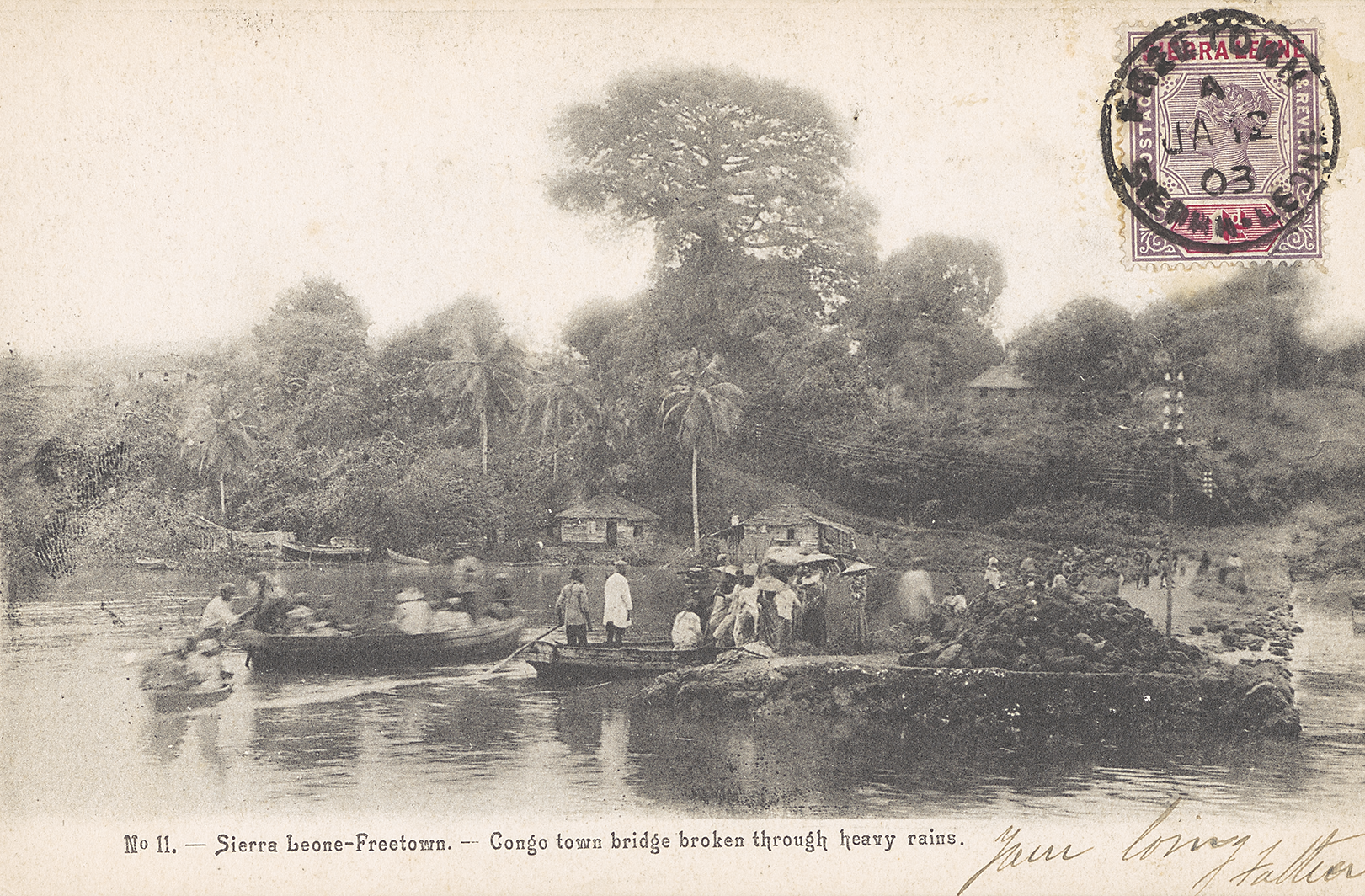
This was an extreme event, but not an extraordinary one. A postcard from 1902 (Figure 1) depicts Congo Town bridge after it had collapsed in floodwaters during the rainy season that year. Bridges regularly collapsed and impassable streets were an annual reality. The streams that bisect Freetown, swollen during the annual deluges, overflowed year on year, reshaping the city on their journeys to the Ocean.
‘No 11. – Sierra Leone-Freetown. – Congo town bridge broken through heavy rains’, Royal Commonwealth Society Collection, Y30446A, postcard, postmarked 1903. Reproduced by kind permission of the Syndics of Cambridge University Library.
‘Good streets form one of the indispensable signs of a prosperous and flourishing city’: writing a deteriorating modernity
Fitzjohn punctuated his critique of the deteriorated state of the streets that began this article with the assertion that ‘good streets form one of the indispensable signs of a prosperous and flourishing city’.Footnote 43 The development and progress of Freetown could be measured by simple observation. In the chaos and mess of the streetscape, Fitzjohn saw a city in decline. In the 1890s, the dilapidated streets had become a fixation for Freetonian newspaper editors, correspondents and readers. Columns and letters were littered with hyperbolic references to urban ruin. This exaggerated reality, the result of government inaction in the context of pluviality, was part of a broader imaginary of a deteriorating modernity that developed on the pages of Freetown’s newspapers in the late nineteenth century. The mud and depressions of the streetscape came to represent two faces of decline: the neglect of Freetown’s basic infrastructures by the colonial government and the expanding population of urban migrants from the city’s hinterland. In writing about decline, the established Freetonian elite were asserting ownership of a city, and an elevated place in its hierarchies, that they felt was slipping from their grasp.
In the final decades of the nineteenth century, the population of Freetown was expanding as people from Temne and Mende heartlands to the north-east and south-east respectively moved to the city.Footnote 44 Between 1880 and 1890, the population of Freetown increased by 8,000 and then between 1890 and 1900, it increased by another 15,000.Footnote 45 Migration to Freetown could provide an escape from a life reliant on the vagaries of agricultural production, or an opportunity to remake social ties in the complex milieu of the heterogeneous city, or wage work between harvests. In 1896, the Sierra Leone protectorate was established, extending colonial sovereignty from the coast into the interior. The colonial state turned its attention towards this new terrain of accumulation with the construction of a railway line from Freetown into the palm oil producing regions to the south-east. Freetonian elites felt the power they had held as intermediaries in the colonial encounter – as civil servants, rentier landlords, merchants – was fading.Footnote 46 This anxiety produced a discourse that framed the city in terms of an encroaching nature, as urbanity in regression, turning back into the bush from whence it came.
Stephanie Newell has shown how Lagosian editors in the colonial era used the discourse of ‘dirt’ to assert a new class consciousness, in opposition to the solidifying racial binary of white and black.Footnote 47 Sanitation was at once evoked to call upon municipal authorities to improve urban public health and to disparage the urban majority. Newell argues that this new elite class consciousness was forged through an adoption and appropriation of colonial public health logics. In Freetown, the established elite, who had close ties to those down the coast in Lagos, deployed a very similar discourse, making use of the binaries of colonial common sense. They mapped a distinction between Freetonian and ‘Aborigine’, on to established understandings of civilized and primitive, urban and rural, to undermine the increasingly dominant formulation of white and black. They evoked colonial anxieties by portraying urban coastal civilization as under threat from a rural primitive interior. Freetown’s elite observed the effects of the pluvial and subsumed them into a hostile rhetoric that heavily criticized both the colonial government and recent migrants to the city.
In his regular column, Fitzjohn exposed the double standards of colonial urban governance. From the ‘beautiful roads which lead up to Tower Hill’ – the site of government house, the military hospital and the barracks – you could look out over the West End of Freetown, to Grassfields, ‘that hotbed of swamps’.Footnote 48 It was not that British imperialism was unable to produce good roads, but rather they were used for the sole benefits of colonial governance and militarization. To Fitzjohn, infrastructural decay was seemingly so extreme that parts of Freetown had returned to a primitive landscape saturated with water, ceasing to be at all recognizable as a city. Such hyperbole contributed to an imagined city overcome by deleterious nature and worked to reveal the real and deep inequalities that undergirded colonial Freetown.
In the East End, at Cline Town, nature was dominant over the built environment. Pigs roamed the street and vegetation grew ‘high enough as to conceal a leopard’.Footnote 49 Here, the writer evoked the bush, where humans were only one of many players in the hunt, as leopards stalked pigs through the streets. This set up a provocative question that probed at the notion of what it meant to be urban, civilized and modern, ‘is not Cline Town part of Freetown?’ Neighbourhoods beyond the city centre were being abandoned by the government to become rural again. But this intrusion of the bush could even reach the heart of the city. Fitzjohn reported in June 1894 that a ‘baboon’ roamed around Rawdon Street, ‘a frightful monster, who molests peaceable and harmless citizens as they pass along’.Footnote 50 The genteel ‘civilians’ of Freetown were under threat from an aggressive nature. It was up to the government to act and reinforce the boundary between the urban and rural.
The imaginary of the bush city was capacious. Alongside its use as a critique of governance, the language of an invasive nature was deployed to closely link recent migrants to the city with disease. Deadly miasmas emanating from the poorest, and most sodden, areas of the city at Grassfields and Brookfields were framed as the product of the failure of both government drainage schemes and primitive understandings of sanitation amongst migrants. Fitzjohn was very clear in making this link between migrants and disease in an invective column from February 1895: ‘[t]he town is simply inundated with aborigines, who hail from all quarters of the horizon. They flock into the town, and thickly locate themselves in quarters which are the hotbeds of filth, dirt and epidemic inciting disease.’Footnote 51 People from the interior brought the bush, and its panoply of deadly diseases, to Freetown. These observations of wetness, the colonial discourse of hygiene and public health and deep anxieties over a city in transition became enmeshed in this imaginary of an encroaching nature.
A petition from William Wycliffe Roberts, a Freetonian photographer, to improve the condition of the streets described an interesting role reversal of urban and rural. In a remapping of the binaries of coloniality, whilst the city was consumed by a primitive nature the interior was being civilized by infrastructures. Freetown’s streets were ‘very insanitary, rugged, and full of grass whilst the roads of the protectorate in the Mendi districts are well made and provided with good bridges’.Footnote 52 Here, Roberts subverted the urban–bush binary to show how the attention of the colonial government on the palm oil producing region to the south-east was closely connected to the receding modernity of the city. The Freetonian elite felt left behind in their city abandoned to nature. The newspapers were the mouthpiece of this anxiety, whilst the street served as the canvas for its expression.
‘What amount of disease and death are in these pools of water’: a discourse of wetness, mosquitoes and malaria
A letter to the Sierra Leone Weekly News, published on 8 June 1889, described a walking tour through ‘rank vegetation’ and ‘pools of water’ in the neighbourhood of Grassfields.Footnote 53 The letter writer, known only as Donkiah, links this wetness to the prevalence of mosquitoes, malaria and death. Donkiah lamented ‘what amount of disease and death are in these pools of water’ and asked ‘cannot the government interfere to ameliorate the condition of things?’ The insanitary condition of a sodden Freetown was causing deaths by the ‘tens and hundreds’. Building on the evocation of disease analysed in the previous section, here the focus sharpens on the pools of water that occupied the dents and depressions of the dilapidated streetscape. Mosquitoes thrived in the late nineteenth-century urban landscape of Freetown. Whilst they did not like rain itself, still waters collected in the holes of a decaying city provided the wetness in which these insects reproduced, and with the success of mosquitoes came the malaria that they transmitted. Matthew Gandy has described how malaria was central to shaping colonial governance in twentieth-century Lagos, where water was everywhere.Footnote 54 Here, evocations of water, mosquitoes and malaria in Freetown’s newspapers at the turn of the twentieth century, concurrent with the colonial discoveries of germ theory, show that mosquitoes were integral to the Freetonian elite’s imagination of a sodden and deteriorating city.
Inspired by Namwali Serpell’s novel The Old Drift, Sarah Nuttall observes that ‘where there is rain, there are mosquitoes’.Footnote 55 Serpell’s novel tells a drenched story of the Zambian nation by tracing interwoven family stories from colonial times into the near future. As generations pass and time unfolds, mosquitoes are a constant buzzing presence, acting as the chorus and narrators. These ancient insects are the past, present and future, having the final word of the story: ‘and so we roil in the oldest of drifts – a slow, slant spin at the pit of the void, the darkest heart of them all’.Footnote 56 Whilst the flooding of the Kariba Dam reservoir is the key hydrocolonial process of the first half of the novel, leading to a proliferation of mosquitoes in floodwaters, Nuttall reminds us that pluviality is not only these extremes, but also that ‘the stagnant wetnesses and swampy thin waters that gather after rainfall, and last longer after flooding, are fertile breeding grounds for one of the most ancient species of all’.Footnote 57 In pluviality, the mosquito thrives.
Mosquitoes have been central to Freetown’s historiography as carriers of the malarial parasite plasmodium falciparum. After a century as the empire’s ‘white man’s grave’, Sierra Leone became a key terrain of early experimentation in the new tropical medicine.Footnote 58 This established story hinges around the discovery of the mosquito as the vector of malaria by Ronald Ross in 1897, the first malaria expedition to Sierra Leone in 1899 and the quick dismissal of holistic approaches to the public health problem of malaria in favour of very unevenly applied racial segregation in Freetown.Footnote 59 More recently, West African historians have returned to this narrative to show how the policies of colonial governments in the region shifted and changed over time, reflecting broader contexts, as well as local struggles.Footnote 60 It is to these local struggles for power, played out in Freetown’s press, that pluviality and its mosquitoes are vital. Wetness and its close association with disease were used by Freetonian editors and correspondents, both before and after the discoveries of Ronald Ross, to at once call the colonial government to action to improve the city and to distance themselves from urban migrants that they decried as disease ridden.
In August 1893, a correspondent for the Sierra Leone Times described Oxford Street, a main thoroughfare running parallel to the waterfront, as ‘a perfect malarial swampy oasis’.Footnote 61 The writer demanded that the Sanitary Department cut the long grass that was growing in front of the houses on Oxford Street, owned by the city’s elite, to prevent the spread of the disease. Meanwhile, in the East End, the colonial government were similarly avoiding their duties of street maintenance. Along Fourah Bay Road, the ‘gutter for about 150 yards is filled with thick slimy foul water; mosquito breeding, frogs sheltering, deadly stagnant muddy matter; just near the very doors of people’s houses and shops. These gutters are the charge of the government’.Footnote 62 Again, along a vital thoroughfare, the government left street infrastructure to turn back to nature, in which mosquitoes could thrive in still waters. Using the language of death, disease and malaria to describe key locations in the city drew attention to the extraordinary neglect of the colonial government. This discourse of public health and sanitation, so central to the workings of colonial urban planning and governance in this period, was used instrumentally to call for urban improvement.
The language of wetness, malaria and disease was at once used to create social distance between the Freetonian elite and recent migrants to the city from its hinterland. Neighbourhoods with growing populations at the periphery of the city, in particular Grassfields and adjacent Brookfields, were persistently posited as principal examples of a city degrading. With characteristic flourish and hyperbole, Fitzjohn pointed Ross’ malaria expedition towards Brookfields: ‘if that swampy and foul-laden region is not as good a breeding-ground for mosquitoes as anywhere else in Africa, then we are prepared to chuck up the sponge’.Footnote 63 Nearby Grassfields was almost as bad. Its gutters held stagnant water that ‘broad-cast the germs of malaria and other fever-producing agencies’.Footnote 64 The presence of the malaria expedition in Freetown heightened the discussion of the disease.
This newspaper discourse mirrored aspects of the colonial ideal of segregation that emerged in the 1890s and crystallized at the turn of the century with the work of Ross and others. Whilst the colonial government was drawing up plans for Hill Station, a whites-only settlement to be built in the mountains to the South of Freetown, the Freetonian elite were working to redraw this colour bar, around a class distinction. They used the colonial discourse of sanitation to associate themselves with cleanliness, neatness and orderliness, in opposition to lower-class Africans who lived in a sodden squalor and created the conditions for deadly diseases to thrive.
Whilst the evocation of malaria by Freetown’s elite was certainly a politics of self-preservation, there was an awareness that segregation, of black and white, or elite and lower class, would not offer any true protection against the spread of malaria. Writing in 1892, Fitzjohn highlighted the importance of a holistic approach to public health by arguing that ignoring the sanitation of peripheral neighbourhoods of the city was ‘imprudent’ as ‘it is from these very localities that epidemic and foul malarial fevers are most likely to come’.Footnote 65 Whilst the migrants and lower-class people beyond the city centre were closely associated with disease, it remained the responsibility of government to do something about it.
Freetonian writers were forging a new elite group identity, whilst at once holding the government to their responsibilities for urban maintenance and improvement. This was not only rhetoric. There was a broader lived reality to these observations of neglect as the decaying streetscape of Freetown held still waters left behind after the rains, providing the waterscape in which mosquitoes reproduced and thrived. During the initial malaria expedition, Ronald Ross derided Freetown’s ‘incompetent engineering efforts…maintained by the grossest sanitary neglect…the roadside drains being generally nothing but [a] series of deep pools filled with stagnant water seething with insect life’.Footnote 66 Although the paucity of colonial record-keeping on the health of Africans for this period means there is no data on the prevalence of malaria, it is possible to draw a connection based on limited collected statistics. The extremely high infant mortality rate, recorded as over 400 deaths per 1,000 births per annum between 1897 and 1900, is suggestive of the extraordinary pervasiveness of malaria in the city as the disease is particularly deadly amongst the very young who have yet to build up resistance.Footnote 67 In the ecology of water, mosquito, human and dysfunctional infrastructure, the diseased environment of the colonial city was amplified.
Conclusion
In Freetown, rain has shaped the urban landscape in close dialogue with government neglect, shifting colonial politics and deadly ecologies. This was the physical morphology of the colonial city, but also its potent imaginaries that were produced on the pages of the Sierra Leone Times and the Sierra Leone Weekly News. Reading for water has meant reading along the grain of observations about wetness, disease and decay. In the contexts of a colonial government more interested in the potential for accumulation in a newly claimed interior and the movement of people to the city from this hinterland, the established Freetonian elite felt squeezed from both above and below. The editors, correspondents and letter writers among them bore witness to the sodden decaying city and turned it into something politically expedient and divisive. This article has shown that newspapers, so central to the social, political and cultural history of modern cities, can be read for insights into the materiality and imaginaries of urban environments. Meanwhile, bringing the methodology of reading for water to the archive, of newspapers and otherwise, provides a model for folding environmental history into the cultural and social histories of the urban. Rain has shaped our cities and how we live in them.
Historians are well placed to show the ways in which wet urbanity is now only intensifying. The history of rain is playing out in violent ways as climate change presses upon rapidly expanding coastal cities in the Global South. On the periphery of Freetown, on 14 August 2017, at the height of the rainy season, a side of Sugar Loaf Mountain collapsed onto a community at Regent, killing over 1,100 people and leaving at least another 3,000 people homeless. In a mirror of the way colonial-era writers critiqued both recent migrants to the city and the urban government, the contemporary media apportioned blame for the landslide between the precarious inhabitants of the sprawling urban periphery and the government’s total absence of urban planning regulation.Footnote 68
The victims of the landslide had squatted on dangerous land that was vulnerable to the increasingly extreme climatic conditions of the twenty-first century. Yet, amongst reports on the disaster, there was little consideration of the wider processes that pushed them there. The history of the changing relationship between rain and settlement on the Freetown peninsula informs this contemporary devastation. Deforestation of the mountain slopes began in the early nineteenth century to serve the nascent colonial settlement of Freetown. The colonial city needed wood and space. Here, we can locate the beginning of the straining ecology of the peninsula as the destruction of tree roots loosened mountain-side earth. Freetown’s population has increased dramatically since the 1960s and has boomed since the mass displacement of people during the civil war of the 1990s. In the absences of both planning regulation and available housing, the mountain sides have increasingly become places of dense human habitation. More recently, these precipitous peripheries have also become sites of intense real estate speculation, pushing this urban frontier further and higher. These unchecked processes of informal urbanism, both from above and below, at environmentally vulnerable urban peripheries in Africa will continue to intersect with extreme rain in highly destructive ways.
Acknowledgments
Thank you to my Ph.D. supervisor, Rebekah Lee, for consistently supporting my research and for all the help developing my thinking on the history of Freetown. Also, thank you to the colleagues at the Charting African Waterscapes and New Directions in African Humanities conferences who listened, responded to and helped shape work-in-progress versions of this article. Finally, thanks to the anonymous reviews whose comments were so important in the final stages of editing this article.
Funding statement
This research was supported by AHRC doctoral funding from CHASE DTP.
Competing interests
The author declares none.


 Open access

