


Introduction
Hunting strategies and tactics deployed by past hunter-gatherer societies are key to understanding the changing relationships between human populations and their environment over time. This becomes especially relevant at middle and high latitudes where hunting is a crucial aspect of human subsistence (Binford Reference Binford2001). The hunter–environment relationship and the degree and type of relationships within and between human groups are both equally important (Binford Reference Binford1978a; Aschero & Martínez Reference Aschero and Martínez2001; Frison Reference Frison2004; Moreno Reference Moreno2012; Bar–Oz & Nadel Reference Bar-Oz and Nadel2013; Borrero Reference Borrero2013).
Hunting structures, their relationship with landscape features, and the knowledge about their spatial location and functioning (i.e. hunting strategies and tactics) can be understood not only as a part of a hunting strategy based on the construction of special-purpose facilities or site furniture (Binford Reference Binford1978b), but also as components of a built niche (Laland & O'Brien Reference Laland and O'Brien2010). In this context, the continuous use and transformation of the landscape—particularly of its durable components such as hunting blinds—by hunter-gatherer populations implies the notion of inherited landscapes. In fact, structural modifications to the landscape are transmitted from generation to generation as a form of ecological inheritance, whereas the knowledge necessary for successful hunting, either individual or communal, is acquired through social learning (Smith Reference Smith2013).
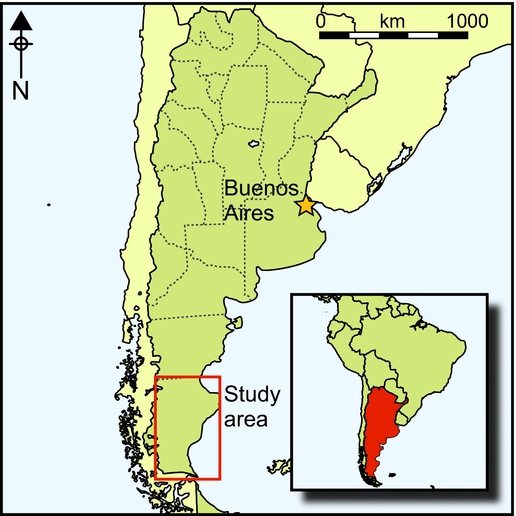
The presence of hunting blinds (locally known as parapetos) in the western basaltic plateaux of southern Patagonia (700–1100m asl, Santa Cruz Province, Argentina) (Figure 1) was first described in the late 1950s (Gradin Reference Gradin1959–Reference Gradin1960). They are mostly semi-elliptical stone structures built for the hunting of guanaco (Lama guanicoe). This medium-sized wild camelid was the main staple for pedestrian hunter-gatherer populations from the very outset of human settlement in Patagonia during the Late Pleistocene (Miotti Reference Miotti1998; Mengoni Goñalons Reference Mengoni Goñalons1999; Borrero Reference Borrero2001). The location, distribution and spatial arrangement of the hunting blinds recorded in this region suggests that they were regularly employed as tactical options in ambush hunting strategies, particularly in the Late Holocene (Belardi et al. Reference Belardi, Espinosa, Barrientos, Carballo Marina, Re, Campan, Súnico, Guichon, Zangrando, Barberena, Gil, Neme, Giardina, Luna, Otaola, Paulides, Salgan and Tívoli2013; Cassiodoro et al. Reference Cassiodoro, Re, Rindel, Cassiodoro, Re and Rindel2014; Goñi et al. Reference Goñi, Re, Belardi, Flores Coni, Guichon, Goñi, Belardi, Cassiodoro and Re2014, Reference Goñi, Cassiodoro, Flores Coni, Dellepiane, Agnolín, Guichon and Mena2016). In addition to radiocarbon dates, the late chronology of hunting blinds is strongly supported by contextual evidence such as the presence of pottery sherds, certain rock art motifs and projectile point designs assigned to the last 2500 years BP (Belardi et al. Reference Belardi, Espinosa, Barrientos, Carballo Marina, Re, Campan, Súnico, Guichon, Zangrando, Barberena, Gil, Neme, Giardina, Luna, Otaola, Paulides, Salgan and Tívoli2013; Cassiodoro et al. Reference Cassiodoro, Re, Rindel, Cassiodoro, Re and Rindel2014; Goñi et al. Reference Goñi, Re, Belardi, Flores Coni, Guichon, Goñi, Belardi, Cassiodoro and Re2014). Ethnohistorical sources, ethnographic models and archaeological data led Goñi (Reference Goñi2010) to suggest that after the introduction of the horse (in the eighteenth century AD), the organisation of human activities—and especially hunting strategies—changed in a number of ways, and the blinds may have ceased to be used, at least on a regular basis.
Location of the landscapes and places surveyed.
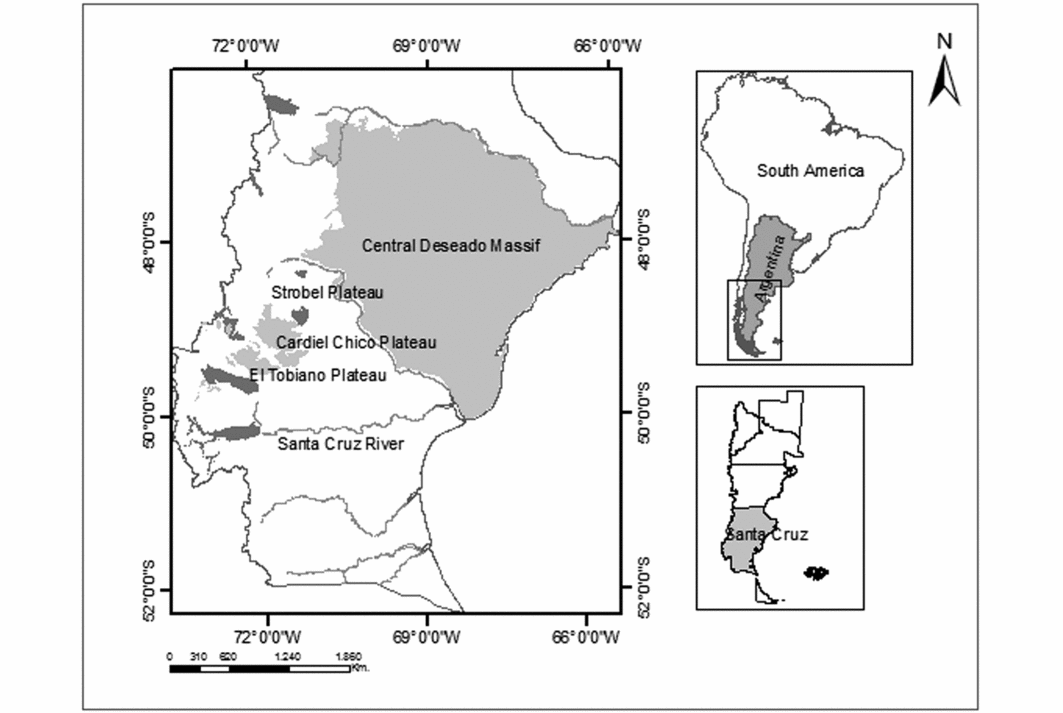
The aim of this article is twofold. Firstly, it will present and discuss recently collected evidence about hunting blinds in two arid cold steppe landscapes that represent the geographic extremes of a major Late Holocene cultural and social interaction area in southern Patagonia (Belardi & Goñi Reference Belardi, Goñi, Fiore and Podestá2006; Goñi et al. Reference Goñi, Re, Belardi, Flores Coni, Guichon, Goñi, Belardi, Cassiodoro and Re2014): a) the western basaltic plateaux (Cardiel Chico and El Tobiano, 900–1100m asl); and b) the central Deseado Massif, extra-Andean Patagonia (hills and sedimentary/basaltic plateaux ≤1000m asl) (Figure 1). Secondly, it will model different hunting tactics that functioned within a general close-encounter, ambush hunting strategy based on the use of blinds in order to contribute to the wider discussion about the tactical deployment of special facilities for the hunting of ungulates (e.g. Bar-Oz & Nadel Reference Bar-Oz and Nadel2013).
Guanacos: population structure and behaviour
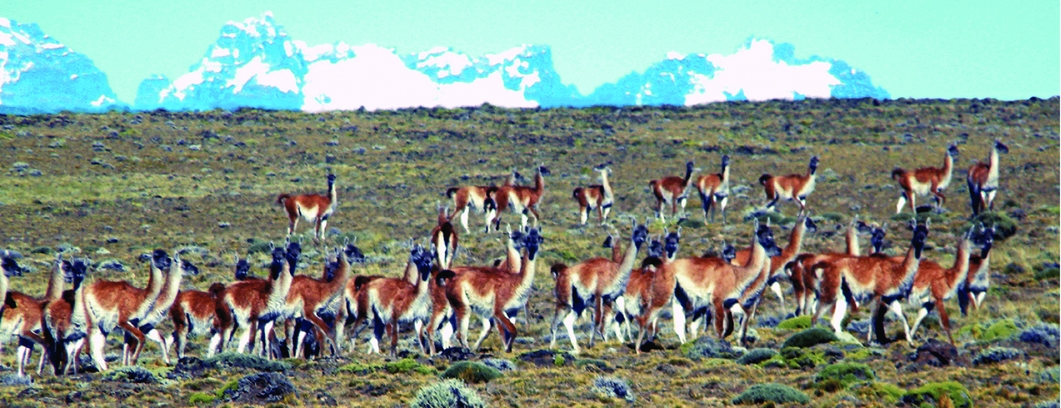
The guanaco is a generalist, medium-sized herbivore (90–120kg), characterised by a social organisation based on a polygynous mating system (González et al. Reference González, Palma, Zapata and Marín2006). Even though it is mostly a grazer, it can also browse according to food availability and season (Figure 2). Its behaviour may be described as seasonally territorial, with some exceptions mainly related to zones with year-round water availability. Three basic social groups are found in wild populations: family groups, male groups and solitary individuals (González et al. Reference González, Palma, Zapata and Marín2006). Holocene hunter-gatherers took advantage of the relatively predictable family group distribution of guanacos resulting from the territorial behaviour of males (Kaufmann Reference Kaufmann2009).
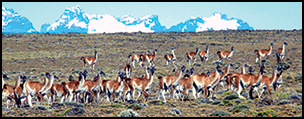
Guanaco family group on the Tobiano basaltic plateau. The Andes range is seen on the horizon.
Current guanaco population density in southern Patagonia is high (1.1–7.4 individuals/km²) and very variable across space. Western basaltic plateaux are the preferred calving areas (late spring and summer); the availability of guanacos in this environment is therefore seasonal and its high density is due to the presence of different social groups. By contrast, in the central Deseado Massif, guanacos are available year round, but their density is lower owing to their more widely spread distribution (Travaini et al. Reference Travaini, Zapata, Bustamante, Pedrana, Zanón and Rodríguez2015 and references therein). Although estimating past guanaco distribution and density are difficult, they are expected to have been similar to present-day values, at least in relative—mainly spatial—terms.
Previous knowledge about hunting blinds in southern Patagonia
Hunting tactics during most of the human occupation of southern Patagonia did not involve the use of hunting blinds. Rock paintings—attributable to the Early Holocene—show scenes of collective hunting, with hunters guiding guanaco herds towards rugged landforms where they were intercepted by other hunters. Those images also show the use of stone bolas (Aschero Reference Aschero and Clottes2012). The appearance and intensive use of tended structures for hunting during the Late Holocene show a new relationship between human pedestrian populations and their main prey, probably related to changes in both guanaco behaviour and human population density.
Hunting blinds were constructed using rocks available locally (mostly basalt), facing the prevailing western winds so as to offer shelter to hunters who tried to avoid being scented by the prey. On occasions, hunters seem to have used elements of local topography such as natural steps in basalt formations or rocky outcrops to conceal themselves, sometimes also using boulders placed purposefully on an outcrop to gain height for their shelter. The artefacts commonly found inside the blinds consist of bases and fragments of projectile points, as well as tiny microflakes, suggesting point replacement and the final retouching of edges (e.g. Hermo Reference Hermo2008; Magnin Reference Magnin2010; Goñi et al. Reference Goñi, Re, Belardi, Flores Coni, Guichon, Goñi, Belardi, Cassiodoro and Re2014). It is notable that some hunting blinds are currently being reused by contemporary chulengo (i.e. young guanaco) hunters.
Most southern Patagonian hunting blinds are located on the top of basaltic plateaux or on access roads leading to them: Buenos Aires Lake Plateau (Gradin Reference Gradin and Otero1996), Guitarra Lake Plateau (Goñi et al. Reference Goñi, Cassiodoro, Re, Guichon, Flores Coni, Dellepiane, Bárcena and Chiavazza2010), Pampa del Asador (Espinosa & Goñi Reference Espinosa and Goñi1999), Perito Moreno National Park and the foothills of the Águila Plateau (Molinari & Ferraro Reference Molinari, Ferraro, Civalero, Fernández and Guaraieb2004; Cassiodoro et al. Reference Cassiodoro, Re, Rindel, Cassiodoro, Re and Rindel2014), Strobel Plateau (Flores Coni Reference Flores Coni2014; Goñi et al. Reference Goñi, Re, Belardi, Flores Coni, Guichon, Goñi, Belardi, Cassiodoro and Re2014) and Cardiel Chico Plateau (Belardi et al. Reference Belardi, Espinosa, Barrientos, Carballo Marina, Re, Campan, Súnico, Guichon, Zangrando, Barberena, Gil, Neme, Giardina, Luna, Otaola, Paulides, Salgan and Tívoli2013 and this article). These plateaux are covered with snow throughout autumn and winter due to their high altitude; their use by hunter-gatherer populations would therefore have occurred in late spring and summer. In addition, the plateaux are surrounded by low-altitude lake basins (250–275m asl) that were used by hunter-gatherers year-round. In the central Deseado Massif, hunting blinds are located on hills, small plateaux and rocky outcrops, taking advantage of the uneven terrain (Hermo Reference Hermo2008; Magnin Reference Magnin2010).
No radiocarbon dates were obtained from the hunting blinds, either in the Cardiel Chico/El Tobiano basaltic plateaux or in the central Deseado Massif sample, due to the lack of organic archaeological material. As mentioned above, however, radiocarbon data from nearby plateaux and the central Deseado Massif indicate that the occupation of this environment occurred mainly over the last 2500 years BP.
Present study
The landscapes
The climate of the western basaltic plateaux (Ramos Reference Ramos and Haller2002) and the central Deseado Massif (Panza Reference Panza2001) (Figure 1) is arid cold steppe, with mean temperatures between 8 and 10°C. In both landscapes the vegetation has a patchy distribution and is composed of shrubs, sub-shrubs and gramineous species, whose occurrence is associated with natural drainage systems (Oliva et al. Reference Oliva, González, Rial, Livraghi, Borrelli and Oliva2001).
Western basaltic plateaux have relatively homogeneous, flattened surfaces with plenty of ponds, characterised not only by the presence of hunting blinds but also by the availability of water and shelter, provided by the basaltic walls that surround the ponds. Good-quality igneous and sedimentary rocks are available for knapping (Espinosa et al. Reference Espinosa, Belardi, Barrientos, Campan and Súnico2015), a resource that was complemented by the transfer of allochthonous obsidians from Pampa del Asador (Espinosa & Goñi Reference Espinosa and Goñi1999). These characteristics, along with the seasonal availability of guanacos, make these basaltic plateaux an important attractor for human activity.
The central Deseado Massif has a slightly uneven surface morphology characterised by vast sedimentary plains with a slight eastward slope. The landscape is jagged, with hills and isolated volcanic cones, alternating with rocky outcrops and small plateaux crossed by longitudinal and transverse valleys. In striking contrast to the western basaltic plateaux, there are numerous rockshelters and caves. The fluvial system is composed of seasonal bodies of water (De Giusto et al. Reference De Giusto, Di Persia and Pezzi1980). There is a high availability of good-quality, but heterogeneously distributed, lithic raw materials for knapping (Cattáneo Reference Cattáneo2002; Hermo Reference Hermo2008; Franco et al. Reference Franco, Cirigliano, Vitrisano and Ambrústolo2015, among others). As in the western basaltic plateaux, the widespread use of black obsidian from Pampa del Asador is also recorded (Molinari & Espinosa Reference Molinari and Espinosa1999; Franco et al. Reference Franco, Cirigliano, Vitrisano and Ambrústolo2015).
Both landscapes share the same complex of engraved geometric and figurative motifs, which appear to be associated with living and hunting areas (Goñi et al. Reference Goñi, Belardi, Re, Nuevo Delaunay, Molinari, Ferraro, Hostig, Strecker and Guffroy2007, Reference Goñi, Re, Belardi, Flores Coni, Guichon, Goñi, Belardi, Cassiodoro and Re2014; Carden Reference Carden2008; Acevedo et al. Reference Acevedo, Fiore, Franco and Ocampo2012–Reference Acevedo, Fiore, Franco and Ocampo2014; Blanco Reference Blanco2014). Although there are noticeable spatial differences in the richness of motifs as well as in the density of representations (higher in the plateaux and western Deseado Massif, fewer in the eastern Deseado Massif), a common major interaction area could be proposed on this basis and other contextual evidence (e.g. exploitation of the same obsidian sources, generation of similar hunting landscapes) (Belardi & Goñi Reference Belardi, Goñi, Fiore and Podestá2006; Goñi et al. Reference Goñi, Re, Belardi, Flores Coni, Guichon, Goñi, Belardi, Cassiodoro and Re2014).
Methodology
Hunting blinds were surveyed during several field seasons by means of a semi-random search around areas in which their presence was suspected. A variable number of observers (between two and five) participated in each field season. Data collection took into account the following variables: a) geographic coordinates (measured in degrees, minutes and seconds with GPS); b) geomorphological setting; c) degree of clustering (determined by the presence of two or more structures within a 20m radius around the first detected structure); d) shape (semi-elliptical/linear); e) size (chord line, sagitta and wall height measured in centimetres); and f) absence/presence of artefacts inside or around each blind.
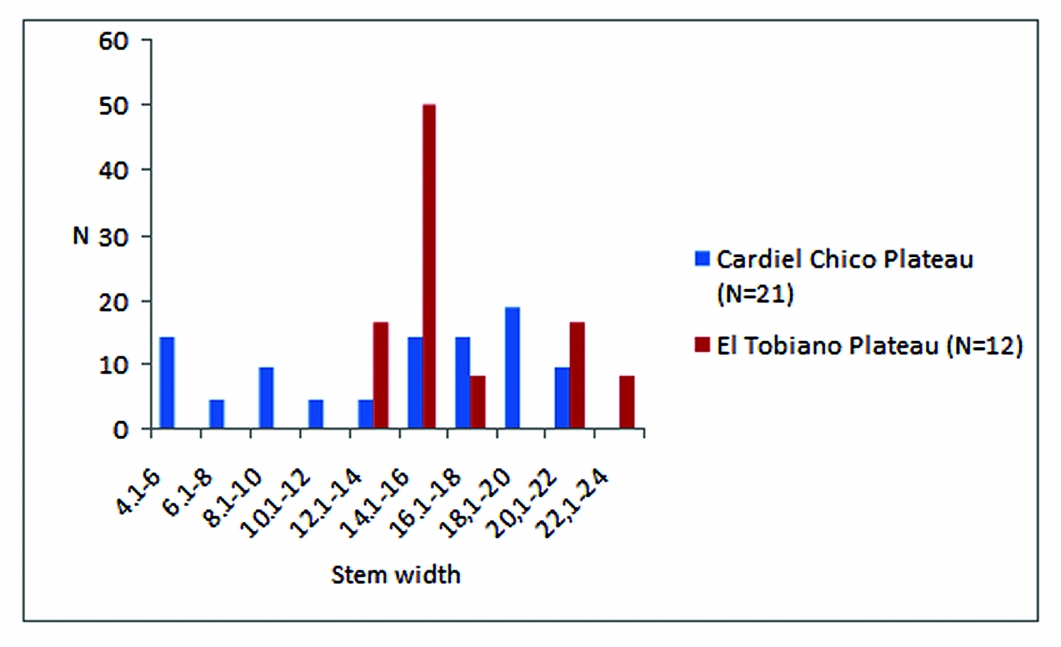
In addition, in the case of the western basaltic plateaux, we also used a slide calliper to record the stem width of the projectile points recovered inside the blinds and in their immediate surroundings (four associated projectile points were recorded in the central Deseado Massif, but no metric information is available). The aim was to distinguish the probable use of different weapon systems, namely throwing spear and bow and arrow. Stem widths less than 10mm were considered to belong to arrowheads, while stem widths greater than 10mm were assumed to correspond to points of throwing spears (Churchill Reference Churchill, Peterkin, Bricker and Mellars1993; Ratto Reference Ratto2012). The high rate of blade fracture and loss precluded any further metric analysis on the recovered points and point fragments.
Distributional and dimensional data results
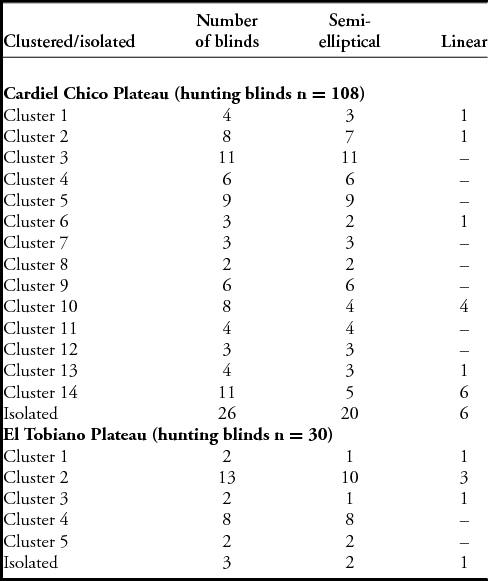
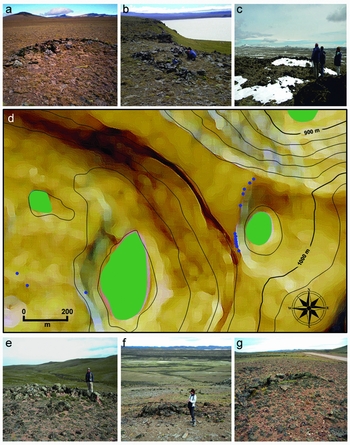
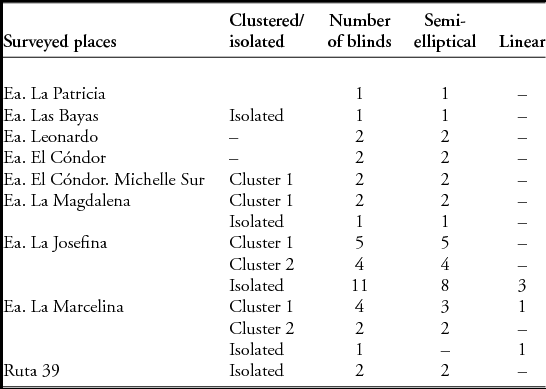
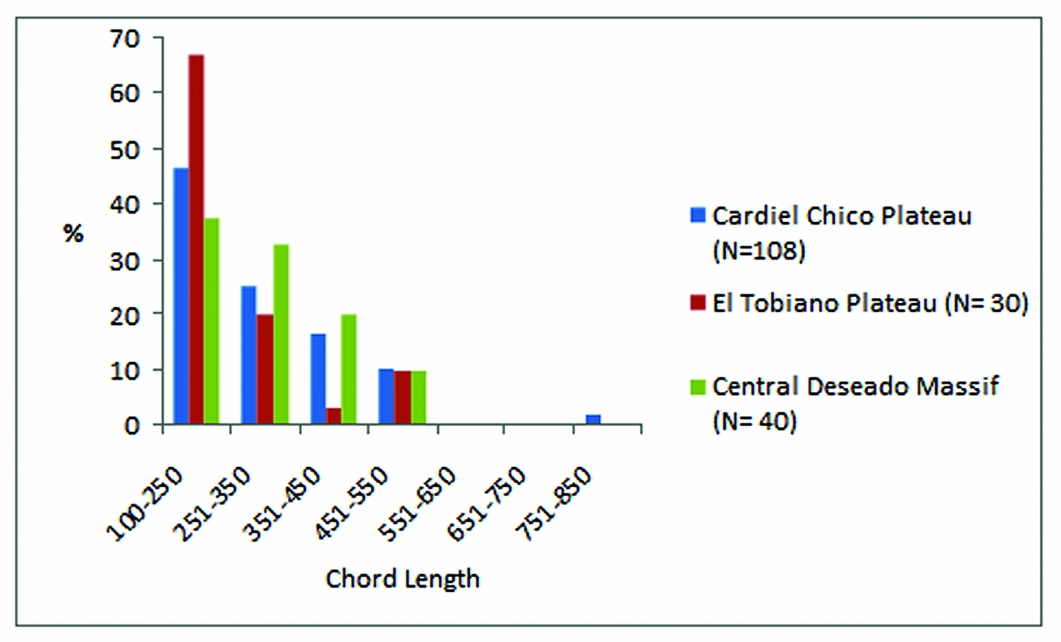
The presence of hunting blinds at Cardiel Chico and Tobiano plateaux (in the western basaltic plateaux) (Table 1 & Figure 3a–c) is more frequent than in the central Deseado Massif (Table 2 & Figure 3e–g). Moreover, these landscapes differ in the density of hunting blinds per km2: 2.8 in the western basaltic plateaux and 0.3 in the central Deseado Massif. Likewise, in the former landscape, clusters of hunting blinds prevail over isolated ones, with marked variations in frequency. In contrast, in the central Deseado Massif, most hunting blinds are isolated (52.5 per cent) and the clusters are composed of a smaller number of structures (between two and five). Despite these differences between the two landscapes, they share a high frequency of semi-elliptical hunting blinds and the same distribution of size intervals (Figure 4).
Hunting blinds from the western basaltic plateaux (Figure 1). Surveyed area: 49km2.
a–c) Hunting blinds from Cardiel Chico basaltic plateau; d) distribution of blinds (blue dots) at El Tobiano plateau; e–g) hunting blinds from the central Deseado Massif.
Hunting blinds from the central Deseado Massif (Figure 1). Surveyed area: 129 km2. Hunting blinds n = 40.
Histograms of relative frequency (%) of hunting blind chord length (in cm).
The stem width of projectile points recovered from blinds in the western basaltic plateaux (mostly obsidian) indicates the prevalence of throwing spears (Figure 5). These weapons are frequently used when the prey is at a disadvantage, mostly in the context of communal hunting (Churchill Reference Churchill, Peterkin, Bricker and Mellars1993). In the Cardiel Chico plateau, however, the use of bow and arrow can also be inferred. This weapon can be very efficient for hunting camelids, as the method is rapid, noiseless and does not provoke stampedes (Yacobaccio & Vilá Reference Yacobaccio and Vilá2013). In two structures, both spear and arrow points were found, although it is at present difficult to say with confidence that both weapon systems were conjointly used in the same hunting events.
Histograms of absolute frequency of projectile point stem width (in mm).
Modelled guanaco hunting tactics involving blinds
Guanaco hunting tactics using hunting blinds were modelled based on location, distribution and spatial arrangement of the structures (Figure 6). The tactics inferred included both individual and communal hunting, i.e. the action of individuals working together for a common purpose or goal (see Hockett et al. Reference Hockett, Creger, Smith, Young, Carter, Dillingham, Crews and Pellegrini2013). Individual hunting occurs when a hunter employs a small-sized, isolated, usually linear, hunting blind (tactic one). Communal hunting involves the use of a cluster of hunting blinds in the plains (tactic two), with hunters waiting for the different guanaco social groups to go into or out of the ponds (tactics three and four), on the downward slopes of the plateaux (tactic five), on the plains between ponds (tactic six); and by using natural narrows in order to direct guanacos to linear arrangements of hunting blinds (tactic seven; see also Figure 3d). Tactics one to four are common to both of the landscapes described here.
Modelled hunting tactics (see references in text).
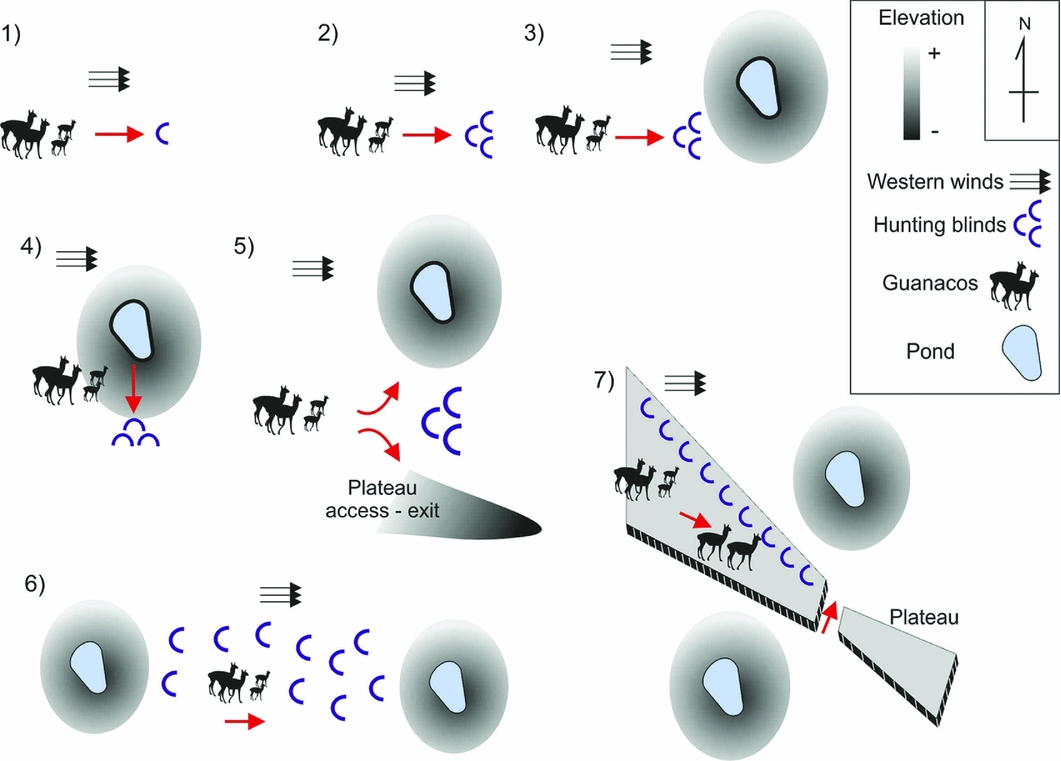
These tactics reveal that communal hunting using structures seems to have been more important in the western basaltic plateaux, from the greater frequency of clustered hunting blinds in that region. Coordinated activities between hunters could have also required the presence of individuals flushing out the prey near the hunting blinds. The predominance in both landscapes of blinds with chord lengths in the 1–2.5m and 2.51–3.5m categories (Figure 4) may indicate that these blinds were designed to accommodate a small number of hunters. The only case that does not follow this trend is a large hunting blind on the Cardiel Chico plateau, which might have been used by a larger group of hunters.
Discussion and conclusions
Overall, the western basaltic plateaux and the central Deseado Massif landscapes seem to have had both similarities and differences as hunting grounds during the Late Holocene. The similarities in the shapes of hunting blinds, their sizes and specific hunting tactics between both landscapes can be explained either by functional constraints (guanaco population structure and behaviour), common traditions (shared cultural/social practices and ideas) or both. As mentioned above, there is strong contextual evidence supporting the hypothesis of a broad social interaction sphere, and hence of a shared cultural transmission system operating in southern Patagonia north of the Santa Cruz River, particularly centred around the Strobel plateau (‘convergence model’; Belardi & Goñi Reference Belardi, Goñi, Fiore and Podestá2006; Goñi et al. Reference Goñi, Belardi, Re, Nuevo Delaunay, Molinari, Ferraro, Hostig, Strecker and Guffroy2007, Reference Goñi, Re, Belardi, Flores Coni, Guichon, Goñi, Belardi, Cassiodoro and Re2014).
Differences in the frequency and diversity of blinds, as well as in the inferred hunting tactics, can be explained by differences in topography, seasonality, prey biomass and hunter-gatherer density. The higher frequency and density of hunting blinds, and the variety of tactics identified at the Cardiel Chico and Tobiano plateaux, are in general agreement with data from other western basaltic plateaux (Cassiodoro et al. Reference Cassiodoro, Re, Rindel, Cassiodoro, Re and Rindel2014; Goñi et al. Reference Goñi, Re, Belardi, Flores Coni, Guichon, Goñi, Belardi, Cassiodoro and Re2014, among others). They are also in accord with the model described above, which proposes the use of these high-altitude environments either as seasonally exploited hunting grounds, approached logistically from lower lake basins (Cardiel, San Martin and Viedma), or as places of more stable occupation by hunter-gatherer family groups. The information presented in this study can help to establish meaningful distinctions in terms of human land-use patterns, particularly calling attention to the relative importance of highland settings as major and reliable sources of critical resources for foraging peoples, a topic that is still not fully appreciated in archaeological studies of hunter-gatherers (Binford Reference Binford and Grønnow2009: 220).
Finally, the information presented in this article, particularly the combined use of hunting blinds and bows and arrows recorded at the Cardiel Chico plateau, suggests a scenario of increasing hunting pressure on guanacos in Late Holocene times (L'Heureux Reference L'Heureux2008). This could have been related to a general human population increase in southern Patagonia (Borrero Reference Borrero1994–Reference Borrero1995; Goñi Reference Goñi2010; Belardi et al. Reference Belardi, Espinosa, Barrientos, Carballo Marina, Re, Campan, Súnico, Guichon, Zangrando, Barberena, Gil, Neme, Giardina, Luna, Otaola, Paulides, Salgan and Tívoli2013), or to a differential distribution of population across this region (Borrero Reference Borrero1994–Reference Borrero1995; Goñi et al. Reference Goñi, Barrientos and Cassiodoro2000–Reference Goñi, Barrientos and Cassiodoro2002; Belardi & Goñi Reference Belardi, Goñi, Fiore and Podestá2006). This widespread ‘hunting blind landscape’ is not present south of the Santa Cruz River (Figure 1), probably owing to differences in regional topography as well as to a lower human population density (Borrero Reference Borrero1994–Reference Borrero1995). In any case, a more detailed comparison with areas inside and outside Patagonia is needed in order to shed more light on this problem and on the broader issue of the relationship between hunting technology, population density and intensification (Tomka Reference Tomka2013; Morgan Reference Morgan2015).
Acknowledgements
We thank the Jordana family and H. Hernández, from Ea. San Adolfo, and Ana Rojo, from Ea. Punta del Lago, for their hospitality and field assistance. María Clara Álvarez, Luis Borrero, Gustavo Martínez, Peter White and two anonymous reviewers contributed valuable comments. The research was conducted with grants provided by the Universidad Nacional de la Patagonia Austral, Unidad Académica Río Gallegos, Proyecto 29/A304-1 and CONICET PIP-11220120100622CO (Res. 4316).



