


- GHG
-
greenhouse gas
Even in the twenty-first century, a billion people around the world go to bed hungry and a further billion suffer from a shortfall of micronutrients( 1 ). Alongside this picture of under-nutrition, more than a billion are overweight or obese, putting them at increased risk of diet-related diseases( 1 ). In rich and poor countries, overweight, obesity and diet-related diseases, such as CVD and type 2 diabetes, are found alongside under-nutrition. Even when energy intake is sufficient or in excess, the foods consumed may be poor sources of essential nutrients. Governments around the world are grappling with the challenges of food security, which has traditionally focused on producing more food, not necessarily more nutritious food. An emerging realisation over the past decade or so has been the need to take into account the sustainability of current food production methods in the face of climate change and the need to feed an increasing global population that is typically also living longer( 1 ). Towards the end of 2011, the world's population reached seven billion and is projected to increase by a further billion by 2025, adding 500 million people to African and to Asian populations. Population growth is far slower in Europe, North America and other westernised societies, and in some cases is declining. Nevertheless, for the first time, the world's urban population has exceeded the numbers living in rural situations, owing to the transition taking place in many parts of the world. Despite the extreme poverty that continues to exist, many people in emerging economies are becoming more prosperous and this is triggering demand for different types of food, as well as fresh water and energy, and this in turn is influencing emissions of greenhouse gases (GHG; CO2, CH4 and N2O). The pattern of climate change over the next 15–20 years will be determined by GHG already in the atmosphere. Agriculture contributes 12–14% of global GHG emissions (including those associated with fertiliser production), and it contributes disproportionately to CH4 and N2O production that have a higher impact on global warming.
Total global impact of the food system on GHG emissions, including in particular those beyond the farm gate and derived from land conversion, is estimated to be about 30%. Low- and middle-income countries contribute three-quarters of this and their proportional share is increasing. Keeping emissions in check is yet another challenge as we strive to produce significantly more food of appropriate nutritional quality to feed the growing number of mouths and progress is already being made. In contrast with the global picture, in the UK the food supply chain contributes 18% of emissions, with 7% from agriculture and the remainder in the food chain beyond the farm gate. Ongoing work is reducing emissions from livestock production( Reference Pullar, Allen and Sloyan 2 ), CH4 production in the UK fell by 19% in the period 1990–2009 and N2O by 23%( Reference Buttriss 3 ).
It has been estimated that the global population will exceed nine billion by 2050; in the mid twentieth century it was just over 2·5 billion and has already reached seven billion, with the fastest rates being recorded in the 1960s (http://www.census.gov/population/international/data/idb/worldpoptotal.php). In the second half of the twentieth century, as population began to rise, solutions focused on generating more arable land by ploughing up grassland and cutting down forests. It is now realised that this contributed significantly to GHG emissions and also reduced the opportunity to sequester carbon in the trees and grassland. Foresight refers to sustainable intensification as the way forward, as a means to producing more food using the same amount of land and fewer inputs (water, energy and fertilisers), but whatever approaches are taken, we need to understand the impact they will have and to avoid unintended consequences. For a discussion of this see Riley and Buttriss( Reference Riley and Buttriss 4 ).
All too often, nutrition has not featured high on the list of priorities in such discussions, which to a nutritionist seems strange, given that foods and drinks are primarily a key vehicle through which life is sustained and health maintained.
As urbanisation expands and our reliance on processed foods increases, the food industry has an even greater role to play in providing a choice of nutritious foods that are procured sustainably. This paper focuses on the challenges facing the food industry and the role of food reformulation in meeting these challenges, through the lens of a public health nutritionist.
Public health challenges in the UK
In Europe, obesity and associated conditions are widespread and one of the highest rates is in the UK( 5 ), where prevalence has increased threefold since the 1980s. In 2010, 26% of adults in England were obese and a further 40% of men and 30% of women had a BMI in the overweight range (BMI 25–30)( 6 ); obesity prevalence is forecast to rise to 47% in men and 36% of women by 2015 if trends continue( 7 ). Three in ten children aged 2–15 years in England are overweight or obese( 6 ) and the National Child Measurement Programme has revealed that almost 10% of children are already obese when they start school and almost 20% of 10–11-year-old are now obese( 8 ). There are also substantial social gradients in the prevalence of obesity among children, with rates being approximately doubled in children from less privileged backgrounds, at all ages( 8 ). However, obesity is not the only public health challenge in the UK. As shown in Table 1, most of the dietary recommendations have yet to be met. Since 1991 when the dietary reference values were published( 10 ) some progress has been made, in particular in relation to total fat intake, which is now below the 35%E target according to the National Diet and Nutrition Survey( Reference Bates, Lennox and Prentice 11 ) but improvement in nutrient intakes remains a requirement. As shown in Table 2, the challenges are not restricted to macronutrients, there being widespread evidence of low intakes of a number of nutrients especially in teenage girls and young women. It should be noted that, publications from the latest National Diet and Nutrition Survey do not as yet provide data for age-specific subgroups of women, despite differences in requirements for Fe in particular. In the absence of such data, it is worth reflecting on the findings of the previous National Diet and Nutrition Survey( Reference Gregory, Lowe and Bates 12 ) which found that the prevalence of intakes of Fe below the lower reference nutrient intake in girls/women of various ages was 44% at 11–14 years, 48% at 15–18 years, 40% at 19–34 years and 23% at 35–64 years( Reference Henderson, Irving and Gregory 13 ).
Progress with achieving current UK dietary recommendations. Information extracted from Bates et al. ( Reference Bates, Lennox and Prentice 9 )

NDNS, National Diet and Nutrition Survey; NMES, non-milk extrinsic sugars; DRV, dietary response values.
Vitamin and mineral intakes, % below the lower reference nutrient intake. National Diet and Nutrition Survey, Rolling Programme Years 1 and 2, 2008–2011 combined; information extracted from( Reference Bates, Lennox and Prentice 11 )
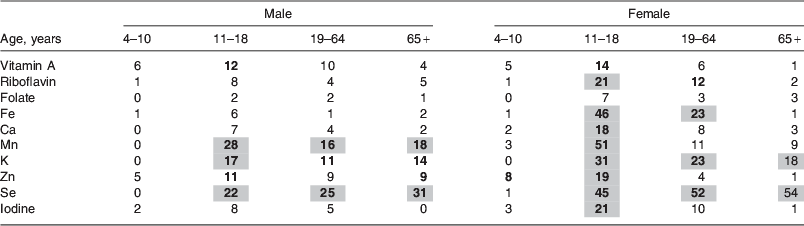
 , Percentage of the sub-population below the lower reference nutrient intake was >15%.
Opportunities for the food and beverage industry
Opportunities to improve both the nutritional profile and the sustainability of diets exist all along the food chain, from the farm through manufacture and retail, to the home. Crop diversification, bio- and food fortification, nutrition-sensitive transportation, minimisation of waste throughout the food chain, reformulation and the promotion of healthier options are among the many factors that have a part to play. Some of the multinational companies have already responded publicly to the challenges faced. For example, Unilever launched a Sustainable Living Plan( 14 ) in 2010 with three objectives: to help improve the health of more than a billion people, to halve the environmental impact of its products, and to source all its agricultural materials sustainably. Pepsico's Performance with Purpose strategy (2009) covers four areas including environmental sustainability( 15 ) and back in 2007 Marks and Spencer launched its Plan A with 100 commitments to be achieved by 2012 (now extended to 180 by 2015) with the ultimate goal of being the world's most sustainable retailer, the five pillars being climate change, waste, sustainable raw materials, health, and being a fair partner( 16 ). Sainsbury's 20 by 20 Sustainability Plan (2011) sets out twenty goals to help customers make nutritional, sustainable and ethical decisions( 17 ). McDonald's sustainability goals for 2011–2012 include reducing environmental impact of direct suppliers, working on the next actions from the Global Conference on Sustainable Beef, making progress on products as identified in McDonald's Sustainable Land Management Commitment, adopting energy-efficient equipment and technology in restaurants, and increasing energy awareness and education across the system( 18 ). Nestlé’s Creating Shared Value report focuses on three areas, one of which is water and environmental sustainability( 19 ). In addition, many companies have signed up to the Responsibility Deal, as discussed later.
Diet and health
There are a number of ways in which manufacturers, retailers and the food service sector can work with others to improve diet and health. These can be categorised as shown in Table 3, which provides some examples of the types of approach already being adopted. However, improving the nutrient profile of a food is often not simply a matter of excluding a particular nutrient, as is discussed in the section on Technical Challenges.
Examples of approaches that can be taken

The Responsibility Deal
The Responsibility Deal, an initiative from the Department of Health (England) that focuses on partnership working with the food industry and other stakeholders, was established in early 2011 to accelerate delivery of public health goals through greater use of businesses’ influence in the market and ability to engage consumers. Five networks have been established: food, alcohol, physical activity, health at work and behaviour change, and organisations engage with the process by signing up to pledges. In the food network, pledges have been established on the following, to which companies are invited to sign-up: Salt (2011), three additional pledges for catering sector (2012); trans fatty acids (2011); calorie labelling out of home (2011); calorie reduction in the food supply (2012); fruit and vegetables (expected Autumn 2012).
Additional topics currently under discussion are revised targets for salt, activity around saturated fat reduction and promotions (e.g. in store). Product reformulation is a feature of a number of these pledges. For example, the wording of the calorie reduction pledge is: ‘We will support and enable our customers to eat and drink fewer calories through actions such as product/menu reformulation, reviewing portion sizes, education and information, and actions to shift the marketing mix towards lower calorie options. We will monitor and report on our actions on an annual basis.’ Publication of the calorie reduction pledge was preceded by a Call to Action in England( 21 ), which set out the importance of action on obesity, and issued a challenge to the population to reduce its total calorie consumption by 5 billion calories (kJ) daily. Associated with this pledge is a menu of options suggesting how the pledge might be achieved (Table 4). At the end of May 2012, the delivery plans for the first twenty signatories to the calorie reduction pledge were published on the Responsibility Deal website( 22 ).
Related to the calorie reduction pledge, the out-of-home calorie labelling pledge is in recognition of the fact that one in six meals is eaten outside the home. The pledge requires signatories to display calorie information (per portion/item/meal) prominently at point of choice in high street food outlets, restaurants and staff canteens. Provision of reference information (guideline daily amounts) is also required. By July 2012, forty-five businesses had signed up to this pledge, representing around 9000 outlets and estimated to cover 23% of all meals sold and a third of meals served on the high street( 23 ).
Menu of options for calorie reduction. Information extracted from Department of Health( 22 )

A key theme in reformulation is the reduction of the energy density of foods (energy provided per g). In theory this can be done in a number of ways: Fat or sugar reduction; addition of low energy ingredients such as fruits and vegetables to composite foods; addition of dietary fibre (a low energy component that provides bulk) and use of wholegrain ingredients; addition of water; addition of air (aeration).
However, as will be evident from the text that follows this procedure is not always as simple as it may at first seem. For dry products, such as breakfast cereals, the removal of sugar often does not affect energy density to the extent that might be expected, unless fibre is increased substantially, because the sugar is replaced by starch (on a weight for weight basis) which has the same energy value. Another factor is that manufacturers are limited in the health claims they can make on foods/drinks to those permitted claims listed in the nutrition and health claims register that was published in 2012 by the European Commission( 24 ). Currently there are few permitted claims of relevance to fibre or whole grains and so this may be a disincentive for manufactures considering embarking on expensive reformulation work. Furthermore, claims that a reduction in fat or sugar has been achieved can only be made if the reduction is 30% or more, which is a substantial step to achieve without fundamental change to the product. There are also restrictions in the use of high intensity sweeteners and consumer concerns about the use in general of additives that may be required in increased amounts in reformulated foods given the functional roles of fat and sugar in some formulations, as discussed further in the next section.
Technical challenges
Some nutrients have a technical or functional role in foods, examples being Na and fat. Their removal can require the utilisation of alternative strategies to substitute for the function and these strategies can run counter to consumer desire for ‘clean labels’ (foods with minimal ingredient lists) and consumer views on the use of high intensity sweeteners and other food additives.
Salt
From a physiological perspective, many systems in the body rely on the balance of electrolytes such as Na, K and Cl. Na is a dietary essential but requirements are far lower than current intakes. Concerns about the association between salt intake and blood pressure triggered the Food Standards Agency's salt campaign (see Wyness et al. ( Reference Wyness, Buttriss and Stanner 25 )) and the drive, in partnership with manufacturers and retailers in particular, to reduce the amount of salt present in foods. A recent analysis has found that the campaign achieved a reduction in salt intake of approximately 10% across the population; the impact was stronger in women than men. Over the past 10 years, salt intake in England has fallen by almost 1·5 g (15%) towards the target for adults of less than 6 g/d. In 2000–2001, salt intake (assessed by urinary Na measurement) was 9·5 g/d. It has fallen progressively since that time: 9 g in 2005/6, 8·6 g in 2008 and 8·1 g in 2011 (men 9·3 g, women 6·8 g)( Reference Sadler, Nicholson and Steer 26 ). The Responsibility Deal salt reduction pledge is linked to the Food Standards Agency's salt targets for 2012, which if achieved will deliver the removal of 1 g salt from the food supply. The figures for 2011( Reference Sadler, Nicholson and Steer 26 ) suggest that half of this reduction has now been achieved. However, it is interesting to note that while average intakes in women are now relatively close to 6 g/d (at 6·8 g/d) average intakes in men are still far in excess of the target, suggesting the value of exploring more targeted approaches to salt reduction. The High Level Steering Group for the Responsibility Deal's Food Network is currently considering next steps and has established a forum for detailed technical discussions on salt and reformulation.
Salt (NaCl), has long been used as a preservative in foods as it controls water activity and hence growth of food poisoning and spoilage organisms. It is also effective in flavour perception. In bread production, salt controls the growth of yeast and fermentation rates, makes gluten more stable and less extensible, and assists in preservation and reduction of spoilage. In cheese manufacture, salt regulates the activity of the starter culture, modifies enzyme activity and has a direct effect on water content during maturation of the cheese. In meat products, together with fat, salt contributes to sensory properties, textural properties (tenderness and juiciness) through the solubilisation of myofibrillar proteins, and also to safety (preservation and shelf life). In the manufacture of savoury snacks, salt creates the hard bite texture and expansion during cooking.
Leatherhead Food Research has reviewed progress in the area of salt reduction and concluded that while there are a number of options (see Tables 5 and 6), each food category has its own particular challenges as salt has multiple roles (influencing taste, texture, shelf life and food safety) and note that food wastage could be an unintended consequence if shelf life is diminished( Reference Wilson, Komitopoulou and Incles 27 ).
Challenges for salt reduction. Information extracted from Wilson et al. ( Reference Wilson, Komitopoulou and Incles 27 )

Strategies for salt reduction. Information extracted from Wilson et al. ( Reference Wilson, Komitopoulou and Incles 27 )

So, salt usage is not simply about flavour and, in achieving the reductions in salt content attained to date (almost 1·5 g on average across the population since 2000–2001), various technical approaches have already been adopted. In a number of cases, the gradual (stepwise) removal of salt has been taking place for several decades ever since concerns about salt intake were first raised. For example, the Federation of Bakers has recorded a reduction of 23% in the salt content of bread since 2004; however, reduction began in the 1980s–1990s and they estimate that a total reduction of about 40% has taken place during this period (personal communication). A major challenge is to ensure that reductions do not outpace consumer expectations from a flavour perspective as this would be counterproductive i.e. sales would fall and this would adversely affect the company's viability and/or salt would simply be added back by the consumer. It is to be hoped that the new salt pledges recently introduced will stimulate greater engagement of the wider food service industry. While some of the high street chains committed to salt reduction some time ago, alongside major retailers and manufacturers, others have been far slower to react. To ensure that progress in adjustment of salt preferences continues, widespread action is required; the new pledges focus on training in kitchen practice, reformulation and procurement in the catering sector and commit companies to a 15% reduction in salt usage in their kitchens( 28 ).
Work conducted at Leatherhead Food Research has confirmed that saltiness perception is changed when the salt crystal size is altered; using smaller particle size salt leads to a larger initial perception of saltiness( Reference Wilson, Komitopoulou and Incles 27 ). Using smaller particle sizes may also help with dispersion thus requiring a lower overall salt level. Adjusting crystal structure and size is the basis of new technologies; none of the products currently available are based on nanoparticle technology although this may offer solutions in the future, subject to EU approval. Yet another approach is odour-induced taste enhancement( Reference Wilson, Komitopoulou and Incles 27 ).
Fat
A number of approaches have been used to reduce the fat content of foods and to improve their overall fatty acid profile. These include changes in animal husbandry to produce leaner animals and hence leaner meat; manipulation of the diets of dairy cows to produce milk with less SFA; removal of fat during processing e.g. trimming meat during butchery, skimming of milk to remove the cream; choice of fat-containing ingredients to modify the fatty acid profile (e.g. selecting a vegetable oil rather than a ruminant fat), use of structured lipids (interesterification) and the blending of oils to avoid processes associated with the production of trans fatty acids during the manufacture of spreads and margarines, use of new baking technologies to change the fatty acid profile of pastry or to reduce the fat content of snacks. The overall contribution of fat to energy intake is now in line with recommendations (Table 1) but contribution of SFA remains above the recommended level (12·7% compared with 11% of energy) although in absolute terms, SFA intake has fallen considerably over the past couple of decades from 42 g in men and 31·1 g in women in the 1980s to 28·8 and 22·0 g/d, respectively, in the latest National Diet and Nutrition Survey( Reference Bates, Lennox and Prentice 11 , Reference Gregory, Foster and Tyler 29 ).
An aspect that is sometimes overlooked is the constraints of legislation for some sectors, for example the Chocolate Directive specifies the fat content of chocolate and limits the changes in composition that can be made. Also, the Nutrition and Health Claims Regulation( 24 ) places constraints on businesses that wish to publicise changes in the fat content of their products; unless the reduction is at least 30%, a fat reduction claim cannot be made and claims of ‘low fat’ are only permissible if a food contains <4 g fat/100 g (a low in saturated fat claim requires there to be <1·5 g per 100 g and the sum of SFA and trans fatty acids must not provide >10% of energy). Manufacturers will want to retain the characteristics of the product that are attractive to consumers, making reformulation to reduce fat a costly and time-consuming business for which a one size fits all approach is not appropriate, even within a particular food category. This is in part because of the structural and organoleptic characteristics provided by SFA. Table 7 summarises some case studies.
Challenges faced in reformulating to reduce SFA content

In some cases, really innovative technological developments have been achieved, an example being ice cream manufacture. With conventional techniques, if the fat content is reduced, the resultant product is less smooth, less creamy, more icy/cold and less stable. An ultra high pressure homogenisation technique has been developed whereby very small fat droplets stabilise small air bubbles, enabling the production of a lower fat/lower energy product that still tastes good (personal communication). Sugar also has a functional role in ice cream, not only does its removal reduce the sweetness but also makes the product harder.
Sugar – not just sweetness
Sugar, in particular non-milk extrinsic sugars, has been targeted for reduction. This poses challenges because sugar's role in foods is often more than simply providing sweetness. Functions are listed in Table 8 along with potential solutions. Some of the alternative approaches have limitations, such as regulatory constraints with high intensity sweeteners, the gastrointestinal consequences associated with high intakes of polyols, resistance of many consumers to foods that contain lots of additives (desire for ‘clean’ labels; minimal ingredients lists). Also, the alternatives are often more expensive than sugar and cannot replicate its unique flavour profile.
Functions of sugar and potential routes for sugar reduction

Changing eating patterns – is reformulation the answer?
Reformulation in isolation is unlikely to provide a complete solution but it can contribute. To date much of the emphasis of the Responsibility Deal's Food Network has been on reformulation but there are signs that the Network's steering group is looking to broaden its strategy. Other aspects that require urgent consideration and attention are: How best can we influence behaviour change?; what is the role of information provision and what are the key messages for consumers (to stimulate behaviour change)?; can the need for sustainability of the food supply, as discussed at the beginning of this paper, be used to drive change and benefit health?; is there a special role for particular sectors?; what is the role of choice editing (v. free choice with regard to portion or pack size, or the nutrient composition of standard products)?; is there a role for regulation?; where does education in schools fit in?
One of the challenges the food industry faces is balancing the provision of what consumers want to buy (the industry exists to make a profit) with what is important from a public health perspective, recognising that there is often a tension between consumers’ desire for choice and choice editing by manufacturers, retailers and the food service sector. People generally do not like to feel they are being told what to do. Some of the successful reformulation efforts have been achieved by stealth, whereby gradual reductions in salt, for example, have been undertaken in a manner that does not alienate customers wedded to a particular flavour profile. Despite these worthy efforts, well-known brands that have used this approach in order to achieve the government's salt targets for their category are sometimes pilloried in the press by media stories that claim that the public has been hoodwinked; changes to their favourite brands have been made behind their backs. This emphasises the need for all sectors to work together in improving the national diet; lots more needs to be done, and more will be achieved, more quickly if the bickering and sniping can be put on the back burner.
One of the biggest challenges faced is the relatively poor understanding of how to change behaviour for the good and in the long term. This was the focus of a recent conference( 30 ). We know that simply giving people information or telling them what they should, or should not, do is not effective in changing behaviour. Delegates heard that the starting point is understanding the problem, the target behaviour(s) and the context in which it exists. These are the principles of the COM-B process, which is at the centre of a new framework for intervention that combines nine interactive functions, based on elements of capability, motivation and opportunity( Reference Michie, van Stralen and West 31 ). Delegates heard that adults make about 200 decisions about food daily but only a small proportion of these are under conscious control (fourteen on average). This means that interventions that encourage change on a conscious level will be limited by the fact that so many of these choices are made on an unconscious level; this brings into sharp focus the importance of insuring the default choice is a healthy choice.
Acknowledgements
The author declares no conflicts of interest. This research received no specific grant from any funding agency in the public, commercial or not for profit sectors.



