





Dyslipidaemia is one of the manifestations of the metabolic syndrome characterised by a change in the blood lipid profiles(Reference Kim, Lee and Kang1). The accumulation of LDL-cholesterol, total cholesterol (TC) and TAG and the decrease of HDL-cholesterol are important risk factors of atherosclerotic plaques, which originate in the medium and large arteries, principally leading to CVD and CHD(Reference Kim, Lee and Kang1–Reference Stocker and Keaney3). The increased prevalence and destructive power of dyslipidaemia are threatening human health worldwide(Reference Halcox, Banegas and Roy4,Reference Pan, Yang and Wu5) . From the epidemiological survey data, there were more than 100 million adults aged 20 years or older having TC levels of 200 mg/dl (5·17 mmol/l) or greater, and almost 31 million have levels of 240 mg/dl (6·20 mmol/l) or greater from 2009 to 2012 in the USA(Reference Kopin and Lowenstein2). In 2013, the age-standardised mortality attributable to all CVD and CHD was 223·9 and 102·6 per 100 000 persons, respectively, in the USA(Reference Writing Group, Mozaffarian and Benjamin6). Traditionally, recognised risk factors for CVD included age, sex, obesity, hypertension, smoking status, type 2 diabetes, familial predisposition, and high levels of LDL-cholesterol(Reference Halcox, Banegas and Roy4). Lowering LDL-cholesterol level with statin therapy can reduce CVD mortality(Reference Ference, Ginsberg and Graham7,Reference Kim, Han and Joung8) . Additionally, dyslipidaemia is also an essential consideration for controlling CVD risk(Reference Kopin and Lowenstein2,Reference Halcox, Banegas and Roy4) .
PUFA are fatty acids that contain more than one double bond in their backbone, generally including n-3 PUFA and n-6 PUFA(9). DHA, EPA, docosapentaenoic acid (DPA), α-linolenic acid (ALA) and octadecatetraenoic acid (ODTA) are crucial long-chain n-3 PUFA for glucose and lipid metabolism as well as metabolic inflammation(Reference Lin, Chu and Luo10). The mechanism of n-3 PUFA action, especially for DHA and EPA, is mediated by surface or intracellular fatty acid receptors and sensors. Intake of PUFA is associated with increased expression of adiponectin. As an anti-inflammatory cytokine, adiponectin promotes the hepatic metabolic enhancement and reduces the atherosclerosis risk by increasing HDL-cholesterol and reducing TAG. ALA and ODTA, often referred to as plant n-3 PUFA, are precursors of DHA and EPA. The physiological and functional attributes of plant n-3 PUFA appear to derive from their conversion to EPA or DHA via desaturase(Reference Calder11,Reference Silva Figueiredo, Carla Inada and Marcelino12) . Dietary intake and supplements are the primary sources of n-3 PUFA in our daily life. Supplements are usually the derivatives with high EPA and DHA concentrations from fish, such as salmon, mackerel, or other oily fishes(Reference Berquin, Edwards and Chen13).
Dietary habit changes with more unsaturated fatty acids are proposed to benefit metabolic disorders(Reference Silva Figueiredo, Carla Inada and Marcelino12). The beneficial effects of n-3 PUFA intake have been established widely in recent years(Reference Calder11,Reference Thota, Ferguson and Abbott14,Reference Rimm, Appel and Chiuve15) . Increased oily fish consumption was associated with a lower risk of hypertriacylglycerolaemia in the general Korean population(Reference Kim, Lee and Kang1). In another randomised controlled trial study(Reference Sawada, Tsubata and Hashimoto16), 6-month use of DHA and EPA 900 mg/d was associated with a reduction in LDL-cholesterol and TAG levels. Furthermore, they observed an increase in HDL-cholesterol level. In a recent meta-analysis of studies totalling 693 CHD, type 2 diabetes or non-alcoholic fatty liver diseases, patients with an average age from 50 to 70 years old declared that high-dose n-3 fatty acids (purity > 90 %) slowed the atherosclerosis progression significantly, which is a potential mechanism in reducing CVD risk(Reference Sekikawa, Cui and Sugiyama17). An authoritative advisory from the American Heart Association claimed that consuming non-fried seafood 1–2 times per week promotes a positive effect on the cardiovascular system, resulting in a reduced risk of cardiac death, CHD, and ischaemic stroke(Reference Rimm, Appel and Chiuve15). In addition, PUFA promote effects on glucose and metabolic inflammation and as a good source of protein and vitamin D(Reference Silva Figueiredo, Carla Inada and Marcelino12,Reference Rimm, Appel and Chiuve15) . However, direct evidence on the association between dietary PUFA and dyslipidaemia risk among a nationally representative large sample-sized adults across various age groups is sparse if not lacking. The linear or non-linear association between dietary PUFA intake and dyslipidaemia is warranted to research.
Of note, fish consumption is a major source of long-chain PUFA intake. In addition to having PUFA, fish, as a package, also contains other trace minerals, including both beneficial elements (e.g., Se within a reasonable range) and toxic metals (e.g., Hg). Se is an antioxidant that elicits its beneficial effects and may modify the association between n-3 PUFA and dyslipidaemia(Reference Berr, Akbaraly and Arnaud18,Reference Park and Seo19) . However, another study claimed that comparing the highest with lowest quartiles, the prevalence ratios of the Se–Zn pattern is 1·36 (95 % CI 1·13, 1·63) for the metabolic syndrome with National Health and Nutrition Examination Survey (NHANES) 2011–2014(Reference Bulka, Persky and Daviglus20). This result corroborated with a study, which found that high Se level is associated with increased TC, LDL-cholesterol, HDL-cholesterol and TAG(Reference Ju, Ji and Li21). Hg, which has heavy metal toxicity and accumulates along the ocean’s food chain(Reference Park and Seo19), may enter the body along with PUFA. Some scholars suggested that Hg be evaluated in any participant with CHD or other vascular diseases(Reference Houston22). Another research indicated that Hg influences include thrombosis, immune and mitochondrial dysfunction, and dyslipidaemia(Reference Houston23). Thus, it deserves an investigation whether Se and Hg will confound and modify the association between dietary PUFA and dyslipidaemia risk.
Therefore, in this study, we aim to examine the associations between the consumption of PUFA and the risk of dyslipidaemia, and whether the associations will be confounded and modified by Se and Hg levels in the US population based on NHANES 2009–2016 data.
Materials and methods
Study population
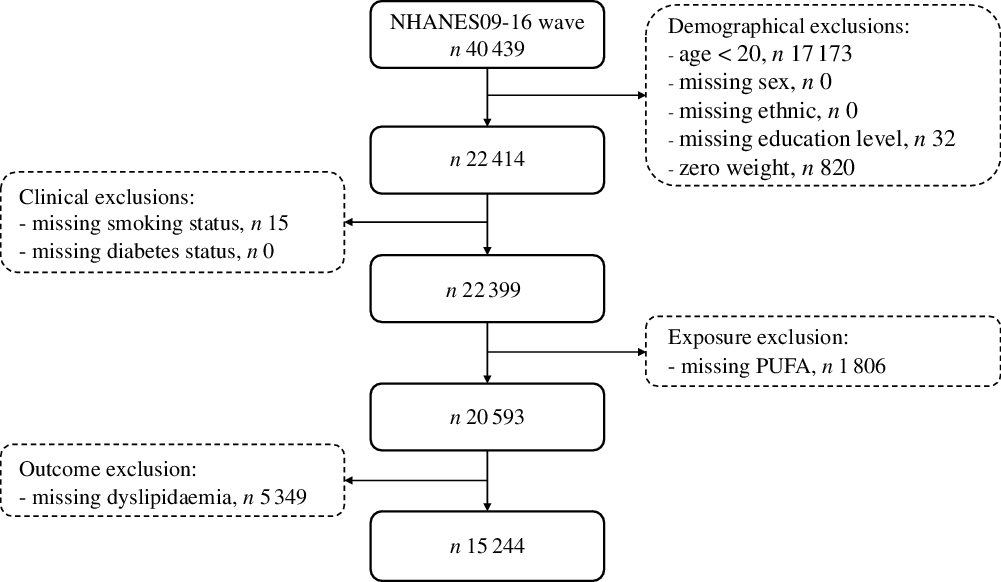
The NHANES is a nationally representative measurement of the civilian non-institutionalised US population with a stratified multistage probability cluster design conducted by the National Center for Health Statistics of the Centers for Disease Control and Prevention. For this study, four NHANES survey waves (2009–2010, 2011–2012, 2013–2014, and 2015–2016) were combined using adjusted sampling weights. A total of 40 439 individuals were selected from these four waves. Eligible participants were 23 234 adults aged 20 or older, with no missing information about sex, ethnicity, education, and weight. Seventeen participants were excluded due to missing smoking and diabetes information. We excluded 2624 missings on the PUFA who did not complete the two 24-h dietary recall interviews. These exclusions resulted in the final sample size of 15 244 adults after 5349 participants were eliminated due to missing measurements on the laboratory examinations, including TC, HDL-cholesterol, LDL-cholesterol, and TAG, or dyslipidaemia medication. The detailed sample elimination process is shown in Fig. 1.
Flow chart of data exclusion process of this study.

Measurement of dyslipidaemia
Blood dyslipidaemia was defined as T C ≥ 240 mg/dl, or HDL-cholesterol < 40 mg/dl for males, HDL-cholesterol < 50 mg/dl for females, or LDL-cholesterol ≥ 160 mg/dl, or TAG ≥ 200 mg/dl, or self-reported usage of prescribed lipid-modifying medication. The TC, HDL-cholesterol, LDL-cholesterol and TAG information all derived from the laboratory measurements. The biospecimens were collected at the Mobile Examination Center (MEC), including the collecting, processing, storing and shipping of blood specimens. The MEC’s controlled environment allowed laboratory measurements to be done under identical conditions at each survey location(24).
Measurement of PUFA
In the NHANES study, the dietary intake information was collected by the trained interviewers for all NHANES examinees and used to estimate the types and amounts of foods and beverages (including all types of water) consumed during the 24-h period prior to the interview (midnight to midnight) and to estimate intakes of energy, nutrients and other components from those foods and beverages. Daily intake of PUFA was reported from the average of two 24-h dietary recall interviews. The first dietary recall interview was collected in-person at the MEC, and the second interview was conducted by telephone after 3–10 d, but not on the same day of the week as the first MEC interview. If a participant did not finish the second dietary call interview, only the first dietary interview was used as average. Daily intakes of the common long-chain n-3 fatty acids, DHA, EPA, and DPA, and their sum were calculated for each participant from the average of two 24-h dietary recall interviews. Other two n-3 unsaturated fatty acids, ALA and ODTA, and their sum were also obtained from the interviews.
Measurement of mercury and selenium
The measured Hg and Se were derived from blood specimens. Whole blood specimens were collected at the MEC, processed, stored, and shipped to the Division of Laboratory Sciences. Some measurements below the detection limit were imputed with the value of ‘detection limit/√2’(25). In the wave of the year 2009–2010, all specimens were not detected Se in the serum. Hg was measured for all four waves. The Hg and Se in µg/l were converted to nmol/l by multiplying 4·99 and 0·0127 nmol/µg, respectively.
Potential confounders
In the NHANES study, demographic, behaviour, social-economic information, and clinical status could be obtained from questionnaires and examinations. In our research, we considered the following variables as potential confounders: age group (groups for every 15 years starting from 20 years old), ethnicity (non-Hispanic white, non-Hispanic black, Hispanic, and others), sex (male and female), BMI, education (under senior high, senior high, and college or university and above), smoking status (never, past, and current), alcohol beverages (total alcoholic drinks per year classified by median), diabetes status (non-diabetes and diabetes) and hypertension (yes v. no). We adjusted these confounders in multiple models sequentially, which would be detailed in the statistical analysis part.
Statistical analysis
Accounting for the complex, stratified, multistage cluster sampling design structure, we used survey procedures in SAS statistical software version 9.4 (SAS Institute Inc.) for all statistical analyses. Four waves of continuous survey data were combined, and an 8-year sampling weight was calculated for the analyses.
Descriptive statistics, including counts and percentages for categorical variables, weighted means and standard errors for continuous variables, were calculated for dyslipidaemia and regular lipid group, respectively. Due to the highly skewed distribution of Se and Hg, we computed weighted geometric means and 95 % CI for these variables(Reference Park, Lee and Basu26). For all PUFA, the weighted median with inter-quartile range was calculated in two groups, based on their sampling distributions.
We constructed multivariable logistic regression models with adjusting confounders to investigate the OR as well as 95 % CI for the risk of dyslipidaemia in association with PUFA. In model 1, we adjusted for age, sex, and race; model 2 further adjusted for education, BMI, smoking status, and alcoholic beverages; model 3 additionally adjusted for hypertension and diabetes. Also, the intakes of protein and cholesterol were involved in model 4. In model 5, we mainly considered the effects of PUFA after adjusting the impact of blood Hg and Se.
We also fitted PUFA with restricted cubic spline functions to explore the non-linear association with the original data. Both first- and second-order interactions among PUFA intake, blood Se (≥ v. < median), and Hg (≥ v. < median) were considered in the full model. The stratification analyses were done for each Hg and Se level to explore the effect modification.
Considering the potential impact of missing data on the analysis results, we performed multiple imputation, mainly for missing values of Se and Hg. We performed logistic regression models to consider the OR for different intake levels of PUFA and interactions with imputed data for the main analysis. All logistic regression results of imputed data were obtained using PROC MIANALYZE in SAS for considering the imputation effect.
Results
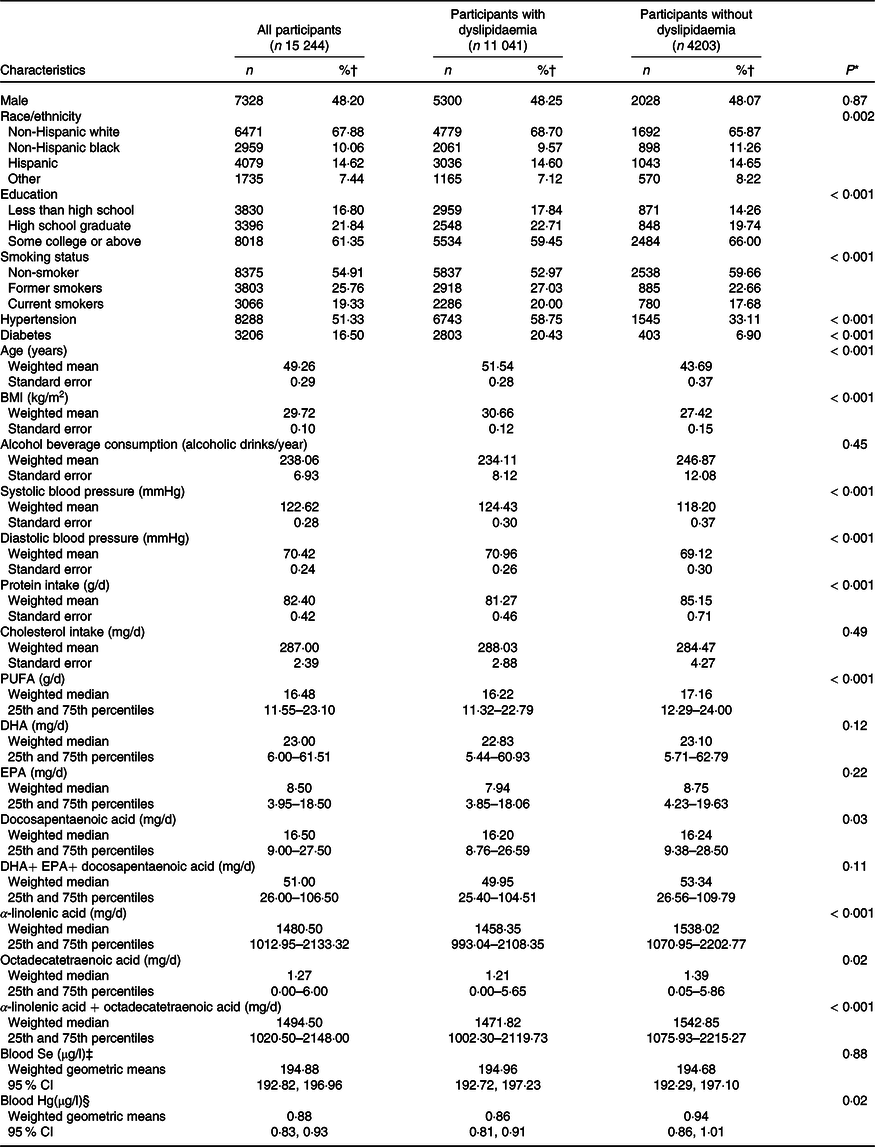
Study population characteristics are presented in Table 1. The unweighted prevalence of dyslipidaemia was 72·4 %, with 11 041 interviewees classified as dyslipidaemia among a total of 15 244 participants. Participants with dyslipidaemia were more likely to be older, smokers, diabetic, non-Hispanic whites, and had higher BMI and blood pressure and lower education than those without dyslipidaemia. Lower intakes of PUFA, protein, DPA, ALA, ODTA, the sum of ALA and ODTA, and Hg were also observed in dyslipidaemia participants. As for sex, the consumption of alcoholic beverages, intakes of cholesterol, DHA, EPA, the sum of DHA, EPA, and DPA, and Se, there was no difference between participants with or without dyslipidaemia.
Characteristics of study participants, by dyslipidaemia status, a cross-sectional study using data from the NHANES 2009–2016 (numbers and percentages).

* P-values were obtained using the t test for the significance of the regression coefficient from the linear regression model with design considered (continuous variable) or the design-adjusted Rao–Scott version of Pearson’s chi-square test (categorical variable).
† Weighted percentages for considering the stratified multistage probability cluster design.
‡ Blood Se data were only available from the NHANES 2011–2016 surveys (n 7151).
§ 3851 participants had a missing value of Hg (n 11 393).
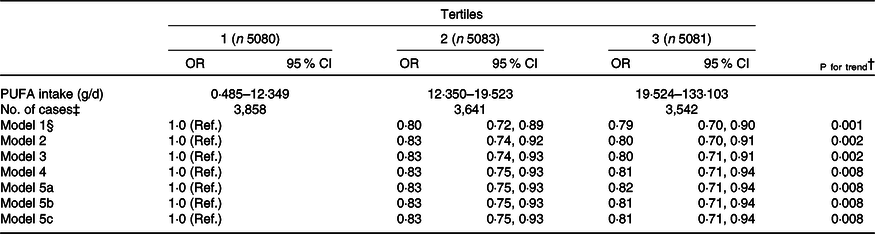
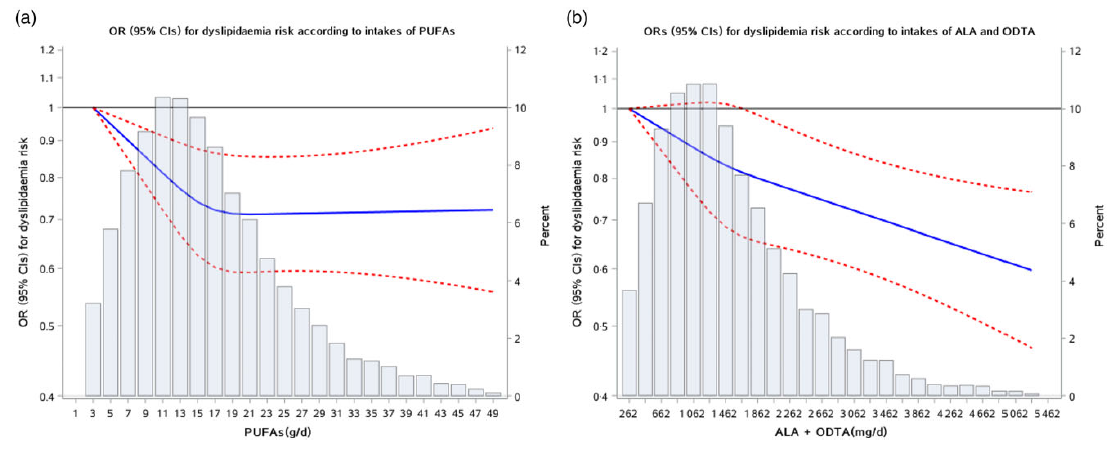
An inverse association was found between PUFA intake and dyslipidaemia (Table 2). Comparing with those in the lowest tertile of PUFA intake, those in the middle and upper tertiles had a 17 % (OR = 0·83 (95 % CI 0·75, 0·93)) and 19 % (OR = 0·81 (95 % CI 0·71, 0·94)) lower risk, respectively, after controlling for multiple confounders (P for linear trend = 0·008). The inverse association was further confirmed when PUFA intake was fitted using restricted cubic spline functions (Fig. 2(a)). Compared with the lowest PUFA intake, a threshold inverse association of PUFA with dyslipidaemia was observed. A nadir risk for dyslipidaemia was reached (OR = 0·72 (95 % CI 0·59, 0·86)) when PUFA intake arrived at its tuning point of 19 g/d.
OR with 95 % CI for risk of dyslipidaemia according to tertiles of PUFA intake, a cross-sectional study using data from the NHANES 2009–2016 * (Odds ratios and 95 % confidence intervals).

* Design-based multivariable logistic regression models were used to examine the associations of interest.
† P for linear trend was calculated with tertiles coded as 1, 2 and 3 as a continuous variable.
‡ Dyslipidaemia was defined as participants who had taken anti-dyslipidaemia medication, or had total cholesterol ≥ 240 mg/dl, or HDL-cholesterol < 40 mg/dl for males, HDL-cholesterol < 50 mg/dl for females, or LDL-cholesterol ≥ 160mg/dl, or TAG ≥ 200 mg/dl.
§ Model 1 adjusted for age, sex, and race/ethnicity; model 2 additionally adjusted for education, BMI, smoking status (never, former or current smokers), and alcoholic beverage consumption; model 3 further adjusted for hypertension and diabetes; model 4 further adjusted for dietary intakes of protein and cholesterol; model 5a added blood Se based on model 4; model 5b added blood Hg based on model 4; model 5c added blood Se and Hg based on model 4.
OR (95 % CI) for dyslipidaemia risk according to intakes of PUFA (a) and the sum of ALA and ODTA (b). The association was examined using logistic regression for survey data with the exposure of interest fitted with restricted cubic spline functions. The solid blue lines are OR, and the dashed red lines are 95 % CI. The light blue bars are histograms of PUFA and the sum of ALA and ODTA, respectively, with the right axis for percentages. ALA, α-linolenic acid; ODTA, octadecatetraenoic acid.

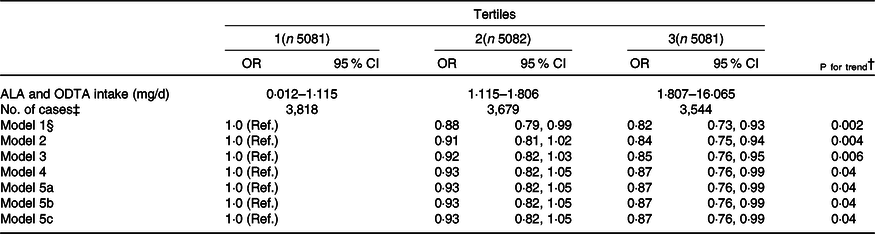
When the exposure of interest was the sum of intakes of ALA and ODTA, the inverse association remained (T3 v. T1: OR = 0·87 (95 % CI 0·76, 0·99); P for linear trend = 0·04) (Table 3). However, we did not observe a threshold phenomenon while fitting the exposure with restricted cubic spline functions (Fig. 2(b)).
OR with 95 % CI for risk of dyslipidaemia according to tertiles of α-linolenic acid (ALA) plus octadecatetraenoic acid (ODTA) intake, a cross-sectional study using data from the NHANES 2009–2016 * (Odds ratios and 95 % confidence intervals).

* Design-based multivariable logistic regression models were used to examine the association of interest.
† P for linear trend was calculated with tertiles coded as 1, 2 and 3 as a continuous variable.
‡ Dyslipidaemia was defined as participants who had taken anti-dyslipidaemia medication, or had total cholesterol ≥ 240 mg/dl, or HDL-cholesterol < 40 mg/dl for males, HDL-cholesterol < 50 mg/dl for females, or LDL-cholesterol ≥ 160 mg/dl, or TAG ≥ 200 mg/dl.
§ Model 1 adjusted for age, sex, and race/ethnicity; model 2 additionally adjusted for education, BMI, smoking status (never, former or current smokers), and alcoholic beverage consumption; model 3 further adjusted for hypertension and diabetes; model 4 further adjusted for dietary intakes of protein and cholesterol; model 5a added blood Se based on model 4; model 5b added blood Hg based on model 4; model 5c added blood Se and Hg based on model 4.
We found that neither Se (≥ v. < median) nor Hg (≥ v. < median) modified the associations of interest in both the categorical analyses and the restricted cubic spline analyses (results not shown). There was no interaction between Se, Hg, and PUFA intake, either. Stratification analysis by sex was also performed for effect modification exploration. The associations were consistent between males and females.
Discussion
In this cross-sectional study of a nationally representative sample of the US adults using data from the NHANES 2009–2016, we found inverse associations of both intakes of PUFA, and the sum of ALA and ODTA with the risk of dyslipidaemia, after controlling for some potential cofounders including blood Se and Hg.
The inverse relation between PUFA and dyslipidaemia was consistent with the findings from previous studies(Reference Calder11,Reference Thota, Ferguson and Abbott14–Reference Sekikawa, Cui and Sugiyama17) . The n-3 PUFA intake operated on the decrease of plasma TAG, VLDL, and APOB-100, as well as the increase of HDL(Reference Silva Figueiredo, Carla Inada and Marcelino12,Reference Backes, Anzalone and Hilleman27–Reference Ganda, Bhatt and Mason29) . The potential mechanisms of n-3 PUFA exerting effects are as follows. N-3 PUFA may decrease the expression of sterol regulatory element-binding protein-1c, contributing to reduced expression of cholesterol-, fatty acid-, and TAG-synthesising enzymes. They could also increase the mitochondrial oxidation rates, or peroxisome, resulting in a reduction in available substrate required for TAG and VLDL synthesis. In addition, they have been shown to inhibit key enzymes involved in hepatic TAG synthesis and increase the expression of lipoprotein lipase, leading to decreased TAG synthesis and increased TAG removal from circulating VLDL and chylomicron particles(Reference Silva Figueiredo, Carla Inada and Marcelino12,Reference Backes, Anzalone and Hilleman27,Reference Preston Mason28,Reference Bays, Tighe and Sadovsky30) . Some studies reported that n-3 PUFA reduced serum TAG in a population with hypertriacylglycerolaemia and increased LDL-cholesterol and HDL-cholesterol; however, the increase in LDL-cholesterol was less than the reduction in VLDL-cholesterol resulting in a decrease of non-HDL-cholesterol (VLDL-cholesterol and LDL-cholesterol)(Reference Watanabe and Tatsuno31,Reference McKenney and Sica32) .
However, the large-scale randomised controlled trial studies – VITAL (NCT01169259)(Reference Manson, Cook and Lee33) and ASCEND (NCT00135226)(Reference Group, Bowman and Mafham34) – revealed that there was no significant difference in the incidence of major cardiovascular events between the n-3 fatty acid supplementation group and the placebo group. In these two studies, the main exposure included n-3 fatty acids 1 g/d. But in the VITAL research, a lower incidence of the primary cardiovascular endpoint in the n-3 supplementation group could be observed in the low fish consumption strata(Reference Manson, Cook and Lee33). In fact, the resources of daily PUFA are derived not only from supplementation but also from dietary seafood. Thus, the biologically plausible effect of PUFA raised the question of the potential difference between cardiovascular events and intermediate cardiovascular endpoints, such as dyslipidaemia, diabetes, inflammatory reaction, and hypertension.
The other two large-scale randomised controlled trials – REDUCE-IT (NCT01492361)(Reference Bhatt, Steg and Miller35) and JELIS (NCT00231738)(Reference Yokoyama, Origasa and Matsuzaki36) – showed that highly purified EPA would reduce the incidence of cardiovascular events in patients who had been under a statin therapy for treating hypertriacylglycerolaemia or hypercholesterolaemia. Both trials claimed that EPA was efficacious for participants who had established CVD for secondary prevention. What is noteworthy was that the imbalanced sex ratio and high fish consumption diet failed to detect a significant effect on primary prevention with an underpowered analysis in a Japanese study(Reference Yokoyama, Origasa and Matsuzaki36). Based on a high PUFA diet, purified EPA was also useful as a prescription medicine for secondary prevention. Pharmacological interventions and nutritional observations are difficult to inter-extrapolate because PUFA contain many fatty acids other than EPA. Further food-based or nutrient trials are warranted to explore the dietary PUFA effect on primary or secondary prevention of different types of CVD.
To our knowledge, this study was the first large-scale observational research on the associations between dietary PUFA and dyslipidaemia risk using the NHANES data. We clearly and newly illustrated the linear relation and a threshold phenomenon between PUFA intake and dyslipidaemia risk. The benefits of dietary PUFA on dyslipidaemia have a potential translative value to the treatment and prevention of hyperlipidaemia in clinical practice. This study further considered Se and Hg’s potential confounding effect due to PUFA intake often deriving from deep ocean oily fish. In participants with higher Hg levels in the blood, possible stronger associations were observed. When participants had lower blood Se levels, there was a significantly decreased trend of OR for dyslipidaemia along with the increased PUFA intake. The toxicity effect of Hg included increased oxidative stress, inflammation, and dyslipidaemia(Reference Houston23). Participants with a higher level of blood Hg had an increased risk of dyslipidaemia. N-3 fatty acid intake could antagonise Hg’s toxicity(Reference Houston23,Reference Tajik, Kurl and Tuomainen37) . However, the interrelationship among PUFA intake, blood Se and Hg has not been well elucidated so far.
In Fig. 2(a), the spline’s slope changed substantially before and after the turning point of PUFA intake (i.e. about 19 g/d). This slope alteration appeared to be related to differences in the size of relation estimates or different dose–response relationship rather than a lack of association(Reference Kim, Lee and Kang1,Reference Sekikawa, Cui and Sugiyama17,Reference Arca, Borghi and Pontremoli38) . After the turning point, there was a threshold phenomenon appeared. The main source of PUFA is seafood, especially deep-sea oily fish. As the intake of fish increases, the PUFA are elevated with an initially protective relation but gradually offset with accumulated organic pollutants(Reference Ginsberg and Toal39,Reference Oh40) . However, the threshold was not observed in the spline result of the sum of ALA and ODTA with dyslipidaemia risk. One possible explanation was that the ALA source was vegetable oil in the American population, especially soyabean oil and rapeseed(Reference Baker, Miles and Burdge41,Reference Kris-Etherton, Taylor and Yu-Poth42) , which are less likely to be contaminated by organic pollutants than seafood. Another possible reason for the steady decline for ALA and ODTA was the insufficient dose with a maximum 5·5 g/d compared with daily PUFA intake. The continuous declination could also be observed in the spline result of daily PUFA intake in Fig. 2(a) with a dose from minimum to 5·5 g/d. On the other hand, plant n-3 PUFA could be converted to DHA/EPA for functional attributes in metabolism, but this limited conversion resulted in lower biological potency(Reference Calder11).
This research also had some limitations. First, residual confounding from the unmeasured covariates may affect the results from observational data. In the NHANES dataset, there was no information about familial predisposition to dyslipidaemia, which may have potential effect on the risk of dyslipidaemia. Additionally, data reporting in this research are subject to recall bias and potential selection bias. Moreover, the insignificant results for the sum of DHA, EPA, and DPA may be due to the extremely low consumption level (i.e. 51 mg/d) comparing with the recommended daily allowance by the American Heart Association (500 mg for DHA and EPA)(Reference Richter, Bowen and Mozaffarian43). In nearly almost dietary PUFA researches(Reference Kris-Etherton, Taylor and Yu-Poth42,Reference Blasbalg, Hibbeln and Ramsden44) , n-6 PUFA has much higher intake than that of n-3 PUFA and ours was no exception. Here, we just focused on total and n-3 PUFA intake with the risk of dyslipidaemia. Future interventional studies focusing on each component of PUFA in the daily diet are needed.
From the NHANES 2009–2016 survey data in the US adults, the inverse association between dietary PUFA and dyslipidaemia was observed after adjusting potential confounders, including Hg and Se. Future prospective large-scale longitudinal studies with long-term follow-up are warranted to confirm our findings.
Acknowledgements
This research received no specific grant from any funding agency, commercial or not-for-profit sectors.
Conceptualisation: J. B., P. X., and J. Z.; data curation: J. Z. and P. X.; formal analysis: J. Z., L. C., S. N., Z. Z., and M. Y.; methodology, J. Z., J. B., and H. Y.; software: J. Z. and L. C.; validation: L. C. and Z. Z.; supervision: J. B. and P. X.; writing – original draft: J. Z., L. C., and S. N.; writing – review and editing: J. B., P. X., Y. Z., and H. Y.
There are no conflicts of interest.

 Open access

