Folate is important for fetal neurodevelopment and is an essential cofactor in DNA and RNA synthesis, DNA methylation processes, among others(Reference Craciunescu, Brown and Mar1–Reference Lee4). Previous studies have established that preconception folic acid supplementation of mothers reduces the risk of neural tube defects(5,Reference Berry, Li and Erickson6) . Recent studies have also shown that preconception or early pregnancy folic acid supplement use and adequate folate intake from food may be beneficial for their offspring’s brain development and function. However, existing studies in humans have controversial findings(Reference Gao, Sheng and Xie7–Reference Naninck, Stijger and Brouwer-Brolsma9). Nevertheless, the effects of maternal prenatal folic acid supplement use and dietary folate intake on offspring’s neurodevelopment after birth have not been reported in Japan. In Japan, there is no mandatory folic acid food fortification policy, and the use of prenatal folic acid supplements is not as widespread as in other developed countries(Reference Ishikawa, Obara and Nishigori10). There are also differences resulting from race and genetic factors(Reference Nagasaki, Yasuda and Katsuoka11). Therefore, Japanese research findings would be expected to provide new insights into prenatal folic acid supplement use/dietary folate intake and offspring neurodevelopment. To obtain evidence, we evaluated the association between maternal prenatal folic acid supplement use and dietary folate intake and motor and cognitive development in 2-year-old offspring using the Japan Environment and Children’s Study (JECS) database.
Methods
Design and participants
JECS is a nationwide prospective birth cohort study involving 100 000 mother–offspring pairs, and the study started in 2011(Reference Kawamoto, Nitta and Murata12,Reference Michikawa, Nitta and Nakayama13) . JECS is ongoing and was planned to continue until the children turn 13 years of age. Trained examiners evaluated the motor and cognitive development of approximately 5000 offspring selected as a Sub-Cohort Study of the JECS(Reference Sekiyama, Yamazaki and Michikawa14). The dataset of 2-year-old offspring’s test results were provided in 2020.
Ethical approval
The JECS protocol has been published elsewhere(Reference Kawamoto, Nitta and Murata12,Reference Michikawa, Nitta and Nakayama13) . This study was conducted according to the guidelines laid down in the Declaration of Helsinki. It was reviewed and approved by the Ministry of the Environment’s Institutional Review Board on Epidemiological Studies (no. 100910001) and by the ethics committees of all participating institutions. Written informed consent was obtained from all participants. From the JECS cohort, a Sub-Cohort Study comprising 5 % of the participating offspring, who were randomly selected and met the eligibility criteria, was extracted(Reference Sekiyama, Yamazaki and Michikawa14). Extended outcome measurements of the Sub-Cohort Study were planned, including face-to-face interviews by trained personnel to evaluate neurological development using the Kyoto Scale of Psychological Development 2001 (KSPD) for 2-year- and 4-year-old offspring(Reference Sekiyama, Yamazaki and Michikawa14). The present study used the jecs-ta-20190930 dataset, which was revised in April 2020. The dataset contains neurological developmental results of 2-year-old offspring by KSPD. Because this study was focused on offspring from singleton pregnancies, multiple birth offspring were excluded from the study.
Exposure: maternal folic acid supplement use
The Ministry of Health, Labor and Welfare in Japan recommended 400 µg/d of supplementary folic acid for pregnant women and women intending to get pregnant(15). A face-to-face interview during pregnancy was conducted for pregnant women to assess folic acid supplementation and other supplementations(Reference Iwai-Shimada, Nakayama and Isobe16,Reference Nishigori, Obara and Nishigori17) . In this study, the use of multivitamin supplements was not considered as folic acid supplements. This is because it was unknown whether all multivitamin supplements contained folic acid.
Participants were classified into four groups, based on the time of initiation of folic acid supplementation: (1) preconception users (started before conception), (2) early post-conception users (within 12 weeks of gestation), (3) late post-conception users (after 12 weeks of gestation) and (4) non-users (non-use of folic acid supplements before conception and during gestation).
Exposure: maternal dietary folate intake
A semi-quantitative FFQ was used to estimate dietary folate intake from foods(Reference Iwai-Shimada, Nakayama and Isobe16). The FFQ comprised the list of foods with standard portion sizes commonly consumed in Japan(Reference Yokoyama, Takachi and Ishihara18). The validity of the FFQ for estimating dietary folate intake has been evaluated previously(Reference Yokoyama, Takachi and Ishihara18). Participants reported the daily, weekly or monthly frequencies of food consumption over the previous year. The mother’s FFQ was administered during the first and second trimester of gestation, at median 14·6 (interquartile range 12·0–18·0) weeks of gestation.
The FFQ is not designed to estimate folic acid(Reference Iwai-Shimada, Nakayama and Isobe16,Reference Yokoyama, Takachi and Ishihara18) . In Japan, there is no mandatory folic acid food fortification policy. To the best of our knowledge, voluntary folic acid food fortification is not also common in Japan.
The Ministry of Health, Labor and Welfare in Japan recommends an estimated average requirement for total dietary folate, for example, from natural food sources, as follows: an intake of ≥ 200 µg/d dietary folate for adult women and ≥ 400 µg/d for pregnant women(15). Therefore, the dietary folate intake of study participants was also classified into three groups (<200 µg, 200 µg to <400 µg and ≥ 400 µg).
Outcome: psychological development in 2-year-old offspring
The KSPD is a standardised developmental assessment tool for Japanese children covering the postural-motor (P-M), cognitive-adaptive (C-A) and language-social (L-S) areas(19,Reference Koyama, Osada and Tsujii20) . The P-M, C-A and L-S areas correspond to the motor, non-verbal cognitive and verbal cognitive development. Scores from these three areas are combined to form the developmental quotient (DQ). The DQ was calculated by dividing the developmental age in days by the chronological age in days and multiplying the quotient by 100. For the reliability of administration, the interviewers were trained and certified by the JECS. Administrative procedures and evaluations were strictly standardised to ensure interviewers’ reliability in this survey.
Statistical analysis and covariables
We compared mothers’ characteristics and their offspring data on psychological development using ANOVA. Multiple regression analysis was used to assess the association between maternal prenatal folic acid intake/dietary folate intake and offspring psychological development. Multiple regression analyses were adjusted for maternal age at delivery, maternal BMI (kg/m2) before pregnancy, infertility treatment, unexpected pregnancies, parity, marital status, maternal highest level of education, paternal highest level of education, maternal smoking status during pregnancy, paternal smoking status during pregnancy, maternal alcohol consumption during pregnancy, annual household income (×103 yen/year) during pregnancy, pregnancy complications, obstetric labour complications, mode of delivery, maternal neuropsychiatric disorders and maternal Kessler 6 (K6) psychological distress scale scores ≥ 5 during pregnancy(Reference Kessler, Barker and Colpe21–Reference Sakurai, Nishi and Kondo23). Adjustments were also made for offspring’s sex and birth weight, gestational week of delivery, breastfeeding at 1 year and 6 months postpartum, family structure, maternal job after delivery, day care centre attendance, multivitamin supplement use, Fe preparations, and trace element use. The dietary intake (FFQ) included energy content and nutrients, including amino acids, n-3 unsaturated fatty acids, Fe, Ca, vitamin A, vitamin B12 and vitamin C. There was no multicollinearity in this analysis. For reference, parity and number of children were found to be multicollinear. Total energy content, protein and Zn were found to be multicollinear.
All the analyses were performed using SAS statistical software, version 9.4 (SAS Institute Inc.).
Results
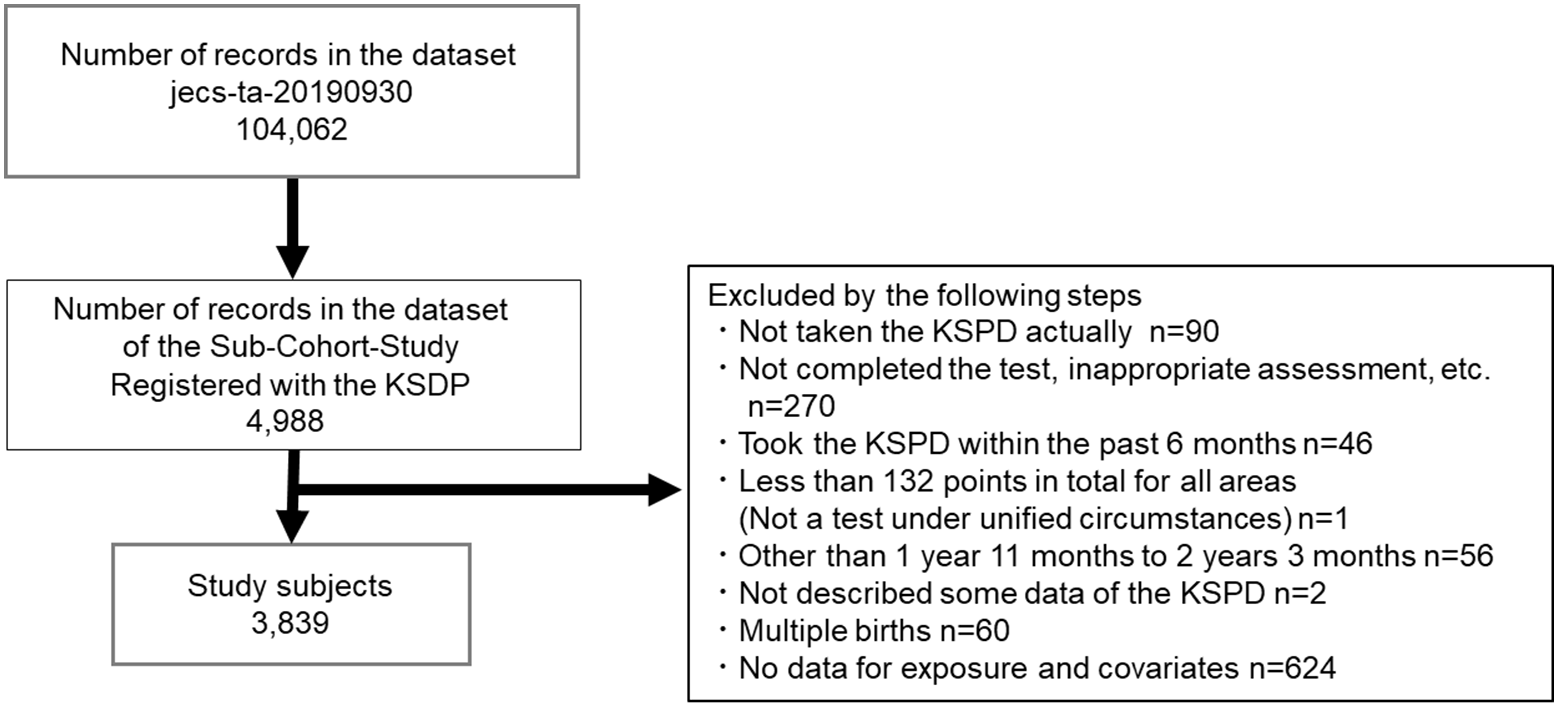
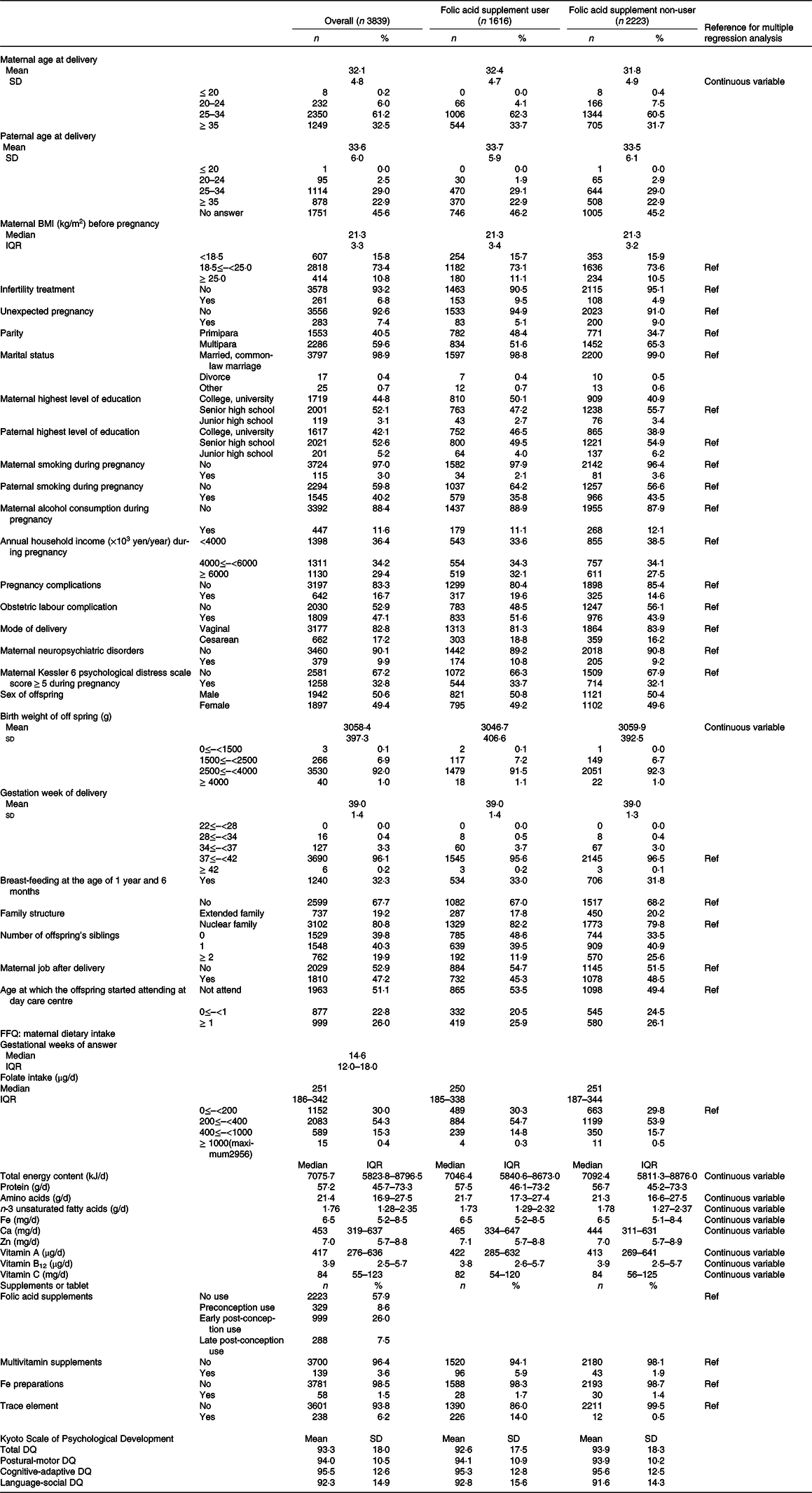
The records from 3839 offspring were analysed from 104 062 records in this dataset (Fig. 1). Table 1 shows the participants’ characteristics, including 3839 single pregnancies and their offspring below 2 years of age. The maximum dietary folate intake of the ≥ 400 µg group was 2956 µg.
Participant selection process flow chart. KSPD, Kyoto Scale of Psychological Development 2001.

Characteristics of the participants (Mean values and standard deviations; numbers and percentages)

IQR, interquartile range; DQ, developmental quotient.
Folic acid supplement user included (1) preconception users (started before conception), (2) early post-conception users (within 12 weeks of gestation) and (3) late post-conception users (after 12 weeks of gestation).
Folic acid supplement non-user: non-use of folic acid supplements before conception and during gestation.
The 6-item Kessler Psychological Distress Scale (K6; total point scores ranged from 0 to 24).
Folic acid supplements
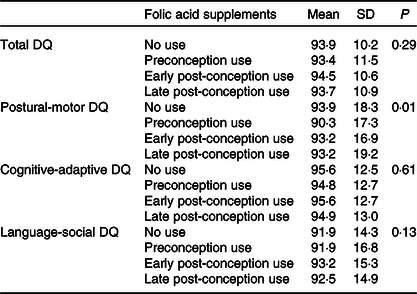
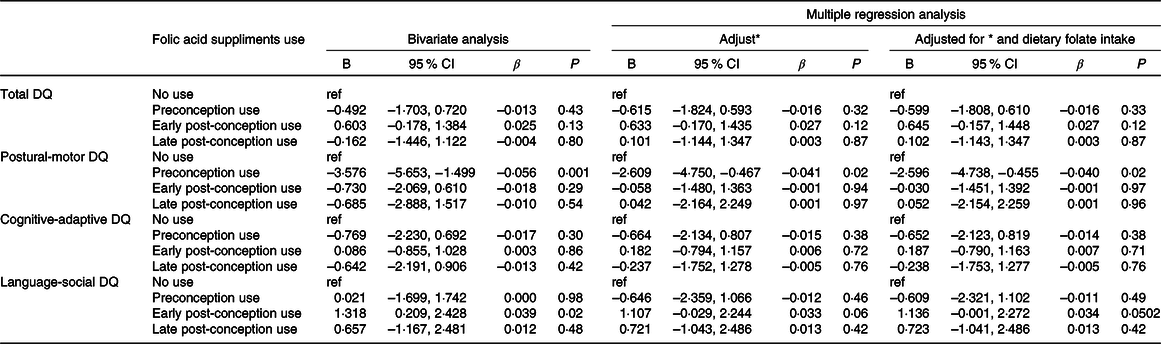
The results of ANOVA for maternal folic acid supplement use and the KSPD of offspring is shown in Table 2. In the multiple regression analysis including dietary folate intake, a significantly lower postural-motor DQ score was observed in the preconception users’ group (partial regression coefficient (B) −2·596, 95 % CI −4·738, −0·455, standardised partial regression coefficients (β) −0·040, P = 0·02) than in the non-users group (Table 3). In post-conception users, there was no significant association with any DQ score, compared with non-users.
ANOVA for maternal folic acid supplement use and the Kyoto Scale of Psychological Development 2001 of 2-year-old offspring (Mean values and standard deviations, n 3839)

DQ, developmental quotient.
Participants were classified into four groups based on folic acid supplementation start time: (1) preconception users (started before conception), (2) early post-conception users (within 12 weeks of gestation), (3) late post-conception users (after 12 weeks of gestation) and (4) non-users (non-use of folic acid supplements before conception and during gestation).
Multiple regression analysis for maternal folic acid supplement use and the Kyoto Scale of Psychological Development 2001 of 2-year-old offspring (Coefficient values and 95 % confidence intervals, n 3839)

DQ, developmental quotient; B, partial regresion coefficient; β, standardised partial regression coefficients.
Participants were classified into four groups based on folic acid supplementation start time: (1) preconception use (started before conception), (2) early post-conception use (within 12 weeks of gestation), (3) late post-conception user (after 12 weeks of gestation) and (4) non-users (non-use of folic acid supplements before conception and during gestation).
* Adjusted for maternal age at delivery, maternal BMI (kg/m2) before pregnancy, infertility treatment, unexpected pregnancies, parity, marital status, maternal highest level of education, paternal highest level of education, maternal smoking status during pregnancy, paternal smoking status during pregnancy, maternal alcohol consumption during pregnancy, annual household income during pregnancy, pregnancy complications, obstetric labour complications, mode of delivery, maternal neuropsychiatric disorders, maternal Kessler 6 (K6) psychological distress scale scores ≥ 5 during pregnancy, offspring’s sex and birth weight, gestation week of delivery, breast feeding at postpartum 1 years 6 month, family structure, maternal job after delivery, day care centre attendance, multivitamin supplement use, Fe preparations, trace element use, and the dietary intake (FFQ) included energy content and nutrients, including amino acids, n-3 unsaturated fatty acids, Fe, Ca, vitamin A, vitamin B12 and vitamin C.
Dietary folate intake
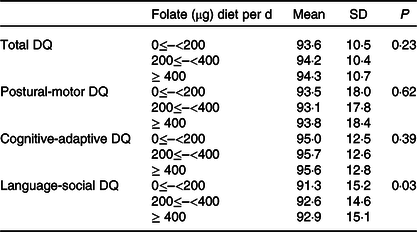
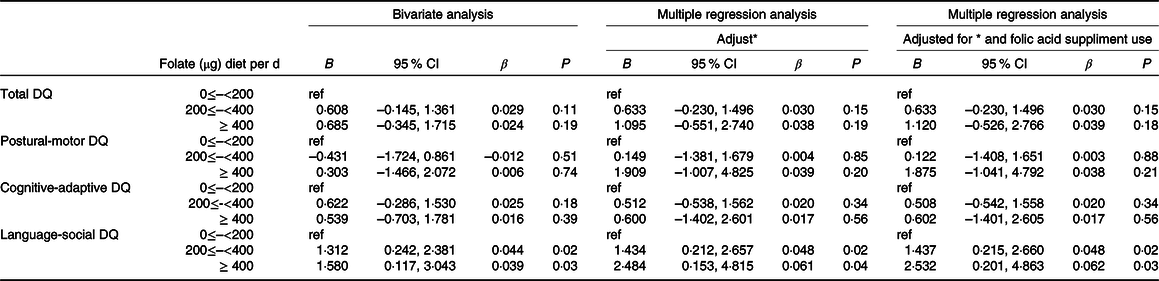
The results of ANOVA for maternal dietary folate intake and the KSPD of offspring is shown in Table 4. In the multiple regression analysis adjusted for folic acid supplement use, there was a significant higher score for language-social DQ in the 200 µg to <400 µg group (B 1·437, 95 % CI 0·215, 2·660, β 0·048, P = 0·02) and the ≥ 400 µg group (B 2·532, 95 % CI 0·201, 4·863, β 0·062, P = 0·03), compared with the <200 µg group (Table 5).
ANOVA for maternal folate intake from food and the Kyoto Scale of Psychological Development 2001 of 2-year-old offspring (Mean values and standard deviations, n 3839)

DQ, developmental quotient.
Multiple regression analysis for maternal folate intake from food and the Kyoto Scale of Psychological Development 2001 of 2-year-old offspring (Coefficient values and 95 % confidence intervals, n 3839)

DQ, developmental quotient; B, partial regresion coefficient; β, standardised partial regression coefficients.
* Adjusted for maternal age at delivery, maternal BMI (kg/m2) before pregnancy, infertility treatment, unexpected pregnancies, parity, marital status, maternal highest level of education, paternal highest level of education, maternal smoking status during pregnancy, paternal smoking status during pregnancy, maternal alcohol consumption during pregnancy, annual household income during pregnancy, pregnancy complications, obstetric labour complications, mode of delivery, maternal neuropsychiatric disorders, maternal Kessler 6 (K6) psychological distress scale scores ≥ 5 during pregnancy,offspring’s sex and birth weight, gestation week of delivery, breast feeding at postpartum 1 year 6 months, family structure, maternal job after delivery, day care centre attendance, multivitamin supplement use, Fe preparations, trace element use and the dietary intake (FFQ) included energy content and nutrients, including amino acids, n-3 unsaturated fatty acids, Fe, Ca, vitamin A, vitamin B12 vitamin C.
Discussion
Our study showed that preconception use of folic acid supplements was associated with lower motor development DQ in 2-year-olds. In contrast, it was not associated with non-verbal cognitive or verbal cognitive development. Post-conception use of folic acid supplementation was not associated with motor, non-verbal cognitive or verbal cognitive development. Regarding dietary folate intake, adequate folate intake from preconception to early pregnancy was associated with higher DQ of verbal cognitive developments in 2-year-old offspring. However, dietary folate intake was not associated with non-verbal cognitive development or motor development.
Regarding the benefits of folic acid/folate, animal studies have shown that its deficiency or excessive use affects neurodevelopment in offspring(Reference Naninck, Stijger and Brouwer-Brolsma9). However, from previous studies in humans, maternal folic acid supplement use/dietary folate intake and neurodevelopment in offspring is inconclusive(Reference Naninck, Stijger and Brouwer-Brolsma9). Since our study involved 2-year-olds, we referred to previous studies in offspring up to 3 years old(Reference Naninck, Stijger and Brouwer-Brolsma9). In a Spanish cohort study, offspring of mothers whose folic acid intake was less than 400 µg/d or 1000–5000 µg/d in early pregnancy had higher mental development scores than offspring of mothers who received 400 µg/d of folic acid, assessed with Bayley Scales of Infant and Toddler Development (BSID)-I in 1-year-old offspring(Reference Valera-Gran, de la Hera and Navarrete-Muñoz24). However, folic acid intakes above 5000 µg/d had lower motor scores(Reference Valera-Gran, de la Hera and Navarrete-Muñoz24). In the Greece cohort study, maternal supplemental folic acid intake of 5000 µg/d in early pregnancy was associated with higher receptive and expressive communication scores, assessed with BSID-III in 18-month-old offspring(Reference Chatzi, Papadopoulou and Koutra25). Nevertheless, folic acid intake exceeding 5000 µg/d was not associated with any of the BSID-III domains(Reference Chatzi, Papadopoulou and Koutra25). In the US cohort study, maternal folate intake from food and supplements of 600 µg/d in early pregnancy was associated with increased receptive language scores, assessed with Peabody Picture Vocabulary Test III in 3-year-old offspring. This association was even stronger for 600 µg/d of folic acid from supplements(Reference Villamor, Rifas-Shiman and Gillman26). Nevertheless, no association was found between folate intake during the first and second trimester of pregnancy and fine motor or visual abilities, assessed with the Wide Range Assessment of Visual Motor Abilities test in 3-year-old offspring(Reference Villamor, Rifas-Shiman and Gillman26). The following studies did not provide information on the amount of folic acid supplements; however, these has been included for reference. In a Polish cohort study, maternal use of folic acid supplements started during the periconception period was not associated with BSID-III scores in 2-year-old offspring(Reference Polańska, Muszyński and Sobala27). In a Norwegian cohort study, maternal use of folic acid supplements from the eighth week of pregnancy was associated with a reduced risk of severe language delay, as reported by parents using the language grammar scale of the Age-Specific Questionnaire (ASQ) in 3-year-old offspring(Reference Roth, Magnus and Schjølberg28). However, there was no association between maternal folic acid supplementation before the eighth week of pregnancy and offspring’s gross motor skills, assessed with ASQ in 3-year-old offspring(Reference Roth, Magnus and Schjølberg28). In the US cohort study, maternal folic acid use was associated with a decreased risk of gross motor skill delay, assessed with the Denver screening test in 3-year-old offspring(Reference Wehby and Murray29). However, there was no association between the use of periconceptional folic acid supplements and language or fine motor development(Reference Wehby and Murray29).
Compared with the findings of the aforementioned studies, our study showed that the use of folic acid supplements before pregnancy was associated with significantly lower motor skills in 2-year-old offspring, when compared with the non-use group. Although previous studies have controversial findings, a similar study showed that maternal folic acid intake of more than 5000 μg/d was associated with lower motor scores in a Spanish cohort study(Reference Wehby and Murray29). In our JECS survey, there was no information on the amount of folic acid in the supplements. Therefore, the association between folic supplement use and neurodevelopment in offspring needs to be examined in more detail, including its time of initiation and the amount of folic acid in the supplements. For reference, in Japan, folic acid supplements are available products from various companies. In general, it is recommended that pregnant women or planning to become pregnant be supplemented with 400 μg/d of folic acid, not exceeding 1000 μg/d(15).
Regarding dietary folate intake, our study showed that the 2-year-old offspring of mothers who took ≥ 200 µg daily dietary folate from preconception to early pregnancy had a higher DQ of verbal cognitive developments than the offspring of those who took <200 µg. The DQ was even higher in the ≥ 400 µg group (up to 2956 µg) than the 200 µg to <400 µg group. The Ministry of Health, Labor and Welfare in Japan recommends a daily intake of ≥ 200 µg of dietary folate for adult women and ≥ 400 µg/d for pregnant women(15). Our study showed a beneficial association between dietary folate intake and verbal cognition development of 2-year-old offspring. This was similar to the findings of the aforementioned cohort studies in Greece, the USA and Norway(Reference Chatzi, Papadopoulou and Koutra25,Reference Villamor, Rifas-Shiman and Gillman26,Reference Roth, Magnus and Schjølberg28) . These findings suggest that, clinically, maternal adequate dietary folate intake from preconception to early pregnancy is associated with better cognitive development of the offspring.
This study had limitations: first, the lack of detailed information on folic acid supplement use and the fact that dietary folate intake evaluation was self-reported by the FFQ. Second, the retrospective collection of information for maternal supplement usage, which in the case of the preconceptional period, was at least about 3–4 months before the interviews; therefore, the recollection may not be very accurate. However, this was an objective investigation in which trained interviewers assessed offspring’s neurodevelopment; this was the study’s strength.
In conclusion, our study showed that maternal adequate dietary folate intake from preconception to early pregnancy has a beneficial association with verbal cognition development in 2-year-old offspring. On the other hand, mothers who started using folic acid supplements before conception had an inverse association with motor development in 2-year-old offspring. There were no details on the amount of folic acid in the supplements used and frequency of use. Therefore, further studies are required.
Acknowledgements
The authors are grateful to all the participants of the study. Members of the JECS group as of 2021 include Michihiro Kamijima (principal investigator, Nagoya City University, Nagoya, Japan), Shin Yamazaki (National Institute for Environmental Studies, Tsukuba, Japan), Yukihiro Ohya (National Center for Child Health and Development, Tokyo, Japan), Reiko Kishi (Hokkaido University, Sapporo, Japan), Nobuo Yaegashi (Tohoku University, Sendai, Japan), Koichi Hashimoto (Fukushima Medical University, Fukushima, Japan), Chisato Mori (Chiba University, Chiba, Japan), Shuichi Ito (Yokohama City University, Yokohama, Japan), Zentaro Yamagata (University of Yamanashi, Chuo, Japan), Hidekuni Inadera (University of Toyama, Toyama, Japan), Takeo Nakayama (Kyoto University, Kyoto, Japan), Hiroyasu Iso (Osaka University, Suita, Japan), Masayuki Shima (Hyogo College of Medicine, Nishinomiya, Japan), Youichi Kurozawa (Tottori University, Yonago, Japan), Narufumi Suganuma (Kochi University, Nankoku, Japan), Koichi Kusuhara (University of Occupational and Environmental Health, Kitakyushu, Japan) and Takahiko Katoh (Kumamoto University, Kumamoto, Japan).
This study was funded by the Ministry of the Environment, Japan. The findings and conclusions of this article are solely the responsibility of the authors and do not represent the official views of the above government.
The authors’ contributions are as follows: T. S., T. N., T. O., T. M, S. Y., K. H., A. G. and H. N. designed the study. T. O., H. K., Y. O., A. S., M. H., K. F., S. Y., K. H. and H. N. carried out the study. T. S., T. N. and H. N. analysed the data. T. S., T. N., T. O., T. M., M. M., T. M., H. K., Y. O., A. S., A. S., M. S., T. T., S. K., M. H., K. F., S. Y., K. H., A. G. and H. N. interpreted the findings. T. S., T. N. and H. N. wrote the paper.
There are no conflicts of interest.