



In 2011, the Danish Ministry of Food, Agriculture and Fisheries launched the Danish Organic Action Plan 2020, intending to double the organic agricultural area in Denmark by 2020( 1 ). The main strategy to achieve this is to increase the overall demand for organic agricultural products in Denmark and hence stimulate farmers’ motivation to convert from conventional to organic food production( 1 ). With approximately half a million public meals produced per day, the Danish government considers public procurement to be a primary driver behind increasing the demand and hence increasing the organic production area( 1 ). The plan aims to increase the organic food procurement up to 60 % in all public kitchens in Denmark before 2020( 1 ). This is in accordance with policy initiatives on the European level( 2 , 3 ). Consequently, the largest amount of funding in relation to the Danish Organic Action Plan 2020 is earmarked for organic food conversion projects run by conversion managers in public kitchens( 1 ).
Organic food production methods have shown to be more sustainable compared with conventional methods in relation to energy utilization, soil quality maintenance, water conservation, pest control and biodiversity improvements, along with limiting antibacterial regimen application, drug-resistant bacteria, fertilizer use, pesticide contamination and greenhouse gas emissions( Reference Pimental, Hurd and Bellotti 4 – 8 ). It is also possible to produce yields and to have economic returns per hectare of organic produce equal to that of conventional( Reference Pimental, Hepperly and Hanson 6 – 8 ); moreover, organic agricultural methods have been suggested as a solution to food insecurity and climate change mitigation( 8 ). However, sustainability also depends on local and seasonal food production along with food processing, packaging, distribution and consumption( Reference Herrin and Gussow 9 , Reference Fenstra 10 ). Importing organic food to meet national demands is likely to undermine sustainability effects achieved as a result of applying organic production methods, especially if the food is out-of-season and highly processed and packaged( Reference Jones 11 ).
Organic food conversion can be viewed as an extensive transformation with several steps relevant to sustainability. Kitchens start by incorporating organic foods with the smallest price premiums like potatoes, cereals and milk and developing further to include more expensive products like meat. The conversion process becomes increasingly challenging as the public kitchens attempt to progress to higher organic food percentage levels within their existing budgets( Reference Mikkelsen, Kristensen and Nielsen 12 , Reference Mikkelsen and Sylvest 13 ) and part of the process therefore includes buying local and seasonal foods, less processed products, limiting meat consumption and reducing food waste( Reference Elle, Jensen and Mikkelsen 14 , 15 ).
In terms of public health nutrition, the impact of organic food conversion in public kitchens remains unclear. The micronutrient content of individual organic foods compared with similar conventional foods, as well as whether or not organic foods contribute with significant additional nutritional and health benefits are issues still being researched and discussed( Reference Forman and Silverstein 7 , Reference Dangour, Dodhia and Hayter 16 – Reference Barański, Srednicka-Tober and Volakakis 20 ). However, studies on organic food conversion agree on positive associations between implementing organic food procurement and more nutritious diet compositions( Reference Jensen, Larsen and Mølgaard 21 – Reference He and Mikkelsen 23 ). During organic food conversion, kitchens seem to develop menu plans more in line with national food-based dietary guidelines for the general population, i.e. by being based on more fruits and vegetables( Reference Jensen, Larsen and Mølgaard 21 , Reference Mikkelsen, Bruselius-Jensen and Andersen 22 , 24 ). Organic food conversion in public kitchens may therefore affect the health of consumers by introducing more nutritious as well as more sustainable dietary compositions rather than due to possible quality differences within individual food products.
Neither organic action plans nor organic food conversions in public kitchens are new phenomena in Denmark or Europe( Reference Mikkelsen 25 – Reference Raunkjær 29 ). Governmental initiatives on organic food conversion, such as the ‘Green Shopping’ scheme in Denmark( 30 ) and several other cases in Finland, Italy and Norway researched by the Study of Innovative Public Organic Food Procurement for Youth (iPOPY) 2007–2010, have focused on organic food procurement( Reference Nielsen, Nölting and Kristensen 31 , Reference Morgan and Sonnino 32 ). The present Danish Organic Action Plan 2020 distinguishes itself by targeting various age groups through different types of public kitchens and aiming for a higher level of organic food procurement at the national level( 1 ).
The Danish Organic Action Plan 2020 introduces another innovative feature by requesting baseline and endpoint organic food procurement measurements conducted in all participating public kitchens by applying the method specified as documentation for achieving the Organic Cuisine Label. The Organic Cuisine Label was launched in 2009 by the Danish Veterinary and Food Administration and represents the official Danish method to estimate organic food procurement( 33 ). Kitchens can apply for the label to promote their commitment to organic procurement if they can document one of the following three levels of organic procurement in the previous three months: 30–60 % (bronze), 60–90 % (silver) and 90–100 % (gold).
Unfortunately, public kitchens face severe challenges during organic food conversion such as inadequate food selection, unstable deliveries, a need for multiple suppliers and price premiums( Reference Mikkelsen and Sylvest 13 ). Attempts by the public kitchens to tackle the price premium of organic foods may be thwarted by limiting procurement contracts, resulting in kitchens not receiving the types and amounts of food needed to increase the organic food percentage( 15 ). Definitions and documentation requirements associated with the Organic Cuisine Label( Reference Strassner, Lukas and Løes 34 ) are also still not clear to all public kitchens and these uncertainties have been identified as obstacles preventing kitchens in applying this method( 15 ).
Instead, a number of public kitchens have applied another method to measure organic food procurement called the Dogme method. The Dogme method was developed in 2005 as an online measurement tool to assess the organic food procurement based on self-reported estimations and background data on each kitchen( 35 ). The tool is designed for internal use by kitchen employees rather than official registrations. Applying both of these two different methods to measure organic food procurement in relation to the Danish Organic Action Plan 2020 poses implications in relation to evaluating and monitoring the conversion process. The uncertainties related to the self-reported data that result from applying the Dogme method may also compromise future research on organic food conversions. Studies on nutritional quality of the menus and kitchen user satisfaction will depend on valid baseline measurements of the organic food procurement in order to assess any associations with organic food conversion. Research is needed to ensure valid measurements in relation to the Danish Organic Action Plan 2020.
The objectives of the present study were to compare organic food measurement estimations by the two methods and to collect and discuss baseline organic food procurement measurements from public kitchens participating in the Danish Organic Action Plan 2020. Based on these findings, implications of future organic food conversion are discussed in terms of sustainability and human health.
Methods
Comparison of the two measurement methods
A total of twenty-six public kitchens were recruited in order to compare measurements of organic food procurement by the Organic Cuisine Label method and the Dogme method. Kitchen contacts were obtained from the list of participants connected to the Danish Organic Action Plan 2020, from the Organic Cuisine Label registration website( 36 ) and from personal contact with organic conversion managers. Kitchens were invited to participate in the study by telephone or email, based on the following inclusion criteria: (i) the kitchen type was either a childcare institution or an elderly home; (ii) kitchens were able to apply both the Organic Cuisine Label method and the Dogme method for organic food procurement estimations; and (iii) the kitchens should represent levels of organic food procurement between 0 and 100 % to compare measurements across the full spectrum.
Childcare institutions and elderly homes were selected because these two types represent the majority of kitchens participating in the Danish Organic Action Plan 2020. The two kitchen types may have similar food production systems compared with hospitals and central kitchens procuring meals for several kitchen units, who apply more large-scale procurement methods and face different barriers to organic food conversion( Reference Mikkelsen, Kristensen and Nielsen 12 ). Nevertheless, childcare institutions and elderly homes vary considerably in terms of the consumer segments of the general population they target, along with what nutritional needs and dietary recommendations they need to consider during menu planning( 37 , 38 ). The procurement volumes found in childcare and elderly homes also vary. Elderly homes generally provide most or all meals for the consumers while childcare institutions usually provide one main meal and one to two in-between meals. These differences are likely to pose various challenges in the organic food conversion process in the two kitchen types, making them interesting to include.
To estimate the organic food procurement according to the Organic Cuisine Label method, invoices from the kitchen supplier during a three-month period were collected. The total procurement during these three months was divided into three categories: (i) organic foods, (ii) non-organic foods and (iii) neutral goods, as described by the calculation sheet developed by the Danish Veterinary and Food Administration( 36 ). Neutral goods include non-food products, water, salt and game such as mammals or birds which are not considered in the organic procurement estimation. The calculation sheet can be downloaded freely online as a tool for all types of kitchens, automatically calculating the total organic food procurement when all goods have been entered into the sheet in either monetary value (Danish Krone) or weight (kilograms).
Organic food procurement levels estimated according to the Dogme method were performed online, using the Dogme web-based model( 35 ). Background information on kitchen type, budget, procurement tonnage and geographic location, along with self-reported organic procurement of different food groups, was entered into the model and the estimated total organic food procurement level was recorded.
Baseline evaluation of the Danish Organic Action Plan 2020
In total, six organic food conversion projects received funding from the Danish Organic Action Plan 2020 during 2012 and 2013. The managers of the six organic food conversion projects independently recruited the participating public kitchens based on their individual area of expertise, network and kitchen volunteers. Consequently, the projects included different numbers and types of public kitchens, beyond childcare institutions and elderly homes. Public kitchens from all six projects were included for the baseline measurement evaluation. The organic conversion managers from each project were responsible for reporting baseline organic food procurement estimates for all participating kitchens by applying the Organic Cuisine Label method. The Dogme method was accepted in cases where the Organic Cuisine Label method was not applicable. Kitchen background information including number of employees, consumers, meals produced and kitchen type was collected using a web-based questionnaire and coupled to the reported organic food procurement estimates.
Data analysis
To evaluate the two measuring methods, the Spearman correlation was applied to account for non-normally distributed data( Reference Brown and Benedetti 39 ). This was complemented by a Bland–Altman plot to evaluate the level of agreement between the measurements by the two methods, with limits of agreement defined as two times the standard deviation of the differences above and below the mean( Reference Bland and Altman 40 ).
For the baseline evaluation, kitchens were grouped according to the following eight different kitchen types: (i) childcare; (ii) school food; (iii) after-school care; (iv) café or canteen; (v) elderly care; (vi) hospital kitchen; (vii) central kitchen; and (viii) residential institution. Descriptive statistics in terms of mean and standard deviation were used to describe the kitchen groups in relation to variables derived from the kitchen background information. These variables included the total number of employees working in the kitchen, number of consumers served by the kitchen and number of main meals as well as in-between meals produced by the kitchen per week.
Statistical analyses were carried out using the R statistical software package version i386 3·0·2 (R Inc., Boston, MA, USA).
Results
Comparison of the two measurement methods
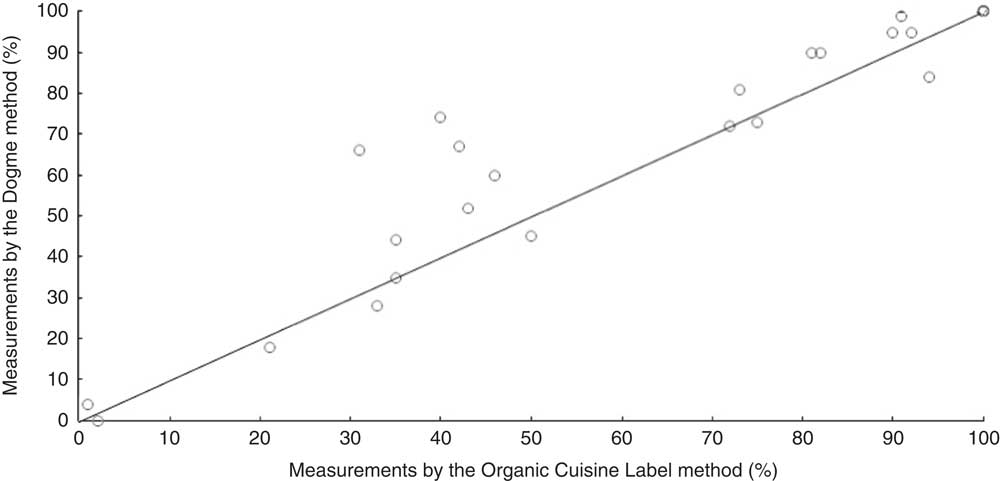
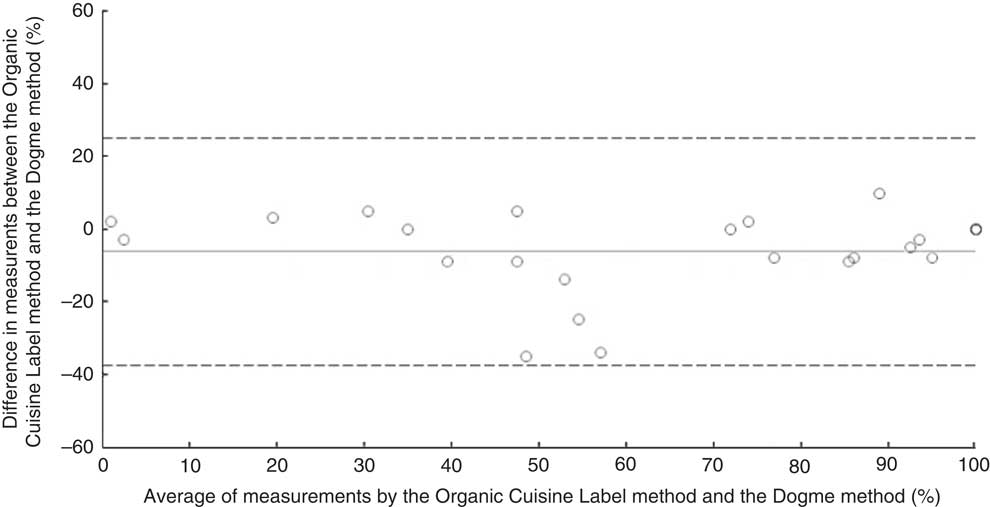
Figure 1 shows the level of agreement between the two methods for estimating organic food procurement level performed in twenty-six kitchens (childcare institutions or elderly homes), ranging from 0 to 100 % organic food. The Spearman correlation coefficient between organic food procurement estimations by the Organic Cuisine Label method and the Dogme method showed a high correlation (r=0·83, P<0·001). The Bland–Altman plot (Fig. 2) confirms the high level of agreement between the two methods, with a bias of −6 % and limits of agreement between −37 % and 25 %. However, both figures indicate an increased level of disagreement between the two measurement methods at certain organic food procurement levels. In Fig. 1, outlying estimations were identified at measurement levels between 55 and 75 % according to the Dogme method (y-axis) and between 30 and 45 % according to the Organic Cuisine Label method (x-axis). These outliers remain in Fig. 2 where disagreement is identified at the average estimation level between approximately 48 and 58 %. As the mean difference (bias) was found to be negative, the results of the comparison study show a generally higher trend of overestimation in measurements by the Dogme method compared with the Organic Cuisine Label method. Therefore, these results suggest that organic food procurement estimations by the Dogme method of 55–75 % carry an increased level of uncertainty and may overestimate the true procurement level.
Comparison of organic food procurement measurements by the Organic Cuisine Label method and the Dogme method among twenty-six public kitchens participating in the Danish Organic Action Plan 2020. The Spearman correlation coefficient between the two measurement methods was found to be significant (r=0·83, P<0·001)
Bland–Altman plot of agreement between measurements by the Organic Cuisine Label method and the Dogme method among twenty-six public kitchens participating in the Danish Organic Action Plan 2020. The average organic food procurement level by the two methods is represented on the x-axis and the difference between the two methods is represented on the y-axis. The middle line (———) indicates the mean difference (y=–6), with the top and bottom lines (– – – – –) showing the upper and lower limits of agreement (y=25 and –37), respectively
Baseline evaluation of the Danish Organic Action Plan 2020
Characteristics of the kitchens participating in the Danish Organic Action Plan 2020 are shown in Table 1. Baseline organic food procurement data were collected from 345 of the 349 public kitchens taking part in the Danish Organic Action Plan 2020. Four kitchens were excluded from the study based on lacking estimations of organic food procurement by either measurement method. The total mean organic food procurement of all eight types of public kitchens was found to be 24 % when including measurements from both methods (see Table 2).
Characteristics of kitchens participating in the Danish Organic Action Plan 2020 (n 345)

* Childcare includes all childcare institutions such as nurseries, kindergartens and integrated institutions; school food includes school canteens and home-cooking classes; after-school care covers institutional after-school care; café or canteen includes canteens or cafés associated with workplaces, universities, activity centres or cultural venues; elderly care includes homes for the elderly; hospital kitchen covers patient procurement; central kitchen includes large-scale food production kitchens delivering procurement for receiving kitchens; residential institution includes institutions in which consumers live permanently (i.e. social care facilities, university boarding schools and barracks).
† Total number of full-time positions in the kitchen (37 h/week).
‡ Total number of people served by the kitchen.
§ Total number of breakfasts, lunches and dinners served by the kitchen per week, self-reported. Institution types open for production 5 d/week: childcare, school food, after-school care and café or canteen. Institution types open 7 d/week: elderly care, hospital kitchen, central kitchen and residential institution.
|| Total number of mid-morning and mid-afternoon in-between meals served by the kitchen per week, self-reported. Institution types open 5 d/week: childcare, school food, after-school care and café or canteen. Institution types open 7 d/week: elderly care, hospital kitchen, central kitchen and residential institution.
¶ Baseline organic food procurement measurements by the Organic Cuisine Label method.
Organic food procurement at baseline in Danish public kitchens participating in the Danish Organic Action Plan 2020

* Childcare includes all childcare institutions such as nurseries, kindergartens and integrated institutions; school food includes school canteens and home-cooking classes; after-school care covers institutional after-school care; café or canteen includes canteens or cafés associated with workplaces, universities, activity centres or cultural venues; elderly care includes homes for the elderly; hospital kitchen covers patient procurement; central kitchen includes large-scale food production kitchens delivering procurement for receiving kitchens; residential institution includes institutions in which consumers live permanently (i.e. social care facilities, university boarding schools and barracks).
† Baseline organic food procurement estimations by kitchen type. Includes estimations derived by applying the Organic Cuisine Label method or the Dogme method.
‡ Percentage of kitchens divided into the different Organic Cuisine Label levels at baseline by kitchen type. Include estimations calculated by the Organic Cuisine Label method and the Dogme method.
Of the 345 included public kitchens, 255 applied the Organic Cuisine Label method to estimate organic food procurement, which corresponds to 74 % (see Table 1). The remaining ninety public kitchens used the Dogme method and of these organic food procurement measurements, 4 % were in the 55–75 % interval. The results in Table 1 show that hospital and central kitchens were few in number but significantly larger in terms of staffing and procurement. All public kitchens within these two types were also able to apply the Organic Cuisine Label method to measure the organic food procurement. The proportion of kitchens applying this method within elderly care and after-school care was much lower.
The different levels of mean organic food procurement according to the Organic Cuisine Label qualifications by kitchen type are shown in Table 2. The mean organic food procurement levels for childcare, school food and elderly care kitchens are the highest of the eight types of public kitchens. Almost all three kitchen types qualify for the Organic Cuisine Label in bronze (30–60 %) at baseline and half of all childcare institutions (n 106) have an organic procurement level between 60 and 100 % (silver or gold label level). In comparison, hospital kitchens and central kitchens are among the kitchen types with the lowest mean organic food procurement level and furthermore, none of these types include individual kitchens qualifying for more than the bronze label at baseline.
Discussion
The present study found that organic food procurement measurements by the Organic Cuisine Label method and the Dogme method are comparable at relevant percentage levels. Tendencies of overestimation were identified at organic food procurement measurements of 55–75 % and when measured by the Dogme method. When considering measurements from both methods, the mean organic food procurement baseline status among the 345 public kitchens participating in the Danish Organic Action Plan 2020 during 2012 and 2013 was found to be 24 %.
At implementation stage, most organic food procurement measurements will remain at low percentage levels. When considering the results of the comparison study, measurements of organic food procurement by the two different methods compared well at lower percentage levels and it is therefore reasonable to consider measurements by both methods for the baseline status of the Danish Organic Action Plan 2020. However, an increased level of disagreement was identified at higher procurement levels with overestimated measurements by the Dogme method between 55 and 75 %. This finding is important in terms of conducting organic food procurement measurements at a later stage during a conversion where more public kitchens are expected to measure higher levels of organic food procurement. Overestimations by the Dogme method may not be surprising as the design is based on self-reported organic procurement. However, applying the Dogme method will introduce unnecessary uncertainties which can be avoided by applying the Organic Cuisine Label method. In terms of endpoint evaluation of organic food conversions, where more public kitchens are likely to have reached organic food procurement levels of 55–75 %, the Organic Cuisine Label method will ensure more reliable results. Results of the comparison study also suggest that measurements by the two methods are comparable at organic food procurement levels of 100 % but not all public kitchens will be able to reach this level within the duration of the organic food conversion projects. Consequently, applying the Organic Cuisine Label method for the endpoint evaluation is recommended.
The Organic Cuisine Label method has proven to result in uniform, standardized and documented calculations of the organic food procurement by incorporating invoices from suppliers. Thereby, the original intention of applying this method exclusively is supported with the following rationale: (i) enabling the kitchens to track their progress during the organic conversion by applying an officially acknowledged method; (ii) guiding the kitchens in applying for and maintaining the Organic Cuisine Label once they are qualified, which is expected to enhance the chances of successful long-term implementation; and (iii) conducting more reliable measurements for the evaluation of the Danish Organic Action Plan 2020. Reliable endpoint measurements are necessary to evaluate whether targets were met, to support further research and to gain insight into best practices for future conversion projects.
The results of the Danish Organic Action Plan 2020 baseline status reveal patterns among the participating public kitchens in relation to their procurement structures, measurement method and organic food procurement level. Hospital kitchens and central kitchens were able to apply the Organic Cuisine Label method exclusively despite having a low mean organic food procurement level. The large-scale procurement structure within these kitchen types may support the application of the Organic Cuisine Label method, even when the kitchens have little or no prior experience with organic food conversion. Childcare, school food and elderly care kitchens seemed to have more difficulties applying the Organic Cuisine Label method but documented higher mean organic food procurement levels. The high level of organic food procurement at baseline in childcare, school food and elderly care kitchens may illustrate uncertainties introduced by applying the Dogme method as described above, but it might also be a result of the increased experience with organic food conversion. In Denmark, these kitchen types have been introduced to organic food conversion before( Reference Mikkelsen, Kristensen and Nielsen 41 – Reference Nölting, Løes and Strassner 43 ), and baseline status among them may therefore be higher.
Whether organic food conversion projects aiming to implement organic food conversion should include kitchens with a certain level of experience in organic food procurement is debatable. Either way, it seems even public kitchens with an organic food procurement above 50 % are motivated to participate in the Danish Organic Action Plan 2020 and possibly advance to 100 %. However, the high level of organic procurement estimated in childcare, school food and elderly care kitchens at baseline poses challenges in terms of further conversion as organic procurement becomes more demanding at increasing shares. The low mean baseline status for the remaining five types of public kitchens (in total n 91) seems to represent an audience which has not been included to the same extent in organic food conversion initiatives before, carrying greater potential in terms of increasing the level of organic food procurement. Organic food conversion in these types of public kitchens will be important to explore in the future to meet the targets of the Danish Organic Action Plan 2020.
As described in the ‘Methods’ section, neither the Organic Cuisine Label method nor the Dogme method explicitly accounts for local or seasonal foods in the measurements. This is an important issue to consider when evaluating the Danish Organic Action Plan 2020 in terms of sustainability. Past experiences with organic food conversions have resulted in a greater focus on health, environment and sustainability with public kitchens buying local and seasonal foods along with limiting food waste, partly in order to make budget cuts to afford the premium price of organic food( Reference Mikkelsen and Sylvest 13 ). However, with public kitchens being evaluated only based on the organic food procurement level, little incentive is left for the kitchens to demand local organic produce in periods where imported organic produce might be available at a lower price. Public kitchens have earlier expressed a strong motivation to collaborate with local suppliers even if the planned and ordered products are not always available in organic versions( 15 ). This motivation should be encouraged to increase sustainability.
In terms of health, one main expected effect of increased organic public food procurement is the decreased intake of chemical fertilizer and pesticide residues among consumers. Effects on nutrient intake are more uncertain as significant differences in micronutrient content between individual organic and conventional food products have not yet been established. Nutritional improvements of future organic food conversions in public kitchens are more likely to result from healthier meal compositions. Apart from organic food conversions in public kitchens, the Danish Organic Action Plan 2020 also included measures targeting the Danish agricultural sector to assist in conversion of farmland from conventional to organic( 1 ), which may carry health benefits in terms of water quality. Overall, the Danish Organic Action Plan 2020 carries great potential to improve sustainability, but care should be taken to ensure a holistic development within health, environment and food quality rather than promoting organic food procurement alone.
To the best of the authors’ knowledge, this is the most extensive organic food conversion baseline registration reported to date. It would have been interesting to compare measurements of organic public food procurement at the national level with results from other countries, but no similar studies were available. Related studies in organic public procurement explore settings and initiatives across European countries, but do not include measurements of organic food procurement across different types of public kitchens( Reference Løes and Nölting 44 , Reference Tikkanen 45 ). This area therefore calls for further research.
A limitation of the present study to consider when interpreting the results includes the small sample size for the comparison of the Organic Cuisine Label method and the Dogme method. Nevertheless, the exploratory value of the study remains significant, with varying levels of organic food procurement included to improve the understanding of the measurement methods.
Conclusion
Results of the present study show that organic food procurement estimations by both the Organic Cuisine Label method and the Dogme method are comparable within the percentage levels relevant at baseline. Furthermore, the mean public organic food procurement in Denmark registered at 24 % leaves room for an increase in organic procurement and possibility to improve the sustainability and nutritional quality of Danish public meals. This baseline status report of organic food procurement in Danish public kitchens hereby provides the first step towards a successful implementation and evaluation of the Danish Organic Action Plan 2020 in terms of public health nutrition and sustainability.
Acknowledgements
Acknowledgements: The authors wish to thank student interns Kathrine Højlund Rasmussen, Sonya Chuhovska and Nicklas Skov for their assistance during data collection. Financial support: This work was supported by the Danish Veterinary and Food Administration and the National Food Institute, Technical University of Denmark. The Danish Veterinary and Food Administration had no role in the design, analysis or writing of this article. Conflict of interests: None. Authorship: All authors were involved in formulating the research questions, designing the study, analysing data and editing article drafts. N.N.S. had a primary role in collecting data, analysing data and writing the article. Ethics of human subject participation: No ethical approval needed.



