

The music of Paolo Papini (d. 1603) is virtually unknown. Apart from a few songs printed in anthologies of laude spirituali during his lifetime that have received a bare mention in studies of that genre, his music has never been investigated.Footnote 1 The catalogue of manuscript collections in the Bischöfliche Zentralbibliothek in Regensburg notes some forty pieces by him, located in five sixteenth-century choirbooks.Footnote 2 These books, which have an indisputable provenance from the Ospedale di Santo Spirito in Sassia, Rome, escaped the attention of the twentieth-century scholars who (as outlined below) collectively traced a large quantity of material from the musical archive of Santo Spirito that was dispersed during the nineteenth century. Robert Eitner’s Quellen-Lexikon identifies a further source containing music by Papini in the Museo Internazionale e Biblioteca della Musica in Bologna, with the call mark Ms Q.31.Footnote 3 This manuscript, too, is yet to be studied in detail. There are also copies of three of his works in the Santini collection in the Diözesanbibliothek in Münster, made in the early nineteenth century.Footnote 4
This article will analyse the hitherto unknown liturgical music of Papini for which the Regensburg choirbooks and Bologna Ms Q.31 are the primary sources. It will also provide new biographical information about the composer, demonstrating his relationship to the Ospedale di Santo Spirito. Further, it will argue that, examined together with documentary evidence such as inventories and financial records from the Ospedale, Papini’s music throws new light on our understanding of the localized reform of liturgical music in the decades following the final session of the Council of Trent in 1563, and that his music demonstrates the influence of the reformer Bernardino da Cirillo while adopting the styles and formats favoured by the papal choir.
The Ospedale di Santo Spirito in Sassia was founded in the late twelfth century by Pope Innocent III, initially to care for abandoned babies and orphans. It rapidly expanded into a large charitable institution that included a school, a conservatory for young women, and a hospital for the poor. It was governed by its own religious order, the Order of Santo Spirito, which had a monastic-style Rule and hierarchy headed by the preceptor, or commendatore, who was appointed by the Pope. By the mid-sixteenth century, the hospital was emerging as a leading medical centre, and a number of the Ospedale’s prominent doctors also served as the private physician to the incumbent Pope. As a religious institution, music was required for liturgical purposes, but in addition, it was used for therapeutic purposes in the wards of the hospital.Footnote 5 It is within the unique context of the Ospedale that Papini’s contribution to the reform of liturgical music will be explored here.
The Musical Archive of the Ospedale
In the early modern period, the Ospedale di Santo Spirito in Sassia and its collegial and parochial church had a reputation for excellent music-making, and it owned a large collection of both manuscript and printed music. A full account of the dispersal of the entire library remains to be written, but in 1937, Guido Mattei-Gentili made the first modern attempt to identify items from the fragmented and scattered collection.Footnote 6 In the period from 1940 to 1950, Antonio Allegra, Raffaele Casimiri, and Pietro de Angelis added new evidence, but it was Lorenzo Feininger in the 1960s who succeeded in cataloguing a large body of material from the Santo Spirito musical archive, in part through his own activities as a collector.Footnote 7 These scholars all focused on the seventeenth-century manuscripts in partbook format. Feininger cited a note written by de Angelis, the librarian of the Biblioteca Lancisiana during the 1960s and an authority on the Ospedale di Santo Spirito, that stated that apart from a handful of sixteenth-century items which he listed, the old musical archive no longer existed — a remark that may be the reason why, to date, there has been no further research to find earlier sources.Footnote 8
The material identified by Feininger and his predecessors was collated by Giancarlo Rostirolla into a systematic list of music, composers, and genres, and the location at that date (2002) of each item in this body of manuscripts.Footnote 9 This list, however, is incomplete. None of these scholars followed up on a remark made by Alessandro Canezza in his 1933 history of the hospitals of Rome, quoted by Allegra in 1940, that there were beautiful choirbooks in the Benedictine school in Regensburg, presumably meaning the school founded by Franz Xaver Haberl in 1874.Footnote 10 Rostirolla includes references to the catalogue of manuscripts in the Proske–Haberl collection held in the Bischöfliche Zentralbibliothek in Regensburg, with regard to seventeenth-century partbooks, but missed nine large choirbooks with an indisputable provenance from Santo Spirito that are also listed in that catalogue.Footnote 11 It is these choirbooks, with the shelf marks BH 6001–BH 6009, that contain a large body of music by Papini.
While Palestrina is the dominant figure in the Regensburg choirbooks, second in terms of the number of compositions is Papini, whose music appears alongside that of Palestrina in more than half of these volumes. These volumes, BH 6004–6006, BH 6008, and the securely dated BH 6009, are similar in content. Although there are a few compositions by other composers from the Roman milieu, such as Cristóbal de Morales and Giovanni Maria Nanino, Palestrina’s music is mostly interspersed with anonymous pieces and compositions by Papini.
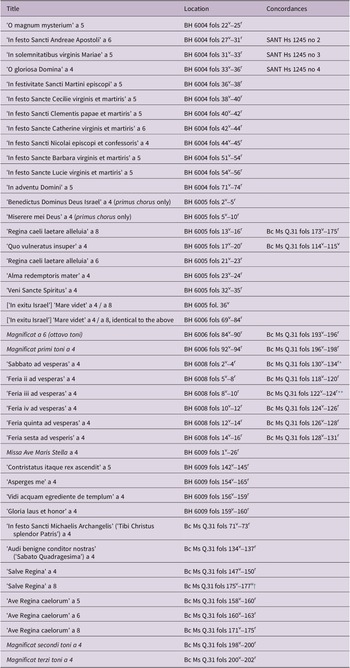
The copying dates of the volumes span the period from around 1570 through to the first three decades of the seventeenth century. Table 1 provides an overview of the contents and presumed dates of all nine choirbooks. Of the five volumes containing Papini’s music, only BH 6009 can be securely dated to 1603 from the inscription on its frontispiece that notes his death. Three of the remaining four have been dated by Dieter Haberl to the last third of the sixteenth century, using the dates of printed editions of some of the music they contain as a terminus post quem, together with codicological details such as watermarks, while the final volume is a compilation comprising materials from the late sixteenth century and some later fascicles.Footnote 12
Overview of the contents of the Regensburg choirbooks

A further manuscript containing music by Papini is located in the Museo Internazionale e Biblioteca della Musica in Bologna, formerly the collection of Padre Giovanni Battista Martini. This manuscript, Ms Q.31, is entitled Liber hymnorum totius anni per tempora disposta and includes pieces by composers associated with Rome and the papal choirs, such as Giovanni Andrea Dragoni, Costanzo Porta, Ruggiero Giovannelli, Costanzo Festa, Johannes Parvus, and Palestrina, as well as a significant number of anonymous items. About half of the Papini compositions in the Bologna manuscript are also found in the Regensburg choirbooks. Although the music in Bologna Ms Q.31 is all from the late sixteenth century, the indications of a copying date are contradictory. The book is quarto-sized but written in choirbook layout. The scribe made very few errors with spacing the voice parts, but in one place the tenor on the verso page is continued onto the recto, and the continuation is marked with the stemma of the Chigi family — six hills surmounted by a cross or star. This suggests that the manuscript was written during the pontificate of Alexander VII Chigi (r. 1655–67). A date of 1659 written in pencil on the flyleaf is consistent with this internal evidence. This date, however, contradicts the date of 1580 inscribed on one of the woodcut images that separates the sections of the manuscript. These were pre-printed pages, the versos of which were ruled for music notation. Such images would have been printed in large quantities and the blocks re-used over a long period of time; thus they are not a secure means of dating. However, the image does provide a terminus post quem indicating a copying date sometime between 1580 and 1659.
Unlike the Regensburg choirbooks that have clear marks of use, such as manicules and accidentals added by later hands, Bologna Ms Q.31 seems to have been compiled as a reference book. The contents are systematically organized, it is written in a single hand, and there are very few signs of correction or of interventions by performers, such as reminders of musica ficta at cadences. Although there are no marks of ownership, the provenance has been identified as Roman.Footnote 13 The presence of compositions by Parvus, who is known primarily as a copyist in the Cappella Ponteficia, would support this. As the only other sources of liturgical music by Papini similarly contain music by composers associated with the papal choirs, such as Palestrina and Dragoni, and are indisputably from the Ospedale di Santo Spirito, and conversely, as Papini’s liturgical music has not turned up in any manuscripts from other Roman institutions, I would suggest that Bologna Ms Q.31 too once belonged to the Ospedale or to the personal library of someone directly associated with it, such as a commendatore — perhaps Virgilio Spada, who worked closely with Alexander VII Chigi.
Collectively, the Regensburg choirbooks and Bologna Ms Q.31 provide evidence of the musical repertory used at an important Roman institution during the period in which post-Tridentine reforms were starting to have an impact. While the Regensburg books are probably chronologically the earliest of the sources, it cannot be established beyond doubt that they were the source for either Bologna Ms Q.31 or the much later Santini manuscripts.
Paolo Papini: Documents and Sources
The preponderance of music by Palestrina in the Santo Spirito choirbooks is hardly a surprise given the geographic proximity of the institution to St Peter’s and its deep ties to papal patronage. What is striking is the sheer quantity of music by Papini, especially given that he is a composer who has otherwise escaped attention. There is no biography of Papini in any of the major musicological reference books, no printed sources of his liturgical music have come to light, and his published output appears to be limited to a handful of laude spirituali included in two anthologies, both printed in Rome, with strong connections to the Oratorians of the Chiesa Nuova. Two of Papini’s laude appeared in Tempio armonico della Beatissima Vergine (1599) and four in Nuove laude ariose (1600).Footnote 14 The laude in the former, including Papini’s contributions to the volume, are consistent with the norms of the genre: they are largely homorhythmic, strophic settings of texts of variable quality, for three voices — two upper parts and a bass. The majority are in mode I or a transposed mode I (with a G final), with little chromatic interest.Footnote 15 One of Papini’s laude in the Tempio armonico, ‘Vergin ben posso dire’, also appears in Nuove laude ariose but is expanded from three to four voices.
There was a deep connection between the Oratorians and the Ospedale di Santo Spirito. Although based at S. Girolamo della Carità from 1551 and working in the hospital there as part of his vocation, Filippo Neri, the founder of the Congregazione dell’Oratorio, was also a frequent visitor to the enormous hospital wards of Santo Spirito, carrying out charitable acts as part of his own sense of pious devotion. In 1555, Bernardino da Cirillo was appointed as commendatore of the Ospedale di Santo Spirito. Cirillo was a friend of Neri, and at one point he asked Pope Pius V if he could be relieved of his duties as commendatore in favour of Neri; his request was turned down.Footnote 16 Cirillo had previously been archpriest of the Santa Casa di Loreto, where he no doubt experienced the singing of simple laude and litanies to the Madonna. Neri’s influence, together with his own past experience, probably influenced Cirillo’s musical tastes and views on music, including that performed at the Ospedale under his jurisdiction.
Given the context of the two laude publications, it might be assumed that Papini was an Oratorian. However, this is not the case. The documentary archive of the Ospedale di Santo Spirito has revealed payment records made to him; these records are somewhat sporadic but are perhaps the only hard evidence of his life, which appears to have been spent as a friar of the Order of Santo Spirito.Footnote 17 Prior to around 1600, the records in the archive of the Ospedale of payments to musicians are not systematic. It is possible that Papini may have been either the singer identified as Paolo Pisano in 1553 and 1555, or Paolo Bresciano, also identified in 1553.Footnote 18 However, neither of these singers is recorded after 1555. The first unambiguous reference to Papini that records both his given and family names occurs seven years later, in a payment dating from 1562 while Bernardino da Cirillo was commendatore. This payment indicates that Papini was a friar of the order and that the payment was made to him ‘for his needs, assigned to him from the revenue of his priory of Ancona, ordered by Monsignor the commendatore’.Footnote 19 Sadly, the records for the decade 1560–69 are incomplete, but similar payments appear in 1564 and 1569 for which records have survived. From these documents it seems likely that Papini was receiving an income from a benefice, that of one of the many affiliated hospitals of the Order of Santo Spirito that existed across Europe. There was an affiliated hospital and priory in Ancona at least as far back as the mid-fifteenth century, as the names of some of the priors have been preserved: in 1458 the position was held by Lorenzo Spagnolo and around 1578 by Fra Giuseppe Maffeo.Footnote 20 By 1571 it appears that Papini was receiving another benefice from Gubbio (Eugubbio), where there was another affiliated hospital and priory, the Casa e Chiesa di Santo Spirito e Ospedale di San Marco.Footnote 21 Sadly, the large folder of documents relating to the priories in Ancona and Gubbio in the archive of the Ospedale does not contain anything that can throw more light on the relationship between Papini and these other priory hospitals.Footnote 22
In January 1578 Papini was paid ten scudi in what appears to be a part payment of a larger amount, possibly a salary increase or contract, that ran for the whole year.Footnote 23 Other singers who appear in the financial records and who perhaps would have worked alongside him in that year include Arcangelo Crivelli, Pietro Borgognone, Cesare Volpi, Marcello da Bologna, Francesco da Segni, and Dragoni.Footnote 24 As at least three of these men had illustrious careers in the Cappella Giulia and other major churches in Rome, we can assume that the singing at Santo Spirito was of a better standard than an ordinary parish church in Rome at the time, though as Richard Sherr explains, even the papal singers were not always as good as we might like to imagine them to have been.Footnote 25 After this date, there is a lacuna in the documents, the next records being for 1595, by which time Papini is identified as maestro di cappella and also prior. However, this payment was a pension, which would suggest that by this time he was either elderly or infirm and unable to carry out any duties.Footnote 26 In all the records he is clearly identified as ‘nostro’, that is, a member of the order, but that does not imply that he was a priest. His membership in the Order of Santo Spirito is corroborated in the Regensburg choirbooks, where he is identified as ‘Frater’ (friar or brother) in the composer attributions of his pieces. Indeed, he would not have been eligible to hold any office such as prior had he not been a member of the order for some considerable time. He died in 1603, as noted on the frontispiece of BH 6009.
The period in which Papini was at Santo Spirito thus likely coincides with the time in which Neri was a regular visitor, and certainly during the period in which the Congregazione dell’Oratorio was established (1575). The appearance of Papini’s laude in anthologies that were connected to the Oratorians is therefore not surprising; the close relationship between Cirillo and Neri may have allowed the composer the opportunity to hear laude at Neri’s gatherings during the 1560s and 1570s. While Papini may not have been a composer of great status, he was known to the Oratorians and was active within the Order of Santo Spirito from the 1560s, during the incumbency of Cirillo.
Cirillo, known to musicologists as an advocate for the reform of liturgical music, was the commendatore of the Ospedale di Santo Spirito for nearly twenty years, until his death in 1575.Footnote 27 As Papini held administrative roles within the Order of Santo Spirito, he would almost certainly have had contact with him. Cirillo’s views, as expressed in a famous letter to key players at the Council of Trent, favoured music that moved people to piety, was not based on secular melodies, used modes to affective purpose, and focused on the meaning and affect of the text, delivering it comprehensibly. Papini’s style is probably indicative of that favoured by Cirillo and in use at the Ospedale under his jurisdiction, that is, according to a further letter of c. 1570, the style of Palestrina as found in the Pope Marcellus Mass — a work that was possibly also Papini’s stylistic model.Footnote 28
The preponderance of Palestrina’s music side by side with Papini’s in the manuscript sources is indicative that Cirillo’s views on the reform of music had some impact on the choice of liturgical music used at Santo Spirito. Papini’s probable working relationship with Cirillo raises the question as to whether Papini himself influenced the choices of music in the years following Cirillo’s death. Inventories of the Ospedale di Santo Spirito from 1535, 1546, and 1582, that is, from before and after Cirillo’s time as commendatore, offer further evidence. The general substance of the Regensburg choirbooks is consistent with the music listed in the last of these (1582), noting the contents of the chapel and choir. This inventory dates from the period in which Papini was active at Santo Spirito and includes printed books by Tomás Luis de Victoria, Morales, Palestrina, and Giovanni Animuccia, among items by one or two older composers such as Josquin that may have been present at an earlier period.Footnote 29 The sequence of inventories indicates an expanding repertory and a leaning towards the composers who were favoured by the papal choirs post-Trent: Palestrina, Morales, Jacobus de Kerle, and Victoria.Footnote 30 Papini therefore had at his disposal plenty of material on which to model his own music.
Together, the Regensburg choirbooks and Bologna Ms Q.31 add over forty items to the previously known output of Papini. The title and location of each composition are shown in Table 2. Although Papini’s music is difficult to date precisely, the documentary evidence of his life and the contextual information gleaned from the Regensburg choirbooks indicate that he was active in the last three decades of the sixteenth century — a period of significance in the history of liturgical music in that it aligns with the changes instigated by the Council of Trent.
Papini’s compositions, locations, and concordances in the order they appear in the Regensburg volumes and Bologna Ms Q.31

* The opposite page is incorrectly numbered 133, hence the page numbering is out of sequence.
** Fol. 120v is opposite fol. 123r.
† The foliation changes to pagination here.
Physical Features and Contents of the Sources
BH 6004 contains motets for specific feast days, all clearly identified. It starts with motets for the Sundays in Advent, the first three by Palestrina, the fourth by Morales. These are followed by Papini’s setting of ‘O magnum mysterium’, proper to matins for Christmas. After two more anonymous pieces, there are further motets by Papini for named feast days, all of which fall in November and December: St Andrew, St Martin, St Cecilia, St Clement, St Catherine, and St Nicholas. The Papini group is followed by two further motets by Palestrina for the Feast of the Immaculate Conception (8 December), two more Papini motets for the feasts of St Barbara and St Lucy (both falling in December), and four more Palestrina motets for December feast days: Christmas, St Stephen, St Thomas the Apostle, and St John Apostle and Evangelist. The last Papini motet in the collection is for Advent (‘Salvatorum expectamus Dominum’), and the volume closes with Palestrina’s Missa ut re mi fa sol la (1570). The Palestrina sources can all be traced to printed volumes dating from 1563 to 1572. Since Papini’s service at Santo Spirito started in the 1560s, a time contemporary with the Palestrina prints, a copying date sometime in the late 1570s or 1580s seems probable.
While the opening items of the volume suggest that it will be in liturgical order, this is not strictly the case, although apart from the Palestrina Mass, which Haberl suggests was copied by a different hand to the rest of the volume, it clearly only has materials proper to feast days for the last two months of the calendar year.Footnote 31 This period also covers the start of Advent, and therefore the beginning of the liturgical year. If this volume reflects a deliberate chronological organization of music, then it would suggest that other choirbooks containing material for the rest of the year would also have existed. The contents of Bologna Ms Q.31 appear to confirm this, as it contains a further hymn by Papini for the feast of St Michael Arcangel (Michaelmas, 29 September), as well as one for vespers for the first Sunday in Lent (‘Audi benigne conditor nostras’).
One physical feature of BH 6004 is the fine decorative penwork. Many of the initial letters in the first pages of the book are finely decorated with filigree, but there are also what appear to be doodles in the same hand. On closer inspection, these are in fact indicators to the singers of places where there is a continuity issue in the musical text. In Papini’s ‘O magnum mysterium’, for example, there are calligraphic flowers to show where the Quintus part that starts on the left (verso) page continues on the right, so the singer can see the continuation quickly. In the setting of ‘Vidi speciosam’, the scribe started the Bassus part on the right-hand (recto) page, ran out of space, and had to continue on the left page. Here, a different hand has used the double cross symbol of the Order of Santo Spirito to mark where the singer would have to read right to left instead of left to right. The capital letters in the later pages are more functional and lack the fine decorations of the opening pages. The musical text is for the most part in a heavier or thicker scribal style, and the ink has damaged the pages in many places, spreading and causing bleed-through, and in the worst areas dropout as well.
The content of BH 6005 is similar to BH 6004, containing some unattributed music alongside compositions by Palestrina and Papini. At first glance there does not appear to be a logical order to the compositions. There are seven different scribes, which suggests that it was not conceived of as a unified book.Footnote 32 In addition, the first three items are for eight voices, presumably in two choirs of four parts each (CATB). Only the first choir, identified in the manuscript as primus chorus, survives. These are a setting by Papini of ‘Benedictus Dominus Deus Israel’ (the canticle for lauds), ‘Miserere mei Deus’ (Psalm 51, one of the penitential psalms used during Holy Week), and Palestrina’s ‘Vicitimae paschali laudes’ (for Easter).Footnote 33 A series of settings of Marian texts follow, some anonymous, some by Papini, including his settings of part of the hymn ‘Vexilla regis’ (‘Quo vulneratus insuper’), ‘Regina caeli’, and ‘Alma redemptoris mater’. After four other anonymous motets (two Marian, one for Communion, and one for compline), the volume is completed with Papini’s setting of the text for Pentecost, ‘Veni Sancte Spiritus’, and an eight-voice version of ‘In exitu Israel’, separated by an anonymous setting of the response ‘Domine adjuvandum’. Although there is no particular order to them, all of these compositions could have been used for one or more of the Divine Offices. Eight of the fifteen pieces are settings of Marian texts, and three others are for specific offices — lauds, vespers, and compline. Bologna Ms Q.31 contains copies of the settings of ‘Regina caeli’ as well as five further settings of Marian texts, three of ‘Ave Regina caelorum’, and two of ‘Salve Regina’. These too are used in the office of compline.
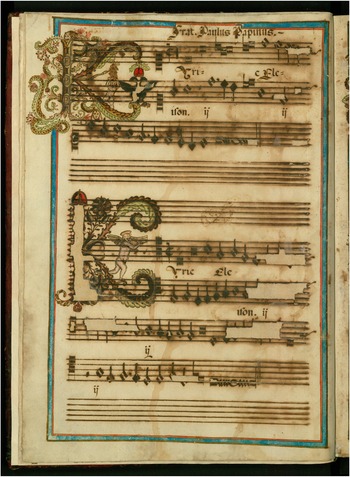
BH 6006 only contains three items by Papini: two Magnificat settings (one for four voices, identified by psalm tone, and one for six voices) and a second copy of ‘In exitu Israel’.Footnote 34 The remainder of the music comprises anonymous compositions for specific feast days, and due to the absence of attributed items, it is difficult to date them more precisely than the last quarter of the sixteenth century. Like BH 6004, BH 6006 also contains decorated initial letters; some of the most striking are those decorating the capital letters of Papini’s six-voice Magnificat, weaving the composer’s name into the capital E of the word Et (Figure 1). It is underneath the final bass staff of this item that the scribe has signed his work Don Valerio Georgio (‘Don Valeri~ Georgi~ scrib~t’); if this scribe could be traced, it would help date the volume more precisely. Both the Magnificats in BH 6006 are copied in Bologna Ms Q.31, alongside two further settings of this text identified by their psalm tone, as Magnificat secundi toni and Magnificat terzi toni, suggesting that there might originally have been a complete cycle of Magnificats in all the psalm tones.
BH 6006, fol. 84v, showing calligraphic decoration by Don Valerio Georgio. Reproduced with permission of the Bischöfliche Zentralbibliothek, Regensburg.

There are only six Papini compositions in BH 6008, all of which are settings of vespers hymns for ferial days. Each is identified by its position in the week, indicating a complete cycle for weekdays. It is possible that the Papini compositions were bound into this volume at a later date, as the rest of the book is in a very different scribal hand and includes an index at the back that does not list the Papini items. Furthermore, these hymns have incomplete initial letters, indicating that decoration was planned but not executed. Bologna Ms Q.31 contains copies of all these hymns.
BH 6009 is a lavishly illuminated choirbook that provides evidence of Papini’s close involvement in the work of the Ospedale. The frontispiece bears an inscription noting its presentation to the commendatore in 1603, the death of Papini, and the name of the scribe:
Most illustrious and most reverend Girolamo Agucchi, preceptor of the Archhospital of Santo Spirito in Sassia of the city, and Don Paolo Papini, may he rest in peace, excellent prior and maestro di cappella of our hospital. Domenico Aniboni, priest and singer, wrote this, 1603.Footnote 35
Papini’s ‘angelic’ music seems to be celebrated in the decorated capitals of his Missa Ave Maris Stella, presented in the opening pages of this volume (Figure 2).Footnote 36 Sadly, the ink damage to BH 6009 is such that this Mass, which is Papini’s only surviving Mass setting, is beyond reliable transcription without significant editorial reconstruction.
BH 6009, fol. 1v, Papini, Missa Ave Maris Stella, Kyrie, showing calligraphy by Domenico Aniboni and the damaged state of the manuscript. Reproduced with permission of the Bischöfliche Zentralbibliothek, Regensburg.

Bologna Ms Q.31 is entitled Liber hymnorum totius anni per tempora disposta and, unlike the Regensburg volumes, seems to have been compiled as a library reference or perhaps a presentation copy, though it lacks any dedication or evidence of ownership. The script is uniformly neat and in a single hand. The mise en page is well planned, with groups of staves pre-ruled with a rastrum in groups of four, three, or two staves, depending on the number of voices in the composition: four for the standard CATB layout, three for five- and six-part compositions, and pairs for eight-voice pieces in two choirs, with Choir 1 placed on the verso and Choir 2 on the recto. The pre-ruled pages are evident in groups of unused pages between sections. There is little or no evidence of scribal corrections. Although the book is in choirbook layout, in practical terms its small size suggests that it could not have been used as such, as the notation is too small to be seen by singers grouped around a single book, the individual pages being smaller than a modern A4 page. Its decorative features, too, suggest points of reference for easily finding suitable music for specific feast days. The pages with subheadings feature printed images of religious figures relating to the liturgical use of the music in the pages that follow.
The overview above is sufficient to indicate that Papini’s output consisted of liturgical music, for the most part with specific functions — vespers hymns, motets for specific feast days, psalms, canticles, and a single Mass setting. Many of the sources indicate the liturgical use, while others can fairly readily be assigned a liturgical function by the association of their texts with feast days or specific offices. These are shown in Table 3. As I will demonstrate, practicality and functionality is key to understanding Papini’s works.
Liturgical functions of Papini’s music

* Text incipits are given in parentheses where they are not present in the title given in the manuscript. Implied incipits of chant intonations are given in square brackets, though these too are not always present in the manuscript.
** This text is part of the lamentation of King David in 2 Samuel but does not appear to have a specific liturgical purpose.
† John D. Spilker, ‘“Oh My Son!” The Musical Origins and Function of King David’s Lamentation’, College Music Symposium (1 October 2009) <https://symposium.music.org/volume-49/articles-1752877057/oh-my-son-the-musical-origins-and-function-of-king-david-s-lamentation.html> [accessed 13 March 2026]. Spilker’s suggestion given here is somewhat obscure. It seems more likely that this text would have been suitable for use in any Requiem Mass, such as the annual commemoration of the dead for All Souls.
Papini’s Style
An analysis of Papini’s music demonstrates the extent to which it adopts Tridentine principles and follows the styles and formats of music used by the papal choir, while at the same time accommodating the personnel available to him at Santo Spirito and catering to the specific needs of the institution. The majority of his output is for four or five voices. Of the forty-four compositions, only twelve, including the reworked ‘In exitu Israel’, are for more than five voices, while twenty-one are for four voices and ten for five. Over 70 per cent of his output is thus for four or five voices, a figure that is consistent with the records of singers employed at Santo Spirito from the 1550s until the early 1600s. Although the records are inconsistent, with singers being paid individually for varying periods of service rather than being recorded as a group, as they are in later registers, there are recurring payments to four or five singers from the 1550s onwards. Extra singers were hired for important festivals, especially for Pentecost, which was celebrated as the patronal feast day as well as being a major feast in the liturgical calendar.Footnote 37
Of the pieces for eight voices, two only survive in part. ‘Benedictus Dominus Deus Israel’ and ‘Miserere mei Deus’, both in BH 6005, are marked primus chorus, indicating the existence of a second chorus to make up the eight voices. Stylistically, these two pieces stand out, as the primus chorus part contains the odd-numbered lines of the text set in falsobordone — an element of Papini’s style which I discuss further below. Apart from the eight-voice ‘Sicut erat’ that forms the final section of the six-part setting of ‘In exitu Israel’, the remaining eight-voice pieces are Marian antiphons.
The eight-voice ‘Regina caeli laetare alleluia’ in BH 6005 is the only large-scale setting to have survived complete in the Regensburg sources. However, Bologna Ms Q.31 contains two further eight-voice settings of the Marian antiphons: ‘Salve Regina’ and ‘Ave Regina caelorum’. The ‘Salve Regina’ is substantially an alternation of two four-part choirs, each delivering a line of the text in turn (see Example 1).Footnote 38 Only the final line (‘O dulcis virgo’) is in a fully worked-out eight-part polyphonic texture. It seems highly likely that this textural disposition was designed for performance with the choirs spatially separated. In contrast, in the settings of ‘Regina caeli laetare alleluia’ and ‘Ave Regina caelorum’, the eight voices function as a single unit. Shorter sections of alternation between the two four-voice choirs provide textural contrasts to passages for the full choir in the opening and closing parts.
Papini, ‘Salve Regina’ a 8, second-to-last verse, showing the alternations between the two choirs. Bologna Ms Q.31, fols 176v–177r.

Contrasting sections for the full texture interspersed with passages in which the voices are paired or grouped and set against each other seems to be typical of Papini’s handling of larger forces, as he also follows this pattern in the six-voice ‘Regina caeli laetare alleluia’ and the six-voice Magnificat in BH 6006. In the latter, all six voices sing the opening verse in declamatory style, the ‘Quia fecit’ introduces more mixed textures, with two groups of three voices briefly emerging out of the larger group, while the ‘Fecit potentiam’ starts with a sparser four-voice texture before reverting to the fuller six-part counterpoint.
The two settings of ‘Regina caeli laetare alleluia’ in BH 6005 are texturally different, although both are based on melodic elements drawn from the plainchant melody (see Examples 2a and 2b).Footnote 39 The incipit of the chant appears in the Cantus 2 and Tenor 2 parts of the six-voice and eight-voice settings respectively. The reuse of some of the other parts, either directly, such as the Bass, or through repositioning, for example the incipit of Cantus 1 in the six-part setting and Tenor 1 in the eight-part setting, suggests that perhaps one is a reworking of the other. The six-part version is homorhythmic and somewhat block-like in its opening statement, while the eight-voice setting opens with a more elaborate contrapuntal texture that groups the voices in different ways as it proceeds. Although the eight-voice version precedes the six-voice one in the book, that may not necessarily represent the order in which they were composed. Two different scribes are evident, and they are separated by music written by a third scribe, so the order is no indication of compositional chronology. While the similarity of parts between the six- and eight-part settings of ‘Regina caeli laetare alleluia’ may be as a result of the underlying chant melody, they do perhaps indicate that Papini reworked some of his liturgical pieces in the same way that he reworked his three-voice lauda ‘Vergin ben posso dire’ into a four-voice setting.Footnote 40
‘Regina caeli laetare alleluia’ a 6, D-Rp BH 6005, fols 21v–22r.

‘Regina caeli laetare alleluia’ a 8, D-Rp BH 6005, fols 13v–14r; I-Bc Ms Q.31, fols 173v–174r.

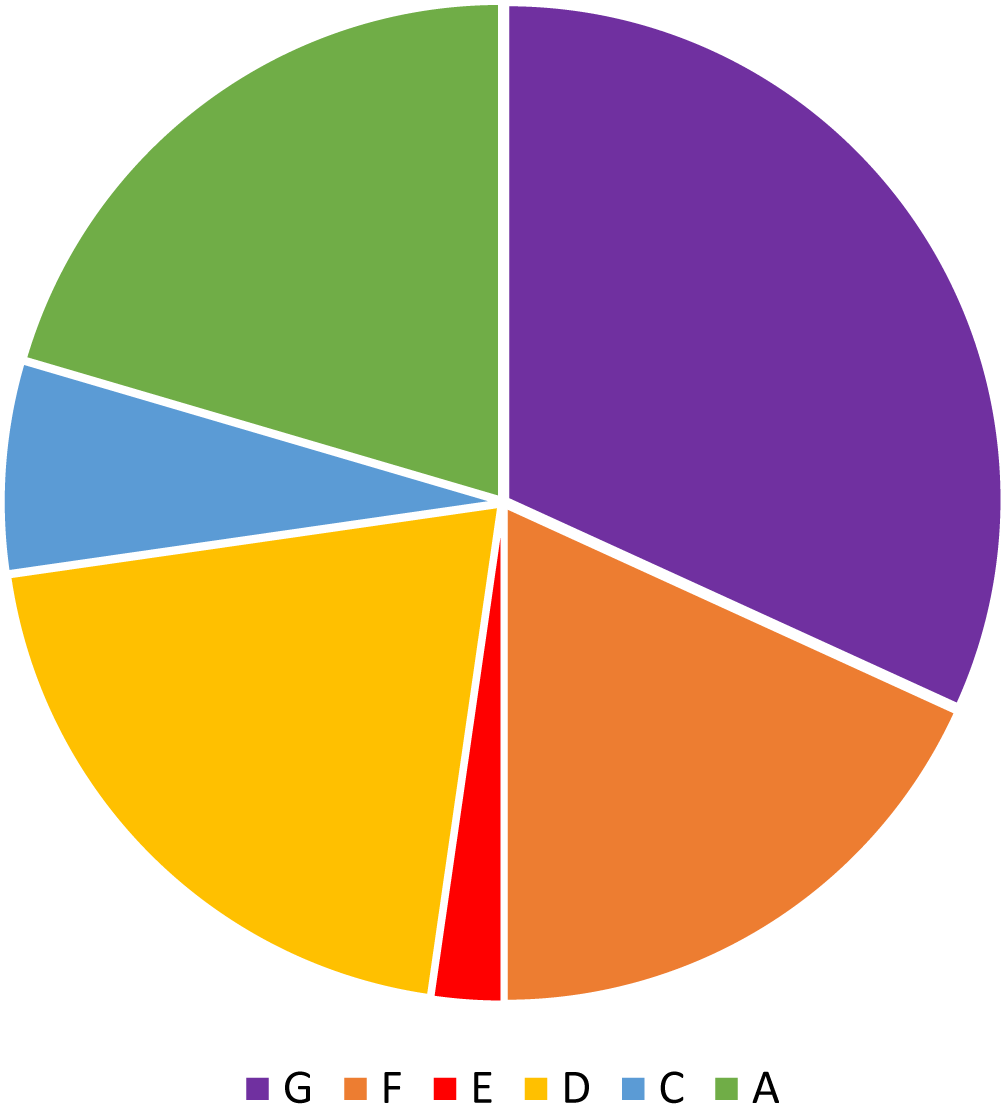
Papini’s music is strictly modal, with just over half the extant compositions having a final of either G (32 per cent) or D (20 per cent). Of these, only one of the pieces on D is not in the natural system (cantus durus), while those on G are split more or less equally between the flat (cantus mollis) and natural systems. The pieces using an A final are similar to those on D, with all but one in cantus durus. Add to this the group of pieces on F and C that all use the flat and natural systems respectively, and a pattern emerges: on the one hand, a nascent ‘major’ tonal type, and on the other a mode I–mode II ‘minor’ tonal type. The leaning towards what might be described as simple or ‘pure’ tonalities that in practice also lack chromatic inflections other than those that are strictly necessary points to the influence of simpler styles such as laude (see Figure 3).
Disposition of finals in Papini’s compositions.

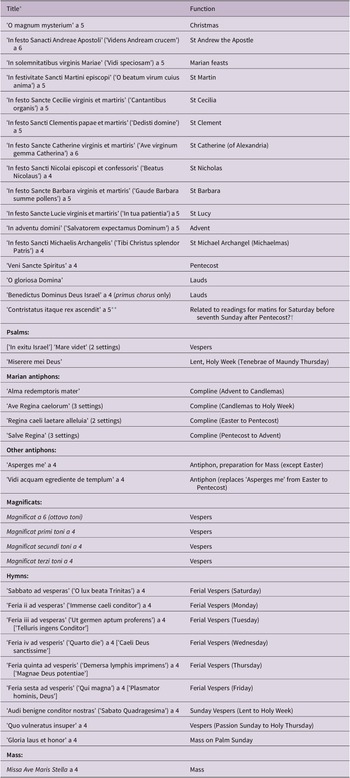
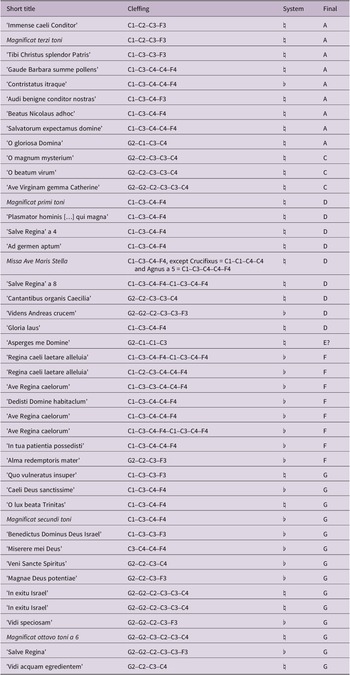
A quirk of Papini’s writing that may or may not be connected to his use of mode is the preponderance of high clefs used for the lowest voice part. While half of his output, including the double-choir settings, uses the standard C1–C3–C4–F4 clef combination, or chiavi naturali, the remainder use either chiavette (G2–C2–C3–F3 or G2–C2–C3–C4) or a mixed cleffing such as C1–C3–C3–F3.Footnote 41 Of the six-part pieces, only one has a bass part notated with an F4 clef; the remainder use either an F3 or C4 clef. Quintus parts are generally in the high tenor to low alto range, using C3 or C4 clefs. The alignment of cleffing, flat or natural system (cantus mollis or cantus durus), and final is not completely consistent, but there are clear patterns.Footnote 42 The four-voice pieces with an A final in the natural system tend to use the mixed C1–C2–C3–F3 or C1–C3–C3–F3 clefs; the three pieces with a C final in cantus durus all use chiavette; all but one of the pieces with an F final in cantus mollis and the majority of pieces with a D final in cantus durus use chiavi naturali (see Table 4).
Cleffing, systems, and finals in Papini’s compositions

Rather than being a function of mode, the tendency to use chiavette and mixed clefs for music in five and six parts may indicate the need to cater for specific voices, perhaps an ensemble that did not include a true bass.Footnote 43 Given that the orphans raised in the hospital were given music lessons, maybe Papini needed to accommodate young voices.Footnote 44 Another feature that may suggest the use of young voices is the comparative simplicity of some of the upper parts, especially in settings in more than five parts. Repeated pitches and stepwise motion prevail, in contrast to tenor and bass parts that range more widely and, in bass parts in particular, include wider intervals such as fourths, fifths, and octaves. If an expanded choir were needed, it is feasible that boys from the orphanage who were not fully trained were called upon to provide the additional high voices. A census document from 1595 numbering the people resident at the Ospedale and their duties provides evidence that the choir at Santo Spirito did indeed include children.Footnote 45 Other evidence in the payment records indicates the presence, at least sporadically, of named bass singers, for example Ottaviano d’Orta in 1557 and Giuliano da Gubbio in 1570.Footnote 46 The comparative scarcity of true bass parts would also align with this specific naming of bass singers in the records, as they would have been an irregularity requiring comment, whereas no other singers are identified by voice during this period.
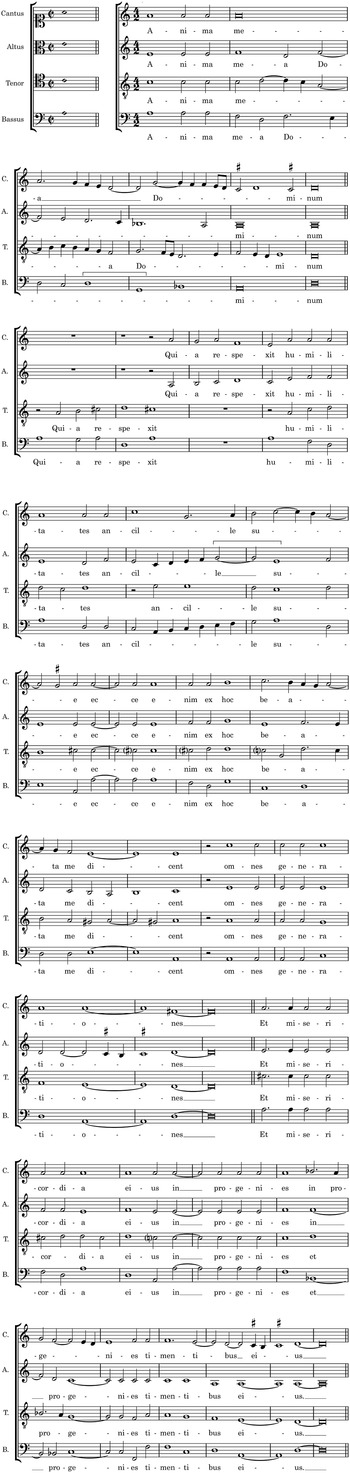
The Magnificat settings that are identified by mode provide useful exemplars of Papini’s harmonic language and his polyphonic style. Sung vespers, with the Magnificat as a core item, were noted in documents well into the seventeenth century as an important way of drawing large numbers of people to the church, inspiring piety and charity. This not only fulfilled the charitable aims of the Order of Santo Spirito but also the impulse for conversion or reconversion arising from the initiatives of the Tridentine reforms.Footnote 47 Each of the three four-part Magnificats uses the traditional modal indicators of the named psalm tone in their titles.Footnote 48 The final, system, disposition of the fourth and fifth within the octave, and medial cadences are carefully followed. Tones II and III are transposed to G and A finals respectively, following common use, and tones I and II utilize the common inflection of the flattened sixth degree, especially in the approaches to cadences.Footnote 49 As the opening intonation is included for all three settings in Bologna Ms Q.31, it is clear that the responding verses maintain a close relationship to the reciting tones of their respective modes. The contrapuntal writing provides some textural contrast between the verses: passages of block-like homorhythmic chords followed by more elaborate cadences, counterpoint with only one moving part, and simple imitation feature in all of them. The text is delivered efficiently as there is no repetition of words or phrases of the text, and only occasional melismas, notably towards cadences. In the Magnificat primi toni, for example, the opening pair of verses demonstrate simple contrapuntal textures that are consonant except at cadences, where some controlled dissonance appears (Example 3).Footnote 50 In contrast, the central verses, ‘Et misericordia’ and ‘Deposuit potentes’, are set in block-like chords leading into more complex contrapuntal cadences. The final two verses are the most elaborate, using moments of imitation.
Papini, Magnificat primi toni, D-Rp BH 6006, fols 106v–107r, demonstrating contrasting textures.

Papini’s most complex contrapuntal writing is found in the motets in BH 6004 and BH 6005. Several of these are imitative from the outset and use head motifs that expand beyond the stepwise motion that is more characteristic of his style; it is in these that Papini’s emphasis on strict modal counterpoint seems to trigger some inelegant moments. In pieces that use imitative motifs moving by fourths or fifths, there is contrapuntal awkwardness, such as narrowly avoided false relations that are created by the articulation of the modal disposition of fourth and fifth within the ambitus of the imitating voices.
The four-part ‘O gloriosa Domina’ is a case in point. The head motif of a rising perfect fifth (A–E) continues with an upward step rather than descending, and is answered at the fifth below by another rising fifth (D–A) in an exact imitation that subsequently introduces B♭s to maintain the intervallic pattern of the opening. The third and fourth entries follow exactly the same process, creating ambiguity between two different modal diapente–diatessaron pairs and implying two different finals, A and D, supported by their sub-semitones, and two modes, mode VII and mode I (Example 4). Modal counterpoint in which the dominant is elaborated is not in itself unusual and can be derived from some chant melodies, but Papini’s handling of this material is less successful than the free counterpoint he uses elsewhere.
Papini, ‘O gloriosa Domina’, D-Rp BH 6004, fols 33v–34r, opening imitation.

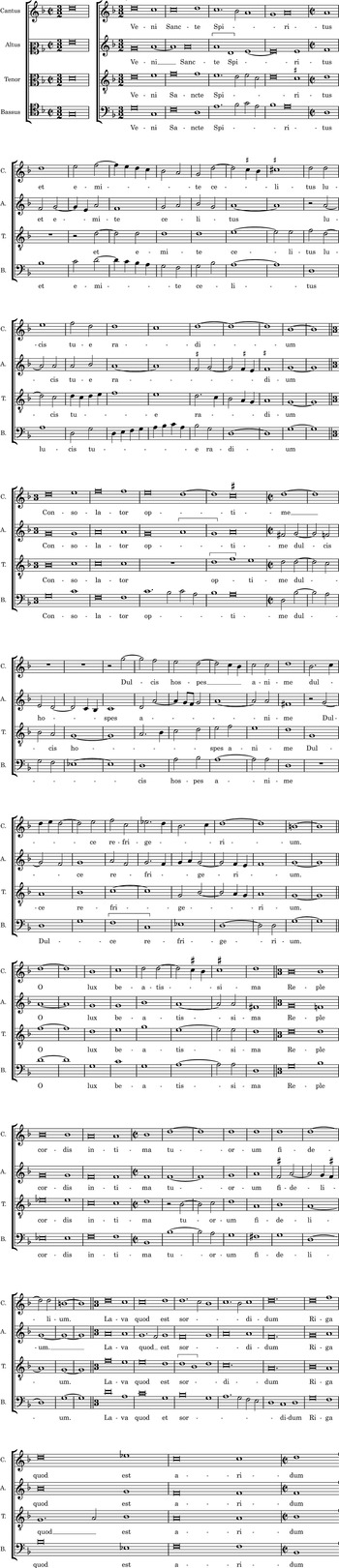
In contrast to the other motets in BH 6005, the opening of the four-part ‘Veni Sancte Spiritus’ is neither imitative nor florid. This motet perhaps exemplifies Papini at his most characteristic, comprising a sectional structure of alternating homorhythmic syllabic triple-metre sections and free-flowing contrapuntal sections in cut time (Example 5).Footnote 51 Melismas are relatively short, though quite frequent in the contrapuntal sections, effectively ‘painting’ the meaning of the entire text describing the descent of the Holy Spirit. The final section opens out into a contrapuntal texture that is rhythmically active, at least across the upper voices. Set in the flat system with a G final, it is no less strictly modal than the motets discussed above, observing the correct medial cadences and occasional flattened sixth degree of the protus modes.
Papini, ‘Veni Sancte Spiritus’, D-Rp BH 6006, fols 32v–35r.

This text was significant to the Order of Santo Spirito as it is proper to the feast of Pentecost, which was celebrated as their patronal feast day and marked by sizable processions, publicly visible charitable acts, and often the presence of the Pope. The reformed Missal of 1570 also established a new liturgy for Pentecost that formally recognized the ‘Veni Sancte Spiritus’ text and included texts underscoring the narrative of conversion, which in the post-Tridentine context included reconversion of Protestants. Papini undoubtedly understood this context and adopted a style that would have been functional in delivering the text unambiguously. Further, the simple homorhythmic sections would have enabled singers who may have had to focus on movement in a procession to maintain the flow of the music.
The modal severity of Papini’s style is occasionally lightened by moments of chromatic alteration to underline words of importance. Shifts between major and minor sonorities on the same root as well as medial cadences to the major in otherwise ‘minor’ modes occur in several places in the eight-part Marian hymns. These shifts illustrate the words ‘radix’ and ‘decora’ in ‘Ave Regina caelorum’ and ‘dulcedo’ in ‘Salve Regina’. They also create the occasional clumsy cross-relation. Indeed, there is scattered evidence that more generally, singers may have found Papini’s counterpoint problematic in places, as later hands have occasionally inserted sharps and flats. Other forms of word-painting are limited to melismas on words such as ‘gaude’ and ‘alleluia’. Melismas of more than two or three notes in Papini’s work are rare and always connected to the text, either as direct word-painting or to underline the broader meaning of a phrase. The positioning of the text in the manuscripts usually aligns with the note on which specific words or phrases start, but the correct placement of syllables and melismas is left to the singer.
Another stylistic trend that is evident across Papini’s output emerges from the first two items in BH 6005: the canticle for lauds ‘Benedictus Dominus Deus Israel’ and the psalm ‘Miserere mei Deus’ (Psalm 51). As noted above, only the primus chorus parts of these pieces survive, and the extant sections of both are written in falsobordone. The use of falsobordone for the ‘Miserere’ is not unusual in itself; as Murray C. Bradshaw noted, the earliest examples of four-part falsobordone are settings of psalms for vespers and for the triduum of Holy Week.Footnote 52 This latter included the Tenebrae ceremony on Maundy Thursday that required both the ‘Benedictus Dominus Deus’ and Psalm 50, ‘Miserere mei Deus’. There is evidence that by 1514, even in the papal chapel, they were both sung in falsobordone alternating with plainchant, in contradiction to ceremonial practice.Footnote 53 The ‘Miserere’ in particular was singled out by Paride de Grassis as having been sung in falsobordone at the request of the Pope for the Tenebrae service in 1518. Papini’s use of falsobordone is contemporaneous with a flourishing of the style in the 1570s and 1580s, after the Council of Trent, evidenced by printed anthologies as well as manuscripts such as Cappella Sistina 205-206.Footnote 54
The texts are set syllabically and homorhythmically using repeated chords that only change at cadence points. In the ‘Benedictus Dominus Deus Israel’, the rhythm of the words is strictly observed, and it is notated without a regular tactus. There is no mensuration sign, and the bar lines occur anything between three and nine semibreves apart (see Figure 4). The text in the surviving book presents only the odd-numbered verses, indicating some form of alternatim for the even-numbered verses, probably in plainchant in imitation of the practice in the papal chapel but possibly in more elaborate polyphony. It seems unlikely that the missing parts added textural density, unless both choirs sang together in the final verse or at key points in the text. The number of homorhythmic chordal passages in Papini’s Magnificats, hymns, and Marian antiphons suggests that a blend of falsobordone with simple and strictly observed counterpoint is a characteristic of his compositional style, as is also evident in Example 5.
Papini, ‘Benedictus Dominus Deus Israel’, D-Rp BH 6005, fols 2v–3r. Reproduced with permission of the Bischöfliche Zentralbibliothek, Regensburg.

Plainchant is never far away in Papini’s music. His liking for falsobordone-style textures is one manifestation of this tendency; another is the use of chant-based melodic fragments as the basis of a composition. While this never extends far enough to be categorized as parody or paraphrase, the quotations of chant connect the compositions to their function. This is particularly evident in the vespers hymns in BH 6008. These hymns include textural elements resembling falsobordone, but in at least three of them (numbers 4, 5, and 6), the bass voice carries phrases of the plainchant. The polyphonic settings start with the second line of text, continuing with the following even-numbered lines, indicating alternatim performance. The incipit of the intonation has been added at the end rather than the beginning of the piece, not always in the same hand and usually squeezed in, probably as a reminder of the chant melody, which presumably means that the whole verse was to be chanted before starting the polyphonic setting. In the case of the music for Friday vespers, the hymn ‘Plasmator hominis Deus’ starts with the second verse, ‘Qui magna’ (Example 6). Here the bass part repeats the pitches of the intonation, providing the harmonic frame for the other voices before joining the polyphonic texture. The fourth verse, ‘Da gaudiorum praemia’, starts with a declamatory homorhythmic passage in triple time that dissolves into polyphony with a change of metre at the words ‘Dissolve litis vincula’. The fifth and final verse, ‘Praesta, Pater’, is missing and would presumably have been chanted. Papini thus creates textural contrast between plainchant, free-flowing counterpoint, and declamatory passages, while delivering the text efficiently.
Papini, ‘Feria sesta ad vesperas’ (‘Qui magna’), D-Rp BH 6008, fols 14v–16r, I-Bc Ms Q.31, fols 128v–131r.

Like the vespers hymns, the Magnificat settings imply alternatim performance, but there are slight differences between the four-voice settings, all of which start with the text ‘Anima mea’, and the six-voice setting which starts at ‘Et exultavit’. The former implies a short intonation of only the word ‘Magnificat’, with the polyphonic setting completing the first line before continuing with the third verse, ‘Quia respexit’, and following odd-numbered verses, while the latter suggests that the entire first line of text is intoned, followed by the even-numbered verses, ‘Quia fecit mihi magna’, ‘Fecit potentiam’, and so on, finishing with a ‘Sicut erat’.
A significant proportion of Papini’s output is written for some sort of alternatim performance. In addition, the textural contrasts within the double-choir pieces effectively suggest alternation between the two choirs. A reasonable conclusion is that alternatim was customary, and these contrapuntal settings elaborate on the chant-based practice that was the daily norm at the Ospedale. It is impossible to know if the daily routine was to sing the full text alternating between choir and cantor, or whether organ versetti were used for alternate verses, but Papini’s settings offer the flexibility for both.
Conclusions
The analysis in this article of the content and style of Papini’s music leads to two clear conclusions. Firstly, the majority of the music had a specific purpose; that is, it is functional music for the offices, notably but not exclusively for vespers and compline, and was written for the personnel available in the specific context of the Ospedale di Santo Spirito. Secondly, his style was modelled on Palestrina and, more importantly, was a direct response to the requirements of the Council of Trent.
The existence of music for vespers is hardly surprising, as Santo Spirito had a long tradition of elaborate musical celebration of vespers, especially on Saturdays.Footnote 55 Sherr notes that during the pontificate of Leo X in the early sixteenth century, the papal choir lacked functional liturgical music for the offices and likely commissioned Carpentras to compose such music, as much of his surviving corpus consists of large cycles of related music, such as hymns and Magnificats for vespers and the Lamentations for the triduum of Holy Week.Footnote 56 The fact that the surviving compositions by Papini parallel this repertoire, including a falsobordone setting of both ‘Benedictus Dominus Deus Israel’ and the ‘Miserere’, a cycle of vespers hymns, potentially a full cycle of Magnificats (though only four have come to light), and a collection of other hymns for the offices, suggests that at Santo Spirito too, there was ample music for the Mass but not for the daily round of offices. Perhaps the nature of the institution, with its charitable function and associated duties of caring for the sick, abandoned infants, orphans, and women, imposed constraints on the music for the offices that were not met in available settings.
The broad characteristics of Papini’s style that emerge in the above analysis demonstrate his Palestrinian style. Melodic lines are predominantly stepwise, with gestures incorporating leaps even of a perfect fifth occurring rarely. When they do, there is a tendency to awkwardness. Strict modality is observed, with virtually no chromaticism apart from the inflections forced by the ‘una nota sopra fa’ rule and occasional B♭s or E♭s that were modal conventions; dissonance is carefully controlled, occurring on weak, unaccented beats except in cadential suspensions; text setting is predominantly syllabic, with melismas used only to heighten the meaning of specific words, for cadential ornamentation, or in the opening up of a contrapuntal texture towards the end of a piece; and much of the counterpoint is not imitative, allowing for the simultaneous delivery of each syllable and enabling intelligible texts.
Papini’s adoption of Palestrina as a model played into the Council of Trent’s attitude, evidenced in a draft ‘canon’ of 10 September 1562 that states in part:
let all things be so restrained that […] everything, being produced clearly and perfectly, may peacefully reach the ears and hearts of the listeners […] The entire reason for singing in musical strains […] is that the words might be comprehended by all and that the hearts of the listener might by joyful contemplation be seized with a desire of heavenly harmony and of blessed things.Footnote 57
Papini’s commitment to the ideals of Trent, evident in his music, also aligns broadly with the style that Cirillo approved in the 1570s, suggesting that perhaps, within the Ospedale di Santo Spirito, Papini provided music that supported Cirillo’s literary campaigns for reform.
The influence of Papini’s musical style on others during his lifetime was likely framed in terms of his status as the maestro di cappella and prior of the Ospedale, a position that enabled him to exercise choices in the repertory used there on a daily basis. Longer-lasting influence after his lifetime seems unlikely, as there is a gap of well over a century between the latest possible date of Bologna Ms Q.31 (1659) and the next known copies of his work, made by the Roman priest Abate Fortunato Santini (1777–1861) in the early nineteenth century. These three copies, all concordant with items in BH 6004, are now held in the diocesan library in Münster with the call mark SANT Hs 1245 2-4. Without an extensive investigation of Santini’s work, it is hard to establish a reason for his interest in just three of Papini’s motets, ‘Videns Andreas’, ‘Vidi speciosam’, and ‘O gloriosa Domina’, but perhaps he recognized them as significant exemplars of sacred polyphony in the style of Palestrina, contemporary with him and closely following Tridentine models.
Papini’s life seems to have been spent within the confines of the Ospedale. His liturgical music remained unpublished, surviving in only a few manuscript sources. While perhaps of minor importance in his own time, over four hundred years after his death, his music provides a body of material that exemplifies an early adoption of Tridentine reforms in a location that, while on the doorstep of the Vatican, needed to be specific to the needs of the Ospedale di Santo Spirito and its charitable functions. It offers a view of reform in action that may have been replicated elsewhere by other minor composers delivering functional music, now lost, for their respective churches. As a body of work, Papini’s music provides evidence of the process of localized reform of liturgical music — a process that has hitherto been overshadowed by the dominance of Palestrina, but one that can help us understand the shifts in style that emerged from the nuance of the Tridentine decrees, and for that alone it is significant.







 Open access

