

I. Wigs, Reform, and Clerical Masculinity in the Eighteenth Century
The wig was the long eighteenth century's quintessential accessory, the signature silhouette of such diverse but iconic figures as Louis XIV, J.S. Bach, Marie Antoinette, the Founding Fathers, and “hanging judge” Jeffreys. Wigs proliferated throughout European and colonial societies, and across all groups and classes. Wearers invested them with multiple meanings – economic, social, and cultural – which scholars now exploit in histories of fashion, consumption, class, and status competition.Footnote 1 Yet not all groups were allowed to embrace the wig with the same enthusiasm. While Lutheran and Anglican clergy often sported elaborate artificial hair at this time – to the point that Owen Chadwick remarked that “the wig became as necessary to the uniform of Anglican bishops as to that of English judges” – Catholic clerics faced harsh and repeated criticism for their use of the very same accessory.Footnote 2 Vanity and eccentricity, charges brought against dandyish followers of fashion, were often assumed to be motivating factors. The wig's problematic status in canon law was also cited: as a head covering, supplementary hair obscured the tonsure and thus could be said, implicitly, to deny ecclesiastical status. Local bishops, including the bishops of Rome, repeatedly sought to curb wig use in their dioceses on this basis via legislation. And yet Catholic clerical wig-wearing seems to have grown gradually throughout the decades before and after 1700 despite such proscriptions. Those in authority within the Church who opposed wigs were all too often forced to seek practical accommodations with a practice of which they disapproved.
The story of eighteenth-century priests and their wigs is entertaining in itself – yet it can also be important in the context of several debates within the early modern historiography of the Roman clergy. It is that importance which this article highlights. A key discussion about those clerics has always revolved around their supposed “professionalization” after Trent – a process understood to have involved, in particular, ongoing and intensified efforts on the part of the hierarchy to enforce visible distinctions between cleric and layman. Historians such as Kathleen Comerford, Wietse de Boer, Celeste McNamara, and Maria Teresa Fattori, have all been interested in the progress of such efforts in diverse areas, including not only clerical dress but also education and discipline.Footnote 3 De Boer, however, has nevertheless also underscored how wider societal trends tempered the self-fashioning and identity formation of such priests in ways that potentially frustrated a reforming bishop's view of what a cleric should be.Footnote 4 McNamara has also recently emphasized the great difficulty which such bishops faced in resourcing their campaigns against recalcitrant priests with other priorities.Footnote 5 Priests who wore wigs, and thus put aesthetic concerns or creature comforts above the letter of canon law, were one such group whose example is instructive. But their example also furnishes useful evidence for a second debate: about how both such priests and the ecclesiastical authorities who ruled them understood sacerdotal bodies in physical (and metaphysical) terms. This understanding had both gender and ability/disability components. On the one hand, there was an issue of how priests performed their masculinity – an old problem to which the medievalist Jo Ann McNamara first drew our attention when she termed it the Herrenfrage (“manliness question”).Footnote 6 Several scholars, including Michelle Armstrong-Partida, Celeste McNamara, and Amanda Scott have now pointed out that later generations of priests often still pursued normative models for masculinity (e.g. by taking concubines) when such models served their need to assert social status better than did the celibacy or pacificism which canonical norms prescribed.Footnote 7 On the other hand, as Brendan Röder has argued, this issue about the priest's body was also a question of how the Church's authorities understood what was required of its physical form, which was, after all, a material object that became an instrumental vessel in the transmission of the sacraments. Did defects, such as lack of hair, affected the correct performance of liturgical duties (rather as wrong words or gestures might do)? What remedies for them were legitimate and permissible – and who was to decide them?Footnote 8
The following pages advance an argument that Settecento Rome's priests adopted wigs, despite instructions from above not to, as part of a desire within wider society to incorporate French fashions into costume and visual appearance. For eighteenth-century men, the wig was a positional good – an assertion of status – and the bigger the wig, generally the better.Footnote 9 The clerical embrace of these wider trends – at various levels of the hierarchy – reveals two things: (1) widespread willingness to engage in normative practices of male status competition among Catholic clergy; and also (2) the ubiquity of resistance to reformers’ notions of priestly otherness. However, the clash over wigs in Rome can also tell us other things, including something of the competition within the social order and also about the personalities and priorities of key figures who sought to regulate it. Popes Benedict XIII Orsini (r. 1724–30) and Benedict XIV Lambertini (r. 1740–58) are foremost among the individuals discussed here. Benedict XIII convened a diocesan synod to renew the effort to implement Tridentine ideals on Rome's clergy and saw wig-wearing as a matter of canonical obedience. Benedict XIV, on the other hand, took a more moderate line and had more sympathy in his writings with the arguments of clerics who wore, or who wished to wear, wigs – arguments which engaged languages of medical necessity and covering up bodily imperfection. Benedict XIV's arguments, and those of other wig-sympathizers, in fact reveal a potential tension about what was required of a priest's body: it was improper for priests to pay improper attention to their physical appearance (i.e. by wearing a wig for aesthetic reasons) but it was proper for them to wear one to cover a physical imperfection which might prove problematic (i.e. for cosmetic reasons). This tension between these statements was never explored or resolved.
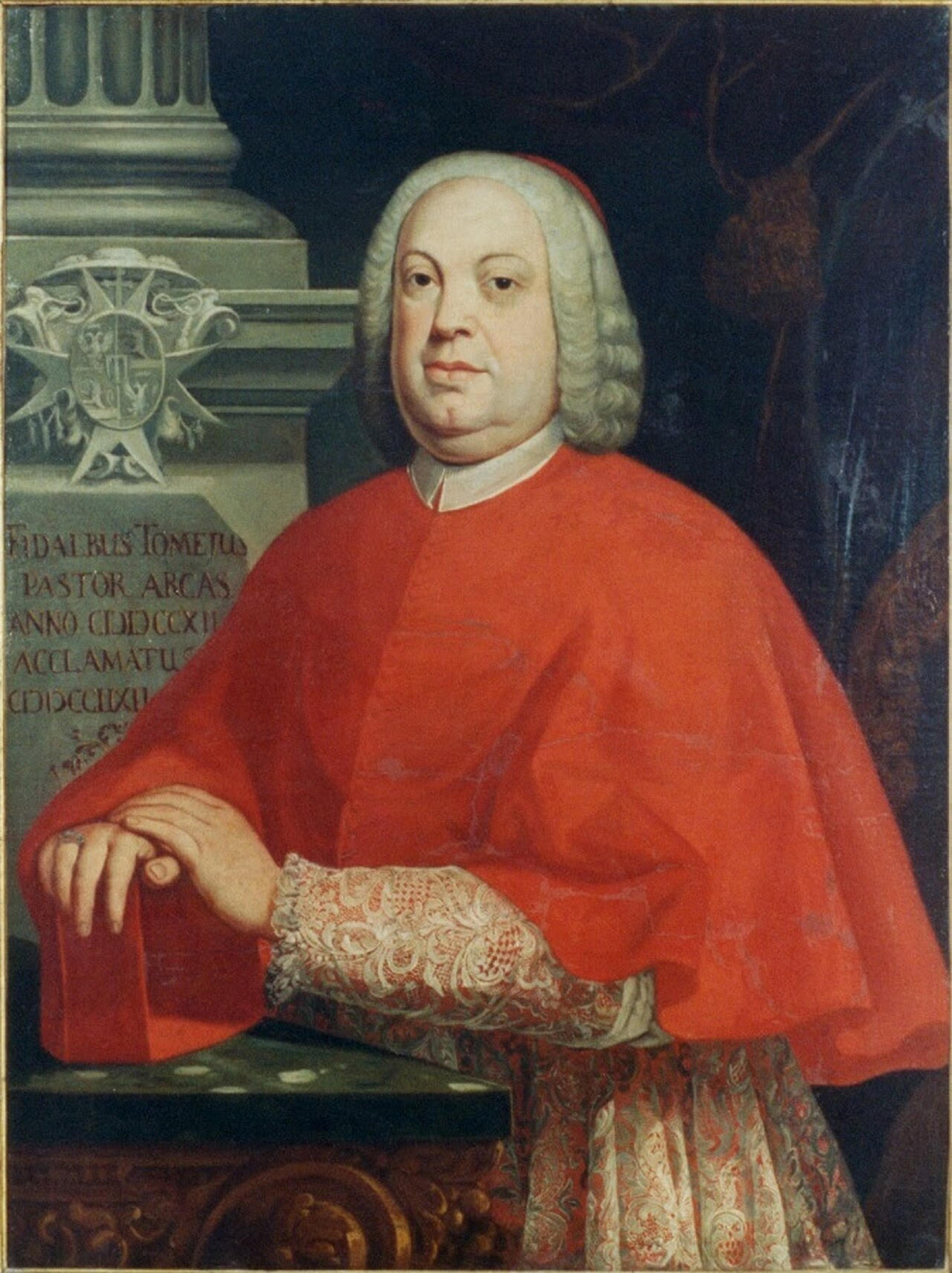
In writing about priests and their wigs in Rome this article draws on a small but important corpus of earlier studies of the general phenomenon of eighteenth-century clerical wig-wearing in the Catholic world. To be specific, Owen Chadwick's limited remarks in The Popes and European Revolution complement an article by the Italian scholar Fulvio de Giorgi and passing comments in studies of the tonsure and Catholic clerical dress by Louis Trichet.Footnote 10 These works have already highlighted some of the difficulties and pitfalls of writing about clerics and their wigs. First among these is the enigmatic problem of how to find information about exactly how such wigs were used or what they looked like. Few detailed descriptions of clerical wigs emerge from inventories and we have no serendipitous survivals equivalent to the petrified wig of Martin Routh (1755–1854), one time President of Magdalen College, Oxford.Footnote 11 Pompeo Sarnelli, a reforming bishop (mentioned below), expressly describes his priests’ wigs as “head masks” (maschere di capo), which implies that they were something akin to toupees.Footnote 12 But clerical “big-wigs” clearly wore different, bigger wigs. The engravings included in Roma sancta, a guide to the Curia under Benedict XIII, render this clearly enough.Footnote 13 Yet, working out which clerics wore wigs is not always straightforward from visual material. Chadwick, when he perused Roma sancta, identified Cardinals Alberoni, Giudice, and Albani as wearing wigs.Footnote 14 However, Pamphilj's portrait seems at least as obviously an example of a wigged cardinal to the present author. Looking beyond that text, few portraits of eighteenth-century cardinals in oils show the wig as obviously as do those of Silvio Valenti Gonzaga (1690–1756) by Vincenzo Milione (1735–c.1805) (Fig. 1) or Pierre Subleyras (1699–1749).Footnote 15 But how did portraits of cardinals – necessarily idealizations based on a particular vision or model – relate to everyday reality? There is no easy answer to this. Roma sancta clearly shows Giambattista Tolomei (1653–1726) without a beard, a depiction contradicted by a memorable contemporary account that claimed Benedict XIII – not only an opponent of wigs – asked him to shave his beard off.Footnote 16
Silvio Valenti Gonzaga, portrait by Vincenzo Milione (1735–c.1805), Museo di Roma, public domain, https://simartweb.comune.roma.it/dettaglio-bene/-398574559.
II. The Clerical Wig: Origins and Arrival in Rome
How then did clerical wigs come to be such controversial items in eighteenth-century Rome? The origins of the seventeenth century's embrace of the “wig fashion” are apparently well known. Louis XIII of France (r. 1610–43), eager to disguise his premature balding, adopted such a hairpiece; others at the French court soon followed and a race to the “full bottom” style ensued.Footnote 17 The clergy's embrace of false hair followed on from this courtly conception. Jean-Baptiste Thiers, whose Histoire des perruques [history of wigs] appeared in 1690, identified it as having spread as a result of a specific culprit: Louis Barbier (1593–1670), the Abbé de la Rivière and a client of the king's brother Gaston d'Orléans. Barbier became grand almoner of the queen and bishop of Langres in 1655. However, as an abbé (i.e., a cleric in minor orders), he held an anomalous status brought about only by special arrangements in the Concordat of Bologna which Pope Leo X and Francis I of France had agreed in 1516. The French king was permitted under the terms of the concordat to appoint 255 “commendatory” abbots (abbés commendataires) who enjoyed pure sinecures and could receive ecclesiastical income without needing to render service. Perhaps precisely because he held one of these posts half in, half out of the clerical ranks (he was not actually ordained priest until his elevation to the episcopate in 1655), Barbier felt able to join in the trend in court fashions. Such fashions soon percolated elsewhere in the French Church as other abbés imitated his example. Gaston Chamillard, another wig critic, whose Concerning the crown, tonsure, and habit of clerics [De corona, tonsure, et habitu clericorum] appeared in Paris in 1659, lamented that cathedral canons around France were also in on the craze. A steady stream of prohibitive legislation, which Trichet dubbed, not unreasonably, the “war on wigs,” can be seen in the canons of diocesan synods at Bayeux in 1662, Lyons in 1670, Soissons in 1673, and Toulouse in 1677, and shows the wig's progress around the clergy of France.Footnote 18
The clerical wig's arrival in Rome seems to have been roughly co-temporaneous with its French diffusion. This development was not pre-ordained, and we should note that the practice of wig-wearing does not seem to have spread equally among all clerics throughout the Catholic world (in the Iberian empires, for example).Footnote 19 Seventeenth-century Italians, however, often imported their fashions from France, and wig-wearing became one more example of this. Various contemporary texts, including the Satyrae of Quinto Settano (Ludovico Sergardi) and Ragguaglio contro le perucche in Parnaso (news-sheet against wigs from Parnassus), a satire which aped a more famous antecedent by Traiano Boccalini, criticized the practice on these grounds as well as those of taste.Footnote 20 Nevertheless, as Renata Ago has shown, Rome's lay elite were adopting wigs enthusiastically by the 1670s. Vittoria Patrizi Spada's account books show her husband Bernardino to have been in possession of several at the start of that decade, alongside combs, brushes, perfumed oils, and creams.Footnote 21 In 1700 Nicola Salviati left his heirs “a little wig along with its box.”Footnote 22 Rome's wig industry was never grand – it was probably never even half the size of Paris's, for that city employed up to 12,000 artisans at a time in the eighteenth century. Nevertheless, the Roman wig-makers’ guild (l'università degli parruchieri) was still substantial enough to split from the barbers’ guild in the 1740s. Its 1753 statues reveal it to have been large enough to mandate a quorum of twelve maestri for its private council (concilio segreto), a figure which compares favorably with the city's other urban guilds at the time.Footnote 23 Clerical wigs are not specifically mentioned in the statutes but evidence of their production and circulation appears in various ancillary texts from this date. An avviso from 1678 reports how Cardinal Chigi (nephew to Pope Alexander VII, r. 1655–67) made use of two wigs for different occasions: “one with a tonsure and one without, the former for performing obligatory functions and the latter for socializing from sunset to sunrise.”Footnote 24 An edict of 1788, which contains a brief reference to short “choir” wigs which display the tonsure [con il giro tondo ad uso delle persone ecclesiastiche], gives a fascinating but frustrating glimpse into a world of specialist production for clerics which would appear to have emerged.Footnote 25
Our best sources for the adoption of wigs by Rome's eighteenth-century priests are, in fact, and unsurprisingly, like that last example, legislative. Rome's Cardinal Vicars (i.e., the holders of an office to which the pope deputized his responsibility for diocesan affairs) issued various bandi (i.e., edicts) which set out penalties for clerical wig-wearing in the city. They did so in the context of the general, and then increasingly complex and specific, regulation concerning clerical dress and comportment. To quantify the survivals: a bando issued by the Cardinal Vicar Giovanni Garzia Mellini (1562–1629) in 1624 constitutes the earliest extant example of this kind of document and deals with the general issue.Footnote 26 Another from 1678 is the first to survive that mentions the wig in particular (“artificial hair, commonly called a wig”).Footnote 27 However, it is predated by another similar one from 1674 and post-dated by three more from 1681, 1691, and 1696.Footnote 28 A further edict of 1667, no longer extant, is also referenced in several of these documents.Footnote 29 Gasparo Carpegna (1625–1714), Cardinal Vicar from 1671 until his death nearly fifty years later, was signatory to all of these – and to further edicts on behalf of Pope Clement XI (r. 1700–21) from May 4, 1701, December 7, 1706, and, possibly also during 1714.Footnote 30 Pope Benedict XIII (r. 1724–30) and his Cardinal Vicar Fabrizio Paolucci issued their own proscriptions on wigs in 1724, and again in 1725 and 1726.Footnote 31 Carpegna's edict of 1706 was the first to use the heading “concerning the life and honesty of clerics and, especially, concerning the habit and clerical tonsure” which would become a standard incipit for such documents for the rest of the century.Footnote 32 Later eighteenth-century popes and Cardinal Vicars reiterated the ban on wigs periodically, typically at the start of their pontificates – and further surviving examples include those of Clement XII (r. 1730–40) from July 12, 1731, from Benedict XIV (r. 1740–58) from December 1, 1740, and from Pius VI (r. 1775–99) from May 17, 1775.Footnote 33 The further edict of 1788, which contains the statement about short “choir” wigs, appears to be the last.Footnote 34
Crucially, this papal legislation about wigs was not formulaically static but evolved revealingly over the course of the seventeenth and eighteenth centuries. Giovanni Garzia Mellini's 1624 edict, for instance, is generally quite practical in tone, mentioning such imperatives as that clerics maintain their hair tidy and modest, and retain a visible tonsure. It is non-specific in its evocation of clerical masculinity but references rather oblique ideals of clerical difference as espoused in Trent's decrees and in ways consistent with Gregory XV's (r. 1621–23) wider reform initiatives.Footnote 35 The stipulation of a considerable penalty of twenty-five scudi d'oro for those who transgress rules about modest hair reflects this. By the time of Gasparo Carpegna's legislation of the 1680s and 1690s, however, the fine for infringements concerning hair had dropped to just ten scudi – a reduction in gravity of offence which could be seen to imply an easing off of such concerns (even if it more likely reflected an effort to increase compliance through more realistic measures).Footnote 36 Paolucci's 1724 edict, on the other hand, stands out precisely because it mandates greatly increased punishments: fifteen days in prison, an indeterminate monetary fine, and suspension of rights to celebrate liturgies. It also significantly increases the specificity of when a transgression was said to have occurred. Earlier legislation had stated only that a priest must not wear the wig while celebrating mass – an obviously pragmatic response to the reality of priests wearing wigs as they went about their everyday business (as Cardinal Chigi did) and also an extension of the canonical logic of the crimes being greater if implicated in liturgical occasions.Footnote 37 Paolucci's bando ignores this and expressly prohibits a priest saying mass if he even brought his wig near the church (in particular, noting the gravity of transgression if he wore it to the church and left it in the sacristy). Under Paolucci's master Benedict XIII, the wig can therefore clearly be seen to have offended against the ideal conception of clerical difference, sacramental obligation, and even masculinity far more gravely than before. The edict innovates too in its emphasis that the priest is in persona not only in the church, where he performs liturgies, but at all times.
III. The Corporeal Context
What made clerical wigs such a problem for those who objected to them? Extant tracts against clerical wigs generally grounded their criticism first and foremost in the wig's irregular, uncanonical status. The two relevant passages are these from Paul's First Letter to the Corinthians: “Every man who prays or prophesies with his head covered dishonors his head” (11:4); and “A man ought not to cover his head, since he is the image and glory of God; but woman is the glory of man” (11:7). Jean-Baptiste Thiers began his Histoire des Perruques by referencing these verses and providing a summary of commentary on their exegesis in the writings of early Church Fathers who took literalist positions on the subject. These Church Fathers may all have interpreted Paul's passage slightly differently, Thiers noted, but they nevertheless agreed on the imperative that men's heads must not be covered in church. Johann Heinrich Cohausen (1665–1750), physician to the Bishop of Münster, who used a pseudonym to pen a relevant second text, Clericus Deperrucatus [The cleric “unwigged”], advanced a similar argument.Footnote 38 One of that work's earliest chapters explains, for instance, how artificial hair transgressed against the pronouncements of the Apostles, sacred canons, papal decretals, and the writings of the Church Fathers. De Giorgi has noted the apparent reason behind Thiers's and Cohausen's concerns: theirs was a sort of proto-Enlightenment perspective preoccupied with liturgical performance and the implications of transgressing rules for the efficacy of sacraments.Footnote 39 Brendan Röder has also already shown the ongoing concern throughout the seventeenth and eighteenth-century Church about the risk that a priest who does not perform the liturgy properly voids its sacramental effect (an argument used against prospective priests with bodily defects).Footnote 40
The problem wig critics faced when advancing their canonistic arguments against the wig, however, is that the tradition of scriptural interpretation of 1 Corinthians 11 was never quite as clear-cut as they implied. Tertullian, a critic of male head coverings, for instance, in his complaints about them also bore inadvertent witness to the inconsistencies in how these rules were applied in the third-century Church.Footnote 41 Thomas Aquinas, likewise, ever the good scholastic, produced quodlibets that justified exceptions for men who did cover their heads in church (bishops, for instance).Footnote 42 Wig defenders, most notably Prospero Lambertini (1675–1758), Pope Benedict XIV (r. 1740–58), writing c. 1739 in his earlier capacity as Archbishop of Bologna, seized on such openings. This may be why wig critics simultaneously pursued a further line of “medicalizing the moral” (as Maria Pia Donato has put it).Footnote 43 Donato engages a slightly earlier Roman text, Antonio Nicola Bernabei's Dissertation concerning sudden death, in which is reasoned about wigs and acids [Dissertazione delle morti improvise, nella quale si ragiona delle perucche, e degli acidi] (1708), which exploits a theory by the Jesuit polymath Athanasius Kircher (1602–80) that wearing a wig suppresses natural evacuations via the hair to denounce wigs as a cause of sudden death.Footnote 44 Yet wig defenders, too, could marshal such arguments – in favor of wig-wearing. Lambertini, for instance, proposed that it was entirely proper for a priest to wear a small wig when saying the mass if he needed to do so to protect himself from cold. Why, even he himself had done so on occasion, though only on doctors’ advice.Footnote 45
Few actual petitions of priests petitioning to be able to wear wigs survive, but where they do they make similar claims to Lambertini's argument. That is to say, they promote the wig-wearing as a medical rather than moral issue. One surviving example from Rome that of Antonio Piervenenanzi, parish priest of San Benedetto in Piscinola, relates the priest's attempt to obtain a license to wear a wig while performing liturgical duties.Footnote 46 A considerable set of health grounds are listed: they include baldness, catarrh, aches and pains, and the loss of almost all his teeth. Two medical doctors sign in support of Piervenenanzi's case – a practice of seeking “expert witness” which Brendan Röder has also observed in many contemporary cases before the Congregation of the Council. Röder, in fact, located two other, similar cases involving wigs in the Congregation's archives: that of the rector of the cathedral church of Gaeta, Giacinto Casaro, from 1690, and that of Damiano Stella, prior of a parish in Viterbo, from 1710.Footnote 47 Casaro was unlucky: like Piervenenanzi, he did not really succeed in his efforts (in part, perhaps, because it transpired that he had already been wearing the wig for twenty years without seeking a dispensation and had written for one only after his conduct had cause scandal among the other cathedral canons). Casaro was permitted henceforth to celebrate mass only in private, but he was allowed to wear his wig when celebrating so long as he removed it when consecrating the host. Stella was luckier: Cardinal Santacroce supported his supplication with the caveat that any artificial hair had to be as natural as possible and to be invisible to the congregation (naturales appareant, ita ut Populus illos non advertat).
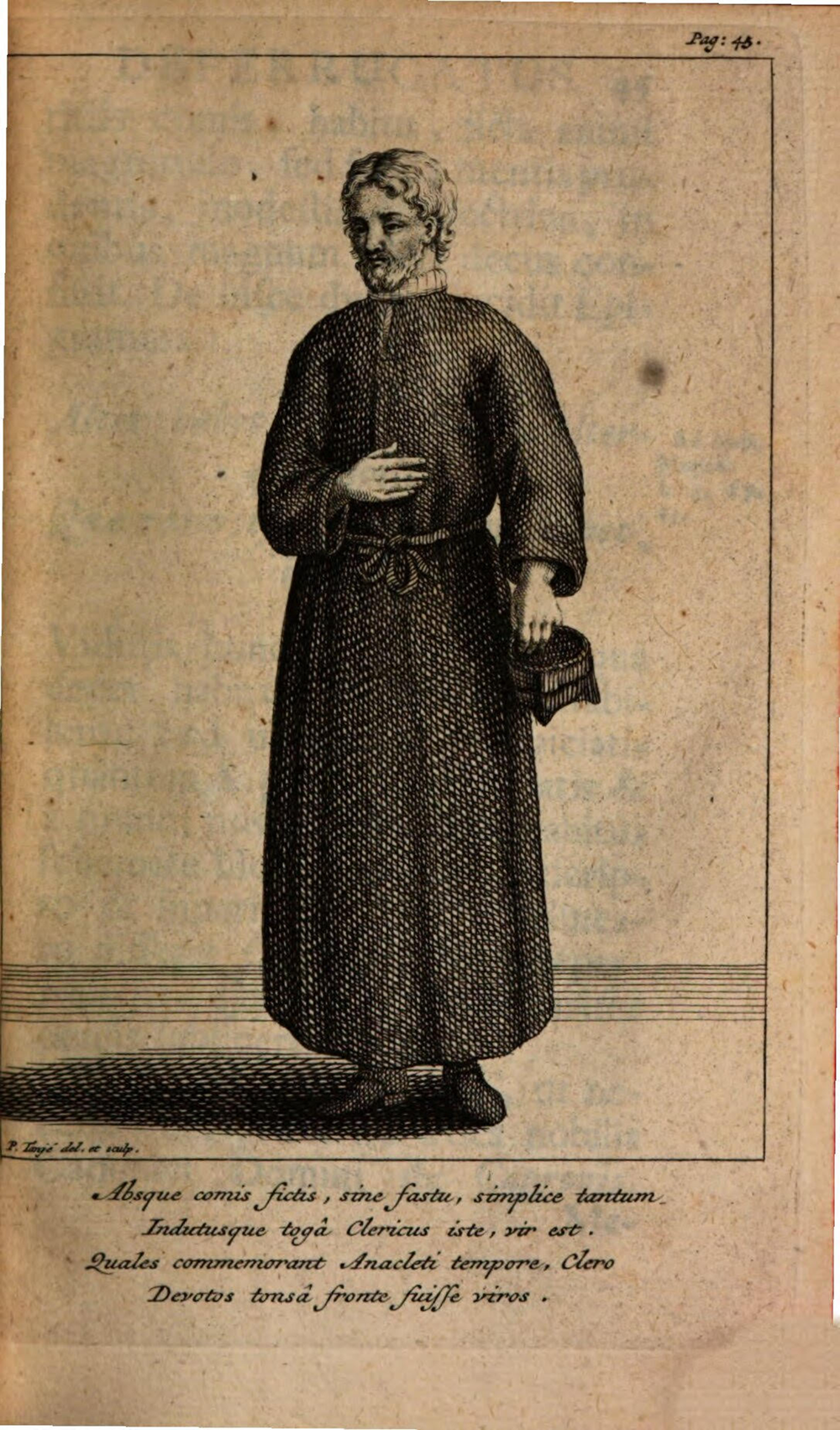
Interestingly, all these priests cited their physical deformity (sometimes mere baldness, but also sometimes scars or discolouration on their heads) as a reason to permit them to wear wigs, with implicit or explicit arguments that their ugliness was dangerous. This mattered because wig critics tended to denounce the wig as a sign of both vanity and eccentricity. Thiers, for instance, spent much of his Histoire explaining the essentially cosmetic origins of the artificial hair industry and linking the wig to other similarly deplorable practices such as enriching hair, curling hair, and using dyes, pomades, and perfumes.Footnote 48 Cohausen went further, gendering the argument explicitly in a pair of poems which accompany images of a “good” cleric (Fig. 2) and a “bad” bewigged abbé (Fig. 3):Footnote 49
Cleric, you are pretty, but you would be prettier by far with a long cassock and without your artificial locks.Footnote 50
Without fake hair, without conceit, so simple!
This cleric, dressed in a full cassock, is a man.
Such as the clerics remembered from Anacletus’ time
Devout men who shaved their forehead.Footnote 51
The “good” cleric, Johann Heinrich Cohausen, Clericus Deperrucatus (Amsterdam, 1725), Bayerische Staatsbibliothek München, J.can.p. 873, (0073).
The “bad” abbé, Johann Heinrich Cohausen, Clericus Deperrucatus (Amsterdam, 1725), Bayerische Staatsbibliothek München, J.can.p. 873, (0037).
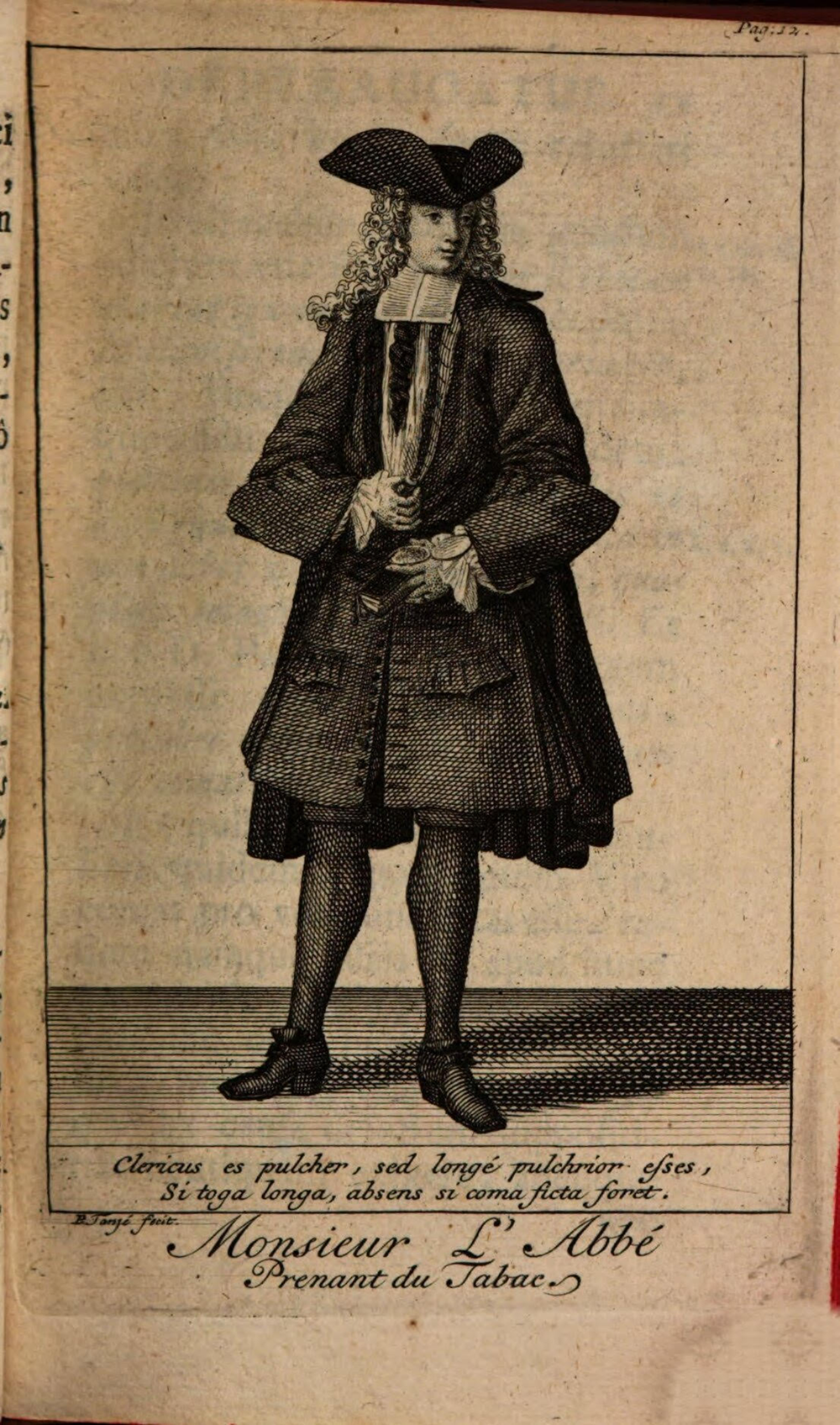
We might note how the bewigged abbé is mocked here as “pulcher” (pretty), an adjective normally only applied to females, while the repetition of “vir” (man) in the ode to the “good” cleric emphasizes his very different qualities. Such criticisms of priests for indulging in effete or unmanly practices were not new – they had been going on for centuries.Footnote 52 However they also expressly echoed contemporary criticism of other eighteenth-century dandies and tapped into fears of a sexualized clergy who might make advances on the women in their flocks.Footnote 53 Yet wig-wearing priests argued the opposite: that they had to wear wigs because it was repulsive for all those who heard Mass to seem them without them, and even more so for those who wanted to receive Holy Communion, to have to approach them in their undisguised state. The double standard, or at least inconsistency here, in the application of canon law is itself interesting. On the one hand, priests were condemned for paying too much attention to personal aesthetic, on the other their physical deformity could see them be excluded from the priesthood for being insufficiently sightly for their parishioners.Footnote 54 A further irony in Cohausen's critique may also be worth noting. The values the Clericus deperrucatus ascribes to appropriate masculinity were decidedly secular values. Beards, for instance, were no more canonically acceptable than wigs in the medieval Latin tradition.Footnote 55 They had only been adopted as a clerical fashion, gradually, after they became important expressions of individualism and status in sixteenth-century France and Italy.Footnote 56 Earlier critics of clerical laxity – for instance, Carlo Borromeo, in a now well-known pastoral letter to his clergy, De barba radenda (“On the importance of shaving the beard”) – specifically cited the growth of facial hair as a problematic example of it: by failing to shave properly they revealed an inappropriate even unholy attachment to the secular world.Footnote 57
IV. The Roman context
Something this article seeks to underline is how the general issues surrounding clerical wig-wearing were somewhat amplified in the context of papal Rome. Rome in the period after Trent was only a moderate sized city – its population rose from 109,729 in 1600 to 135,089 in 1699 and 158,000 in the 1770s – but it stood out for its unusual political institutions and highly gendered demography.Footnote 58 Males outnumbered females in Rome by a ratio of 4:5, and even 7:10 at some times. A large proportion of those males were Catholic clerics in major or minor orders. In percentage terms, these clerics peaked at 7.41 percent of the city's population in the 1710s before undergoing a secular decline to around 5 percent in the 1790s. However, in absolute terms, clerics increased in number from c. 2,500 early in the eighteenth century to c.3,000 during the first decade of Pius VI's pontificate (r. 1775–99).Footnote 59 Laurie Nussdorfer, Eleanora Canepari, and Jennifer DeSilva have all explored aspects to the dynamics of this on households and on social relations within the city.Footnote 60 The particular importance of honor culture and male status competition has, moreover, been well-established in a series of studies by Thomas and Elizabeth Cohen, and by John Hunt.Footnote 61 Rome's unusual demographics meant that clergy were uniquely prominent in civic and cultural life. Moreover, via and on account of the apparatus of the papal government, they also enjoyed a political and social status there which they did not hold in other places. Many priests were literally rulers and magistrates. A cardinal's ear, or his patronage, was nigh on essential for anyone who wanted to get things done or to establish himself in Roman society. Status competition mattered in Rome at least as much as it did in Versailles – and clerics were therefore at least as implicated in it than even in such other spots. Nussdorfer has noted how advice even to laymen in ecclesiastical households was sometimes for them to ape clergy in appearance.Footnote 62 The irony of clerics also adopting lay fashions intersects, though was surely also shaped by, this.
The specific dynamics of Rome's diocesan clergy would also seem to be a relevant factor in Roman exceptionalism in this instance. First, those dynamics made it harder to enforce lay-clerical visual distinctions. After all, who could enforce them on so august an eminence as Cardinal Chigi? Such elite clerics were more numerous in Rome than elsewhere and had formed part of wider and elite social circles for centuries, adopting, even shaping, their tastes and fashions. The elite embrace of the clerical wig was just the latest episode in this longer history. Yet, Rome, as the center of Catholicism, also had a plethora of lower clergy – and those lower clergy, like Rome's elite clergy, were unusually vulnerable to criticism.Footnote 63 One lament, sent to Clement XI (r. 1700–21), typifies in its denunciation of their lackadaisical indifference about performing liturgical duties. “Perhaps one in a hundred priests celebrate the mass as they should, according to the rubrics. . .The majority rush through the mass so fast that the parishioners can scarcely hope to keep up and it is impossible that everything that is written in the missal is said,” its author notes caustically.Footnote 64 The priest Pier Francesco Giordanini (1658–1720) likewise thundered in 1719 that “the man of the cloth must distinguish himself from the secular” (a sure sign that this was not going on).Footnote 65 One root of the issue lay in the number of non-native clergy, especially from the Italian South, who were migrating to Rome and were viewed as less educated. However, another lay in the structure of priestly formation in the city. The training of local clergy had been given over to the Jesuits since the late sixteenth century – Rome's Seminario Romano being, effectively an adjunct of or offshoot from the more celebrated Jesuit Collegio Romano. Yet, by the late 1600s, this caused specific tensions: the Jesuits were accused of having neglected their responsibilities in favor of their elite formation efforts.Footnote 66
The personality of Pope Benedict XIII himself was, of course, a third factor in all this in the Roman case. Benedict, a Benedictine monk – a cleric regular rather than secular – even as Archbishop of Benevento (1686–1724) had been less willing to indulge the secularizing tendencies of diocesan clergy than many of his fellow bishops; he carried this policy forward as pope.Footnote 67 We might further speculate that as early modernity's only fully bald pope (or, perhaps, we should say, the only early modern pope who permitted himself to be depicted thus) he had a particular interest in, and animus against, wig-wearing. Certainly, his virulent distaste for wig-wearing clerics can be taken as consistent with his own plain approach to self-fashioning.Footnote 68 He had already sponsored a 1702 Italian translation of Thiers and he supported a second edition of the translation in 1724. Moreover, his reputation as a wig critic was sufficient that Cohausen sought to associate his text with him. Though published in Amsterdam, Clericus deperrucatus has Benedict's image emblazoned on its first page and rejoices the providence of the election.Footnote 69 Later paragraphs also laud the new pope for his “glorious regime as the great pontiff de nos jours” and praise his efforts to get the clergy to revert to ancient purities of practice in dress and hairstyles.Footnote 70
Yet, Benedict's “war on wigs” also seems to have reflected something else which was relevant to Rome's unique circumstances: a long-standing uncertainty regarding status and hierarchy within its clergy. In 1725 Benedict convened the Concilio Romano, his own attempt at a diocesan synod to implement Trent's reforms more effectively.Footnote 71 The Concilio, though, even if a well-intentioned initiative, soon became the cause of considerable tension between pope and cardinals. The latter were the pope's subordinates and were titular priests of many of his city's parish churches – yet they were also advisors and electors who held, or claimed to hold, de facto or de jure, a quasi-independent standing in the Church. Questions about the cardinals’ standing were as old as the College itself. But the Concilio caused them to re-emerge from a two-century slumber. The relevant question was this: if the pope convened a gathering in his capacity as diocesan bishop was it binding on those whom he had authority over not as bishop but as supreme pontiff? Wigs became a proxy skirmish in the papal-cardinalitial fight – again, perhaps particularly because they were so highly visible in shaping the cleric's projection of selfhood. When the Council decided not only to uphold but to reiterate Cardinal Paolucci's 1724 edict it was seen to have made a major statement with respect to the city's most senior clergymen.Footnote 72 Cardinals, including the Jesuit Giambattista Tolomei, produced legal opinions which sought to limit its jurisdiction in response to such acts.Footnote 73 Benedict produced a further flurry of legislation on wigs, which, in retrospect, seems purposeful and designed to assert his pontifical authority over the papal bureaucracy (rather than just the diocesan clergy) in the wake of such controversies. A May 1725 bull condemned clerics who dress as laymen and an August instruction to various papal nuncios reminded them of the prohibition on wigs and the need to see that it was enforced universally.Footnote 74 In April 1726 Paolucci produced yet another edict which reiterated all these same points.Footnote 75
V. Why Rome's War on Wigs Failed
Benedict XIII's crackdown on wigs seems largely to have failed on its own terms. There are no records of ordinary priests successfully prosecuted for transgressing his instructions (though, admittedly, this could be because of catastrophic losses of material from the relevant archives during the Napoleonic period). Chadwick cites an anecdotal account which relates how the pope humiliated Cardinal Alberoni for his defiance in continuing to wear a wig by removing him from a procession.Footnote 76 De Giorgi also suggests that Cardinal Giudice, Dean of the College, did comply with the edicts.Footnote 77 However none of this can be corroborated: both scholars cite unreliable nineteenth-century sources. Other cardinals besides Giudice, for instance Altieri, Pico, Bentivoglio, and Alberoni himself, appear to have continued wearing wigs even in De Giorgi's telling. Papal legislation also became more lenient about wig-wearing following Benedict's death in 1730. In contrast to his edicts, a 1731 edict issued by Prospero Marefoschi, Cardinal Vicar to Clement XII (r. 1730–40) reinstated the specific ten-scudo fine (“to be applied to pious causes”) and removed the threat of prison. Giovanni Guadagni's edict of 1740, issued on behalf of Benedict XIV (r. 1740–58), and all subsequent legislation, reiterated this position – it concentrated instead on tightening restrictions on clerical behavior in other areas of concern such as dancing with women and attending masked balls. A 1775 bando issued on behalf of Pius VI (r. 1775–99) would seem to be the final piece of papal legislation on the issue.Footnote 78 Wig-wearing fell out of fashion amongst Italian clergy during Pius VI's long pontificate (1775–99) – again, echoing its decline in secular society. The last major controversy in Italy surrounding clerical wigs seems to have been that raised at the Synod of Pistoia, which the local bishop Scipione de Ricci (1741–1810) convened in 1786.Footnote 79
It is possible that the lowering of a penalty in bandi and the lessening of interest in the issue of wigs relates to improvement in seminaries.Footnote 80 Better-trained priests were more likely to meet the eighteenth-century's “professionalizing” expectations. However, the on-going concern about priestly conduct also indicates a restitution of pragmatism in post-Benedict XIII Rome which simply recognized the practical limitations of the pope's ability to enforce strict rules. An anonymous 1705 or 1706 consilium for Clement XI had already intimated as much:
Experience has made it known how unsuccessful the edicts against priests and those ordained in sacris and against other beneficed clergy over the absence of the cassock or tonsure have been at various times and one can understand from this that [such clerics] care little for their continued disgrace via the renewal of edicts or the aggravation of penalties. Any edict that is made is very difficult to put into practice and executing its penalties is just as hard due to the difficulty of obtaining evidence of the transgression, and for the quality of those who transgress, who base themselves on the offices they exercise and on the protection they enjoy. . . not only would I not allow the publication of a new extensive and more rigorous edict but rather I would like to establish things with greater moderation and with such discretion by which we certainly hoped for observance and that the clerics seeing themselves enticed by a more moderate way.Footnote 81
A second document, “delle perruche” written shortly after 1725, took this line further.Footnote 82 Its author actually concedes the argument in canon law advanced by Thiers and, indeed, also the potential vanity of the desire to wear wigs. He nevertheless based an appeal for pragmatism on the legitimate need of men to show hair as a sign of virility and the long tradition of exceptions to canonical requirements which the Church has indulged and endorsed.Footnote 83 Lambertini's consilium as Archbishop of Bologna also made similar points.Footnote 84
The success of anti-wig campaigns in general depended heavily on how far local bishops leaned into moral fervor or pragmatism – a reminder of the bishop's singular importance as a figure in determining Tridentine reform's direction in the locality. De Giorgi studied three bishops from the Italian South – Pompeo Sarnelli (1649–1724) of Bisceglie, Antonio Salerni (d. 1754), of Molfetta, and Pietro Orsini (1686–1724), later Pope Benedict XIII, of Benevento – who were particularly active.Footnote 85 But they, and the other reforming bishops who are generally studied within debates about Trent's implementation, were self-evidently exceptional to some degree. Gregorio Barbarigo, McNamara's subject, for instance, is one of the few other bishops who can be shown to have taken specific actions against wig-wearing (a surviving 1692 letter relates with satisfaction how he has excluded a canon who wore a wig and has ensured that the other canons are all ‘modestly shorn’ [modestamente tosati]).Footnote 86 Elsewhere in Italy, and certainly beyond, a more mixed picture emerges. “Delle perruche” notes within its argument for mitigation how the Archbishop of Trier was himself now wearing a wig – and even the papal nuncio in Vienna had recently been willing to consider licensing a priest to wear his wig when administering last rites to the sick.Footnote 87 Roma sancta (1724) contains portraits of many apparently bewigged non-Italian cardinals – Czacki, De Althann, Kollnitz, Potier, Rohan, Schrattenbach, Schönborn are some of the more obvious examples – which shows how varied attitudes prevailed. It would not be much of a surprise to discover that the proximity of Protestant religious leaders who wore wigs influenced their decision also to sport them. And, apropos of such observations, it is also worth drawing attention to the striking similarity between the arguments made by Protestant defenders of the wig such as Johann Albrecht Bengel (1687–1752), and Lambertini. Bengel's Gnomon of the New Testament, like Lambertini, specifically addressed the differences between “head coverings” and “imitations of the hair [which] are sometimes quite necessary. . . where that is too thin,” exploiting a view that Paul's original formally symmetric gendered system of head-covering was too culturally bound to be universally applied.Footnote 88
A final interesting point in this respect concerns the afterlife of clerical wigs in the nineteenth century. Such wigs continue to appear in a few French sources during the Napoleonic period and after the Bourbon Restoration.Footnote 89 However, they disappeared from Roman clerical portraits and inventories quite quickly after Pius VI's demise. Pius VII and his successors are shown with long, flowing natural locks in a romantic mode. But by mid-century, the fashion for wigs in eighteenth-century Rome was likely a source of embarrassment for the papacy's supporters, some of whom seem to have been at pains to downplay it as much as they could. This was certainly the case for Gaetano Moroni (1802–83), Pope Gregory XVI's major-domo and author of the extraordinary 103-volume Dizionario storico-ecclesiastica. Moroni stresses at length in that work how Pius VI, though he had worn a wig as a cardinal, had given it up as pope.Footnote 90 In fact, contemporary evidence contraindicates this. Jeffrey Collins, in his recent study of Pius, says that the pope wore a wig to his coronation, although he subsequently shifted to a berrettino.Footnote 91 An eyewitness account from José de Viera y Clavijo (1731–1813), who accompanied the Marquis of Santa Cruz de Mudela and his family to Rome between April 1780 and July 1781, in fact suggests he continued to wear the wig still later. Indeed, Viera y Clavijo describes Pius as “wearing a very natural-looking toupee with a single curl around the edge and a little powder.”Footnote 92 The important point, in the end, is this: by the 1840s, a time of great pressure on the pope's government in Italy, it was clearly unseemly to Moroni for Pius, the “martyr pope” who had suffered under Napoleon, to have been involved with an item which carried the uncanonical and profane connotations.Footnote 93 In a sense, Thiers, Cohausen, and, indeed, Benedict XIII, had won the day, although the endeavors of Benedict's nineteenth-century successors to retain meaningful distinctions between clerics and laymen in Rome were always a rearguard effort.
Acknowledgments
The author would like to thank Michael Barbezat, Michael Hanaghan, Celeste McNamara, Brendan Röder, and the Journal's anonymous readers for their helpful suggestions on drafts of this article. He also thanks Domenico Rocciolo for his assistance with archival sources in Rome.


 Open access

