





Introduction
There has been renewed interest in nonchemical weed control in recent years, driven by the prevalence of herbicide-resistant weeds and increased demand for organically grown food due to consumer concerns over pesticide residues (Ascard et al. Reference Ascard, Hatcher, Melander, Upadhyaya, Upadhyaya and Blackshaw2007; Leon and Ferreira Reference Leon and Ferreira2008; Reganold and Wachter Reference Reganold and Wachter2016). Thermal weed control is a broad concept encompassing multiple nonchemical methods of transferring energy to plants and seeds, thereby rupturing plant cell membranes or damaging seed structures, ultimately causing irreversible injury and loss of viability (Kerpauskas Reference Kerpauskas2006; Ulloa et al. Reference Ulloa, Datta and Knezevic2010a). Thermal weed control tools vary considerably in the method of energy delivery and, therefore, they differ in control efficacy and energy efficiency (Coleman et al. Reference Coleman, Stead, Rigter, Xu, Johnson, Brooker, Sukkarieh and Walsh2019).
Flaming is one of the most common and energy-efficient thermal weed control techniques, requiring 1,008 to 4,334 megajoules (MJ) ha−1 to control 2- to 6-leaf broadleaf weeds (Coleman et al. Reference Coleman, Stead, Rigter, Xu, Johnson, Brooker, Sukkarieh and Walsh2019; Knezevic et al. Reference Knezevic, Stepanovic and Datta2014). Meanwhile, thermal weed control using UV light can require up to 100,000 MJ ha−1 to kill some species (Coleman et al. Reference Coleman, Stead, Rigter, Xu, Johnson, Brooker, Sukkarieh and Walsh2019). Precision-applied lasers are a more recent thermal weed control option; however, their energy efficiency can vary drastically depending on laser type, size of the treated area, treatment duration, plant morphology, growth stage, and, most importantly, weed density (Coleman et al. Reference Coleman, Stead, Rigter, Xu, Johnson, Brooker, Sukkarieh and Walsh2019; Sosnoskie et al. Reference Sosnoskie, Bill, Butler-Jones, Bouchelle and Besançon2025). For example, 165 MJ ha−1 of energy was required to achieve 90% control of 2-leaf barnyardgrass [Echinochloa crus-galli (L.) P. Beauv.] at densities of 5 plants m−2 (Coleman et al. Reference Coleman, Stead, Rigter, Xu, Johnson, Brooker, Sukkarieh and Walsh2019; Marx et al. Reference Marx, Barcikowski, Hustedt, Haferkamp and Rath2012).
Previous studies of thermal weed control have demonstrated that weed species, growth habit, and growth stage are important factors that influence efficacy (Ascard Reference Ascard1994, Reference Ascard1995; Knezevic et al. Reference Knezevic, Stepanovic and Datta2014; Leon and Ferreira Reference Leon and Ferreira2008). Species-specific traits, including the location of growing points, pubescence, leaf wax, lignin, and water content, contribute to weed tolerance to thermal weed control efforts (Ascard et al. Reference Ascard, Hatcher, Melander, Upadhyaya, Upadhyaya and Blackshaw2007; Bauer et al. Reference Bauer, Marx, Bauer, Flury, Ripken and Streit2020). Perennial weeds are often difficult to control via thermal methods because the plants often regrow from the energy reserves in underground roots (Ascard, Reference Ascard1995; Bauer et al., Reference Bauer, Marx, Bauer, Flury, Ripken and Streit2020). A study found that repeated flame weeding was ineffective when perennial weeds were abundant due to incomplete plant destruction and resprouting from vegetative organs (Mainardis et al. Reference Mainardis, Boscutti, Cebolla and Pergher2020). Additionally, there is a direct relationship between applied energy dose and the amount of tissue affected. Consequently, larger plants with greater biomass tend to be less sensitive to thermal weed control (Bauer et al. Reference Bauer, Marx, Bauer, Flury, Ripken and Streit2020). Repeated treatments are often necessary to achieve complete control of weed species with high thermal tolerance (Ascard Reference Ascard1995; Ascard et al. Reference Ascard, Hatcher, Melander, Upadhyaya, Upadhyaya and Blackshaw2007).
Thermal weed control may also be effective against weed seeds when temperatures are high enough for a sufficient duration to be lethal. Seed susceptibility varies with seed size, shape, seedcoat thickness, and moisture content (Egley Reference Egley1990; Nishida et al. Reference Nishida, Kurokawa, Shibata and Kitahara1999; Norsworthy et al. Reference Norsworthy, Green, Barber, Roberts and Walsh2020). High-temperature (∼50 C) water baths can kill the seeds of many weed species after exposure for several hours (Dahlquist et al. Reference Dahlquist, Prather and Stapleton2007), whereas direct flaming can achieve >90% seed mortality in less than 1 s (White and Boyd Reference White and Boyd2016). However, many high-energy thermal methods, such as direct flaming, have inherent fire risks, especially where residue is present or near non-crop areas (Leon and Ferreira Reference Leon and Ferreira2008). Soil steaming as a weed-seed control method has been shown to have minimal fire risk (Melander and Jørgensen Reference Melander and Jørgensen2005). Soil steaming for 15 to 20 min reduced weed densities by 64% to 100% compared with a control in leafy greens and carrots (Guerra et al. Reference Guerra, Fennimore, Siemens and Goodhue2022). Many soil steamers are stationary and not suitable for use in large fields, but recent advancements have led to the development of mobile steam units (Fennimore et al. Reference Fennimore, Ajwa, Browne and Subbarao2014). However, these systems still require long application times (≥20 min) and thus may not fit in with many agricultural systems (Guerra et al. Reference Guerra, Fennimore, Siemens and Goodhue2022).
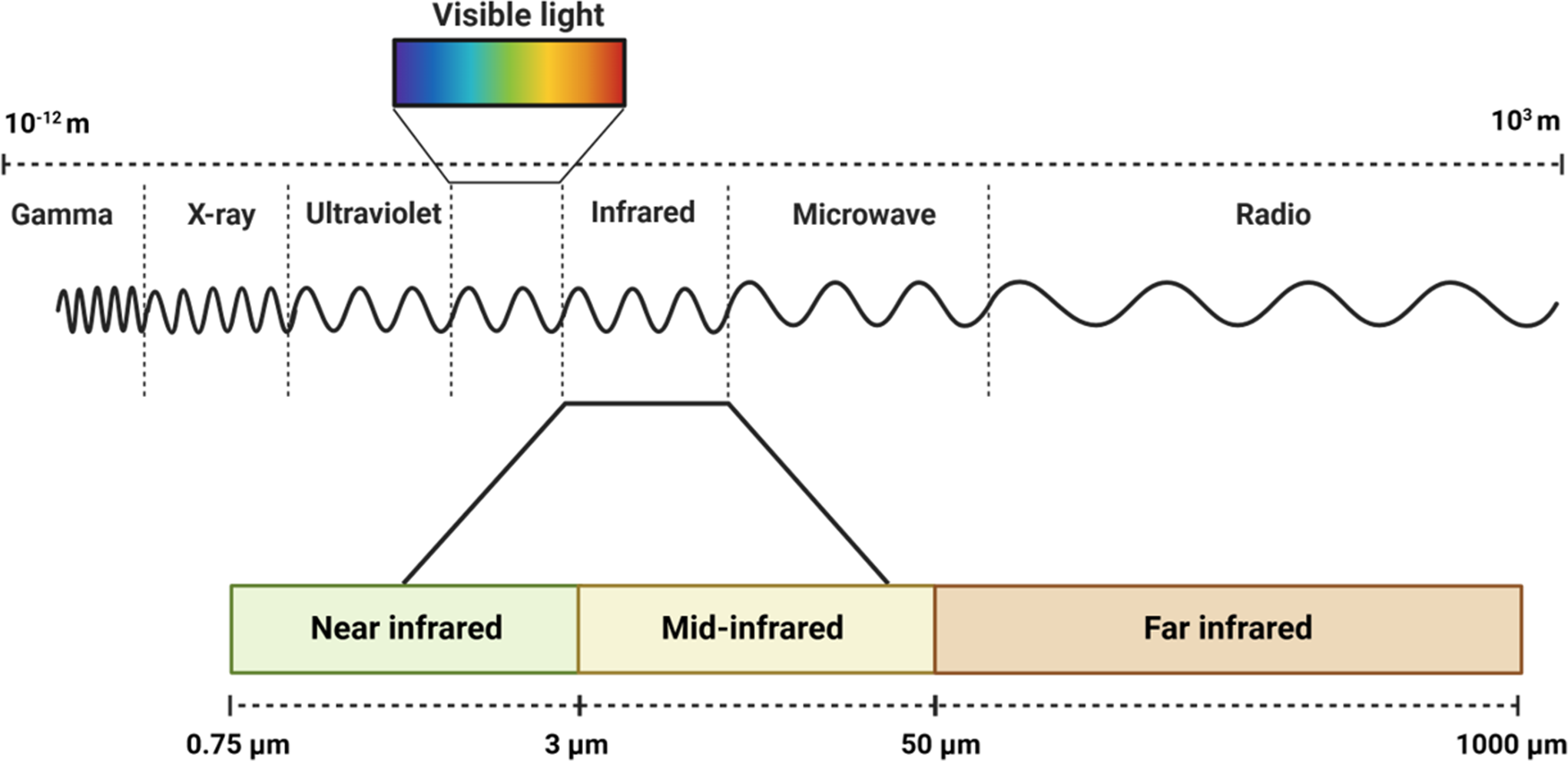
Infrared (IR) radiation offers an alternative thermal method with a lower fire risk. IR radiation is a nonvisible wavelength that ranges between 0.75 µm and 1,000 µm (i.e., 1 mm) and is typically categorized into near IR (0.75 to 3 µm), mid IR (MIR) (3 to 50 µm), and far IR (50 to 1000 µm) (Figure 1). IR radiation weeders can be powered by electricity, gasoline/diesel fuel, or propane-heated ceramic/metal elements that reach ∼900 C without producing an open flame (Ascard et al. Reference Ascard, Hatcher, Melander, Upadhyaya, Upadhyaya and Blackshaw2007). IR radiation weeders have been reported to be less energy-efficient than open-flame weeders (Astatkie et al. Reference Astatkie, Rifai, Havard, Adsett, Lacko-Bartosova and Otepka2007). However, some studies have found comparable control under certain conditions (Ascard Reference Ascard1998; Hoyle et al. Reference Hoyle, McElroy and Rose2012; White and Boyd Reference White and Boyd2016). Each region of the IR spectrum exhibits wavelength-dependent interactions with materials, leading to differences in energy absorption and heat transfer (Sakai and Hanzawa Reference Sakai, Hanzawa, Yano, Matsuno and Nakamura1994). Therefore, plant responses and energy transfer efficiencies will likely vary across IR wavelength regions. Previous studies investigating IR radiation for weed control have not specified the wavelength region used; thus, limited information of plant responses to specific IR categories exists. Recent technologies have emerged that use only the MIR region of the IR spectrum for weed control, suggesting that this spectral region enables effective plant damage at a relatively low irradiance and short exposure durations (Jackson et al. Reference Jackson, Erikson, Fischer, Thompson, Mehta and Oswalt2023). Preliminary testing across a range of wavelengths revealed that ∼3 µm MIR was the most effective for weed control purposes, likely due to the rapid energy-absorbing property of water at that wavelength (J. Jackson, personal communication).
Diagram showcasing the electromagnetic spectrum with the infrared wavelength ranges highlighted (Created in BioRender: https://BioRender.com/tiuaif2). The mid infrared radiation ranges from 3 to 50 µm.

Figure 1. Long description
A diagram of the electromagnetic spectrum. The spectrum is divided into different regions, including Gamma, X-ray, Ultraviolet, Visible light, Infrared, Microwave, and Radio. The Infrared region is further divided into Near infrared, Mid-infrared, and Far infrared. The Near infrared ranges from 0.75 micrometers to 3 micrometers, the Mid-infrared ranges from 3 micrometers to 50 micrometers, and the Far infrared ranges from 50 micrometers to 1000 micrometers. The Visible light region is highlighted in the center of the spectrum.
Despite extensive studies on the effects of weed species and growth stage, and on energy-dose relationships for emerged weeds using unspecified IR wavelengths, no published research has quantified the minimum MIR energy dose (joules per square centimeter; J cm−2) required to control seeds or seedlings. Previous studies have primarily reported generated temperatures and exposure durations, rather than precise energy inputs, and few have compared dry versus imbibed seeds, despite evidence that imbibed seeds may have lower heat tolerance (Nishida et al. Reference Nishida, Kurokawa, Shibata and Kitahara1999). Understanding these energy requirements and biological factors is necessary for assessing the efficacy and efficiency of MIR as a weed management tool. Therefore, the objectives of the present studies were to 1) determine the minimum amount of MIR thermal energy required to control various weed species at different growth stages, and 2) compare the susceptibility of imbibed versus dry weed seeds to MIR thermal energy exposure.
Materials and Methods
Influence of Weed Species and Growth Stage on Tolerance to Mid IR Radiation
Greenhouse experiments were conducted at the Norman Borlaug Center for Southern Crop Improvement located at Texas A&M University, in College Station, Texas. The weed species tested were chosen based on their morphological differences and status as problem weeds in row crops. All weed populations tested were either sourced locally or purchased from Azlin Seed Service (Leland, MS). Palmer amaranth, common lambsquarters (Chenopodium album L.), ivyleaf morningglory (Ipomoea hederacea Jacq.), kochia, barnyardgrass, and Italian ryegrass seeds were sown into plastic trays that measured 28 cm by 28 cm (Jiffy Products of America Inc., Lorain, OH) filled with potting soil media (LC1 Sungro, Agawam, MA). The seedlings were grown in the trays until the 2-leaf stage. Individual 2-leaf seedlings of each species were then transplanted into pots (6 cm diam, 12 cm deep) filled with LC1 potting media containing Osmocote Smart-Release fertilizer (Scotts, Marysville, OH). The transplanted seedlings were maintained in the greenhouse at 28/22 C day/night temperatures, with natural sunlight supplemented with artificial light from metal halide lamps (600 µmol photons m− 2 s− 1), simulating a 14-h photoperiod. Plants were watered as needed. All plants were grown under the conditions described earlier before and after the MIR treatments.
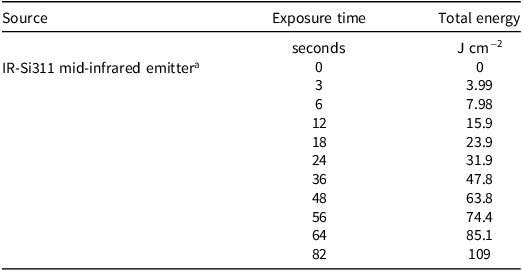
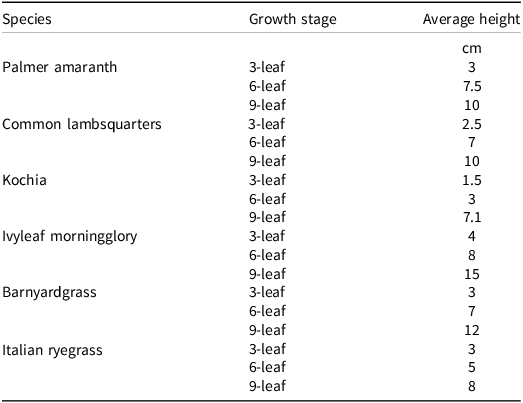
The experiments for each weed species used a 3 by 11 factorial arrangement of three growth stages (3-leaf, 6-leaf, and 9-leaf) and 11 MIR thermal energy doses (0 through 109 J cm−2) arranged in a completely randomized design (Tables 1 and 2). Each treatment combination was replicated eight times (single plant per pot) with two temporal runs. Plant responses were measured 14 d after treatment (DAT) and consisted of individual plant injury (0% to 100%; where 0% means no observable symptoms, and 100% means complete necrosis with no green tissue), individual plant survival, and aboveground dry biomass. Individual plant survival was determined based on visual injury observations in which plants with ≥90% injury and no regrowth at 14 DAT were considered dead. All plants were excised at the soil surface 14 DAT, placed individually into paper bags, and then oven-dried at 50 C for 7 d to determine aboveground dry biomass.
Summary of mid infrared energy parameters used in the experiments.

a Hawkeye Technologies, Milford, CT.
Summary of weed species and growth stages subjected to mid infrared treatments.

Influence of Mid IR Radiation on Imbibed and Dry Weed Seeds
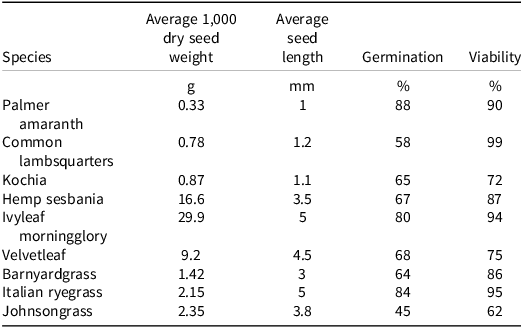
Laboratory experiments conducted at Texas A&M University aimed to determine the minimum MIR thermal energy (J cm−2) required to reduce seed viability of various weed species. Experiments were arranged in a completely randomized 2 × 9 × 11 factorial design with seed moisture status (dry or imbibed), nine weed species, and 11 MIR energy levels as factors (Tables 1 and 3). Each treatment was replicated four times, and the experiment was repeated. The species tested were chosen based on their status as problem species as well as their differences in seed size, color, and shape. These included Palmer amaranth, common lambsquarters, kochia (Bassia scoparia L. A.J. Scott), hemp sesbania (Sesbania herbacea Mill. McVaugh), ivyleaf morningglory, velvetleaf (Abutilon theophrasti Medik), barnyardgrass, Italian ryegrass, and johnsongrass (Sorghum halepense L. Pers.) (Table 3). Seeds were obtained using the same sources described previously. Seed size, weight, germination percentage, and viability were measured prior to initiating the experiments (Table 3).
Characteristics of seeds prior to treatment with mid infrared thermal energy.

Each treatment consisted of seeds placed in 100-mm petri dishes lined with Whatman No. 1 filter paper. To ensure adequate spacing, 15 seeds of large-seeded species and 30 seeds of small-seeded species were placed per dish. Imbibed seeds were prepared by adding 10 mL of deionized water to each dish and incubating them in the dark in a growth chamber (Conviron, Winnipeg, MB, Canada) at 15 C for 9 h. Although optimal imbibition periods vary among species, a 9-h duration was applied across all species to ensure a comparable physiological starting point while avoiding premature germination (Song et al. Reference Song, Feng, Tian and Zhang2005). Seed water uptake was not directly quantified; therefore, the extent of imbibition may have varied across species.
Dry and imbibed seeds were then transferred to precut aluminum foil trays (7 mm by 76 mm), evenly spaced to avoid overlap, and the trays were placed beneath the MIR emitter for treatment at the specified energy level. Following the MIR treatment, seeds were immediately placed into petri dishes lined with Whatman No. 1 filter paper moistened with 5 mL of deionized water, sealed inside clear plastic bags to minimize moisture loss, and incubated in a Conviron growth chamber under a 14-h light (28 C)/10-h dark (20 C) cycle. Germinated seeds were counted at 3, 7, and 14 DAT, and seeds were considered germinated if the radicle had emerged and reached ∼3 mm in length. Viability of any seeds that failed to germinate was evaluated using a tetrazolium chloride (TZ) assay conducted according to the methods described in the Tetrazolium Testing Handbook (Peters Reference Peters2000). The seed coats of velvetleaf, ivyleaf morningglory, Johnsongrass, and barnyardgrass were punctured prior to testing to facilitate tetrazolium penetration. Seeds with red-stained embryos were considered viable, whereas those without staining were considered nonviable.
Mid IR Radiation Treatment
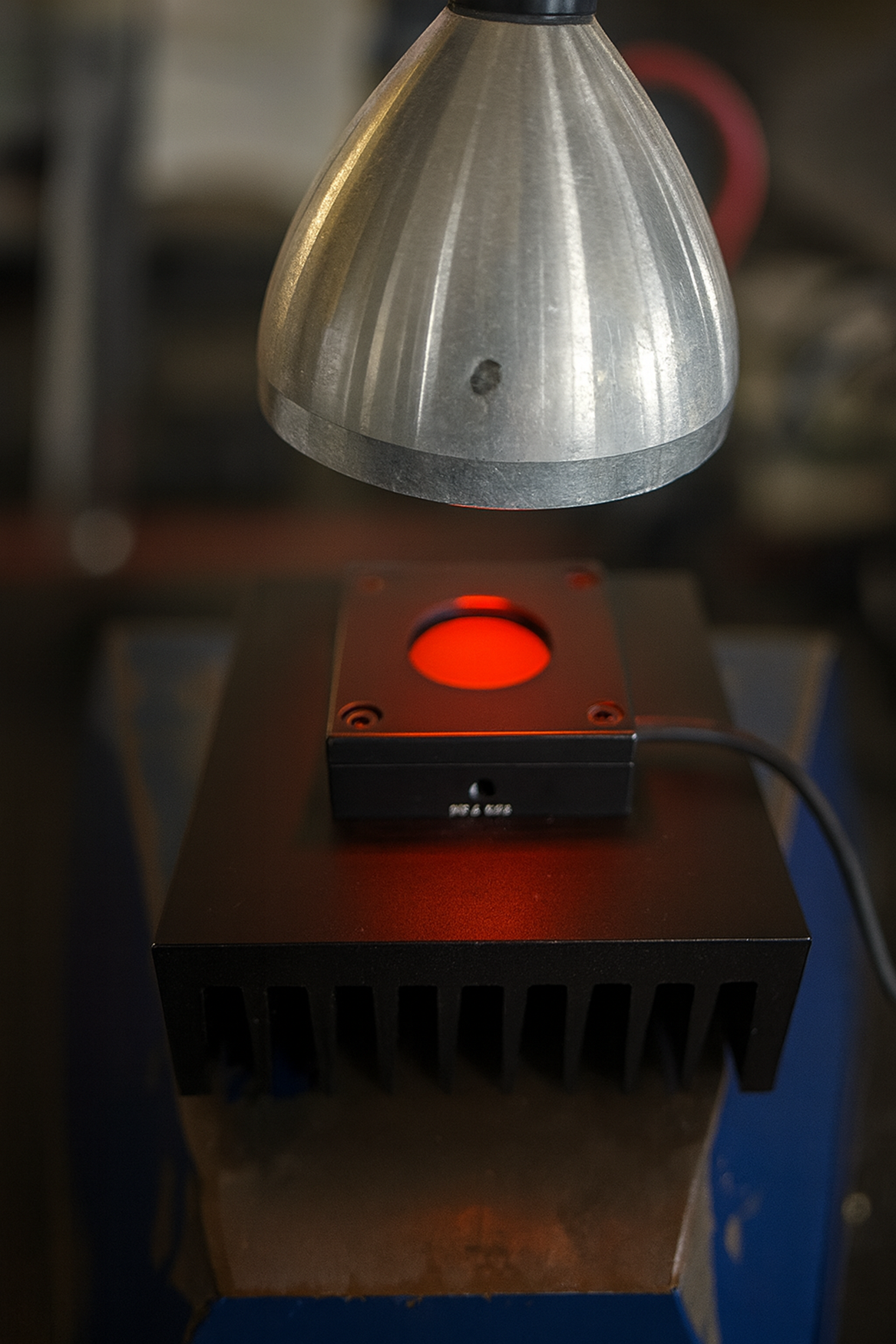
All MIR treatments were applied using a single IR-Si311 emitter (Hawkeye Technologies, Milford, CT) with a heat shield (Figure 2). The MIR emitter was powered using a regulated desktop power supply set to 12 volts and 5.5 amps (approximately 65 watts), reaching a temperature of 1,025 C, with peak emission near approximately 3.2 to 3.5 µm. Energy output from the MIR emitter was measured using an S425C-L thermal power sensor head (Thorlabs Inc., Newton, NJ) attached to a Thorlabs PM100D optical power and energy meter. The MIR emitter was placed 6 cm from the target plant to ensure that 1.33 J cm−2 s−1 of MIR thermal energy was delivered to the plants (Table 1). The specific output of 1.33 J cm−2 s−1 was chosen based on preliminary testing, allowing for a broader range of doses to be tested by varying the exposure duration. Plants were placed directly under the MIR emitter during treatment to ensure adequate coverage of the shoot apical meristem(s). The same approach was used for seed treatments in the second experiment, but the distance from the emitter was adjusted to maintain the same energy delivery rate (1.33 J cm−2 s−1). Seeds were evenly spaced on aluminum trays and placed approximately 2 cm below the emitter base during application (Figure 2).
The mid infrared emitter and sensor used to deliver thermal energy to weed plants and seeds. The samples were positioned at the center of the platform, shown in a circle.

Statistical Analysis
All data were analyzed in R statistical software v. 4.4.3 (R Core Team 2025). Data visualization was performed using the tidyverse package suite (Wickham et al. Reference Wickham, Averick, Bryan, Chang, McGowan, François, Grolemund, Hayes, Henry, Hester, Kuhn, Pedersen, Miller, Bache, Müller, Ooms, Robinson, Seidel, Spinu, Takahashi, Vaughan, Wilke, Woo and Yutani2019). Multiple candidate nonlinear regression models were fit for each weed species using the drc package to describe the relationship between MIR dose (J cm−2) and either dry aboveground biomass or seed viability (Knezevic et al. Reference Knezevic, Streibig and Ritz2007; Ritz et al. Reference Ritz, Baty, Streibig and Gerhard2015). Candidate models within the drc package were compared, and the model with the lowest Akaike information criterion was selected (Keshtkar et al. Reference Keshtkar, Kudsk and Mesgaran2021; Ritz Reference Ritz2010; Ritz et al. Reference Ritz, Baty, Streibig and Gerhard2015). The selected models were used to determine the ED50 and ED90 values, the effective doses that reduce biomass by 50% and 90%, respectively. Similarly, the LD50 and LD90 were determined, which are the doses required to reduce weed survival or seed viability by 50% and 90%, respectively. A three-parameter log-logistic model provided the best fit for the aboveground biomass of Palmer amaranth and ivyleaf morningglory, and for the seed viability of barnyardgrass and hemp sesbania. The model is described in Equation 1:
![Mathematical equation defining y as d divided by 1+exp[b(logx-loge)], representing a logistic-style exponential function with parameters b, d, and variable x.](https://static.cambridge.org/binary/version/id/urn:cambridge.org:id:binary:20260714130044299-0526:S0890037X26101146:S0890037X26101146_eqn1.png?pub-status=live) $y = {d \over {1 + {\rm{exp}}[b(\log {\rm{x}} - \log {\rm{e}})]}}$
$y = {d \over {1 + {\rm{exp}}[b(\log {\rm{x}} - \log {\rm{e}})]}}$
where y is the aboveground dry plant biomass or seed viability, x is the J cm−2 of MIR, b is the slope at the inflection point, d is the upper asymptote, and e is the energy (J cm−2) required to achieve a 50% reduction in dry biomass or seed viability (ED50).
A three-parameter Weibull-2 model provided the best fit for aboveground biomass responses of kochia, common lambsquarters, and Italian ryegrass, as well as for seed viability responses of kochia, common lambsquarters, Palmer amaranth, and velvetleaf. The model is described in Equation 2:
![Mathematical equation defining y as (d-0) multiplied by 1-exp[-exp{b(log(x)-log(e))}], representing a double-exponential growth function with parameters b, d, and variable x.](https://static.cambridge.org/binary/version/id/urn:cambridge.org:id:binary:20260714130044299-0526:S0890037X26101146:S0890037X26101146_eqn2.png?pub-status=live) $y = \left( {d - 0} \right)(1 - {\rm{exp}}( - {\rm{\;exp}}\{ b[\log \left( x \right) - \log \left( e \right)]\} ))$
$y = \left( {d - 0} \right)(1 - {\rm{exp}}( - {\rm{\;exp}}\{ b[\log \left( x \right) - \log \left( e \right)]\} ))$
where y is aboveground dry plant biomass or seed viability, x is the J cm−2 of MIR, b is the relative slope at the inflection point, d is the upper asymptote, and e is the inflection point (i.e., ED50) of the curve.
The three-parameter Weibull-1 model provided the best fit for barnyardgrass dry biomass and for seed viability of Italian ryegrass, ivyleaf morningglory, and johnsongrass, as described by Equation 3:
![Mathematical equation defining y as (d-0)exp[-exp{b(log(x)-log(e))}], representing a double-exponential decay function with parameters b, d, and variable x.](https://static.cambridge.org/binary/version/id/urn:cambridge.org:id:binary:20260714130044299-0526:S0890037X26101146:S0890037X26101146_eqn3.png?pub-status=live) $y = \left( {d - 0} \right){\rm{exp}}( - {\rm{\;exp}}\{ b[\log \left( x \right) - \log \left( e \right)]\} )$
$y = \left( {d - 0} \right){\rm{exp}}( - {\rm{\;exp}}\{ b[\log \left( x \right) - \log \left( e \right)]\} )$
where y is aboveground dry plant biomass or seed viability, x is the J cm−2 of MIR, b is the relative slope at the inflection point, d is the upper asymptote, and e is the curve inflection point.
Due to the binomial nature of the plant survival data, a two-parameter log-logistic model was used to describe the relationship between plant survival and MIR energy (J cm−2) using Equation 4: $y = {1 \over {1 + \left( {b\left( {\log \left( x \right) - \log \left( e \right)} \right)} \right)}}$
where y is the survival percentage of each species, b denotes the slope at the inflection point, and e denotes the dose required for 50% plant survival. The upper and lower limits were set to 1 and zero, respectively.
The three-parameter Weibull-1, Weibull-2, and log-logistic models all had their lower limit fixed to zero. Parameter estimates for all models were generated using dry aboveground plant biomass and seed viability data. However, for easier interpretation, the figures show reductions in dry plant biomass and seed viability relative to a nontreated control, as suggested by Knezevic et al. (Reference Knezevic, Streibig and Ritz2007). For all regression models, ED90 and LD90 values were calculated as the dose required to achieve 90% of the response variable by inverting the fitted dose-response curves using the ED function in the drc package in R.
Results and Discussion
Influence of Weed Species and Growth Stage on Weed Tolerance to Mid IR Radiation
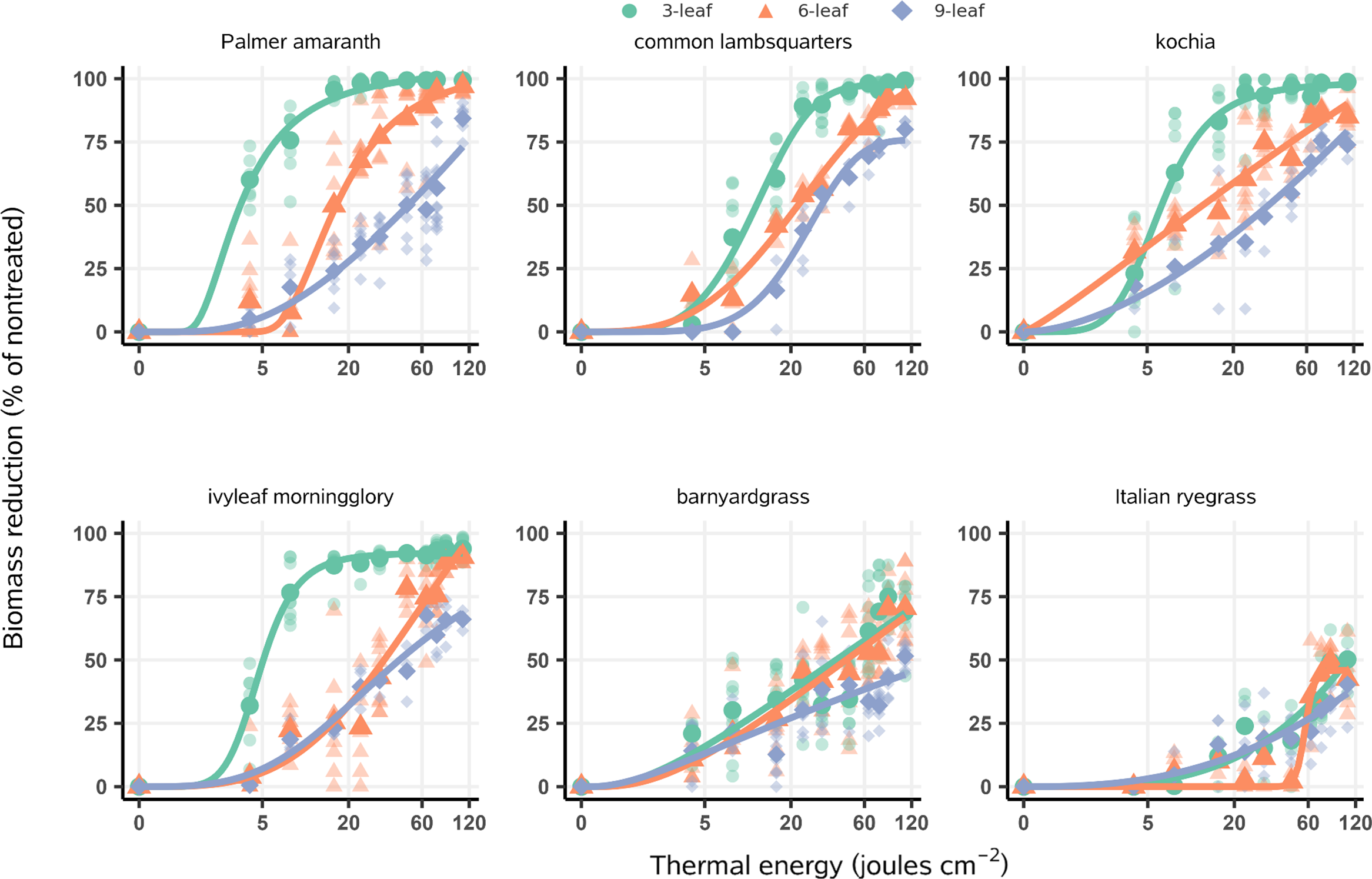
Run-by-treatment interactions were not significant; therefore, data were pooled across experimental runs before further analysis. Mid IR radiation reduced the aboveground plant biomass of all species tested, regardless of growth stage (Figure 3). As expected, smaller growth stages required less energy to reduce biomass than larger ones.
Effect of mid infrared thermal energy on dry biomass of six weed species at three growth stages, 14 d after treatment.

Figure 3. Long description
The image contains six line graphs, each representing the effect of thermal energy on the biomass reduction of different weed species at three growth stages. Each graph shows the relationship between thermal energy (joules per square centimeter) on the horizontal axis and biomass reduction (percent of nontreated) on the vertical axis. The growth stages are indicated by different symbols: circles for 3-leaf, triangles for 6-leaf, and diamonds for 9-leaf. Panel A: Palmer amaranth. Panel B: common lambsquarters. Panel C: kochia. Panel D: ivyleaf morningglory. Panel E: barnyardgrass. Panel F: Italian ryegrass. Each graph shows how biomass reduction increases with thermal energy, with variations depending on the growth stage of the weed species.
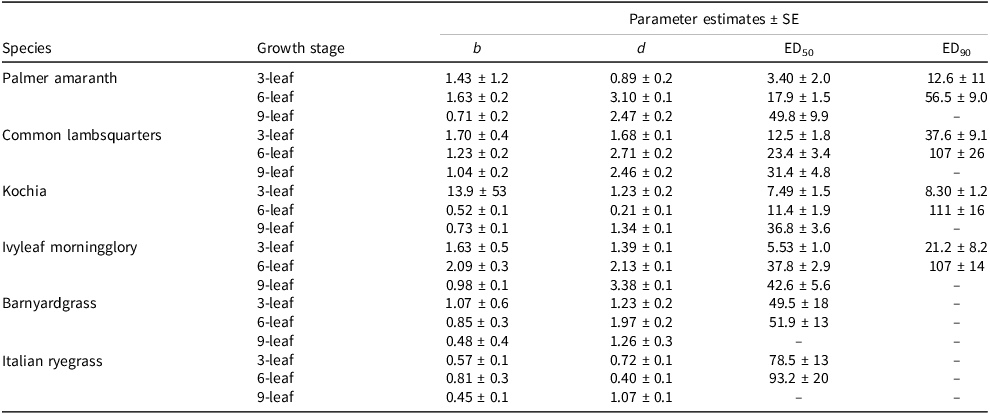
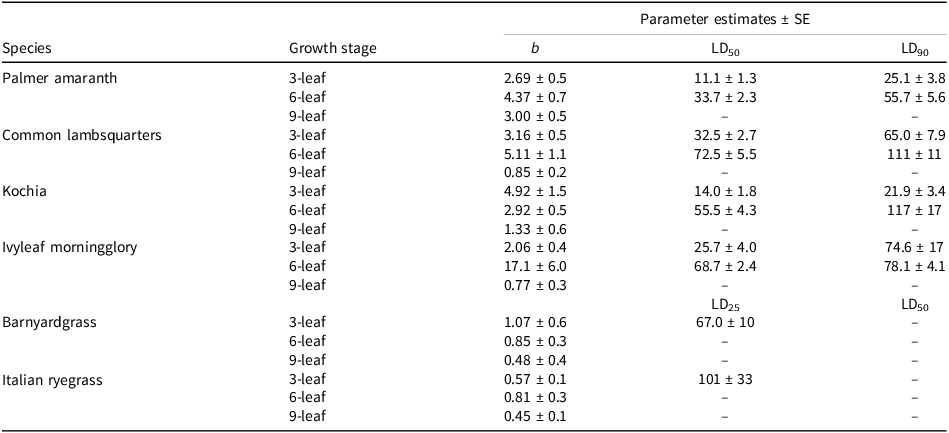
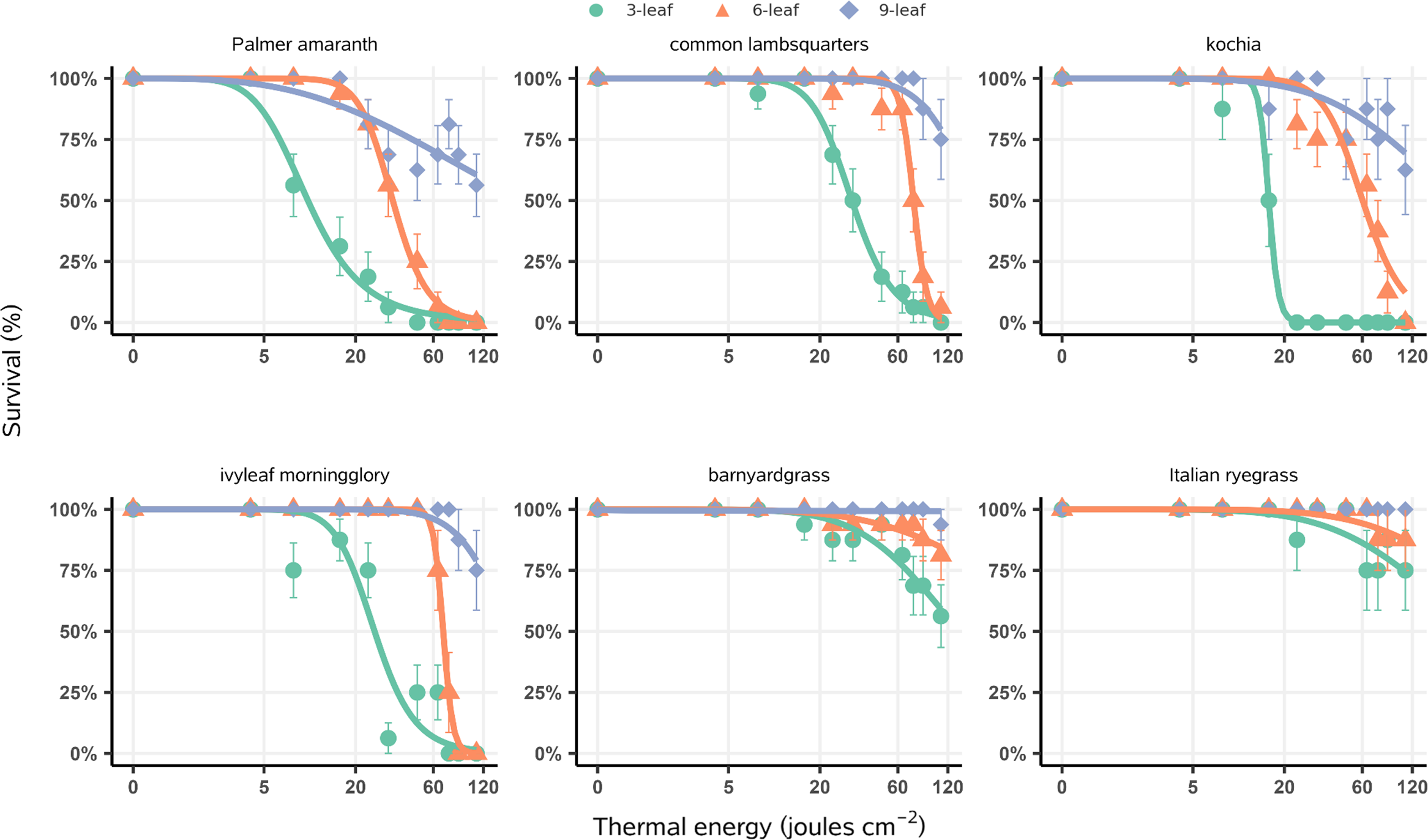
Palmer amaranth required 13 and 57 J cm−2 of MIR thermal energy to achieve 90% biomass reduction at the 3- and 6-leaf stages, respectively. A 90% reduction in biomass was never achieved for Palmer amaranth at the 9-leaf stage (at the maximum tested energy of 109 J cm−2). Nine-leaf Palmer amaranth required 15-fold more MIR thermal energy to achieve a 50% biomass reduction compared with the 3-leaf growth stage (Table 4). Using the thermal energy of a CO2 laser (10,600 nm), Marx et al. (Reference Marx, Barcikowski, Hustedt, Haferkamp and Rath2012) demonstrated that redroot pigweed growth stage strongly influenced control efficacy, with 46 J and 105 J of applied energy required to achieve 90% biomass reduction at the 2- and 4-leaf stages, respectively. In the present study, the lethal dose required to reduce Palmer amaranth survival by 90% was 25 J cm−2 and 56 J cm−2 for 3- and 6-leaf growth stages, respectively. In the study by Cisneros and Zandstra (Reference Cisneros and Zandstra2008), survival of 4-leaf redroot pigweed to flaming was reduced by <90% across multiple energy levels when using a flame weeder. In the present study, 9-leaf Palmer amaranth survival was never reduced by 50%, with mean survival remaining at 56% even at the maximum applied dose (Table 5; Figure 4).
Parameter estimates from nonlinear models describing aboveground plant biomass responses following mid infrared radiation treatment.a–c

a Values were estimated using a three-parameter log-logistic regression for Palmer amaranth and ivyleaf morningglory; a three-parameter Weibull-1 regression for kochia, common lambsquarters, and Italian ryegrass; and a three-parameter Weibull-2 regression for barnyardgrass.
b Parameter estimate b is the slope at the inflection point, d is the upper asymptote, and ED50 and ED90 are the joules per square centimeter (J cm−2) of energy required for 50% and 90% biomass reduction, respectively.
c A dash (–) indicates that the 50% or 90% biomass reduction threshold was not achieved.
Parameter estimates from a two-parameter log-logistic regression model describing plant survival following mid infrared radiation treatment.a,b

a Parameter estimate b is the slope at the inflection point, d is the upper limit, and LD25, LD50, and LD90 are the joules per square centimeter (J cm−2) of energy required for 25%, 50%, and 90% reduction in plant survival, respectively.
b A dash (–) indicates that the 50% or 90% biomass reduction threshold was not achieved.
Effect of mid infrared thermal energy on the plant survival of six weed species at three growth stages, 14 d after treatment (DAT). Individual plant survival was determined based on visual observations of injury in which plants with ≥90% injury and no regrowth at 14 DAT were considered dead.

Common lambsquarters was highly tolerant to MIR at the 3-leaf stage (Table 4; Figure 3). The ED90 of 3-leaf common lambsquarters was 2.9-fold and 4.5-fold higher than that of 3-leaf Palmer amaranth and kochia, respectively. Astatkie et al. (Reference Astatkie, Rifai, Havard, Adsett, Lacko-Bartosova and Otepka2007) reported that common lambsquarters at the 6-leaf stage or earlier was more tolerant to flame weeding than redroot pigweed, with 3,887 MJ ha−1 (38 J cm−2) achieving only 64% control of lambsquarters compared with 100% control of redroot pigweed. The leaves of common lambsquarters are densely coated with silvery epicuticular wax, which among other features, can reduce herbicide penetration and reflect light across various wavelengths (Taylor et al. Reference Taylor, Davies and Cobb1981). Epicuticular wax is more prevalent on young leaves and is gradually lost as the leaves mature (Brian and Cattlin Reference Brian and Cattlin1968). This may partially explain the high tolerance of common lambsquarters to MIR when the plant is at younger growth stages; however, further research is needed for confirmation. Six-leaf common lambsquarters required 107 J cm−2 to achieve a 90% reduction in biomass and 111 J cm−2 to achieve a 90% reduction in survival (Table 5; Figure 4). In a field study using IR, Astatkie et al. (Reference Astatkie, Rifai, Havard, Adsett, Lacko-Bartosova and Otepka2007) reported 100% control of 6- to 8-leaf common lambsquarters when the IR mechanism operated at a ground speed of 1.5 km h−1and 2.5 km h−1. In the present study, a 90% reduction in 9-leaf common lambsquarters biomass or survival was never achieved (Figures 3 and 4).
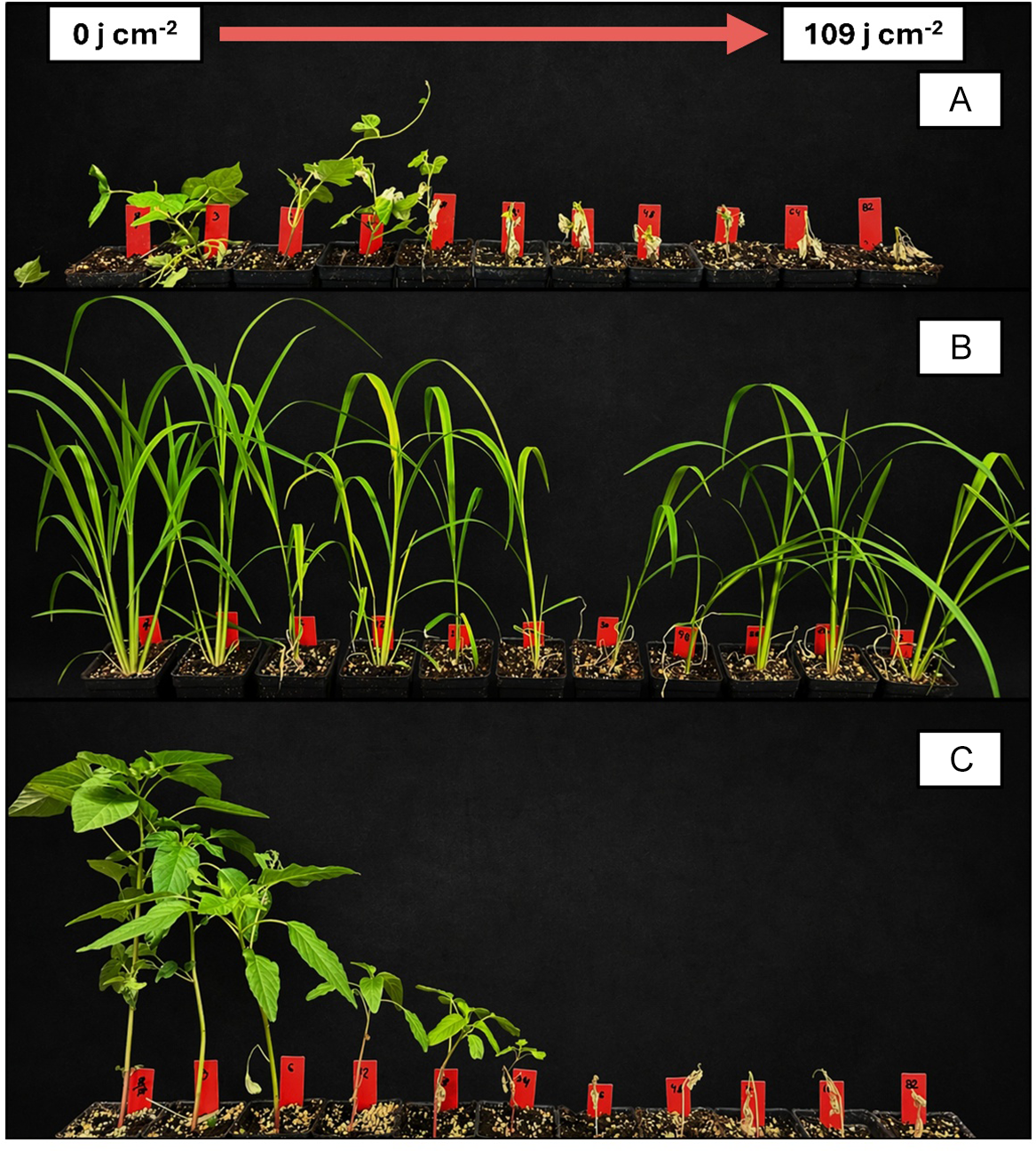
Kochia was highly sensitive at the 3-leaf stage, requiring just 8 J cm−2 to achieve a 90% reduction in biomass and 22 J cm−2 for a 90% reduction in survival (Tables 4 and 5). At the 6-leaf stage, kochia required more thermal energy than Palmer amaranth and common lambsquarters to achieve a 90% reduction in biomass (Table 4). Survival of kochia was >50% at the highest MIR dose (109 J cm−2) used in this study and the plant would often begin to regrow shortly after thermal application (Figure 4). This may be partially explained by the morphology of kochia, which possesses extensive leaf pubescence and a highly branched growth habit. At later growth stages, these traits likely protected meristems from MIR thermal energy, but further research is needed to confirm this observation. Three-leaf ivyleaf morningglory required only 21 J cm−2 to achieve 90% biomass reduction. While ivyleaf morningglory appeared to be highly sensitive at this growth stage, some plants survived and recovered by 14 DAT, resulting in an LD90 of 75 J cm−2. Plants that recovered were severely damaged, lacked green leaf tissue, and would likely not have survived under field conditions (Figure 5). The ED90 of 9-leaf ivyleaf morningglory was 107 J cm−2, which was the second highest among the broadleaf species, after kochia (Table 4).
Visual response of 3-leaf ivyleaf morningglory (A), 6-leaf barnyardgrass (B), and 6-leaf Palmer amaranth (C) following 11 mid infrared energy doses (0 joules cm−2 to 109 joules cm−2), 14 d after treatment.

Figure 5. Long description
Panel A: A row of ivyleaf morningglory plants with three leaves each, subjected to increasing doses of mid infrared energy ranging from 0 joules per square centimeter to 109 joules per square centimeter. The plants show progressive damage as the energy dose increases. Panel B: A row of barnyardgrass plants with six leaves each, subjected to the same range of energy doses. The plants exhibit varying degrees of damage, with more severe effects at higher doses. Panel C: A row of Palmer amaranth plants with six leaves each, also subjected to the same range of energy doses. The plants display progressive damage, similar to the other species, with more severe effects at higher doses.
These data contrast with those reported by Ulloa et al. (Reference Ulloa, Datta and Knezevic2010b), that Ipomoea species required a lower propane dose than kochia to achieve 90% control when using a flame weeder. Survival of 9-leaf ivyleaf morningglory declined to 75% at the highest dose tested (Figure 4). The high tolerance at this growth stage may be partially explained by the vining growth habit of ivyleaf morningglory, which made it difficult to achieve full coverage during application, resulting in partial shielding of the main stem and growing points.
The response of grass species to MIR thermal energy differed substantially from that of broadleaf species, with very little biomass reduction across all treatments and growth stages (Table 4; Figure 3). The ED50 values for 3-leaf and 6-leaf barnyardgrass were 50 and 52 J cm−2, respectively. Compared with the highly sensitive broadleaf Palmer amaranth, 3-leaf barnyardgrass required 14-fold more thermal energy to achieve a 50% biomass reduction (Table 4). A 90% reduction in barnyardgrass biomass was not achieved. Cisneros and Zandstra (Reference Cisneros and Zandstra2008) reported that the survival of 4-leaf barnyardgrass and large crabgrass was comparable to that of the nontreated control at 14 DAT when subjected to flame weeding at speeds of 2, 4, and 6 km/h. Similarly, in the present study, barnyardgrass survival was never reduced by more than 40% (Figures 4 and 5).
Previous research revealed that grass weeds are highly tolerant of thermal energy (Ascard Reference Ascard1995; Ulloa et al. Reference Ulloa, Datta and Knezevic2010b). Seven-leaf barnyardgrass required double the propane dose to achieve 90% biomass reduction using a flame weeder compared with 6-leaf kochia (Ulloa et al. Reference Ulloa, Datta and Knezevic2010b). In the present study, the ED50 of barnyardgrass was 4.5 times greater than that of 6-leaf kochia (Table 4). Italian ryegrass was very tolerant, requiring 79 and 93 J cm−2 to reduce biomass by 50% and 90%, respectively, at the 3-leaf stage. Like barnyardgrass, a 90% reduction in biomass of Italian ryegrass was never achieved at any MIR dose or growth stage (Table 4; Figure 3). Plant mortality was low for Italian ryegrass, with a 50% reduction in survival achieved only at the 3-leaf stage, requiring 101 J cm−2 (Table 5; Figure 4). Overall, the grasses in the present study exhibited minor leaf necrosis after treatment but quickly regrew within 7 to 14 d (Figure 5).
The wide range in tolerance observed between grass and broadleaf weeds may be partially explained by differences in plant morphology, leaf architecture, moisture content, and the greater protection of growing points commonly found in grass species during early development (Ascard Reference Ascard1995; Radosevich et al. Reference Radosevich, Holt and Ghersa2007). Grass weeds have lower leaf water content than broadleaves (Wang et al. Reference Wang, He, Li, Xu and Li2021). Since thermal control relies on heating intracellular liquids, lower water content may confer greater tolerance; however, to confirm this, tests across a broad range of plant water content are warranted. Moreover, if higher thermal energy doses had been evaluated in the present study, greater reductions in survival and biomass would likely have been observed across all tested species.
Influence of Mid IR Radiation on the Viability of Dry and Imbibed Weed Seeds
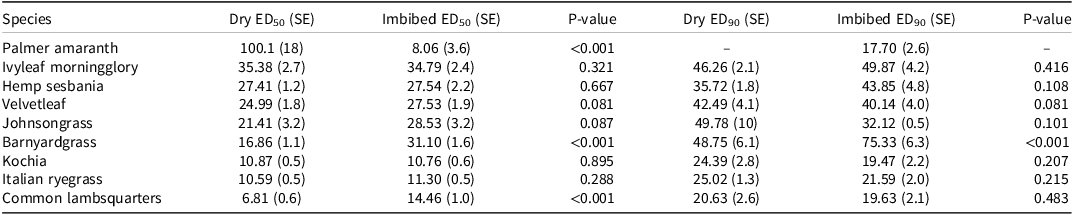
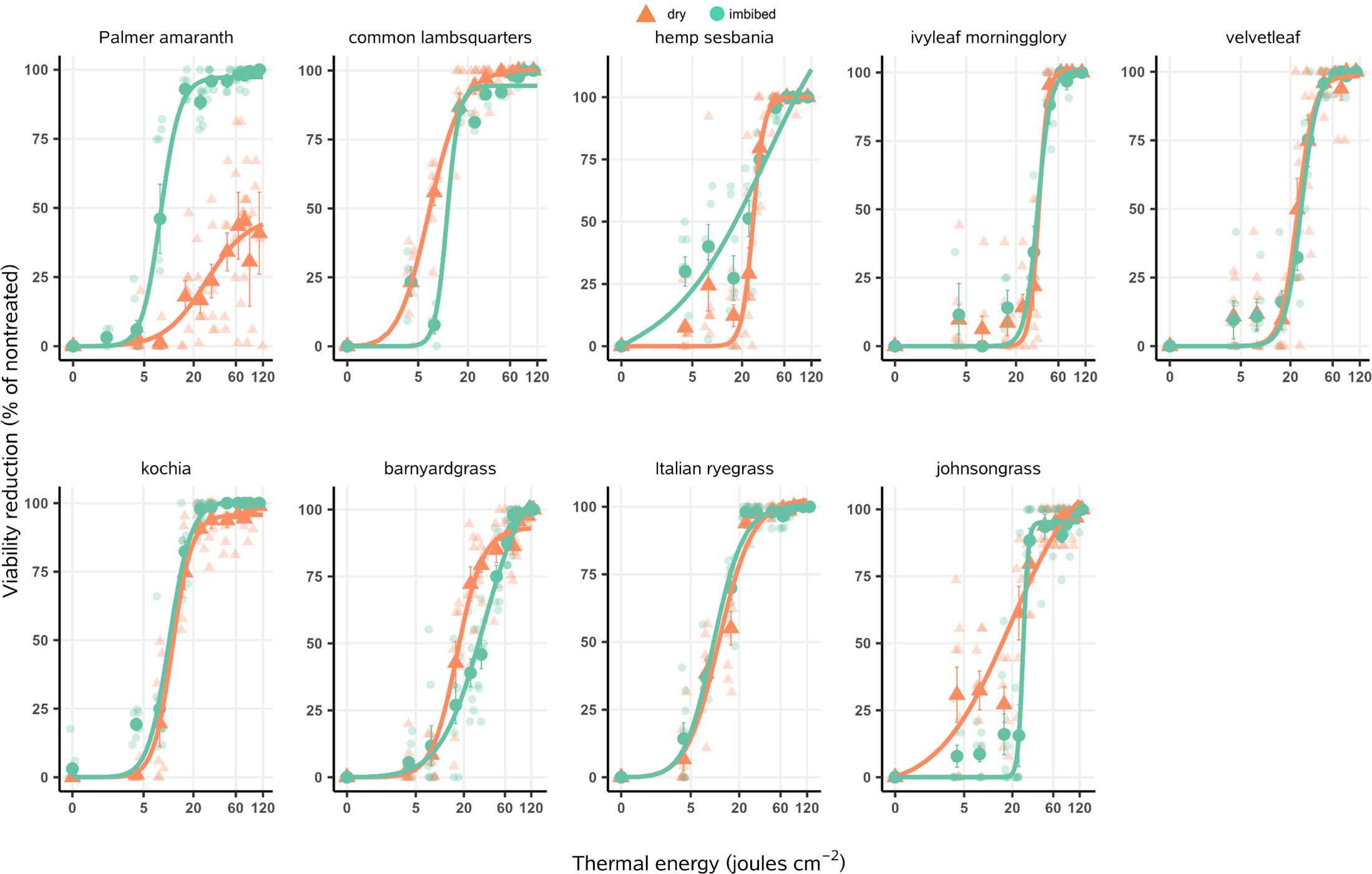
Run by treatment interactions were not significant; therefore, data were pooled across experimental runs before further analysis. Viability reduction increased with increasing thermal energy exposure for all weed species, although differences were observed between dry and imbibed seeds of Palmer amaranth and barnyardgrass (Table 6; Figure 6). Imbibed Palmer amaranth seeds were highly sensitive in the present study and required only 8 and 18 J cm−2 of MIR thermal energy to achieve 50% and 90% reductions in viability, respectively (Figure 6). Conversely, dry Palmer amaranth seeds required 100 J cm−2 to obtain a 50% reduction in viability, which was significantly higher than that of imbibed seeds. A 90% reduction in viability of dry Palmer amaranth seeds was not achieved (Table 6; Figure 6). In some wild plant populations, seed moisture content has been shown to influence heat tolerance, with higher lethal temperatures observed when seeds were dry than when moistened (Tangney et al. Reference Tangney, Merritt, Fontaine and Miller2019). Lower seed moisture levels increase water viscosity, which can constrain physiological reactions (Walters et al. Reference Walters, Hill and Wheeler2005). Conversely, seeds with high moisture content may incur greater heat damage as water heats up at high temperatures; however, the extent of this damage can vary depending on several factors, including embryo positioning (Tangney et al. Reference Tangney, Merritt, Fontaine and Miller2019). Moreover, increased MIR sensitivity of imbibed seeds may be attributed to rehydrated cellular membranes and increased metabolic activity during imbibition (Bewley et al. Reference Bewley, Bradford, Hilhorst and Nonogaki2013).
Comparison of the effective doses of mid infrared thermal energy required to reduce the viability of dry and imbibed weed seeds.a,b

a ED50 and ED90 are the joules cm−2 of energy required for a 50% and 90% reduction in seed viability, respectively. Values were estimated using a three-parameter log-logistic regression for barnyardgrass and hemp sesbania; a three-parameter Weibull-1 regression for Italian ryegrass, ivyleaf morningglory, and johnsongrass; and a three-parameter Weibull-2 regression for kochia, common lambsquarters, Palmer amaranth, and velvetleaf.
b A dash (–) indicates that the 50% or 90% seed viability reduction threshold was not achieved.
Effect of mid infrared thermal energy on the seed viability of nine weed species, both dry and water imbibed, 14 d after treatment.

Previous studies have shown that seed size may also play a role in heat tolerance, with larger seeds being more heat-tolerant (Jakobsen et al. Reference Jakobsen, Jensen, Bitarafan and Andreasen2019; Norsworthy et al. Reference Norsworthy, Green, Barber, Roberts and Walsh2020). Despite being the smallest-seeded species evaluated, Palmer amaranth exhibited higher tolerance to MIR thermal energy when seeds were dry, but sensitivity increased substantially after 9 h of imbibition. This may be due to multiple factors, including the small seed size and the peripherally arranged embryo. Nine hours of imbibition were likely sufficient to hydrate the small embryo of Palmer amaranth, making it more vulnerable to thermal energy. In contrast, dry seeds may exhibit greater tolerance due to reduced internal water content and potential differences in heat transfer and dissipation. Additionally, seed traits such as seed coat composition and seed size may influence thermal responses; however, the role of these factors in mediating heat tolerance has not been well characterized in Amaranthus species.
Dahlquist et al. (Reference Dahlquist, Prather and Stapleton2007) found that dry tumble pigweed (Amaranthus albus L.) seed was more tolerant to 50 C heat than dry barnyardgrass and London rocket (Sisymbrium irio L.) seed. No differences in 50% and 90% viability reductions were detected between dry and imbibed kochia seeds, and among those of ivyleaf morningglory, hemp sesbania, and velvetleaf (Table 6). Moreover, the energy requirements were similar across all three of the latter species (Table 6; Figure 6). Norsworthy et al. (Reference Norsworthy, Green, Barber, Roberts and Walsh2020) reported that velvetleaf and hemp sesbania required similar heat indices (23,000 heat index), whereas pitted morningglory (I. lacunosa L.) required a substantially higher heat index (34,600) to achieve complete mortality in a clay kiln.
Imbibed barnyardgrass seeds were highly tolerant to MIR thermal energy, requiring 75 J cm−2 to achieve a 90% reduction in viability. Interestingly, the comparison between dry and imbibed barnyardgrass seeds was opposite to that observed in Palmer amaranth, with imbibed seeds demonstrating greater tolerance to thermal energy than dry seeds (Table 6; Figure 6). This finding was unexpected and may be due to differences in seed morphology, seed coat thickness, or composition. Moreover, water may have acted as a thermal buffer, protecting the embryo, but further research is needed to determine this. A recent study on soil steaming revealed that barnyardgrass, when imbibed for 12 h, was more tolerant to steaming than dry seeds (Bitarafan et al. Reference Bitarafan, Kaczmarek-Derda, Berge, Tørresen and Fløistad2022). Our findings, along with those reported by Bitarafan et al. (Reference Bitarafan, Kaczmarek-Derda, Berge, Tørresen and Fløistad2022), suggest that imbibition may enhance the heat tolerance of barnyardgrass seeds.
Italian ryegrass was highly sensitive to MIR thermal energy, requiring just 25 and 22 J cm−2 to reduce viability by 90% for dry and imbibed seeds, respectively (Table 6). Norsworthy et al. (Reference Norsworthy, Green, Barber, Roberts and Walsh2020) found that Italian ryegrass had a lower heat index for complete kill than johnsongrass. Similarly, in the current study, dry johnsongrass seeds required nearly 2-fold more thermal energy to achieve a 90% reduction in seed viability compared to Italian ryegrass (Table 6). Overall, seed moisture status influenced the thermal responses of Palmer amaranth, common lambsquarters, and barnyardgrass, with MIR thermal energy responses comparable across moisture status for all other species. These contrasting responses likely reflect species-specific seed traits and imbibition dynamics that influence embryo hydration and heat tolerance. Imbibition duration was standardized across species; however, seeds may have been at different physiological stages of water uptake at the time of thermal treatment, depending on the species. Extending imbibition duration may further reduce thermal tolerance in some species, although further research is needed to confirm this. Moreover, species that exhibit physical dormancy, which inhibits imbibition, may not show imbibition-related responses unless the seeds have overcome the dormancy.
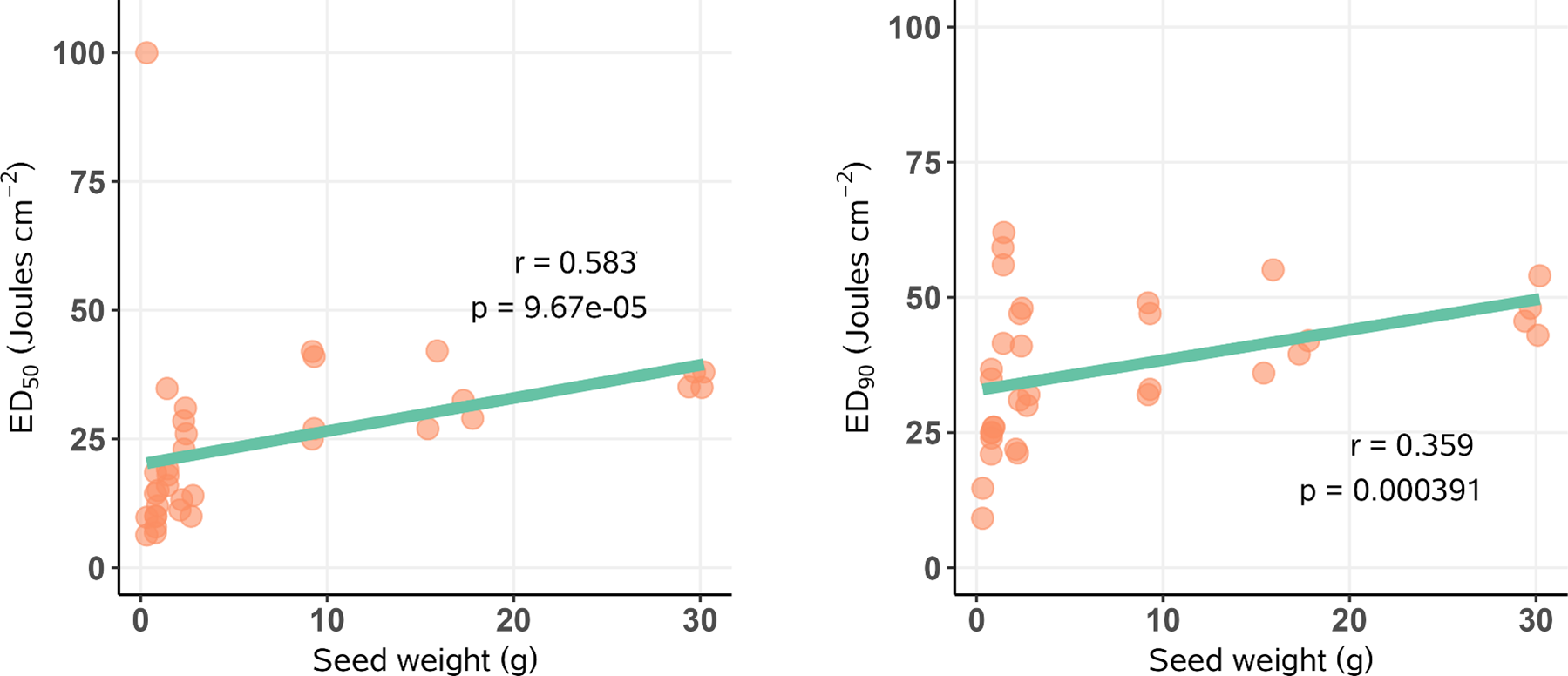
Seed size likely influences tolerance to thermal control methods (Jakobsen et al. Reference Jakobsen, Jensen, Bitarafan and Andreasen2019; Norsworthy et al. Reference Norsworthy, Green, Barber, Roberts and Walsh2020). Except for the small-seeded Palmer amaranth, larger-seeded weed species in our study generally required higher MIR energy doses (J cm−2) to achieve 50% and 90% reductions in viability (Table 6; Figure 6). A Pearson correlation revealed moderate positive relationships between seed weight and energy requirement for ED50 (r = 0.58) and ED90 (r = 0.36) (Figure 7). These data provide evidence that seed weight may contribute to MIR thermal energy tolerance. Additional factors, such as seed coat composition and thickness, seed morphology, and physiology, are also likely to contribute to seed tolerance to MIR thermal energy.
Pearson correlations between 1,000 dry seed weight and effective doses for 50% (ED50) and 90% (ED90) reductions in seed viability.

The results of Experiments 1 and 2 demonstrated that MIR thermal energy has the potential to control seeds and emerged weeds (especially young broadleaf weed seedlings) if adequate energy levels are achieved. Growth stage and weed species were significant factors influencing biomass reduction and survival response to MIR thermal energy. Emerged grass species were tolerant to MIR at all three growth stages, consistent with their ability to survive other thermal weed control methods (Ascard Reference Ascard1994; Coleman et al. Reference Coleman, Betters, Squires, Leon-Saval and Walsh2021; Schreier et al. Reference Schreier, Bish and Bradley2022). Higher MIR energy levels than those we evaluated may help reduce biomass more effectively and increase mortality in grass weed species. However, higher energy requirements have negative implications for the efficiency and feasibility of field deployment. Based on results of the present study, it is evident that to maximize efficiency, MIR used for weed control should be applied at the earliest possible stage of plant growth. Weed seed response to MIR varied drastically across species. The wide range in response between dry and imbibed Palmer amaranth was unexpected, particularly when considering that a 90% reduction in viability was never achieved for dry seeds, within the range of treatments used in this study. Notably, common lambsquarters, which is black and similar in size to that of Palmer amaranth, showed no difference in ED90 between the two moisture conditions. The moderate correlation between seed size and energy requirement supports that seed size plays a contributing, though not exclusive, role in determining the heat tolerance of seeds. Although the present study demonstrates the potential of MIR thermal energy as a weed seed management method, much remains to be understood about its effects and mechanisms across this wavelength spectrum.
Practical Implications
The need for nonchemical weed management options has intensified in recent years, with practices such as tillage, flame weeding, and electrical weed control gaining increased traction (Bauer et al. Reference Bauer, Marx, Bauer, Flury, Ripken and Streit2020). The feasibility of these technologies depends on understanding the energy costs required for acceptable weed control. The present study demonstrated the potential of using MIR thermal energy as a means of nonchemical weed management and the minimum energy required to control common weed species. The key difference between MIR and flaming or electrical weed control is the minimal fire risk associated with MIR. In high-residue cropping systems, minimizing fire risk may be essential for the safety of the user and the crop, making thermal methods such as MIR advantageous over flaming or electrical weed control.
While this research provided foundational insights into plant response to MIR, further studies are needed to understand the feasibility and applicability of MIR weed control. Field-based research is required to further validate the findings from these greenhouse studies because weeds may respond differently in such scenarios. Moreover, the current study tested only a single thermal energy application within a limited dose range; future work should investigate whether insufficient control can be overcome by increasing energy delivery, either through longer exposures or multiple applications of MIR. Intraspecific differences, such as plant moisture, lignin content, and the presence or absence of pubescence or cuticular wax, may likely play a role in plant tolerance to thermal energy and should be investigated further.
Controlling weed seeds with thermal energy such as that provided with MIR may be useful. Windrow burning is a thermal seed-killing technique used in cropping systems in Australia, but fire risks are a significant concern (Walsh and Newman Reference Walsh and Newman2007). The potential to control weed seeds using MIR at lethal temperatures below those that would ignite crop residue could therefore provide a safer alternative. Future research should investigate how crop chaff composition affects the energy required for seed mortality using MIR and assess strategies for integrating MIR-based tools into harvest weed seed control systems. Additionally, the potential for MIR to control seeds in the soil seedbank remains unexplored, and future studies should investigate the energy needed to reduce weed emergence across multiple burial depths and varying soil moisture conditions. Nonetheless, the present study provides a baseline understanding of the MIR thermal energy thresholds required to control common weed species and their seeds. These results may help guide the development of new thermal weed control technologies that offer growers effective, nonchemical management options.
Acknowledgments
We thank undergraduate research assistants Kristy Nguyen, Jodi Chio, Nathan McClure, and Gabriel Gava, who assisted in greenhouse and laboratory preparations, treatment applications, and data collection for the experiments. We acknowledge the technical and equipment support provided by Jon Jackson of Global Neighbor, Inc. Additionally, we thank Sarah Chu for assisting with seed procurement and technical expertise, and Dr. Micheal Owen for providing technical edits to the manuscript.
Funding
This research received no specific grant from any funding agency, commercial or not-for-profit sectors.
Competing Interests
The authors declare they have no conflicts of interest.

 Open access

