





1. Introduction
A central goal of the sociolinguistic enterprise has been to understand which factors constrain variability in language production (see, inter alia, Labov Reference Labov1994, Reference Labov2001, Reference Labov2010). Subsequently, a great deal of sociolinguistic work has attempted to understand questions such as ‘what governs the variable use of were for was in sentences such as She were at home that evening?’ In the field of variationist sociolinguistics, the variation has typically been explained in terms of social, stylistic and cognitive factors (e.g. Cheshire & Fox Reference Cheshire and Fox2009; Moore Reference Moore2010). Whereas in the field of interactional sociolinguistics, the variation has typically been explained in terms of microlevel discourse and conversational phenomena, such as turn-taking, voicing and quoting (e.g. Rampton Reference Rampton1995).
More recently, however, in (quantitative) variationist sociolinguistics there has been a push to consider that, in addition to social and linguistic factors, interactional factors may also constrain the variation – what Eiswirth (Reference Eiswirth2020) terms ‘interactional accountability’ (Snell Reference Snell2010; Levon Reference Levon2016; Eiswirth Reference Eiswirth2020; Ilbury Reference Ilbury2021; Moore Reference Moore2023). For instance, in her analysis of the possessive pronoun me in the north-east of England, Snell (Reference Snell2010) argues that the variant is not straightforwardly predicted by the social-class identity of the speaker, but rather it is strategically deployed in specific interactional moments by working-class children to stylise an enregistered identity. Similarly, in an analysis of the suprasegmental feature, High Rising Terminals (HRTs), Levon (Reference Levon2016) concludes that the use of this feature is employed by men and women to achieve different interactional goals. For the men, HRTs are used to draw attention to new information in their narratives, whereas for the women, HRTs are used to maintain epistemic authority in the relaying of a narrative. Not only do these studies demonstrate the utility of combining variationist and interactional approaches, but they also emphasise the necessity of considering the interactional conditioning of sociolinguistic variation.
This article adds to this line of inquiry by exploring a lesser-studied but nevertheless noteworthy pronoun: man. Combining both qualitative and quantitative methods, I analyse the use of this feature across a corpus of spoken language recordings and a dataset of social media posts, focusing on the social-stylistic and interactional mechanisms that constrain the infrequent use of pronominal man. In doing so, the analysis reveals not only that the use of man appears to fulfil a useful interactional function, but that this function may have contributed to its spread beyond the speech context in which it first emerged – a potential which is, at present, rarely considered in the literature on language change. In concluding, this article follows others in advocating for greater interactional accountability in variationist sociolinguistics (Levon Reference Levon2016; Eiswirth Reference Eiswirth2020; Ilbury Reference Ilbury2021; Moore Reference Moore2023) and calls for future research on language change to consider the interactional potential of a feature in promoting (or constraining) its uptake and spread.
The article is structured as follows. First, an overview of the distribution and function of the pronoun man based on the existing literature is provided. The method is then described before an analysis of man in the conversations and social media content from young people at an East London youth group is presented. The first part of the analysis is then supplemented by a more recent dataset of comments extracted from the social media platform, TikTok, to interrogate the more recent development of man. This leads to a brief consideration of the relationship between man and a related pronominal feature that appears to have spread – bro.
2. Pronominal man
The pronoun man – as in man’s doing that voice recording thing where in Standardised English we might expect ‘I’ – was first documented in a variety of English that has been labelled ‘Multicultural London English’ (MLE; Cheshire et al. Reference Cheshire, Fox, Kerswill, Torgersen, Ammon and Mattheier2008, Reference Cheshire, Kerswill, Fox and Torgersen2011; Cheshire Reference Cheshire2013). More recently, a similar feature – mans – has been documented by Denis (Reference Denis2016) in online posts and media contexts from Toronto, Canada. In many ways, the emergence of man in London (and mans in Toronto) may appear comparable to the now archaic pronoun with the same form (cf. Los Reference Los, Fanego, Lopez-Couso and Perez-Guerra2002; van Bergen Reference van Bergen2003). Indeed, in several Germanic languages, such as Danish, there still exists an indefinite pronoun, mann ‘one’ (Knooihuizen Reference Knooihuizen2015). This was the case in English for some time; however, historical evidence shows that man fell out of use around the fifteenth century. Prior to its demise in Middle English, the indefinite pronoun man was roughly synonymous with ‘one’, having developed from the general noun ‘man’ (Los Reference Los, Fanego, Lopez-Couso and Perez-Guerra2002; van Bergen Reference van Bergen2003).
However, in the contemporary urban contact dialects spoken in London and Toronto, man appears to have developed with different referential values to both its archaic and Germanic counterpart. Unlike the historical pronoun, man does not only refer to indefinite subjects (1), but it can refer to situations where the subject is unambiguously defined as the speaker (2).


Whilst man(s) can theoretically occur with any number and person configuration, previous accounts suggest that it is overwhelmingly used with first-person singular reference (Cheshire Reference Cheshire2013; Denis Reference Denis2016; Hall Reference Hall2020). In Cheshire’s (Reference Cheshire2013) analysis, 70.2 per cent of all pronominal tokens of man are used in this way, as in (3). Although less frequent, Cheshire observes that it can be used as a second-person (as in (4), 4.3 per cent), third-person (as in (5), 3.2 per cent) and indefinite/impersonal pronoun (as in (1) above, 8.5 per cent):


The emergence of man(s) has generated a significant level of academic and popular interest primarily because pronominal systems are typically thought to be resistant to change. Indeed, Heine & Song (Reference Heine and Song2010: 117) suggest that, as the pronominal system is typically considered to be a closed-class system of the grammar, pronouns are ‘diachronically fairly stable’. Subsequently, a central goal of the existing work on man has been to determine the origin of this pronoun, as well as identify the sociolinguistic factors that constrain its use. A key consideration has been whether the appearance of man in London and mans in Toronto, both pronouns originating in the urban contact dialects spoken there, are connected in any way. In his analysis, Denis initially suggests that it ‘may well be possible for features of MLE to globally diffuse’ (2016: 8), such that mans in Toronto may have been borrowed from MLE. However, Denis goes on to reject this interpretation based on the lack of similarities between the distribution and form of the feature in the local dialect. He claims that a diffusion and development hypothesis from MLE to Toronto would necessarily entail that man would have been in widespread use prior to mans. However, this assumption is not borne out. As Denis notes, in his dataset ‘man is not used pronominally (or even ambiguously between a pronoun and noun); mans is the primary pronominal form’ (2016: 8). Thus, Denis maintains that mans appears to have developed simultaneously as opposed to have directly diffused from MLE.
An alternative and more convincing argument Denis proposes focuses on the sociodemographic similarities of the two cities where the feature is used: London and Toronto. He suggests that the pronoun likely diffused and developed from the creoles spoken by the local West Indian communities, pointing to the comparable size of the Jamaican population in London and Toronto. Denis goes on to compare the emergence of man(s) to the various lexical borrowings from West Indian varieties in MLE and Multicultural Toronto English (MTE), such as wah gwan ‘what’s happening’, yard ‘house’ and batty ‘buttocks’.
Further evidence which supports a borrowing hypothesis is discussed by Cheshire (Reference Cheshire2013: 614), who notes that Jamaican Creole already has a noun man meaning ‘people’. She observes that, in some contexts, this can be interpreted in much the same way as the pronoun in Old English (cf. Los Reference Los, Fanego, Lopez-Couso and Perez-Guerra2002; van Bergen Reference van Bergen2003), with indefinite referential value (6). An initial assessment of man therefore seems to suggest that this pronoun could have developed via borrowing and grammaticalisation from Jamaican Creole.

However, although these accounts shed some light on the emergence of man(s), given its low frequency and the fact that the pronoun appears to be a relatively recent development, these analyses suffer from a lack of data and, as a consequence, a lack of explanatory power. Indeed, existing accounts of man(s) (Cheshire Reference Cheshire2013; Denis Reference Denis2016; Hall Reference Hall2020) are exploratory in nature, with the aim of providing a detailed discussion of the syntactic and semantic properties of the pronoun, situating its emergence within the broader sociolinguistic context of the emergence of urban contact dialects. Subsequently, the existing work is unable to tell us much about the social meaning of the feature nor its interactional function. For instance, in Cheshire’s analysis of the feature in MLE, only six speakers use man, producing just 11 tokens. To supplement the analysis, she analyses data from a documentary, a film (Anuvahood, 2011) and an interview with Grime artist Giggs, providing a total of 94 tokens of man. Although her interpretations are preliminary, Cheshire (Reference Cheshire2013) does attempt to provide an interactional account of man, suggesting that it is most often used as a rhetorical device that specifies the individual as part of a contextually defined group. Cheshire goes on to propose that it has particular utility as a dramatization or politeness device where it can be used to ‘mitigate a potentially face-threatening act [and] solicit empathy from their interlocutor or construct solidarity’ (2013: 608). However, she warns that these conclusions are speculative given that the dataset is based on a small amount of data from one context (interviews). Thus, the goal of the present article is to expand this line of inquiry by examining a newer dataset of naturalistic self-recordings and social media posts and comments to understand the distribution, function and social meaning of man.
3. Method
The analysis presented here is based on two datasets: (i) a corpus of spoken conversations and social media data collected from young people attending a youth group in East London in 2016/17 and (ii) a more recent corpus of fifty TikTok videos and their comments (N= 6,751) extracted in 2024. The TikTok dataset will be introduced later in the analysis since the principal focus is on the first dataset of naturalistic conversations, which were collected as part of a larger ‘blended’ offline/online sociolinguistic ethnography of an East London youth group that I refer to as ‘Lakeside’. Between October 2016 and October 2017, I conducted ethnographic fieldwork that tracked twenty-five adolescents across offline (i.e. at the youth group) and online (i.e. on social media) contexts. Whilst at Lakeside, I became a ‘youth worker’ and was actively involved in setting up nightly activities as well as assisting in the running of the club. Lakeside is based in an East London neighbourhood in Hackney, an inner-city borough of London that is extremely ethnically and culturally diverse (see figure 1).
The Inner East London borough of Hackney (shaded) within the wider conurbation of Greater London (GLA 2020, contains Ordnance Survey data © Crown copyright and database rights)

The context and speaker demographic of the Lakeside dataset is similar to that of Cheshire’s (Reference Cheshire2013) study, enabling this article to make direct comparisons between the two studies. Hackney was a key field site in the MLE projects, and it is also the setting of the film Anuvahood (two data sources in Cheshire Reference Cheshire2013). Similarly, like those in the MLE projects (see Cheshire et al. Reference Cheshire, Kerswill, Fox and Torgersen2011), the speakers at Lakeside were (pre)teens (aged 11–17), ethnically diverse and resided in a working-class neighbourhood in inner-city London (see Ilbury Reference Ilbury2019, Reference Ilbury2021 for further information on the demographic profile of Lakeside).
The first section of the analysis focuses on a data from 36 hours of self-recordings, 6 hours of interview recordings, around 50,000 words of fieldnotes, and 850 social media posts from Snapchat and Instagram. For self-recordings, the young people were allocated a Zoom H2N recorder and lapel microphone and were instructed to wear the device for the evening. For interviews, the young people were recorded in small groups of two or three peers and were asked informal questions about their life, the youth group and their backgrounds. Although not all speakers participated in interviews (N=16/25), this data is included to enable a direct comparison with Cheshire’s (Reference Cheshire2013) interactional analysis, which is based entirely on interview data (see Cheshire et al. Reference Cheshire, Kerswill, Fox and Torgersen2011). This additionally demonstrates the utility of self-recordings in eliciting infrequent vernacular features that occur more commonly in informal peer-to-peer interaction (cf. Snell Reference Snell2010).
To analyse the data, all tokens of <man> were extracted. As is standard in variationist sociolinguistics, circumscribing the variable requires excluding tokens that were repeated, appeared in false-starts, or were in reported speech. In total, 358 tokens of <man> were identified, excluding derivatives such as mandem. The tokens were first coded as ‘address term’ (7), ‘noun’ (8) or ‘pronoun’ (9) based on the pragmatic function and syntactic properties of the variant. Whilst the focus of this analysis is on the pronominal function of man, the three functions are distinguished here to demonstrate the relative frequency and variability in the realisation of man. ‘SR’ refers to self-recordings, ‘INT’ refers to interviews.


This process identified some ambiguous tokens that could, arguably, be interpreted as any one of the three functions. Take, for instance, (7) which could be interpreted as either an address term/discourse marker ‘you, man’, or a noun phrase ‘you man’, as it is in (8) where it is used as an uninflected plural noun. In these instances, the ambiguity was largely resolved by inspecting the extralinguistic context of the token. In this case, the address term is preceded by an audible pause, whereas the noun phrase ‘you man’ is not.
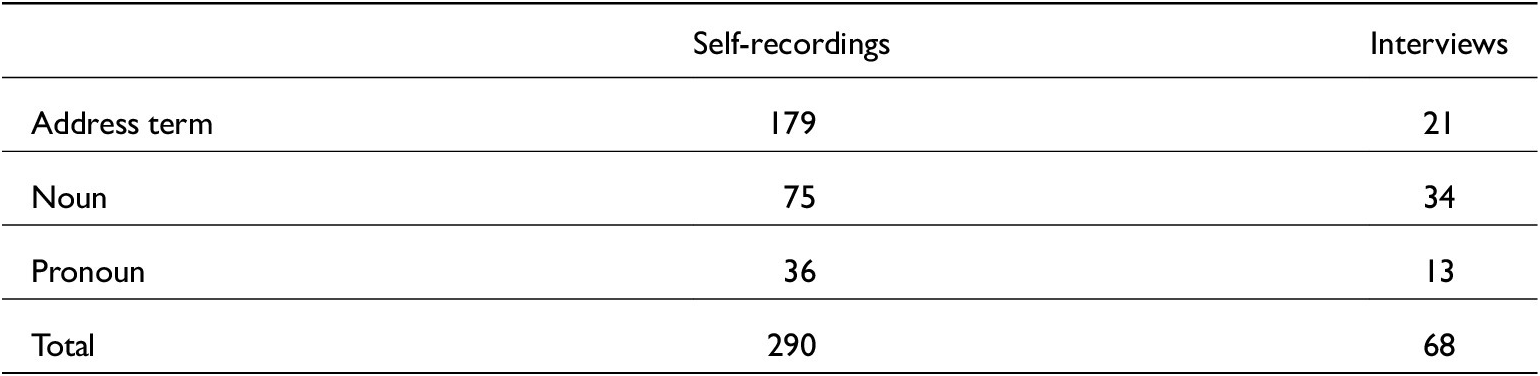
Table 1 shows the functions of man as a ‘noun’, ‘address term’ and ‘pronoun’ across the spoken language datasets. As previously mentioned, only bare man (i.e. man not mandem) tokens are reported. As expected, the pronominal function is the least frequent use of man across both datasets, accounting for just 13.7 per cent of all tokens, mirroring Cheshire’s (Reference Cheshire2013) findings.
Distribution of man tokens across self-recordings and interviews

The relative infrequency of pronominal man may initially be perceived as an issue in pursuing this type of analysis as variationist analyses typically focus on variables which are high frequency (see Tagliamonte Reference Tagliamonte2006). Nevertheless, there is a body of work which demonstrates the utility of the present approach in examining the function and distribution of infrequent variables (e.g. Snell Reference Snell2010; Drummond Reference Drummond2018). In that work, it is argued that frequency appears to have little to do with interactional function or social meaning since, as Kiesling observes, ‘[i]ndexical meaning can thus arise out of statistical commonality or single instances of use that are salient enough to gain meaning for speakers’ (2009: 117). For these reasons, and given that the emergence of pronouns is typically rare cross-linguistically (Heine & Song Reference Heine and Song2010), there appears to be sufficient theoretical and empirical justification to conduct this type of analysis. Similarly, an additional advantage of a relatively small dataset is that it was possible to inspect each and every token of man thereby increasing the validity of the interactional analysis (see also Snell Reference Snell2010).
4. Analysis
4.1. Social-stylistic constraints on pronominal man
Of the 26 speakers who participated in self-recordings, just 11 used pronominal man. Those 11 speakers produced a total of 49 tokens of the pronoun man across both interviews and self-recordings. The majority of tokens are found in data from the self-recordings (see table 1). The feature also appears to be stylistically constrained by the speaking context. In interviews, pronominal man is relatively uncommon (N=13) used by just 3/16 young people that were interviewed. In the informal self-recordings, on the other hand, the feature is considerably more frequent (N=36), used by 11/25 speakers. Of the 8 speakers who participated in both interviews and self-recordings, only 3 (Marcus, Ben and Henry) use this pronoun in both contexts. This appears to suggest that form is heavily stylistically constrained, with those who use pronominal man in informal speech contexts generally avoiding the use of the feature in what could be considered a stereotypically more ‘formal’ speech context – at least in the Labovian sense of the term (Labov Reference Labov1994).
Arguably, the difference in the rate of pronominal man between previous work (e.g. Cheshire Reference Cheshire2013) and the current analysis could be attributed to the differences in data elicitation procedures (i.e. interviews vs self-recordings). However, man does appear to have increased in use regardless of differences in data collection. Compare Cheshire’s (Reference Cheshire2013) analysis of interview data from a corpus of 2.8 million words (Cheshire et al. Reference Cheshire, Kerswill, Fox and Torgersen2011: 157–8), which identified only 11 unambiguous tokens of pronominal man from 6 speakers, to the present analysis which identifies 49 tokens from 11 speakers (13 of which were from interviews with 3 individuals) in a corpus that is roughly 5 per cent the size of the MLE project. Thus, given that the speaker demographic and context of the present study is highly comparable to the MLE projects, it appears that the rate of man has increased substantially.
Interestingly, although the frequency of the innovative pronoun appears to have increased, the social constraints of man appear to be robust. As previously reported, pronominal man is used almost exclusively by male speakers. Only one female speaker uses this feature, Nicole. In the one instance she uses the pronoun man, however, she does so to refer to a specific group of boys, thus revealing an additional constraint on the referential properties of this feature. The one instance is a context where Nicole, having just entered a room where a group of boys were previously playing on PlayStation, turns to me and says:

In extract (10), Nicole’s uses man to refer to the group of boys – initially referred to with the third-person plural they – who had just left the room. Her use of man not only reveals an awareness of the association of the use of the feature with a particular group of people, but it also confirms that the reference of man is necessarily [ +animate] and [+male], thus confirming the semantic restrictions identified in previous research (Cheshire Reference Cheshire2013; Hall Reference Hall2020). In fact, all 49 tokens in the dataset are used to refer to male-identifying addressees.
Thus far, then, the distribution of pronominal man appears to be well predicted by previous analyses which argue that, as an ingroup pronoun, it is used to define a contextually bound group of males (Cheshire Reference Cheshire2013; Denis Reference Denis2016). However, this explanation does not account for the fact that 5 of the 15 males who participated in the recordings (and who were part of Lakeside) do not use this feature at all. To explain this distribution, I return to Nicole’s statement in (10). In this context, her use of man appears to reflect an awareness of the enregisterment of this feature with a particular type of person and identity. The boys who were playing on PlayStation were part of a self-defined Community of Practice at the youth group: the ‘gully’ – a group of boys who adopted an orientation that was generally characterised by an ‘anti-establishment’ stance. A small minority of this CofP reported participating in low-level crime, while most indexed this stance in more superficial ways, such as by refusing to participate in group activities organised by the youth group. The term ‘gully’ originates from Jamaican Creole meaning the ‘streets’ or, more strongly, ‘a ghetto or slum’ (Jamaican Patwah n.d.) and refers to the ‘street’ or ‘road’ orientation of the group (see Ilbury Reference Ilbury2021). While it may be tempting to interpret this label as a direct reference to the ethnic identity of its members, in reality, the group comprised boys from a diverse range of backgrounds, both Black and White, with and without Caribbean heritage. It appears, then, that the pronominal use of man at Lakeside is restricted not just to boys, but to a specific group of boys who engaged with a particular CofP (see also Ilbury Reference Ilbury2019, Reference Ilbury2021).
4.2. Linguistic constraints on pronominal man
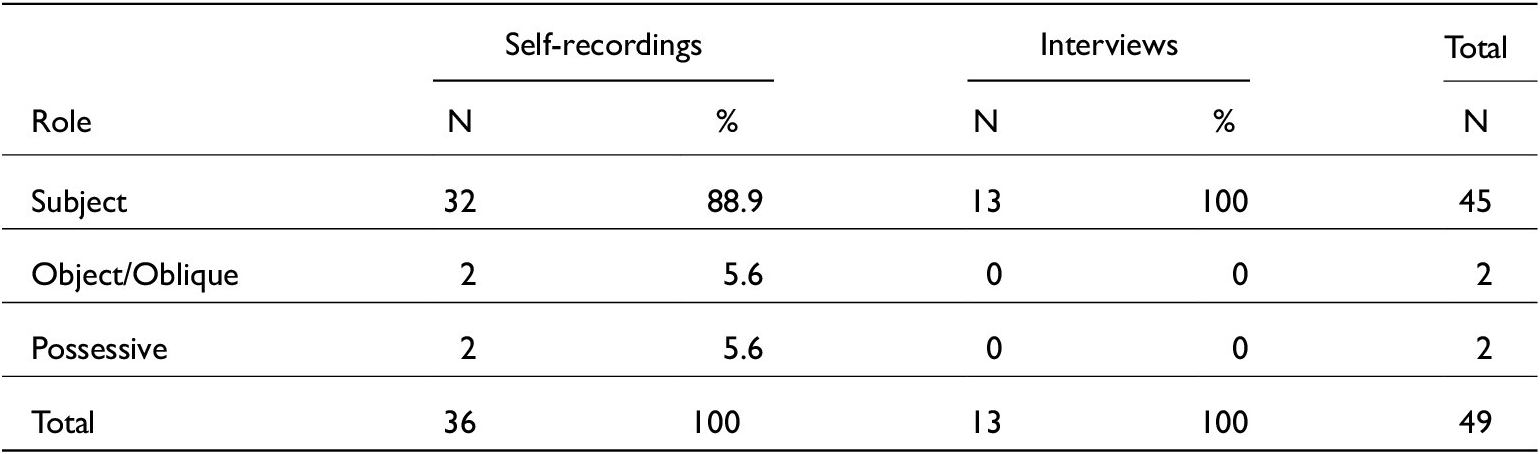
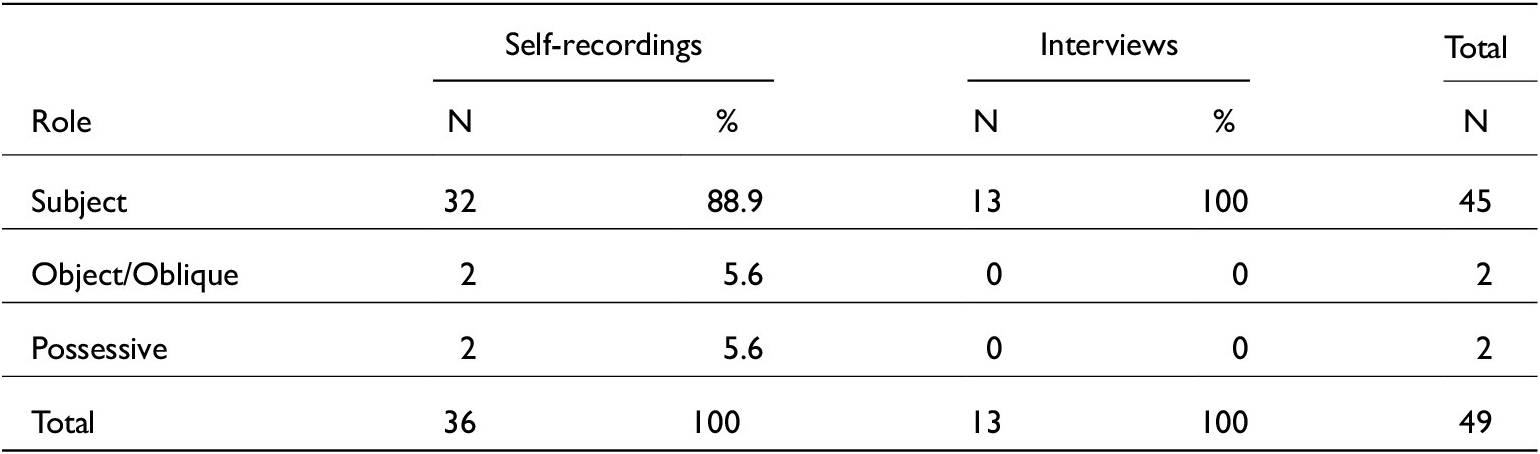
Further evidence for its stability is found in the syntactic roles of man (table 2). As Cheshire (Reference Cheshire2013) and Denis (Reference Denis2016) observe, man overwhelmingly functions in subject position. Similarly, and as previously reported, whilst comparatively rare, man can function as an object/oblique (11)Footnote 1 or to mark possessive case (12). In subject position, man typically triggers singular verbal agreement (13), as predicted by prior analyses (Cheshire Reference Cheshire2013; Denis Reference Denis2016; Hall Reference Hall2020).


Syntactic roles of pronominal man across the two datasets
Stark differences, however, are observed in the semantic roles of pronominal man. Whilst Hall (Reference Hall2020) observes that man can (theoretically) occur with all numbers and all persons, in the work of Cheshire (Reference Cheshire2013) and Denis (Reference Denis2016), it is first-person singular man that dominates, with both researchers observing the following hierarchy:
 $$ 1\;\mathrm{sing}.\left(70.2\%\right)<1\;\mathrm{plu}.\left(13.8\%\right)<\mathrm{indef}.\left(8.5\%\right)<2\;\mathrm{sing}.\left(4.3\%\right)<3\;\mathrm{sing}.\left(3.2\%\right) $$
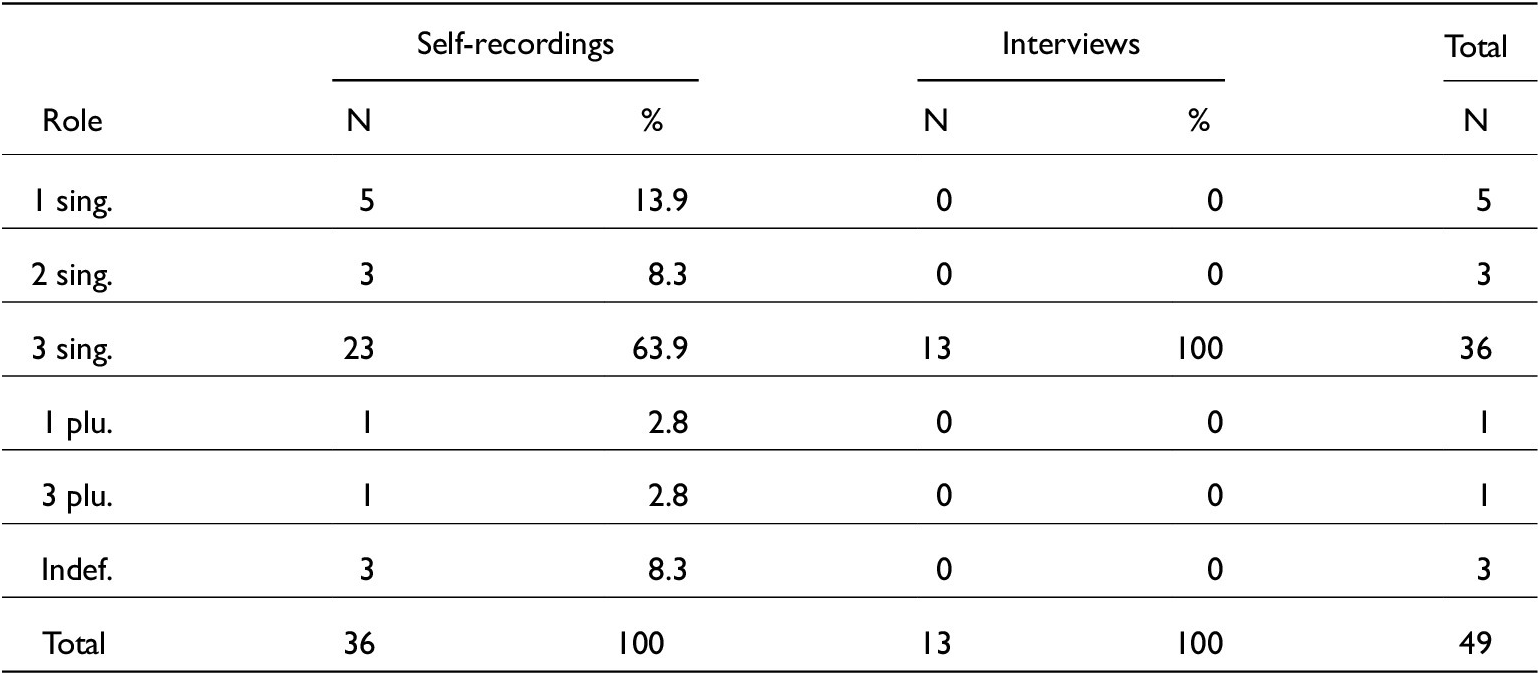
As table 3 shows, in this dataset, across both interviews and self-recordings, man is overwhelmingly used as a third-person singular pronoun. The cline reported is as follows (percentages reported for the self-recorded data):
 $$ 3\;\mathrm{sing}.\left(63.9\%\right)<1\;\mathrm{sing}.\left(13.9\%\right)<\mathrm{indef}.\sim 2\;\mathrm{sing}.\left(8.3\%\right)<3\;\mathrm{plu}.\sim 1\;\mathrm{plu}.\left(2.8\%\right) $$
Person properties of pronominal man across the two datasets
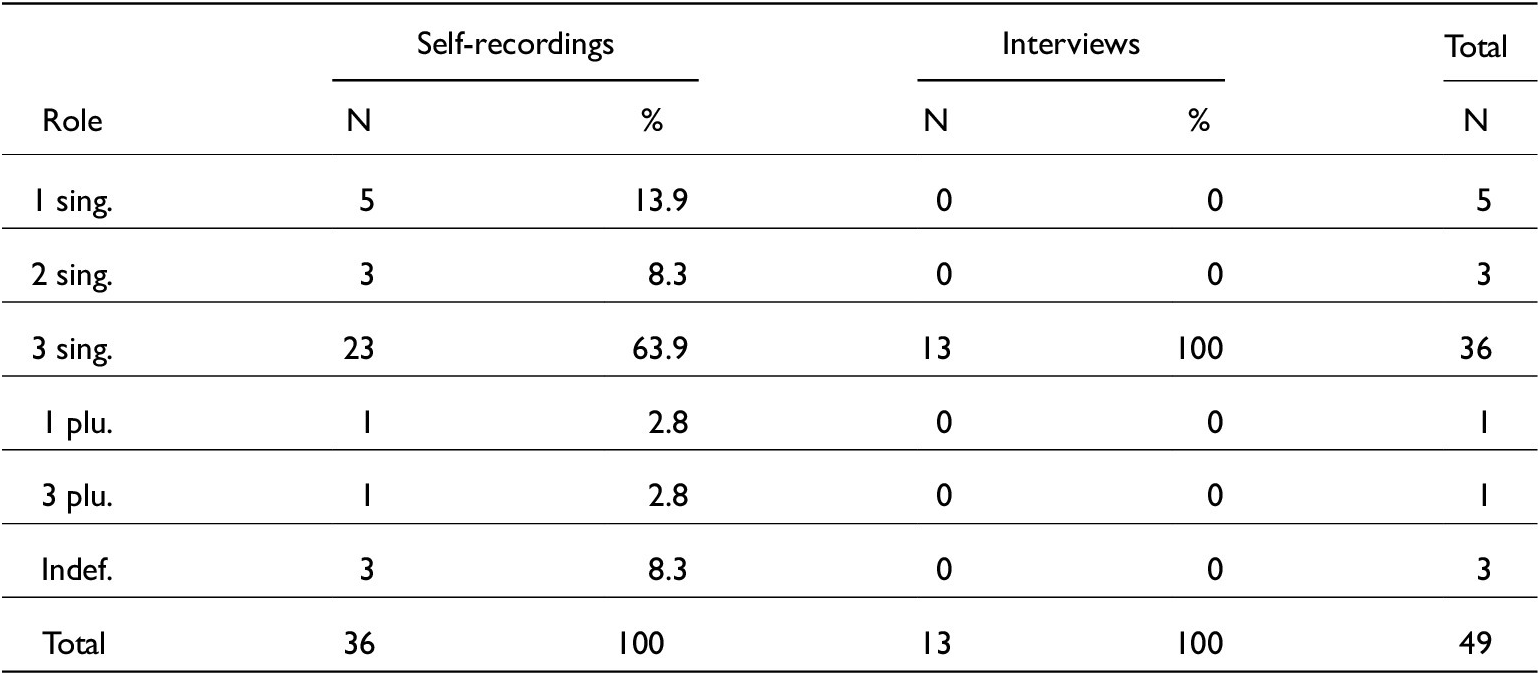
In other words, the context that is reported as least favoured in previous accounts (third-person singular) now appears to be the most common environment in which man is used. Whilst these interpretations are necessarily limited by small token numbers, the fact that the interview data contains only third-person singular man seems to suggest that this pattern may be indicative of the broader distribution of this pronoun. When compared with Cheshire’s (Reference Cheshire2013) findings, this observation appears even more remarkable. Across the four corpora that comprise her analysis, only one (the film Anuvahood) contains any third-person singular tokens of man, with just 3/59 tokens this type. Thus, at least based on the patterns presented in table 3, it appears that there has been a shift in the person reference of man, from first-person to third-person.
One possible interpretation of this development is that man is now simply competing with the established third-person singular masculine pronoun he, and that the speaker could, theoretically, use either he or man in any given context. Table 4 reports total counts for third-person pronouns in Ben’s self-recordings and interviews. Since the form man is only used to refer to male-identifying addressees in this dataset and where the form could compete with standard he, totals only from these contexts are reported.
Distribution of third-person singular masculine pronouns for Ben

As table 4 shows, it is evident that man is still relatively uncommon in Ben’s (and indeed other speakers’) speech and although we would expect that he would naturally be more frequent as the standard pronoun in this context, it is notable that Ben does use man somewhat in interviews and self-recordings. What then predicts the relatively infrequent use of man? Given that social and linguistic factors do not appear to be able to explain why a speaker would use man over he, I turn instead to an examination of the interactional context of the feature. In doing so, I draw inspiration from contemporary research which suggests that variation may be additionally motivated by the ‘immediate interactional and relational goals’ of the speaker, in addition to social and linguistic constraints (Snell Reference Snell2010: 651; see Moore & Snell Reference Moore, Snell, Gregersen, Parrott and Quist2011; Drummond Reference Drummond2018).
4.3. Interactional constraints on pronominal man
In Cheshire’s analysis, she describes the development of the pronominal use of man as ‘a consequence of the rhetorical strategies’ (2013: 609) by which speakers use it. Specifically, she suggests that man has developed to fulfil two interrelated functions: (i) to index the speakers’ social affiliation and (ii) to achieve specific interactional ends. As a membership category device, man functions to situate the speaker as part of a ‘contextually defined group’ (2013: 622). Based on the mutual values of the group indexed by the use of man, the speaker is therefore able to achieve certain rhetorical effects. The first interactional resource is related to Brown & Levinson’s (Reference Brown and Levinson1987) politeness theory. Specifically, Cheshire argues that a speaker might use man to mitigate the potential for an utterance to be interpreted as face-threatening by distancing the user from the pragmatic force of that statement. A second function is linked to the dramatization of storytelling, with man used to relay ‘events that for them are emotionally heightened, to make their speech vivid and to involve their addressees’ (2013: 623).
Whilst Cheshire’s (Reference Cheshire2013) discussion of the ‘rhetorical strategies’ of man appear convincing, there remain several issues with these interpretations when applied to the current dataset. First, Cheshire’s interpretations are based on patterns identified in data obtained exclusively from interviews, where speakers gave lengthy and detailed narratives – speech events which typically do not occur in self-recordings. Second, and as determined earlier, the present analysis identifies a shift in the person reference of man (1PS → 3PS). It is therefore possible that the rhetorical strategies initially described for man have, too, shifted. In other words, the change in the relative frequencies of the semantic values of the innovative pronoun may be a consequence of the changing rhetorical functions of man. This possibility necessitates further analyses of this feature to understand how this development may have affected the interactional utility of man and it is this discussion which is introduced next.
First, there does appear to be evidence in the distributional analysis to support Cheshire’s (Reference Cheshire2013) claim that man is used as a way for speakers to mark their allegiance with a contextually defined group. As discussed earlier, the pronoun is strongly associated with a CofP – the ‘gully’ – and so it follows that speakers at Lakeside use man to index their alignment with this CofP. Cheshire (Reference Cheshire2013) goes on to argue that, in using man, speakers appeal to the mutual interests of the recipient, thereby eliciting empathy on the basis of a shared understanding of the speaker–hearer. However, initial introspection of the discourse contexts in which man is used in the present article do not appear to support Cheshire’s (Reference Cheshire2013) interactional account. Instead, in the following, it will be argued that, as a third-person singular pronoun, man does not appeal to the mutual interests of the recipient, but rather it does the opposite: it excludes the interlocutor and strengthens the mutual ground occupied by those who belong to the ingroup.
Before presenting this analysis, and in order to enable a comparison with the existing literature, I will first focus on first-person singular man. To recap, previous accounts have suggested that first-person singular man is used to mitigate the possibility of a face-threatening utterance and/or heighten the drama of the narrative. However, in the current dataset, there is little evidence to support the conclusion that man is used as part of a complex politeness ritual nor as a resource intended to dramatize the speaker’s version of events. Considering just those tokens which occur with first-person singular reference, of these four contexts, only one (14) appears to be an explicitly face-threatening situation.

In (14), with the rest of the group dawdling, Jack appeals to his peers to go with him to the shop to buy snacks because he’s hungry. If we are to follow Cheshire’s arguments, then this instance of man could be interpreted as some sort of appeal to the ingroup to empathise with his request to go to the shops, thus avoiding the negative politeness associated with on-record requests. This is indeed a possible interpretation of this excerpt, but it is unconvincing for several reasons. First, throughout Jack’s recordings, there are various other on-record requests made to other individuals (including to those who are his friends) and none of them include man. Consider (15) and (16).


Excerpt (15) follows a discussion between Jack and his friends in which he requests an item from Henry (note, the referent of it is unclear). Realising the object had been concealed by Henry, Jack excitedly proclaims You got it! before commanding that he give it to him, referring to himself using the first-person pronoun, me. Similarly, in (17), seeing that his friend has some money (£1) to buy food, Jack asks for the change, using the first-person pronoun, I. In neither case do we see the use of man. Both (16) and (17) are situations where there is a potentially face-threatening speech act: a command and a request. However, in both object and subject contexts, it is the standard first-person pronouns, I and me, that Jack uses to refer to himself. It is exactly these contexts – face-threatening situations between friends – that Cheshire’s analysis predicts man to be used in.
Further evidence to suggest that politeness appears to be irrelevant to the use of man comes from other instances in which first-person singular man is used, yet there appears little contextual evidence to suggest that the situation is read as face-threatening, such as (17):

In (17), Chris has just been given the recorder; he’s in the computer room and announces that he’s participating in the project: that voice recording thing. In this example, and also in the two cases in which first-person singular man is used, the speaker does not appear to be engaged in any interaction that could be considered face-threatening.
We could instead interpret these instances of man as evidence of what Cheshire (Reference Cheshire2013: 623) refers to as a dramatisation resource. However, the wider contexts in which these interactions take place do not seem to support such a reading. In the dataset, man generally occurs in relatively mundane contexts rather than in narratives of an emotionally fraught event. For instance, in (17), Chris is simply stating his involvement in the research project. It is therefore unlikely that Chris’ use of man is intended to dramatise his version of events (cf. Cheshire Reference Cheshire2013: 623).
I argue instead that a more compelling interpretation of how this feature is used in the present dataset can be found in the sociolinguistic literature on ‘stance’ (Kiesling Reference Kiesling and Jaffe2009; Jaffe Reference Jaffe and Jaffe2009). In the following, it is argued that first-person singular man is most often used to construct a stance of solidarity with other members of the ingroup (i.e. the CofP) and, by using this feature, the speaker indexes himself as belonging to that group, often to achieve some desired outcome. In (14), this is appealing to the other members in the group – all part of the same CofP – to go to the shops, and in (17), Chris is directly speaking to a close friend who, like himself, is a peripheral member of the CofP (Bartek), who he wants to recognise and appreciate his involvement in the research project.
To be clear, the distributional and interactional differences between Cheshire (Reference Cheshire2013) and the present study are interpreted here as developments in the use and function of man – a relatively recent pronoun. It is possible that when the pronoun first emerged, it did so with a set of rhetorical functions, such as those identified in Cheshire (Reference Cheshire2013) and, as man has stabilised and increased in use, some of its interactional functions have been maintained (e.g. man as indexing ingroup membership), while others have been dropped (e.g. man as a politeness strategy).Footnote 2 Of course, and as noted earlier, differences in data collection may explain some differences in the use of man, since Cheshire’s (Reference Cheshire2013) tokens of man are largely derived from narratives in sociolinguistic interviews whereas the present analysis focuses on data from casual conversations in informal interviews and self-recordings – contexts which did not encourage dramatic and lengthy narratives. However, given the somewhat different but consistent interactional function of man in the Lakeside dataset, it seems more likely that the differences are explained by the development and stabilisation of this pronoun as it has become established in use.
Evidence for the interactional development of man is also found in the shift in person-reference. Recall that, in the present article, man is overwhelmingly used as a third-person – not first-person – singular pronoun. However, rather than appealing to the mutual understanding of the hearer as Cheshire’s (Reference Cheshire2013) analysis would predict, in the Lakeside dataset man appears to do the opposite when used in third-person singular contexts: it excludes that person from the shared community.
To demonstrate these arguments, I now present an interactional analysis of third-person singular man in the Lakeside dataset. Through this analysis, I conclude that speakers most often use man to construct a stance of solidarity, which in turn distinguishes ingroup members from those who do not belong to this social group, further validating and establishing an ingroup CofP identity.

A case in point is (18), which is taken from an interview with Harinder, Ben and Jack when they are asked about gang crime in the area. In line 2, Ben states that they [gangs] are on the one two five. In line 4, I try to clarify this reference, misinterpreting the one two five as a bus route, when in fact it relates to a 125cc engine – a synecdoche for moped (line 10). In lines 5–7, all three erupt in laughter, with my misinterpretation of the one two five as a bus signalling my ‘outsider’ status. Laughing and emphasising my error, in line 5 Jack refers to me as this guy. By using the demonstrative pronoun this, Jack implies a physical distance between himself and me, the interviewer, thus explicitly excluding me from the ingroup – those who know what the ‘one two five’ is. In line 6, my ‘outsider’ status is confirmed by Ben who uses the third-person singular man (man said) to quote my speech. Here, it is unlikely that the use of man is intended to index me as part of the ingroup, as Cheshire’s account (2013: 621–2) would predict, since the error clearly demarcates me as an outsider. Rather, the use of man in this context appears to do similar work to when Jack refers to me as this guy (line 5). More specifically, I argue that, by using man as a third-person pronoun, Ben temporarily excludes me from the interaction, reporting my speech as if I were not there at all. This effect is also marked by the lower intensity of his speech, suggesting that it is his friends – not me – who are the intended addressee. It is additionally contrasted with the marked change in intensity, interrogative rising intonation and the use of second-person singular pronoun you in lines 6–7, where the question about whether I was being disingenuous is quite clearly directed at me, the interviewer. Thus, the use of man in line 6 allows Ben to distance himself and, by extension, the others from the misunderstanding and, in doing so, its use allows Ben to construct a stance of solidarity with his friends based on the mutual understanding of the referent of one two five, whilst explicitly othering me as someone who lacks this ingroup knowledge.
The possibility that choice in pronouns can exclude or include speakers as belonging to the ingroup is well documented (e.g. van Dijk Reference van Dijk2006), as is pronoun choice with reference to solidarity (Brown & Gilman Reference Brown, Gilman and Sebeok1960). Following this work, and to elaborate the function of man in the present dataset, the analysis invokes Goffman’s (Reference Goffman1981: 137) ‘participation framework’ to explore how the hearer, who is just as active as a coparticipant as the speaker, responds to and informs the interaction. More specifically, I understand Jack’s use of man in (18) as an example of what Goffman (Reference Goffman1981: 134) refers to as ‘byplay’ or the ‘subordinated communication of a subset of ratified participants’. In other words, man appears to temporarily exclude the addressee from the discourse, strengthening the ingroup bond between those who ‘know’.
A similar turn of events is seen in (19) when I – the researcher – walk into a room and inadvertently step on Daniel’s Huaraches (a type of trainers/shoes made by Nike). In line 1, he uses the possessive first-person singular man to refer to his shoes, tagging this with the address term cuz (an abbreviation of ‘cousin’ that, like the address term man, has become semantically bleached). The use of first-person possessive man here is the only token of this type in the dataset, but it does seem to be used at the potentially face-threatening moment where Daniel claims that I’d stepped on his shoes. Nevertheless, as I go on to explain, it is not clear that his primary goal in using man in this context is to mitigate a face-threatening act (cf. Cheshire Reference Cheshire2013).

In line 2, I make an ironic jibe about the price of the shoes – which both of us know can be interpreted as a joke based on the knowledge that Huaraches are an expensive pair of trainers. In the following lines (3–6) Daniel launches into a light-hearted defence of his shoes, reporting my speech using the third-person singular man. Although I am his primary interlocutor, he uses the third-person pronoun to address the other individuals in the room and to report my speech, emphasising how incredulous it was that I asked if they were twenty quid. This is marked by a perceptible increase in intensity in line 3 and laughter from the other young people in the room. Daniel then uses the second-person singular pronoun you, addressing me by stating that I’m chatting bars (talking rubbish). He then repeats a quote of my speech, again using man to distance himself from my comments. Daniel goes on to justify his defence that they’re limited edition (line 6) and therefore are more expensive than typical Huaraches (which are not twenty pounds, in any case!). As in (18), man appears to function here as a means to temporarily exclude the interlocutor from the interaction and draw attention to the incredulous comment that the trainers were only twenty pounds, as opposed to a straightforward politeness device.
Until this point, the analysis has focused on two examples from interactions with the researcher. As an individual who did not grow up in the community and was considerably different in terms of my positionality to most of the young people and youth workers, I was considered a true ‘outsider’ at Lakeside. It is therefore (perhaps) unsurprising that the byplay function occurs most frequently in these types of interactions since I was already deemed ‘other’. However, it is notable that this feature does also occur in peer-to-peer interaction, where it is used in similar ways, most often to emphasise behaviour as incompatible with the values of the ingroup. For instance, in (20) Adeep has just observed Elias in the gym playing football in trainers reported to be Giuseppe Zanottis – a high-end fashion label:

In the excerpt, Adeep can’t believe that he has just witnessed Elias playing football in trainers that are worth hundreds of pounds (line 1). His shock is signalled by a marked emphatic high-rising intonation and by him kissing his teeth in disapproval (line 2). After leaving the gym and returning to the sofas in the lounge area, he turns to another young person in the club, announcing what he has just seen, using man as a third-person singular pronoun to refer to Elias (line 4). At this point, it appears that Adeep is attempting to appeal to his friend to appreciate his perspective and recognise the incredulity of Elias playing football in such an expensive pair of trainers. By using third-person singular man, he distances himself from this act, characterising this incident as unacceptable ingroup behaviour and, as a consequence, others Elias.
Beyond Lakeside, the byplay function of third-person singular man was also observed in the social media posts that the young people engaged with at the club. Alongside spoken language recordings, 850 social media posts from Instagram and Snapchat accounts that the young people were frequently seen to interact with were also extracted. Although man was infrequent in these types of posts, when it was used, it appeared to function in a similar way to that in the speech of those at Lakeside. For instance, figure 2 is taken from an Instagram account (The Street Blogs) that the young people were seen to interact with. The figure is a screenshot taken from a video that has been uploaded of an altercation in which an individual is assaulted. The accompanying text Man got slapped refers to the third-person singular subject use of man that I find to be the most frequent in the data from spoken interactions. In the accompanying caption, the pronoun is again repeated alongside the use of the nominal man. Here, as in the interactional data, it appears that man draws attention to and ridicules the actions of a third person, thereby excluding that individual from the ingroup. Similar examples are found in other posts where pronominal man is overwhelmingly used to refer to third-person singular subjects, hence captions such as Man said ‘grease up the ting’, Man’s running for his life and Man got bumped. Again, all these examples appear to emphasise or accentuate the absurd, comical or unacceptable actions of the addressee/third party. This suggests that the byplay function of man was not specific to Lakeside but rather is a more general interactional quality of this feature across communities of users.
The Street Blogs Instagram post ‘Man got slapped’

4.4. The development of pronominal man
Having established that distribution and function of man has developed since earlier work, the next section of the analysis asks whether the pronoun has developed even further since the Lakeside data were obtained. To do this, 6,751 comments from a random collection of 50 English-language videos on the social media platform TikTok were extracted. All videos were geographically restricted to the UK. Comments were downloaded via the plugin Zeeschuimer (Peeters Reference Peeters2025) – a tool which records social media data – before the dataset was cleaned and coded. The decision to extract comments from TikTok was based on anecdotal observations that the pronoun man was relatively common on the app. Similarly, in Ilbury’s (Reference Ilbury2023) analysis of TikTok parodies of MLE, the pronoun is noted to be highly frequent, such that it appears to have become a stereotype of the variety.
An initial round of coding revealed that all three functions (noun, address term and pronoun) of man were used in the comments. However, the pronominal function was comparatively rare. Only 32 tokens of pronominal man were identified but, importantly, all were third-person singular, as in the following examples (21)–(22).


In both (21) and (22), the interactional function of third-person singular man that has been proposed above appears to be persistent. That is, the function of drawing attention to or ridiculing the actions or words of the addressee. In (21), the comment mocks an individual who is perceived to be an inauthentic speaker of MLE, referring to the British crime drama Top Boy, which is set in the fictional Summerhouse estate in Hackney, and depicts characters who speak MLE. In (22), the comment refers to an individual’s overly dramatic reaction to thinking he was about to be ‘shanked’ (a term often used in MLE for ‘stabbed’). The incredulity of the situation is emphasised through the addition of the ‘crying tears of joy’ emoji ( ). It seems unlikely that all tokens of man in the TikTok dataset are used by MLE speakers, especially given MLE lexical and grammatical features are now used by young people across the UK more generally (Ilbury et al. Reference Ilbury, Grieve and Hall2024). Nevertheless, the interactional function of third-person singular man as signalling a type of ‘byplay’ (Goffman Reference Goffman1981) is maintained.
Due to the lower rate of man in the comments, the data were examined for any potentially competing forms. Interestingly, this process revealed that there is another noun which functions similarly, both as a pronoun and as signalling byplay: bro. In the 6,751 comments, there are 217 tokens of pronominal bro, used in contexts such as the following:


Comments (23)–(26) exemplify the use of bro as a pronoun. It is, like man, used exclusively as a third-person pronoun and, in all of the examples, bro functions in a similar way to man. Namely, it appears to draw attention to or ridicule the thoughts, actions or words of a third party. For instance, in (25), the user responds to a video in which a young man says tiki taka. The use of all-caps, the sentence-initial bye and am howlin (i.e. ‘I am howling with laughter’), all suggest that the commenter finds the video to be extremely funny and/or incongruent. The byplay function of man is therefore seemingly also a function of bro.
However, interestingly, and different to the Lakeside dataset, for both pronouns the semantic qualities of [+animate]/[+male] appear to have been dropped. In the comments, man and bro can refer to non-human entities (e.g. animals), inanimate objects (e.g. a snowman) and those with no clear gender identity (e.g. a dog). This appears to signal an additional development of man/bro.
This is not the first analysis to describe bro as a pronoun. The use of bro as a pronoun is attested in African American (Vernacular) English prior to the emergence of social media (Abad-Santos Reference Abad-Santos2013). One possibility, then, is that the use of this pronoun in internet culture is part of a broader process of the digital appropriation and diffusion of AA(V)E (see Ilbury & Walcott Reference Ilbury and Walcott2026). However, these claims require further scrutiny and additional work is needed to establish how man and bro develop as they become circulated more widely in digital and non-digital contexts.
5. Conclusion
Sociolinguistic research has long concluded that patterns of language variation and change are constrained by social, stylistic and cognitive factors (Labov Reference Labov1994, Reference Labov2001, Reference Labov2010), while more contemporary research has proposed that interactional phenomena may additionally constrain sociolinguistic variation (Snell Reference Snell2010; Moore & Snell Reference Moore, Snell, Gregersen, Parrott and Quist2011; Levon 2015; Drummond Reference Drummond2018; Eiswirth Reference Eiswirth2020; Ilbury Reference Ilbury2021; Moore Reference Moore2023). This article has extended this line of inquiry by examining the social meaning and interactional function of a pronoun first documented in MLE – man – by arguing that its interactional utility not only constrains its use, but may also promote its spread.
Different to previous analyses (Cheshire Reference Cheshire2013; Denis Reference Denis2016; Hall Reference Hall2020), the present article claims that man is used primarily as a third-person singular pronoun in contexts where the speaker intends to draw attention to or ridicule the comments or actions of an addressee – what Goffman (Reference Goffman1981) calls ‘byplay’. A more recent dataset of TikTok comments is consulted to demonstrate not only that this pronoun appears to have diffused beyond MLE – in line with the spread of MLE features more generally (see Ilbury et al. Reference Ilbury, Grieve and Hall2024) – but its interactional function has been retained. The TikTok dataset additionally reveals that the pronoun bro (which originated in AAVE) also fulfils a similar interactional function and appears to compete with man, such that it is now the more frequent variant in digital communication.
Concluding, it is proposed that man and bro have diffused because they fulfil a useful interactional function that other variants do not. Whilst both pronouns are (theoretically) in variation with other third-person pronouns such as he, man and bro have a distinct pragmatic profile that the standard pronoun he cannot achieve alone – namely that of ridiculing or drawing emphasis to the words or actions of an addressee. These arguments are not only relevant to research on pronouns, but they also direct our attention to the role of interaction phenomena in language variation and change. Indeed, while variationist work has increasingly acknowledged the role of interaction in constraining the variable envelope, interactional phenomena are rarely (if ever) considered relevant in analyses of language change. It is therefore recommended that future research should seriously consider the potential for the pragmatic function of a feature to promote its spread – an area which is yet to be seriously addressed in work that interrogates the mechanisms of diffusion and language change (cf. Trudgill Reference Trudgill1974; Eisenstein et al. Reference Eisenstein, O’Connor, Smith and Xing2014; Ilbury et al. Reference Ilbury, Grieve and Hall2024).
Acknowledgements
I am grateful to the editors and the reviewers who provided detailed and incisive feedback on earlier versions of this article. The article has been improved immeasurably through these revisions. Any remaining shortcomings are my own.




 Open access

