


Introduction
The Veracruz Reef System National Park (PNSAV), southwestern Gulf of Mexico (GoM), is an important marine area for its numerous coral structures (Ortiz-Lozano et al., Reference Ortiz-Lozano, Colmenares-Campos, Gutiérrez-Velázquez, Granados-Barba, Ortiz-Lozano, González-Gándara and Salas-Monreal2019) with a great biological richness (Granados-Barba et al., Reference Granados-Barba, Abarca-Arenas and Vargas-Hernández2007, Reference Granados-Barba, Ortiz-Lozano, Salas-Monreal and González-Gándara2015, Reference Granados-Barba, Ortiz-Lozano, González-Gándara and Salas-Monreal2019). New submerged reef structures have recently been discovered both inside and outside this PNSAV polygon, including the reef of Los Picos. The latter is composed of a consolidated substrate similar to dunes, which provides a different habitat for sponges (Ortiz-Lozano et al., Reference Ortiz-Lozano, Colmenares-Campos and Gutiérrez-Velázquez2018, Reference Ortiz-Lozano, Colmenares-Campos, Gutiérrez-Velázquez, Granados-Barba, Ortiz-Lozano, González-Gándara and Salas-Monreal2019). Since there are still several unexplored ecosystems around these reefs, research and interest in sponge biodiversity and ecology have increased in recent years (De la Cruz-francisco and Bandala-Pérez, Reference De la Cruz-francisco and Bandala-Pérez2016; Carmona-Islas et al., Reference Carmona-Islas, Morales-García, Hernández-Mendiola, Gama-Villasan, Colmenares-Campos and Cruz-Gutiérrez2019; De la Cruz-francisco et al., Reference De la Cruz-francisco, González-González and Morales-Quijano2016, Reference De la Cruz-francisco, Argüelles-Jiménez, Rodríguez Muñoz, León Mendez and Duran-López2019), with growing evidence that sponges are becoming dominant members of reef communities (Pawlik et al., Reference Pawlik, Loh and McMurray2018). They often overgrow or spread over, and their dominance could lead to sponge-dominated reefs by the Anthropocene (Farnham and Bell Reference Farnham and Bell2018; González-Murcia et al., Reference González-Murcia, Ekins, Bridge, Battershill and Jones2023).
Despite the difficulty in identifying sponges, and in turn the great morphological plasticity they exhibit (Wulff, Reference Wulff2001; Bell et al., Reference Bell, Burton, Bullimore, Newman and Lock2006), taxonomic studies on coral reef sponges have been added throughout the GoM: Rützler et al. (Reference Rützler, van Soest, Piantoni, Felder and Camp2009), on a checklist; Gómez (Reference Gómez2014), on the genus Clathria; De la Cruz-Francisco and González-González (Reference De la Cruz-francisco and González-González2016), on three new records: Vansoestia caribensis, Haliclona (R.) chlorilla and Mycale (N.) diversisigmata; Díaz and Pomponi (Reference Díaz and Pomponi2018), on two novel Poecilosclerida sponges at the eastern side; De la Cruz-Francisco et al. (Reference De la Cruz-francisco, Argüelles-Jiménez, Rodríguez Muñoz, León Mendez and Duran-López2019), on the description and new record of Amorphinopsis atlantica; Ugalde et al. (Reference Ugalde, Gómez and Simões2015), on the description of 19 species and seven new records; Ugalde et al. (Reference Ugalde, Fernández, Gómez, Lôbo-Hajdu and Simões2021), on 34 new records fully illustrated and described; Cruz-Barraza et al. (Reference Cruz-Barraza, Vega, Ávila and Vázquez-Maldonado2017, Reference Cruz-Barraza, Vega, Rützler and Sala-Castañeda2020), on Tethytimea carmelita and Timea alcoladoi new species, and its molecular analysis; Gómez et al. (Reference Gómez, Calderón-Gutiérrez, González-Gándara and Rojas-Terán2021), a new species of Microscleroderma, M. mexica is described and compared with Amphibleptula aaktun; Gómez and Heras-Escutia (Reference Gómez, Heras-Escutia, Hernández-Aguilera and Arenas-Fuentes2022), exhibit an inventory and new records for the Verde Reef; Díaz et al. (Reference Díaz, Nuttal, Pomponi, Rützler, Klontz, Adams, Hickerson and Schmahl2023), performed an identification guide to mesophotic reef sponges in the northwest. Not to mention, grey literature such as doctoral theses, reports, or magazines is not included for the present purpose. It is worth mentioning the challenge represented by spicular variability, where the absence, presence, or scarcity are unstable characters in many sponge species (Gómez, Reference Gómez2014). Usually, sponges tend to incorporate suspended fine sediments from their surrounding environment, including foreign spicules from neighbouring sponges as part of their skeleton. These are basic components for the classification of the phylum (Hajdu et al., Reference Hajdu, Peixinho and Fernandez2011; Rützler et al., Reference Rützler, Piantoni, van Soest and Díaz2014), which requires laboratory analysis of the spicules and/or fibres that constitute its skeletal structure (Zea, Reference Zea1987; Gómez, Reference Gómez2002). This has historically hindered the publication of many studies and the full identification of a large number of species. The present study aims to describe six new species from the region, particularly in a sedimentary formation called the Los Picos reef, an unusual environment. In addition, it seeks to establish the most comprehensive sponge inventory in the reef, with new records included for the reefs of Veracruz and the GoM, widening their geographic distribution.
Materials and methods
Study area: Los picos reef
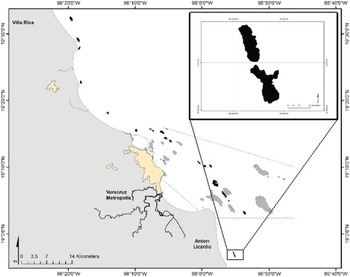
Los Picos reef is part of a complex reef area of about 10 submerged reefs that have been located and recently mapped along the Reef Corridor of the Southwest Gulf of Mexico (RCSGM) by Ortiz-Lozano et al. (Reference Ortiz-Lozano, Colmenares-Campos, Gutiérrez-Velázquez, Granados-Barba, Ortiz-Lozano, González-Gándara and Salas-Monreal2019). It is located south of the PNSAV, outside the protection polygon, in front of the Alvarado Lagoon, Veracruz, Mexico (Figure 1). Los Picos are two contiguous reef structures called Los Picos Norte (760 m long × 220 m wide) and Los Picos Sur (800 m × 370 m), with unusual characteristics for the GoM since they are not of coralline origin. The latter is the object of the present study. The two structures are located between 10 and 16 m deep, with a maximum height of 6 m, highlighted for their non-coralline origin, and are made up of structures like semi-consolidated dunes due to sediment compaction. This reef is colonized mainly by sponges, hydrozoans, and scarce coral patches. It was only known and visited by fishermen in the area for being a fishing spot (fish and other marine species).
Location of “Los Picos” reef, Veracruz; north and south portion (Modified from Ortiz-Lozano et al., Reference Ortiz-Lozano, Colmenares-Campos and Gutiérrez-Velázquez2018).

Sampling and processing methods
The collection of sponge specimens was carried out by Scuba diving, making random visual routes along the Los Picos Sur reef at 10‒16 m depth. The samples were handled individually for fixation and preservation, taking notes of the pertinent morphological data for each one. The identification process of the specimens was performed through temporary and permanent preparations of tangential and longitudinal tissue sections, carefully cut to allow basic measurements of the structures (Gómez, Reference Gómez2002; Hajdu et al., Reference Hajdu, Peixinho and Fernandez2011). According to the skeleton composition (fibres or spicules), different methodologies were employed to allow the clear observation of structures (op. cit.). Additionally, samples were prepared for photomicrographs using the scanning electron microscope (SEM) and light microscopes (LM) (Gómez, Reference Gómez2002).
The taxonomic identification of the taxa follows the compiled and revised classification by Morrow and Cárdenas (Reference Morrow and Cárdenas2015) and Hooper and van Soest (Reference Hooper and van Soest2002), adopted by the World Porifera Database (WPD) (De Voogd et al., Reference De Voogd, Alvarez, Boury-Esnault, Cárdenas, Díaz, Dohrmann, Downey, Goodwin, Hajdu, Hooper, Kelly, Klautau, Lim, Manconi, Morrow, Pinheiro, Pisera, Ríos, Rützler, Schönberg, Turner, Vacelet, van Soest and Xavier2025).
Type material and all the specimens were deposited in the Porifera collection Colección Nacional del Phylum Porifera ‘Gerardo Green’ (CNPGG), at the Instituto de Ciencias del Mar y Limnología, Universidad Nacional Autónoma de México, Mexico City. The new species were registered in Zoobank, and the key number is included in the description of each species.
Results
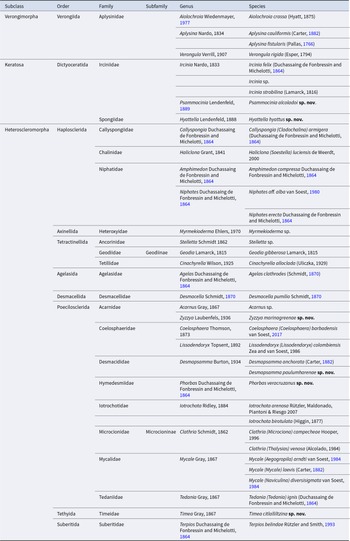
The sponge population in the Los Picos Sur reef is currently 37 species out of a total of 89 individuals of the Class Demospongiae, classified into 10 orders, 22 families, and 28 genera (Table 1). Of this total, 19 species (51.35%) had already been previously reported for the region, 15 species are new records for the Mexican coast, and 13 are for the GoM, thus expanding their geographic distribution. In addition, six species (16.21%) are new to science and are described here. These are Psammocinia alcoladoi sp. nov., Hyatella hyattus sp. nov., Zyzzya marinagreenae sp. nov., Desmapsamma paulumharenae sp. nov., Phorbas veracruzanus sp. nov., and Timea citlallitzina sp. nov. Three species are also described and illustrated: Desmacella pumilio new record for Mexico; Coelosphaera (Coelosphaera) barbadensis, and Terpios belindae, new records for the GoM, with extra characters or additional habitat records provided.
Comprehensive sponge inventory from the Los Picos reef, southwest of the Gulf of Mexico, reaching 37 species of the Class Demospongiae. Following the systematic order of van Soest (Reference van Soest2017)

The inventory of the Los Picos reef represents the total number of species discovered thus far, encompassing the most comprehensive list of sponge species (see Table 1). It is worth noting that around 10 species remain unidentified due to their diminutive size and the inadequate tissue samples available for analysis.
Description of the new species and new records
Class Demospongiae Sollas, 1885
Subclass Keratosa Grant, 1861
Order Dictyoceratida Minchin, 1900
Family Irciniidae Gray, 1867
Genus Psammocinia Lendenfeld, Reference von Lendenfeld1889
Psammocinia alcoladoi sp. nov.
ZooBank: LSID urn:lsid:zoobank.org:act:510F7736-4702-46F5-B58 F-47F2D69722C0
Material examined. HOLOTYPE: CNPGG‒2563 Los Picos Sur reef, Las Barrancas, Alvarado, Veracruz, 18.946149 N, 95.919452 W, 23/August/2017; 10‒13 m depth, col. A. Granados and J.A. Martínez-Vargas, on pebbles substrate.
Etymology. In honour of Dr Pedro M. Alcolado, friend and colleague, for his important contributions to our knowledge of the ecology and taxonomy of the sponge fauna of Cuba.
Type locality. Los Picos Sur reef, Veracruz (GoM).
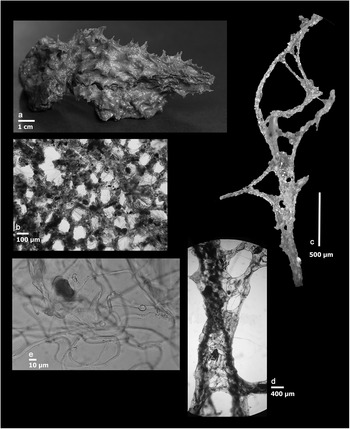
Description. Massive to lamellate sponge, 9 cm long, 4.5 cm high, 3 cm wide (Figure 2a). Colour brownish-grey when alive, light brown when preserved in alcohol. Surface strongly conulose, generally with bifid conules, others obtuse, 3‒6 mm high, and 5‒10 mm apart. Oscules round, mostly <1‒2 up to 5 mm in diameter. Consistency, compressible, and soft, somewhat difficult to tear or cut.
Skeleton. The ectosome consists of a fine armoured mesh of sand with spicule fragments, strengthened below by another mesh of spongin filaments (Figure 2b). The choanosomal skeleton (Figure 2c–d) consists of fully packed primary fibres with large and small debris, together with a few spongin filaments; primary fibres are slightly fasciculated, 310‒742 µm in diameter. The secondary fibres 40-185 µm in diameter, also have some debris or are free of it. Spongin filaments are moderate in choanosome and abundant in ectosome, 2.5‒4.5 µm shaft diameter, many detached from the knob, the knob usually round to oval, 5‒9 µm wide (Figure 2e).
Psammocinia alcoladoi sp. nov., a. Specimen habitus of holotype CNPGG-2563 preserved in alcohol; b. LM image of sand-armoured surface; c. Fascicular fiber showing fully cored primary and secondary fibers; d. LM detail of fascicular fiber; e. LM Image of some spongin filaments and its knobs.

Distribution. So far, it only occurs in the Los Picos Sur reef, Veracruz (GoM). The genus Psammocinia recorded implies an important finding, being the first for the Mexican waters, the GoM, and North America, since all the species belonging to this genus are skewed towards a distribution in the western Pacific, Indonesia, and the Great Barrier Reef (De Voogd et al., Reference De Voogd, Alvarez, Boury-Esnault, Cárdenas, Díaz, Dohrmann, Downey, Goodwin, Hajdu, Hooper, Kelly, Klautau, Lim, Manconi, Morrow, Pinheiro, Pisera, Ríos, Rützler, Schönberg, Turner, Vacelet, van Soest and Xavier2025), except for P. compacta from the Brazilian coast (Muricy et al., Reference Muricy, Esteves, Moraes, Santos, da Silva, Klautau and Lanna2008).
Remarks. Psammocinia alcoladoi sp. nov. corresponds to this genus due to the presence of a sand-armoured surface combined with a mesh of spongin filaments, as well as slightly fasciculated primary fibres, which are distinctive characteristics of the genus (Sim and Lee, Reference Sim and Lee1999; Cook and Bergquist, Reference Cook, Bergquist, Hooper and van Soest2002a; Kelly and Thacker, Reference Kelly and Thacker2021). By contrast, Ircinia Nardo (1833) is distinguished by the absence of an ectosomal sand-armoured layer (Kelly and Thacker, Reference Kelly and Thacker2021; Cook and Bergquist, Reference Cook, Bergquist, Hooper and van Soest2002a), and its primary fibres are meshed together in strong fascicles or massive fascicules which are also cored with foreign debris (fibrofascicules) (Cook and Bergquist, Reference Cook, Bergquist, Hooper and van Soest2002a; Sandes and Pinheiro, Reference Sandes and Pinheiro2014; Kelly and Thacker, Reference Kelly and Thacker2021). Psammocinia also differs from Ircinia by the coring in their secondary fibres, which are simple and uncored in Ircinia (Cook and Bergquist, Reference Cook, Bergquist, Hooper and van Soest2002a). In all, members of the genus Psammocinia typically have simple primary fibres, sometimes with moderate fasciculation. In contrast, Ircinia species typically have massive, sometimes spectacular fascicular fibres (Cook and Bergquist, Reference Cook, Bergquist, Hooper and van Soest2002a).
Psammocinia alcoladoi sp. nov. is distinguished by large conules, a dermal surface in an armoured mesh of sand combined with spongin filaments, lightly fasciculated primary fibres, and non-fasciculated secondary fibres, unlike the only Caribbean congener, P. compacta (Poléjaeff, Reference Poléjaeff1884). Since Poléjaeffs’s description is very brief, the present material was compared with P. compacta re-described by Muricy et al. (Reference Muricy, Esteves, Moraes, Santos, da Silva, Klautau and Lanna2008) from Bahia, Brazil (the type locality). Describing the species as a massive erect sponge, with a low conulose surface and a thick ectosomal cortex (500‒1263 μm), primary fibres, 429‒1086 μm, secondary fibres, 500 μm, and filaments, 10‒16 μm in diameter. Furthermore, it was confirmed by Cook and Bergquist (Reference Cook and Bergquist1998: 403, Figure 3) that is has small conules, a moderate and dispersed number of filaments, and primary and secondary fibres heavily loaded with debris; although the secondary fibres were later reported to be free of inclusions.
Figure 2 and the corresponding footnote.
Family Spongiidae Gray, 1867
Genus Hyattella Lendenfeld, Reference von Lendenfeld1889
Hyattella hyattus sp. nov.
ZooBank: LSID urn:lsid:zoobank.org:act:C02A2098-F7C1-4735-B511-A82E100FEECA
Material examined. HOLOTYPE: CNPGG‒2340 Los Picos Sur reef, Las Barrancas, Alvarado, Veracruz; 18.946149 N, 95.919452 W, 23/August/2017; 10‒13 m depth, col. A. Granados and J.A. Martínez-Vargas, on pebbles substrate and sediment with algae. PARATYPE: CNPGG‒2348, CNPGG‒2560. Same data as the holotype.
Additional non-type material from Hyattella cavernosa sensu Lehnert and van Soest, 1999, was examined for comparison and stored in the Colección Nacional del Phylum Porifera ‘Gerardo Green‘: CNPGG–583, CNPGG–588 Sisal Banks reefs, 21°26’16.59” N, 90°16’39” W, 1/December/2001, 15 m in depth. CNPGG–1290 Alacranes reef, 22º23’42.7” N, 89º42’20” W, 1/August/2009, 5 m in depth. CNPGG‒1959 Cayo Arcas, Southern GoM, 20°11’29.8” N, 91°59’27.1” W, 24/April/2016, col. D. Ugalde. CNPGG‒2503 Yucatan Channel, Southern GoM, 23º9’36“N, 87º10’55.2” W, 18/October/1985, 74 m in depth, col. Research vessel Justo Sierra.
Etymology: The specific epithet hyattus is used as a noun in apposition, referring to the internal cavities of the new species (L.).
Type locality. Los Picos Sur reef, Veracruz (GoM).
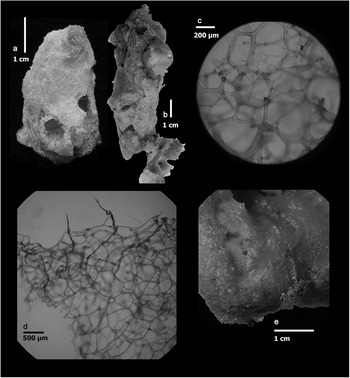
Description: Elongated cavernous sponge, with some volcano-shaped lobes, 3.2 cm high, 3 cm at its base, the largest specimen is an elongated, irregular tube resting lengthwise on the substrate, 11 cm long, 2.5 cm in diameter (Figure 3a–b), wide lacunose spaces extend across the entire body, the apertures are mainly oval and reach up to 1.5 cm in diameter, and pass through much of the elongated tubes. Colour dark purple when alive, turning greyish-brown in alcohol. Surface mainly smooth, but microconulose in some parts, with conules 400 µm high; all covered by a thin and transparent dermal layer (Figure 3e). Consistency is more than compressible due to the hollow lacunose body, also elastic and soft texture, making it difficult to cut.
Hyattella hyattus sp. nov., a. Specimen habitus of holotype CNPGG-2340 preserved in alcohol; b. Paratype CNPGG-2560; c. LM image of ectosomal skeleton showing the fine dermal fiber reticulum (upper side); d. LM image of cross section of peripheral skeleton, showing cored primary fibers; e. Osculum in a dermal membrane.

Skeleton. Ectosomal skeleton is a tangential network of fibres embedded in a dermal layer, consisting of amber-coloured, very slender fibres, 6‒18.5 µm in diameter (Figure 3c). The choanosomal skeleton consists mainly of a polygonal network of uncored, amber fibres, 18.5‒49.5 µm in diameter, forming meshes 117‒755 µm wide. Primary fibres towards the periphery of the body are cored or packed by foreign detritus, 37‒49.5 µm in diameter, spaced approximately 1.0 mm apart; these fibres form the conulose surface (Figure 3d).
Distribution. So far, it only occurs in the Los Picos Sur reef, Veracruz. Other reports on the genus Hyattella in the GoM refer to H. cavernosa (to the north by de Laubenfels [Reference de Laubenfels1953] and Rützler et al. [Reference Rützler, van Soest, Piantoni, Felder and Camp2009]; as well as to the south by Ugalde et al. [Reference Ugalde, Gómez and Simões2015]). However, there are no records for H. cavernosa in the Los Picos reef.
Remarks. The specimens studied correspond to the genus Hyattella Lendenfeld, 1888, due to the typical characteristics of the genus: presence of numerous lacunae both through the sponge body and on the surface, cored primary fibres within a dense mesh of uncored secondary fibres, and a fine-meshed, tangential, dermal fibre network (Cook and Bergquist, Reference Cook, Bergquist, Hooper and van Soest2002b). Hyattella hyattus sp. nov. is particularly distinguished, regardless of the gender characteristics above, by its bulbous tube shape, smaller fiber sizes (up to 50 µm), as well as bright purple colour, with a very compressible consistency, and soft texture. Unlike the only Caribbean congener, H. cavernosa (Pallas, Reference Pallas1766), which has clear differences even among specimens of the same size. Detailed comparisons of non-type material of H. cavernosa with the new species and different authors in the literature, confirmed the differences with the new species raised above. H. cavernosa has a massive-encrusting body to branchy, different shades of colour brown, green, black, to grey in vivo, toughly consistency, and a wide range of fiber diameters not in the range of the new species: from Curaçao primary fibres 60‒140 µm in diameter (van Soest, Reference van Soest1978 as Hyattella intestinalis Figure 8, plates 4, 5); from Colombia primary fibres 20‒90 µm (Zea, Reference Zea1987 as Hyattella intestinalis Figure 8, plate 5); from Brazil 62‒210 and 40‒60 µm (Muricy et al., Reference Muricy, Esteves, Moraes, Santos, da Silva, Klautau and Lanna2008; Sandes and Pinheiro, Reference Sandes and Pinheiro2014 Figure 6A, B, respectively); and from the southern GoM fibres 50‒75 µm (Ugalde et al., Reference Ugalde, Gómez and Simões2015 Figure 20A, B). Although the Colombian skeletal measurements include those of the new species, several features differentiate them, apart from the above mentioned, the new species is highly lacunose with cavities 1.5 cm in diameter compared to 0.400‒0.900 cm up to 1 cm in H. cavernosa, H. hyattus sp. nov. has mainly a smooth surface giving a soft texture versus coarse in H. cavernosa, and exceptionally compressible consistency of the new species. The purple colour in its live state has also not been reported for H. cavernosa. Making a new species for the genus Hyattella.
Figure 3 and the corresponding footnote.
Subclass Heteroscleromorpha Cárdenas, Pérez and Boury-Esnault, 2012
Order Desmacellida Morrow and Cárdenas, Reference Morrow and Cárdenas2015
Family Desmacellidae Ridley and Dendy, Reference Hajdu, van Soest, Hooper and van Soest2002
Genus Desmacella Schmidt, Reference Schmidt1870
Desmacella pumilio Schmidt, Reference Schmidt1870
D. pumilio (Schmidt, Reference Schmidt1870:53; de Laubenfels, Reference de Laubenfels1936:114; van Soest, Reference van Soest1984:136; Alcolado, Reference Alcolado2002:66; van Soest, Reference van Soest, Hooper and van Soest2002:644).
Material examined. CNPGG‒2569, CNPGG‒2572, Los Picos Sur reef, Las Barrancas, Alvarado, Veracruz; 18.946149 N, 95.919452 W, 7/October/2017, 10‒13 m depth, col. A. Granados and J.A. Martínez-Vargas, rocky substrate, on coral rubble and relatively consolidated sediment. CNPGG–2566, CNPGG‒2570, 23/August/2017, other data such as above.
Type locality. Florida (Schmidt, Reference Schmidt1870).
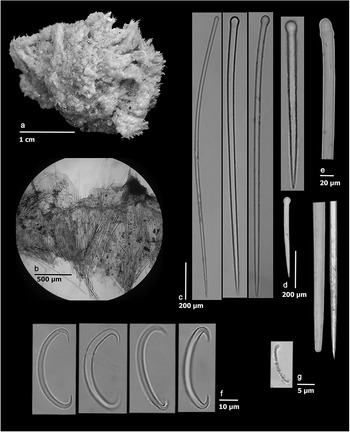
Description: Encrusting sponge up to 1.5 cm thick, 2.7 cm2 in extension (Figure 4a), orange colour when alive, pinkish beige to pale yellow when preserved in alcohol. The surface is grainy and microhispid due to protruding spicules extending up to 800 µm outside the surface, although it has a soft texture, without apparent oscules. Consistency is limp, compressible in thicker specimens, firmer in thinner ones.
Desmacella pumilio (Schmidt, Reference Schmidt1870), a. Specimen habitus of CNPGG-2569 preserved in alcohol; b. LM image of cross section of peripheral skeleton; c. LM image of large tylostyles; d. LM image of small tylostyles; e. LM image detail of tylostyle endings (round and sharp); f. LM images of large sigmata; g. LM image of small sigma.

Skeleton. Skeletal arrangement of the plumose type is made up of bundles of tylostyles (Figure 4b); no other structure is observed.
Spicules. Tylostyles in a wide size range: 195‒290‒1821 × 5.2‒20.8 µm (probably splitted in three size categories I: 195‒290‒395 × 5.2‒10.7‒13 µm; II: 433‒756‒965 × 10.5‒11.5‒20.8 µm; III: 1110‒1343‒1821 × 10.4‒14‒20.8 µm), some of the thinner 5.6 µm diameters of various lengths, are probably in development (Figure 4c–e). Sigmata in two size categories, I: 37.5‒75.5 µm (Figure 4f); II, very thin: 13‒19.5 µm (Figure 4g); there are no raphides.
Distribution: D. pumilio is a deep-water species (100‒600 m), reported in Florida (Schmidt, Reference Schmidt1870), Jamaica (van Soest, Reference van Soest1984), and Cuba (Alcolado, Reference Alcolado2002). This is the first record for Mexico with an extension of its geographic distribution to the southwest of the GoM with a bathymetric distribution of 10‒13 m. Deep-water species on the Guyana shelf also occurred at much shallower depths than their previously known depth. Undoubtedly, the specimens belong to the same species as the shallow-water ones, with an apparently larger ecological range (van Soest, Reference van Soest2017).
Remarks. The features of D. pumilio (Schmidt, Reference Schmidt1870) have remained imprecise due to the brief original description, and subsequent descriptive records showing some discrepancies (Hajdu and van Soest, Reference van Soest, Hooper and van Soest2002). However, D. pumilio can be defined from our specimens, strengthened with the more accurate description by van Soest (Reference van Soest1984), which describes an encrusting to massive habitus, without apparent oscules, tylostyle spicules, 235‒960 × 6‒20 µm, and sigmata, 12‒46 µm. Furthermore, spicule measurements of de Laubenfels (Reference de Laubenfels1936) are also closer to the present material (tylostyles, 530‒1400 × 9‒17 µm; sigmata, 38‒78 µm).
According to Cárdenas and Rapp (Reference Cárdenas and Rapp2013), depth has a direct influence on the size of the spicules, related to the availability of silica at different depths. Therefore, the spicular meristic differences reported between authors and/or locations here may be related to the depth at which the individuals were taken in each study, which were mostly deep-water organisms, whereas the specimens from Los Picos were obtained from a shallow reef environment.
Other congeneric species differ from the material assigned to D. pumilio: D. annexa Schmidt, Reference Schmidt1870 is a very thin film, characterized by sinuous toxiform raphides (53‒115 µm) and very thin tylostyles (2.5‒8 µm) (van Soest, Reference van Soest1998); D. meliorata Wiedenmayer, Reference Wiedenmayer1977 is a lobular, crimson red sponge, with very small and thinner tylostyles (210‒230 × 3.5‒4.5 µm); D. polysigmata van Soest, Reference van Soest1984 has style-type spicules, tending to strongyles (513‒635 × 10‒19 µm) rather than tylostyles, and a very small size of the smallest sigmata (10‒15 µm). Other Desmacella species from the Brazilian coast do not match with D. pumilio either (see Nascimento and Pinheiro, Reference Nascimento and Pinheiro2022).
Figure 4, and the corresponding footnote.
Order Poecilosclerida Topsent, 1928
Family Acarnidae Dendy, 1922
Genus Zyzzya de Laubenfels, Reference de Laubenfels1936
Zyzzya marinagreenae sp. nov.
ZooBank: urn:lsid:zoobank.org:act:2B3EE6B0-37AA-4395-8EF4-FED1586D36AA
(Figures 5a–f, 6a–c)
Material examined. HOLOTYPE: CNPGG‒2571 Los Picos Sur reef, Las Barrancas, Alvarado, Veracruz; 18.946149 N, 95.919452 W, 23/August/2017; 10‒13 m depth, col. A. Granados and J.A. Martínez-Vargas, on pebbles substrate and sediments with algae. PARATYPE: CNPGG‒2583. Same data as the holotype.
Etymology. The specific name chosen honours the author’s daughter (PG), Dr Marina Green (PhD, internal medicine specialist).
Type locality. Los Picos Sur reef, Veracruz (GoM).
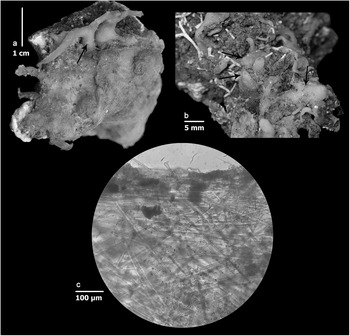
Description. Thinly encrusting sponge, from which open fistules arise with a thin and transparent, delicate wall (Figure 5a–c), wide open end, and smooth surface; no pores or oscules were seen. The fistules are easily damaged, measuring 2.5‒3.0 mm high, and 600 µm up to 1.5 mm in diameter. No colour live was detected, light transparent brown in fixative.
Zyzzya marinagreenae sp. nov. a. Specimen habitus of holotype CNPGG-2571 preserved in alcohol; b-c. Paratype CNPGG-2583 (pointed by arrows); d. LM image of the skeletal arrangement of the fistule; e-f. LM images of tylotes with microspined ends, acanthostrongyles, and palmate isochelae.

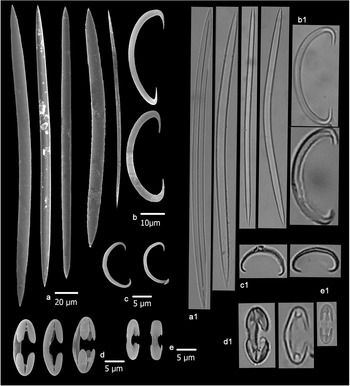
Zyzzya marinagreenae sp. nov., SEM and LM images of spicules: a-a1. Tylotes with microspined ends; a2. Details of tyle endings; b, b1, b2. Acanthostrongyles and the end details; c, c1. Palmate isochelae.

Skeleton. The ectosomal skeleton in the fistule wall consists of scattered but tangentially distributed megascleres (both tylotes and acanthostrongyles), in a homogeneous but indistinct pattern (Figure 5d). Choanosomal skeleton filled with megascleres in all directions.
Spicules. Tylotes with minutely spined bases, sometimes asymmetrical, 228.9‒280‒321.7 × 4.5‒6.4‒7.5 µm (Figures 5e–f, 6a, a1, a2); acanthostrongyles straight to slightly curved, with asymmetrical endings, regular or irregularly spined, not verticillated, 73.5‒146‒192 × 4.5‒5‒7.5 µm (Figures 5e–f, 6b-b2); palmate isochelae 12‒15‒18.2 µm (Figures 5e–f, 6c-c1). No toxas were found.
Distribution. So far, it only occurs in the Los Picos Sur reef, Veracruz (GoM).
Remarks. There are only five species of Zyzzya worldwide (De Voogd et al., Reference De Voogd, Alvarez, Boury-Esnault, Cárdenas, Díaz, Dohrmann, Downey, Goodwin, Hajdu, Hooper, Kelly, Klautau, Lim, Manconi, Morrow, Pinheiro, Pisera, Ríos, Rützler, Schönberg, Turner, Vacelet, van Soest and Xavier2025; Table 2), with Zyzzya invemar van Soest, Zea and Kielman, Reference van Soest, Zea and Kielman1994 from Colombia, as the first species recorded for the western Atlantic. Zyzzya marinagreenae sp. nov. differs from the Colombian species by its open fistular shape and is not blind as in Z. invemar. In addition, the latter has verticillated-spined acanthostrongyles and different sizes of spicules: tylotes strongly spined bases (235‒301 × 4‒8 µm), acanthostrongyles (167‒215 × 4.5‒10 µm), and palmate isochelae (19‒23 µm). Furthermore, it is black when preserved in alcohol and not beige as in Z. marinagreenae sp. nov.
Comparative spicule measurements recorded for Zyzzya species and their distribution worldwide, length × width (smaller length – mean – larger length in µm)

Figures 5 and 6 and the corresponding footnote.
Family Coelosphaeridae Hentschel, 1923
Genus Coelosphaera Thomson, 1873
Subgenus Coelosphaera Thomson, 1873
Coelosphaera (Coelosphaera) barbadensis van Soest, Reference van Soest2017
(Figures 7a–c, 8a–g)
Coelosphaera raphidifera Hechtel, Reference Hechtel1969:13.
No – Coelosphaera raphidifera (Topsent, Reference Topsent1889):16 (as Fibularia raphidifera) is a valid species.
Coelosphaera (Coelosphaera) barbadensis van Soest, Reference van Soest2017:134.
Material examined. CNPGG‒2568, CNPGG‒2573, CNPGG‒2576, CNPGG‒2578, Los Picos Sur reef, Las Barrancas, Alvarado, Veracruz; 18.946149 N, 95.919452 W, 7/October/2017; 10‒13 m depth, col. A. Granados and J.A. Martínez-Vargas, on pebbles and sediment with algae and mollusc shells.
Type locality. Barbados (Hechtel, Reference Hechtel1969).
Description. Encrusting sponge that shows several hollow fistules with irregular diameters, thinned to the end, and mostly closed at the top; some of these are lying down to the substrate with short, upward-growing branches (Figure 7a–b). The average length of the fistules is 2 cm, and their diameter ranges from less than 1 to 2 mm; one is 3 cm long by 1.8 mm in greatest diameter. Colour when alive is not known due to its cryptic habit and was not observed until viewed under a microscope; it is opaque white in alcohol, sometimes with darkened summits on the fistules. Smooth surface, and in some parts, the spicules pierce the surface. The sponge has a firm consistency in general, but is limp, bendable, and delicate. Inside the body, shows a slimy substance.
Coelosphaera (Coelosphaera) barbadensis van Soest, Reference van Soest2017. a-b. Habitus of specimens CNPGG-2578 and 2573 preserved in alcohol (arrows indicate specimens); c. LM image of cross section of peripheral skeleton.

Skeleton. Ectosomal skeleton is a dense layer of tylotes in confusion but arranged tangentially to the fistule wall, with raphides in trichodragmata, ca. 330 µm long. The choanosomal skeleton consists of sparse and poorly developed spicule tracts but is primarily a dense layer of spicules in confusion (Figure 7c).
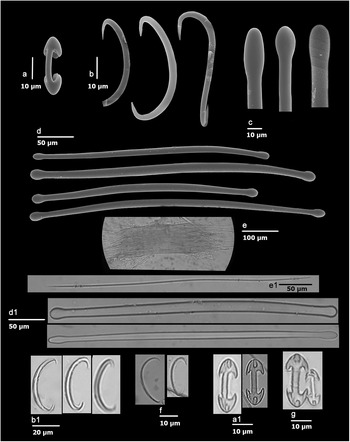
Spicules. Tylotes nearly straight to wavy, with smooth, oval tyles, in two size categories, I: 222‒245.8‒270 × 5‒8‒9 µm; II: 350‒387.6‒470 × 7.5‒10‒13 µm (Figure 8c-d1); arcuate isochelae typified by lateral alae freely from the shaft, and the front alae shorter than the lateral ones, in two size categories, I: 15‒17‒19 µm (Figure 8g); II: 21‒24.5‒27 µm (Figure 8a-a1, g); sigmata in two size categories, I: elongated, with inequiended ends, 27‒37‒55.5 µm (Figure 8b), II: thin and round shaped: 16.5‒21.5‒25.5 µm (Figure 8f); raphides, 207‒420 µm long (Figure 8e1), generally arranged in trichodragmata up to 88 µm wide, same longitude (Figure 8e).
Coelosphaera (Coelosphaera) barbadens van Soest, Reference van Soest2017, SEM and LM images of spicules: a-a1. Large arcuate isochelae; b-b1. Large sigmata; c. Detail of tyle endings; d-d1. Tylotes; LM images: e. Trichodragma; e1. Single raphide; f. Small sigmata; g. Large and small arcuate isochelae.

Distribution. Coelosphaera (Coelosphaera) barbadensis is recorded for the first time in the Los Picos Sur reef, Veracruz (GoM); this implies an expansion in the range of geographic distribution, originally confined to Barbados (Hechtel, Reference Hechtel1969).
Remarks. According to van Soest´s (Reference van Soest2017) studies, beginning with the original slide of C. raphidifera (Topsent, Reference Topsent1889) from Campeche Bank, determined that the species’ spicule set comprises strongyles 300 × 6 µm, large isochelae distinguished by pointed alae, and raphides measuring only 60 µm long. These features differ from those depicted by Hechtel´s (Reference Hechtel1969) as C. (C.) raphidifera from Barbados, which is distinguished by having tylotes with smooth, oval tyles (231‒488 × 3.5‒10.6 µm), much longer raphides (294‒473 µm), two size categories of chelae integrated into the same measurement range (20–28 µm) (Hechtel, Reference Hechtel1969); for which deserved a different name given by van Soest (Reference van Soest2017). Additional features presented here are consistent with the Barbados species.
Another Coelosphaera species with large raphides, like C. (C.) barbadensis, inhabiting the western Atlantic, is C. (C.) hechteli van Soest, Reference van Soest1984. Important morphological differences between the two species are disclosed here, since C. (C.) hechteli has on average larger and thinner tylotes (252.8‒386‒533 × 2‒7‒11.3 µm) with barely swollen heads, narrower trichodragmata (20‒55 µm wide), just one category of sigmata with a larger size (38‒60 µm); and likewise a single size category of arcuate isochelae (20.5‒34 µm) (data taken from van Soest, Reference van Soest1984 and Lizarazo and Zea, Reference Lizarazo and Zea2024). Albeit the latter authors have widened the spicular measurements of Colombian C. (C.) hechteli, particularly from the tylotes, these are depicted by barely swollen tyles and confirm the presence of a single category of sigmata and chelae. All features are different from C. (C.) barbadensis. Other C. (C.) raphidifera records found in Brazil (Hechtel, Reference Hechtel, Harrison and Cowden1976) and in Cuba (Alcolado, Reference Alcolado1980) should be confirmed to avoid misapplications (van Soest, Reference van Soest2017).
Family Desmacididae Schmidt, Reference Schmidt1870
Genus Desmapsamma Burton, 1934
Desmapsamma paulumharenae sp. nov.
ZooBank: urn:lsid:zoobank.org:act:EA49BE5E-884D-4203-9214-1022A0036558
Material examined. HOLOTYPE: CNPGG‒2562 Los Picos Sur reef, Las Barrancas; Alvarado, Veracruz; 18.946149 N, 95.919452 W, 07/October/2017; 10‒13 m depth, col. A. Granados and J.A. Martínez-Vargas, dead coral substrate and bivalve shell. PARATYPE: CNPGG‒2581, 2582. Same data as the holotype.
Additional non-type material from Desmapsamma anchorata (Carter, Reference Carter1882:283) was examined, from literature and samples deposited in the Colección Nacional del Phylum Porifera ‘Gerardo Green’: CNPGG–428 Veracruz, 19.216667 N, 96.05000 W, July/1987. CNPGG–2502 Los Picos Sur reef, Veracruz, 19.056667 N, 95.988056 W, (Spicule sizes are based on 15 re-measurements).
Etymology. The composed name paulumharenae is derived from the Latin paulum = few, little, and harenae = sand, in reference to the little sand it contains.
Type locality. Los Picos Sur reef, Veracruz (GoM).
Description. Encrusting sponge, 2 × 2.5 cm2 in extent, 8 mm thick, attached to a calcareous rock (Figure 9a); the paratypes enclose or grow around objects such as a bivalve shell and several small calcareous rocks, forming a spherical mass; they measure 1‒1.5 cm in diameter. Its colour when alive is orange, turning dirty white when preserved in alcohol. Gives off strings of mucus even after being preserved in alcohol. Evenly rough surface, with numerous adhered grits, scattered oscules free from sand, 500‒1500 µm, difficult to see since they are located at the base and between the grooves of the surface. Firm consistency, barely compressible.
Desmapsamma paulumharenae sp. nov., a. Specimen habitus of holotype CNPGG-2562 preserved in alcohol; b. LM image of tangential section of the ectosomal skeleton; c. LM image of cross section of the peripheral skeleton (ectosome on top showing the sand grain coating).

Skeleton. A reticulate ectosomal skeleton is present, composed mainly of paucispicular tracts and at the same time lightly outlined by fine sand grains (Figure 9b). The choanosomal skeleton is an irregular renieroid reticulum, with multispicular to paucispicular, often undefined tracts. Several subdermal cavities are interspersed here (Figure 9c).
Spicules. Oxeas are usually straight, slightly curved, probably in two size categories, I mainly hastate: 140‒205‒285 × 6‒9‒12 µm (Figure 10a-a1); II fusiform, in less quantity: 117‒148 × 3‒4.5 µm. Microscleres, sigmata in C and S shape, in two size categories, I: 21‒29‒50 µm (Figure 10b-b1), II: 7.5‒13.5‒18 µm (Figure 10c-c1); anchorate isochelae in two distinct size categories, I: 16‒16.5‒21 µm (Figure 10d-d1); II: 7.5‒11‒15.6 µm (Figure 10e-e1).
Desmapsamma paulumharenae sp. nov., SEM and LM images of spicules: a-a1. Large and small oxeas; b-b1. Large sigmata; c-c1. Small sigmata; d-d1. Large anchorate isochelae; e-e1. Small anchorate isochelae (same scale bar that corresponds to the previous letters).

Distribution. Up to now, it has only occurred in the Los Picos Sur reef, Veracruz (GoM). Desmapsamma paulumharenae sp. nov. is the second species reported for the western Atlantic and GoM, after D. anchorata (Carter, Reference Carter1882) reported to the southwest (Green et al., Reference Green, Fuentes-Velázquez and Gómez1986; Gómez, Reference Gómez2002, Reference Gómez, Granados-Barba, Abarca-Arenas and Vargas-Hernández2007) and southeast of the GoM (Ugalde et al., Reference Ugalde, Fernández, Gómez, Lôbo-Hajdu and Simões2021).
Remarks. Thus far, only three species of Desmapsamma occur worldwide: D. turbo (Carter, Reference Carter1885) from Australia, D. vervoorti van Soest, Reference van Soest1998 from Indonesia, and D. anchorata (Carter, Reference Carter1882) from the Caribbean Sea. Desmapsamma paulumharenae sp. nov. is somewhat similar to its congener D. anchorata. However, a detailed comparison between species obtained from the literature and specimens examined from the CNPGG Collection revealed important morphological differences:
Shape. D. anchorata shows ramose or massive shape, the latter usually with elevated volcano-shaped oscules, whereas the three specimens of the new species show an encrusting shape no more than 8 mm thick.
Colour. Pale pink or pinkish orange in D. anchorata, due to the whitish dermis that covers its bright orange interior. While the new species is light orange on all sides.
Surface. D. anchorata exhibits an organic dermis over a dense network of debris; this dermis has a skin-like appearance, revealing a smooth, velvety surface. Opposed to D. paulumharenae sp. nov., which has less debris, it lacks a dermal layer and remains completely rough.
Oscules. In D. anchorata, oscules are easily visible, 1‒7 mm in diameter, sometimes provided with a raised membrane; unlike D. paulumharenae sp. nov., which measures up to 1.5 mm, not evident due to their position at the base of the surface grooves.
Consistency. D. anchorata is compressible and soft, while D. paulumharenae is firm, hardly compressible.
Megascleres. D. anchorata has oxeas from 100‒200 µm, distinguished by its very thin diameter, 2.5‒5‒9 µm, smaller and thinner oxeas compared with the new species. D. anchorata has been reported near the study region; however, no spicule measurements are shown (Gómez, Reference Gómez2002, Reference Gómez, Granados-Barba, Abarca-Arenas and Vargas-Hernández2007; Ugalde et al., Reference Ugalde, Fernández, Gómez, Lôbo-Hajdu and Simões2021), nor are there any measurements of this species in Alcolado (Reference Alcolado1976) from Cuba, Lehnert and van Soest (Reference van Soest1998) from Jamaica, Pineda-Munive and Zea (Reference Pineda-Munive, Zea, García-Urueña, Acero, Zea, Ardila, Hérnández Hamón, Cabarcas and Pineda-Munive2020), from Colombia. Except for de Laubenfels (Reference de Laubenfels1936), from Florida (as Holopsamma helwigi), Gómez and Green (Reference Gómez and Green1984), from the Mexican Caribbean (as H. helwigi), and Green et al. (Reference Green, Fuentes-Velázquez and Gómez1986), from Veracruz (see Table 3). Two samples from the CNPGG collection assigned to D. anchorata were examined to obtain new spicule measurements and descriptive data to compare and confirm differences between species; these are also shown in Table 3. Farther locations along the western tropical Atlantic of D. anchorata from Jamaica (Hechtel, Reference Hechtel1965; Pulitzer-Finali, Reference Pulitzer-Finali1986); Colombia (Zea, Reference Zea1987); Curaçao and Bonaire (van Soest, Reference van Soest1984); to Brazil (Muricy and Hajdu, Reference Muricy and Hajdu2006; Hajdu et al., Reference Hajdu, Peixinho and Fernandez2011) have oxeas with similar measurements to D. anchorata (Table 3), different from the new species.
Comparative data and spicule measurements recorded for Desmapsamma species and their worldwide distribution, length × width (minimum length – mean – maximum length in µm)

Microscleres. In sigmata I, a slightly smaller range is recorded in D. anchorata than in D. paulumharenae sp. nov.; sigmata II of D. anchorata are larger than those of the new species (Table 3).
The other two species of Desmapamma, turbo, and vervoorti, are separated geographically, making population conspecificity doubtful. Furthermore, D. turbo has not been fully defined since its original description, only Lendenfeld (Reference von Lendenfeld1889, as Sigmatella turbo) reported strongyles (130 × 2–3 µm) for this species instead of oxeas as well as longitudinal fibers densely packed with sand grains in a square to rectangular network. Similarly, Dendy (Reference Dendy1896, as Esperiopsis turbo) reported slender styles and tiny isochelae. Overall, these traits are not in accordance with Desmapsamma. We therefore agree with van Soest (Reference van Soest1998) in considering it tentative. Consequently, comparisons of the various features do not match those of the new species.
Figures 9 and 10 and the corresponding footnote.
Family Hymedesmiidae Topsent, 1928
Genus Phorbas Carter, 1876
Phorbas veracruzanus sp. nov.
ZooBank: urn:lsid:zoobank.org:act:17C2131B-1BD0-4E53-96EF-03112D91B37E
Material examined. HOLOTYPE: CNPGG‒2559 Los Picos Sur reef, Las Barrancas, Alvarado, Veracruz; 18.946149 N, 95.919452 W, 23/August/2017; 10‒13 m depth, col. A. Granados and J.A. Martínez-Vargas, on calcareous pebbles.
Additional non-type material from Phorbas amaranthus was examined, from literature and samples deposited in the Colección Nacional del Phylum Porifera 'Gerardo Green': CNPGG–047 Yucatan Peninsula, 22.501667 N, 89.007550 W, 16/November/2005, depth 47 m (spicule sizes are based on 15 re-measurements).
Etymology. The species name refers to the region where the holotype was found.
Type locality. Los Picos Sur reef, Veracruz (GoM).
Description. Thinly encrusting sponge, up to 1 mm thick, 2 × 3 cm2, with protruding conule-like processes or pilose surface, 1.5 mm high (Figures 11a–b). Unknown colour when alive, cinnamon colour when in alcohol. Oscules round, up to 250 µm. Consistency is soft, delicate, barely compressible. No visible pore fields were observed.
Phorbas veracruzanus sp. nov., a-b. Specimen habitus of holotype CNPGG-2559 preserved in alcohol (indicated by arrows); c. LM image of the ascending tract; d. LM image of cross section of the peripherical skeleton (ectosome on top showing plumose spicule tracts).

Skeleton. Thick, multispicular ascending tracts, 600‒700 µm in diameter, form the pilose surface; the tracts are fully packed by tornotes interspersed with acanthostyles (Figure 11c). Some tracts are sparsely echinated and have plumose endings. On the encrusting part, the tornotes protrude outside the surface with a tendency to form plumose bundles (Figure 11d); towards the interior, there are scattered acanthostyles with abundant microscleres.
Spicules. Straight tornotes, smooth, with asymmetrical endings, mainly with conical tips mixed with few strongylote modifications, 239‒280‒312 × 3.6‒5.2‒7.8 µm (Figure 12a); acanthostyles in two distinct size categories, I: usually curved at the half shaft, grainy head, and slightly spined shaft, the spines gradually diminishing towards the pointed end, 187‒222‒236.6 × 5.4‒7‒8.3 µm (diameters without spines) (Figure 12b); acanthostyle II: usually straight, with strongly spined head and shaft, frequently with a tiny hook at the pointed end, 109.7‒120.8‒132.6 × 4.9‒5.7‒7.8 µm (diameters without spines) (Figure 12c). Microscleres abundant arcuate isochelae with strong shaft and short alae, 21.8‒24.3‒28 µm (Figure 12d).
Phorbas veracruzanus sp. nov., LM images of spicules: a. Tornotes with symmetrical and asymmetrical endings; b. Acanthostyles I; c. Acanthostyles II with two arcuate isochelae; d. Arcuate isochelae.

Distribution. So far, it only occurs in the Los Picos Sur reef, Veracruz (GoM).
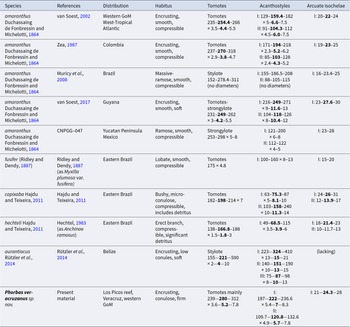
Remarks. There are five species of Phorbas from the Tropical Western Atlantic (TWA) (Table 4), with Phorbas amaranthus Duchassaing and Michelotti, Reference Duchassaing de Fonbressin and Michelotti1864 sharing spicule types and close measurements like those observed in Phorbas veracruzanus sp. nov. However, the skeletal architecture differs between the two, contrasting in the column width of megascleres, which is thinner in P. amaranthus (60‒190 µm) (Zea, Reference Zea1987; van Soest, Reference van Soest, Hooper and van Soest2002; Reference van Soest2017), and the acanthostyle II in the new species frequently has a tiny hook at the pointed end, which is absent in P. amaranthus. Furthermore, if Phorbas amaranthus may resemble Phorbas veracruzanus sp. nov. with a fine encrusting habit, the former is distinguished by its consistently smooth surface. This characteristic has been reported by several authors from multiple localities across the TWA region, from Florida to Brazil (de Laubenfels, Reference de Laubenfels1936 as Merriamium tortugasensis; Zea, Reference Zea1987; van Soest, Reference van Soest, Hooper and van Soest2002, Reference van Soest2017). In contrast, Phorbas veracruzanus sp. nov. has a bristly surface.
Comparative morphologic data and spicule measurements recorded for Phorbas species and their distribution along the Tropical Western Atlantic, length × width (smaller length – mean – larger length in µm)

Further congeners also differ on several relevant features (Table 4); Phorbas fusifer (Ridley and Dendy, Reference Ridley and Dendy1887) (as Myxilla plumosa var. fusifera) has a lobate shape with a single category of acanthostyle 100‒160 × 8‒13 µm, fusiform oxeas 175 × 4 µm, and isochelae 15–20 µm (Ridley and Dendy, Reference Ridley and Dendy1887). Phorbas capixaba Hajdu and Teixeira, Reference Hajdu and Teixeira2011 has a bushy shape habitus, with smaller spicules than the new species: tornotes 182‒214 × 7 µm, two size categories of acanthostyles I: 63‒87 × 5‒10 µm, II: 103‒240 × 10‒14 µm, and two size categories of isochelae. Phorbas hechteli Hajdu and Teixeira, Reference Hajdu and Teixeira2011 is a bushy ramose sponge, also with smaller and thinner spicules, in addition to having one kind of acanthostyle and two categories of isochelae (Hechtel, Reference Hechtel1965). Phorbas aurantiacus Rützler, Piantoni van Soest and Díaz, Reference Rützler, Piantoni, van Soest and Díaz2014 has styles instead of tornotes, three size categories of acanthostyles, and the absence of chelae. All species are different from Phorbas veracruzanus sp. nov.
Figures 11 and 12 and the corresponding footnote.
Order Tethyida Morrow and Cárdenas, Reference Morrow and Cárdenas2015
Family Timeidae Topsent, 1928
Genus Timea Gray, 1867
Timea citlallitzina sp. nov.
ZooBank: urn:lsid:zoobank.org:act:F636F479-7D0B-42AA-A9DC-EBD79FDE49CC
Material examined. HOLOTYPE CNPGG‒2575 Los Picos Sur reef, Las Barrancas, Alvarado, Veracruz (GoM); 18.946149 N, 95.919452 W, 23/August/2017; 10‒13 m depth, col. A. Granados and J.A. Martínez-Vargas, rocky substrate. PARATYPE: CNPGG‒2577, 7/October/2017, substrate: sediment with algae, other data such as the holotype.
Etymology. The species name citlallitzina is a noun in apposition, which means little star in the Nahuatl language, the common language used by the Aztecs in ancient Mexico, and which refers to the morphology of the euasters characteristic of the species.
Type locality. Los Picos Sur reef, Veracruz (GoM).
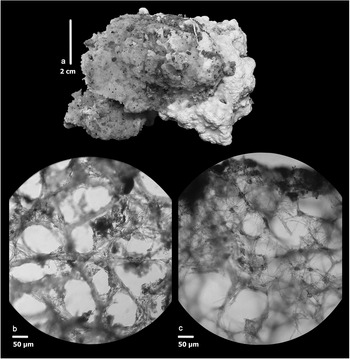
Description. Very thin encrustations, less than 1 mm thick; with a crust extension ca. 1.4 × 1 cm2 (Figure 13a–b). Consistency soft. Colour not recorded in vivo, greyish-white when in alcohol. Surface with protruding spicules, tips ending outside the surface, without giving a hispid appearance, oscules not visible.
Timea citlallitzina sp. nov., a-b. Specimen habitus of holotype CNPGG-2575 preserved in alcohol; c. LM image of cross-section of peripheral skeleton (ectosome on top showing tylostyle tips protruding outside the surface and sedimentary rocks at the bottom).

Skeleton. Mainly of a dense layer of euasters, pierced by vertical tylostyles that cross the surface (Figure 13c), other tylostyles are arranged parallel to the base, which is also covered by euasters.
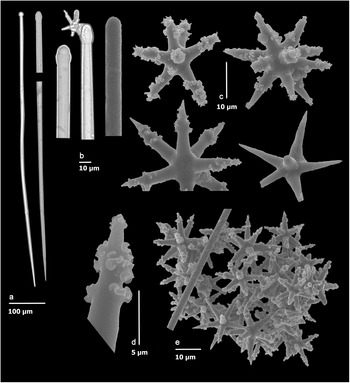
Spicules. Tylostyles with rounded, ovoid, and mucronated tyles, sometimes subterminal, sometimes styloid-shaped. In two size categories, mainly of the type I: straight, with slender diameter and sharply pointed, 213‒387.4‒610.5 × 2.5‒4.8‒7.5 µm (Figure 14a–b); II: straight, with the same shape as the previous ones, most of them broken, most likely due to their larger size and handling during collection and conservation, 683‒742‒850.7 × 9.8‒10.4‒13.5 µm. Tyle sizes 4.4‒12.7 µm wide. Abundant euasters, oxyaster type in two size categories (Figure 14c–e), from large to small in a continuum size, mainly with 8‒12 distinctive rays, characterised by lumpy tips, I: 3.7‒5.2‒7.5 µm, II: 12‒26‒36.4 µm. A few asters with smooth rays occurred intermingled with the others, 20‒25 µm in diameter (Figure 14c).
Timea citlallitzina sp. nov., a. LM images of tylostyles; b. LM detail images of tylostyle heads; SEM images: c. Euasters, oxyaster type in two size categories, few with smooth rays; d. Detail of an oxyaster ray; e. Cluster of euasters.

Distribution. So far, it only occurs in the Los Picos Sur reef, Veracruz (GoM).
Remarks. T. citlallitzina sp. nov. is distinguished by its peculiar aster microscleres with lumpy-tipped rays, absent from every other known Timea spp. Furthermore, other Timea spp. may show different categories of asters, such as tylasters, oxyspherasters, spherasters, and strongylasters (chiasters), which also differ in their dimensions among the various species. Morphological features of the genus Timea, such as colour when alive, encrusting habitus, consistency, surface, and skeletal pattern, do not seem to be differentiable interspecific traits, especially in preserved individuals. Their differentiation is largely given by the type or types of euasters. A similar conclusion is afforded by Carballo and Cruz-Barraza (Reference Carballo and Cruz-Barraza2006) for the Timea species of the East Pacific coast. Therefore, based on the particular micromorphology of its euasters, Timea citlallitzina sp. nov. is considered confidently differentiated from the remaining 16 spp of Timea known from the Central Western Atlantic (see Cruz-Barraza et al., Reference Cruz-Barraza, Vega, Rützler and Sala-Castañeda2020).
Figures 13 and 14 and the corresponding footnote.
Order Suberitida Chombard and Boury-Esnault, 1999
Family Suberitidae Schmidt, Reference Schmidt1870
Genus Terpios Duchassaing and Michelotti, Reference Duchassaing de Fonbressin and Michelotti1864
Terpios belindae Rützler and Smith, Reference Rützler and Smith1993
Material examined. CNPGG‒2567; Los Picos Sur reef, Las Barrancas, Alvarado, Veracruz (GoM); 18.946149 N, 95.919452 W, 23/August/2017; 10‒13 m depth, col. A. Granados and J.A. Martínez-Vargas, on pebbles and dead coral. CNPGG‒2589 Same as previous data, except 7/October/2017, on rocks.
Type locality. Tobago (Rützler and Smith, Reference Rützler and Smith1993).
Description. Fine encrusting sponge, 2.5 × 3 cm², 1 mm thick. It grows on rocks, in crevices, and under sedimentary rocks as well (Figure 15a). The surface is microhispid, without apparent oscules. Soft consistency, difficult to define. Its colour when alive is red, turning brown when preserved in alcohol.
Terpios belindae Rützler and Smith, 1993. a. Specimen habitus CNPGG-2567; b. LM image of cross-section of the peripheral skeleton; c. SEM image of tylostyle; d. LM images of tylostyles with different shapes of tyles; e. Details of tyles from the tylostyles.

Skeleton. Formed by plumose bundles of tylostyles that pierce the ectosome and protrude their tips outside the surface. The choanosomal skeleton is undefined with spicule bundles, and many loose spicules in all directions (Figure 15b).
Spicules. Straight tylostyles, with very sharp tips, in a single size category, with a wide size range 105‒370 × 4‒9 µm (Figure 15c–e); the tyle is multilobate, usually quadrilobate, tyle width 5‒10.5 µm. Probably the smallest tylostyles (105‒135 µm) are growth stages.
Distribution: The actual record of T. belindae denotes the first for the GoM. Other distribution sites are Tobago (Rützler and Smith, Reference Rützler and Smith1993), Guadeloupe (Alcolado and Busutil, Reference Alcolado and Busutil2012), and Brazil (Mothes et al., Reference Mothes, Campos, Lerner and Silva2006).
Remarks. In the original description, the tylostyles measure 140–440 × 3‒9 µm (Rützler and Smith, Reference Rützler and Smith1993), showing a slight difference in length from the sample studied, but not in diameter. However, this variation is not considered to be of substantial significance. Thinner tylostyles are recorded by Mothes et al. (Reference Mothes, Campos, Lerner and Silva2006) from Brazil (164‒370 × 2.3‒6.9 µm). Intraspecific variations may occur owing to differences in habitat and geographic area. However, the size ranges of the material studied are very close to those marked for the species, and the morphological characteristics of T. belindae agree with these, such as its red colour in vivo and brown in conservation. In addition, T. belindae and the samples studied have more robust tylostyles than its congeners, T. manglaris Rützler and Smith, Reference Rützler and Smith1993 (200‒450 × 2.5‒7 µm) and T. fugax Duchassaing and Michelotti, Reference Duchassaing de Fonbressin and Michelotti1864 (150‒460 × 2.5‒5 µm) (data taken from Rützler and Smith, Reference Rützler and Smith1993). Terpios lobiceps (Schmidt, Reference Schmidt1870) has been designated a taxon inquirendum (De Voogd et al., Reference De Voogd, Alvarez, Boury-Esnault, Cárdenas, Díaz, Dohrmann, Downey, Goodwin, Hajdu, Hooper, Kelly, Klautau, Lim, Manconi, Morrow, Pinheiro, Pisera, Ríos, Rützler, Schönberg, Turner, Vacelet, van Soest and Xavier2025) due to Schmidt’s lack of description. Furthermore, Rützler and Smith (Reference Rützler and Smith1993) subsequently examined an extant slide of Schmidt’s species; they found mostly Tedania ignis spicules plus 10 different types of tylostyles, and, in the absence of other morphological features, it was considered unrecognisable.
Figure 15 and the corresponding footnote.
Comprehensive sponge inventory of Los Picos Sur reef
The current sponge inventory of Los Picos Sur reef comprises up to now 37 species of the Class Demospongiae (Table 1). Of this total, 13 (35.1%) are new records for the GoM, including six new species, with two genera reported for the first time in the GoM, Psammocinia and Zyzzya. In addition, these new records increased the diversity of Porifera in the Veracruz region, from 83 species formally reported in the different reefs of the PNSAV to 99, six of them expanded their geographical distribution to this region: Haliclona (S.) luciensis De Weerdt, 2000, Niphates aff. alba van Soest, Reference van Soest1980, Lissodendoryx (L.) colombiensis Zea and van Soest, 1986, Coelosphaera (C.) barbadensis van Soest, Reference van Soest2017, Mycale (Aegogropila) arndti, and T. belindae.
It is very likely that a more exhaustive exploration may reveal species of the Homoscleromorpha and/or Calcarea Classes, the latter generally inhabit cryptic habitats, under rocks, and between cracks, in which they were not detected in this set of collections. This is probably due to the sedimentation rate to which these usually small individuals, with a simple and more fragile structure, are not adapted to, avoid it, or would hardly support it (Manuel et al., Reference Manuel, Borojevic, Boury-Esnault, Vacelet, Hooper and van Soest2002; Manuel, Reference Manuel2006); however, the incorporation of sediments has been detected in both classes (Schönberg, Reference Schönberg2016).
Most of the inventoried species have already been treated in taxonomic reports of sponges from the coral reefs of Veracruz itself, the reefs of Yucatan, and Quintana Roo (Hartman, Reference Hartman1955; Topsent, Reference Topsent1889; Gómez, Reference Gómez2002, Reference Gómez, Granados-Barba, Abarca-Arenas and Vargas-Hernández2007, Reference Gómez2011, Reference Gómez2014; González-Gándara et al., Reference González-Gándara, Patiño-García, Asís-Anastasio, Serrano and Gómez2009; De la Cruz-Francisco and González-González, Reference De la Cruz-francisco and González-González2016; De la Cruz-Francisco et al., Reference De la Cruz-francisco, González-González and Morales-Quijano2016; Ugalde et al., Reference Ugalde, Fernández, Gómez, Lôbo-Hajdu and Simões2021, Reference Ugalde, Gómez and Simões2015; Gómez and Heras-Escutia, Reference Gómez, Heras-Escutia, Hernández-Aguilera and Arenas-Fuentes2022), showing here a wide potential for adaptation to stressful environments, on high sedimentation rate, with 52.7% of the specimens adhering to hard substratum, and 2.15% to sandy substratum. In any case, sponge communities are less diverse in soft-bottom areas than those inhabiting hard substrates, partly due to the homogenous bottom, sediment instability, and low availability of firm substrate for their support (Pansini and Musso, Reference Pansini and Musso1991; Ilan and Abelson, Reference Ilan and Abelson1995; Valderrama and Zea, Reference Valderrama and Zea2013). There are two substrate components that most probably allow sponge settlement: 1) sand and mud for species with anchoring habits; 2) gravel, calcareous shells, and crustacean exoskeletons for those that require a means of adhering to the substrate (Rützler, Reference Rützler1997). This scenario, unlike hard bottoms and heterogeneous relief as well as greater substrate stability, impedes the adhesion of a large number of sponge species (Parra-Velandia and Zea, Reference Parra-Velandia and Zea2003; Bell et al., Reference Bell, McGrath, Biggerstaff, Bates, Bennett, Marlow and Shaffer2015).
Discussion
Study area earnings
Whenever unexplored areas in the variety of coral structures on the Veracruz reef system are reached and examined, more new species and new records will emerge among the discovered ecosystems; this is the case of the Los Picos Sur reef, Veracruz, southwest of the GoM. This is an unusual reef due to its non-coralline origin, its semi-consolidated sedimentary substrate, and the scarce presence of scleractinian corals (Ortiz-Lozano et al., Reference Ortiz-Lozano, Colmenares-Campos and Gutiérrez-Velázquez2018). At least 37 sponge species were identified and characterized, not counting those that were left out of the transect lines and were not collected. In addition to not covering the total area of the reef. It is worth mentioning that although sedimentation is deleterious to sponge growth and health in many ways (Bell et al., Reference Bell, McGrath, Biggerstaff, Bates, Bennett, Marlow and Shaffer2015; Schönberg, Reference Schönberg2016), many sponge species and the Los Picos reef sponge community have developed strategies to deal with it and take advantage of it (Cerrano et al., Reference Cerrano, Calcinai, Gioia Di Camillo, Valisano, Bavestrello, Custodio, Lobo-Hajdu, Hajdu and Muricy2007; Bell et al., Reference Bell, McGrath, Biggerstaff, Bates, Bennett, Marlow and Shaffer2015; Schönberg, Reference Schönberg2016). It is very likely that this distinctive feature that enhances the Los Picos reef has developed the species richness of sponges in an area of 800 × 370 m (Ortiz-Lozano et al., Reference Ortiz-Lozano, Colmenares-Campos and Gutiérrez-Velázquez2018). A similar case can be observed at Banco de las Ánimas (Colombian Caribbean), where sandstone reefs are present. These structures feature soft sandy bottoms and low coral abundance (Zea et al., Reference Zea, Bernal, López, Weber and García-Urueña2019), with sponges being one of the three most abundant groups (García-Ureña, Reference García-Ureña, García-Urueña, Zea, Hernández Hamon, Cabarcas, Pineda-Munive, Ardila and Acero2020), comprising 35 described species to date (Pineda-Munive and Zea, Reference Pineda-Munive, Zea, García-Urueña, Acero, Zea, Ardila, Hérnández Hamón, Cabarcas and Pineda-Munive2020). However, although the number of reported species in both sites is very similar, it should be noted that Los Picos covers an area only one-tenth the size of Banco de las Ánimas (8 × 2 km, Zea et al., Reference Zea, Bernal, López, Weber and García-Urueña2019), where sponges account for nearly 50% of the coverage (pers. comm.), compared to the 6.54% reported for Banco de las Ánimas (García-Ureña, Reference García-Ureña, García-Urueña, Zea, Hernández Hamon, Cabarcas, Pineda-Munive, Ardila and Acero2020).
The presence of six new species and other unusual ones represents a high percentage for a relatively small area, especially neighbouring a protected area historically studied as the PNSAV. The more notorious species in the GoM, apart from the new ones, are Coelosphaera (C.) barbadensis van Soest, Reference van Soest2017 originally from Barbados and only reported in the present work; Mycale (Aegogropila) arndti van Soest, Reference van Soest1984, from Curaçao, reported in Florida (van Soest, Reference van Soest1984), Colombia (Zea, Reference Zea1987), and Belize (Hajdu and Rützler, Reference Hajdu and Rützler1998). Mycale (Naviculina) diversisigmata van Soest, Reference van Soest1984 from Curaçao, reported in southeast Brazil (Cedro et al., Reference Cedro, Hajdu, Sovierzoski, Correia, Custodio, Lobo-Hajdu, Hajdu and Muricy2007; Bettcher et al., Reference Bettcher, Pinheiro, Fernandez, Gastaldi, Bispo, Leal, Leite, Avelino-Alves, Clerier, Rezende, Gulart and Hajdu2023) and the western GoM (De la Cruz-Francisco and González-González, Reference De la Cruz-francisco and González-González2016); and Haliclona (Soestella) luciensis de Weerdt, 2000 originally from St. Lucia Island, cited in Belize (Rützler et al., Reference Rützler, Piantoni, van Soest and Díaz2014). All are expanding their geographic distribution.
Taxonomic considerations
The new species described do not have any correspondence to the species diversity recorded in the Tropical Western Atlantic settled in the WPD (De Voogd et al., Reference De Voogd, Alvarez, Boury-Esnault, Cárdenas, Díaz, Dohrmann, Downey, Goodwin, Hajdu, Hooper, Kelly, Klautau, Lim, Manconi, Morrow, Pinheiro, Pisera, Ríos, Rützler, Schönberg, Turner, Vacelet, van Soest and Xavier2025). The 'Remarks' section of each species explains the reasons why it is defined as a new species despite its small size and lack of in vivo photography. More new species are expected to emerge on the Los Picos reef, either from those collected samples that were difficult to identify due to their small size (Ircinia sp., Myrmekioderma sp., Stelletta sp., among others) or due to the lack of those sponges that go unnoticed by the diver. Furthermore, the consideration of employing molecular tools in future studies will aid in species differentiation, particularly for those specimens where it has not been possible to definitively determine whether their morphological variations are a result of environmentally induced plasticity or indicative of distinct species. All of this underscores the undeniable need for further studies incorporating multiple identification methodologies to better represent the full diversity of sponges across the entire reef.
Final considerations
The diversity of Porifera in the GoM increased slightly, with 21 resident species from the Los Picos reef; 13 reported for the first time, plus six new species described. In addition, two species already reported in the northern GoM expanded their distribution to the southern portion (Table 1). The sponge population, 37 species, is represented mainly by 15 species of the order Poecilosclerida and 10 horny sponges (4 Verongimorpha, 5 Keratosa); comparable total in previous reports in some other reefs of the PNSAV, as in the case of La Blanquilla reef (Gómez, Reference Gómez, Granados-Barba, Abarca-Arenas and Vargas-Hernández2007) with 46 species, and the Verde reef with 52 (Gómez and Heras-Escutia, Reference Gómez, Heras-Escutia, Hernández-Aguilera and Arenas-Fuentes2022).
The new findings and the presence of the genera Psammocinia and Zyzzya, recorded here for the first time in the GoM, highlight the importance of studying different environments other than coral reefs (Gómez, Reference Gómez2011) since they can represent a significant contribution to species biodiversity (Rützler et al., Reference Rützler, Piantoni, van Soest and Díaz2014; Ereskovsky et al., Reference Ereskovsky, Kovtun and Pronin2016; Calderón-Gutiérrez et al., Reference Calderón-Gutiérrez, Solís-Marín, Gómez, Sánchez, Hernández-Alcántara, Álvarez-Noguera and Yáñez-Mendoza2017; Grenier et al., Reference Grenier, Ruiz, Fourt, Santonja, Dubois, Klautau, Vacelet, Boury-Esnault and Pérez2018). The reason why the idea of estimating the Porifera biodiversity at least double the current level for the GoM is supported (Ugalde et al., Reference Ugalde, Fernández, Gómez, Lôbo-Hajdu and Simões2021).
It is expected that more sponge species will occur in the Los Picos Sur reef, especially in sciophilic sites, since there is still a good part of the reef to be studied. The unique characteristics of this area along the Veracruz coast raise the question of whether it should be incorporated into the PNSAV protection zone. Currently, it is not included due to being a recently discovered reef.
Acknowledgements
We thank Karina Arvizu-Coyotzi, Tania Acevedo-Barradas, Leonardo Ortiz-Lozano, and Jimmy Argüelles-Jiménez for helping in the fieldwork; Luis Alfonso Vázquez-Morales for taking macrophotographies to preserve material, and to Laura Elena Gómez-Lizárraga for SEM photomicrography. We thank anonymous reviewers for the valuable comments that improved the manuscript.
Author contributions
JAMV, AGB, and PG conducted initial sample collection and identification. PG and AMG conducted morphological identification. JAMV wrote the initial manuscript. All authors read, contributed to, and approved the final manuscript.
Funding
This work is part of the project CONACyT (Now SECIHTI) Ciencia de Frontera 2019 Corredor Arrecifal del Suroeste del Golfo de México: caracterización espacio temporal y establecimiento de procesos históricos evolutivos with number 39553. This research was in part supported by CEMDA (Centro Mexicano de Derecho Ambiental A.C.) and by the PFCE-UV-2017 for fieldwork. The CONACyT supported the scholarship grant 448364 to JAMV.
Competing interests
The authors declare no conflict of interests.
Data availability
All data supporting the results of the present study are available within the article. All the specimens were deposited in the Porifera collection.
Ethical standards
Not applicable.







 Open access

