




Impact statement
Despite unequivocal evidence of the adverse impacts of microplastics on environmental and human health, the inclusion of how microplastics will be addressed within the Global Plastics Treaty remains unclear. Microplastics are chemically diverse contaminants and need prioritizing for regulation under the Global Plastics Treaty similar to other multilateral agreements (MEA) to address air pollution. Thus, finalizing the Global Plastics Treaty at INC-5.2 provides a valuable opportunity to push for the inclusion of atmospheric microplastics. The inclusion of the atmosphere as an environmental compartment as important to monitor as marine, freshwater and terrestrial environments and subsequent biota would provide an opportunity to include atmospheric microplastics as the “elephant in the room” in the Global Plastics Treaty negotiations.
Letter to the editor
The international legally binding instrument on plastic pollution, including in the marine environment – referred to in this letter as the “Global Plastics Treaty” – has been under negotiation by the Intergovernmental Negotiating Committee (INC) since 2022 (Walker, Reference Walker2022; Arora et al., Reference Arora, March, Nieminen, Shejuti and Walker2024; March et al., Reference March, Tsouza, Nieminen, Winton, Arora, Shejuti, Walker and Fletcher2024), with the second part of the fifth session of negotiations scheduled for 5–14 August 2025, in response to United Nations Environment Assembly resolution 5/14. Treaty negotiations aim to develop an instrument with the objective to “end plastic pollution and to protect human and environmental health” (Diana et al., Reference Diana, Vegh, Karasik, Bering, D. Llano, Pickle, Rittschof, Lau and Virdin2022). Despite overwhelming evidence of the adverse impacts of microplastics (i.e. plastic fragments <5 mm) on human and environmental health, the inclusion of how microplastics will be addressed within the Global Plastics Treaty remains unclear (Gündoğdu et al., Reference Gündoğdu, Bour, Köşker, Walther, Napierska, Mihai, Syberg, Hansen and Walker2024).
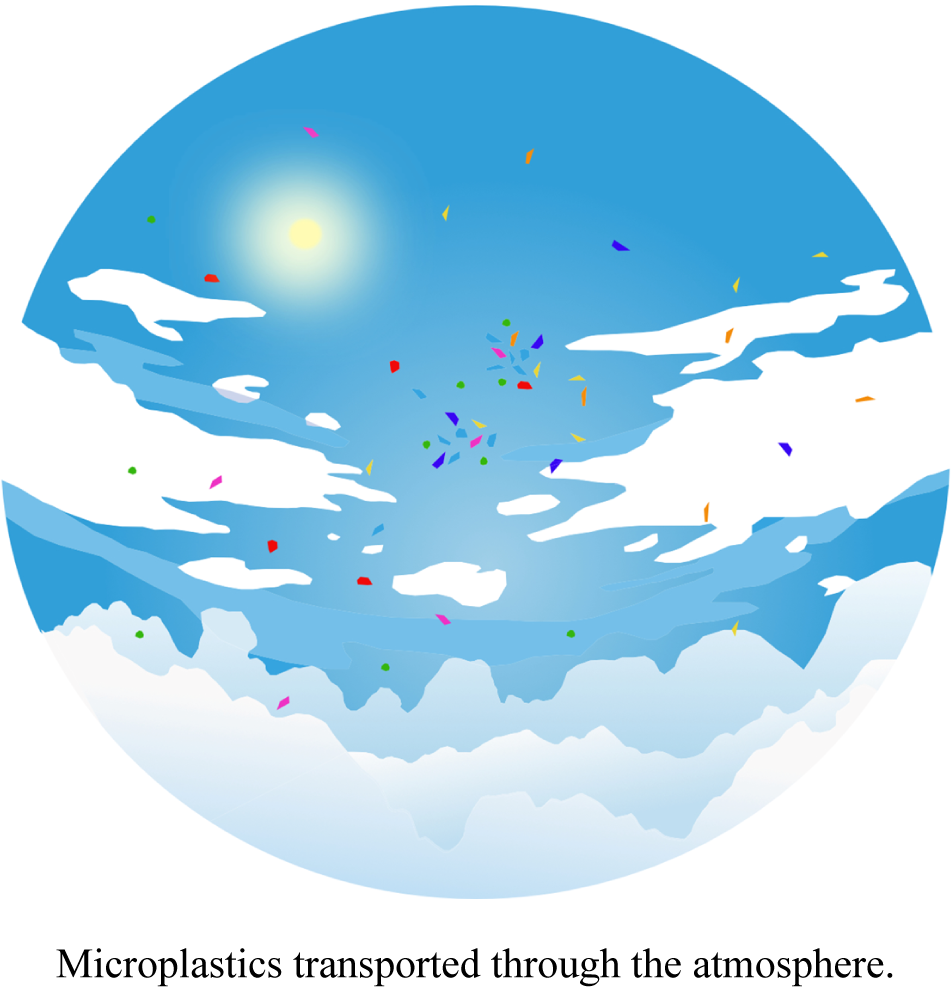
One of the most continuous and potentially greatest pathways for microplastic transport is through the atmosphere (Ryan et al., Reference Ryan, Allen, Allen, Maselli, LeBlanc, Kelleher, Krause, Walker and Cohen2023). The atmosphere can easily be considered one of the last planetary frontiers with regard to plastic pollution, and our understanding of microplastic input, transport and distribution is relatively sparse. Due to the small size of microplastics, once they become airborne, they can persist in the atmosphere for long periods and undergo further degradation from weathering processes (Seo et al., Reference Seo, Shin, Song, Lim, Ok and Weon2024). Understanding how the atmosphere contributes to the global transport and environmental and human health impact of this omnipresent contaminant is critical to addressing microplastic pollution. For example, the residence time and accumulation of microplastics in human lungs are not yet clear. The movement and distribution of particles in airways is influenced by the aerodynamic particle size, whereby larger particles cannot travel deep into the lungs and smaller particles can readily distribute throughout the respiratory system (Wright and Borm, Reference Wright and Borm2022). The presence of fine particulate matter (PM2.5) is a major health concern, especially regarding non-communicable diseases as, once in the alveolar sacs, they can impede critical processes like gas exchange and can be transferred across the respiratory-blood epithelial barrier (Brunekreef and Holgate, Reference Brunekreef and Holgate2002). Disturbingly, decades of research have shown that PM2.5 atmospheric pollutants have been significantly correlated with respiratory disease and mortality (Brunekreef and Holgate, Reference Brunekreef and Holgate2002). A contaminant as morphologically and chemically diverse as microplastics should be prioritized for regulation under the Global Plastics Treaty as it is in other MEAs to address air pollution (Raubenheimer and McIlgorm, Reference Raubenheimer and McIlgorm2017; Rochman et al., Reference Rochman, Brookson, Bikker, Djuric, Earn and Bucci2019).
The 1987 Montreal Protocol on Substances that Deplete the Ozone Layer (Montreal Protocol) is one of the most successful global environmental treaties that specifically addresses air quality (Schiermeier, Reference Schiermeier2009). In response to the 1970s identification of the depletion of ozone and the associated ozone “hole” over Antarctica, the global community came together to phase out ozone-depleting compounds, including chlorofluorocarbons (CFCs), from use (Solomon et al., Reference Solomon, Alcamo and Ravishankara2020). The success of this MEA is in part because “industry took responsibility for the environmental impacts of the products they produced.” Furthermore, the success of this treaty was attributed to the worldwide commitment to the phase-out of ozone-depleting compounds (e.g. CFCs) and the use of comprehensive targets and benchmarks to monitor and ensure the delivery of these commitments (Raubenheimer and McIlgorm, Reference Raubenheimer and McIlgorm2017). In addition to the clear targets, there are regular (re)assessments of the targets (every 2–4 years), and importantly, the scientific body associated with the treaty conducts regular scientific assessments to define target applicability and effectiveness.
The Montreal Protocol was designed to allow for flexibility for the parties, enabling them to adapt strategies and priorities while still meeting the goals for reducing CFCs and ultimately leading to an eventual phase-out (Solomon et al., Reference Solomon, Alcamo and Ravishankara2020). This flexibility is crucial for ensuring the ongoing success of the Montreal Protocol, especially if new scientific information and technologies become available. Lessons that can be learnt from the Montreal Protocol to address atmospheric microplastics in the Global Plastics Treaty include that monitoring atmospheric pollution is vital to addressing environmental human health concerns, that hosting ongoing international dialogue is critical to the scientific evidence-based design of Treaty goals and that both these approaches around monitoring and dialogue are necessary to achieve ambitious impacts at a global scale.
Even before the Montreal Protocol, the 1979 Convention on Long-Range Transboundary Air Pollution (CLRTAP) is another key global convention that demonstrates the importance of and effectiveness in regulating atmospheric pollution. This convention is one of the most geographically extensive MEAs and covers almost 50 million km2 and a quarter of the world population (Byrne, Reference Byrne2017). Given the diversity of air contaminants, subsequent protocols have been established to address their regulation, including nitrogen oxides, sulphur oxides (i.e. sulphur dioxide), heavy metals and metalloids (i.e. mercury) and PM2.5. The regulatory consideration of the latter pollutant reflects the importance of including atmospheric microplastics in the Global Plastics Treaty. And if the inclusion of microplastics in the Global Plastics Treaty remains a barrier for some delegates representing the “like-minded group” (a coalition of countries, primarily fossil fuel producers, who are actively opposing the inclusion of provisions in the Global Plastics Treaty such as restricting plastic production), then perhaps the CLRTAP could be updated to include the consideration of microplastics under PM2.5, in addition to or instead of inclusion of atmospheric microplastics in the Global Plastics Treaty.
Despite the historical emphasis of addressing global environmental issues through atmospheric health, as exemplified by the Montreal Protocol and the CLRTAP, the atmospheric compartment has been mostly absent from previous versions of the Global Plastics Treaty text in negotiations to date. Vince et al. (Reference Vince, Almroth, Grilli, Dwivedi, Brien, Beyer and Vince2024) critically analysed the zero draft of the Treaty produced from INC-2 (held in Paris, France, in June 2023) and made the initial observation that atmospheric microplastics were omitted from the draft Treaty text. Vince et al. (Reference Vince, Almroth, Grilli, Dwivedi, Brien, Beyer and Vince2024) identified this as highly problematic and suggested that “atmospheric input” be included within the future versions of the draft text so that end-of-life plastics could be better defined within the Treaty. More specifically, it was recommended that the term “the atmosphere” be included in combination with the aquatic and terrestrial environment within sections like Objectives, Option 2 “…including the environment [and other aquatic as well as terrestrial ecosystems]” (Vince et al., Reference Vince, Almroth, Grilli, Dwivedi, Brien, Beyer and Vince2024). The underrepresentation of the atmospheric pathway was not surprising since the announcement of the Global Plastic Treaty under UNEA Resolution 5/14 initially emphasized the importance of addressing plastic pollution, “including in the marine environment” without mentioning pollution in the atmosphere or other environmental compartments.
The academic community was not the only stakeholder group that highlighted the absence of atmospheric microplastics from earlier versions of the Global Plastics Treaty draft text. In fact, there was support from the broader international community to promote the representation of atmospheric microplastic pollution as a vital consideration with regard to air quality. The World Health Organization (WHO) submitted an information document prior to the fifth session of the INC (INC-5) that stated that within the Treaty, under Article 7 Emissions and Releases, there should be an “aim to minimize and avoid any emissions related to plastic products with potential health risks and releases of nano and microplastics in all ecosystems (including the atmosphere) throughout the plastics lifecycle” (World Health Organization, 2024). The inclusion of “atmosphere” in this WHO information document highlights the level of awareness that the atmosphere is an important pathway for the transport of microplastics that can lead to implications for human health (e.g. respiratory disease and mortality). Within the WHO information document, the atmospheric compartment was noted as an area of research interest and was mentioned several times, without the use of brackets, alongside other environmental compartments like “air, water and sediments.”
As the goal of finalizing the negotiations for the Global Plastics Treaty at the first part of the fifth session of INC (INC-5.1) was not realized, there is a valuable opportunity to push for more inclusion and objectives that include atmospheric microplastics during upcoming negotiations at the second part of the fifth session (INC-5.2) from 5 to 14 August 2025 in Geneva, Switzerland. The atmospheric compartment is as important to monitor as marine, freshwater and terrestrial compartments and subsequent biota. The explicit inclusion of the atmosphere in draft Treaty text would provide the opportunity to further advance the discussion around the “elephant in the room,” atmospheric microplastics.
To ensure that atmospheric microplastics are present within the Global Plastics Treaty text, the following are recommended (relevant articles for these considerations are presented in brackets):
-
i. Emphasize relevant terminology within the final draft [Article 2 and throughout the Treaty]: Ensure that the inclusion of the terms/words “air” and/or “atmosphere” and/or “atmospheric microplastics” be included alongside other environmental compartments like terrestrial and aquatic (marine and freshwater) environments. The importance of clear terminology cannot be understated as this document can be used as the foundation for future amendments and subsequent protocols to be developed for more targeted actions.
-
ii. Emphasize plastic pollution management from a top-down approach [Articles 3, 5]: Upstream measures such as capping plastic production are critical to reducing subsequent microplastic pollution. For example, Cowger et al. (Reference Cowger, Willis, Bullock, Conlon, Emmanuel, Erdle, Eriksen, Farrelly, Hardesty, Kerge, Li, Li, Liebman, Tangri, Thiel, Villarrubia-Gómez, Walker and Wang2024) found a direct 1:1 linear relationship between production and plastic pollution in the environment. Other researchers, such as Bergmann et al. (Reference Bergmann, Almroth, Brander, Dey, Green, Gundogdu, Krieger, Wagner and Walker2022) and Baztan et al. (Reference Baztan, Jorgensen, Almroth, Bergmann, Farrelly and Muncke2024), have called for caps on global plastic production (upstream measures) to curb plastic pollution in concert with other solutions across the entire plastics lifecycle. Other solutions across the entire plastics lifecycle include improvements to global plastic recycling (downstream measures) (Walker and Xanthos, Reference Walker and Xanthos2018; Singh and Walker, Reference Singh and Walker2024) and improvements to product design or development of microplastic capture technologies for plastic products known to contribute to atmospheric microplastic pollution (e.g. dryer emissions, automotive tyres) (Erdle et al., Reference Erdle, Nouri Parto, Sweetnam and Rochman2021).
-
iii. Set clear empirical targets on pollution reduction [Articles 7, 14, 15, 18]: Comprehensive empirical targets should be established to mitigate emissions of atmospheric microplastics from “leaky” regions (e.g. urban centres, industrial regions), and targets should also be placed on activities that result in the generation and release of secondary microplastics (e.g. dryer emissions, roadsides) (Erdle et al., Reference Erdle, Nouri Parto, Sweetnam and Rochman2021). For example, implementation of microplastic capture technologies such as dryer filters is known to reduce microfibre emissions compared to dryers with no filters and could be reported. These science-based targets should ensure that atmospheric microplastics of various size classes are considered. The framework to reduce pollution should be informed by the structure of other relevant successful MEAs (e.g. the Montreal Protocol and CLRTAP), and goals should be informed by the present science and data obtained from monitoring.
-
iv. Establish a global atmospheric monitoring network [Articles 7, 14, 15, 18]: A global network of atmospheric monitoring observatories should be established to: (a) identify “leaky” regions or sources/activities and (b) monitor temporal changes in microplastic concentrations via long-range processes. For example, many countries already have established national air quality monitoring networks such as the Canadian National Air Pollution Surveillance Program (NAPS) (Giacosa et al., Reference Giacosa, Rainham and Walker2023).
-
v. Harmonize scientific methods that can be implemented effectively in both high- and low-income countries to ensure global equity [Articles 11, 12, 18]: As the field and laboratory methods for atmospheric microplastic science are rapidly developing, it is necessary to establish specialized working groups of global experts that can develop and harmonize methods that are effective and up to date with science. Furthermore, sampling needs to be rooted in equity, and collected data need to represent countries of all economic standings, including by ensuring adequate access to financial resources. Accessibility to producing this science should involve aspects of community involvement (e.g. citizen science) and infrastructure to process samples.
-
vi. Use atmospheric microplastic monitoring data to inform progress on Global Plastics Treaty goals [Articles 15, 16]: Data obtained from iii. and iv. would allow parties to assess the effectiveness of mitigation and reduction strategies for atmospheric microplastics in relation to the empirical targets established by the Global Plastics Treaty (see iii.).
-
vii. Measuring atmospheric microplastics to assess the bigger impact of curbing plastic pollution [no relevant article present within the current draft Global Plastics Treaty text]: Atmospheric microplastics can be used as a metric to assess whether broader-scale changes to plastic pollution reduction strategies implemented by the Global Plastics Treaty are effective.
Continued dialogue under the upcoming “second part” of the fifth session of the INC, INC-5.2, must consider atmospheric microplastics to be able to fully address the global, transboundary threat of plastic pollution.
Open peer review
To view the open peer review materials for this article, please visit http://doi.org/10.1017/plc.2025.10004.
Author contribution
Justine Ammendolia: methodology, formal analysis, validation, writing – original draft preparation, and writing – reviewing and editing. Deonie Castle: writing – reviewing and editing. Kelsey Richardson: writing – reviewing and editing. Tony R. Walker: conceptualization, methodology, formal analysis, writing – reviewing and editing, and supervision.
Competing interest
The authors declare that they have no known competing financial interests or personal relationships that could have appeared to influence the work reported in this letter to the editor.
Ethics statement
Ethical approval was not sought for this paper because the research analysis conducted here relies upon publicly available information on the Global Plastics Treaty. Ethics approval was not required for this letter to the editor.

 Open access


Comments
Dear Steve,
Please find attached our invited letter to the Editor manuscript titled, ‘Why atmospheric microplastics need to be urgently addressed in ongoing UN Global Plastics Treaty negotiations?’ Our letter responds to your email invitation to Contribute a Letter to the Editor on the Global Plastics Treaty dated April 7th.
Many thanks for the invitation and for your consideration (on behalf of my co-authors), Tony