

Introduction
‘Why is it that when we pay for childcare and house-cleaning, when we eat out, when we buy milk for our babies, or when we call in the mechanic or the plumber, these add to GDP and count toward economic growth and progress; but when we look after our own children, clear our own house, cook our own meals, breastfeed our babies, tune up our own cars, and fix our own leaking faucets, these have no value in our current measures of progress?’ (Collas-Monsod Reference Collas-Monsod, Jain and Elson2011)
GDP currently excludes non-market household services such as breastfeeding, rendering women’s unpaid lactation work invisible to policymakers.
Since the early 1950s, unpaid work has been deemed by national statisticians to be a non-economic phenomenon – and therefore been excluded from measurement in GDP. The UN System of National Accounts (SNA) has treated household production as outside GDP, reflecting a gender bias that invisibilizes women’s non-market productivity. Feminist critiques emphasise that ‘what is measured is valued’, and note that excluding breastfeeding distorts policy priorities and resource allocation.
This paper advances the ‘Beyond GDP’ agenda by demonstrating that breastfeeding and human-milk production meet standard criteria for economic pricing – they respond to market incentives, generate prices through milk banks and informal exchanges, and can thus be monetised for inclusion in key economic indicators.
We first summarise the historical drivers of breastfeeding’s displacement by formula, then review debates over non-market valuation in the SNA, and finally present new estimates of breast milk’s economic value in selected countries. Our central question: Can market-derived prices provide a robust proxy for valuing women’s unpaid breastfeeding work in GDP? We show that incorporating human milk into key economic indicators through market pricing not only reflects its true economic contribution but also advances human rights and the sustainable development agenda. Moreover, by accounting for the unmeasured health and environmental costs of commercial breast milk substitutes, we enable a more comprehensive true-cost accounting of market-based economic development under current paradigms.
Economic drivers of breastfeeding and its displacement as the evolved food system for infants and young children
Despite wide variation in its practice in time and place, breastfeeding has been the evolved first food system for children and child spacing mechanism throughout human history (Eaton et al Reference Eaton, Pike, Short, Lee, Trussell, Hatcher, Wood, Worthman, Nicholas, Konner, Hill, Bailey and Hurtado1994; Sellen Reference Sellen2001; Volk and Atkinson Reference Volk and Atkinson2013), and women have been the main producers in what can be characterised as the ‘infant and young child (IYC) food economy’.
Figure 1 provides a conceptual framework for analysing the main stakeholders and producers in the IYC food economy. It encompasses women’s non-market provisioning of milk to infants and young children through breastfeeding or milk sharing and providers in the not-for-profit and for-profit market sectors with an interest in breastfeeding and lactation, as well as market sector suppliers of breast milk substitutes, notably cow milk and commercial milk formula products. This illustrates a range of potential economic and competitive interactions between the household and market sectors and the relative magnitude of their output. It also shows the spectrum of non-market and market-related exchanges that occur in the not-for-profit, market sector, where both financial and altruistic motivations can be at play. This conceptual framework points to the political economy of infant and young child feeding, a topic addressed in several studies (Palmer Reference Palmer2009; Smith et al. Reference Smith, Galtry and Salmon2014) and most recently as part of the 2023 Lancet Series on Breastfeeding (Baker et al. Reference Baker, Smith, Garde, Grummer-Strawn, Wood, Sen, Hastings, Pérez-Escamilla, Ling, Rollins and McCoy2023).
The infant and young child (IYC) food economy.

The short history that follows applies this conceptual framework to illustrate how economic incentives set by wages, prices, and technological change, as well as cultural practices and marketing, shape infant and young child feeding patterns across populations over time. Several studies of infant feeding trends document the economic, historical, and other drivers of declining breastfeeding and human milk production during 19th-century industrialisation in Europe and North America, as well as more recently in some developing countries (Apple Reference Apple1987; Baumslag and Michels Reference Baumslag and Michels1995; Fildes Reference Fildes1986; Golden Reference Golden1996; Minchin Reference Minchin1985; Palmer Reference Palmer1988; Swanson Reference Swanson2014; Thorley Reference Thorley2008; Wickes Reference Wickes1953; Wolf Reference Wolf2003).
Three key themes that can be identified across these countries are: disincentives and barriers to breastfeeding created by labour markets and unresponsive social institutions during industrialisation; the low valuation placed on breastfeeding, lactation work and human milk by medical institutions and employers of wet nurses during the 19th and early 20th century; and a 20th century alliance of public health regulators, medical science, and the dairy industry to develop commercial breast milk substitutes that were cheaper, more convenient, and safer than hiring wet nurses, purchasing from milk sellers, or implementing maternity protections to keep new mothers and infants out of poverty (Smith Reference Smith and Cohen2017a).
Lack of long-term data series on the non-market component of economic activity in the IYC food economy, that is, on breastfeeding and lactation, hinders historical analysis of the economic determinants and productivity implications of changing breastfeeding practices. However, in Norway, annual data has been compiled from retrospective reports by women for several decades back into the 1850s (Liestøl et al Reference Liestøl, Rosenberg and Walløe2008). This data series shows that the decline in breastfeeding in that country over the 20th century was not because fewer women initiated breastfeeding but instead took the form of shorter breastfeeding duration. Breastfeeding duration in Norway declined slowly from 1860, then more sharply throughout the country after 1920. While over 60% of Norwegian mothers and infants breastfed at 6 months in 1860, fewer than 20% did so in 1967. The proportion who had ceased breastfeeding by 12 months (40%) increased greatly between 1920 and the late 1960s, when virtually all Norwegian women had weaned their babies by 12 months.
The identified causes of these breastfeeding trends in Norway are illustrative of historical trends identified elsewhere. Employment participation contributed to a shorter duration of breastfeeding, particularly by unmarried mothers in the decades from 1860 to 1920 (Liestøl et al Reference Liestøl, Rosenberg and Walløe2008). From the 1950s, restrictive hospital and maternity care regimes were central, reducing breastfeeding duration as well as preventing initiation. This was in the context of increased hospitalisation of deliveries during the 1950s and 1960s, high rates of medicated births, and strict feeding regimes involving separation of mothers from infants, all of which hindered the establishment of breastfeeding and disrupted the establishment of an adequate milk supply (Liestøl et al Reference Liestøl, Rosenberg and Walløe2008). By the 1970s, the role of milk formula company marketing within health facilities was also well documented, leading to unnecessary supplementation and disturbed lactation (Helsing Reference Helsing, Eide and Kracht2005). A return to breastfeeding in numerous countries from the late 1960s arose from maternal activism as well as policy interventions (Austveg and Sundby Reference Austveg and Sundby1995; Rosenberg Reference Rosenberg1989). Norway provided 12 weeks of paid maternity leave from the late 1960s (40 weeks from 1994), and this helped return breastfeeding duration to around 40% at 12 months (Helsing Reference Helsing, Eide and Kracht2005; Norwegian Health Directorate 2015). There was also greater regulation of the marketing of breast milk substitutes from the 1980s and a systematic introduction of ‘breastfeeding friendly’ hospital practices in the 1990s. Notably, breastfeeding initiation remained high in Norway throughout; hospital milk banks remained operational throughout the postwar decades and continue to operate throughout the country today, in part due to national policies that all children should receive human milk during early infancy (Grovslien and Gronn Reference Grøvslien and Gronn2009).
Wet nurses have long been employed to supply breastfeeding or breast milk where mothers or female relatives were unavailable or unable to breastfeed their infant themselves and were a respected occupation in many countries (Fildes Reference Fildes1988; Fildes Reference Fildes, Stuart-Macadam and Dettwyler1995). During the late 1800s, wet nursing, or milk selling, became stigmatised in Europe and North America as it increasingly became a livelihood of unsupported or impoverished mothers forced to give birth in charity hospitals. Relatedly, orphanages found it difficult to secure human milk at an acceptable cost, including because of the costs of accommodating and managing an unruly & coerced workforce (Golden Reference Golden1988; Golden Reference Golden2020; Swanson Reference Swanson2014). Until the reemergence of milk banks at scale in North America and globally in the 1990s, only a small number of milk banks provided human milk to a limited number of vulnerable babies (Paynter and Hayward Reference Paynter and Hayward2018). As industrialisation proceeded, factory employment became more attractive to young women than domestic service or wet nursing, and the high wage cost and scarcity of wet nurses or milk sellers also reduced their appeal to orphanages, institutional purchasers, and private employers, reducing the extent of this form of employment (Featherstone Reference Featherstone2002; Thorley Reference Thorley2008).
Meanwhile, women’s productivity in lactation work was undermined by competition from technological changes and public health measures, which escalated dairy industry productivity and perceived safety from the early 1900s (Albanesi and Olivetti Reference Albanesi and Olivetti2007). As medical communities endorsed commercial milk formula products from the 1930s (Greer and Apple Reference Greer and Apple1991), lactating women found themselves engaged in intense price competition against low-cost dairy and commercial producers of breast milk substitutes, whilst facing competing labour market rewards and requirements for their time and presence in work environments that separated them from their infants and young children.
Especially with the escalation of marketing in the post-war trade liberalisation era, food or pharmaceutical companies engaged in manufacturing and marketing processed milk powder and dairy products became dominant competitors to breastfeeding (Smith Reference Smith2007a). Researchers have shown how the cost of commercial milk formula plummeted relative to women’s wages in the US over the 20th century (Albanesi and Olivetti Reference Albanesi and Olivetti2007).
This declining trend and scale of loss of women’s production of breastfeeding and breast milk within the IYC food economy over the past two centuries has been largely unmeasured and unacknowledged in the literature, including on women’s unpaid care work. Only recently has it come to the attention of economic historians in the UK (Humphries Reference Humphries2024). As a consequence, the large economic losses involved in commercial infant milk formula displacing breastfeeding passed unremarked until the 1970s (Jelliffe and Jelliffe Reference Jelliffe and Jelliffe1978). From that time, researchers documented that the substantial displacement of human milk supply by manufacturers of commercial breast milk substitutes that had been occurring in developing countries over the past decades had been a significant and ongoing loss of food production with major economic, environmental, and health significance (Berg Reference Berg and Berg1973). Nevertheless, only in the early 1990s was the economic value of human milk estimated for a high-income country, Norway (Oshaug and Botten Reference Oshaug and Botten1994). Norway remains the only country to count human milk in its food supply statistics and is considered further in Section 3.
Using GDP as an indicator of the economy – conceptual critiques and measurement controversies
Feminist analyses have shown how social institutions, public regulations, and policies perpetuate systems that coerce women’s free or low-cost availability for reproductive and productive work (Folbre Reference Folbre2004; Folbre and Weisskopf Reference Folbre, Weisskopf, Ben-Ner and Putterman1998). Even in the 1930s, Margaret Reid called for a recognition of the importance of the household to the economic system, documenting and analysing the productivity of the household economy and its implications for standards of living (Folbre Reference Folbre1996; Reid Reference Reid1934). It is noteworthy that Reid’s 1934 analysis incorporated a time-use study of infant care and feeding, which is an archetypally time-intensive care activity.
GDP remains a widely used concept for measuring the economy. Since the early 1950s, the ‘System of National Accounts (SNA)’ (Commission of the European Communities 2008) has been the agreed international statistical framework for all countries to define and measure GDP and assess the value of national economic activity. Economists have long been aware of the limitations of measuring economic activity and material well-being using conventional GDP and related economic statistics. The leading early national accounts researchers had warned from the 1940s about the bias introduced to economic statistics by excluding non-market household production (Kuznets Reference Kuznets1941). From the early 1970s, the SNA came under increasing criticism for providing a narrow, inaccurate, and misleading measure of economic well-being, as well as for its treatment of environmental degradation (Hawrylyshyn Reference Hawrylyshyn1976; Mamalakis Reference Mamalakis1996; Nordhaus and Tobin Reference Nordhaus and Tobin1972; Nordhaus Reference Nordhaus2000; Weinrobe Reference Weinrobe1974; Zolotas Reference Zolotas1983).
From the 1980s, there was growing public attention to the gender-biased interpretation of economic progress and development that underpinned the SNA and GDP measurement. Marilyn Waring’s comprehensive and damning critique of the UN system of national accounts (Waring Reference Waring1988) showed how the unpaid work traditionally done by women has been systematically excluded from measurement by national economic statistical systems, alongside a comparable non-measurement of environmental pollution and depreciation or the depletion of environmental assets. Particularly by underreporting subsistence and non-market household production, this economic accounting framework has ignored the pivotal economic role of women, made some countries seem poorer than they are, and overstated economic growth and progress by valuing market activity but not the unpaid household production that it displaces (Benería Reference Benería1992; Boserup Reference Boserup1970; Smith Reference Smith1987).
Furthermore, recognition of ‘a fourth sector’ in the process of economic development – women’s role in household human capital formation – illustrated the need to measure household as well as public investments in human capital (Cloud and Garrett Reference Cloud and Garrett1996). Macroeconomic modelling and policy have typically assumed that the labour force (human capital) comes from nowhere (Walters Reference Walters1995). Studies in the 1990s drew attention to how national accounting practice makes invisible the crucial economic productivity applied to human capital building by families’ provision of health care and education services to children (Abraham and Mackie Reference Abraham and Mackie2005; Folbre Reference Folbre2012; Smith and Ingham Reference Smith and Ingham2005). A study conducted by the official statistician in the 1920s in Australia showed that the contribution of unpaid labour to the formation of human capital was substantial (Treadgold Reference Treadgold2000).
In 2009, a major review of the use of GDP as a way of measuring economic progress was conducted for the French president in the wake of the Global Financial Crisis. The review was led by two of the world’s most eminent economists, Nobel Prize winners Amartya Sen and Joseph Stiglitz (Stiglitz et al Reference Stiglitz, Sen and Fitoussi2009), and coordinated by a leading French economist, Jean-Paul Fitoussi. These influential international experts in national accounting cited human milk production as an example of how current practices for measuring GDP devalued women’s unpaid work and biased policymaking. In their reflections on measuring economic progress, they concluded that,
There is a serious omission in the valuation of home-produced goods – the value of breast milk. This is clearly within the System of National Accounts production boundary, is quantitatively non-trivial and also has important implications for public policy and child and maternal health. (Stiglitz et al Reference Stiglitz, Sen and Fitoussi2009, 39)
The Sen-Stiglitz-Fitoussi report set in train a reform agenda known as ‘Beyond GDP’. Many countries now collect household time use data, which would facilitate the inclusion of unpaid household work in GDP. Work in relevant UN agencies has continued to progress in this area. It is worth noting that as well as being a pioneer in time use studies, Australia produced accounts for human capital assets from as early as the 1920s and experimental environmental accounts in the early 1990s (Australian Bureau of Statistics 2001; Ingham Reference Ingham1991; Treadgold Reference Treadgold2000; Wei Reference Wei2001).
Nevertheless, countries’ continued exclusion of unpaid household work reinforces concerns that an important reform agenda laid out by Waring’s critique of national accounting as ‘applied patriarchy’ remains largely unimplemented (Saunders and Dalziel Reference Saunders and Dalziel2016). In a sharp contrast to the lack of progress in integrating time-use measurement of the very large household production sector, priority changes to national accounting practice were requirements in Europe to count illegal sexual services in GDP since 2014 (Abramsky and Drew Reference Abramsky and Drew2014). This is extremely difficult to measure accurately and relatively small compared to household production but affects international comparisons and is of practical interest to taxation authorities.
In 2018, leading national accounting experts at OECD Statistics showed how economic growth was significantly overstated in several major countries since the 1970s due to the non-measurement of unpaid childcare work (van de Ven et al Reference van de Ven, Zwijnenburg and De Queljoe2018). For some countries, properly measuring the shift of production from unpaid childcare to the market sector would have wiped out measured GDP growth over periods since the 1970s. The same year, Maria Mazzucato drew attention to the continued omission of unpaid work from GDP and the lack of credible arguments for inaction (Mazzucato Reference Mazzucato2018). The same year, the OECD stated that addressing concerns about GDP was ‘of crucial importance for the credibility and accountability of public policies but also for the very functioning of democracy’ (Organization for Economic Co-operation and Development (OECD) 2018).
National accounting methodology on breastfeeding
Partly in response to feminist argument and advocacy in the previous decades (Smith Reference Smith, Bjørnholt and McKay2014), the SNA had been modified in 1993 to take better account of subsistence production; GDP should include all ‘own account’ production of goods by households. This included agricultural subsistence production such as sowing, planting, tending, and harvesting field crops; growing vegetables, fruit, and other trees and shrub crops; gathering wild fruits, medicinal and other plants; tending, feeding, or hunting animals mainly to obtain meat, milk, hair, skin, or other products; and storing or carrying some basic processing of this produce. SNA93 also provided for any agricultural produce consumed on-farm to be included in GDP.
Since 1993, the national accounting framework has thus included within the GDP production boundary all non-marketed goods, including the production, processing, and storage of food by households. Applying these international guidelines, for example, the Australian Bureau of Statistics (ABS) includes imputations for the value of homegrown fruit, vegetables, eggs, beer, wine, and meat in estimates of final private consumption expenditure and therefore GDP. Australian core accounts now include ‘the own account production of all goods retained by their producers for their own final consumption or gross capital formation’ (Australian Bureau of Statistics 1997, 46), where these are quantitatively significant, thereby following the practice set down in SNA93 (para 6.18).
Reflecting the changes to the SNA since 1993, women’s production of breast milk (though not breastfeeding) now comes within the scope of GDP measurement (Smith Reference Smith2012; Smith Reference Smith2013; Smith and Ingham Reference Smith and Ingham2005). While breastfeeding is a childcare activity classified by national accountants as an unpaid household service to be included in ‘satellite accounts’, breast milk is a commodity that meets the official criteria for inclusion within the SNA93 core production boundary (Smith and Ingham Reference Smith and Ingham2001; Smith and Ingham Reference Smith and Ingham2005). In national accounting language, it can be produced, stored, and sold on markets and thus be valued (Commission of the European Communities 1993, para. 6.7; Smith and Ingham Reference Smith and Ingham2001b; 2005c). The existence of markets in human milk means there are prices of a closely related or analogous product – a shadow price – from which to impute its economic value.
A variety of practical and conceptual barriers are put forward by statistical agencies against including non-market household services in GDP (Benería Reference Benería1992; Collas-Monsod Reference Collas-Monsod, Jain and Elson2011; Elson Reference Elson2017; Esquivel Reference Esquivel2011; Smith Reference Smith, Bjørnholt and McKay2014). For example, the Australian Government was advised by the Australian Bureau of Statistics in 1990 that unpaid work should continue to be excluded from GDP because the market sector was the primary concern for macroeconomic policy and because unpaid household work was not related to market forces as directly as goods (Australian Bureau of Statistics 1990, 6-7). Collas-Monsad (Collas-Monsod Reference Collas-Monsod, Jain and Elson2011, 95) also identified arguments in the Philippines’ statistical agency that excluding unpaid work is necessary to maintain the usefulness of the accounts to policymakers. This was said to avoid ‘overburdening or disrupting the central system’ (Commission of the European Communities 1993, para. 21.4). A third reason is said to be the costs involved in changing the collection and use of national accounts (Fraumeni Reference Fraumeni2010, 30).
Exclusion of unpaid breastfeeding and lactation work from GDP raises comparable issues to exclusion of other unpaid household production highlighted by feminist economists, although it is unique in that the female body is the production unit. As noted in the previous section, the prevalence of breastfeeding and the practice of wet nursing across many countries have been directly influenced by market forces, and the availability of human milk has responded to prices and wages as well as competition from breast milk substitutes. Direct competition with breastfeeding by companies selling breast milk substitutes has been influential since at least the 1930s (Smith Reference Smith2004; Smith Reference Smith, Dixon and Broom2007b). Economic studies continue to show that maternal labour market participation and time for breastfeeding also compete directly (Mandal et al Reference Mandal, Roe and Fein2012). Human milk is a good that is or can be produced, stored, and exchanged or traded in commercial markets.
Economic determinants of breastfeeding and lactation are now well explored by economists, demographers, and anthropologists (Butz Reference Butz1977; Butz Reference Butz1981; Dib et al Reference Dib, Fewtrell and Wells2023; Sellen Reference Sellen2007; Tully and Ball Reference Tully and Ball2013). As economic pricing is relevant, and market prices are available, there remains the opportunity to measure its monetary value, including for inclusion in key economic statistics such as GDP.
Feasibility of measuring the macroeconomic value of breastfeeding
The practice of including dairy industry output such as cows’ milk and milk formula but ignoring milk production by mothers results in GDP misleadingly measuring a rise in economic activity when breastfeeding declines and milk formula sales rise, and a decline in productivity when breastfeeding increases (Smith and Ingham Reference Smith and Ingham2005). Despite the changes to SNA guidelines over three decades ago, national accounting practice continues to exclude human milk production from national economic accounts and economic statistics.
A key issue in national accounting for non-market production is the availability of a suitable shadow price for valuing production. The monetary value of human milk production and breastfeeding can be estimated using accepted national accounting valuation methods. As shown in the preceding section, breastfeeding and human milk production by lactating women are economic activities where both producers and consumers are influenced by economic rewards, including market incentives, and where breast milk is actively traded or exchanged, including across national borders.
From a national accounting methodological perspective, valuation of human milk or breastfeeding involves either using an ‘input cost’ based approach or using the ‘market value’ of the output. The different economic valuation methodologies within national accounting practice were first discussed in a study of Australian human milk production in 1999 (Smith Reference Smith1999). Input pricing refers to the time costs of breastfeeding or expressing milk. The preferred approach to valuing production in the national accounts system is using ‘market values’ of output, such as for breastfeeding or for human milk provision. Wages for wet nurses indicate a market output price for breastfeeding, though this price may also include an element of payment for childcare services. The 1999 study estimated that human milk production in Australia in 1992 was 33 million kg. Using a ‘market value of output’ approach to valuing this production, human milk production in Australia had a market value of $2.1 billion a year at that time. The 1992 estimate for Australia was based on a price of US$50 per litre paid by milk banks in Norway, which had been used for estimating the economic value of breastfeeding in that country (Oshaug and Botten Reference Oshaug and Botten1994). This illustrated that the value of human milk in Australia was qualitatively important compared to other goods produced for own consumption by households, which were valued at $1 billion in 1997 and counted in GDP by the ABS (Smith and Ingham Reference Smith and Ingham2005).
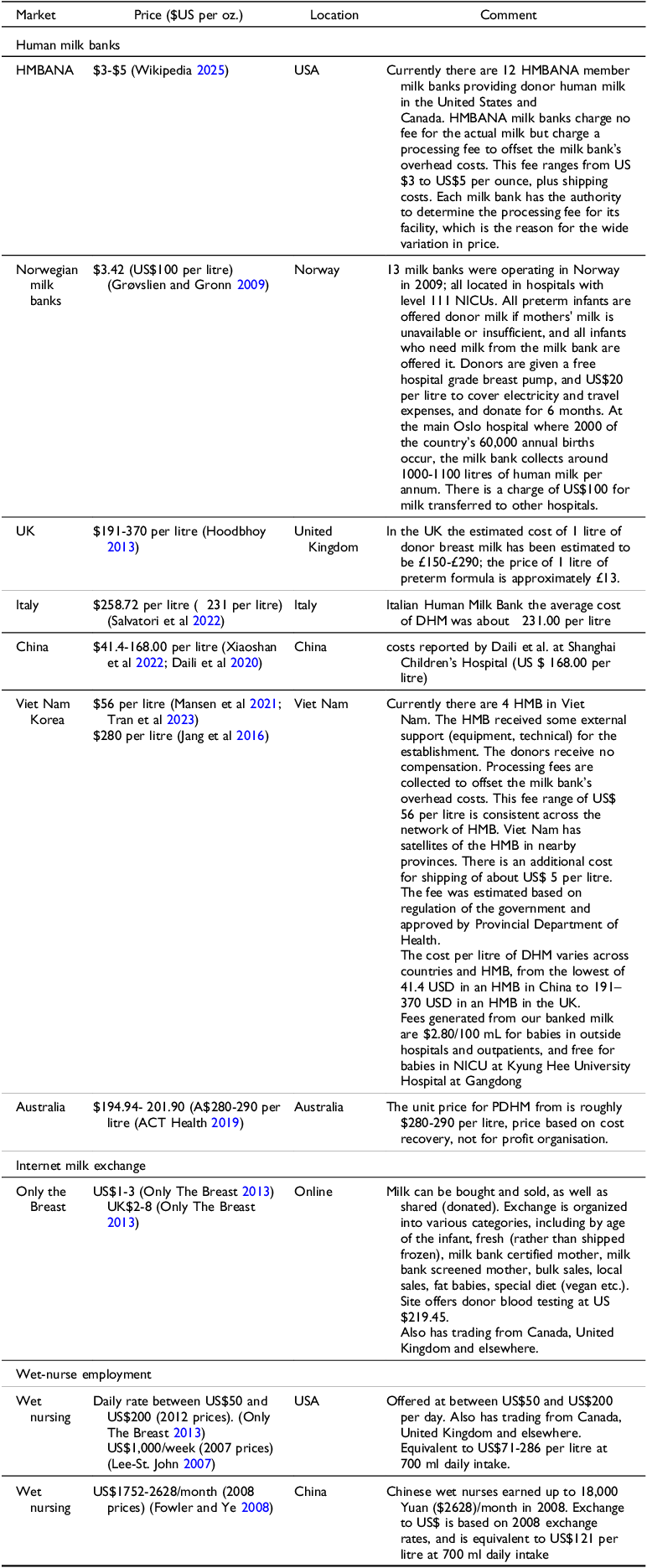
Table 1 summarises key economic characteristics of several representative country markets in human milk and provides examples of contemporary economic pricing of human milk. These include milk banks, internet trading, commercial infant feeding products, and women’s employment as wet nurses.
Market prices for human milk, $US per litre, selected countries

Sources: ACT Health (2019); Daili et al (Reference Daili, Kunkun and Guangjun2020); Fowler and Ye (Reference Fowler and Ye2008); Grøvslien and Gronn (Reference Grøvslien and Gronn2009); Hoodbhoy (Reference Hoodbhoy2013); Jang et al (Reference Jang, Cho, Kim, Kim, Park, Park, Kim, Choi, Bae and Chung2016); Lee-St.John (Reference Lee-St.John2007); Mansen et al (Reference Mansen, Nguyen, Nguyen, Do, Tran, Nguyen, Mathisen, Nguyen, Ngo and Israel-Ballard2021); Only The Breast (2013); Salvatori et al (Reference Salvatori, De Rose, Clemente, Gentili, Verardi, Amadio, Reposi, Bagolan and Dotta2022); Tran et al (Reference Tran, Nguyen, Nguyen, Barnett, Weaver and Mathisen2023); Wikipedia (2025); Xiaoshan et al (Reference Xiaoshan2022).
By 2020, an estimated 756 milk banks operated in 66 countries around the world (Tyebally Fang et al Reference Fang, Chatzixiros, Grummer-Strawn, Engmann, Israel-Ballard, Mansen, O’Connor, Unger, Herson, Weaver and Biller-Andorno2021). Economic analyses of costs and processing fees per litre show wide variations across countries, sectors, and institutions for supplying and receiving donor milk: costs and charges to patients (mostly reported as average rather than marginal costs) also depended on operating procedures, financing, and the source of donor milk (ACT Health 2019; Daili et al Reference Daili, Kunkun and Guangjun2020; Escuder Vieco et al Reference Escuder Vieco2023; Fengler et al Reference Fengler, Heckmann, Lange, Kramer and Flessa2020; Hoang et al Reference Hoang, Nguyen, Tran, Luu, Vu, Tran, Nguyen and Mathisen2024; Hoodbhoy Reference Hoodbhoy2013; Jang et al Reference Jang, Cho, Kim, Kim, Park, Park, Kim, Choi, Bae and Chung2016; Jegier et al Reference Jegier, Meier, Engstrom and McBride2010; Mansen et al Reference Mansen, Nguyen, Nguyen, Do, Tran, Nguyen, Mathisen, Nguyen, Ngo and Israel-Ballard2021; Salvatori et al Reference Salvatori, De Rose, Clemente, Gentili, Verardi, Amadio, Reposi, Bagolan and Dotta2022; Tran et al Reference Tran, Nguyen, Nguyen, Barnett, Weaver and Mathisen2023; Wesolowska et al Reference Wesolowska, Bernatowicz-Lojko, Sinkiewicz-Darol, Pawlus and Golicki2020). Costs range from around $US$41 per litre in China to $US300 or more in the UK (Hoang et al Reference Hoang, Nguyen, Tran, Luu, Vu, Tran, Nguyen and Mathisen2024), while charges to institutions and recipients vary in part due to differences in funding sources (Daili et al Reference Daili, Kunkun and Guangjun2020). Most milk banks charge a processing fee to those ordering donor milk to cover processing costs (Unger and O’Connor Reference Unger and O’Connor2024). For example, in the Philippines, official milk banks supplied human milk at a cost of around Php 180 an ounce (around US$135 a litre or US$4 an ounce) in 2015, although it could be sourced online much cheaper at around $US30 a litre (Santos Reference Santos2015). In Norway, human milk has been exchanged within the country’s human milk bank network for some years at around €130 (US$100) per litre, after covering a longstanding payment of around US$20 per litre for donor ‘expenses’ (Grøvslien Reference Grøvslien and Smith2021; Grovslien and Gronn Reference Grøvslien and Gronn2009).Footnote 1 Over the past decade, not-for-profit milk banks in the United States have sold human milk to health facilities at a price of around US$90-150 per litre (US$3-5 per ounce) (Buia and Reuters 2015; Wikipedia 2025). Human milk offered on internet milk trading sites such as Only the Breast in North America and the UK has also typically been priced at around US$3 per ounce for mothers with health certification, though many offer it for less (for example, the cost of postage or for around $1 per ounce to specified recipients) (Only The Breast 2013; 2024). Wages for wet nurses in China and the US were comparable or higher than equivalent milk bank fees (Fowler and Ye Reference Fowler and Ye2008; Lee-St.John Reference Lee-St.John2007). The United States-based company Prolacta offers $US1.20 per ounce to milk donors to compensate women for compensate for their time and effort in meeting its requirements for donation (Prolacta 2024).
Estimates of the monetary value of human milk production in selected countries
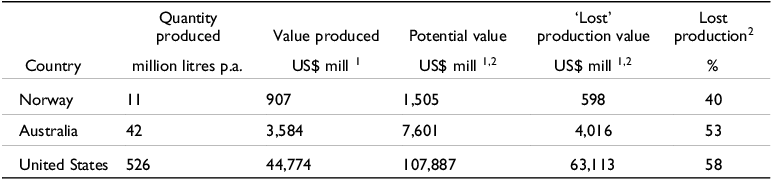
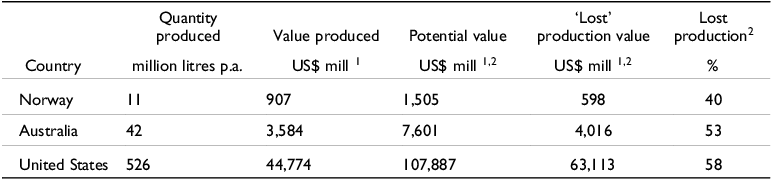
Table 2 presents the estimated economic value of breastfeeding for three selected high-income countries, Australia, Norway, and the United States, in 2012 from a study published in 2013 using the best available estimates of breastfeeding rates for those countries at that time (Smith Reference Smith2013).
Annual production of human milk for infants, 0-24 months, 2009-2010, selected countries
Sources: See Smith (Reference Smith2013).
Notes: 1 2012 prices. 2 biological potential of breastfeeding prevalence of 95% from 0 to 24 months.
The monetary value of the milk produced by breastfeeding mothers in those countries was approximately US$907 million, US$3,584 million, and US$44,774 million, valued at a price of US$3 per ounce (around US$85 per litre), the price charged by US milk banks. This might be compared with the market value of commercial baby food, including milk formula products: retail sales in these three countries in 2012 were reported by Euromonitor International to be US$108 million, US $643 million, and US 6,782 million, respectively, in 2012 (Euromonitor International 2017).
India and China are large and populous middle-income countries in Asia that present contrasting trends and policies on breastfeeding and human milk production. Estimates for the annual monetary value of human milk produced in these countries for 2008–12 are presented below, again using UNSNA guidelines and conventional economic valuation approaches to measuring economic production in GDP (Smith Reference Smith and Cohen2017a). In this study, published in 2017, human milk was valued at around US$100 a litre, consistent with milk bank charges in the United States and Norwegian milk bank prices around that time. There has been a considerable expansion of milk banking in both these countries in the past 5–10 years (Tyebally Fang et al Reference Fang, Chatzixiros, Grummer-Strawn, Engmann, Israel-Ballard, Mansen, O’Connor, Unger, Herson, Weaver and Biller-Andorno2021; Xiaoshan et al Reference Xiaoshan2022).
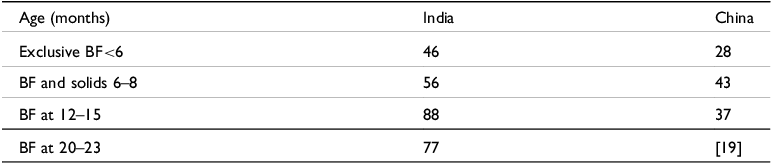
Table 3 and Table 4 summarise breastfeeding practices and findings on the value of human milk production in these countries (Smith Reference Smith and Cohen2017a).
Infant and young child feeding practices, 2008–2012, % breastfeeding (BF)

Sources: see Smith (Reference Smith and Cohen2017a).
Quantity and economic value of human milk, 0–24 months, India and China, 2005–2012

Sources: See Smith (Reference Smith and Cohen2017a).
Breastfeeding in India is near universal, with more than 90% of mothers still breastfeeding at 12 months, and most (77%) continuing through to 2 years. Exclusive breastfeeding is considerably lower, though still high by international standards. There is a growing affluent middle class in India, with an increasing number of births in hospitals, and a growing number of employed professional women are becoming a target for the marketing of breast milk substitutes. Quality maternity care standards to protect breastfeeding are also not widely implemented (World Health Organization (WHO) 2017a; b). However, India is a lower-middle-income country, most births are not in health institutions, and maternal labour force participation is very low. While maternity protection policies support breastfeeding, their implementation is weak. On the other hand, India has a comprehensive, legislated WHO Code of Marketing of Breast milk Substitutes, which is applied, including through strong and high-profile NGO activism in the courts, and limits baby food marketing activity (Euromonitor International 2013).
Breastfeeding has traditionally been very high in China, but the use of breast milk substitutes became widespread during the 1970s, and breastfeeding fell to a low point in the 1980s. The breastfeeding rate in China started to increase in the 1990s, responding to efforts to promote breastfeeding, including in hospitals, where nearly all Chinese babies are born. From the mid-1990s rates of ‘any breastfeeding’ at four months in most cities and provinces (including minority areas) were above 80% (Xu et al Reference Xu, Qiu, Binns and Liu2009) (see also Schulze et al Reference Schulze, Zhao and Young2009). However, breastfeeding declined dramatically in China in the subsequent decade. UNICEF reported in 2013 that exclusive breastfeeding prevalence for children aged 0–6 months had fallen from 67% in 1999 to around 27% (Hou Reference Hou2014). After a period of rapid market-based economic development, China has become an upper middle-income country, with strong growth of household incomes, including from high rates of female labour force participation. While maternity leave policies provide for 12 weeks of paid leave, this entitlement may not be fully accessible or enforced (Hou Reference Hou2014). Though China has partially implemented the WHO International Code through legislation, it has limited scope, and there is evidence to suggest that it is not effectively enforced (Liu et al Reference Liu, Dai, Xie and Chen2014).
The considerable decline in breastfeeding that has been documented in China since 1999 (Shen Reference Shen2016) resulted in a dramatic but unmeasured deterioration in unpaid household production. There was a loss of around 700 million litres of breast milk per year from the replacement of breast milk in the diet of infants, a loss of economic production value of around US$77 billion a year. Data is unavailable for breastfeeding among older infants and young children, but measuring a proportionate decline for the 6-month to 2-year-age group, the annual loss of production represented by declining breastfeeding in China since the 1990s is on the order of US$335 billion a year.
The study estimated that mothers in India produced over 7 billion litres a year of human milk, double the levels estimated in 1999. Potential production from increasing breastfeeding to biologically optimal levels was US$335 billion a year. The value of human milk produced in China was much lower, at around 2.3 billion litres in 2012, with an estimated market value of some US$248 billion. This estimate is broadly consistent with the unpublished study by Ross and colleagues in 2001 (Ross et al Reference Ross, Chunming, Zhenying, Wu, Gang, Yuying and Mingxia2001), which estimated about 4.2 billion litres of human milk were produced annually in China, at time when breastfeeding rates there were considerably higher.
By comparison, commercial baby food sales in India totalled around $425 million a year in 2012, far lower than the value of human milk produced by Indian mothers (Table 5). Table 5 reports data from the 2014 Euromonitor baby food market reports for India and for China. The Indian market for commercial baby food is relatively small at less than 1 kg per child (Euromonitor International 2014). By contrast, the Chinese market for baby food, mainly formula, doubled in 5 years from 5.5 kg to 12.1 kg per child p.a., and by 2014 milk formula sales in China exceeded $12 billion (Euromonitor International 2014).
Commercial baby food sales, 0–36 months, 2012

Sources: Smith (Reference Smith and Cohen2017a).
Long term historical trends in relation to GDP
The historical experience of Norway and Australia exemplifies the important contemporary economic and population health challenge in countries like China, where breastfeeding rates halved in the decade and a half of rapid market-based economic development up to 2013. In similarly highly populous South Asian countries such as India and Nepal, breastfeeding remains remarkably high, but similar patterns of decline are emerging.
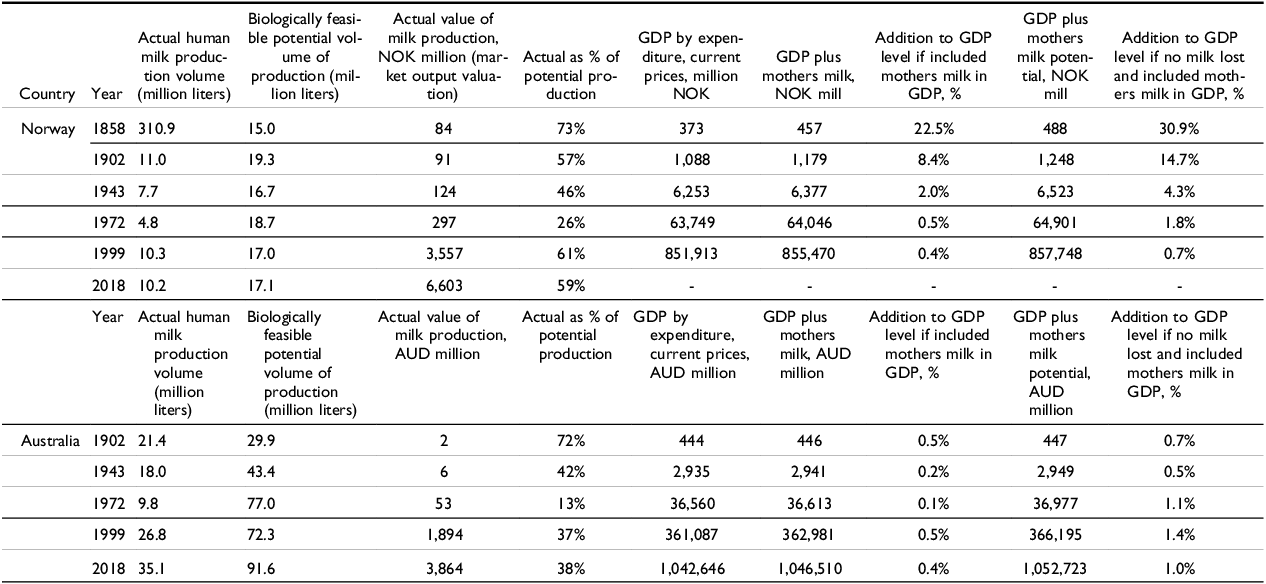
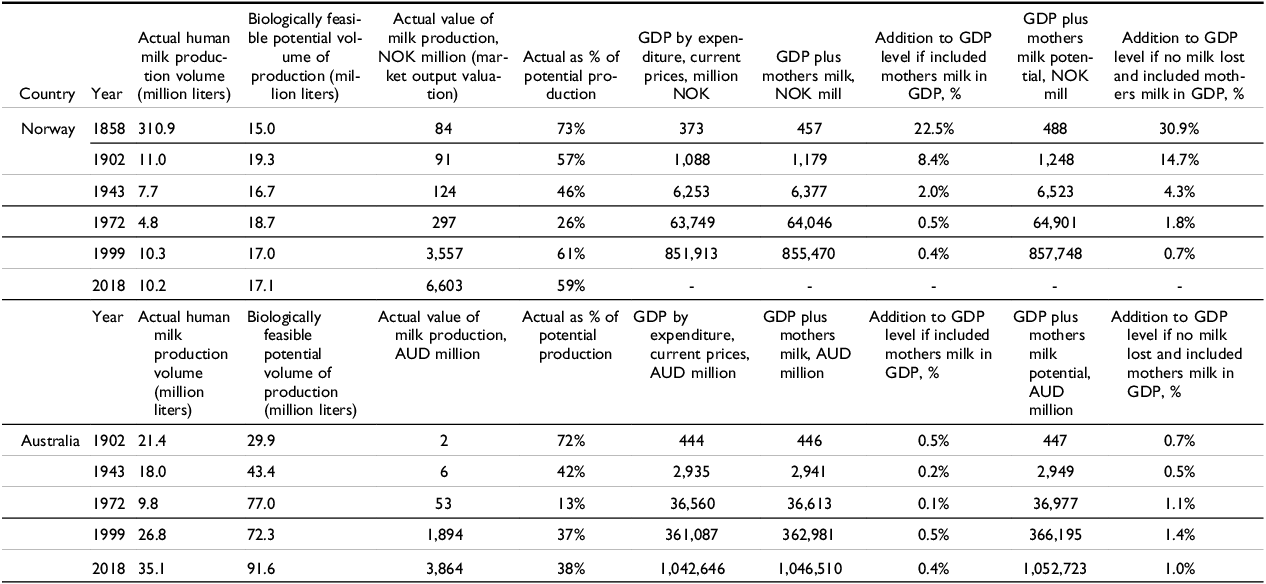
A study presented at the 2021 General Conference of the International Association for Research on Income and Wealth aimed to estimate the quantities and monetary values of mother’s milk at key points during the 20th century in Norway and Australia. It used long-term breastfeeding data for Norway from 1858 and Australia from 1902 to document the precipitous decline in breastfeeding in those countries during the 1960s (Smith Reference Smith2021). This study illustrated the substantial scale of ‘lost milk’ (70–90%) that is implied by long-term trends in breastfeeding of infants and toddlers 0–2 years of age. The methodology for estimating the historical volumes of milk produced annually in Norway was that used by the Norwegian Health Directorate. Norway’s official food statistics have included human milk production since the 1990s, as recently documented in a study published in Public Health Nutrition (Smith et al Reference Smith, Lande, Johansson, Baker and Bærug2022).
Key variables were as follows:
-
breastfeeding prevalence for 1903–2019 from retrospective data on breastfeeding collected in health clinics in Norway;
-
for Australia official statistics for the same period derived from NSW for 1903–05 and from Victoria for the subsequent period;
-
estimated milk intake is based on the conservative assumptions as used by the Norwegian Health Directorate for breastfeeding at each month of child age, which implies 306 litres of milk for breastfeeding throughout a lactation period of 0 to 24 months of age.
To measure the monetary value of production, market output prices and replacement cost approaches were used, along with historical price deflators for GDP or private consumption. For Norway, prices were extrapolated backwards from those charged for milk from a public milk bank network from the 1990s, and for Australia, extrapolated forwards from the wage of a wet nurse in the late 1800s, by reference to wages of childcare workers in the 1990s. Historical evidence suggests a professional wet nurse could produce around 1.875 litres a day, and this was used to calculate a cost per litre of milk obtained in Australia from a wet nurse. At least 40–60% of potential production is currently lost in these two countries (Table 6). The study also demonstrated indicated that if breastfeeding had been counted as productive, a substantial 8–22% would have been added to GDP in Norway during the time period 1868–1902.
Monetary values of actual and potential production of milk for Norway and Australia, 1858–2018
Sources: Smith (Reference Smith2021).
Calculations of the amount of milk produced in Norway and Australia 1902–2018 show up to 11 million litres a year were produced in Norway in 1902 and in 2018. Only 4.8 million litres were produced in 1972, the low point of breastfeeding in that country; three quarters of potential production was lost in Norway at that time compared to if 95% of women had breastfed as is biologically feasible. There is a similar pattern of lost production in Australia, where all but 10% of potential supply was lost in 1972. In Norway, nationwide policies were adopted from the 1970s in hospitals and through paid maternity leave and marketing controls to protect the ongoing supply of mothers’ milk. By contrast, in Australia, around two-thirds of potential production has continued to be lost since the 1940s. That is an ongoing annual loss, which is currently around A$4 billion a year.
The study also demonstrated using historical wage data that if breastfeeding had been counted as productive, a substantial 8–22% would have been added to GDP in Norway during 1868–1902. Table 6 presents detailed results for both Norway and Australia from that study for that period.
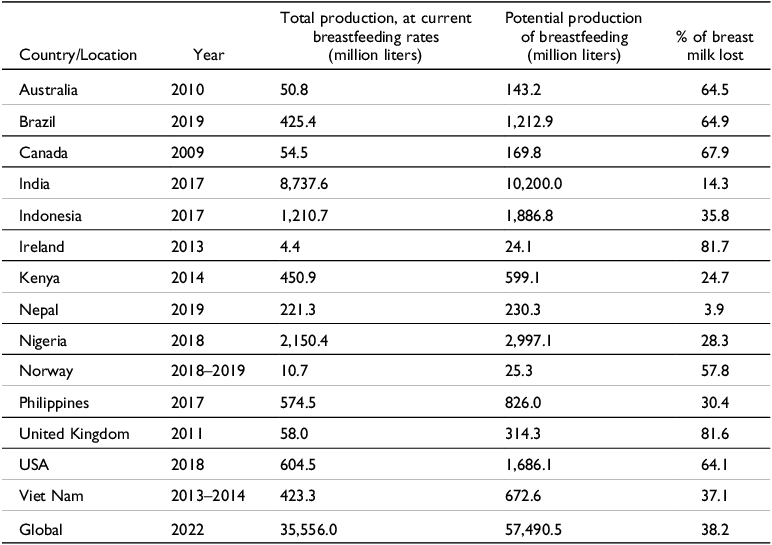
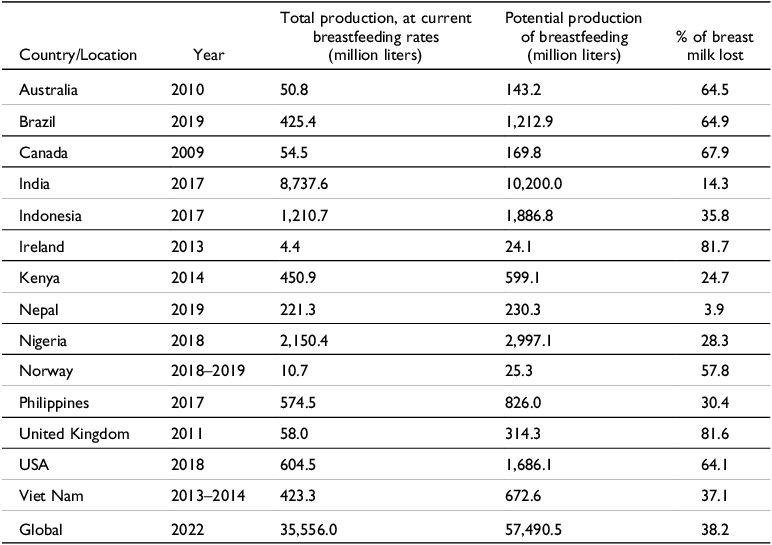
In 2023, a global nutrition tool, the Mothers’ Milk Tool, was launched which allows such calculations for many countries worldwide. Results for several countries were published in 2023 (Smith et al Reference Smith, Iellamo, Nguyen and Mathisen2023b). This means that estimates can now be made for over 100 countries that have data for IYC feeding practices in the UNICEF dataset. The Tool uses similar methodology to previous studies, and aligns with the official calculations of human milk production for Norway (Smith et al Reference Smith, Lande, Johansson, Baker and Bærug2022). It uses a value for human milk production of US$100 per litre. However, in line with WHO recommendations for breastfeeding to continue to two years and beyond, the Mothers Milk Tool estimates production for children 0–3 years, rather than the 0–2 years age category used in previous studies discussed above.
The Mothers’ Milk Tool shows that in Nepal, for example, which still has very high breastfeeding rates of both infants and young children, human milk production for children 0–3 months was 220 million litres of milk in 2020, and only 4% of biological potential was lost (see Table 7). The loss of this human milk production, if it were to occur in the future, would be the equivalent of more than half of that country’s current GDP.
Estimated amounts and values of actual and potential human milk production by country for children aged 0–36 months
Sources: Smith Reference Smith2023.
Discussion
After the adoption of the United Nations (UN) System of National Accounts (SNA) in 1953, economic statistical conventions systematically excluded much of women’s economic activity from measurement in most countries (Saunders and Dalziel Reference Saunders and Dalziel2016; Waring Reference Waring1988) because households’ non-market production of goods and services, done mostly by women, was deemed a ‘non-economic’ phenomenon. This study has shown there were influential economic drivers of the displacement of breastfeeding by commercial milk formula during the 20th century, and that the resultant decline in breastfeeding resulted in losses of an economically valuable resource. Secondly, it has described the important feminist critiques of GDP measurement practices, which exclude unpaid care from the system of national accounts (SNA), and analysed the implications of modifying SNA rules to make visible the productivity contributed by women’s breastfeeding of infants and young children. Thirdly, it has shown that a range of available market prices for the valuation of breast milk can be used to estimate the monetary value of breast milk production in countries. Recently developed tools confirm that the magnitude of this value is large compared to the retail value of commercial milk formula, such as in China and India, or in relation to GDP in other countries, historically and at present.
First, this study contributes empirical evidence to arguments that care of children has features of ‘public goods’ that risk socially inefficient under-provision (Folbre Reference Folbre1994). As the benefits of investing in children are increasingly socialised, parenting is said to increasingly become a public service. The encroachment of market incentives on unpaid household economic activity has been argued to result in a shrinking ‘Magic Pudding of Care’ as market development proceeds and more female labour is drawn into it by policies promoting market-based economic development (Folbre Reference Folbre2002). This process of competition for women’s time also creates new markets for commercial milk formula due to amplifying the time pressures on families with infants and young children.
Market prices are the preferred way to value non-market production for this purpose. Over the past two decades, there has been a revival of trade and exchange of breast milk and commercial wet-nursing as far afield as China, North America, India, and Australia. For example, in 2015, a company called Ambrosia Milk began purchasing human milk from mothers in Cambodia at $0.5–1.0 per ounce of milk for export to the United States (Clark Reference Clark2016; Jackson Reference Jackson2015). The milk was to be sold for $3 an ounce in a market where many new mothers experience challenges with establishing breastfeeding and may lack entitlement to paid maternity leave but want their child to be breastfed as recommended by health authorities (Wood Reference Wood2015). For the Cambodian mothers – only those with healthy, older babies could participate – their lactation work offered the possibility of having a longer absence from often exploitative employment in order to better care for – and continue breastfeeding – their young children.
Not measuring changes in unpaid work burdens during modernisation and economic transition can also generate gender inequality, including by reinforcing women’s unequal access to earnings and leisure (Qi and Dong Reference Qi and Dong2016). For example, despite the value of essential unpaid care work in China being between a quarter and a third of GDP, as Qi and Dong observe,
… the overriding concern of the Chinese government in the post-reform period has been to improve the productivity of paid work and maximize growth of per capita GDP, assuming that the provision of domestic and care services will adjust itself accordingly (Cook and Dong Reference Cook and Dong2011). As a result, the role of the state and the employers as a provider of social goods and services has been eroded; responsibility for social reproduction and “care”—a domain principally of the state in the urban sector under the planned economy—has returned to the household. This process has considerable implications for the work and status of women in both the home and the marketplace (Qi and Dong Reference Qi and Dong2016 19).
That is, devaluation of a mother’s unpaid lactation work expands the market economy but shrinks the total economy, and at the expense of economic justice for women.
Secondly, feminist critiques have long emphasised that using GDP to measure and manage the economy reflects a gender-biased interpretation of economic progress and development, and ignores the vital social and economic role of reproduction, care, and nurture (Berik and Kongar; Boserup Reference Boserup1970). An alternative approach to valuing human productivity based on ‘social provisioning’ (Power Reference Power2004) incorporates domestic work and unpaid care work as fundamental to economic analysis, and evaluates economic process or performance on how well it achieves sustainable human development (Benería et al Reference Benería, Berik and Florio2016). This highlights the need for analyses of the economy to account for the key role of gender power relations and gendered social institutions such as the SNA in generating and perpetuating inequities between men and women (Agarwal Reference Agarwal1997). The exclusion of breastfeeding and human milk production from GDP exemplifies women’s institutionalised exclusion and disadvantage from current economic statistical systems, and the need to better account for women’s unpaid caring and reproductive work in making resourcing and budgeting decisions. Since 1993, all commodities have been within the scope of core GDP, and human milk meets the criteria for inclusion (Smith and Ingham Reference Smith and Ingham2005),Footnote 1 yet national accounting practice continues to exclude measurement of human milk production.
The current invisibility of women’s productivity in the non-market household economy distorts economic policy-making and biases government budget funding priorities to the disadvantage of women and girls (Balakrishnan et al Reference Balakrishnan, Elson, Heintz and Lusiani2011; Himmelweit Reference Himmelweit2002; Pan American Health Organization (PAHO) 2010). The estimates reported above show the need to integrate thinking about economic progress across both the market and non-market household sectors to provide a reliable basis for labour market and social protection policymaking and budgeting. The case of paid maternity leave is illustrative. Modern welfare regimes that evolved to address unemployment risks emerging during industrialisation and urbanisation have responded inadequately to the key economic risks facing women in the modern economy, which commonly arose from their investing in child-raising and financial dependency on a male breadwinner (O’Connor Reference O’Connor and O’Connor2013; Orloff Reference Orloff1993). Valuing women’s productivity from time spent in infant care and breastfeeding would, for example, highlight the importance of governments investing in measures to align with International Labor Organization (ILO) Maternity Protection Convention standards for paid maternity leave and lactation breaks. Recent ILO research confirms that meeting these standards is affordable in all country settings (Baker et al Reference Baker, Smith, Garde, Grummer-Strawn, Wood, Sen, Hastings, Pérez-Escamilla, Ling, Rollins and McCoy2023), and would recognise the costs to mothers of meeting health authority recommendations for exclusive breastfeeding (Smith and Forrester Reference Smith and Forrester2013). Valuing this productivity would also bring a greater priority to reducing the role of healthcare providers in distributing commercial milk formula products (Rollins et al Reference Rollins, Piwoz, Baker, Kingston, Mabaso, McCoy, Ribeiro Neves, Pérez-Escamilla, Richter, Russ, Sen, Tomori, Victora, Zambrano and Hastings2023).
China’s recent development pathway indicates how gender inequality increases when the care economy is not accounted for and adequately resourced. It can be argued that institutions such as the SNA have influenced fiscal priorities and contributed to the inadequacy of paid maternity leave and broader maternity protections throughout the world (Baker et al Reference Baker, Smith, Garde, Grummer-Strawn, Wood, Sen, Hastings, Pérez-Escamilla, Ling, Rollins and McCoy2023) in recent decades, which, in turn, have influenced the ongoing decline of breastfeeding (Baker et al Reference Baker, Santos, Neves, Machado, Smith, Piwoz, Barros, Victora and McCoy2021) and expansion of markets in commercial milk formula (Baker et al Reference Baker, Smith, Salmon, Friel, Kent, Iellamo, Dadhich and Renfrew2016).
Incomplete economic statistics distort public policy in other important ways, such as in trade and industry policies. A consequence of not measuring breastfeeding or non-market human milk production in GDP and related food production measures is that policymakers focus on promoting the activities of commercial firms producing breast milk substitutes, whilst giving no importance to protecting household production of human milk worth far more in monetary terms. Despite the importance of breastfeeding demonstrated by the 2008 melamine crisis, in which hundreds of thousands of infants were hospitalised and six infants died, public policy in China has prioritised the development of the commercial milk formula industry (Qi Reference Qi2014; Xia Reference Xia2014). Only in 2014, far too late (AAP 2013; Correy Reference Correy2013; Harney Reference Harney2013; Liu et al Reference Liu, Dai, Xie and Chen2014; Waldmeir Reference Waldmeir2013; Xu et al Reference Xu2013), did the national government begin to focus on stemming the dramatic declines in breastfeeding since the late 1990s (Wu Reference Wu2014). Weak health, the labour market, and market regulatory policies are crucial drivers of these declines (Hou Reference Hou2014).
Thirdly, an important reservation by national accountants on including non-market production in GDP has been whether ‘economic pricing’ is important for demand and supply in these markets, that is, whether breastfeeding, human milk production, and the trade or exchange of human milk meets the test of ‘sensitivity to economic rewards’ (Kravis Reference Kravis and Kendrick1957). The existence of market for breastfeeding and human milk provides important evidence of ‘economic pricing’ – that economic rewards and market prices affect its supply and demand. Such evidence strengthens the case for measuring breastfeeding and human milk in GDP.
However, these processes create new markets for commercial milk formula and generate unmeasured health, economic, and environmental costs. A major collaborative study published in The Lancet in 2016 estimated that health treatment costs of around $224 million a year could be saved by small increases in breastfeeding in China, while the economic loss from cognitive deficits associated with current infant feeding practices was estimated at US$24 billion a year (Rollins et al Reference Rollins, Bhandari, Hajeebhoy, Horton, Lutter, Martines, Piwoz, Richter and Victora2016). This represented an ongoing annual loss equal to 0.33% of China’s GDP. However, the economic losses involved are unseen, and the implied decline in breast milk production is framed narrowly within maternal/child health, rather than perceived more broadly as corrosive of China’s economic productivity and human capital formation. Perversely, extra food and health treatment costs that result from increased formula sales, reduced breastfeeding, and less healthy children and adults are measured as an addition to GDP under current national accounting practices (Smith and Ingham Reference Smith and Ingham2005).
The environmental cost externalities of displacing breastfeeding are also multiple (Andresen et al Reference Andresen, Hjelkrem, Bakken and Andersen2022) but remain unmeasured in current economic statistical systems. The importance of breastfeeding practices to climate change mitigation, adaptation, and resilience is of growing concern and relevance to public policy (Smith Reference Smith2019a). In the case of China, the hidden environmental costs of commercial milk formula are particularly large because of its large population. Greenhouse gas emissions from the manufacturing of milk formula sold in China in 2012 were estimated to be 2.24 million tonnes CO2 equivalent (Dadhich et al Reference Dadhich, Smith, Iellamo and Suleiman2015). While these environmental aspects are largely beyond the scope of this paper, new nutrition tools show that the environmental costs of displacing breastfeeding are substantial in high-income countries and globally (Smith et al Reference Smith, Borg, Iellamo, Nguyen and Mathisen2023a; Smith et al Reference Smith, Borg, Nguyen, Iellamo, Pramono and Mathisen2024).
Feminist economic thinking has made important contributions to ecological economics over half a century (Berik and Kongar Reference Berik and Kongar2021; Gaard Reference Gaard2013; Smith Reference Smith, Butler and Higgs2024; Waring Reference Waring1988). In the 2024 flagship report of the Food and Agriculture Organization (FAO), the problems for the sustainability of the global agrifood system of inadequate accounting for the non-market sector are highlighted (Food and Agriculture Organization of the United Nations (FAO) 2024 p.75). FAO is moving towards ‘true cost accounting’ (TCA) for the hidden costs of the market-based global agrifood system. The report includes a focus on breastfeeding and on the practical measurement tools that are being developed to better measure, understand and align health, environmental and social values and achieve more sustainable food systems.
While reforming statistical measurement systems to compare the economic values to encompass non-market values such as breastfeeding and the production of human milk has been seen as disruptive, overburdening, and inconvenient to conventional practitioners, showing the large magnitude of women’s non-market household production of infant and young child milk importantly informs a range of policies. Likewise, as recently argued in the leading medical journal The Lancet, including time spent on infant and young child care and feeding in satellite accounts to GDP would enhance monitoring and analysis of long-term productivity trends and patterns in the food, nutrition, childcare, and health sectors, as well as better inform policies on maternal labour force participation (Baker et al Reference Baker, Smith, Garde, Grummer-Strawn, Wood, Sen, Hastings, Pérez-Escamilla, Ling, Rollins and McCoy2023). Environmental accounting as part of the true cost accounting of the agrifood system is the next major frontier in such reforms.
Furthermore, breastfeeding is a human rights issue for both mother and child, and is recognised in several human rights instruments (United Nations Office of the High Commissioner [OHCHR] 2016). Trade and exchange of human milk might commodify this relationship and disempower women, displacing a primal relationship between mothers and their infants. Distributional concerns about the expansion of commercial markets in human milk are also profound. Lack of access to maternal breastfeeding contributes importantly to global inequity in child health (Roberts et al Reference Roberts, Carnahan and Gakidou2013). Breastfeeding confers additional health and development benefits on the child beyond those from receiving human milk, and breastfeeding her child also significantly reduces the woman’s reproductive health risks, such as for breast cancer (Labbok Reference Labbok2001; Victora et al Reference Victora, Bahl, Barros, França, Horton, Krasevec, Murch, Sankar, Walker and Rollins2016).
Importantly, market exchange may redistribute mothers’ milk and breastfeeding away from vulnerable consumers (children) with biological claims to it to those most able and willing to pay – including adult males seeking sexual gratification. Infants and children cannot exercise agency separately from their parents in such markets, with the well-recognised concept of the breastfeeding ‘dyad’ challenging economic assumptions about ‘separability of self’ (Nelson Reference Nelson, Ferber and Nelson1993). There is also potential for exploitation, including trafficking of lactating women due to gender inequality in wealth and income, weak or unequal bargaining power within households and markets, and inadequate human rights protections against female poverty (Smith Reference Smith and Cohen2017b; Smith et al Reference Smith, Cohen and Cassidy2021; United Nations Office of the High Commissioner [OHCHR] 2016).
Indeed, the most willing producers – selling the cheapest milk – may be the more desperate or dishonest suppliers, rather than those offering the most suitable milk, such as relatives or friends. Markets can systematically disadvantage purchasers over sellers of certain kinds of products because of unequal information on products’ characteristics, such as whether a used car is a ‘lemon’ or whether milk is diluted or contaminated (Akerlof Reference Akerlof1970). Market prices can also provide misleading signals about the societal value of products, which distorts decision-making about what is produced or consumed; for example, market prices fail to incorporate negative health and environmental cost externalities of milk formula consumption or the social benefits of parental investments in children (Dadhich et al Reference Dadhich, Smith, Iellamo and Suleiman2015; Folbre Reference Folbre1994; Smith Reference Smith2004).
On the other hand, by drawing attention to the monetary value of breast milk, expanded or revitalised markets in mothers’ milk could improve its availability, benefit nutrition and health, and contribute to greater economic justice for women (Smith Reference Smith2015). The sale or donation of surplus human milk could directly improve the nutrition and health of those children otherwise deprived of it. Lactating women might gain health and financial benefit from increased breastfeeding, while mothers able to secure surplus breast milk through trade or exchange may be more than willing to pay for the personal satisfaction and better nutrition and health for their child. The economic inequity of the contemporary donative market in the United States, where ‘everyone except the woman who donates her milk benefits’, has been increasingly questioned (Fentiman Reference Fentiman2009, 66).
Such controversies aside, a major potential gain from the reemergence of such markets in mothers’ milk is that they generate prices evidencing ‘willingness to pay’ for the advantages of breastfeeding, which can be used to proxy the monetary value of breast milk for inclusion in national economic statistics such as GDP. Around half of the 140 million infants born each year globally are nourished mainly by the milk of their breastfeeding mothers, but this productivity is largely invisible.
Acknowledging human milk within this influential economic measurement system would be a transformative institutional change that would make clearer to policymakers the value of investing in a crucial form of non-market household production.
Limitations
There are challenges and limitations in making these estimates, which are intended to be illustrative and informative of the possibilities for better accounting for women’s productive contribution to the evolved global first-food system of infants through breastfeeding. Importantly, it should be noted that using a market price for expressed breast milk underestimates the economic value of breastfeeding. There are distinct, additional values for the process of breastfeeding and for using the mother’s own milk rather than another mother’s milk, such as for promoting maternal attachment, jaw development, and strengthening the immune system (Bertino et al Reference Bertino, Giuliani, Occhi, Coscia, Tonetto, Marchino and Fabris2009; Strathearn et al Reference Strathearn, Mamun, Najman and O’Callaghan2009). These include lower healthcare and other economic costs related to higher acute and chronic illness for women as well as for children where rates of breastfeeding exclusivity or duration are suboptimal (Jegier et al Reference Jegier, Smith and Bartick2024).
The price that individual consumers are willing to pay for breast milk, even well-informed medical buyers, may also be lower than its economic value from a societal perspective, for example, because buyers are not fully informed about its health and development importance, because the optimal feeding of the child is not the only consideration in infant feeding decisions, or because personal valuations may not take into account wider societal health system or environmental cost impacts.
It might also be argued that the price of milk sold by milk banks may reflect the particular economic and institutional characteristics of a specific market. The commercial market for human milk is still relatively small, and most human milk production by breastfeeding women is not marketed. Most is provided altruistically rather than through a market exchange. Also, in some countries trading in human milk is only for meeting the needs of newborn infants; in Norway, for example, milk banks usually only supply human milk for infants under 3 months old. Pricing mechanisms may be relatively undeveloped in these markets, and price may be little used in supply or demand decisions. The price charged by milk banks to hospitals for human milk supplies may also be challenged as a proxy for the value of human milk if it is more highly valued for hospitalised premature or vulnerable infants rather than healthy, full-term, or older infants. Nevertheless, it has been shown elsewhere that prices of human milk derived using other valuation methods (such as using time input for expressing milk or replacement wage costs) are broadly consistent and comparable with milk bank prices (Smith Reference Smith1999). It can be argued that using such prices is a reasonably valid representation of the market value of human milk.
It may be argued that the price of formula, which is lower, should be used to value the lost economic value when human milk production is replaced by formula feeding, as the mothers who formula feed may not value breast milk as highly as breastfeeding mothers. A recent costing study in a European neonatal unit found that commercial milk formula was eight times cheaper than donated human milk (average cost of €306.95 per litre) and was also cheaper than providing the mother’s own milk (Fengler et al Reference Fengler, Heckmann, Lange, Kramer and Flessa2020). A number of early studies used the price of powdered milk or infant formula to proxy the economic costs of replacing breastfeeding (Aguayo and Ross Reference Aguayo and Ross2002; Almroth et al Reference Almroth, Greiner and abd Latham1979; Gupta and Khanna Reference Gupta and Khanna1999; Hatloy and Oshaug Reference Hatloy and Oshaug1997; Rohde Reference Rohde1974; Rohde Reference Rohde1981). However, lower prices for formula only show that consumers value bovine-based milk or plant-derived formula milk products at this price, not how much they may be willing to pay for human milk. The price of formula may be low because women consider breast milk substitutes to have a lower economic worth. At present, some formula-feeding mothers may not be able to purchase breast milk even if they prefer to do so. Formula is also provided cheaply to health facilities as a marketing strategy because its early use disrupts the establishment of lactation and successful breastfeeding.
More generally, breastfeeding practices vary greatly across countries, and gaps and deficiencies in data affect the accuracy of measuring human milk production at national levels (Smith Reference Smith2013). Current survey practices may overstate the extent of exclusive breastfeeding (Aarts et al Reference Aarts, Kylberg, Hörnell, Hofvander, Gebre-Medhin and Greiner2000; Nanishi et al Reference Nanishi2023). This highlights the importance of regular and comprehensive measurement of infant and young child feeding practices, especially in high-income countries, and more precise measurement of breastfeeding and human milk intake in all countries (Smith et al Reference Smith, Iellamo, Nguyen and Mathisen2023b).
Also, while trade and exchange of human milk products is expanding (Smith Reference Smith2015), there are multiple cultural and ethical complexities in monetising breast milk (Prouse Reference Prouse2021). Even in emergencies and disasters, employing a wet nurse to provide life-giving milk to an orphan involves complexity at multiple levels (Iellamo et al Reference Iellamo, Bindi Borg, Smith and Mihrshahi2025). This is beyond the scope of this paper but highlights that market valuation tools should not be overused. Putting a price on breast milk might be perceived as offensive in some settings. Breastfeeding cannot be reduced to its economic aspects and has deep, sometimes conflicting meanings for women (Waldby et al Reference Waldby, Noble-Carr and Carroll2023). Breastfeeding is an evolved and complex physiological, emotional, and social relationship between the human mother and child, which is in turn intricately related to the family and the community or society she lives in (Smith Reference Smith2013).
Conclusion
If women’s work as producers and reproducers is invisible as a contribution to the national accounts, women are invisible in the distribution of benefits. (Marilyn Waring, Counting for Nothing, 1988, 77).
Estimating the economic value of breastfeeding has pitfalls but can emphasise the extent of breastfeeding and its value, and acknowledge one of women’s unique contributions to society, while highlighting its importance to economic welfare and contributing to more accurate public policy analysis and more soundly based economic and health policies.
Including human milk production in key economic statistics advances human rights of women and children and supports a sustainable development agenda informed by better measurement of the costs and benefits of market-based economic development. It is ironic that the United Nations (UN) is the main institutional framework for furthering human rights in the world community, yet still in 2025, measurement of GDP in the key institution of the SNA, led by public organisations like Eurostat, the UN Statistics Division, OECD Statistics, the World Bank, and the International Monetary Fund, hinders the realisation of women’s and children’s human rights to health, nutrition, and economic equality through its effect on policy priorities (Smith Reference Smith2019b). Breastfeeding is a key measure and indicator of children’s health and well-being, as well as important to women’s reproductive health, and can be captured within the central framework or satellite accounts of the SNA.
The recent expansion of trade in human milk and breastfeeding may be a ‘vice’ or a ‘virtue’ for women’s and children’s well-being. It might, on the one hand, reinforce the valorisation of market activities at the expense of non-market economic activity, including breastfeeding. Alternatively, it might motivate a renewed feminist challenge to the practice of excluding human milk from economic accounting systems. Here, it has been argued that by indicating market values for breastfeeding, trade in human milk has strengthened the case for its inclusion in GDP. This paper has provided data to demonstrate the economic value of breastfeeding and breast milk and its relevance to current initiatives to go ‘beyond GDP’. It illustrates how increasing the visibility of women’s lactation work in key economic statistics might challenge the gender bias in policy that under-prioritises allocating resources to address women’s needs. It can also emphasise the importance of governments developing societal, policy, and regulatory responses to markets in human milk that enable, rather than hinder, maternal breastfeeding and that promote the beneficial rather than harmful aspects of milk trade and exchange.
Lactation and breastfeeding are economically productive work. To better understand trends in human maternal welfare and well-being, it is crucial to better measure and value the foundational economic contributions of women via their breastfeeding work. This in turn may advance economic justice for women, as well as improve the efficiency of resource allocation within the national food system for infants and young children and the broader infant and young child food economy.
Addressing concerns about GDP is crucial for more credible and accountable public fiscal and economic policies and for building trust in their fairness. As well as giving more emphasis to trends in household income and consumption and its distribution, the OECD is scrutinising how to better measure unpaid household activities and develop satellite accounts, including measuring human capital and interactions between the economy and the environment. Nobel laureates like Joseph Stiglitz and Amartya Sen have drawn attention to the policy distortions arising from excluding it from GDP.
Progress is slow and difficult, though barriers are said to be practical rather than conceptual. Women’s reproductive work of nourishing children with human milk through breastfeeding is rarely considered in discussions of global or national food systems, food policies, or food security. Some have suggested that only ‘demand driven advocacy’ will improve national accounting practices (Collas-Monsod Reference Collas-Monsod2007, 5-7; Virola et al Reference Virola2007, 7). Without wider public understanding of how such statistics can be used for better decision-making or how to use them for advocacy, statisticians will do little about introducing them – though ‘what we don’t know could hurt us’ (Abraham Reference Abraham2005, 1).
Nevertheless, there is some advancement. In 2023, to address multiple planetary and human health crises and inequities, the World Health Organization Council on the Economics of Health for All called for a new way of thinking about valuing and measuring what matters (World Health Organization (WHO) Council on the Economics of Health for All 2023). Leaders in major international agencies such as the FAO, World Bank, UNICEF, and the WHO endorsed breastfeeding as a key example of where this could be taken forward in practice (Alive and Thrive 2022; 2023). It now awaits for each of these organisations to work within their remit with UN and OECD statistical divisions towards these recommendations: i) improved data on breastfeeding, ii) including human milk production in food balance sheets, iii) piloting time use measurement of breastfeeding in national economic accounts, and iv) aligning the ILO Convention on Maternity Protection recommendations for 14 weeks paid leave with WHO/UNICEF exclusive breastfeeding recommendations for 6 months to prioritise policies enabling breastfeeding in workplaces and childcare, as well as strengthening UNICEF practices in disaster and emergency settings. Meanwhile, UN agencies with a relevant mandate might ask the International Court of Justice for advice on whether maintaining the status quo of SNA accounting on breastfeeding is an ongoing breach of women’s human rights to health and children’s rights to food.
Supplementary material
The supplementary material for this article can be found at https://doi.org/10.1017/elr.2025.10031
Funding statement
No specific research funding was provided for this article. Julie Smith was supported by the Australian Research Council Fellowship award (FT140101260) until June 2024.
Competing interests
The author has no competing interests.
Dr. Julie Smith is an honorary associate professor at the Australian National University and an associate professor at the University of Canberra. Recent research focuses on economic and environmental aspects of breastfeeding and markets in mothers’ milk (FT140101260) and scaling up breastfeeding support in maternity care services (2023_MRF2031430 - 2031430). She has advised the US Surgeon-General Office and the World Health Organization (WHO), conducted evidence reviews for WHO and the Australian Department of Health, and was previously a senior economist in the Australian and New Zealand governments.





 Open access

