


In the USA, household food insecurity is associated with multiple health problems including type 2 diabetes, obesity, depression and poor general health( Reference Seligman, Bindman and Vittinghoff 1 – Reference Melchior, Caspi and Howard 3 ). While the majority of US households are categorized as ‘food secure’, a disproportionate percentage of minority groups are food insecure. Food insecurity is most prevalent among households in poverty, affecting 40·2 % of households below the poverty line( 4 ).
While the US Department of Agriculture publishes food insecurity statistics for ethnic minority groups with high rates of poverty, American Indians are not included. To our knowledge, there is only one published study that has documented levels of food insecurity in American Indians in the USA. Utilizing data from the 2001–2004 Current Population Surveys, Gundersen estimated that nationally 21·9 % of American Indian households with children and 16·3 % of American Indian households without children were food insecure, approximately double the estimates for non-American Indians( Reference Gundersen 5 ).
Many American Indian communities have high rates of poor health and economic factors commonly associated with food insecurity. Between 1996 and 2006, the prevalence of type 2 diabetes increased by 26·9 % and the prevalence of obesity increased by 25·3 % in American Indians and Alaska Natives( Reference Jernigan, Duran and Ahn 6 ). It is estimated that from 2006 to 2010, 26·4 % of American Indians lived below the poverty line – this is the highest rate among racial groups in the USA( 7 ). From 2006 to 2010, unemployment rates in American Indians were estimated at 13·9 %, nearly twice the national average of 7·9 %( 8 ).
On the Navajo Nation, the economic factors associated with food insecurity are markedly worse than has been estimated for American Indians in general, which led us to hypothesize that food insecurity will be higher than national estimates for American Indians. We sought to answer the following questions:
-
1. What are the levels of food insecurity on the Navajo Nation?
-
2. What factors are associated with food insecurity in this setting?
-
3. What is the association between food insecurity and obesity among adults?
Experimental methods
Study setting
The study took place from 2006 to 2007 in ten communities across the Navajo Nation.
The Navajo Nation is the largest American Indian reservation, spanning over 25 000 square miles across Arizona, New Mexico and Utah. Most of the reservation is classified as rural, and many Navajos must travel great distances on poor roads to access food sources. The US Department of Agriculture Food Desert Locator shows that nearly the entire Navajo Nation is a food desert( 9 ). Many Navajo rely on alternative food sources, such as gas station stores, convenience stores, flea markets and trading posts, which are limited in their selection of healthy options( Reference Lombard, Forster-Cox and Smeal 10 ). Only ten supermarkets are located on the Navajo Nation. Recent findings characterized the Navajo diet as high in energy, but poor in nutrients, with high consumption of processed meats and sweetened beverages and low fruit and vegetable intake( Reference Sharma, Yacavone and Cao 11 ). Poverty and unemployment rates are high, at 42·9 % and 54·1 % respectively, which may also influence dietary choices( 12 ).
Recruitment and sampling
The data reported here are from the baseline data collection for an intervention trial to improve the food environment on the Navajo Nation. A total of 276 adult community members participated in the study. Recruitment occurred over a period of 7 months, from May to November 2007. Every third person entering food stores, community centres, senior centres and laundromats was asked to complete a screening questionnaire. Approximately 5 % of those invited to participate declined. The majority of participants (∼60 %) were recruited from food stores, but most were under 60 years old. Therefore, senior centres were added as recruitment sites to include participants over the age of 60 years and make the sample more representative. Approximately 15 % of participants were recruited from community centres, and the rest from senior centres and laundromats.
Inclusion criteria included: (i) being the main food preparer/shopper for the household; (ii) being ≥18 years of age; (iii) being a Navajo tribal member or spouse responsible for food shopping and preparation in a Navajo household; (iv) residency within the Navajo Nation for at least 1 month; (v) no plans to move off the reservation for 1 year; and (vi) not pregnant. The majority of participants were Navajo; however, fewer than 10 % of participants were non-Navajo American Indians and two were white, non-Indian participants. These participants were married to Navajo tribal members and were interviewed because they were the main food preparers/shoppers for their households.
Interviews were usually conducted at recruitment sites but sometimes were conducted in participants’ homes at another time. Road conditions and weather were the biggest obstacles to recruitment. Participants who were able to complete only part of the questionnaire at the recruitment site were scheduled to complete the remainder of the questionnaire in their homes or at the recruitment site. All data collectors were fluent Navajo speakers with a health background and had completed extensive data collection training for certification. Each participant was compensated with a $US 30 gift card to either the local grocery store or a chain department store if he/she did not live near a grocery store.
Measures
All questions were developed with the full input of our four Navajo-speaking staff to ensure cultural appropriateness and understanding, and were piloted in an age- and gender-diverse sample (n 20).
Food insecurity
The ten-item Radimer/Cornell instrument( Reference Kendall, Olson and Frongillo 13 ) was used to determine degree of food security on four levels of increasing severity: (i) food secure, (ii) food insecure at the household level, (iii) food insecure at the adult level and (iv) food insecure at the child level. The standard coding method was utilized.
Material style of life score
Material style of life score (Cronbach's α = 0·85) was assessed by reading participants a list of fifteen items and asking how many of each, in working condition, they owned. Items included televisions, cellular and landline telephones, cars/trucks and home computers. The quantity of items was summed to calculate the material style of life score.
Knowledge score
Nine multiple-choice questions were asked to assess knowledge of the healthfulness of different foods. For example, participants were asked whether vegetable oil, shortening or cooking spray adds the least amount of fat when cooking. Correct answers were added to calculate the knowledge score (α = 0·64). Minimum possible score was 0 and maximum possible score was 9.
Label reading score
Participants were asked to read the nutrition facts label from two foods and answer four questions about each label. The questions included the number of serving per package, the grams of fat in one serving and in the entire package, and the % Daily Value for Total Fat in each serving. The label reading score (α = 0·82) was calculated as the sum of correct answers to the eight questions.
Healthy eating self-efficacy score
Nineteen questions were asked about how easy or difficult it would be to make healthier food preparation, eating and shopping choices. For example, participants were asked how easy or hard it would be to snack on fruits or vegetables rather than chips. Answers on a Likert scale of 1–4 (1 = ‘impossible’, 2 = ‘very hard’, 3 = ‘kind of hard’, 4 = ‘very easy’) were added together to calculate the score (α = 0·87). Minimum possible score was 19 and maximum possible score was 76.
Healthy eating intention score
Fifteen questions about buying, eating and cooking certain foods were asked using a forced choice, hypothetical format. Each respondent was asked which of three foods/behaviours he/she would really choose and not what he/she thought was the healthy or right choice. For example, the respondent was asked if he/she had to fry eggs, what he/she would use to fry them. The options were cooking spray, vegetable oil, or shortening, butter or lard. The responses were scored 0, 1 or 2 depending on the healthfulness of the option. The score (α = 0·72) ranged from 0 to 30, with higher scores indicating intention for making healthier choices.
Healthy food getting frequency score
This additive score (α = 0·93) was calculated by using the frequency of getting different healthy food options during the previous month. The forty-one healthy foods included 1 % or skimmed milk, water, fruits and vegetables. Higher score indicated a healthy food getting habit.
Unhealthy food getting frequency score
This score (α = 0·77) was generated by adding the frequency of getting twelve less healthy foods such as whole milk, regular soda, sugary cereals, etc. Higher score was an indication of unhealthy food getting.
Healthy family food pattern score
Healthy family pattern score (α = 0·58) was assessed with four questions about the family's habits of shopping, preparing and consuming food in the past 30 d. For example, participants were asked how often they ate together as a family for main meals. Answers were obtained on a Likert scale of 1–5 (1 = ‘never’, 2 = ‘almost never’, 3 = ‘some of the time’, 4 = ‘most of the time’, 5 = ‘always’). The numerical values of the response for each question were summed to calculate the score. Minimum possible value of the score was 4 and maximum possible value was 20.
Perceived expensiveness of healthy choices
Perceived expensiveness of healthy choices score (α = 0·73) was calculated from the level of agreement or disagreement with three statements assessing beliefs about expensiveness of healthy food, thereby assessing beliefs about the affordability of healthy foods. For example, participants were read the statement ‘I cannot afford to eat healthy foods’. Answers were given on a Likert scale of 1–5, ranging from ‘strongly disagree’ (= 1) to ‘strongly agree’ (= 5). Minimum possible score was 3 and maximum possible score was 15.
Perceived inconvenience of healthy choices
Perceived inconvenience of healthy choices score (α = 0·83) was calculated from the level of agreement with five statements assessing beliefs and attitudes about the inconvenience of eating, cooking and accessing healthy foods. For example, participants were read the statement ‘Healthy foods are not convenient to make’. Answers were given on a Likert scale of 1–5, ranging from ‘strongly disagree’ (= 1) to ‘strongly agree’ (= 5). Minimum possible score was 5 and maximum possible score was 25.
The Likert-scale questionnaires described above posed challenges in administration, particularly for the third of the study sample who spoke Navajo only. Degrees of agreement do not translate to the Navajo language so specific examples had to be given to explain the Likert scales, which, in some instances, doubled the amount of time required to complete a questionnaire from 1·5 h to 3 h.
Anthropometry
BMI was assessed by direct measurement of height and weight using a Shorr height board (Olney, MD, USA) and a Tanita digital weight scale (Arlington Heights, IL, USA), respectively (81·4 % of all participants). Two measurements were obtained for each. Self-reported heights and weights were obtained when participants did not agree to measurement (18·6 %).
Data analysis
Data were analysed using the SAS statistical software package version 9·1. A few scores were generated to measure the outcomes and associated factors of interest. Sociodemographic characteristics were collected as continuous, dichotomous or categorical variables. The χ 2 test was used to analyse categorical or dichotomous variables across groups. ANOVA was conducted to examine the association of the factors of interest with the different levels of food insecurity. P < 0·05 was used as the level of significance for χ 2 and P < 0·008 was used as the level of significance for ANOVA, on account of six comparisons across four groups using Bonferroni correction.
Ethical approval
The study was conducted according to the guidelines laid down in the Declaration of Helsinki and all procedures involving human subjects/patients were approved by the Johns Hopkins University Institutional Review Board and the Navajo Nation Human Research Review Board (NNHRRB). Per Navajo Nation mandate, the principal investigator met with and gained the approval of the local Navajo Chapter and Agency-level authorities prior to receiving NNHRRB approval. Written informed consent was obtained from all participants. The manuscript was approved by the NNHRRB.
Results
Prevalence of food insecurity on the Navajo Nation
More than three-quarters (76·7 %) of Navajo households participating in the study had some level of food insecurity. Food insecurity was highest at the child level (28·9 %), followed by the adult level (25·7 %) and the household level (22·1 %; Fig. 1).
Percentage of food-secure ( ) and food-insecure (
 ) households (n 276) in ten communities on the Navajo Nation using the ten-item Radimer/Cornell food insecurity instrument, May–November 2007

Sociodemographic factors associated with food insecurity
Low education was associated with greater food insecurity (Table 1). Higher education status (>12 years of schooling) was significantly less frequent in food-insecure households and least common in households with food insecurity at the child level (P = 0·0003). Mean years of schooling were also significantly lower in food-insecure households and lowest in households with food insecurity at the child level (P = 0·0001).
Sociodemographic characteristics of the sample: adult members (n 276) in ten communities on the Navajo Nation, May–November 2007

WIC, Special Supplemental Nutrition Program for Women, Infants, and Children.
The χ 2 test was used for dichotomous and categorical variables. P < 0·05 was the level of significance for χ 2.
ANOVA was used for continuous variables. P = 0·008 was the level of significance for ANOVA.
Participants in food-insecure households had significantly lower employment rates (P = 0·01) and higher mean ages (P = 0·0476). Material style of life scores were significantly lower in food-insecure households (P = 0·0001). All of these associations were most pronounced in households with food insecurity at the child level, the lowest category of food security.
Household size, marital status and participation in food stamp, WIC (Special Supplemental Nutrition Program for Women, Infants, and Children), commodity food and senior-centre food assistance programmes were not significantly associated with food insecurity. The percentage of households receiving assistance from Food Bank/Navajo Way was significantly different across the categories of food security (P = 0·03).
Psychosocial factors associated with food insecurity
Mean knowledge score (P = 0·001), label reading score (P = 0·16) and healthy eating self-efficacy score (P < 0·0001) were lowest in participants from food-insecure households and decreased as severity of food insecurity increased (Table 2).
Psychosocial factors and food-related behaviours by food security status: adult members (n 276) in ten communities on the Navajo Nation, May–November 2007

ANOVA was used to test the difference in means between the groups of food security. P = 0·008 was used as the level of significance.
Perceived expensiveness (P < 0·0001) and perceived inconvenience of healthy foods (P < 0·0001) increased significantly with the severity of food insecurity.
Healthy eating intention score, healthy food getting frequency score, unhealthy food getting frequency score and healthy cooking score did not differ significantly by level of food insecurity.
Food insecurity and obesity
Mean BMI was 30·0 kg/m2. Of adult participants, 17·5 % were normal weight, 39·0 % were overweight and 43·5 % were obese. Among the latter, 27·1 % were grade I obese (BMI = 30·0–34.9 kg/m2), 9·7 % were grade II obese (BMI = 35·0–39·9 kg/m2) and 6·7 % were grade III or morbidly obese (BMI ≥ 40·0 kg/m2).
No significant associations were found between food insecurity and obesity. Obesity rates categorized by food insecurity status are described in Table 3.
Weight status (%) by food security status: adult members (n 276) in ten communities on the Navajo Nation, May–November 2007
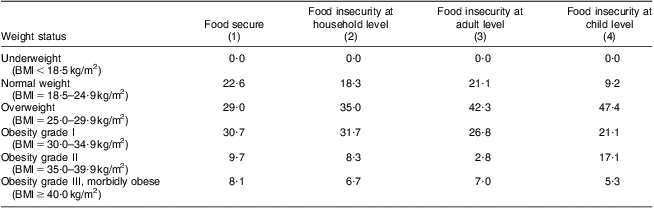
The χ 2 test was performed; P = 0·11.
Discussion
We found that Navajo households have the highest prevalence of food insecurity (76·7 %) ever reported for a US population. The prevalence of household food insecurity on the Navajo Nation is more than four times the rate of food insecurity previously reported for American Indians( Reference Gundersen 5 ) and more than five times the US national rate( 4 ). What is perhaps more compelling are the very high rates of child hunger. Our finding of food insecurity at the child level in almost 30 % of households on the Navajo Nation represents an urgent challenge. Food insecurity in children has been associated with a multitude of adverse outcomes, including lower test scores( Reference Jyoti, Frongillo and Jones 14 , Reference Winicki and Jemison 15 ), increased likelihood of fair or poor health (v. excellent or good health)( Reference Cook and Frank 16 , Reference Alaimo, Olson and Frongillo 17 ), increased likelihood of hospitalization( Reference Cook and Frank 16 ) and psychosocial problems( Reference Weinreb, Wehler and Perloff 18 , Reference Alaimo, Olson and Frongillo 19 ).
As expected and seen in other populations, socio-economic status was strongly associated with the degree of food insecurity; years of schooling, percentage educated >12 years, percentage full-time employed and material style of life score all decreased as food insecurity increased in severity from household to adult to child levels. A study of Mexican American households also found significant associations between food insecurity and socio-economic status, with years of education and income decreasing as the degree of food insecurity increased from household to adult to child levels( Reference Kaiser, Melgar-Quiñonez and Lamp 20 ). Food insecurity affects 44·0 % of black, non-Hispanic households with incomes below 130 % of the poverty line, compared with 25·1 % of all black, non-Hispanic households( Reference Coleman-Jensen, Nord and Andrews 21 , Reference Coleman-Jensen, Nord and Andrews 22 ). These associations underscore the reality that, in order to address food insecurity, poverty needs to be addressed.
No association was found between food insecurity and use of food assistance from food stamps, WIC, senior centres and commodity foods. Previous cross-sectional studies have found positive associations between food insecurity and federal food assistance programmes, with the hypothesis that food-insecure households are more likely to self-select into these programmes( Reference Nord and Golla 23 ). This effect may have been somewhat masked in our study due to the high rates of poverty on the Navajo Nation and the high rate of participation in food assistance programmes in our sample: 26·1 % of households in our sample received food stamps, 22·8 % received WIC, 18·1 % received commodity foods and 20·3 % ate at senior centres. We did see significant differences in use of the Food Bank/Navajo Way, with households experiencing adult hunger more likely to use this resource and those with child hunger unlikely to use this resource. This difference appears to be linked to variation in household composition, with households that use the food bank relatively less likely to have children (as indicated by lower rates of WIC usage).
Measures of knowledge, beliefs and attitudes also significantly correlated with the degree of food insecurity. Knowledge score and healthy eating self-efficacy score were significantly lower as the degree of food insecurity increased, while perceived expensiveness and inconvenience were significantly greater as the degree of food insecurity increased. These findings may be associated with the increased levels of low education and unemployment present as the severity of food insecurity increases. Nevertheless, knowledge, self-efficacy and perceptions remain important factors associated with food insecurity. Multilevel interventions have successfully improved diabetes and obesity-related psychosocial factors in multiple American Indian communities( Reference Gittelsohn and Rowan 24 ), and may be effective models in addressing food insecurity on the Navajo Nation.
Improved psychosocial factors alone cannot improve food security. Healthy foods need to be made affordable and accessible. Jernigan et al. characterized upstream factors influencing food insecurity in American Indians in the Round Valley Indian Reservation community, which also has high unemployment rates and a predominantly unhealthy food environment. Round Valley community members identified the lack of American Indian-owned businesses and stands at the local farmers’ market, the abundance of unhealthy commodity foods, the high cost of foods at the local grocery store and distance from the closest supermarket as top priorities to address( Reference Jernigan, Salvatore and Styne 25 ). These upstream factors are consistent with the Navajo experience and are important disparities to address in reducing food insecurity on the Navajo Nation.
The 82·5 % rate of overweight and obesity in our participants is much greater than the rates reported in the 1991–1992 Navajo Health and Nutrition Survey( Reference White, Ballew and Gilbert 26 ). These findings are consistent with the findings that obesity rates in American Indians have increased sharply in just a decade( Reference Jernigan, Duran and Ahn 6 ). Our study did not find any significant associations between food insecurity and obesity. The research on food insecurity and obesity to date has shown mixed results, prompting the recent recommendation that future research include longitudinal studies to better assess the relationship between food insecurity and obesity( Reference Larson and Story 27 ).
Our study has several limitations. Initially, we attempted to recruit from chapter listings, but were unable to obtain accurate listings. The majority of participants were recruited from small and large food stores located on the reservation, which may have contributed to under-sampling of community members who shop off-reservation or who rarely shop. It is also possible that our sampling strategy increased the likelihood of recruiting low-income, unemployed participants, who may have been more available to travel to community centres and spend 1–2 h on the interview. Our sampling in senior centres may have led to a bias towards retired and low-income individuals, but we felt it important to capture a broad age range of respondents, including those who do not have ready access to personal transportation.
Another limitation to our analysis is that education, employment and anthropometric data were collected for the respondent only and not for all adults in the household. Therefore, it is likely we do not have a complete picture of the associations between food insecurity and obesity status among different types of household members. However, the strength of this method was that all of our participants were the main food shoppers/preparers of their households and therefore it is likely that they were the best judges within the household of food insecurity and related psychosocial factors.
These findings demonstrate the need for additional work to assess food insecurity and its associations in American Indian communities. To our knowledge, the only published rates of food insecurity in US American Indians are derived from responses of people self-identified as American Indian on the Current Population Survey, and thus include American Indians who live off-reservation( Reference Gundersen 5 ). Food insecurity may be more severe in some tribes than others. Furthermore, assessment of food insecurity on the Navajo Nation should be expanded to include a larger and more representative sample, and BMI and socio-economic factors should be assessed in all household members.
The extremely high rates of food insecurity that we have found may be a contributing factor in the high prevalence of chronic disease on the Navajo Nation( Reference Will, Strauss and Mendlein 28 – Reference Percy, Freedman and Gilbert 30 ). Efforts are needed to improve food security in this population. Low socio-economic status, which is highly prevalent on the Navajo Nation and which we found to be significantly associated with food insecurity, must be considered in future endeavours to improve food security and decrease the risk of chronic disease.
Acknowledgements
Sources of funding: This research was supported by the US Department of Agriculture (grant number 2010-8515-20666). Conflicts of interest: No conflicts of interest were reported by the authors. Authorship contributions: M.P. coordinated the project, provided substantial input into study design and data collection, and oversaw writing of the manuscript. D.P. was responsible for the writing of the manuscript. S.S. conducted the data analysis and provided substantial input into writing of the manuscript. J.G. is principal investigator of the project and guided data collection, study design, data analysis and writing of the manuscript. Acknowledgements: The authors would like to extend their appreciation to the Navajo Nations community members. The authors are grateful for all the assistance received from staff and students during this study.



