


Relationships with parents and peers are key determinants of children's socialization (Grusec & Hastings, Reference Grusec and Hastings2014), both being related to concurrent and later well-being and psychopathology. It remains surprisingly open, however, whether negativity in children's relationships with parents and peers is longitudinally related, in which direction effects operate, and whether and how specific maladjusted behaviors of children carry relationship dynamics from one context to the other. Such knowledge is crucial to tackle interpersonal difficulties and prevent chronic problems. The current study addresses this lacuna by investigating the interplay between rejection and warmth in parent–child relationships and peer victimization, as a particularly detrimental dimension of the peer environment, to elucidate the interplay between the two contexts and to understand potential pathways via child maladjustment.
Parent-peer relationship spillover
The spillover concept originates from social systems theories, including the ecological perspective (Almeida, Wethington, & Chandler, Reference Almeida, Wethington and Chandlerf1999) and family systems framework (Anderson, Lindner, & Bennion, Reference Anderson, Lindner and Bennion2008). These perspectives share the assumptions that individuals are embedded in various interdependent social systems. Changes in one system can alter emotions and behaviors that affect social interactions in other systems. As such, spillover theory suggests that parent-child relationships and peer victimization might mutually affect each other (Parke & Ladd, Reference Parke and Ladd2016). Unfortunately, most spillover-informed research has been conducted in family contexts (e.g., marital, parent–child, and sibling relationship spillover), and only very few empirical studies have been aimed at shedding light on cross-domain spillover between parent–child and peer relationships. Here, children's experiences of peer relational aggression and rejection were related to more adverse interactions with parents, such as criticism or negative emotional tone toward children, later that day (Lehman & Repetti, Reference Lehman and Repetti2007). Moreover, conflicts with peers and parents “spilled over” into each other within a time span of 2 days, suggesting that children can get caught in a vicious cycle of problems (Chung & Fuligni, Reference Chung and Fuligni2011).
Spillover effects might not only occur over short intervals, but also evolve during long-term development. Indeed, features of parent–child relationships, including abuse, neglect, or maladaptive parenting, predict peer victimization years later (for a meta-analysis, see Lereya, Samaya, & Wolke, Reference Lereya, Samaya and Wolke.2013). For example, family maltreatment at age 5 was found to predict peer victimization at age 7 (Bowes et al., Reference Bowes, Arseneault, Maughan, Taylor, Caspi and Moffitt2009), and experiencing a harsh, punitive, and hostile family environment at age 6 predicted peer victimization at age 8 (Schwartz, Dodge, Pettit, Bates, & Bierman, Reference Schwartz, Dodge, Pettit, Bates and Bierman2000). More longitudinal research is needed to capture long-term associations in both temporal directions.
Maladjustment symptoms as pathway
It is likely that affective reactions drive spillover between different interpersonal contexts (Barling & Macewen, Reference Barling and Macewen1992; Edwards & Rothbard, Reference Edwards and Rothbard2000), because frequent negative affect manifests itself in maladjustment symptoms such as internalizing and externalizing problems (Parke & Ladd, Reference Parke and Ladd2016) that act as gateways between different interpersonal domains. When children's needs for social connection and acceptance within the parent–child relationship are thwarted, they might act out frustration and disappointment through internalizing or externalizing symptoms that, in turn, might have a detrimental effect on their peer relationships in terms of becoming the target of exclusion and bullying by peers (Reijntjes et al., Reference Reijntjes, Kamphuis, Prinzie, Boelen, Van Der Schoot and Telch2011; Reijntjes, Kamphuis, Prinzie, & Telch, Reference Reijntjes, Kamphuis, Prinzie and Telch2010). Withdrawn or anxious children are less likely to defend themselves and to retaliate, or to be defended by others, and are more likely to be victimized (Reijntjes et al., Reference Reijntjes, Kamphuis, Prinzie and Telch2010). In addition, children with conduct problems or who bully others are often rejected and become victimized themselves as other children retaliate (Lereya et al., Reference Lereya, Samaya and Wolke.2013; Marsh, Parada, Craven, & Finger, Reference Marsh, Parada, Craven, Finger, Sanders and Phye2004; Reijntjes et al., Reference Reijntjes, Kamphuis, Prinzie, Boelen, Van Der Schoot and Telch2011). As such, maladjustment symptoms are a likely proximate mechanism between parent–child and peer problems. It is important to test this assumption rigorously (i.e., using a longitudinal design).
Can maladjustment symptoms also explain spillover from peer to parent–child relationships? Parent–child relationships are not static, but are co-constructed by patterns of bidirectional influence between parents and children, with parents responding and reacting to child behaviors (Belsky, Rha, & Park, Reference Belsky, Rha and Park2000; Bronfenbrenner & Morris, Reference Bronfenbrenner and Morris2007; Van Eijck, Branje, Hale III, & Meeus, Reference Van Eijck, Branje, Hale and Meeus2012; Wertz et al., Reference Wertz, Nottingham, Agnew-Blais, Matthews, Pariante, Moffitt and Arseneault2016). Some behaviors are more frequent in children who experience peer problems, such as peer victimization, which has been shown to elicit child maladjustment symptoms including aggression, withdrawal, and anxiety (Reijntjes et al., Reference Reijntjes, Kamphuis, Prinzie and Telch2010, Reference Reijntjes, Kamphuis, Prinzie, Boelen, Van Der Schoot and Telch2011). As such, these maladjustment symptoms might function as gateways for peer-to-parent spillover. Indeed, increases in anxiety explained why aggression and rejection by peers were linked to negative interactions with parents (Lehman & Repetti, Reference Lehman and Repetti2007). Although parents are usually described as a potential buffer against problem outcomes of peer victimization (Lereya et al., Reference Lereya, Samaya and Wolke.2013; Sentse, Lindenberg, Omvlee, Ormel, & Veenstra, Reference Sentse, Lindenberg, Omvlee, Ormel and Veenstra2010), it may be particularly difficult for victimized children to receive such support, because maladjustment resulting from negative peer interactions spills over into their relationships with their parents. A comprehensive understanding of these processes is essential to better help these children escape escalating interpersonal negativity and associated maladjustment.
Additionally, associations between parent–child relationships, maladjustment, and victimization might differ between boys and girls. Prevalence rates of internalizing symptoms are higher for girls, whereas boys outrank girls in terms of externalizing symptoms (Bongers, Koot, Van Der Ende, & Verhulst, Reference Bongers, Koot, Van Der Ende and Verhulst2003). In line with this, stress often manifests itself in internalizing symptoms for girls and in externalizing symptoms among boys (Kerig, Reference Kerig1998); therefore, we expected that parent–peer associations would be more likely to be explained by internalizing symptoms among girls and by externalizing symptoms among boys.
The current study
The current study addresses several gaps in the literature that limit our understanding of the interplay between parent–child relationships and peer victimization. First, although there is mileage in the theoretical notion of parent–peer interdependence (Bronfenbrenner & Morris, Reference Bronfenbrenner and Morris2007; Patterson, Reference Patterson1982), as well as some empirical support, few studies have focused on spillover effects simultaneously from parents to peers and vice versa (Chung & Fuligni, Reference Chung and Fuligni2011). Second, studies on spillover have usually used short intervals, as reflected in their methods, which included daily diary studies, but spillover processes may evolve over greater time spans, reflecting more long-term development (Parke & Ladd, Reference Parke and Ladd2016). It is feasible that moment-to-moment spillover consolidates into lasting relationship patterns, in which specific interactions such as arguments or excluding a person from a group activity can be seen as symptomatic for an underlying, dysfunctional relationship. As such, problematic relationships can have long-term effects on mental health (Flook & Fuligni, Reference Flook and Fuligni2008) and affect other relationships over longer time frames as well. Third, maladjustment symptoms are key mechanisms in spillover theory in general, and important correlates of parent–child relationships and peer victimization, but have not been systematically tested as gateways in parent–peer/peer–parent spillover.
Addressing these gaps, we examined whether and how children may get caught in a reciprocal pattern of problems in parent and peer relationships, using repeated assessments across 2 yr. Focusing on a sample of children in middle and late childhood, we expanded knowledge about an age period in which both parent and peer domains play particularly central roles in children's social lives. Based on theoretical notions and prior empirical work, we hypothesized that parental rejection and warmth and peer victimization would be related over time in a bidirectional fashion. Moreover, we expected that these bidirectional parent–peer associations would be mediated by internalizing symptoms, specifically depressive symptoms and social anxiety, and externalizing symptoms, specifically conduct problems and bullying perpetration. Finally, given established gender differences in all constructs in the model, gender was included as a potential moderator (Sentse, Prinzie, & Salmivalli, Reference Sentse, Prinzie and Salmivalli2017).
Methods
Participants and procedure
The data used in this study come from the randomized controlled evaluation study of the KiVa anti-bullying program in the Netherlands (Salmivalli, Kärnä, & Poskiparta, Reference Salmivalli, Kärnä and Poskiparta2011; Veenstra, Reference Veenstra2015). This intervention emphasizes the roles of the peer group and teachers in tackling bullying. The intervention contains no specific component on parent–child relationships, except for a folder for parents that explains the program and the basics of bullying research. Schools were randomly assigned to control (n = 33) or intervention (n = 66) conditions, and children in both conditions received identical questionnaires. In the current sample, we tested the possible effect of condition on results, because KiVa tackled victimization and might thus affect the parent–peer pathways. The intervention did not affect any of the results (see Appendix 1); therefore, we pooled samples from intervention and control schools.
Information about the study and consent forms were sent to parents before data collection. Parents who did not want their child to participate in the assessment were asked to return the form. Students were informed at school about the research and gave oral assent. Students did not participate when their parents refused to participate, when they did not want to participate themselves, or when they were unable to complete the questionnaire. Both parents and students could withdraw from participation at any time. At the start of data collection (2012), Dutch law did not require institutional review board permission for this type of research, and an internal review board was not established or common at the local institution.
Individual internet-based questionnaires were completed during regular school hours, with primary teachers present to answer questions and assist students when necessary. Teachers were given detailed instructions before the data collection started. In addition, teachers were offered phone and e-mail support before and during the data collection. Complex topics were explained to students in several instructional videos. In one video, students were told that their answers would remain confidential but that their teacher would receive general feedback to improve the classroom climate. The order of questions and instruments used was randomized to prevent the presentation of questions from systematically influencing results.
In subsequent analyses, we used data collected every 6 months between May 2012 and May 2014 (five waves, T1–T5). The initial target sample consisted of 9,820 students. Fifty of those students were excluded because they did not participate in the waves in which data on parent–child relationships and peer victimization were collected (T2, T4), leaving us without any relevant information for the planned analyses. There were no differences between the excluded and included samples on gender, intervention condition, and initial victimization scores, which were all the measures obtained from this subsample. Moreover, the included and excluded samples differed on hardly any of the maladjustment measures except for social anxiety at T3, in which children from the excluded subsample scored lower (mean [M] = 1.13, standard deviation [SD] = 0.30) than the included sample (M = 1.89, SD = 0.73). Percentages of missing data within the final sample ranged from 4.0% (victimization at T2) to 31.5% (victimization at T5) and in the majority of cases was due to the whole classroom not yet (T2) or no longer (T5) participating in the study (e.g., because they were too young at T2 or had moved on to secondary school at T5). In the remainder of the sample, <1%, individual participants had missing data, for example, because they had left the school or had been absent for a long period. The participation rates were high because the data were collected digitally and students who incidentally missed the scheduled day of data collection could participate on another day within a month. Missing data were correlated with some of the study variables: lower levels of victimization at T2 and T3 (N missT2 = 1.30, SD = 0.72 vs. N compT2 = 1.49, SD = 0.42; N missT3 = 1.33, SD = 0.57 vs. N compT3 = 1.42, SD = 0.64), social anxiety at T3 (M missT3 = 1.82, SD = 0.71 vs. M compT3 = 1.92, SD = 0.73), and depressive symptoms at T3 (N missT3 = 1.57, SD = 0.57 vs. N compT3 = 1.61, SD = 0.61). Auxiliary variables were not included in the analyses.
The students in the final sample (n = 9,770, 50% boys; M age = 9.16; range 7–12) were 80.1% Dutch, 2.9% Moroccan, 1.8% Turkish, 2.6% Surinamese, and 1.1% Dutch Antillean. The remaining 11.6% of children reported another Western (6.1%) or non-Western (5.5%) ethnicity.
Measures
Peer victimization (T1–T5) was measured through self-reports using the Olweus (Reference Olweus1996) Bully/Victim Questionnaire. Children were presented with one global item (“How often have you been bullied during the past few months?”) and seven specific items concerning physical, verbal (two items), relational (two items), material (taking or breaking others’ property), and cyber victimization. Children answered on a 5-point scale (0 = not at all, 1 = once or twice, 2 = two or three times a month, 3 = about once a week, 4 = several times per week). The scores on these eight items formed internally consistent scales across the five time points (all α > .87).
Parental rejection and warmth (T2, T4) were assessed using the Egna Minnen Beträffande Uppfostran Warmth and Rejection Scale (Arrindell, Emmelkamp, Brilman, & Monsma, Reference Arrindell, Emmelkamp, Brilman and Monsma1983). We used four items from each of the original subscales (rejection and warmth), referring to both father and mother (eight items total for each parent). Students responded on a 4-point scale (1 = no to 4 = almost always) to questions such as “Is your mother/father sometimes harsh and unkind to you?” referring to rejection and “If things are not going right for you, does your father/mother try to comfort or help you?” referring to warmth. The items formed reliable scales: maternal rejection (α > .73) and warmth (α > .85) and paternal rejection (α > .75) and warmth (α > .86). Answers for both parents were highly correlated (p < .001), for rejection (r > .51) and for warmth (r > .56); thus, we used a composite (α > .81 for rejection, α > .88 for warmth).
Social anxiety (T2, T3) was measured using a 7-item scale, derived from the Social Phobia Screening Questionnaire (Furmark et al., Reference Furmark, Tillfors, Everz, Marteinsdottir, Gefvert and Fredrikson1999). We used items from the original questionnaire that were appropriate for this age group, such as, “I am scared to talk to someone whom I don't know” (1 = never, 5 = always; α > .77).
Depressive symptoms (T2, T3) were measured using nine age-appropriate items from the Major Depression Disorder Scale (Chorpita, Yim, Moffitt, Umemoto, & Francis, Reference Chorpita, Yim, Moffitt, Umemoto and Francis2000). Students responded on a 4-point scale to items such as “I feel worthless” (1 = never to 4 = always; α > .81).
Conduct problems (T2, T4) were measured using 13 items from the Conduct Problem Scale of the Youth Self Report (Achenbach, Reference Achenbach1991). Several items were slightly modified to improve applicability to this age group. Students responded on a 3-point scale to items such as, “I break rules at home, school, or elsewhere” (1 = never to 3 = often; α > .79).
Bullying perpetration (T2, T3) was measured through self-reports using the Olweus (Reference Olweus1996) Bully/Victim Questionnaire. Similar to the victimization scale, children were presented with one global item (“How often have you bullied others during the past couple of months?”) and seven specific items. Children answered on a 5-point scale (0 = not at all, 1 = once or twice, 2 = two or three times a month, 3 = about once a week, 4 = several times per week). The scores on these eight items formed internally consistent scales at both time points (α > .83). Gender (T1) was coded as 0 (girl) or 1 (boy).
Analytic strategy
After computing bivariate correlations between all study variables, we estimated bidirectional associations over time between parent–child relationships and peer victimization using a random-intercept cross-lagged panel model (RI-CLPM) in Mplus 7 (Muthén & Muthén, Reference Muthén and Muthén2015) to account for the stability of individual differences. The RI-CLPM facilitates the separation of between-person and within-person stability by including a random intercept that partials out the between-person stability over time (Hamaker, Kuiper, & Grasman, Reference Hamaker, Kuiper and Grasman2015). In this way, the lagged coefficients represent within-person patterns of change. Because only peer victimization was assessed at more than two time points, we were only able to include random intercepts for peer victimization; however, we also regressed both the T2 and T4 assessments of parent–child relationships on the random intercept of peer victimization and used the residuals in the dynamic part of the model to account for some of the stable between-person variance in the parent-child relationships; thus, the variance that was related to victimization. Further, in each model, we included autoregressive paths to correct for the stability of the constructs and we included concurrent associations between parent and peer measures.
To investigate whether maladjustment symptoms mediated bidirectional relations, we estimated a cross-lagged path model that included both direct and indirect bidirectional relations between victimization (T2, T4) and parent–child relationships (T2, T4) through child maladjustment symptoms (T3, controlled for T2), and we assessed mediation from T2 to T4 via maladjustment symptoms to investigate whether indirect relations were significant (Figure 1 provides a graphical presentation of the conceptual model). We tested mediation from T2 to T4 only because parent–child relationships were not assessed at other time points. We estimated a model including the indirect effects of all child behaviors simultaneously to determine whether, and identify which, effects were robust and operated independently of other effects. We used bootstrapped tests of indirect effects. All models included both parental rejection and warmth, so we were able to test for the effects of each parenting construct while taking into account the effects of the other.
Conceptual model of indirect bidirectional parent-peer associations.

In all models, we used maximum likelihood estimation with robust standard errors to correct for non-normally distributed data, and handled missing data using full information maximum likelihood estimation. The model fit of each final model was evaluated using the Comparative Fit Index (CFI), the Tucker Lewis Index (TLI), and root mean square error of approximation (RMSEA). Model fit is considered good with a CFI and TLI ≥ .95 and RMSEA <.06 (Hooper, Coughlan, & Mullen, Reference Hooper, Coughlan and Mullen2008). We controlled for gender and investigated differences in hypothesized relations by estimating multiple group models in which paths were estimated freely across boys and girls; we compared these models with fully constrained models using Satorra-Bentler scaled χ2 difference tests. Significant test results indicate differences in the model estimates across gender, suggesting that a (more parsimonious) model in which paths are constrained across gender fits the data significantly worse than a model in which paths are free across these groups.
Several additional robustness and sensitivity analyses were conducted. First, we analyzed the impact of intervention condition on the results (Appendix 1). Second, we carried out sensitivity analyses for conduct problems. Because this measure was assessed at T2 and T4 only, and thus at the same time as the predictors in the mediation model, we performed additional longitudinal mediation analyses (Appendix 2) using T2 parent–child relationships, T4 conduct problems (controlled for T2 conduct problems), and T5 victimization. Third, we carried out a robustness check using a peer nomination strategy that provided information about peer victimization as perceived by peers (Appendix 3) to reduce the risk of inflated associations resulting from a shared method variance.
Results
Preliminary analyses
Table 1 presents the means and standard deviations of the variables and bivariate correlations between them. Repeatedly measured constructs were stable over time, as suggested by r ranging from .36 to .54 across time points. Moreover, consistent and small to medium correlations were detected between parental rejection and lack of warmth and peer victimization, and between these constructs and all four maladjustment symptoms.
Pearson intercorrelations among variables (N = 9,770)
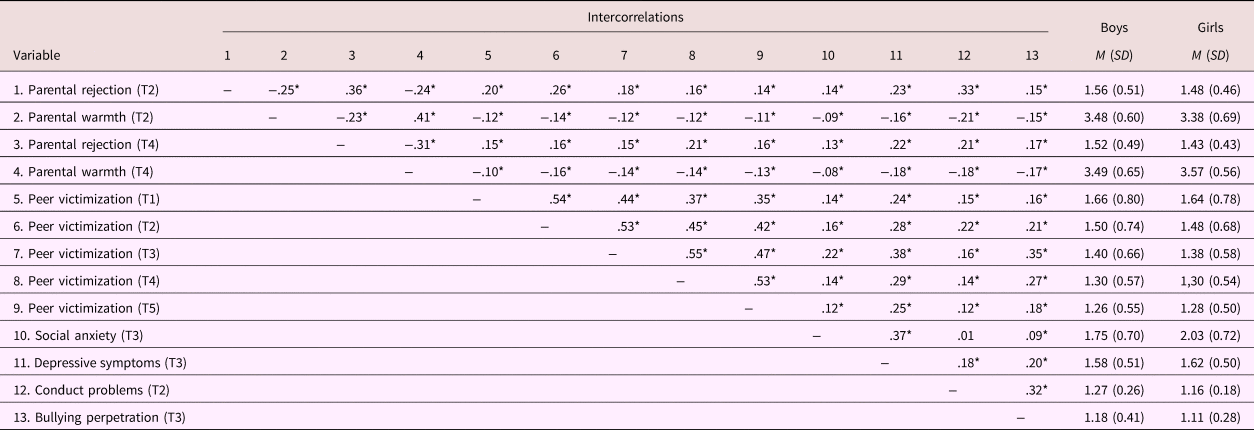
Note: *p < .001. M = mean; SD = standard deviation.
Bidirectional associations between parent–child relationships and peer victimization
The cross-lagged model (Figure 2; see Figure A2 for separate analyses for mothers and fathers) with random intercepts for peer victimization in which we regressed peer victimization and parents’ rejection and warmth on each other across five waves, controlling for previous levels of each outcome, fit the data very well: CFI = .98, TLI = .90, RMSEA = .04; 90% confidence interval (90% CI) [.04, .05]. Adding time constraints to the lagged effects worsened the model fit, both for the fully constrained model and for the models in which stability paths were constrained one by one, so all were estimated freely.
Direct effects between parent-child relationships and victimization.
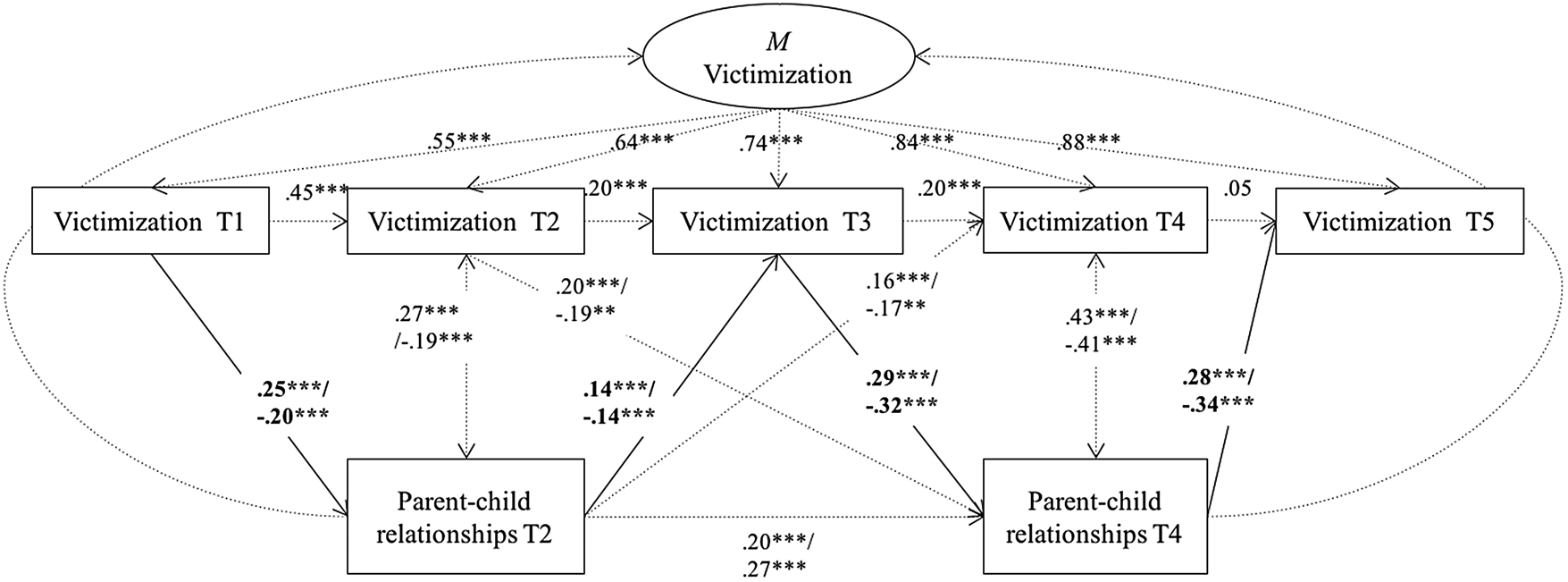
Standardized estimates (Figure 2) suggest concurrent and small to moderate associations between parent–child relationships and peer victimization (β ranging from -.19 for warmth to .43 for rejection; p < .001). Moreover, after stability of the constructs and concurrent associations were corrected for, parent–child relationship quality (higher rejection, lower warmth) was stably predictive of peer victimization over time and vice versa, providing evidence for a bidirectional model of low-quality parent–child relationships and peer victimization. More specifically, peer victimization at T1 and T3 predicted parent–child warmth and rejection at T2 and T4, respectively, and parent–child warmth and rejection at T2 and T4 predicted peer victimization at T3 and at T5, respectively. Effects were small to moderate in size (β ranging from .14 to -.34; p < .001).
Gender predicted parental rejection and warmth, with boys experiencing higher rejection (b = 0.06, p < .001) and lower warmth (b = -0.03, p = .01) than girls; however, constraining model estimates to be equivalent for boys and girls did not significantly worsen model fit, χ2 = 11.8, p = .16; thus, no gender-specific models were computed.
Maladjustment symptoms as mediators of parent–peer spillover
Next, we estimated a cross-lagged model with indirect effects to determine whether maladjustment symptoms mediated paths between parent–child relationship quality and peer victimization. The model included bidirectional relationships from parental rejection and warmth at T2 to maladjustment symptoms at T3, except for conduct problems, which were assessed at T2, and to victimization at T4 and vice versa.
The model, with all indirect effects included simultaneously, showed an excellent fit, CFI = .96, TLI = .91, RMSEA = .03; 90% CI [.03, .04]; Figure 3 (see Figure A3 for separate analyses for fathers and mothers and Figure A4 for unstandardized effects). The effects from parent–child relationships to victimization and vice versa decreased in size in this model.
Indirect effects as mediators explaining spillover effects between parent-child relationships and victimization.
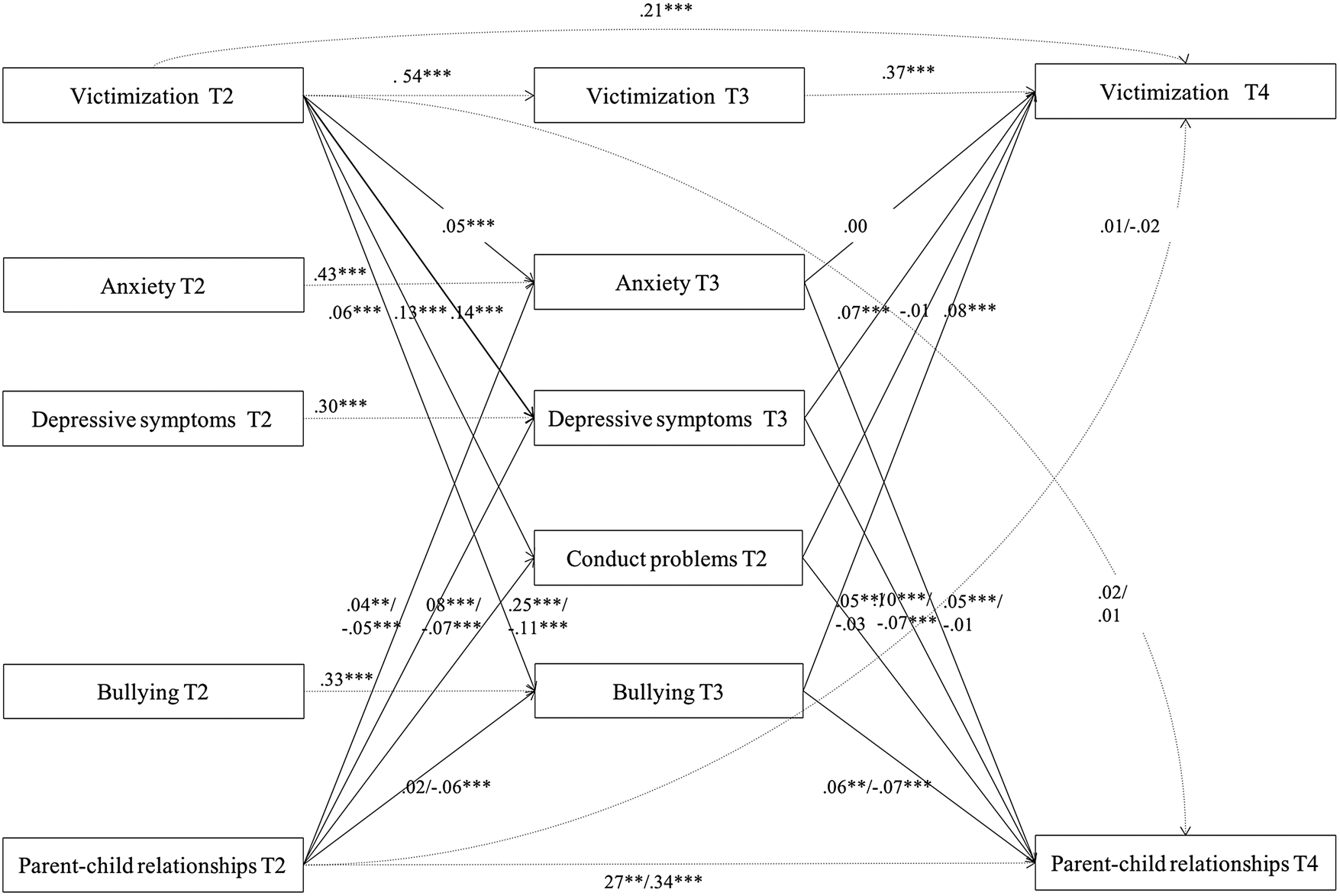
Several indirect effects were shown. Specifically, depressive symptoms and bullying perpetration mediated the effects of parent–child relationship quality on peer victimization: for depressive symptoms, both for rejection (b = .006, 95% CI [0.003, 0.009]) and warmth (b = .004, 95% CI [-0.007, -0.002]), and for bullying perpetration for warmth (b = -.004; 95% CI [-.007, -.001] and not rejection. The model explained 33.0% of the variance in peer victimization. With respect to associations from peer victimization to parent–child relationship quality, indirect effects were found for depressive symptoms (for rejection, b = .009; 95% CI [0.006, 0.012]; for warmth, b = -.009; 95% CI [-.013, -0.005]), and for bullying perpetration (for rejection, b = .002; 95% CI [-.001, .001]; for warmth, b = -.004; 95% CI [-.007, -.001]). Further, social anxiety (b = .002; 95% CI [.001, .003]) and conduct problems (b = .004; 95% CI [.001, .007]) mediated the effect of peer victimization on parental rejection but not on warmth. The model explained 18.3% of the variance in parental rejection and 20.0% of the variance in parental warmth. The results for conduct problems were also supported by longitudinal analyses using later waves (Appendix 2). Gender predicted parent–child relationships; boys experienced higher rejection (b = 0.06, p < .001) and lower warmth (b = -0.03, p = .03) (p < .001 for rejection, p = .03 for warmth) than girls, but constraints across boys and girls did not significantly worsen model fit, χ2 (24) = 26.0, p = .35.
Peer reports as robustness check
We conducted a robustness check using peer reports as a measure of victimization. We used information from a peer nomination strategy based on asking students to nominate the classmates they bullied (“Whom do you bully?”). For each student, received nominations were summed and divided by the number of participating classmates, resulting in proportion scores for victimization (0–1). A detailed description of the results and graphical representation can be found in Appendix 3. There were almost no differences between this model and the model using self-reported peer victimization with regard to the paths that were (non-)significant except for the non-significant effect from depressive symptoms on peer victimization. Small differences in effect sizes (difference in β ≥ .05) concerned larger effects for self-report than for peer nominations of peer victimization on depressive symptoms and conduct problems, and of depressive symptoms on peer victimization.
Discussion
How are parent–child relationship quality and peer victimization related? This key question was addressed by examining whether parental rejection and warmth were bidirectionally linked to peer victimization, and whether children's maladjustment symptoms explained this spillover. The results suggest that children may get caught in a vicious cycle of negativity in family and peer relationships: children who experienced hostility and low affection from parents showed increases in peer victimization in the subsequent months; in turn, peer victimization further increased rejection and diminished warmth in parent–child relationships. As hypothesized, children's maladjustment symptoms acted as gateways for these spillover mechanisms. That is, children's depressive symptoms and bullying perpetration mediated the effects of parent–child relationship quality on peer victimization, whereas social anxiety, depressive symptoms, conduct problems, and bullying perpetration mediated the effects of peer victimization on parent–child relationship quality. The results were largely consistent across analyses using self-reported versus peer nominations of victimization and across children's and parents’ gender, and they also did not differ based on whether or not children took part in an anti-bullying intervention.
Vicious cycle of negativity in parent–child and peer relationships?
Although most developmental research using the spillover framework has been focused on within-family processes, our findings show that spillover can also cross the family and peer boundaries, thus operating between different social systems. This phenomenon was already suggested by a few studies that showed spillover of daily processes, such as conflicts with peers and parents (Chung & Fuligni, Reference Chung and Fuligni2011), and that it can be extended to more stable features such as parent–child relationship quality and peer victimization (Pouwels et al., Reference Pouwels, Souren, Lansu and Cillessen2016).
The bidirectional nature of parent–peer associations was alarming with regard to peer victimization. The effect of parenting, such as maltreatment and maladaptive, hostile parenting, on peer victimization appears to be only one piece of the transactional chain (Bowes et al., Reference Bowes, Arseneault, Maughan, Taylor, Caspi and Moffitt2009; Lereya et al., Reference Lereya, Samaya and Wolke.2013; Schwartz et al., Reference Schwartz, Dodge, Pettit, Bates and Bierman2000). Peer victimization is also a risk factor for negative parenting, which implies that children could get “captured” within reinforcing patterns of parent–child negativity and peer victimization that might become chronic and get worse over time. Such persistency is important because it has even more severe psychopathological consequences than episodic parent–child problems or peer victimization (Bowes et al., Reference Bowes, Maughan, Ball, Shakoor, Ouellet-Morin, Caspi and Arseneault2013; Kim, Thompson, Walsh, & Schepp, Reference Kim, Thompson, Walsh and Schepp2015).
Maladjustment symptoms: Explaining spillover in parent–peer relationships
Increases in maladjustment symptoms, which could reflect negative affect, functioned as gateways between parent–child relationship quality and peer victimization in both directions. Children who experienced cold and hostile parenting showed an increase in depressive symptoms and were subsequently victimized even more. A lack of affection in relationships with parents can threaten children's fulfillment of their need to belong and might, therefore, predict depressive symptoms (Baumeister & Leary, Reference Baumeister and Leary1995; Roelofs, Meesters, Ter Huurne, Bamelis, & Muris, Reference Roelofs, Meesters, Ter Huurne, Bamelis and Muris2006), which can lead to stressful peer interactions (Hammen, Reference Hammen2006): children with depressive symptoms are often more prone to self-blame (“I have caused the victimization”) and hopelessness, limiting successful functioning in interpersonal contexts (Joiner, Wingate, Gencoz, & Gencoz, Reference Joiner, Wingate, Gencoz and Gencoz2005). They tend to act more submissively when being targeted by bullies (Reijntjes et al., Reference Reijntjes, Kamphuis, Prinzie and Telch2010) and are unlikely to defend themselves or retaliate, thus heightening risk for further victimization.
Not only internalizing, but also externalizing symptoms, such as bullying perpetration, explained how rejection and low affection in parent–child relationships spilled over into peer victimization. Children with difficult relationships with their parents have been shown to be at greatest risk of being bullying victims (Lereya et al., Reference Lereya, Samaya and Wolke.2013; Veenstra et al., Reference Veenstra, Lindenberg, Oldehinkel, De Winter, Verhulst and Ormel2005), and previous research found evidence of a bully–victim cycle (Marsh et al., Reference Marsh, Parada, Craven, Finger, Sanders and Phye2004). Extending this cycle, our findings suggest that children may follow a pattern of being a victim of negative parenting at home, being a bully at school, and in turn becoming a victim at school.
In addition, maladjustment symptoms not only explained parent-to-peer associations but also clarified how peer victimization influenced the parent–child relationship: all maladjustment symptoms tested here were mediators between peer victimization and hostile and cold parenting. When children bring home their sadness, anxiety, or anger resulting from being victimized by peers, they might elicit negative responses in parents, such as withdrawing affection or showing rejection. Further, children who bully their peers as a result of being victimized might generalize the power-asserting, dominant roles acquired in bullying their peers to interactions with their parents (Simons-Morton, Chen, Hand, & Haynie, Reference Simons-Morton, Chen, Hand and Haynie2008). Parent–child interactions therefore seem to not only affect bullying perpetration (Lereya et al., Reference Lereya, Samaya and Wolke.2013), but are also affected by it. Previous research demonstrated that the detrimental consequences of peer victimization were a catalyst for future peer victimization in other contexts (Brendgen & Poulin, Reference Brendgen and Poulin2017); they might also spill over to problems in other social domains, such as the family.
Interestingly, several differences emerged between the effects of parental rejection versus warmth. First, the mediating effects of bullying in the effect of parenting on peer victimization were found only for warmth and not rejection. Parental warmth involves the expression of social behaviors, such as affection and empathy, which children might observe and apply in social interactions with peers. Experiencing low warmth may therefore result in children learning fewer adaptive socialization strategies (Lereya et al., Reference Lereya, Samaya and Wolke.2013) and lower children's boundaries to displaying antisocial behaviors to others when they aim to increase their status among peers. In contrast, parental rejection particularly reflects discipline, and when experienced in the context of an overall affectionate and warm relationship, rejection might be less detrimental to children's socialization and thus their bullying behaviors (Baumrind, Reference Baumrind1966; Georgiou, Reference Georgiou2008). In addition, with regard to peer-to-parent associations, social anxiety and conduct problems mediated the effects of peer victimization on parental rejection only, and not warmth. Parents may use firmer discipline or language with anxious children who are overly afraid of everyday situations. Oppositional children do not obey rules, which could elicit more rejection, but may not reduce their displays of affect in less challenging interactions with parents, and thus may not experience less warmth in the overall relationship.
Strengths and limitations
To our knowledge, this study is the first to simultaneously test bidirectional spillover between parent–child relationship quality and peer victimization, especially in combination with maladjustment as a gateway. We relied on data that spanned a 2-yr period, included both self- and peer-reported information from >9,000 children, and used an innovative statistical approach that accounted for much of the stable between-person variance. Despite the insights gained, our results need to be interpreted with some limitations in mind.
First, most measures were based on children's self-reports, possibly resulting in inflated associations from shared method variance; however, a robustness check using peer-reported victimization to estimate the effect of this limitation yielded similar results. Although we did not have parent reports of parent–child relationships, it is important to note that in this study we measured children's personal, subjective perceptions of parent–child relationships, which we deemed more relevant for maladjustment. Future studies could extend these findings by incorporating multiple informants to find out whether similar patterns arise when parents report on their relationships with children.
Relatedly, the peer nomination measure of victimization used for the robustness check was bully-reported, which is less conventional than asking for all peers’ observations of bullying, and little is known about its validity. Bully-reported information might lead to underestimations of victimization due to social desirability; however, information reported by the broader peer group might do so as well, because of the hidden nature of victimization (Volk, Veenstra, & Espelage, Reference Volk, Veenstra and Espelage2017). Moreover, the similarities between our findings based on self-report and our bully-reported peer nomination item strengthened our trust in the quality of this measure. Nonetheless, it would be valuable if future researchers were to compare the validity of different sources of peer nominations and investigate whether bullies are valid informants of peer victimization.
Third, not all measures were assessed at all time points; therefore, we could not examine whether the findings would have been different if conduct problems were longitudinally included in the main model (in addition to the univariate model in Appendix 2). For this reason, we were also unable to account for all between-person variance: the RI-CLPM requires at least three measurements to estimate random intercepts. We illuminated between-person variance in peer victimization and in the variance of parent–child relationships that was related to stable between-person differences in victimization.
Future research and practical implications
Our findings raised questions beyond the scope of the current research. First, how can we prevent children from getting caught in a potentially vicious cycle of parent–child relationship problems, maladjustment symptoms, and peer victimization? Friendships can buffer prospective associations between hostile parenting and peer victimization (Schwartz et al., Reference Schwartz, Dodge, Pettit, Bates and Bierman2000) and bidirectional links between maladjustment and peer victimization (Hodges, Boivin, Vitaro, & Bukowski, Reference Hodges, Boivin, Vitaro and Bukowski1999). In addition to close friends, teachers are other attachment figures that can potentially interfere with children's negative experiences with both parents and peers (Kennedy & Kennedy, Reference Kennedy and Kennedy2004). Future studies could investigate the potential buffer of close friendships or high-quality teacher relationships in harmful parent–peer associations.
Second, it is feasible that different processes are at play for groups of children. For example, a lack of retaliation by victims may explain the mediating effect of internalizing symptoms in associations between negative parenting and peer victimization for some children, whereas retaliation by others might explain the mediating role of externalizing symptoms in these associations in other children. It would be valuable to examine this possibility by using person-oriented analytic methods to examine the processes that explain individual pathways.
Third, what other mechanisms might account for pathways between parent–peer relationships? We focused on child maladjustment in line with the focus of the prior literature on maladjustment symptoms or affective responses as gateways between parent and peer relationships; however, the indirect effects were small, so additional factors might contribute to explaining parent–child relationships and peer victimization. Perhaps, in connecting parents-to-peers associations, parents’ ways of handling victimization would also be an important mediator. Moreover, in explaining peers-to-parents links, children's agency in social situations might play a role because children who are victimized often lack social interactions that help them to solve complex social issues that are also present in interactions with people other than peers, such as parents (Ladd & Troop-Gordon, Reference Ladd and Troop-Gordon2003). Also, biological factors, such as cortisol responses to stress, have been associated with parenting, peer victimization, and depressive symptoms (Brendgen et al., Reference Brendgen, Ouellet-Morin, Lupien, Vitaro, Dionne and Boivin2017) and might partly explain parent–peer associations. Other studies have shown that genes play a role in parent–peer associations: for example, coercive parent–child relationships amplified the genetic risk of deviant peer affiliation (Li, Chen, Li, & Deater-Deckard, Reference Li, Chen, Li and Deater-Deckard2015).
Last, what does spillover look like in adolescent samples? The structure and content of young people's relationships with parents and peers change substantially during adolescence (e.g., Parke & Ladd, Reference Parke and Ladd2016). It might therefore be valuable to examine how this affects spillover processes between home and school domains.
Our study has some practical implications. Programs focusing on school and family domains could be better integrated when trying to tackle problems in each domain. For example, school-wide anti-bullying interventions increasingly involve parents, but mostly by improving parent–school relationships, such as parent's understanding of how the school tackles victimization (Axford et al., Reference Axford, Farrington, Clarkson, Bjornstad, Wrigley and Hutchings2015), and not by improving individual parent–child relationships and parents’ understanding of children's maladjustment.
Moreover, intervention programs could focus particularly on parents’ responses to children's maladjustment resulting from peer problems such as victimization. Parents are often considered important sources of support to decrease peer victimization or its consequences (Lereya et al., Reference Lereya, Samaya and Wolke.2013), but according to our findings, the children who are most in need of such support seem the least likely to garner it from their parents. In contrast, victimized children are at greater risk for hostile, low-affectionate parenting. Hence, parents may need guidance in how to recognize and respond to their children's maladjustment symptoms as signs of potential peer victimization.
Overall, our findings show that children's family and peer worlds should be understood as an integrated system in which problems in both domains continue to reinforce each other, and in which children's own feelings and behaviors partly function as gateways. To prevent or break a self-sustaining cycle of parent–child negativity and peer victimization, interventions targeting families or peers need to be integrated more systematically.
Author ORCIDs
Tessa M. L. Kaufman, 0000-0003-0191-953X. T. Kretschmer 0000-0001-6936-9285. G. Huitsing 0000-0001-7826-4178. R. Veenstra: 0000-0001-6686-6307
Financial support
This research is part of the Dutch KiVa project. The implementation and evaluation of KiVa in the Netherlands was financed by grants from the Dutch Ministry of Education (Onderwijs Bewijs, ODB10025) and the Dutch Science Foundation (NWO VICI 453-14-016).
Supplementary material
To view the supplementary material for this article, please visit https://doi.org/10.1017/S0954579418001360


 Open access

