

This contribution provides an overview of the main results of older and recent archaeological research concerning the Neolithic transition in north-west France, in the regions bordering the English Channel. Depending on the period, this process concerned, at the end of the 6th and beginning of the 5th millennia, a geographical area between the Armorican Massif to the west, the Channel Islands, and the sedimentary basins of the Caen Plain up to the Seine Valley, and, from the end of the 5th and beginning of the 4th millennium, cross-Channel connections. A Big Data approach enables us to identify a fluctuating pattern of settlement density, which can be interpreted in terms of demographic history. This text covers research themes common to archaeologists on both sides of the Channel, and therefore resonates as a call for new collaborations.
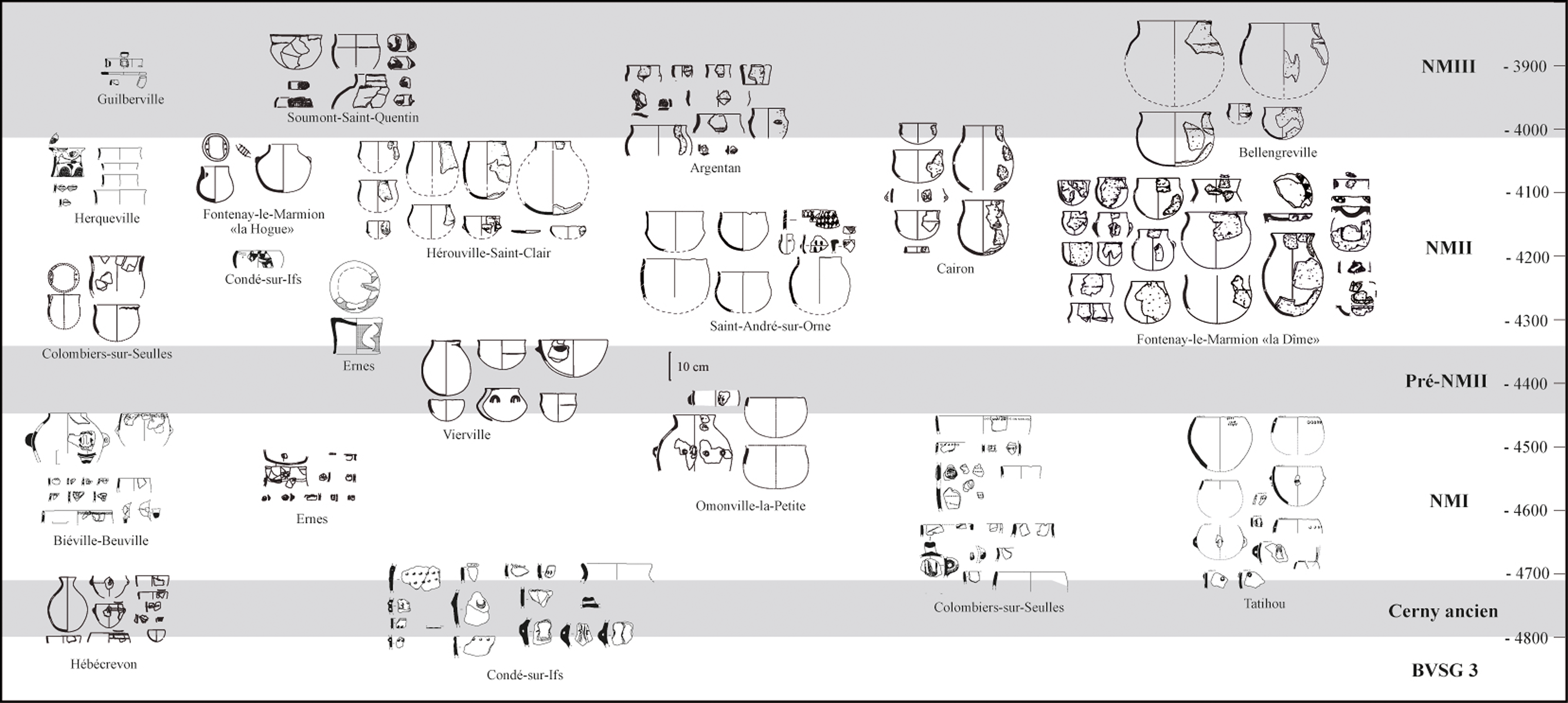
Although exhaustive, our research programmes did not manage to fill all the gaps in regional archaeological research concerning the Neolithic (Charraud Reference Charraud2024). As regards chronotypology, the different components of the lithic industries were incorporated into the temporal and spatial framework. However, pottery studies very much lag behind because of the absence of scientific attention. A holistic critical review of the available corpus is therefore an essential challenge in the medium term. The main research priorities for this material, which is essential to define the cultural groups which coexisted or succeeded each other in Normandy, could be the updating of the inventory of pottery shapes observed in the region throughout the Middle Neolithic (Figure 1). Such a macroscopic vision may be sufficient if the aim is to characterise the significant chronotypological elements of the regional corpus, but does not allow a sound technological analysis of the pottery assemblages. In the current state of research, four broader stages can be distinguished. These witnessed the development of various cultural groups at a regional scale. Their assemblages stand out mainly by virtue of a few vessels displaying more typical features and decoration which are incorporated in a wider, rather similar repertory, which establishes a common basis.
Overview of the pottery shapes assigned to the Middle Neolithic of Normandy (credit E. Ghesquière & C. Marcigny, Inrap).

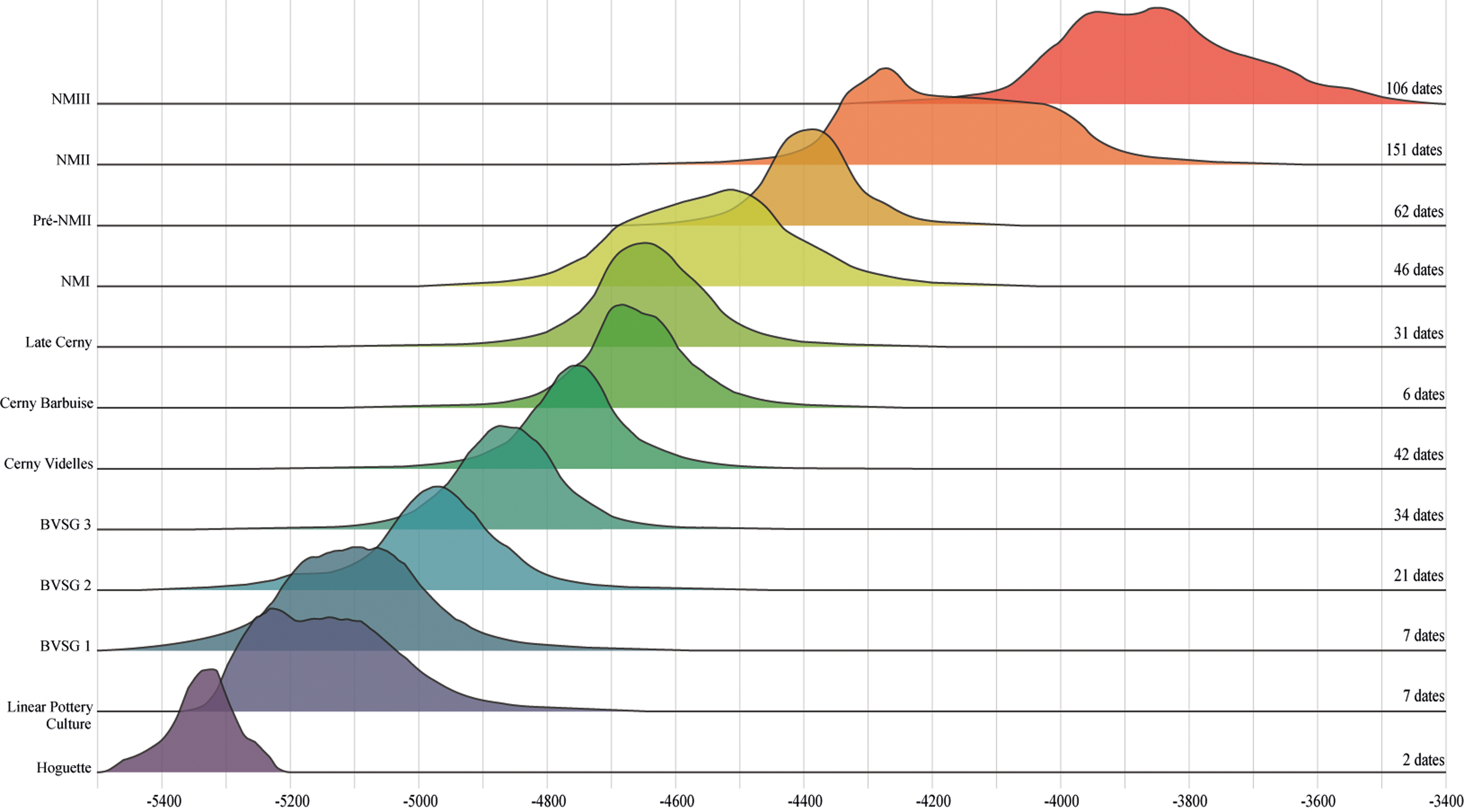
An exhaustive list of the radiocarbon dates obtained from all the Neolithic sites in the study area was used to build the detailed chronostratigraphy presented in the following pages. A total of 579 radiocarbon measurements were collected (Supplementary 1) and information about their archaeological context (at the level of the feature) was collated. The age measurements were calibrated using OxCal software (curve IntCal20; Reimer et al. Reference Reimer and Talamo2020). All calibrated dates, both in the article and in the appendix, are indicated with a probability of 95.4%. The modelling based on Bayesian statistics used the ChronoModel software, either to obtain smaller chronological intervals for groups of dates or to generate activity curves using probability sums. The probability density curves (PDC) were obtained using an Excel macro.
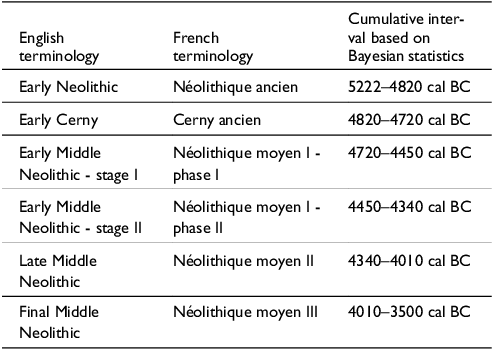
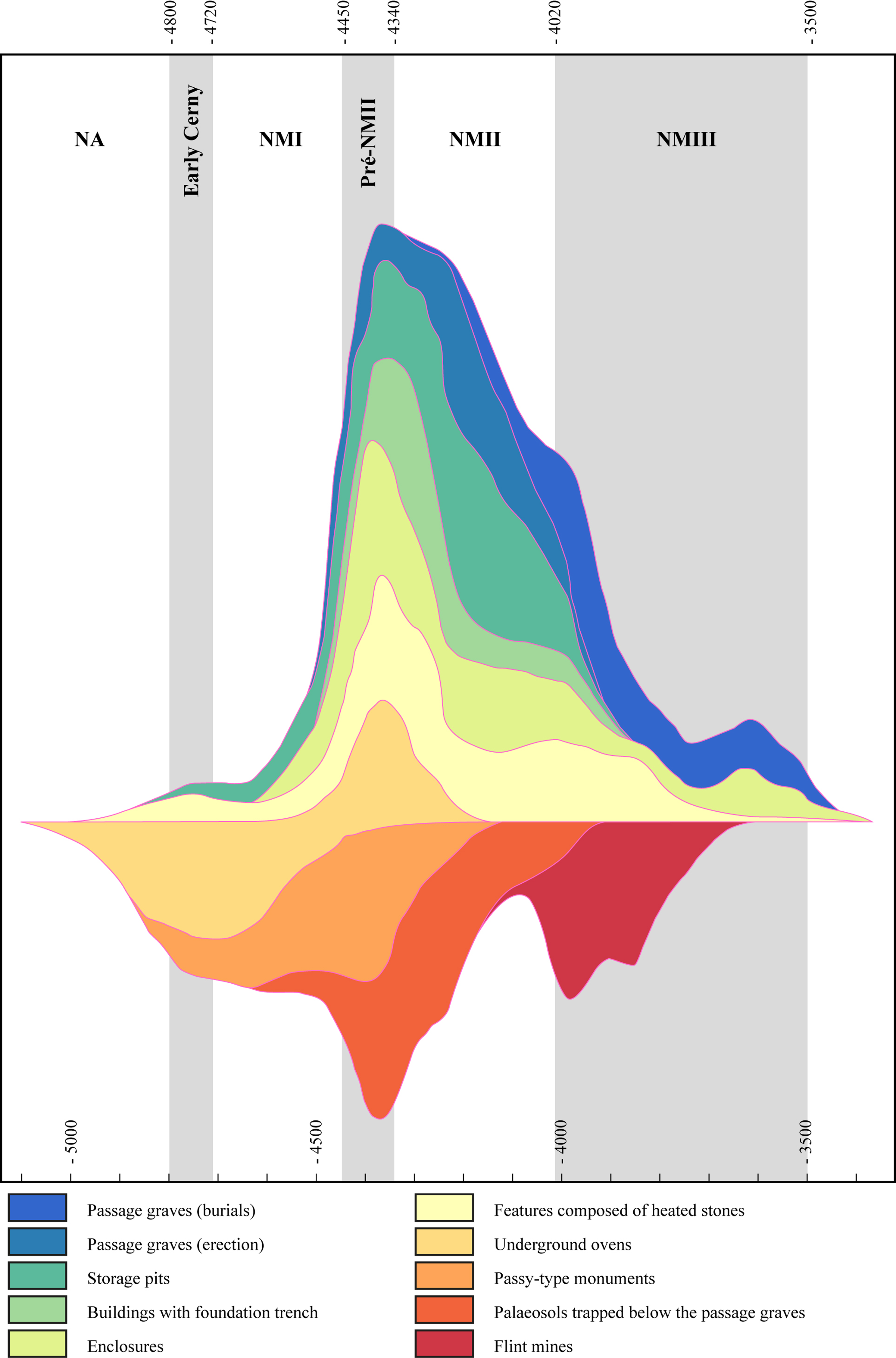
This study made it possible to detail the internal periodisation of the Middle Neolithic for the area of study using two different methods summarised by the overview diagrams presented in Table 1 and Figures 2 & 3 Footnote 1 :
Correspondence table between French and English chronological systems for the Neolithic.

Absolute chronology of the various stages of the Neolithic in Normandy, developed using the ChronoModel software, according to the radiocarbon data presented in Supplementary S1. The number of dates used to define each phase is indicated at the end of each line (credit F. Charraud & C. Marcigny, Inrap).

-
• a phase-by-phase sequencing (Early, Late and Final Middle Neolithic, ie, Néolithique moyen I, II, III in the French terminology — for convenience, only English terminology will be used in this text), which makes it possible to accurately define the theoretical chronological benchmarks for each of these periods;
-
• a sequencing by type of feature, which makes it possible to refine the temporal resolution of all the major kinds of archaeological evidence attributed to this period. This method, which is based on a classification of the dates according to archaeological context, makes it possible to obtain cumulative curves revealing the major developmental trends for each phenomenon.
The radiocarbon data used for this model are presented in Supplementary S1.
The Mesolithic and Early Neolithic background (prior to 4750 cal BC)
Although our focus concerns mainly the Middle Neolithic period, it may be useful to provide a brief overview of the features that characterise the groups present during the preceding centuries in the area of study, so as to set the scene.
To summarise a long-running debate, the presence of Mesolithic groups is attested in the area surrounding the Gulf of Morbihan (Téviecian) and the Loire Valley (Retzian; Marchand Reference Marchand2014), but there is no evidence from Normandy which would make it possible to assume any type of interaction between the last groups of hunter-gatherers and the earliest farmers (Ghesquière Reference Ghesquière2017). It must be observed that the earliest Neolithic groups around 5200 cal BC advanced into territories devoid of any evidence of human presence for at least several centuries.
The discovery of several La Hoguette vessels in north-western France is to be noted. These ceramics are the oldest known in western Europe, and following an east–west movement, they seem to precede by a few decades, in all regions, the first Neolithic settlements. But in the absence of an informative archaeological context, it is not possible to link them to the first Neolithic populations rather than to the last hunter-gatherers. Only one vessel, discovered in the Seine Valley at Alizay, is clearly dated (5370–5222 cal BC). The presence of groups with La Hoguette vessels therefore seems to precede the establishment of structured Neolithic hamlets by several decades. However, most of this pottery was found out of context and it is difficult to assign it to groups of hunter-gatherers rather than to the earliest farming communities.
Nonetheless, the data recovered from developer-funded archaeological excavations carried out in Brittany since the 2000s demonstrate that the Neolithic way of life spread to the north-western tip of Finistère as early as the beginning of the 5th millennium and even as early as the end of the 6th millennium BC, if the earliest radiocarbon dates from several Neolithic sites are taken into account (Charraud et al. Reference Charraud, Garrow, Ghesquière, Juhel, Lespez, Marcigny, Sturt, Bostyn, Denaire, Domenech-Jaulneau and Manceauin press). In the current state of research, they demonstrate that the dispersal of the Early Neolithic to Normandy and Brittany was mainly of Danubian origin: the significance of this cultural model, which was established in the North European Plain, apparently left little room for alternative traditions in these regions, even for the Early Neolithic of the Centre-Atlantic region (NACA: Joussaume Reference Joussaume1981; Cassen Reference Cassen1993), the presence of which is never found north of the Loire, although previously attested south of the river. The river therefore may have acted as a boundary separating the continental and the southern Neolithic areas at least up to the first decades of the 5th millennium BC, prior to the emergence of southern influences in pottery styles (Ghesquière et al. Reference Charraud, Garrow, Ghesquière, Juhel, Lespez, Marcigny, Sturt, Bostyn, Denaire, Domenech-Jaulneau and Manceauin press). Although this idea appears obvious from the archaeological evidence, it remains counterintuitive because the Loire corridor has always been a favoured communication route.
North of the River Loire, the end of the Early Neolithic testifies, in various material aspects, to a progressive disintegration of the Danubian model: possible dissolution of the standard architectural plan (Coudart Reference Coudart1998) and disappearance of the hamlet model; progressive replacement of blade industries by simple lithic products (Denis Reference Denis2017; Bostyn et al. Reference Bostyn, Charraud, Denis, Montoya, Fagnart and Locht2019; Charraud Reference Charraud2022); reduction in personal ornaments made from slate at the end of the period (Fromont Reference Fromont2013); increasingly regional circulation of artefacts (Bostyn Reference Bostyn1994; Augereau Reference Augereau2005) etc. This decline can be observed during the latest stage of the Blicquy/Villeneuve-Saint-Germain culture (BVSG), which is marked by the development of new pottery decorations: cordons (plastic decoration), the central-Atlantic origin of which was highlighted very early on (Bailloud Reference Bailloud1964), and ‘repoussé’ bosses, which appear at the transition to the Early Middle Neolithic (Ghesquière et al. Reference Charraud, Garrow, Ghesquière, Juhel, Lespez, Marcigny, Sturt, Bostyn, Denaire, Domenech-Jaulneau and Manceauin press).
A turning point around 4750 cal BC: the emergence of the Cerny culture
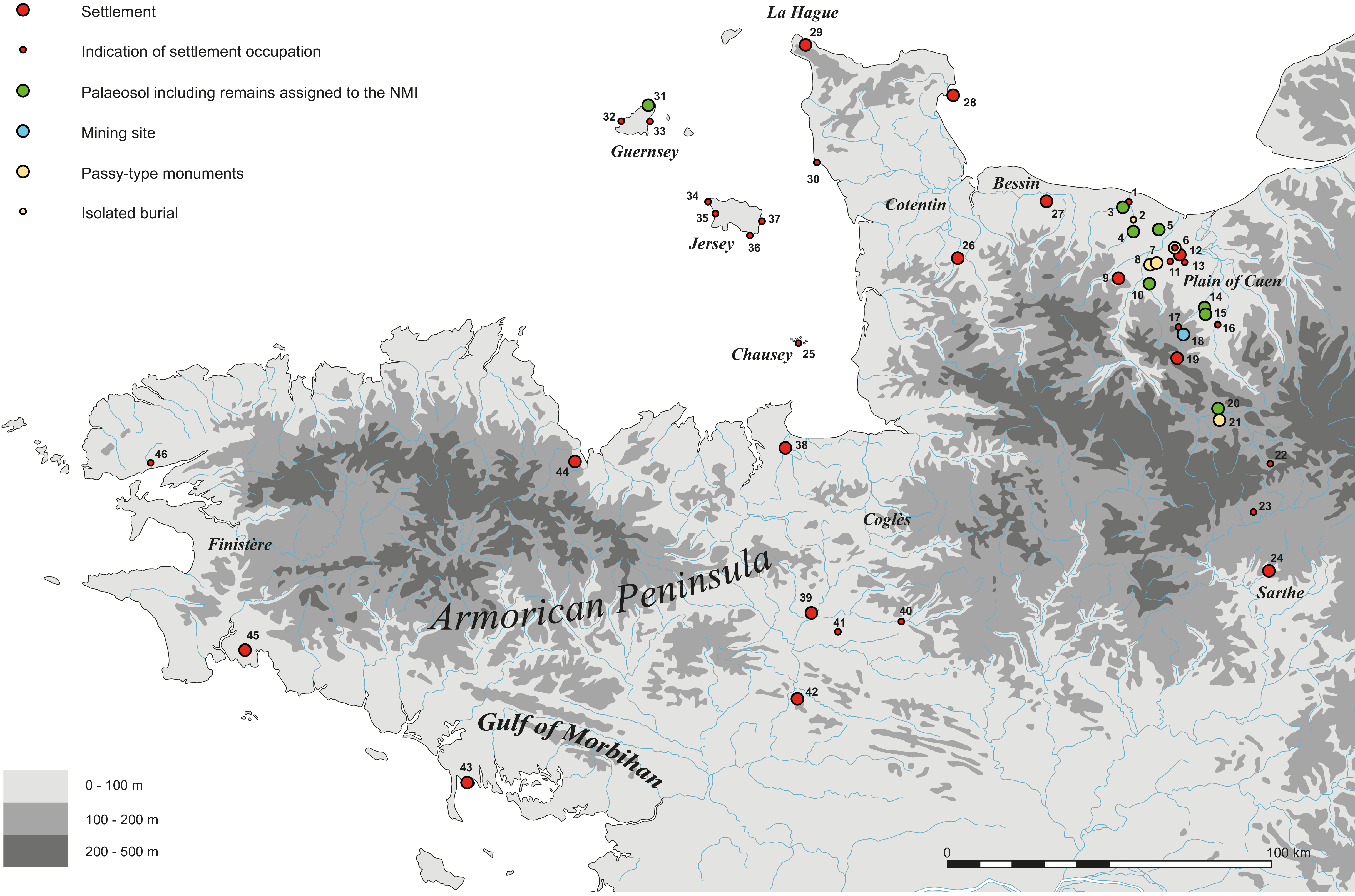
In Normandy as well as in Brittany this transition can be observed around 4750 cal BC and was of limited duration, introducing a new cultural model that corresponds to the emergence of the Cerny culture in the region (cumulative interval based on Bayesian statistics 4820-4720 cal BC: see Figures 2 & 3). This early stage of the Cerny culture, sometimes designated Cerny-Videlles in reference to a pottery style described in the Essonne Valley (Louboutin & Simonin Reference Louboutin, Simonin, Constantin, Mordant and Simonin1997), is characterised by cordon decoration directly inherited from the BVSG repertoire. Although of short duration, this phase is represented by a large number of sites in north-west France (Figure 4).
Overview of radiocarbon data from western Normandy. Chronological stage markers and the presence of distinct phenomena were obtained using activity curves from the ChronoModel software (SPD) from the 579 dates in Supplementary S1 (credit F. Charraud & C. Marcigny, Inrap).

Map of the sites attributed to the Early Cerny (interval 4800–4700 cal BC), Cerny and Early Middle Neolithic stage 1 (interval 4700–4450 cal BC) documented by excavations or test pits in western Normandy, the Channel Islands and Brittany (credit F. Charraud, Inrap). 1 Banville ‘Camp de la Burette’; 2 Basly ‘La Campagne’; 3 Colombiers-sur-Seulles ‘La Commune Sèche’; 4 Cairon ‘La Pierre Tourneresse’; 5 Biéville-Beuville ‘Les Sapins’; 6 Cuverville ‘Le Clos du Houx’; 7 Ifs ‘Le Hoguet’; 8 Fleury-sur-Orne ‘Les Hauts de l’Orne’; 9 Evrecy ‘La Croix Boucher’; 10 Fontenay-le-Marmion ‘La Hogue’; 11 Cagny ‘Route de Démouville’; 12 Démouville ‘Le Clos Neuf ’; 13 Émiéville ‘Le Chanp des Oiseaux’; 14 Condé-sur-Ifs ‘La Bruyère du Hamel’; 15 Ernes ‘Derrière les Prés’; 16 Jort ‘La Carrière Macé’; 17 Soumont-Saint-Quentin ‘Le Mont Joly’; 18 Soumont-Saint-Quentin ‘Les Longrais’; 19 Falaise ‘Les Sentes 2’; 20 Moulin-sur-Orne ‘Les Hogues’; 21 Sarceaux ‘La Butte du Houx’; 22 Sées ‘Les Allouées’; 23 Valframbert ‘Le Moulin d’Aché’; 24 Vivoin ‘Le Parc’; 25 Granville, îles Chausey ‘La Cale’; 26 Hébécrevon ‘L’Hôtel Torquet’; 27 Mosles ‘La Vignette’; 28 Saint-Vaast-la-Hougue ‘Tatihou’; 29 Omonville-la-Petite ‘La Jupinerie’; 30 Barneville-Carteret ‘Le Castel’; 31 Guernsey, Vale ‘Les Fouaillages’; 32 Guernsey, l’Érée ‘L’Erée Bay’; 33 Guernsey, Saint Peter’s Port ‘Royal Hotel’; 34 Jersey, Saint-Ouen ‘Le Pinacle’; 35 Jersey, Saint-Ouen ‘L’Ouzière’; 36 Jersey, Saint-Clément ‘La Motte’; 37 Jersey, Gorey ‘Mont Orgueil’; 38 Lillemer; 39 Vezin-le-Coquet ‘Les Champs Bleus’; 40 Saint-Aubin-des-Landes ‘Les Lacs’; 41 Domloup ‘Le Tertre’; 42 Pléchâtel ‘Le Bois’; 43 Carnac ‘Montauban’; 44 Trémuson ‘Le Coin des Petits Clos’; 45 Pleuven ‘Pen Hoat Salaün’; 46 Brest ‘Kerlinou’.

In the Plain of Caen, Condé-sur-Ifs ‘La Bruyère du Hamel’ (Dron et al. Reference Dron, Charraud, Le Goff and Gâche2016) and Falaise ‘Les Sentes’ (Jan et al. Reference Jan, Beauchamp, Charraud, Larue and Riquier2020) have yielded the most impressive assemblages of artefacts. Comparison with the lithic industries recovered from these sites suggests that the mining site of Soumont-Saint-Quentin ‘Les Longrais’ (Ghesquière et al. Reference Ghesquière, Marcigny, Desloges and Charraud2008) belongs to this stage, but this hypothesis requires additional field studies. In the northern part of the Plain of Caen and in the Bessin region, the underground ovens of Cuverville ‘Le Clos du Houx’ and Mosles ‘La Vignette’ can also be attributed to this group, although they have yielded smaller assemblages that limit cultural comparisons. In the Cotentin and on the north coast of the Armorican Peninsula, the sites of Hébécrevon ‘L’Hôtel Torquet’ (Ghesquière et al. Reference Ghesquière, Marcigny, Lepaumier, Dietsch-Sellami, Renault and Savary1999) and Trémuson ‘Le Coin des Petits Clos’ (Toron et al. Reference Toron, Donnart and Favrel2018) contained very characteristic pottery assigned to the Early Cerny together with underground ovens, although they did not yield any building plans (Figure 4).
At Pleuven ‘Pen Hoat Salaün’ (Nicolas et al. Reference Nicolas, Marchand, Henaff, Juhel, Pailler, Darboux and Errera2013), a site located at the tip of Finistère, Cerny-type pottery was recovered from a layer dated by radiocarbon to the interval 4850–4700 cal BC, together with a feature composed of heated stones; although the structural and functional characteristics of the site still need to be clarified, this is nonetheless proof that the Cerny culture, during its earliest stage, spread across the entire Armorican peninsula, thus completing the spread of the Neolithic associated with the BVSG. At the nearby site of Brest ‘Kerlinou’ (Roy Reference Roy2015), a diagnostic study carried out during developer-funded excavations recorded two groups of postholes linked to a feature composed of heated stones dated to 4845–4720 cal BC. Despite the obvious importance of this site, no further investigation was carried out, which makes it impossible to decide whether this site dates to the beginning of the Cerny culture or rather to the end of the BVSG.
The site of Vivoin ‘Le Parc’ (Sarthe department; Ghesquière et al. Reference Ghesquière, Marcigny, Aubry, Clément-Sauleau, Dietsch-Sellami, Deloze, Hamon, Querré and Renault2003) is currently the only site dated to this period which has yielded a complete plan of a building. An additional building discovered recently at Cagny ‘Route de Démouville’ (Lamerant Reference Lamerant2014) shares several characteristics with that at Vivoin, in particular a trapeze-shaped, north–south-oriented plan without lateral pits. Two burials below the northern gable wall were dated by radiocarbon and can be assigned to the Cerny culture (see Supplementary S1). However, only slate bracelets were associated with the deceased. Therefore, even though the assemblage was assigned to the Early Neolithic by the excavators, an attribution to the Cerny culture is also an admissible hypothesis when the results of the radiocarbon dating are taken into account.
The earliest enclosures in Normandy are of quite a late date (after 4500 cal BC), but a recent discovery made in Loire-Atlantique suggests that this type of monument was probably known during that period: the digging of the interrupted ditch enclosure of Le Pallet ‘Rue de Sèvre’ is attributed to the interval 4800–4600 cal BC based on three concordant radiocarbon measurements that are consistent with the pottery discovered (Favrel et al. Reference Favrel, Zanotti, Donnart, Gourmelon, Martin and Prouin2023).
The underground ovens, interpreted as cooking ovens, are not limited to this temporal and cultural period but they are very characteristic of it (Charraud et al. Reference Charraud, Marcigny, Aubry and Seignac2024). At Falaise and at Condé-sur-Ifs these ovens are associated with remains which confirm the domestic nature of these occupations. At both sites the material recovered from the underground ovens is identical to the material of the surrounding concentrations. These two sites are therefore representative for the period; other sites, although smaller, are comparable.
The pottery is very characteristic. Plastic decoration is prevalent, the predominant type being boss decoration obtained by pushing back the clay from inside the vessel wall. This type of ‘repoussé’ decoration became characteristic of the material culture of western France and its use persisted up to the Late Middle Neolithic in greatly varying proportions depending on the periods and the geographical areas. On the other hand, vessel shapes (simple hemispherical shapes and bottles) are very similar to those of the preceding period and it appears that the Early Cerny, although it uses new decoration techniques, entirely adheres to the grammar of the BVSG with plastic decoration (or BVSG ‘with cordons’), including rows of ‘repoussé’ bosses arranged in a V shape above the handles, as well as the cordon motifs.
The characteristics of the lithic industries confirm this origin in Early Neolithic technological tradition. The most significant element undoubtedly is the predominance of a late blade industry (Charraud Reference Charraud2013; Dron et al. Reference Dron, Charraud, Le Goff and Gâche2016), the blades directly stemming from the standardised types in use during the BVSG. The same range of types is represented, including many of the bifacial tranchets. These industries require high-quality flint, which is present in the region only in deep deposits, and it must be supposed that it was extracted through mining, as can be demonstrated for Cinglais flint (Charraud Reference Charraud2015). Apart from Cinglais flint, Laizon flint was preferentially used at the Cerny sites and was apparently extracted at the Soumont-Saint-Quentin ‘Les Longrais’ mine (Ghesquière et al. Reference Ghesquière, Marcigny, Desloges and Charraud2008). As regards personal ornaments, a few discoveries of bracelets with a wide crown suggest that these were a late distinguishing feature, contrasting with the narrow-crown slate rings of the preceding BVSG (Fromont Reference Fromont2013).
Despite these few reference sites, the social and economic framework of this period remains unclear given the lack of significant information. For example, blade production using Laizon flint does not seem to spread over long distances; the exchange network present during the BVSG might therefore have disappeared with the end of the Early Neolithic. On the other hand, there is no significant evidence for farming practices except for the oven at Hébécrevon. This site yielded a significant assemblage, but the absence of sickle elements is striking, all the more so as this is a major distinction compared with the BVSG series, and not a single pit attests to the storage of harvests. However, grinding stones are abundant at Falaise (Jan et al. Reference Jan, Beauchamp, Charraud, Larue and Riquier2020). The specific characteristics of the Early Cerny are thus primarily defined by the pottery styles, the management of lithic resources and tools, as well as dates centred around 4750 cal BC, whereas the series of dates related to stages 2 and 3 of the BVSG invariably fall prior to 4800 cal BC (Ghesquière et al. Reference Charraud, Garrow, Ghesquière, Juhel, Lespez, Marcigny, Sturt, Bostyn, Denaire, Domenech-Jaulneau and Manceauin press). These details are sufficiently significant to determine that this stage is not an epiphenomenon of the Linear Pottery culture. They are indicative of a change towards a different kind of Neolithic which ends the Danubian pioneering stage.
The Early Middle Neolithic (4700–4350 cal BC): a new cultural patchwork
The Early Middle Neolithic in north-west France can be subdivided into two stages:
-
• a period of approximately three centuries (cumulative interval based on Bayesian statistics 4720–4450 cal BC; Figures 2 & 3), characterised by poor archaeological data, especially as regards settlements, which considerably differ from the preceding period;
-
• a period of dynamic movement, lasting about one century (cumulative interval based on Bayesian statistics 4450–4340 cal BC; Figures 2 & 3), during which the features that subsequently witness their full development in the course of the Late Middle Neolithic are progressively established, such as enclosures, passage graves, storage pits, etc. This initial stage can be qualified as an introduction to the Late Middle Neolithic or pre-Late Middle Neolithic.
The first three centuries of the Early Middle Neolithic coincide with a significant climate deterioration, when it becomes colder and wetter (Bond et al. Reference Bond, Kromer, Beer, Muscheler, Evans, Showers, Hoffmann, Lotti-Bond, Hajdas and Bonani2001; Lespez et al. Reference Lespez, Clet-Pellerin, Davidson, Barbier, Mauger and Boulejbem2006). This period is marked by regionalisation and a reconfiguration of the cultural groups, which seems to mirror a general stabilisation of the agropastoral system in north-west France: the Danubian spread of the Neolithic halts at the ocean, and spreads no further. The end of specialised blade production almost everywhere in north-west Europe in favour of more regional development testifies to this evolution: the spread of the Neolithic no longer involves a forward-oriented movement towards new territories, but rather continues as human impact on and exploitation of all environments. This is shown by the occupation of hitherto disregarded areas (Seine Valley, coastal areas, hilltops or rock shelters) and signs of increasing human impact in pollen diagrams. These indications, which are still subtle during the Early Middle Neolithic, were progressively strengthened during the Late Middle Neolithic.
The differentiation between the cultural groups in north-west France from the Early Middle Neolithic onwards is based on the description of the pottery assemblages and above all their decoration (Cassen Reference Cassen1993; Patton Reference Patton1995; Marcigny Reference Marcigny2014). It has been suggested that a distinction can be drawn between chronocultural assemblages that were established as early as 4700/4600 cal BC in the west, ie, in the area of the Armorican massif (Brittany, Cotentin, Channel Islands), and those in the east in the sedimentary basins (Normandy, Maine, Anjou, Beauce).
In eastern Normandy the influence of the Cerny-Barbuise group, which is predominant in the Paris Basin and well-known in the Seine Valley, can be detected through its characteristic dragged-comb decorations (Prost Reference Prost2015). These badly defined assemblages from the Plain of Caen are similar to the Early Cerny culture, but decoration becomes rare except for bosses arranged in linear patterns. In some cases southern characteristics related to the Chambon group, which is located in the Beauce and the Val-de-Loire regions (solar motif from the palaeosol at Ernes: San Juan & Dron Reference San Juan and Dron1997), are incorporated.
In western Normandy the Castellic style has been identified at La Hague (Omonville-la-Petite: Juhel Reference Juhel2006) and at Carteret (Billard et al. Reference Billard, Delrieu and Le Maux2014), and the Pinacle-Fouaillages style has been identified on the Channel Islands (Pioffet Reference Pioffet2014). The Pinacle-Fouaillages style is associated with segmented profiles and concave, strongly marked necks. The vessels are abundantly decorated with garland designs or thin complex cordons. ‘Repoussé’ bosses are invariably present in large numbers. Vessels with deformed mouth or with a ‘squared mouth’ must be highlighted; these are evocative of contemporaneous southern cultural contexts (the Chambon group being the closest of these).
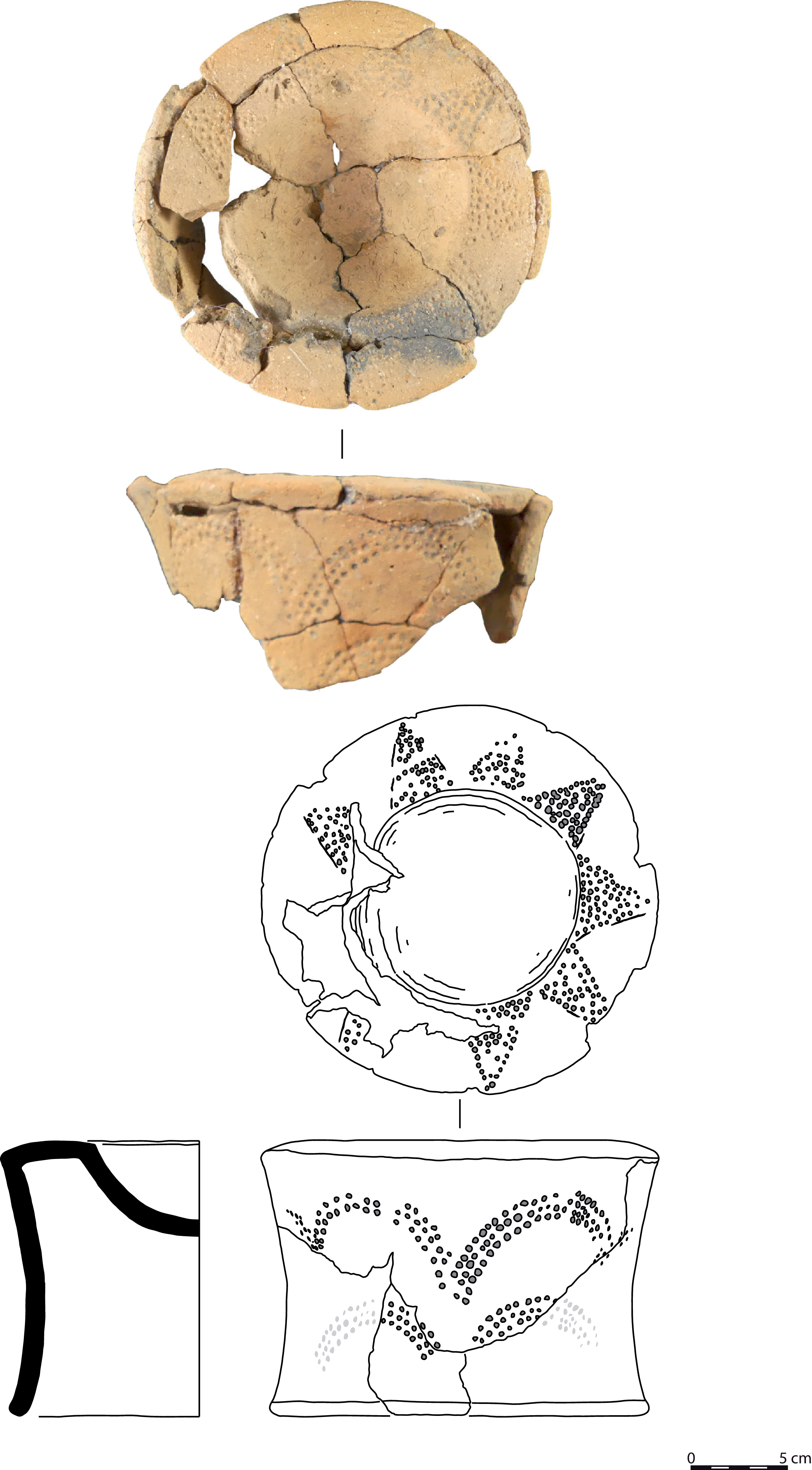
Although its distribution is centred on the Gulf of Morbihan, the Castellic style extends across part of the Manche department. The shapes of the Castellic-type vessels are very similar to those of the Pinacle-Fouaillages style, but some of the decorative motifs are completely different and the designs belong to a different type (meander patterns, decorations arranged in panels, etc.). In these contexts, ‘repoussé’ bosses are found again. The earliest coupes à socle with cylinder-shaped stem can be assigned to this period (Figure 5). They could relate to an early Chasséen influence (Gernigon Reference Gernigon and Perrin2016).
Example of a coupe à socle from Bénouville ‘Quartier de la Clôture’ (after Coupard Reference Coupard2025).

It is not yet clear what part environmental factors (landscapes, coastal areas, insularity, nature of the geological substratum) played in forming the individual features of these Neolithic groups. In any case, these do not obscure the many common characteristics that reveal their affiliation with the same cultural background. In addition, the abandonment of blade industries and the simplification of the lithic assemblages is common to the entire west European area at this time. Local logistics predominate but the tool range becomes simpler, and domestic assemblages no longer require the high degree of know-how that was doubtlessly the domain of highly skilled producers during the Early Neolithic. As a consequence, there is no indication of flint extraction by mining during this period, and trade of specialised products over long distances ceases; not a single such product remains among this patchwork of Cerny-related cultures.
The occupation of hilltop sites in this period is confirmed (Figure 4) at sites such as Soumont-Saint-Quentin ‘Le Mont Joly’, Merri ‘Le Camp de Bierre’, Banville ‘La Burette’, and Barneville-Carteret ‘Le Castel’ (under Castellic influence), but these heterogeneous assemblages are invariably composed of both Early and Late Middle Neolithic material and lack reliable archaeological contexts, since no large-scale excavations were carried out. The fortifications at these topographic locations are all of a more recent date. Neolithic remains or dates were recovered from palaeosols trapped below the protohistoric defensive walls or were found among disturbed remains in more recent pits, as is the case at Banville.
The rock shelter at Omonville-la-Petite also contained vestigial remains that testify to occupations ranging from the end of the BVSG to the transition from the Early to the Late Middle Neolithic, evidencing obvious Castellic influence (Juhel Reference Juhel2006). The currently most convincing hypothesis is that very short-lived occupations succeeded each other in the long term at this possible hunting camp.
The few Cerny culture sites in the area towards the Seine Valley are established on flood-prone river banks, comprising hard to interpret settlement layers or pits without any apparent organisation (Prost Reference Prost2015). Moreover, a few features composed of heated stones suggest the presence of meeting places, in particular in the loop of the Seine river at the latitude of Le Vaudreuil (Charraud et al. Reference Charraud, Marcigny, Aubry and Seignac2024), but also very near the megalithic alignments in Quiberon Bay. At Carnac ‘Montauban’ (Hinguant Reference Hinguant2010), dates obtained from features composed of heated stones peak around 4500 cal BC, suggesting that these are concordant with the beginning of stela alignments. This is corroborated by the examples of Saint-Just (Ille-et-Vilaine: Le Roux et al. Reference Le Roux, Lecerf and Gautier1989) and Hoëdic (Morbihan: Large Reference Large2014), which precede by a short interval the construction of the earliest cairns with passage graves.
In the sedimentary basins of Normandy, palaeosols trapped below passage graves are contexts that are emblematic of this period. In all cases, the heterogeneity of the remains reflects the uncertain nature of the occupation levels preserved by these monuments. These assemblages were formed over more or less extended periods between the end of the Early Neolithic and the Early Middle Neolithic, followed by a gap of variable duration that precedes their sealing by the monuments erected during the Late Middle Neolithic. Nonetheless, the major importance of these contexts lies in what they tell us about the organisation of Neolithic societies and territorial organisation at that point in time: cyclical occupations following a model of rotational fallowing or ‘terroirs’ sealed by monuments that are probably both symbolic and landscape markers, as are the tombs. Lastly, the heterogeneous composition of most assemblages dated to this period may reflect cyclical occupations, and both palaeosols, rock shelters, and hilltop sites express the same type of occupation or reoccupation of the same locations over a long period.
In other contexts, for example in the Sahara or the eastern Sahel during the 5th and 4th millennium BC, this type of occupation is related to highly mobile nomadic or semi-nomadic agropastoral systems following the free-range pasturing of the herds (Lesur Reference Lesur2018). The return to an economy of ‘herder-gatherers’ occasionally practising hunting is often associated with periods of significant climate deterioration during which groups roam territories delimited by drystone monuments, some of which at least were tombs, to graze their herds (Cauliez et al. Reference Cauliez, Dachy and Gutherz2018). The presence of livestock in various forms in these tombs (offerings of quarters of animals, funerary feasting, or ritual sacrifices) is considered a very significant characteristic of these herding societies (Lesur Reference Lesur2018). It tantalisingly evokes the funerary deposits observed in the Passy-type monuments of the Plain of Caen (Ghesquière Reference Ghesquière2019).
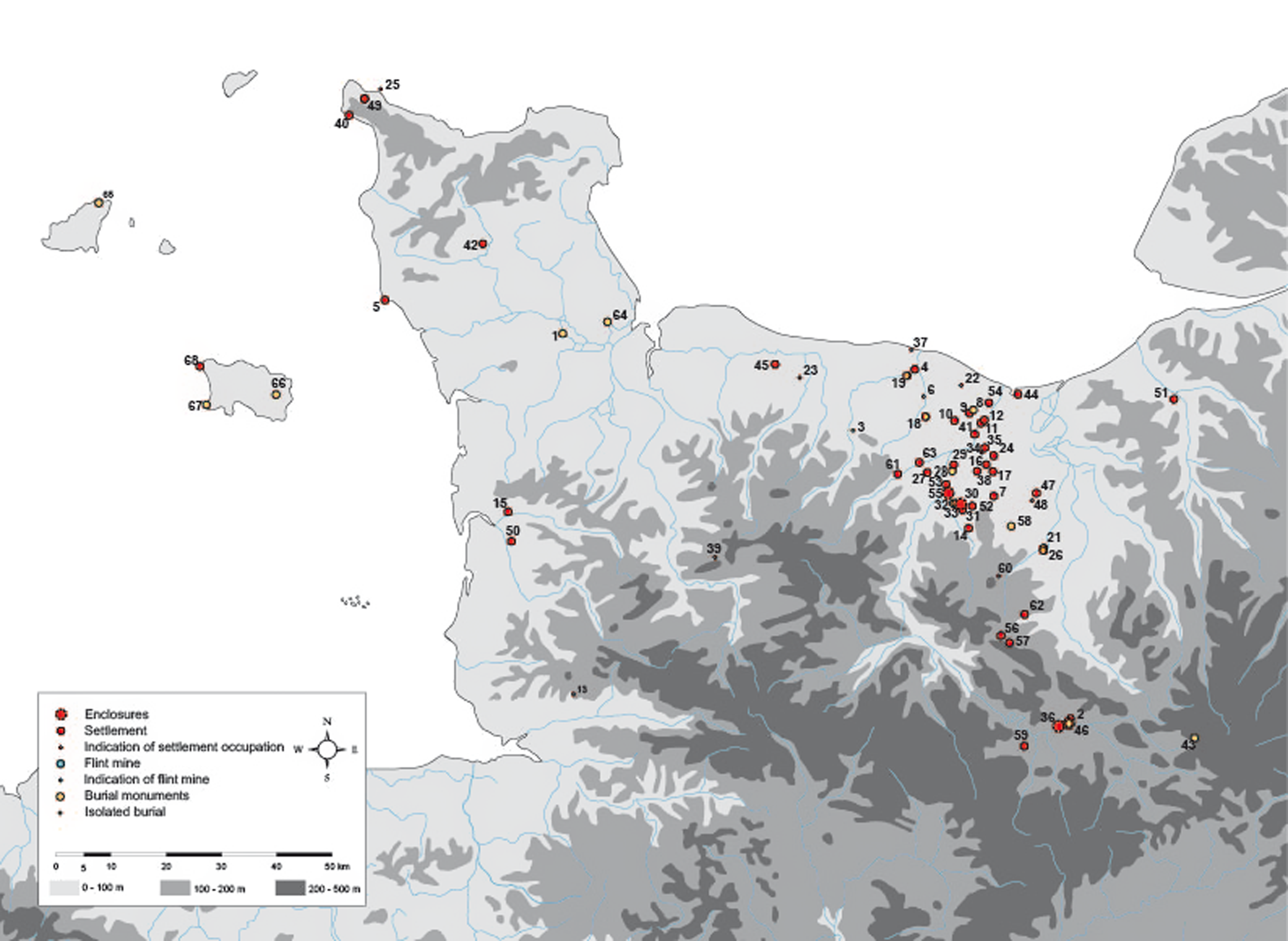
During the last century of the period (or ‘pre-Late Middle Neolithic’ from 4450 cal BC onwards) the earliest, initially subtle features of the Late Middle Neolithic can be identified, which significantly increase from 4350 cal BC (Figures 2, 3 & 6).
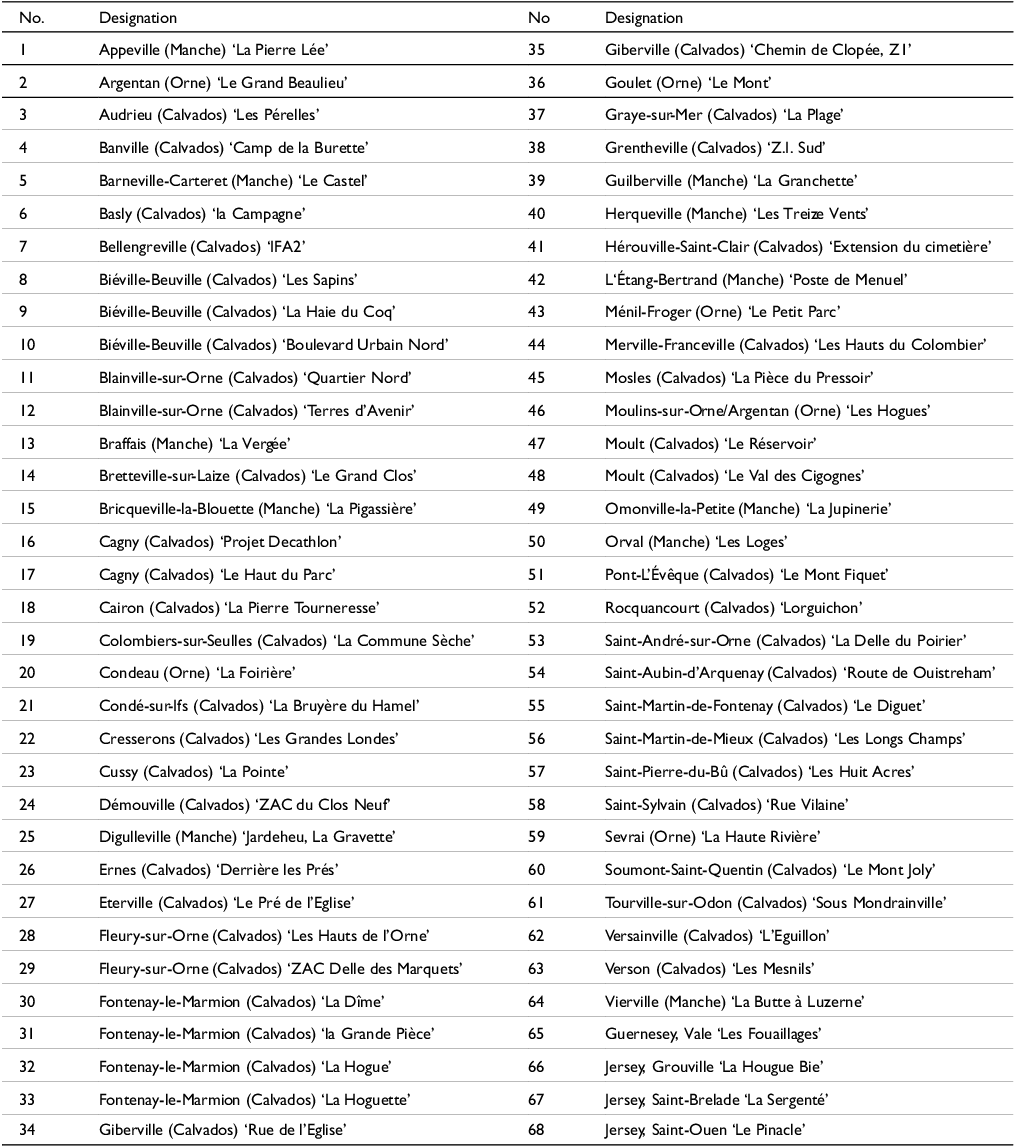
Map of the sites attributed to the Early Middle Neolithic stage 2 (4450–4350 cal BC) and to the Late Middle Neolithic (4350–4000 cal BC) in western Normandy and the Channel Islands. The numbering is detailed in Table 2 (credit F. Charraud, Inrap).

The earliest enclosures in Normandy can be dated to around 4450 cal BC at Saint-Martin de-Fontenay ‘Le Diguet’ (Marcigny Reference Marcigny2013) and at Saint-Vigor d’Ymonville ‘La Mare des Mares’ (Marcigny et al. Reference Marcigny, Ghesquière, Clément-Sauleau, Giazzon and Gallouin2002). These two examples suggest a temporal distinction between enclosures surrounded by palisades, erected doubtlessly by the end of the Early Middle Neolithic, and interrupted ditch enclosures dated to the Late Middle Neolithic (Ghesquière & Marcigny Reference Ghesquière and Marcigny2014). The earliest examples in the Val de Loire region (Sandun, Le Pallet) can be assigned to a different, Atlantic dynamic, while not a single enclosure is currently known prior to 4300 cal BC in the Armorican Massif (Laporte et al. Reference Laporte, Bizien-Jaglin and Guyodo2014). The enclosure of Saint-Martin-de-Fontenay yielded only very little pottery, most probably because there were few features suitable to ‘trap’ the remains, such as storage pits. Nonetheless, a few storage pits without diagnostic remains can be dated to this period at Biéville-Beuville ‘La Haie du Coq’ (Germain-Vallée et al. Reference Germain-Vallée, Pillault, Giraud, Jan, Mauger, Marcoux, Neveu, Aoustin, Labbey and Beauchamp2013) and l’Étang-Bertrand ‘Poste de Menuel’ (Charraud Reference Charraud2019), as well as pits that contained Cerny-Barbuise-style sherds at Pinterville ‘Le Clos des Cerisiers’ in the Eure Valley (Aubry Reference Aubry2001).
The emergence of monumental features, in particular monumental tombs, is common to both the western and eastern part of the study area, but materialised in different types in the different geographical areas. In the western part the most emblematic case is the monument of Les Fouaillages on Guernsey (Kinnes Reference Kinnes1982). Part of this monument was used for funerary purposes and was dated to around 4450 cal BC. The mound is composed of sediments (turf) including the disturbed residual remains from a preceding occupation assigned to the Pinacle-Fouaillages tradition (Garrow et al. Reference Garrow, Griffiths, Anderson-Whymark and Sturt2017). The monument was probably designed to hold a single burial, but within a monumental tomb that resembles a long barrow, which can be linked to the same dynamic as the Passy-type monuments.
In the eastern part, in the sedimentary basins, the presence of cemeteries of Passy-type monuments is to be noted, namely at the sites of Rots, Fleury-sur-Orne, Ifs, and Cuverville. The DNA analyses carried out at Fleury-sur-Orne suggest southern contacts (Rohrlach & Haak, Reference Rohrlach and Haak2021; Rivollat et al. Reference Rivollat, Thomas, Ghesquière, Rohrlach, Späth, Pemonge, Haak, Chambon and Deguilloux2022), but there is no evidence to support this assumption in the material culture. These burial monuments predate Les Fouaillages and are rooted in a Cerny dynamic, but their chronology extends over several centuries. They take the form of a long mound bordered by two parallel ditches, which can measure up to 350 m in length in the case of the largest examples. In the centre of these monuments or at their ends, a pit grave is frequently located which contains a single burial accompanied by abundant grave goods: quiver, flint tools, joints of meat, bone awls, etc. In a few rare cases the central burial exhibits a complex cist-type structure reminiscent of Armorican tombs.
During this period certain individuals thus seem to attain a hitherto unprecedented status, undoubtedly mirroring increasing social complexity or stratification from the second half of the 5th millennium BC. However, there is not a single house plan or settlement structure in this cultural patchwork which would make it possible to provide information about the daily life of the builders of these monuments.
The Late Middle Neolithic (4350–4000 cal BC): wealth and Chasséen influence
The last three centuries of the 5th millennium BC enjoyed a rather favourable climate, which is now warmer and drier (Bond et al. Reference Bond, Kromer, Beer, Muscheler, Evans, Showers, Hoffmann, Lotti-Bond, Hajdas and Bonani2001; Lespez et al. Reference Lespez, Clet-Pellerin, Davidson, Barbier, Mauger and Boulejbem2006). This interval, which is in strong contrast to the preceding stages, groups together most of the features known for the Middle Neolithic in western Normandy: the creation of interrupted ditch enclosures, sites with storage pits, the few buildings known for this period, as well as continued funerary monumentalism in the form of passage graves (Figures 2 & 3). There is a much greater density of sites and comparatively the data collected from these sites are much more abundant (Figure 6; Table 2).
List of sites attributed to the earliest stages of the Late Middle Neolithic and to the Late Middle Neolithic in western Normandy and on the Channel Islands. The numbering corresponds to the numbering of the map in Figure 6 (credit F. Charraud, Inrap).

The cultural setting of the Late Middle Neolithic, defined on the basis of pottery style characterisation, continues the trend initiated during the preceding period: the regional groups develop from a common substratum within an area of shared cultural interactions. Most of the monumental collective features are shared by all these entities, thus mirroring basic trends peculiar to the west European Neolithic. This period can be interpreted as a reaction to the influence exerted by the Chasséen culture, which during its early stage expands from the Mediterranean over the northern half of France (Gernigon Reference Gernigon and Perrin2016).
The transformations visible in the pottery assemblages of western Normandy therefore broadly correspond to those occurring in parallel in the Late Castellic, which is now limited to the southern part of the Armorican peninsula. To the east, in the Plain of Caen, this collision with the Chasséen culture is illustrated by larger pottery assemblages with predominately S-shaped vessels (beakers, bottles, bowls), sometimes equipped with handles. Decoration becomes rarer, except for the coupes à socle, which are a frequent type in both domestic and burial contexts. In the west, the vessels have almost the same shapes as during the preceding stage, apart from concave necks being less abundant. The decoration is less lavish, although snake and crook motifs survive. The decorative techniques combine grooves with stroke ornaments. These motifs are found throughout the Armorican Massif, in the Manche department, as well as on the Channel Islands, where the Pinacle-Fouaillages is absorbed by the Late Castellic during this period.
Beakers with internal handles, such as those discovered at Fontenay-le-Marmion, Grentheville and Colombiers-sur-Seulles, seem to be specific to the region, whereas other elements are proof of influences or contacts between the different cultural entities: a vessel with a multi-perforated handle at Fontenay-le-Marmion recalls Chasséen types, a vessel found at Cairon is of Late Castellic manufacture (Marcigny Reference Marcigny2014).
In the current state of research, the only significant Neolithic phenomenon for which direct or indirect proof is completely absent during this interval prior to 4000 cal BC are flint mines: the currently available radiocarbon dates exclusively stem from Ri, where early flint extraction begins around 4100 cal BC, but fully develops only after 4000 cal BC (Ghesquière et al. Reference Ghesquière, Marcigny and Charraud2021). As a consequence, there is no indication in the settlement contexts (roughouts, technological waste) that would make it possible to establish a social and economic relationship between the mining sites and the settlements or to suppose that they were contemporaneous (Charraud Reference Charraud2013). Mining extraction and specialised production of flint axes therefore most probably post-date this stage. On the other hand, axes made from hard rocks (dolerite, hornfels) are common in the settlements, which is in keeping with the hypothesis that their production started as early as the mid-5th millennium BC (Le Maux Reference Le Maux2018). Settlement assemblages are characterised by simplified operational sequences, entirely carried out in situ, and by typologically barely diversified, opportunistically made tools, while objects with high added value (specialised products, exogeneous materials) have almost completely disappeared.
As regards other features, there are important highlights in the domain of monumentality and burial practices. Several radiocarbon dates suggest that Passy-type monuments were still used, at least at the beginning of the period (Fleury-sur-Orne: Ghesquière Reference Ghesquière2019). More generally, a trend towards a wider distribution of monumental burials can be identified both in the Armorican peninsula and in the sedimentary basins: in the Morbihan the chambered long barrows slightly precede the earliest collective burials such as the tomb of Vierville in western Normandy, which is part of the earliest ‘Castellic’ monuments and yielded a Late Castellic vessel with an arc-shaped motif (Chancerel et al. Reference Chancerel, Verron, Pradat and Chancerel1986). The tombs are no longer exclusively reserved for a single individual but contain a group of individuals. The progressive evolution of collective burials towards passage graves is one of the major characteristics of this period. And unlike the Passy-type monuments, the passage graves erected during the last three centuries of the 5th millennium BC received deposits at least up to 3800 cal BC, even later if the dates obtained from the burials at Ernes (San Juan & Dron Reference San Juan and Dron1997) are taken into account. These sites — places endowed with strong symbolic power and at the same time key elements of the structure of the Neolithic territories or geosymbols (Bonnemaison Reference Bonnemaison1981) — left durable imprints in the landscapes of that period. They comprise various types and, in some cases, they lasted for several centuries or millennia, thus confirming their status as a basis of memory for Neolithic societies in the very long term.
At the start of the evolution of monumental architectures are large elongated tumuli, such as monument 29 at Fleury-sur-Orne (Ghesquière Reference Ghesquière2019) and that at Cuverville (Fromont et al. Reference Fromont, Charraud, Hachem, Hérard, Manceau, Vipard and Wattez2016), both built with turf, as were the long barrows of Les Fouaillages (Kinnes Reference Kinnes1982) and Colombiers-sur-Seulles (Chancerel et al. Reference Chancerel, Desloges, Dron and San Juan1992), combining earth, stone, and timber. The plans of these monuments recall long barrows or Passy-type monuments. In a second stage, multichambered tombs appear, for example at Fontenay-le-Marmion or Barnenez (Finistère: Cousseau Reference Cousseau2023; Laporte Reference Laporte, Hofmann, Cummings, Bjørnevad-Ahlqvist and Iversen2025), followed by small circular cairns with generally a single chamber, which can be organised into cemeteries, as is the case at Ernes and Condé-sur-Ifs (Dron et al. Reference Dron, Charraud, Le Goff and Gâche2016).
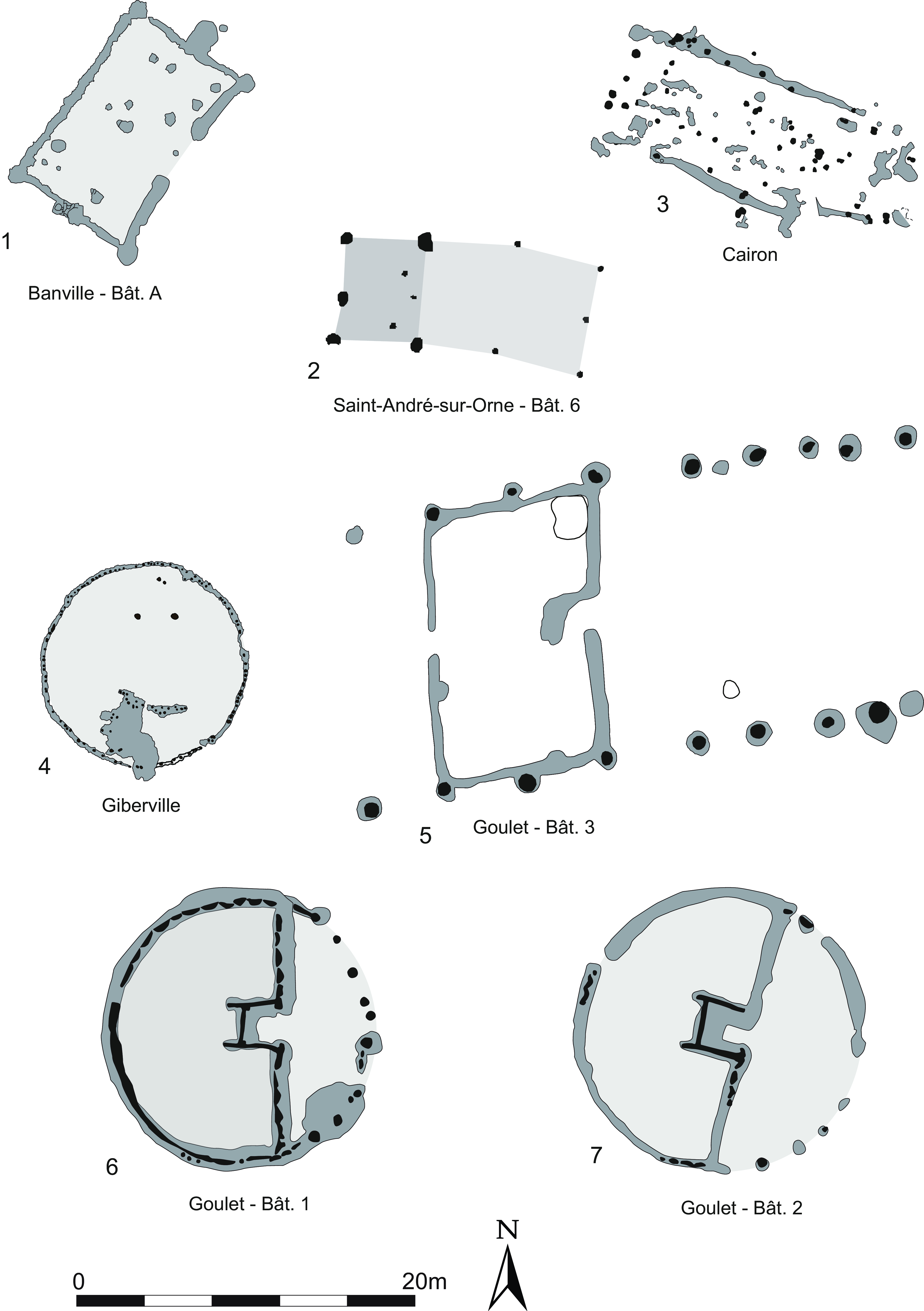
This pattern of development can be interpreted in the light of a correlation between domestic structures and funerary monuments, as a symbolic evocation of the former by the latter with a delay of several decades or several centuries between them (Laporte et al. Reference Laporte, Fromont, Ghesquière, Marcigny, Tinevez, Blanchet, Jallot and Wattez2018). This hypothesis is convincing, all the more so considering that the rare house plans of that period in Normandy (Figure 7) are located in significant contexts as regards both their place in the landscape and their symbolic meaning: enclosures (Goulet, Moulins-sur-Orne), hilltops (Banville), or preceding a monument (Cairon). These houses, which are certainly not destined for the living, become meaningful in a context of ranked societies (status hierarchy) or stratified societies (political hierarchy) echoing the changes in funerary architecture at this time. However, the progressive emergence of a more stratified society, which combines surplus production (storage pits) and monumental architecture, so far leaves unexplained the issue of ordinary settlements and daily life, which still need to be identified.
Comparison of dated Middle Neolithic buildings in western Normandy, to scale and oriented (credit E. Ghesquière & F. Charraud, Inrap; 1 Kerdivel et al. Reference Kerdivel, Hamon, Barge, Bohard, Desloges, Lepaumier, Billard and Legris2010; 2 Ghesquière et al. Reference Ghesquière, Charraud, Hachem, Manceau, Marcigny and Seignac2016; 3 Ghesquière & Marcigny Reference Ghesquière and Marcigny2011; 4 Ghesquière et al. Reference Ghesquière, Pillault and Marcigny2020 ; 5–7 Billard et al. Reference Billard and Pioffet-Barracand2024).

The change in social organisation at the end of the 5th millennium BC becomes apparent through a new diversification of the settlement locations and other landscape markers with an unprecedented influence: enclosures. Next to ‘farmsteads’ or dispersed farming settlements, large monuments appear, which are more stable, more durable and fortified. Assuming that these enclosures are settlements (Charraud Reference Charraud2024), in the long term they accompany an overall expansion also visible in other evidence.
First of all, the increasing number of large storage pits at this time is a direct indication of growing agricultural productivity: certainly the harvests were large enough to require storage management in the medium term. These are also, as shown by numerous historical examples, indicative of population growth (Boserup Reference Boserup1993). The features composed of heated stones are probably another indicator of demographic growth, in that they attest to the assembly of large groups of people (Hart Reference Hart2022). It is therefore tempting to establish a relationship between the number of these indicators, which peak between 4300 and 4200 cal BC, and population density in their surroundings (Charraud et al. Reference Charraud, Marcigny, Aubry and Seignac2024). These features are very probably created due to substantial demographic increase (Shennan Reference Shennan2024).
Another new characteristic of this burgeoning Middle Neolithic, which is subtle in the archaeological record but highly significant, is its presence across environmental proxies. The marks left by human impact can be observed from the bogs of the Seine Valley to the hilly terrain of La Hague or the Channel Islands, and the limestone areas on the margins of the Armorican Massif; all environments are explored, occupied and exploited. This dynamic continues the process of Neolithic consolidation in western France, which, after the occupation of all territories, branches out in order to establish itself in a lasting manner.
The Final Middle Neolithic (4000-3500 cal BC): a territorial crisis?
The conclusion of this chronological overview tackles the end of the Middle Neolithic, thanks to a new subdivision which makes it possible to distinguish the period prior to (Late Middle Neolithic) and after (Final Middle Neolithic) a turning point around 4000 cal BC and which corresponds to a cultural reconfiguration observed throughout western Europe at the transition to the 4th millennium BC (Cauwe et al. Reference Cauwe, Dolukhanov, Kozlowski and Van Berg2007; Shennan Reference Shennan2024). The strong growth described for the preceding period comes to a sudden stop (Figures 2 & 3). A drastic decrease in the number of settlement sites can be observed in Normandy. As a consequence, this period is poorly described because of a lack of information, although certain trends can be identified. Storage pits suddenly become rare (Charraud & Ghesquière Reference Charraud and Ghesquière2023), and not a single building plan can be dated to this interval in Normandy. The occurrence of features composed of heated stones also decreases very rapidly between 4000 and 3800 cal BC (Charraud et al. Reference Charraud, Marcigny, Aubry and Seignac2024).
The ditches of the large enclosures erected at the beginning of the Late Middle Neolithic were apparently still maintained (Ghesquière & Marcigny Reference Ghesquière and Marcigny2014), which suggests continuous occupation of these sites. However, not a single new foundation can be dated after 4000 cal BC. The passage graves were also still in use up to the mid-4th millennium BC (Dron et al. Reference Dron, Charraud, Le Goff and Gâche2016), but are then replaced by dolmens, ie, structures that incorporate megalithic elements: the example of Cairon, probably built around 4000 cal BC (Ghesquière & Marcigny Reference Ghesquière and Marcigny2011), shows an intermediate type between passage graves built with drystone work and megalithic dolmen chambers (Boujot & Cassen Reference Boujot and Cassen1992). The two phenomena combined thus make it possible to suppose the survival of activity patterns as regards enclosures and collective burials (not involving new constructions), which are without doubt the most remarkable landscape markers of the Middle Neolithic. However, the evidence of their use is very subtle and the network of farmsteads indicated by storage pits during the preceding period seems to have completely disappeared.
The lithic tools used in settlement contexts are also unknown. Throughout the period specialised productions return, with an unprecedented increase in flint axe production and distribution. The rare dated mining sites in Normandy are indeed later than 4100–4000 cal BC, such as Ri and Potigny. The associated production and the operational sequences have been well studied (Ghesquière et al. Reference Ghesquière, Marcigny and Charraud2021) but little is known about distribution. In Great Britain so-called ‘prestige’ axes (Pétrequin et al. Reference Pétrequin, Cassen, Errera, Klassen and Sheridan2012) as well as other axe types are found after 4100 cal BC (Whittle et al. Reference Whittle, Healy and Bayliss2011; Schauer et al. Reference Schauer, Bevan, Shennan, Edinborough, Kerig and Parker Pearson2019). At Ri, extraction by mining is exactly contemporaneous with exploitation at the mining sites in Sussex, such as Cissbury or Blackpatch (Russell Reference Russell2000; Ghesquière et al. Reference Ghesquière, Marcigny and Charraud2021). However, an overall impression emerges that at this time only mining sites and some megalithic monuments are present in the Jurassic plains of Normandy.
It would be hasty to overlook the gaps persisting in regional archaeological research: the occupation of hilltop sites during the Middle Neolithic has never been studied in detail. Field research will be necessary for this: these sites may reveal a reoccupation of defensive positions as early as 4000 cal BC and play a particular role in the control and exploitation of nearby lithic resources. In this context of complete change, the search for settlement sites comparable to those of the preceding periods would be doomed to failure if population now concentrated in particular places within the landscape as yet unexplored by archaeological research. A change in the typology of the sites, in fact, would reveal a change in the structuring of Neolithic territories.
In any case, the importance of mining during the first two centuries of the 4th millennium BC in the plains, or more generally the importance of megalithic monumentality in western France, do not coincide with the complete disappearance of all kinds of settlement site and no indication of a gap or a decline in agriculture is visible in the sedimentary record (Lespez et al. Reference Lespez, Clet-Pellerin, Davidson, Barbier, Mauger and Boulejbem2006; Lespez Reference Lespez2012).
By contrast, in the same period Brittany, driven by a dynamic in the Armorican peninsula, seems to be untouched by the abandonment of settlement locations and rare settlements are documented, for example at Pléchâtel (Juhel et al. Reference Juhel, Donnart, Forré, Gâche and Wiethold2014) and Larmor-Plage (Blanchet Reference Blanchet2016). The survival of the Castellic culture coincides with the peak of megalithic monumentality between 4000 and 3800 cal BC. On the other hand, towards the east and the Seine Valley, settlements are also abandoned during the same period and the decrease in occupations on the banks of the River Seine is obvious (Charraud et al. Reference Charraud, Marcigny, Aubry and Seignac2024).
An alternative (or complementary) hypothesis can be offered for the general abandonment of the settlement sites. Geographically, Normandy lies at the crossroads of two major movements that characterise the Neolithic during the first half of the 4th millennium BC:
-
• the general decline of the Chasséen dynamic during its late stage (after 4000 cal BC), which is not contemporaneous from region to region but can be observed everywhere (Perrin Reference Perrin and Perrin2016);
-
• the Neolithic transition in Great Britain, which started during the 41st century cal BC around the estuary of the Thames River and which subsequently very rapidly spread across Britain and Ireland between 4000 and 3800 cal BC (Whittle et al. Reference Whittle, Healy and Bayliss2011). In a recent study, Garrow et al. (Reference Garrow, Griffiths, Anderson-Whymark and Sturt2017) substantially contribute to this chronology by suggesting the establishment of a western sea route during these two centuries of expansion, in which Brittany and Normandy held an important place.
The abandonment of the sites in Normandy is inversely related to a Neolithic boom that can be observed at the same time in southern England in all of its diversity (enclosures, megalithic monuments, storage pits, mining sites, etc.). It can be assumed that these two phenomena are more or less directly related to each other. Coincidences are rare in history and such migrations of populations have been documented in other European Neolithic contexts (Pétrequin 1984). On a macroscopic scale, DNA analyses confirm major demographic movements around 4000 cal BC across western Europe (Beau et al. Reference Beau, Rivollat, Réveillas, Pemonge, Mendisco, Thomas, Lefranc and Deguilloux2017; Brace & Barnes, Reference Brace and Barnes2019). These phases of migration are not unique to the Neolithic: the history of human societies provides a plethora of examples and reveals a cyclical or pulse-like character to their structure (eg economic diasporas of the Ancient East: Algaze Reference Algaze1993; movement of archaic Greek colonisation: Amiet Reference Amiet1986; Greco Reference Greco1996; rural exoduses and ‘settler colonialism’ during the 19th century: Duby & Wallon Reference Duby and Wallon1981). Dramatic reasons are sometimes evoked, for example wars, disease, or major ecological crises. More simply, it seems that once a society has reached a certain degree of growth and overexploitation of the environment (on a very local scale) which becomes incompatible with its technological basis, it effectively creates the conditions for its own weakening. Although this issue today takes on particular resonance, the large number of historical examples suggests that these non-linear systems are intrinsic to the development of human societies, and follow the progressive depletion of territories. The Final Middle Neolithic period would thus witness large population movements extending to new lands (across the Channel) as a consequence of the growth dynamics identified during the Late Middle Neolithic.
Conclusion
This text summarises the results of an overview based on a plethora of archaeological excavations, carried out over a long time and using a great variety of methods. In order to assess two centuries of archaeological research on this period in a pioneering region, it was necessary to collect, sort and classify the information stemming from all these operations. That made it possible to draw up maps showing unequal distributions of ovens, hearths, more or less clearly identified building plans, or ditches surrounding large spaces. The lack of information regarding these internal spaces raises unresolvable questions as to the types of Neolithic settlement at the scale of the region alone. Establishing a functional typology for these structural elements and establishing comparisons between varying temporal and spatial scales made it possible to shed new light on the different components of daily life of these early agropastoral communities. In the context of an emerging ranked society, structures that are thought to be related to elites seem to be closely connected with enclosed spaces, which can be interpreted as places in which villages were established, in contrast to dispersed settlements composed of small individual farmsteads (Charraud Reference Charraud2024).
The geographical distribution of this evidence testifies to the way in which Neolithic settlers progressively occupied the territories of the Armorican peninsula and the islands, using sea routes to spread across the territories bordered by the Channel. The temporal distribution of sites shows that the Neolithic transition in Normandy, a region which is among the most distant from the epicentres of the Neolithic in Europe, was not the result of a linear or regular spread. Punctuated by obvious phases of boom followed by decline, even complete disappearance, this was in reality a process shaped by many upheavals, like the history of any human society. Nonetheless, we are only beginning to perceive the continuities and gaps over time, and the pace of this history.
The end of the Early Neolithic represented by the Blicquy/Villeneuve-Saint-Germain culture is marked by the decline of the hamlet pattern and the progressive dissolution of the trapeze-shaped building plan. The absence of settlements later characterises the entire Middle Neolithic period. The subsequent Cerny culture, which radically differs from all the preceding ones, was established around 4700 cal BC, and shows contradictory trends: on the one hand the impressive Passy-type monuments, powerful expressions of an elite society, testify to an unprecedented anchoring of the farming populations in the landscape; on the other hand, the archaeological record suggests brief, repeated but undifferentiated occupations over several generations. Using analogies from Africa, this contrast could signify the establishment of semi-nomadic pastoralism, of groups and their herds roaming the landscapes marked by monuments, which structured both the territories and social life by probably functioning as places of regular assembly.
The following final three to four centuries of the 5th millennium BC were characterised by another upheaval with the emergence of new types of social organisation, combining dispersed farmsteads on the one hand and enclosures and fortified settlements and settlement clusters on the other hand. Funerary monuments, too, are no longer restricted to individuals but intended for groups of individuals. This stage fully completes the thousand-year Neolithic transition in western France and is characterised by an unprecedented spread of all Neolithic features and by human impact on all environments. This general boom, confirmed by background trends at the European scale at the transition to the 4th millennium BC, may reflect demographic growth. From 4000 BC onwards, it continues on the other side of the Channel in southern England, while during the following century there is virtually no evidence of Neolithic occupation in Normandy except for the flint mines. This study therefore is concluded, consistent with this lack of archaeological data.
To gain a deeper understanding of this period, we need to assess the interconnections that developed from the end of the 5th millennium on both sides of the Channel: the chronology and methods of flint mining, for example, but also the cross-Channel circulation of materials or objects, which can be seen in the typology of certain tools and vessels. The distribution of monumental sequences also echoes, in many respects, that defined on the Continent. We call for a new dynamic of cross-Channel sharing and collaboration to further these reflections.
Supplementary material
To view supplementary material for this article, please visit https://doi.org/10.1017/ppr.2025.10070
Acknowledgements
We want to express our sincere gratitude to Professor Christopher Scarre for his kind advice. Translated from the French by Karoline Mazurié de Keroualin.


 Open access

