


The discovery and development of metal as a tool medium is a topic of global interest. Consequently, incipient metal usage is widely studied from multiple archaeological perspectives (e.g., Roberts and Thornton [Reference Roberts and Thornton2014] and references within). A fundamental research goal involves establishing the timing of human experimentation with naturally occurring copper ore (Burger and Gordon Reference Burger and Gordon1998; Özdoğan and Özdoğan Reference Özdoğan, Özdoğan, Hauptmann, Pernicka, Rehren and Yalçi1999; Patterson Reference Patterson1971; Roberts et al. Reference Roberts, Thornton and Pigott2009) because this phase of development predates other, more complex metallurgical production methods. Prior to the development of smelting and alloying of metals, the forging of native copper was the first method of manufacture used in areas where bronze metallurgy was independently developed. Although in most areas of the world this process of innovation is associated with sedentary, agrarian-based societies, in North America there is well-documented millennia-scale exploitation of copper as a tool medium by small, seasonally mobile hunter-gatherer groups. This phenomenon is largely associated with Middle-Late Archaic (6000–3000 RCYBP) cultures located in the Great Lakes region (Bebber and Eren Reference Bebber and Eren2018; Ehrhardt Reference Ehrhardt2009; Gibbon Reference Gibbon1998; Pleger Reference Pleger2001; Pleger and Stoltman Reference Pleger, Stoltman, Emerson, McElrath and Fortier2009; Vernon Reference Vernon, Lasca and Donahue1990). Although it is widely documented that several sites containing copper artifacts date to the latter part of the Archaic period (Hill Reference Hill2006; Kuehn Reference Kuehn2002; Martin Reference Martin1993; Pleger Reference Pleger2001; Ritzenthaler Reference Ritzenthaler1970), there is also a variety of data suggesting that the copper industry in fact began thousands of years prior, during the Early Holocene (Martin Reference Martin1993, Reference Martin1999; Pompeani et al. Reference Pompeani, Abbott, Steinman and Bain2013; Reardon Reference Reardon2014; Steinbring Reference Steinbring1991; Wittry and Ritzenthaler Reference Wittry and Ritzenthaler1956).
In the second half of the twentieth century, archaeologists documented the possibility that Late Paleoindian groups may have begun using copper as a tool medium almost immediately after they entered the Lake Superior basin (Martin Reference Martin1999; Steinbring Reference Steinbring1966, Reference Steinbring1968, Reference Steinbring1991). Some have even suggested that Late Paleoindian groups began using copper in southern glacial drift regions well before humans ever set foot in the copper-bearing regions of Michigan's Upper Peninsula (Steinbring Reference Steinbring and Hlady1970). Indeed, reports have shown that Late Paleoindian stone points have been found along with copper tools (Buckmaster and Paquette Reference Buckmaster and Paquette1988; Clark Reference Clark1989, Reference Clark1991; Hunzicker Reference Hunzicker2002; Mayer-Oakes Reference Mayer-Oakes1951; Pettipas Reference Pettipas and Burley1985) or with unfinished copper fragments (Harrison et al. Reference Harrison, Redepenning, Hill, Rapp, Aschenbrenner, Huber and Mulholland1995; Martin Reference Martin1993; Salzer Reference Salzer and Johnson1974; Shay Reference Shay1971), although it is important to note that the exact dates and relationships of the stone and copper materials remain equivocal.
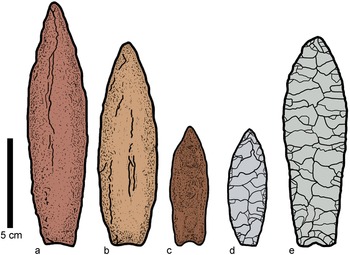
Despite the fact that a strict chronology for North American copper tool evolution is sorely lacking (Bebber Reference Bebber2021; Martin Reference Martin1993), it is generally thought that the earliest copper tool forms were broadly similar to Late Paleoindian stone point forms, specifically “lanceolate” types related to Plano groups (Pettipas Reference Pettipas and Burley1985; Steinbring Reference Steinbring1975; Reference Steinbring1991). Specific styles of copper points (Figure 1), defined as McCreary points (Steinbring Reference Steinbring1968), appear to be morphologically analogous to Late Paleoindian projectile points. Unfortunately, as with most North American copper materials, all of these “paleo-like” specimens are poorly dated surface finds (Martin Reference Martin1999). Due to lack of stratigraphic association and lack of chronometric dating for these specimens, it is difficult—if not impossible—to establish meaningful relationships between them, or to reliably cross-date similarly shaped isolated finds, even when the formal attributes are convincing at first glance. We know from several studies that convergence in projectile point form and technology is quite common (Eren et al. Reference Eren, Meltzer and Andrews2018; Maguire et al. Reference Maguire, Buchanan, Boulanger, Redmond and Eren2018; Norris et al. Reference Norris, Stephens and Eren2019), even on a global scale (Groucutt [Reference Groucutt and Carleton2020] and references therein; O'Brien et al. [Reference O'Brien, Buchanan and Eren2018] and references therein; Scerri Reference Scerri2012), and it seems quite sensible that the earliest copper projectiles would be simple in form before ancient people began experimenting with various tang morphologies. Therefore, despite the fact that certain copper points appear to be visually consistent with Late Paleoindian point styles, the argument for their origin remains largely circular.
“Paleo-like” copper points and Agate Basin points: Drawn based on (a–b) Steinbring (Reference Steinbring1968, Reference Steinbring and Hlady1970); Pettipas (Reference Pettipas and Burley1985); (c) Mayor-Oakes (Reference Mayer-Oakes1951), along with typical Late Paleoindian Agate Basin points; (d–e) Steinbring (Reference Steinbring and Hlady1970). (Color online)

The understanding of copper development and chronology in North America is currently only as accurate as the artifacts recovered and the sites identified, which ideally includes in situ datable materials and clear stratigraphic and contextual relationships. Unfortunately, for most copper artifacts, such data are simply not available due to a general lack of systematic fieldwork and the fact that most copper artifacts have been found as isolated surface finds with little provenience data (Bebber and Chao Reference Bebber, Chao, Buchanan and Eren2022; Martin Reference Martin1999). Consequently, although intriguing, the data supporting the co-occurrence of Late Paleoindian artifacts and copper materials remain ambiguous.
The copper origin date in North America remains even more uncertain than its later development and chronology due to the fact that chronometric dates demonstrating early use of copper in the Americas are still generally lacking. Yet, recent research has shed light on this topic. Reardon (Reference Reardon2014) reported on what was then, and still is, the earliest well-established date for copper tool production and use as hunting weaponry. Radiocarbon dates generated from organic material found embedded in a copper conical point—via use of a metal detector 10–15 cm (4–6 in.) below the surface in Vilas County, Wisconsin—place copper tool production firmly at 7690 ± 40 RCYBP. The second conical point found in the same location generated a similar date of 7305 ± 60 RCYBP (Reardon Reference Reardon2014). Likewise, other points from the Western Great Lakes with embedded materials (Pompeani et al. Reference Pompeani, Steinman, Abbott, Pompeani, Reardon, DePasqual and Mueller2021) as well as cremation burial data (Libby Reference Libby1954; Wittry and Ritzenthaler Reference Wittry and Ritzenthaler1956) provide dates older than 7000 RCYBP (Table 1). Stratigraphic data from the mining region of the Upper Peninsula of Michigan provides the earliest date for a copper production site at 7870 ± 350 RCYBP (Martin Reference Martin1993).
Radiocarbon Dates Used in Optimal Linear Estimation (OLE) Analysis.

Note: Ten oldest radiocarbon dates associated with copper use in the Western Great Lakes.
Although these dates are within the range of what is generally considered to be the transition from Late Paleoindian lifeways to Early Archaic tradition in the Western Great Lakes (ca. 10,000–8000 RCYBP; Kuehn Reference Kuehn2002), there is no definitive archaeological evidence to support the assertion that copper use began soon after the initial occupation of the region by Late Paleoindian groups, which would have occurred sometime after 10,000 RCYBP, and likely much later in the northern copper-bearing regions. A key factor restricting Paleoindian movement into the copper mining district prior to this date was the Marquette readvance of the Laurentide Ice Sheet. This glacial readvance covered the copper-bearing regions of Michigan's Upper Peninsula until 10,024 RCYBP, at which point it reached its maximum southern extent and then began to recede northward, exposing the copper-bearing trap rocks of the Upper Peninsula (Carr Reference Carr2009; Ellis et al. Reference Ellis, Carr and Loebel2011)Footnote *.
In regard to the timing of initial human mining endeavors, recent geochemical studies are consistent with the presence of substantive copper-related activities in the Lake Superior mining district as early as approximately 7000 RCYBP (8000 cal BP; Pompeani et al. Reference Pompeani, Abbott, Steinman and Bain2013:5549). These mining-related data are intriguing in regard to the origin of copper working. In order for Early Archaic groups to be involved in such industrious removal and processing of copper ore—to a magnitude extensive enough to cause conspicuous lead (Pb) signals in lake sediments—there must have been a period of experimentation with the novel tool medium substantially prior to these mining-related dates. Unfortunately, however, the chance of finding the “first” artifact made from copper is virtually zero (Meltzer Reference Meltzer2009; Prasciunas and Surovell Reference Prasciunas, Surovell, Smallwood and Jennings2015). In turn, this hampers our understanding of innovation processes in the North American Holocene and restricts debate on why this material was first sought and by whom.
Recent developments within Paleolithic archaeology may provide a solution. Optimal linear estimation (OLE) modeling has recently been used to reconstruct both the origin date and end date of several key Paleolithic technologies (Key, Jarić, and Roberts Reference Key, Jarić and Roberts2021; Key, Roberts, and Jarić Reference Key, Roberts and Jarić2021). Of most relevance here is Key, Roberts, and Jarić's (Reference Key, Jarić and Roberts2021) use of OLE to estimate date of origins for the Oldowan and Acheulean. In these examples, the model inferred the first production of these technologies to be at least 36,000 and 55,000 years earlier (Oldowan and Acheulean, respectively) than the current oldest-known archaeological sites indicate. In straightforward terms, OLE models can use the oldest-known occurrences of a cultural tradition or technological phenomenon to model the length of time that it is likely to have existed prior to the current earliest-known evidence. In other words, it effectively reconstructs the portion of the archaeological record not yet discovered. In the present scenario, it would become possible to estimate the duration of time that copper was worked prior to the earliest evidence of its use as a tool medium as reported by Martin (Reference Martin1993).
Such scenarios are not limited to the human material record, and archaeology is certainly not the only discipline confronted with reconstructing meaningful behavioral data from incomplete temporospatial datasets. Indeed, OLE has a long history. It was first developed to reconstruct the timing of species extinctions within conservation science and has since also been adopted widely within paleontological studies (Clements et al. Reference Clements, Worsfold, Warren, Collen, Clark, Blackburn and Petchey2013; Crees and Turvey Reference Crees and Turvey2014; Pimiento and Clements Reference Pimiento and Clements2014; Roberts and Solow Reference Roberts and Solow2003; Solow Reference Solow2005; Zhang et al. Reference Zhang, Jarić, Roberts, He, Du, Wu, Wang and Wei2020). Importantly, however, OLE models have no underlying assumptions that are specific to biological organisms, and they perform equally well when predicting the origin or “extinction” of any phenomenon, as long as they are characterized by sporadic observations through time (Clements et al. Reference Clements, Worsfold, Warren, Collen, Clark, Blackburn and Petchey2013; Key, Roberts, and Jarić Reference Key, Roberts and Jarić2021; Rivadeneira et al. Reference Rivadeneira, Hunt and Roy2009). Here, we adopt this model and present the most accurate estimate yet for when copper tool production in North America originated.
Methods
Optimal Linear Estimation
Optimal linear estimation (OLE) modeling, as proposed by Roberts and Solow (Reference Roberts and Solow2003), has been shown to be a robust inferential method within diverse dating scenarios (Clements et al. Reference Clements, Worsfold, Warren, Collen, Clark, Blackburn and Petchey2013). This includes those varying in chronological magnitude and distribution. When estimating dates of origin, OLE requires the earliest-known occurrences of a phenomenon to be entered into the model, from which it identifies the date at which the process generating the occurrence (in this case, humans producing copper artifacts) is likely to have started. As explained elsewhere (Clements et al. Reference Clements, Worsfold, Warren, Collen, Clark, Blackburn and Petchey2013; Key, Roberts, and Jarić Reference Key, Roberts and Jarić2021; Roberts and Solow Reference Roberts and Solow2003), OLE is based on the concept that the oldest occurrences (or most recent, if inferring extinction) entered into the model have (roughly) the same “Weibull form,” irrespective of the timings of other instances later in the phenomenon's timeline. Simply, it is the chronological distribution of—and intervals between—these first observations that inform the inferred date of origin, and these inferences are modeled according to defined predictions seen in Weibull distributions. To put it another way, the dated observations are used to tailor the (Weibull distribution) probability curve, from which a point of origin can be inferred. The model asks the question, Given known artifactual occurrences and past sampling effort, when would the next artifact in the sequence be expected? If no artifact has been found between this point and the current earliest occurrence, then it can be inferred that the phenomenon is unlikely to have existed prior to this point.
Full formulaic description of the OLE models are described elsewhere (Clements et al. Reference Clements, Worsfold, Warren, Collen, Clark, Blackburn and Petchey2013; Key, Jarić, and Roberts Reference Key, Jarić and Roberts2021; Solow Reference Solow2005). All models were performed in R (version 4.0.3) using the sExtinct software package (Clements Reference Clements2013). Although a fast adoption of copper use is possible, it cannot be assumed, so we did not apply the classical extinction method outlined by Solow (Reference Solow1993). We also used the tenth-oldest occurrence (5730 RCYBP) as the beginning of the period because there was no specific start date to the time series (Table 1).
Each OLE model produced two variables important to understanding the origin of copper production in North America. The first of these is T O and the second is T CI. T O represents the inferred date of origin for the use of copper within each respective model, whereas T CI is the upper bound of each model's confidence interval. T CI effectively details the 95% confidence limit around T O, beyond which copper only has a minimal chance of preceding it (i.e., in 95 out of 100 cases, the point or origin will be between the T CI date and the currently earliest-known artifact). T O represents the date at which an earlier occurrence of copper use would have been expected to have been found (relative to the current oldest) if it existed prior to his point. As stated above, T O is defined by the temporal spacing and search intensity associated with sites used in the model, and the aforementioned Weibull distribution.
Sampling Procedure
It is generally recommended that 10 dates can be considered optimal within OLE modeling (Rivadeneira et al. Reference Rivadeneira, Hunt and Roy2009; Solow Reference Solow2005). The inclusion of additional “younger” copper occurrences is unlikely to impact the result and could even invalidate several of the model's assumptions (Solow Reference Solow2005). A detailed review of the literature was undertaken to identify the 10 oldest radiocarbon dates associated with copper use (Table 1; Figure 2). These data include radiocarbon dates gleaned from material embedded in copper tools (Beukens et al. Reference Beukens, Pavlish, Hancock, Farquhar, Wilson, Julig and Ross1992; Morris and Steinbring Reference Morris and Steinbring2020; Pleger Reference Pleger2001; Pompeani et al. Reference Pompeani, Steinman, Abbott, Pompeani, Reardon, DePasqual and Mueller2021Footnote 1; Reardon Reference Reardon2014), materials from cremation burials (Libby Reference Libby1954), and stratigraphic material found in close association with worked copper (Martin Reference Martin1993). From each site, we collected the main estimated date and date range, along with the calibrated median date and the 95.4% confidence intervals. In cases where the calibrated dates were not reported, they were calibrated to calendar ages using the IntCal20 calibration curve at 2σ (Reimer et al. Reference Reimer, Austin, Bard, Bayliss, Blackwell, Ramsey and Butzin2020) via Calib version 8.2 (Stuiver and Reimer Reference Stuiver and Reimer1993). The 10 oldest, well-documented radiocarbon dates from archaeological contexts were used to run the analyses (Table 1). All were assumed to be discrete occurrences of the technological phenomenon (as required by the model). Within archaeological contexts, and in its most extreme interpretation, this means that each archaeological occurrence is assumed to have been made by a distinct individual (i.e., a single biological repository for the cultural information required to exploit copper).
Map showing the location of the 10 oldest radiocarbon dates associated with copper use in the Western Great Lakes that were used in the OLE model.

Two OLE models were initially run using the 10 main estimated dates (RCYBP) and the calibrated median dates (cal BP). In addition to this, radiocarbon dating provides potential ranges with an approximate normal distribution from the mean or calibrated median, and these enter a degree of uncertainty into any discussion of an artifact's age. To account for this, we also applied a resampling approach where a date from within each of the 10 associated date ranges was randomly drawn from a normal distribution and used instead of the main or calibrated median dates. This was repeated 10,000 times, and each randomly drawn dataset of 10 dates was assessed using the OLE method (Supplemental Table 1).
Results
All models push the origin of copper production in North America beyond 8000 RCYBP (Table 2; Figure 3). There is greater consistency between the central range estimate and resampling technique estimate within the RCYBP models relative to the cal BP estimates. Given the restricted ranges for most RCYBP data in Table 1, this is not unexpected. Indeed, OLE models using RCYBP dates infer copper production to begin (T O) between 8126 and 8184 RCYBP. The upper bound of this date range is defined by the resampling technique, whereas the lower uses the main estimated dates. T CI dates, beyond which copper production only has a 5% chance of preceding this point, provide a bracket of 8914–9020 RCYBP. Upper and lower bounds were again defined by the resampling technique and main estimated dates (respectively).
Violin-boxplots detailing predicted dates of origin for the use of copper by Paleoindian populations, derived from 10,000 iterations of the random sampling method.

Optimal Linear Estimation (OLE) Modeling Results.

Note: Inferred origin dates for the use of copper via optimal linear estimation, using central range estimates and resampling procedures.
Calibrated dates returned estimated dates of origin (T O) ranging between 9068 and 9413 years cal BP. The T CI dates for these models provide upper bound limits of 9969 and 10,723 cal BP, with the lower being derived from the median calibrated dates, and the greater resulting from the resampling technique.
Future Sampling Considerations
As described above, OLE models are generally most effective when analyzing the 10 oldest (or youngest, if inferring “extinction”) dates on record. If new dates are discovered for copper artifacts, these occurrences could “replace” the more recent dates of our model (i.e., several of the artifact dates used here are less than 7000 RCYBP) and would alter the predicted date of origin inferred here. If future discoveries provide tighter date clustering around the oldest occurrences, then the inferred date of origin would likely be more recent. If future discoveries are toward the tail end of the current distribution of dates, then there would be minimal impact on the model's predictions. If future discoveries provide evidence of older copper artifacts relative to those used here, then the model would infer an older age for copper production. We would welcome future discoveries that allow additional, updated OLE models to be run. However, it is worth emphasizing that our models are robust in light of current evidence, and they provide new empirical evidence in support of previous assumptions that copper production is likely to have an earlier origin relative to current dates.
Unfortunately, the problem of finding copper artifacts that date to the Late Paleoindian time period is likely to remain challenging because the potential for finding the earliest of any cultural item is exceedingly small. Indeed, the statistical probability of finding an artifact that represents the “oldest” becomes increasingly unlikely the farther one goes back in time (Meltzer Reference Meltzer2009; Prasciunas and Surovell Reference Prasciunas, Surovell, Smallwood and Jennings2015). This can be thought of as a simple battleship curve: the peak area represents the abundance of materials found during a cultural zenith, whereas the left tail represents the initial experimentation with a new tool medium, and the right tail represents the decline or replacement of the tool type with a new variant. This is simply because the farther the archaeological record goes back in time, the more ephemeral the record becomes (notably, this is one of the fundamental assumptions underlying OLE). This ephemerality is heightened further for pioneering populations of highly mobile hunter-gatherers. Additionally, during the initial stage of copper experimentation, there would be very few finished tools compared to the vast number of tools associated with the “Old Copper” zenith that peaked between 6000 and 3000 RCYBP. This pattern is evident in a variety of novel hunter-gatherer technologies—such as pottery—that tend to “bump along” at low frequencies (Jordan and Cummings Reference Jordan, Cummings, Cummings, Jordan and Zvelebil2014:587) until their utility is fully realized, and they eventually become a central component of a technological system.
Likewise, attempts to reconstruct the human past are further hampered by taphonomic processes and modern human interaction. This is a problem for analyzing all prehistoric materials. However, undersampling bias is a particular problem in this scenario given that copper tools have long been collected by hobbyists via the use of metal detectors, and therefore only a small sample of the total past assemblage is currently accessible for data analysis (Bebber and Chao Reference Bebber, Chao, Buchanan and Eren2022). Likewise, many hobbyists inadvertently destroy valuable data by “cleaning” copper specimens, which removes valuable organic material that could be used for radiocarbon dating. Additionally, it has been noted that European settlers melted and repurposed prehistoric copper tools (Brown Reference Brown1904). Truly, it is difficult to comprehend the amount of early copper material that has been lost. We hope that future finds will be carefully collected, studied, and chronometrically dated. In fact, based on the results of the model used here, we should expect to eventually recover copper spearpoints with organic materials extending to 8100 RCYBP and potentially beyond.
Discussion
The results of this study support the early Holocene use of copper by Late Paleoindian groups in North America around 8100–8200 RCYBP. The implications of these results are manifold. Here, we discuss these results in light of three questions that form the basis of archaeological inquiry: (1) when, (2) who, and (3) why, Admittedly, the questions of when and who are the more straightforward and for this reason will be discussed first. The question of why colonizing populations may have begun experimenting with a novel tool medium such as copper requires slightly more consideration and will be discussed in light of mobility, raw material availability, and hunter-gatherer innovation.
When
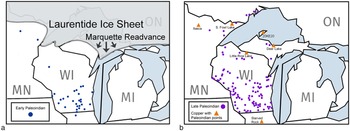
The timing of the initial occupation in the Upper Peninsula is largely dependent on climatological conditions and glacial activity. Indeed, when investigating the colonization of the western Great Lakes region, the position of the Laurentide Ice Sheet and the fluctuation of its southern border are key considerations (Figure 4a). By the onset of the Younger Dryas (ca. 11,000 RCYBP; Eren Reference Eren2012), the Laurentide Ice Sheet had begun its retreat northward into the Lake Superior basin. However, due to the cooling associated with the Younger Dryas event, there was a readvance of glacial ice that began around 10,400 RCYBP and reached its maximum southern extent by 10,025 RCYBP (Lowell et al. Reference Lowell, Larson, Hughes and Denton1999; Pregitzer et al. Reference Pregitzer, Reed, Bornhorst, Foster, Mroz, McLachlan, Laks, Stokke, Martin and Brown2000). The Marquette readvance covered most of the Upper Peninsula of Michigan for approximately 360–700 years (Derouin et al. Reference Derouin, Lowell and Hajdas2007), after which it once again began its northward retreat between 9700 and 9500 RCYBP (Hill Reference Hill2012). It is likely that the northward ice retreat in the Upper Peninsula began along the western glacial border and then moved eastward over the course of a few hundred years. This process would have allowed for reoccupation of northeastern Wisconsin prior to the initial eastward colonization of Michigan's Upper Peninsula (Derouin et al. Reference Derouin, Lowell and Hajdas2007).
Habitation patterns of Western Great Lakes: (a) Early Paleoindian site distribution (based on Ellis et al. Reference Ellis, Carr and Loebel2011; Mulholland et al. Reference Mulholland, Mulholland, Peters, Huber and Mooers1998) showing approximate maximum extent of the Marquette Readvance ca. 10,025 RCYBP; (b) Late Paleoindian site distribution after glacial retreat (after 9500 RCYBP), along with sites where copper materials were found with Late Paleoindian cultural materials (McCreary site, Manitoba, not shown on map). (Color online)

The final glacial retreat, and the subsequent opening of the landscape for reoccupation, occurred during the Late PaleoindianFootnote 2 period. This period in the copper mining area is not precisely dated due to a lack of chronometric dates associated with diagnostic materials. Most of the cultural dates are estimates based on lithic assemblages containing diagnostic point types from the Late Paleoindian “Plano” phase (Clark Reference Clark1989). This phase is not well defined for the Lake Superior region, but it generally includes materials similar to those of the Agate Basin complex or Cody complex, which are both based on Paleoindian cultural materials in western North America. Agate Basin points date between 10,500 and 10,000 RCYBP (Eren et al. Reference Eren, Bebber, Knell, Story and Buchanan2022; Holliday Reference Holliday2000). The Cody complex dates to 10,100–8000 RCYBP and contains both Scottsbluff- and Eden-style projectile points (Knell and Muñiz Reference Knell, Muñiz, Knell and Muñiz2013). Consequently, there is close temporal proximity between these dates and the predicted origin of copper use at 8100 RCYBP.
Who
It is clear that prior to the Younger Dryas (ca. 11,000 RCYBP), early Paleoindian groups were inhabiting southern and central Wisconsin. An abundance of “Clovis-like” sites (Ellis et al. Reference Ellis, Carr and Loebel2011) show that early Paleoindian groups had migrated into modern-day Wisconsin by 11,000 RCYBP. There are a multitude of finds from this time period in southern and central parts of the state, and a few sites in the northwestern areas (Amick et al. Reference Amick, Bozhardt, Hensel, Hill, Loebel and Wilder1999; Loebel Reference Loebel2005). However, there are currently no Clovis-like sites either in the northeastern portion of Wisconsin or in the Upper Peninsula of Michigan that show evidence for occupation during Early Paleoindian times (Ellis et al. Reference Ellis, Carr and Loebel2011). Indeed, distribution data suggest that the Younger Dryas cooling event (ca. 11,000–10,000 RCYBP; Eren Reference Eren2012) had a dramatic effect on Paleoindian landscape use in northern regions. During the Marquette readvance, Paleoindian site distribution suggests a severe southern retraction when compared to earlier Clovis-like site distributions. During the Younger Dryas, there are almost no Folsom-like sites in Wisconsin, and the few that have been recorded occur in a range much farther south (Figure 4a) than in the preceding era (Ellis et al. Reference Ellis, Carr and Loebel2011). For the most part, it appears that during the Marquette readvance, the northern part of Wisconsin was abandoned. However, shortly after 10,000 RCYBP, the southern lobe of the Laurentide Ice Sheet began to recede, and with this recession came the repopulation of northern Wisconsin and the initial colonization of the Upper Peninsula. This initial colonization took place during a warming period that occurred during the transition between the late Pleistocene and early Holocene (Derouin et al. Reference Derouin, Lowell and Hajdas2007). Due to the warming oscillations, Paleoindian populations may have been drawn northward as the climate improved and new landscapes became available.
The first Late Paleoindian cultural material in Michigan's Upper Peninsula is closely related to Agate Basin, which is generally associated with Late Paleoindian “Plano” groups from the northern Great Plains and dates to the period of 10,500–10,000 RCYBP (Eren et al. Reference Eren, Bebber, Knell, Story and Buchanan2022; Hofman and Graham Reference Hofman, Graham and Wood1998). The Agate Basin points found in northern Michigan are generally intact specimens made from exotic lithic raw materials, most often Hixton silicified sandstone, which is the most common raw material used by western Great Lakes Late Paleoindian groups (Carr and Boszhardt Reference Carr and Boszhardt2010). Clark (Reference Clark1989) notes that formal tools such as projectile points are made of Hixton silicified sandstone, with little resharpening or debitage, whereas more expedient tools were made on local quartzites and are associated with significant tool production waste. Overall, the lithic data suggests the presence of highly mobile groups engaged in long-distance logistical mobility from known toolstone quarries to the south, such as Silver Mound in Wisconsin (Carr Reference Carr2009; Clark Reference Clark1989; Ellis et al. Reference Ellis, Carr and Loebel2011).
Of central interest here are the few sites in the Upper Peninsula that contain Paleoindian lithic materials associated with copper materials (Figure 4b). Buckmaster and Paquette (Reference Buckmaster and Paquette1988) and Clark (Reference Clark1989) analyzed Late Paleoindian artifact clusters that occurred in Marquette County, Michigan. Theses clusters were distributed around Deer Lake, situated 20 km south of the modern Lake Superior shoreline. In some instances, copper materials were found with Late Paleoindian–style tools made on Hixton silicified sandstone sourced from Silver Mound Wisconsin (Martin Reference Martin1999). The Deer Lake artifact clusters contained points consistent with Plano cultural materials, and a few clusters contained Paleoindian Eden-Scottsbluff-style points, which span a time period of approximately 10,100–8100 RCYBP (Knell and Muñiz Reference Knell, Muñiz, Knell and Muñiz2013).
Farther to the west of the mining region, copper materials have been found in association with Late Paleoindian projectile points in the South Fowl Lake area of Minnesota (Harrison et al. Reference Harrison, Redepenning, Hill, Rapp, Aschenbrenner, Huber and Mulholland1995). At several sites in this area, copper material was found along with Plano projectile points manufactured on Hixton silicified sandstone. And, although no direct dates are associated with the copper materials, Dawson (Reference Dawson1983) provides an occupation date for the South Fowl Lake area of 8480 ± 390 RCYBP, generated by radiocarbon dating of an early cremation burial. However, the relationships between the cultural materials remain equivocal.
Taken together, these data show that beginning in the Late Paleoindian era, the earliest inhabitants of Michigan's mining district—and neighboring regions—were highly mobile groups that valued quality raw materials for projectile-point production. These data inform our discussion of why Paleoindian groups may have innovated copper tools.
Why
Identifying precisely why pioneering populations experiment with novel tool media is a multifaceted endeavor. There are undoubtedly a variety of interrelated factors that may stimulate experimentation as groups encounter unknown environments—environments that present new possibilities in terms of subsistence and technology. Here, the incipient experimentation of metal as tool material will be considered in light of Late Paleoindian mobility patterns, regional raw material availability and quality, and hunter-gatherer innovation.
Late Paleoindian Mobility, Use of Materials, and Necessity of Quality Tool Media
As discussed above, evidence from Late Paleoindian assemblages shows that groups were highly mobile and continued to import high-quality lithic raw materials from over 200 km away in the western Great Lakes region, which is a contrasting pattern to Late Paleoindian trends found in the eastern Great Lakes (Ellis et al. Reference Ellis, Carr and Loebel2011). This pattern sheds lights on a key factor—lack of toolstone—that may have driven interest in novel tool materials such as copper in the Lake Superior region. Overall, there is a relative dearth of chert outcrops and a general lack of quality toolstone compared to areas to the south and east. In northern Michigan, the most readily available lithic raw materials are quartzites, rhyolites, and quartz (Hill Reference Hill2012). A limited amount of chert, in the form of small nodules, could have been sourced from glacially deposited tills. Of interest is that “float” copper can also be found in these glacial tills (Martin Reference Martin1999). Consequently, it is quite possible that the early colonizers of the region first encountered the novel material while looking for adequate toolstone.
Indeed, quality tool material would have been a highly valued commodity, especially for the manufacture of formal tools. In fact, studies have argued that local toolstones were regularly heat treated to improve their production-related characteristics (Behm and Faulkner Reference Behm and Faulkner1974; Mraz et al. Reference Mraz, Fisch, Eren, Owen Lovejoy and Buchanan2019; Purdy and Brooks Reference Purdy and Brooks1971). One could imagine that copper nuggets might have found their way into the heat treatment process (Pargeter and Schmidt Reference Pargeter and Schmidt2020). If so, Late Paleoindian tool manufacturers would have had the opportunity to observe the unique properties displayed by copper when heated. It is likely that Late Paleoindian groups first encountered float copper in the glacial drift area far south of the mining districts of Lake Superior. Steinbring (Reference Steinbring1991) suggests that this novel material was quickly adopted as a tool medium by Plano groups, possibly as an adaptation to hunting in the newly expanded northern prairie.
From a technological perspective, studies have repeatedly shown that in comparison to later groups, Paleoindians designed their spearpoints to be durable (Buchanan and Hamilton Reference Buchanan and Hamilton2020). It can therefore be inferred that copper would be an ideal medium for making large, durable, field-adapted, hunting weaponry. In the northern Great Plains, subsistence was largely geared toward the taking of large herd animals, primarily bison (Bamforth Reference Bamforth2011; Buchanan et al. Reference Buchanan, Collard, Hamilton and O'Brien2011; Carlson and Bement Reference Carlson and Bement2013; Speth Reference Speth2020). In this regard, it is worth noting that a few sites to the west of the copper heartland demonstrate the co-occurrence of copper materials and bison remains. These include the Itasca site in Minnesota (Shay Reference Shay1971), and the Jansson site in Manitoba (Steinbring Reference Steinbring and Hlady1970).
Admittedly, it is uncertain precisely how early copper tools would have functioned as adaptive modifications to an already successful technological system, or what advantage (if any) they may have offered plains hunters. Indeed, experimental research has demonstrated that there is no significant difference in penetration depth between projectile points made from copper and those made from stone (Bebber Reference Bebber2021; Bebber and Eren Reference Bebber and Eren2018). Therefore, it is likely that other factors—such as the increased durability of copper tools (Bebber et al. Reference Bebber, Key, Fisch, Meindl and Eren2019) or, alternatively, the limited availability of lithic raw materials (Hill Reference Hill2012)—were driving the interest in copper projectile points.
Late Paleoindian Innovation
Based on an analysis of various copper materials found in Manitoba, Steinbring (Reference Steinbring and Hlady1970:55) defined copper McCreary points as “a generalized flint Agate Basin, hammered from native copper.” He asserts that McCreary points date to as early as 8500 RCYBP in western Manitoba, but that the technology would have had to evolved prior to their early appearance in the west. This means that Late Paleoindian groups would have begun experimenting with float copper in southern glacial drift regions possibly as early as 10,200 RCYBP, when Agate Basin materials first appear in the western Great Lakes (Ellis et al. Reference Ellis, Carr and Loebel2011). In fact, support for this scenario is found at the Starved Rock site in northern Illinois (Mayer-Oakes Reference Mayer-Oakes1951), which is situated in the range of float copper dispersal (Bornhorst Reference Bornhorst2017; Bornhorst and Lankton Reference Bornhorst, Lankton, Schaetzl, Darden and Brandt2009). Here, a copper lanceolate point was found in the lowest stratigraphic levels along with late Paleoindian-style points (Mayer-Oakes Reference Mayer-Oakes1951). Consequently, it is possible that as groups moved farther northward, into areas with lower-quality toolstone, demand for copper as a tool medium intensified to the point where surface-sourced copper materials were no longer sufficient. Such a scenario may have stimulated the first attempts at copper extraction from the trap rock of the Upper Peninsula. Of interest to this latter possibility is mining-related data gleaned from lake sediments. Geochemical studies have revealed signatures in Copper Falls Lake and Lake Manganese that suggest that copper mining and processing began in the Upper Peninsula as early as approximately 7000 RCYBP (Pompeani et al. Reference Pompeani, Abbott, Steinman and Bain2013). This suggests that copper usage had accelerated to a magnitude warranting the increased energy expenditure associated with copper mining (Bastian Reference Bastian1963; Bebber Reference Bebber2021; Trotter Reference Trotter2017) by the transition from Late Paleoindian to Early Archaic period in the Lake Superior region.
Hunter-Gatherer Innovation
Moving beyond the more rudimentary questions of temporospatial origins, the results here can inform our understanding of hunter-gatherer innovation during the initial colonization of the western Great Lakes region. Innovation is a central topic in the study of past culture because it is a vital source of artifactual variability and complexity. Indeed, investigating how and why innovation occurs is key to understanding cultural evolution and our human ability to adapt to novel situations or fluctuating environments.
Regarding hunter-gatherer innovation, Hewlett (Reference Hewlett, Terashima and Hewlett2016:10) states that “the vast majority of innovations are not entirely new; they are novel recombinations or small additions to existing beliefs, practices, technology, institutions, etc.” Indeed, this is apparent in the morphological similarities of the earliest copper tool forms and Late Paleoindian lanceolate forms. However, here, the manipulation of native copper represents more than a “small addition” to an existing practice: it represents a dramatic shift in the manufacturing procedure. Principally, the innovation of copper as a tool medium required a sudden switch from a purely reductive tool production process to one that can be conceptualized as an additive-reductive tool production process (Schillinger et al. Reference Schillinger, Mesoudi and Lycett2014). The innovation of a completely novel production procedure involving the hammering of a copper nugget into a large, lanceolate point form, represents an unprecedented technological shift—one so extraordinary that it cannot be fully expressed here but warrants careful future consideration. As it stands, the copper tool production of the western Great Lakes predates all known utilitarian uses of metal technologies in the world. Of interest is that although hammered native copper has been found in the form of small decorative items such as beads and pins, as early as 10,000 RCYBP in Anatolia (Özdoğan and Özdoğan Reference Özdoğan, Özdoğan, Hauptmann, Pernicka, Rehren and Yalçi1999; Yalçin Reference Yalçın, Tsuneki, Yamada and Hisada2017), copper was not used for producing tools (i.e., projectiles or knives) until after the development of extractive metallurgy and casting technologies, which occurred sometime after 7000 RCYBP (Yalçin Reference Yalçın, Tsuneki, Yamada and Hisada2017). Consequently, North America's copper technology represents the earliest use of metal forging techniques to produce projectiles, knives, axes, and other functional tools.
The results presented here shed light on the behavior of pioneering populations as they enter terra incognita. As observed by Hiscock and colleagues (Reference Hiscock, O'Connor, Balme and Maloney2016:9), “The timing of these innovations at the point of colonization suggests that dispersing humans were often innovating as they entered new territories.” Indeed, this process of imaginative experimentation and the rapid development of a complex new production technique are evident in the patterns discussed herein. This pattern of innovation evident in Paleoindian lifeways would have facilitated changes to mobility and production systems that best suit the raw materials available in a given locale. This flexibility allowed for groups to expand into an area with generally lower availability of toolstone. In doing so, these pioneering Paleoindian groups initiated localized practices that would ultimately manifest fully as the defining characteristics of Archaic traditions. These developing social practices are evinced by cremation rituals (Buckmaster and Paquette Reference Buckmaster and Paquette1988) and could signal use of copper as a trade item or social signal (Pleger Reference Pleger2001; Pleger and Stoltman Reference Pleger, Stoltman, Emerson, McElrath and Fortier2009). By adapting a key component of their technological system, these early groups established novel economic systems focused on the extraction and production of copper materials. In fact, it is possible that the new tool medium and production efforts generated social and trade networks that would ultimately culminate in the Late Archaic and Early Woodland cultural practices evinced by classic Old Copper Culture sites such as Oconto (Ritzenthaler and Wittry Reference Ritzenthaler and Wittry1952), Osceola (Ritzenthaler Reference Ritzenthaler1957; Wittry and Ritzenthaler Reference Wittry and Ritzenthaler1956; Reference Wittry and Ritzenthaler1957), and Reigh (Baerreis et al. Reference Baerreis, Daifuku and Lunstad1954; Ritzenthaler et al. Reference Ritzenthaler, Ostberg, Whaley, Greenwald, Foust, Schug, Wittry, Meyer and Lundsted1957).
Conclusion
The OLE results presented here suggest that the invention of copper as a tool medium occurred shortly after the first pioneering populations encountered the novel material during the Pleistocene-Holocene transition. The proposed origin dates projected here (ca. 8100 RCYBP) reveal several important features about the behavior of pioneering populations. First, the invention of copper as a tool medium exemplifies the importance of novelty during the initial colonization of North America. As humans moved into a newly exposed landscape, their technological systems were adapted and transformed via the exploration of an entirely new tool medium. Second, the early invention of copper as a tool medium in the western Great Lakes regions antedates all other metallurgical developments in the world. This phenomenon represents the earliest use of metal for utilitarian copper tool production. Third, the processes that began in the western Great Lakes nearly 10,000 years ago represent the onset of regional differentiation in technological, economic, and social traditions during the earliest period of exploration and settlement. These early developments formed the basis for patterns evident in later Archaic period groups, whose origins, we argue, are located within Paleoindian adaptive behaviors.
Overall, this analysis adds a unique perspective to our understanding of Late Paleoindian technological innovation in the context of the colonizing process. These patterns suggest a high level of adaptability and creativity, along with a dynamic, continually evolving, technical skill set. And although there is still much unknown about Paleoindian social life and artistic expression, we argue that by investigating the first human interaction with metal, we can provide a richer narrative of Paleoindian lifeways. Indeed, further studies will, ideally, elucidate the magnitude and structure of technological experimentation and adaptation as revealed by pioneering populations such as those in the western Great Lakes.
Acknowledgments
Bebber is financially supported by the Kent State University College of Arts and Sciences and gratefully acknowledges the support received from the Robert J. and Lauren R. Patten Endowment. Key's research is supported by the Royal Society. We are both grateful to D. Roberts and I. Jarić for their advice concerning the OLE models.
Data Availability Statement
Original data were presented in this article through the OLE resampling procedure and are available in the online supplemental materials.
Supplemental Material
For supplemental material accompanying this article, visit https://doi.org/10.1017/aaq.2021.121.
Supplemental Table 1. OLE Copper Resampling Data.




 Open access

