




Recent debates have emphasized the need for a common policy to attract labour migrants to the European Union – a recurring demand that resurfaces alongside familiar arguments. During the COVID-19 pandemic, for example, agricultural workers temporarily employed in the United States were deemed essential and required to continue working, their labour considered vital to sustaining life. In 2004, US President George W. Bush proposed an immigration reform that included a temporary worker programme. The following year, the EU Commission called for a unified approach regarding the admission of so-called economic migrants. Yet, by 2007, a leading scholar in the field of Migration Studies questioned the resurrection of the “guest worker” in political agendas around the world, having written its “obituary” twenty years earlier.Footnote 1 Since the turn of the century, the institutional and intellectual debate about migration has focused not only on refugees and the well-known politics of reinforced borders, but also on the conditions for temporary importation of foreign labour and the status of economic migrants. Today, the term “migrant” encompasses a range of very different human experiences, yet this diversity cannot obscure a fundamental truth, that “the whole history of humanity is a history of immeasurable numbers of migrations. Humans have always been mobile beings living out from what nature provides. Many forms of mobility have made our planet”.Footnote 2
Most human migrations have been undertaken by people engaged in agriculture. Although scholarship has often employed the term “migrants” broadly – to identify any moving persons or workers – it is important to recognize that, historically, the majority of migrants were agricultural workers performing low- or medium-skilled labour in various employment arrangements. While the importance of agricultural workers seemed to be fading at the dawn of the Glorious Thirty, in favour of industrial wage workers across the world, the former have re-emerged in greater numbers under the dynamic of the current food regime. Much like Alice in Wonderland's bewilderment at the elusive Cheshire cat, we may ask ourselves about the presence and role of agricultural workers today. A broad debate about this question has unfolded since the mid-1990s – a discussion that need not be revived here.Footnote 3 Suffice it to say that both the ideologies that have historically bound peasantries together and the ways in which states, societies, and scholars have represented peasants tends to cast them as static subjects. Once peasants move, they dissolve and become workers.
This assumption, however, is challenged in Ulbe Bosma's monumental study The World of Sugar: How the Sweet Stuff Transformed Our Politics, Health, and Environment over 2,000 Years, which places the movements of agricultural workers from its very first pages. In particular, it highlights how the peasant mobility has contributed to the succession of commodity regimes, together with technological innovations, political turmoil, climate change, and the depletion of natural resources. The World of Sugar is a history of commodity frontiers, which forms part of the field of research of the Commodity Frontiers Initiative, whose aim is to investigate the historical trajectories of commodity regimes and the ways in which their crises are “fixed” through spatial relocation.Footnote 4
If we wish to determine enduring features of human history, two key areas stand out: caregiving and agricultural labour for commodity production. Both are essential to the reproduction of humans on Earth. The World of Sugar provides a valuable example of the latter, tracing the shifting frontiers of sugar production over two millennia. Like those of our ancestors, today’s societies depend on peasants as the primary agents of commodity frontiers – a point Bosma makes early in his book when he states that “thousands of peasants travelled to Siam to regenerate its sugar sector”.Footnote 5 In other words, peasants anticipated commodities and shaped their frontiers. The present volume, which is the product of twenty years of research, together with Bosma’s introduction, “The World of Sugar and the Commodity Frontiers Initiative”, allows us to explore the relations between commodities, mobility, labour, and the environment from a historical perspective. I would like to contribute to this perspective with four reflections on the scale of global capitalism.
From War Regimes to Commodity Regimes
Given Europe's and the Mediterranean's frequent involvement in wars of global relevance, the commodity frontiers approach seems particularly valuable for its topicality and ability to identify crucial political transformations – both past and present. In The World of Sugar, we learn how commodity frontiers are shifted by wars, conquests, and colonization processes. The making of these frontiers always entailed wars and oftentimes massacres or even genocide. For example, the European Crusades are intimately tied to the history of sugar production in the Levant, the Jordan Valley, and Cyprus.Footnote 6 In this regard, framing conflicts merely as “war regimes” risks highlighting and perpetuating simplistic narratives of ethnic, religious, or ideological strife – narratives frequently reinforced by governments, religious leaders, and the media. By contrast, the commodity frontiers approach teaches us that armed conflicts are primarily an outcome of emerging and expanding commodity frontiers. Militarization and wars in the making are justified through the rhetoric of a fight for power, freedom, democracy, or other immaterial values – and yet, since the end of World War II, the production of oil has literally set our planet on fire, with devastating ecological consequences. Oil and gas are clearly geopolitical drivers – and assets – of present-day wars, such as those in Ukraine, Palestine and Lebanon, and Syria. The same can be said for the United States’ “dirty wars” in Latin America, aimed at maintaining control over coffee and banana production and commodity chains throughout the nineteenth and twentieth centuries. These wars are rarely directly linked to the urgent need to reconsider humans’ lifestyles and luxury, however. Reducing such conflicts to the catch-all term “wars” obscures one of the central problems on our planet: the sharing of resources. While the corresponding debate faded during the twentieth century, the early twenty-first century has seen a determined attempt by social movements to defend the “commons” in various world regions, reviving fundamental questions about how we share the limited resources available on Earth. How can luxury goods – such as sugar, consumed daily by billions – be reconciled with the reality of limited global resources? The World of Sugar also reminds us of the prominent role of boycotts as a major catalyst for the abolitionist movement in the seventeenth century, which began to label sugar as a “sinful luxury” and its consumption as a “crime”.Footnote 7 The problem of the deadly cost of the expansion and shifting of commodity frontiers can only be resolved with an approach that scrutinizes humans’ consumption habits and lifestyles.
The Valorization of Mobility and Immobility in Labour Regimes
The World of Sugar narrates a history of work that goes beyond the bottom-up approach of traditional labour history. Elites, entrepreneurs, and especially agents of refineries made great efforts to circulate knowledge about crop qualities, cultivation techniques, refining processes, and the like across continents. Their activities established sophisticated and relevant connections between world regions. For instance, the Caribbean plantations were a result of centuries of knowledge transfer and involved skills and technologies originating from Egypt, Syria, Muslim Andalusia, Sicily, Cyprus, and Portuguese Madeira.Footnote 8 It is no coincidence that the present-day restructuring of the sugar industry by neoliberal capitalism relies partly on companies selling their know-how about sugar processing and partly on the enduring power of the colonial sugar bourgeoisie, which has survived over centuries by establishing oligopolistic commodity trade networks. This is the top of the sugar hierarchy, which has rarely experienced significant setbacks, continually benefiting from the circulation of knowledge conducted by agents and middlemen. The beneficiaries of these processes are historically predetermined: the profits of European capitalists are built on centuries of colonialist expansion of the commodity frontier of sugar, which remains clearly visible to this day in European cities.Footnote 9 This process of accumulation was governed not only by the above-mentioned circulation of knowledge, but also by dispossession, land grabbing, genocide, and the appropriation of resources. “The dirty, dangerous and physically exhausting work of cane cutting”Footnote 10 is still performed by seasonal workers in the fields in various world regions.
As capitalism drove people to wherever commodities could be produced at the lowest possible cost, it imposed varying types and degrees of coercion on agricultural workers.Footnote 11 Industrialists, capitalists, and states played a key role both in shaping the management of workers and in the logistical infrastructure of their mobility. They also employed different forms of labour relations across time, often concurrently in the same fields, in order to maximize profits and differentiate labour conditions so as to prevent agricultural workers from organizing. Enslaved labour was combined with coerced labour, and indentured labour was paired with contract seasonal labour or informal labour in general. This coexistence is historical and topical. “The evidence of labour coercion during the early modern and modern periods exhibits varied and coexisting forms of labour rather than a linear shift from unfree to free labour, thus challenging histories that emphasize temporal breaks.”Footnote 12 Capitalism and entrepreneurs have always used varying labour relations to expand the frontiers of commodities and exact extractivist policies under imperial or colonial rule. International regulations have been of little help to agricultural labourers even in recent decades: tomato pickers in southern Italy as well as cane harvesters in Brazil demonstrate the persistence of coercive relations in the fields – in particular where sugar crystals take their first steps and labour conditions are analogous to slavery.Footnote 13
The trajectories of agricultural worker mobility reveal the intricate web of movements that are needed to produce commodities. Among these commodities, sugar occupies a distinctive place. Like cotton, it is farmed in vast plantations worldwide, but it requires quick harvesting due to its perishability. Compared to other commodities, cane must be cut and industrially processed within a narrow time frame, and harvesters therefore must be mobilized and made available promptly (Figure 1). Agricultural workers are recruited from regions that are often hundreds of miles away from the fields in which they will be employed. In other words, the exploitation and valorization of mobile workers does not begin at the worksite but instead involves a much longer time frame, a multi-scale space, and heterogeneous forms of labour. This, in turn, means that mobile workers do not produce value exclusively at the worksite; on the contrary, they are already productive when they leave their homes, and they remain so for a long time after the end of their contracts. The circulation of workers itself produces value at every stage of this mobility chain.Footnote 14
Braceros waiting in lines grouped by state of origin at the Monterrey Processing Center, Mexico, 1956.Source: Photograph by Leonard Nadel. National Museum of American History; CC0.
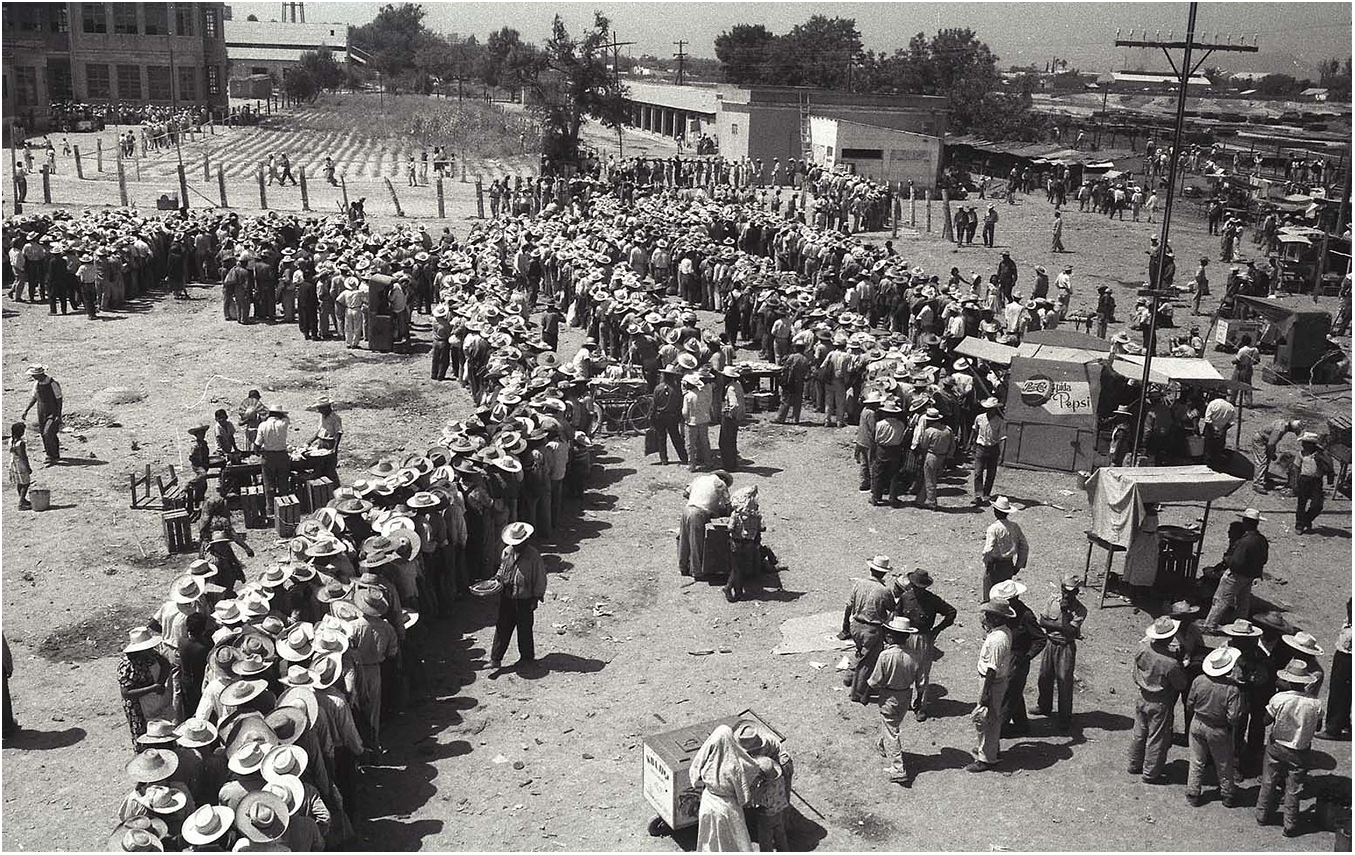
We are prone to focusing on the drivers of mobility that provide sites of commodity production with the necessary workers. But these trajectories are only the endpoint of a long and often dramatic process. Countless individuals never survive the journey to the site, or do not succeed in getting a contract or a job. It is erroneous to suppose that all workers reach a site of production with the exception of those suffering incidental death due to disease and harsh travel conditions – as was common in the Atlantic slave trade. Seasonal workers may also be rejected at recruiting centres, fired because of their behaviour, or dismissed due to a health condition. Thousands of workers were rejected every year under the temporary work programme established by the United States and Mexico after World War II, which lasted twenty-two years and moved millions of Mexicans to fields in the US Southwest.Footnote 15 We do not know how many lost their lives around the fields and industries in the in-between seasons while working, waiting for employment as harvesters, or hoping to be accepted at a recruitment centre. Temporary and seasonal work entails waiting and searching; it is a circular trip around different fields in distant regions, even within a single country.
The critical role of travel permits, labour camps, and plantations as methods or sites of confinement and immobilization of potential workers has yet to be investigated. What of the trajectories of those agricultural workers who were left behind or lost in the process? Seasonal workers are not only those who make it into the fields; the “disappeared workers” are an integral part of the labour im/mobility regime that enables the overall functioning of plantations and their mode of production.
Mobile workers rarely have a single site of employment. What about the connections between these sites and the movements between them? What about waiting times between one season as a harvester and the next as a picker? What happens when a group of workers, often of the same ethnicity or originating from a specific place or region, are discarded in favour of others? What changes when there is a shift in the worker selection and recruitment process? The drivers of mobility established by capitalists, states, and entrepreneurs simultaneously create sites of immobilization where agricultural workers await new employment, hope for better labour conditions – and fear for their life.
Work is mostly considered as occurring in a specific place or linked to a specific site of production, or at least along a linear trajectory between the communities of departure and destination. However, we can assume a different stance by viewing im/mobility as a process involving a broader historical context made up of trajectories of flight and voluntary mobility, places of confinement or temporary immobilization, and recruitment and processing centres. In other words, a continuous and hectic back and forth across space that is integral to labour relations. This highlights the diffuse and hierarchical structures through which labour coercion emerges, thereby contributing to a newly spatialized history of labour processes and labour coercion.Footnote 16
Nonetheless, the necessary focus on mobilization has neglected investigations into immobilization. The intricate web of mobility trajectories is produced not only by movement but also by crossing points where workers wait, hope, and die. It is also created by those who escape the commodification of labour altogether, running from forced recruitment and corrupt agents, as well as by those who protest the recruitment process and demand that states and other stakeholders reimburse them for the poor treatment they have received.Footnote 17 This is often underestimated because trajectories of productivity obfuscate sites of immobilization, which are considered unproductive and tend to remain almost invisible. I argue, however, that immobility is constituent to and coexistent with mobility within the same regime. Control over labour, coercion and indebtedness, exploitation of waiting times, and the moulding of workers into disposable subjects are all means of generating value out of immobility. Waiting times play a key role by interrupting the supposed continuum of periods of labour and the linearity of paths of migration, thereby affecting both the temporality and the subjectivity of workers.
We urgently need to explore the making of commodity frontiers through the respective sites of immobilization – whether voluntarily established or contingently emerging from the mobilization of workers – as well as workers’ means of escaping such immobilization. These two processes have continually redrawn the trajectories of labour mobility throughout history and, in turn, influenced the movement of commodity frontiers.
Health, Food, and Labour under Capitalism
The nexus of health, food, and labour is so striking today that Bosma’s reflections on the systemic crisis of sugar in the present course of capitalism is a question for us not just as historians, but also as humans on this planet. Labour history and environmental history are clearly linked due to soil exhaustion and the effects of changing weather and climates on agricultural fields, as well as with a view to seasonal workers’ employability and contamination owing to the use of agrochemicals. For instance, soil exhaustion occurred during the seventeenth and eighteenth centuries in Java, where Chinese workers were coercively employed and occasionally massacred, as well as in other sugar frontiers such as Barbados, the Guianas, Jamaica, and Saint Domingue.Footnote 18 This soil exhaustion shifted the respective frontiers and sometimes imposed change on the commodity produced. Such processes have occurred repeatedly throughout history with varying outcomes depending on the availability of docile labour, additional land, capital, and technologies to be implemented. Although crops, labour conditions, and modes of production were historically varied, the expansion of agro-industrial capitalism has increasingly flattened these differences and homogenized the associated effects on environments and populations.
Importantly, a common aspect of commodity production has been the use of chemical substances employed in crop cultivation. Workers have been exposed to these toxic substances over the past two centuries, and sugar is no exception.Footnote 19 Today, sugar cane crops are treated with a wide range of pesticides, with severe consequences for human health, including “immune and endocrine disruption, damage to the peripheral and central nervous systems, and carcinogenesis”.Footnote 20
In the twentieth century, we have witnessed protests by agricultural workers and unions with regard to labour standards – not only due to wage levels, availability of leisure time, retirement plans, healthcare benefits, paid vacations, and general working conditions, but also concerning safety. Struggles for safety in the agricultural fields frequently have to do with pesticide exposure. For instance, in the vast farming landscapes of Arizona, Mexican Americans and Mexican migrants began to organize under the Maricopa County Organizing Project (MCOP) in the 1970s and 1980s. MCOP played a key role in mobilizing agricultural workers to protest labour conditions related to the use of pesticides and water quality.Footnote 21 This groundbreaking form of syndication was pivotal and contributed to the establishment of larger projects monitoring the use of pesticides in agriculture for the protection of workers as well as the environment.Footnote 22
The concept of “fair trade” appears to mitigate some of the detrimental effects of commodity production, particularly in areas where pesticides are prohibited, working conditions follow international occupational standards, and cooperatives run the overall process of production and distribution through regulated chains. Nevertheless, access to these “fair” commodities is extremely limited – and nearly non-existent with regard to sugar.Footnote 23 In reality, the majority of today's moving commodity frontiers remain toxic, both for workers and the environment.
The Toxicity of Twenty-First-Century Commodity Frontiers
In addition to its fundamental role in the historical “development of global agro-industrial capitalism”,Footnote 24 sugar has also caused considerable health damage to consumers around the world.Footnote 25
Sugar is an unhealthy food system not only because of its impact on consumers, but also due to the devastating health consequences associated with the chemical intensification of agriculture.Footnote 26 As a result, agro-industrial capitalism has become agrochemical capitalism and should be consistently investigated through the lens of the environment–labour–toxicity nexus. This perspective seems relevant for identifying similar patterns at the global level, trajectories of change within “green capitalism”, political campaigns by unions and associated workers to reverse the trend of toxification, as well as policies for preventing and undoing environmental and health damage caused by agrochemical capitalism.
On the one hand, the history of commodities is a history of contamination owing to systems of production that cause soil dehydration and exhaustion, air pollution, contamination of land and water, land grabbing and extractivism, and the distribution of huge amounts of plastic waste and chemicals to every corner of the planet.Footnote 27 On the other hand, it is also a history of increasingly contaminated commodities due to the use of chemicals in their processing. Moreover, tracing commodity chains is always a matter of identifying the level of toxicity that a given commodity acquires during each step of its production, distribution, consumption, and disposition. Humans increasingly live through toxicity: it is hard to find any product or commodity on this planet that is not contaminated with toxic chemicals, and emerging research on the effects of specific commodities indicates that even human body parts represent a capitalist frontier.Footnote 28
Our bodies are sustained by water, food, and air, along with all the natural and human-made elements that create and reproduce them. Just as we can map the historical movement of commodity frontiers on the planet, we are also able to detect the presence of toxicity in our bodies resulting from the production of specific commodities that we consume or are exposed to. We can expect the expansion of “green capitalism” to be accompanied by detoxication cures, health checks for cancer prevention, high-cost nutrition programmes, and the creation of environmental safe spaces where natural disasters and health issues caused by global warming are less dramatic.
The global scale of capitalism has reached the micro scale of particles. The commodity frontiers that exist in our bodies as well as in other-than-human entities are more pervasive than ever. Understanding this fact should give us cause to reconsider and rebalance the costs and benefits of moving commodity frontiers. If nation states and capitalists historically pursued low sugar prices and managed disposable workers worldwide, those same institutions can also intervene to countervail global inequalities. In this sense, a global redistribution of wealth seems the only viable solution for increasing the still almost non-existent consumption of “fair” (but costly) commodities that strive to evade present-day global capitalism.


 Open access

