


Introduction
Across much of the world, threatened species persist within human-modified landscapes alongside rural or Indigenous communities who rely on natural resources for their livelihoods. Such shared social–ecological systems are under pressure, as they need to support socio-cultural and economic development as well as biodiversity (Miller et al., Reference Miller, Caplow and Leslie2012). Such communities often possess rich bodies of local ecological knowledge about wildlife and environmental resources, which can potentially guide the development of sustainable management strategies (Gómez-Baggethun et al., Reference Gómez-Baggethun, Corbera and Reyes-García2013; Berkes, Reference Berkes2018). However, local-scale anthropogenic processes, including habitat conversion and encroachment, resource overexploitation and human–wildlife conflict, represent key global concerns that biodiversity is facing (Tilman et al., Reference Tilman, Clark, Williams, Kimmel, Polasky and Packer2017). Understanding how threatened species respond to different anthropogenic activities is crucial in evidence-based conservation. There is therefore an urgent need to understand the dynamics of social–ecological systems, to determine the sustainability of different direct and indirect interactions between people and biodiversity (Nuno et al., Reference Nuno, Bunnefeld and Milner-Gulland2014).
Identifying sustainable solutions for both humans and wildlife is a key conservation concern in China, a megadiverse country that contains 14% of global vertebrate species and a wide range of ecosystems (Xie et al., Reference Xie, Cao, Yang, Xin, Fan and Gao2015), but which has suffered severe biodiversity loss associated with intensive human population growth, resource overexploitation and habitat modification (Shapiro, Reference Shapiro2016; Marks, Reference Marks2017). In particular, Chinese terrestrial ecosystems are threatened by widespread conversion to agricultural production, largely to provide food security and livelihoods for low-income rural communities (Liu et al., Reference Liu, Duan and Yu2013). Agriculture is the largest driver of global biodiversity loss, through modification and conversion of natural habitats and release of pesticides and fertilizers, and rice agriculture in particular is an important driver of the loss of natural wetlands (Donald, Reference Donald2004; Dudley & Alexander, Reference Dudley and Alexander2017). Agricultural expansion and intensification have been associated with progressive historical depletion of Chinese wildlife populations (Marks, Reference Marks2017; Turvey et al., Reference Turvey, Crees, Li, Bielby and Yuan2017), and these pressures continue to drive extensive regional species declines (Xie et al., Reference Xie, Cao, Yang, Xin, Fan and Gao2015).
The Chinese alligator Alligator sinensis is a small crocodylian endemic to freshwater wetlands in eastern China. Alligators were formerly distributed across the middle–lower Yangtze and Yellow River basins, and were culturally important in Chinese history as manifestations of dragons that could also alert local people to changes in weather and the seasons (Thorbjarnarson & Wang, Reference Thorbjarnarson and Wang2010; Wu et al., Reference Wu, Zhang, Jin, Song, Luan and Xue2019). However, this region has experienced massive-scale historical conversion to rice agriculture and other human environments (Marks, Reference Marks2017), and during the past century, alligators became restricted to progressively smaller areas of habitat south of the lower Yangtze channel (Huang, Reference Huang1981; Watanabe, Reference Watanabe1982; Chen, Reference Chen1990; Thorbjarnarson & Wang, Reference Thorbjarnarson and Wang1999, Reference Thorbjarnarson and Wang2010; Thorbjarnarson et al., Reference Thorbjarnarson, Wang, Ming, He, Ding and Wu2002). The last surviving wild population, comprising c. 200 individuals, is distributed across a series of isolated habitat fragments (remnant natural wetlands and ponds in agricultural valleys and hills) within five counties in south-eastern Anhui Province (Thorbjarnarson et al., Reference Thorbjarnarson, Wang, Ming, He, Ding and Wu2002; Thorbjarnarson & Wang, Reference Thorbjarnarson and Wang2010; National Forestry and Grassland Administration, 2019). The species is now one of the rarest and most threatened crocodylians; it is recognized as a global conservation priority on the basis of unique evolutionary history (Gumbs et al., Reference Gumbs, Gray, Wearn and Owen2018) and is categorized as Critically Endangered on the IUCN Red List, with effective monitoring and threat mitigation identified as urgent management needs (Jiang & Wu, Reference Jiang and Wu2018). The Chinese alligator has been listed as a Class I Endangered Species under Chinese national legislation since 1972, and the remnant Anhui population was protected in 1982 by the designation of the five-county National Chinese Alligator Reserve (Thorbjarnarson & Wang, Reference Thorbjarnarson and Wang2010). A large ex situ population has also been established through captive breeding and is being used to bolster the wild population (Wang et al., Reference Wang, Yao, Ding, Thorbjarnarson and Wang2011; Jiang & Wu, Reference Jiang and Wu2018).
Landscape protection has been shown to improve the population status of crocodylians (e.g. Nyirenda, Reference Nyirenda2015). However, unlike in many other Chinese protected areas (Xu et al., Reference Xu, Li, Pimm, Hull, Zhang and Zhang2016), rural communities continue to live alongside wild alligators across the National Chinese Alligator Reserve. Activities that harm alligators, disturb alligator nesting or degrade alligator habitats are prohibited within the Reserve, but agricultural and silvicultural production is permitted, and communities utilize the terrestrial and wetland habitats of this landscape for subsistence and local trade (Thorbjarnarson & Wang, Reference Thorbjarnarson and Wang2010; Jiang & Wu, Reference Jiang and Wu2018). Agriculture can threaten crocodylians through loss of habitat (e.g. conversion to rice paddies or aquaculture, water extraction for irrigation), disturbance, persecution and exploitation associated with increased contact with people and domestic animals, and direct and indirect effects of environmental contaminants (pesticides, fertilizers) on both crocodylians and their prey base (Manolis and Stevenson, Reference Manolis and Stevenson2010; Tavalieri et al., Reference Tavalieri, Galoppo, Canesini, Luque and Muñoz de Toro2020; Cavalier et al., Reference Cavalier, Pratt, Serenari and Rubino2022). All of these factors are identified as threats to Chinese alligators (Huang, Reference Huang1981; Watanabe, Reference Watanabe1982; Chen, Reference Chen1990; Thorbjarnarson & Wang, Reference Thorbjarnarson and Wang1999, Reference Thorbjarnarson and Wang2010; Thorbjarnarson et al., Reference Thorbjarnarson, Wang, Ming, He, Ding and Wu2002). However, the potential impacts of ongoing agricultural activities on wild alligators within the Reserve remain unclear, with little evidence available on the severity or sustainability of different anthropogenic pressures at local or landscape scales in this social–ecological system, as most recent studies have instead focused on the captive population.
Identifying direct and indirect pathways of impact on freshwater crocodylians can be challenging, with threats potentially acting in unexpected ways. For example, anthropogenic landscape modification can alter freshwater ecology and fragment crocodylian populations, but can also provide new permanent water bodies that contain increased prey (Somaweera et al., Reference Somaweera, Brien, Sonneman, Didham and Webber2019). Many rural communities are able to coexist with crocodylians within other human-modified systems (Cavalier et al., Reference Cavalier, Pratt, Serenari and Rubino2022), making it difficult to infer the relative significance of different threats to Chinese alligators in the absence of locally acquired data. This knowledge gap may affect the success of conservation management of the last wild Chinese alligator population in the Reserve, and of alligator reintroductions to other human-occupied Chinese landscapes (Wang et al., Reference Wang, Yao, Ding, Thorbjarnarson and Wang2011; Platt et al., Reference Platt, Li, He, Wang and Lu2016).
To address the existing knowledge gap on the status of and threats to wild Chinese alligators, we conducted an interview survey of agricultural communities within and around the Reserve. Specifically, we investigated: (1) whether local ecological knowledge can provide useful information on the local status of Chinese alligators, and (2) the relationship between different land-use practices and alligator sightings, and their implications for understanding threats to and conservation requirements of Chinese alligators.
Methods
Interview survey
We conducted interviews in July and August 2018 in the five counties within the Reserve (Guangde, Jing, Langxi, Nanling, Xuanzhou) and in four counties bordering the Reserve (Fanchang, Ningguo, Sanshan, Wuhu) in Anhui Province (Fig. 1). This sampling design aimed to compare respondent knowledge and activities across landscapes that vary in current alligator occurrence and histories of local extirpation or persistence, but which had all contained wild alligators within living memory (Huang, Reference Huang1981; Watanabe, Reference Watanabe1982; Thorbjarnarson & Wang, Reference Thorbjarnarson and Wang1999, Reference Thorbjarnarson and Wang2010; Thorbjarnarson et al., Reference Thorbjarnarson, Wang, Ming, He, Ding and Wu2002). We compiled a list of villages for the survey region by using aerial imagery, and randomly selected a minimum of four villages per county; more villages were selected in Xuanzhou (six) and Guangde and Langxi (five each) as these are proportionally larger regions. We aimed to conduct 10 interviews per village. We opportunistically selected respondents to interview by traversing villages on foot. We interviewed both men and women, did not interview individuals below the age of 18, and only interviewed one person per household to ensure independence of responses. We used a standard questionnaire that contained 36 questions and took 20 min to complete (Supplementary Material 1). Before starting interviews, we explained the purpose of our research, obtained verbal consent from all respondents, and informed them that they would remain anonymous and could halt the interview at any time. Interviews were conducted in Mandarin.
Location of survey villages across counties within and adjoining the National Chinese Alligator Reserve in Anhui Province, China.

During interviews, we collected respondents' socio-demographic data and information about their agricultural practices, including land ownership, pesticide and fertilizer use, use of local water resources (irrigation, fish farming), and how many years they had spent farming. We then showed respondents three locally sourced photographs of wild and captive Chinese alligators in different positions (partially submerged in water, sprawling, resting), and asked them to identify the animal. Respondents who correctly identified the photographs were asked to provide additional diagnostic morphological or ecological attributes to confirm their familiarity with the species (e.g. another known local name; knowledge of its behaviour, habitat or vocalizations). Respondents who failed to identify photographs were prompted with common local names (tulong, helong) and guided through the same process. Only respondents who could identify alligators from photographs or common names, and who also provided additional morphological or ecological information, were asked further questions about whether and when they had seen wild alligators or their eggs and nests, their perceptions of local alligator population trends compared to historical baselines from 20 and 30 years earlier, and whether they knew of alligators ever being killed.
Analysis
We conducted all analyses in R 3.6.1 (R Core Team, 2021; Supplementary Material 2). We first performed a non-metric multidimensional scaling (NMDS) analysis to investigate whether respondents' land-use practices differed inside and outside the Reserve. Using the subset of 170 respondents who had provided complete responses about socio-demographic and land-use characteristics, we calculated Gower distances to accommodate the mixture of categorical (binary) and quantitative data, as recommended by Legendre and Legendre (Reference Legendre and Legendre2012). The 12 respondent variables were: annual income, whether they currently grow crops (binary), number of years they have grown crops, proportion of their lifetime spent growing crops, whether they apply pesticides (binary), number of pesticide types used, frequency of pesticide use per year, number of agrochemical fertilizer types used, frequency of fertilizer use per year, number of months during which fertilizers are applied each year, whether they use the local water supply for irrigation (binary), and whether they farm fish (binary). We performed scree-plot analysis to examine how the number of dimensions in the NMDS affects the stress measure (the residual variance of differences), with the ‘elbow’ of the plot identified at three dimensions. To verify this, we performed a Monte Carlo test with 999 permutations, as suggested by Dexter et al. (Reference Dexter, Rollwagen-Bollens and Bollens2018), which verified that our stress statistic of 0.09 was significantly lower than the mean stress of the null model (0.12; standardized effect size = −5.50, P = 0.001). To test the differences between respondents inside and outside the Reserve, we conducted a nested (Reserve/county) analysis of similarity (ANOSIM) with 999 permutations. We used the vegan package in R (Oksanen et al., Reference Oksanen, Simpson, Guillaume Blanchet, Kindt, Legendre and Minchin2023) to perform the NMDS (function metaMDS), Monte Carlo simulations (function oecosim), and ANOSIM (function adonis2).
We investigated the relationships between respondent knowledge/experience of alligators and associated socio-demographic and land-use variables using four candidate generalized linear mixed models (all binomial with logit link function). We first analysed the entire dataset to determine the variables predicting whether respondents could recognize alligators. We then employed further models to investigate the subset of respondents who recognized alligators, to evaluate predictors of: (1) whether they had seen a wild alligator, (2) whether they had seen wild alligator eggs or nests, and (3) whether they perceived wild alligators to have been more abundant in the past. Response variables were modelled as functions of whether respondents lived within the Reserve (binary), age (z-standardized), gender (binary), education level (four-level categorical), annual income, and 11 indices of respondents' habitat modification/usage or activities that could be expected to affect alligators: whether respondent currently grows crops (binary), proportion of their lifetime spent growing crops, whether they perceive the area they grow crops in to have changed over time (three-level ordinal), whether they apply pesticides (binary), number of pesticide types used, frequency of pesticide use per year, number of agrochemical fertilizers used, frequency of fertilizer use per year, number of months during which fertilizers are applied each year, whether they use the local water supply for irrigation (binary), and whether they farm fish (binary). Some variables were square-rooted or square-transformed to evenly distribute the data. County was fitted as a random effect in all models to account for potential local similarities or dependency between respondents' activities in the same county.
We employed a model-selection approach to determine which variables were influential (Burnham & Anderson, Reference Burnham and Anderson2002, Reference Burnham and Anderson2004). We generated candidate models for each response variable by modelling each explanatory variable additively and with county included as a random effect, and with the Reserve variable fixed to investigate differences between respondents inside and outside the Reserve. We removed predictors with excessive missing values (> 20% of the total sample size) and further cleaned the data of missing values. We tested the remaining predictors for multicollinearity using variance inflation factors, with sequential removal until all predictors had values below the conservative threshold of 3. We built candidate models using the final subset of predictors and ranked them using Akaike's information criterion corrected for small sample sizes (AICc), using the dredge function in the MuMIn package in R (Bárton, Reference Bárton2023). A dredging approach was employed because we had established that the selected predictors were important for the examination of differences in demographic and land-use practices between respondents inside and outside the Reserve, and wanted to explore the subset of variables that was important for the selected response variables; our primary hypotheses were driven by examination of the differences between respondents inside and outside the Reserve, so Reserve was included in all candidate models whilst allowing flexibility in demographic and land-use variables. We retained all models within 2 AICc units of the best model and used a model fully-averaging approach to calculate the average coefficient for each predictor. We estimated 95% confidence intervals for each of the averaged coefficients with 999 parametric bootstraps from each candidate model using the bootMer function in the lme4 package in R (Bates et al., Reference Bates, Maechler, Bolker and Walker2015). We report the averaged model for each response variable (details of all candidate models are given in Supplementary Tables 2–9).
Results
We interviewed 370 respondents, 225 of whom resided within the Reserve (Fanchang, n = 37; Guangde, n = 49; Jing, n = 38; Langxi, n = 48; Nanling, n = 40; Ningguo, n = 37; Sanshan, n = 39; Wuhu, n = 32; Xuanzhou, n = 50; Supplementary Table 1). The mean respondent age was 66.6 years (range: 25–89), 77.3% were men, 22.7% were women, and most (91.6%) had always lived in the same village. Education was low, with 38.6% having no education, 42.1% having only primary-school education, 16.8% having secondary-school education and 2.4% having higher education (n = 368). The mean reported annual income was CNY 15,893 (n = 229; equivalent to c. GBP 1,820 at the time of the survey).
Only 64.1% of respondents reported farming as their occupation, but 95.7% reported growing crops, with 38.4% having grown crops in the past (mean proportion of lifetime that respondents had grown crops: 0.62). In total, 50.8% of respondents (inside the Reserve, 127/225; outside the Reserve, 61/145) reported a decline in their cropland area since starting farming, 38.9% reported no change (inside the Reserve, 78/225; outside the Reserve, 66/145) and 3.5% reported an increase (inside the Reserve, 9/225; outside the Reserve, 4/145). Most respondents (88.4%) used or had previously used pesticides, on average two types, and applied pesticides 2.83 ± SD 2.27 times per year. The most commonly reported pesticides were dimehypo (thiosultap disodium: 25.9%) and methamidophos (organophosphate: 12.4%). Respondents reported using three types of chemical fertilizers on average, applied for 2.06 ± SD 1.03 months or 2.00 ± SD 2.41 times per year. Most respondents (77.0%) used the local water supply for irrigation. Few respondents (11.4%) farmed fish in local ponds.
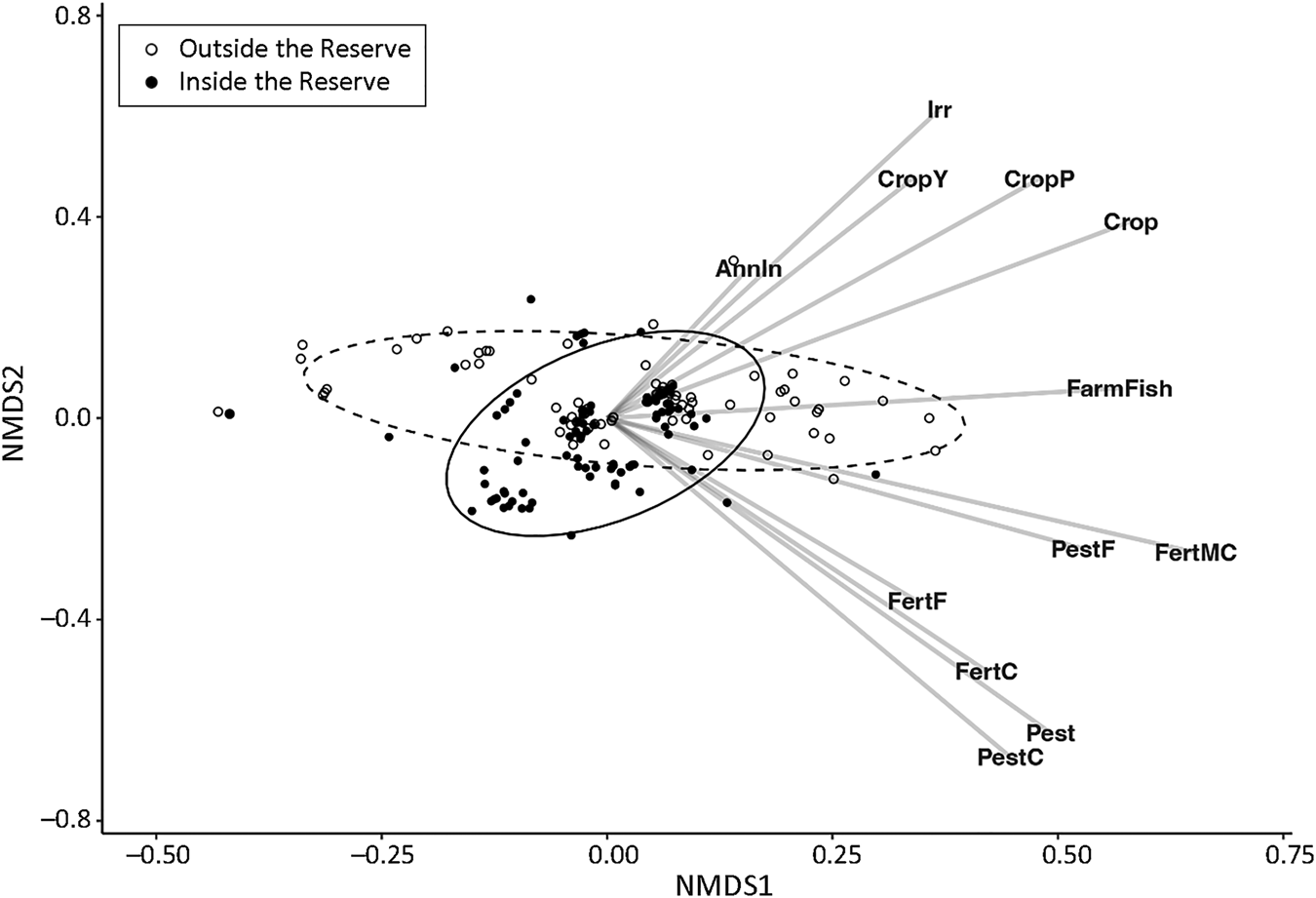
NMDS and ANOSIM revealed significant segregation between respondents inside and outside the Reserve (F[1,164] = 9.70, R2 = 0.05, P = 0.001). Counties inside and outside the Reserve also differed significantly (F[4,164] = 3.98, R2 = 0.08, P = 0.001). In general, respondents outside the Reserve were distributed across NMDS1, were more likely to farm fish, applied more types of pesticide, and used fertilizers for more months per year. Respondents inside the Reserve were instead mainly distributed across NMDS2, generally earned less, did not irrigate their land using the local water supply, and did less cropping (fewer years growing crops, and a smaller proportion of their lifetime spent growing crops; Fig. 2). However, unexplained variance remained high (86.5%), indicating that further factors influenced respondents' land-use practices.
Respondents inside and outside the Reserve separated in two dimensions of non-metric multidimensional scaling (NMDS) analysis. Ellipses encompass 95% of respondents. Socio-demographic and land-use variables are plotted in grey according to their ordination scores. Key: AnnIn, annual income; Crop, whether they currently grow crops; CropP, proportion of lifetime spent growing crops; CropY, years spent growing crops; FarmFish, whether they farm fish; FertC, number of fertilizers used; FertF, frequency of fertilizer use per year; FertMC, number of months that fertilizers are applied per year; Irr, whether they use local water supply for irrigation; Pest, whether they apply pesticide; PestC, number of pesticides used; PestF, frequency of pesticide use per year.

In total, 43.8% of respondents recognized alligators. Candidate models explained 29–34% of the variation in respondents' ability to recognize alligators, with between-county differences explaining 10–14% and fixed effects explaining 16–24% (Supplementary Table 2). Sixteen candidate models were averaged (Supplementary Table 3), which showed that recognition was higher in respondents inside the Reserve (coefficient = 2.02 ± 0.70, z = 2.90, P = 0.004), who were male (coefficient = 1.07 ± 0.39, z = 2.77, P = 0.005), did not grow crops (coefficient = 0.72 ± 0.34, z = 2.14, P = 0.03), irrigated their land (coefficient = 1.11 ± 0.46, z = 2.39, P = 0.02) and had a secondary school education (coefficient = 1.10 ± 0.53, z = 2.09, P = 0.04). At least one respondent from each county recognized alligators, and respondents from counties inside the Reserve were more likely to recognize them, with the highest recognition in Xuanzhou (estimate: 81.3%, 95% CI 63.3–89.8%) and the lowest in Fanchang (estimate: 5.0%, 95% CI 2.3–20.6%; Fig. 3a).
Variation across respondents from counties inside and outside the Reserve: (a) probability of respondent recognizing Chinese alligators Alligator sinensis, (b) probability of wild alligator sighting, (c) probability of wild alligator egg/nest sighting, and (d) probability of perceiving alligator decline. Plots show means and 95% confidence intervals estimated from 999 parametric bootstraps from averaged candidate models. Outside the Reserve (Out. Res.): FC, Fanchang; NG, Ningguo; SS, Sanshan; WH, Wuhu. Inside the Reserve (Ins. Res.): GD, Guangde; J, Jing; LX, Langxi; NL, Nanling; XZ, Xuanzhou.

Only 15.1% of total respondents (34.6% of those who recognized alligators) had seen a wild alligator, with sightings reported from all counties except Fanchang. All sightings had occurred locally. Nine candidate models explained 14–18% of the variation in the likelihood of alligator sightings. There were no differences in sighting likelihood between counties, but sighting likelihood was higher in respondents inside the Reserve (coefficient = 1.55 ± 0.63, z = 2.45, P = 0.01), who were older (z-age coefficient = 0.48 ± 0.22, z = 2.15, P = 0.03), and who farmed fish (coefficient = 1.64 ± 0.77, z = 2.12, P = 0.03; Fig. 3b, Supplementary Tables 4 & 5). The mean reported alligator last-sighting date was 42.4 ± SD 18.0 years earlier, with only four sightings from the previous decade (most recent sighting = 6 years earlier) and only nine from the previous 20 years. Respondents from Jing reported the most recent last sightings (mean 29.0 ± SD 13.5 years previously).
Only 7.3% of total respondents (16.7% of those who recognized alligators) reported having seen alligator eggs or nests, with the mean last-sighting date 43.0 ± SD 18.7 years earlier. Five candidate models explained c. 84% of the variation in the likelihood of egg or nest sightings (Supplementary Table 6). There were no differences in sighting likelihood between counties or between respondents inside or outside the Reserve, but egg or nest sightings were more likely to be reported by respondents who were older (coefficient = 1.08 ± 0.39, z = 2.76, P = 0.006), who farmed fish (coefficient = 3.56 ± 0.99, z = 3.60, P < 0.001), who did not irrigate their land (coefficient = 2.10 ± 0.79, z = 2.59, P = 0.01) and who had increased their cropland area (coefficient = 3.64 ± 1.25, z = 2.91, P = 0.004; Fig. 3c, Supplementary Table 7).
Only 9.7% of total respondents (22.2% of those who recognized alligators) perceived alligators to have declined. Declines were perceived in all counties inside the Reserve, but only in three counties outside the Reserve (Wuhu, n = 2; Ningguo, n = 1; Sanshan, n = 1; Ningguo, n = 1). Generally, more respondents in counties inside the Reserve perceived alligator declines, with decline perception highest in Xuanzhou (estimate: 35.2%, 95% CI 18.1–46.1%) and lowest in Sanshan (estimate: 12.3%, 95% CI 2.2–30.4%; Fig. 3d). Nine candidate models explained 4–11% of the variation in decline perception, with between-county differences explaining 3–6% and fixed effects explaining 1–6% (Supplementary Table 8), but the average model found no statistical effect of any predictor variables, including between respondents inside and outside the Reserve (Supplementary Table 9). Eleven respondents reported knowing of alligators having been killed; reports were made by respondents both inside and outside the Reserve (Langxi, n = 1; Sanshan, n = 3; Wuhu, n = 1; Xuanzhou, n = 6), and four were associated with details of events that occurred inside and outside the Reserve (Nanling: 1973, killed for meat using hooks; Sanshan: 1988, killed by net; Wuhu: 2017, two reports of an alligator being killed, with one report stating that this was for meat).
Discussion
This study provides a baseline from which to assess the utility of social-science methods for understanding the local status of a threatened crocodylian, and the potential impact of differing anthropogenic land-use activities on its last surviving wild population. Some indices of respondents' awareness and experience in our models are correlated with age, gender and education, socio-demographic parameters that are also known to predict environmental knowledge acquisition in other systems. This variation is likely to reflect well-understood factors such as age-related shifting baselines in knowledge of declining species that were previously more detectable, and gendered division of labour in rural Chinese communities associated with differing exposure to wildlife (Turvey et al., Reference Turvey, Barrett, Hao, Zhang, Zhang and Wang2010; Xiao & Hong, Reference Xiao and Hong2010; Allendorf & Yang, Reference Allendorf and Yang2017). However, our models account for these expected patterns of variation, and reveal other important conservation-relevant insights into local knowledge content and likely threats to alligators across their last wild population.
Local ecological knowledge is increasingly recognized as a powerful tool for monitoring wildlife (Anadón et al., Reference Anadón, Giménez, Ballestar and Pérez2009; Parry & Peres, Reference Parry and Peres2015; Gray et al., Reference Gray, Phommachak, Vannachomchan and Guegan2017). However, it has rarely been used to understand the local status of crocodylians (Eniang et al., Reference Eniang, Akani, Dendi, Fa and Luiselli2020; Than et al., Reference Than, Zaw and Hughes2022) and local crocodylian knowledge is known to be sensitive to contingent ecological and social factors (Ligtermoet et al., Reference Ligtermoet, Gumurdul, Nayinggul and Baker2023). Extensive local ecological knowledge on Chinese alligators could be expected to exist, as these animals are large, easily identifiable, culturally important, and a focus for regional conservation attention and government policies, which are all characteristics that increase awareness (Jones et al., Reference Jones, Andriamarovololona, Hockley, Gibbons and Milner-Gulland2008; Turvey et al., Reference Turvey, Fernández-Secades, Nuñez-Miño, Hart, Martinez and Brocca2014). Local knowledge obtained through questionnaire surveys has previously been used to guide Chinese alligator field surveys, but its information content has not been formally assessed or reported (Ding & Wang, Reference Ding and Wang2004). Our results demonstrate that respondents inside the Reserve were more likely to recognize alligators and report sightings. Alligator declines over recent decades were also reported more widely inside the Reserve, which is also consistent with existing alligator survey baselines; alligators are known to have experienced considerable declines within the Reserve since the 1980s (Thorbjarnarson et al., Reference Thorbjarnarson, Wang, Ming, He, Ding and Wu2002; Thorbjarnarson & Wang, Reference Thorbjarnarson and Wang2010; Jiang & Wu, Reference Jiang and Wu2018), and although they have declined to extinction outside the Reserve, these losses occurred longer ago (Huang, Reference Huang1981; Watanabe, Reference Watanabe1982; Thorbjarnarson & Wang, Reference Thorbjarnarson and Wang1999, Reference Thorbjarnarson and Wang2010).
Our data also show further variation in the indices of awareness and experience of alligators across different counties inside the Reserve. These patterns are harder to assess because of limited independent data on the species’ status across different parts of the Reserve, and recent reintroductions of captive-bred individuals (Jiang & Wu, Reference Jiang and Wu2018). However, increased recognition levels in Xuanzhou may reflect the presence of China's largest alligator captive-breeding facility (the Anhui Research Centre for Chinese Alligator Reproduction) and the release and monitoring of alligators at the nearby Hongxing conservation site in this county (Wang et al., Reference Wang, Yao, Ding, Thorbjarnarson and Wang2011). The relatively high proportion of recent sightings in Jing also contrasts with the minimal number of recent sightings from many other areas of the Reserve, and with the greater proportion of respondents perceiving declines in Xuanzhou (in contrast to high recognition levels from this county). These data are consistent with the known local survival of very few wild alligators in several counties inside the Reserve, including Xuanzhou, Guangde and Langxi (Thorbjarnarson et al., Reference Thorbjarnarson, Wang, Ming, He, Ding and Wu2002).
However, although relative patterns of local ecological knowledge are consistent with independent data on varying alligator status and conservation interventions across the region, absolute levels of awareness and experience were low. Fewer than half of the respondents (and only 54.2% within the Reserve) could recognize alligators, only 9.7% (and only 14.2% within the Reserve) thought that alligators had declined, and only 15.1% (and only 21.8% within the Reserve) had seen a wild alligator. The mean last-sighting dates for alligators and their eggs and nests were over 40 years earlier, with only a handful of reported sightings from the past 2 decades. These low encounter levels within the human-modified landscape of the Reserve highlight the perilous status of the species, and further social-science surveys using opportunistic respondent sampling may be of limited use for understanding alligator population parameters for conservation planning. Other respondent sampling approaches, such as stratified sampling based upon habitat quality or other relevant landscape characteristics, or the targeting of specific individuals with known expertise about local wildlife using snowball sampling, may be more appropriate (Newing, Reference Newing2011). Such approaches could build upon the existing engagement of some local farmers who act as alligator caretakers within the Reserve (Thorbjarnarson et al. Reference Thorbjarnarson, Wang, Ming, He, Ding and Wu2002; Thorbjarnarson & Wang, Reference Thorbjarnarson and Wang2010), to establish a coordinated community-based monitoring network. However, few people who live alongside China's last wild alligators (and inside the protected area that was established to conserve them) can even recognize them or are aware of their existence. In addition, although we collected little evidence of people killing alligators, recent reports from counties outside the Reserve suggest alligators may occur in these landscapes and raise concerns about possible ongoing exploitation of alligators for food. Even if not killed directly, wild Chinese alligators probably also remain threatened by other interactions with local people (e.g. disturbance, ingesting poisoned prey; Thorbjarnarson et al. Reference Thorbjarnarson, Wang, Ming, He, Ding and Wu2002; Thorbjarnarson & Wang, Reference Thorbjarnarson and Wang2010; Jiang & Wu, Reference Jiang and Wu2018). Together, these findings highlight the importance of conducting locally appropriate educational outreach activities to support the effective conservation of the species.
As relatively few respondents have any experience of encountering alligators or recognize that their numbers have declined, this baseline of local ecological knowledge highlights the precarious status of the species within the Reserve, but in itself is insufficient to guide specific management decision-making. However, local ecological knowledge is useful for conservation not only in terms of the new baselines provided by respondents' direct knowledge about target species, but also in terms of how this knowledge correlates with data on respondents' behaviours and environmental interactions. Our analysis of these correlative patterns provides important new insights for alligator conservation, in terms of identifying specific land-use activities that are associated with indices of reduced alligator occurrence, thus highlighting these practices as potentially unsustainable for alligator persistence.
Notably, our models show that alligators were recognized by significantly fewer respondents who grew crops, and thus potentially encroached on remaining alligator habitats. Respondents inside the Reserve practise substantially less crop farming than those outside the Reserve, and have experienced substantially more reported declines in cropland area. Indeed, respondents inside the Reserve generally earn less than people in neighbouring counties, raising important concerns over equitable support for local community livelihoods whilst also supporting alligator conservation. However, although local pressure from agricultural conversion may therefore have decreased, over one-third of respondents in the Reserve had maintained or increased their cropland area. These results suggest that existing levels of agriculture within the Reserve may continue to pose a threat to the survival of wild alligators. Indeed, alligators often persist within the Reserve in unconnected fragments of marginal or unsuitable habitat, such as oligotrophic ponds in hilly terrain where burrowing is difficult (Thorbjarnarson et al., Reference Thorbjarnarson, Wang, Ming, He, Ding and Wu2002; Thorbjarnarson & Wang, Reference Thorbjarnarson and Wang2010), which may be insufficient to support a viable population.
Our models also show that, although respondents who irrigated cropland using the local water supply were more likely to recognize alligators, there was a major difference between awareness vs direct experience of alligators associated with this land-use practice, and alligator eggs and nests were more likely to be reported by respondents who did not irrigate cropland. This finding highlights the potential threat posed to alligators by the modification of local water sources, which is known to be associated with regional habitat loss and increased human–wildlife conflict (Watanabe, Reference Watanabe1982; Thorbjarnarson et al., Reference Thorbjarnarson, Wang, Ming, He, Ding and Wu2002; Thorbjarnarson & Wang, Reference Thorbjarnarson and Wang2010; Wang et al., Reference Wang, Yao, Ding, Thorbjarnarson and Wang2011), and is practised by most respondents interviewed in our study. Conversely, our models also show an increased likelihood that respondents had seen alligators or their eggs and nests if they farmed fish, and an increased likelihood of having seen eggs and nests if they had increased their cropland area. We interpret these relationships as potentially attributable to an increased likelihood of encountering alligators if respondents spend more time near local water bodies, or if they work across wider areas of the landscape. Conversely, fish farming may pose less of a threat to alligator survival compared with other land-use changes. Our data indicate that respondents within the Reserve practise less irrigation and fish farming, and thus may have a reduced impact on the local wetland habitats required by alligators. These activities might therefore be associated with past alligator disappearance outside the Reserve, and should be assessed when planning future alligator reintroductions, but may no longer constitute major threats within the Reserve.
Pesticides and fertilizers are recognized threats to crocodylians, as they damage reproductive, developmental and immune systems and can be lethal (Tavalieri et al., Reference Tavalieri, Galoppo, Canesini, Luque and Muñoz de Toro2020). They are identified as potential drivers of alligator decline within the Reserve, as they destroy the species' prey base and kill juvenile and adult individuals directly, posing a particular risk to hatchlings (Huang, Reference Huang1981; Watanabe, Reference Watanabe1982; Chen, Reference Chen1990; Thorbjarnarson & Wang, Reference Thorbjarnarson and Wang1999, Reference Thorbjarnarson and Wang2010; Thorbjarnarson et al., Reference Thorbjarnarson, Wang, Ming, He, Ding and Wu2002). The increased use of agrochemicals associated with agricultural intensification also has deleterious effects on other biodiversity and human health across China (Wood et al., Reference Wood, Qiao, Li, Ding, Lu and Xi2010; Shapiro, Reference Shapiro2016). Our NMDS analysis indicates that respondents within the Reserve were less likely to apply numerous pesticide types, and used fertilizers for fewer months per year than those outside the Reserve. Unlike other land-use activities, our models also provide no evidence of relationships between alligator persistence or disappearance and the use of different agrochemicals. However, most respondents both inside and outside the Reserve still regularly used multiple pesticides and fertilizers, and the two most widely used pesticides across the region, dimehypo and methamidophos, are designated as moderately hazardous (Class II) and highly hazardous (Class IB) by the World Health Organization (2020), respectively. These findings highlight the ongoing prevalence of agrochemical use across the Chinese alligator's remaining distribution, and the continued potential risk this poses.
We recognize that the explanatory power of our interview data is potentially limited. Unexplained variance remained high across all analyses, indicating that additional factors influenced respondents' awareness, activities and experience, and our land-use indices represent relatively coarse metrics of anthropogenic pressures. Follow-up work using applied ecological methods (e.g. remote sensing analysis of spatio-temporal land-use change, and ecotoxicological testing to determine agrochemical effects) is needed to elucidate the finer-scale dynamics and impacts of different pressures, which may be complex and nuanced. Further social-science investigations could also clarify relevant human dimensions of this system, for instance the effect that alligator caretakers might have on local awareness-raising and positive behaviour change towards alligators. However, our analyses still detected several relationships between specific anthropogenic activities and variation in encounters with alligators, indicating that our dataset is sufficiently robust to provide insights into anthropogenic correlates of varying local-scale alligator occurrence, and that investigating the activities of people living alongside this species can help identify specific threats and inform conservation.
Our findings are concerning, as they suggest the protected landscape of the National Chinese Alligator Reserve continues to experience negative human pressures that threaten China's last wild alligators. Much needs to be done to ensure continued alligator persistence, including establishing more alligator-friendly agricultural landscapes, restoring wetlands, and revising the management of the Reserve to reduce unsustainable land-use practices. Our study has further important implications for efforts to reinforce or reintroduce Chinese alligator populations, which have largely lacked consideration of the social or ecological dimensions of anthropogenic pressures at release sites (Thorbjarnarson & Wang, Reference Thorbjarnarson and Wang2010), and we highlight that captive-bred animals translocated into the Reserve will also be at risk from ongoing harmful human activities in this landscape. Our engagement with local communities who live alongside alligators emphasizes the importance of considering both the ecological and the human dimensions of this social–ecological system, and of identifying locally appropriate management strategies within the context of maintaining support for local people's needs, livelihoods and well-being (cf. Ma et al., Reference Ma, Zhang, Wang, Zhang, Xiao and Thompson2022). Importantly, as respondents within the Reserve generally earn less than people in neighbouring counties, alligator conservation initiatives must address these socio-economic imbalances to be sustainable in the long term. We hope that our consideration of human–environmental dynamics within the Reserve can thus provide a new perspective from which to guide in situ conservation planning, and support continued alligator survival and coexistence with rural communities in China.
Author contributions
Study design: STT, JPR, PDM; fieldwork: JPR, TP; data analysis: EYXL, JAH; writing: EYXL, STT, JAH.
Acknowledgements
We thank Xiaobing Wu, Xiaotong Du, Heidi Ma, Arkhat Abzhanov, and all respondents who kindly shared their knowledge. Financial support was provided by Imperial College London, a NERC PhD studentship, the IUCN Species Survival Commission Crocodile Specialist Group, the Universities' China Committee in London, and the Leverhulme Trust (RPG-2021-202). STT's research is supported by Research England and PDM's research is supported by a Royal Society University Research Fellowship (UF160216).
Conflicts of interest
None.
Ethical standards
This study abided by the Oryx guidelines on ethical standards and adhered to the code of ethics of the British Sociological Foundation. The Imperial College London Science, Engineering and Technology Research Ethics Committee (21IC6963) and Anhui Normal University approved the project design.



 Open access

