




What can art music say about the world?
What can art music say about our world today? While an increased engagement with political, social, and environmental concerns can be seen in recent years, contemporary art music remains ambivalent about directly addressing the pressing global issues of our time. I have tackled some of these in my recent compositions, most notably the opera Kein Licht (2017) and the theatrical oratorio Lab.Oratorium (2019) – and, among composers of my generation, I salute Georges Aperghis, who has often dealt with these subjects as well, as in his Migrants (2022) for two voices and ensemble. In this article, I will explore a few aspects of my approach to works that engage with political issues, starting with a reflection on the fundamental ethical and political aspects of music – a reflection that, in my view, is closely linked to the complex question of musical semantics.Footnote 1
Music and political commitment: a few historical examples
Music is a world in itself, and does not concretely refer to the real world. This does not mean, of course, that it is not linked to the real world: the affects, sensations, emotions, and thoughts music arouses in us are indeed provoked by forms that are inherent to it. It is often difficult for me to summarize in one sentence what a specific piece of music expresses, but I do know that what music conveys cannot be communicated in any other way: not by the visual arts, film, dance, computer science, mathematics, philosophy, literature, or science. Is there an incompatibility between addressing our contemporary lives through music and expressing ourselves in elaborate, complex forms? Turning the question on its head, we could ask whether the vocation of these complex forms of expression might be to transcend the present times. Do they lose their soul by clinging to mundane facts or transitory realities? Art music has the reputation of being a rather hermetic art form, isolated, detached, perhaps even contemptuous of the world in which it evolves – like an abstract universe, feeding only on its own material. An art form that, like Narcissus, contemplates itself in the mirror, unconcerned with the world around it. It is true that the issues, often tragic, that trouble our societies have been – and continue to be – overwhelmingly expressed by voices from the realm of popular music rather than art music. Songs expressing dissidence, opposition, or the fight against dictatorships are more likely to be heard in the venues of underground culture than on philharmonic or opera stages. Here are a few examples.
The former dissident Václav Havel, who personified Czechoslovakia’s newly regained freedom after years of Communist terror and crime when he came to power after the fall of the Soviet Bloc, chose Frank Zappa as his cultural adviser. He could very well have chosen the Czech conductor Rafael Kubelík, who could not be suspected of any sympathy whatsoever with the previous regime, to hold this symbolic position. More recently, it was Pussy Riot, an all-female punk band, who directly challenged Vladimir Putin’s rule, even to the point of suffering terrible prison conditions. Political protest in this case did not come from a representative of the classical or contemporary art music world. Giving concerts to raise funds for famine-stricken Ethiopia, for the victims of September 11, or to raise awareness of the climate crisis is more the purview of singers such as Bono or Sting than stars of the opera, violin, piano, or conductor’s podium.Footnote 2
From this point of view, history seems to be repeating itself. But has it always been this way? There are many examples of composers taking on controversies that agitated the political or social spheres of their time. The most famous of all is Ludwig van Beethoven. While he initially admired Napoleon Bonaparte as the bearer of the French Revolution’s ideals of freedom, Beethoven later hated him when he crowned himself emperor and embarked on a campaign of military expansion that ravaged much of Europe. The composer’s Third Symphony (known as the Eroica) bears witness to this reversal. Beethoven also speaks out against cruel and unjustified imprisonment in his opera Fidelio. Frédéric Chopin composed his ‘Revolutionary’ etude (Op. 10, no. 12) in 1831 upon learning of the crushing of the Polish uprising and the fall of Warsaw. A more contemporary example is Arnold Schoenberg’s 1947 oratorio A Survivor from Warsaw, in which he sets to music the testimony of a Jew from the Warsaw ghetto, a victim of Nazi barbarism. And of course, there are many other twentieth-century works with political or social themes at their core. One might think of Nuits by Iannis Xenakis (1967–68) or many of Luigi Nono’s works, such as Il canto sospeso (1956) and Intolleranza (1959–69) to name only the best known.
Why, then, do so few contemporary works take up the political and social issues of our times? One observation that comes to mind is that popular music has largely taken over this domain. After the Second World War, popular music enjoyed an unprecedented worldwide development that continues today with the further reinforcement of social media. This is partly due to the massive ‘technologization’ of the populations of wealthy countries, but also – again thanks to technology – to the standardization and globalization of music styles emanating from English-speaking countries. The financial costs of repairing the damage caused by the tragedies of our times are so huge that it is only logical that they should be covered by art forms that reach a vast public, something that contemporary art music cannot hope to achieve. We can hardly use Schoenberg’s A Survivor from Warsaw – alas, I would add – to silence Holocaust deniers. The greater the formal complexity, the further one moves away from the more popular modes of communication; and the more one pushes ahead the musical language chosen for self-expression, the greater the risk of obscuring the primary ‘message’.Footnote 3 But taking an artistic stand against the scourges afflicting our planet cannot be limited to raising funds; in the face of unacceptable situations, music can provide food for thought, stimulate the imagination, and serve a moral, political, or even philosophical purpose.
What can we make music ‘say’?
A musical work – and more specifically one that is not based on a text – has two faces. The first, turned inward, is based on the work’s intrinsic musical means. In that view, the work is abstract and signifies nothing else than itself. It derives its expressivity from the arrangement of musical characteristics, and nothing external intervenes to shape it, other than the composer’s imagination organizing the sonic material. The second face, turned outwards, makes the work able – to a certain extent – to go beyond itself and take on content that is not its own, thanks to its expressive powers. Music can evoke loneliness, awaken hope, inspire sadness, and provoke joy or anger. Codes and conventions have always existed, handed down through history to express non-musical content – for example, a fanfare to evoke the military or official sphere, a tremolo of strings to imitate shuddering, or a burst of percussion to echo thunder or denote sudden change. Composers of the past classified such conventions as ‘affects’. Some have endured, while others have disappeared. Film music has made ample use of them and continues to do so today. But despite all the attempts at classification and explanation by music theorists, psychologists, and semioticians, the emotional reactions provoked by music remain highly individual, as they do not fall within a well-defined signifying system. Schoenberg wrote to Kandinsky on 24 January 1911: ‘For the present, there is no question of my works winning over the masses. All the more surely do they win the hearts of individuals – those really worthwhile individuals who alone matter to me.’Footnote 4
You can make music ‘say’ whatever you want. Music can transcend eras with ease. Stanley Kubrick choreographed spacecraft to a Viennese waltz in 2001: A Space Odyssey (1968); Luchino Visconti used countless repetitions of the haunting motif of the Adagietto from Mahler’s Symphony No. 5 to evoke ecstatic beauty in a toxic world; Jean-Luc Godard chopped up Beethoven quartets to support his abrupt montages. My friend, the composer Helmut Lachenmann, told me that at the age of seven, he heard a speech on the radio by Joseph Goebbels paying tribute to the German soldiers who died as heroes at Stalingrad for the glory of the Führer and the Reich. This speech was immediately followed by the first movement of Beethoven’s Symphony No. 5 (known as the ‘Fate’ symphony). The pathos of this music had an immediate effect: ‘Immediately’, Lachenmann told me, ‘I too wanted to die for the Führer.’ Through heightened pathos, Beethoven’s music was made, in this very specific case, to carry a very strange message. More recently, on 30 November 2021, Éric Zemmour, a far-right candidate for the French presidency, used the Allegretto from Beethoven’s Symphony No. 7 as background music for his campaign video. The insistent, processual, inexorable feeling of its slow marching rhythm seemed to fit perfectly with the candidate’s vision of himself becoming, a little more each day, the one who would prevail. The initial rhythmic motif, gradually joined by other voices, was meant to depict the candidate himself, who, having set out alone, would eventually unite the entire nation around him. Taking a piece of classical music to accompany a moving image is a practice that has long existed in cinema and television, but for a candidate for France’s presidency to hijack Beethoven to paint himself as a hero is deeply arrogant. One wonders why he did not go all the way to the end of this movement, when Beethoven, refuting all triumphalism, entrusts this motif to a few meagre pizzicati concluded by a final chord that is heard just as the first violins make a ‘false re-entry’ starting a beat too early. This carefully composed ‘final error’ prompted Hector Berlioz to write these lines in 1862, which I hope will resonate in the minds of future Zemmourians:
[T]he orchestra, as if exhausted by its arduous struggle, is reduced to playing only fragments of the main theme; then it collapses and dies away. The flutes and oboes take up the theme again but in a faint voice; they are too weak to complete it. It is the violins who do so with a few barely audible pizzicato notes, after which the winds, reviving suddenly like the flame of a dying lamp, breathe a deep sigh over an indecisive harmony and – the rest is silence.Footnote 5
How can contemporary works, whose ‘language’ is nowhere near as familiar to listeners as that of a Beethoven symphony, carry a ‘message’ that will be understood by many? Should composers forgo formal complexity in order to express ideas and content of a political, social, or even tragically ‘civilizational’ nature? From my point of view, certainly not. On the contrary, we need to find what it is about the subject at hand that resonates with the form of the work itself and with its elements. A musical work is neither a news story nor a documentary, nor an analysis, nor a manifesto. It is above all a musical work. It must grasp the complexity of the subject that led to its creation, show its tensions and intricacies, and, if possible, bring out its tragic, comic, and even absurd elements. While it may not have the power to reach as large a mass audience as popular music, it does possess a different power, that of integrating these external contents into its very structure. Put another way, these contents must leave an indelible mark on the music: without them, the work, in all its formal dimensions, would be altogether different.
Let us take an example from literature to support my argument. Samuel Beckett portrayed the absurdity of the human condition like no other. When his first works were published, his language was widely misunderstood; people thought he simply didn’t care about the world. He refused to comment or explain. He said he didn’t know why his characters acted so incongruously. And yet, in real life, who hasn’t been touched by Beckettian characters? I’m deliberately using Beckett as an example because it seems to me that, by cutting through pathos and sensationalism, Beckett revealed the tragedy beneath the absurd, and that his language could not have existed at any other time than his own. Beckett never simplified his writing. In his works, the technical means, literary form, and dramatic situation correspond perfectly to one another. This is the antithesis of what used to be called ‘engaged’ works of art. Only a few dictatorial regimes – which might well be described as ‘operetta dictatorships’ if they weren’t so criminal – still believe in the virtue of ‘engaged art’. Most of today’s politicians have understood that to properly ‘manage’ their image and appear up to date, it is much more profitable to use fashionable popular music – to which this political use confers, in turn, a newly official status.
Anyone seeking out tragedies need not search far in time nor in space. No need to look to the ancient Greeks, the classics, or the Romantics for tragedy – sadly, real tragedies happen abundantly in our own times. Wars are multiplying, and the distress and mass exodus of refugees never ceases: it is a daily reality. Racial crimes and the enslavement of populations are legion as I write this. Religious intolerance and bigotry flourish everywhere. We are confronted daily with the yawning gap between the ever-increasing poverty of the many and the exponential accumulation of wealth among the few.Footnote 6 The fabrication and manipulation of information by today’s political leaders remain common practice, ensuring, as the philosopher Jacques Bouveresse wrote, that ‘the crime that is committed’ and ‘the cynical lie that cancels it out’ are kept close.Footnote 7 Michel Houellebecq recently declared, with his notorious sense of provocation, that ‘good literature is made with good sentiments’.Footnote 8 I don’t think this is true of music. I mentioned above the use of pathos in music to manipulate people for commercial and political reasons. It’s true that music, when it starts to affect you too much, can cloud your judgement. It will never be easy to escape this dilemma. So how do we better understand it, and how do we tackle the crises of our time, whether tragic or absurd – most often both at the same time?
In the next two sections, I will illustrate my own approach to this question, with examples drawn from two recent works, both collaborations with German director Nicolas Stemann. The first is Kein Licht, produced by the Opéra Comique in 2017. It is an opera based on a text by the Austrian writer Elfriede Jelinek (b. 1946), winner of the Nobel Prize in Literature in 2004. The second is Lab.Oratorium, premiered in 2019 by François-Xavier Roth and the Gürzenich Orchester Köln. The work is an experimental and theatrical oratorio based on the situation of migrants in the Mediterranean at the time of its composition.
Kein Licht: a Thinkspiel
In Kein Licht, Jelinek explores the tragedy caused by the tsunami that triggered a nuclear disaster in Fukushima, Japan, in March 2011 without ever explicitly referring to it. The text takes the form of a dialogue between A and B, two characters whose identities are never revealed. Sometimes the words exchanged give the impression that they are violinists, sometimes we wonder if they might be two particles endowed with consciousness and talking to each other – sometimes it’s impossible to imagine anything. There are no temporal references in these dialogues, and no causal links either. This relative abstraction allows for a great deal of creative freedom and enabled me to develop a new form of musical theatre, which I have called ‘Thinkspiel’: an attempt to unify spoken theatre with singing and instrumental music, a contemporary updating of historical genres such as Singspiel.Footnote 9 Nicolas Stemann and I came up with a simple idea: singing makes the text more difficult to understand, but at the same time, it makes the music more moving. As a consequence, the audience cannot grasp both the semantic and emotional content of a vocal expression at the same time and with the same intensity. Based on this principle, we made choices about what should be sung and what should be spoken in Jelinek’s text. The other important principle of Thinkspiel is that while theatre and music can occur at distinct moments, they must also be able to merge into one another. Theatre and music do not operate within the same temporality. The temporality of musical composition is structured by a coded language fixed in the score, while in theatre, time unfolds in a more intuitive way. Thinkspiel involves imagining forms that allow these two entities to coexist, sometimes to the point of overlapping. A final feature of Thinkspiel is that the score consists of many separate modules, the order of which is decided gradually over the course of the rehearsals. A new production might use these modules in a different order to suit a different dramaturgy.
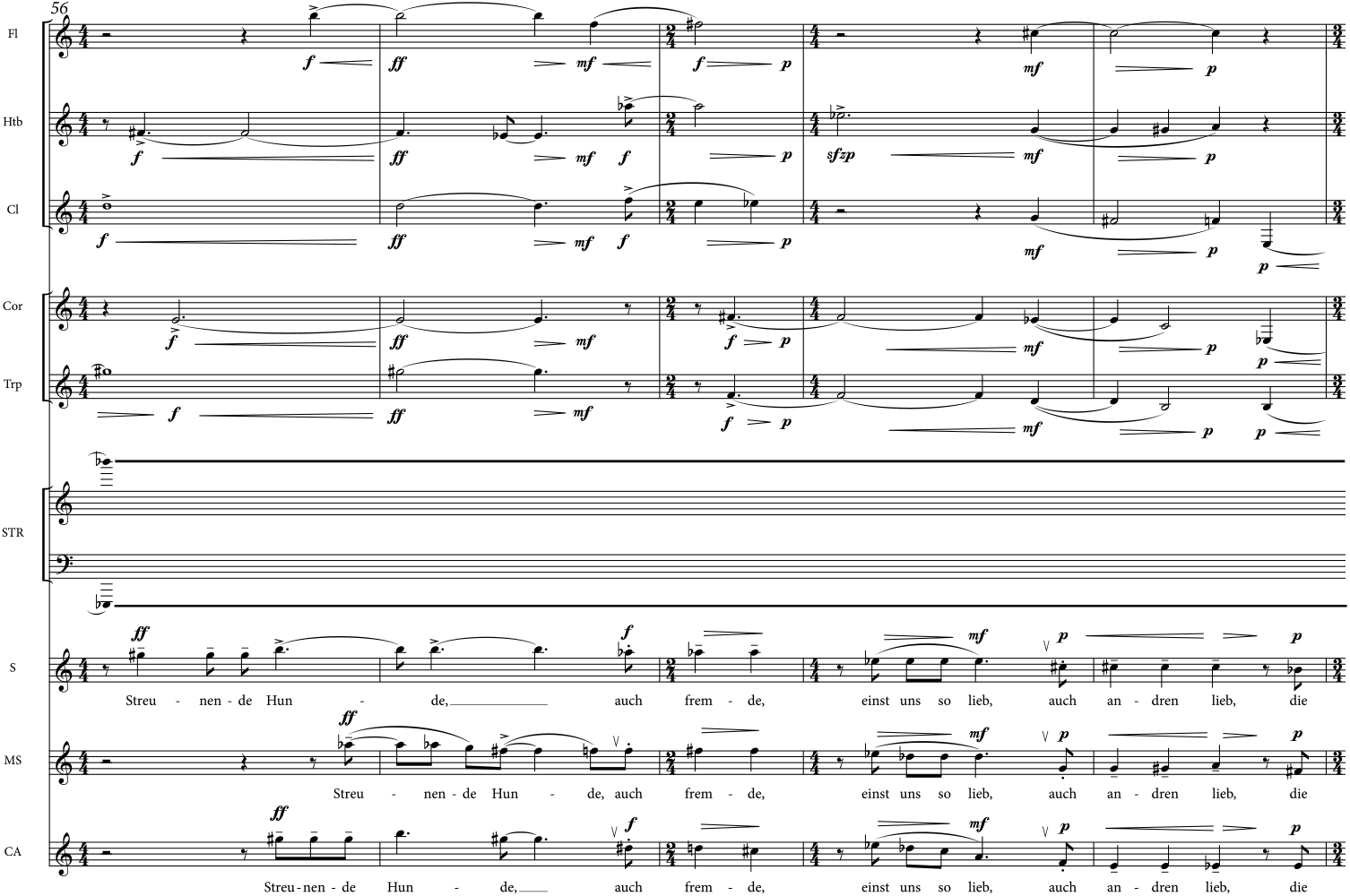
As we have seen, Jelinek’s text does not directly mention the Fukushima disaster, but focuses on capturing its consequences for the people who suffered from it. For example, it evokes women who, having lost their families, husbands, and children, as well as their homes, take refuge near some stray dogs in the devastated city. They put on make-up and make themselves beautiful for the dogs, the only companions they have left. For this passage (see Example 1), I composed a trio of women accompanied by a live dog that is discreetly guided by a trainer who makes it vocalize. It was the best way I found to evoke the loneliness and desolation of these women.
Kein Licht, Module IX, bb. 56–60. © Durand.

A later scene considers the question of civil nuclear power, an issue that continues to divide states and individuals alike. On the one hand, should we abandon nuclear power in favour of other forms of energy production to avoid disasters like the one that happened in Fukushima? But, on the other hand, can so-called ‘clean’ energy alone provide us with all the electricity we need at a time when energy consumption continues to grow exponentially? As Kein Licht is largely inspired by a tragedy that unfolded in Japan, I suggested to Nicolas Stemann that he take the Osaka bunraku puppet theatre as a model. In bunraku, each puppet is operated by three people, accompanied, on stage right, by an actor who disguises their voice and a musician playing the shamisen (a Japanese plucked string instrument with three strings and a hollow body). In Kein Licht, the shamisen is replaced by a solo viola. The puppet named ‘Atomi’, representing nuclear energy, is asked to go to sleep. It’s a satire, of course, inspired by Germany’s decision to phase out nuclear power at the end of 2022 – a decision that was confirmed by the German government on 16 April 2023.
During rehearsals for Kein Licht, I invited physicists Sébastien Balibar and Mathieu Langer to give a scientific presentation on the risks and possibilities of nuclear power to the entire cast. This helped us in the conception of the project. Nuclear energy was made possible by two famous equations: one by Albert Einstein (known as special relativity), the other by Erwin Schrödinger. There comes a crucial moment in the work when, after a parodic love hymn to energy, its power, and its beauty, the two formulas are sung one after the other like a magical incantation, releasing a wild energy, ready to be consumed (see Example 2).
Kein Licht, Einstein's equation, Module VIIK, bb. 117–119. © Durand.

My next example demonstrates how analogies can unfold between a real situation and its symbolic musical version. We know that nuclear disasters are the consequence of the failure to control nuclear chain reactions. To create electronic music in real time – one of my favourite means of expression – I have long been using Markov chains, a formalism well known to mathematicians, to generate infinite sequences of sounds according to probabilistic principles. The metaphor could not have been more apt. In the middle of the show, I take the floor to inform the audience that the music they are hearing was not created by a human brain, but by a machine that I could stop at any moment – even though I won’t – leaving them to believe that, as long as there is electricity, the machine will continue to produce music indefinitely. The energy is boundless and seems inexhaustible, until water invades the stage leading to a moment of catastrophe. Blackout, complete darkness… Kein Licht!
This on-stage blackout is obviously fake. Everything has been carefully staged, both visually and sonically. From this point on, the music becomes purely acoustic, as the computer no longer has power.Footnote 10 At the very end of the show, after a lamento warning us of our own foolishness – the text is taken from a poem by Friedrich Nietzsche that explicitly states, ‘O Mensch! Gib acht!’Footnote 11 (‘O man, take care!’Footnote 12) – we are reminded of another situation currently unfolding before our very eyes: the colonization of space. We have destroyed the beautiful garden of Earth, and all that remains for us is to emigrate to other planets, all likely far less welcoming. The people left on Earth struggle on as best they can, trapped in their own follies, while a lucky few (Elon Musk is obviously implied here) seek to start an extraterrestrial history that – if it happens at all – is likely to fail just like our own, if nothing is done to avert catastrophe. And so ends Kein Licht.
Lab.Oratorium: at the heart of Europe’s drama
The second work I would like to explore here is Lab.Oratorium, written for François-Xavier Roth’s Gürzenich Orchester and premiered in May and June 2019 at the Kölner Philharmonie, the Elbphilharmonie Hamburg, and the Philharmonie de Paris. The topic of this work is a terrible ordeal that has been going on for centuries and that continues to unfold before our eyes: the inexorable exodus of populations fleeing wars and misery, and yet finding no clear path to stability and dignity. Must a composer take sides in the treatment of the topic they have chosen? I don’t think it should be compulsory. As far as I am concerned, I have been able to adopt both attitudes. As much as I find it hard to be firmly opposed to nuclear energy due to the dramatic ecological risks posed by fossil fuels, my position is unequivocal when it comes to the fate of people trying to save their lives by setting out on makeshift rafts: it is an international disgrace.
For Lab.Oratorium, I imagined each of the three philharmonic halls where the work was premiered as a large ship, with the stage representing its prow.Footnote 13 The libretto is based on texts by the Austrian poet Ingeborg Bachmann (1926–73), whose work often evokes the themes of travel, wandering, and solitude, and was written by Patrick Hahn, Nicolas Stemann, and myself. The orchestra takes the stage, and two actors invite the audience to follow them on a joyful cruise. The boat sets sail and the festive atmosphere is in full swing when a forty-strong choir, sitting incognito among the audience, suddenly begins to sing:

The choir symbolizes the first group of migrants to appear among the cruise’s guests. The entrance of the chorus marks a change in tone that persists from this point on, as the atmosphere changes from joyful and festive to tragic. The choir now sings a Lied based on Grodek, the last poem written by Georg Trakl (1887–1914) during the First World War. The text of the poem argues that war is the main cause of these journeys into the unknown. But all this is just the tip of the iceberg, for a little later, a second, larger chorus invades the entire hall before singing Vision, a tragic poem by Ingeborg Bachmann:

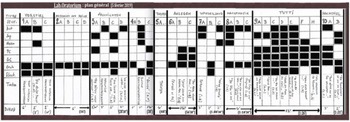
Lab.Oratorium follows a rigorous formal plan (Example 3).
Formal plan for Lab.Oratorium (March 20, 2019).

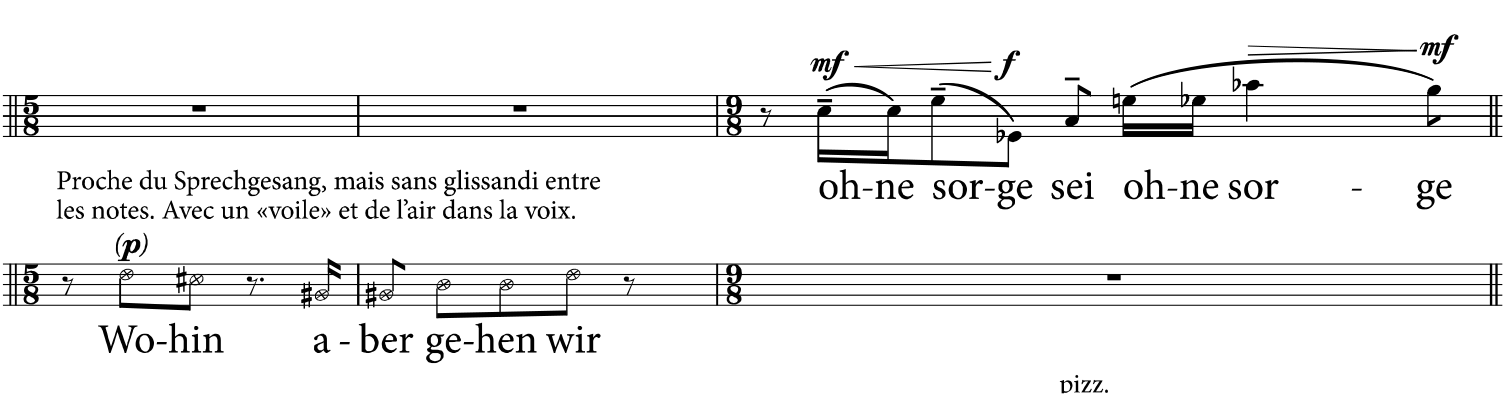
Each large section develops a specific theme: the departure, the journey, the emergence of the first group of migrants, then the second, the docking of the boat, the clandestine crossing of countries, fatigue and sleep, people’s dreams, international and national politics. What happens in these people’s real lives? For the most part, they are fleeing a life of misery and danger, only to be confronted by the societies of rich industrialized countries, with their advertising, consumerism, and promises of a happy life. Ingeborg Bachmann’s Reklame (Advertisement), one of her best-known poems, is a mockery of the blissful promises that advertising pours on us all the time – on walls, in newspapers, and on screens. It is a poem in two voices, one of which constantly asks questions. The second voice keeps interrupting, saying: ‘ohne sorge, sei ohne sorge’ (‘carefree, be carefree’).

Here again, though music is powerless to create realism as a film or book might, it uses metaphors to attempt to create a world of its own, a parallel world that is the reflection of our reality. Here, the questioning, worried voice is spoken, while the guileless, answering voice is sung by a coloratura soprano (see Example 4).
Lab.Oratorium, Bachmann's Reklame, Section VIIA, bb. 7–9. © Durand.

Just before the grand tutti that precedes the end of the work, there is a Nocturne for orchestra, followed by a dream scene featuring spoken and sung voices with the orchestra. It is easy to imagine that, given the exhausting nature of their journeys, refugees must often experience anxious nights filled with dreams. In this ethereal scene, the dreams are superimposed, with several voices singing at the same time, and then converge on a shared dream that explodes after a crescendo from the orchestra towards the extreme high register. The text here is from Ingeborg Bachmann’s ‘Das Spiel ist aus’ (‘The Game is Over’):

At the beginning of this essay, when I raised the question of whether or not the composer should take sides, I posited that a musical work could not represent a political situation, but more aptly could depict the tensions and forces that struggle and contend within it. And so, just before the end of Lab.Oratorium, I depict some of the antagonistic discourses of European political forces that are opposed to refugee migration. Among these we did not hesitate to expose those who express themselves violently, discourses coming mainly from German far-right and populist parties, but which can be found in just about every European country. On stage, the two actors utter sentences found on the internet or proclaimed during the speeches or congresses of the political parties in question:

Meanwhile, the chorus wanders the hall, like migrants on the lands of Europe, reproaching those who try to repel and drive them away:

The very end of Lab.Oratorium takes a path that seems to me the only possible utopia: the refusal of any kind of nationalism. At this point in the work, I use the thoughts of two philosophers and poets in conversation with each other. First, excerpts from Friedrich Nietzsche’s poem Vereinsamt:

Then a poem that Hannah Arendt wrote in New York in 1946:

While these parallel sentences might seem to be opposed, they seem to me to point in the same direction. Nietzsche, who was a stateless person in Switzerland after renouncing his Prussian nationality, knew what problems this status caused in a world where wartime patriotism flourished everywhere. His ‘Weh dem, der keine Heimat hat’ is, in my opinion, not to be understood as a condemnation, but rather a sad observation of the situation of the stateless. Hannah Arendt, also stateless in the United States, was more direct. However, there’s no doubt that Arendt’s phrase was directly inspired by Nietzsche’s.
An orchestra for the twenty-first century?
Music theatre and other performing arts, when they refer to concrete situations, usually proceed by analogy, as it is impossible to reproduce the real situations that are evoked on stage. In Lab.Oratorium, the concert hall represents Europe as it is traversed by migrants, who are represented by the choir. We can extend the analogy even further to consider the role of the symphony orchestra, which has often been described as a kind of mirror of society. Indeed, the constitution of the orchestra has much in common with society, and especially with the society that established it in its modern form in the eighteenth and nineteenth centuries – in both cases a very hierarchical structure. There are soloists in the orchestra, even super-soloists, while the others are rank-and-file musicians. This is most obvious in the string section where there are many players, but it is also evident in the other instrumental families. As in society, the idea of hierarchy is not inherently reprehensible. In fact, a hierarchy is probably necessary and even natural in many areas. However, we might well wish for a society in which responsibilities are shared more widely than they are at present, in which power is not based on an immutable vertical structure. We could also imagine an orchestra in which, to give a simple example, there would be no first and second violins, but two or more groups of violins in equal interaction.Footnote 26 Within each group, a hierarchy could be active, in the sense that each group includes musicians of varying degrees of experience – in reality, levels of knowledge and expertise are never equally distributed. The point here is not to change these dispositions for the existing repertoire, of course, but to advance a new repertoire that would be based from the beginning, from the very writing of the scores, on a more egalitarian distribution of responsibilities than in classical works.Footnote 27 Thus, at the instigation of François-Xavier Roth, I composed the Köln Trilogy, a group of orchestral works consisting of In situ (2013), Ring (2016), and Lab.Oratorium (2019), already discussed at length above. This trilogy is entirely based on the reconfiguration of the orchestra’s instrumental families and groupings. My work on the restructuring of the orchestra includes a reflection on the spatialization of the instrumental groups (a possibility initially explored, of course, by Andrea and Giovanni Gabrieli in the sixteenth century and later taken up by many twentieth-century composers), which is why some of them are placed around and behind the audience.
Another aspect of the orchestra which could be reimagined as part of its evolution towards a more egalitarian social model is the homogeneous composition of its instrumental subgroups. Our modern societies place great emphasis on social diversity. The intermingling of different populations will soon become the norm and, whatever the difficulties such situations may engender, this is undoubtedly a major civilizational development. Opposition to such an evolution could only be enacted through arbitrary, authoritarian, and brutal political decisions. Similarly, the symphony orchestra is traditionally structured into homogeneous families (strings, woodwinds, brass, percussion), yet it would now be constructive to compose works that use heterogeneous groups made up of members from different instrumental families. As I wrote earlier, the orchestra has long been considered a microcosm of society. Federico Fellini made no mistake when he filmed Prova d’orchestra (1978), with its revolution of the orchestra musicians against their constraints. The creation of works for such a reimagined and regrouped orchestra would make it no longer a mirror of society, but rather its avant-garde. Music has already been seen in history to anticipate political and social events. Perhaps it is time to consider this again.
Funding statement
This work was financially supported by the European Union’s Horizon 2020 research and innovation programme under the Marie Skłodowska-Curie grant agreement No. 101027828 (project ONTOMUSIC), the Schulich School of Music of McGill University, and the Canada Research Chair in Music and Politics at the Université de Montréal Faculty of Music. The funding bodies played no role in the development of this article, which reflects only the author’s view.


 Open access

