




Introduction
Combating methane emissions is a critical component of combating climate change. While methane is a shorter-lived greenhouse gas (GHG) than carbon dioxide, methane’s global warming impact is 28 times that of carbon dioxide’s over a 100-year period (US EPA, 2024). In the United States, 25% of methane emissions come from enteric fermentation, or the natural digestive process of cattle and other ruminants (US EPA, 2024). Decreasing enteric methane emissions from cattle has the potential to decrease global GHG emissions significantly.
There are many strategies to cut enteric methane emissions from cattle, including altering feed quality, introducing feed additives, and a combination of these (Hristov, Reference Hristov2024). The industry for methane-reducing feed additives for dairy cows is rapidly evolving, with research on supplements such as 3-nitrooxypropanol (3-NOP), fatty acids, nitrates, tannins, essential oils, saponins, ionophores, biochar, and algae or seaweed (Palangi and Lackner, Reference Palangi and Lackner2022). Understanding correlations between farmer’s and dairy nutritionist’s perceptions of the effects of changes in feeding regimes and measuring them against the scholarly literature can provide useful findings for assessing whether feed supplements provide beneficial outcomes for farmers and the dairy industry, and this is the subject of our investigation and paper.
Algae feed supplements are particularly interesting because they have been used by historical and current dairy farmers for their herd health and nutritional benefits. For millennia, coastal communities around the world have collected seaweed along beaches for use as livestock feed (Vijn et al., Reference Vijn, Compart, Dutta, Foukis, Hess, Hristov, Kalscheur, Kebreab, Nuzhdin, Price, Sun, Tricarico, Turzillo, Weisbjerg, Yarish and Kurt2020). In the past few decades, products such as Tasco—derived from the brown seaweed Ascophyllum nodosum—have been used by organic dairy farmers for their gut health and stress management benefits (Allen et al., Reference Allen, Pond, Saker, Fontenot, Bagley, Ivy, Evans, Schmidt, Fike, Zhang, Ayad, Brown, Miller, Montgomery, Mahan, Wester and Melton2001). Only recently have algae species such as Asparagopsis taxiformis gained attention for their methane-reducing properties (Kinley et al., Reference Kinley, De Nys, Vucko, Machado and Tomkins2016). Current research on algae feed supplements spans both macroalgae, including kelp and seaweed, and microalgae, single-celled microorganisms.
Academic research on algae supplements’ herd health benefits remains mixed (Tynan et al., Reference Tynan, Bryant, Welsh and Greenwood2023). For example, a recent meta-analysis (Orzuna-Orzuna et al., Reference Orzuna-Orzuna, Lara-Bueno, Mendoza-Martínez, Miranda-Romero, Vázquez Silva, de la Torre-Hernández, Sánchez-López and Hernández-García2024) synthesized data from 23 peer-reviewed scientific articles on seaweed supplementation in dairy cows. It found that seaweed decreased dry matter intake, milk protein content, milk urea nitrogen, and somatic cell count, while milk fat content, milk lactose content, and milk iodine all increased. In addition, dietary supplementation with seaweed did not affect nutrient digestibility, total volatile fatty acids, acetate, and propionate. In addition, CH4 emissions, yield, and intensity were reduced (Orzuna-Orzuna et al., Reference Orzuna-Orzuna, Lara-Bueno, Mendoza-Martínez, Miranda-Romero, Vázquez Silva, de la Torre-Hernández, Sánchez-López and Hernández-García2024). An earlier meta-analysis (Lean et al., Reference Lean, Golder, Grant and Moate2021) suggested that milk production increased with seaweed treatment. Data limitations prevented conclusive findings of increases in milk fat and protein, but preliminary findings measured increases in both variables. The authors concluded there was evidence of potential health benefits to dairy cows from feeding seaweed, but called for more in vivo experiments (Lean et al., Reference Lean, Golder, Grant and Moate2021). In addition, some studies have found that A. nodosum (kelp meal) reduces heat stress (Allen et al., Reference Allen, Pond, Saker, Fontenot, Bagley, Ivy, Evans, Schmidt, Fike, Zhang, Ayad, Brown, Miller, Montgomery, Mahan, Wester and Melton2001), while others have found little to no effect (Pompeu et al., Reference Pompeu, Williams, Spiers, Weaber, Ellersieck, Sargent, Feyerabend, Vellios and Evans2011). While many organic dairy farmers have attributed reductions in pink-eye to kelp meal (Tynan et al., Reference Tynan, Bryant, Welsh and Greenwood2023), research studies have found no relationship (Sorge et al., Reference Sorge, Henriksen, Bastan, Cremers, Olsen and Crooker2016). These conflicting claims have led to uncertainty about the validity of some of the health claims from using algae feed supplements.
This research was conducted as part of a multi-institutional, transdisciplinary study on algae feed supplements for dairy cows that reduce enteric methane emissions, improve herd health and nutrition, and facilitate rural prosperity. This study is a follow-up to a previous study by Tynan et al. (Reference Tynan, Bryant, Welsh and Greenwood2023), which found that organic dairy farmers are more likely than conventional dairy farmers to feed algae supplements and to be aware of their health claims Tynan et al. (Reference Tynan, Bryant, Welsh and Greenwood2023) also found that dairy farmers (organic and conventional) rely on their dairy nutritionists for information about feed supplements. In turn, Tynan et al. (Reference Tynan, Bryant, Welsh and Greenwood2023) found that most dairy nutritionists rely on academic literature for trusted information about feed supplements. Building on this research, we sought to investigate informational or knowledge correlations between organic dairy farmers, dairy nutritionists, and academic literature by comparing perceptions of claims about algae feed supplements. And, in general we found strong positive correlations between academic literature and nutritionist perceptions, and between farmer and nutritionist perceptions, especially regarding algae serving as a source of vitamins and nutrients. Notably, we found no significant correlation between academic literature and farmer perceptions.
Methods
To assess agreement or disagreement between organic dairy farmers, dairy nutritionists, and peer-reviewed literature, we combine three datasets—survey responses from dairy nutritionists, survey responses from organic dairy farmers, and a bibliometric analysis of peer-reviewed literature. Each dataset centers on a list of 20 claims about algae feed supplements. This list of claims was developed in a previous study through focus group interviews with organic dairy farmers and a review of peer-reviewed and grey literature (Tynan et al., Reference Tynan, Bryant, Welsh and Greenwood2023).
Survey data collection
The goal of both nutritionist and farmer surveys was to understand the samples’ perceptions of algae feed supplements for dairy cows. Both survey protocols were approved by the Syracuse University Institutional Review Board. The first survey was conducted with a sample of dairy nutritionists at the Cornell Nutrition Conference in October 2023. Researchers engaged participants verbally, requested their participation, and provided the survey in either electronic or paper formats. Electronic surveys were conducted using Qualtrics software, and paper survey responses were converted into electronic responses using the same software. Out of a conference of approximately 400 attendees, 152 people responded to the survey. Of these respondents, 122 completed the survey and indicated ‘yes’ to a screening question, reporting that their job involved recommending or assessing dairy feed supplements. Those that responded ‘no’ were not asked further questions. The respondents were 67% male (n = 63), 31% female (n = 29), and 2% preferred not to specify their gender (n = 2). Most respondents were between the ages of 26 and 45 (53%, n = 50).
The second survey was conducted with a sample of organic dairy farmers between January and March 2024. Contact information (including operation name, address, phone number, and email address) for 211 producers was provided from the US Department of Agriculture’s National Organic Program. Researchers engaged participants through an initial email, a phone call, and a reminder email. Participants could complete the survey electronically through a Qualtrics link or on the phone with a researcher who recorded their responses in Qualtrics on their behalf. The farmers received no compensation for their participation.
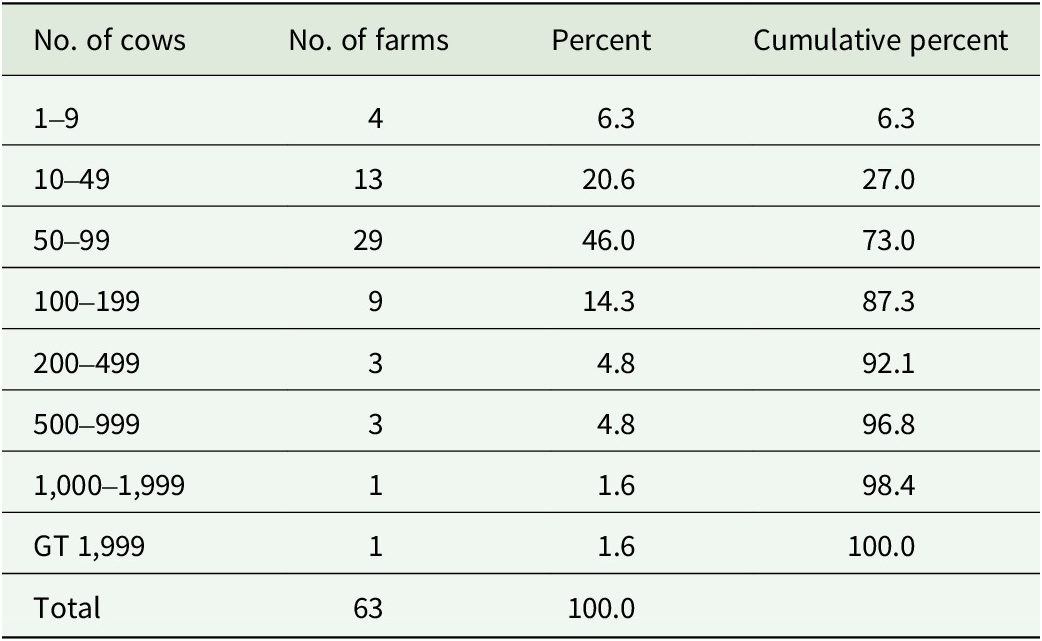
We received 76 survey responses, of which 63 responses were complete. Table 1 presents the herd size distribution of the survey respondents. Almost half of the respondents maintained a milking cow herd size between 50 and 99 head (46%, n = 29), and most respondents maintained a herd size between 10 and 199 (80%, n = 51). As comparison, the 2021 Certified Organic Survey conducted by the National Agriculture Statistics Service of the US Department of Agriculture finds that organic dairies in the United States kept an average of 132 milking cows per farm.
Organic dairy herd size distribution—survey data

Table 1. Long description
The table consists of four columns: Number of cows, Number of farms, Percent, and Cumulative percent.
* 1 to 9 cows: 4 farms, 6.3 percent, 6.3 cumulative percent.
* 10 to 49 cows: 13 farms, 20.6 percent, 27.0 cumulative percent.
* 50 to 99 cows: 29 farms, 46.0 percent, 73.0 cumulative percent.
* 100 to 199 cows: 9 farms, 14.3 percent, 87.3 cumulative percent.
* 200 to 499 cows: 3 farms, 4.8 percent, 92.1 cumulative percent.
* 500 to 999 cows: 3 farms, 4.8 percent, 96.8 cumulative percent.
* 1,000 to 1,999 cows: 1 farm, 1.6 percent, 98.4 cumulative percent.
* Greater than 1,999 cows: 1 farm, 1.6 percent, 100.0 cumulative percent.
* Total: 63 farms, 100.0 percent.
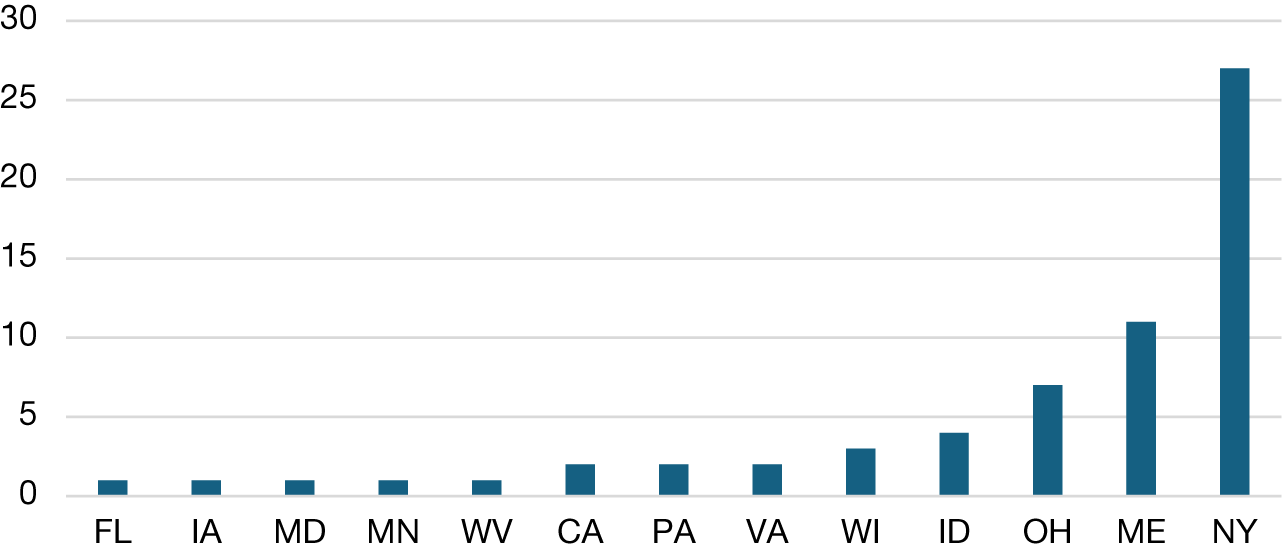
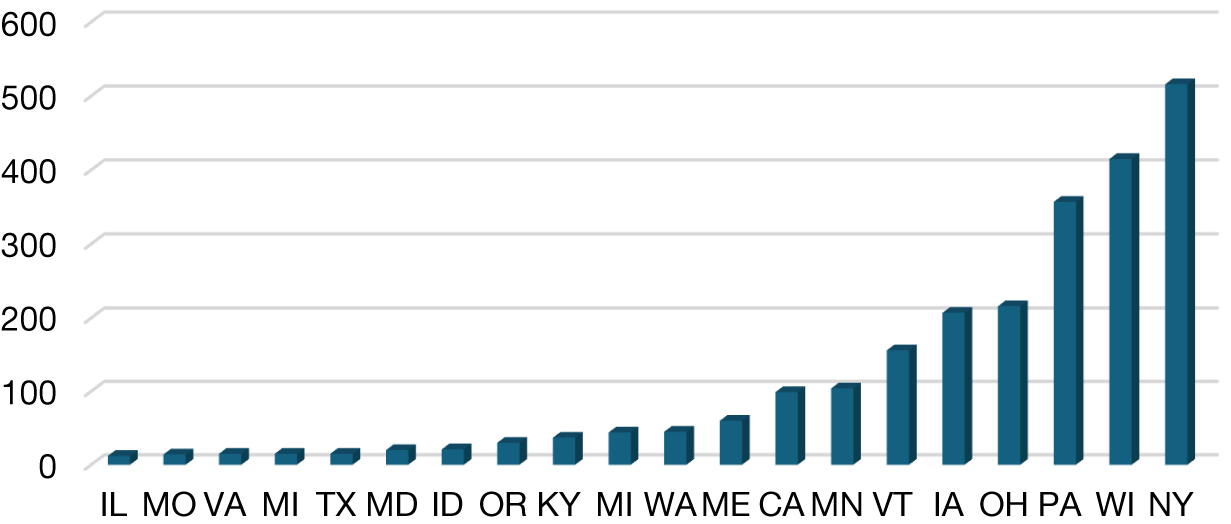
The respondents were 70% male (n = 44), 29% female (n = 18), and 2% preferred not to specify (n = 1). Most respondents were evenly distributed between the age brackets presented: 24% (n = 15) were in the range of 36–45 years, 24% (n = 15) were in the range of 46–55, 27% (n = 17) were in the range of 56–65, and 21% (n = 13) were over 65. Respondents were geographically distributed across 13 states, and the state with the most respondents was New York (43%, n = 27). New York State respondents were the majority for the NASS survey also—516 respondents or about 20%. Figures 1 and 2 compare the survey respondents by state with the NASS Organic Survey. The distribution of respondents overlaps but also differs in some respects, such as fewer Wisconsin respondents for our survey and more from Maine—our survey reflects a heavier Northeastern perspective.
Organic dairy farms by state: survey data.

Organic dairy farms by state: NASS data.

Figure 2. Long description
The vertical Y axis represents the number of farms, ranging from 0 to 600 in increments of 100. The horizontal X axis lists state initialisms. The data shows a gradual increase in farm counts for the first 15 states, followed by a sharp rise for the final five.
From left to right, the states and their approximate values are:
* I L, M O, V A, M I, T X, M D, and I D all have fewer than 25 farms.
* O R, K Y, M I, and W A are between 25 and 50 farms.
* M E is approximately 60 farms.
* C A and M N are approximately 100 farms.
* V T is approximately 150 farms.
* I A and O H are approximately 200 farms.
* P A is approximately 350 farms.
* W I is approximately 410 farms.
* N Y has the highest count at approximately 510 farms.
Survey data analysis
The Dairy Nutritionist and Organic Dairy Farm survey datasets were cleaned and analyzed using Microsoft Excel and Statistical Package for the Social Sciences (SPSS). The primary focus of analysis was the respondents’ perceptions of various claims about seaweed feed supplements. Both survey groups were presented with the same list of claims, but they were asked to respond to it in different ways. Dairy nutritionists were asked to indicate whether each claim had no scientific support, some scientific support, or strong scientific support; they were also given the option to leave the question blank if they had not heard of the claim. Organic dairy farmers were asked to indicate whether they were aware or not aware of each claim; if they were aware of it, they were asked to indicate if they believed each claim was valid. If respondents indicated they were not aware of the claim, they were not presented with the question about its validity. The difference in approaches of the two samples was purposeful since dairy farmers may be less familiar with scientific literature but may have opinions of the validity of a claim.
Researchers calculated a set of awareness scores for each survey group. For the dairy nutritionists, the awareness score for each claim represents the percentage of respondents who indicated any level of scientific support for the claim divided by the total number of respondents who indicated any level of scientific support for any claims. For the organic dairy farmers, the awareness score for each claim represents the percentage of respondents who indicated that they were aware of the claim.
Researchers also calculated a support score for each survey group. For dairy nutritionists, the scientific support score was calculated by weighting the respondents based on the level of scientific support they indicated for each claim. The number of respondents who selected ‘no scientific support’ was multiplied by 0, the number of respondents who selected ‘some scientific support’ was multiplied by 0.5, and the number of respondents who selected ‘strong scientific support’ was multiplied by 1. This value was divided by the total number of respondents who selected any level of scientific support for each claim. The resulting scientific support score for each claim is a value between 0 and 1; a score of 0 would occur if all respondents who were aware of the claim stated that there was no scientific support for that claim, and a score of 1 would occur if all respondents who were aware of the claim stated that there was strong scientific support for that claim.
For organic dairy farmers, the validity score was calculated by dividing the number of respondents who indicated that they believe the claim is valid by the number of respondents who indicated that they were aware of the claim. The resulting validity score for each claim is a value between 0 and 1; a score of 0 would occur if none of the respondents who were aware of the claim stated that it was valid, and a score of 1 would occur if all the respondents who were aware of the claim stated that it was valid.
Bibliometric analysis
Researchers conducted a bibliometric analysis to quantify the proportion of academic literature on algae feed supplements for cows which discuss each of the 20 claims. The bibliometric analysis was conducted using NotebookLM, an artificial intelligence (AI)-based research tool from Google (Google, 2025).Footnote 1
Researchers collected literature from a database generated by team members of this multidisciplinary study, who scanned the scholarly literature for any articles referencing algae feed supplements using internet search engines. This set of literature was supplemented by relevant articles from Google Scholar’s ‘cited by’ list for a key review article on the subject by Vijn et al. (Reference Vijn, Compart, Dutta, Foukis, Hess, Hristov, Kalscheur, Kebreab, Nuzhdin, Price, Sun, Tricarico, Turzillo, Weisbjerg, Yarish and Kurt2020). This sample was screened based on its relevance to the feeding of algae feed supplements to cows based on a search within each article for (‘alga*’ OR ‘seaweed’ OR ‘kelp’ AND ‘cow’ OR ‘cattle’ OR ‘rumen*’). This screening resulted in a sample of 164 peer-reviewed articles and book chapters.
Through trial-and-error experimentation, researchers determined a Chat prompt in NotebookLM that would produce a frequency table with the number of sources that refer to each of the 20 claims, as they relate to the feeding of algae supplements to cows. Researchers specified that each source be counted a maximum of once for each claim, and sources should be counted regardless of the direction of the claim (positive, negative, or no effect). Sources were divided into four distinct Notebooks for analysis, based on recommendations from a previous study (O’Keefe et al., Reference O’Keefe, Welsh, Oppong, Fitzgerald, Conner, Tynan, Price and Quigley2024). The frequency tables produced within each Notebook were combined to create a final frequency table. To create a bibliometric analysis score, the frequencies presented by NotebookLM were divided by the total number of sources (n = 164).
Results
Feeding algae feed supplements is relatively higher among organic dairy farmers (69% reported feeding the supplements currently or previously) compared to dairy nutritionists’ experience recommending algae feed supplements (24% reported ever recommending the supplements). This supports previous findings that experience with algae feed supplements is higher among organic dairy farmers than the broader conventional dairy farming population (Tynan et al., Reference Tynan, Bryant, Welsh and Greenwood2023). The primary reasons that organic dairy farmers cited for feeding algae feed supplements were for preventative general cow health (88%) and for nutrition (70%). When asked why they do not feed or recommend algae feed supplements, the most common response for both groups was ‘I do not know enough about them’ (50% for farmers, 52% for nutritionists).
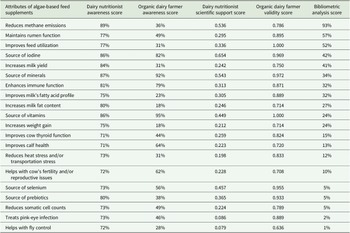
Trends in the awareness scores and support scores show that dairy nutritionists generally reported higher awareness scores and lower support scores, and organic dairy farmers generally reported lower awareness scores and higher support scores (see Table 2). So, farmers were less likely to have heard of claims than nutritionists, but if the farmers had heard of them, they were more confident than the nutritionists the claims were valid. Nutritionist awareness scores ranged from 71% (improves calf health and improves cow thyroid function) to 89% (reduces methane emissions). Nutritionist scientific support scores ranged from 0.079 (helps with fly control) to 0.654 (source of iodine). On the other hand, farmer awareness scores covered a much wider range from 18% (increases weight gain and increases milk fat content) to 95% (source of vitamins). Farmer validity scores covered a narrower range from 0.636 (helps with fly control) to 1 (source of vitamins and improves feed utilization).
Scores for perceptions of algae feed supplements from dairy nutritionists, organic dairy farmers, and academic literature
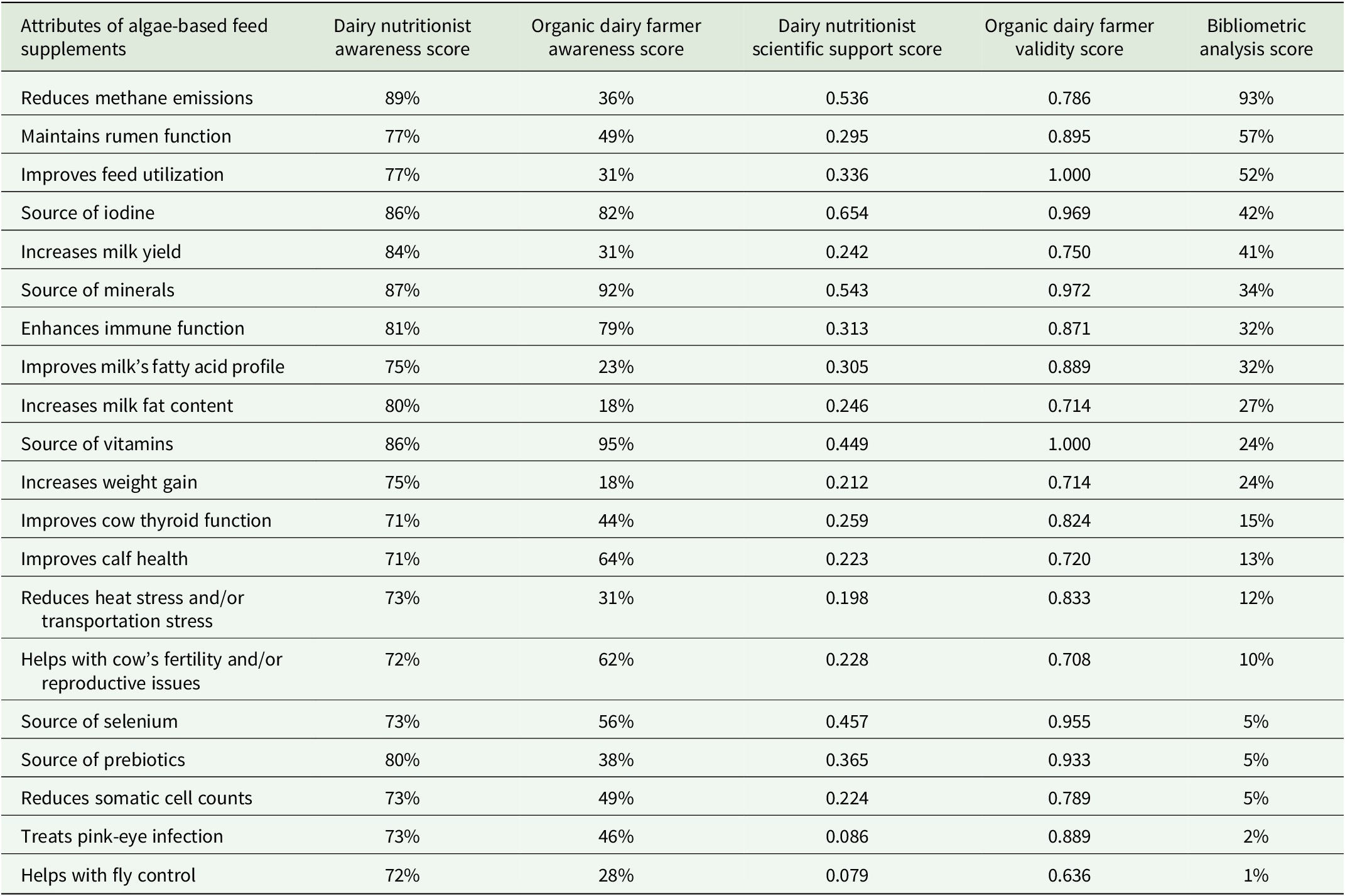
Table 2. Long description
The table contains 20 rows of attributes with five scoring columns.
1. Reduces methane emissions: Nutritionist awareness 89 percent, Farmer awareness 36 percent, Nutritionist support 0.536, Farmer validity 0.786, Bibliometric score 93 percent.
2. Maintains rumen function: Nutritionist awareness 77 percent, Farmer awareness 49 percent, Nutritionist support 0.295, Farmer validity 0.895, Bibliometric score 57 percent.
3. Improves feed utilization: Nutritionist awareness 77 percent, Farmer awareness 31 percent, Nutritionist support 0.336, Farmer validity 1.000, Bibliometric score 52 percent.
4. Source of iodine: Nutritionist awareness 86 percent, Farmer awareness 82 percent, Nutritionist support 0.654, Farmer validity 0.969, Bibliometric score 42 percent.
5. Increases milk yield: Nutritionist awareness 84 percent, Farmer awareness 31 percent, Nutritionist support 0.242, Farmer validity 0.750, Bibliometric score 41 percent.
6. Source of minerals: Nutritionist awareness 87 percent, Farmer awareness 92 percent, Nutritionist support 0.543, Farmer validity 0.972, Bibliometric score 34 percent.
7. Enhances immune function: Nutritionist awareness 81 percent, Farmer awareness 79 percent, Nutritionist support 0.313, Farmer validity 0.871, Bibliometric score 32 percent.
8. Improves milk fatty acid profile: Nutritionist awareness 75 percent, Farmer awareness 23 percent, Nutritionist support 0.305, Farmer validity 0.889, Bibliometric score 32 percent.
9. Increases milk fat content: Nutritionist awareness 80 percent, Farmer awareness 18 percent, Nutritionist support 0.246, Farmer validity 0.714, Bibliometric score 27 percent.
10. Source of vitamins: Nutritionist awareness 86 percent, Farmer awareness 95 percent, Nutritionist support 0.449, Farmer validity 1.000, Bibliometric score 24 percent.
11. Increases weight gain: Nutritionist awareness 75 percent, Farmer awareness 18 percent, Nutritionist support 0.212, Farmer validity 0.714, Bibliometric score 24 percent.
12. Improves cow thyroid function: Nutritionist awareness 71 percent, Farmer awareness 44 percent, Nutritionist support 0.259, Farmer validity 0.824, Bibliometric score 15 percent.
13. Improves calf health: Nutritionist awareness 71 percent, Farmer awareness 64 percent, Nutritionist support 0.223, Farmer validity 0.720, Bibliometric score 13 percent.
14. Reduces heat or transportation stress: Nutritionist awareness 73 percent, Farmer awareness 31 percent, Nutritionist support 0.198, Farmer validity 0.833, Bibliometric score 12 percent.
15. Helps with fertility or reproductive issues: Nutritionist awareness 72 percent, Farmer awareness 62 percent, Nutritionist support 0.228, Farmer validity 0.708, Bibliometric score 10 percent.
16. Source of selenium: Nutritionist awareness 73 percent, Farmer awareness 56 percent, Nutritionist support 0.457, Farmer validity 0.955, Bibliometric score 5 percent.
17. Source of prebiotics: Nutritionist awareness 80 percent, Farmer awareness 38 percent, Nutritionist support 0.365, Farmer validity 0.933, Bibliometric score 5 percent.
18. Reduces somatic cell counts: Nutritionist awareness 73 percent, Farmer awareness 49 percent, Nutritionist support 0.224, Farmer validity 0.789, Bibliometric score 5 percent.
19. Treats pink-eye infection: Nutritionist awareness 73 percent, Farmer awareness 46 percent, Nutritionist support 0.086, Farmer validity 0.889, Bibliometric score 2 percent.
20. Helps with fly control: Nutritionist awareness 72 percent, Farmer awareness 28 percent, Nutritionist support 0.079, Farmer validity 0.636, Bibliometric score 1 percent.
Nutritionists and farmers tended to support the claims that algae supplements provided vitamins, iodine, and selenium. But nutritionists were more skeptical than farmers about direct therapeutic claims such as treating pink-eye and lowering somatic cell count, though there was some support from nutritionists for algae feed supplements improving feed efficiency and acting as a prebiotic. However, it is important to note that vitamin and mineral supplementation have substantial herd health benefits and can influence acute health outcomes. For example, selenium is a trace mineral critical for antioxidant activity, immune function, thyroid hormone conversion, fetal development, and reproduction. Selenium deficiency can result in diseases such as white muscle disease (Majors, Myers and Kasimanickam, Reference Majors, Myers and Kasimanickam2025).
The bibliometric analysis revealed that academic literature on algae feed supplements for cows overwhelmingly focuses on their ability to reduce methane emissions (93%). The second and third most common claims were that the supplements maintain rumen function (57%) and improve feed utilization (52%); these values are outliers in that the AI’s inclusion criteria for these claims varied widely across the four Notebooks used, with scores ranging from 14% to 100% for rumen function and from 14% to 96% for feed utilization.
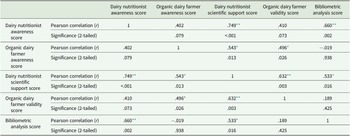
We used correlations to assess the relationships between each of our five variables (see Table 3). As expected, there is a strong positive correlation between dairy nutritionist awareness scores and dairy nutritionist scientific support scores (r = .749, p = < .001). Similarly, there is a moderate positive correlation between organic dairy farmer awareness scores and organic dairy farmer validity scores (r = .496, p = .026). Awareness and support are at least moderately related within both samples.
Correlations among scores for perceptions of algae feed supplements

Table 3. Long description
The table correlates five variables: Dairy nutritionist awareness score, Organic dairy farmer awareness score, Dairy nutritionist scientific support score, Organic dairy farmer validity score, and Bibliometric analysis score. For each pair, it provides the Pearson correlation (r) and the 2-tailed significance.
* Dairy nutritionist awareness score: Correlates strongly with Dairy nutritionist scientific support score (r = .749, p < .001) and Bibliometric analysis score (r = .660, p = .002).
* Organic dairy farmer awareness score: Correlates with Dairy nutritionist scientific support score (r = .543, p = .013) and Organic dairy farmer validity score (r = .496, p = .026), but has a negligible negative correlation with Bibliometric analysis score (r = -.019, p = .938).
* Dairy nutritionist scientific support score: Shows significant correlations across all categories, including Organic dairy farmer validity score (r = .632, p = .003) and Bibliometric analysis score (r = .533, p = .016).
* Organic dairy farmer validity score: Beyond the correlations mentioned above, it has a non-significant relationship with the Bibliometric analysis score (r = .189, p = .425).
Asterisks indicate significance levels: ** for 0.01 level and * for 0.05 level.
* Correlation is significant at the 0.05 level (2-tailed).
** Correlation is significant at the 0.01 level (2-tailed).
There is also a strong positive correlation between dairy nutritionist scientific support scores and organic dairy farmer validity scores (r = .632, p = .003). Both samples expressed relative support for claims like algae feed supplements are a source of iodine (0.654 for nutritionists, 0.969 for farmers) and relative skepticism about claims like algae feed supplements help with fly control (0.079 for nutritionists, 0.636 for farmers). Generally, nutritionists and farmers agreed about which claims had relatively lower or higher support. There are two notable outliers from this trend: claims regarding the reduction in methane emissions and the treatment of pink-eye infection. Methane emissions reductions have a dairy nutritionist support score of 0.536 and an organic dairy farmer validity score of 0.786, which are the 3rd highest and the 14th highest score for each sample, respectively. Pink-eye treatment has a dairy nutritionist support score of 0.086 and an organic dairy farmer validity score of 0.889, which are the 19th highest and the 8th highest score for each sample, respectively. These two examples illustrate the differences between nutritionists’ and farmers’ information regarding algae feed supplements. It might be that most dairy nutritionists are only recently becoming aware of algae feed supplements due to the focus on methane reduction and therefore are less supportive of their potential herd health benefits as they become aware of them. Conversely, organic dairy farmers have used algae feed supplements for decades because of their health benefits, including ones as specific as pink-eye treatment, despite a lack of discussion around this claim among dairy nutritionists (Tynan et al., Reference Tynan, Bryant, Welsh and Greenwood2023).
Introduction of the bibliometric analysis score illustrates other interesting trends. First, there is a moderate to strong positive correlation between the bibliometric analysis score and the dairy nutritionist awareness score (r = .660, p = .002) and between the bibliometric analysis score and the dairy nutritionist scientific support score (r = .533, p = .016). This supports previous research by Tynan et al. (Reference Tynan, Bryant, Welsh and Greenwood2023), who found that dairy nutritionists’ most trusted source of information about feed supplements is academic literature. In contrast, there is no significant correlation between the bibliometric analysis score and the organic dairy farmer awareness score (r = −.019, p = .938) or between the bibliometric analysis score and the organic dairy farmer validity score (r = .189, p = .425).
While farmers’ beliefs about algae feed supplements correlate with nutritionists’ beliefs and nutritionists’ beliefs correlate with information in academic literature, farmers’ beliefs do not correlate with academic literature. These findings suggest that farmers trust information from dairy nutritionists, who in turn rely on scientific studies, but nutritionists are seemingly not the only source of information for organic dairy farmers. Farmers have an embodied source of knowledge about how their herd responds to different feed supplements (Tynan et al., Reference Tynan, Bryant, Welsh and Greenwood2023), and the health and nutrition claims they are following closely may not be the same as those highlighted in the literature.
Discussion and conclusions
Perceptions of dairy feed supplements vary among stakeholders based on their sources of information, but there is also substantial overlap. Investigating perceptions along the feed supplement supply chain is important to understand why a supplement is ultimately fed or not or why it may not be used as it was intended. We studied perceptions of algae feed supplements at three different points in the supply chain: academic literature, dairy nutritionists, and organic dairy farmers. Correlation analysis resulted in a positive relationship between perceptions in academic literature and among dairy nutritionists, and between perceptions among dairy nutritionists and organic dairy farmers, supporting previous study findings. However, there was no significant correlation between perceptions in academic literature and among organic dairy farmers, suggesting a more complex information pathway or differences in information sources.
The findings suggest that organic dairy farmers’ trust in feed supplements is based on more than just information received from dairy nutritionists and academic literature. They also receive daily information from their herd, observing which feed supplement shifts produced positive or negative changes for cow health and productivity. This lack of direct reliance on scientific literature is probably in large part due to the lack of herd health interventions for organic dairy farmers: organic dairy farmers rely on information networks with other organic dairy farmers (Hassanein and Kloppenburg, Reference Hassanein and Kloppenburg1995; Tynan et al., Reference Tynan, Bryant, Welsh and Greenwood2023).
Information about feed supplements should be distributed through more channels than just academic literature, such as extension programs, farmer-to-farmer communication, and dairy cooperatives. In addition, future research on algae feed supplements should engage organic dairy farmers throughout the research design process to more closely approximate real-world conditions of organic dairies feeding algae feed supplements. These research designs should attempt to incorporate dairy farmers’ experiential and observational knowledge and to build trust, rather than discounting farmer knowledge as unreliable. It can be difficult to create conventional scientific experiments using organic dairies, since herd sizes tend to be smaller and statistical power is more difficult to achieve (Tynan, Reference Tynan2023). However, if health claims of organic dairy farmers regarding algae feed supplements can be confirmed, it could benefit the entire dairy industry.
Data availability statement
The data presented in this study are available on request from the corresponding author (R.W.) due to privacy protections in accordance with Institutional Review Board protocol.
Acknowledgements
The authors acknowledge the use of NotebookLM as an artificial intelligence (AI) tool that aided in this research. The use of AI is described fully in the Methods section.
Funding statement
This research was funded by USDA National Institute of Food and Agriculture (Grant Nos. 2021-69012-35919 and 2021-51300-35226).
Competing interests
The authors declare none.
Ethics statement
The study protocol was approved by the Institutional Review Board of Syracuse University. Dairy nutritionist surveys are subject to protocol #21-351, and organic dairy farmer surveys are subject to protocol #21-397. Informed consent for participation was obtained from all subjects involved in the study.

 Open access

