





1. Introduction
There is robust evidence that long-term experience with a tonal language shapes the perception of tone differently than experience with a non-tonal language does. Behavioral and neurophysiological studies have shown that there are differences in the way that Chinese and English speakers identify vowels and tones (e.g., Gottfried & Suiter, Reference Gottfried and Suiter1997), in their perception of tones in speech versus musical stimuli (e.g., Burnham & Francis, Reference Burnham and Francis1997), in the strength and scope of tone and segment integration (e.g., Repp & Lin, Reference Repp and Lin1990; Lee & Nusbaum, Reference Lee and Nusbaum1993), in their perception of contour versus level tones (e.g., Gandour, Reference Gandour1983; Kaan, Wayland, Bao & Barkley, Reference Kaan, Wayland, Bao and Barkley2008) and in how they discriminate tones from another language such as Thai (e.g., Wayland & Guion, Reference Wayland and Guion2004). Moreover, dichotic listening experiments show that Chinese and English speakers also differ in their pitch lateralization (e.g., Wang, Jongman & Sereno, Reference Wang, Jongman and Sereno2001); functional magnetic resonance imaging (fMRI) studies show differences in the neuronal encoding of pitch (e.g., Gandour, Dzemidzic, Wong, Lowe, Tong, Hsieh, Satthamnuwong & Lurito, Reference Gandour, Dzemidzic, Wong, Lowe, Tong, Hsieh, Satthamnuwong and Lurito2003, Gandour, Tong, Wong, Talavage, Dzemidzic, Xu, Li & Lowe, Reference Gandour, Tong, Wong, Talavage, Dzemidzic, Xu, Li and Lowe2004; Gandour, Reference Gandour2007), and event-related potential (ERP) studies show differences in tone processing (Chandrasekaran, Krishnan & Gandour, Reference Chandrasekaran, Krishnan and Gandour2007b, Reference Desroches, Newman and Joanisse2009; Chandrasekaran, Gandour & Krishnan, Reference Chandrasekaran, Gandour and Krishnan2007a). Altogether, these studies provide consistent evidence in favor of the idea that experience with a tonal language enhances the perception of tone. However, there is little research on intonation and whether and how language experience shapes its perception. Given that pitch variations in the signal constitute the phonetic material of both tone and intonation, a comprehensive theoretical account of the effect of language experience on pitch perception must account for intonation as well as tone.
1.1. The form-meaning mapping problem: F0, tone and intonation
While tone and intonation share F0, or rate of vocal fold vibration, as their acoustic material, they differ in the domains they apply to and meanings they convey. Tones refer to the F0 variations that take place within words and change their meanings, and intonation includes the F0 variations that take place over an intonation phrase and convey sentence-level meanings. For example, the four tones of Mandarin work together with segments to convey lexical meaning, so that Mandarin speakers cannot know whether the word “ma” means “scold” or “hemp” until they process the F0 variation. “Ma” with tone 4, which has a falling F0, means “scold,” whereas it means “hemp” in combination with the rising F0 contour of tone 2. In contrast, in non-tonal languages like English, the F0 variation present in words does not change lexical meaning. The word “Rose” spoken with a falling F0 and “Rose” with a rising F0 refer to the same person. What these F0 shapes change is sentence-level meanings. “Rose” with a falling F0 can be an answer to the question “What's her name?” whereas “Rose” with a rising F0 can be part of the question “Rose? Is it you?” Consequently, the different meanings that tone and intonation confer on an F0 pattern may lead to a form-meaning mapping problem – namely, the same F0 pattern, for instance a rising F0 over a word, can be interpreted either as tone 2 or as a question.
This mapping problem acquires further complexity when we consider the specific ways in which languages exploit tone and intonation, resulting in a continuum of tone-intonation interactions. Tonal languages like Mandarin and Cantonese can be placed at one end of this continuum and non-tonal, stress-accent languages like English and Spanish are at the opposite extreme. In Chinese, preserving tonal shapes is so important to word comprehension that the use of F0 to express sentence intonation becomes very limited (Chao, Reference Chao1968; Yuan, Reference Yuan2004; Yuan & Shih, Reference Yuan and Shih2004; Wang & Xu, Reference Wang and Xu2011). For example, Wang and Xu (Reference Wang and Xu2011) showed that the encoding of focus and topic in Mandarin is based exclusively on the manipulation of pitch range which preserves the tone shapes of words. However, other expressions of sentence intonation are in direct conflict with tone such as a tone 2–3 word in Cantonese placed at the end of questions (Kung, Chwilla & Schriefers, Reference Kung, Chwilla and Schriefers2014; Ren, Tang, Li & Sui, Reference Ren, Tang, Li and Sui2013). In this context, the rising intonation of questions blurs the contrast between a low tone like 2–3 and a high tone like 2–5. Kung et al. (Reference Kung, Chwilla and Schriefers2014) showed that accuracy scores reflected speakers' perception difficulties in this context because they were lower in questions than in statements, especially for 2–3 tones. Nevertheless, Cantonese speakers tried to recover the tonal contrast in questions, as shown by the P600 and N400 ERP components. The authors interpreted the P600 differences as evidence that speakers access competing representations of tone. N400 showed that tones were more difficult to access in questions than in statements because in questions tone shapes were distorted relative to a canonical shape. Thus, ERP evidence showed that even in contexts where tonal contrasts were neutralized because of intonation, speakers tried to recover the tonal information, corroborating the theory that, for Chinese speakers, interpreting F0 variation in relation to words takes precedence over interpreting sentence intonation meanings.
In contrast to Chinese, this conflict between tone and intonation does not exist in languages like English or Spanish. In these languages, the F0 variation present in the speech signal is recruited exclusively for the expression of sentence intonation. It will be recalled that when processing “Rose” with a falling or a rising F0, English speakers relate this F0 variation to sentence-level meanings but not to word meanings. Consequently, it is assumed that the word recognition component in stress-accent languages like English or Spanish excludes F0 and current word recognition models reflect this assumption by including only segmental information (e.g., Marslen-Wilson & Warren, Reference Marslen-Wilson and Warren1994; McClelland & Elman, Reference McClelland and Elman1986; Grosjean, Reference Grosjean1998, Reference Grosjean2008). Any effects of F0 on word recognition are thought to come from the interaction of the lexical component with sentence prosody (Cutler, Reference Cutler2012; Alves, Reference Alves2010; Christophe, Peperkamp, Pallier, Block & Mehler, Reference Christophe, Peperkamp, Pallier, Block and Mehler2004; Michelas & D'Imperio, Reference Michelas and D'Imperio2010; Sekiguchi, Reference Sekiguchi2006) and that it is in this interaction where English and Spanish speakers give a specific F0 shape to the word. The details of this interaction, however, are still under debate.
Together, the form-meaning mapping problem and the language-specific interaction of tone and intonation trigger the question of whether experience with a tonal language shapes the perception of intonation in specific ways. For example, given that tone preservation in Chinese constrains the use of F0 to express intonation meanings whereas in English any F0 variation in the speech signal is recruited to express intonation, do Chinese ESL speakers perceive the above-mentioned contrast of “Rose” with a falling F0 versus “Rose?” with a rising F0 differently from English and Spanish ESL speakers? This question, which is at the core of our investigation, has implications for word recognition models and pitch perception, the areas addressed in Sections 1.2 and 1.3.
1.2. F0 and word recognition in tonal and non-tonal languages
There is consensus that F0 variations related to tone are processed at the lexical level whereas F0 variations related to intonation are processed at the post-lexical level. However, traditional models of word recognition do not consider F0 as a source of information and base the matching process between the incoming signal and the speaker's representations only on segmental data. As noted by many researchers (Kung et al., Reference Kung, Chwilla and Schriefers2014; Lee, Reference Lee2007; Malins & Joanisse, Reference Malins and Joanisse2010, Reference Malins and Joanisse2012; Schrimer et al., Reference Schirmer, Tang, Penney, Gunter and Chen2005; Ye & Connine, Reference Ye and Connine1999; Yip, Reference Yip2001), the reason behind this exclusion is that models are based on non-tonal Indo-European languages like English where suprasegmental information, i.e., pitch, duration and loudness, has little or no role in word recognition (Cutler, Reference Cutler1986; Cooper, Cutler & Wales, Reference Cooper, Cutler and Wales2002; Cutler, Reference Cutler1986, Reference Cutler2012; Cutler, Dahan & van Donselaar, Reference Cutler, Dahan and van Donselaar1997; Cutler, Wales, Cooper & Janssen, Reference Cutler, Wales, Cooper and Janssen2007). Even in tonal languages like Chinese, pioneering behavioral studies assumed that tone did not constrain word recognition to the same extent as segments did because tone was accessed later than segments (e.g., Cutler & Chen, Reference Cutler and Chen1997). However, recent eye tracking and ERP studies showed that in on-line processing there was not such difference in timing (Malins & Joanisse, Reference Malins and Joanisse2010; Schirmer, Tang, Penney, Gunter & Chen, Reference Schirmer, Tang, Penney, Gunter and Chen2005; Malins & Joanisse, Reference Malins and Joanisse2012). Tone and segments were accessed in the same time window, and they constrained lexical access to the same extent. Given these recent findings, some authors have highlighted the need to give a more relevant role to F0 in word recognition models for tonal languages (e.g., Malins & Joanisse, Reference Malins and Joanisse2012).
In contrast with tonal languages, word recognition models in non-tonal languages still exclude F0 as a source of information. However, earlier studies on lexical stress showed that in contrast to English, where suprasegmental cues to stress played a minor or non-existent role in word recognition (e.g., Cutler, Reference Cutler1986; van Donselaar, Koster & Cutler, 2005), in languages like Spanish, German and Dutch suprasegmental cues to stress played a stronger role by reducing the number of possible word candidates (Soto-Faraco, Sebastián-Gallés & Cutler, Reference Soto-Faraco, Sebastián-Gallés and Cutler2001; Cutler & Pasveer, Reference Cutler and Pasveer2006; Cutler, Reference Cutler2012). These results were taken as supporting evidence for the interaction of the word recognition component with a higher, sentence-level prosodic component. How early in the word recognition process this higher-level prosody component is accessed is still a matter of debate (Cutler, Reference Cutler2012). Recently, studies in French, Portuguese and Japanese (Alves, Reference Alves2010; Christophe et al., Reference Christophe, Peperkamp, Pallier, Block and Mehler2004; Michelas & D'Imperio, Reference Michelas and D'Imperio2010; Sekiguchi, Reference Sekiguchi2006) have found that pauses in sentences, which include F0 variation as one of the cues, affect word recognition, suggesting that sentence prosody, in particular pauses, has a more direct effect on word recognition than does simple bias. For example, Christophe et al. (Reference Christophe, Peperkamp, Pallier, Block and Mehler2004) found that in French “chat grin” as in “un chat grincheux” (a grumpy cat) is not a good match for the word “chagrin” (grief), concluding that the prosodic analysis of sentences, which includes F0, is processed in parallel with lexical activation and recognition.
As in L1 models, in bilingual models of lexical access, such as the Bilingual Interactive Activation model (BIA, van Heuven, Dijkstra & Grainger, Reference van Heuven, Dijkstra and Grainger1998, BIA+, Dijkstra & van Heuven, Reference Dijkstra and van Heuven2002), the Bilingual Language Interaction Network for Comprehension of Speech (BLINCS, Shook & Marian, Reference Shook and Marian2013), the Bilingual Interactive Model of Lexical Access (BIMOLA, Léwy & Grosjean, Reference Léwy and Grosjean1997; Grosjean, Reference Grosjean1998), and the Unified Model (2012), suprasegmental information is not addressed. For example, feature and phoneme nodes in BIMOLA refer exclusively to segmental information. Moreover, to our knowledge, bilingual models have yet to be tested on bilingual speakers of tonal and non-tonal languages such as Chinese–English bilinguals in whom F0 processing is especially interesting. Testing bilinguals of tonal and non-tonal languages becomes even more compelling when we take into consideration observations made in contexts of bilingualism and language contact. For example, Chinese speakers living in Spain produced words in statements with an F0 peak on the stressed syllables even though native Spanish speakers produce a post-tonic F0 peak in this context, showing that the prosodic inventories of Chinese–Spanish bilinguals lack the Spanish post-tonic pitch accent (Chen, Reference Chen2007). Likewise, varieties of English with substrate tone languages like Cantonese and Nigerian English are observed to have a very reduced inventory of pitch accents, and speakers fail to deaccentuate words when the intonation of a sentence requires it (Gussenhoven, forthcoming; Gussenhoven & Udofot, Reference Gussenhoven and Udofot2010; Yiu, Reference Yiu2010). Altogether, these production patterns suggest that a tonal L1 affects the intonation of a non-tonal language, reinforcing the idea that bilingual speakers of tonal and non-tonal languages may process intonation in a stress-accent language such as English and Spanish differently from native non-tonal speakers.
In summary, F0 variation has not yet been thoroughly studied in word recognition models. Although F0 information is not included in word recognition models for non-tonal languages because it is assumed that any effect of F0 in word recognition comes from the interaction of the lexical component with a prosodic component, recent research on tonal languages has suggested that F0 information should be part of word recognition models. Bilingual models of word recognition still exclude F0 and have not yet been tested with bilingual speakers of tonal and non-tonal languages like Chinese–English bilinguals. However, this bilingual scenario offers a particularly interesting testing ground for studying F0 processing in word recognition by, for example, examining how speakers of tonal languages perceive the F0 variation of English words, which expresses intonation regardless of the fact it takes place in the word domain.
1.3. The effects of language experience on the perception of intonation
In addition to models of word-recognition, our core question – namely, whether long-term experience with a tonal language shapes the perception of intonation in English words in specific ways – has implications for pitch perception. As pointed out in Section 1, studies on the perception of intonation are still scarce in comparison with tone studies. Many of these intonation studies used non-sense stimuli and showed that these stimuli were perceived differently by tonal and non-tonal speakers (e.g., Braun & Johnson, Reference Braun and Johnson2011; Braun, Galts & Kabak, Reference Braun, Galts and Kabak2014; Gandour et al., Reference Gandour, Dzemidzic, Wong, Lowe, Tong, Hsieh, Satthamnuwong and Lurito2003, Reference Gandour, Tong, Wong, Talavage, Dzemidzic, Xu, Li and Lowe2004; Gandour, Reference Gandour2007). For example, Braun and Johnson (Reference Braun and Johnson2011) used the nonsense word pairs ‘mova/noba’ and ‘denu/zenu’ with two F0 contrasts, one emulating a tone and another an intonation contrast. Results from an AXB task showed that for Chinese speakers incongruent trials were more difficult to process if the F0 contrast resembled a tone, whereas for Dutch speakers the intonation trials were the most difficult, showing that Chinese and Dutch speakers perceive the same F0 stimuli differently, probably because of their language background. Moreover, Gandour and colleagues' fMRI research (2003, 2004, 2007a) showed that these differences in the interpretation of pitch variation as tone or intonation in nonsense utterances had a neural basis. By comparing Chinese and English speakers' pitch perception in hums and three and one-syllable nonsense utterances, they showed that regardless of the stimuli length, speech stimuli emulating a tone contrast triggered left hemisphere (LH) lateralization only in Chinese speakers. Other stimuli were processed mainly on the right hemisphere by speakers of both languages, suggesting that in speech tonal versus intonation contrasts rather than stimuli length triggered lateralization in speakers of tonal languages (for a complete overview of other factors as well as tone which trigger LH lateralization see Zatorre & Gandour, 2008).
Altogether, these studies provide strong evidence supporting the idea that language experience shapes F0 perception. The same F0 contour was perceived differently by speakers of tonal and non-tonal languages if this contour was identified as linguistically relevant by one of the language groups. Evidence was particularly compelling with the stimuli emulating tone contrasts because they triggered LH lateralization only in speakers of tonal languages. However, these results should be interpreted with caution because of the characteristics of the stimuli. Whereas using nonsense stimuli allowed a direct comparison between speakers of tonal languages and speakers of non-tonal languages, the interpretation of these stimuli in relation to either a tone meaning or an intonation meaning was based solely on the resemblance between the stimuli and the speakers' L1. Yet, most de-contextualized F0 forms are ambiguous, and they can be related to both a tone and an intonation interpretation. Consequently, there is only indirect evidence that participants perceiving F0 variation in nonsense stimuli were indeed relating a particular F0 shape with the intended meaning. As a result, these studies demonstrate that speakers' L1 had an effect on pitch perception but cannot provide direct evidence of whether experience with a tonal language shaped the perception of intonation.
To our knowledge, only one study has used meaningful utterances to explore the perception of intonation by speakers of tonal and non-tonal languages. Liang and van Heuven (Reference Liang and van Heuven2007) examined the perception of tone and intonation in the Chinese dialect of Beijing by native speakers of other Chinese dialects, i.e., Nantong and Changsha, and by speakers of Uygur, a non-tonal language unrelated to Chinese. Participants were asked to perform a tone identification task and an intonation task. Results showed that speakers of tonal dialects perceived tone more accurately and faster than intonation, whereas the non-tonal speakers perceived the boundary tone changes in the intonation task more accurately and faster than tones. This trade-off between tone and intonation showed that, despite the clear link in the stimuli between an F0 form and either a tone or an intonation meaning, speakers' interpretations were still biased by what was linguistically relevant in their L1.
1.4. Rationale, research questions and predictions
In our study, we further explored the details of this trade-off between tone and intonation by administering a lexical decision task in English with words that contrasted in segment and F0 shape to Chinese ESL speakers and two control groups, i.e., Spanish ESL speakers and native English speakers. To ensure that results from this task gave information about the effects of a tonal language on the perception of intonation, four environmental factors were created to favor a clear mapping between the F0 shape of a given stimulus and an intonation interpretation. First, using English as the target language instead of a tonal language had the advantage of exposing participants to an unambiguous mapping between F0 shape and intonation meaning. English has no tone, and therefore any F0 shape is unambiguously related to intonation. Second, lexical decision tasks have an emphasis on meaning because speakers have to discern real words from non-words. In our task, this emphasis was amplified by making non-words different from real words in only one segment, i.e., ‘kice’ as opposed to ‘mice’ and ‘rice.’ Third, L1 interference was minimized by creating an environment that promoted the use of English. For example, the instructions and the task were in English, and the experiment was run in Pittsburgh, PA, where participants were living at the time of data collection. This pro-English environment enhanced the monolingual mode in ESL speakers, making speakers' L1 remain as inactive as possible (Grosjean, Reference Grosjean1998, Reference Grosjean2008). Finally, participants were advanced ESL speakers and they used English regularly in their everyday lives because at the time of the experiment they were studying for a degree in a U.S. university. Therefore, these four environmental factors worked together to enhance a clear mapping between F0 and intonation, which in turn ensured that the lexical decision task used in this experiment went beyond relating speakers' L1 background to pitch perception in general and explored the effects of tone in the perception of intonation.
In addition to examining pitch perception, the lexical decision task also examined segment processing by comparing prime-target pairs that differed in one segment. These segment contrasts took place in onset and in coda position, i.e., rice-mice, plate-plane. Because in previous bilingual word recognition research segmental processing has been thoroughly studied whereas F0 information has not yet been addressed, the results of this lexical decision task on segments allow a comparison with previous research, providing a baseline that F0 results cannot provide because of its novelty. Previous research on segment perception found consistent evidence in favor of the idea that sub-syllabic components affected segment processing in languages like English and Spanish (Allopenna, Magnuson & Tanenhaus, Reference Allopenna, Magnuson and Tanenhaus1998; Desroches, Joanisse & Robertson, Reference Desroches, Joanisse and Robertson2006: Desroches, Newman & Joanisse, Reference Desroches, Newman and Joanisse2009). However, results were not as clear in Chinese. Some authors proposed a holistic processing of the Chinese syllable based on evidence showing that, in Mandarin, syllabic temporal effects were stronger and more pervasive than those of their components (Zhao, Guo, Zhou & Shu, Reference Zhao, Guo, Zhou and Shu2011). In contrast, results from recent studies failed to find supporting evidence for this holistic approach and showed that onsets and rhymes in Mandarin behaved similarly to the way they do in English (Malins & Joanisse, Reference Malins and Joanisse2012).
Thus, the lexical decision task in this experiment examines both F0 and segment processing. Whereas results on segmental processing are expected to support those of previous research, F0 results constitute a new contribution to the pitch perception literature in the sense that, to our knowledge, no study has explored the perception of F0 variation in English words by bilingual speakers of tonal and non-tonal languages. In particular, we answer the research questions below.
-
1. In a lexical decision task where English words contrast in one segment and/or F0 shape, what are the processing similarities between speakers of tonal languages like Chinese and speakers of non-tonal languages like Spanish and English?
-
2. Are there any cross-language processing differences? In particular, are there any differences in F0 processing between Chinese ESLs on the one hand and Spanish ESL and English native speakers on the other, suggesting that long-term experience with a tonal language shapes the perception of intonation in English words in specific ways?
-
3. If so, what are the implications of the above F0 processing differences for word recognition models, especially in models for bilingual speakers of tonal and non-tonal languages?
2. Methodology
2.1. Participants
The experimental group consisted of 40 Chinese native speakers (31 females, 9 males) with ages ranging from 18 to 45 years (M = 27.5 SD = 7.05). English native speakers (N = 53, 33 females and 20 males) and native Spanish speakers (N = 41, 19 females and 22 males) constituted the non-tonal control groups. English speakers' ages ranged from 18 to 33 (M = 21.33 SD = 2.7) and Spanish speakers' ages ranged from 21 and 44 (M = 32.5 SD = 5.29). At the time of the experiment, participants were undergraduate or graduate students at the University of Pittsburgh. The Chinese and Spanish speakers rated their English proficiency in speaking, listening, reading and writing as either intermediate-high or high. They used English every day, both at work and in social contexts. Out of the 81 L2 English speakers, 77 had lived in the US between two and four years. The remaining four participants had lived 10 years or more in the US. Participants reported having normal speech and hearing.
2.2. Materials and recordings
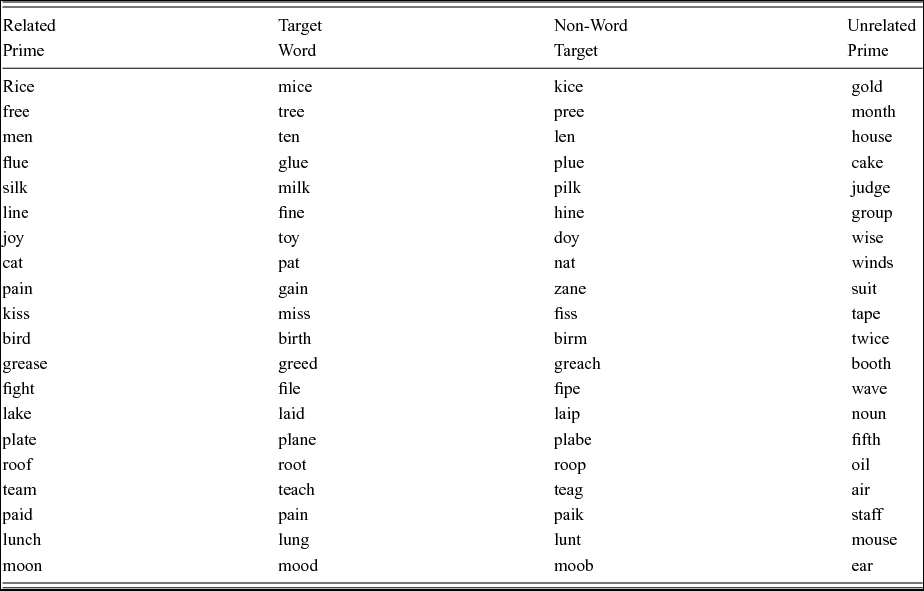
A list of 128 monosyllabic words with a CVC, CCVC or CVCC syllabic structure was created to generate materials for the lexical decision task. These 128 words were grouped into 32 sets of 4. Each quartet consisted of a target word, e.g., mice, a non-word target, e.g., kice, a related prime, e.g., rice, and an unrelated prime e.g., gold. Sixteen quartets contained prime-target pairs that differed in one segment in onset, e.g., rice-mice. Another 16 quartets contained pairs that contrasted in one segment in coda, e.g., plate-plane. The unrelated primes shared no segment with the target, i.e., gold-mice. Words in each quartet had similar frequencies according to the Spoken Frequency Database (Pastizzo & Carbone, Reference Pastizzo and Carbone2007). In general, words' relative frequency ranged from 0.00 to 0.04.
Two native speakers of English were asked to produce each of the 128 words within two carrying sentences, i.e., “She said ____,” which yielded words with a falling F0, and the incredulity question “She said ____?” which gave words with a rising F0 (see Figure 1). The recording was created with Praat at a sampling rate of 44100 Hz (8 bits) with a high quality condenser microphone, Sennheiser Evolution e845, in a quiet room. Two trained phoneticians, two native English speakers, and two native Chinese speakers listened to these recordings and selected the speaker with the clearest diction and his most clearly spoken words. These selected words were used for the lexical decision task (80 words * 2 F0 contours = 160 words; see Appendix 1 for a complete word list).
Spectrograms and F0 tracks of the word file spoken as a question (left) or a statement (right)

To further examine the differences between falling and rising F0 contours of the selected 160 words, we measured F0 at three different points in the pitch contour, i.e., within the initial 20 ms, at the middle and within the last 20 ms (means and standard deviations are summarized in Appendix 2). The mean differences between falling and rising contours were around 20 Hz at the beginning of the contour, increasing to over 100 Hz towards the end. Since the just noticeable difference (jnd) remains constant at 3 Hz in pure tones ranging from 100 Hz to 1000 Hz (Shower & Biddulph, Reference Shower and Biddulph1931; Wever & Wedell, Reference Wever and Wedell1941), the pitch differences between falling and rising contours in the test words remained clearly audible all along the word.
2.3. Task
The selected 160 words were paired into prime-target sets according to five experimental conditions, i.e., Full Match (FM), Full Mismatch (FMM), Mismatch in Segment (MMS), Mismatch in F0 (MMF0) and Mismatch in Segment and F0 (MMSF0). In Full Matches, prime and target words had the same segments and F0 contour, e.g., miceR- miceR in which R refers to rising F0. In the Full Mismatch condition, primes had no segments in common with the target and had opposite F0 contours, e.g., goldF- miceR in which F refers to falling F0. In the Mismatch in Segment condition, the mismatched segment could take place in onset or in coda, e.g., riceR- miceR, plateF- planeF. In the Mismatch F0 condition, primes and targets differed in the pitch contour, e.g., miceF- miceR. As explained in Section 2.3, F0 differences between falling and rising contours were audible all along the contour from the beginning of the word. Finally, prime-target pairs in the Mismatch in Segment and F0 condition differed in one segment and in the speech contour, e.g., riceR-miceF. Each condition was created with word and non-word targets.
All the stimuli combined yielded a total of 400 pairs. To ensure that the task did not last more than 30 minutes, only 120 of the 200 target non-word pairs were used, reducing the number of pairs to 320 (200 with word targets and 120 with non-word targets). With these 320 word pairs, we built three lists, one with 50 ms between prime and target, a second with 250 ms and a third with 750 ms in order to examine whether processing differences between L1 groups increased with larger ISIs which promote a more linguistic and less acoustic mode of perception (e.g., Lee, Reference Lee2007). These lists were listened to by a similar number of participants within each language group (Chinese: 15, 15, 10; English: 21, 16, 16; Spanish: 15, 15, 11).
2.4. Procedure
The 134 participants listened to the priming lexical decision task via Sennheiser HD555 headphones connected to the computers in the Phonetics Laboratory at the University of Pittsburgh. The participants' task consisted of listening to word pairs and deciding if the second word in a pair was a real English word. They were instructed to press the red button in the response pad (Cedrus RB840) if they heard a real English word and the blue button if they heard a non-word. After reading the instructions in the computer screen, participants had a practice session that consisted of 10 randomly selected pairs (6 non-word targets, 4 word targets) not included in the task. Once participants had completed the session, they were encouraged to ask questions before starting the task. The task started with a warm-up of 20 pairs (10 word targets, 10 non-word targets) to give participants time to get acquainted with the task and the response pad. These 20 pairs were not included in the results. The task proper consisted of the next 320 pairs (200 word targets, 120 non-word targets). Participants were given a one-minute break after every 40 stimuli, for a total of seven breaks. The practice, warm-up and experimental task took approximately 30 minutes.
2.5. Measurements and statistics
Speakers are faster at processing their native language than an L2. For example, the native English speakers in our study were generally faster (N = 10263, M = 502.76 ms, SD = 359) than the L2 groups (Chinese: N = 7643, M = 611.14 ms, SD = 439; Spanish: N = 7797, M = 717.19 ms, SD = 448). However, our goal was to capture cross-language differences related to the experience with tonal (L1 Chinese) versus non-tonal languages (L1 English, L1 Spanish) rather than speed differences related to being a native versus a non-native English speaker. To ensure the capture of the cross-language differences related to a tonal versus a non-tonal background, we ran our models on two score types, i.e., facilitation scores and log-transformed RTs. Facilitation scores were calculated as the difference between the Full Mismatch condition (FMM) and each of the other four conditions, i.e., FMM – FM, FMM – MMS, FMM – MMF0, and FMM – MMSF0. For example, the RTs obtained by participant 1 in the FM pair miceF-miceF, in the MMS pair riseF-miceF, etc were each subtracted from the RT he obtained in the FMM word pair goldR-miceF. Larger scores represented stronger facilitation effects (see Figure 2). Thus, facilitation scores were less sensitive than RTs to speed differences because of the participants' L1-L2 difference as they were normed against a control condition. Thus, we were interested in factors that became significant in the facilitation scores. Yet we also considered factors that were significant in both measures to ensure that significant factors from the facilitation scores were robust enough to remain significant even when there was L1-L2 variation in the data and were not a mere artifact of the subtraction in the control condition.
Participants' Facilitation Scores by L1, Condition and Intonation. Participants' L1 is on the x-axis. Facilitation scores in ms. are along the y-axis and represent the difference of each condition with Full Mismatches, the control condition.

Participants' log-transformed RTs by L1, Condition, and Intonation.
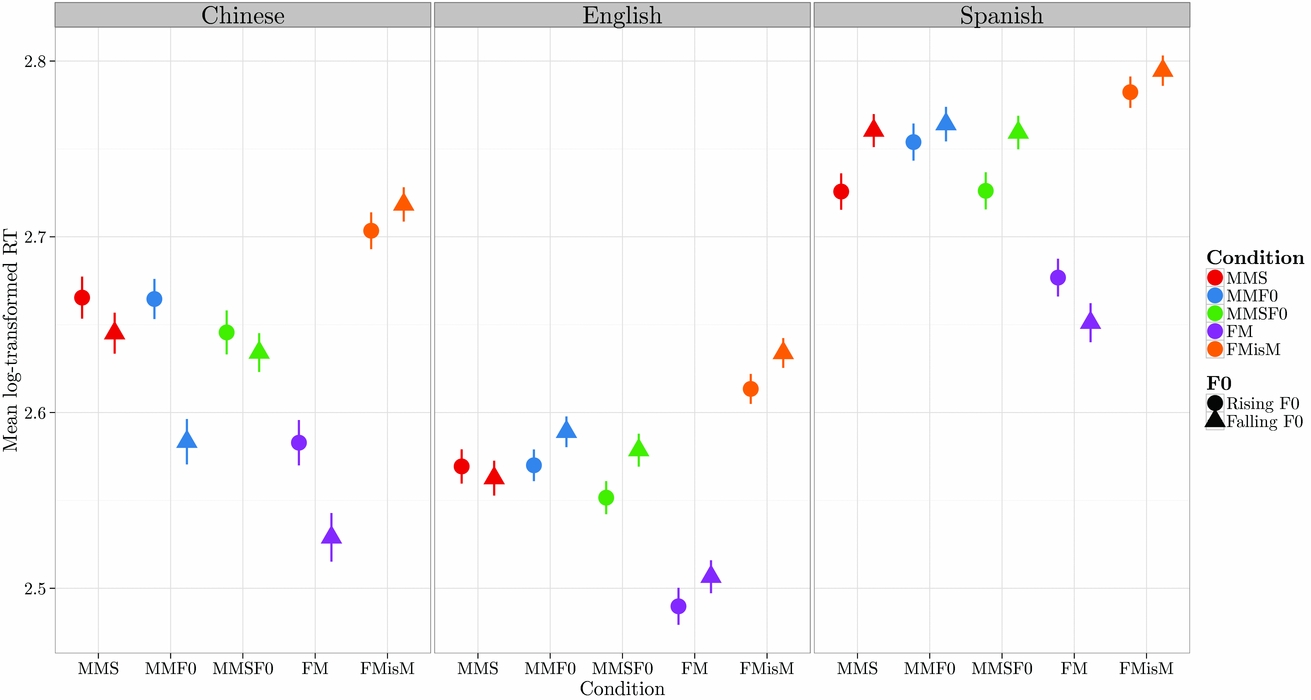
The facilitation scores and log-transformed RTs were computed on correctly identified English words (Chinese speakers correctly identified 90.4% of real English words, English speakers 91.8% and Spanish speakers 90%) and were analyzed by means of hierarchical linear modeling (package *lmer* in R; Bates, Maechler, Bolker & Walker, Reference Bates, Maechler, Bolker and Walker2014) with random intercepts for participant and stimulus pairs. There was no evidence of variability in random slopes for these terms. Because there was no consistent evidence of differences between the three values of ISI for both facilitation scores and log-transformed RT data, data were collapsed across ISI for the analyses reported here. Two models were analyzed for each outcome based on a priori prediction: main effects of L1 (Chinese, English, Spanish), Condition (FM, MMF0, MMS, MMSF0) and Intonation (target with rising F0, target with falling F0) and their interactions in section 3.1., and the main effects of L1, Condition and Syllable Position (Onset, Coda) and their interactions in section 3.2.. For each model, p-values, least square means and differences of least square means for fixed effects were estimated with the lmerTest (Kuznetsova, Brockhoff & Christensen, Reference Kuznetsova, Brockhoff and Christensen2014).
3. Results
3.1. L1. Intonation and Condition
A hierarchical linear model with the fixed effects of L1 (Chinese, English, Spanish), Intonation (falling F0, rising F0) and Condition (FM, MMS, MMF0, MMSF0, FMM) and the random effects of subject and item were run separately on facilitation scores and on log-transformed RTs on correctly identified words. Results are displayed in Table 1 below.
Effects of L1, condition and intonation on facilitation scores and log-transformed RTs.

Signif. codes: p<.0001 ‘***’ 0.001 ‘**’ 0.01 ‘*’ 0.05 ‘†’ 0.1 ‘ ’ 1
As shown in Table 1, the three-way interaction, the two-way interactions of L1 with Intonation and Condition and the main factor of Condition were significant at p < 0.05 in both datasets, ratifying that these effects were robust. Whereas the significant main factor of Condition shows that there are some cross-language resemblances, the significant interactions with L1 show that there are cross-language differences in the modulating effect of the participants' native language.
Cross-language similarities showed up in the significant main factor of Condition (see Table 1) which denotes the way in which participants processed the degree of similarity between primes and targets. Regardless of the speakers' language background, participants obtained the largest facilitation scores in Full Matches (N = 4927, M = 153.6, SD = 499). Facilitation scores became progressively smaller in conditions where the prime and the target differed by one dimension, i.e., Mismatched F0 (N = 4963, M = 56.5, SD = 509), Mismatched Segment (N = 4989, M = 58.7, SD = 509) and finally by two dimensions, i.e., Mismatches F0 and Segment (N = 4981, M = −64.4, SD = 503). This progression suggested that more similar pairs triggered larger facilitation effects than less similar pairs. As depicted in Figure 2, these similarity effects took place within each language group and in both targets. Within each language group, the blue bars for the Full Matches obtained larger facilitation scores than the green and red bars for the Mismatched F0 and Mismatched Segment conditions respectively, and these were larger than the orange bars for the Mismatched F0 and Segment conditions.
Regarding the cross-language differences, the three-way interaction showed that, for Chinese speakers, facilitation scores were larger in targets with a falling F0 (bars in darker shades in Figure 2) than in targets with a rising F0 (bars in lighter shades), and that this difference became especially large in the Mismatched F0 condition. The two-way interactions corroborate these results. The L1 * Intonation interaction confirms that, for Chinese speakers, a target with a falling F0 (N = 2948, M = 81.2, SD = 529) triggered more facilitation than one with a rising F0 (N = 2937, M = 35.6, SD = 556), t (139.6) = −4.08, p = 0.0001, and that in contrast with Chinese, differences between falling and rising F0 targets did not reach significance in English, t (94.1) = −0.98, p = 0.3295, or in Spanish, t (135.8) = −0.13, p = 0.8953. The L1 * Condition interaction ratifies that for Chinese speakers, a mismatch in F0 produced significantly larger facilitation than in English (M diff = 35), t (633.9) = 2.91, p = 0.0038, and Spanish (M diff = 63), t (652.1) = 3.95, p = 0.0001. Thus, Chinese speakers were the only group showing a bias for targets with a falling F0, which became especially noticeable in F0 mismatches.
In order to examine the three-way interaction further, hierarchical linear models with the fixed effects of Intonation and Condition and the random effects of subject and item on facilitation scores were run separately for each language group. As summarized in Table 2, results showed that only Chinese speakers obtained significant differences for Intonation and Intonation*Condition ratifying that Chinese speakers' performance was different from that of non-tonal language speakers. The significant Intonation factor confirmed that only Chinese speakers showed a bias towards targets with a falling F0, and the significant Intonation * Condition interaction corroborated that this bias was especially large in F0 mismatches. In addition, results showed that Condition was significant in each language group, confirming that computations of similarity between primes and targets were similar across language groups, i.e., full matches were more similar than mismatches in one dimension and those were more similar than mismatches in two dimensions.
Effects of condition and intonation on facilitation scores within each language group.
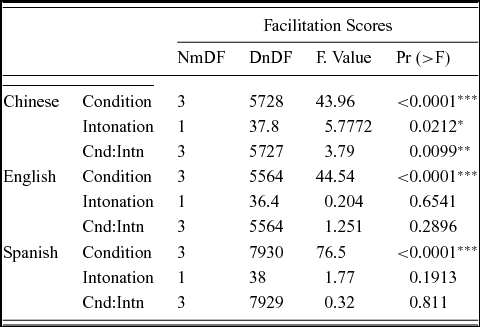
Signif. codes: p < .0001 ‘***’ 0.001 ‘**’ 0.01 ‘*’ 0.05 ‘†’ 0.1 ‘ ’ 1
3.2. Effects of onset and coda
As explained in Section 2, syllabic position was relevant only for conditions containing mismatched segments. Therefore, a second model with the random factors of subject and item and the fixed factors of L1, Condition and Syllable Position (Onset Coda) was applied to the facilitation scores of Mismatched Segment and Mismatched Segment and F0 conditions. The model was run on log-transformed RTs. Recall that facilitation scores and log transformed RTs were based on participants' reaction times to correctly identified words. As in the previous models, results were based on significant factors from both datasets. Results are summarized in Table 3.
Effects of L1, condition and syllable position on facilitation scores and log transformed RTs.

Signif. codes: p < .0001 ‘***’ 0.001 ‘**’ 0.01 ‘*’ 0.05 ‘†’ 0.1 ‘ ’ 1
The effect of Syllable Position was significant in both datasets only in their interaction with Condition, showing that speakers detected mismatched segments faster in onset position than in coda. In the log-transformed RT dataset, L1 was significant as a main effect, showing that native English speakers were faster overall (N = 4087, M = 470.45, SD = 352.146) than L2 English speakers (Chinese: N = 3054, M = 577.85, SD = 432.796, Spanish: N = 3120, M = 665.06, SD = 437.606). Moreover, in log-transformed RTs, Syllable Position was marginally significant as a main effect and significant as an interaction with L1. As a main effect, it showed that mismatches in onset were detected 28 ms faster than in coda. In the interaction with L1, English speakers detected mismatches in onsets 16 ms faster than in codas, Chinese speakers 40 ms faster and Spanish speakers 33 ms faster. Overall, these results showed that speakers from the three language groups detected mismatches in onsets faster than in codas.
3.3. Summary
Participants from the three language backgrounds exhibited similar patterns regarding the syllable position of the mismatched segment and the number of mismatched dimensions in the prime. Pairs with mismatched segments in onset, e.g., riceF-miceF, triggered more facilitation than pairs with mismatched segments in the coda position, e.g., birdF-birthF. Regarding the number of mismatched dimensions, fully matched pairs obtained higher facilitation scores than pairs mismatched in the segmental dimension e.g., riceF-miceF, or the F0 dimension, e.g., miceF-miceR. In turn, the latter pairs obtained higher facilitation scores than pairs mismatched in the two dimensions, e.g., riceF- miceR. Thus, more similar pairs triggered greater facilitation effects than less similar pairs. Altogether, the above results indicate that cross-language similarities were related to segment processing and general computations of similarity involving F0.
In contrast, cross-language differences were related to F0 processing and singled out Chinese speakers from the other two language groups. First, Chinese speakers obtained higher facilitation scores when the target word was produced with a falling F0 and these differences occurred within each experimental condition. In contrast, F0 variation in the target word had no significant effects for English and Spanish speakers. Second, Chinese speakers obtained higher facilitation scores in F0 mismatches than English and Spanish speakers, especially in F0 mismatches with a falling F0 target, miceR-miceF. Thus, these cross-language differences set Chinese speakers apart from the other language groups by showing a Chinese bias towards English words with a falling F0, which triggered more facilitation, especially in the MMF0 condition.
4. Discussion
4.1. Cross-language similarities
Cross-language similarities were related to both segment and F0 processing. Similarities in segment processing showed that for speakers from the three L1 backgrounds mismatches in onsets triggered temporally different effects from mismatches in codas. Speakers obtained higher facilitation scores in onsets than in codas, suggesting that they recovered faster from a mismatch that occurred earlier in the word. Detecting a segment mismatch in onset in a CVC word allowed facilitation to start from the vowel. However, detecting a segment mismatch in coda delayed the whole recovery process. Previous research in English and Spanish L1 obtained similar results (Allopenna et al., Reference Allopenna, Magnuson and Tanenhaus1998; Desroches et al., Reference Desroches, Joanisse and Robertson2006, Reference Desroches, Newman and Joanisse2009). However, previous research in Chinese obtained controversial results. On the one hand, some studies showed that in Mandarin the syllable as a whole had temporal effects that go above and beyond those of their parts, suggesting a more holistic processing of the syllable (Zhao et al., Reference Zhao, Guo, Zhou and Shu2011). On the other hand, results from recent studies failed to find supporting evidence for this holistic approach while showing that onsets and rhymes in Mandarin behaved similarly in English (Malins & Joanisse, Reference Malins and Joanisse2012). Our results showed that speakers from the three language backgrounds processed segment mismatches in onsets and codas similarly, suggesting that the three languages, Chinese, English and Spanish, have similar onset-coda temporal effects. If so, this would support the findings that onsets and codas in Chinese are processed similarly in English. However, if Chinese syllables are in fact processed holistically and onsets and codas behave differently from English, then our results would indicate that our Chinese speakers did learn the English syllabic structure and processed it in a native-like manner.
The second cross-language similarity referred to F0 processing. Speakers from the three language groups found full matches more similar than mismatches in one dimension, i.e., a mismatch in segment or in F0, and those more similar than mismatches in two dimensions, i.e., a mismatch in both segment and F0. That means that speakers from the three language groups found prime-target pairs with the same segments more similar when they did not differ in F0, i.e., the pair riceF-miceF was more similar than riceR-miceF and the pair miceF- miceF was more similar than miceR- miceF . Thus, regardless of whether they had a tonal or a non-tonal L1, speakers could not ignore F0 variation in English words when making a lexical decision. This result was unexpected, especially for native English speakers and Spanish ESLs, because, as reflected in current models of word recognition for non-tonal languages, F0 information is not part of the computations of lexical access and recognition. Yet our results indicate that speakers from the three language backgrounds used F0 in the English lexical decision task.
One possible explanation is that, as described in Section 1, speakers from tonal and non-tonal languages accessed F0 by means of different mechanisms. On the one hand, Chinese speakers could have accessed F0 during the word recognition process by transferring to English those mechanisms that computed tone. On the other hand, in English and Spanish, F0 information was computed at the post-lexical level in the sentence prosody component, and F0 could have been accessed in word recognition through the interaction with this component. Yet it seems implausible that such different mechanisms – one operating at the lexical level and another at the post-lexical – yield similar outcomes.
A common mechanism based on the integral processing of segments and F0 information provides an alternative explanation. There is solid evidence that speakers of both tonal and non-tonal languages cannot ignore F0 variation in the speech signal when processing segmental information. Traditional Garner-type studies (e.g., Lee & Nusbaum, Reference Lee and Nusbaum1993; Miller, Reference Miller1978; Repp & Lin, Reference Repp and Lin1990) showed that both speakers of Chinese and speakers of English could not avoid processing F0 variation when attending to segmental contrasts. Cross-language differences resided in the degree and scope of this integration, showing more integration for speakers of tonal languages. For example, Lee and Nusbaum (Reference Lee and Nusbaum1993) showed that Chinese speakers perceived segments and tones integrally in both a tone task and a flat pitch task whereas English speakers perceived them integrally only in the tone task. Likewise, identification and discrimination studies using word-level stimuli provide further evidence for different levels of integration (e.g., Braun & Johnson, Reference Braun and Johnson2011; Braun et al., Reference Braun, Galts and Kabak2014). In an AXB task, Braun and Johnson (Reference Braun and Johnson2011) found that speakers of non-tonal languages could not ignore F0 in incongruent trials, albeit speakers of tonal languages used the F0 dimension more often – i.e., 7.1% by Dutch speakers versus 43% by Mandarin speakers. Altogether, these studies showed that despite cross-language differences in degree, F0 and segment information were processed integrally by speakers of tonal and non-tonal languages, and, as a result, speakers from different language backgrounds cannot ignore F0 variation even in a lexical decision task in English where F0 variation becomes irrelevant for word meaning. Since integral perception of segmental and F0 information takes place at lower levels of processing, this cross-language mechanism operates with acoustic information and without relating F0 to lexical meaning. In this respect, it resembles the processing of F0 to identify the gender of the speaker. A mechanism of this sort would suffice to account for the cross-language pattern whereby prime-target pairs with identical segments are less similar if they differ in F0.
In summary, speakers from the three language backgrounds processed English words similarly regarding syllable structure and the acoustic integration of the segmental and F0 information in the speech signal. Regardless of the nuances of syllable structure in the speakers' L1, i.e., a more holistic approach in Chinese than in English and Spanish, speakers were sensitive to the linearity of the speech signal in that they recovered sooner from mismatches in onsets than in codas. It was clear as well that speakers from the three language groups integrated segmental and F0 information at lower levels of processing and that this acoustic perception accounted for their initial computations of similarity between prime-target pairs where pairs with identical segments were less similar if they differed in F0.
4.2. Cross-language differences
Whereas speakers from the three language groups were similar in that they could not ignore F0 while processing segmental information, Chinese speakers differed from English and Spanish speakers in another two aspects of F0 processing. These differences are carefully examined in this section in order to evaluate whether they support the idea that experience with a tonal language shapes the perception of intonation in specific ways, answering in this way our second research question.
The first F0 pattern that differentiated Chinese speakers from speakers of non-tonal languages is that Chinese speakers obtained significantly higher facilitation scores in F0 mismatches, suggesting that, in comparison with the control condition, Chinese speakers detected F0 variation faster than speakers of non-tonal languages. Higher facilitation scores and faster reaction times in F0 mismatches have also been obtained in lexical decision tasks in tonal languages (e.g., Yip, Reference Yip2001) and in training studies with word-object pairs (e.g., Braun et al., Reference Braun, Galts and Kabak2014). For example, Braun et al. (Reference Braun, Galts and Kabak2014) showed that Chinese speakers were more accurate and faster at detecting F0 mismatches than speakers of German, Russian and French, suggesting a finer perception of F0 by speakers of tonal languages. This finer F0 perception by Chinese speakers in comparison with speakers of non-tonal languages has been replicated not only in words but in a wide range of stimuli such as level and contour tones (Gandour, Reference Gandour1983; Chandrasekaran et al., Reference Chandrasekaran, Krishnan and Gandour2007b; Kaan et al., Reference Kaan, Wayland, Bao and Barkley2008), and speech versus musical tones (Burnham, Francis, Webster, Luksaneeyanawin, Attapaiboon, Lacerda & Keller, Reference Burnham, Francis, Webster, Luksaneeyanawin, Attapaiboon, Lacerda and Keller1996) indicating that it affects perception of F0 contours in general and not only those related to lexical meaning. Moreover, neurophysiological research provides evidence for a relation between earlier and higher levels of processing, making it feasible that an earlier fine perception of tone is related to experience with a tonal language. For instance, MMN studies showed that this finer F0 perception by Chinese speakers in contrast to English speakers took place at a pre-attentive level of processing (Chandrasekaran et al., Reference Chandrasekaran, Krishnan and Gandour2009). Connections from cortical areas to the brainstem (e.g., Heald & Nusbaum, Reference Heald and Nusbaum2014) provide neurological evidence for a direct relation between a pre-attentive level of processing with higher-level processing. Altogether, these results show that experience with a tonal language refines perception of F0 contours in general regardless of conveyance of tonal or intonation meanings, failing to support the idea of a special relation between experience with tonal language and perception of intonation.
However, the second F0 pattern that differentiates the current sample of Chinese speakers from English and Spanish speakers constitutes compelling evidence in support of the idea that experience with a tonal language shapes the perception of intonation in specific ways. Chinese speakers obtained higher facilitation scores when the target word had a falling F0. This difference occurred in each condition and it became especially large in F0 mismatches. For example, while a full match like miceF- miceF obtained higher facilitation scores than miceR- miceR, an F0 mismatch like miceR- miceF obtained notably higher facilitation scores than miceF-miceR, showing that, for Chinese speakers, the shapes of the F0 contours played a stronger role in their recognition of English words than they did for English and Spanish speakers. For Chinese speakers, English words with a falling F0 were easier to retrieve than those with a rising F0, suggesting that words with falling F0, the pitch contour of words in citation form, constituted a closer match to their representation of English words. Thus, Chinese ESL speakers represented English words with a rather fixed F0 contour as they did with tone in Chinese words. In contrast, for English and Spanish speakers, both F0 contours were equally acceptable. Words with falling or rising F0 were equally easy to retrieve, suggesting that their representation of English words does not contain a fixed or preferred F0 contour. Thus, these results showed that despite the clear link in our stimuli between F0 and intonation meanings, the pro-English context promoting a monolingual English mode and the advanced proficiency of our ESL speakers, L1 was still active and Chinese speakers processed English words with a tone-like, fixed F0 shape, failing to process intonation contours in a similar way to English and Spanish speakers.
In summary, some aspects of F0 processing were common across languages whereas others singled out Chinese speakers from English and Spanish speakers. Cross-language similarities showed that speakers from tonal and non-tonal languages processed both segmental and tonal information in English words. Despite having no bearing on lexical meaning, F0 could not be ignored in the English lexical decision task by any of the language groups, presumably because the F0 and spectral acoustic information of the speech signal were processed integrally at early stages of perception. This perceived F0 variation had the effect of reducing facilitation scores in prime-target pairs that contained the same segments but had an additional mismatch in F0, i.e., miceF-miceR had less facilitation than miceR-miceR. This initial cross-linguistic perception of F0 was shaped further by experience with a tonal language, as illustrated by the two F0 patterns that singled out Chinese speakers from English and Spanish speakers. First, Chinese speakers were faster at detecting F0 mismatches. Since this finer F0 perception has been obtained in a large variety of stimuli, it reflects a more detailed acoustic perception of F0 contours regardless of their link with tone or intonation meanings. However, the second F0 pattern provided solid evidence that tonal language experience shaped the perception of intonation in specific ways. Chinese speakers represented the intonation of English words with a rather fixed F0 contour reminiscent of a tone, which in turn, favored recognition of words with a falling F0 over those with a rising F0. This tone-like representation demonstrated that Chinese speakers failed to process intonation as English and Spanish speakers did and this cross-language difference appeared despite the clear link between F0 shapes and intonation meanings in English words, the English monolingual mode and the advanced proficiency of our ESL speakers.
4.3. Implications for word recognition models
To our knowledge, models of bilingual word recognition have not yet addressed F0 processing. We fill this gap by discussing how the three F0 processing patterns described above could be implemented in current bilingual models. The first F0 pattern showed that contrary to expectations speakers from the three language backgrounds found prime-target pairs with identical segments more similar if they did not differ in F0, showing that regardless of whether they had a tonal or non-tonal L1, speakers processed F0 information in our lexical decision task in English, a language where F0 was assumed not to be part of the lexical access and recognition process. We suggested that this unexpected cross-language behavior could be accounted for by the integral perception of segmental and F0 information at early stages of processing. This integral perception could be represented in word recognition models by feature detectors that analyze both the spectral and the F0 information of the speech signal. However, feature detectors in current bilingual models only analyze cues to segmental information. For example, in BIMOLA (Grosjean, Reference Grosjean1998, Reference Grosjean2008; Léwy & Grosjean, Reference Léwy and Grosjean1997), the speech signal is linked to French and English phonemes by a set of 16 segmental features inspired by the original Chomsky and Halle (Reference Chomsky and Halle1968) features. In BLINCS (Shook & Marian, Reference Shook and Marian2013), the speech signal is mapped into English and Spanish phonemes by means of three-dimensional vectors that capture place, voice and manner characteristics in segments. By considering cues that capture F0 information, such as the tonal center of gravity (Barnes, Veilleux, Brugos & Shattuck-Hufnagel, Reference Barnes, Veilleux, Brugos and Shattuck-Hufnagel2010) in addition to cues to segmental information, these models could include F0 information in their feature detectors, allowing low-level processing of F0 information in bilingual word recognition.
Second, our results showed that Chinese ESL speakers were faster at detecting F0 variation in English words than speakers of non-tonal languages, indicating that the fine tuning to F0 used by Chinese speakers when processing Chinese words is also used when the same Chinese speakers processed English words. In contrast to Chinese ESL speakers, Spanish ESL speakers did not show these effects. This cross-language difference can be modeled by shared F0 feature detectors by Chinese and English on the one hand and by Spanish and English on the other, providing further supporting evidence for the ideas that feature detectors are shared by the two languages of a bilingual speaker, as they are in many models like BIMOLA (Grosjean, Reference Grosjean1998, Reference Grosjean2008; Léwy & Grosjean, Reference Léwy and Grosjean1997), BIA+ (Dijkstra & van Heuven, Reference Dijkstra and van Heuven2002), and BLINCS (Shook & Marian, Reference Shook and Marian2013), and that they are shaped by the speakers' long-term exposure to tone (Chandrasekaran et al., Reference Chandrasekaran, Krishnan and Gandour2007b, Reference Chandrasekaran, Krishnan and Gandour2009). Therefore, by virtue of these cross-language, especially-sensitive F0 feature detectors, bilingual speakers of a tonal and a non-tonal language will have a more nuanced perception of F0 in their non-tonal language than native speakers of that same non-tonal language.
The third F0 pattern showed that Chinese–English bilinguals had a bias for English words with a falling F0 so that these words were recognized faster than words with a rising F0. This bias suggested that, after detecting the acoustic F0 characteristics of English words via feature detectors, Chinese–English speakers kept on processing F0 information. In Chinese words, this latter F0 processing was a required step for accessing tone in a lexical representation (i.e., Malins & Joanisse, Reference Malins and Joanisse2012). In English words, however, it was not so required, as shown by the absence of a similar bias in our native English speakers and Spanish–English bilinguals, who nevertheless successfully recognized English words. Therefore, this late F0 processing of English words by Chinese–English bilinguals arose from the connection between the phono-lexical representations of a tonal and a non-tonal language, which can be modeled by self-organizing maps (SOM) like those used in BLINCS (Shook & Marian, Reference Shook and Marian2013) and the Unified Model (MacWhinney, Reference MacWhinney2004).
Self-organizing maps work on the Hebbian learning principle that “what fires together wires together” (Hebb, 1949). For example, in the phono-lexical SOMs in BLINCS (Shook & Marian, Reference Shook and Marian2013), English and Spanish words organized themselves according to their phonological similarity, equivalent translations and word frequency so that a word like tenedor (“fork” in Spanish) activated a within language competitor, tortuga “turtle,” a cross-linguistic competitor, tent, and the translation equivalent, fork. In Chinese words, however, segmental information is wired together with F0 information. This means that in phono-lexical SOMs for Chinese–English bilinguals, words from the two languages are organized by F0 similarity in addition to segmental and word frequency criteria. Moreover, in English, words with a falling F0 (i.e., words in citation form, words at the end of statements) are more frequent than those with a rising F0. As a result of the F0 and word frequency organization criteria, Chinese–English bilinguals recognized English words with a falling F0 faster than those with a rising F0.
In contrast to models like BLINCS (Shook & Marian, Reference Shook and Marian2013) and the Unified Model (MacWhinney, Reference MacWhinney2004), it would be difficult to reproduce this bias in a model like BIMOLA (Grosjean, Reference Grosjean1998, Reference Grosjean2008; Léwy & Grosjean, Reference Léwy and Grosjean1997) where languages are kept separate, albeit interconnected, in the phoneme and lexical representations. Interlanguage connections in BIMOLA (Grosjean, Reference Grosjean1998, Reference Grosjean2008; Léwy & Grosjean, Reference Léwy and Grosjean1997) are regulated by top-down effects like language mode and linguistic context, and bottom-up effects, like language-specific phonotactics. In our experiment both top-down effects and phonotactics strongly favored a unilingual English mode, whereby interlanguage activation was kept at a low level. Therefore, in this context, the late F0 processing of English words should be avoided, making it difficult to model a falling F0 bias on English words.
In summary, the first two F0 patterns affected early processing and were amenable to implementation in a wide selection of models. They would require that word recognition models of both tonal and non-tonal languages included F0 feature detectors shared by the two languages. However, the last of the three F0 patterns, the falling F0 bias in English words, showed interlingual interference at later processing levels which was better handled by bilingual models with highly interconnected languages, i.e., BLINCS (Shook & Marian, Reference Shook and Marian2013) and the Unified Model (MacWhinney, Reference MacWhinney2004). Devices like phono-lexical SOMs allowed modeling of the falling F0 bias on English words by organizing both English and Chinese words according to F0 shape in addition to segmental similarity and word frequency, showing that the interconnection between English and Chinese lexical forms is stronger than that predicted by selective models like BIMOLA (Grosjean, Reference Grosjean1998, Reference Grosjean2008; Léwy & Grosjean, Reference Léwy and Grosjean1997).
5. Conclusion
The results of this experiment illustrate how F0 variation in English words is processed by speakers of tonal and non-tonal languages. Cross-language similarities suggested an initial computation of acoustic similarity based on the integral processing of segmental and F0 variation in the speech signal. After this initial stage, language experience shaped F0 perception further, as suggested by the two patterns that singled out Chinese speakers from English and Spanish speakers. First, Chinese speakers detected F0 mismatches faster. Because this pattern has been found in a wide range of stimuli, it was interpreted as an enhanced acoustic representation of F0 contours owed to experience with a tonal language. Second, Chinese speakers more quickly processed words with a falling F0, suggesting a bias towards a fixed F0 representation in English words reminiscent of tone despite any F0 variation in English words being unambiguously related to intonation. In light of these results, it is suggested that models of word recognition should include F0 information at lower levels of processing not only in tonal languages but also in non-tonal languages like English. Moreover, bilingual models of word recognition for Chinese–English speakers need to address the falling F0 bias. It has been argued that models with highly interconnected lexicons such as BLINCS (Shook & Marian, Reference Shook and Marian2013) could account better for this bias than more selective models like BIMOLA (Grosjean, Reference Grosjean1998, Reference Grosjean2008; Léwy & Grosjean, Reference Léwy and Grosjean1997).
Word quartets
F0 values in word stimuli Means and standard deviations of the words' F0 values at the beginning (F01), the middle (F02), and the end of the F0 track (F03).

Means and standard deviations of the non-words' F0 values at the beginning (F01), the middle (F02), and the end of the F0 track (F03).



 Open access

