





1. Introduction
Heritage language (HL) acquisition has become a prominent subfield of bilingualism research. HLs are spoken in situations where another language has greater community and institutional presence. The differences in status between these languages often lead heritage speakers (HSs) to become dominant in the socially more prevalent language around the beginning of the school period (Castilla-Earls et al., Reference Castilla-Earls, Francis, Iglesias and Davidson2019; Hiebert & Rojas, Reference Hiebert and Rojas2021; Wong Fillmore, Reference Wong Fillmore1991). Research on young bilingual children and adult HSs has been frequent, but there have been fewer studies evaluating bilingual development during the late childhood and adolescent years, a period that Montrul (Reference Montrul2018, p. 534) calls the “missing link” in HL acquisition research. Incorporating children and adult HSs in a single study is critical for charting the path of typical bilingual development and for contributing to theories of HL acquisition. On the one hand, some such theories concentrate on the reasons that HSs diverge from other groups of speakers of the same language, while more recent approaches have concentrated on differences between individual HSs and within a single speaker's grammar. Exploring if and how bilingual children acquire and maintain their HL across childhood and into adulthood allows for a principled distinction between these theories.
The Spanish subjunctive mood is a morphosyntactic structure whose intricacies have made it a popular topic in HL research. Most past studies on the HL acquisition of the subjunctive have concentrated on adult HSs (e.g., Giancaspro, Reference Giancaspro2019, Reference Giancaspro, Brehmer and Treffers-Daller2020; Giancaspro et al., Reference Giancaspro, Perez-Cortes and Higdon2022; López-Beltrán & Dussias, Reference López-Beltrán and Dussias2023; Martillo Viner, Reference Martillo Viner2016; Montrul, Reference Montrul2009; Perez-Cortes, Reference Perez-Cortes2016, Reference Perez-Cortes2021, Reference Perez-Cortes2022). While there is also research on bilingual children's acquisition of the Spanish subjunctive (Castilla-Earls et al., Reference Castilla-Earls, Pérez-Leroux, Restrepo, Gaile and Chen2018; Dracos & Requena, Reference Dracos and Requena2022; Potowski, Reference Potowski2007), there has not yet been a study charting the course of development of the subjunctive from late childhood through adulthood. The present study evaluates HS children and adults in their productive and receptive knowledge of the subjunctive mood in volitional clauses. It therefore contributes to a limited body of work comparing multiple age groups that can discern between theories of HL acquisition, as argued in section 2. As indicated in section 3, the subjunctive mood appears to be a particularly challenging area of the Spanish inflectional system for bilinguals to acquire, making it ideal to test these theories. Section 4 presents the research questions, hypotheses, participants and methods, and section 5 presents the results. Finally, section 6 discusses these findings, their implications for bilingualism theory and their limitations, followed by the conclusion.
2. Child–adult comparisons and HL acquisition theory
The comparison of children and adults who are HSs has key theoretical implications. Early theories of HL acquisition concentrated on how to account for differences between HSs' grammars and those of other populations of native speakers. On the one hand, Montrul (e.g., Reference Montrul2002, Reference Montrul2008, Reference Montrul, Herschensohn and Young-Scholten2013) has argued that HSs experience incomplete acquisition of certain components of their HL because as a group, they show lower levels of production or receptive knowledge of a particular structure. This theory emphasizes that HL acquisition is interrupted by a reduction in input and exposure, typically around the onset of schooling. Another theory is that HSs experience attrition of the HL later in life due to decreases in exposure (e.g., Hicks & Domínguez, Reference Hicks and Domínguez2020; Köpke, Reference Köpke, Schmid, Köpke, Kejzer and Dostert2007; Polinsky, Reference Polinsky and Browne1997, Reference Polinsky2011, Reference Polinsky2018). If older HSs show lower levels of production or receptive knowledge of the subjunctive than younger participants, it can be argued that these speakers have (at least partially) lost this structure from their grammar. While incomplete acquisition and attrition are not mutually exclusive (see Cuza et al., Reference Cuza, Pérez-Tattam, Barajas, Miller, Sadowski and Schwieter2013 for an example), setting them apart definitively requires longitudinal data. Montrul (Reference Montrul, Herschensohn and Young-Scholten2013, pp. 370–371) argues that “Although longitudinal studies are ideal to tease apart these two possibilities, another way to address these questions is by comparing child and adult heritage speakers.” The present study adopts the latter of these approaches, which, in the absence of extensive longitudinal data, provides useful and timely insight into the path of HL acquisition in school-aged children leading to adulthood. Still another account of HL acquisition is that HSs experience protracted development of morphosyntax. Studies supporting this framework show growth in mastery of morphosyntax by school-aged HSs of Spanish (Corbet & Domínguez, Reference Corbet and Domínguez2020; Cuza & Miller, Reference Cuza, Miller, Klassen, Liceras and Valenzuela2015; Martinez-Nieto & Restrepo, Reference Martinez-Nieto and Restrepo2022; Montrul & Potowski, Reference Montrul and Potowski2007; Montrul & Sánchez-Walker, Reference Montrul and Sánchez-Walker2013; Solano-Escobar & Cuza, Reference Solano-Escobar and Cuza2023; Thane, Reference Thane2024a), Portuguese (Flores & Barbosa, Reference Flores and Barbosa2014; Flores et al., Reference Flores, Santos, Jesus and Marques2017), Greek (Daskalaki et al., Reference Daskalaki, Chondrogianni and Blom2023) and Mandarin (Jia & Paradis, Reference Jia and Paradis2020). However, most such studies do not trace development into adulthood (except for Martinez-Nieto & Restrepo, Reference Martinez-Nieto and Restrepo2022; Montrul & Sánchez-Walker, Reference Montrul and Sánchez-Walker2013; Thane, Reference Thane2024b, all in Spanish). Protracted development does not preclude incomplete acquisition, as HSs may still differ from other native speaker populations in adulthood, nor attrition after childhood. Rather, it emphasizes the rate of HL development, which differs from other contexts of first language acquisition, but not the route, as in the case of incomplete acquisition and attrition.
A possible limitation of these frameworks, however, is that they do not concentrate on the heterogeneity within HS populations. Many HSs are indistinguishable from speakers dominant in the HL (see Kupisch & Rothman, Reference Kupisch and Rothman2018 and Rothman et al., Reference Rothman, Bayram, DeLuca, Di Pisa, Duñabeitia, Gharibi, Hao, Kolb, Kubota, Kupisch, Laméris, Luque, van Osch, Pereira Soares, Prystauka, Tat, Tomić, Voits and Wulff2023), and it is often not the case that HSs never produce a particular structure. Putnam and Sánchez (Reference Putnam and Sánchez2013) advance a framework that provides predictions that can account for why HSs differ from one another and explain variability within a single speaker's grammar. These researchers claim that consistent exposure to and activation of the HL in the memory is essential to process input and convert it to intake. Putnam and Sánchez (Reference Putnam and Sánchez2013) adopt a feature-oriented approach adapted from second language acquisition research (see Lardiere, Reference Lardiere, Liceras, Zobl and Goodluck2008, Reference Lardiere2009) that has garnered significant attention in the study of HLs in recent years (e.g., Lohndal & Putnam, Reference Lohndal and Putnam2021, Reference Lohndal and Putnam2024; Perez-Cortes et al., Reference Perez-Cortes, Putnam and Sánchez2019; Putnam et al., Reference Putnam, Sánchez, Perez-Cortes, Schmid and Kopke2019, Reference Putnam, Schwarz, Hoffman, Polinsky and Montrul2021).
There are two important considerations to clarify regarding the feature reassembly approach to HL acquisition. First, empiricalizing language activation has taken multiple approaches. Previous studies have identified proficiency (e.g., Giancaspro & Sánchez, Reference Giancaspro and Sánchez2021; López Otero et al., Reference López Otero, Cuza and Jiao2023a, Reference López Otero, Hur and Goldin2023b; Thane, Reference Thane2024a) and frequency of use (e.g., Perez-Cortes, Reference Perez-Cortes2016; Thane, Reference Thane2024a) as proxies for HL activation and exposure, so both variables are addressed in the present study. Second, since the notion of feature is often underdefined (Putnam et al., Reference Putnam, Schwarz, Hoffman, Polinsky and Montrul2021), the present project uses Putnam et al.'s (Reference Putnam, Sánchez, Perez-Cortes, Schmid and Kopke2019, p. 19) definition: “features are seen as indices on lexical items and larger syntactic objects that allow generated structures to be interpreted at external interfaces.” As Lohndal and Putnam (Reference Lohndal and Putnam2021, Reference Lohndal and Putnam2024) argue, such an approach assumes a distributed lexicon (see Embick & Noyer, Reference Embick, Noyer, Ramchand and Reiss2007; Halle & Marantz, Reference Halle, Marantz, Hale and Keyser1993), which allows for a principled distinction between underlying syntactic competence and surface-level difficulties in mapping syntax onto morphology.
This approach has multiple theoretical advantages for the study of HSs' knowledge of morphological and syntactic structures. Following previous HL and second language acquisition research (e.g., Lardiere, Reference Lardiere, Liceras, Zobl and Goodluck2008, Reference Lardiere2009; Lohndal & Putnam, Reference Lohndal and Putnam2021, Reference Lohndal and Putnam2024), abstract syntactic–semantic features must be mapped onto morphology and joined together to form lexical items that can be spelled out and interpreted. This approach therefore allows for dissociating the process of mapping features onto morphology to generate lexical items from underlying syntactic competence. This process may be particularly challenging in situations of crosslinguistic influence from the dominant language, where the syntax and/or morphology differ between the dominant language and the HL. Along these lines, HSs may experience more difficulty mapping features onto lexical items under the pressures of language production, which begins at the conceptual level (Chater et al., Reference Chater, McCauley and Christiansen2016), than accessing the same features for interpretation. Therefore, HSs may exhibit morphological variability in production that might not represent their underlying syntactic knowledge assessed using less taxing receptive tasks.
In contexts of HL acquisition, Putnam and Sánchez (Reference Putnam and Sánchez2013) argue that HSs reassemble the features of their HL with those from the more-dominant language. This process begins in production due to mapping challenges that result from decreased HL exposure and use. Subsequently, the reassembly process eventually leads to changes in syntactic representation (Perez-Cortes et al., Reference Perez-Cortes, Putnam and Sánchez2019). At any stage of this process, HSs may have a bilingual alignment (Sánchez, Reference Sánchez2019) that sources grammatical knowledge from either or both of their languages during production and/or comprehension. This emphasizes the vitality of comparing productive and receptive knowledge to achieve a more holistic perspective of HSs' grammatical systems and the process through which they undergo change due to crosslinguistic influence. This process is modulated by patterns of HL activation and exposure, as described above.
In addition to proficiency and frequency of use, an indirect way to test language activation is through age. On the one hand, if older children or adults have a prolonged period of exposure to and activation of the HL, they may exhibit growth in their knowledge of morphology and syntax over time, as their cumulative exposure continues to amass. This would support protracted development. However, if older children show greater optionality than younger HSs, this could constitute evidence for feature reassembly due to decreased exposure to Spanish, as Putnam and Sánchez (Reference Putnam and Sánchez2013) predict. This pattern has also been documented in previous research with school-aged children, although less frequently (e.g., Cuza, Reference Cuza2016; Goebel-Mahrle & Shin, Reference Goebel-Mahrle and Shin2020; Merino, Reference Merino1983).
Consequently, Putnam and Sánchez's (Reference Putnam and Sánchez2013) approach argues that quantity of HL activation and exposure can account for differences in the degree of restructuring (within-group/between-speaker differences), and posits that HSs may exhibit greater optionality in production than in their receptive knowledge (within-speaker differences). Concentrating on these levels of variability shifts the focus from group-level differences to the intricacies of HL grammars. This framework draws evidence from an increasing number of studies concentrating on HL experience and exposure (e.g., Cuza & Pérez-Tattam, Reference Cuza and Pérez-Tattam2016; Giancaspro, Reference Giancaspro, Brehmer and Treffers-Daller2020; Giancaspro & Sánchez, Reference Giancaspro and Sánchez2021; Gómez Alzate et al. Reference Gómez Alzate, Cuza, Camacho and Zanelli2023; López Otero, Reference López Otero2022, Reference López Otero2023; Martínez Vera et al., Reference Martínez Vera, López Otero, Sokolova, Cleveland, Marshall and Sánchez2023; Perez-Cortes, Reference Perez-Cortes2016; Solano-Escobar & Cuza, Reference Solano-Escobar and Cuza2023; Shin et al. Reference Shin, Cuza and Sánchez2022; Thane, Reference Thane2023, Reference Thane2024a). However, inherent to this approach is the fact that features must have been acquired in the first place to subsequently be reassembled, so this model therefore has not been the topic of extensive research on how bilingual children build their HL grammars in the face of crosslinguistic influence.
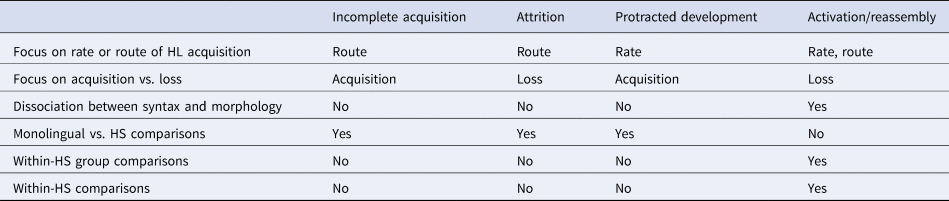
It is important to note that these theories are not necessarily mutually exclusive, because they formulate predictions at multiple levels. Incomplete acquisition, attrition and protracted development concern differences between HSs and other groups of bilinguals, either in the rate or ultimate route of acquisition, while Putnam and Sánchez's (Reference Putnam and Sánchez2013) activation and reassembly approach addresses differences between and within individual HSs. Moreover, incomplete acquisition and protracted development concern language development, while attrition and the activation and reassembly approach predict HL loss and restructuring. Table 1 summarizes the similarities and differences between these theories. The present study explores the relationships between them by testing HSs' command of the subjunctive in volitional clauses following the verb querer (‘to want’), whose structure and acquisition are reviewed at length in the following section.Footnote 1
Summary of theories of HL acquisition and maintenance

3. Spanish subjunctive mood
The subjunctive is one of three moods marked through Spanish verbal morphology, alongside the indicative and the imperative (Seco, Reference Seco1990). Mood is the morphological realization of modality, which Bosque (Reference Bosque, Hualde, Olarrea and O'Rourke2012) defines as the evaluation of the truth value of propositions. The indicative is by far the most frequent; the subjunctive occurs in approximately 7% of inflected verbs (Biber et al., Reference Biber, Davies, Jones and Tracy-Ventura2006). This structure has attracted considerable attention in heritage Spanish because it occurs in a multitude of syntactic contexts and has multiple semantic functions that are relatively infrequent in the input (see Kempchinsky, Reference Kempchinsky2009 and Quer, Reference Quer2009). Fábregas (Reference Fábregas2014) argues that the subjunctive represents multiple syntactic and semantic entailments mapped onto a single set of morphological forms, many of which have non-transparent meanings (see also Lee, Reference Lee1987 and Terrell et al., Reference Terrell, Baycroft, Perrone, VanPatten, Dvorak and Lee1987 in support of this claim).
The subjunctive occurs predominantly in subordinate clauses whose subject differs from that of the matrix clause. In certain syntactic contexts such as volitional clauses tested here, the subjunctive is the result of obligatory lexical selection. In such cases, lexical items such as strong intensional verbs (including querer) require the subjunctive in a tensed subordinate clause if there is a subject shift or infinitival forms in contexts of coreference. Following Kempchinsky (Reference Kempchinsky2009), these lexical items select the subjunctive through an uninterpretable mood feature that is checked and deleted in the heads of Force and Fin in the subordinate clause. The subjunctive is then spelled out through dedicated past or present inflections on the subordinate verb. Sentence (1) exemplifies an instance of subjunctive mood in a volitional clause.
(1) Sofía quiere que María venga a la fiesta.
Sofia want [3PS-IND] that Maria come [3PS-SUBJ] to the party.
Sofia wants Maria to come to the party.
Although English does have a subjunctive mood, this structure has been in a period of loss for centuries (Kovács, Reference Kovács2009), and acceptability judgment data indicate that many monolingual speakers find the indicative to be equally or more grammatical (Iverson et al., Reference Iverson, Kempchinsky and Rothman2008; Rojas, Reference Rojas1998). Regardless, the subjunctive is not used in English volitional clauses as in Spanish. Instead, for-to infinitival constructions are common, but tensed subordinate clauses following verbs of volition would be ungrammatical (see Iverson et al., Reference Iverson, Kempchinsky and Rothman2008 for a syntactic account). To exemplify this difference, sentence (2) would be considered ungrammatical in English (but grammatical if translated to Spanish), while sentence (3) would be considered grammatical (but ungrammatical if translated to Spanish).
(2) *Sofia wants that Maria come to the party.
Sofia want [3PS] COMP Maria come [3PS] to the party.
(3) Sofia wants Maria to come to the party.
Sofia want [3PS] Maria to come [INF] to the party.
Following this analysis, the differences between English and Spanish regarding the subjunctive in volitional clauses make it an ideal structure with which to study crosslinguistic influence within feature-based frameworks. Putnam and Sánchez (Reference Putnam and Sánchez2013) would predict morphological variability or syntactic reassembly of the Spanish subjunctive mood by HSs who have frequent activation of English.Footnote 2 At the morphological level, since there is no contrast between indicative and subjunctive in English, HSs may obviate the need for subjunctive mood inflections in Spanish and instead prefer the indicative. At the syntactic level, since English allows control structures in contexts of disjoint reference, HSs may be prone to reassemble the uninterpretable mood feature and instead use infinitival structures in subordinate clauses. Both outcomes have been documented in past research (e.g., Montrul, Reference Montrul2009; Perez-Cortes et al., Reference Perez-Cortes, Putnam and Sánchez2019).
3.1. Child development of subjunctive mood
Monolingual children produce the subjunctive in volitional clauses nearly categorically by between ages four and five (Blake, Reference Blake1983; Dracos et al., Reference Dracos, Requena and Miller2019). Monolingual children master the subjunctive in volitional clauses before other syntactic contexts (Ahern & Torrens, Reference Ahern, Torrens, Avram, Sevcenco and Tomescu2021; Pérez-Leroux, Reference Pérez-Leroux1998), but later than other inflectional structures (e.g., López Ornat et al., Reference López Ornat, Fernández, Gallo and Mariscal1994; Rodríguez-Mondoñedo, Reference Rodríguez-Mondoñedo2008). The subjunctive is consequently acquired around the onset of schooling, at which time HSs begin to experience a shift in dominance (Castilla-Earls et al., Reference Castilla-Earls, Francis, Iglesias and Davidson2019; Hiebert & Rojas, Reference Hiebert and Rojas2021; Wong Fillmore, Reference Wong Fillmore1991). For this reason, the subjunctive is a particularly useful structure with which to study the impact of exposure in contexts of HL development.
Supporting this claim, two case studies of bilingual siblings in the early school years have found a relationship between exposure and mood development (Anderson, Reference Anderson2001; Silva-Corvalán, Reference Silva-Corvalán2014). In both, the sibling who had less exposure to Spanish also had lower subjunctive production rates. In fact, Silva-Corvalán (Reference Silva-Corvalán2014) documented the complete attrition of subjunctive mood morphology from her younger grandson's production around the start of schooling. Cross-sectional work has also exposed variability in HSs' mood knowledge. Dracos and Requena (Reference Dracos and Requena2022) conducted a study with HS children between ages four and fifteen tapping production of subjunctive mood. HSs exhibited considerable individual variability modulated by morphosyntactic proficiency and patterns of language exposure. Although there was no effect for age, there was only a small sample of older children in which age effects may have emerged. Castilla-Earls et al. (Reference Castilla-Earls, Pérez-Leroux, Restrepo, Gaile and Chen2018) also showed considerable rates of subjunctive omission by English-Spanish bilingual children, particularly those who have developmental language disorders. In this study, HSs showed increased subjunctive production with age and as a result of greater exposure to Spanish. These findings align with those reported by Flores et al. (Reference Flores, Santos, Jesus and Marques2017), who provide evidence of protracted development and exposure effects in the acquisition of the Portuguese subjunctive by German-dominant child HSs. Children with higher HL exposure showed growth in subjunctive production between ages eight and twelve, while the lower-exposure group made similar gains after age twelve. These children's subjunctive production rate was at approximately 80% of that of monolingual children. However, what cannot be gleaned is whether HSs' subjunctive production would have increased, decreased or remained the same in adulthood. Across these studies, it is also unclear if children showed even stronger command of subjunctive mood at the receptive level, as only production data were taken into consideration.
3.2. Subjunctive mood in adult HSs
Despite overall lower rates of subjunctive mood production compared to Spanish-dominant adults (e.g., Martillo Viner, Reference Martillo Viner2016, Reference Martillo Viner2018; Montrul, Reference Montrul2009; Silva-Corvalán, Reference Silva-Corvalán1994a, Reference Silva-Corvalán1994b), adult HSs use the subjunctive in volitional clauses more consistently than in other contexts (van Osch et al., Reference van Osch, Hulk, Sleeman, Aalberse, Bellamy, Child, González, Muntendam and Parafita Couto2017). When comparing differences within HS populations, multiple studies have reported that morphosyntactic proficiency affects command of subjunctive mood (Giancaspro, Reference Giancaspro2019; Montrul, Reference Montrul2009; Montrul & Perpiñán, Reference Montrul and Perpiñán2011). Moreover, Perez-Cortes (Reference Perez-Cortes2016) found that an interaction between proficiency and frequency of use accounted for HSs' knowledge of the subjunctive, and those bilinguals who were less-frequent users of their HL showed greater differences between their performance on production and receptive tasks (acceptability judgment and truth value judgment). The effects for proficiency and frequency of use, and asymmetries between productive and receptive knowledge, are consonant with Putnam and Sánchez's (Reference Putnam and Sánchez2013) claims.
4. The present study
To contribute to these topics using an experiment with multiple age groups that incorporates a production task and a receptive measure, the following three research questions (RQs) were proposed, organized by level of variability (between groups of HSs, between individual HSs and within a single speaker):
1. Do child and adult HSs of Spanish increase their rates of subjunctive mood production and selection in volitional clauses with age?
Previous case studies on the acquisition of subjunctive mood have shown attrition in early childhood (Anderson, Reference Anderson2001; Silva-Corvalán, Reference Silva-Corvalán2014), yet results suggest growth in late childhood (Flores et al., Reference Flores, Santos, Jesus and Marques2017). However, these studies have not focused on older children or on comparing HS children and adults. Therefore, in line with most previous studies on child HSs' acquisition of inflectional morphology (Corbet & Domínguez, Reference Corbet and Domínguez2020; Cuza & Miller, Reference Cuza, Miller, Klassen, Liceras and Valenzuela2015; Flores et al., Reference Flores, Santos, Jesus and Marques2017; Montrul & Potowski, Reference Montrul and Potowski2007; Montrul & Sánchez-Walker, Reference Montrul and Sánchez-Walker2013; Solano-Escobar & Cuza, Reference Solano-Escobar and Cuza2023; Thane, Reference Thane2024a), it was predictable that HSs would show increases in subjunctive production throughout late childhood and into adulthood. It was hypothesized that adult HSs would produce and select more subjunctive in volitional clauses than children in seventh and eighth grades (ages 12;0–14;0), who in turn would do so more frequently than those in fifth grade (ages 10;0–11;0). This would imply an upward developmental trajectory in the acquisition of the subjunctive in adolescence that has not yet been captured in research on Spanish as a HL.
2. Do morphosyntactic proficiency and frequency of use of Spanish affect individual HSs' rates of subjunctive production and selection in volitional clauses?
In alignment with Putnam and Sánchez (Reference Putnam and Sánchez2013), previous studies have used morphosyntactic proficiency and/or frequency of use as proxies to HL exposure (e.g., Giancaspro & Sánchez, Reference Giancaspro and Sánchez2021; Perez-Cortes, Reference Perez-Cortes2016; Thane, Reference Thane2024a, Reference Thane2024b). Multiple previous experimental studies with adults have found a role for morphosyntactic proficiency in the acquisition of subjunctive mood (Giancaspro, Reference Giancaspro2019; Giancaspro et al., Reference Giancaspro, Perez-Cortes and Higdon2022; Montrul, Reference Montrul2009; Perez-Cortes, Reference Perez-Cortes2016), which is consistent with Dracos and Requena's (Reference Dracos and Requena2022) analysis in English–Spanish bilingual children. Furthermore, studies that have evaluated patterns of language use have also found a role for this variable (Castilla-Earls et al., Reference Castilla-Earls, Pérez-Leroux, Restrepo, Gaile and Chen2018; Dracos & Requena, Reference Dracos and Requena2022; Perez-Cortes, Reference Perez-Cortes2016). Therefore, it was predicted that HSs with higher morphosyntactic proficiency and who reported using Spanish more frequently would produce and select more subjunctive mood in volitional clauses.
3. Do HSs select the subjunctive in volitional clauses on a receptive task more frequently than they produce this structure?
Putnam and Sánchez (Reference Putnam and Sánchez2013) predict that HSs often exhibit asymmetrical knowledge of morphosyntactic structures across tasks, such that they may select or interpret them more frequently on receptive measures than they produce them. Perez-Cortes (Reference Perez-Cortes2016) supports this claim in research on adult HSs' subjunctive systems. Therefore, the same patterns were predicted for the present study, whereby all HS groups would select the subjunctive more frequently than they would produce it. It was also predicted that HSs with lower levels of use of Spanish would be more impacted by these task effects.
4.1. Participants
One hundred and twenty-seven bilinguals participated in this study, broken into four groups: Spanish-dominant bilingual adults (SDBA; n = 18), HS adults (HSA; n = 34), HSs in seventh and eighth grade (HS7/8; n = 34) and HSs in fifth grade (HS5; n = 41). The SDBA participants (average age: 33.6, SD = 10.1) were raised monolingually in Spain (five participants), Colombia (three participants), Argentina, the Dominican Republic (two participants each), Chile, Mexico, Peru, Puerto Rico, and Venezuela (one participant each). One participant did not report his country of origin. In a comprehensive evaluation of multiple dialects of Spanish, Faulkner (Reference Faulkner2021) did not report variability in the use of the volitional subjunctive, suggesting that there would be commonality among all of these speakers. Since it has been demonstrated in two separate previous studies that monolingual children produce the subjunctive nearly categorically between ages four and five (Blake, Reference Blake1983; Dracos et al., Reference Dracos, Requena and Miller2019), age-matched monolinguals did not participate.
The HSA was comprised of HSs above age eighteen (average age: 24, SD = 7.4). Many participants were undergraduate students at a public research university.Footnote 3 These HSs had not received a primary or secondary bilingual education, but some were participating in undergraduate courses in Spanish. These HSs represented a highly diverse group with speakers of Colombian, Dominican, Mexican (four each), Peruvian, Spanish (three each), Bolivian, Cuban, Ecuadorian, Guatemalan, Honduran, Panamanian, Puerto Rican (two each) and Nicaraguan (one each) descent, with some participants from families from multiple Spanish-speaking countries. One participant did not indicate his family's place of origin.
The HS7/8 and HS5 students were primarily sequential bilinguals enrolled in two school districts. Both school districts were predominantly Hispanic (86% in both schools), all children reported Spanish as the dominant or only language spoken at home, and school reports revealed highly similar socioeconomic profiles of their respective student bodies. The majority of HS7/8 and HS5 were of Mexican descent, although there were also participants with home exposure to other Caribbean and Central American dialects. Table 2 summarizes each group's frequency of use of Spanish, morphosyntactic proficiency as measured on the BESA and DELE exams (see below), and number of monolingual Spanish-speaking parents, which roughly represents the concentration of sequential bilinguals in each HS group. Students in one school were enrolled in a dual language immersion programme, while those in the English-only school did not receive any instruction in Spanish. There was no difference in rates of subjunctive production or selection between the children in each school (see Thane, Reference Thane2024b for evidence).
Characteristics of each participant group

4.2. Experimental tasks
Data collection took place using Qualtrics software with an audio integration powered by Phonic.ai. Adults carried out the experiment asynchronously, while children completed the tasks using laptop computers in their schools with the researcher present. The first task was a language background questionnaire concerning participants' exposure to and frequency of use of Spanish. Specifically, participants reported how frequently they used Spanish in six contexts (with parents, with other family members, with friends, at school, in public, while watching television) using 1–5 Likert scales with descriptors. The sum of these Likert scales reflected frequency of use of Spanish in the statistical analyses. Note that, in departure from previous studies on young bilingual children, the participants themselves were of sufficient age to complete this brief questionnaire, rather than their parents. The advantage of this approach is that children can provide more direct approximations of their language use in contexts where their parents are not present (Castilla-Earls et al., Reference Castilla-Earls, Ronderos and Fitton2022).
Following the questionnaire, participants also completed a fourteen-item subset of the Bilingual English-Spanish Assessment (BESA; Peña et al., Reference Peña, Gutiérrez-Clellen, Iglesias, Goldstein and Bedore2014) morphosyntax section in Spanish testing gender and number agreement in determiner phrases (k = 4), gender clitics (k = 4), verbal agreement (k = 4) and preterit aspect (k = 2).Footnote 4 This task has been used frequently in other research on bilingual children, including Dracos and Requena's (Reference Dracos and Requena2022) study on subjunctive mood. The number of answers matching the anticipated responses reflected each participants' BESA proficiency score. Adults also carried out a lengthier exam modified from the Diploma del español como lengua extranjera (DELE), which has been used extensively in adult research (e.g., Duffield & White, Reference Duffield and White1999; Montrul & Slabakova, Reference Montrul and Slabakova2003), including on subjunctive mood (Giancaspro, Reference Giancaspro, Brehmer and Treffers-Daller2020; Montrul, Reference Montrul2009; Perez-Cortes, Reference Perez-Cortes2016).Footnote 5
The two experimental tasks targeted the production and selection of the volitional subjunctive mood following the frequent matrix verb querer (to want) in volitional clauses. Including productive and receptive measures is critical for dissociating variability in production from underlying knowledge, as Putnam and Sánchez (Reference Putnam and Sánchez2013) argue. Both tasks followed a communicative focus in which a mother shared the desires for two twin sisters to care for their younger brother while they are away at sleepaway camp. Given morphological regularity can affect HSs' production and processing of subjunctive mood (e.g., Giancaspro et al., Reference Giancaspro, Perez-Cortes and Higdon2022; López-Beltrán & Dussias, Reference López-Beltrán and Dussias2023), the same eight morphologically regular, disyllabic –ar verbs were used one time in each task.
In the elicited production task (EPT), participants read brief prompts concerning the volitional subjunctive that ended in ¿Qué quiere la mama? Quiere que las hermanas… (What does the mother want? The mother wants for the sisters…). The verb querer is among the most frequent in Spanish and lexically selects the subjunctive in subordinate clauses. Participants needed to complete the subordinate clause orally using the verb whose infinitive appeared in parentheses, as well as any other words they felt were necessary. The children's EPT contained eight target items as well as eight distractors not reported here. The adult data contained 31 additional distractors. The online supplementary materials contain a list of stimuli that elicited the volitional subjunctive on the EPT in Appendix S2.Footnote 6 Figure S1 in the online supplementary materials displays a sample prompt from the EPT as displayed on Qualtrics.
The forced choice task (FCT) tested HSs' selection of mood when given a binary choice between subjunctive and indicative. On this written receptive task, participants read similar prompts and needed to select which of two sentences they felt looked best. The two sentences started with la mamá quiere que… (the mother wants that…), which expectedly results in a tensed subordinate clause with subjunctive morphology. The two options differed only in the subjunctive or indicative moods, such that participants needed to make a selection that reflected their recognition of this contrast. The FCT included eight items eliciting volitional subjunctive using the same subordinate verbs as the EPT, as well as fourteen distractors. Adults completed an additional 33 distractors. The online supplementary materials contain a list of stimuli that targeted participants' selection of the volitional subjunctive on the FCT in Appendix S3. Figure S2 in the online supplementary materials displays a sample stimulus from the FCT as displayed on Qualtrics.
It should be noted that the FCT, which tested receptive knowledge of subjunctive mood, was administered in written format, while the EPT targeted oral production. Previous studies on the acquisition of Spanish as a HL have shown that HSs are generally more consistent with Spanish-dominant speakers on oral measures than on written tasks (Bowles, Reference Bowles2011a, Reference Bowles2011b; Fernández Cuenca & Bowles, Reference Fernández Cuenca, Bowles and Bowles2022). Therefore, if participants' rates of subjunctive selection on the FCT exceed those of the EPT, this suggests that the asymmetry between productive and receptive knowledge impacts HSs more greatly than task modality (oral versus written).
5. Results
The results section begins with a description of the coding and independent variables in section 5.1. Section 5.2 includes an analysis of group-level descriptive results, followed by individual analyses in section 5.3. Multivariate analyses are presented in section 5.4, followed by a summary in section 5.5.
5.1. Coding and analysis
The researcher conducted all statistical analyses using RStudio (R Core Team, 2022) with the emmeans (Lenth, Reference Lenth2021), lmer (Bates et al., Reference Bates, Mächler, Bolker and Walker2015), lmerTest (Kuznetsova et al., Reference Kuznetsova, Brockhoff and Christensen2017) and tidyverse (Wickham et al., Reference Wickham, Averick, Bryan, Chang, McGowan, François, Grolemund, Hayes, Henry, Hester, Kuhn, Pedersen, Miller, Bache, Müller, Ooms, Robinson, Seidel, Spinu and Yutani2019) packages. All data were deidentified, coded, analyzed and uploaded to a public GitHub repository (https://github.com/pthane/DLI-Morphosyntax-2023, see BLC subfolder). Only the subjunctive responses were analyzed. The dependent variable in the present study was operationalized as binary, according to whether the participants' responses contained the present tense subjunctive inflections in the expected instances. All responses containing present tense subjunctive mood inflections were awarded a score of 1, including in instances of person/number agreement errors. Indicative, infinitival, and alternative forms received a score of 0.
Furthermore, data from the language questionnaire and proficiency tasks were integrated to generate independent variables. The categorical variable for group included SDBA, HSA, HS7/8 and HS5. Furthermore, the variable for task included the binary distinction between the EPT and FCT. Following Ortega (Reference Ortega2020), to capture the full spectrum of variability in HSs' grammatical knowledge, proficiency and frequency of use were included as continuous independent variables. All participants' BESA proficiency scores were incorporated, operationalized as the number of expected responses (maximum fourteen). The DELE proficiency scores from the HSA group were also reported by calculating the number of expected responses on this measure (maximum fifty). Finally, participants' frequency of use was the sum of the six 1–5 Likert scales on the language questionnaire (maximum thirty). All three of the continuous variables were standardized (z-scores) prior to statistical analysis so that they would be evaluated along a consistent scale.
5.2. Descriptive analyses
Because each of the 127 participants provided eight responses on each task, there were an anticipated total of 2,032 observations for analysis. Sixty three out of 1,016 responses (6.2%) in the EPT were discarded in which participants did not produce a response or did not save their recording before advancing to the following question. This left 953 observations in the production data for analysis, in which 556 (58.3%) contained subjunctive mood and 397 (41.6%) contained alternative structures. As in previous research, the most frequent alternative form produced across groups was the indicative, used in 332 of the non-subjunctive responses (83.6%), followed by infinitival constructions in forty-two instances (10.4%). Participants also produced the periphrastic future in thirteen instances (3.2%),Footnote 7 the imperfect subjunctive in five instances (1.2%), the imperfect indicative in two instances (.4%), the future tense in two instances (.4%) and the preterit past in one instance (.2%). Five miscellaneous forms whose inflections could not be identified (1.2%) were produced.
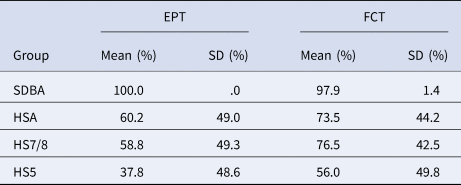
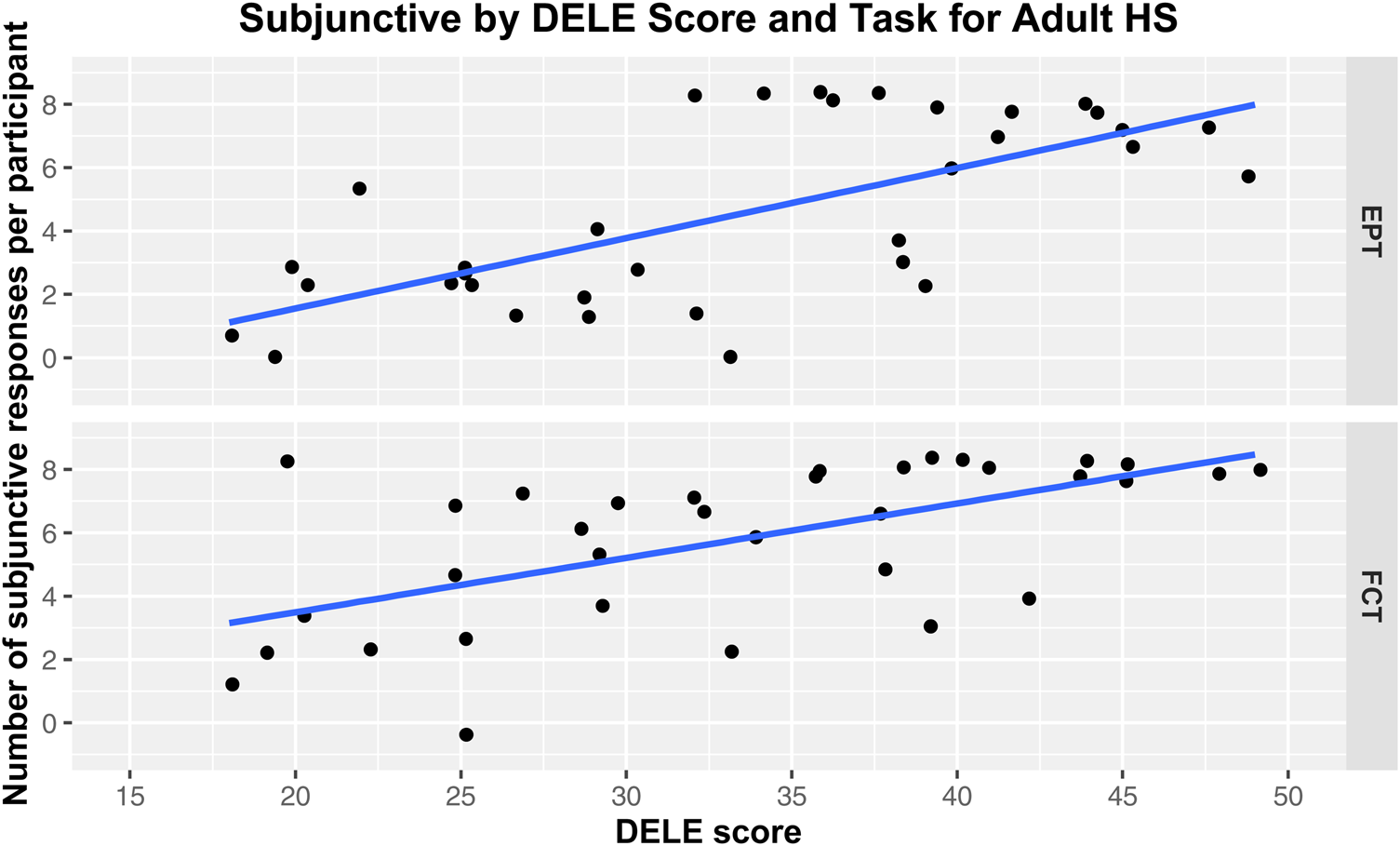
Table 3 and Figure 1 show each group's rates of subjunctive production and selection. The results of Table 3 are presented as percentages in visual form in Figure S3 of the supplementary online materials. The roles of BESA proficiency and frequency of use are summarized in Figures 2 and 3, respectively. Finally, the role of DELE proficiency in HSA participants' subjunctive mood knowledge is visualized in Figure 4. These data reveal categorical production and nearly categorical selection of subjunctive mood by the SDBA group, but greater variability for HSs. While HSA and HS7/8 groups appeared to have similar subjunctive tendencies, both groups had higher production and selection rates than the HS5 group. All HS groups appeared to select the subjunctive more frequently than they produced this structure, and use of subjunctive in both tasks appeared to increase as a function of both metrics of proficiency and self-reported frequency of use of Spanish.
Average and standard deviation in percentage of responses containing subjunctive on EPT and FCT by group

Statistical summary of subjunctive mood production and selection by group.

Rates of subjunctive production and selection by BESA proficiency.

Rates of subjunctive production and selection by frequency of use of Spanish.

Subjunctive mood production and selection by DELE proficiency.

5.3. Individual analyses
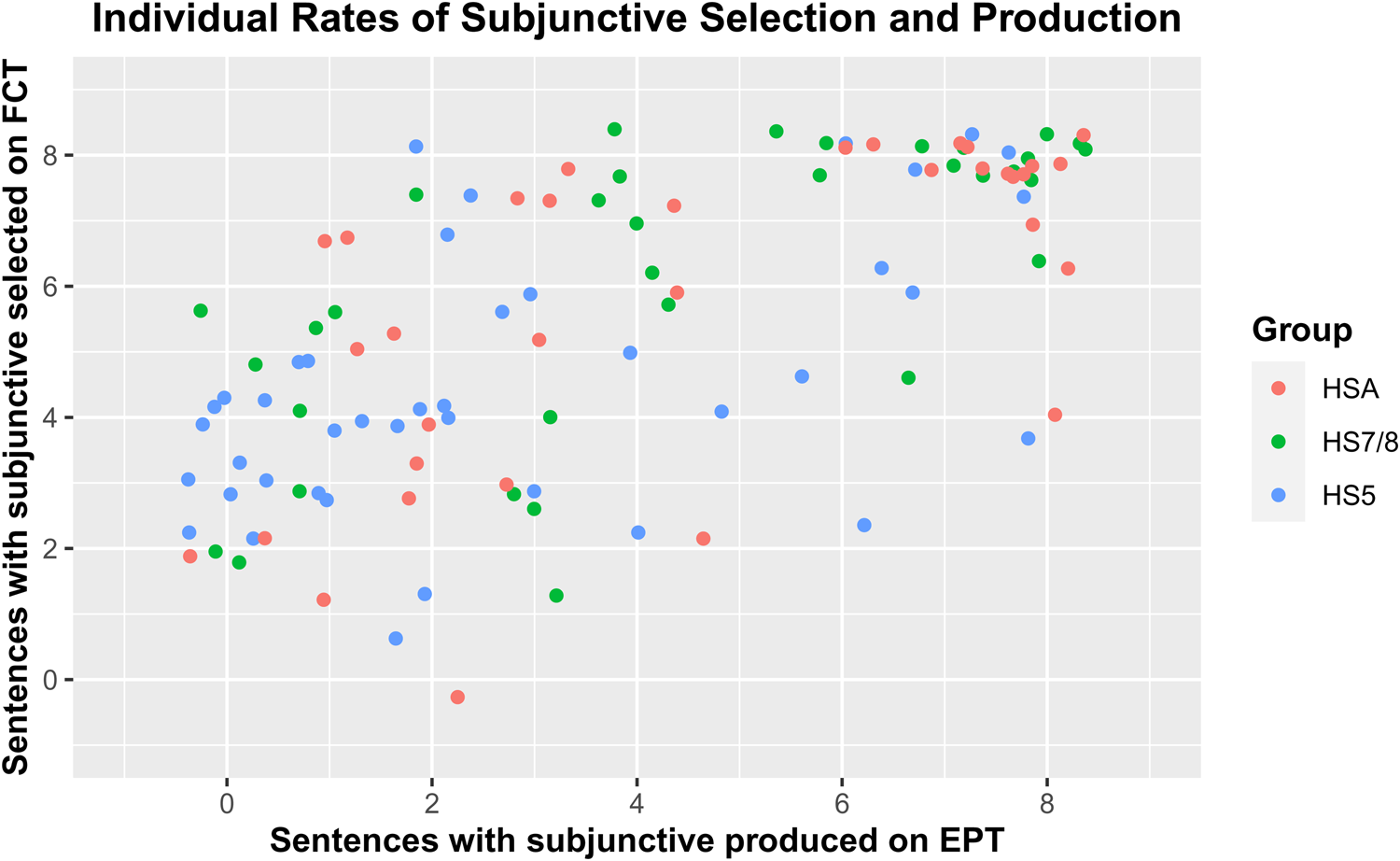
The inclusion of individual analyses provides a more nuanced perspective into the extent of variability in subjunctive mood production and selection. Each HS participant's rates of subjunctive production and selection are shown in Figure 5. In line with the descriptive data shown in Figure 1, most participants selected the subjunctive as frequently as or more frequently than they produced it. While there is considerable variability in participants' use of the subjunctive, all produced and/or selected this structure in at least 2/16 instances. All SDBA participants produced and selected the subjunctive in at least 15/16 contexts; there were 25/109 HSs (four HS5, ten HS7/8, eleven HSA; 22.9% of HS participants overall) who performed within this range. Therefore, while the HS participants differed at the group level in their production and selection of subjunctive mood, as represented in Figure 1, approximately 1/4 of HSs converged on SDBA participants in this study. Moreover, there was a higher percentage of HSA than HS7/8 participants who used the subjunctive within the range of the SDBAs; the same trend was evident when comparing the HS7/8 to the HS5 group, suggesting increased mastery of the subjunctive with age. Not a single HS exhibited categorical omission, arguing against the complete absence of this feature from any of their grammars.
Individual rates of production and selection of subjunctive by HS participant.

5.4. Multivariate analyses
To address the descriptive data using multivariate statistics, three generalized linear mixed methods (GLMM) binomial logistic regression models were necessary. In all GLMM models, the suppliance of subjunctive was the dependent variable, as outlined above in the descriptive statistics and individual analyses. Unlike many previous studies where different tasks are addressed through separate statistical models, performing analyses on both tasks at the same time allows for greater insight into the possible productive–receptive asymmetries targeted in RQ3. Such an approach has been utilized in recent research on Spanish as a HL (e.g., Thane, Reference Thane2024a, Reference Thane2024b).
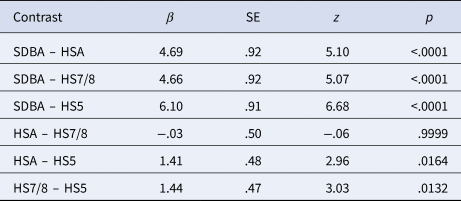
The first GLMM model evaluated group-level differences using data from all groups. This was necessary to evaluate differences between HS age groups, as addressed in RQ1. Group was therefore included as the predictor, with SDBA set as the reference level. The resulting model revealed statistically significant effects for each group of HSs: HSA (β = –4.70, SE = .92, z = –5.10, p < .001), HS7/8 (β = –4.66, SE = .92, z = –5.07, p < .001), and HS5 (β = –6.10, SE = .91, z = –6.69, p < .001). To determine if the differences between the groups of HSs were significant at the p < .05 level, Tukey post-hoc comparisons were necessary. The results of the post-hoc comparisons, summarized in Table 4, indicate that all HS groups differed from the SDBA baseline, and both the HSA and HS7/8 differed from the HS5. However, the HSA and the HS7/8 did not differ from one another.
Results of Tukey post-hoc comparisons for group

The second GLMM model evaluated the effects of task, BESA proficiency, and frequency of use with the HSs' data only. The interactions between task and BESA proficiency as well as between task and frequency of use were also included. This model was essential for evaluating RQ2 and RQ3. The results indicated main effects for task (β = 1.11, SE = .13, z = 8.50, p < .001), BESA proficiency (β = .46, SE = .20, z = 2.22, p = .026), and frequency of use (β = .53, SE = .20, z = 2.61, p = .009). The task by proficiency interaction (β = .12, SE = .13, z = .88, p = .377) and task by frequency of use interaction (β = –.16, SE = .14, z = –1.13, p = .260) were not significant at the p < .05 level.
In addition, it is useful to interpret adults' proficiency data in greater detail using the additional measure, the DELE. A final GLMM model was fit with HSA participants' responses from the EPT and FCT. This GLMM model allowed for further insight into RQ2, which addressed the role of proficiency. Participants' DELE proficiency and task, as well as the interaction between them, were included as fixed effects, with participant and item as random effects. The resulting model revealed main effects significant at the p < .05 level for DELE proficiency (β = 1.95, SE = .38, z = 5.14, p < .001) and for the FCT (β = 1.14, SE = .31, z = 3.70, p < .001), but not their interaction (β = .06, SE = .33, z = .19, p = .852). This implies that patterns of exposure, reflected through adult participants' proficiency scores (per Giancaspro & Sánchez, Reference Giancaspro and Sánchez2021), as well as the type of task, affected HSs' knowledge, but that DELE proficiency did not influence performance on one task more than the other.
5.5. Summary
The inferential and descriptive results show that at the group level, HS participants' knowledge of subjunctive mood increases between fifth and seventh/eighth grades, but there were no differences in the descriptive or inferential statistics between the HS7/8 and HSA groups. HSs selected the subjunctive more frequently on the FCT than they produced this structure, an effect that was significant at the p > .05 level. Within and across age groups, BESA proficiency and frequency of use of Spanish accounted for variability between participants. Additionally, the adult proficiency data from the DELE accounted for variability in adults' rates of subjunctive production and selection. The individual analyses complement these findings and reveal that all HSs produced and/or selected the subjunctive mood in at least 2/16 contexts, arguing against the absence of this feature from their grammar, and 25 HSs' rates of subjunctive use converged on those of the SDBA.
6. Discussion
While the Spanish subjunctive mood has been a frequent topic in HL research, the present project is the first to evaluate its acquisition across late childhood and into adulthood. Through an analysis at the group level, this experiment explores the acquisition of subjunctive morphology cross-sectionally. This approach is useful to distinguish between incomplete acquisition and attrition in the absence of lengthy longitudinal studies (Montrul, Reference Montrul, Herschensohn and Young-Scholten2013). At the individual level, this experiment tracks how proficiency in and frequency of use of Spanish can account for differences between HSs. Additionally, it evaluates the role of asymmetrical productive and receptive knowledge at the within-speaker level. Testing multiple layers of variability contributes to Putnam and Sánchez's (Reference Putnam and Sánchez2013) approach within growing scholarship on feature-oriented accounts of HL acquisition (e.g., Lohndal & Putnam, Reference Lohndal and Putnam2021, Reference Lohndal and Putnam2024; Putnam & Sánchez, Reference Putnam and Sánchez2013; Putnam et al., Reference Putnam, Schwarz, Hoffman, Polinsky and Montrul2021). Furthermore, this project explores protracted development and possible incomplete acquisition and attrition across these age groups.
RQ1 addressed whether age would modulate HSs' knowledge of subjunctive mood in volitional clauses. It was predicted that HSs would show increased command from fifth grade to adulthood, in line with studies on other areas of the Spanish inflectional system. At the group level, HS7/8 and HSA were indistinguishable from one another, but produced and selected more subjunctive than the HS5 group. This partially supports the predictions, as HSs appear to be adult-like by early adolescence. The HS7/8 and HSA groups produced similar levels of subjunctive mood morphology with regular verbs to those of adult HSs in Giancaspro et al.'s (Reference Giancaspro, Perez-Cortes and Higdon2022) experiment, and of participants with intermediate proficiency in Montrul's (Reference Montrul2009) study. Therefore, the similar production rates between the HS7/8 group and the adults across these three studies suggests that HSs converge on the bilingual adult-like subjunctive mood system by early adolescence. This is also consistent with Flores et al.'s (Reference Flores, Santos, Jesus and Marques2017) study testing Portuguese HSs' subjunctive mood knowledge.
RQ2 addressed whether proficiency in and frequency of use of Spanish, which represent patterns of HL exposure (Giancaspro & Sánchez, Reference Giancaspro and Sánchez2021), would shape HSs' knowledge of subjunctive mood. In alignment with previous studies, as well as Putnam and Sánchez's (Reference Putnam and Sánchez2013) framework, it was predicted that both variables would account for variability between individual HSs. These predictions were upheld by the BESA and DELE proficiency tests and by the effect of frequency of use of Spanish.
Finally, RQ3 addressed the possible asymmetries between HSs' productive and receptive knowledge of subjunctive mood in volitional clauses. In line with Putnam and Sánchez's (Reference Putnam and Sánchez2013) predictions, it was anticipated that HSs, particularly those with less-frequent HL use, would select the subjunctive more frequently on the FCT than they would produce this structure on the EPT. The effect of task supports this prediction and aligns with previous research showing that HSs have asymmetrical performance between productive and receptive domains (Giancaspro & Sánchez, Reference Giancaspro and Sánchez2021; Perez-Cortes, Reference Perez-Cortes2016; Perez-Cortes et al., Reference Perez-Cortes, Putnam and Sánchez2019; Sherkina-Lieber, Reference Sherkina-Lieber2015; Thane, Reference Thane2024a, Reference Thane2024b). However, exposure did not modulate the degree of these asymmetries, so the prediction is only partially upheld.
Having spelled out the results relative to the hypotheses, it is useful to turn to a broader discussion of how these findings contribute to the theories of HL acquisition addressed throughout this paper and summarized in Table 1. The finding that cross-sectionally, HSs show an upward trend in the acquisition of mood argues against its attrition in older bilinguals who, after reaching adulthood, may have experienced decreased patterns of HL use. This does not directly support the predictions of Putnam and Sánchez's (Reference Putnam and Sánchez2013) model, which posits reassembly of HL features over time. Instead, the data argue that many (but, crucially, not all) HSs experience protracted development, but have converged on their adult-like mood system that is quantitatively different from SDBA baselines by early adolescence. These results are similar to Flores et al.'s (Reference Flores, Santos, Jesus and Marques2017) study, in which Portuguese HSs' subjunctive production rates remained steady at and after adolescence, at approximately 80% of the contexts in which age-matched monolinguals produced the same structure. This is an impressive accomplishment given that most HSs' exposure to Spanish is reduced upon the onset of schooling, yet at the group level, these bilinguals were able to acquire the mood feature that is not highly frequent in their already reduced input, albeit differently and variably.
Since HSs' production and selection rates differ from those of SDBAs', results also could be interpreted as evidence for the incomplete acquisition of subjunctive mood by bilingual adolescents and adults. This theory correctly predicts quantitative, group-level differences between HSs' mood production and selection tendencies and those of a bilingual baseline. However, while HSs differ from SDBAs at the group level in terms of their production and selection tendencies, incomplete acquisition theory does not elucidate why none of the participants categorically omits the subjunctive in these instances.
In contrast, feature-based accounts that dissociate morphological competence from underlying syntactic representation provide a more precise account of inconsistent use of subjunctive mood. For instance, Lohndal and Putnam (Reference Lohndal and Putnam2021) argue that persistent variability in mapping syntactic features onto morphological forms is typical in HL acquisition. Therefore, this account recognizes that HSs may possess a syntactic representation that they do not consistently map onto inflectional morphology, rather than a representational deficit. The data presented herein are more compatible with this approach, particularly since such difficulties are more pronounced in production, as Putnam and Sánchez (Reference Putnam and Sánchez2013) predict.
HSs' variable use of subjunctive mood is also consistent with previous large-scale analyses of naturalistic data concerning subjunctive development. Specifically, both Silva-Corvalán (Reference Silva-Corvalán1994a, Reference Silva-Corvalán1994b) and Martillo Viner (Reference Martillo Viner2016) reveal gradual yet partial loss of subjunctive mood over generations. In fact, in his naturalistic data, Martillo Viner (Reference Martillo Viner2016) reports that adult HSs used the Spanish subjunctive in all of the same contexts of obligatory selection as SDBAs, but with greater variability, leading him to describe that HSs possess a “variable mood grammar” (p. 343).
While feature-based accounts that posit a dissociation between mapping forms onto morphology and syntactic representation provide an advantage in accounting for the variable use of the subjunctive, the theories reviewed so far do not provide insight into what factors condition individual patterns of subjunctive use. Putnam and Sánchez's (Reference Putnam and Sánchez2013) approach offers a promising explanation, as it correctly predicted that HSs with higher proficiency in and frequency of use of Spanish would produce and select the subjunctive more frequently. Moreover, as stated, this framework correctly predicted asymmetries favoring receptive over productive knowledge. However, age, exposure and proficiency do not modulate asymmetrical knowledge between tasks, which exposes a nuance of Putnam and Sánchez's (Reference Putnam and Sánchez2013) hypothesis that could merit further exploration. Specifically, these researchers predict that decreased exposure to Spanish results in more asymmetrical knowledge and/or a decrease in mood production and selection over time due to greater activation of English. While productive–receptive asymmetries and the influence of proficiency and exposure account for individual rates of subjunctive use as Putnam and Sánchez (Reference Putnam and Sánchez2013) predict, the directionality of age effects does not point toward reassembly of the HL grammar over time, but rather towards protracted development.
With adjustments, Putnam and Sánchez's (Reference Putnam and Sánchez2013) framework may be able to account for the protracted acquisition of HL morphology and syntax by bilingual children heading into adulthood. One possibility is that these predictions are bidirectional. In this regard, what may be evident in the present study is the initial assembly (rather than reassembly) of features, whereby HSs acquire the ability to interpret structures such as the subjunctive before they produce them reliably. This would align with the predictions of a recent interpretation of the feature reassembly framework in second language acquisition proposed by Thane (Reference Thane2024b), arguing that receptive knowledge develops gradually and stabilizes before production.Footnote 8 If this were the case, Putnam and Sánchez's (Reference Putnam and Sánchez2013) predictions could correctly predict the initial HL acquisition of functional features such as mood in addition to subsequent reassembly as a result of decreased exposure. This approach to the study of HL acquisition could even unify the theories of incomplete acquisition or attrition, whose predictions are unidirectional and do not emphasize individual and within-speaker differences as extensively, under a single account.
To summarize, the framework of incomplete acquisition correctly predicts differences at the between-groups level, but does not provide extensive explanations as to why HSs differ from one another. Individual patterns of proficiency and frequency of use, taken as proxies for HL exposure, and asymmetries between productive and receptive knowledge at the within-speaker level, support Putnam and Sánchez's (Reference Putnam and Sánchez2013) framework. This highlights that these frameworks can, to some degree, be complementary. However, while Putnam and Sánchez's (Reference Putnam and Sánchez2013) framework has greatly advanced the study of HL acquisition by shifting the focus to within-group and within-speaker differences, the data from the present study are contra the direction of the predictions that these researchers advance. Rather than feature reassembly, older children and adults show evidence of growth in their acquisition of this morphological structure. This study thus joins a growing body of work documenting protracted development of Spanish as a HL (e.g., Corbet & Domínguez, Reference Corbet and Domínguez2020; Cuza et al., Reference Cuza, Pérez-Tattam, Barajas, Miller, Sadowski and Schwieter2013; Martinez-Nieto & Restrepo, Reference Martinez-Nieto and Restrepo2022; Montrul & Potowski, Reference Montrul and Potowski2007; Montrul & Sánchez-Walker, Reference Montrul and Sánchez-Walker2013; Solano-Escobar & Cuza, Reference Solano-Escobar and Cuza2023; Thane, Reference Thane2024a).
An unintentional yet interesting consequence of the present study is that it appears that receptive tasks favor the recognition of the subjunctive more than production, in spite of differences in modality. Previous research (e.g., Bowles, Reference Bowles2011a, Reference Bowles2011b; Fernández Cuenca & Bowles, Reference Fernández Cuenca, Bowles and Bowles2022) has shown that HSs show stronger performance on oral measures than written tasks. However, the opposite was true in the present experiment, which invites the interpretation that HSs' receptive knowledge is generally stronger than their production regardless of task modality. Future research that uses two production tasks (one written and one oral) as well as two receptive tasks (one written and one oral) would be better equipped to fully tease apart the effects of domain from modality. Such a study that separates domain from modality could also contribute to disentangling the potential confound between written tasks and metalinguistic knowledge.
Before concluding, it is vital to recognize the limitations of this experiment. First, the present study did not take HSs' age of acquisition into consideration, which has been tied to the development of subjunctive mood (Giancaspro, Reference Giancaspro2019). Additionally, while the present study makes an important contribution to research on mood development and HL acquisition in adolescence, it would have benefitted from younger children to expand the age range studied. Younger children would be especially important for exploring whether HSs' receptive knowledge develops before production, which would support the possible adaptation of Putnam and Sánchez's (Reference Putnam and Sánchez2013) model to HL acquisition in childhood. Moreover, a more implicit interpretation task may have revealed that participants had higher rates of subjunctive selection than found in this study, but such a task would be difficult to design since the subjunctive in volitional clauses is uninterpretable. A final limitation that is crucial for future research is that in its attempt to avoid bilingual versus monolingual comparisons (following Pascual y Cabo & Rothman, Reference Pascual Y Cabo and Rothman2012 and Rothman et al., Reference Rothman, Bayram, DeLuca, Di Pisa, Duñabeitia, Gharibi, Hao, Kolb, Kubota, Kupisch, Laméris, Luque, van Osch, Pereira Soares, Prystauka, Tat, Tomić, Voits and Wulff2023), the present study did not incorporate a group of monolingual children. Future research could incorporate both a bilingual adult comparison group and age-matched monolingual peers (or bilingual peers raised in a Spanish-dominant environment) to fully elucidate the roles of age, exposure, and bilingualism in the acquisition of the volitional subjunctive.
7. Conclusion
These limitations notwithstanding, the present study joins growing previous research (e.g., Corbet & Domínguez, Reference Corbet and Domínguez2020; Cuza et al., Reference Cuza, Pérez-Tattam, Barajas, Miller, Sadowski and Schwieter2013; Martinez-Nieto & Restrepo, Reference Martinez-Nieto and Restrepo2022; Montrul & Potowski, Reference Montrul and Potowski2007; Montrul & Sánchez-Walker, Reference Montrul and Sánchez-Walker2013; Solano-Escobar & Cuza, Reference Solano-Escobar and Cuza2023; Thane, Reference Thane2024a) showing protracted development of Spanish as a HL. Contra the predictions, HSs in seventh and eighth grade pattern with adults in both their production and selection of mood. However, HS7/8 participants produced and selected more subjunctive mood morphology than fifth-grade children, arguing that HSs continue to acquire this structure through adolescence. These findings show that HSs appear to reach adult-like mood systems that differ in terms of quantitative levels of mood production compared to SDBAs, and that their HL proficiency and frequency of use of Spanish account for differences between participants. These findings make important theoretical contributions to traditional approaches to HL acquisition such as incomplete acquisition and especially to more recent frameworks that separate syntax and morphology and that emphasize individual differences (Putnam & Sánchez, Reference Putnam and Sánchez2013). Findings also point to protracted development across late childhood.
Supplementary material
The supplementary material for this article can be found at https://doi.org/10.1017/S1366728924000440.
Data availability statement
The anonymized data and code that support the findings of this study are available on a public GitHub repository: https://github.com/pthane/DLI-Morphosyntax-2023. The figures and code relevant to the present manuscript can be found in the BLC (Subjunctive Age) subfolder in the Manuscripts subdirectory. Interested readers may consult the Introduction text file on the main page of the repository for more detailed instructions.
Acknowledgments
The author thanks Jennifer Austin, Joseph Casillas, David Giancaspro, Silvia Perez-Cortes and Liliana Sánchez for their contributions to the success of this paper, as well as the two schools and all of the participants who generously made this project possible.
Competing interests
The author(s) declare none.





 Open access

