


1. Introduction
1.1. The 'wicked' problem of climate change - from nature-based solutions to smart nature-based systems
The risks posed by climate change to urban habitations globally has precipitated a greater emphasis on both the 'resilience' and 'sustainability' of products designed for, and diffused into, the construction sector. Integrating sustainability objectives enhances the adaptive capacity of ecosystems, resilience reinforces a systems' capacity to absorb and recover from climatic disturbances. Multiscalar problems such as how to innovatively renature cities and enable climate sensitive development requires a system of systems approach including Nature-based solutions (NBS), particularly those which have sensing technologies and are supported by digital twins (D.T) and (A.I.). The European Commission (2023) defines NBS as “Solutions that are inspired and supported by nature, which are cost-effective, simultaneously provide environmental, social and economic benefits and help build resilience...” Little critical attention has been paid to the design of the engineered solutions required to support NBS or their adoption. Galle et al. (Reference Galle, Nitoslawski and Pilla2019) and Voeten et al. (Reference Voeten, Snep and van Hutten2020) have alluded to the possibilities of what they term the 'internet of nature' or 'high tech NBS', but do not suggest any new frameworks for the design of such hybrid solutions. The concept of 'nature tech' also lacks the theoretical underpinnings to adequately explain smart NBS (Reference DjurickovicDjurickovic, 2023). The transition of these 'solutions' to 'systems' is challenging due to the diversity of such interventions and their applications. For the purposes of this paper, the focus is on solutions which are 'engineered' and utilised in urban settings, described as type 3 NBS (Reference Cohen-Shacham, Walters, Janzen and MaginnisCohen-Shacham, 2016). Whilst Bressane et al. (Reference Bressane, Loureiro, Madeiros, Moruzzi, Formiga, Negri and Saraiva2024) describe what they term 'intelligent nature-based solutions' to address urbanisation challenges, they do not address the complexities at product or system level. Examples of 'smart' NBS' include smart green blue roofs, tree pits, raingardens and living walls. Below shows the 'Polysync' smart green blue roof, one of the case study systems selected for this research:
Smart roof system

'Smart nature-based system' is our definition of such hybrid, modified, naturally occurring systems linked to weather data, augmented by sensing, D.T and A.I technology to deliver optimum ecosystem services, social and economic value. Porter and Heppelmann (2014), describe the evolution of smart connected products to systems of systems and the new 'technology stacks' required to offer optimal value. They warn of the impact this transition to a system of systems has on what they term 'legacy organisations', particularly manufacturers. Momeni et al. (2023) highlight the structural, sociopolitical, and emergent complexities they associate with digital servitization in manufacturing firms, a useful starting point to understand the sources of complexity when developing smart nature-based systems.
1.2. Complexity and smart nature-based systems - delineating from other complex adaptive systems
We argue that there are forms of complexity specific to the integration of natural, engineered and technological components that constitute a smart nature-based system, which distinguishes them from other complex engineered systems (CAS). Ahmad et al (Reference Ahmad, Baryannis and Hill2024) advance a novel definition of complex, adaptive systems including adaptation, aggregated behaviour, learning, self-organisation and emergence, memory, evolutionary process and complexity as components of a CAS. They refer to the concept of 'agency' when considering a system's capacity to leverage memory and learning to self-organise and evolve over time. We argue that this question of 'agency' in terms of smart nature-based systems distinguishes them from other CAS. Human interventions using engineered physical systems and digital infrastructure to augment and enhance urban nature presents additional complexity when we consider agency. The living element of the nature-based solution design will have its own natural evolutionary trajectory and adaptations but when we integrate D.T, A.I and sensor technologies, remotely intervening in the maintenance of the system, we are transforming the 'agency' of the natural infastructure we are looking to support. Sheard and Motashari (Reference Sheard and Motashari2010) advanced six types of complexity including socio-political which requires expansion to specifically address the cognitive complexities associated with a world in which climate and nature are increasingly at the forefront of the decision-making process in the construction / built environment sector. Their treatment of dynamic and structural complexity fails to account for how living systems might be incorporated into their taxonomy. Maier's dimensions of complexity (Reference Maier2009) ignores the difference between physical and digital technologies which is essential when considering the new technological-ecological relationships being established with the advent of smart nature-based solutions. His treatment of organisational complexity, focused on maturity, also misses the specific complexities associated with inter-organisational partnerships. Young, Farr and Valerdi (2010) conceptualise product complexity as purely physical and only refer to 'IT complexity'. This illustrates the importance of revising such models to fully encompass systems in which physical includes both man made and ecological elements and augmented with D.T and A.I technologies. Zou et al. (Reference Zou, Braz and Risto2018), observe that multiplicity, diversity, interdependence and variability are common factors of smart-connected products. Krucken and Meroni (Reference Krucken and Meroni2006) emphasise networks of relationships and information exchange. Suh (Reference Suh2005) presents two views of complexity one being physical, the other functional. The functional focused on the uncertainties associated with user requirements and physical related to the number of components. Complexity can also be time dependent or time independent. If the system range changes over time, then there is a time-dependency element and by the very nature of smart nature-based systems, functional requirements must be satisfied throughout seasonal changes, accounting for extreme weather patterns and climate change. Magee and De Weck (Reference Magee and De Weck2004) characterise complex systems as having numerous components, interconnections, interactions and interdependence, difficult to describe, predict, manage and design. De Weck (Reference De Weck2023) observes that the complexity of both artificial and natural systems has been increasing and that conserving complexity to deliver key functional requirements is the first law of engineering. Functional complexity is driven by market/consumer demand which in turn impacts structural and organisational complexity. De Weck notes the diminishing returns from increasing system complexity. This trade-off phenomenon is explored in the case studies and semi-structured interviews.
1.3. Aims and research questions
This research aims to understand how the complexity of hybrid systems involving the integration of natural and digital infrastructure impacts the diffusion of such systems into the construction sector. It aims to identify types of complexity in nature-based solutions which incorporate digital infrastructure, looking at examples of how the sources of complexity are being managed. This paper is exploratory, focusing on how the 'perceived complexity' of these novel solutions can be mitigated through a better understanding of the design problem, the process of the development and how these solutions can be managed 'in situ' when implemented in public realm and private commercial scheme. We pose the following research questions:
1. To what extent can the specific complexities associated with nature-based systems be mapped onto the project life cycle associated with the construction sector to provide further insights into potential mitigation strategies?
2. To what extent can the complexities of such systems be reduced without impacting on perceived value of these solutions by the Clients and Specifiers?
Through the use of Case studies and semi-structured interviews to answer the above questions, we provide a novel taxonomy of smart nature-based systems, demonstrating the unique complexities associated with the natural/engineered/digital components and their interface. We also provide a framework which identifies how these complexities emerge throughout specific stages of the project lifecycle and suggest the effective mitigation techniques which improve the successful adoption of these solutions in construction projects.
2. State of the art
This paper brings the previously unconnected fields of NBS scholarship, systems and complexity theories together to suggest new pathways to create resilient nature-based systems for the construction sector.
2.1. Complexity in relation to smart nature-based solutions
A significant gap in the literature relates to the classification of complex systems with a specific emphasis on the hybrid nature of natural-technological-engineered systems. Oftentimes the complexity of engineered systems is presented in opposition to that of natural / naturally occurring systems. Magee and de Weck (2024) in their classification of complex systems present just such a dichotomy alluding to natural 'subsystems' but do not consider how 'nature' (green/blue infrastructure) can constitute the operand of a complex system itself, and the functionality of the system (storage, transport, transformation) focused beyond purely human wants. There has been little attempt to understand the specific forms of emergent behaviours when the natural asset in a hybrid system develops novel interactions with the associated technologies and responds to the automated, data-driven approaches to its management.
Grimm et al. (Reference Grimm, Pickett, Hale and Cadenasso2017) describe hybrid urban NBS as intermediaries between extremes of engineered, technological and ecological. Alberti (Reference Alberti2008) maintains that the urban ecosystems into which these products are diffused are hybrid, the consequence of coupled human and ecological dynamics. Salliou and Stritih (Reference Salliou and Stritih2023), argue that active interventions in NBS are only required when complexity is low and the conditions for self-organisation not present, that complexity is key condition for natural assets to thrive and human in the loop design approaches undesirable. Mahmoud et al. (Reference Mahmoud, Morello, Bisello and Kolokotska2024), characterise technologies ' in and for green' as critical to supporting the diffusion of NBS; regulating their costs, mitigating emerging behaviours associated with living systems. We need to rethink what a 'system' means in this context. A useful synthesis can be made between 'Design Thinking', 'Systems Thinking' and 'Nature Based Thinking'. 'Nature Based Thinking', a mindset that works across practices and sectors, governance levels to create space for nature (Reference Randrup, Buijis and KonijendijRandrup et al., 2019) suggests the integrated pathways and multidisciplinary practices that will be required for successful smart nature-based system design. As argued by Potts et al (Reference Potts, Sartor, Johnson and Bullock2020), the complexity of complex system-of-systems presents management challenges that need to be addressed. When managing complex systems, particularly in the construction sector, the use of lean principles to deliver customer value are often the most popular amongst organisations. If, as Howell and Koskela (Reference Howell and Koskela2000) argue, 'lean' strives for perfection, an ideal, future state, valuable only as the ultimate goal for improving processes, which takes time, this type of approach to the project process does not lend itself to the delivery of complex systems with a living asset for which a perfect, utopian state will be at constant risk of external changes to the urban ecosystem and contested by multiple stakeholders. Krinner et al (Reference Krinner, Elezi, Tommelein and Lindemann2011) argue that the formation of cluster groups and the creation of Design teams as well as Design support teams transmitting information to the receiving group of Consultants and Engineers can be overlaid onto a DSM. This therefore enables organisations to better manage through a modularised organisational DSM, the complexities of inter-organisational collaborations. Whilst the above approaches to managing complexities associated with more conventional engineered systems such as the DSM suggested by Repetski et al (Reference Repetski, Sarkani, Mazzuchi, Stowe, Browning, Eppinger and Tran2019) provide a useful approach for specific stages of the design process, a more detailed and specific framework is required for practitioners working in the NBS space.
3. Methodology
Case studies and semi-structured interviews incorporating a wider cross section of industry specialists were undertaken to provide rich datasets and uncover the relationships between the multiple forms of complexity specifically associated with nature-based systems and reveal the degree to which organisations were able to mitigate these complexities throughout the project lifecycle process.
3.1. Case studies
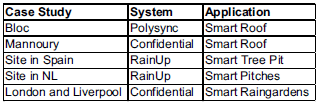
Six separate case studies have been selected from the UK and Europe with the purpose of comparing the identified complexities of the different smart nature-based systems used in each project. The table below lists the type of nature-based system application in which smart technologies were incorporated:
Case studies

To be selected, the case studies had to include a technological system that exhibited the qualities of a 'smart' system with the concomitant autonomous decision-making, algorithmic complexities, use of digital twin technologies and real-time control. Purely sensing technologies which are far more common were excluded. Three of the case studies all utilised the same physical technologies to support the natural asset named Permavoid, a shallow geocellular solution which can provide passive sub-surface irrigation to the vegetation above.
Permavoid with passive irrigation

Other case studies utilised different geocellular drainage systems and smart systems. Stakeholders were selected from across the Design, Execution and Post-installation phases of the project life cycle. The design logic of the actors through the development phase, partnership working across organisation to commercialise the solution, the viewpoints of Consultants, Clients and End-users enabled the Researcher to establish connections between sources of complexity, the impact on the development and diffusion of the systems and the choice of mitigations to satisfy the Client.
3.2. Semi-structured interviews
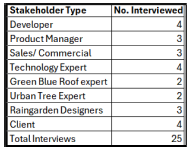
A semi-structured interview technique was utilised to enable the researcher to interrogate the ways in which organisations commercialising these systems, Specifiers, Industry Experts and Clients, interact to manage the complexities associated with smart nature-based solutions. Through the gathering of rich insights derived from a qualitative approach, relationships between specific complexities and their management and the successful adoption of these innovations from a variety of stakeholder perspectives, is ascertained. The table below highlights the stakeholder profiles and number of interviews undertaken:
Stakeholder and interviewee numbers

3.2.1. Selection and coding
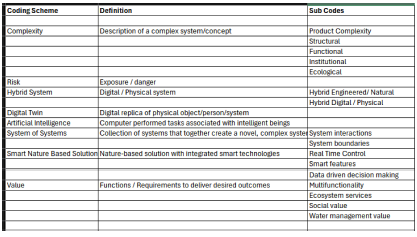
Interviewees were chosen based on their involvement with the selected case study projects and or their expertise regarding smart nature-based systems. The interviews were semi-structured, half an hour approximately, undertaken online and transcribed. Twenty-five interviewees were chosen. The Researcher interviewing is an embedded researcher working for one of the companies who develops smart nature-based systems. Interviews were coded with first and second order coding. The coding was generated through a dialectic of top-down coding applied through an analysis of literature and bottom up, derived from the interview data. The table below details the coding schemes used
Coding scheme

4. Findings
4.1. Complexities associated with hybrid smart nature-based systems and the project lifecycle
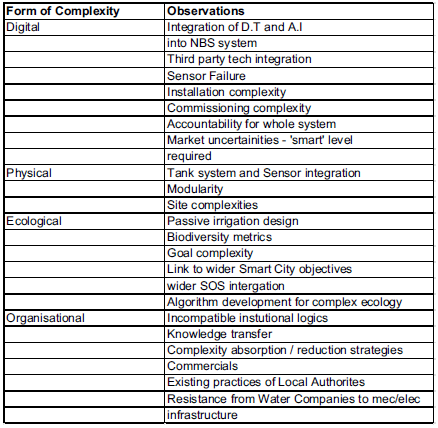
Findings have been divided into identified complexities associated with the smart nature-based systems and approaches to their management and value perception of these novel systems. The table below details the observes complexities incorporating specific ecological and digital elements:
Identified complexities

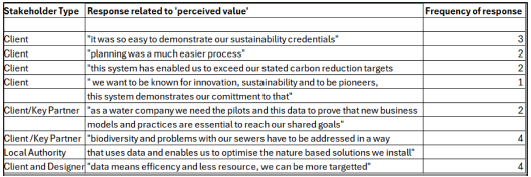
Response overview - perceived value

We also noted the frequency of responses of a similar nature, focused on the same value perceptions of the systems. These findings enable us to expand upon the existing characterisations of complexity advanced by De Weck (Reference De Weck2023) who focuses on structural, functional and organisational complexity of complex systems. Our observations enable us to extend the analysis to consider how complexities interact at the product, project and organisational level. Whilst De Weck delineates between engineered complex systems and natural systems, we cannot separate these elements when accounting for smart nature-based assets. The ecological components of complexity are inextricably linked to other complexity forms identified above which transcend the product level. The interplay between the product / system / project and institutional levels must be accounted for in the development of subsequent models. Eckert et al. (Reference Eckert, Earl and Johnson2004) argue that design of product-systems can be constituted of products, processes, users and organisations and that there is no singular theory that yet captures these interactions. Whilst they identify uncertainty and incompleteness of data as key challenges this is not extended to a useable model or framework. They advocate transforming time dependent combinatorial complexity of a system to periodic complexity where uncertainty is reset at regular intervals. This is informative when applied to the development of smart nature-based systems in which multiple aspects of time are embedded within a complex, hybrid system; the design life of the engineered layer, the digital layer and lifespan and regenerative properties of the living asset being supported.
4.2. Management strategies to mitigate complexity for clients and specifiers from design and development to project implementation
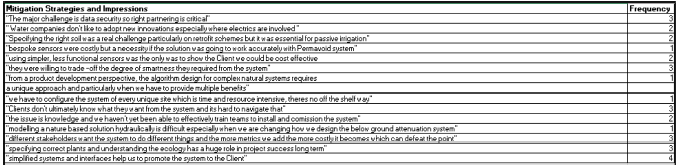
The table below presents the complexities associated with the natural and the digital elements of the nature-based systems and strategies leveraged. Interviewees were also asked if these approaches had been successful in expediting the adoption of the systems on such projects.
Complexity mitigation table

Sample responses and frequency

It was also possible to ascertain the degree to which the trade-off between the value delivered by the system and the increased complexities associated with their multifunctionality was managed. Whilst some Clients were willing to go purely to a monitoring only set up, the majority focused on keeping the real time control and autonomous decision-making components of the systems offered which were perceived to be the most costly and complex aspects of these schemes but offering the most long-term value.
5. Proposed model
We propose a model that incorporates the digital, physical and ecological components of complexity considering the interactions and emergence of these complexities at different stages of the project life cycle. This consciously extends the work of De Weck and Eckert to account for changes required to complexity management beyond the design phase. Whilst De Weck (Reference De Weck2023) notes that complexity of natural and artificial systems is driven by regulation, customers and competition, it is important to understand the values that complex systems are required to encompass, to enable design teams to better understand how much complexity needs to be absorbed and how much reduced without compromising the performance of natural asset. NBS scholars address challenges of governance and stakeholder engagement but do not address the technologies required to support them. Extant models focused on the management of complex systems do not consider how the various forms of complexity are managed throughout the project lifecycle. Eckert et al. (Reference Eckert, Earl and Johnson2004) focus specifically on the product complexity in the design stage and do not extend this to the subsequent phases. Momeni et al. (2023) advance a model for complexity management, divided into three stages; emerge, consolidate, evolve. They hypothesize that complexity absorption is the most prominent approach during the emerge stage and that the choice of complexity reduction or absorption is chosen in subsequent stages contingent on the type of manufacturing enterprise studied. Whilst useful this model does not assist organisations to navigate the balance between absorption and reduction of complexities based on the product, project and stakeholder typologies in question.
Smart nature-based system model

We also provide below a novel complexity taxonomy associated specifically with smart nature-based systems. Whilst Mahmoud et al (Reference Mahmoud, Morello, Bisello and Kolokotska2024) have provided a taxonomy of technologies 'in' and 'for' nature, they do not link their taxonomy to specific interventions or suggest how these technologies can be connected to specific ecosystems services delivered. The taxonomy also fails to provide detail on the use of specific advancements in D.T and A.I technologies with a focus primarily on sensors and mapping tools. Our taxonomy below focuses specifically on urban smart nature-based solutions:
Taxonomy of smart nature-based systems

6. Conclusions and recommendations for further research
Existing classifications of complex systems are insufficient to account for smart nature-based systems being diffused into the market, presenting a false dichotomy between the natural and the artificial. A model has been developed that considers the three key elements of a hybrid smart NBS; digital, physical and natural, incorporating key findings which span product and project lifecycles accounting for design, implementation and post installation, supporting manufacturing organisations commencing their digital servitization journey. A taxonomy focused on smart nature-based systems and their concomitant technological components linked to multiple benefits for the urban environment and stakeholders has been produced which is a novel contribution, bridging the gap between conventional CAS taxonomies and that produced by Mahmoud et al (2022). There are limitations to this research. We have focused on specific proprietary technologies due to access to case studies and interview participants however future research could take a comparative approach analysing a larger sample of manufacturing organisations and their respective technology partners. An extended model of the one provided could incorporate complexity absorption and reduction decision pathways, enabling organisations to decide if absorption or reduction techniques will produce a more successful adoption outcome.
Acknowledgements
We would like to acknowledge Polypipe, the industry sponsor of Charlotte Markey's PhD thesis and who provided access to case study data. This work was also supported by the Engineering and Physical Sciences Research Council (grant number EP/T022566/1). DIGIT Lab is a Next Stage Digital Economy Centre.





 Open access

