


Human activities have changed natural habitats in many ways. The most familiar and obvious changes involve the widespread degradation and fragmentation of large tracts of natural areas, such as the conversion of forest to agriculture (Saunders et al., Reference Saunders, Hobbs and Margules1991). Although less obvious, but of potentially equal impact, is the construction of linear developments (e.g. paths, roads, railways) through previously continuous areas of habitat (Reed et al., Reference Reed, Johnson-Barnard and Baker1996; Forman, Reference Forman2000). These linear features have the potential to interrupt ecological processes at a scale that is disproportional to their size. Most studies of the ecological effects of roads have dealt with traffic-related wildlife mortalities or direct impacts on wildlife of habitat loss associated with construction (Edwards & Slater, Reference Edwards and Slater1981). Of potentially more importance is the effect of roads as barriers. The presence of vehicular traffic and the continuous, linear nature of roads can be a significant physical barrier to animal movement (Mader et al., Reference Mader, Schell and Kornacker1990). The objective of this study was to assess the impact that a road may be having on Cabot's tragopan Tragopan caboti in Wuyishan National Natural Reserve, south-east China, with a view to informing conservation management of the species and future plans to improve the road.
Cabot's tragopan is categorized as Vulnerable on the IUCN Red List (IUCN, 2008) and listed on Appendix I of CITES (Fuller & Garson, Reference Fuller and Garson2000). The typical habitat of the species is broadleaved evergreen and mixed broadleaved-coniferous forest at altitudes of 800–2,000 m (Zhang & Zheng, Reference Zhang and Zheng2007) but much of its preferred habitat has been destroyed through conversion to agricultural land or construction of housing, roads and railways.
Wuyishan National Natural Reserve (Fig. 1), with c. 200 days of rain per year and an average annual precipitation of 2,583 mm (Liu & Fang, Reference Liu and Fang2001), contains some of the best habitat for Cabot's tragopan and is therefore an internationally important site for the species. In the 1980s a c. 19 km clay road of 4–5 m width was constructed through the primary forest in the core area of the Reserve. The road is the main access route for tourists to Wuyi Mountains and effectively bisects the Reserve. We studied a 3-km length of the road at 1,650–1,800 m, used daily by tourist vehicles (c. 10 per day), which passes through steep (c. 40°) well-forested terrain that is the Reserve's best habitat for Cabot's tragopan.
The location of Wuyishan National Natural Reserve (rectangle) in south-east China (left) and the study area in Wuyishan National Natural Reserve (shaded area), showing the road passing through the core area (right).

The study was undertaken during March–June 2006 and March–September 2007, which covered the breeding season of Cabot's tragopan and the rainy season of each year, in a total of 118 days along the road and 17 days inside the forest. The surveys were conducted each day for a 2-hour period immediately after sunrise and immediately before sunset, on foot and along the same stretch of road. When observed on the road, the number of individual Cabot's tragopan, their sex, behaviour, and length of time on the road were recorded. Four transects, each c. 1.5 km long, were positioned parallel to the road through the forest and were surveyed four times each (one five times), using the same method as along the road. In all, Cabot's tragopan were observed on 82 of the observation days on the road and 2 in the forest. Only males were observed in the forest, and they reacted strongly to the presence of the observer, immediately running further into the forest. Along the road, for both males and females, we defined three types of individual response: scared (the individuals moved quickly away from the observer), disturbed (the individuals stopped what they were doing and moved slowly away from the observer) and undisturbed (the individuals did not alter their behaviour in response to the observer). The length of time individuals remained on the road after being observed was divided into five categories, the number of vehicles using the road on survey days (obtained from the Office of the Reserve) into three categories, and the weather into two categories based on visibility.
Analysis of Covariance (ANCOVA) was used to ascertain if weather, year, sex of bird and time of day influenced road use, with traffic volume used as a covariate. The number of birds recorded was log(x+1) transformed prior to analysis. Based on the results of the ANCOVA, a χ2 analysis was undertaken to examine if the number of birds demonstrating different behaviours varied in relation to other factors. The number of birds observed on the road varied significantly between years (F 1,466 = 5.940, P = 0.015) and time of day (F 1,466 = 4.177, P = 0.042) but not in relation to any other factor (all P > 0.05). More birds were seen in 2006 than 2007 and more in the morning than the afternoon. The reaction of Cabot's tragopan to being disturbed by the observer did not vary significantly between years ( = 0.323, P > 0.05) or traffic volume categories (
 = 6.898, P > 0.05) but did vary significantly between time of day (
 = 6.625, P = 0.036). Individuals were more easily disturbed in the afternoon (80%) than in the morning (69%). For the 122 individuals undisturbed using the road, 47 (39%) were walking along the road, 55 (45%) were walking across the road and 20 (16%) were foraging on or beside the road. Overall, our results suggest that the present traffic volume is not noticeably influencing the behaviour of Cabot's tragopan.
Examining the influence of all factors on the length of time birds were observed on the road, a multinomial logistic regression showed that only weather ( = 24.37, P < 0.05) had a significant effect (Model fit
  = 35.692, P < 0.005), with Cabot's tragopan observed for longer on the road in bad weather. Although the reason is unknown, it is most likely related to reduced traffic volume on such days.
In the rainy season birds were regularly seen on the road during sunny periods, when we assume they were using exposure to the sun to dry their feathers. This was particularly noticeable on sunny days following several days of heavy rain, even when there was a relatively high volume of traffic using the road.
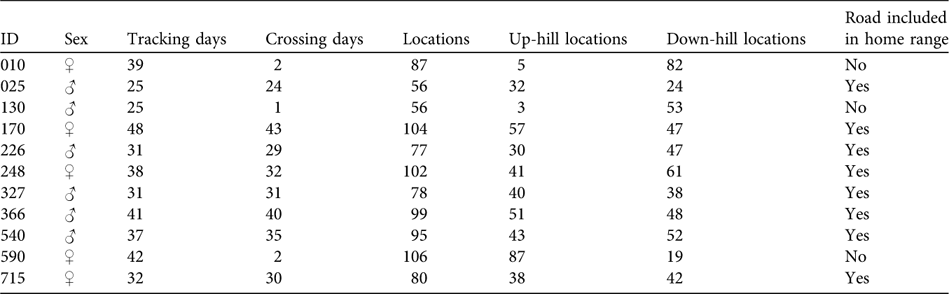
Additional information was collected from six male and five females that were captured and fitted with necklace radio transmitters. Each individual was located at least twice per day. If within a single day an individual was located on both sides of the road we assumed it crossed the road, and the percentage of birds that crossed each day was calculated. Minimum convex polygons (MCP) were used to determine home-range size using the software RANGES v. 6 (Anatrack, Wareham, UK). The road was included in the home ranges of eight individuals (Table 1). A multiple regression model with the stepwise method (calculated using SPSS v. 11.0, SPSS, Chicago, USA) showed that weather and year had a significant effect on pheasants' crossing (adjusted R 2 = 0.181, df = 2, F = 11.793, P < 0.05). In bad weather and in 2006 birds crossed the road more often than on sunny days and in 2007. The significance of year in influencing birds crossing the road is probably a result of the greater number of rainy days in the 2006 breeding season.
Location information of 11 radio-tracked Cabot's tragopan Tragopan caboti, with number of days each was tracked and on which they crossed the road, total number of tracked locations, number of relocations on the up-hill and down-hill sides of the road and whether the road was included in the individual's home range.
Most research on fragmentation has concentrated on the effect of large-scale clearings as barriers to wildlife movements (Xia et al., Reference Xia, Yang, Li, Wu and Feng2007). It is only recently that narrow barriers, such as roads or paths crossing habitats, have been investigated and in some cases shown to have significant effects on some species (Trombulak & Frissell, Reference Trombulak and Frissell2000). However, rather than being a barrier for Cabot's tragopan the road through Wuyishan National Natural Reserve appears to provide opportunities for the species. We saw behaviours such as feeding, walking and courtship display on the road. Collection of grit for the pheasant's gizzard is probably also an important use of the road (Newborn & Foster, Reference Newborn and Foster2002), especially as within the forest deep leaf-litter may limit access to grit.
Management of vehicular traffic on the road to Wuyi Mountains ensures that all vehicles pass through the habitat of the species without stopping and thus there is little human disturbance. However, it has been proposed that the surface of the clay road be replaced with a bituminous macadam surface. This could potentially reduce the availability of grit for Cabot's tragopan but small ditches either side of the road could fulfill this function. Upgrading of the road could result in increased traffic and therefore careful traffic management needs to be maintained to ensure the impacts of the road are minimized. The results of this study have been discussed with the Reserve's management authority and they have provided assurances that, to protect Cabot's tragopan, it is unlikely work will be undertaken on the road in the immediate future.
Acknowledgements
We thank all the staff of Wuyishan National Natural Reserve for the help and support they provided throughout this study, Professor Liang Wei for useful advice, Zhou Zhixin for help with transect and radio-tracking work, and two anonymous referees for useful comments that helped improve this article. This research was supported by the National Natural Science Foundation of China (No. 30670289).
Biographical sketches
Yue Sun has been studying habitat selection, breeding ecology and habitat and resource use of Cabot's tragopan for > 3 years. Lu Dong focuses on the conservation genetics of Cabot's tragopan and the silver pheasant. Yanyun Zhang is a member of the IUCN–Species Survival Commission Pheasant Specialist Group and one of the committee members of the China Ornithological Society, with interests in research on threatened species of pheasants and bird song. Guangmei Zheng is the President of the World Pheasant Association and Honorary President of the China Ornithological Society. He has carried out ornithological research, especially on threatened species of pheasants, for several decades. Stephen Browne has researched and monitored bird declines in the UK and, more recently, has developed a particular interest in Asian Galliformes. He now works for Fauna & Flora International and is Manager of its Asia-Pacific Programme, which includes China.



