





Introduction
Smut grass species are perennial grasses native to the tropical and subtropical regions of Asia (Mears et al. Reference Mears, Hennessy and Williamson1996; Wunderlin and Hansen Reference Wunderlin and Hansen2003). These species are considered invasive and prolific, can thrive in diverse conditions, and cause problems in Florida pastures by reducing the production of desirable forage (Ferrell et al. Reference Ferrell, Mullahey, Dusky and Roka2006; Rana Reference Rana2012; Shay et al. Reference Shay, Baxter, Basinger, Schwartz and Belcher2022). West Indian dropseed (hereafter called giant smut grass) has a diameter of 30 to 45 cm, while smut grass (hereafter called small smut grass) is approximately 20 to 25 cm in diameter. The seedhead of giant smut grass is open, with panicle branches oriented vertically, and little to no black fungus. Small smut grass has a compact seedhead in which the panicle branches touch the panicle and is commonly infected with black fungus (Vanky Reference Vanky2003). The plants produce approximately 1,400 seeds per seedhead and 45,000 seeds per plant, and the seeds are red to orange (Currey et al. Reference Currey, Parrado and Jones1972). Both species produce seeds throughout the growing season, with new seedheads produced after mowing or burning (Wilder et al. Reference Wilder, Sellers, Ferrell and MacDonald2011).
Management techniques for smut grass include mechanical control such as mowing, which decreases clump size but can increase density through seed dispersal (McCaleb and Hodges Reference McCaleb and Hodges1971). Additionally, full pasture renovation attempts are costly, often not economically feasible, and may even double the number of smut grass plants (McCaleb et al. Reference McCaleb, Hodges and Kirk1966; Rana et al. Reference Rana, Sellers, Ferrell, MacDonald, Silveria and Vendramini2015). Hexazinone is the only herbicide labeled for selective use to control smut grass in bahiagrass (Paspalum notatum Flugge) pastures and causes only short-term injury to bahiagrass (Sellers et al. Reference Sellers, Ferrell and MacDonald2008; Wilder et al. Reference Wilder, Sellers, Ferrell and MacDonald2011).
Hexazinone is a soil-applied herbicide that exhibits good apoplastic movement (Senseman Reference Senseman2007). It is also absorbed through the leaves but has limited translocation due to poor mobility through the phloem (Shaner Reference Shaner2014). Hexazinone is highly water-soluble, and rain enhances its incorporation into soil, root uptake, and translocation (Ferrell and Mullahey Reference Ferrell and Mullahey2006; Mislevy et al. Reference Mislevy, Martin and Hall2002). However, high rain accumulation and high-intensity rain can move hexazinone from the soil surface and root zone (Bandeira et al. Reference Bandeira, Batista, das Chagas, Silva, Fernandes, de Andrade and Silva2022; Bouchard et al. Reference Bouchard, Lavy and Lawson1985; Brown et al. Reference Brown, Stone, Carlisle, Myers, Ewel, Stone, Carlisle, Myers, Ewel, Myers and Ewel1990; Feng et al. Reference Feng, Stornes and Rogers1988). Rain that occurs within the first 7 d after hexazinone application has been shown to decrease its efficacy on target plants. For example, applying hexazinone at 0.5 kg ai ha−1 followed by 120 mm of simulated rain within 7 d of application resulted in decreased control of a morning glory species (Ipomoea grandifolia L.) in Brazil (Tonieto and Regitano Reference Tonieto and Regitano2014). Similarly, Dias et al. (Reference Dias, Mncube, Sellers, Ferrell, Enloe, Vendramini and Moriel2025) observed reduced efficacy of hexazinone at 0.56 and 1.12 kg ai ha−1 on giant smut grass when more than 75 mm of rain fell within 7 d after application. Florida soils are predominantly sandy with low organic matter content, thereby increasing the likelihood of hexazinone movement through the soil profile (Bandeira et al. Reference Bandeira, Batista, das Chagas, Silva, Fernandes, de Andrade and Silva2022; Bouchard et al. Reference Bouchard, Lavy and Lawson1985; Brown et al. Reference Brown, Stone, Carlisle, Myers, Ewel, Stone, Carlisle, Myers, Ewel, Myers and Ewel1990; Feng et al. Reference Feng, Stornes and Rogers1988).
Applying hexazinone with adjuvants may be a strategy for improving its efficacy. Adjuvants are chemical additives that modify the spray solution properties and herbicide-soil interactions, thereby improving deposition, adhesion, and retention of active ingredients in the soil (Alva and Singh Reference Alva and Singh1991; Green and Foy Reference Green and Foy2004; Katzman et al. Reference Katzman, Zivan and Dubowski2023). The formulation and selection of both herbicide and adjuvant determine the extent to which the herbicide moves through the soil profile, which affects both retention in the root zone and overall efficacy (Hall et al. Reference Hall, Jones, Hickman, Amistadi, Bogus, Mumma, Hartwig and Hoffman1998). Additionally, the interactions between herbicides and adjuvants in the root zone are affected by environment, which influences mobilization, retention, removal, or translocation (Palma-Bautista et al. Reference Palma-Bautista, Vazquez-Garcia, Travlos, Tataridas, Kanatas, Domínguez-Valenzuela and De Prado2020). For example, desorption of herbicide-adjuvant mixtures varies with soil texture, organic matter, and soil pH (Chaabane et al. Reference Chaabane, Cooper, Azouzi and Coste2005; Locke et al. Reference Locke, Reddy, Gaston and Zablotowicz2002).
Adjuvants mixed with herbicides enhance herbicide efficacy through synergistic interactions, partly by altering physicochemical properties of the spray solution and modifying herbicide-soil interactions after application (An et al. Reference An, Feng, Ji, Wang, Pang, Liu, Wang, Shi, Dong and Liu2024). For soil-applied herbicides, adjuvants promote adsorption to soil particles, reduce excessive herbicide runoff following heavy rains, and maintain herbicide availability within the weed root zone for extended periods (Hewitt Reference Hewitt2024; Kočárek et al. Reference Kočárek, Kodešová, Sharipov and Jursík2018). This is important in sandy soils with low organic matter, like those in Florida, where herbicides such as hexazinone are more susceptible to movement beyond the target root zone. By improving soil retention and persistence, adjuvants have the potential to increase hexazinone efficacy and improve smut grass control.
The effects of adjuvants have been extensively studied in foliar-applied herbicides (Kirkwood Reference Kirkwood1993). However, previous studies using foliar adjuvants in hexazinone applications did not improve its efficacy compared with hexazinone-only applications (Wilder Reference Wilder2009). Fewer studies have investigated adjuvants designed to reduce the leaching of soil-applied herbicides (Madalao et al. Reference Madalao, Silva, Faria, Saraiva, Pires and Jakelaitis2019). For example, Alva and Singh (Reference Alva and Singh1991), An et al. (Reference An, Feng, Ji, Wang, Pang, Liu, Wang, Shi, Dong and Liu2024), Madalao et al. (Reference Madalao, Silva, Faria, Saraiva, Pires and Jakelaitis2019), and Swarcewicz and Gregorczyk (Reference Swarcewicz and Gregorczyk2013) reported reduced atrazine leaching and increased herbicide efficacy when applied with adjuvants. Additionally, Kucharski and Sadowski (Reference Kucharski and Sadowski2011) observed that adjuvants slowed metazachlor leaching into deeper soil profiles and extended its half-life by 8 to 16 d, further highlighting the role of adjuvants in improving herbicide retention in the root zone.
Although the influence of rain on hexazinone has been extensively studied using soil columns (Feng et al. Reference Feng, Stornes and Rogers1988; Monquero et al. Reference Monquero, Amaral, Binha, Silva and Silva2008; Tonieto and Regitano Reference Tonieto and Regitano2014), environmental fate (Neary et al. Reference Neary, Bush and Douglass1983), and rainfall simulation experiments (Dias et al. Reference Dias, Mncube, Sellers, Ferrell, Enloe, Vendramini and Moriel2025; Tonieto and Regitano Reference Tonieto and Regitano2014), the potential for adjuvants to modify the interactions between sandy soils and rainfall has not been investigated. This is particularly important for smut grass control in Florida pastures. Therefore, the objectives of this study were to determine 1) the effect of adjuvants on hexazinone efficacy for giant smut grass control under varying simulated rain accumulation volumes in greenhouse conditions, and 2) the effect of adjuvants on hexazinone efficacy for giant smut grass and small smut grass control in field conditions.
Materials and Methods
Greenhouse Experiment
A greenhouse experiment was conducted at the Range Cattle Research Education Center (RCREC) at the University of Florida Institute of Food and Agricultural Sciences, located near Ona, (27.6733°N, 82.5856°W). Soil was sourced from the research center and sieved through a 5-mm screen to remove extraneous debris. The soil was an Ona fine sand (sandy, siliceous, hyperthermic Typic Alaquods), with an average pH of 4.9 and 3.0% organic matter. Soil was filled into 3-L plastic pots (16 cm diam top, 12 cm diam base, and 16 cm depth) and supplemented with 5 kg m−3 of 14-14-14 N-P-K slow-release fertilizer (Osmocote Smart-Release Plant Food; Scotts Company, Marysville, OH). Clumps of giant smut grass were gathered from a nearby pasture (27.6344°N, 82.5758°W), and a single clump with intact roots was extracted and transplanted into each pot. The greenhouse environment was maintained at 30/24 C day/night temperatures under a 14-h photoperiod, employing a combination of natural and supplemental lighting. Plants were allowed to grow for 2 mo, then clipped to 7.5 cm, and allowed to grow an additional month before treatments were applied.
The experiment was a randomized complete block design in a 4 by 6 factorial treatment arrangement with three replicates and two experimental runs. Each pot was considered an experimental unit. A nontreated control was maintained in each replicate for comparison with the treatment. Treatments for each experimental run were applied on September 27 and October 18, 2023. Before treatment application, each pot was subirrigated up to the saturation point and allowed to drain for 48 h. Hexazinone (Tide International USA, Irvine, CA,) was applied at 1.12 kg ai ha−1 alone or in combination with the label recommendation rates of three adjuvants: NanoPro (1 mL L− 1) (Aqua Yield Operations, Sandy, UT), Sorbyx at (3 mL L−1) (Precision Laboratories, Waukegan, IL), and Grounded (10 mL L−1) (Helena Chemical, Collierville, TN). Treatments were applied using a compressed air-powered moving nozzle spray chamber (Generation 11 Spray Booth; Devries Manufacturing Corp., Hollandale, MN), equipped with a TeeJet 8001 EVS spray nozzle (TeeJet Technologies, Glendale Heights, IL) calibrated to deliver 280 L ha−1.
After treatments were applied, giant smut grass was subjected to the equivalent of six rainfalls (0, 6, 12, 25, 50, and 100 mm) chosen based on previous research by Dias et al. (Reference Dias, Mncube, Sellers, Ferrell, Enloe, Vendramini and Moriel2025). Replicates were blocked based on smut grass height (26 to 30, 31 to 35, and 36 to 40 cm) and overall biomass appearance (i.e., clump width). A nontreated control was maintained in each replicate for treatment comparison. A Tlaloc 3000 rain simulator at an intensity of 65 mm h−1 and under pressure of 27.6 KPa was used to simulate rain 2 h after the treatments were applied. This simulator covers a 2.8- by 2.3-m2 area with a central nozzle 3 m above the plant canopy. Polyethylene tarps were used as a windscreen on all sides of the simulator to ensure even rainfall distribution across the experimental units. After the simulation, all pots were allowed to drain for 24 h before being transferred to the greenhouse. Clear vinyl saucers measuring 10 cm in depth and 14 cm in diameter were positioned beneath each pot to minimize leaching. Afterward, plants were subirrigated with 60 mL of water at 48-h intervals until the end of the experiment.
Giant smut grass control was determined with percent control estimates (0% to 100% scale), where 0% equals no injury or completely alive and 100% equals complete death. Control ratings were recorded at 30 d after treatment (DAT). Aboveground biomass was collected 30 and 60 DAT by clipping plants at 7.5 cm above the soil surface. Biomass samples were dried at 60 C for 72 h, and dry weights were recorded. Biomass was converted to percent of the nontreated control before analysis.
Regression analysis was performed to determine the influence of adjuvants on smut grass control and biomass across simulated rainfall accumulation volumes using quadratic regression with Sigma Plot statistical software (v.15.0; SPSS Inc., Chicago, IL). The rainfall range required for 80% visual estimates of control, 50% biomass at 30 DAT, and 20% biomass regrowth at 60 DAT was determined using the quadratic equation (Equation 1). The maximum rainfall, control, and biomass regrowth were determined by estimating the graph’s vertex point. The quadratic model was: $Y = a{x^2} + bx + c$
where Y is the response variable (visual control at 30 DAT, biomass at 30 DAT, and regrowth biomass at 60 DAT), x is simulated rainfall accumulation volumes, a is the coefficient for the position (opening upward opening downward), b is the coefficient for shape (horizontal translation of the curve), and c is constant for orientation (vertical translation of the curve).
Field Experiments
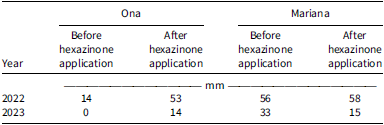
Field experiments were conducted on giant smut grass and small smut grass species in bahiagrass pastures. An experiment to control giant smut grass was conducted on private property with 90% smut grass cover, near the RCREC (27.6442 N, 82.5817 W), in Ona, Florida, on August 11, 2022, and was repeated again on August 17, 2023, in an adjacent pasture. The predominant soil was Smyrna sand, with 2.5% organic matter, pH 5.6. The experiment to control small smut grass was conducted in northern Florida on private property with 60% smut grass cover, near the North Florida Research Education Center (NFREC), near Mariana (30.8570 N, 85.1681 W), on August 12, 2022, and repeated again on September 6, 2023, in an adjacent pasture. The soil was Greenville fine sandy loam with 1.5% organic matter, pH 5. In both locations, a rain data logger (RainLog TM 2.0; RainWise Inc., Boothwyn, PA) was installed, and rain data were recorded hourly during the first 7 d after treatment (Table 1), as rainfall during this period is essential for hexazinone efficacy (Dias et al. Reference Dias, Mncube, Sellers, Ferrell, Enloe, Vendramini and Moriel2025).
Total precipitation 7 d after treatment recorded using a rainfall data logger at Ona and Mariana, Florida, in 2022 and 2023.

The experiment was a randomized complete block design with five treatments and four replications. Hexazinone was applied at 1.12 kg ai ha−1 alone or with one of four adjuvants: NanoPro, Sorbyx, Grounded, and BREAK-THRU (Evonik Corporation, Richmond, VA) at their labeled rates of 1, 3, 10, and 50 mL L− 1, respectively, and were mixed according to label directions. Experiments were repeated four times at all locations, except at Mariana in 2023, where they were repeated three times. A nontreated control was included in each replicate. Plot sizes were 6 by 15 m and 3 by 7.5 m in Ona and Mariana, respectively. Treatments in Ona were applied using a compressed air broadcast sprayer equipped with a 6-m boom mounted to an all-terrain vehicle, while in Mariana, a CO2 pressurized backpack sprayer equipped with a 3-m boom was used. Both sprayers were fitted with a flat-fan nozzle and were calibrated to deliver 280 L ha−1.
Control was determined by assessing the reduction in smut grass density of both species at 30 and 60 DAT. The density reduction of giant smut grass was determined by counting the number of dead and live clumps using a diagonal line transect placed 1.5 m from each edge of the corner. For small smut grass, dead and live plants in the entire plot were counted, starting at 0.6 m from the plot edge. Smut grass density reduction was calculated as the percentage of dead plants of the total number of plants at 30 and 60 DAT. Plants were considered dead when they completely lacked any green tissue.
Statistical analyses were performed using the open-source software R (v.4.2.1) (R Core Team 2023). Normality, independence of errors, and homogeneity of variance were examined for all response variables. All response variables were analyzed using mixed-effects models fitted with the nlme package in R (Pinheiro et al. Reference Pinheiro, Bates, DebRoy and Sarkar2016). The model statement for all response variables included adjuvants as a fixed effect, and block and year were considered as a random effect. Data were subjected to ANOVA to test the effect of adjuvants on hexazinone efficacy for smut grass control. Treatments were considered different when P ≤ 0.05. Additionally, mean comparison was determined using a Tukey HSD test at a 5% significance level.
Results and Discussion
Greenhouse Experiment
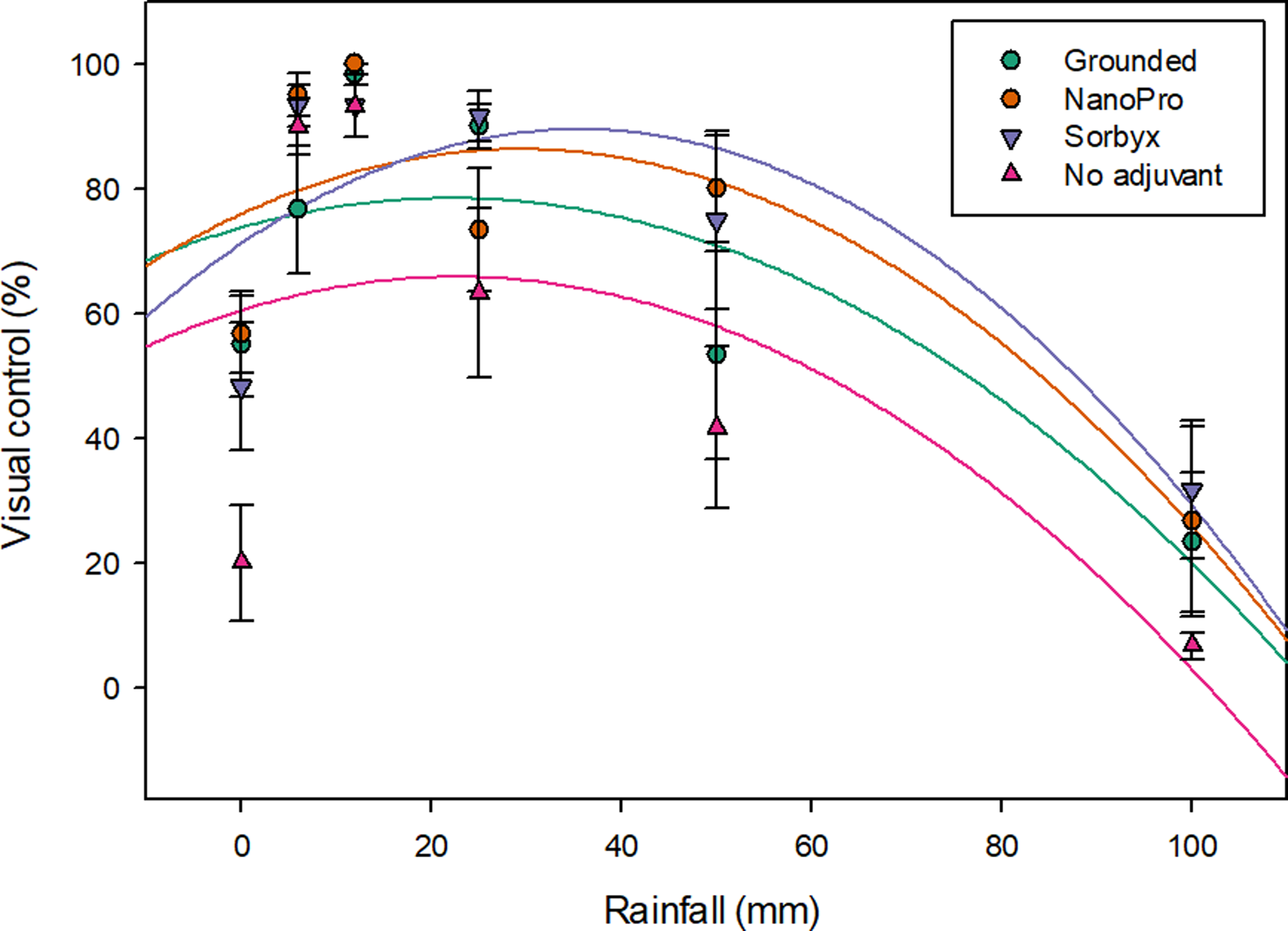
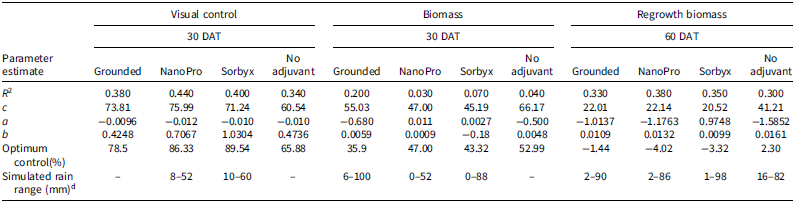
Adding adjuvants to hexazinone increased smut grass control compared with applying hexazinone alone. When averaged over all rain accumulation volumes, hexazinone applied with adjuvants resulted in 66% to 72% control, which was greater than the control achieved with hexazinone alone (53%) (Supplementary Table S1). Additionally, regression analysis across rain accumulation volumes showed that hexazinone combined with adjuvants provided greater control of giant smut grass than hexazinone alone. Only Sorbyx (90%) and NanoPro (86%) resulted in greater than 80% control following rain volumes within a range of 8 to 52 mm and 10 to 60 mm, respectively (Figure 1 and Table 2). Adding Grounded to hexazinone (which provided 79% control) was comparable to that of applying hexazinone without an adjuvant (66% control).
Visual estimates of giant smut grass control 30 d after treatment in response to increasing rain accumulation volumes (0, 6, 12, 25, 50, and 100 mm) for each adjuvant, including hexazinone alone (no adjuvant). The predicted model for Grounded: y = −0.0096x2 + 0.4248x + 73.81 (R 2 = 0.38); for NanoPro: y = −0.0120x2 + 0.7067x + 75.99 (R 2 = 0.44); for Sorbyx: y = −0.01x2 + 1.0304x + 71.24 (R 2 = 0.4); and for No adjuvant: y = −0.01x2 + 0.4736x + 60.54 (R 2 = 0.34); where y = visual control (%) and x = rain accumulation volume in millimeters.

Quadratic regression parameter estimates and rainfall range needed to achieve >80% control, <50% biomass, and <20% regrowth biomass of smut grass with hexazinone and adjuvants under greenhouse conditions. a–c

a Abbreviation: DAT, days after treatment.
b Quadratic model: Y = ax + bx 2 + c, where Y is the response variable (visual control at 30 DAT, biomass at 30 DAT, and regrowth biomass at 60 DAT), x is simulated rainfall accumulation volumes, a is the coefficient for the position (opening upward opening downward), b is the coefficient for shape (horizontal translation of the curve), and c is constant for orientation (vertical translation of the curve).
c Optimum control was determined from the vertex of the fitted quadratic regression models and represents the predicted maximum visual control at 30 DAT, minimum biomass at 30 DAT, and minimum regrowth biomass at 60 DAT. The negative values in regrowth biomass are due to extrapolation of quadratic regression; these values are interpreted as zero.
d Simulated rainfall range indicates the range of simulated rainfall accumulation volume for greater than 80% visual control, less than 50% biomass at 30 DAT, and less than 20% regrowth biomass at 60 DAT based on the fitted regression curve. The blank space indicates that no level of control was observed for that treatment at any rainfall accumulation volume.
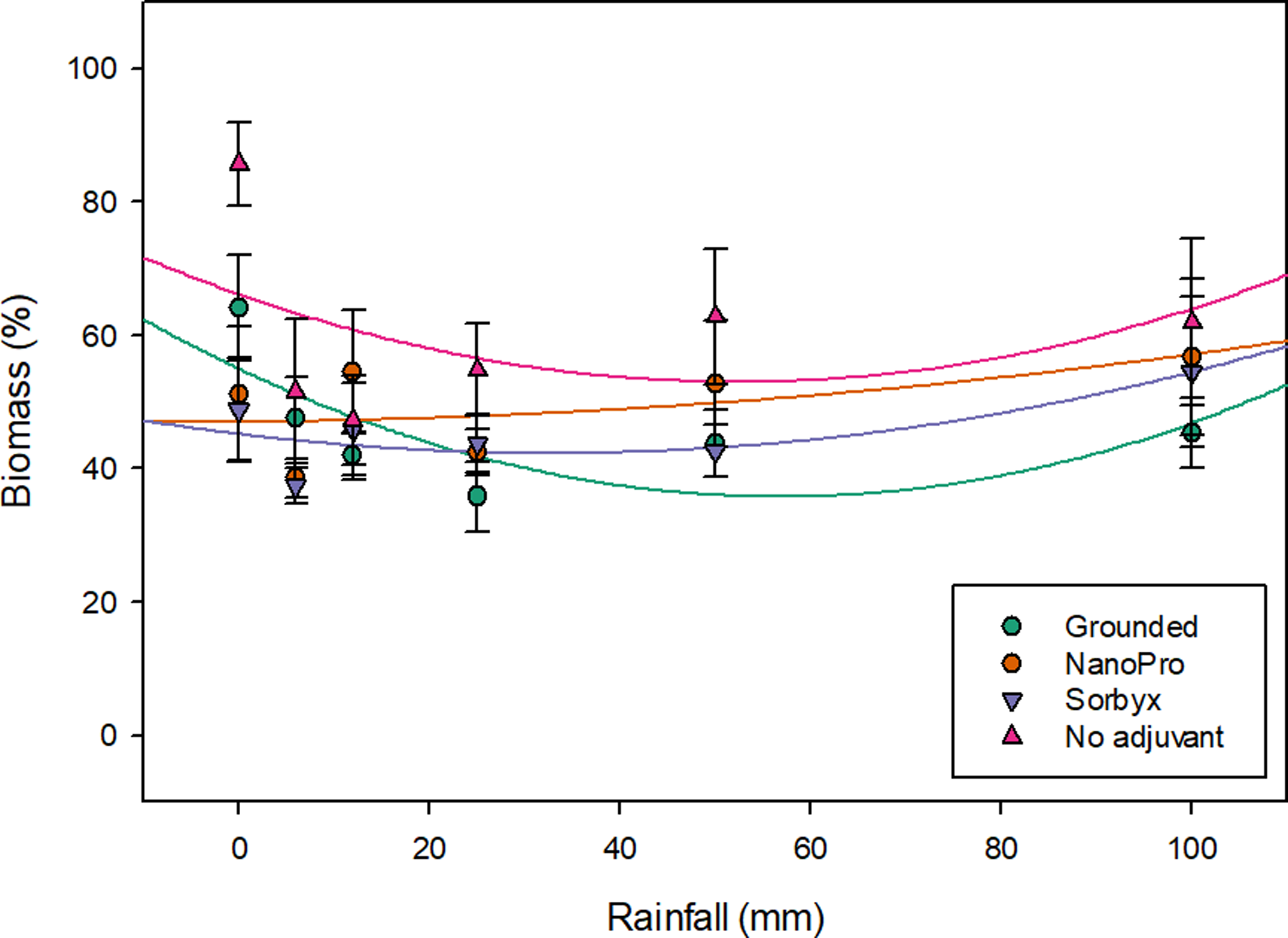
Smut grass biomass was also affected by adding adjuvants to hexazinone. At 30 DAT, hexazinone applied with Grounded, NanoPro, and Sorbyx resulted in biomass that was less than 50% of the nontreated control following 6 to 100, 0 to 52, and 0 to 88 mm of rain, respectively (Figure 2 and Table 2). Additionally, biomass was 1.1-fold to 1.4-fold greater with hexazinone alone than with adjuvants averaged over all rain amounts (Supplementary Table S1). When hexazinone was applied alone, biomass ranged from 56% to 84% of the nontreated control, with the highest biomass produced following no rain.
Dry biomass (% of nontreated control) of giant smut grass 30 d after treatment (DAT) in response to increasing rainfall accumulation volumes (0, 6, 12, 25, 50, and 100 mm) for each adjuvant, including hexazinone alone (No adjuvant). Predicted lines are plotted with the mean and standard error. The predicted model for Grounded: y = 0.0059x2 − 0.6778x + 55.03 (R 2 = 0.16); for NanoPro: y = 0.0009x2 + 0.0115x + 47 (R 2 = 0.03); for Sorbyx: y = −0.1755x2 + 0.0027x + 45.19 (R 2 = 0.07); and for No adjuvant: y = 0.0048x2 − 0.5044x + 66.17 (R 2 = 0.04); where y = smut grass biomass (% of untreated control) and x = rain accumulation volume in millimeters).

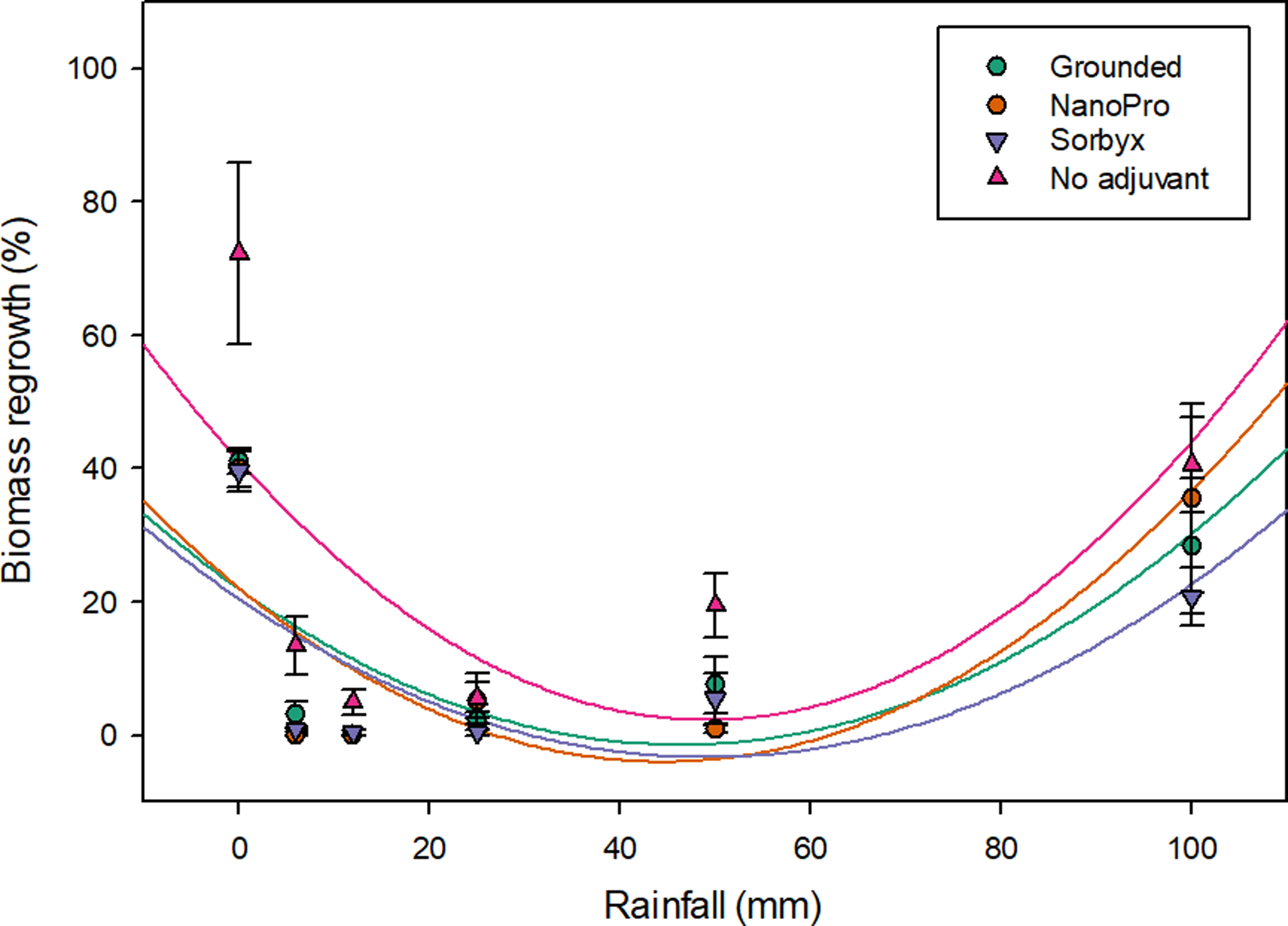
Biomass regrowth at 60 DAT was less than 14% of the nontreated control with an adjuvant addition, while biomass regrowth was 26% with hexazinone only (Supplementary Table S1). Hexazinone with adjuvants resulted in at least 2.3-fold less biomass regrowth than when hexazinone was applied alone (Figure 3). Additionally, adding adjuvants to hexazinone extended the rainfall range for reduced biomass regrowth (<20%) compared with hexazinone alone. For example, the rain range for less than 20% biomass regrowth following the application of hexazinone with Grounded, NanoPro, and Sorbyx was estimated to be 2to 90, 2 to 86, and 1 to 98 mm, respectively, whereas for hexazinone alone it was 16 to 82 mm (Table 2).
Biomass regrowth (% of nontreated control) of giant smut grass 60 d after treatment in response to increasing rain accumulation volumes (0, 6, 12, 25, 50, and 100 mm) for each adjuvant, including hexazinone alone (No adjuvant). Predicted lines are plotted with the mean and standard error. The predicted model for Grounded: y = 0.0109x2 − 1.0137x + 22.01 (R 2 = 0.33); for NanoPro: y = 0.0132x2 − 1.1763x + 22.14 (R 2 = 0.38); for Sorbyx: y = 0.0099x2 + 0.9748x + 20.52 (R 2 = 0.35); and for No adjuvant: y = 0.0161x2 − 1.5852x + 41.20 (R 2 = 0.3); where y = smut grass regrowth biomass (% of untreated control) and x = rainfall accumulation volume in millimeters).

Adding adjuvants to hexazinone increased giant smut grass control, reduced its biomass, and extended the rain range for hexazinone efficacy. Smut grass biomass at 30 DAT was less than 50% of the nontreated smut grass from when hexazinone was applied with NanoPro and Sorbyx, with no rain. Kočárek et al. (Reference Kočárek, Kodešová, Sharipov and Jursík2018) reported improved herbicide sorption of pendimethalin with the adjuvant Grounded, which increased herbicide retention in topsoil (0 to 5 cm), demonstrating that Grounded can bind herbicide molecules in soil. Additionally, each planting pot contained a single clump, and unlike in field conditions, there was no surrounding smut grass canopy to interfere with the applied hexazinone and adjuvants, allowing the chemicals to reach the soil surface.
The results of this study also support previous findings that rain is crucial for hexazinone to be effective in controlling giant smut grass. In this study, the optimal amount of rain for giant smut grass control following hexazinone application with adjuvants was estimated at 60 mm for visual control, 100 mm for biomass, and 98 mm for biomass regrowth, all greater than the range of rain required for optimal control with hexazinone alone. Additionally, Dias et al. (Reference Dias, Mncube, Sellers, Ferrell, Enloe, Vendramini and Moriel2025) reported that 82 mm of rain was necessary to achieve a 50% reduction in smut grass biomass without adjuvants. These results suggest that adjuvants may tolerate greater amounts of rain following an application of hexazinone without affecting its efficacy, likely by reducing herbicide leaching and improving retention within the root zone.
Field Experiments
Giant Smut Grass
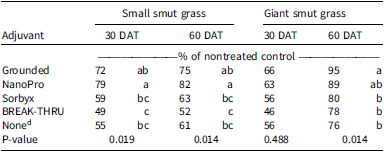
Adding adjuvants to hexazinone did not influence the density of giant smut grass at the Ona site at 30 DAT. However, at 60 DAT, adding Grounded to hexazinone resulted in a greater reduction in (95%) density than adding Sorbyx or BREAK-THRU to hexazinone, or applying hexazinone alone (Table 3). The reduction in density following hexazinone applications with NanoPro did not differ from that of any of the other treatments.

a Abbreviation: DAT, days after treatment.
b Means followed by the same letters are not significantly different according to the Tukey HSD test at a = 0.05. The data were averaged from 2022 and 2023.
c The small smut grass experiment was conducted in Mariana, Florida, and the giant smut grass was conducted in Ona, Florida, in 2022 and 2023.
d None indicates hexazinone applied alone.
Small Smut Grass
Small smut grass density was reduced to a similar extent by hexazinone at both 30 and 60 DAT (Table 3). Adding NanoPro to hexazinone resulted in the best smut grass control with 79% and 82% control at 30 and 60 DAT, respectively. Adding Grounded to hexazinone resulted in similar density reductions as with NanoPro. Additionally, the reduction in smut grass density with Grounded and NanoPro was 1.6-fold greater than with BREAK-THRU or hexazinone alone. The reduction in smut grass density from the addition of Sorbyx to hexazinone was comparable to that of applying hexazinone alone and other adjuvants, except NanoPro (Table 3).
This study aimed to evaluate the effectiveness of adding various adjuvants to hexazinone in controlling two smut grass species under field conditions at two locations over 2 yr. Adding Grounded and NanoPro to hexazinone resulted in a greater reduction in giant and small smut grass density than hexazinone alone; however, the effect of Sorbyx was similar to that of NanoPro and hexazinone alone at both locations. Why the reduction in smut grass density was greater by adding Grounded to hexazinone is unknown, but it could be due to decreased runoff or leaching as reported by Fillols and Davis (Reference Fillols and Davis2020). Previous research using Grounded with preemergence herbicides has had various results. For example, Palmer and Hemmant (Reference Palmer and Hemmant2011) found that adding Grounded to trifluralin and pendimethalin resulted in at least a 50% reduction in blackgrass (Alopecurus myosuroides Huds.) density compared to the herbicides applied without Grounded. Conversely, Grichar and McGinty (Reference Grichar and McGinty2022) found that adding Grounded with either pendimethalin or S-metolachlor has no effect on control of Texas millet [Urochloa texana (Buckley) R. Webster] compared to the herbicides applied without Grounded. Overall, the differing responses among adjuvants and hexazinone might suggest that NanoPro and Grounded have greater compatibility with hexazinone than BREAK-THRU, potentially due to differences in formulation chemistry that influence spray solution behavior, soil interactions, and environmental conditions (Idziak et al. Reference Idziak, Sobczak, Waligóra, Szulc and Majchrzak2023; Rizwan et al. Reference Rizwan, Tanveer, Khaliq, Abbas and Ikram2018). However, the specific mechanisms supporting these differences were not directly evaluated in this study.
The differences in hexazinone efficacy between giant and small smut grass could be attributed to a combination of species characteristics, soil texture, and rain patterns. Previous research by Wilder et al. (Reference Wilder, Sellers, Ferrell and MacDonald2011) determined that the rates of hexazinone required to obtain 90% control of small smut grass and giant smut grass at 365 DAT was 1.18 kg ai ha−1 and 1.05 kg ai ha−1, respectively, indicating that there is very little difference in response among these two species. Giant smut grass was evaluated in fine sand at Ona and when rain before and after hexazinone application was low in 2023 and moderate in 2022, potentially limiting early hexazinone incorporation and resulting in minimal density reduction at 30 DAT. In contrast, small smut grass was evaluated in sandy loam soil at Mariana, where higher amounts of rain before and after hexazinone application resulted in consistent density reduction at 30 DAT and 60 DAT. The addition of adjuvants likely enhanced hexazinone retention and availability in the soil, mitigating some effects of low or uneven amounts of rain and contributing to improved control, particularly for giant smut grass under less favorable rain conditions.
In the greenhouse experiment, Grounded, NanoPro, and Sorbyx provided greater than 65% giant smut grass visual control, less than 50% biomass, and less than 20% biomass regrowth, while the field experiment demonstrated >63% giant and small smut grass density reduction from these adjuvants tested. The field experiment results confirm the greenhouse results, especially for Grounded and NanoPro, indicating the benefits of adjuvants in enhancing hexazinone efficacy for smut grass control and broadening the rain range. Further research should be conducted to evaluate the effects of these adjuvants on hexazinone leaching, especially following heavy rains.
Practical Implications
Hexazinone is one of the most expensive herbicides used to control weeds in pastures. The variability in smut grass control with hexazinone following heavy rains often results in economic losses through decreased herbicide efficacy and increased or continued competition of smut grass with desirable forage species. Adding Grounded, NanoPro, or Sorbyx to hexazinone may be beneficial for optimizing smut grass control under field conditions, especially following heavy rain events. Since the amount of rain within a week after hexazinone application under field conditions cannot be predicted, the use of these adjuvants could reduce variability in smut grass control.
Supplementary material
The supplementary material for this article can be found at https://doi.org/10.1017/wet.2026.10085.
Competing interests
The authors declare they have no competing interests.
Funding
This research was funded by the Florida Cattle Enhancement Board.


 Open access

