

1. Introduction
Micro, small, and medium-sized enterprises (MSMEs), representing a substantial share of economic activity, often face structural challenges in international markets. According to the World Bank, MSMEs constitute 90% of total businesses and employ over 50% of the workforce (Megersa, Reference Megersa2020; OECD, 2019; Arched et al., Reference Arshed, Carter and Mason2014), yet their participation in global value chains (GVCs) is relatively small. In parallel with the constantly increasing number of regional trade agreements (RTAs), the provisions related to MSMEs are rising across different chapters. Of the 360 RTAs in 2023, 201 include MSME-related provisions. In this paper, we study the moderating role of MSME-related provisions on SMEs’ GVC participation and explore the effects of different provisions (trade-related versus non-trade-related) across sectors, income groups, and regions.
The reasons for MSMEs’ vulnerable position in foreign markets are manifold. First, according to the new trade theory, economies of scale advantages are enjoyed solely by large enterprises (Krugman, Reference Krugman1980). In addition, while MSMEs cannot endure high trade costs (Sui and Baum, Reference Sui and Baum2014), large enterprises often engage in dumping against smaller counterparts to monopolize the market (Viner, Reference Viner1922). Hence, according to selection theory, MSMEs are prone to exit the market following trade liberalization (Hiller et al., Reference Hiller, Schröder and Sørensen2017). Given MSMEs’ structural disadvantages, RTAs are expected to incentivize and support their participation in GVCs, especially through MSME-related provisions that aim to increase the competitiveness of small and vulnerable firms. MSME-related provisions refer to clauses in RTAs that explicitly aim to support the competitiveness of MSMEs and reduce barriers that disproportionately affect them. Among other measures, these include a wide range of policy areas that facilitate access to information, simplify administrative and customs procedures, and encourage cooperation on capacity building and technical assistance. For analytical clarity, MSME-related provisions can be broadly classified into two categories: trade-related and non-trade-related provisions. Trade-related provisions are closely tied to the liberalization of trade and the facilitation of export and import activities. In contrast, non-trade-related provisions address broader structural and institutional constraints that affect MSMEs’ competitiveness. These include cooperation on development, services, and institutional support. While these provisions do not directly alter border measures, they strengthen the ecosystem in which MSMEs operate, thereby enhancing their ability to participate in GVCs.
The literature elucidates different potential benefits of trade-related provisions, including access to cheaper intermediate goods, larger production networks, and increased exports (Martinez, Reference Martinez2024). Yet, trade policy enhances foreign market access in middle- and low-income countries only when accompanied by complementary institutional and regulatory reforms. These reforms include facilitating compliance, access to finance, and skilling (WTO, 2024). On empirical grounds, a major challenge in studying the impact of trade agreements at the firm level is the lack of data concerning the extent of utilization of specific provisions or the agreement in general. Based on a sample of 595 firms in Indonesia, Malaysia, and the Philippines, 20–39% use trade agreements, and the likelihood of utilization varies with institutions and technological capabilities. For MSMEs, the primary reason for non-utilization is the lack of information (Julien, Reference Julien1995; Wignaraja, Reference Wignaraja2014). Using the Association of Southeast Asian Nations (ASEAN) agreement data on utilization, Tambunan and Chandra (Reference Tambunan and Chandra2014) show that MSMEs are the least active in utilizing the increasing number of trade agreements.
Conceptually, MSME-related provisions enhance GVC participation through various channels. First, capacity-building tailored provisions facilitate market access and solidify MSMEs’ position in foreign markets. Small businesses that use trade-related provisions pursue entry strategies into new foreign markets (Zimmerman et al., Reference Zimmerman, Barsky and Brouthers2009). Second, simplifying trade procedures and streamlining customs procedures reduces the burdens on MSMEs by lowering trade costs. Third, facilitating access to finance and export promotion programs allows MSMEs to invest in product quality and exporting activities (Nguyen and Su, Reference Nguyen and Su2021). Nevertheless, increased access to foreign markets can be counterproductive for firms’ survival due to heightened foreign competition (Hiller et al., Reference Hiller, Schröder and Sørensen2017).
From another angle, engaging in trade agreements involves burdensome compliance costs for MSMEs. Hence, increased costs may reduce their capacity to engage in export and import activities (Bagchi, Reference Bagchi2014). Empirical studies show that among firms in selected Asian countries using trade agreements’ provisions, 20% report increased costs due to rules-of-origin complexity (Kawai and Wignaraja, Reference Kawai and Wignaraja2011). Rules of origin significantly increase business costs, creating a ‘spaghetti bowl’ in which multiple rules overlap, adding up transaction costs (Kawai and Wignaraja, Reference Kawai and Wignaraja2011). In Thailand, using administrative records, rules of origin are equivalent to a 2–8% tariff applied to manufacturing exports (Kohpaiboon, Reference Kohpaiboon2009). To compare preference schemes across RTAs, using data on Japan’s imports from neighboring countries, the utilization rate increases when tariffs under Japan’s own RTA decrease and when tariffs under other RTAs increase (Hayakawa, Reference Hayakawa, Urata and Yoshimi2019). Hence, direct and cross effects interfere with the utilization rate, making it challenging to track the RTA effect on firms’ trade activities.
At the firm level, the determinants of agreement utilization and GVC participation are intertwined. First, large firms participate more in GVC and are more likely to utilize trade agreements (Hiratsuka et al., Reference Hiratsuka, Hayakawa, Shiino and Sukegawa2008). Second, the ratio of exports to total sales is positively associated with RTAs (Takahashi and Urata, 2008) and is one of the GVC determinants (Dovis and Zaki, Reference Dovis and Zaki2020; Urata and Baek, Reference Urata and Baek2020). Indeed, active engagement in product fragmentation is associated with the use of trade-related provisions (Hiratsuka et al., Reference Hiratsuka, Hayakawa, Shiino and Sukegawa2008), particularly in manufacturing activities (Kordalska and Olczyk, Reference Kordalska and Olczyk2021; Hiratsuka et al., Reference Hiratsuka, Hayakawa, Shiino and Sukegawa2008).
In this paper, we contribute to the scant literature on MSME-related provisions and GVC participation in two ways. First, we differentiate between the benefits of MSME-related provisions to small versus large firms. Second, we differentiate between the trade-related and non-trade-related policy areas of the provisions. To do that, we merge the World Bank Enterprise Surveys (WBES) comprehensive dataset with the World Trade Organization (WTO) dataset on trade agreements. Our results show a consistent positive effect of MSME-related provisions on MSMEs’ participation in GVCs. In addition, non-trade-related provisions matter more than trade-related ones. This effect is more pronounced in low-technology-intensive sectors and in Asian economies. Our results remain robust when we use alternative variables, methodologies, and when we control for the sample characteristics.
The rest of the paper is organized as follows. Section 2 reviews the literature on the link between provisions and GVCs. Section 3 presents the data and some stylized facts. Section 4 explains the methodology. Section 5 shows the empirical results, and Section 6 concludes. ‘
2. A Review of Literature
Through his seminal model, Melitz (Reference Melitz2003) suggests that firm heterogeneity influences firms’ exporting decisions. Larger and more productive firms tend to export and are more likely to maintain their presence in foreign markets, whereas smaller and less productive counterparts are more likely to exit foreign markets. More recent empirical studies extend the analysis to GVC participation and indicate that firms’ characteristics, such as age and technological readiness, as well as country-level determinants, such as trade agreements, are critical to overcoming entry barriers, including scale and knowledge.
In this section, we review the theoretical and empirical literature as follows. First, we present the theoretical background behind the bottlenecked GVC participation for MSMEs. Second, we relate the different policy areas of MSME-related provisions to the probability that MSMEs participate in GVCs.
Although MSMEs are the backbone of employment and entrepreneurship (Mayangsari et al., Reference Mayangsari, Pratomo and Perdana2024), they face challenges to their participation in GVCs. The lower participation is explained in international trade theory in terms of two dimensions. First, a core insight of the new trade theory is that firms exploiting economies of scale can participate in international markets. Accordingly, larger firms are better positioned in GVCs because they can spread fixed costs across a larger volume, lowering average costs and increasing competitiveness (Krugman, Reference Krugman1980, Reference Krugman1998). In contrast, MSMEs often operate below the scale threshold, making compliance and upgrading investments relatively more costly. In that sense, vulnerable firms either shrink due to foreign exposure or are forced to exit. On empirical grounds, studies consistently find that smaller firms are less likely to export or integrate into GVCs (Eissa and Zaki, Reference Eissa and Zaki2025; Epede and Wang, Reference Epede and Wang2022; Del Prete et al., Reference Del Prete, Giovannetti and Marvasi2017). Second, MSMEs face structural barriers, such as low access to information and finance due to regulatory and risk-based constraints (Mignamissi, Reference Mignamissi, Asongu, Tebeng and Ngoungou2025; Beck, Reference Beck2020).
While the twofold constraints restrict MSMEs’ participation in GVCs, as a policy tool, RTAs play a significant role in encouraging global and inclusive integration of firms. On the one hand, RTAs reduce border restrictions by reducing tariffs (Blanchard et al., Reference Blanchard, Bown and Johnson2025; Grossman et al., Reference Grossman, Helpman and Redding2024; Yanikaya et al., Reference Yanikkaya, Tat and Altun2024). On the other hand, RTAs establish deep regulatory and institutional frameworks that soothe non-border barriers to trade (Sanguinet et al., Reference Sanguinet, Alvim and Atienza2022). By addressing ‘behind-the-border’ measures, such as customs procedures, regulatory cooperation, and standards harmonization, modern trade agreements enable firms and countries to import intermediates and export final goods more efficiently (Reddy and Sasidharan, Reference Reddy and Sasidharan2025). In addition, signing and enforcing trade agreements signal transparency and predictability, which are vital for fostering GVCs and global interlinkages (Katebi et al., Reference Katebi, Mohiuddin, Ed-Dafali and Özsungur2025). Despite the advantages, some literature notes the unequal gains from RTAs and highlights the need for tailored provisions to address particular challenges for MSMEs (Chowdhury, Reference Chowdhury2025; Martinez, Reference Martinez2024; Park and Park, Reference Park and Park2023).
The barriers to MSMEs’ participation in GVCs require tailored provisions in regional trade agreements to promote their inclusion in global markets. Relevant provisions aiming at enhancing cooperation and competitiveness can be broadly classified into two main policy areas: trade-related and non-trade-related. Trade-related clauses tailored to MSMEs include simplified rules of origin, customs procedures, and trade facilitation, ensuring that disadvantaged small enterprises, when negotiating complex compliance requirements, gain meaningful and equitable access to GVCs. Empirical evidence across Asia, Africa, and Latin America shows that trade facilitation, including customs modernization and improved logistics, is among the strongest policy drivers of GVC participation, particularly for MSMEs (Kowalski et al., Reference Kowalski, Gonzalez, Ragoussis and Ugarte2015).
Non-trade-related clauses aim at enhancing institutional quality, access to services, and development for MSMEs. First, by reducing transaction costs, enhancing contract enforcement, and promoting predictability, institutional provisions enable MSMEs to overcome structural entry barriers to financial and foreign markets (Nasser and Ouerghi, Reference Nasser and Ouerghi2024; Nan et al., Reference Nan, Shahbaz, Haq, Nadeem and Imran2023; Le et al., Reference Le, Hoang, Doan, Pham and To2022). Second, service-related provisions, such as government procurement, investment facilitation, digital trade, and e-commerce, substantially lower barriers to international linkages, which is especially beneficial for MSMEs facing high fixed costs. Moreover, this is of particular importance given the servicifcation of the manufacturing sector (Karam and Zaki, Reference Karam and Zaki2020). Recent empirical literature highlights that digitalization and e-commerce platforms reduce transaction costs, streamline cross-border operations, and improve the performance of MSMEs (Teng et al., Reference Teng, Wu and Yang2022), allowing them to participate in foreign markets. Likewise, government procurement and investment provisions open new channels for market access and finance for MSMEs (Cusolito et al., Reference Cusolito, Safadi and Taglioni2016). Studies on Southeast Asia (OECD, 2019) and on global data (Reddy, 2023) find that Information and Communication Technology (ICT) investment, enabled by service provision, increases the probability of SMEs’ participation in GVCs. Reddy (2023) quantifies an up to 20% increase in GVCs for MSMEs following digitization reforms. Third, enhancing development policies through MSME-related provisions improves management skills and innovation readiness, thereby reducing barriers to SMEs’ entry into foreign markets by bridging the competitiveness gap (Urata, Reference Urata2021). Furthermore, using firm-level competitiveness data in Vietnam shows that management skills and labor productivity are strongly linked to forward GVC participation (Korwatanasakul and Hue, Reference Korwatanasakul and Hue2022). Through improved development policies, MSMEs benefit from increased productivity, management skills, and knowledge acquisition, especially in developing economies where productivity and knowledge gaps are significant (Urata, Reference Urata2021; Huchet‐Bourdon et al., Reference Huchet‐Bourdon, Lipchitz and Rousson2009).
However, drawing on ‘protection-for-sale models’, the literature warns that provisions intended to help MSMEs can be exploited and controlled by large, politically connected companies (Grossman and Helpman, Reference Grossman and E.1994). Recent research indicates that organized sectors and politically linked firms lobby more effectively for favorable trade agreements, securing exemptions, privileged market access, and regulatory benefits that MSMEs cannot access (Aboushady and Zaki, Reference Aboushady and Zaki2025; Ludema et al., Reference Ludema, Mayda, Yu and Yu2021). This pattern is observed in multiple regions, especially in the Middle East and North Africa and Southeast Asia, where policy enforcement often benefits large firms with ties to government or trade associations (Faccio, Reference Faccio2010; Diwan and Schiffbauer, Reference Diwan and Schiffbauer2018).
To our knowledge, evidence on the effects of different types of MSME-related provisions on the inclusion of marginalized enterprises is scarce. Grounding on theoretical and empirical literature, our contribution is twofold. First, we examine the causal effect of MSME-related provisions on GVC participation for MSMEs and differentiate between trade-related and non-trade-related provisions. Second, we explore the effect of heterogeneity across sectors, income groups, and regions. In our empirical analysis, we use alternative variables, methodologies, and sample characteristics.
3. Data and Stylized Facts
This section outlines key patterns in the evolution and distribution of MSME-related provisions in trade agreements, as well as their relationship to SME participation in GVCs. Our merged dataset, spanning the years 2006 to 2023, includes 190,820 observations across 136 countries in six emerging regions. All firm-level characteristics are drawn from the WBES comprehensive dataset, and measures of MSME-related provisions are drawn from the WTO trade agreements dataset.Footnote 1 To construct our variables, the counting of provisions was conducted manually at the country–year level. For the empirical work, we construct two variables measuring MSMEs provisions: one at the extensive margin (whether there are MSME provisions in the agreements or not) and one the intensive margin (number of provisions within agreements).
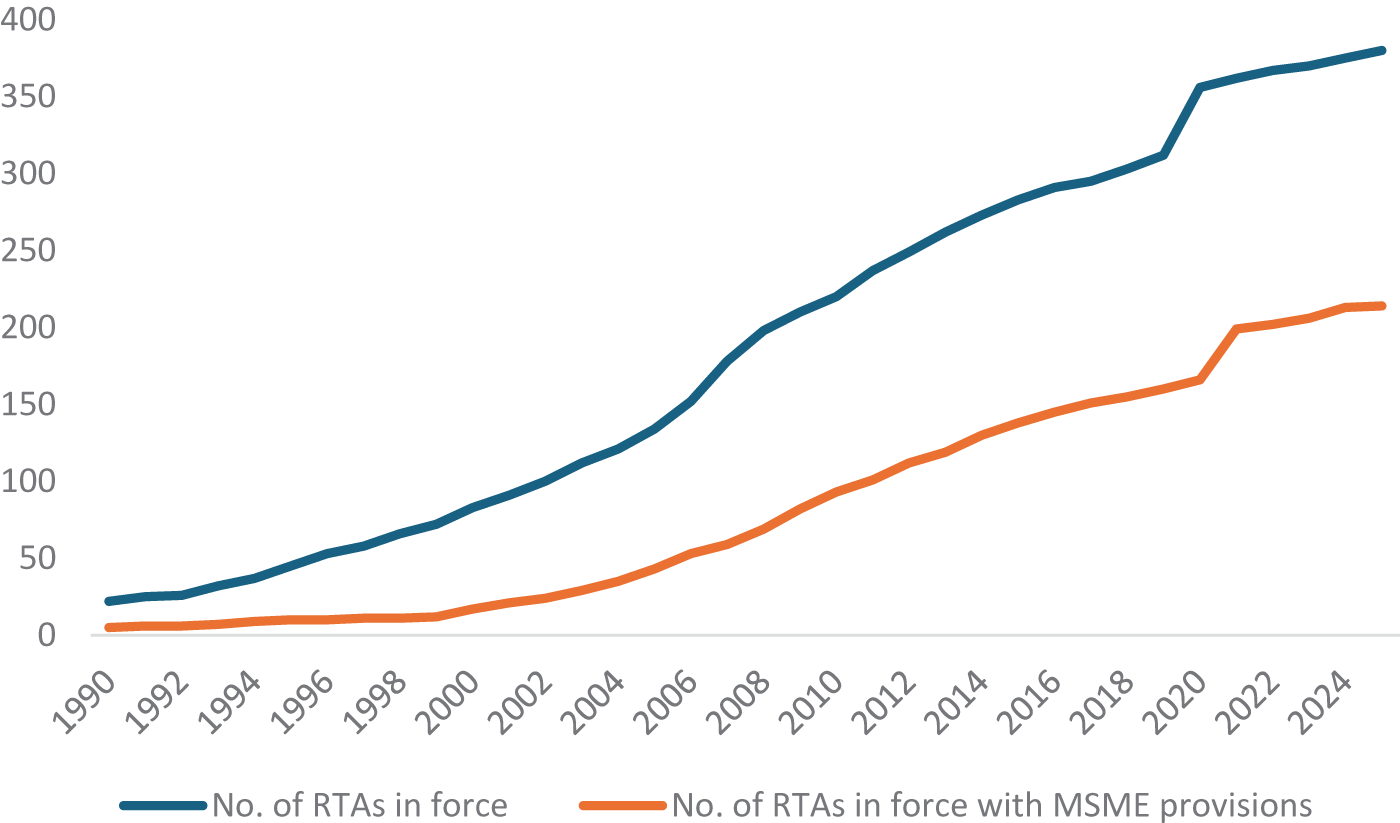
As shown in Figure 1, the total number of RTAs in force has increased over time, and the share of agreements incorporating MSME provisions has expanded in parallel. Since 1999, there has been a clear, consistent upward trend in the number of RTAs with MSME-related provisions. As the number of RTAs in force has increased over time, MSME-oriented measures, such as those facilitating access to finance, cooperation, government procurement, customs, and digital trade have expanded in parallel. The trend reflects growing policy recognition and broader efforts to integrate development and inclusivity goals into trade frameworks.
The number of RTA and MSME-related provisions in force over time.

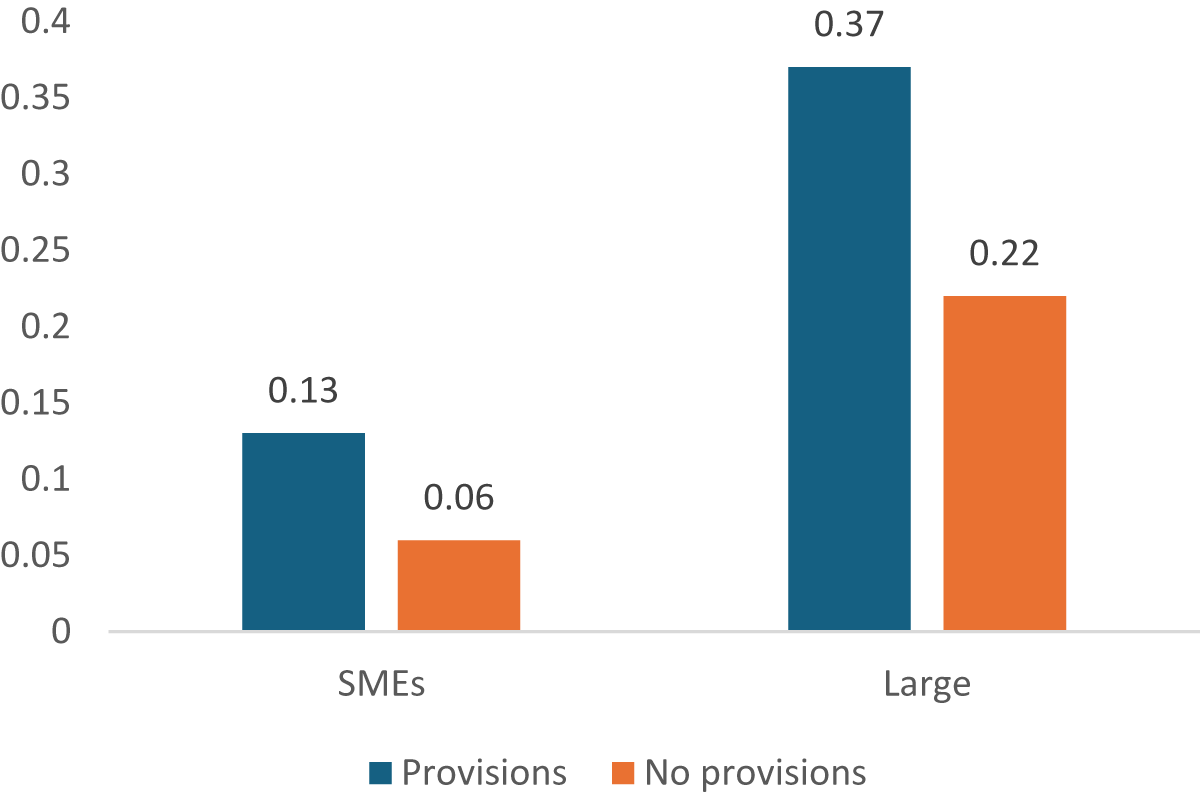
Because the provisions aim to enhance competitiveness, we expect them to be positively associated with GVC participation. Using the simple GVC definition of simultaneous importing and exporting (Dovis and Zaki, Reference Dovis and Zaki2020), Figure 2 compares the relationship between MSME provisions and GVC participation across MSMEs and large firms. The data suggest that the scope of MSME-related provisions is more associated with GVC engagement among smaller firms than larger counterparts. As shown, a higher share of GVC participation is positively associated with the presence of MSME provisions. While this holds true for both SMEs and large firms, the difference in GVC participation is larger for SMEs (13% versus 6% with and without provisions, respectively) than for large ones (37% versus 22%). While large firms are typically well integrated into GVCs regardless of policy provisions,Footnote 2 SMEs appear more responsive to trade agreements that include targeted support measures. This pattern highlights the potential of MSME provisions to narrow participation gaps and enhance SMEs’ inclusiveness in international production networks.
GVC participation over provisions across firm sizes.

Preliminary association between provisions related to SMEs and the latter’s participation in GVCs is clear. Yet, because the provisions cover multiple topics and areas, it is important to disentangle the relevant policy areas. Accordingly, Table 1 presents the probability of GVCs’ participation by firm size (SMEs versus large) across trade-related and non-trade-related provisions.
Share of SMEs and large firms’ GVC participation over areas of provision

Table 1 Long description
The table compares the share of small and medium enterprises and large firms that participate in global value chains versus not, split by whether trade-related and non-trade-related provisions are included. For SMEs, GVC participation is low when provisions are not included: 7 percent for trade-related and 5 percent for non-trade-related, with the remainder non-GVC. When provisions are included, SMEs’ GVC share rises to 15 percent for trade-related and 12 percent for non-trade-related, but non-GVC still dominates. For large firms, the split is stable across all rows: 33 percent GVC and 67 percent non-GVC, regardless of provision type or whether it is included. Overall, inclusion of provisions is associated with a modest increase in SMEs’ GVC participation, while large firms show no change across provision categories. Percentages are presented as shares within each firm-size group and provision condition, so they describe composition rather than causal effects.
Source: Own construction based on the World Bank Enterprise Surveys and WTO datasets.
Note: YES refers to the inclusion of the provision in question. NO refers to the non-inclusion of the provision in question.
The two areas reflect distinct policy dimensions through which trade agreements can affect firms’ integration into international production networks. Trade policy provisions cover market access, customs facilitation, and the reduction of non-tariff barriers that directly influence the tradability of intermediate inputs and final goods. However, non-trade-related provisions span institutional, development, and services provisions. First, institutional provisions include measures that strengthen coordination, transparency, and the administrative environment supporting MSMEs. These may involve establishing cooperation platforms and capacity-building mechanisms. Second, service provisions address access to finance, business services, and digital infrastructure that enable firms to upgrade within GVCs. The latter are important given the servicification of the manufacturing sector (Crozet and Millet, Reference Crozet and Milet2017). Third, development-related provisions encompass technical assistance, training, and knowledge-sharing initiatives that enhance firms’ absorptive capacity and linkages.
The data reveal a consistent pattern: SMEs operating under agreements with MSME-related provisions are more likely to participate in GVCs than those without. That is 15% of SMEs with trade-related provisions and 12% with non-trade-related provisions participate in GVCs, whereas only 7% SMEs without trade-related provisions and 5% without non-trade-related provisions trade in GVCs. In other words, GVC participation among SMEs rises from 7% to 15 % when trade-related provisions are present and from 5% to 12% when non-trade-related provisions are included. For large enterprises, GVC participation rises from 33% to 34% when either trade-related or non-trade-related provisions are included. Although the data show that provisions benefit both SMEs and large enterprises, the marginal gains for SMEs are higher, suggesting that MSME-oriented measures are particularly effective in reducing fixed costs and informational barriers that constrain SMEs’ engagement in cross-border production. This aligns with evidence in the literature that improving digital connectivity, trade facilitation, and institutional coordination have been shown to enhance small-firm internationalization and innovation capacity (Añón and Bonvin, Reference Añón Higón and Bonvin2024; López González et al., Reference López González, Munro, Gourdon, Mazzini and Andrenelli2019).
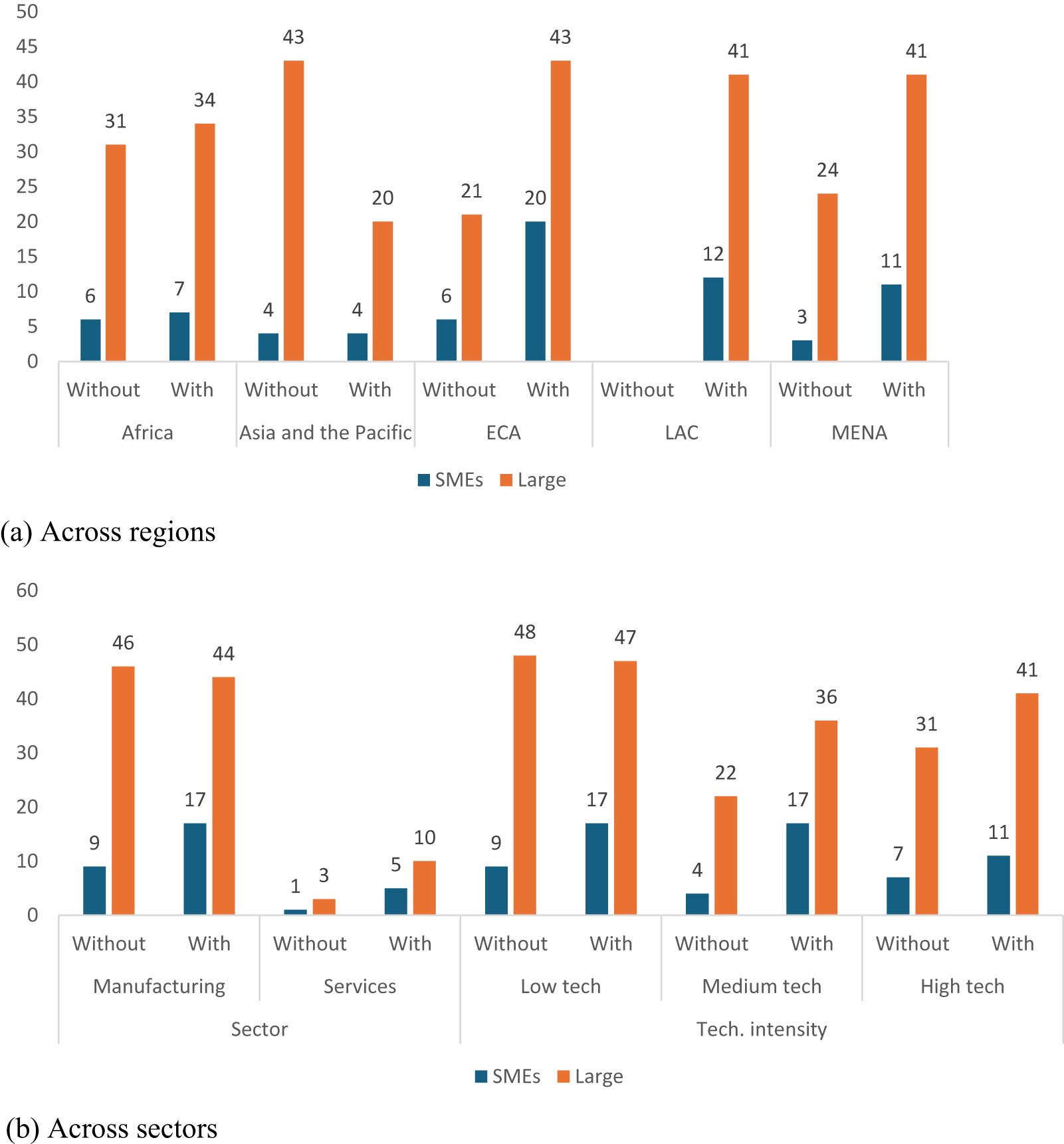
To scrutinize the association between MSME-related provisions and GVCs, Figures 3a and 3b show that the share of provisions for GVC participants is higher than that for non-GVC participants for SMEs and large enterprises across regions and sectors.Footnote 3 At the sectoral level, this association is clearer in manufacturing than in services. When classifying the manufacturing sector by technology level across SMEs and large enterprises, we observe a strong association with low- and medium-tech-intensive industries relative to high-technology-intensive sectors.
MSME-related provisions and GVCs participation (SMEs versus large firms).

Figure 3 Long description
The graphs illustrate the impact of MSME-related provisions on SMEs and Large firms. The vertical axis represents the percentage share, ranging from 0 to 60. The first graph compares regions: Africa, Asia and the Pacific, ECA, LAC and MENA. Key patterns include higher percentages for Large firms in all regions, with notable differences in Africa and Asia. The second graph compares sectors and technology intensity: Manufacturing, Services, Low tech, Medium tech and High tech. Large firms consistently show higher percentages, especially in Manufacturing and Low tech. Key values include Africa with Large firms at 34 percent and SMEs at 7 percent and Manufacturing with Large firms at 46 percent and SMEs at 9 percent. The graphs highlight the greater share of provisions for Large firms across all categories. The legend differentiates SMEs and Large firms.
Besides the association with GVCs, we observe that, overall, the share of provisions in large enterprises exceeds that in SMEs. Because large enterprises are advantaged in capacity, connectivity, and the utilization of agreements, we suspect a lobbying effect of the provisions. Although the provisions target small and disadvantaged enterprises, the benefits may also be realized by larger enterprises that outsource some activities to MSMEs. To this end, it is important to control the lobbying effect of large firms in the empirical strategy to ensure the benefit to SMEs is captured.
Taken together, the stylized facts indicate that MSME-specific provisions are correlated with a higher share of GVC participation among smaller enterprises. Furthermore, manufacturing and low-technology-intensive sectors have higher shares than services or higher-technology sectors. Across regions, large enterprises have a higher share of provisions than SMEs. These facts signal the role of well-designed, targeted trade-agreement clauses in making global integration more inclusive. Yet, econometric modeling is necessary to determine the causal and robust effect of provisions on GVCs.
4. Methodology
Our empirical strategy estimates the effect of MSME-related provisions in RTAs on firms’ participation in GVCs. Following Dovis and Zaki (Reference Dovis and Zaki2020), we construct a GVC binary variable equal to 1 if the firm simultaneously imports foreign inputs and exports, and 0 otherwise. This measure is the least strict definition and includes vertical integration, as the firm imports intermediate goods and exports. Because this extensive measure does not capture the firm’s position along the chain, it remains a proxy for GVCs’ participation at the extensive margin level rather than a comprehensive indicator of the depth of integration or the position within the value chain. In that sense, our analysis focuses on the relative participation across firms rather than detailed participation mechanisms and positions.
Using a probit regression, we estimate the MSME effect on GVC participation as follows:
 \begin{align}GV{C_{ijt}}\, & = \,{a_o}\, + \,a_1^{}Provision{s_{jt}}\, + \,{a_2}SM{E_{ijt}}\, + \,{a_3}(provision{s_{jt}}\,*SM{E_{ijt}}) \nonumber \\& \quad + \,{a_4}{Z_{ijt}} + {\delta _{jt}} + {\delta _s} + {\varepsilon _{ijt}}\end{align}
where  $GV{C_{ijst}}$ is the constructed GVC participation extensive measure in firm i, country j, and year t. $Provision{s_{jt}}{\text{ }}$ is the extensive measure of MSME-related provisions in country j at year t corresponding to a binary variable that is equal to 1 if the MSME-related provisions exist within the country’s signed agreements and equals 0 otherwise. $SM{E_{ijt}}$ is a binary variable equal 1 if the firm is a micro, medium, or small enterprise with total number of employees less than 100 and equals 0 otherwise. ${Z_{ijt}}$ is a vector of control variables including firm age, and government ownership. We control for firm age, defined as the number of years since operation, because mature firms have lower sunk costs and are less financially constrained than younger counterparts (Minetti and Zhu, Reference Minetti and S.C.2011; De and Nagaraj, Reference De and Nagaraj2014). Accordingly, we expect a positive association between firm age and GVC participation. Finally, government ownership controls for firms’ connectivity because more connected firms participate more in GVCs (De and Nagaraj, Reference De and Nagaraj2014; Aboushady and Zaki, Reference Aboushady and Zaki2025). Besides the observed control variables, we include country-year fixed effects ${\delta _{jt}}{\text{ }}$to and sector fixed effects ${\delta _s}$ control for unobservable heterogeneity.
Because larger firms with higher competitiveness and productivity derive economies of scale, we expect the SME variable to be negatively associated with GVC, as large firms participate more in GVCs (Urata and Baek, Reference Urata and Baek2020). Yet, the interacting variable is key to emphasizing the strengthening role of provisions in SMEs’ participation in GVCs. Although the direct association between SMEs and GVCs is expected to be negative, provisions may mitigate this effect by supporting SMEs’ penetration of foreign markets.Footnote 4
To assess the robustness of our results, we first alternate the dependent variable, using the strict definition of GVC (GVC 4), incorporating foreign ownership and international certification, with GVC 1 to define participation. As for the independent variable, we alternate it with the number of provisions included in the signed RTA. In that sense, we examine the relevance of the intensity of provisions and not only their mere presence.
Second, we suspect that the effect might be driven by large enterprises who might lobby for the inclusion or the exclusion of such provisions. To control for potential lobbying effects arising from large enterprises, we exclude the top 10% and 1% by number of full-time employees based on the country-level firm size distribution. Moreover, MSMEs that are already active in GVCs may demand, and obtain, the inclusion of MSME-related provisions in trade agreements. This is especially plausible in countries where MSMEs represent a large share of the economy and are well organized. Thus, we extend the sample trimming procedures by excluding the country with the largest number of MSMEs. Finally, the effects of provisions might also be driven by countries actively including MSME provisions in their RTAs. To overcome this problem, we exclude the region with the highest concentration of MSME provisions in trade agreements.
Third, we control for endogeneity in provisions using alternative methodologies. Because firms engaged in GVCs may already be in countries with a high concentration of RTAs and provisions, we suspect reverse causality. Accordingly, we use a two-stage instrumental variable approach to ensure the causal effect of provisions on GVCs. We instrument the provisions with the quality of institutions of the main trade partner. Conceptually, higher institutional quality in a partner country may increase the likelihood and depth of trade agreement provisions (Aly and Zaki, Reference Aly and C.2025), while it is unlikely to affect directly the country’s GVC participation except through its influence on agreement design. Moreover, we apply a leave-one-out strategy where the average of provisions is computed by aggregating provisions at the country–year level while excluding those related to the firm in question.
Given the nature of our multi-level dataset, we use a multilevel modeling framework to account for the nested structure of firms within country–year contexts, thereby controlling for both across- and within-country correlations in outcomes. Because our regressors are at both the firm and the country–year level, ignoring this hierarchical structure may bias standard errors and confuse firm-level and country-level sources of variation (Snijders, Reference Snijders2011; Rabe-Hesketh and Skrondal, Reference Rabe-Hesketh and A.2010; Searle et al., Reference Searle, G. and C.E.1992), in which firm-specific factors are modeled at the first level while country-level characteristics, represented by the MSMEs provisions, are modeled at the second level. This approach accounts for within-country correlation in outcomes and provides a more appropriate specification when combining micro and macro determinants.
After ensuring a robust effect of provisions on GVCs, we extend the analysis in several ways. First, to scrutinize the effect of varying types, we divide the MSME-related contents into trade-related and non-trade-related provisions. This will help identify the relevant provisions for SMEs and examine whether trade policy is sufficient to enhance SMEs’ participation in GVCs, or whether complementary non-border measures are more relevant (Di Ubaldo and Gasiorek, Reference Di Ubaldo and Gasiorek2022). To do that, we construct a dummy variable for trade-related provisions that takes the value of 1 if the agreement includes at least one of the following: customs, administration of the agreement, goods trade, subsidies, or rules of origin. For non-trade related provisions, we construct a dummy variable that takes the value of 1 if the agreement includes at least one of the following: cooperation, transparency, competition, preamble, regulatory practice/coherence, industrial policy, state owned enterprises, and institutional provisions, government procurement, investment, intellectual property, services, e-commerce, and digital trade, development, SMEs, labor, and environment. We alternate between the types in the regressions and observe the direct and SMEs moderating effects of each on GVC participation. As a third extension, we explore heterogeneity in effects across sectors by classifying economic activity by technology intensity, income levels, and geographical region. We expect that the manufacturing sector and low or medium-technology sectors are likely to benefit more from such provisions, given that large firms outsource such activities to MSMEs, which increases their integration into GVCs. As per income level, the lower a country’s absorptive capacity, the greater the spillover effect of international interlinkages. Thus, low and middle-income countries are more likely to benefit from such provisions. Finally, at the regional level, regions where SMEs face disproportionately high barriers to international integration (such as Africa), such provisions can be less effective.
5. Empirical Results
In this section, we present the results on the effect of MSME-related provisions on firms’ GVC participation. To guarantee a robust effect, we use alternative measures of the variables of interest, different methodologies, and control for different sample characteristics. Our analysis focuses on the differential effect of trade-related and non-trade-related provisions. Additionally, we examine the heterogeneity in the effects across sectors, income levels, and regions.
5.1 Baseline Results
As presented in Table 2, the presence of MSME-related provisions is positively associated with firms’ GVC participation. In countries with MSME-related provisions, column 1 shows that firms are 20 percentage points more likely to participate in GVCs. Because our analysis focuses on SMEs, we examine the moderating effect of provisions on their participation. Although MSME-related provisions are expected to primarily support smaller firms, trade agreements’ provisions generally serve larger counterparts, often with a similar or even higher momentum than SMEs, due to their greater lobbying and connectivity (Antoine et al., Reference Antoine, Atikcan and Chalmers2023). Moreover, the inclusion of MSME provisions can be an indicator of the depth of the agreement that can benefit SMEs and large firms. Finally, the inclusion of MSME provisions can help SMEs that are part of clusters with large firms that often rely on SMEs as suppliers, distributors, or service providers. In addition, such provisions can help SMEs better comply with trade standards and certification processes, which simplify operations for large firms.
Baseline results

Table 2 Long description
The table reports two regression models with extensive GVC participation as the outcome and 165,321 observations in each model. MSME provisions have a positive and statistically strong association with the outcome in both specifications, with coefficients about 1.16 in model 1 and 0.95 in model 2. SME status shows a negative and statistically strong association, about minus 0.88 in model 1 and minus 1.19 in model 2. Model 2 adds an interaction between SME status and MSME provisions that is positive and statistically strong at about 0.34, indicating the provisions are associated with a larger increase for SMEs than for non SMEs. Log age is positive and statistically strong in both models at about 0.03 to 0.04, while log government ownership is small and not statistically distinguishable from zero. Model fit is the same across models with R squared around 0.278, and both include country by year and sector fixed effects. Coefficients should be interpreted as associations conditional on the included controls and fixed effects, not necessarily causal effects.
Notes: Standard errors are in parentheses.
*** p < 0.01, ** p < 0.05, * p < 0.1.
As column 2 shows, the presence of MSME-related provisions mitigates the negative association between SMEs and GVCs, underscoring their relevance, particularly for SMEs. The baseline findings align with the empirical literature, which shows that supportive policies are necessary to overcome structural constraints (Anand and Kaur, Reference Anand and Kaur2021; De and Nagaraj, Reference De and Nagaraj2014). In that sense, the disadvantages of firm size are mutable with institutional and cooperation support.Footnote 5 As for the control variables, older firms participate more in GVCs due to better-established networks (Karakara et al., Reference Karakara, Obeng, Armah and Nunoo2025). Older firms are not only better integrated into foreign markets but also have a higher probability of establishing local networks, thereby facilitating access to finance and credit lines and fostering foreign market entry (Elsharawy and Ezzat, Reference Elshaarawy and Ezzat2023). Including firm age as a control variable accounts for factors such as connectivity, access to knowledge, and lower risk.
5.2 Robustness Checks
To guarantee the robustness of the effect of MSME-related provisions on SMEs’ participation in GVCs, we proceed by employing alternative measures for the variables of interest, sample trimming to control for possible lobbying effects and sample biases, and alternative methodologies to circumvent endogeneity and cross-country variations.
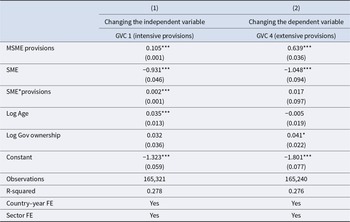
Table 3 presents the results of employing different measures of provisions (an intensive measure) and GVC (the strict definition). As column 1 shows, a consistent positive and significant effect remains for intensive provisions on GVCs. Recall that this variable shows the total number of MSMEs related provisions in trade agreements. As the number of provisions increases by 1 unit, the probability of GVC participation increases by 10.5%. Beyond consistency with baseline results, we find that the intensity of trade agreements matters for GVC participation (Delera and Foster-McGregor, Reference Delera and Foster-Mcgregor2020). As the number of provisions related to MSMEs increases, the probability of GVC participation increases, with a positive interaction with SMEs. Although the intensive margin matters, the extensive margin of provisions has a higher effect on GVC participation.
Alternative measures for the dependent and independent variables

Table 3 Long description
Two regression models relate MSME provisions, SME status, their interaction, and firm controls to two alternative global value chain measures. Model 1 uses GVC 1 as the outcome and reports a positive association for MSME provisions at 0.105, while SME status is negative at minus 0.931; the interaction term is small but positive at 0.002. Model 2 uses GVC 4 as the outcome and shows a larger positive association for MSME provisions at 0.639 and a negative association for SME status at minus 1.048; the interaction term is 0.017 and is not statistically reliable. Log age is positive in model 1 at 0.035 but near zero and not statistically reliable in model 2 at minus 0.005. Log government ownership is not statistically reliable in model 1 at 0.032 and is weakly positive in model 2 at 0.041. Both models include country by year and sector fixed effects, have about 165 thousand observations, and similar fit with R-squared around 0.28. Coefficients should be interpreted as associations conditional on the included controls and fixed effects, not as causal effects.
Notes: Standard errors are in parentheses.
*** p < 0.01, ** p < 0.05, * p < 0.1.
In column 2, we show the results of MSMEs provisions (measured by the extensive variable) on the strict definition of GVCs (GVC 4 that includes two-way traders, foreign ownership, and foreign certification). The positive effect of MSME-related provisions remains significant, indicating that their presence is associated with a 2.4% higher probability of engaging in GVCs. Yet when we use the strict GVC measure, the interaction with SMEs becomes insignificant. Our results show that although provisions strengthen SMEs’ two-way trade, they do not affect the covariates of foreign ownership and international certification. This is consistent with empirical evidence on ASEAN economies showing that foreign ownership is relevant to large but not too small or medium-sized enterprises (Bozsik et al., Reference Bozsik, Ngo and Vasa2023). Accordingly, the interaction of MSME-related provisions with SMEs is insignificant, indicating that, when it comes to foreign investments, large firms are the sole beneficiaries of these provisions. In addition, it aligns with Bozsik et al. (Reference Bozsik, Ngo and Vasa2023), showing that the positive effect of FDIs on SMEs is unguaranteed and conditional on contextual factors such as absorptive capacities.
To further ensure that the positive effect of provisions is not driven by sample characteristics (see Table 4). First, to control for the lobbying effect, columns 1 and 2 present the results after excluding the top 10% and 1% of full-time employment, based on the country-level firm size distribution. Excluding the superstar firms is important to ensure that the largest enterprises do not exploit their connectivity and benefit exclusively from the trade agreement’s provisions. The results are in line with the baseline ones.
Alternative samples

Table 4 Long description
The table reports four regression specifications that test robustness by excluding different sets of large observations: top 90th percentile, top 99th percentile, the largest number of SMEs, and the largest number of provisions. In every specification, the coefficient on MSME provisions is positive and statistically significant, ranging from about 0.88 to 1.16. SME status is consistently negative and statistically significant, ranging from about minus 1.06 to minus 1.37. The interaction between SME and provisions is positive and statistically significant in all columns, roughly 0.32 to 0.46, indicating the provisions effect is more favorable for SMEs than the SME main effect alone suggests. Log age is positive and statistically significant in all models, while log government ownership is small and not consistently significant, becoming weakly positive in the fourth specification. Sample sizes vary from about 115 thousand to 163 thousand observations, and model fit is similar across columns with R-squared around 0.24 to 0.28. All models include country by year fixed effects and sector fixed effects, so coefficients reflect within country year and within sector comparisons. Interpret results as associations rather than causal effects, and note that statistical significance is based on reported standard errors.
Notes: Standard errors are in parentheses.
*** p < 0.01, ** p < 0.05, * p < 0.1.
In columns 3 and 4, we exclude the country with the largest number of SMEs and the region with the highest number of MSME provisions in RTAs, respectively. The rationale behind this trimming is that countries with many SMEs in the sample are more prone to demand and use the MSME-related provisions and hence drive the results. In the same sense, signing RTAs, including a large number of MSME provisions, can signal high engagement in global networks and GVCs for SMEs. The results across different sample trimmings are consistent with our baseline evidence, showing that the effect is not driven by large enterprises, many SMEs, or RTAs that are intensive in MSME provisions.
Although sample trimming reduces bias, it does not control for endogeneity between GVC and MSME provisions. To control for this, Table 5 presents results from instrumental variables, multi-level, and leave-one-out methodologies in columns 1, 2, and 3, respectively. Because GVCs can encourage countries to increase the number of RTAs to enhance or deepen their participation, reverse causality is suspected. Accordingly, we employ an instrumental variables two-stage method, using the quality of institutions in the main trade partner to instrument the provisions. The rationale behind the instrument is that higher institutional quality in a partner country may increase the likelihood and depth of trade agreement provisions (Aly and Zaki, Reference Aly and C.2025), while it is unlikely to directly affect the country’s GVC participation, except through its influence on agreement design. As presented in column 1, the SME interaction with provisions is significant and positive.Footnote 6 Circumventing endogeneity reveals a particular relevance of provisions to SMEs only.
Alternative methodologies

Table 5 Long description
The table reports regression coefficients and standard errors for three estimation approaches: instrumental variables, multi-level analysis, and leave-one-out. SME status is negative and statistically significant in all three models, with estimates around minus 1.05, minus 0.24, and minus 1.19. MSME provisions are positive and statistically significant in the instrumental variables and leave-one-out models (about 2.00 and 0.95), but small and not statistically significant in the multi-level model (about 0.02). The interaction between SME and provisions is positive and statistically significant in all models (about 0.19, 0.04, and 0.34), suggesting provisions are associated with a less negative outcome for SMEs. Log age is positive and statistically significant across methods, while log government ownership is positive and significant in the first two models but not significant in leave-one-out. Sample sizes are large and similar across models (about 163 thousand to 166 thousand observations), and the reported R-squared values are about 0.279 for instrumental variables and 0.278 for leave-one-out. All models include country-by-year and sector fixed effects, so results reflect within-country-year and within-sector comparisons; differences in significance across methods indicate some sensitivity to specification.
Notes: Standard errors are in parentheses.
*** p < 0.01, ** p < 0.05, * p < 0.1.
Second, we construct the ‘leave-one-out mean’ of provisions, which is computed by aggregating provisions at the country–year level while excluding those related to the firm in question. This approach prevents mechanical correlation between firm-level outcomes and contextual regressors constructed from the same sample. Column 3 shows consistent effects with the baseline estimates.
Third, given the structure of the data, we employ a multilevel analysis to ensure that country-specific conditions do not drive a positive effect. This specification introduces random intercepts to capture unobserved heterogeneity such as institutional quality, market structures, and trade policy. As presented in column 2, the multi-level analysis shows a particular relevance of provisions to SMEs with a positive and significant interaction term and an insignificant direct effect. The consistency of results across robustness checks strengthens our confidence in the finding that MSME provisions positively shape SMEs’ participation in GVCs.
5.3 Extensions
Our baseline and robustness checks results show the positive effect of MSME-related provisions on SMEs’ participation in GVCs, revealing patterns that are not only consistent with theoretical expectations but also raise questions about the specific contents driving firms’ engagement in GVCs. As mentioned earlier, because the provisions span multiple policy areas, we proceed by compiling relevant content into two categories: trade-related and non-trade-related. By allocating the contents into these two groups, Table 6 presents the results for each group on GVCs’ participation. Although both types show a positive effect, our analysis depicts that non-trade-related provisions exert a larger magnitude and significance of the interaction term. This greater magnitude and significance suggest that auxiliary support and access to services are transformative in shaping GVC participation (Aboushady, Reference Aboushady2022; Di Ubaldo and Gasiorek, Reference Di Ubaldo and Gasiorek2022) and matter more than border and direct trade policy measures.
Provisions heterogeneity

Table 6 Long description
The table reports regression results separately for trade and non-trade sectors, estimating how MSME provisions, SME status, and their interaction relate to the outcome while controlling for firm age and government ownership. MSME provisions have positive and statistically strong associations in both sectors, about 0.367 in trade and 0.96 in non-trade. SME status alone is negative and statistically strong, about minus 0.956 in trade and minus 1.163 in non-trade. The interaction between SME status and provisions is positive, small in trade at about 0.132 with weaker statistical support, and larger and statistically strong in non-trade at about 0.313, suggesting provisions are more beneficial for SMEs especially outside trade. Log age is positive and statistically strong in both sectors at about 0.034 to 0.035, while log government ownership is near 0.031 and not statistically distinguishable from zero. Both models use 165,321 observations, have an R-squared of 0.278, and include country-year and sector fixed effects, so results reflect within-country-year and within-sector comparisons rather than cross-country differences.
Notes: Standard errors are in parentheses.
*** p < 0.01, ** p < 0.05, * p < 0.1.
The higher impact of non-trade-related provisions aligns with recent evidence that digitalization, e-commerce, and government support services are crucial for SME resilience and competitiveness (Sharma et al., Reference Sharma, Kraus, Talan, Srivastava and Theodoraki2024). Undoubtedly, digitization and e-commerce reduce logistics and communication costs, thereby facilitating integration with foreign markets (Gopalan et al., Reference Gopalan, Reddy and Sasidharan2022). Recent evidence shows that policy instruments such as public procurement strengthen resilience by diversifying supply chains and incentivizing local upgrading (Baraldi et al., Reference Baraldi, Ciabuschi and Fratocchi2025), particularly for SMEs (Pushp and Ahmed, Reference Pushp and Ahmed2023). In addition, investment clauses and financial constraints are positioned to be the biggest barrier to GVC participation (Reddy and Sasidharan, Reference Reddy and Sasidharan2021).
While the comparatively small effect of trade-related clauses is unexpected, the rationale behind it is threefold. First, trade-related provisions often focus on customs and trade regulations, which tend to benefit firms already capable of engaging in two-way trade rather than directly supporting the capacity of domestic SMEs to penetrate foreign markets. Second, unlike service-oriented or institutional provisions, trade policy measures may not provide the finance, networks, or technical assistance that small firms need in order to overcome the barriers to participation. Third, the effectiveness of export promotion provisions is dampened by large disparities in institutional quality across countries. Accordingly, as Aboushady et al. (Reference Aboushady, Harb and Zaki2025) suggest, institutional quality-related reforms shall be considered by donors of trade integration in recipient countries. In addition, development and institutional provisions bridge the gap between partners, which is necessary for increased integration (Ben et al., Reference Ben Belgacem, Younsi, Bechtini, Alzuman and Khalfaoui2024). Our findings align with the World Trade Organization’s World Development Report, which suggests the indispensable domestic policies for inclusive trade in low- and middle-income countries (WTO, 2024).Footnote 7
As another relevant extension, we examine heterogeneity in the effects of MSME-oriented provisions across sectoral, income, and regional groups. As shown in Table 7, while the direct effect of these provisions is positive across both aggregate sectoral categories (manufacturing and services) and technological classifications (low-, medium-, and high-technology),Footnote 8 the interaction with SMEs is statistically significant only for manufacturing and low-technology-intensive sectors. This suggests that MSME provisions are most effective in facilitating GVC participation where production is more tangible and entry barriers are relatively low. Services and higher-technology sectors may require additional complementary measures to enhance SMEs’ capabilities for the provisions to be effective in fostering GVC interlinkages. The silent effect in medium- and high-technology-intensive sectors suggests that, while provisions are effective, they are insufficient to foster SME upgrading across the chain.
Sectoral heterogeneity

Table 7 Long description
The table reports regression results by sector group (manufacturing, services) and by technological intensity (low, medium, high), with country–year fixed effects included in all models. MSME provisions have positive and statistically strong coefficients in every column, largest in services (0.91) and low-tech (0.704), smaller in medium-tech (0.453) and high-tech (0.168). SME status is negative and statistically strong across all specifications, ranging from about minus 0.709 in services to about minus 1.314 in low-tech, and remaining near minus 1.114 in high-tech. The interaction between SME and provisions is positive and statistically strong in manufacturing and low-tech (around 0.293 to 0.300), but not statistically strong in services, medium-tech, or high-tech. Firm age shows small positive associations in most columns, but is not statistically strong in high-tech where the estimate is negative. Government ownership is generally not statistically strong, except a small positive estimate in medium-tech. Sample sizes vary widely across columns, from 92,819 observations in manufacturing to 2,572 in high-tech, and model fit (pseudo R-squared) is highest in the medium- and high-tech columns (about 0.283 to 0.288).
Notes: Standard errors are in parentheses.
*** p < 0.01, ** p < 0.05, * p < 0.1.
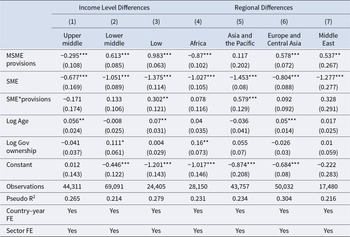
Finally, Table 8 presents heterogeneity across income levels and regions to assess the inclusivity of the provisions across countries. At the income-group level, the interaction effect is only significant for the low-income group. In line with Eissa and Zaki (Reference Eissa and Zaki2023), the lower a country’s absorptive capacity, the greater the spillover effect of international interlinkages.
Country-level heterogeneity

Table 8 Long description
The table reports regression coefficients for MSME provisions, SME status, their interaction, and firm controls across seven subsamples split by income group and world region. MSME provisions are negative for upper-middle income countries and Africa, but positive and statistically strong for lower-middle and low-income countries and for Europe and Central Asia and the Middle East; the estimate for Asia and the Pacific is small and not statistically clear. SME status is consistently negative and statistically strong in every column, with the largest negative estimates appearing in low-income countries and in Asia and the Pacific. The interaction between SME and provisions is generally small; it is positive and statistically meaningful in low-income countries and in Asia and the Pacific, but not clearly different from zero in most other subsamples. Among controls, log age is modestly positive in upper-middle income, low-income, and Europe and Central Asia, while government ownership is only sporadically significant, including a positive estimate in Africa and a weaker positive estimate in lower-middle income countries. Sample sizes range from about seventeen thousand to sixty-nine thousand observations, and pseudo R-squared values are roughly between 0.21 and 0.30, indicating moderate model fit across subsamples. Interpret results with caution because statistical significance varies by subsample and the estimates are conditional on country-year and sector fixed effects.
Notes: Standard errors are in parentheses.
*** p < 0.01, ** p < 0.05, * p < 0.1.
Latin America and the Caribbean region is dropped from the regression because of insufficient variability in provisions.
At the regional level, a particularly noteworthy finding of this study is that MSME-related provisions significantly enhance SMEs’ participation in GVCs only in Asia and the Pacific region, as shown in the positive interaction term. In Africa, the direct effect is negative, emphasizing particularly high compliance costs. In many African economies, SMEs face disproportionately high barriers to international integration, including limited access to trade-related information, weak institutional support, and high transportation and fixed trade costs (UN Trade and Development, 2025; World Bank, 2020). By improving transparency, reducing friction, and facilitating compliance with trade procedures, MSME-related provisions can play a meaningful role in alleviating the constraints in African economies to support SMEs’ participation in GVCs.
The country-level heterogeneity results highlight the substantial potential for SME integration into GVCs and suggest that well-designed trade agreements serve as effective instruments for fostering inclusive GVCs.
6. Conclusion
Despite their central role in employment and economic dynamism worldwide (OECD, 2019; Arshed et al., Reference Arshed, Carter and Mason2014), SMEs face persistent structural barriers that limit their participation in GVCs. Over time, the parallel rise in RTAs and the growing inclusion of MSME-related provisions across chapters reflect a policy shift toward addressing these constraints. Such provisions can ease financing, regulatory, and knowledge barriers, thereby fostering competitiveness, cooperation, and integration into GVCs. However, compliance and adaptation costs remain disproportionately high for smaller firms, possibly offsetting potential benefits. Our findings reveal a positive impact of MSME-related provisions in RTAs on SMEs’ GVC participation, and the results are consistent across different measures, sample trimmings, and methodologies with a greater effect of non-trade-related provisions than of trade-related ones.
In addition, trade policies appear to have a smaller magnitude than non-trade-related clauses, suggesting that non-border support – especially in services like digital trade and e-commerce – matters more to SMEs’ participation in GVCs than customs and border measures. The heterogeneity analysis reveals a particular impact on low-technology-intensive manufacturing sectors, low-income countries, and Asia. The particular significance of low-technology sectors signals that, although the provisions enhance downstream GVCs’ participation, they are insufficient to upgrade across the chain.
Our findings highlight the importance of targeted, well-designed policy measures to ensure SMEs can effectively benefit from provisions embedded in RTAs, particularly in economies at earlier stages of development. The consistent inclusion of MSME-related clauses across RTA chapters appears to promote SME integration into GVCs. This effect is particularly pronounced in Asia and the Pacific region. In Africa, results reveal high compliance. Embedding services and institutional provisions within the AfCFTA framework can play a key role in supporting firm participation in cross-border production networks. To boost integration, complementary and supportive domestic policies are equally essential to trade policy. Investment in human capital development encourages skilled labor-intensive manufacturing and attracts foreign investment, thereby strengthening local firms’ adaptive capacity. At the same time, targeted financial support mechanisms can help SMEs overcome the high fixed costs associated with compliance and GVC participation. Together, these policy dimensions point to a broader strategy in which trade policy and domestic reforms jointly advance inclusive integration into global markets.
Data replication
Yasmine Eissa; Chahir Zaki, 2026, ‘Replication Data for: Competitiveness vs. Compliance: How Trade Provisions Affect MSMEs in Global Value Chains?’, https://doi.org/10.7910/DVN/RQ1L7Z, Harvard Dataverse.
Competing interests
The authors did not receive support from any organization for the submitted work. They have no relevant financial or non-financial interests to disclose.
Ethics and consent to participate declarations
Not applicable.
Appendices
Variables definitions

Table A1 Long description
The table lists variable names and their definitions used in an analysis of firms and trade agreement content. Two global value chain indicators are defined: one flags firms that both export and import intermediate goods, and a stricter one also requires foreign ownership and international quality certification. Several variables capture whether a signed regional trade agreement includes specific provision groups, including MSME, institutions, services, trade policy, and development; most are coded as one when present and zero otherwise. An additional MSME measure counts how many MSME-related provisions appear across signed agreements, making it an intensity measure rather than a simple yes or no indicator. Firm characteristics include whether the enterprise is micro, small, or medium, years in operation expressed on a log scale, and government ownership share expressed on a log scale. The table also defines a country-level density rate as the number of registered limited-liability firms per one thousand working-age people. Two lobbying variables describe sample restrictions that exclude very large employers using different employee-count cutoffs, so results may differ depending on which cutoff is applied.
Descriptive statistics

Table A2 Long description
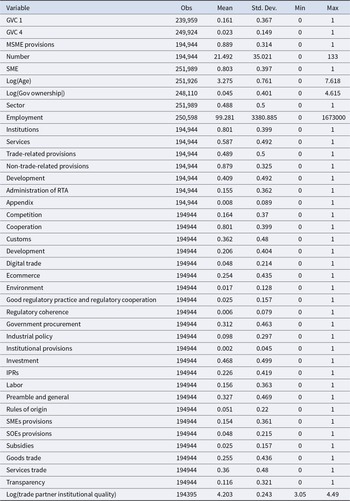
Descriptive statistics summarize multiple variables, reporting observation counts, averages, dispersion, and minimum and maximum values. Many variables are binary with ranges from 0 to 1, so their means indicate prevalence: MSME provisions average 0.889, SME averages 0.803, institutions average 0.801, and cooperation averages 0.801, while GVC 4 is uncommon with a mean of 0.023 and GVC 1 averages 0.161. Several policy-area indicators have moderate prevalence, including services at 0.587, trade-related provisions at 0.489, investment at 0.468, and customs at 0.362. Some features are rare, such as appendix at 0.008, regulatory coherence at 0.006, institutional provisions at 0.002, and environment at 0.017. Continuous measures show wide spread: employment averages 99.281 with a very large standard deviation and a maximum of 1,673,000, and the variable labeled number averages 21.492 with a maximum of 133. Logged measures include age with a mean of 3.275 (range 0 to 7.618), government ownership with a mean of 0.045 (range 0 to 4.615), and trade partner institutional quality with a mean of 4.203 (range 3.05 to 4.49). Observation counts vary by variable, from about 194,395 to 251,989, so comparisons should note that not all statistics are based on the same sample size.
Source: Authors’ own elaboration.
Empirical results: effect of trade and non-trade provisions on employment

Table A3 Long description
The table reports regression results where the outcome is the log of employment, estimated separately for the full sample and for small and medium-sized enterprises. In the full sample, the coefficient for trade provisions is 0.379 with a standard error of 0.011, while non-trade provisions is 0.223 with a standard error of 0.013. For SMEs, trade provisions is 0.268 with a standard error of 0.004, compared with 0.153 with a standard error of 0.004 for non-trade provisions. Across both samples, trade provisions have a larger positive association with employment than non-trade provisions. The number of observations is 165,229 for the full sample models and 133,442 for the SME models. Model fit is similar within each sample, with R-squared of 0.15 for the full sample and 0.103 for SMEs, and all models include fixed effects and controls. Coefficients are statistically significant at the one percent level, but the results describe associations and should not be read as definitive causal effects without additional design details.
Notes: Standard errors are in parentheses.
*** p < 0.01, ** p < 0.05, * p < 0.1.
IV First stage regression results

Table A4 Long description
The table reports a first-stage regression with MSME-Provisions as the dependent variable and several firm or ownership characteristics as predictors. The strongest highlighted result is that Institutions trade partner is positively related to MSME-Provisions, with an estimated coefficient of 0.25 and a standard error of 0.093, indicating high statistical significance. Log Age is also positive and highly significant, with a coefficient of 0.459 and standard error 0.12. SME status is positive with a coefficient of 0.772 and standard error 0.456, and is only weakly statistically significant. Log Gov ownership is negative at minus 0.486 with standard error 0.353 and is not statistically significant. The constant term is negative at minus 2.444 with standard error 0.795 and is highly significant. The model uses 272 observations, includes year fixed effects, and reports an R-squared of 0.184, so the explained variation is modest and results should be interpreted with that limitation in mind.
Notes: Standard errors are in parentheses.
*** p < 0.01, ** p < 0.05, * p < 0.1.
Disaggregated provisions

Table A5 Long description
The table reports four regression models with Extensive GVC 1 as the outcome, using different provision categories: Institutions, Services, Development, and Trade policy. In every model, MSME provisions have a positive and statistically strong association with the outcome, largest in the Services model and smallest in the Trade policy model. SME status is negative and statistically strong across all models, indicating SMEs have lower Extensive GVC 1 than the reference group when provisions are held constant. The interaction between SME status and provisions is positive and only weakly statistically supported in each model, suggesting provisions partly offset the negative SME association but by a relatively small amount. Log age is positive and statistically strong in all models, while log government ownership is small and not statistically distinguishable from zero. All models use the same sample size and show the same overall fit, and they include country by year and sector fixed effects, so results reflect within country year and within sector comparisons rather than cross country differences.
Note: Standard errors are in parentheses.
*** p < 0.01, ** p < 0.05, * p < 0.1.
Content interaction with SME effect on GVC.








 Open access

