


Introduction
Fisheries management is challenging (Beddington et al., Reference Beddington, Agnew and Clark2007) in part because of miscommunications between regulators and fishers regarding regulatory processes and requirements (Jentoft, Reference Jentoft2000; van Densen & McCay, Reference van Densen and McCay2007). This can result in limited trust among stakeholders, potentially leading to failure to manage the resource effectively (Kaplan & McCay, Reference Kaplan and McCay2004). These problems are particularly acute in small-scale fisheries, which are typically poorly managed (Salas et al., Reference Salas, Chuenpagdee, Seijo and Charles2007; Jacquet & Pauly, Reference Jacquet and Pauly2008). Nonetheless, when communication is used appropriately it can strengthen fisheries practices (Hartley & Robertson, Reference Hartley and Robertson2008; Gutierrez et al., Reference Gutierrez, Hilborn and Defeo2011). This has been the case with fleet communication tools used in fisheries to reduce impacts on protected species such as seabirds and turtles (Gilman et al., Reference Gilman, Dalzell and Martin2006). The use of modern communication tools to enhance conservation programmes has been found to be productive in other arenas, especially in remote geographical areas (Banks & Burge, Reference Banks and Burge2004; Kavanagh, Reference Kavanagh2008).
In Peru small-scale fisheries play an important role in provision of food and are a source of employment for >200,000 people (McGoodwin, Reference McGoodwin2001). Bycatch in these fisheries, however, has been shown to have an impact on threatened seabirds (Awkerman et al., Reference Awkerman, Huyvaert, Mangel, Shigueto and Anderson2006), marine turtles (Alfaro-Shigueto et al., Reference Alfaro-Shigueto, Mangel, Bernedo, Dutton, Seminoff and Godley2011) and marine mammals (Mangel et al., Reference Mangel, Alfaro-Shigueto, Waerebeek, Cáceres, Bearhop, Witt and Godley2010). Addressing conservation of these protected species in small-scale fisheries is difficult, partly because of the remoteness of many coastal communities (Chuenpagdee et al., Reference Chuenpagdee, Liguori, Palomares and Pauly2006), hampers management and enforcement. Also, the limited educational level of many stakeholders involved in these fisheries (Berkes et al., Reference Berkes, Mahon, McConney, Pollnac and Pomeroy2001) can contribute to a poor understanding of the conservation status of threatened fauna (Van Bressem et al., Reference Van Bressem, Alfaro-Shigueto, Geysen, Onton, Vega, Chavez-Lisambart and Van Waerebeek2006).
In the case of marine turtles, which are greatly affected by fisheries (Lewison & Crowder, Reference Lewison and Crowder2007; Peckham et al., Reference Peckham, Diaz, Walli, Ruiz, Crowder and Nichols2007; Casale, Reference Casale2011), a variety of solutions to reduce bycatch are in place or being tested in many fisheries. These approaches include technological innovation (turtle excluder devices, circle hooks, lights; Watson et al., Reference Watson, Epperly, Shah and Foster2005; Cox et al., Reference Cox, Lewison, Zydelis, Crowder, Safina and Read2007; Wang et al., Reference Wang, Fisler and Swimmer2010), educational programmes for fishers (Marcovaldi & Marcovaldi, Reference Marcovaldi and Marcovaldi1999), the use of incentives (Ferraro & Gjertsen, Reference Ferraro and Gjertsen2009), legally non-binding measures (e.g. the Inter-American Convention for the Protection and Conservation of Sea Turtles), and fisheries closures (NMFS, 2000). For small-scale fisheries, however, solutions are not widely executed and usually implemented voluntarily as most of these fisheries are poorly regulated, with limited enforcement and lack of economic incentives (Salas et al., Reference Salas, Chuenpagdee, Seijo and Charles2007; Jacquet & Pauly, Reference Jacquet and Pauly2008).
Communication tools have been used as an alternative way to prevent bycatch of marine turtles and other protected marine fauna in industrial fisheries (Gilman et al., Reference Gilman, Dalzell and Martin2006; Howell et al., Reference Howell, Kobayashi, Parker, Balazs and Polovina2008). Fleet communication programmes within the US North Atlantic longline swordfish, North Pacific, Alaska trawlers and Alaska demersal longline fisheries have been shown to reduce bycatch and prevent established bycatch thresholds from being exceeded (Gilman et al., Reference Gilman, Dalzell and Martin2006). In the US Hawaiian longline fleet managers provide fishers with updated maps of sea surface temperature as a tool to help them choose fishing grounds whilst avoiding bycatch of loggerhead turtle Caretta caretta (Howell et al., Reference Howell, Kobayashi, Parker, Balazs and Polovina2008).
Five species of marine turtles have been recorded in the waters of Peru, primarily as foraging animals (Alfaro-Shigueto et al., Reference Alfaro-Shigueto, Mangel, Bernedo, Dutton, Seminoff and Godley2011). Tagging, genetics and satellite tracking have demonstrated linkages with distant rookeries. Genetics of the leatherback turtle Dermochelys coriacea off Peru suggest they are from rookeries in the eastern (i.e. Mexico and Costa Rica) and western Pacific (i.e. Papua New Guinea, Indonesia and Solomon Islands; Dutton et al., Reference Dutton, LaCasella, Alfaro-Shigueto, Donoso, Blumental, Panagopoulou and Reesin press). Satellite tracking studies (Eckert & Sarti, Reference Eckert and Sarti1997; Shillinger et al., Reference Shillinger, Palacios, Bailey, Bograd, Swithenbank and Gaspar2008) have linked Peru and the Mexican and Costa Rican rookeries. A proportion of the green turtles Chelonia mydas visiting Peru originate from the Galapagos (Hays-Brown & Brown, Reference Hays-Brown, Brown and Bjorndal1982; Seminoff et al., Reference Seminoff, Zárate, Coyne, Foley, Parker, Lyon and Dutton2008) and Mexico (Velez-Zuazo & Kelez, Reference Velez-Zuazo, Kelez, Blumental, Panagopoulou and Reesin press). Loggerhead turtles are linked to populations breeding in Australia and New Caledonia (Alfaro-Shigueto et al., Reference Alfaro-Shigueto, Dutton, Mangel and Vega2004; Boyle et al., Reference Boyle, FitzSimmons, Limpus, Kelez, Velez-Zuazo and Waycott2009). Tagging and genetics of olive ridley turtles Lepidochelys olivacea suggest they originate from Costa Rica, Colombia and Mexico (Zeballos & Arias-Schereiber, Reference Zeballos and Arias-Schereiber2001; Velez-Zuazo & Kelez, Reference Velez-Zuazo, Kelez, Blumental, Panagopoulou and Reesin press). There is a paucity of information for the hawksbill turtle Eretmochelys imbricata but there may be links with continental Ecuador (Gaos et al., Reference Gaos, Abreu-Grobois, Alfaro-Shigueto, Amorocho, Arauz and Baquero2010). All these species are vulnerable to fisheries impacts (Alfaro-Shigueto et al., Reference Alfaro-Shigueto, Mangel, Caceres, Seminoff, Gaos and Yanez2010a, Reference Alfaro-Shigueto, Mangel, Bernedo, Dutton, Seminoff and Godley2011), and the effect of fisheries bycatch on some of these stocks has been detrimental (Spotila et al., Reference Spotila, Reina, Steyermark, Plotkin and Paladino2000; Limpus & Limpus, Reference Limpus, Limpus, Bolten and Witherington2003).
Peruvian small-scale fishing vessels often conduct trips offshore for >3 weeks (Alfaro-Shigueto et al., Reference Alfaro-Shigueto, Mangel, Pajuelo, Dutton, Seminoff and Godley2010b). As a result fishers are on land for only short periods, preventing their participation in many conservation programmes (i.e. attending workshops or outreach talks conducted at their ports). To address this we implemented a high frequency (HF) radio communication programme that communicates with fishers at sea to provide guidelines on the use of safe release methods for incidentally captured turtles, as well as information useful to them, in exchange for voluntary reports of locations of turtle bycatch. The aim was to use the provided locations to identify potential areas of high bycatch. These locations were then reported back to fishers operating in the same areas in an attempt to reduce the impacts of their fisheries on marine turtle populations.
Methods
We broadcasted from a fixed station based at Lima (12°30′ S, 77°24′ W) using a Vertex 1700 HF radio (price range: USD 1,600–1,800). Power output was 100–125 watts. Receiving frequency was 30 kHz–30 MHz and transmission frequency was 1.6–30 MHz. We used a multiband antenna that offered flexibility in switching between bands and frequencies during communications.
We used the internet to access daily updated oceanographic data (sea surface temperature, wind direction, chlorophyll, tides and potentially dangerous events; e.g. tsunamis, rough sea conditions), using websites that offer these services without charge (e.g. Buoyweather, 2012). Local websites were also used, such as the Peruvian Coastguard Dirección de Capitanías y Puertos (DICAPI, 2012) and the Instituto del Mar del Perú (IMARPE, 2012).
Broadcasts were from 0.90 to 15.00, local time, from January 2009 to December 2010. The number of broadcast days per month varied. During January–March 2009 we broadcasted 20 days per month, during April–July 2009 13 days, from August 2009 to May 2010 7 days, and during June–December 2010 8 days. Broadcasts were initiated by us on an open work frequency used daily by fishers throughout Peru and whenever fishers were interested in more information they would respond and initiate a conversation. Further into the conversation they would usually request to go into a personal frequency to provide information on marine fauna and fishing areas used.
Communications were two-way and in real time, preferably with fishing vessel captains. During each radio conversation we requested the boat name and ID, tonnage capacity, port of origin, date of departure and estimated date of arrival in home port, number of crew, fishing gear used, status of the person contacted (e.g. crew, captain), target species, fishing area used and any further information on fishing effort (type and number of hooks, number of fishing net panels) and their contact details (phone number, common radio frequency used, e-mail). We registered information on location of turtle bycatch, numbers captured, final fate (released live, discarded dead or retained for consumption), condition of capture (entangled, hooked) and species, if identified. Radio broadcasters were biologists and veterinarians, trained in handling, resuscitation and release techniques. Whenever turtle bycatch was reported we provided instructions on safe handling and release, based upon the National Marine Fisheries Service onboard observer protocols (NMFS-SEFSC, 2008). Our contact details were also shared with fishers, including name, phone number, address and e-mail.
Results
Broadcasting coverage
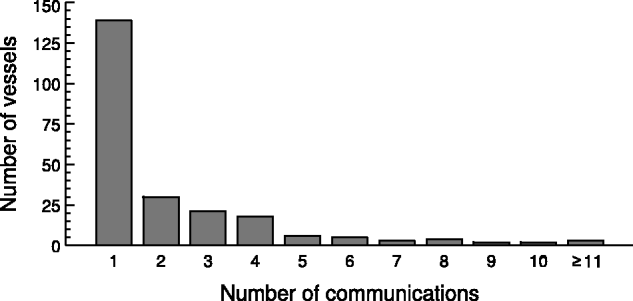
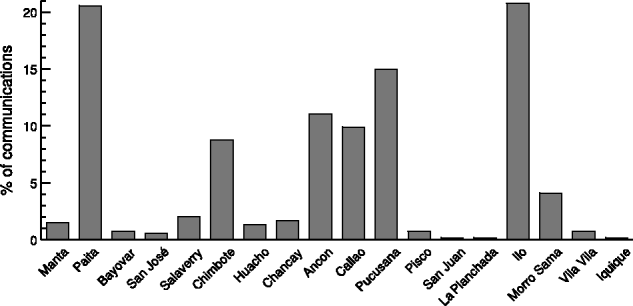
We obtained a total of 535 communications of which 74% were with vessels that communicated with us on multiple occasions (mean 2.3±SD 2.5, range 1–22; Fig. 1). The programme reached 234 small-scale fishing vessels from 18 fishing ports, from Manta in Ecuador to Iquique in Chile, giving a broadcast range of >3,000 km of coastline (Fig. 3). The number of communications per port of origin was, by an order of magnitude, led by Ilo, Paita, Pucusana, Ancon, Callao and Chimbote, with others constituting much smaller proportions of contacts (Fig. 2).
Number of HF communications per fishing vessel. The total number of contacts with vessels was 535 and the greatest number of contacts with a single vessel was 22.
Percentage of communications, of a total of 535 communications, per port, with ports (Fig. 3) listed from north (Manta) to south (Iquique).
Distribution of the use of fishing gear types (purse-seine, longline, gillnet and jigging) used by the 234 small-scale fishing vessels with which we made radio contact, and the locations of the 18 ports of origin (from Manta in Ecuador to Iquique in Chile) of the vessels. The location of the continental shelf is indicated. The inset indicates the location of the main map in South America.

Contacts
Over 239 days of communications there were no contacts with fishing vessels on only 39 days (16.3%). The overall mean daily rate of radio contacts was 2.4±SD 1.7 vessels (range 0–7). A total communication time of 208 hours was obtained. Mean talk time per contact was 23.8±SD 11.9 minutes (range 3–117, n=522). Considering that at least one fisher per vessel (n=234) heard the conversation at least 234 fishermen were reached. However, if one also includes the number of crew on board per communication (mean 6.3±SD 2.3, range 3–22, n=437 trips) for all vessels contacted, we estimate that as many as 1,474 fishers may have been reached by the programme.
Fisheries description
In most cases we contacted the fishing captain (89.9%, n=535), followed by a crew member (8.8%) and the cook (1.3%). Most of the contacts were with longline vessels (80.4%), followed by gillnet boats (15.0%), jiggers targeting squid (3.4%), purse-seiners (1.1%) and trawlers (0.2%).
Fishing areas reported showed that longliners operated extensively from Ecuador to Chile, and as far as 600 nautical miles offshore. Jigger boats stayed close to the coast, operating primarily from northern ports. Gillnet vessels operated mostly within and on the edge of the continental shelf and were less common towards the southern coast. The limited number of locations reported by the purse-seiners precluded further insights into the distribution of this fleet (Fig. 3).
Reported target species included dolphinfish Coryphaena hippurus (57.9%), elasmobranchs, mostly blue Prionace glauca and mako sharks Isurus oxyrinchus (25.0%), swordfish Xiphius gladias (7.0%), Humboldt squid Dosidicus gigas (4.7%), bonito Sarda chiliensis chiliensis (2.2%), Patagonian toothfish Dissostichus eleginoides (1.5%), anchoveta Engraulis ringens (0.9%) and schooling fishes (i.e. chub mackerel Scomber japonicus, Chilean jack mackerel Trachurus murphyi; 0.5%).
The mean reported capacity in gross tonnage (GRT) was 13.0±SD 8.9 t (range 4–70, n=227 vessels). Vessels of 6–15 GRT were the most common (80.7%, n=227 vessels), with a minority of vessels of 30–70 GRT (6.4%).
Because most communications were with longline vessels we obtained more detailed information for this fishing method. The type of hook used varied within the J shape hooks from number 1 to 14 (the higher the number, the smaller the size of the hook). A higher percentage of vessels used number 3 (19.5%, n=430 trips), number 5 (29.8%) and number 2 (15.8%). The mean number of hooks reported by longline vessels was 1,680.6±SD 521.7 (range 700–4,000, n=410 trips).
Turtle bycatch
Of a total of 535 communications 44.3% of fishers reported incidental turtle captures, totalling 1,395. The majority of the bycatch was of hard-shelled turtles: green (74.3%), loggerhead (17.5%) and olive ridley turtles (5.7%). Leatherback turtles comprised 2.5% of reported bycatch. Of the reported turtle bycatch 52.5% were entangled and 47.5% hooked. In most cases (97.3%) these turtles were released alive; however, 1.9% of turtles were discarded dead and 0.7% were retained when dead and consumed as food on board.
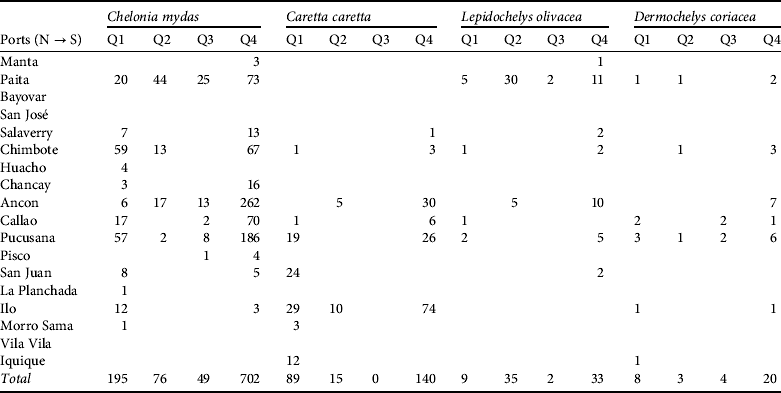
Reported bycatch was higher during the summer and the lowest number of events was reported in spring, for all species (Table 1). Although interactions with green turtles were reported from most of the range, they appeared to be particularly common in central areas (Fig. 4). This species appeared to have a more northerly distribution in winter/spring (Table 1). A generally northerly distribution was evident for interactions with olive ridley turtles, which were also more prominent in winter/spring (Table 1, Fig. 4). Conversely, reports of interactions with loggerhead turtles had a more southerly distribution (Table 1, Fig. 4). Although interactions with leatherback turtles were least numerous, they spanned the whole latitudinal range of the study. Most interactions with loggerhead turtles were off the continental shelf (Fig. 4).
Locations of interactions with (a) green Chelonia mydas (n=45), (b) leatherback Dermochelys coriacea (n=27), (c) loggerhead Caretta caretta (n=14) and olive ridley marine turtles Lepidochelys olivacea (n=3) reported by the small-scale fishing vessels with which we made contact. The locations of the 18 ports of origin (Fig. 3) of the fishing vessels are indicated but only Callao is labelled, for reference. The location of the continental shelf is indicated.

Reported numbers, by port and quarter, of four species of turtles caught as bycatch. Q1, autumn (22 April–21 June); Q2, winter (22 July–21 September); Q3, spring (22 October–21 December); Q4, summer (22 December–21 March).
Follow-up contacts and other bycatch
In fifty-seven communications other bycatch was reported, including Procellariform seabirds (54.4%), cetaceans (36.8%; dusky dolphins Lagenorhynchus obscurus, common dolphins Delphinus spp., bottlenose dolphins Tursiops truncatus, humpback whales Megaptera novaeangliae), sea lions Otaria flavescens (5.3%), and manta rays Manta birostris and Mobula sp. (3.5%). In 10 communications fishers reported metal identification tags found on seabirds and turtles.
We received follow-up contacts from 47 vessels, via mobile phone calls reporting bycatch events. We also received visits in Lima from four fishers interested in personally meeting programme staff and obtaining educational materials on marine turtles and the target species. Additionally, we received seven e-mails from fishers providing pictures taken with their mobile phone cameras.
Radio used as a safety tool
On four occasions we assisted vessels that were damaged or adrift. We worked as a bridge between these vessels and the Peruvian Coast Guard, local fishing association or their families, as direct contact from the vessels was not possible. Further assistance in coordinating their rescue was also provided.
Discussion
The benefits of this low-cost programme as an alternative way to engage fishers in marine conservation became quickly apparent, offering a means to mitigate the impact of fisheries on marine turtles. The radio programme covered a vast area (from Ecuador to Chile) and the real time communications with fishers offered a unique opportunity to exchange information that benefited their fisheries (i.e. sea surface temperature, wind directions, tides) but also identified areas of potential high turtle bycatch, later reported back to fishers as a warning to fish with caution.
The number of small-scale fishing vessels in Peru has been estimated at c. 9,000 (Alfaro-Shigueto et al., Reference Alfaro-Shigueto, Mangel, Bernedo, Dutton, Seminoff and Godley2011) and thus our programme reached 2.6% of this total for the country. However, the number of fishers reached through this study was possibly as many as 1,474, highlighting the opportunity offered by this programme to engage large numbers of active fishers in conservation. The personal contacts provided by the fishers (i.e. e-mail, phone number), provided channels for further communication to be explored, especially for those with e-mail or social network accounts.
Similar efforts using communication to prevent bycatch of loggerhead turtles in high-use areas have also been undertaken in the Hawaii-based longline fleet (Howell et al., Reference Howell, Kobayashi, Parker, Balazs and Polovina2008). The ‘Turtle watch’ programme (Howell et al., Reference Howell, Kobayashi, Parker, Balazs and Polovina2008) consolidated information on reported bycatch, sea surface temperature and satellite telemetry data to create and distribute maps showing areas of high-use by loggerhead turtles in the North Pacific. Correspondingly, the use of communications within the US North Atlantic longline and North Atlantic and Alaska trawl fleets has been used to reduce fleet-wide bycatch of marine turtles, seabirds and certain crustaceans and fish species (Gilman et al., Reference Gilman, Dalzell and Martin2006).
The vast majority of contacts were with the small-scale longline fleet. Given the continued growth of this fishery in Peru (Alfaro-Shigueto et al., Reference Alfaro-Shigueto, Mangel, Pajuelo, Dutton, Seminoff and Godley2010b; Estrella & Swartzman, Reference Estrella and Swartzman2010) this programme has an opportunity to work and expand with this fishery. The general characteristics of the fleet obtained from the radio programme (i.e. size of vessel, tonnage) were similar to those obtained from government records (Estrella & Swartzman, Reference Estrella and Swartzman2010) and on-board observer programmes (Alfaro-Shigueto et al., Reference Alfaro-Shigueto, Mangel, Pajuelo, Dutton, Seminoff and Godley2010b). Fishing areas used by each of the net and longline fleets, within and off the continental shelf, respectively, were also consistent with those identified by on-board observer programmes (Alfaro-Shigueto et al., Reference Alfaro-Shigueto, Mangel, Bernedo, Dutton, Seminoff and Godley2011). The species-specific spatial patterns of bycatch locations reported were also in broad concordance with those obtained by on-board observer programmes (Alfaro-Shigueto et al., Reference Alfaro-Shigueto, Mangel, Bernedo, Dutton, Seminoff and Godley2011). Additionally, seasonality of bycatch, peaking in the summer season (December–March), concurs with other studies in the same region (Hays-Brown & Brown, Reference Hays-Brown, Brown and Bjorndal1982; Donoso & Dutton, Reference Donoso and Dutton2010; Alfaro-Shigueto et al., Reference Alfaro-Shigueto, Mangel, Bernedo, Dutton, Seminoff and Godley2011). These overlaps in the fisheries operations and fishing areas used by small-scale fisheries, as well as in species seasonality and spatial distribution, confirm the accuracy of our radio broadcast programme.
The final fates of captured turtles reported via radio indicated that the vast majority were released alive, with a minority being discarded dead or retained when dead for eating on board. Similar patterns were documented by on-board observer programmes for longline fisheries (Alfaro-Shigueto et al., Reference Alfaro-Shigueto, Mangel, Bernedo, Dutton, Seminoff and Godley2011). No fisher, however, reported via radio to have retained a live turtle for consumption on board, which could have been because of uncertainty as to how such information would be used.
The radio programme offered direct benefits to the fisheries (i.e. advice on oceanographic features, warnings about dangerous events, presence of hazardous manta rays for small vessels). Use as a safety tool, in cases where vessels were adrift, was a serendipitous service provided by the programme. Considering that safety at sea is a particular problem for small-scale fisheries (FAO, 2008) the radio is a backup or alternative plan for vessels that have no other safety devices (e.g. distress radio beacons) for at-sea emergencies. The radio programme, which is still in daily operation, now also transfers to fishers information on market prices for their catch, allowing them to better time their return to port or choose a port with a better price.
One of the major advantages of the use of this radio programme included the direct, personal contact established with the main stakeholders involved in turtle conservation at sea, promoting an opportunity to establish a relationship of trust with individual fishermen working in remote areas. Our communications were mostly with the captain of the vessel because he is the main authority (Bureau of Labor Statistics, 2010), the one responsible for overseeing the fishing operation and the most likely to make decisions related to bycatch (i.e. release, keep for use or sale). Contacting the captains is optimal for the promotion of safe release methods for marine turtles obtained as bycatch.
Small-scale fisheries in the south-eastern Pacific are among the largest in terms of the number of fishing vessels (CPPS, 2003; Stewart et al., Reference Stewart, Lewison, Dunn, Bjorkland, Kelez, Halpin and Crowder2010). We used a widely available technology that, if linked with other similar stations in the region, could act as a mass-media tool. Because of the relatively low cost compared with other forms of educational campaigns and mitigation measures this approach is an alternative for situations where fisheries are highly dispersed, making traditional outreach methods cost prohibitive. Our trade of information principle could be expanded to different fleets and used to conduct rapid assessments of local fisheries, implement networking within fleets and generally encourage the active participation of fishers in marine conservation.
Acknowledgements
We thank the fishers who participated in this programme, and the ProDelphinus staff, Ortiz, Ugolini and Luna, for their help with the radio broadcasts. The study was conducted with funds received from the National Oceanographic and Atmospheric Administration, Southwest Fisheries Science Center (AB133F08-SE-4160), National Fish and Wildlife Foundation (2010-0107-000), the International Seafood Sustainability Foundation through the Ocean Foundation, American Bird Conservancy and the Darwin Sustainable Artisanal Fisheries Initiative in Peru. JCM and JAS are ORSAS and Exeter University scholarship awardees respectively. The article was improved greatly as a result of the Writing for Conservation Workshop organized by the Conservation Leadership Programme.
Biographical sketches
Joanna Alfaro-Shigueto and Jeffrey Mangel direct the Peruvian NGO ProDelphinus whose work centres around monitoring and mitigating the bycatch of threatened marine fauna in small-scale fisheries. Jeffrey Seminoff is a marine ecologist studying the life history and conservation status of marine turtles throughout the Pacific. Peter Dutton has coordinated the study of the genetics of marine turtles at the Southwest Fisheries Science Center at NOAA since 1995. Brendan Godley is a marine conservation scientist focusing on large vertebrates, especially marine turtles.



