Introduction
Giant land tortoises, although at one time abundant on all continents except Antarctica, now reside only on Aldabra atoll in the Seychelles Islands of the Indian Ocean (Geochelone gigantea) and the Galapagos Islands (Geochelone spp.; Gunther, Reference Gunther1875; MacFarland et al., Reference MacFarland, Villa and Toro1974). In the Galapagos, giant tortoises were abundant in the 16th–18th centuries (Porter, Reference Porter1815; VanDenburgh, Reference VanDenburgh1914) but were decimated by buccaneers, whalers, seal hunters, merchants and colonists, who exploited the animals for meat and oil (Townsend, Reference Townsend1925; Slevin, Reference Slevin1959). The tortoises also suffered from depredation on eggs, juveniles and adults inflicted by feral mammals and introduced fire ants Solenopsis sp. (Beck, Reference Beck1903; MacFarland et al., Reference MacFarland, Villa and Toro1974).
Of the original 13 species of giant land tortoises on the Galapagos Islands (Ernst & Barbour, Reference Ernst and Barbour1989) one, the Floreana Island species Geochelone elephantophus was extinguished by human pressure in the 1800s (MacFarland et al., Reference MacFarland, Villa and Toro1974). The species from Fernandina Island, G. phantastica, was last encountered in 1906, having presumably fallen victim to extensive volcanic activity of the Fernandina volcano. By 1974 MacFarland et al. (Reference MacFarland, Villa and Toro1974) listed 11 surviving species, one of which (G. abingdoni from Pinta Island) was extinct in the wild, with only one surviving male, Solitary George, maintained in captivity since 1972 at the Charles Darwin Research Station and the Galapagos National Park. Seven or eight of the other remaining species were reduced to minimal numbers, and three or four maintained healthy populations, although these were also threatened by predators or introduced mammalian competitors (MacFarland et al., Reference MacFarland, Villa and Toro1974). Since the analysis by MacFarland et al. (Reference MacFarland, Villa and Toro1974) efforts by the Charles Darwin Research Station and Galapagos National Park Service to protect and restore these populations have resulted in increases for all species except G. abingdoni (Solitary George; unpublished reports of Charles Darwin Research Station).
Although killing of Galapagos tortoises was legally prohibited by the Ecuadorian government in 1933, killing of tortoises for local meat consumption continued, albeit at a lower level. Cayot & Lewis (Reference Cayot and Lewis1994) documented an alarming increase in poaching of tortoises during 1980–1994. The poaching has continued to the present day, especially in the areas of Sierra Negra and Cerro Azul volcanoes on Isabela Island, although poaching has occurred on other islands as well. Here we document and examine change in levels of tortoise poaching in the period since the report by Cayot & Lewis (Reference Cayot and Lewis1994), covering events during 1995–2004, and make recommendations for the future conservation of these species.
Methods
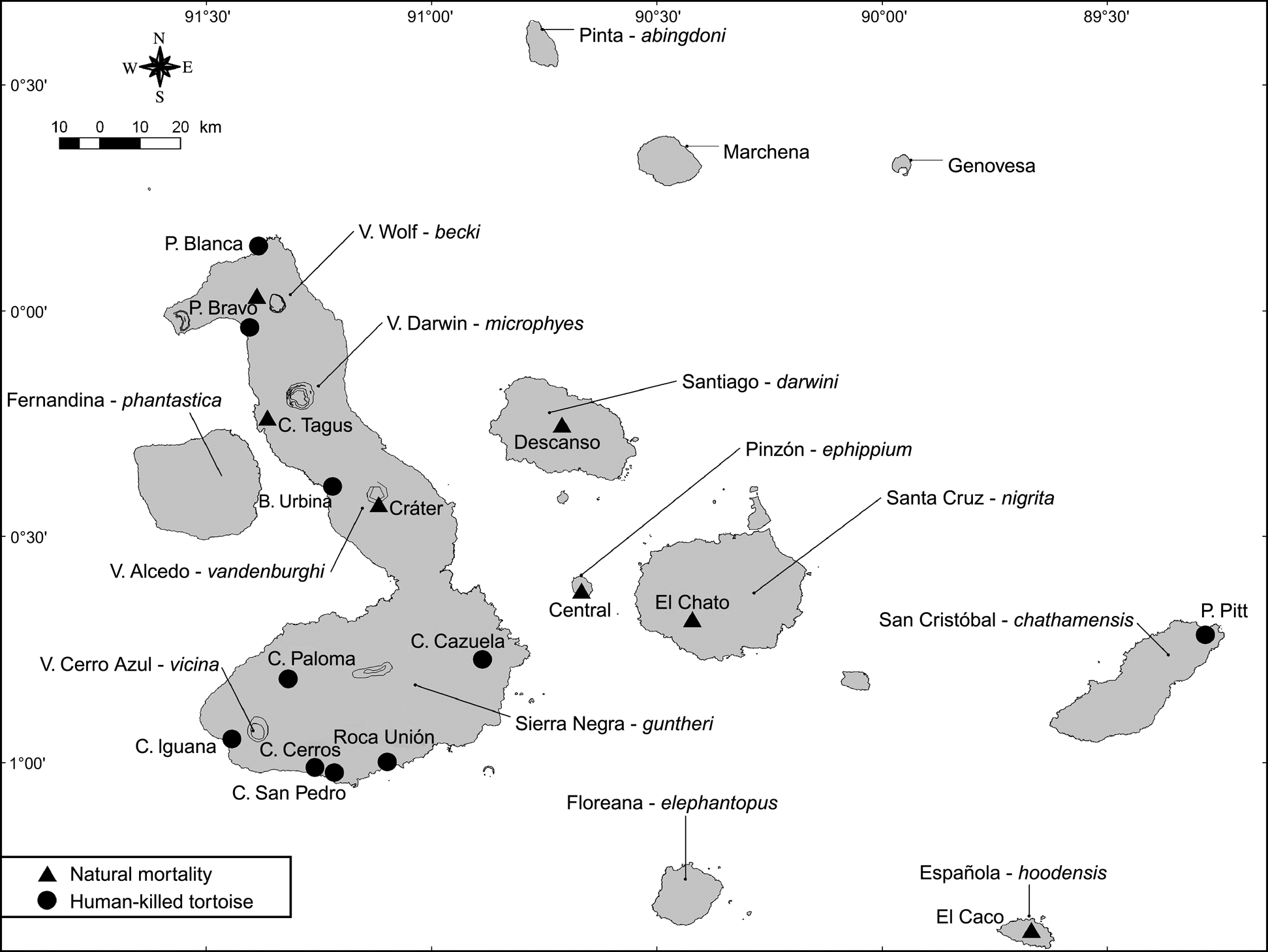
During 1995–2004 populations of Galapagos tortoises were monitored by personnel of the Galapagos National Park Service and the Charles Darwin Research Station, on Isabela, Española, Santiago, Santa Cruz, San Cristóbal, and Pinzón islands (Fig. 1). These surveys were carried out several times per year for some sites (especially Roca Unión and Cerro Cazuela on Isabela Island and on Santa Cruz Island), and at least twice per year at other sites on the coast of Isabela Island. More remote sites, such as the interior of Pinzón, Española and Santiago islands were usually visited only once per year. During these surveys tortoises found dead were recorded along with information on the cause of death (natural or human-induced) and additional information such as date, location (recorded with a global positioning system if possible), estimated date of death, sex (if possible to determine), age class, and a photograph of the remains. In some cases the curved carapace length of the dead tortoise was measured and recorded. In addition to more formal surveys, personnel of the Park Service and Research Station kept incidental records of dead tortoises whenever they encountered them.
The Galapagos Archipelago, showing locations of sites referred to in Tables 1 and 2 where dead tortoises, either killed by humans or a result of natural causes, have been found. Islands (the largest is Isabela Island) and volcanoes (V.) are identified along with the species name of the tortoise (all are Geochelone) occurring at that site.

Tortoises dying from natural causes can easily be distinguished from those killed by humans for meat. To extract the meat from a tortoise shell, the plastron is removed, usually by chopping along the sides of the plastron of an overturned tortoise using a machete or hatchet. Natural causes of death do not cause the removal of the plastron, even in cases of violent death (usually by falling). Usually even a highly decayed carcass from a natural mortality will be upright, with the plastron intact beneath and the limb bones relatively in place.
Results
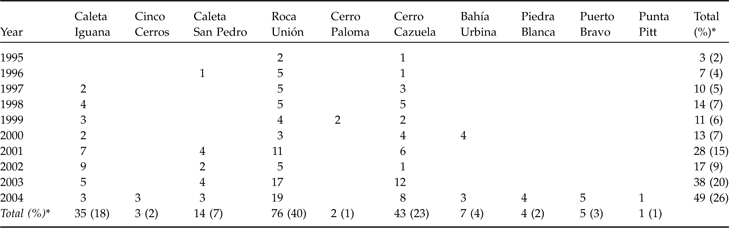
From 1995 to 2004 personnel recorded the remains of 189 Galapagos tortoises killed by humans on Isabela Island and one on San Cristóbal (Table 1). Tortoises that had been killed by poachers were found at nine sites on Isabela Island (Fig. 1). Of these, three sites account for the large majority of the poached tortoises, with 154 (81%) of the 190 tortoises killed at Roca Unión, Cerro Cazuela and Caleta Iguana (Table 1).
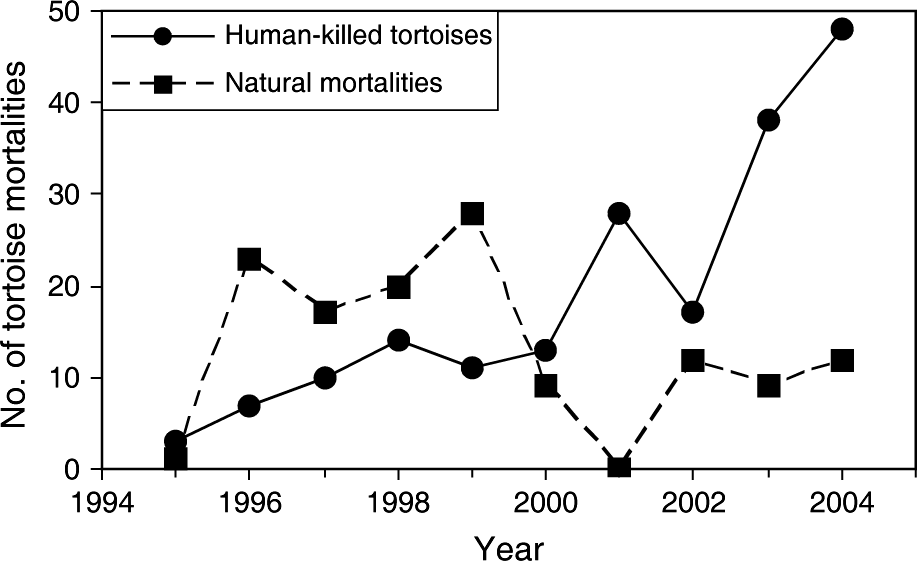
The number of tortoises found killed by humans did not surpass 14 until 2001 (Fig. 2). Prior to 2001 the average number of tortoises found poached each year was 9.7 tortoises; for the 4 years 2001–2004 the average was 33.0 tortoises per year (Table 1), an increase of more than three-fold. The average number of tortoises found poached for the entire 10-year period was 19.0 tortoises per year.
Numbers of Galapagos tortoises found dead each year during 1995–2004 from natural mortality and from poaching.

Number and percentages of Galapagos tortoises found killed by humans, by site and year, during 1995–2004. All are on Isabela Island except Punta Pitt, which is on San Cristóbal (Fig. 1).

* Percentages do not add up to 100% because of rounding errors
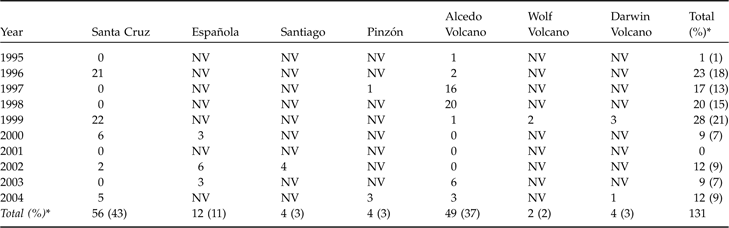
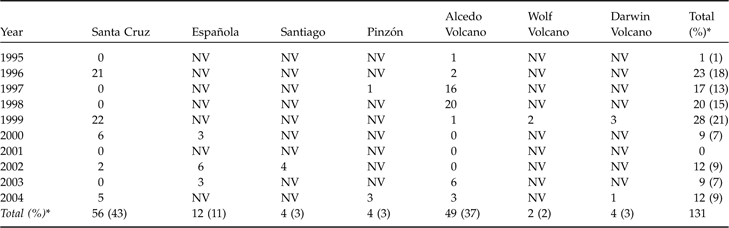
During the same period natural tortoise mortality was recorded on the islands Santa Cruz, Española, Santiago, and Pinzón, and on Isabela Island on volcanoes Wolf, Darwin and Alcedo (Fig. 1), with 131 tortoises found dead from natural causes (Table 2). The greatest number of natural tortoise mortalities (56 individuals) was recorded from Santa Cruz Island (primarily adult males), and the second largest number (49 individuals) from Alcedo Volcano on Isabela Island (adult males and females, and juveniles). The 12 dead tortoises found on Española Island were all juveniles, as would be expected, because all tortoises on that island are the result of a captive breeding and repatriation project begun in the 1970s. The average number of tortoises found dead from natural causes was 13.1 per year.
Natural mortality of Galapagos tortoises, by site and year, during 1995–2004. Santa Cruz, Española, Santiago and Pinzón are islands, and Alcedo, Wolf and Darwin are all volcanoes on Isabela Island (Fig. 1). NV means the site was not visited.
* Percentages do not add up to 100% because of rounding errors
High mortality on Alcedo was recorded in 1997 and 1998 during the very strong El Niño of 1997–1998 but high mortality on Santa Cruz occurred in 1996 and 1999, the years before and after the El Niño event.
Discussion
The count of 190 tortoises killed by humans for food during the 10 years 1995–2004 should be considered a minimum estimate. The remoteness, difficult terrain, and dense vegetation of areas where Galapagos tortoises occur and therefore where poaching takes place, coupled with efforts by poachers to hide the remains of butchered tortoises, mean it is likely that many tortoises killed by human poachers are never found and recorded. Overall, tortoises dying from natural causes are probably more likely to be found than poached tortoises, because no effort is made to hide the remains.
The average number of tortoises found dead each year from natural mortality (13.1) is less than the average number poached each year (19.0). This is especially pronounced when only the period 2001–2004 is considered. Therefore, it is clear that killing of adult and juvenile tortoises by humans has a more significant impact on tortoise populations than natural mortality. Although many more hatchling tortoises are killed by natural (Galapagos hawks Buteo galapagoensis and great blue herons Ardea herodias) and introduced (cats Felis catus, dogs Canis familiaris, pigs Sus scrofa and rats Rattus rattus) predators, the tortoises are long-lived species with low reproductive rates and loss of adults has a much greater effect on population recovery. The wild populations of the most heavily poached species (Geochelone guntheri and G. vicina) are being augmented by juveniles produced in the Galapagos National Park Service captive breeding centre (Fritts et al., Reference Fritts, Snell, Cayot, MacFarland, Earsom, Márquez, Llerena and Llerena2000), which offsets and exceeds the losses to poaching. However, because adults are selectively killed by the poachers, natural reproduction in the wild is significantly reduced, precluding any natural reproduction and population recovery.
The only human settlements on Isabela Island are Puerto Villamil, on the southern coast, and small villages and farms on the southern slope of Sierra Negra Volcano. It is therefore not surprising that the tortoises on Sierra Negra Volcano suffer the greatest levels of human depredation, with 64% of all poached tortoises found at its Roca Unión, Cerro Cazuela and Cerro Paloma sites. The first of these sites is frequented by local fishermen, while Cerros Cazuela and Paloma are inland, and most tortoise poaching is probably carried out by local people while hunting feral goats Capra hircus, cattle Bos taurus and pigs.
The tortoises of Cerro Azul are primarily depredated at coastal sites (Caleta Iguana, Cinco Cerros and Caleta San Pedro) by local fishermen. These sites, especially Roca Unión, caletas San Pedro and Iguana and Cinco Cerros, are easily accessed by boat from Puerto Villamil. These are also sites where the tortoises range near to the coast, and where they are therefore more available and accessible to crews of fishermen coming ashore. On 10 September 2004 wardens of the Park Service on patrol encountered a Galapagos fishing boat at Caleta Iguana with tortoise meat in the cooking pot. At the time of writing the results of legal action against the fishermen involved in this incident have not been finalized. The more remote sites, also coastal, of Bahía Urbina, Puerto Bravo and Piedra Blanca have experienced lower levels of human depredation on their tortoise populations. These depredations are also probably being carried out by fishermen.
Cayot & Lewis (Reference Cayot and Lewis1994) reported high numbers of poached tortoises at Piedra Blanca, a site that had a low level of poaching in our study, but only one tortoise killed at Caleta Iguana, the site with the second-highest level of poaching in our study. However, overall, Cayot & Lewis (Reference Cayot and Lewis1994) reported findings similar to those of the present study, with poaching of tortoises in approximately the same areas, including high levels of poaching at Cerro Cazuela and Roca Unión. Little has therefore changed since 1994 with regard to the main sites where tortoise killing has been taking place.
Natural mortality was noticeably high in the Santa Cruz population (Geochelone nigrita), with 43 mortalities between 1996–1999, and in the Alcedo Volcano, Isabela Island population (G. vandenburghi), with 36 tortoises dying in 1997–1998 and a total of 49 during the decade. On Santa Cruz the mortality of the 43 tortoises was apparently a result of a minor epidemic caused by bacterial septicemia from Aeromonas hydrophila and Pseudomonas sp. (G. Trueba, pers. comm., 1999; Ontaneda et al., Reference Ontaneda, Trueba, Sevilla and Sevilla2001), associated with nematodal parasitosis by Atractis marquezi and Labiduris sp. (Bursey & Flanagan, Reference Bursey and Flanagan2002). These parasites and environmental factors combined to cause the deaths of 21 tortoises in 1996, with a second outbreak in 1999 causing the death of 23 tortoises. The majority of these mortalities were of adult males. On Alcedo Volcano the large majority of mortalities were associated with the effects of the very strong El Niño of 1997–1998. During this event 36 tortoises were killed, mostly as a result of torrential rains causing tortoises to be washed into and down ravines on the slopes of the volcano. During the same event a few of the tortoises died of unknown causes, but probably related to the heavy rains.
The inhabitants of southern Isabela have inherited a history of predation on tortoises. Prior to the establishment by Antonio Gil of a town and a tortoise processing facility in 1897 at Puerto Villamil, thousands of Geochelone guntheri and G. vicina lived on the coast and southern slopes of nearby Sierra Negra and Cerro Azul volcanoes (VanDenburgh, Reference VanDenburgh1897; Beck, Reference Beck1903). Gil’s colonists and workers slaughtered most of these animals for meat and oil, such that afterwards so many plastrons were found on the flanks of the volcano that the workers of the colony used them for roofing materials (P. Cartagena, pers. comm., 1986). Local beliefs, such as that tortoise meat is an important nutritional need for post-parturition mothers for 40 days, have reinforced the harvesting of the tortoises,.
A further cause of the increased poaching in recent years is resentment towards the Park Service and conservationists in general, which has on occasions produced negative reactions in the local population. Many households in Puerto Villamil in particular remain dependent on fishing, and have felt that regulation of fishing harvests (especially of sea cucumbers, a lucrative item) has reduced their ability to earn a living. The negative backlash to the regulation has been directed towards the regulating agency (Galapagos National Park Service) and towards conservationists, who have generally supported the fishing regulations, and ultimately towards the Park and conservation efforts. Providing economic alternatives to fishing, such as opportunities in tourism business, may reduce the effect of regulations on fishermen and reduce this backlash.
Conservation and environmental education efforts by the Charles Darwin Research Station and Galapagos National Park Service have apparently had little effect, and poaching of tortoises may be increasing. Improved environmental education is necessary from the earliest ages to enhance the understanding of the value of the tortoises by the inhabitants and reduce the ongoing poaching. In addition, it is necessary to improve enforcement through monitoring of the most active sites where tortoises are killed. The number of these sites is relatively small, with most of the poaching occurring at Cerro Cazuela, Roca Unión and Caleta Iguana, and therefore concentrating enforcement at these sites could have great effect. A redoubled effort to prevent future poaching of Galapagos tortoises is necessary so that similar levels of harvesting are not reported over the next 10 years.
Acknowledgements
We would like to thank the multitude of wardens of the Galapagos National Park Service, and volunteers, scholarship students and personnel of the Charles Darwin Research Station who have helped acquire information on the giant tortoise populations and who have reported incidents of tortoise mortality. Our gratitude also to the Frankfurt Zoological Society, Friends of Galapagos – Switzerland, Galapagos Conservation Foundation, the GEF Project ECU/00/G31 Especies Invasoras de las Galápagos, the Government of Ecuador and others that have financed studies of the giant tortoises of Galapagos, without whose help and support it would not have been possible to complete this study. We also wish to express our appreciation to the Galapagos National Park Service for allowing us to work on the islands, and to the Charles Darwin Foundation and Charles Darwin Research Station for the logistical support and administration of funds. An anonymous reviewer helped to improve the manuscript.