




Introduction
For nurses, acute-care hospitals are a high-stakes, fast-paced work environment characterized by strong interdependency and interactivity among coworkers engaged in complex collective projects addressing the changing conditions of patients (Wei, Sewell, Woody, & Rose Reference Wei, Sewell, Woody and Rose2018). The operations of the care units require the staff to engage in teamwork, communicate continuously with coworkers, and provide them with practical assistance (Baker, Day, & Salas Reference Baker, Day and Salas2006; Kalisch, Weaver, & Salas Reference Kalisch, Weaver and Salas2009), despite the risk of interruptions, multitasking, and work overload (Kalisch & Aebersold Reference Kalisch and Aebersold2010). Nurses are well aware of these risks, as evidenced by a long-standing body of professional literature on how to say ‘no’ to colleagues’ requests (see Deering Reference Deering1996 for an example), although they acknowledge that collaboration and coworker support are key to job performance and job satisfaction (Dijkshoorn-Albrecht, Six, Vermeulen, & Meijerink Reference Dijkshoorn-Albrecht, Six, Vermeulen and Meijerink2024).
Nursing research develops scales of teamwork, collaboration, and social support, distinguishes between forms of coworker assistance, measures them, and assesses pertaining staff attitudes (Dougherty & Larson Reference Dougherty and Larson2010; Kalisch, Lee, & Salas Reference Kalisch, Lee and Salas2010). What is missing is a detailed examination of how ‘involvement—assistance, cooperation, or contribution—in the realisation of courses of action’ (González-Martínez & Drew Reference González-Martínez and Drew2021:48) is solicited, volunteered, and secured by coworkers, on the spot and in real time, in the first place. Recruitment research (Kendrick & Drew Reference Kendrick and Drew2016; Floyd, Rossi, & Enfield Reference Floyd, Rossi and Enfield2020; Kendrick Reference Kendrick, Floyd, Rossi and Enfield2020, Reference Kendrick2021) in the field of interactional linguistics and conversation and multimodal analysis provides a framework for addressing this gap. Recruitment is considered an interactional outcome of methods through which the involvement of an Other is solicited or offered and emerges as apposite (Kendrick & Drew Reference Kendrick and Drew2016:2). It is the effect of a larger interactional trajectory throughout which coparticipants interrelatedly achieve the relevance of the Other’s involvement and their availability, or lack thereof, to come forward. Focusing on assistance with trouble, Kendrick & Drew (Reference Kendrick and Drew2016:11) outline a continuum in which the methods for recruitment are arranged depending on ‘how the trouble becomes recognizable, the relevance of assistance as a response, and whether Self or Other initiates the recruitment’. A request, which implies Self mentioning the solution to trouble and thus compelling Other to act upon it, differs for instance from practices through which Other anticipates trouble and acts to preempt it. In the course of some recruitment trajectories, participants produce a ‘recruitment sequence’ (Kendrick Reference Kendrick, Floyd, Rossi and Enfield2020) formed of a ‘recruiting move’ by Self, who solicits the involvement of Other in a specific new course of action, followed in turn by a ‘responding move’ by Other. Since these recruiting moves are often the reason for a new episode of interaction, they are sometimes preceded by a summons-answer (SA) sequence (Schegloff Reference Schegloff1968, Reference Schegloff2007) in which the summons is an address term, typically Other’s name, oriented towards securing their attention (Kendrick Reference Kendrick, Floyd, Rossi and Enfield2020:128–29). The SA sequence is then part of the larger recruitment trajectory and a preliminary of the base sequence made contingent upon a positive response to the summons (Schegloff Reference Schegloff2007). Distinctively, recruitment research examines these trajectories of action, as they are sequentially achieved by the coparticipants through the articulation of talk, bodily conduct, and material and spatial resources, captured in audio and video-recordings of real-life interactions.
Adopting the recruitment framework, this article is based on multimodal analysis (Mondada Reference Mondada2014) of video-recordings of nursing-staff corridor interactions with coworkers in a hospital outpatient clinic in the French-speaking part of Switzerland. These interactions are often oriented towards enlisting a passing coworker for the realization of some practical activity (González-Martínez, Bangerter, Lê Van, & Navarro Reference González-Martínez, Bangerter, Lê Van and Navarro2016). The recruitment has the potential of disrupting the current involvements of the recruitee, who may have been heading somewhere as part of a larger project. The recruitee will therefore need to engage in several activities simultaneously or suspend or even abandon what they were doing in order to attend to their coworker. We have conducted a research project on preliminaries to the initial recruiting move soliciting involvement in a specific new course of action and, specifically, on SA sequences.Footnote 1 This article focuses on the display of limited availability for involvement in a new practical activity at the time the prospective recruiter calls on the prospective recruitee and this person responds.Footnote 2 We identify related practices deployed by summoned parties who merely suspend their current involvement, instead of abandoning it, and in some cases additionally display being disrupted, or who alternatively continue what they are doing and orient only minimally to the summoner. Since limited availability for the upcoming recruitment can already be displayed before the base recruitment sequence begins, we argue that the SA sequence should be considered part of the larger recruitment trajectory of action.
Summonses and displays of availability
Summonses are interactional devices that can take the form of bodily conduct such as a wave of the hand or a tap on the shoulder, oral and verbal behavior like whistling or uttering a name, or mechanically and electronically produced signs, for instance, a telephone ring or a police car siren (Schegloff Reference Schegloff1968, Reference Schegloff2007; Cekaite Reference Cekaite2008; Licoppe Reference Licoppe2010; Gardner Reference Gardner, Jenks and Seedhouse2015; Kidwell Reference Kidwell2018; Sikveland Reference Sikveland2019; Reber & Couper-Kuhlen Reference Reber and Couper-Kuhlen2020). In response to the summons, the summoned party ordinarily produces a ‘go-ahead’ or ‘blocking’ response like ‘yes?’ or ‘not now’ (Schegloff Reference Schegloff1968, Reference Schegloff2007; see Eilittä Reference Eilittä2024 for an up-to-date literature review). The SA sequence secures a coordinated entry into a new course of interactional action by offering a solution to a generic practical problem. According to Schegloff (Reference Schegloff2007), the sequence is indeed ‘designed to mobilize, secure, or establish the availability, attention, and aligned recipiency of its addressed target’ (Reference Schegloff2007:59) for interaction, talk, and an ‘incipient, but as-yet-unspecified’ (Reference Schegloff2007:49) activity foretold by the summons. Securing attention refers to obtaining an orientation of the summoned party’s perception towards the summoner and towards what this person is doing and saying. Securing recipiency refers to the fact that the summoned person is not simply a present ‘sentient body with functioning eyes and ears’ (Schegloff Reference Schegloff, Hovy and Scott1996:7). They are also an addressed person visibly and/or audibly acting as a second party: for instance, ‘a hearer for the first utterance and prospective producer of a second fitted utterance’ (Schegloff Reference Schegloff, Katz and Aakhus2002b:361), namely the response to the summons. Securing availability refers to the fact that the summons is produced when attention and recipiency are in question, ‘typically by involvement in some competing activity’ (Schegloff Reference Schegloff, Katz and Aakhus2002a:294). The summons calls for reallocation of involvement on the part of the summoned party since it entails entering into interaction with the summoner and forecasts a new activity in which the summoner intends to engage the summoned party. For this reason, producing a summons implies an assessment on the part of the prospective summoner of the upcoming summoned person’s availability and a claim to obtain it. ‘Ordinarily, a summons is done only “for cause”’ (Schegloff Reference Schegloff, Katz and Aakhus2002a:294) following an assessment of relative priority, convenience, and opportunity. What makes this especially important is the fact that answering the summons, and making room for the activity that it heralds, is meant to become the summoned person’s priority. If the summons is not understood to have been done ‘for cause’ and after careful ‘assessments of relative priority and temporal fit’ (Schegloff Reference Schegloff, Katz and Aakhus2002b:368), it can be ignored, resisted, or turned into a subject of complaint. Moreover, Schegloff (Reference Schegloff1968, Reference Schegloff, Katz and Aakhus2002b) distinguishes between presence, availability in the sense of recipiency, and availability in the sense of readiness to engage in a new course of action. Picking up the phone when a call comes in but without speaking establishes presence. A completed SA sequence, regardless of the answer, establishes availability in the sense of recipiency. The answer ‘displays (or at least claims) the attentiveness’ of the summoned person (Schegloff Reference Schegloff2007:59). Nevertheless, depending on the answer, the caller may wonder ‘not whether he can continue, but whether he should’ (Schegloff Reference Schegloff, Katz and Aakhus2002b:361, emphasis in original) when faced with an interlocutor showing little readiness to get involved in what may come next. Availability at the time of responding to the summons indeed does not equate to availability ‘in the continuing course of the interaction’ (Schegloff Reference Schegloff1968:1089).
Schegloff’s research on beginning a new unit of talk (Reference Schegloff1968, Reference Schegloff, Katz and Aakhus2002a,Reference Schegloff, Katz and Aakhusb) and Goffman’s (Reference Goffman1963, Reference Goffman1971) and Kendon’s (Kendon & Ferber Reference Kendon, Ferber, Michael and Cook1973) work on entering into interaction have fueled a wealth of studies in multimodal analysis addressing the issue of availability. These studies examine how one person looking at and/or approaching another sizes up their availability for interaction, conversation, and/or a new activity, and how both parties produce and receive displays of it in interactions involving a street newspaper vendor and passing prospective customers (Llewellyn & Burrow Reference Llewellyn and Burrow2008); pedestrians and a person asking for directions (Mondada Reference Mondada2009); students and the staff member of a help desk (Mortensen & Hazel Reference Mortensen and Hazel2014); coworkers in office spaces (Salvadori Reference Salvadori2016; Tuncer & Licoppe Reference Tuncer2018); customers and salespersons in shops (Harjunpää, Mondada, & Svinhufvud Reference Harjunpää, Mondada and Svinhufvud2018); residents with dementia and caretakers or visitors (Rasmussen, Kristiansen, & Andersen Reference Rasmussen, Kristiansen and Andersen2019); street canvassers and potential supporters (Mondada Reference Mondada2022); and construction workers at a construction site (Hoey Reference Hoey, Haddington, Eilittä, Kamunen, Kohonen-Aho, Rautiainen and Vatanen2023a,Reference Hoeyb). These researchers have thus shown that the person being approached can display unavailability through practices like looking or walking away from the (prospective) initiator and avoiding postural co-alignment (Llevellyn & Burrow Reference Llewellyn and Burrow2008; Mondada Reference Mondada2009, Reference Mondada2022; Rasmussen et al. Reference Rasmussen, Kristiansen and Andersen2019; Hoey Reference Hoey, Haddington, Eilittä, Kamunen, Kohonen-Aho, Rautiainen and Vatanen2023a,Reference Hoeyb); not responding to the summons, initial greetings or other attempts to talk (Mortensen & Hazel Reference Mortensen and Hazel2014; Salvadori Reference Salvadori2016; Rasmussen et al. Reference Rasmussen, Kristiansen and Andersen2019; Mondada Reference Mondada2022); producing verbal refusals to engage in interaction (Mondada Reference Mondada2022; Hoey Reference Hoey, Haddington, Eilittä, Kamunen, Kohonen-Aho, Rautiainen and Vatanen2023a,Reference Hoeyb) and displaying being in a hurry (Mondada Reference Mondada2022); and orienting to objects related to their up-to-now involvement and continuing their engagement with their current activity (Mortensen & Hazel Reference Mortensen and Hazel2014; Salvadori Reference Salvadori2016; Harjunpää et al. Reference Harjunpää, Mondada and Svinhufvud2018; Tuncer & Licoppe Reference Tuncer2018; Hoey Reference Hoey, Haddington, Eilittä, Kamunen, Kohonen-Aho, Rautiainen and Vatanen2023a,Reference Hoeyb). The (prospective) initiator orients to these verbal and bodily cues as markers of unavailability and either abandons their approach or adjusts it accordingly. Observing very young children at daycare centers, Kidwell (Reference Kidwell, Hayashi, Raymond and Sidnell2013) argues that gaze towards the caregiver is a display of availability for interaction and a subsequent action in response to a first-name summons. Some children can already orient to the summons as a directive and cease their problematic conduct in anticipation of the action they have been summoned for. Conversely, refraining from shifting their gaze to the caregiver is a way of avoiding becoming the recipient of a directive next action and enables the children to do ignoring or defying. Studying interactions at a construction site, Hoey (Reference Hoey, Haddington, Eilittä, Kamunen, Kohonen-Aho, Rautiainen and Vatanen2023a,Reference Hoeyb) shows that at the time of a verbal summons and/or a physical approach acting as such, the person being approached can anticipate the reason-for-the-interaction and oppose the summoner’s presumed project.
Building on these studies, we have investigated SA sequences as preliminaries to initial recruiting utterances. More specifically, we have focused on a set of embodied practices that display limited availability and potential reluctance to engage in the new practical activity that the summons foreshadows.
A multimodal study on recruiting practices in hospital corridors
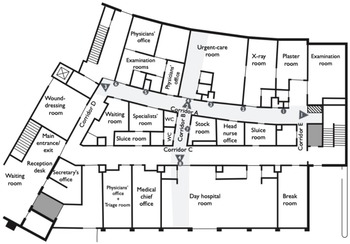
We have examined a corpus of 331 hours of video-recordings, supplemented by ethnographic data, that was collected in an outpatient clinic of an acute-care hospital in the French-speaking part of Switzerland (González-Martínez, Bangerter, & Lê Van Reference González-Martínez, Bangerter and Lê Van2017). The clinic provided scheduled and walk-in care in general and orthopedic medicine, including non-life-threatening urgent care. On a weekday, the staff was composed of fourteen members: a head physician, a head nurse, several residents, nurses, nurses’ aides, nursing assistants and students, and a clinic secretary. The research team video-recorded activity in the clinic’s corridors and liminal spaces using four cameras suspended from the ceiling and eight wireless microphones suspended from light fixtures, functioning uninterruptedly twelve hours per day over seven consecutive days (see the appendix for a corridor map with the recording equipment’s locations).
The nursing staff members often called on colleagues to get them involved in tasks related to the clinic’s operations (González-Martínez et al. Reference González-Martínez, Bangerter, Lê Van and Navarro2016), mainly taking care of patients, since each case required the contribution of several professionals. Even the few members who had a fixed workstation for some hours were expected to stay available to their colleagues if they were needed somewhere else or had a free moment. Although expected, availability for a new task could not be taken for granted, since each staff member had their own responsibilities, commitments, and time pressures.
The present study is based on a selection of sixty-six excerpts in which the main activity is one staff member recruiting another for ‘involvement—assistance, cooperation or contribution—in the realization of a course of action’ (González-Martínez & Drew Reference González-Martínez and Drew2021:48). The identification of the excerpts on which this article is based was a two-step process. In the first step, we focused on the way the new episode of interaction started. We identified forty-six cases, out of the initial sixty-six, in which the participants produce a verbal SA sequence in the opening of their interaction before the initial recruiting move, through which the summoner and prospective recruiter solicits the summoned person to get involved in a specific new practical activity.Footnote 3 At least one of the SA sequence’s pair-parts includes linguistic and/or non-linguistic vocalizations. Only in two cases is the summons based exclusively on non-linguistic resources: knocking at a door and calling a cellphone. In the vast majority of cases, the summons is a standalone first name produced in full form.Footnote 4 The response to the summons is made exclusively through bodily conduct in twelve cases out of forty-six.Footnote 5 In the forty-six selected cases, the initial recruiting move—for instance, the request—is always based on linguistic vocalizations except in two cases in which it is produced exclusively by bodily means: gesturing to be handed a cellphone and signaling, through bodily behavior, for a coworker to approach. In the second step of the process of constituting the collection of cases for the present study, we examined the prospective recruitee’s displays of availability, or lack thereof, at the time of the SA sequence. We decided to focus on twelve cases, out of the forty-six presenting a verbal SA sequence in the opening phase, in which, the prospective recruitee already displays limited availability to become involved in a new practical activity when responding to the first-name summons.Footnote 6 Because these cases deviate from the conventional immediate involvement, they are particularly interesting in an examination of the different facets and nuances of availability. We have transcribed them following Jefferson’s (Reference Jefferson and Lerner2004) conventions for talk and Mondada’s (Reference Mondada2019) for bodily conduct. The study relies on multimodal analysis (Mondada Reference Mondada2014) to examine how the situated organization of the participants’ talk, articulated with bodily behavior and material resources, contributes to the production of social action.
Displaying limited availability
When a nursing staff member verbally summons a coworker in the corridor, the prospective coparticipants achieve availability to engage in interaction as they mutually reorient their attention: they may look at each other, reorient their bodies, and approach each other (Goffman Reference Goffman1963, Reference Goffman1971; Kendon & Ferber Reference Kendon, Ferber, Michael and Cook1973; Mondada Reference Mondada2009). They get involved in talk when they produce a verbal summons and also respond to it verbally. Moreover, they specifically show availability to get involved in a new practical activity when they abandon their heretofore competing involvements, for instance, when they halt their movements, free their hands, put aside objects related to their current activity, and/or move away from the place where they were previously occupied (Mortensen & Hazel Reference Mortensen and Hazel2014; Eilittä Reference Eilittä2024; Harjunpää et al. Reference Harjunpää, Mondada and Svinhufvud2018).Footnote 7 However, availability at the three levels—for interaction, for talk, and for a new practical activity—is not always granted and may not be achieved simultaneously or shown to the same extent. For instance, the summons may succeed in drawing the attention of the summoned coworker, who may look at the summoner and thus share a focus of attention, but the summoned party can still decline to talk with the summoner. The summoned coworker may also talk but only to produce a ‘problematic answer’ like ‘I’m busy’ (Schegloff Reference Schegloff, Katz and Aakhus2002b) that questions whether the summoner should proceed with the incipient activity. Moreover, running counter to the idea that the summons is by definition preparatory to an ‘as-yet-unspecified’ project (Schegloff Reference Schegloff2007:49), the coparticipants can already display, multimodally, some understanding of the forthcoming activity’s nature and specificities, for instance, that it will entail putting aside the up-to-now practical involvements and doing something different with/for someone. On this basis, limited availability for the practical involvement that the summons projects can already be displayed before the actual initial recruiting move that solicits it. When displaying this, the summoned party relies on some understanding of the likely reasons for the summons, inferring them from immediate concrete circumstances—such as who is summoning them, when and how the summons is produced, what the summoner is doing at the time of the summons, and the objects the summoner may be holding—as well as background knowledge about the activities relevant at the site where the interaction is taking place (Hoey Reference Hoey, Haddington, Eilittä, Kamunen, Kohonen-Aho, Rautiainen and Vatanen2023a,Reference Hoeyb).
In this analytical section, we examine cases in which coparticipants achieve limited availability for an upcoming recruitment already at the time of the response to the summons. The recipient displays reluctance to abandon their current practical activity and engage in a new one. We thus show that the summons is produced and dealt with as projecting a new practical activity competing with the summoned party’s present one. Even if preliminary to the recruiting move through which the summoner will then solicit the summoned party’s involvement in a new course of action, the SA sequence is thus to be considered part of the larger recruitment trajectory of action. In the first part of the following section, we examine two cases in which the summoned party merely suspends what they were doing, which implies that they remain oriented to their activity instead of abandoning it. In the second part, we deal with two instances in which the summoned parties not only limit themselves to suspending their activity (instead of abandoning it) but, in addition, show that they are being disrupted. In the third and last part, we present a case in which the summoned party continues her activity, which takes her away from the summoner, and orients only minimally to her colleague. Although we examine these practices from the summoned party’s perspective, our analysis shows that ‘availability is better thought of not as a ‘state of the other’ … but rather as a matter of ‘relative states’ of the prospective initiator and his intended co-participant’ and a phenomenon achieved interactionally throughout (Schegloff Reference Schegloff, Katz and Aakhus2002b:368).
Suspending the current activity
We begin with two excerpts in which the summoned party suspends her involvement in her activity, in contrast to abandoning it. She shows that the activity is put temporarily on hold and remains oriented to it. In our analysis, we identify three interrelated bodily practices: ‘Staying in place’, ‘Showing restricted body orientation towards the summoner’, and ‘Remaining oriented towards the current activity through object handling’. These are sometimes accompanied by a lack of verbal response to the summons.Footnote 8
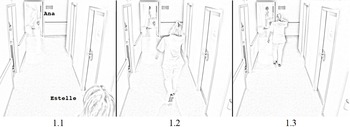
In excerpt (1), Ana, a nurse, is in the Day Hospital Room jokingly talking with a patient (lines 1–2) that she is about to treat; this patient is lying on a bed in the room’s interior section. Justa (Jus), a nurses’ aide, is also talking with the patient (lines 3–4), inside the room but off-camera. As for Ana, she is positioned behind a curtain, which covers part of her body and separates the bed section from the entrance area. Estelle (Est), also a nurse, is walking along Corridor B towards the Day Hospital Room from the Urgent Care Room.

As she is about to close the curtain, Ana notices Estelle walking from the Urgent Care Room towards the Day Hospital Room. She closes the curtain with a decisive tug (line 3, Figure 1, image 1.1) but opens it again slightly while looking at Estelle again (lines 3–4, image 1.2). When she is halfway into Corridor B, Estelle summons Ana (line 5) by her first name. In response, Ana produces a go-ahead token uttered with rising intonation (line 7). She thus invites Estelle to say what she has to say and move on with whatever activity the summons projects. At this point, Ana has engaged in interaction and talk and is displaying availability to hear what will come next. However, in contrast to the cases in which the summoned nurse approaches the summoner coworker (see Balantani & González-Martínez (Reference Balantani and González-Martínez2025) and González-Martínez & Balantani (Reference González-Martínez and Balantani2025) for examples), Ana does not abandon her current locus of activity nor what she is doing there but shows that she has only suspended it; see Eilittä (Reference Eilittä2024) on suspending the current activity in response to a summons. Key to that is the fact that she stays in place and keeps her torso and lower body parallel to the curtain: only her shoulders and head are torqued towards the summoner (Schegloff Reference Schegloff1998), leaning slightly forward (line 7, image 1.3). Moreover, she moves the curtain in front of her slightly and keeps holding it with her right hand (line 7). Ana thus stays involved with an object related to the activity in which she was engaged up to this point and handles it in a way that is not conducive to moving on to a new one; see Harjumpää, Mondada, & Svinhufvud (Reference Harjunpää, Mondada and Svinhufvud2018), Tuncer & Licoppe (Reference Tuncer2018) and Hoey (Reference Hoey, Haddington, Eilittä, Kamunen, Kohonen-Aho, Rautiainen and Vatanen2023a,Reference Hoeyb) on object handling as a display of availability or lack thereof. All in all, Ana shows continuing engagement with her up-to-now activity, with only transitory engagement with the interaction and talk in which Estelle is involving her and limited availability to engage in the new activity that the summons might be projecting. In line 8, Estelle prompts her to go pick up a patient in another department, which we consider the initial recruiting move, soliciting thus involvement in a specific new practical activity; for the specific format, see Couper-Kuhlen (Reference Couper-Kuhlen2014) on requests referring to ability in the sense of potentiality. Ana agrees to do as suggested but only after showing her discontent (line 9), which confirms the earlier bodily display of limited availability.
Estelle and Ana in the Day Hospital entrance area and Corridor B. View from camera 2.

Figure 1 Long description
Estelle and Ana in the Day Hospital entrance area and Corridor B. View from camera 2.
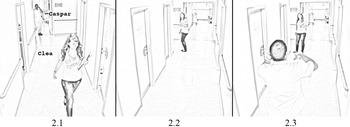
In excerpt (2), Clea (Cle), the clinic’s secretary, is walking from Reception towards the Urgent Care Room, through Corridor B. As she is about to enter Corridor A, she is summoned by Caspar (Cas), the head nurse, who is walking towards her from the Day Hospital Room (line 5, Figure 2, image 2.1) while talking on the phone with someone from the Microbiology Department; he directs this person to hold for a moment (lines 2, 4).

Caspar and Clea in the Day Hospital entrance area and Corridor B. View from camera 4, except for image 2.1, which shows the view from camera 2.

Figure 2 Long description
Caspar and Clea in the Day Hospital entrance area and Corridor B. View from camera 4, except for image 2.1, which shows the view from camera 2.
Caspar suspends his telephone call in a way that is audible and intelligible to Clea (lines 2–4), then addresses her via the summons (line 5). Afterwards, he keeps moving while looking towards her. In response to the summons, Clea turns around and looks towards Caspar but does not respond verbally, even though Caspar remains silent (line 6, image 2.2).Footnote 9 As she finishes turning around, she takes one step forward and adopts a static position. She does not approach Caspar but waits for him to come nearer. Although she is now facing Caspar, Clea stays on the path leading to her original destination. While she shows availability for interaction, by turning to Caspar and thus bodily responding to the summons, she refrains from engaging in talk with him by not responding verbally to it. Moreover, by staying in place, she shows continuing engagement in the activity she was involved in so far, which she has only temporarily suspended; see Humă, Joyce, & Raymond (Reference Humă, Joyce and Raymond2023) on remaining still and staying silent as ways of accomplishing resistance and Hoey (Reference Hoey, Haddington, Eilittä, Kamunen, Kohonen-Aho, Rautiainen and Vatanen2023a) on restricted approaches as ways of enacting a transitory brief interaction. Also contributing to this is the fact that Clea keeps the folders she is holding clasped to her chest (line 6, image 2.2) as a visible sign of the activity in which she was engaged. An important task for which the clinic’s secretary is responsible, and in which Clea was involved at the time of the summons, is distributing medical records among the consultation rooms and retrieving them later. In this excerpt, Clea relies on the records as ‘involvement shields’ (Goffman Reference Goffman1963), not in the sense of preventing interaction but in the sense of shaping how and when she gets involved in it. By keeping them in front of her, instead of placing them aside, she shows limited availability to engage in something new. Moreover, she puts her right hand on her cellphone, which is clipped to her pants pocket (line 7, image 2.3), thereby maintaining contact with an object related to her continuing activity at Reception and displaying readiness to use it.
In short, apart from paying attention to Caspar, Clea does not contribute to moving talk forward and shows only limited availability to get involved in a new practical activity that the summons may be projecting. She waits for the summoner to talk again and, after sharing some background information with her, to produce the initial recruiting move, which is a request (Kendrick & Drew Reference Kendrick and Drew2016) to retrieve a medical record (line 7). As it happens, Clea will keep showing only limited availability for taking on the new task.
In sum, participants make use of verbal, bodily, and material resources to display their limited availability to engage in a new course of action. When being summoned, participants stay in place and do not approach their interlocutors. In other words, they remain in the locus of their previous activity and do not show willingness to abandon it for the sake of a new one. This is accentuated by only partially orienting their bodies towards the summoner and by handling objects related to the previous activity that are present in the interaction. The handling of objects is key as they embody the previous activity that is thus displayed as being suspended but not fully abandoned. Together with these bodily practices, the summoned party refrains from engaging in talk or verbally conveys little eagerness to get involved in a new activity.
Doing being disrupted
In the cases presented in the previous section, participants suspend their current activity, showing that it has been put on hold instead of fully abandoned. In this section, we examine cases in which the participants moreover show that suspending their activity causes disruption: the summons cuts the current activity short; there is friction between the existing involvement, the continuation of which the summons interrupts, and the one that the summons foretells. The summoned party thus constructs the call to engage in interaction and a new activity as disruptive. In relation to this, we have identified two additional bodily practices: ‘Being halted’ and ‘Visible deflation’ (Clift Reference Clift2014), characterized by an abrupt transition between the up-to-now activity and the bodily response to the summons. As in the cases examined below, these practices are sometimes accompanied by a lack of verbal response to the summons. In others, the summoned party produces a response that conveys a complaint about being disrupted.
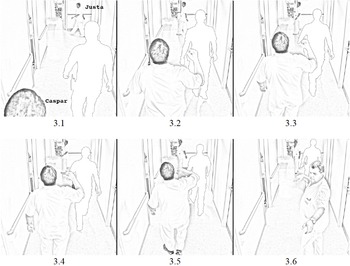
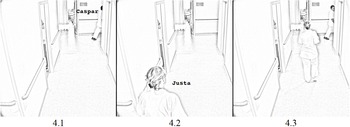
In excerpt (3), Justa (Jus), a nurses’ aide, is walking from Reception in the direction of the Break Room. As soon as she enters the intersection of Corridors B and C, she directs her gaze towards Caspar (Cas), the head nurse, who is walking along Corridor B, from the Urgent Care Room, behind a paramedic (line 1, Figure 3, image 3.1). Caspar looks at Justa and summons her (line 2).
Caspar and Justa in the Day Hospital entrance area and Corridor B. View from camera 2. Images edited to conceal the appearance of a paramedic.

Figure 3 Long description
Caspar and Justa in the Day Hospital entrance area and Corridor B. View from camera 2. Images edited to conceal the appearance of a paramedic.

Caspar utters the summons and raises his right arm with his thumb extended upward (line 3, image 3.2). What could initially be just a drawing-attention gesture turns into a pointing sign, the thumb oriented backward towards the Urgent Care Room. Caspar is thus not only drawing Justa’s attention for interaction but also showing her, at the time of the SA sequence, that there is something related to the Urgent Care Room requiring it. Caspar has still not produced a verbal recruiting move for a specific new activity but prepares the way for one and limits ‘the potential foci of attention’ (Keisanen & Rauniomaa Reference Keisanen and Rauniomaa2012:350). Justa halts her trajectory but does not verbally respond to the summons. She thus gets involved in interaction with Caspar while refraining from engaging in talk with him. Additionally, her bodily conduct displays more than just limited availability for a new activity; it conveys distinct reluctance. There is an abrupt transition from Justa’s walking to her bodily presentation following the summons, ‘at a point of maximum observability’ (Clift Reference Clift2014:383) since a response is expected from her at that time. She stops as if being suddenly halted on her way somewhere (line 3, image 3.3). She concludes the step she was taking with her left foot midway and places her right foot at its side. She also reduces the swinging of her arms and then raises both arms in front of her and freezes for a short moment (line 3, image 3.4). She stays in place, on the path that she was following up to this point, and adopts a static position. Her body is turned only partially towards Caspar—first her head and later her torso—with her lower body oriented forward in a display of continuing engagement with her previous activity: walking towards the Break Room (line 3, image 3.5), the pursuit of which the summons has interrupted. Next, Caspar produces an informing that adopts a ‘there is’ + NP format (“there is a fitted sheet from stretcher one please”, lines 4–5). The recruiting utterance functions as a ‘nudge’ (González-Martínez Reference González-Martínez2023) that enjoins Justa to abandon her current activity and engage in a new one. At “there is”, Caspar points with his right hand to Justa, turns his body towards the Urgent Care Room and shows her, with his left arm, which direction to move in (line 4, image 3.6). Simultaneously, Justa lets her arms drop in a gesture of visible deflation (Clift Reference Clift2014), slapping her thigh with her right hand. She also tilts her head towards the paramedic and exchanges a look of connivance with him (line 4, image 3.6). She then starts moving in Caspar’s direction but keeps her gaze oriented towards the paramedic for a moment. As the preliminaries forecast, Justa will afterwards show little eagerness to deal with the sheet.
In excerpt (4), the roles are reversed. Caspar is walking from the Break Room towards Reception. As he passes the Day Hospital Room, Justa, who is walking from the Urgent Care Room towards the Day Hospital Room, holding some documents in front of her, sees and summons him (line 2, Figure 4, image 4.1).
Caspar and Justa in the Day Hospital entrance area and Corridor B. View from camera 2.

Figure 4 Long description
Caspar and Justa in the Day Hospital entrance area and Corridor B. View from camera 2.

Justa summons Caspar just as he is about to disappear from her view (line 2, image 4.1). Caspar does not respond verbally to the summons, thus refraining from engaging in talk. Initially, he keeps walking in the direction of Reception until he is no longer visible to Justa (line 3, image 4.2). He then abruptly halts his walking, as suggested by the sound of him letting a foot fall suddenly to the floor. Justa orients to this as a sign of Caspar stopping and looks first at the documents that she is about to hand to him. She then redirects her gaze in his direction as if waiting for him to show up. Indeed, after 2.3 seconds, Caspar returns to the intersection of Corridors B and C, but stepping backward (line 4, image 4.3). As in the previous case, the summoned person displays that the summons frustrates the continuation of the current activity, which they resist abandoning in favor of a new involvement that is marked as undesirable. Caspar thus keeps his body oriented towards his original destination, both feet pointing in the direction of Reception. It is only his head that is slightly torqued to the right, towards Justa. Having become visually available, Caspar then adopts a static position, waiting for Justa to approach him.
As Caspar steps back towards her, Justa introduces a new activity preliminary to the upcoming recruiting move, soliciting some related information from him: she asks him a question about the presence of a doctor in the unit (“Mr. Solly”, line 4). Caspar’s answer is curt and uttered in a determined tone of voice (line 6). Meanwhile, Justa looks at the documents she is holding, then places them in front of him as a way of pre-emptively soliciting his alignment (Keisanen & Rauniomaa Reference Keisanen and Rauniomaa2012) for the upcoming recruitment. Next, she starts asking Caspar to do something, apparently in relation to the documents, but abandons the recruiting utterance midway, instead telling how she got them and what she knows about them (line 8); for similar first-person tellings acting as recruiting moves, see Zimmerman (Reference Zimmerman, Drew and Heritage1992). Caspar takes the documents, thus engaging bodily in dealing with them, but Justa will need to provide additional information before Caspar leaves with the documents, which he is responsible for handing over to the doctor.
In this section, we have shown that the summoned party may move beyond displaying limited availability by merely suspending their activities. They can convey reluctance to get involved in a new practical activity by showing that they are being disrupted. The summons frustrates the progression of their current activity, cutting it short. There is friction between the activity in which the summoned person was involved and the one that the summons foretells, which comes across as undesirable. In these cases, in addition to staying in place and only partially orienting towards the summoner, the summoned party may enact being abruptly halted, as if stopped in their tracks. Moreover, the summoned party may let part of their body drop as a sign of visible deflation (Clift Reference Clift2014). In any case, there is a stark transition between the bodily trajectory prior to the summoning and the reluctant presentation following it. These bodily practices are accentuated by the lack of a verbal response to the summons.
Continuing the current activity and minimally orienting towards the summoner
In the previous cases, the summoned party always suspended their current activity even when showing limited availability to engage in a new one. Although they did not approach the summoner, they did stay in place, waiting for them to come near. In contrast, the summoned party shows greater reluctance to engage in interaction and a new practical activity when they continue an activity that takes them away from the summoner, to whom they only orient minimally. The practice of ‘sustaining away-oriented walking’ contributes to this marked display of limited availability.
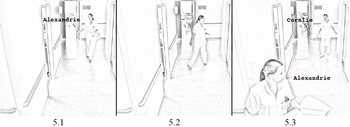
In excerpt (5), Coralie (Cor), a nursing intern, who is walking in Corridor C, summons (line 2) Alexandrie (Ale), a nurse, who is walking well ahead of her, in Corridor B.

At the beginning of excerpt (5), Coralie (off-camera) tries to secure Alexandrie’s attention from behind and at a distance. Alexandrie, who is holding a medical record open in front of her, is walking well ahead of Coralie and heading resolutely in another direction (line 2, Figure 5, image 5.1). Coralie utters a first-name summons in a tentative tone of voice (rising pitch contour with a final rising intonation) that acknowledges the contingencies potentially associated with hearing it and responding positively (line 2). The response in line 4 invites Coralie to state why she is calling on Alexandrie but, with its pronounced final elongation and rising intonation, conveys hesitation rather than eagerness to jump at the occasion. Simultaneously, Alexandrie shifts her right foot to the right and pivots her body towards Coralie but only for a fraction of a second (line 4, image 5.2). With her next step, Alexandrie continues walking away, although at a slower pace and with her head slightly oriented towards Coralie. Coralie is thus compelled, while chasing after Alexandrie, to tell her why she has sought her attention. She describes a problematic situation (Zimmerman Reference Zimmerman, Drew and Heritage1992; Kendrick & Drew Reference Kendrick and Drew2016)—several patients are waiting for a doctor, Mr. Pytel (line 6–7, image 5.3)—and this report functions as a recruiting move, soliciting Alexandrie’s involvement in a specific new activity. As it happens, Coralie will keep adding information about the problem, following the nurse all the way to the inner part of the Urgent Care Room, where Alexandrie decides to stop.
Alexandrie and Coralie in the Corridor B area. View from camera 2.

Figure 5 Long description
Alexandrie and Coralie in the Corridor B area. View from camera 2.
Compared to the excerpts previously examined, this case is a display—exceptional in our collection—of even greater reluctance to engage in interaction and a new practical activity. The summoned party continues her current involvement, sustaining away-oriented walking, and does not stop or turn around, but merely slows down and orients her head towards the summoner, who is compelled to chase after her. Interaction gets done at a distance as the summoner trails behind the summoned person, who communicates something to the effect of ‘if you want something from me, you will need to follow me and talk as I continue what I’m already doing’.Footnote 10
Discussion and conclusion
This article contributes to the understanding of how coparticipants move from unfocused to focused interaction (Goffman Reference Goffman1963) and initiate a new episode of talk (see Pillet-Shore Reference Pillet-Shore2018 for a literature review) in an environment marked by a pseudo-continuing state of incipient talk (Schegloff & Sacks Reference Schegloff and Sacks1973); we use the term ‘pseudo’ since staff members are not constantly physically co-present but keep moving across a spatially distributed workplace. Greetings would be redundant (since staff greet each other the first time they meet in the morning), mutual attention is not always secured (since staff members each concentrate on their own activities), and the interaction’s prospective initiator should clearly designate their intended recipient among all the individuals in the vicinity. Over and over, the coparticipants produce a first-name summons and orient to it. SA sequences have traditionally been considered generic pre-sequences oriented towards securing attention, recipiency, and availability for a new episode of talk ‘preparatory to some incipient, but as-yet-unspecified, project’ (Schegloff Reference Schegloff2007:49). We have respecified these terms by identifying the concrete practices to which they refer and analytically disentangling them even though they are interdependent. In particular, we have distinguished between availability for interaction, for talk, and for an incipient new activity. Focusing on interactions between hospital nursing staff members has allowed us to shed light on additional facets and nuances of availability since coworkers, unlike pedestrians solicited by street vendors or canvassers (Llewellyn & Burrow Reference Llewellyn and Burrow2008; Mondada Reference Mondada2022), can ill afford to avoid or ignore each other altogether.
More specifically, the article also contributes to the study of how recruitment (Kendrick & Drew Reference Kendrick and Drew2016; González-Martínez & Drew Reference González-Martínez and Drew2021) is achieved in talk-in-interaction. As they produce the SA sequence, coparticipants may already display some understanding of what the activity that the summons foreshadows may entail. For instance, the fact that the summoner is about to solicit practical involvement in a competing activity rather than, for example, just providing some information in passing. The summoned party can thus display limited availability for the upcoming recruitment from the very opening of the interaction, at the same time that they orient towards the summons. Our analysis has focused on instances in which, following the summons, the summoned party bodily orients at least minimally to the summoner, looks at them, and sometimes even produces a verbal go-ahead response, thus displaying availability for interaction and talk, but shows limited availability, even reluctance, to engage in the upcoming new practical activity that the summons foreshadows. We identify related practices produced by summoned parties who merely suspend their current involvement, instead of abandoning it, and sometimes additionally display being disrupted, or alternatively continue what they are doing. The article thus contributes to the understanding of anticipation in the initial stages of the interaction (Fox & Heinemann Reference Fox2019; Deppermann, Mondada, & Pekarek Doehler Reference Deppermann, Mondada and Doehler2021; Hoey Reference Hoey, Haddington, Eilittä, Kamunen, Kohonen-Aho, Rautiainen and Vatanen2023a,Reference Hoeyb) and the recruitment trajectory of action. The SA sequence is already part of the trajectory through which the coparticipants discover and achieve both the relevance of Other’s becoming involved and their availability, or lack thereof, to come forward. We argue, however, that the distinction between preliminaries and the initial recruiting move, between being about to be recruited and being recruited, remains relevant, since the participants orient to it. They often produce complete SA sequences, even though a verbal answer may be absent in the case of limited availability, and the summoned party waits for the recruiting utterance that solicits involvement in a new practical activity to be issued before accepting or declining.
In this article, sequential analysis is driven by and supports the study of a social organizational problem (Kendrick Reference Kendrick2021). The studied practices resonate with the practical dilemmas in which the hospital nursing staff is entangled. They are attentive to the needs of their patients and coworkers and the functioning of the units. They remain visible and accessible, instead of staying behind closed doors and being formal when it comes to addressing a colleague or being addressed. Responding to the solicitations of hospital coworkers, a core dimension of teamwork, is expected, needed, and actively promoted (Baker et al. Reference Baker, Day and Salas2006). Nevertheless, getting involved in a new course of action in a busy workplace necessarily delays and interrupts any current activity or adds to the present workload (Yanchus, Ohler, Crowe, Teclaw, & Osatuke Reference Yanchus, Ohler, Crowe, Teclaw and Osatuke2017). Interruptions and task-switching are frequent in hospital nursing work (Kalisch & Aebersold Reference Kalisch and Aebersold2010). They have been associated with adverse outcomes in terms of cognitive load, task performance, and job satisfaction, as well as frustration, tiredness, and irritation, among other negative feelings (Sørensen & Brahe Reference Sørensen2013) for which nursing staff develop coping strategies (Laustsen & Brahe Reference Laustsen2018). The SA sequence is an interactional resource coparticipants can use to deal with the delicacy of calling on a coworker (Mondada Reference Mondada2009; Salvadori Reference Salvadori2016), who was already engaged in an activity, and enlisting them for a different one. With the summons, the summoner ‘prepares the ground’ and ‘takes the temperature’ for the recruiting move, for instance a request, before going ahead with it. The first-name summons serves to affirm the summoner’s relationship with the recipient (Kendrick Reference Kendrick, Floyd, Rossi and Enfield2020), as they are about to become a recruiter. The summoned person has an opportunity to respond first to the summons and show their availability for a new involvement. A go-getter colleague will anticipate the request and offer to do what is needed. As transpires in the cases of ‘displaying being disrupted’, a reluctant coworker will have the opportunity to show annoyance and vent frustration before the actual uttering of the request. In the response position, ongoing commitments, fatigue, and interpersonal likes and dislikes can be safely conveyed when nothing has yet been asked, and it is still possible to ‘drag one’s feet’ for a second, before responding, once again, ‘ready for action’ (Kalisch et al. Reference Kalisch, Weaver and Salas2009).
Acknowledgements
The authors presented preliminary analysis of the data in several data sessions and at the International Pragmatics Association Conference held in Brussels on June 10, 2023. They thank the participants for their constructive comments as well as Paul Drew (University of York), partner of the research project, for the collaboration, and Elisabeth Lyman for her editing of the present article.
Appendix: Clinic premises and recording set-up
Clinic premises and recording set-up. The triangles represent the video cameras, the dots the wireless microphones and the striped rectangle the reception/mixing/editing station. The area covered by the video cameras is represented in gray. Corridor A is 27.40 meters long, Corridor B (the section between Corridors A and C) 4.16 meters long, and Corridor C 31.50 meters long (González-Martínez et al. Reference González-Martínez, Bangerter and Lê Van2017).


 Open access

