

Introduction
The World Health Organization has pointed out that ageism has become a global challenge. The ongoing pandemic has not only unveiled but also more widely spread and exacerbated the age stereotypes in different discourses (Brooke and Jackson, Reference Brooke and Jackson2020; Vervaecke and Meisner, Reference Vervaecke and Meisner2021). Authoritative voices united to affirm older people's vulnerability, thus providing a ‘proper’ reason for disdain towards older people. Scholars denoted that internalised ageism embedding in gerontology was built on the epistemological understanding of age as a biological difference (Fletcher, Reference Fletcher2021). At the same time, misrepresentations and misjudgements of older people have been a running thread in the mass media. In Hong Kong, the government has set particular guidelines for people aged 65 or above. For example, the Centre for Health Protection of the Department of Health announced a particular directive to older people that they ‘stay home as far as possible and avoid going out’. The announcement also emphasised the dependence of older people by encouraging special attention to be offered to them in helping with ‘everyday tasks such as shopping for basic necessities’ (Centre for Health Protection of the Department of Health, 2021). Older adults were undoubtedly taken as the highest risk group through the prevailing tone of the mass media (Lou et al., Reference Lou, Yang, Au and Wong2021), which trumpeted, ‘More elderly people will die, grim facts behind Hong Kong's COVID-19 death surge’ (Cheung, Reference Cheung2020). Previous studies of media representation of older people suggested that the media's political orientation also influenced the types of stereotyping (Davidson, Reference Davidson2016: 29–30; Marier and Revelli, Reference Marier and Revelli2017). Within the specific context of COVID-19, this study aims to examine how newspapers portrayed the image of older people and how the construction was influenced by their ideological inclinations. Then we investigate how different types of ageism were represented in newspapers with divergent ideological preferences.
The categories of ageism
Ageism, a concept proposed by Robert Neil Butler in the 1970s, describes stereotyping and discrimination against people based on their age. The media's discriminatory and stereotyping practices were revealed mainly against older adults, mostly underlining their physical incapability and unproductivity (Fealy et al., Reference Fealy, McNamara, Treacy and Lyons2012; Lepianka, Reference Lepianka2015). The stereotype was extended to different dimensions, defining the various forms of ageism (Binstock, Reference Binstock2010; Walker, Reference Walker2012; Cary et al., Reference Cary, Chasteen and Remedios2017). A compassionate attitude was rooted in social liberal ideology, which implied ‘collective concerns’ (Binstock, Reference Binstock2010) of ensuring against the challenge associated with an ageing population and the belief in ‘big government’ in the social welfare policy process (Rosenblatt, Reference Rosenblatt2018). In the United States of America (USA), influenced by the conservative ideology of highlighting personal responsibilities and ‘small government’, another type of stereotyping older people as an opposing theme was constructed by the media discourse, portraying the older population as selfish plunderers of resources with political and economic power (Binstock, Reference Binstock2005; Hudson and Gonyea, Reference Hudson and Gonyea2012; Achenbaum, Reference Achenbaum2015).
The concept of new ageism was primarily rooted in intergenerational conflict (Biggs et al., Reference Biggs, Phillipson, Money and Leach2006; Binstock, Reference Binstock2010). The social issues surrounding the challenges caused by the ageing population mainly were about expanded health-care costs, stagnant economic growth, intergenerational conflicts and the social welfare burden. The media represented an active image of older adults (Rozanova, Reference Rozanova2010; Ylänne, Reference Ylänne, Twigg and Martin2015) since baby boomers were believed to be more active and competent than the former generations (Hilt and Lipschultz, Reference Hilt and Lipschultz2016: 54–55). Meanwhile, with fast-paced technology, cosmetic surgical techniques were increasingly adopted to control aesthetic aspects of ageing; older people could have a ‘choice’ (Giddens, Reference Giddens1991: 80) to become healthier and at least look younger in the era of ‘neoliberal libidinal economy’ (Edmonds, Reference Edmonds2007). In the Western world, the interplay of social welfare policy and neoliberal consumerism released space for the media to reposition older people away from the discourse of compassion and intergenerational conflict so that new ageism, encouraging ‘active and successful ageing’ (Foster and Walker, Reference Foster and Walker2015), emerged as a competing trend. Nevertheless, this cultural battle against the natural ageing processes was the evidence of the internalised newspapers' ageism in the current society (Rattan, Reference Rattan and Gullette2019); and the diffusion of compassionate ageism during the outbreak of COVID-19 further disclosed active and productive ageing's promise of the ‘emperor's new clothes’.
Taking these various views together, the categorisation of ageism could, on the one hand, give insights into social welfare policy making and professional practice improvement but, on the other hand, the definition of different categories showed a tendency to essentialise particular attitudes towards older people. It failed to specify contexts and consequences associated with why old age was stereotyped in a certain way.
Media representation of older adults under COVID-19
Mass media still plays a significant role in shaping the public's perceptions, and cultural and social values about older people and the ageing process, thus influencing the policy process (Walgrave et al., Reference Walgrave, Soroka and Nuytemans2008). For that reason, a wide range of studies have explored how older people are represented in magazines, newspapers, television series, news and advertisements (Kovács et al., Reference Kovács, Aczél and Bokor2021; Markov and Yoon, Reference Markov and Yoon2021). It is meaningful to study more empirical cases for older people's media portrayal to understand how they were stereotyped during a pandemic crisis in different socio-economic, political and cultural contexts. Although all age segments of the population are vulnerable to COVID-19, and everyone's lives have been affected by the global pandemic, greater attention has always been paid to the negative impact of the disease on older adults. Scholars in different countries have studied the narrative of how older people are represented during a global public health crisis, and a common conclusion was reached: coverage of older people during the pandemic has been overwhelmingly framed by compassionate ageism (Previtali et al., Reference Previtali, Allen and Varlamova2020; Søraa et al., Reference Søraa, Manzi, Kharas, Marchetti, Massaro, Riva and Serrano2020; Zhang and Liu, Reference Zhang and Liu2021). These studies predominantly criticise the victimisation of older people. However, their assertion of more coverage reporting older people's active contributions has swayed ageism to a new side.
Like the study in New Zealand (Morgan et al., Reference Morgan, Wiles, Williams and Gott2021), despite framing older adults as a homogeneous group at greater risk, media discourse also articulated an active portrait of older adults regarding their pre-emptive response to COVID-19. In China, through an examination of five popular Chinese media, Zhang and Liu (Reference Zhang and Liu2021) found older people were homogenised as passive recipients with a need for special protection and as a threat to the intergenerational dichotomy, thus criticising the absence of older people's active contribution. The emphasis on capability and active contribution implied categorisation by physical or mental capacity, which would increase the potential link between ageism and ableism (van der Horst and Vickerstaff, Reference van der Horst and Vickerstaffin press), implying a stronger connection between old age and frailty, immobility and dependency. A study of four major US-based newspapers during the first month of COVID-19 kept tabs on the new ageism trap. It found an older ‘survivor’ narrative that showed an ageist attitude regarding people's capability and productivity (Jen et al., Reference Jen, Jeong, Kang and Riquino2021). In an interesting contrast, a Finnish study (Martikainen and Sakki, Reference Martikainen and Sakki2021), focusing on the visual portrayal of different age groups of people in local newspapers, found that youth and older adults were stereotyped as carefree villains and victims, respectively. Only the adults were depicted with a positive image as heroes.
From traditional Chinese culture and philosophies, Confucian culture-influenced countries and districts affirm filial respect for older people and ageing parents as a virtue, thus taking a more active attitude towards ageing and the older population. However, several scholars have proposed that personal and cultural values are not always in the league; individuals in Eastern cultures – particularly in East Asia – have had more negative attitudes than those in Western cultures (North and Fiske, Reference North and Fiske2015; Zhang et al., Reference Zhang, Xing, Guan, Song, Melloy, Wang and Jin2016). It was believed that Confucian traditional values were overshadowed by the accelerating process of industrialisation and modernisation, of which Hong Kong has been a key representative (Harwood et al., Reference Harwood, Giles, Clément, Pierson and Fox1994). What has often appeared as fundamental cultural differences between West and East were often different only in timing and degree. Based on the past decades of studies on Hong Kong society, individual attitudes towards older adults were not as friendly and positive as traditional cultural values had expected (Chiu et al., Reference Chiu, Chan, Snape and Redman2001; Löckenhoff et al., Reference Löckenhoff, Lee, Buckner, Moreira, Martinez, Sun, Cheng, Chi and Fung2015). The invisibility and objectification of older people were prevalent in print media and Hong Kong's modernisation process. However, it has been 25 years since the study by Gibb and Holroyd (Reference Gibb and Holroyd1996) on print media's representation of older people in Hong Kong was published. The global public health crisis provided a good opportunity to re-examine Hong Kong's mass media meme surrounding older adults.
Research objectives
The political orientation of the media influences the content selection and the type of coverage of a particular issue. Previous studies examined and explained notable differences between the conservative and liberal-leaning media in reporting numerous social issues, including climate change (Dotson et al., Reference Dotson, Jacobson, Kaid and Carlton2012), vaccinations (Baum, Reference Baum2011), refugees (Kenix and Jarvandi, Reference Kenix and Jarvandi2019), racial attitudes (Engelhardt, Reference Engelhardt2021) and political campaign (Entman, Reference Entman2010). Likewise, news media with different political orientations have articulated ageism differently (Marier and Revelli, Reference Marier and Revelli2017).
Thanks to misinformation and agendas, the COVID-19 pandemic – and news thereof – has been politicised and thus believed to serve different political purposes (Abbas, Reference Abbas2020). Political predispositions were found to be significantly related to beliefs of conspiracy theories (Stecula and Pickup, Reference Stecula and Pickup2021), perceptions of the threat of COVID-19 (Calvillo et al., Reference Calvillo, Ross, Garcia, Smelter and Rutchick2020), response and collective action (Choma et al., Reference Choma, Hodson, Sumantry, Hanoch and Gummerum2021), and consuming behaviours (Micalizzi et al., Reference Micalizzi, Zambrotta and Bernstein2021) during the COVID-19 pandemic. More importantly, the relationship between political position and an individual's beliefs and actions may be influenced by how the media represents the issue (Calvillo et al., Reference Calvillo, Ross, Garcia, Smelter and Rutchick2020). Therefore, it is essential to identify how the political tendencies of newspapers construct the ageist discourse.
Among the studies on media stereotyping of older people during the COVID-19 pandemic, no contributions are exploring the relationship between the political spectra of the media and their discursive construction of ageism during a global pandemic crisis. To reflect the expansion of ageism accelerated by the crisis and its implications, this study suggests an alternative perspective to reflect the logic underlying a social structural process of how older people and ageism are portrayed, and further investigates the implications of different forms of ageism within a specific sociocultural context.
Based on the above analysis of the existing literature, this study has three major research questions:
RQ1: How have Hong Kong's local newspapers generally represented older persons during the COVID-19 pandemic?
RQ2: What differences are there among the newspapers with various political orientations in representing older people during the COVID-19 pandemic?
RQ3: What types of ageism have been constructed by Hong Kong's local newspapers with different ideological inclinations, and what are the implications?
Methods
The authors conducted a quantitative and qualitative content analysis of articles reporting COVID-19 and older adults published by three newspapers between 1 January and 31 December 2020. It should be noted that differing from the Western system, political parties in Hong Kong do not have extreme divisions between liberalism and conservatism. Instead, two broad factions are pronounced in Hong Kong's political spectrum: pro-democracy and pro-government. The former is believed to support liberal values, while the latter is believed to hold a more conservative position (Lee, Reference Lee2014). Correspondingly, we selected three local newspapers to feature in this study: Apple Daily, Ming Pao and Oriental Daily News. The masses-oriented and Oriental Daily News are two of the most widely circulated newspapers in Hong Kong. They are well-known for their prominent stances on the political spectrum. Apple Daily is generally considered pro-democracy, usually raising severe criticisms against the government and holding liberal beliefs in discussing different social issues (Lee, Reference Lee2014). Oriental Daily News falls into the pro-government group as a representative of the conservative media. Still, it sometimes expounds critical attitudes about the government without challenging the pre-existing political system and arrangement (Chan, Reference Chan2020). Ming Pao is a middle class-oriented paper with self-proclaimed journalistic professionalism and impartiality (Lee, Reference Lee2014).
The diversity of political orientations among the selected newspapers allowed us to investigate how the ideological manipulation behind the newspapers influences the framing procedures and reporting styles in the representation of older adults and the diffusion of ageism during the novel coronavirus pandemic.
Combining quantitative and qualitative approaches in media content analysis strengthened the interpretive power (Shoemaker and Reese, Reference Shoemaker and Reese1996). As analysed above, given no practical analytical framework to study the intertwined relations between ageism, media and social policy, this study applied inductive analysis by taking reference from the relevant literature (Morgan et al., Reference Morgan, Wiles, Williams and Gott2021; Zhang and Liu, Reference Zhang and Liu2021). Quantitative content analysis systematically categorised the textual data and generated patterns and themes (Forman and Damschroder, Reference Forman, Damschroder, Jacoby and Siminoff2007). We studied the mainstream media for the entire 2020 calendar year and further examined how the political orientation of the media influences the transmission of ageism in newspapers.
Data collection
Articles were perused and selected with the aid of WiseNews, an electronic newspaper database archive that collects all local newspapers and daily news articles in real time. The authors developed and refined the search terms after performing a pilot test in WiseNews to ascertain the measurement validity. It should be noted that an English vocabulary can have diverse Chinese expressions to represent its general and localised meaning with flexibility within the specific Hong Kong context.
We first searched articles comprising the following keywords: (a) mentioning any one of the nine keywords (23): ‘elderly’ (zoeng2- ze2 ), ‘older people’ (lou5- jan4, lou5- jau5- gei3), ‘elder’ (lou5- jat1- bui3, zoeng2- bui3), ‘old’ (gou1- ling4, lou5- nin4, nin4- lou5, nin4- zoeng2, nin4- gei2- daai6), ‘old man’ (aa3- baak3, baak3- baak3, gung1- gung1, lou5- jung1), ‘old women’ (aa3- po4, lou5- fu5, po4- po4), ‘grandparent’ (zou2- fu6, zou2- mou5), ‘retired’ (teoi3- jau1) or ‘nursing home’ (on1- lou5, wu6- lou5, joeng5- lou5); and (b) mentioning either one of the two keywords ‘Coronavirus’ (fai3- jim4) or ‘Pandemic’ (jik6- cing4). The search was restricted to five news sections most relevant to COVID-19 reporting: ‘Headlines’ (tau4- tiu4), ‘Highlights’ (jiu3- man4), ‘Local news’ (gong2- man4), ‘Health’ (wai6- saang1) and ‘Supplements’ (fu3- hon1). The authors and trained research assistants then reviewed thousands of articles to identify the relevant ones that fulfil the inclusion criteria that should pertinently portray older adults' livelihoods, experiences or behaviours during different stages of the COVID-19 crisis. Overall, 814 articles were selected for analysis: 498 from Apple Daily, 198 from Oriental Daily News and 118 from Ming Pao.
Quantitative content analysis
To document the current patterns of newspaper representations of older people during the COVID-19 pandemic, this study first employed quantitative content analysis to make replicable and valid inferences by systematically and objectively identifying specified characteristics within the collected news. A comprehensive coding list with multiple relevant variables and categories was constructed to provide the researchers with a consistent framework for analysing the materials (Macnamara, Reference Macnamara2005).
A trained research assistant independently developed a content analysis scheme by reading the existing research literature and a preliminary random sample of 50 newspaper articles. Blind coding was conducted by the authors and the trained research assistant to achieve the intercoder reliability sub-sample to avoid unintentional measurement bias. We then met one week later to discuss the results, reconcile the discrepancies in the subjective judgements during the coding process, and review and refine the existing coding scheme (Neuendorf, Reference Neuendorf2017).
The subsequent stage proceeded after the two independent researchers agreed on the modifications made to the original coding book. Another sub-sample of 50 newspaper articles was randomly selected for the pilot study to test the reliability of the revised coding scheme. The intercoder reliability was shown to be high (Cohen's kappa = 0.59), and the final coding scheme was formulated.
Qualitative content analysis
Summative qualitative content analysis was applied in this research (Hsieh and Shannon, Reference Hsieh and Shannon2005). To understand the contextual use of the words, it supplemented the statistical analysis of the numerical data by further examining textual structure and language characteristics. It allowed the authors to attain a more in-depth and systematic ‘communication of meaning’ (Altheide, Reference Altheide1987; Schreier, Reference Schreier2012: 3). The previously mentioned research questions directed all the analysis process. Following Elo and Kyngäs (Reference Elo and Kyngäs2008), the research team thoroughly read all the articles and was immersed in the data (Polit and Beck, Reference Polit and Beck2004) for more than ten months. During this period, as many headings as necessary to describe all aspects of the content were noted down and understood for creating better categories and generating knowledge (Cavanagh, Reference Cavanagh1997; Hsieh and Shannon, Reference Hsieh and Shannon2005). The abstraction of the qualitative data was attained by formulating a general description of the research agenda through a comparison between these data and understanding the social-cultural context of the media contents (Polit and Beck, Reference Polit and Beck2004). The process was occupied by systematic close reading and determining the underlying meaning of the text. For a thick description purpose, the qualitative content analysis focused on the text's textual content, literal rhetoric and contextual meaning (Hsieh and Shannon, Reference Hsieh and Shannon2005).
The authors purposively selected the quotes to analyse further in order to answer the specific research questions better. The analysis concentrated on language narratives relating to how older people and stories related to them were described, as well as patterns, cultural references, and social and political practices related to older adults during the pandemic.
Scientific rigour was presented through credibility, dependability, confirmability and transferability (Guba and Lincoln, Reference Guba, Lincoln, Denzin and Lincoln1994). The credibility of the data was enhanced by member-checking, including the authors and two independent researchers (Koch and Harrington, Reference Koch and Harrington1998). The dependability and confirmability of the analysis were reinforced by the authors' reflexivity (Mantzoukas, Reference Mantzoukas2005). Transferability was determined by thick description and purposive sampling with both quantitative and qualitative data (Bitsch, Reference Bitsch2005), and the contextual conditions were analysed to ensure an in-depth understanding of the phenomena.
Findings
Older adults under COVID-19: not only at risk but also a risk
Three major categories could be extracted from how older people were associated with the pandemic situation. The first category related to how older people reacted to and coped with the pandemic; the second one mainly focused on how the older population was impacted by COVID-19; the third category concentrated on support from the government and other institutions and organisations (see Table 1). Our findings indicated that when depicting the social demographic characteristics, the older population was taken as a homogenised group, with unspecified gender (72.1% not identified) and social identity (82.3% not specified). Among 144 articles in which the social identity was given, 84 per cent were identified as grassroots and working class, while 16 per cent were professionals. Instead, the reports used different forms of generalised wording to name older people, such as lou5 jan4 (older people) and zoeng2 ze2 (the elderly). But differing from the mainstream articulation of older people with identified poor health conditions (Fealy et al. Reference Fealy, McNamara, Treacy and Lyons2012; Swift and Chasteen, Reference Swift and Chasteen2021), this study found the health condition of older adults was not specified in 63.3 per cent of the reports. Among 299 articles that presented health conditions, these were mainly identified as general health problems, such as immobility and physical disabilities (62.5%), chronic disease (32.8%) and mental health issues (13.0%).
Final content analysis coding scheme
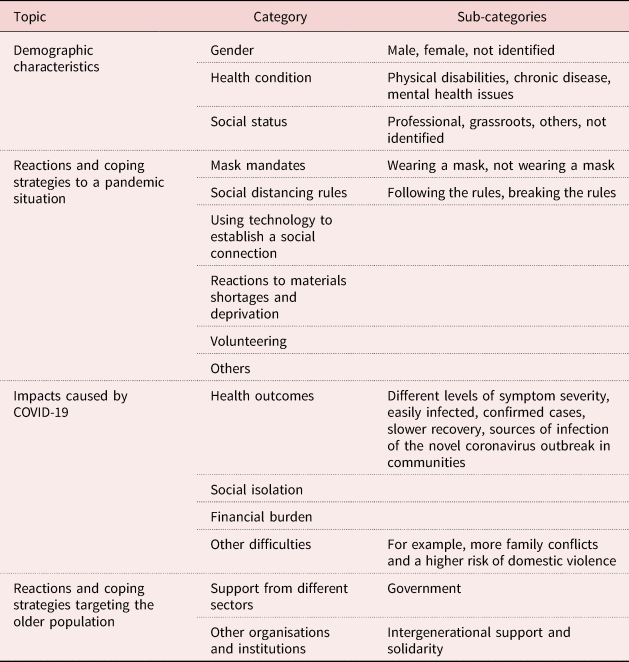
The first category indicating how older people reacted to and coped with the pandemic included 282 news articles. Among these 282 examined news articles, 26.2 per cent (N = 74) of these articles viewed older adults as troublemakers during the public health crisis, including representation of breaking the rules of social distancing (17%, N = 48) and ignoring mask-wearing mandates (16%, N = 45). In comparison, only 9.6 per cent (N = 27) of such news articles reported that older adults followed special social rules during the pandemic situation (keeping social distance 2.5%, wearing masks 7.1%). Here are some examples:
Holding a retirement dinner party during the sensitive period would increase the risk of large-scale virus transmission. (Apple Daily, 16 July 2020)
Only older adults broke in and jumped into the swimming pool. (Ming Pao, 23 September 2020)
Some older adults were obsessed with gambling. Some gambler recovery centres documented a growing number of assistance-seeking cases among older adults. (Oriental Daily News, 8 August 2020)
The above three narratives were excerpted from the reports about how Hong Kong citizens reacted during the COVID-19 situation. The rhetoric of older people's stereotype was emphasised by articulating the old age, ‘retirement’ and ‘older adults’, respectively, in the excerpts, to breaking social distancing rules. What is more, the narrative stigmatised older adults as the homogenous population who would not follow social distancing rules regardless of their other demographic traits. Only the second quote described older people as a generalised group; the first excerpt referred to a group of retired people with a decent career, while the third excerpt implied the grassroots.
News reports also presented how older adults coped with material shortages and deprivation (N = 61, 21.6%). A compassionate attitude constructed the rhetoric of mockery, through which older adults were overgeneralised as a panicked, helpless and incompetent group of people, for example:
Older adults risked their lives [wan2 ming6 bok3] to get free food. (Apple Daily, 8 November 2020)
Banks are suggested to use a quota system to spread out the crowds to avoid the influx of multiple older people submitting the paperwork at the bank. (Oriental Daily News, 22 June 2020)
Many older adults living alone could not buy a mask even if they waited in line. (Ming Pao, 25 February 2020)
At the same time, 19.5 per cent of news articles (N = 55) portrayed older adults, either actively or with others' assistance, as using technologies to avoid social isolation and seek COVID-related knowledge and information; for example:
She was surprised and happy about the elderly's high level of technology acceptance. The epidemic created both challenges and opportunities. (Ming Pao, 28 September 2020)
Older adults can keep a safe social life by using technology to connect with relatives and friends. (Apple Daily, 15 December 2020)
It is suggested that the old people can use the family's smartphone to download ‘HA Go’ [a mobile application launched by Hospital Authority, HA, to improve patients' experience when using public hospital services]. (Oriental Daily News, 9 March 2020)
But even among the reports about older people's positive reactions, the rhetoric in the first excerpt revealed how older adults were misunderstood and stereotyped by the public.
Other reactions (8.2%, N = 23) included escaping from the pandemic situation by moving or travelling and expressing their opinions about the government's anti-epidemic measures. It should be noted that there were only seven articles (2.5%) reporting older adults' contribution to fighting the epidemic, and they were all articulated to specific social class backgrounds; for example:
The police force formed an anti-epidemic voluntary group and a group of retired older volunteers. (Apple Daily, 26 February 2020)
The retired civil servants of the Hong Kong Customs & Excise Department actively joined the anti-epidemic voluntary group. (Oriental Daily News, 16 July 2020)
The excerpts above implied that the neutral and positive portraits of older adults were only associated when they were with higher social status.
For the second category, how the older population was impacted by COVID-19, 47.4 per cent (N = 386) of news articles among 814 reports mentioned health outcomes caused by the coronavirus disease. Among these 386 articles, older people were depicted with different levels of symptom severity (38.9%, N = 150), easily infected (55.7%, N = 215), as confirmed cases (56.7%, N = 219) and having a slower recovery (3.1%, N = 12). Some reports explicitly positioned older people as sources of infection of the novel coronavirus outbreak in communities (55.7%, N = 215). In addition to emphasising older people's physical vulnerability, newspapers depicted that all aspects of older people's lives were negatively impacted by the pandemic situation, including 101 news articles mentioning older people experiencing social isolation (26.2%), 64 articles associating older people with financial burden (16.6%), and other difficulties (6.0%, N = 23), such as more family conflicts and a higher risk of domestic violence during the pandemic situation; for example:
A hoary-haired female cleaning worker was picking up rubbish along the hiking trails. Carrying a huge bag was highly strenuous for an older person. It looked so sad. (Oriental Daily News, 27 April 2020)
Under Covid-19, both the physical and mental health of older adults should be paid more attention to. Besides the higher mortality rate after infection, older adults' mentality was severely afflicted. (Apple Daily, 26 July 2020)
The elderly's lack of vital energy made them have a more extended recovery period. (Ming Pao, 5 October 2020)
The rhetorical performance is repeated in specifying older adults' deficits and deficiencies in physicality, mentality, social connectedness and financial situation.
The third category included articles on the support older people received from the government and other institutions and organisations. Among 814 examined news articles, 458 articles (56.3%) mentioned special support for older people, and of these articles, 80.1 per cent (N = 367) specified support from the government, while only 22.1 per cent (N = 101) mentioned non-government support and 2.2 per cent (N = 10) mentioned both. The code about governmental support also included criticism of the government's insufficiency and inefficiency in supporting the older population. In other words, 56.3 per cent (N = 458) viewed older adults as passive recipients with a need for special protection and support from society and communities. Similar to previous studies on age stereotyping, older adults were represented as passive beneficiaries at large; for example:
With a group of volunteers, Teresa Cheng packaged all the epidemic prevention materials, supermarket coupons, and health information leaflets and donated them to non-governmental organisations to distribute to older adults and low-income families. (Ming Pao, 6 March 2020)
Novel coronavirus got increasingly severe, and the government expanded the free testing service in the community. (Apple Daily, 26 November 2020)
The government took slow and sluggish action to fight against the outbreak of Covid-19, and it could not even yield enough masks for older adults and the deprived. (Oriental Daily News, 6 April 2020)
Though the above narratives showed different attitudes towards the government's measures, they highlighted that only older adults relied on the free support and established an articulation of older people to the disadvantaged population.
To conclude this discussion, older people were portrayed as physically and mentally more vulnerable, frail, dependent, outdated, technophobic, socially deprived, and needing a lot of extra resources and special support. In brief, older adults had been seen as objects of discrimination. More than that, they were also represented as troublemakers during a public crisis. According to the news reporting, the older population were not only at risk but also represented a risk in themselves.
Liberal and market-oriented newspapers: more hostile to older people
Consistent with previous studies, the three newspapers mostly focused on older people's physical and mental vulnerability despite their political stripe, with most reports about the negative impacts on older people's health (47.4%, N = 386), while Apple Daily paid the greatest attention to this issue (54.8%, N = 273) amongst the three. Liberal newspapers were more likely to include articles portraying older people as physically, mentally and socially vulnerable. However, Ming Pao, with its conservative inclination, had the most news reports (61%, N = 72) emphasising support for older people. In comparison, more than half of the news coverage of Oriental Daily News (56.6%, N = 112) and Apple Daily (54.2%, N = 270) also featured a similar approach. In contrast to the conclusions from past studies (Tepe and Vanhuysse, Reference Tepe and Vanhuysse2010; Marier and Revelli, Reference Marier and Revelli2017), with its conservative position, Ming Pao focused more on the government's responsibilities for older people (48.3%, N = 57) and was closely followed by another conservative paper, Oriental Daily News (47.5%, N = 94) and the Apple Daily (43.4%, N = 216) with its liberal position.
In depicting older people's behaviours during the pandemic, 10.1 per cent (N = 20) of the Oriental Daily News news articles focused on how older people broke social rules, either by not following social distancing (7.6%, N = 10) or by disobeying mask mandates (7.6%, N = 10), followed by Apple Daily (9.4%, N = 47) and Ming Pao (7.6%, N = 9). Among the reports mentioning the impact of coronavirus on older people's health, Apple Daily had the most news articles positioning older adults as a source of infection for the outbreak in communities (28.5%, N = 142), followed by Oriental Daily News (23.7%, N = 47) and Ming Pao (22.9%, N = 27). Ming Pao had more coverage of older people's adoption of technology to cope with social isolation (16.9%, N = 20), followed by Apple Daily (3.4%, N = 17) and then Oriental Daily News (3%, N = 6). In addition, Ming Pao and Apple Daily each had three articles on older people's active contribution in fighting epidemics. In contrast, the one with a conservative inclination, Oriental Daily News, had just one piece.
Statistical findings developed a big picture of how newspapers with different political leanings represented older people during the pandemic, and an in-depth examination of the textual data with attention to the content or contextual meaning could find differences in the rhetorical constructions among the three newspapers.
Apple Daily, the liberal-leaning newspaper, expressed sympathy and benevolence towards older adults with a mocking tone. As analysed in the above section, when depicting how older people reacted and coped with materials shortages and deprivation, the paper made these comments:
Many residents, especially the elderly, flooded the mobile testing station. Some older adults fell while waiting. (10 November 2020)
The patronising tone could be easily found:
Even an illiterate older adult understands the difference between the front and backside of a mask, but the Secretary does not know! (9 December 2020)
Oriental Daily News had a similar tone in a few articles. For example, a news article on abnormal behaviours during the pandemic reported that
Some older adults used orange peel with a rubber band as a mask. (11 February 2020)
In representing how older people were supported by others, mainly by the government, Apple Daily and Ming Pao were particularly critical of the government; in addition to the excerpt from Oriental Daily News quoted in the section above, another example is:
The government did not even give me a call after it happened, with no words of sympathy or condolence. The irresponsible government never considered our feelings of losing an aged parent during the pandemic situation. (Apple Daily, 21 December 2020)
Also Ming Pao situated social support in an intergenerational dichotomy. In an interview with a younger generation member of the community, they wrote:
Amidst the resurging pandemic, institutionalised residents need extra multi-dimensional support. Food becomes a connection between the service providers and older people. Attentiveness turns something ordinary into something special. (14 December 2020)
Due to its self-proclaimed neutral and middle-class/professional position, Ming Pao expressed ‘collective concern’ with a paternalistic and patronising tone. In reporting older adults' reactions to mask mandates and social distancing rules, Apple Daily and Oriental Daily News directly showed hostile attitudes, while Ming Pao took a mild position. Instead of making pejorative remarks, Ming Pao applied a baby-talk tone, as in these two examples:
An older man with his mask off while enjoying chess games in the park. But they were very amenable [gwaai1, a Chinese word to describe a well-behaved child in a parental tone] when being reminded of a rule. (28 March 2020)
Older community adults often surreptitiously played mah-jong in hidden places and prioritised it over health concerns. They nonetheless reduced social contacts after being kindly reminded by social workers and the district councillor. (19 December 2020)
The baby-talk tone disclosed Ming Pao's condescending attitudes towards older adults, implying an ageist categorisation of the population embedded in their self-proclaimed neutrality and professionalism.
To conclude these quantitative and qualitative findings, the newspapers overgeneralised older people in their coverage of the global pandemic crisis, corresponding with the findings of previous studies (Zhang and Liu, Reference Zhang and Liu2021). Three major themes (see Table 2) could be derived from the coding scheme, including older people's vulnerability, governmental and non-governmental support (which also partly implied older people's vulnerability), and the portrayal of older people as troublemakers. The findings indicated that notwithstanding the ideological preference of the media, older people were generally taken as a particularly vulnerable and fragile group in terms of health, financial condition, social connections and other life aspects. But instead of overwhelmingly presenting older adults as passive recipients with poor conditions, the Hong Kong newspapers also portrayed them as ‘troublemakers’ who tended to disregard both social distancing and mask mandate norms. More than that, they were a major source of virus outbreaks in the community. The quantitative findings suggested no significant difference among how the three newspapers represented older people's disobedience regarding mask-wearing and social distancing rules (χ2(2) ≥ 0.79, p = 0.67), nor when portraying them as a source of community outbreaks (χ2(2) ≥ 2.95, p = 0.23). With closer attention to the rhetoric by qualitative enquiry, Apple Daily and Oriental Daily News were found to hold more hostile attitudes towards older people by reporting most about how they broke social rules during the COVID-19 pandemic. The findings also suggested no significant difference in reporting governmental support for older people during the pandemic (χ2(2) = 1.53, p = 0.47). This result might imply a consensus between liberal- and conservative-leaning media on the government's complete responsibility for the ageing population amid the global crisis.
Frequencies of three themes

Note: N = 814.
Both market-oriented newspapers, regardless of their opposing political positions, showed a hostile and derogatory attitude towards older people while also expressing compassion towards older adults. Both likewise criticised the government's irresponsibility and inefficiency in supporting the older population. But the liberal newspaper was more likely to identify older people as troublemakers during the health crisis. By contrast, the conservative newspaper, with its self-proclaimed journalistic professionalism and neutrality, took a mild tone in describing the vulnerability of older people and focused mostly on the government's responsibility, social harmony and intergenerational solidarity.
Assorted ageism is prevalent, despite political inclinations
Liberal-leaning newspapers acknowledged ‘generational interdependence’ and state intervention by liberal ideological consideration of various social causes and conditions (Kim et al., Reference Kim, Carvalho and Davis2010). In consonance with conservative opposition to a vital governmental role in improving social welfare, media with conservative political values were believed to stress individual responsibilities and minimal governmental support. Accordingly, past studies proved compassionate ageism was more prominent in liberal media, while intergenerational and new ageism were more prevalent in conservative media. Inspired by Marier and Revelli (Reference Marier and Revelli2017) and to answer RQ3, researchers fit the variables in coding schemes into compassionate ageism, new ageism and hostile ageism. Compassionate ageism consisted of older people's vulnerability, including physical and mental weakness and frailty, financial and social deprivation, materials shortages, and the negative impact caused by the coronavirus; new ageism comprised older people's identity as higher social status and upper class, adoption of technology to cope with social isolation and contributions in anti-epidemic volunteering work. Hostile ageist beliefs assume older people to be not only incompetent but also unadaptable (Cary et al., Reference Cary, Chasteen and Remedios2017), typically like ‘Old people are a drain on the health-care system and economy’ and ‘Old people are too easily offended’. Contextualised in this study, hostile ageism was defined as addressing generally derogatory attitudes; thus, viewing older people as troublemakers would be categorised into this type. The three newspapers divide up these types of ageism, as shown in Table 3.
Frequencies of ageism by newspaper

Note: N = 814.
The above findings indicate that Hong Kong newspapers had a disproportionately large coverage dealing with compassionate ageist and hostile ageist attitudes towards older people. In line with studies in past decades, coverage of ageism was prevalent across the media (Davidson, Reference Davidson2016: 29–30). But diverging from the past studies, though compassionate ageism still spanned multiple political spectra, hostile ageism was represented more in the liberal-leaning newspaper than the conservative-leaning ones. It also should be highlighted that compassionate ageism was variously but tightly interwoven with hostile ageism through newspapers' representation. For example, as stated earlier, when reporting free testing services provided in the community, Apple Daily wrote, ‘Many residents, especially old people, flooded the mobile testing station. Some older adults fell while waiting.’ It showed concern for older people's deprivation and security, but at the same time, it implied older adults were a drain, taking advantage of free public resources. Despite the pervasiveness of compassionate and hostile tones among the three newspapers, the two conservative-leaning papers constructed a positive ‘active ageing’ image of older adults by dividing the ageing population in terms of productivity and chronological age segments. In narrating how older adults faced the pandemic crisis positively, Ming Pao reported:
Retirees are capable of becoming volunteers working in museums. (27 November 2020)
To encourage older adults to have confidence in fighting against COVID-19, another report stated:
Quite a few middle- and old-age persons aged over 60 actively participate in triathlons coached by Gary, who has experience leading triathlon training in Australia. (29 December 2020)
Ming Pao's rhetoric of positive imagery of older adults reflected the omnipresence of successful ageing proposed in gerontology, emphasising physical health, contribution and productivity (Biggs and Daatland, Reference Biggs, Daatland, Daatland and Biggs2004). Oriental Daily News categorised older adults into different age segments: those aged 61–70 were defined as older people, while those above 70 were named the senior-aged adults (gou1 ling4 zoeng2 ze2). Though reporting portrayed older people aged 61–70 as victims of financial fraud during the pandemic situation, the information implied they might not be financially deprived; for example:
More than half of victims of financial fraud were aged 60 years or over; total combined fraud losses were one hundred million; that is, per capita losses were around 380 thousand Hong Kong dollars. (7 December 2020)
Influenced by the overall discourse in which older adults were constructed as homogenous or invisible, the rhetoric of the above quote showed its new ageist attitudes by stressing their productivity and social resources.
Discussion
This study examined how newspapers portrayed the image of the older Hong Kongers living during the pandemic public health crisis and how the papers constructed images of older adults and ageism that were influenced by their ideological inclinations. The quantitative and qualitative analysis gained observations about media representation of older people in two major dimensions: older people were overgeneralised as a homogeneous population unit, and various forms of ageism were represented in all newspapers, with negative reports predominating. Generally, compassionate ageism was prevalent in the newspaper with a liberal inclination, while new ageism was most evident in the conservative newspaper. But after an in-depth examination, the findings of this study provided three new perspectives to reflect the implications of different types of ageism in media discourse and the relation between ageism and media's political predispositions.
First, this study suggested that historical context and media's market positioning might also influence how they represented older adults' image, though political orientation still played an essential role. In line with Marier and Revelli's (Reference Marier and Revelli2017) study in the USA and Canada, the political orientation of media played an essential role in how they stereotyped the older population. However, their ideological inclination was neither necessarily related to their attitudes towards older adults nor their position in the policy process. Newspaper coverage was influenced by the interplay between the newspaper's ideology, traditional news values and other factors, such as the market (Carvalho, Reference Carvalho2007). Three newspapers varied in the linguistic expression of conveying compassionate attitudes. Through analysis of the narrative of qualitative data, market-oriented newspapers – targeting a larger market of younger audiences – employed a more explicitly mocking and hostile tone to portray older people ‘as targets of ridicule or as extreme caricatures’ (Ylänne, Reference Ylänne, Twigg and Martin2015: 375). Though with conservative ideological preference, Ming Pao's self-proclaimed journalistic professionalism disciplined its articulation of marginalised or deprived groups.
However, it was a universal belief that the government was taking a dominant role in taking full responsibility for caring for the older population. In contrast to popular belief (Binstock, Reference Binstock2010), two conservative newspapers had slightly more extensive coverage of governmental support in protecting the older population. Besides, there was a growing sense for both the conservative paper (Oriental Daily News) and the liberal one (Apple Daily) that the government's measures were flawed and insufficient to take care of the older population and fight the epidemic. Market-oriented press proved to have a stronger inclination towards populism, and Oriental Daily News and Apple Daily were two of the major sources of populist rhetoric materials in Hong Kong (Tang, Reference Tang2017). Populism, in its byzantine relations with specific political ideologies, was not confined to the conservative. In Hong Kong, populist discourse carried forward two main cleavages: ‘rich government’ and ‘the people’ (older adults in this study) (Tang, Reference Tang2017). This could explain Oriental Daily News's criticism of the government despite its conservative position. In Hong Kong, newspapers with populist inclinations in both camps showed more hostile attitudes towards older people and agreed on the government's role in taking primary responsibility for caring for the older population. New ageism, emphasising individual responsibility for their own lives, loomed large in elite-oriented conservative media like Ming Pao. At the same time, it struggled to emerge as a competing discourse in the conservative camp with populist beliefs, Oriental Daily News.
Second, based on the first conclusion, the polarised ageism framework, mainly including compassionate ageism, new ageism and hostile ageism, could not be applied to fully understand ageist beliefs implied by the news media. This study suggested that different types of ageism were intermeshed in creating a multiplicity of meanings. It challenged a statistical approach to examining the ageist beliefs constructed in both media texts and personal interactive narratives. Ageism has been considered a significant mechanism creating societal inequality since Butler (Reference Butler1980) proposed this concept. Understanding how various types of ageism were intertwined and changed contributed to breaking up the stereotype while also better explaining the politics of policies on ageing, the broader context of the political economy and an understanding of the different ideological approaches to issues of social security (Binstock, Reference Binstock2010). Liberal-leaning newspapers portrayed older people with both vulnerability and destructivity. With compassionate attitudes, older people were portrayed as major victims of the public health crisis, leading to feelings of pity and sympathy (Cuddy and Fiske, Reference Cuddy, Fiske and Nelson2002). But, at the same time, the tone they employed took vulnerability as an object to be made fun of. Compassionate ageism in the liberal newspaper also concealed a hostile attitude towards the older population and unrealised anxiety about intergenerational conflict (Lou and Dai, Reference Lou and Dai2017). Compassionate ageism in the conservative newspaper showed a self-conflicting dilemma. On the one hand, Ming Pao employed the baby-talk tone to avoid portraying older people as troublemakers, which implied the lower competence of older people and conveyed less respect. Compared with Apple Daily's emphasis on physical and mental vulnerability and materials shortages, Ming Pao showed compassion due to older people's lower social-economic status. Yet, at the same time, Ming Pao depicted an elite image of older people and underlined their active contribution to the fight to overcome the epidemic.
Third, the disagreement in news selection between conservatives and liberals is not as considerable as previous research has claimed (Iyengar and Hahn, Reference Iyengar and Hahn2009). Instead, more attention should be paid to the divergence in the rhetorical construction, and the interpretation of ageism should be situated in the interplay of politics, culture and the temporal context. Deriving from the Confucian tradition, filial piety and respect for older people were considered the highest virtues. To take care of the older population was thus viewed as the code of ethics and a compulsory obligation. The prominent difference between a compassionate attitude and filial piety lies in the motivation and the act of caring for older people. Compassionate ageism was rooted in the social-liberal ideology, which recognised the government's responsibility in ensuring the wellbeing of the older population (Arber and Ginn, Reference Arber and Ginn1991; Marier and Revelli, Reference Marier and Revelli2017). Rather than relying on families and individuals, this study found that despite the difference in political beliefs, the media nonetheless came to a consensus that the government should take a significant role in protecting and supporting the older population. This finding allowed scholars and policy makers to partly disentangle the influence of the ideological agenda compared to other factors – such as population structure – in analysing issues raised by ageing societies. In addition, the moral standard did not necessarily translate into the motivation for actual behaviours. On the contrary, this mandate of elder respect might lead in the opposite direction (Tan and Barber, Reference Tan and Barber2020). The hostile ageism found in market-oriented newspapers (assumed as more populist) supported the evidence of observations on negative personal attitudes about older people in Hong Kong (North and Fiske, Reference North and Fiske2015).
Nonetheless, this research is subject to several limitations. First, the sample size for content analysis was limited to three Chinese newspapers. These three newspapers, representative in terms of their influence and circulation, were examined with rich and contextualised analysis. However, the presence of 54 newspapers printed in Hong Kong might influence the generalisability of the results. Besides, the only parts of the papers examined were ‘Headlines’ (tau4- tiu4), ‘Highlights’ (jiu3- man4), ‘Local news’ (gong2- man4), ‘Health’ (wai6- saang1) and ‘Supplements’ (fu3- hon1), which were included for sampling in this study due to the relevance of the context. For a more comprehensive understanding of how older people are represented and associated with different topics, it would be necessary to expand the analysis to other sections of the media to reflect the relations among mass media and political ideology, and their implications for social policy.
Second, Chinese and English are both official languages in Hong Kong. English is widely used in commercial activities and legal matters. The English newspaper also has a broad market, in particular targeting younger business people and professionals (Sing Tao Newspaper Group, nd). It proposes avenues for future research in investigating new ageism and intergenerational ageism.
Third, this study used a mixed method in interpreting the textual data. Further studies can pay closer attention to linguistic features to analyse how political and social inequalities are constructed and reproduced. An avenue of approach for future studies could be to focus on how the political economy shapes the communication of ageist content from the media and its relations with social policy making and policy structure. Lastly, a comparative study of the mediatisation of ageism in a cross-cultural context and the degree of its acceptance and the reflexivity of its audience in receiving ageist information should also be highlighted in the future.
Financial support
This research received no specific grant from any funding agency in the public, commercial or not-for-profit sectors.
Conflict of interest
The authors declare no conflicts of interest.
Ethical standards
This study did not engage human participants, hence corresponding ethical approval is not applied.


 Open access

