





1. Introduction
How should we evaluate distributions of well-being across people? The simplest approach is Utilitarianism: the value of a distribution is given by summing each person’s well-being. Another common approach is the Priority View, or Prioritarianism: the value of a distribution is given by first transforming each person’s well-being in a certain way, and then summing such transformed well-being levels. The prioritarian transformation is the same for all individuals, and ends up giving more weight to worse-off people (Parfit Reference Parfit, Clayton and Williams2002; Adler Reference Adler2011).
A central argument for Utilitarianism is given by John Harsanyi’s interpretation of his social aggregation theorem (Reference Harsanyi1955, Reference Harsanyi1977, Reference Harsanyi, Sen and Williams1982). Harsanyi shows that if individual and social preferences in conditions of risk satisfy the axioms of expected utility theory, and if social preference defers to individual preferences when the latter all agree, then there exist von Neumann–Morgenstern (vNM) expected utility representations $V,{V}_{1}, \ldots, {V}_{n}$
for society and individual preferences respectively, such that
$V,{V}_{1}, \ldots, {V}_{n}$
for society and individual preferences respectively, such that $V={V}_{1}+ \ldots +{V}_{n}$
(following Broome’s Reference Broome, Hirose and Olson2015 statement). Lotteries and hence degenerate lotteries – i.e. outcomes – are ranked according to a sum of vNM utilities. Harsanyi went on to interpret the individual vNM utility representations in this formula as cardinal measures of individual well-being. He therefore took his theorem to support Utilitarianism: if outcomes are ranked by a sum of individual vNM utilities, and the latter are cardinal measures of well-being, then outcomes are ranked by summing individual well-being.
However, Harsanyi’s interpretation of his social aggregation theorem is contentious. According to what has come to be known as the Sen–Weymark critique (Sen Reference Sen1976, Reference Sen, Butts and Hintikka1977; Weymark Reference Weymark, Elster and Roemer1991; Roemer Reference Roemer1996), the cardinal structure that individual well-being has (or may have) is to be sharply distinguished conceptually from the quantity that the vNM representation theorem identifies, i.e. which individuals that satisfy the vNM axioms maximize in expectation (von Neumann Morgenstern Reference von Neumann and Morgenstern1944; see Fishburn Reference Fishburn1989). Absent an argument for why the two should be identified, Harsanyi’s aggregation theorem fails to support Utilitarianism.
There are different ways one can react to the Sen–Weymark critique. One option is to claim that well-being has no cardinal structure independently of vNM utility; hence there is only really one quantity, vNM utility, and it provides a precisification of what we might mean by “quantities of well-being” and “utilitarianism”.Footnote 1 Another option is to insist that well-being does have cardinal structure independently of vNM utility, and reject the sum of vNM utility approach (more on this below).Footnote 2
This paper explores a different route. Suppose we assume that well-being has cardinal structure independently of vNM utility and is comparable across individuals, and that individuals’ preferences can display differing degrees of risk-aversion in well-being, as encoded by their vNM utility.Footnote 3 We can then ask two sets of questions. First, what position do we land on, with respect to the question of how well-being itself (as opposed to income or resources) should be distributed? That is, how should we then interpret the sum of vNM utilities vis-à-vis the project of ranking well-being distributions? Second, could we still defensibly maintain that social value is given by a sum of vNM utilities? Can the resulting position be morally justified? The large literature surrounding Harsanyi’s aggregation theorem seems to lack a sustained philosophical investigation of these questions, especially with regard to the latter set.Footnote 4
I will treat the Sen–Weymark critique as a point of departure to investigate whether a non-utilitarian philosophical defence of the sum of vNM utility approach can be given on the assumption that well-being is cardinally measurable and comparable independently of vNM utility. I develop and defend an alternative interpretation of the philosophical significance of Harsanyi’s social aggregation theorem. Like Prioritarianism, the ranking of well-being distributions that I claim is supported by Harsanyi’s social aggregation theorem evaluates each distribution of well-being in terms of a sum of transformed well-being levels. Unlike Prioritarianism, it does not perform the same transformation for all individuals, for the simple reason that people’s preferences under risk with respect to well-being may differ: what transformation is performed on an individual’s well-being level depends on that individual’s attitude to risks involving well-being. We can call this a
Risk-Prioritarian interpretation of the sum of vNM utilities. Social value is a sum of transformed well-being levels such that each individual’s transformation function is determined by their risk attitude in well-being, with risk attitudes in well-being allowed to vary across individuals.
Is this reinterpretation of the sum of vNM utility approach philosophically viable? An obvious difficulty is that when people’s risk attitudes for well-being differ, as they can be expected to, the Risk-Prioritarian interpretation entails that individuals should receive differential treatment in well-being (see Blackorby et al. Reference Blackorby, Donaldson and Weymark1980: 30; Cibinel Reference Cibinel2025b). This contravenes deeply held intuitions. It is standardly believed that
(Outcome Anonymity) if the well-being distributions of two outcomes $x$
and
$x$
and $y$
only differ in who gets which well-being level,
$y$
only differ in who gets which well-being level, $x$
and
$x$
and $y$
are equally good (see e.g. Adler Reference Adler2019: 97),
$y$
are equally good (see e.g. Adler Reference Adler2019: 97),
and, even more strongly, that
(Suppes–Sen Principle) if the well-being distributions of two outcomes $x$
and
$x$
and $y$
only differ in who gets which well-being level, and we improve the well-being of some individuals in
$y$
only differ in who gets which well-being level, and we improve the well-being of some individuals in $x$
to get
$x$
to get $x+$
, then
$x+$
, then $x+$
is better than
$x+$
is better than $y$
(adapting Suppes Reference Suppes1966; Sen Reference Sen2017: 211).
$y$
(adapting Suppes Reference Suppes1966; Sen Reference Sen2017: 211).
To think otherwise, it is typically said, amounts to being objectionably partial: to prioritize the interest of some individuals just because of their identity. Utilitarianism, Prioritarianism and all the other main rankings of well-being distributions satisfy these principles. I will argue, however, that the Risk-Prioritarian rejection of Outcome Anonymity and the Suppes–Sen Principle can be defended. The Risk-Priority View denies these principles not because it thinks some individuals’ well-being matters more simpliciter, but rather because it thinks their well-being matters more in some specific cases, and the well-being of other individuals matters more in other cases. It is a differential treatment that is compatible with, and indeed secures, impartiality.Footnote 5
Here is how the paper will be structured. In section 2, I develop the Risk-Prioritarian interpretation in full detail. In section 3, I discuss the issue of vNM utility comparisons in light of the Risk-Prioritarian interpretation. In section 4, I proceed to develop two interrelated philosophical defences of the Risk-Prioritarian rejection of Outcome Anonymity and the Suppes–Sen Principle. Section 5 concludes the paper, and is followed by a formal Appendix.
Before I proceed, a note on the scope of this paper. My aim is to argue that the Risk-Prioritarian interpretation of the sum of vNM utility approach is philosophically tenable, in the sense that its counterintuitive ranking of well-being distributions can be defended. To my knowledge, no other work in the literature argues for the plausibility of the sum of vNM utility approach in the face of an explicit assumption of cardinal well-being measurability and comparability independent of vNM utility itself, with vNM utility obtained from heterogeneous individual preferences over well-being lotteries. This is the distinctive contribution of the paper. I do not attempt to defend the sum of vNM utility approach in general as against a range of objections stemming from alternative approaches one might take in social ethics, and in response to Harsanyi’s aggregation theorem. A few such approaches, however, deserve mention. Ex post versions of prioritarianism as well as non-separable egalitarianism reject the application of Pareto principles ex ante, because of the resulting insensitivity to the distribution of well-being ex post (see Adler Reference Adler2011: Ch. 7; Reference Adler2025: 241; Voorhoeve and Fleurbaey Reference Fleurbaey, Voorhoeve, Norheim, Hurst, Eyal and Wikler2013; Adler and Holtug Reference Adler and Holtug2019). Ex ante versions of prioritarianism and non-separable egalitarianism, by contrast, reject the application of expected utility theory (indeed, of weaker dominance principles) at the level of social preference; relevant here is Diamond’s (Reference Diamond1967) early critique of Harsanyi, showing that the sum of vNM utility approach cannot accommodate a kind of “fairness” in the distribution of probabilities of well-being improvements and losses (see Epstein and Segal Reference Epstein and Segal1992; McCarthy Reference McCarthy2006; for applied comparisons between the ex ante and ex post prioritarian approaches see Adler et al. Reference Adler, Ferranna, Hammitt and Treich2021 and Ferranna et al. Reference Ferranna, Hammitt, Adler, Bloom, Sousa-Poza and Sunde2023). A sum of vNM utility proponent certainly needs to reckon with such alternatives, but they can do so independently of how vNM utility is understood: whether as a cardinal measure of well-being, as per the utilitarian interpretation, or as a transformation on well-being, as per the Risk-Prioritarian interpretation. This brief tour of alternatives should, however, underscore how different Risk-Prioritarianism is from traditional strands of prioritarian thought.
2. Setup and Characterization
Well-being is assumed to be cardinally measurable and fully comparable independently of vNM utility.Footnote
6
There is a set of $n$
individuals, and a set of final outcomes. A well-being function,
$n$
individuals, and a set of final outcomes. A well-being function, $W(\cdot )$
, takes in outcomes and returns well-being distributions, understood as lists, with
$W(\cdot )$
, takes in outcomes and returns well-being distributions, understood as lists, with $n$
entries, of numbers representing well-being levels on a scale encoding the assumptions about well-being just made: this is known as an interval scale, common for all individuals.
$n$
entries, of numbers representing well-being levels on a scale encoding the assumptions about well-being just made: this is known as an interval scale, common for all individuals.
We then consider the set of probability functions on the set of outcomes, and interpret such functions as the policies or “lotteries” with possibly uncertain outcomes that we want to evaluate socially.Footnote
7
We can now treat any outcome $x$
as equivalent to the “degenerate” probability function that assigns probability 1 to
$x$
as equivalent to the “degenerate” probability function that assigns probability 1 to $x$
and 0 to all other outcomes. This allows us to deal with a single object for social evaluation, namely, the set of lotteries.
$x$
and 0 to all other outcomes. This allows us to deal with a single object for social evaluation, namely, the set of lotteries.
Each lottery $a$
gives to each individual
$a$
gives to each individual $i$
a prospect
$i$
a prospect ${a}_{i}$
: a probability function over well-being levels. We are interested in individuals’ preferences over prospects. We assume that they are orderings – that is, complete and transitive relations. Moreover, we assume that when restricted to degenerate prospects, these orderings match (the ordering of) well-being levels: a degenerate prospect is preferred to another just in case it results in greater well-being.
${a}_{i}$
: a probability function over well-being levels. We are interested in individuals’ preferences over prospects. We assume that they are orderings – that is, complete and transitive relations. Moreover, we assume that when restricted to degenerate prospects, these orderings match (the ordering of) well-being levels: a degenerate prospect is preferred to another just in case it results in greater well-being.
We will be asking whether our evaluations of policies should change upon variations in people’s preferences over prospects – that is, changes in their risk attitudes in well-being. To address this, we need to consider different configurations of possible preferences over prospects that individuals might have. We will think of these as lists, with $n$
entries, of orderings of prospects, and call them risk profiles, or simply profiles. The set of all risk profiles of interest will be denoted by
$n$
entries, of orderings of prospects, and call them risk profiles, or simply profiles. The set of all risk profiles of interest will be denoted by $\cal{R}$
. With
$\cal{R}$
. With $R=({R}_{1}, \ldots, {R}_{n})\in \cal{R}$
, the
$R=({R}_{1}, \ldots, {R}_{n})\in \cal{R}$
, the ${i}^{\mathrm{t}\mathrm{h}}$
entry
${i}^{\mathrm{t}\mathrm{h}}$
entry ${R}_{i}$
stands in for individual
${R}_{i}$
stands in for individual $i$
’s ordering of prospects under that particular configuration. Finally, we are interested in evaluating what I will call risk-encompassing social welfare functionals (after Sen’s Reference Sen2017 notion of a social welfare functional):
$i$
’s ordering of prospects under that particular configuration. Finally, we are interested in evaluating what I will call risk-encompassing social welfare functionals (after Sen’s Reference Sen2017 notion of a social welfare functional):
A risk-encompassing social welfare functional is a function that returns a social ordering of lotteries for each risk profile of interest.Footnote 8
This is the framework we shall work with, and the assumptions made so far are taken as given.
We can now state a version of Harsanyi’s aggregation theorem. In the present setup, the “ex ante Pareto” principle, according to which we should defer to rational people’s unanimous preference for a given policy over another, can be stated as follows.
Strong Pareto.
(Informal) Consider any lotteries $a,b$
and profile
$a,b$
and profile $R$
. If every individual ranks their prospect with
$R$
. If every individual ranks their prospect with $a$
at least as high as their prospect with
$a$
at least as high as their prospect with $b$
in
$b$
in $R$
, then
$R$
, then $a$
is at least as good as
$a$
is at least as good as $b$
in
$b$
in $R$
. If, in addition, some rank their prospect with
$R$
. If, in addition, some rank their prospect with $a$
strictly higher than their prospect with
$a$
strictly higher than their prospect with $b$
in
$b$
in $R$
, then
$R$
, then $a$
is better than
$a$
is better than $b$
in
$b$
in $R$
.
$R$
.
This principle encodes a certain kind of respect for rational people’s evaluation of their prospects, in line with their risk attitudes in well-being. We make the extra rationality assumptions, to be justified later, that individual and social preference satisfy the axioms of expected utility theory. We accordingly assume that all the entries of any risk profile in $\cal{R}$
satisfy the expected utility axioms and that our risk-encompassing social welfare functional outputs only social orderings that also satisfy the expected utility axioms. Individual and social preference orderings therefore admit of vNM utility representations. Our assumption that people’s preferences for degenerate prospects match the ordering of well-being levels can now be stated as follows: individual vNM utility is a strictly increasing function of well-being.
$\cal{R}$
satisfy the expected utility axioms and that our risk-encompassing social welfare functional outputs only social orderings that also satisfy the expected utility axioms. Individual and social preference orderings therefore admit of vNM utility representations. Our assumption that people’s preferences for degenerate prospects match the ordering of well-being levels can now be stated as follows: individual vNM utility is a strictly increasing function of well-being.
Harsanyi’s (Reference Harsanyi1955) social aggregation theorem now allows us to infer that for all $R\in \cal{R}$
, and any expected utility representations
$R\in \cal{R}$
, and any expected utility representations ${U}_{1}, \ldots, {U}_{n}$
for individual preferences in
${U}_{1}, \ldots, {U}_{n}$
for individual preferences in $R$
, there exist positive real numbers
$R$
, there exist positive real numbers ${\alpha }_{1}, \ldots, {\alpha }_{n}$
such that for all
${\alpha }_{1}, \ldots, {\alpha }_{n}$
such that for all $a\in A$ ${U}\left(a\right)={\alpha }_{1}{{U}}_{1}\left({a}_{1}\right)+ \ldots +{\alpha }_{n}{{U}}_{n}\left({a}_{n}\right),$
with $U$
an expected utility representation for social preference. Since for any individual
$U$
an expected utility representation for social preference. Since for any individual $i$
, the function
$i$
, the function ${{U}}_{i}^{\mathrm{\star}}={\alpha }_{i}{{U}}_{i}$
is just another vNM utility function for
${{U}}_{i}^{\mathrm{\star}}={\alpha }_{i}{{U}}_{i}$
is just another vNM utility function for $i$
, another way of stating the result is this: for all
$i$
, another way of stating the result is this: for all $R\in \cal{R}$
, there exist expected utility representations
$R\in \cal{R}$
, there exist expected utility representations ${U},{{U}}_{1}^{\mathrm{\star}}, \ldots, {{U}}_{n}^{\mathrm{\star}}$
for social and individual preferences respectively, such that for all
${U},{{U}}_{1}^{\mathrm{\star}}, \ldots, {{U}}_{n}^{\mathrm{\star}}$
for social and individual preferences respectively, such that for all $a\in A$
,
$a\in A$
, ${U}\left(a\right)={{U}}_{1}^{\mathrm{\star}}\left({a}_{1}\right)+ \ldots +{{U}}_{n}^{\mathrm{\star}}\left({a}_{n}\right).$
When a lottery $a$
assigns probability 1 to some outcome
$a$
assigns probability 1 to some outcome $x$
, and so is equivalent to that outcome, we abuse notation and more conveniently write:
$x$
, and so is equivalent to that outcome, we abuse notation and more conveniently write: ${U}\left(x\right)={{U}}_{1}^{\mathrm{\star}}\left({w}_{1}\right)+ \ldots +{{U}}_{n}^{\mathrm{\star}}\left({w}_{n}\right)$
with ${w}_{1}, \ldots, {w}_{n}$
the well-being levels that
${w}_{1}, \ldots, {w}_{n}$
the well-being levels that $1, \ldots, n$
get in
$1, \ldots, n$
get in $x$
.Footnote
9
This formulation reveals the Risk-Prioritarian nature of the sum of vNM utilities in the present setting: when it comes to evaluating outcomes, each person’s well-being is treated differently depending on their risk attitude with respect to well-being.Footnote
10
$x$
.Footnote
9
This formulation reveals the Risk-Prioritarian nature of the sum of vNM utilities in the present setting: when it comes to evaluating outcomes, each person’s well-being is treated differently depending on their risk attitude with respect to well-being.Footnote
10
As things stand, the transformations ${{U}}_{1}^{\mathrm{\star}}, \ldots, {{U}}_{n}^{\mathrm{\star}}$
performed on people’s well-being are individual-specific and profile-dependent. Individual-specificity means that two individuals with the same risk-attitude in well-being in some profile
${{U}}_{1}^{\mathrm{\star}}, \ldots, {{U}}_{n}^{\mathrm{\star}}$
performed on people’s well-being are individual-specific and profile-dependent. Individual-specificity means that two individuals with the same risk-attitude in well-being in some profile $R$
may nonetheless be treated differently; profile-dependency means that two individuals with the same risk-attitude in well-being in two different profiles
$R$
may nonetheless be treated differently; profile-dependency means that two individuals with the same risk-attitude in well-being in two different profiles $R$
,
$R$
, $R\mathrm{\text{'}}$
may nonetheless be treated differently. These two features make room for unacceptable differential treatment, based on an individual’s sheer identity.
$R\mathrm{\text{'}}$
may nonetheless be treated differently. These two features make room for unacceptable differential treatment, based on an individual’s sheer identity.
To show that there can be a rationale behind the way in which a Risk-Prioritarian prioritizes people differently depending on risk attitude in well-being, I will now derive the existence of individual-independent and profile-independent transformations; I will call a risk-encompassing social welfare functional that is Risk-Prioritarian with individual-independent and profile-independent transformations impartial. Impartial Risk-Prioritarianism is characterized via the introduction of a second, new axiom, which I will call Interprofile Anonymity.
I will first illustrate how the axiom works with an example. Suppose that there are three individuals, Cam, Dale, and Elise. We consider two risk profiles, $R$
and
$R$
and $R\mathrm{\text{'}}$
. Under
$R\mathrm{\text{'}}$
. Under $R$
, Cam is risk-averse, Dale risk-seeking and Elise risk-neutral. Under
$R$
, Cam is risk-averse, Dale risk-seeking and Elise risk-neutral. Under $R\mathrm{\text{'}}$
, Cam and Dale swap risk attitudes: Cam is risk-seeking (to the same degree that Dale is in
$R\mathrm{\text{'}}$
, Cam and Dale swap risk attitudes: Cam is risk-seeking (to the same degree that Dale is in $R$
), Dale is risk-averse (to the same degree that Cam is in
$R$
), Dale is risk-averse (to the same degree that Cam is in $R$
), and Elise is again risk-neutral. Consider now four lotteries
$R$
), and Elise is again risk-neutral. Consider now four lotteries $a,b,c,d$
with sure outcomes, where
$a,b,c,d$
with sure outcomes, where ${w}^{+}\gt w\gt {w}^{-}$
are numbers representing quantities of well-being (Figure 1).
${w}^{+}\gt w\gt {w}^{-}$
are numbers representing quantities of well-being (Figure 1).
Illustration of Interprofile Anonymity.

Notice that Elise is unaffected in a comparison between the four lotteries; so, we can forget about the last column in the table. Suppose $c$
is socially better than
$c$
is socially better than $a$
under
$a$
under $R$
. This means that the gain of giving
$R$
. This means that the gain of giving ${w}^{+}$
to risk-seeking Dale more than makes up for the loss of giving
${w}^{+}$
to risk-seeking Dale more than makes up for the loss of giving ${w}^{-}$
to risk-averse Cam under
${w}^{-}$
to risk-averse Cam under $R$
.
$R$
. $R\mathrm{\text{'}}$
differs only in that we swap Cam and Dale’s risk attitudes. It stands to reason that the gain of giving
$R\mathrm{\text{'}}$
differs only in that we swap Cam and Dale’s risk attitudes. It stands to reason that the gain of giving ${w}^{+}$
to risk-seeking Cam should now, under
${w}^{+}$
to risk-seeking Cam should now, under $R\mathrm{\text{'}}$
, outweigh the loss of giving
$R\mathrm{\text{'}}$
, outweigh the loss of giving ${w}^{-}$
to risk-averse Dale, which amounts to
${w}^{-}$
to risk-averse Dale, which amounts to $d$
being better than
$d$
being better than $b$
under
$b$
under $R\mathrm{\text{'}}$
. To think otherwise would effectively mean biasing one’s social judgements in favour of Dale over Cam. Equal treatment of Cam and Dale, more broadly, requires
$R\mathrm{\text{'}}$
. To think otherwise would effectively mean biasing one’s social judgements in favour of Dale over Cam. Equal treatment of Cam and Dale, more broadly, requires $a$
to be at least as good as
$a$
to be at least as good as $c$
in
$c$
in $R$
if and only if
$R$
if and only if $b$
is at least as good as
$b$
is at least as good as $d$
in
$d$
in $R\mathrm{\text{'}}$
.
$R\mathrm{\text{'}}$
.
To generalize this thought, we need to introduce two notions. First, an individual is “concerned” with respect to certain options just in case they potentially stand to gain or lose from a choice between those options. In the case just considered, Cam and Dale are concerned, while Elise is unconcerned. More precisely,
if individual $i$
’s prospect with lottery
$i$
’s prospect with lottery $a$
differs from at least one of their prospects with lotteries
$a$
differs from at least one of their prospects with lotteries $b,c,d$
, then
$b,c,d$
, then $i$
is defined to be concerned with respect to lotteries
$i$
is defined to be concerned with respect to lotteries $a,b,c,d$
.
$a,b,c,d$
.
Second, a “permutation” $\sigma $
of individuals is a one-to-one correspondence between individuals. If permutation
$\sigma $
of individuals is a one-to-one correspondence between individuals. If permutation $\sigma $
assigns, for example, Dale to Cam, then we say that Dale is Cam’s counterpart (relative to that permutation). We can finally introduce the novel axiom of
$\sigma $
assigns, for example, Dale to Cam, then we say that Dale is Cam’s counterpart (relative to that permutation). We can finally introduce the novel axiom of
Interprofile Anonymity.
(Informal) Consider any lotteries $a,b,c,d$
and profiles
$a,b,c,d$
and profiles $R,R\mathrm{\text{'}}$
. Suppose there is some permutation such that, for all individuals (i) the prospect they get with
$R,R\mathrm{\text{'}}$
. Suppose there is some permutation such that, for all individuals (i) the prospect they get with $a$
equals the prospect their counterpart gets in
$a$
equals the prospect their counterpart gets in $b$
; (ii) the prospect they get with
$b$
; (ii) the prospect they get with $c$
equals the prospect their counterpart gets in
$c$
equals the prospect their counterpart gets in $d$
; and moreover, for all concerned individuals, (iii) the ordering they get with
$d$
; and moreover, for all concerned individuals, (iii) the ordering they get with $R$
equals the ordering their counterpart gets in
$R$
equals the ordering their counterpart gets in $R\mathrm{\text{'}}$
. Then
$R\mathrm{\text{'}}$
. Then $a$
is at least as good as
$a$
is at least as good as $c$
in profile
$c$
in profile $R$
if and only if
$R$
if and only if $b$
is at least as good as
$b$
is at least as good as $d$
in profile
$d$
in profile $R\mathrm{\text{'}}$
.
$R\mathrm{\text{'}}$
.
It is easy to check that Interprofile Anonymity indeed delivers the correct verdict in our illustration above, capturing the attractive thought that the identity of who has a certain risk attitude should not be morally significant.
Adding Interprofile Anonymity to Strong Pareto allows us to derive an individual-independent and profile-independent way of making tradeoffs between people with different attitudes towards risk in well-being, as shown in the Appendix. For all rational orderings of prospects, ${R}_{\mathrm{*}},{R}_{\dagger }, \ldots $
, let U be any assignment of vNM utility representations
${R}_{\mathrm{*}},{R}_{\dagger }, \ldots $
, let U be any assignment of vNM utility representations ${\boldsymbol{U}}_{{R}_{\mathrm{*}}},{\boldsymbol{U}}_{{R}_{\dagger }}, \ldots, $
to those orderings respectively. There will then exist positive real numbers
${\boldsymbol{U}}_{{R}_{\mathrm{*}}},{\boldsymbol{U}}_{{R}_{\dagger }}, \ldots, $
to those orderings respectively. There will then exist positive real numbers ${\alpha }_{{R}_{\mathrm{*}}},{\alpha }_{{R}_{\dagger }}, \ldots $
such that for all
${\alpha }_{{R}_{\mathrm{*}}},{\alpha }_{{R}_{\dagger }}, \ldots $
such that for all $R\in \cal{R}$ ${{U}}_{R}\left(a\right)={\alpha }_{{R}_{1}}{\bf{U}}_{{R}_{1}}\left({a}_{1}\right)+ \ldots .+{\alpha }_{{R}_{n}}{\bf{U}}_{{R}_{n}}\left({a}_{n}\right),$
with ${R}_{i}$
the ordering of individual
${R}_{i}$
the ordering of individual $i$
in profile
$i$
in profile $R$
, and
$R$
, and ${{U}}_{R}$
a vNM utility function of social preference in
${{U}}_{R}$
a vNM utility function of social preference in $R$
. The key point here is that the weights
$R$
. The key point here is that the weights ${\alpha }_{{R}_{\mathrm{*}}},{\alpha }_{{R}_{\dagger }}, \ldots $
are chosen so as to scale vNM utility functions before the latter are assigned to particular individuals. Hence individuals with the same risk attitude in well-being, within and across profiles, are treated exactly the same – i.e. individual-specificity and profile-dependency are eliminated. Since for any ordering
${\alpha }_{{R}_{\mathrm{*}}},{\alpha }_{{R}_{\dagger }}, \ldots $
are chosen so as to scale vNM utility functions before the latter are assigned to particular individuals. Hence individuals with the same risk attitude in well-being, within and across profiles, are treated exactly the same – i.e. individual-specificity and profile-dependency are eliminated. Since for any ordering ${R}_{\mathrm{*}}$
, the function
${R}_{\mathrm{*}}$
, the function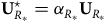 ${\bf{U}}_{{R}_{\mathrm{*}}}^{\mathrm{\star}}={\alpha }_{{R}_{\mathrm{*}}}{\bf{U}}_{{R}_{\mathrm{*}}}$
is just another vNM utility function of
${\bf{U}}_{{R}_{\mathrm{*}}}^{\mathrm{\star}}={\alpha }_{{R}_{\mathrm{*}}}{\bf{U}}_{{R}_{\mathrm{*}}}$
is just another vNM utility function of ${R}_{\mathrm{*}}$
, the result can be stated in the following alternative format: for all rational orderings of prospects,
${R}_{\mathrm{*}}$
, the result can be stated in the following alternative format: for all rational orderings of prospects, ${R}_{\mathrm{*}},{R}_{\dagger }, \ldots $
, there exists an assignment U
${R}_{\mathrm{*}},{R}_{\dagger }, \ldots $
, there exists an assignment U ${\mathrm{}}^{\mathrm{\star}}$
of vNM utility representations to these orderings,
${\mathrm{}}^{\mathrm{\star}}$
of vNM utility representations to these orderings, ${\bf{U}}_{{R}_{\mathrm{*}}}^{\mathrm{\star}},{\bf{U}}_{{R}_{\dagger }}^{\mathrm{\star}}, \ldots, $
respectively, such that for all
${\bf{U}}_{{R}_{\mathrm{*}}}^{\mathrm{\star}},{\bf{U}}_{{R}_{\dagger }}^{\mathrm{\star}}, \ldots, $
respectively, such that for all $R\in \cal{R}$
,
$R\in \cal{R}$
, ${ U}_{R}\left(a\right)={\bf{U}}_{{R}_{1}}^{\mathrm{\star}}\left({a}_{1}\right)+ \ldots .+{\bf{U}}_{{R}_{n}}^{\mathrm{\star}}\left({a}_{n}\right),$
with ${R}_{i}$
the ordering of individual
${R}_{i}$
the ordering of individual $i$
in profile
$i$
in profile $R$
, and
$R$
, and ${U}_{R}$
a vNM utility function of social preference in
${U}_{R}$
a vNM utility function of social preference in $R$
. The upshot for the question of how distributions of well-being should be evaluated is clear. For all profiles
$R$
. The upshot for the question of how distributions of well-being should be evaluated is clear. For all profiles $R\in R$
and outcomes
$R\in R$
and outcomes $x,\overline{x}$
, with
$x,\overline{x}$
, with ${w}_{1}, \ldots, {w}_{n}$
the well-being levels that
${w}_{1}, \ldots, {w}_{n}$
the well-being levels that $1, \ldots, n$
get in
$1, \ldots, n$
get in $x$
and
$x$
and $\overline{{w}_{1}}, \ldots, \overline{{w}_{n}}$
the well-being levels that
$\overline{{w}_{1}}, \ldots, \overline{{w}_{n}}$
the well-being levels that $1, \ldots, n$
get in
$1, \ldots, n$
get in $\overline{x}$
,
$\overline{x}$
, $x$
is socially at least as good as
$x$
is socially at least as good as $\overline{x}$
under profile
$\overline{x}$
under profile $R$
just in case
$R$
just in case ${\bf{U}}_{{R}_{1}}^{\mathrm{\star}}\left({w}_{1}\right)+ \ldots +{\bf{U}}_{{R}_{n}}^{\mathrm{\star}}\left({w}_{n}\right)\ge {\bf{U}}_{{R}_{1}}^{\mathrm{\star}}\left(\overline{{w}_{1}}\right)+ \ldots +{\bf{U}}_{{R}_{n}}^{\mathrm{\star}}\left(\overline{{w}_{n}}\right).$
Well-being distributions are evaluated by a sum of transformed well-being levels, where the transformations are vNM utility functions that are chosen in an individual-independent and profile-independent way. For ease of reference, I will call the vNM utility functions picked out by assignment U ${\mathrm{}}^{\mathrm{\star}}$
, which allow us to express social preference over outcomes as a sum of unweighted transformations on well-being levels, “privileged”.Footnote
11
I note in closing that, as a bonus, Interprofile Anonymity and Strong Pareto together allow us to dispense with assuming expected utility theory at the individual and social level. In the Appendix, I adopt weaker rationality assumptions consistent with the well-known Allais preferences, and derive the version of the sum of vNM utility approach presented here – Impartial Risk-Prioritarianism – all the same.Footnote
12
${\mathrm{}}^{\mathrm{\star}}$
, which allow us to express social preference over outcomes as a sum of unweighted transformations on well-being levels, “privileged”.Footnote
11
I note in closing that, as a bonus, Interprofile Anonymity and Strong Pareto together allow us to dispense with assuming expected utility theory at the individual and social level. In the Appendix, I adopt weaker rationality assumptions consistent with the well-known Allais preferences, and derive the version of the sum of vNM utility approach presented here – Impartial Risk-Prioritarianism – all the same.Footnote
12
A comparison with related results in the spirit of Harsanyi’s may be helpful at this juncture. Mongin and d’Aspremont (Reference Mongin, D’Aspremont, Barbera, Hammond and Seidl1998: 430–31) address the problem of profile-dependency by reconstructing Harsanyi’s aggregation theorem in Sen’s (Reference Sen2017) “multi-profile” setting of social welfare functionals (following Mongin Reference Mongin1994). They then show that an axiomatization of utilitarianism can be obtained by imposing standard axioms of anonymity (“Axiom A”: 414) and independence of irrelevant alternatives (“Axiom I”: 409). However, as they recognize, their multi-profile setting does not address the Sen–Weymark critique, since there is no distinction in their setup between vNM utility and well-being. By contrast, Blackorby et al. (Reference Blackorby, Donaldson, Weymark, Fleurbaey, Salles and Weymark2008: 157), incorporate the Sen–Weymark critique and derive profile-dependent “transformed utilitarian” social welfare functions – with the transformations given by vNM utility functions, much like we did immediately after assuming Strong Pareto above. However, they do not impose any axiom to ensure that the same transformation is applied to people with the same ordering of prospects, nor to relate different profile-dependent formulas in a normatively compelling way, as was achieved here, with the introduction of Interprofile Anonymity.Footnote 13
The part of my axiomatic development which derives expected utility at the social and individual level from weaker axioms (see Appendix) is in the tradition of Mongin and Pivato (Reference Mongin and Pivato2015), McCarthy et al. (Reference McCarthy, Mikkola and Thomas2020), Nebel (Reference Nebel2020), Bradley (Reference Bradley2022) and Gustafsson et al. (Reference Gustafsson, Spears and Zuber2023); of these authors, my strategy follows most closely Nebel and Bradley, the main difference being that I operate within a lottery rather than states-of-nature framework, and show that Outcome Anonymity, which they appeal to, is not essential to their approach to deriving expected utility. The connection with Gustafsson et al. (Reference Gustafsson, Spears and Zuber2023) is also worth mentioning. They do not assume that individuals’ ex ante preferences are orderings, and yet are able to derive the conclusion that social preference is expectational with respect to a sum of transformed well-beings, using weak dominance axioms. Their only individual-level assumption in the fixed-population setting, which is the one used in this paper, is stochastic dominance.Footnote 14 In comparison, I do here assume that individuals rank prospects with full-blown orderings; this allows me to operate in a multi-profile setting, and explore how the individual transformations on well-being relate within and across profiles, depending on what orderings individuals adopt. While Gustafsson et al. (Reference Gustafsson, Spears and Zuber2023) effectively leave individual preferences out of their framework (an apt approach given their aim), such preferences are of central interest to the present project. As a consequence, the formula they derive is less committal than the one we obtained above. For example, their result is consistent with Utilitarianism and Prioritarianism, while mine rules such views out as general rankings of well-being distributions.
3. Scaling of vNM Functions
The crucial question now to be considered is how exactly vNM utility functions should be scaled in the framework of section 2. This question arises for all proponents of the view that social value is given by a sum of vNM utilities. But it means something different on a Risk-Prioritarian interpretation of such a sum than it does on a utilitarian interpretation. On a utilitarian interpretation of Harsanyi’s aggregation theorem, scaling vNM utility functions amounts to deciding how to make comparisons of well-being improvements and losses for different people (see Adler Reference Adler2019: 55–64; Fleurbaey and Zuber Reference Fleurbaey and Zuber2021). On the Risk-Prioritarian interpretation, scaling vNM utility functions amounts to deciding how to make comparisons of the moral significance of well-being improvements and losses for people with different risk attitudes in well-being.Footnote 15
What the Risk-Prioritarian interpretation of Harsanyi’s aggregation theorem developed in section 2 gives us is thus a class of theories, which differ from one another in the way they make interpersonal comparisons of vNM utility for people with different risk attitudes in well-being. There is an analogy here with Prioritarianism. The Priority View is also a class of theories, with each member of this class differing from the others in the degree to which it prioritizes worse-off individuals. Some prioritarian theories implausibly give too much – or too little – weight to the worse off. While the class of Prioritarian rankings can be characterized axiomatically (Adler Reference Adler, Adler and Norheim2022: 63), particular normative judgements have to guide prioritarians in making their choice of which version of their theory to accept.
With these two analogies in mind – utilitarian vNM scaling and prioritarian choice of transformation function – I now present a particular approach for a Risk-Prioritarian scaling of vNM utility functions.Footnote 16 The aim here is to put forward a relatively concrete proposal as proof of concept in the service of an argument for the viability of Risk-Prioritarianism in general. It is not to conclusively advocate for this particular solution.
We identify two reference levels of well-being (according to our well-being function): one, ${w}_{L}$
, corresponding to the state of someone who is moderately badly off, and another,
${w}_{L}$
, corresponding to the state of someone who is moderately badly off, and another, ${w}_{G}$
, corresponding to the state of someone who is moderately well off. To be clear, this selection of reference levels is based on the actual condition of each individual,
${w}_{G}$
, corresponding to the state of someone who is moderately well off. To be clear, this selection of reference levels is based on the actual condition of each individual, $i$
, in outcomes which the welfare function maps to
$i$
, in outcomes which the welfare function maps to ${w}_{L}$
and
${w}_{L}$
and ${w}_{G}$
, respectively, for
${w}_{G}$
, respectively, for $i$
;
$i$
; ${w}_{L}$
and
${w}_{L}$
and ${w}_{G}$
are just numbers returned by the welfare function
${w}_{G}$
are just numbers returned by the welfare function $W$
, and have no independent moral significance. The Risk-Prioritarian scaling to be laid out prioritizes (i) individuals who are risk-averse in well-being over individuals who are not risk-averse in well-being below level
$W$
, and have no independent moral significance. The Risk-Prioritarian scaling to be laid out prioritizes (i) individuals who are risk-averse in well-being over individuals who are not risk-averse in well-being below level ${w}_{L}$
(circumstances are “dire”); (ii) individuals who are risk-neutral in well-being over risk-aversion and risk-seekingness in well-being between
${w}_{L}$
(circumstances are “dire”); (ii) individuals who are risk-neutral in well-being over risk-aversion and risk-seekingness in well-being between ${w}_{G}$
and
${w}_{G}$
and ${w}_{L}$
(circumstances are “normal”); (iii) individuals who are risk-seeking in well-being over risk-aversion and risk neutrality above
${w}_{L}$
(circumstances are “normal”); (iii) individuals who are risk-seeking in well-being over risk-aversion and risk neutrality above ${w}_{L}$
(circumstances are “favourable”).
${w}_{L}$
(circumstances are “favourable”).
Here is how the scaling in question selects privileged vNM utility functions (Figure 2). We start by arbitrarily selecting a vNM function representing the ordering of prospects ${R}_{N}$
that is risk-neutral in well-being,
${R}_{N}$
that is risk-neutral in well-being, ${\bf{U}}_{{R}_{N}}^{\mathrm{*}}\left(w\right)=\alpha w+\beta $
. For any risk-averse ordering of prospects
${\bf{U}}_{{R}_{N}}^{\mathrm{*}}\left(w\right)=\alpha w+\beta $
. For any risk-averse ordering of prospects ${R}_{A}$
, the privileged vNM function
${R}_{A}$
, the privileged vNM function ${\bf{U}}_{{R}_{A}}^{\mathrm{*}}$
is selected so that its first derivative at
${\bf{U}}_{{R}_{A}}^{\mathrm{*}}$
is selected so that its first derivative at ${w}_{L}$
equals
${w}_{L}$
equals $\alpha $
, i.e.
$\alpha $
, i.e.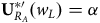 ${\bf{U}}_{{R}_{A}}^{\mathrm{*\prime}}\left({w}_{L}\right)=\alpha $
. For any risk-seeking ordering of prospects
${\bf{U}}_{{R}_{A}}^{\mathrm{*\prime}}\left({w}_{L}\right)=\alpha $
. For any risk-seeking ordering of prospects ${R}_{S}$
, the privileged vNM function
${R}_{S}$
, the privileged vNM function ${\bf{U}}_{{R}_{S}}^{\mathrm{*}}$
is selected so that its first derivative at
${\bf{U}}_{{R}_{S}}^{\mathrm{*}}$
is selected so that its first derivative at ${w}_{G}$
equals
${w}_{G}$
equals $\alpha $
, i.e.
$\alpha $
, i.e.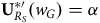 ${\bf{U}}_{{R}_{S}}^{\mathrm{*\prime}}\left({w}_{G}\right)=\alpha $
.
${\bf{U}}_{{R}_{S}}^{\mathrm{*\prime}}\left({w}_{G}\right)=\alpha $
.
Illustration of vNM utility scaling as a function of well-being, as discussed in main text.

An intuitive case for this scaling can be made along the following lines. There are different ways to pursue one’s good (well-being) under risk: risk-averse individuals focus on avoiding worse case scenarios; risk-seeking individuals focus on pursuing better case scenarios. For this reason, it is somewhat worse if risk-averse people end up very poorly off, compared to risk-seeking ones. And it is to some extent better if risk-seeking people end up very well off, compared to risk-averse ones. Crucially, it is not worse for the individuals in question: on the Risk-Prioritarian (unlike on the utilitarian) interpretation of vNM utility, cardinally measurable and comparable well-being levels are what people’s vNM utility functions take as arguments. Rather, the claim is that these outcomes are worse or better from a moral or social point of view (compare Nebel Reference Nebel2022: 39). Thus, for instance, going from ${w}_{L}$
to
${w}_{L}$
to ${w}_{L}-\mathrm{\Delta }$
is exactly as bad for a risk-averse individual as it is for a risk-seeking individual, by design of our section 2 setup. The Risk-Prioritarian scaling here considered, however, sees a risk-averse individual going from
${w}_{L}-\mathrm{\Delta }$
is exactly as bad for a risk-averse individual as it is for a risk-seeking individual, by design of our section 2 setup. The Risk-Prioritarian scaling here considered, however, sees a risk-averse individual going from ${w}_{L}$
to
${w}_{L}$
to ${w}_{L}-\mathrm{\Delta }$
as morally worse than a risk-seeking individual going from
${w}_{L}-\mathrm{\Delta }$
as morally worse than a risk-seeking individual going from ${w}_{L}$
to
${w}_{L}$
to ${w}_{L}-\mathrm{\Delta }$
.Footnote
17
${w}_{L}-\mathrm{\Delta }$
.Footnote
17
4. The Risk-Priority Ethos
While Interprofile Anonymity sweetens the pill of Risk-Prioritarian violations of Outcome Anonymity and the Suppes–Sen Principle, the task remains of providing a philosophically compelling story for why people’s well-being should be weighed differently, according to their risk attitude, even in risk-free cases. Fundamentally, what motivates taking account of risk attitudes when there is no risk involved? Ostensibly, Strong Pareto only recommends giving weight to risk attitudes in risky contexts. The counterintuitive Risk-Prioritarian violations of Outcome Anonymity and the Suppes–Sen Principle, by contrast, result from giving weight to risk attitudes in risk-free contexts. What philosophical move could possibly get us from the former stance to the latter?
This section pursues two interrelated answers, concerning justifiability to each person and individual responsibility, respectively. To keep things simple, I will focus on violations of Outcome Anonymity; my remarks generalize to violations of the Suppes–Sen Principle. The strategy is this: I will introduce cases that proponents of Strong Pareto should already recognize as supporting some form of differential weighting of well-being, and describe how these verdicts are typically motivated. I will then show that such standard justifications of these verdicts should be developed and built upon in ways that lead to more radical violations of Outcome Anonymity, involving risk-free contexts.
It will be helpful to be able to refer to a couple of risk-free cases in what follows. Hence, consider
Dire Circumstances, in which Alda is risk-seeking and Bruno risk-averse. They are both poorly off, at well-being level ${w}_{L}-\mathrm{\Delta }$
. A decision-maker can either (A) improve Alda’s well-being to
${w}_{L}-\mathrm{\Delta }$
. A decision-maker can either (A) improve Alda’s well-being to ${w}_{\mathrm{L}}$
, or (B) improve Bruno’s well-being to
${w}_{\mathrm{L}}$
, or (B) improve Bruno’s well-being to ${w}_{L}$
.
${w}_{L}$
.
And compare
Favourable Circumstances, in which risk-seeking Alda and risk-averse Bruno are both well-off, living happily at well-being level ${w}_{G}$
. A decision-maker can either (C) improve Alda’s well-being to
${w}_{G}$
. A decision-maker can either (C) improve Alda’s well-being to ${w}_{G}+\mathrm{\Delta }$
, or (D) improve Bruno’s well-being to
${w}_{G}+\mathrm{\Delta }$
, or (D) improve Bruno’s well-being to ${w}_{G}+\mathrm{\Delta }$
.
${w}_{G}+\mathrm{\Delta }$
.
These two cases are stipulated to be as risk-free as possible. In each case, Alda and Bruno are strangers to the decision-maker; do not know that one of them is going to be benefited; and their current well-being level is not the result of some previous decision to take or turn down a gamble. The decision-maker’s choice of who to give the well-being gain to is entirely based on which ranking of well-being distributions would be better impartially from a social or moral point of view. The Risk-Prioritarian sum of vNM utilities developed in section 2, as scaled in section 3, nonetheless recommends (counterintuitively) the non-anonymous verdicts that (B) should be chosen over (A), and (C) over (D).
4.1 Justifiability
To begin with our first justification of these Risk-Prioritarian verdicts, contrast Dire and Favourable Circumstances with a pair of cases in which risk plays an obvious role. In
Endorsed Risk, risk-seeking Alda ends up poorly off at well-being level ${w}_{L}-\mathrm{\Delta }$
, as a result of a risky policy that she wished the decision-maker would implement. Risk-averse Bruno is at well-being level
${w}_{L}-\mathrm{\Delta }$
, as a result of a risky policy that she wished the decision-maker would implement. Risk-averse Bruno is at well-being level ${w}_{L}$
.
${w}_{L}$
.
In a second case
Unendorsed Risk, risk-averse Bruno ends up poorly off at well-being level ${w}_{L}-\mathrm{\Delta }$
, as a result of a risky policy that he wished the decision-maker would not implement. Risk-seeking Alda is at
${w}_{L}-\mathrm{\Delta }$
, as a result of a risky policy that he wished the decision-maker would not implement. Risk-seeking Alda is at ${w}_{L}$
.
${w}_{L}$
.
Intuitively, Alda’s predicament in Endorsed Risk is less regrettable, morally, than Bruno’s predicament in Unendorsed Risk. A natural explanation of this judgement appeals to the idea of justifiability to each individual affected (Scanlon Reference Scanlon1998). In Endorsed Risk, Alda cannot reasonably blame the decision-maker for her unfortunate condition, since the decision-maker’s choice perfectly reflected Alda’s own evaluation of her prospects. When Alda ends up unlucky, the decision-maker can justify the decision to Alda on the basis of her preference ex ante (James Reference James2012; Frick Reference Frick2015). By contrast, Bruno appears to have grounds for complaint in Unendorsed Risk, since his unfortunate condition is due to the decision-maker enacting a policy that went against his own evaluation of his prospects.
These cases show how a commitment to respecting people’s preferences ex ante in the way that Strong Pareto prescribes already entails some differential evaluation, resulting in violations of Outcome Anonymity (Cibinel Reference Cibinel2022). In both Endorsed Risk and Unendorsed Risk, there is one individual at well-being level ${w}_{L}-\mathrm{\Delta }$
and one at
${w}_{L}-\mathrm{\Delta }$
and one at ${w}_{L}$
: yet, the outcome of Endorsed Risk is better than that of Unendorsed Risk.
${w}_{L}$
: yet, the outcome of Endorsed Risk is better than that of Unendorsed Risk.
It would be a further step, however, to argue for differential treatment in a context of zero risk: if we can benefit only one of Alda or Bruno under conditions of certainty, proponents of ex ante Pareto would typically say that we should be indifferent between the two options.Footnote 18 If the decision-maker chooses (B) in Dire Circumstances, Alda is not badly off as a result of a gamble that she was willing to take, but rather because of a decision the decision-maker took with full information of its consequences. Surely, one might think, in such a risk-free situation (A) and (B) are to be deemed equally good morally speaking, in line with Outcome Anonymity.
I will now argue that this more radical violation of Outcome Anonymity can nonetheless be vindicated by considerations of justifiability to everyone involved. In other words, there is a viable route that takes us from the relatively uncontroversial
Ex Ante Intuition (I), according to which Alda ending up poorly off in Endorsed Risk is not as bad as Bruno ending up poorly off in Unendorsed Risk,
all the way to the verdicts of the Risk-Priority View in risk-free cases also: for example, the verdict that the decision-maker should help Bruno rather than Alda in Dire Circumstances.
Notice, first, that whether an act is justifiable to every individual affected depends on the cumulative effects that can be expected, overall, if similar acts are performed in similar circumstances (Scanlon Reference Scanlon1998: 203–4). That is, the justifiability status of specific acts hinges on the justifiability status of principles “for the general regulation of behavior” (Scanlon Reference Scanlon1998: 153) – in particular, for the regulation of behaviour in related conditions. If a policy turns out to someone’s disadvantage on some specific occasion, but is shown to be part of a broader scheme that can be expected to further this person’s interest, it seems that the person has no reasonable ground for rejecting the specific act. In light of this clarification, we can ask: how would a general scheme of treating everyone equally in all circumstances, as Outcome Anonymity demands, fare against a Risk-Prioritarian plan of differential treatment?
To answer this question we need to look at what would happen if Alda, Bruno and the decision-maker were to settle on a general principle for how to proceed should they find themselves in Dire Circumstances or in Favourable Circumstances, with no evidence making one scenario more likely than the other to obtain. On an Outcome Anonymity scheme, the decision-maker should be indifferent between whom to help in either circumstance. They would thus follow the plan:
(S1) Be indifferent between (A) and (B) if Dire Circumstances obtains, and be indifferent between (C) and (D) if Favourable Circumstances obtains.
On a Risk-Prioritarian scheme, the decision-maker should prioritize risk-averse Bruno if circumstances are dire, and risk-seeking Alda if circumstances are favourable. That is, the decision-maker’s scheme should be:
(S2) choose (B) if Dire Circumstances obtains, and choose (C) if Favourable Circumstances obtains.
Which scheme would the group agree to enact?
Consider first S1. If Dire Circumstances obtains, the decision-maker is indifferent as to who should be benefited. For Alda and Bruno, this amounts to equal (and perfectly inversely correlated) chances of getting well-being level ${w}_{L}$
or well-being level
${w}_{L}$
or well-being level ${w}_{L}-\mathrm{\Delta }$
. (Anything other than equal chances seems to encode bias in favour of one individual, and is thus incompatible with indifference.) If Favourable Circumstances obtains, the decision-maker will again decide who should be benefited on the basis of indifference. This gives Alda and Bruno equal (and perfectly inversely correlated) chances of getting well-being level
${w}_{L}-\mathrm{\Delta }$
. (Anything other than equal chances seems to encode bias in favour of one individual, and is thus incompatible with indifference.) If Favourable Circumstances obtains, the decision-maker will again decide who should be benefited on the basis of indifference. This gives Alda and Bruno equal (and perfectly inversely correlated) chances of getting well-being level ${w}_{G}$
or well-being level
${w}_{G}$
or well-being level ${w}_{G}+\mathrm{\Delta }$
. So, S1 looks exactly the same from Alda’s perspective as it does from Bruno’s. By contrast, S2 is more risky for Alda and more safe for Bruno. S2 doubles Alda’s chance at getting well-being
${w}_{G}+\mathrm{\Delta }$
. So, S1 looks exactly the same from Alda’s perspective as it does from Bruno’s. By contrast, S2 is more risky for Alda and more safe for Bruno. S2 doubles Alda’s chance at getting well-being ${w}_{G}+\mathrm{\Delta }$
, since if the decision-maker is presented with Favourable Circumstances, they will benefit Alda for sure. However, S2 also doubles Alda’s chance at well-being
${w}_{G}+\mathrm{\Delta }$
, since if the decision-maker is presented with Favourable Circumstances, they will benefit Alda for sure. However, S2 also doubles Alda’s chance at well-being ${w}_{L}-\mathrm{\Delta }$
, since if the decision-maker is presented with Dire Circumstances, they will benefit Bruno for sure. Alda’s chances of obtaining well-being
${w}_{L}-\mathrm{\Delta }$
, since if the decision-maker is presented with Dire Circumstances, they will benefit Bruno for sure. Alda’s chances of obtaining well-being ${w}_{L}$
or
${w}_{L}$
or ${w}_{G}$
are correspondingly reduced to zero. By contrast, S2 doubles Bruno’s chances at well-being levels
${w}_{G}$
are correspondingly reduced to zero. By contrast, S2 doubles Bruno’s chances at well-being levels ${w}_{L}$
and
${w}_{L}$
and ${w}_{G}$
, and reduces to zero his chance to obtain either well-being level
${w}_{G}$
, and reduces to zero his chance to obtain either well-being level ${w}_{L}-\mathrm{\Delta }$
or
${w}_{L}-\mathrm{\Delta }$
or ${w}_{G}+\mathrm{\Delta }$
.
${w}_{G}+\mathrm{\Delta }$
.
Alda, being risk-seeking, will prefer S2 to S1: in expectation, the two schemes give her equal future well-being, but the former increases her chance at the very best outcome. Bruno, being risk-averse, will also prefer that the decision-maker adopt S2 instead of S1: in expectation, the two schemes give him equal future well-being, but the former reduces his chance at the worst outcome. Since S2 would be unanimously preferred, it seems that the decision-maker can justify its adoption to all, while S1 can be reasonably rejected. In particular, the decision-maker can justify choosing (B) to Alda if Dire Circumstances in fact obtains, since it is part of a general scheme that she has no reason to object to.Footnote 19 This example illustrates how, by construing risk-free choices as governed by general principles for how to choose in a range of interrelated scenarios, Risk-Prioritarian verdicts can be justified to every individual affected, along similar lines as was done for Ex Ante Intuition (I). In the long run, implementing a Risk-Prioritarian scheme instead of one conforming to Outcome Anonymity better satisfies people’s preferences for risks in well-being: it gives more gambles (in well-being) to more risk-seeking individuals, and more safety (with respect to well-being) to more risk-averse individuals. As such, it seems no one could object to such a scheme.Footnote 20
A ranking of policies in terms of their goodness from a social or moral point of view is simply a general principle specifying how a decision-maker should act in certain given circumstances they might find themselves in. This suggests that a Risk-Prioritarian ranking can be justified to the individuals involved, whereas a ranking that respects Outcome Anonymity cannot.
4.2 Responsibility
Justifiability to each person is one of two main ways in which Strong Pareto is typically motivated. The other, related approach appeals to individual responsibility.Footnote 21 Consider
Option & Brute Luck, where both Risk-seeking Alda and risk-averse Bruno end up poorly off at well-being level ${w}_{L}-\mathrm{\Delta }$
. Alda’s bad outcome, however, is the result of a gamble that she chose of her own will, whereas Bruno’s bad outcome is the result of a gamble that he had no choice but to accept.
${w}_{L}-\mathrm{\Delta }$
. Alda’s bad outcome, however, is the result of a gamble that she chose of her own will, whereas Bruno’s bad outcome is the result of a gamble that he had no choice but to accept.
It seems right to say that Alda’s predicament is less regrettable, from a moral point of view, than Bruno’s predicament. Both events are bad, but Bruno’s bad luck is worse. A natural explanation involves the thought that individuals should be held accountable for risks that they freely choose to incur (Dworkin Reference Dworkin1981). When Alda ends up poorly off as a result of a risk that she decided to take, the thought goes, she is in some sense responsible for her unfortunate condition – this is a case of what Dworkin calls “option luck”.Footnote
22
The same cannot be said of Bruno, who ends up badly off through no fault of his own – this is a case of what Dworkin calls “brute luck”. Suppose we can either improve Alda’s well-being level to ${w}_{L}$
, or else Bruno’s well-being level to
${w}_{L}$
, or else Bruno’s well-being level to ${w}_{L}$
. Since Bruno’s predicament is more regrettable, we should help Bruno instead of Alda, violating Outcome Anonymity.
${w}_{L}$
. Since Bruno’s predicament is more regrettable, we should help Bruno instead of Alda, violating Outcome Anonymity.
When such a differential treatment is defended, however, it is not extended to cover the more radical violations of Outcome Anonymity entertained by the Risk-Priority View, involving risk-free cases. In other words, there is no suggestion in this literature that we should prioritize Bruno over Alda in a case like Dire Circumstances, where neither Alda nor Bruno are in any obvious sense responsible for the unfortunate condition they find themselves in.Footnote 23 I will now argue that differential prioritization in risk-free cases is nonetheless justified by considerations broadly based on individual responsibility. In other words, there is a viable route that takes us from the
Ex Ante Intuition (II), according to which, in Option & Brute Luck, the fact that Alda ends up poorly off is not as bad as the fact that Bruno ends up poorly off,
all the way to the more controversial verdicts of the Risk-Priority View.
To begin, it will help to think about how background risks and opportunities shape our judgements about responsibility for risks incurred. Suppose that, in
Background Risk, there is a $50\mathrm{\%}$
chance that both Alda and Bruno will end up poorly off at well-being
$50\mathrm{\%}$
chance that both Alda and Bruno will end up poorly off at well-being ${w}_{L}-\mathrm{\Delta }$
. Such a fact is given; there is nothing they can do about it. However, they can affect what happens if that bad outcome does not obtain. They can either have well-being level
${w}_{L}-\mathrm{\Delta }$
. Such a fact is given; there is nothing they can do about it. However, they can affect what happens if that bad outcome does not obtain. They can either have well-being level ${w}_{L}$
in all remaining possibilities, or else well-being level
${w}_{L}$
in all remaining possibilities, or else well-being level ${w}_{L}-\mathrm{\Delta }$
and well-being level
${w}_{L}-\mathrm{\Delta }$
and well-being level ${w}_{G}+\mathrm{\Delta }$
with equal probability. Risk-seeking Alda chooses the latter option, and risk-averse Bruno the former. As it happens, Alda ends up poorly off at well-being level
${w}_{G}+\mathrm{\Delta }$
with equal probability. Risk-seeking Alda chooses the latter option, and risk-averse Bruno the former. As it happens, Alda ends up poorly off at well-being level ${w}_{L}-\mathrm{\Delta }$
.Footnote
24
${w}_{L}-\mathrm{\Delta }$
.Footnote
24
Is Alda here responsible for her unfortunate condition, in the way she is in Option & Brute Luck? I think we should feel ambivalent about how to answer this question, and that this supports a comparative understanding of individual responsibility for risks, which in turn counts in favour of the Risk-Priority View. Let’s unpack this line of argument.
It might be tempting to say that whether Alda is responsible in Background Risk depends on whether she is at well-being level ${w}_{L}-\mathrm{\Delta }$
because of the
${w}_{L}-\mathrm{\Delta }$
because of the $50\mathrm{\%}$
background risk, or rather because of the added
$50\mathrm{\%}$
background risk, or rather because of the added $25\mathrm{\%}$
risk she freely chose to incur. But this proposal does not stand up to scrutiny. If the mechanism that caused the background risk is exactly the same one that also caused the extra risk, it is not clear what it would mean for Alda to have ended up poorly off because of one or the other “portion” of the total risk she faced. It might be suggested that we need to know what would have happened had she chosen otherwise: if, had she chosen in the same way as Bruno, she would have ended up safe at well-being level
$25\mathrm{\%}$
risk she freely chose to incur. But this proposal does not stand up to scrutiny. If the mechanism that caused the background risk is exactly the same one that also caused the extra risk, it is not clear what it would mean for Alda to have ended up poorly off because of one or the other “portion” of the total risk she faced. It might be suggested that we need to know what would have happened had she chosen otherwise: if, had she chosen in the same way as Bruno, she would have ended up safe at well-being level ${w}_{L}$
, then she is responsible for her actual bad condition; but if, had she chosen in that way, she would still have ended up at well-being level
${w}_{L}$
, then she is responsible for her actual bad condition; but if, had she chosen in that way, she would still have ended up at well-being level ${w}_{L}-\mathrm{\Delta }$
, then she is not responsible for her actual bad condition.
${w}_{L}-\mathrm{\Delta }$
, then she is not responsible for her actual bad condition.
But, first, there may be no fact of the matter as to what would have happened had Alda chosen otherwise (see Hare Reference Hare2011, Reference Hare, Eyal, Cohen and Daniels2015). And, second, answering this question does not seem normatively relevant after all. Suppose the $50\mathrm{\%}$
background chance that Alda and Bruno end up at well-being level
$50\mathrm{\%}$
background chance that Alda and Bruno end up at well-being level ${w}_{L}-\mathrm{\Delta }$
in Background Risk is due to the presence of an incoming storm, which carries the threat of being hit by lightning. Each of them can stay at home: lightning will hit their house with
${w}_{L}-\mathrm{\Delta }$
in Background Risk is due to the presence of an incoming storm, which carries the threat of being hit by lightning. Each of them can stay at home: lightning will hit their house with $50\mathrm{\%}$
probability, but there is nowhere more protected where they can go. If their house remains intact, they will be safe but bored, at well-being level
$50\mathrm{\%}$
probability, but there is nowhere more protected where they can go. If their house remains intact, they will be safe but bored, at well-being level ${w}_{L}$
. Alternatively, they can go out surfing. If all goes well, they enjoy themselves, at well-being level
${w}_{L}$
. Alternatively, they can go out surfing. If all goes well, they enjoy themselves, at well-being level ${w}_{G}+\mathrm{\Delta }$
; however, going surfing increases the chance of being hit by lightning to
${w}_{G}+\mathrm{\Delta }$
; however, going surfing increases the chance of being hit by lightning to $75\mathrm{\%}$
. Alda goes surfing and gets hit by lighning. Suppose that Bruno, who stays home, is also hit by lightning. If we only have the resources to provide first-aid care to one of them, who should we help? I think the answer is that Bruno should be prioritized. And this is so even if we learn ex post that, had Alda remained at home, she would have been hit by lightning anyway. What matters to assessing Alda’s situation, it seems to me, is that she chose to run more risk than Bruno did.Footnote
25
$75\mathrm{\%}$
. Alda goes surfing and gets hit by lighning. Suppose that Bruno, who stays home, is also hit by lightning. If we only have the resources to provide first-aid care to one of them, who should we help? I think the answer is that Bruno should be prioritized. And this is so even if we learn ex post that, had Alda remained at home, she would have been hit by lightning anyway. What matters to assessing Alda’s situation, it seems to me, is that she chose to run more risk than Bruno did.Footnote
25
The discussion does show, nonetheless, that the sense in which Alda is responsible for her bad condition in Background Risk is rather sui generis, and quite distinct from the more familiar notion of moral responsibility employed in attributions of praise and blame. Alda’s odds were not ideal to start with, since she faced a $50\mathrm{\%}$
background risk that she could not get rid of. And it’s not as if she wanted risk for its own sake: had she had the option of securing well-being level
$50\mathrm{\%}$
background risk that she could not get rid of. And it’s not as if she wanted risk for its own sake: had she had the option of securing well-being level ${w}_{G}+\mathrm{\Delta }$
with certainty – going surfing with a clear sky – she would have chosen that. Taking a gamble means that we are acting in sub-optimal circumstances, which must be taken into account when evaluating responsibility for risks incurred. This points to the suggestion that we interpret Alda’s responsibility for her bad condition comparatively, to mean that she should receive less priority, in this case, than people in similar circumstances who took fewer risks, and that the reason for this is precisely that she chose to be more risk-seeking than those other people. That choice was hers, and in this sense she is responsible for it. But this does not mean that, if we can help her at no cost to others, we have no reason to do so (cf. Lippert-Rasmussen Reference Lippert-Rasmussen, Zalta and Nodelman2023: sect. 7).
${w}_{G}+\mathrm{\Delta }$
with certainty – going surfing with a clear sky – she would have chosen that. Taking a gamble means that we are acting in sub-optimal circumstances, which must be taken into account when evaluating responsibility for risks incurred. This points to the suggestion that we interpret Alda’s responsibility for her bad condition comparatively, to mean that she should receive less priority, in this case, than people in similar circumstances who took fewer risks, and that the reason for this is precisely that she chose to be more risk-seeking than those other people. That choice was hers, and in this sense she is responsible for it. But this does not mean that, if we can help her at no cost to others, we have no reason to do so (cf. Lippert-Rasmussen Reference Lippert-Rasmussen, Zalta and Nodelman2023: sect. 7).
We can now notice, however, that this consideration also applies to Alda’s situation in Option & Brute Luck: the reason why Alda took a gamble in that case must have been that her options were somewhat limited. If she could have acted so as to achieve the best possible outcome of that gamble with certainty, she would have done that. So, a comparative understanding of responsibility for risks incurred seems to be appropriate quite generally.
We next need to combine what we learned from Background Risk with the following observation: the choice of what risk attitude in well-being, or vNM utility function, to adopt is itself a risky choice made by the individual. To elaborate, let’s begin by noting that preferences are dispositions to choose. Preferences under risk are therefore dispositions to choose when we don’t know the consequences of our actions. They can thus be understood as complete plans for how to act in any given circumstance. Once I have chosen such a plan and face some given decision problem, all I have to do is implement an algorithm: pick an option that maximizes my vNM utility.Footnote
26
In making the choice of risk attitude – that is, in ranking all possible lotteries over well-being levels – each individual will take account of background risks and opportunities they might encounter: perhaps I will trip and break my neck; perhaps I will win the lottery; and so on. Since we know about these risks and opportunities when we choose our risk attitude, they are relevantly like the $50\mathrm{\%}$
background risk that Alda faces in Background Risk. If she is responsible for her condition then – which she is, if we want to hold her responsible in Option & Brute Luck – so too are those of us who choose to be risk-seeking and end up poorly off “through no fault of their own”.
$50\mathrm{\%}$
background risk that Alda faces in Background Risk. If she is responsible for her condition then – which she is, if we want to hold her responsible in Option & Brute Luck – so too are those of us who choose to be risk-seeking and end up poorly off “through no fault of their own”.
Ultimately, then, my discussion should be interpreted as casting doubt on the usefulness of Dworkin’s (Reference Dworkin1981) distinction between brute and option luck.Footnote
27
Take a paradigm case of brute luck: a rock falls from the sky through the roof and hurts a given individual, Frank, while he was resting in his house, leaving him at ${w}_{L}-\mathrm{\Delta }$
when he would otherwise have had well-being level
${w}_{L}-\mathrm{\Delta }$
when he would otherwise have had well-being level ${w}_{L}$
. Against my proposal of prioritizing Frank’s predicament differently, depending on his risk attitude in well-being, one might note: “there is nothing Frank could have done to alter the probability of this happening!” In response, I claim: the normatively significant event is not that a rock hits Frank’s head, but rather that Frank ends up at well-being
${w}_{L}$
. Against my proposal of prioritizing Frank’s predicament differently, depending on his risk attitude in well-being, one might note: “there is nothing Frank could have done to alter the probability of this happening!” In response, I claim: the normatively significant event is not that a rock hits Frank’s head, but rather that Frank ends up at well-being ${w}_{L}-\mathrm{\Delta }$
; and there is something that Frank could have done to alter the probability of the claim that Frank ends up at well-being level
${w}_{L}-\mathrm{\Delta }$
; and there is something that Frank could have done to alter the probability of the claim that Frank ends up at well-being level ${w}_{L}-\Delta $
. Before the misfortune, we should leave open that Frank’s future might present him with a risky choice involving the possibility of a
${w}_{L}-\Delta $
. Before the misfortune, we should leave open that Frank’s future might present him with a risky choice involving the possibility of a $\mathrm{\Delta }$
-loss from
$\mathrm{\Delta }$
-loss from ${w}_{L}$
. If, prior to the rock falling, we assume that Frank is risk-seeking in well-being, that will result in a different (higher) risk of ending up at
${w}_{L}$
. If, prior to the rock falling, we assume that Frank is risk-seeking in well-being, that will result in a different (higher) risk of ending up at ${w}_{L}-\mathrm{\Delta }$
in the future than if we assume that Frank is risk-averse in well-being. This is my basis for claiming that it is comparatively more urgent to help Frank if he is risk-averse in well-being in this case.
${w}_{L}-\mathrm{\Delta }$
in the future than if we assume that Frank is risk-averse in well-being. This is my basis for claiming that it is comparatively more urgent to help Frank if he is risk-averse in well-being in this case.
In sum, background risks are part of the context within which we make any choice, including our choice of general policy for how risky to be. Recognition of this fact changes our assessment of any misfortune that befalls a given individual in two opposing ways. On the one hand, we will be able to identify some point in time relative to which the claim that “a misfortune of this magnitude eventuates” was a background risk, and also able to identify some choice the individual could have made at that time – including choice of risk attitude in well-being – which would have altered the probability of that risk. On the other hand, the fact that this claim had positive probability to start with is obviously beyond the individual’s control, and this affects the sense in which they can be held responsible for it. The brute/option luck distinction attempts to demarcate a clear line between personal responsibility for one’s condition and lack thereof; but there isn’t one. The erosion of this distinction, I suggest, points to a revision to the notion of personal responsibility for one’s condition: it is to be cashed out comparatively, in terms of what degree of priority one is entitled to receive in the given circumstances, relative to other individuals.
Thus, Risk-Prioritarian verdicts such as those in Dire and Favourable Circumstances can be supported by considerations of personal responsibility similar to those that motivate the Ex Ante Intuition (II). A Risk-Prioritarian ranking of policies in terms of how good they are socially or morally speaking systematizes such judgements of prioritization based on individual responsibility.
5. Conclusion
While weighing people’s well-being by risk attitudes may seem odd at first, I have tried to convey a way of thinking about distributive ethics which makes the proposal quite natural. This approach is impartial in just the right way: enough as to not play favourites, but not so much that it disregards people’s preferences. It can be motivated by interrelated considerations of justifiability to each person and individual responsibility. And it illuminates the philosophical significance of Harsanyi’s social aggregation theorem, while paying heed to the Sen–Weymark critique. I conclude that the Risk-Priority View offers an attractive account for how well-being should be aggregated.
Acknowledgements
I would first like to thank Lara Buchak and Jake Nebel, both of whom helped me massively at all stages of development of the project. I thank Chris Bottomley, Richard Bradley, Franz Dietrich, Adam Elga, Daniel Herrmann, Kacper Kowalczyk, Marcus Pivato, Jeff Russell, Weng Kin San, Margaret Shea, Lingzhi Shi, Teruji Thomas, John Weymark and Qichen Yan for beneficial discussion, and Harvey Lederman and Sarah McGrath for that as well as for very useful written comments. For constructive feedback, my gratitude also goes to a number of anonymous referees (in particular two referees of Economics and Philosophy) and to audiences at the 2024 Global Priorities Workshop and 2024 Meeting of the Society for Social Choice and Welfare, where a talk version of this paper was presented.
Appendix
This formal appendix lays out the model and axioms that the theorem is based upon, and then gives a proof of the theorem.
Model
- $N$
is the finite set of
$n$
individuals.
$N$
is the finite set of
$n$
individuals. -
$X$
is the set of final outcomes.
-
$W:X\to {\mathbb{R}}^{n}$
is the well-being function.


Assumption 1. Well-being is cardinally measurable and fully comparable.
Assumption 2. The set of all well-being levels is order-isomorphic to $\mathbb{R}$
.
$\mathbb{R}$
.
Assumption 3. For any $({w}_{1}, \ldots, {w}_{n})\in {\mathbb{R}}^{n}$
, there exists
$({w}_{1}, \ldots, {w}_{n})\in {\mathbb{R}}^{n}$
, there exists $x\in X$
such that
$x\in X$
such that $W\left(x\right)=({w}_{1}, \ldots, {w}_{n})$
.
$W\left(x\right)=({w}_{1}, \ldots, {w}_{n})$
.
Notation. For all $i\in N$
and
$i\in N$
and $x\in X$
,
$x\in X$
, ${W}_{i}\left(x\right)$
denotes
${W}_{i}\left(x\right)$
denotes $i$
’s well-being level
$i$
’s well-being level ${\mathrm{w}}_{i}$
in
${\mathrm{w}}_{i}$
in $x$
.
$x$
.
-
$A$
is the set of all probability functions on
$X$
with finite support.


Notation. For all $a\in A$
,
$a\in A$
, ${a}_{i}$
is
${a}_{i}$
is $i$
’s prospect with
$i$
’s prospect with $a$
.
$a$
.
Notation. A lottery that gives lottery $a$
with probability
$a$
with probability $\alpha $
and lottery
$\alpha $
and lottery $b$
with probability
$b$
with probability $(1-\alpha )$
is written as
$(1-\alpha )$
is written as $a\alpha b$
.
$a\alpha b$
.
-
For all outcomes
$x\in X$
and lotteries
$a\in A$
, if
$a\left(x\right)=1$
,
$a$
and
$x$
are treated as equivalent, with corresponding abuse of notation. -
$\cal{R}$
is the set of all risk profiles of interest, i.e.
$n$
-tuples of rational orderings of prospects, with typical element
$R=({R}_{1}, \ldots, {R}_{n})$
.



Notation. For all $i\in N$
and
$i\in N$
and $R\in \cal{R}$
, strict preference is denoted by
$R\in \cal{R}$
, strict preference is denoted by ${P}_{i}$
and indifference by
${P}_{i}$
and indifference by ${I}_{i}$
.
${I}_{i}$
.
-
Risk-encompassing social welfare functionals are functions that return a social ordering of lotteries for each
$R\in \cal{R}$
, denoted by
${\succeq}_{R}$
.


Notation. ${\succ }_{R}$
denotes strict preference, and
${\succ }_{R}$
denotes strict preference, and ${\sim }_{R}$
indifference.
${\sim }_{R}$
indifference.
Axioms, Lemmas & Theorem
Rationality axioms.
Let ${\succeq}$
be any ordering on lotteries. Corresponding axioms are defined in the obvious way for any ordering on prospects. The following axioms are all well-known.
${\succeq}$
be any ordering on lotteries. Corresponding axioms are defined in the obvious way for any ordering on prospects. The following axioms are all well-known.
Continuity
. For all $a,b,c\in A$
, if
$a,b,c\in A$
, if $a\succ b\succ c$
, there exist
$a\succ b\succ c$
, there exist $\alpha, \beta \in \left(\mathrm{0,1}\right)$
such that
$\alpha, \beta \in \left(\mathrm{0,1}\right)$
such that $a\alpha c\succ b\succ a\beta c$
.
$a\alpha c\succ b\succ a\beta c$
.
For all outcomes $x\in X$
and lotteries
$x\in X$
and lotteries $a\in A$
, let
$a\in A$
, let $a\left[x\right]$
denote the probability, according to
$a\left[x\right]$
denote the probability, according to $a$
, that an outcome at least as good as
$a$
, that an outcome at least as good as $x$
obtains.
$x$
obtains.
Stochastic Dominance
. For all $a,b\in A$
, if for all outcomes
$a,b\in A$
, if for all outcomes $x\in X$
,
$x\in X$
, $a\left[x\right]\ge b\left[x\right]$
, then
$a\left[x\right]\ge b\left[x\right]$
, then $a\succeq b$
.
$a\succeq b$
.
Independence
. For all $a,b,c\in A$
and every
$a,b,c\in A$
and every $\alpha \in \left(\mathrm{0,1}\right)$
, if
$\alpha \in \left(\mathrm{0,1}\right)$
, if $a\succeq b$
then
$a\succeq b$
then $a\alpha c\succeq b\alpha c$
.
$a\alpha c\succeq b\alpha c$
.
The Allais preferences (Allais Reference Allais1953) are regimented as violations of T-Independence (Ozbek Reference Ozbek2024: 5), which is entailed by Independence.
T-Independence
. For all $a,b,c,d\in A$
and every
$a,b,c,d\in A$
and every $\alpha \in \left(\mathrm{0,1}\right)$
if
$\alpha \in \left(\mathrm{0,1}\right)$
if $a\alpha c\succeq b\alpha c$
then
$a\alpha c\succeq b\alpha c$
then $a\alpha d\succeq b\alpha d$
.
$a\alpha d\succeq b\alpha d$
.
We next note two more entailments of Independence (adapting Ozbek Reference Ozbek2024: 5–6).
S-Independence
. For all $a,b\in A$
and
$a,b\in A$
and $\alpha \in \left(\mathrm{0,1}\right)$
, if
$\alpha \in \left(\mathrm{0,1}\right)$
, if ${x}_{\mathrm{*}}\in X$
is such that for all outcomes
${x}_{\mathrm{*}}\in X$
is such that for all outcomes $y$
in the support of either
$y$
in the support of either $a$
or
$a$
or $b$
,
$b$
, $y\succeq {x}_{\mathrm{*}}$
, then
$y\succeq {x}_{\mathrm{*}}$
, then $a\succeq b$
entails
$a\succeq b$
entails $a\alpha {x}_{\mathrm{*}}\succeq b\alpha {x}_{\mathrm{*}}$
.
$a\alpha {x}_{\mathrm{*}}\succeq b\alpha {x}_{\mathrm{*}}$
.
Betweenness
. For all $a,b\in A$
and
$a,b\in A$
and $\alpha \in \left(\mathrm{0,1}\right)$
, if
$\alpha \in \left(\mathrm{0,1}\right)$
, if $a\succeq b$
, then
$a\succeq b$
, then $a\succeq a\alpha b\succeq b$
.
$a\succeq a\alpha b\succeq b$
.
Lemma 1 (adapting Ozbek Reference Ozbek2024: 6, Proposition 1). T-Independence and S-Independence, and T-Independence and Betweenness, each entail Independence.
Proof. The proof follows Ozbek (Reference Ozbek2024: 16–17) with minor adaptations, and is omitted.
We say that the
Allais-Compatible Package
is satisfied if and only if: for all $R\in \cal{R}$
, each individual entry of
$R\in \cal{R}$
, each individual entry of $R$
satisfies Continuity and either S-Independence or Betweenness, and
$R$
satisfies Continuity and either S-Independence or Betweenness, and ${\succeq }_{R}$
satisfies Continuity and Stochastic Dominance.
${\succeq }_{R}$
satisfies Continuity and Stochastic Dominance.
Ethical axioms.
Strong Pareto
. For all profiles $R\in \cal{R}$
and lotteries
$R\in \cal{R}$
and lotteries $a,b\in \mathrm{A}$
, if
$a,b\in \mathrm{A}$
, if ${a}_{i}{R}_{i}{b}_{i}$
for all
${a}_{i}{R}_{i}{b}_{i}$
for all $i$
, then
$i$
, then $a\,{\succeq }_{R}b$
, and if, moreover,
$a\,{\succeq }_{R}b$
, and if, moreover, ${a}_{i}{P}_{i}{b}_{i}$
for some
${a}_{i}{P}_{i}{b}_{i}$
for some $i$
, then
$i$
, then $a\,{\succ }_{R}b$
.
$a\,{\succ }_{R}b$
.
Interprofile Anonymity
. For all $a,b,c,d\in A$
, and
$a,b,c,d\in A$
, and $R,R\cal{\text{'}}\in \cal{R}$
, if there exists a permutation
$R,R\cal{\text{'}}\in \cal{R}$
, if there exists a permutation $\sigma $
of
$\sigma $
of $N$
such that for all
$N$
such that for all $i\in N$
,
$i\in N$
, ${a}_{i}={b}_{\sigma \left(i\right)}$
and
${a}_{i}={b}_{\sigma \left(i\right)}$
and ${c}_{i}={d}_{\sigma \left(i\right)}$
, and for all concerned individuals
${c}_{i}={d}_{\sigma \left(i\right)}$
, and for all concerned individuals $i$
,
$i$
, ${R}_{i}={R\mathrm{\text{'}}}_{\sigma \left(i\right)}$
, then
${R}_{i}={R\mathrm{\text{'}}}_{\sigma \left(i\right)}$
, then $a\,{\succeq }_{R}c \,\Longleftrightarrow \,b\,{\succeq }_{R\mathrm{\text{'}}}d$
.
$a\,{\succeq }_{R}c \,\Longleftrightarrow \,b\,{\succeq }_{R\mathrm{\text{'}}}d$
.
Lemma 2. Strong Pareto, Interprofile Anonymity and the Allais-Compatible Package entail expected utility theory for individual and social preference.
Proof. We derive Independence from Strong Pareto, Interprofile Anonymity, and the Allais-Compatible Package (adapting Nebel Reference Nebel2020 and Bradley Reference Bradley2022 to the framework of lotteries; note that we don’t need Outcome Anonymity, which these authors appeal to).
Suppose that individual preferences need not satisfy T-Independence. Then for some $R\in \cal{R}$
,
$R\in \cal{R}$
, ${R}_{i}={R}_{j}$
for all
${R}_{i}={R}_{j}$
for all $i,j\in N$
, and there exist prospects
$i,j\in N$
, and there exist prospects $p,q,r,s$
and
$p,q,r,s$
and $\alpha \in \left(\mathrm{0,1}\right)$
such that
$\alpha \in \left(\mathrm{0,1}\right)$
such that $p\alpha s{R}_{i}q\alpha s$
but
$p\alpha s{R}_{i}q\alpha s$
but $q\alpha r{P}_{i}p\alpha r$
for all
$q\alpha r{P}_{i}p\alpha r$
for all $i\in N$
. Fix
$i\in N$
. Fix $a,b\in A$
as follows:
$a,b\in A$
as follows: $a=\underline{a}\alpha c$
and
$a=\underline{a}\alpha c$
and $b=\underline{b}\alpha c$
, with everyone but two individuals,
$b=\underline{b}\alpha c$
, with everyone but two individuals, $j$
and
$j$
and $k$
, receiving some arbitrary well-being level
$k$
, receiving some arbitrary well-being level $w$
for sure, and
$w$
for sure, and ${\underline{a}}_{j}=p$
,
${\underline{a}}_{j}=p$
, ${\underline{a}}_{k}=q$
,
${\underline{a}}_{k}=q$
, ${\underline{b}}_{j}=q$
and
${\underline{b}}_{j}=q$
and ${\underline{b}}_{k}=p$
,
${\underline{b}}_{k}=p$
, ${c}_{j}=s$
,
${c}_{j}=s$
, ${c}_{k}=r$
. In particular, for all well-being levels
${c}_{k}=r$
. In particular, for all well-being levels ${w}_{p},{w}_{q}$
in the support of
${w}_{p},{w}_{q}$
in the support of $p$
and
$p$
and $q$
respectively, choose
$q$
respectively, choose $x\in X$
such that
$x\in X$
such that ${W}_{j}\left(x\right)={w}_{p},{W}_{k}\left(x\right)={w}_{q}$
, and let
${W}_{j}\left(x\right)={w}_{p},{W}_{k}\left(x\right)={w}_{q}$
, and let $\underline{a}\left(x\right)=p\left({w}_{p}\right)q\left({w}_{q}\right)$
, and choose
$\underline{a}\left(x\right)=p\left({w}_{p}\right)q\left({w}_{q}\right)$
, and choose $y\in X$
such that
$y\in X$
such that ${W}_{j}\left(y\right)={w}_{q},{W}_{k}\left(y\right)={w}_{p}$
, and let
${W}_{j}\left(y\right)={w}_{q},{W}_{k}\left(y\right)={w}_{p}$
, and let $\underline{b}\left(y\right)=p\left({w}_{p}\right)q\left({w}_{q}\right)$
. Note that there exists a bijection
$\underline{b}\left(y\right)=p\left({w}_{p}\right)q\left({w}_{q}\right)$
. Note that there exists a bijection $f$
from outcomes in the support of
$f$
from outcomes in the support of $\underline{a}$
to outcomes in the support of
$\underline{a}$
to outcomes in the support of $\underline{b}$
such that
$\underline{b}$
such that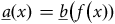 $\underline{a}\left(x\right)=\underline{b}\left(f\right(x\left)\right)$
and
$\underline{a}\left(x\right)=\underline{b}\left(f\right(x\left)\right)$
and ${W}_{j}\left(x\right)={W}_{k}\left(f\right(x\left)\right)$
,
${W}_{j}\left(x\right)={W}_{k}\left(f\right(x\left)\right)$
, ${W}_{k}\left(x\right)={W}_{j}\left(f\right(x\left)\right)$
; by Interprofile Anonymity,
${W}_{k}\left(x\right)={W}_{j}\left(f\right(x\left)\right)$
; by Interprofile Anonymity, $x{\sim }_{R}f\left(x\right)$
. Given this construction of
$x{\sim }_{R}f\left(x\right)$
. Given this construction of $a$
and
$a$
and $b$
, Stochastic Dominance for social preference entails
$b$
, Stochastic Dominance for social preference entails $a{\sim }_{R}b$
. By Strong Pareto, however,
$a{\sim }_{R}b$
. By Strong Pareto, however, $a{\succ }_{R}b$
. Contradiction. Therefore, individual preferences satisfy T-Independence for all
$a{\succ }_{R}b$
. Contradiction. Therefore, individual preferences satisfy T-Independence for all $R\in \cal{R}$
, and hence Independence by Lemma 1. Since they also satisfy Continuity and are orderings, the vNM theorem applies and there exist expected utility representations for each entry
$R\in \cal{R}$
, and hence Independence by Lemma 1. Since they also satisfy Continuity and are orderings, the vNM theorem applies and there exist expected utility representations for each entry ${R}_{i}$
of any
${R}_{i}$
of any $R\in \cal{R}$
(see e.g. Gilboa Reference Gilboa2009: 79–86). Moreover, since individual preferences match well-being levels, each individual’s vNM utility function is increasing in well-being.
$R\in \cal{R}$
(see e.g. Gilboa Reference Gilboa2009: 79–86). Moreover, since individual preferences match well-being levels, each individual’s vNM utility function is increasing in well-being.
Suppose next that social preference need not satisfy Independence. Then for some $R\in \cal{R}$
there exist
$R\in \cal{R}$
there exist $a,b,c\in A$
and
$a,b,c\in A$
and $\alpha \in \left(\mathrm{0,1}\right)$
such that
$\alpha \in \left(\mathrm{0,1}\right)$
such that $a{\succeq }_{R}b$
but
$a{\succeq }_{R}b$
but $f=b\alpha c\,{\succ }_{R}e=a\alpha c$
. Define
$f=b\alpha c\,{\succ }_{R}e=a\alpha c$
. Define ${a}^{\mathrm{*}},{b}^{\mathrm{*}},{c}^{\mathrm{*}}$
as follows: for all
${a}^{\mathrm{*}},{b}^{\mathrm{*}},{c}^{\mathrm{*}}$
as follows: for all $i\in N$ ${a}_{i}^{\mathrm{*}}$
(respectively
${a}_{i}^{\mathrm{*}}$
(respectively ${b}_{i}^{\mathrm{*}},{c}_{i}^{\mathrm{*}}$
) is the certainty equivalent of
${b}_{i}^{\mathrm{*}},{c}_{i}^{\mathrm{*}}$
) is the certainty equivalent of ${a}_{i}$
(respectively
${a}_{i}$
(respectively ${b}_{i},{c}_{i}$
). By Strong Pareto
${b}_{i},{c}_{i}$
). By Strong Pareto ${a}^{\mathrm{*}}{\sim }_{R}a,{b}^{\mathrm{*}}{\sim }_{R}b$
; hence
${a}^{\mathrm{*}}{\sim }_{R}a,{b}^{\mathrm{*}}{\sim }_{R}b$
; hence ${a}^{\mathrm{*}}{\succeq }_{R}{b}^{\mathrm{*}}$
. Let
${a}^{\mathrm{*}}{\succeq }_{R}{b}^{\mathrm{*}}$
. Let ${e}^{\mathrm{*}}={a}^{\mathrm{*}}\alpha {c}^{\mathrm{*}}$
and
${e}^{\mathrm{*}}={a}^{\mathrm{*}}\alpha {c}^{\mathrm{*}}$
and ${f}^{\mathrm{*}}={b}^{\mathrm{*}}\alpha {c}^{\mathrm{*}}$
. By Stochastic Dominance for social preference,
${f}^{\mathrm{*}}={b}^{\mathrm{*}}\alpha {c}^{\mathrm{*}}$
. By Stochastic Dominance for social preference, ${e}^{\mathrm{*}}{\succeq }_{R}{f}^{\mathrm{*}}$
. By Strong Pareto,
${e}^{\mathrm{*}}{\succeq }_{R}{f}^{\mathrm{*}}$
. By Strong Pareto, ${e}^{\mathrm{*}}{\sim }_{R}e,\,{f}^{\mathrm{*}}{\sim }_{R\,}f$
; hence
${e}^{\mathrm{*}}{\sim }_{R}e,\,{f}^{\mathrm{*}}{\sim }_{R\,}f$
; hence $e{\succeq }_{R\,}f$
. Contradiction. Therefore, social preference satisfies Independence for all
$e{\succeq }_{R\,}f$
. Contradiction. Therefore, social preference satisfies Independence for all $R\in \cal{R}$
. Since each output social preference is an ordering that also satisfies Continuity, the vNM theorem applies and for all
$R\in \cal{R}$
. Since each output social preference is an ordering that also satisfies Continuity, the vNM theorem applies and for all $R\in \cal{R}$
, there exist an expected utility representation for
$R\in \cal{R}$
, there exist an expected utility representation for ${\succeq }_{R}$
.
${\succeq }_{R}$
.
Theorem. Assume the Allais-Compatible Package. Then a risk-encompassing social welfare functional satisfies Strong Pareto and Interprofile Anonymity if and only if it is Impartial Risk-Prioritarian.
Proof. $(\Rightarrow )$
Given Lemma 2, Harsanyi’s (Reference Harsanyi1955) social aggregation theorem then allows us to infer that for all
$(\Rightarrow )$
Given Lemma 2, Harsanyi’s (Reference Harsanyi1955) social aggregation theorem then allows us to infer that for all $R\in \cal{R}$
, we can choose expected utility representations
$R\in \cal{R}$
, we can choose expected utility representations ${{U}}_{R},{{U}}_{{R}_{1}}, \ldots, {{U}}_{{R}_{n}}$
for social and individual preferences respectively, such that for all
${{U}}_{R},{{U}}_{{R}_{1}}, \ldots, {{U}}_{{R}_{n}}$
for social and individual preferences respectively, such that for all $a\in A$
,
$a\in A$
, ${{U}}_{R}\left(a\right)={{U}}_{{R}_{1}}\left({a}_{1}\right)+ \ldots +{{U}}_{{R}_{n}}\left({a}_{n}\right)$
(see Broome Reference Broome1991 for this way of stating Harsanyi’s theorem). We want to show the following:
${{U}}_{R}\left(a\right)={{U}}_{{R}_{1}}\left({a}_{1}\right)+ \ldots +{{U}}_{{R}_{n}}\left({a}_{n}\right)$
(see Broome Reference Broome1991 for this way of stating Harsanyi’s theorem). We want to show the following:
-
(i) for all
$R\in \cal{R}$
, and
$i,j\in N$
, if
${R}_{i}={R}_{j}$
, then
${{U}}_{{R}_{i}}={{U}}_{{R}_{j}}+\beta$
(this means: within a profile, the well-being of individuals with the same risk attitude is weighted in the same way); -
(ii) for all
$R,R\cal{\text{'}}\in \cal{R}$
, and
$i,j,\mathrm{k},l\in N$
, if
${R}_{i}={R\mathrm{\text{'}}}_{j}$
and
${R}_{k}={R\mathrm{\text{'}}}_{l}$
then
${{U}}_{{R}_{i}}=\alpha {{U}}_{{R\mathrm{\text{'}}}_{j}}+{\beta }_{1}$
and
${{U}}_{{R}_{k}}=\alpha {{U}}_{{R\mathrm{\text{'}}}_{l}}+{\beta }_{2}$
, with constant
$\alpha \gt 0$
and
${\beta }_{1},{\beta }_{2}\in \mathbb{R}$
(this means: across profiles, the well-being of individuals with the same risk attitudes is weighted in the same way).


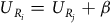






We first prove that if (i) fails, then Interprofile Anonymity is violated. By contraposition, we then get that if Interprofile Anonymity holds, (i) also does. So, we fix $R\in \cal{R}$
, and let
$R\in \cal{R}$
, and let ${R}_{1}={R}_{2}$
but
${R}_{1}={R}_{2}$
but ${{U}}_{{R}_{1}}=\alpha {{U}}_{{R}_{2}}+\beta$
for
${{U}}_{{R}_{1}}=\alpha {{U}}_{{R}_{2}}+\beta$
for $\mathrm{1,2}\in N$
, with
$\mathrm{1,2}\in N$
, with $\alpha \ne 1$
. Without loss of generality, assume
$\alpha \ne 1$
. Without loss of generality, assume $\alpha \gt 1$
. Then consider the two lotteries
$\alpha \gt 1$
. Then consider the two lotteries $e,f\in A$
in Figure 3, where
$e,f\in A$
in Figure 3, where ${w}^{+}\gt w\in \mathbb{R}$
.
${w}^{+}\gt w\in \mathbb{R}$
.
Lotteries $e$
and
$e$
and $f$
defined.
$f$
defined.

Lottery $e\in A$
results for sure in everyone but
$e\in A$
results for sure in everyone but $1$
at well-being
$1$
at well-being $w$
, and
$w$
, and $1$
at
$1$
at ${w}^{+}\gt w$
. Lottery
${w}^{+}\gt w$
. Lottery $f\in A$
results for sure in everyone but
$f\in A$
results for sure in everyone but $2$
at well-being
$2$
at well-being $w$
, and
$w$
, and $2$
at
$2$
at ${w}^{+}$
. Then
${w}^{+}$
. Then $e{\succ }_{R}f$
, which violates Interprofile Anonymity. To see this, let
$e{\succ }_{R}f$
, which violates Interprofile Anonymity. To see this, let $R=R\mathrm{\text{'}}$
and
$R=R\mathrm{\text{'}}$
and $a=d,b=c$
in the statement of the principle. Then take the permutation
$a=d,b=c$
in the statement of the principle. Then take the permutation $\sigma \left(1\right)=2,\sigma \left(2\right)=1,$
and
$\sigma \left(1\right)=2,\sigma \left(2\right)=1,$
and $\sigma \left(k\right)=k$
for all
$\sigma \left(k\right)=k$
for all $k\ne \mathrm{1,2}\in N$
. For all individuals
$k\ne \mathrm{1,2}\in N$
. For all individuals $i\in N$
, we have
$i\in N$
, we have ${e}_{i}={f}_{\sigma \left(i\right)},$
and
${e}_{i}={f}_{\sigma \left(i\right)},$
and ${f}_{i}={e}_{\sigma \left(i\right)}$
, and for all concerned individuals, i.e.
${f}_{i}={e}_{\sigma \left(i\right)}$
, and for all concerned individuals, i.e. $1$
and
$1$
and $2$
, we have
$2$
, we have ${R}_{1}={R}_{\sigma \left(1\right)=2}$
and
${R}_{1}={R}_{\sigma \left(1\right)=2}$
and ${R}_{2}={R}_{\sigma \left(2\right)=1}$
. But it’s not the case that
${R}_{2}={R}_{\sigma \left(2\right)=1}$
. But it’s not the case that $e{\succeq }_{R}f$
iff
$e{\succeq }_{R}f$
iff $f{\succeq }_{R}e$
– since
$f{\succeq }_{R}e$
– since $e{\succ }_{R}f$
. By contraposition, if Interprofile Anonymity holds, then (i) follows.
$e{\succ }_{R}f$
. By contraposition, if Interprofile Anonymity holds, then (i) follows.
We show (ii) by contradiction. Fix $R,R\cal{\text{'}}\in \cal{R}$
, and
$R,R\cal{\text{'}}\in \cal{R}$
, and $i,j,k,l\in N$
with
$i,j,k,l\in N$
with ${R}_{i}={R\mathrm{\text{'}}}_{j}=\mathrm{*}$
and
${R}_{i}={R\mathrm{\text{'}}}_{j}=\mathrm{*}$
and ${R}_{k}={R\mathrm{\text{'}}}_{l}=\circ $
, but suppose for contradiction that
${R}_{k}={R\mathrm{\text{'}}}_{l}=\circ $
, but suppose for contradiction that ${{U}}_{{R}_{i}}={\alpha }_{1}{{U}}_{{R\mathrm{\text{'}}}_{j}}+{\beta }_{1}$
and
${{U}}_{{R}_{i}}={\alpha }_{1}{{U}}_{{R\mathrm{\text{'}}}_{j}}+{\beta }_{1}$
and ${{U}}_{{R}_{k}}={\alpha }_{2}{{U}}_{{R\mathrm{\text{'}}}_{l}}+{\beta }_{2}$
, with
${{U}}_{{R}_{k}}={\alpha }_{2}{{U}}_{{R\mathrm{\text{'}}}_{l}}+{\beta }_{2}$
, with ${\alpha }_{1}\ne {\alpha }_{2}$
. Without loss of generality, we assume that
${\alpha }_{1}\ne {\alpha }_{2}$
. Without loss of generality, we assume that ${\alpha }_{1}\gt {\alpha }_{2}$
. Figure 4 depicts
${\alpha }_{1}\gt {\alpha }_{2}$
. Figure 4 depicts $R$
and
$R$
and $R\mathrm{\text{'}}$
, and another profile
$R\mathrm{\text{'}}$
, and another profile ${R}^{\mathrm{\text{'}}\mathrm{\text{'}}}$
that we will need to consider.
${R}^{\mathrm{\text{'}}\mathrm{\text{'}}}$
that we will need to consider.
Depiction of profiles appealed to in the proof.

Arbitrarily select $w,{w}^{+}\in \mathbb{R}$
, where
$w,{w}^{+}\in \mathbb{R}$
, where ${w}^{+}\gt w$
. Then, for
${w}^{+}\gt w$
. Then, for ${{U}}_{{R\mathrm{\text{'}}}_{j}},{{U}}_{{R\mathrm{\text{'}}}_{l}},{{U}}_{{R}_{i}},{{U}}_{{R}_{k}}$
the difference in utility between (degenerate prospects yielding for sure)
${{U}}_{{R\mathrm{\text{'}}}_{j}},{{U}}_{{R\mathrm{\text{'}}}_{l}},{{U}}_{{R}_{i}},{{U}}_{{R}_{k}}$
the difference in utility between (degenerate prospects yielding for sure) ${w}^{+}$
and
${w}^{+}$
and $w$
is positive, since all individual utility functions are strictly increasing in well-being. Let
$w$
is positive, since all individual utility functions are strictly increasing in well-being. Let $\epsilon $
be some positive real number strictly smaller than any of these four differences in utility, and
$\epsilon $
be some positive real number strictly smaller than any of these four differences in utility, and $M$
some other positive real number strictly greater than any of these four differences in utility. Next, consider prospect
$M$
some other positive real number strictly greater than any of these four differences in utility. Next, consider prospect $v$
, which gives to the individual who receives it a
$v$
, which gives to the individual who receives it a $p$
probability of
$p$
probability of ${w}^{+}$
, and a
${w}^{+}$
, and a $(1-p)$
probability of
$(1-p)$
probability of $w$
, with
$w$
, with $p = {\varepsilon \over {2M}}$
. Notice that for all of
$p = {\varepsilon \over {2M}}$
. Notice that for all of ${U}_{{R\mathrm{\text{'}}}_{j}},{U}_{{R\mathrm{\text{'}}}_{l}},{U}_{{R}_{i}},{U}_{{R}_{k}}$
, the difference in utility between
${U}_{{R\mathrm{\text{'}}}_{j}},{U}_{{R\mathrm{\text{'}}}_{l}},{U}_{{R}_{i}},{U}_{{R}_{k}}$
, the difference in utility between $v$
and
$v$
and $w$
is positive but strictly smaller than
$w$
is positive but strictly smaller than $\epsilon $
. This can be shown as follows, with
$\epsilon $
. This can be shown as follows, with ${U}$
standing in for any one of the four utility functions under consideration. Since
${U}$
standing in for any one of the four utility functions under consideration. Since $U$
is expectational,
$U$
is expectational, $U\left(v\right)=pU\left({w}^{+}\right)+(1-p)U\left(w\right)$ $U\left(v\right)=pU\left({w}^{+}\right)+U\left(w\right)-pU\left(w\right)$ $U\left(v\right)-U\left(w\right)=p\left[U\right({w}^{+})-U(w\left)\right]$ $U\left( v \right) - U\left( w \right) = {\varepsilon \over {2M}}[U({w^ + }) - U(w)] \lt {\varepsilon \over {2M}}M = {\varepsilon \over 2} \lt \varepsilon $
Look next at Figure 5, illustrating four lotteries $e,f,g,h\in A$
.
$e,f,g,h\in A$
.
Lotteries $e,f,g,h$
defined.
$e,f,g,h$
defined.

Consider the permutation $\sigma $
of
$\sigma $
of $N$
such that
$N$
such that $\sigma \left(i\right)=j,\sigma \left(j\right)=i,\sigma \left(k\right)=l,\sigma \left(l\right)=k$
, and
$\sigma \left(i\right)=j,\sigma \left(j\right)=i,\sigma \left(k\right)=l,\sigma \left(l\right)=k$
, and $\sigma \left(m\right)=m$
for
$\sigma \left(m\right)=m$
for $m\ne i,j,k,l\in N$
. Note that
$m\ne i,j,k,l\in N$
. Note that ${g}_{i}={h}_{\sigma \left(i\right)}$
and
${g}_{i}={h}_{\sigma \left(i\right)}$
and ${e}_{i}={f}_{\sigma \left(i\right)}$
, and similarly for all other individuals. Also,
${e}_{i}={f}_{\sigma \left(i\right)}$
, and similarly for all other individuals. Also, ${R}_{i}^{\mathrm{\text{'}}\mathrm{\text{'}}}={R\mathrm{\text{'}}}_{\sigma \left(i\right)}$
, and similarly for the remaining concerned individuals
${R}_{i}^{\mathrm{\text{'}}\mathrm{\text{'}}}={R\mathrm{\text{'}}}_{\sigma \left(i\right)}$
, and similarly for the remaining concerned individuals $j,k,l$
. By Interprofile Anonymity,
$j,k,l$
. By Interprofile Anonymity, $g{\succeq }_{{R}^{\mathrm{\text{'}}\mathrm{\text{'}}}}e$
iff
$g{\succeq }_{{R}^{\mathrm{\text{'}}\mathrm{\text{'}}}}e$
iff $h{\succeq }_{R\mathrm{\text{'}}}f$
. Now look at
$h{\succeq }_{R\mathrm{\text{'}}}f$
. Now look at $R$
and
$R$
and ${R}^{\mathrm{\text{'}}\mathrm{\text{'}}}$
, and consider the identity permutation. By Interprofile Anonymity,
${R}^{\mathrm{\text{'}}\mathrm{\text{'}}}$
, and consider the identity permutation. By Interprofile Anonymity, $g{\succeq }_{R}e$
iff
$g{\succeq }_{R}e$
iff $g{\succeq }_{{R}^{\mathrm{\text{'}}\mathrm{\text{'}}}}e$
. This can be seen by letting
$g{\succeq }_{{R}^{\mathrm{\text{'}}\mathrm{\text{'}}}}e$
. This can be seen by letting $a=b$
and
$a=b$
and $c=d$
in the statement of the principle. It then follows that
$c=d$
in the statement of the principle. It then follows that $g{\succeq }_{R}e$
iff
$g{\succeq }_{R}e$
iff $h{\succeq }_{R\mathrm{\text{'}}}f$
. There are three cases. If
$h{\succeq }_{R\mathrm{\text{'}}}f$
. There are three cases. If $h{\sim }_{R\mathrm{\text{'}}}f$
, since
$h{\sim }_{R\mathrm{\text{'}}}f$
, since ${\alpha }_{1}\gt {\alpha }_{2}$
, it follows tht
${\alpha }_{1}\gt {\alpha }_{2}$
, it follows tht $e{\succ }_{R}g$
, which contradicts the verdict just reached using Interprofile Anonymity twice. If
$e{\succ }_{R}g$
, which contradicts the verdict just reached using Interprofile Anonymity twice. If $f{\succ }_{R\mathrm{\text{'}}}h$
, we need an additional step. First notice that
$f{\succ }_{R\mathrm{\text{'}}}h$
, we need an additional step. First notice that $f{\succ }_{R\mathrm{\text{'}}}h$
entails that
$f{\succ }_{R\mathrm{\text{'}}}h$
entails that ${U}_{{R\mathrm{\text{'}}}_{j}}\left(v\right)-{U}_{{R\mathrm{\text{'}}}_{j}}\left(w\right)\gt {U}_{{R\mathrm{\text{'}}}_{l}}\left(v\right)-{U}_{{R\mathrm{\text{'}}}_{l}}\left(w\right)$
. Define next
${U}_{{R\mathrm{\text{'}}}_{j}}\left(v\right)-{U}_{{R\mathrm{\text{'}}}_{j}}\left(w\right)\gt {U}_{{R\mathrm{\text{'}}}_{l}}\left(v\right)-{U}_{{R\mathrm{\text{'}}}_{l}}\left(w\right)$
. Define next ${v}^{+}$
as a prospect that gives to the individual who receives it a
${v}^{+}$
as a prospect that gives to the individual who receives it a $q$
probability of
$q$
probability of ${w}^{+}$
and a
${w}^{+}$
and a $(1-q)$
probability of
$(1-q)$
probability of $w$
, with
$w$
, with $q = {{{U_{R{{\rm{'}}_j}}}\left( v \right) - {U_{R{{\rm{'}}_j}}}\left( w \right)} \over {{U_{R{{\rm{'}}_l}}}\left( {{w^ + }} \right) - {U_{R{{\rm{'}}_l}}}\left( w \right)}}$
Notice that $0\lt q\lt 1$
, since
$0\lt q\lt 1$
, since $0\lt {U}_{{R\mathrm{\text{'}}}_{j}}\left(v\right)-{U}_{{R\mathrm{\text{'}}}_{j}}\left(w\right)\lt \epsilon \lt {U}_{{R\mathrm{\text{'}}}_{l}}\left({w}^{+}\right)-{U}_{{R\mathrm{\text{'}}}_{l}}\left(w\right)$
. We now show that
$0\lt {U}_{{R\mathrm{\text{'}}}_{j}}\left(v\right)-{U}_{{R\mathrm{\text{'}}}_{j}}\left(w\right)\lt \epsilon \lt {U}_{{R\mathrm{\text{'}}}_{l}}\left({w}^{+}\right)-{U}_{{R\mathrm{\text{'}}}_{l}}\left(w\right)$
. We now show that ${U}_{{R\mathrm{\text{'}}}_{l}}\left({v}^{+}\right)-{U}_{{R\mathrm{\text{'}}}_{l}}\left(w\right)={U}_{{R\mathrm{\text{'}}}_{j}}\left(v\right)-{U}_{{R\mathrm{\text{'}}}_{j}}\left(w\right)$
. Since
${U}_{{R\mathrm{\text{'}}}_{l}}\left({v}^{+}\right)-{U}_{{R\mathrm{\text{'}}}_{l}}\left(w\right)={U}_{{R\mathrm{\text{'}}}_{j}}\left(v\right)-{U}_{{R\mathrm{\text{'}}}_{j}}\left(w\right)$
. Since $l$
is an expected utility maximizer,
$l$
is an expected utility maximizer, ${U}_{{R\mathrm{\text{'}}}_{l}}\left({v}^{+}\right)=q{U}_{{R\mathrm{\text{'}}}_{l}}\left({w}^{+}\right)+(1-q){U}_{{R\mathrm{\text{'}}}_{l}}\left(w\right)$
Rearranging, ${U}_{{R\mathrm{\text{'}}}_{l}}\left({v}^{+}\right)-{U}_{{R\mathrm{\text{'}}}_{l}}\left(w\right)=q\left[{U}_{{R\mathrm{\text{'}}}_{l}}\right({w}^{+})-{U}_{{R\mathrm{\text{'}}}_{l}}(w\left)\right]$
So, ${U_{R{{\rm{'}}_l}}}\left( {{v^ + }} \right) - {U_{R{{\rm{'}}_l}}}\left( w \right) = {{{U_{R{{\rm{'}}_j}}}\left( v \right) - {U_{R{{\rm{'}}_j}}}\left( w \right)} \over {{U_{R{{\rm{'}}_l}}}\left( {{w^ + }} \right) - {U_{R{{\rm{'}}_l}}}\left( w \right)}}\left[ {{U_{R{{\rm{'}}_l}}}\left( {{w^ + }} \right) - {U_{R{{\rm{'}}_l}}}\left( w \right)} \right] = {U_{R{{\rm{'}}_j}}}\left( v \right) - {U_{R{{\rm{'}}_j}}}\left( w \right)$
With $g\mathrm{*},h\mathrm{*}\in A$
as defined in Figure 6, we have
$g\mathrm{*},h\mathrm{*}\in A$
as defined in Figure 6, we have $h\mathrm{*}{\sim }_{R\mathrm{\text{'}}}f$
but
$h\mathrm{*}{\sim }_{R\mathrm{\text{'}}}f$
but $e{\succ }_{R}g\mathrm{*}$
(since
$e{\succ }_{R}g\mathrm{*}$
(since ${\alpha }_{1}\gt {\alpha }_{2}$
), which can be shown to contradict Interprofile Anonymity.
${\alpha }_{1}\gt {\alpha }_{2}$
), which can be shown to contradict Interprofile Anonymity.
Lotteries $g\mathrm{*},h\mathrm{*}$
defined;
$g\mathrm{*},h\mathrm{*}$
defined; $e,f$
also depicted for comparison.
$e,f$
also depicted for comparison.

To see the contradiction, consider again first profile $R\mathrm{\text{'}}\mathrm{\text{'}}$
and
$R\mathrm{\text{'}}\mathrm{\text{'}}$
and $R\mathrm{\text{'}}$
as above, and note that Interprofile Anonymity entails
$R\mathrm{\text{'}}$
as above, and note that Interprofile Anonymity entails $g\mathrm{*}{\succeq }_{{R}^{\mathrm{\text{'}}\mathrm{\text{'}}}}e$
iff
$g\mathrm{*}{\succeq }_{{R}^{\mathrm{\text{'}}\mathrm{\text{'}}}}e$
iff $h\mathrm{*}{\succeq }_{R\mathrm{\text{'}}}f$
. Next, consider
$h\mathrm{*}{\succeq }_{R\mathrm{\text{'}}}f$
. Next, consider $R\mathrm{\text{'}}\mathrm{\text{'}}$
and
$R\mathrm{\text{'}}\mathrm{\text{'}}$
and $R$
, and note that Interprofile Anonymity entails
$R$
, and note that Interprofile Anonymity entails $g{*}{\succeq }_{R}e$
iff
$g{*}{\succeq }_{R}e$
iff $g\mathrm{*}{\succeq }_{{R}^{\mathrm{\text{'}}\mathrm{\text{'}}}}e$
. Therefore,
$g\mathrm{*}{\succeq }_{{R}^{\mathrm{\text{'}}\mathrm{\text{'}}}}e$
. Therefore, $g\mathrm{*}{\succeq }_{R}e$
iff
$g\mathrm{*}{\succeq }_{R}e$
iff $h\mathrm{*}{\succeq }_{R\mathrm{\text{'}}}f$
. Finally, if
$h\mathrm{*}{\succeq }_{R\mathrm{\text{'}}}f$
. Finally, if $h{\succ }_{R\mathrm{\text{'}}}f$
, we need an analogous additional step. Define
$h{\succ }_{R\mathrm{\text{'}}}f$
, we need an analogous additional step. Define ${v}^{\dagger }$
as a prospect that gives to the individual who receives it an
${v}^{\dagger }$
as a prospect that gives to the individual who receives it an $r$
probability of
$r$
probability of ${w}^{+}$
and a
${w}^{+}$
and a $(1-r)$
probability of
$(1-r)$
probability of $w$
, with
$w$
, with $r = {{{U_{R{{\rm{'}}_l}}}\left( v \right) - {U_{R{{\rm{'}}_l}}}\left( w \right)} \over {{U_{R{{\rm{'}}_j}}}\left( {{w^ + }} \right) - {U_{R{{\rm{'}}_j}}}\left( w \right)}}$
Notice that $0\lt r\lt 1$
. We show that
$0\lt r\lt 1$
. We show that ${U}_{{R\mathrm{\text{'}}}_{j}}\left({v}^{\dagger }\right)-{U}_{{\mathrm{R}\mathrm{\text{'}}}_{j}}\left(w\right)={U}_{{R\mathrm{\text{'}}}_{l}}\left(v\right)-{U}_{{R\mathrm{\text{'}}}_{l}}\left(w\right)$
. Since
${U}_{{R\mathrm{\text{'}}}_{j}}\left({v}^{\dagger }\right)-{U}_{{\mathrm{R}\mathrm{\text{'}}}_{j}}\left(w\right)={U}_{{R\mathrm{\text{'}}}_{l}}\left(v\right)-{U}_{{R\mathrm{\text{'}}}_{l}}\left(w\right)$
. Since $j$
is an expected utility maximizer,
$j$
is an expected utility maximizer, ${U}_{{R\mathrm{\text{'}}}_{j}}\left({v}^{\dagger }\right)=r{U}_{{R\mathrm{\text{'}}}_{j}}\left({w}^{+}\right)+(1-r){U}_{{R\mathrm{\text{'}}}_{j}}\left(w\right)$
Rearranging, ${U}_{{R\mathrm{\text{'}}}_{j}}\left({v}^{\dagger }\right)-{U}_{{R\mathrm{\text{'}}}_{j}}\left(w\right)=r[{U}_{{R\mathrm{\text{'}}}_{j}}({w}^{+})-{U}_{{R\mathrm{\text{'}}}_{j}}(w\left)\right]$
So, ${U_{R{{\rm{'}}_j}}}\left( {{v^\dagger}} \right) - {U_{R{{\rm{'}}_j}}}\left( w \right) = {{{U_{R{{\rm{'}}_l}}}\left( v \right) - {U_{R{{\rm{'}}_l}}}\left( w \right)} \over {{U_{R{{\rm{'}}_j}}}\left( {{w^ + }} \right) - {U_{R{{\rm{'}}_j}}}\left( w \right)}}\left[ {{U_{R{{\rm{'}}_j}}}\left( {{w^ + }} \right) - {U_{R{{\rm{'}}_j}}}\left( w \right)} \right] = {U_{R{{\rm{'}}_l}}}\left( v \right) - {U_{R{{\rm{'}}_l}}}\left( w \right)$
With $e\mathrm{\,*},f\mathrm{\,*}\in A$
as given in Figure 7, we have
$e\mathrm{\,*},f\mathrm{\,*}\in A$
as given in Figure 7, we have $h{\sim }_{R\mathrm{\text{'}}}f\mathrm{\,*}$
but
$h{\sim }_{R\mathrm{\text{'}}}f\mathrm{\,*}$
but $e\mathrm{\,*}{\succ }_{R}g$
, which again can be shown to contradict Interprofile Anonymity by similar reasoning as above.
$e\mathrm{\,*}{\succ }_{R}g$
, which again can be shown to contradict Interprofile Anonymity by similar reasoning as above.
Lotteries $e\mathrm{*},f\mathrm{*}$
defined;
$e\mathrm{*},f\mathrm{*}$
defined; $g,h$
also depicted for comparison.
$g,h$
also depicted for comparison.
 $(\Leftarrow )$
This direction is immediate, and the proof is omitted.
$(\Leftarrow )$
This direction is immediate, and the proof is omitted.
Pietro Cibinel is an Assistant Professor in the Department of Philosophy at the University of North Carolina, Chapel Hill. He works at the intersection of ethics and decision theory, with his research investigating key connections between rational choice, social choice and welfare measurement.






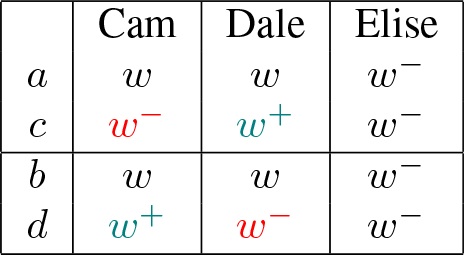
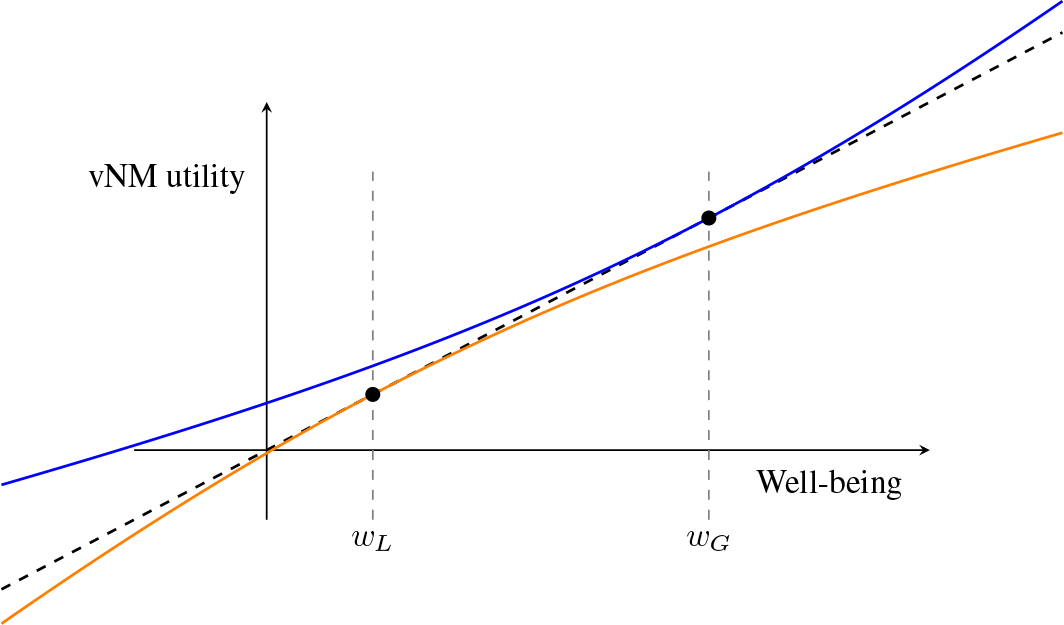
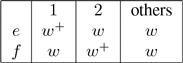


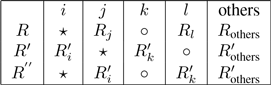
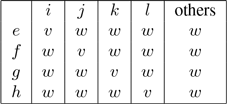

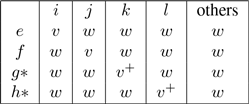


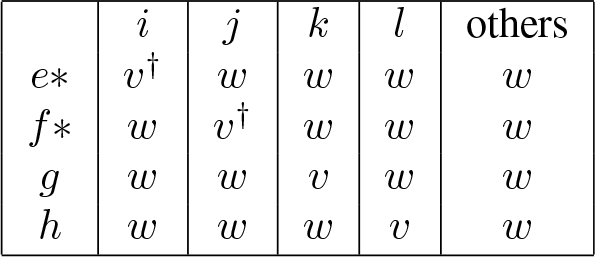


 Open access

