





Introduction
Weeds and weed management impose enormous economic, environmental, and social costs in both managed and natural ecosystems. Although progress has been made in identifying weed management practices that limit these costs, ongoing challenges such as climate change and evolution of herbicide resistance require continued innovation to reduce the negative impacts of weeds and weed management on natural ecosystems and to support sustainable development of managed ecosystems. Identifying research priorities to address such challenges is essential for guiding the rational allocation of resources at multiple levels. Prioritizing research areas that address emerging challenges and leverage emerging opportunities in weed science should be helpful for government agencies in allocating grant funding to various programs and determining funding levels and research foci within those programs. Similarly, academic institutions or individuals developing weed science curricula benefit from prioritizing emerging research needs relative to current capacity and areas of expertise.
Within the weed science discipline, past efforts to identify and reflect on research priorities have differed greatly in their scope, time horizon, and the practitioners or institutions they aim to represent. In terms of scope, research prioritization efforts have varied from those aimed at capturing a wide range of topics in weed science (e.g., Davis et al. Reference Davis, Hall, Jasieniuk, Locke, Luschei, Mortensen, Riechers, Smith, Sterling and Westwood2009; Hall et al. Reference Hall, Van Eerd, Miller, Owen, Prather, Shaner, Singh, Vaughn and Weller2000; Jordan et al. Reference Jordan, Schut, Graham, Barney, Childs, Christensen, Cousens, Davis, Eizenberg, Ervin and Fernandez-Quintanilla2016; McWhorter and Barrentine Reference McWhorter and Barrentine1988), to those focusing on specific subdisciplines such as herbicide resistance (e.g., Shaner and Beckie Reference Shaner and Beckie2014), nonchemical weed management (e.g., Baker and Mohler Reference Baker and Mohler2015), invasive species management (e.g., Bayliss et al. Reference Bayliss, Stewart, Wilcox and Randall2013; Foxcroft et al. Reference Foxcroft, Pyšek, Richardson, Genovesi and MacFadyen2017), and weed genomics (Ravet et al. Reference Ravet, Patterson, Krähmer, Hamouzová, Fan, Jasieniuk, Lawton-Rauh, Malone, McElroy, Merotto, Westra, Preston, Vila-Aiub, Busi and Tranel2018). Others have focused on identifying weed research priorities to address not only economic outcomes, but also potential environmental and social impacts (Bagavathiannan et al. Reference Bagavathiannan, Graham, Ma, Barney, Coutts, Caicedo, Clerck-Floate, West, Blank, Metcalf and Lacoste2019; Jordan et al. Reference Jordan, Schut, Graham, Barney, Childs, Christensen, Cousens, Davis, Eizenberg, Ervin and Fernandez-Quintanilla2016; Neve et al. Reference Neve, Barney, Buckley, Cousens, Graham, Jordan, Lawton-Rauh, Liebman, Mesgaran, Schut and Shaw2018). Time horizons have also varied from relatively short-term prioritizations to address well-documented threats such as herbicide resistance (Sarangi and Jhala Reference Sarangi and Jhala2018) to long-term speculation about priorities for the more distant future (Westwood et al. Reference Westwood, Charudattan, Duke, Fennimore, Marrone, Slaughter, Swanton and Zollinger2018). Past approaches to identify weed research priorities generally fall within three categories: (1) those reflecting the opinions of one or several individuals, based on their perceptions of the discipline (e.g., Chauhan et al. Reference Chauhan, Matloob, Mahajan, Aslam, Florentine and Jha2017; Mortenson et al. Reference Mortensen, Egan, Maxwell, Ryan and Smith2012; Wyse Reference Wyse1992); (2) those based on intensive discussion with a broader but still limited range of invited scientists and/or stakeholders (e.g., Hall et al. Reference Hall, Van Eerd, Miller, Owen, Prather, Shaner, Singh, Vaughn and Weller2000; Jordan et al. Reference Jordan, Schut, Graham, Barney, Childs, Christensen, Cousens, Davis, Eizenberg, Ervin and Fernandez-Quintanilla2016; Neve et al. Reference Neve, Barney, Buckley, Cousens, Graham, Jordan, Lawton-Rauh, Liebman, Mesgaran, Schut and Shaw2018; Ward et al. Reference Ward, Cousens, Bagavathiannan, Barney, Beckie, Busi, Davis, Dukes, Forcella, Freckleton and Gallandt2014); and (3) those based on results and interpretation of survey instruments sent to members of professional societies or stakeholders involved in weed science at the national (e.g., Davis et al. Reference Davis, Hall, Jasieniuk, Locke, Luschei, Mortensen, Riechers, Smith, Sterling and Westwood2009; McWhorter and Barrentine Reference McWhorter and Barrentine1988) or regional level (e.g., Sarangi and Jhala Reference Sarangi and Jhala2018; Stoller et al. Reference Stoller, Wax and Alm1993).
Unsurprisingly, research priorities identified through these different approaches vary. Those working most directly with stakeholders in agricultural settings (e.g., farmers and consultants) generally place greatest emphasis on herbicide-related research targeting efficient control of weeds in specific crops (e.g., Sarangi and Jhala Reference Sarangi and Jhala2018; Stoller et al. Reference Stoller, Wax and Alm1993). Others place greater emphasis on understanding weed biology and ecology to support integrated or ecological weed management using a wider range of strategies (e.g., Chauhan et al. Reference Chauhan, Matloob, Mahajan, Aslam, Florentine and Jha2017), especially in organic production systems or minor crops where chemical options are limited (e.g., Baker and Mohler Reference Baker and Mohler2015). In addition, several groups have emphasized the need for transdisciplinary research to integrate agroecological and socioeconomic approaches in weed management (Neve et al. Reference Neve, Barney, Buckley, Cousens, Graham, Jordan, Lawton-Rauh, Liebman, Mesgaran, Schut and Shaw2018) and to address challenging weed problems as part of broader efforts to advance ecosystem sustainability (Jordan et al. Reference Jordan, Schut, Graham, Barney, Childs, Christensen, Cousens, Davis, Eizenberg, Ervin and Fernandez-Quintanilla2016). All of these perspectives and approaches are represented to different degrees within the Weed Science Society of America (WSSA) and reflected in the results and interpretation of previous surveys of WSSA membership (Davis et al. Reference Davis, Hall, Jasieniuk, Locke, Luschei, Mortensen, Riechers, Smith, Sterling and Westwood2009; McWhorter and Barrentine Reference McWhorter and Barrentine1988). While some observers have speculated that views regarding weed research priorities have become increasingly polarized (Ward et al. Reference Ward, Cousens, Bagavathiannan, Barney, Beckie, Busi, Davis, Dukes, Forcella, Freckleton and Gallandt2014), little documented evidence is available to evaluate such claims.
The WSSA’s E6 Weed Research Priorities Committee has met annually for decades to discuss weed science priorities and to generate priority lists that are periodically communicated to members, funding agencies, and the general public. Historically, these priorities have relied heavily on the opinions of volunteer members of the E6 committee, with various levels of informal or formal input from the wider WSSA community. Formal surveys of membership occurred in 1987 (McWhorter and Barrentine Reference McWhorter and Barrentine1988) and 2007 (Davis et al. Reference Davis, Hall, Jasieniuk, Locke, Luschei, Mortensen, Riechers, Smith, Sterling and Westwood2009). In the 2007 survey, respondents were asked to rank 15 research areas that had been suggested as priorities by the E6 committee almost a decade earlier (Hall et al. Reference Hall, Van Eerd, Miller, Owen, Prather, Shaner, Singh, Vaughn and Weller2000). Thus, the most recent formal prioritization of weed science research with broad input from weed scientists occurred 16 years ago and was based on research categories generated almost 25 years ago. Given the many challenges, opportunities, and advancements that have arisen within the weed science discipline since that time, the current WSSA Research Priorities Committee (E6) undertook a survey to gauge current opinions on a range of research areas in weed science.
The primary objectives of our survey were to (1) identify research topics perceived by weed scientists in the United States and Canada to be important for advancing weed science and management in the next 5 to 10 years and (2) gain insight into potential gaps in current expertise and funding sources needed to address those priorities. Secondary objectives included exploring associations between respondents’ professional characteristics (areas of expertise, years of experience, institution type, and study system) and their research priorities, as well as evaluating potential shifts in research emphasis and funding since the last survey in 2007.
Materials and Methods
The survey was developed by the WSSA Research Priorities Committee (E6) in spring of 2021 and implemented as an online survey using Qualtrics software in the fall and winter of 2021 and 2022 (see Supplementary Appendix for survey questions). In brief, respondents were asked to provide professional and demographic information; report their own broad areas of research expertise; rank and prioritize both broad and specific research categories; and identify important funding sources for their research.
To determine which research categories and topics to include in the survey, we reviewed those included in the 2007 survey (Davis et al. Reference Davis, Hall, Jasieniuk, Locke, Luschei, Mortensen, Riechers, Smith, Sterling and Westwood2009) and made adjustments to reflect new research areas of perceived interest that have emerged since the last survey (e.g., precision weed management and robotics) and distinguish “broad” areas of research from more specific topics. The previous surveys asked respondents to rank 15 research topics ranging in scope from “Invasive Weeds” to “Nutraceuticals” (two of which were later combined into “Other” for analysis and publication). We chose nine broad research areas for prioritization and included 5 to 10 subcategories within each for subsequent prioritization. Our approach was similar to that used by McWhorter and Ballentine (Reference McWhorter and Barrentine1988), which included rankings of six broad “research needs,” each with a set of research subcategories.
The nine broad research areas selected for the survey (Figure 1) were intended to reflect typical groupings used by WSSA members to describe their areas of expertise and to encompass a wide range of topics of potential interest. However, it should be noted that comparisons of broad area rankings in this survey—as with previous surveys—should be interpreted with caution, as they represent non-independent, overlapping categories with inherent ambiguities and differences in scope. To partially address these issues, respondents were asked not only to rank broad categories from highest (“top”) to lowest, but also to categorize them as “high,” “medium,” or “low” research priority areas. For example, respondents struggling to decide whether research on Invasive and Aquatic Weeds (IAW) should be ranked higher than potentially overlapping areas (e.g., Weed Ecology) could place both in a single priority class (e.g., high). We thus had two sets of rankings for these broad areas—a sorted ranking from top priority to lowest priority and a qualitative ranking of high versus medium versus low priority.
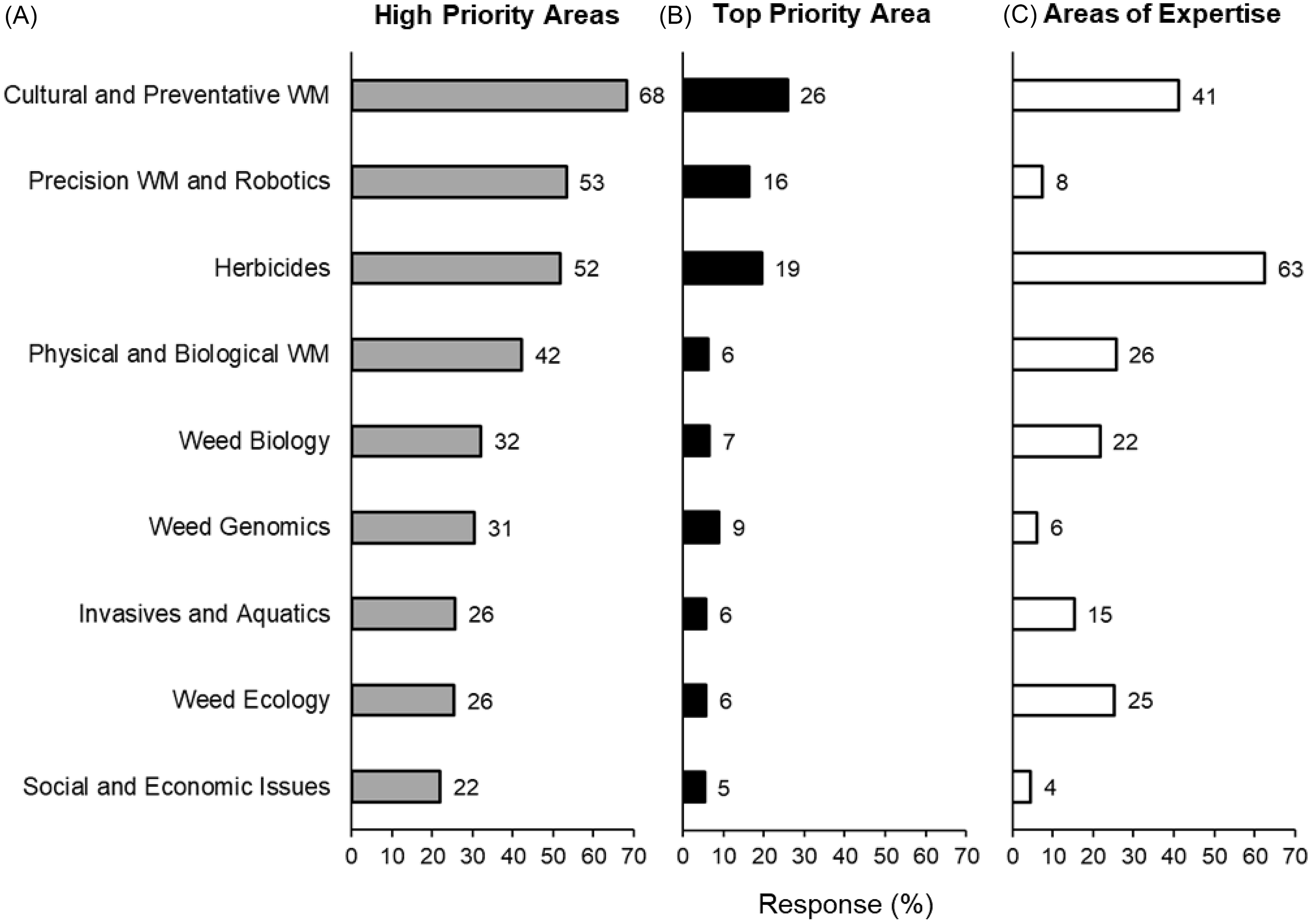
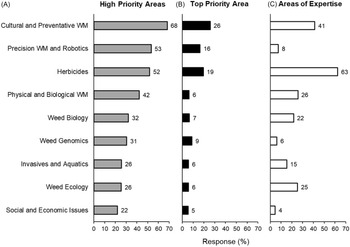
Percentage of respondents indicating broad areas of weed science as (A) high-priority research areas, (B) their top research priority area, and (C) their own area(s) of research expertise. WM, Weed Management.
Within each of the nine broad research areas, research subcategories were selected by the E6 committee with input from two to five additional weed scientists with relevant expertise. Initial lists of potential subcategories were generated by the committee, circulated for comment to these selected experts, and revised based on their input. As with broad research areas, respondents were asked to both rank subcategories from top to lowest priority and indicate whether they were high, medium, or low priority. Respondents could rank subcategories within as many broad areas as they chose, regardless of their self-identified areas of expertise and where they ranked the broad research area.
In contrast to previous surveys conducted by WSSA (Davis et al. Reference Davis, Hall, Jasieniuk, Locke, Luschei, Mortensen, Riechers, Smith, Sterling and Westwood2009; McWhorter and Ballentine Reference McWhorter and Barrentine1988), the survey was not restricted to WSSA membership, but extended to a broader range of professional societies including affiliated societies and international weed science societies listed on the WSSA website. However, response rates were low for many other societies, so our survey primarily reflects views of scientists working within WSSA and its closest affiliates. In addition, due to low response rates from outside the United States and Canada (n = 56), results presented here include only responses from those two countries. As with previous surveys, responses represent a convenience sample, not a random sample, and may not be representative of U.S. and Canadian weed scientists as a whole.
Following Davis et al. (Reference Davis, Hall, Jasieniuk, Locke, Luschei, Mortensen, Riechers, Smith, Sterling and Westwood2009), the results in this survey are presented primarily as binned response proportions to multiple-choice questions. The percentage of respondents selecting different choices (in multiple-choice questions) or classifying research areas or subcategories in different priority classes (in ranking questions) were calculated for all respondents and for different subcategories of respondents. For optional questions (e.g., subcategory rankings and funding questions), percentages were based only on the subset of respondents answering those questions, so the number of responses varied, as noted in the “Results and Discussion.” To determine associations between respondents’ professional characteristics (i.e., institution type, study system, areas of expertise) and their responses, we used two-way contingency tables (Davis et al. Reference Davis, Hall, Jasieniuk, Locke, Luschei, Mortensen, Riechers, Smith, Sterling and Westwood2009; Gotelli and Ellison Reference Gotelli and Ellison2004) implemented using PROC FREQ in SAS. In cases in which the number of respondents in specific professional categories were too small to conduct valid chi-square tests (i.e., expected counts in corresponding cells of contingency tables were <5), categories were aggregated to form larger subgroups before analysis. For example, respondents indicating that they conducted the majority of their research in “vegetables,” “fruits,” or “ornamental” crops were aggregated into a larger “horticultural” category. Similarly, for analyses of subcategory prioritization, respondent institution types for agronomic systems could be separated into “private sector” (industry) versus “public sector” (government and university) due to larger sample sizes.
Results and Discussion
Profile of Respondents
We received 475 responses from weed scientists in the United States (91% of respondents) and Canada (9% of respondents). Within the United States, respondents were fairly evenly distributed by region, with 30% from the Northeastern region, 28% from the Central region, 21% from the Western region, and 20% from the Southern region. The majority of respondents were members of WSSA (68%), representing approximately 23% (271 of approximately 1,200) of WSSA total membership. This response rate was almost identical to the 23% (304/1,330) rate obtained by Davis et al. (Reference Davis, Hall, Jasieniuk, Locke, Luschei, Mortensen, Riechers, Smith, Sterling and Westwood2009) in their survey of WSSA membership.
Respondents with <10 years of weed research experience represented 38% of the total, while those with 10 to 20 or more than 20 years of experience represented 22% and 40% of the total, respectively. The relatively low percentage of responses from midcareer (10 to 20 years) scientists could be due to fewer weed scientists in that category or to a lower response rate among them. The majority of respondents were from academia (55%), followed by industry (21%), government (15%), and other institutions (9%). This distribution of responses by institution was also almost identical to that of the 2007 survey (Davis et al. Reference Davis, Hall, Jasieniuk, Locke, Luschei, Mortensen, Riechers, Smith, Sterling and Westwood2009). Respondents’ study system data were also similar to those reported for previous surveys, with the majority of respondents (53%) conducting research in agronomic crops, followed by horticultural crops (16%); natural terrestrial areas (9%); forage, pasture, or rangeland (5%); aquatic habitats (4%); turf (3%); and other (10%).
Prioritization of Broad Research Areas and Areas of Expertise
Among the nine broad research areas, Cultural and Preventative Weed Management (CPWM) received the highest rankings among all respondents, with 68% listing it as a high priority and 26% as their top priority (Figure 1A and 1B). Herbicides and PWMR were the next most highly ranked broad research areas, with approximately 50% of respondents ranking them as high priority and 16% to 19% as top priorities. These were followed by Physical and Biological Weed Management (PBWM) (42% high priority; 6% top priority), Weed Biology (32% high priority; 7% top priority), and Weed Genomics (31% high priority; 9% top priority). Those areas perceived as lower priorities included IAW, Weed Ecology, and Social and Economic Issues (SEI), with 22% to 26% of respondents ranking these categories as high priority and 5% to 6% as their top priority.
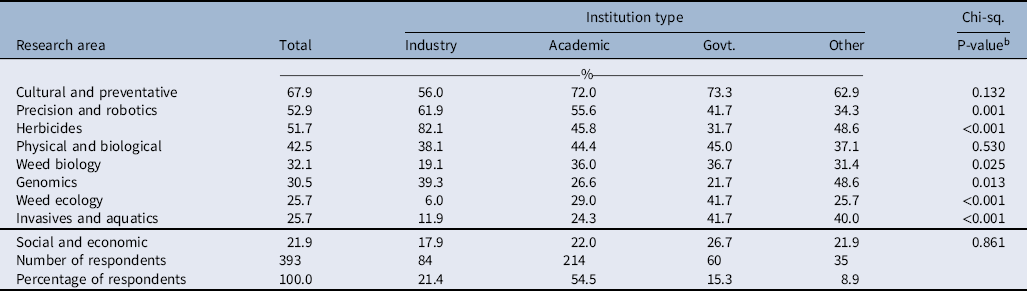
Ranking of broad research areas varied by the institution type of respondents and generally followed expected patterns (Table 1). Scientists working in the private sector gave highest rankings to priorities for addressing short-term challenges with potential to generate revenue (e.g., herbicides, robotics), while those in the public sector placed greater priority on research aimed at areas with relatively little incentive for private investment (e.g., CPWM, Weed Biology). Among industry respondents, 82% ranked Herbicides as a high priority compared with 46% from academia and 32% from government. In contrast, 73% of respondents from academia and government ranked CPWM as a high priority compared with 56% for those in industry.
Percentage of respondents (n = 393) ranking categories as high prioritya based on Institution type.
a Respondents were asked to indicate whether each area was “high,” “medium,” or “low"priority based on its “potential value for advancing weed science” in the next 5–10 years.
b Significance of chi-square test (df = 6); a value <0.05 suggests that respondents prioritized research areas differently based on their institution affiliations.
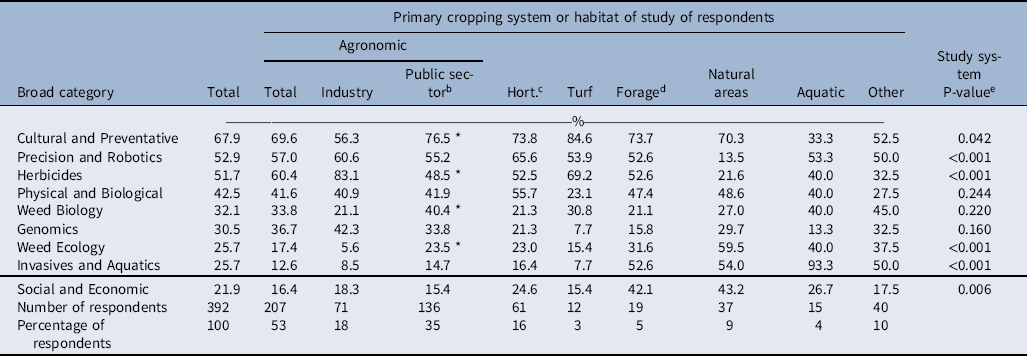
Rankings of broad categories also varied based on the primary cropping system or habitat of study of respondents (Table 2). For example, those working primarily in agronomic and horticultural cropping systems ranked Herbicides as a higher priority than those working in natural areas, while those working in natural areas gave higher priority to Weed Ecology. However, it should be noted that among respondents conducting the majority of their work in agronomic cropping systems, prioritization of several broad categories differed substantially based on their institutional affiliations (Table 2). In particular, agronomists working in the public sector were four times more likely to view Weed Ecology as a high priority compared with those from industry. Similarly, almost twice as many agronomists working in industry viewed herbicide research as a high priority compared with those working in the public sector.
Percentage of respondents (n = 392) ranking categories as high priority based on primary study system. a
a Respondents were asked to indicate whether each area was “high,” “medium,” or “low” priority based on its “potential value for advancing weed science” in the next 5–10 years.
b Includes academic and government; an asterisk (*) indicates that responses of public sector agronomists differed from those from industry (chi-square test P-value <0.05).
c Includes vegetables, fruits or nuts, and ornamentals.
d Includes forage, pasture and rangeland.
e Significance of chi-square test (df = 18); a value <0.05 suggests that respondents prioritized research areas differently based on their study systems.
Respondents self-identified their areas of expertise, with Herbicides being the most commonly selected area (63% of respondents reporting expertise; Figure 1C). CPWM was the second most commonly selected area of expertise, with 41% of respondents. In contrast, <20% of respondents reported expertise in the following broad research areas: IAW (18%), PWMR (8%), Weed Genomics (6%), and SEI (4%). Respondents’ reported area(s) of expertise varied by institution type and study system, but not by years of experience in weed research. Those with <10 years of experience had an almost identical distribution of reported broad areas of expertise compared with those with >20 years of experience. The lack of association between years of research experience and areas of expertise suggests that broad areas of expertise in weed science may not have changed much in the past 20 years. However, more detailed information would be needed to evaluate this assertion relative to alternative explanations. For example, it is possible that more experienced scientists have shifted their areas of expertise over time or that substantial differences in expertise are only apparent for research topics within broad categories. Because previous surveys did not document respondents’ areas of expertise, we cannot directly evaluate shifts in expertise over time. Our survey, however, provides a baseline against which future surveys can measure such changes.
Comparing respondents’ research priorities (Figure 1A and 1B) with their areas of expertise (Figure 1C) reveals several discrepancies. Most notably, only 8% of respondents reported expertise in PWMR compared with >50% who rated it as a high priority. Similarly, five times as many respondents rated Weed Genomics and SEI as a high priority compared with the number reporting expertise in those areas. Low levels of expertise in these areas suggest a strong need to bolster collaboration and training in areas such as engineering, computer science, genomics, sociology, and economics to help address emerging research priorities. These needs are discussed in more detail for several of the broad research areas in the next section.
Subcategory Prioritization within the Nine Research Areas
CPWM
CPWM was ranked as the top research priority among the nine broad research areas (Figure 1A). CPWM was ranked highly by respondents regardless of institution type (Table 1) and years of experience. However, depending on their primary study systems, respondents prioritized CPWM differently (Table 2). For example, CPWM was a higher priority for respondents studying turf compared with those studying aquatic habitats. Among respondents studying agronomic cropping systems, those in the public sector ranked CPWM above those from industry.
Although CPWM was not an explicit category in the 2007 WSSA survey, several related areas of research including “Non-chemical Weed Management” and “Cropping System Ecology” were ranked far below the dominant categories of “Herbicide Efficacy” and “Herbicide Resistance” at that time (Davis et al. Reference Davis, Hall, Jasieniuk, Locke, Luschei, Mortensen, Riechers, Smith, Sterling and Westwood2009). This result suggests that prioritization of research related to CPWM has increased relative to herbicide categories in the last 15 years, perhaps due to increasing frequency of herbicide resistance, limited development of herbicides with new mechanisms of action, and a growing emphasis on organic and nonchemical weed management (Birthisel et al. Reference Birthisel, Clements and Gallandt2021; Mennan et al. Reference Mennan, Jabran, Zandstra and Pala2020).
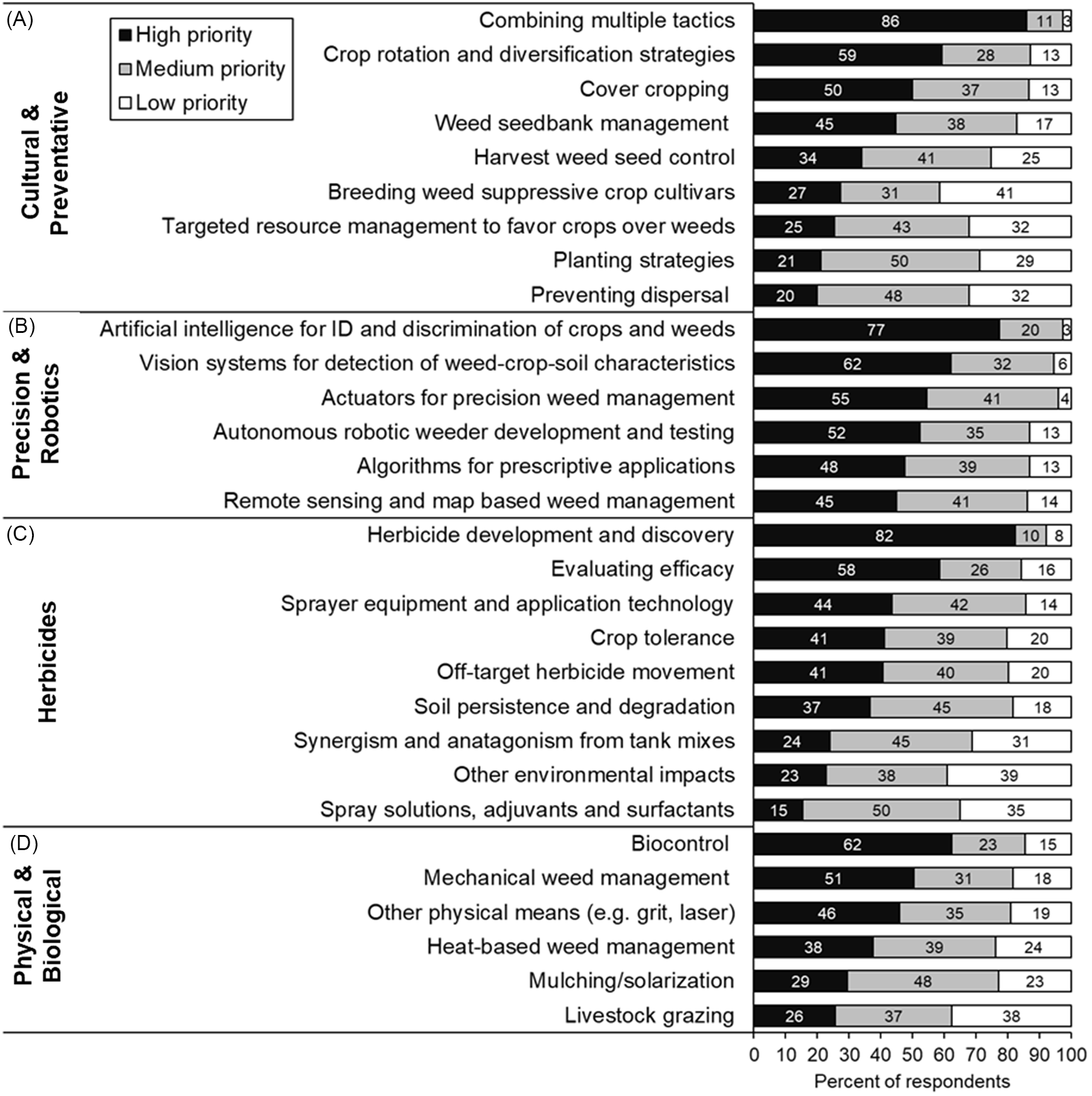
Among the 186 respondents choosing to rank subcategories within CPWM, 67% indicated expertise in this research area, with the vast majority (77%) working in cash crop systems (horticultural and agronomic crops) and the public sector (81%). Among this group of respondents, 86% ranked the subcategory Combining Multiple Weed Management Tactics as a high priority (Figure 2A)—not surprising given its breadth. For example, combining herbicides with cover crop residue would count in this subcategory, as would preseason tillage combined with in-season cultural practices. Interestingly, older yet more complex tactics including Crop Rotation and Diversification and Cover Cropping ranked relatively high, with more than half of respondents considering these high priorities. Weed Seedbank Management and Harvest Weed Seed Control—the latter being a relatively new tactic in the United States—received intermediate rankings, while other cultural tactics including Weed-Suppressive Crop Cultivars, Targeted Resource Placement, and Preventing Dispersal were assigned relatively low priority, with <30% of respondents ranking these as high priority. In general, rankings of subcategories within CPWM were similar across respondent institutions and study systems, with the exception of Cover Cropping, which was viewed as a high priority by 54% of those from the public sector compared with only 34% of those from the private sector.
Prioritization of research subcategories within broad research areas focused on weed management: (A) Cultural and Preventative Weed Management, (B) Precision Weed Management and Robotics, (C) Herbicides, and (D) Physical and Biological Weed Management. Boxes are shaded based on the percentage of respondents rating the research subcategory as a high priority (black), medium priority (gray), or low priority (white).
Despite the high prioritization of CPWM, only about 40% of total survey respondents representing our broader sample (i.e., not just those further ranking subcategories) considered this one of their areas of expertise (Figure 1C), suggesting a potential need for increased training and collaboration in CPWM practices. This result parallels that of the 2007 WSSA survey (Davis et al. Reference Davis, Hall, Jasieniuk, Locke, Luschei, Mortensen, Riechers, Smith, Sterling and Westwood2009), in which respondents reported seeking collaborators with expertise in cropping-system ecology. On the other hand, interest in collaboration with experts in Non-chemical Weed Management was ranked very low at that time.
The high prioritization placed on CPWM practices is encouraging for those advocating the expansion of weed science beyond its traditional emphasis on chemical weed control. Given rapid increases in herbicide resistance, challenges with adoption of new herbicide-tolerant crop traits, and increasing herbicide costs, developing and utilizing various CPWM practices will be critical.
PWMR
PWMR was highly ranked among the nine broad research categories, with 53% of respondents categorizing it as a high priority and 16% ranking it as their top priority (Figure 1A and 1B). This rapidly emerging area of weed management was not included as an option in previous surveys of weed research priorities (Davis et al. Reference Davis, Hall, Jasieniuk, Locke, Luschei, Mortensen, Riechers, Smith, Sterling and Westwood2009) but is clearly viewed as a promising area for managing weeds in the near future.
The ranking of PWMR varied based on the respondent’s institution and cropping system or habitat of study (Tables 1 and 2). For example, respondents from industry ranked PWMR higher than those from academia or government (Table 1). Those weed scientists working in horticultural crops ranked PWMR higher than those working in other cropping systems or habitats (Table 2). Interest among respondents studying these specialty crop systems is likely driven by the high economic value, lack of effective herbicides, and high manual weeding costs of these crops (Fennimore and Cutulle Reference Fennimore and Cutulle2019). Likewise, >50% of the respondents studying agronomic, forage, and turf systems ranked PWMR as a high priority compared with only 25% of respondents studying natural areas.
Among the 145 respondents choosing to rank subcategories within PWMR, only 18% indicated expertise in this research area, with the vast majority working in cash crop systems (81%). Among this group of respondents, Artificial Intelligence for Identification and Discrimination of Crops and Weeds and Vision Systems for Detection of Weed-Crop-Soil Characteristics were ranked as high priority by the highest percentage of respondents (Figure 2B). Sub-priority ratings within PWMR did not vary substantially based on institution or study system, with the exception of Autonomous Robotic Weeder Testing and Development, which was ranked as high priority by 60% of those in the public sector, compared with only 35% of those from the private sector. In general, these priorities are consistent with those emphasized by Fennimore and Cutulle (Reference Fennimore and Cutulle2019); in their review of robotic weeders for specialty crops, they conclude that research to improve “Weed-Crop Differentiation” and “Improved Physical Weed Control Actuators” should be the top priorities.
Despite the perceived importance of PWMR for advances in weed science, only 8% of all respondents reported expertise in this area (Figure 1C). This suggests a need for greater training of weed scientists in this priority area, coupled with greater collaboration across disciplines to address priority subcategories within it. Previous calls for greater interdisciplinary collaboration in weed science research (e.g., Davis et al. Reference Davis, Hall, Jasieniuk, Locke, Luschei, Mortensen, Riechers, Smith, Sterling and Westwood2009; Ward et al. Reference Ward, Cousens, Bagavathiannan, Barney, Beckie, Busi, Davis, Dukes, Forcella, Freckleton and Gallandt2014) have emphasized agroecology and other disciplines as diverse as economics, sociology, and psychology; our results suggest that engineering and computer science should be added to that list. Results from this survey also support the suggestion of Fennimore and Cutulle (Reference Fennimore and Cutulle2019, p. 1773) that “weed science curricula for undergraduate and graduate students should be revised to include the basics of robotic engineering.”
Herbicides
Herbicides ranked among the top three broad priority areas, with 52% of respondents considering them a high priority and 19% as their top priority (Figure 1). The ranking of Herbicides varied based on the respondent’s institution type (Table 1) and cropping system or habitat of study (Table 2). For example, 82% of respondents from industry ranked Herbicides as their top priority, compared with only 46% for those from academia and 32% from government institutions (Table 1). The Herbicides category was ranked as a high priority by >60% weed scientists working with agronomic and turf systems compared with only 22% of respondents working in natural areas (Table 2). These results demonstrate that herbicides are still widely valued for weed control across various crop production systems. Chemical weed control is often preferred over other methods because of its ease of application, relatively low cost, and effectiveness (Shaner and Beckie Reference Shaner and Beckie2014).
Among the 202 respondents choosing to rank subcategories within the broad area of Herbicides, 92% indicated expertise in this area, with 79% working in cash crop systems and 37% working in industry. Among these respondents, 82% ranked Herbicide Development and Discovery, and 58% ranked Evaluating Efficacy as high priorities (Figure 2C). More than 40% of those respondents also ranked Sprayer Equipment and Application Technology, Crop Tolerance, and Off-Target Herbicide Movement as high priorities. In general, ratings within this area were similar regardless of institution type or study system, although a larger percentage of private sector respondents rated Herbicide Development and Discovery (83%) and Sprayer Equipment and Application Technology (55%) as high priority compared with respondents from the public sector (78% and 37%, respectively). The top prioritization of Herbicide Development and Discovery likely reflects the continued concern surrounding herbicide-resistant weeds undermining the efficacy of many commonly used herbicides and the perceived need for developing herbicides with new mechanisms of action (Ruegg et al. Reference Ruegg, Quadrantiand and Zoschke2007).
Reported expertise in herbicide research among all respondents was high, with 63% indicating expertise in this area (Figure 1C). This is not surprising, given that herbicides are the primary tool for weed control in many cropping systems and that herbicide research continues to be a high priority for the discipline.
PBWM
More than 40% of respondents ranked PBWM as a high priority, but <10% ranked it as their top priority (Figure 1A and 1B); 26% of respondents identified as having expertise in this area (Figure 1C). Prioritization of PBWM relative to other broad categories did not differ by institution type (Table 1) or by primary cropping system or study habitat (Table 2). The latter is surprising, given well-known differences in applications of these nonchemical approaches across study systems. For example, physical weed management has long been associated with horticultural cropping systems and biological weed management with management of invasive weeds in natural systems (Cuda et al. Reference Cuda, Charudattan, Grodowitz, Newman, Shearer, Tamayo and Villegas2008; Fennimore et al. Reference Fennimore, Slaughter, Siemens, Leon and Saber2016; Van Driesche et al. Reference Van Driesche, Hoddle and Center2009). Why these historic differences were not reflected in our survey results is unclear.
Among the 109 respondents choosing to rank subcategories within PBWM, 52% indicated expertise in this area, with 68% working in cash crop systems. Overall, among these respondents, Biocontrol was ranked as high priority by >60%, followed by Mechanical Weed Management at 51%. Management using Other Physical Means (46%) or Heat Based Weed Management (38%) followed, with Mulching and Solarization and Livestock Grazing ranked as a high priority by 29% and 26%, respectively (Fig. 2D). However, prioritization of several of these subcategories varied by the study system of respondents (data not shown). For example, Livestock Grazing and Biocontrol were ranked as high priority by 43% and 80% of respondents working in non-cash crops compared with 18% and 54% of those working in cash crop systems, respectively.
In the 2007 WSSA survey (Davis et al. Reference Davis, Hall, Jasieniuk, Locke, Luschei, Mortensen, Riechers, Smith, Sterling and Westwood2009), only 10% of respondents sought collaborators with expertise in nonchemical weed management, which includes PBWM. This may help explain the relative paucity of current expertise in this area among survey respondents. Greater collaboration beyond WSSA membership and greater research and training emphasis in PBWM may be valuable for addressing important research priorities in this area.
Weed Biology
Weed Biology was ranked as a high research priority by a third of respondents and as a top priority by <10%, placing this category in the middle of broad category rankings (Figure 1A and 1B). The relatively low ranking of this broad area might be an indication that a considerable number of weed scientists believe that sustainable weed management can be achieved without an in-depth knowledge of the physiological and environmental factors that determine weed growth and development or that they consider that our current knowledge of those factors is sufficient to properly design and implement effective weed management strategies.
Prioritization of Weed Biology varied based on the respondent’s institution type (Table 1) but not on the study system (Table 2). Respondents from academic and government institutions were almost twice as likely as industry respondents to select Weed Biology as a high priority (Table 1).
It is interesting that although Herbicides were at least twice as likely to be considered a priority for those studying agronomic, horticultural, and turf systems compared with those studying natural areas, the perception of the importance of Weed Biology did not differ across management systems. Consistent ranking of Weed Biology might indicate that there is a common, basic recognition of the value of biological knowledge for weed management regardless of the system, despite relatively low ranking.
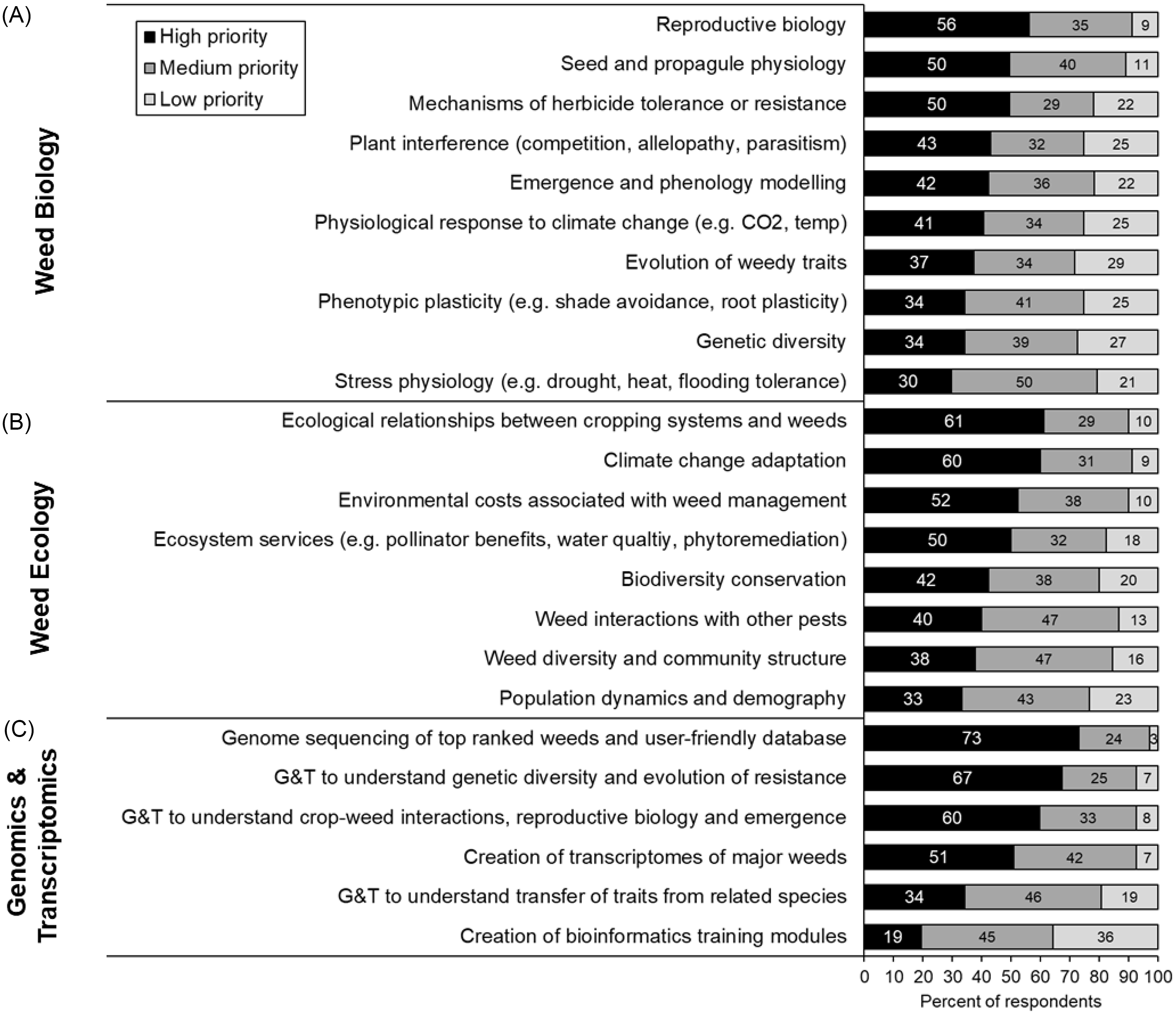
Among the relatively small number of respondents (53) choosing to rank subcategories within Weed Biology, 40% indicated expertise in this area, 81% were from the public sector, and 64% worked primarily in cash crop systems. Among these respondents, more than half ranked Reproductive Biology as high priority, followed by Seed and Propagule Physiology and Mechanisms of Herbicide Tolerance and Resistance (Figure 3A). Forty percent of respondents rated weed Plant Interference, Emergence and Phenology Modeling, and Physiological Responses to Climate Change as high priorities. However, in several cases, subcategory ratings varied substantially based on the institution of respondents (data not shown). For example, 76% of private sector respondents rated Mechanisms of Herbicide Tolerance and Resistance as a high priority compared with 43% of those from the public sector. Likewise, only 12% of industry respondents considered Physiological Responses to Climate Change a high priority compared with 47% of those from the public sector.
Prioritization of subcategories within (A) Weed Biology, (B) Weed Ecology, and (C) Weed Genomics and Transcriptomics. Boxes are shaded based on the percentage of respondents indicating the research subcategory as high priority (black), medium priority (gray), and low priority (white).
Weed Genomics
Weed Genomics was considered a high priority by 31% of respondents, with 9% ranking it as their top priority (Figure 1A and 1B). This ranking was roughly on par with that of Weed Biology and well below rankings of the four broad areas more directly related to weed management. This relatively low ranking could be because research in weed genomics is still in its infancy and/or that many weed scientists responding to this survey may not see a clear connection between Weed Genomics and improved weed management.
Although the importance of genetic studies to provide insights into the discovery of new herbicide targets and an in-depth understanding of weed biology have long been recognized (Hess et al. Reference Hess, Anderson and Reagan2001; Ravet et al. Reference Ravet, Patterson, Krähmer, Hamouzová, Fan, Jasieniuk, Lawton-Rauh, Malone, McElroy, Merotto, Westra, Preston, Vila-Aiub, Busi and Tranel2018; Tranel and Horvath Reference Tranel and Horvath2009), only recently has considerable effort been made in whole-genome sequencing of important weed species (Laforest et al. Reference Laforest, Martin, Bisaillon, Soufiane, Meloche and Page2020; Patterson et al. Reference Patterson, Saski, Sloan, Tranel, Westra and Gaines2019; Peng et al. Reference Peng, Abercrombie, Yuan, Riggins, Sammons, Tranel and Stewart2010). For example, the recently established International Weed Genomics Consortium (IWGC) aims for a coordinated international effort to provide a platform for private and public collaboration to develop genomic tools and resources to stimulate global research in weed biology and management and to ensure there is no duplication of sequencing of weed species (Ravet et al. Reference Ravet, Patterson, Krähmer, Hamouzová, Fan, Jasieniuk, Lawton-Rauh, Malone, McElroy, Merotto, Westra, Preston, Vila-Aiub, Busi and Tranel2018).
Among the 67 respondents choosing to rank subcategories within Weed Genomics, 27% indicated expertise in this area, with 79% working in cash crop systems and 30% working in industry. Among these respondents, Genome Sequencing of Top-ranked Problem Weeds and Development of User-Friendly Databases was the top rated subcategory, followed by use of Weed Genomics and Transcriptomics to Understand Genetic Diversity and the Evolution of Resistance (Figure 3C). More than two-thirds of those prioritizing these subcategories identified these as high priority. The whole-genome sequencing of problem weeds is also a top priority of IWGC, with sequencing of several of the top-ranked weeds (Palmer amaranth [Amaranthus palmeri S. Watson], waterhemp [Amaranthus tuberculatus (Moq.) Sauer], barnyardgrass [Echinochloa crus-galli (L.) P. Beauv.], horseweed [Conyza canadensis (L.) Cronquist]) completed and available to the public. Whole-genome sequencing of several other weed species (e.g., perennial ryegrass [Lolium perenne L.], giant ragweed [Ambrosia trifida L.], common ragweed [Ambrosia artemisiifolia L.], and wild radish [Raphanus raphanistrum L.]) are in progress.
Only 6% of all survey respondents indicated expertise in Weed Genomics (Figure 1C), suggesting a need for increased training of weed scientists in this area. Further, it is important that weed scientists establish collaborations with plant evolutionary biologists and experts in plant genomics to address key issues in this research area. Nonetheless, interest in weed genomics appears to have grown in the last 15 years, although direct comparisons with the 2007 survey are not possible, as only 2% of respondents considered weed genomics a top priority with respect to their primary stakeholders at that time (Davis et al. Reference Davis, Hall, Jasieniuk, Locke, Luschei, Mortensen, Riechers, Smith, Sterling and Westwood2009).
Weed Ecology
The survey clearly indicated that Weed Ecology is not considered a high research priority among the majority of survey respondents (Figure 1A and 1B), although rankings varied greatly depending on their institutions (Table 1) and study system (Table 2). Overall, approximately 25% of respondents considered Weed Ecology a high priority, and only 6% ranked it as their top priority. Respondents from academic and government institutions were five and seven times more likely to consider Weed Ecology a high priority than industry respondents, respectively. Respondents working in agronomic, horticultural, and turf study systems generally rated weed ecology as lower priority than those working in natural areas, forage, rangeland, or pasture. However, priorities sometimes differed substantially among weed scientists within study systems. For example, among respondents working in agronomic cropping systems, a larger portion of those in academia (24%) viewed Weed Ecology as a high priority compared with those from industry (6%).
Among the 90 respondents choosing to rank subcategories within Weed Ecology, 62% indicated expertise in this area, with 61% working in cash crop systems and 92% working in academic or government institutions (with only 8% working in industry). Among these respondents, nearly two-thirds ranked Ecological Relationships between Crops and Weeds as a high priority, followed by Climate Change Adaptation, a category with some overlap in Weed Biology (Figure 3B). However, for several subcategories, prioritization varied based on the study system of respondents. Most notably, >60% of respondents working in natural systems rated Biodiversity Conservation as a high priority compared with only 29% of those working primarily in cash crop systems. Despite the limited information on weed adaptations to climate change, the survey suggests that weed scientists are paying attention to climate change as a driver of future weed problems or challenges in management. The role of weeds as a source of ecosystem services was ranked as a high priority for half of respondents, which suggests that many weed scientists are open to exploring and even recognize the need of better understanding the role that weeds play in agricultural and nonagricultural ecosystems beyond interfering with production practices.
An interesting result of our survey is that relatively few respondents (33%) viewed the study of Population Dynamics and Demography as a high priority, despite the high prioritization of Ecological Relationships between Cropping Systems and Weeds. This suggests that respondents may not recognize the importance of plant density fluctuations over time as a key determinant of ecological relationship between crops and weeds.
In contrast with several other broad research areas, the percentage of respondents indicating that they had expertise in weed ecology was almost identical to the percentage that viewed it as a high priority. This result suggests that the level of training received by weed scientists responding to this survey roughly matches its perceived importance as an area of research.
IAW
The relatively broad and non-independent research area of IAW was categorized as high priority by 25% of respondents (Figure 1A). These results must be viewed in light of the fact that only 15% of respondents reported having expertise in IAW (Figure 1C) and that the majority of responses were drawn from members of WSSA, which has historically been a professional organization of researchers managing weeds primarily in agronomic cropping systems. In terms of rank, only 5% of respondents viewed IAW as their top research priority. However, this relatively low ranking in part reflects the breadth of this area, which would be on par with “agriculture weeds,” which was not a choice on the survey. Also, IAW includes elements of all of the other categories, so respondents were asked to choose to rank IAW broadly against other overlapping areas. Nevertheless, it seems clear that among survey respondents, IAW are of lower priority than other aspects of weed management.
The percentage of respondents ranking IAW as a high priority varied by institution type (Table 1) and study system (Table 2). It was ranked the highest among government employees (ranked high priority twice as often as it was by academics and four times as often as it was by scientists in industry), although intermediate among broad research areas within this institution type. The low ranking of IAW among respondents from industry likely reflects their primary emphasis on managing weeds in row crops. On the other hand, those working in natural areas ranked IAW the highest (Table 2), reflecting the ecosystems most impacted by these species.
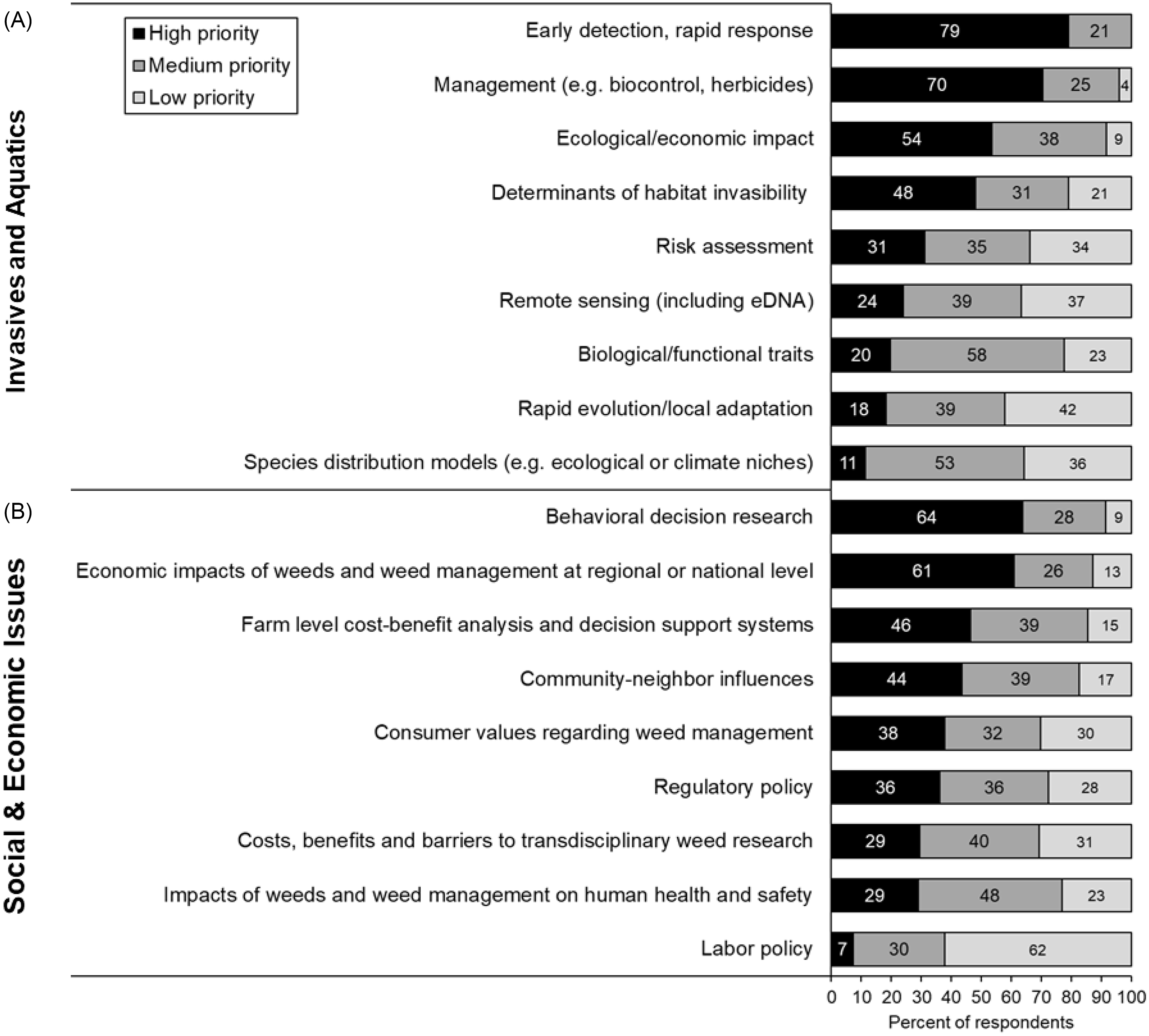
Among the 100 respondents choosing to rank subcategories within IAW, 59% indicated expertise in this area, and 92% reported working in the public sector (only 8% from industry). Among these respondents, rankings of the subcategories (Figure 4A) somewhat reflects the opportunities perceived to have the greatest impact on mitigating these damaging species. The top ranked subcategory was Early Detection and Rapid Response (EDRR), with about 80% of respondents ranking it as high priority, followed by Management, with 70% of respondents. Prevention has long been considered the stage at which the greatest return on investment can be achieved (Keller et al. Reference Keeler, Lodge and Finnoff2007), with the subcategory Risk Assessment serving that role (ranked fifth in our survey), and EDRR being most effective post-introduction at limiting the negative impacts of invasive species. High prioritization of Management among survey respondents reflects an urgent need of land managers, who have many fewer tools and options for managing invasive and aquatic species relative to their counterparts in agronomic systems. The non–management related themes (e.g., traits, rapid evolution, distribution models) were ranked relatively lower, although they remain important areas of research in the invasive species community.
Prioritization of subcategories within (A) Invasives and Aquatics and (B) Social and Economic Issues. Boxes are shaded based on the percentage of respondents indicating the research subcategory as high priority (black), medium priority (gray), and low priority (white).
The number of respondents who identified as having expertise in IAW was low relative to the more agronomically related weed management disciplines (Figure 1). This reflects the impression of the distribution of “weed scientists” who work in this area, though there are perhaps orders of magnitude more researchers with expertise in IAW who do not consider themselves weed scientists and are not affiliated with WSSA, and thus did not respond to, or never saw, our survey. This highlights an opportunity to engage the broader IAW research community, as happened in 2003 with the joint WSSA/Ecological Society of America meeting.
SEI
SEI was the lowest-ranked broad research area among respondents, with <25% ranking it as a high priority and only 5% ranking it as their top priority (Figure 1A and 1B). This is not surprising, given that <5% of respondents reported expertise in this area (Figure 1C) and that it encompasses a wide range of issues viewed perhaps as beyond the scope of the weed science discipline. Nonetheless, the relatively low ranking of SEI suggests that calls for more inter- or transdisciplinary research integrating social and economic perspectives (e.g., Jordan et al. Reference Jordan, Schut, Graham, Barney, Childs, Christensen, Cousens, Davis, Eizenberg, Ervin and Fernandez-Quintanilla2016; Neve et al. Reference Neve, Barney, Buckley, Cousens, Graham, Jordan, Lawton-Rauh, Liebman, Mesgaran, Schut and Shaw2018; Ward et al Reference Ward, Cousens, Bagavathiannan, Barney, Beckie, Busi, Davis, Dukes, Forcella, Freckleton and Gallandt2014) to solve “wicked problems” such as herbicide resistance (Jussaume et al. Reference Jussaume, Dentzman and Owen2019) have not gained widespread appreciation among weed scientists responding to this survey.
The prioritization of SEI did not vary by institution type (Table 1) but did differ according to the study system of respondents (Table 2). In particular, scientists working in natural systems and forage habitats were roughly twice as likely to rank SEI as high priority compared with those in agronomic or horticultural systems.
Among the 69 respondents choosing to rank subcategories within the SEI research area, 16% reported expertise in this area, with 68% working in cash crop systems and 78% in the public sector. Among these respondents, the highest-ranked subcategory was Behavioral Decision Research, followed by Economic Impacts of Weeds and Weed Management (Figure 4B). The lowest-ranked subcategories included Costs, Benefits and Barriers to Transdisciplinary Research, Impacts of Weeds and Weed Management on Human Health, and Labor Policy. However, in some cases, prioritization varied considerably based on institution type or study system. Most notably, those from the private sector were more than twice as likely to rate Consumer Values Regarding Weed Management as a high priority (67%) compared with those working in the public sector (30%), perhaps a reflection of their desire to understand and overcome negative perceptions of herbicides or genetic modification among consumers. In addition, those working in natural systems were much more likely to rate Impacts of Weeds on Human Health and Safety as a high priority (50%) compared with those working in cash crop systems (19%).
These ratings suggest greater interest among respondents in narrow farm-level or weed-level economic issues, rather than research addressing broader social issues or policy. This result may be discouraging to those who advocate for integration of social and economic approaches to balance trade-offs between private and collective interests related to weed management challenges (e.g., Bagavathiannan et al. Reference Bagavathiannan, Graham, Ma, Barney, Coutts, Caicedo, Clerck-Floate, West, Blank, Metcalf and Lacoste2019; Jordan et al. Reference Jordan, Schut, Graham, Barney, Childs, Christensen, Cousens, Davis, Eizenberg, Ervin and Fernandez-Quintanilla2016; Ward et al. Reference Ward, Cousens, Bagavathiannan, Barney, Beckie, Busi, Davis, Dukes, Forcella, Freckleton and Gallandt2014).
Funding for Research
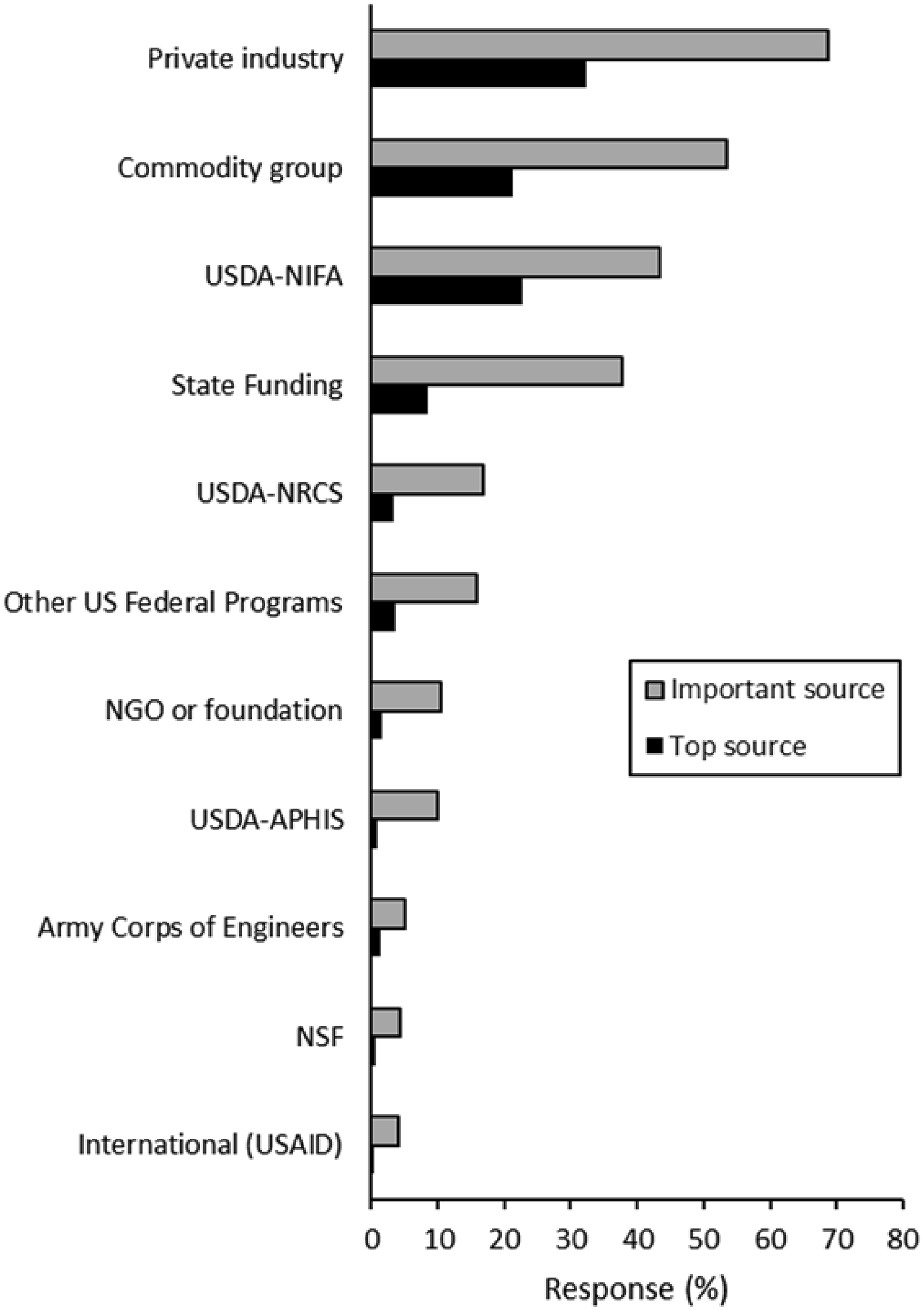
The four sources of funding identified by the highest number of survey respondents as important for weed science research were (1) private industry, (2) commodity groups, (3) U.S. Department of Agriculture–National Institute of Food and Agriculture (USDA-NIFA), and (4) state funding (Figure 5). More than two-thirds of survey respondents indicated that private industry was an important source of their research funding, and 32% ranked it as their top funding source. Commodity groups ranked second, with 54% listing it as an important source, and 21% as their top source. Of federal agencies, USDA-NIFA was identified as an important source of funding by the highest number of respondents (43%) and the top source of funding by 23%. Other federal funding agencies, including USDA–Natural Resources Conservation Service (USDA-NRCS) and USDA–Animal and Plant Health Inspection Service (USDA-APHIS), were identified as important by 10% to 20% of the respondents. The Army Corps of Engineers, National Science Foundation (NSF), and U.S. Agency for International Development (USAID) were identified as important by <10% of the respondents. Other federal agencies not specifically included in the survey, such as USDA–Agriculture Research Service (USDA-ARS), U.S. Department of Transportation (DOT), and U.S. Department of Defense (DOD) were identified by 16% of the respondents as important. State funding was identified as an important source by 38% of the respondents, but as the top source by only 8%. Nongovernmental organizations (NGOs) or foundations were selected as important sources of funding by 10% of the respondents.
Importance of different funding sources for U.S. respondents. Percentage of respondents indicating that the source is important (gray bars) or their top (black bars) funding source. NGO, nongovernmental organization; NSF, National Science Foundation; USAID, U.S. Agency for International Development; USDA-APHIS, U.S. Department of Agriculture–Animal and Plant Health Inspection Service; USDA-NIFA, U.S. Department of Agriculture–National Institute of Food and Agriculture; USDA-NRCS, U.S. Department of Agriculture–Natural Resources Conservation Service.
While these composite data are informative, it is important to note that significant differences in responses were identified by institution type (Table 3). Private industry and commodity groups were an important source of funding not only for those in industry—as expected—but also for those in academia and, to a lesser extent, those in government (Table 3). Approximately two-thirds of academic respondents identified commodity group and private industry funding as important, compared with 25% to 33% of government respondents. A much higher percentage of academic respondents (59%) identified USDA-NIFA as an important source of funding, compared with those from industry and government, and a higher percentage of government respondents identified state funding and other federal sources as important, compared with industry and academic respondents.
Percentage of U.S. respondents (n = 297) ranking funding sources as important, by institution type. a
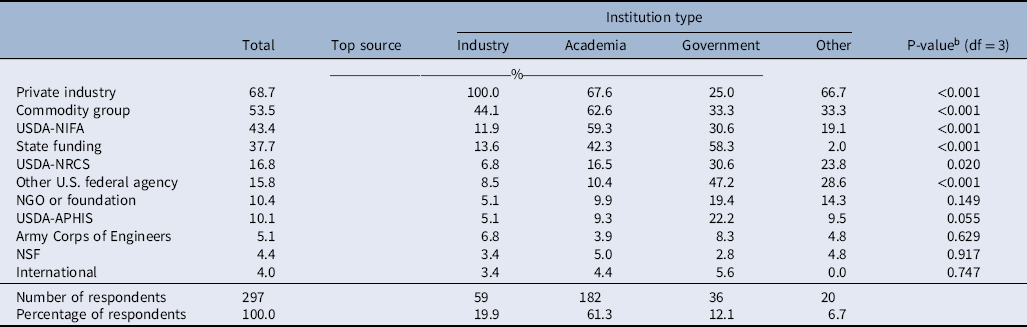
a Abbreviations: NGO, nongovernmental organization; NSF, National Science Foundation; USDA-APHIS, U.S. Department of Agriculture–Animal and Plant Health Inspection Service; USDA-NIFA, U.S. Department of Agriculture–National Institute of Food and Agriculture; USDA-NRCS, U.S. Department of Agriculture–Natural Resources Conservation Service.
b Significance of chi-square test; a value <0.05 suggests that the percentage of respondents considering a source important varied by insitution type or study system.
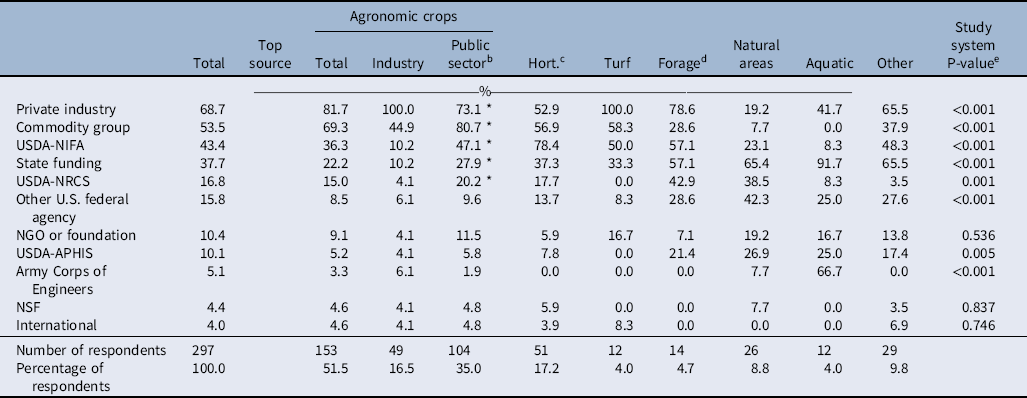
Funding sources also varied by the study system of respondents (Table 4). Funding from private industry was identified as particularly important for those working in agronomic, turfgrass, and forage systems (>75% reporting as important), followed by horticultural crops (53%) and aquatic study systems (42%). In contrast, only 19% of those working in natural (terrestrial) study systems reported private industry as an important funding source. Similarly, commodity group funding was identified as important primarily for those working in agronomic, turfgrass, and horticultural study systems. Commodity funding was reported as particularly important for public sector respondents studying agronomic systems (81% reporting as important). Among public sector funding sources, USDA-NIFA was identified as important by 78% of respondents studying horticultural systems, compared with 47% of agronomy respondents working in the public sector and 23% of those studying natural areas. In contrast, those studying aquatic systems most often reported funding from state government sources (92%) and the Army Corps of Engineers (67%) as important. State funding was also considered an important funding source by >50% of those studying natural areas and forage crops and 37% of those studying horticultural crops, but only 22% of those studying agronomic cropping systems. USDA-NRCS and USDA-APHIS funding were important funding sources primarily to respondents studying natural areas and forage cropping systems.
Percentage of U.S. respondents (n = 297) ranking funding sources as important, by study system. a
a Abbreviations: NGO, nongovernmental organization; NSF, National Science Foundation; USDA-APHIS, U.S. Department of Agriculture–Animal and Plant Health Inspection Service; USDA-NIFA, U.S. Department of Agriculture–National Institute of Food and Agriculture; USDA-NRCS, U.S. Department of Agriculture–Natural Resources Conservation Service.
b Includes academic and government; an asterisk (*) indicates that important funding sources for public sector agronomists differed from agronomists from industry (chi-square test P-value <0.05).
c Includes vegetables, fruits or nuts, and ornamentals.
d Includes forage, pasture, and rangeland.
e Signifcance of chi-square test (df = 6); a value <0.05 suggests that the percentage of respondents considering a source important varied by insitution type or study system.
Differences in the importance of funding sources based on study system and institution generally followed expected patterns. Commercial funding (private industry and commodity group) was important primarily for those working in agronomic and horticultural cropping systems, reflecting the important market these crops represent to private industry and greater availability of checkoff dollars for these commodity groups. As expected, public funding sources at the state and federal level were more important for those working in natural areas and aquatic systems, where private sector incentives for investment are lower.
Results from this survey suggest that commercial funding (private industry and commodity group funding) represents an important source of support for weed science research. Among survey respondents, 53% reported commercial funding as their top source (59% among WSSA members) compared with only 43% from the 2007 survey of WSSA members (Davis et al. Reference Davis, Hall, Jasieniuk, Locke, Luschei, Mortensen, Riechers, Smith, Sterling and Westwood2009). This trend is consistent with reported shifts in funding sources for U.S. agricultural research in general over this time period. For example, Nelson and Fuglie (Reference Nelson and Fuglie2022) reported that public sector spending for agricultural research has declined by a third over the past two decades. During roughly the same time period, private sector funding for research and development from agricultural input industries increased sharply (Fuglie and Nelson Reference Fuglie and Nelson2022), although the distribution of that funding to weed scientists is unclear. This shift in funding sources raises concerns regarding our capacity to address research questions in weed science with relatively little private sector incentives for investment.
The Way Forward
We received 475 responses to the survey, including approximately 25% of the membership of WSSA. Despite the inherent limitations and biases of surveys like this one, we believe the results reflect opinions of a broad range of weed scientists associated with WSSA and some of its affiliates. Furthermore, the information gathered here provides useful discussion points for policy makers, funding agencies, and academic institutions as they consider allocation of resources for research and training. Although it is challenging to interpret rankings of overlapping research categories that vary in scope, survey results support several broad conclusions worth emphasizing.
Perhaps most notably, our survey suggests a strong interest in broadening weed science research beyond the historic emphasis on herbicides toward several other areas of management. In the previous WSSA survey conducted in 2007 (Davis et al. Reference Davis, Hall, Jasieniuk, Locke, Luschei, Mortensen, Riechers, Smith, Sterling and Westwood2009), herbicide-related topics, including “Herbicide Efficacy Enhancement” and “Herbicide Resistance” were the top two research priorities, far surpassing other topics included in that survey. Although herbicide-focused research clearly remains an important priority today (>50% of respondents indicated it was a high priority), CPWM led the current list of broad research areas (Figure 1), with subcategories such as Crop Rotation and Diversification Strategies and Cover Cropping ranked as high priority by >50% of respondents. Our survey also indicates a strong interest in research in the emerging area of PWMR, with >50% of respondents considering this an important research priority. Artificial Intelligence for Weed ID and Vision Systems for Detection of Weed-Crop-Soil Characteristics were ranked as particularly important research subcategories within PWMR deserving of public support.
Despite shifts in perceived research priorities since 2007, our survey suggests that broad areas of weed science expertise have not changed much in that time, and our discipline’s ability to address research areas that it considers important may be limited as a result. Comparing survey respondents’ broad areas of expertise with their research priorities (Figure 1A vs. C), several potential gaps are evident. Most notably, respondents to this survey are underequipped to directly address priorities in the area of PWMR. Similarly, there appears to be a mismatch between expertise in Weed Genomics and SEI and their perceived importance to our discipline.
Given discrepancies between perceived research priorities and expertise in several research areas, our survey suggests that the weed science discipline would benefit from efforts to increase training and collaboration in areas such as engineering, computer science, genomics, and economics to help address our broad research priorities. While efforts are underway to broaden collaboration and training in some of these areas (e.g., the IWGC), more work is clearly needed.
Calls for greater collaboration and training across disciplines to address weed research priorities are not new (e.g., Davis et al. Reference Davis, Hall, Jasieniuk, Locke, Luschei, Mortensen, Riechers, Smith, Sterling and Westwood2009; Neve et al. Reference Neve, Barney, Buckley, Cousens, Graham, Jordan, Lawton-Rauh, Liebman, Mesgaran, Schut and Shaw2018; Ward et al. Reference Ward, Cousens, Bagavathiannan, Barney, Beckie, Busi, Davis, Dukes, Forcella, Freckleton and Gallandt2014; Wyse Reference Wyse1992). For example, Davis et al. (Reference Davis, Hall, Jasieniuk, Locke, Luschei, Mortensen, Riechers, Smith, Sterling and Westwood2009) concluded, based in part on their interpretation of 2007 survey results, that “if it is to remain relevant,” the weed science discipline must broaden its scope beyond herbicide efficacy and encourage greater integration of topics with a “complex systems” focus. Our survey suggests that, in terms of research priorities, some movement in this direction has occurred since 2007, as evidenced by the top ranking of CPWM and the subcategory Combining Multiple Tactics. However, the relatively low ratings of Weed Biology, Weed Ecology, and Weed Genomics suggest that many respondents do not believe that expanded research in these areas is critical for the development of successful integrated weed management programs. Additionally, self-identified expertise in these topics is similar between early-career and later-career weed scientists. The low rankings of SEI also suggest that the majority of weed scientists do not prioritize integration of social and economic approaches for solving weed management challenges such as those suggested by Bagavathiannan et al. (Reference Bagavathiannan, Graham, Ma, Barney, Coutts, Caicedo, Clerck-Floate, West, Blank, Metcalf and Lacoste2019) and increasingly emphasized by federal agencies (e.g., USDA-NIFA) supporting weed science research (Jordan et al. Reference Jordan, Schut, Graham, Barney, Childs, Christensen, Cousens, Davis, Eizenberg, Ervin and Fernandez-Quintanilla2016).
Identification of research priorities is an important first step, but progress in addressing those priorities depends critically on availability of the funding and expertise to do so. Although a detailed characterization of respondent funding levels was beyond the scope of this survey, our results suggest a shift toward an increased reliance on private sources of funding since 2007. This apparent shift is consistent with reported decline in public sources of funding for agricultural research in general over this time period (Nelson and Fuglie Reference Nelson and Fuglie2022) and raises concerns regarding the capacity of weed scientists to address research priority areas without clear private sector incentives for investment (Clancy et al. Reference Clancy, Fuglie and Heisey2016). Communicating these priority areas to public sector funding agencies and demonstrating how they will contribute to sustainable crop production are essential for the diverse categories that encompass our broader discipline. Moreover, using surveys such as this as guidance for training the next generation of weed scientists can help ensure flexibility in our discipline moving forward.
Acknowledgments
We express our gratitude to the anonymous survey respondents who made this study possible. We would also like to thank Stephen Young, Alan Helm, Douglas Bessette, Steven Fennimore, Anita Dille, David Erwin, George Frisvold, Patrick Tranel, Bill Johnson, Jason K. Norsworthy, Jason Ferrell, and Chauhan Bhagirath for their advice and valuable suggestions. We also appreciate the thoughtful comments and suggestions from two anonymous reviewers on previous versions of this article. No conflicts of interest have been declared. This research received no specific grant from any funding agency or the commercial or not-for-profit sectors.


 Open access

