





Highlights
-
• Cross-situational word learning paradigms can reflect monolingual and bilingual learning.
-
• Word to object mappings are easier to learn from just one language.
-
• Mixing labels impairs learning two words for an object.
-
• Language mixing may exert only a short-term negative effect on learning.
-
• Competition between labels potentially explains slower learning in language mixing.
1. Introduction
Determining the mapping between a word and its referent is a major challenge in language learning, because there are many – infinite even – possibilities for what the word refers to in the learner’s environment (Quine, Reference Quine1960). Fortunately, however, learners tend to hear words more than once, across environmental situations that vary, and this creates opportunities for identifying a unique aspect of the environment that co-occurs with the word (Siskind, Reference Siskind1996) as the speaker’s intended referent.
Numerous studies have now demonstrated that learners are sensitive to, and able to use, these cross-situational statistics in order to acquire mappings between words and referents (Akhtar & Montague, Reference Akhtar and Montague1999; Bunce & Scott, Reference Bunce and Scott2017; Monaghan & Mattock, Reference Monaghan and Mattock2012; Yu & Smith, Reference Yu and Smith2007). However, the majority of these studies have focused on how one-to-one word–object mappings can be acquired (Roembke, Simonetti, Koch, & Philipp, Reference Roembke, Simonetti, Koch and Philipp2023), but this does not capture all types of mappings that are required for language learning, which make the task of learning not only substantially richer but also even more challenging. There are numerous instances where the same word can refer to different referents (as in homonyms within a language, or false friends across languages). Yet, these instances of one label mapping to multiple referents can also be acquired through cross-situational statistics (Poepsel & Weiss, Reference Poepsel and Weiss2016; Yurovsky, Yu, & Smith, Reference Yurovsky, Yu and Smith2013). However, more commonly in natural language situations (Nowak & Krakauer, Reference Nowak and Krakauer1999), different words can refer to the same referent. This many-to-one mapping situation applies both within a language, in the case of basic and superordinate or subordinate category labels (e.g., bird, animal, penguin), which can again be acquired through cross-situational statistics (Chen, Zhang, & Yu, Reference Chen, Zhang and Yu2018; Gangwani, Kachergis, & Yu, Reference Gangwani, Kachergis and Yu2010), and also in multilingual environments. Many-to-one mappings are the usual, rather than the exceptional, case for the majority of the world growing up in multilingual learning environments.
1.1. Learning two labels for one object
Learning a single label for a referent is not only supported by cross-situational statistics, but has also been proposed to be supported by mutual exclusivity (McMurray, Horst, & Samuelson, Reference McMurray, Horst and Samuelson2012; Trueswell, Medina, Hafri, & Gleitman, Reference Trueswell, Medina, Hafri and Gleitman2013). Mutual exclusivity refers to a learner’s bias to link one word only with one referent, such that if a referent in the learner’s environment has already been labelled then the learner tends to assume that a novel word refers to another referent (Markman, Reference Markman1990). In the case of acquiring two labels for a referent, however, the learner has to instead relax the mutual exclusivity constraint, and accept lexical overlap for a referent (Kalashnikova, Mattock, & Monaghan, Reference Kalashnikova, Mattock and Monaghan2015, Reference Kalashnikova, Mattock and Monaghan2016; Savage & Au, Reference Savage and Au1996). Both children and adults can do this: Kalashnikova, Oliveri, and Mattock (Reference Kalashnikova, Oliveri and Mattock2019), for instance, showed that children are able to learn two labels for an object in an overt referent labelling task, though younger (monolingual) children are less adept at doing so (Kalashnikova et al., Reference Kalashnikova, Mattock and Monaghan2015).
Learning two labels for a referent can be successfully acquired using cross-situational statistics. Ichinco, Frank, and Saxe (Reference Ichinco, Frank and Saxe2009) gave participants a set of one-to-one word–object mappings in a cross-situational learning paradigm, and then were introduced to additional words and objects, resulting in a mix of one-to-one, two-to-one and one-to-two word–object mappings. They found that, though participants tended to resist additional words mapping onto previously labelled objects, they were able to acquire some of these two-to-one word–referent mappings. Similarly, Benitez, Yurovsky, and Smith (Reference Benitez, Yurovsky and Smith2016) conducted a series of studies investigating adult learners’ ability to acquire one-to-one and two-to-one word–object mappings. In their first study, they intermixed the one-to-one and two-to-one word–object mappings and found that there was an advantage for acquiring the one-to-one mappings, but that two-to-one word–object mappings were also learned better than chance levels. In their second study, in the first part of training, only one label was presented for each object and then in the second part of the study, for two-to-one word–object mappings only the second label for the object was presented. Again, the results demonstrated that learners were able to acquire both labels under the two-to-one mapping condition, and though the accuracy was lower than the one-to-one mappings, there was no deficit for acquiring the second compared to the first label for the two-to-one mappings. Benitez and Li (Reference Benitez and Li2024) found that for children aged 4 to 7, two-to-one learning was only possible for the older children, though children throughout this age range could learn one-to-one mappings.
Despite the greater difficulty in acquiring two labels for an object compared to one label, learners are evidently able to achieve this, at least by some point in development. However, learners’ language background – the extent to which they have experience of multiple languages in their language environment – may also influence the extent to which participants are able to learn two-to-one word–referent mappings.
1.2. Monolingual versus bilingual word learning
Learners who have proficiency in multiple languages seem to have an advantage in learning words compared to learners who have proficiency in only one language, for both explicit instruction (Colunga, Brojde, & Ahmed, Reference Colunga, Brojde and Ahmed2012; Kaushanskaya & Marian, Reference Kaushanskaya and Marian2009; Yang, Hartanto, & Yang, Reference Yang, Hartanto and Yang2016; though see Paap, Johnson, & Sawi, Reference Paap, Johnson and Sawi2015) and when acquiring words implicitly through cross-situational statistics (Escudero, Mulak, Fu, & Singh, Reference Escudero, Mulak, Fu and Singh2016), though this is not always found (e.g., Crespo and Kaushanskaya, Reference Crespo and Kaushanskayain press). This advantage, though relatively small, may be enhanced in cases where participants must acquire word–referent mappings that overlap. Poepsel and Weiss (Reference Poepsel and Weiss2016) gave participants one-to-one word–object mappings to acquire, then a second block where the same words mapped onto different objects (one-to-two word–object mappings). They found that bilingual participants were able to acquire the additional word–object mappings than monolingual participants, demonstrating greater relaxation of mutual exclusivity, consistent with bilingual children’s greater willingness to accept lexical overlap than monolingual children (Kalashnikova et al., Reference Kalashnikova, Oliveri and Mattock2019).
Benitez et al. (Reference Benitez, Yurovsky and Smith2016) tested whether monolingual and bilingual adult participants learned one-to-one and two-to-one word–object mappings differently. They found no differences for one-to-one mappings, nor were there differences for two-to-one mappings, except when an additional phonotactic cue was present in which each of the two labels for the same object comprised distinct syllabic structures. In this case, there was a bilingual learning advantage. Chan and Monaghan (Reference Chan and Monaghan2019) similarly found that monolingual and bilingual speakers did not differ in acquiring one-to-one mappings from cross-situational statistics, but for two-to-one word–object mappings, the bilingual speakers learned more quickly than monolingual speakers. Li and Benitez (Reference Li and Benitezin press) confirmed that there was no difference between monolinguals and bilinguals on two-to-one word–object mappings when similar phonotactic structure (but distinct lexical tones for each word in the two-to-one mappings) was used for all words.
Learners’ language experience, thus, under certain circumstances of word learning, affects ability to accept and acquire two labels for the same referent. Yet, environmental conditions of learning also have an impact on word learning that may interact with language experience.
1.3. Local co-occurrences in monolingual language learning
In natural language, speakers, especially with young children, tend to use the same word multiple times in quick succession (Karmazyn-Raz & Smith, Reference Karmazyn-Raz and Smith2023; Slone, Abney, Smith, & Yu, Reference Slone, Abney, Smith and Yu2023), referred to as ‘burstiness’ in the linguistic environment (Altmann, Pierrehumbert, & Motter, Reference Altmann, Pierrehumbert and Motter2009). In experimental studies, repeating words provides an advantage for learning (Horst & Samuelson, Reference Horst and Samuelson2008), particularly when those repetitions are close together (Schwab & Lew-Williams, Reference Schwab and Lew-Williams2016), and this ‘burstiness’ has been shown to support segmentation of speech when the same word occurs in consecutive utterances (Onnis, Waterfall, & Edelman, Reference Onnis, Waterfall and Edelman2008).
Onnis, Edelmann, and Waterfall (Reference Onnis, Edelmann and Waterfall2011) directly manipulated how closely together words were repeated in a cross-situational word learning study. In each learning trial, two words and two objects appeared, and participants had to learn, over multiple trials, what the word–object mappings were. In their local learning condition, 80% of trials had one word–referent pair in common, such that one of the two words from one trial occurred in the following trial. In their global learning condition, only 5% of consecutive trials contained a repeated word, though the overall frequencies of occurrences of words and objects, and the conditional probabilities of words and target and foil objects were the same across both conditions. Onnis et al. (Reference Onnis, Edelmann and Waterfall2011) found that participants in the local learning condition acquired mappings more accurately than those in the global learning condition, suggesting that they benefitted from these repetitions – the burstiness – in consecutive trials (see also Onnis & Edelman, Reference Onnis and Edelman2019).
Theoretical models of cross-situational word learning differ in terms of whether they propose that participants apply a strategic approach to learning, whereby a mapping is proposed by the learner, then either confirmed or disconfirmed from further experience (Trueswell et al., Reference Trueswell, Medina, Hafri and Gleitman2013), or whether learning is by more gradual, implicit associative learning between words and potential referents (McMurray et al., Reference McMurray, Horst and Samuelson2012; Yu & Smith, Reference Yu and Smith2012). In both models, local learning for acquiring one-to-one mappings is likely to be advantageous as it either enables the mapping to be tested soon after its proposal (according to the propose-but-verify account), or by boosting associations due to close proximity in experience, mitigating effects of memory decay on the associations (as in the associative learning accounts).
1.4. Local and global co-occurrences in bilingual language environments
Given that local learning is advantageous for learning one-to-one mappings, that is, for acquiring words in a single language, is this also likely to be the optimal conditions for acquiring two-to-one mappings in bilingual learning environments?
Children growing up in bilingual environments experience a wide range of linguistic environments, with different degrees of language mixing (Genesee, Reference Genesee1994). In terms of the distribution of languages in multilingual environments, code-switching between languages is common (Byers-Heinlein, Reference Byers-Heinlein2012), with languages reportedly mixed within sentences frequently (Bail, Morini, & Newman, Reference Bail, Morini and Newman2015; Heredia & Altarriba, Reference Heredia and Altarriba2001; Orena, Byers-Heinlein, & Polka, Reference Orena, Byers-Heinlein and Polka2020), and infants developing skills to focus attention on one language within intermingled language input (Byers-Heinlein, Morin-Lessard, & Lew-Williams, Reference Byers-Heinlein, Morin-Lessard and Lew-Williams2017). The prevalence of language mixing, then, suggests that one of the key challenges to word learning in bilingual environments is that the child is likely to experience two words (one from each language) for the same referent in close proximity – within the local context.
To what extent is this language mixing, or local co-occurrence, environment advantageous or an impediment to learning? A developmental computational model of speech segmentation under bilingual conditions (Fibla, Sebastian-Galles, & Cristia, Reference Fibla, Sebastian-Galles and Cristia2022) found that switching from one language to another every utterance had no overall impact on learning to segment two languages compared to switching every 100 utterances. In an experimental study, Orena and Polka (Reference Orena and Polka2019) showed that language switching from sentence to sentence did not affect infants’ speech segmentation compared to switching languages after blocks of sentences within a language. Thus, though there was no observed advantage of local interchange of languages, there was no detectable disadvantage either. In a study investigating learning of novel words, sentences that mixed languages resulted in lower levels of learning than sentences that were presented in a single language for children aged 3;10–4;10 years (Byers-Heinlein, Jardak, Fourakis, & Lew-Williams, Reference Byers-Heinlein, Jardak, Fourakis and Lew-Williams2022).
In a questionnaire-based study, however, Byers-Heinlein (Reference Byers-Heinlein2012) asked bilingual parents of young children about the frequency of their language mixing using questionnaires, and then related this to 1;5 and 2-year-old children’s vocabularies. They found that frequent mixing within utterances related to children’s smaller vocabularies at age 1;5 years, but this relationship was not found at 2 years. Relatedly, Place and Hoff (Reference Place and Hoff2011) for 25 month olds, Bail et al. (Reference Bail, Morini and Newman2015) for children aged 18–24 months and De Houwer (Reference De Houwer2007) for 6- to 10-year-old children found that the degree of language mixing did not seem to relate to vocabulary learning and development.
In studies with adults, language mixing is common in second language learning settings (e.g., Thompson & Harrison, Reference Thompson and Harrison2014), and Blair and Morini (Reference Blair and Morini2023) tested the effect of mixing on acquisition of novel words. English-speaking second language learners of Spanish learned new words embedded either in English, Spanish or a sentence containing a mix of English and Spanish. They found that new words in the familiar language (English) resulted in best performance, but the sentences containing mixed languages resulted in better performance than a Spanish-only sentence. This could be interpreted as showing that presenting contextual language from the learner’s dominant language resulted in best performance for acquiring new words. On a longer term scale of learning, there is some evidence that acquiring additional languages simultaneously versus successively may boost learning of each language in the language classroom (e.g., Rahmatian & Farshadjou, Reference Rahmatian and Farshadjou2013), because this enabled meta-knowledge about language structure to be applied to support learning of each language (Dmitrenko, Reference Dmitrenko2017).
Although the evidence is somewhat mixed, it may be that separation of languages – and thus avoidance of burstiness in terms of two-to-one mappings – may be helpful to simultaneous learning of multiple languages, especially in earlier stages of vocabulary development.
1.5. The current study
Naturalistic observational studies seem to indicate that language mixing may affect early stages of vocabulary learning, such that when multiple languages are used in a similar context, vocabulary development is beneficial (Byers-Heinlein, Reference Byers-Heinlein2012). However, naturalistic language environments involve complex interactions among social, environmental and linguistic factors that are hard to control (DeKeyser, Reference DeKeyser2013). In this study, therefore, we isolated one key aspect of language mixing that may affect novel word learning, and examined its effect in a controlled laboratory-based setting. Specifically, we tested the extent to which local co-occurrences of two labels for a referent, compared to one label for a referent, may affect acquisition.
First, we predicted that, overall, adult participants will acquire word–object mappings for the words in the language, but that acquisition of mappings for objects that have a single label will be more accurate than those with two labels, in accordance with previous studies (Benitez et al., Reference Benitez, Yurovsky and Smith2016; Li & Benitez, Reference Li and Benitezin press; Poepsel & Weiss, Reference Poepsel and Weiss2016).
Second, we predicted that local co-occurrences will support acquisition of one-to-one word to object mappings (Onnis et al., Reference Onnis, Edelmann and Waterfall2011), but we do not know how local co-occurrences will affect learning two-to-one mappings. This local co-occurrence condition of label mixing simulates one aspect of language mixing learning environments where speakers are likely to use two words for the same referent in a similar context, one from each language. It could be that close occurrences of different labels for the same object can support acquisition of multiple labels for the object, enabling the learner to identify that the word has multiple labels. Alternatively, it may be better to separate these labels from one another to avoid confusion (consistent with Byers-Heinlein, Reference Byers-Heinlein2012).
Third, based on previous studies of cross-situational learning of word–object mappings where there is greater tolerance of mappings that are not one-to-one by bilingual speakers compared to monolingual speakers (Benitez et al., Reference Benitez, Yurovsky and Smith2016; Poepsel & Weiss, Reference Poepsel and Weiss2016), we predicted that language background – whether the participant is proficient in an additional language – will have an effect on learning, particularly for the two label to one object mappings. We also tested whether language background might have an effect on responses to local versus global training, to determine whether there is greater responsiveness to local co-occurrences for speakers who are proficient in an additional language. As bilingual speakers are more adept at accepting multiple labels for a referent, this may enable them to benefit from local co-occurrences of the two-to-one mappings, thus resulting in a mitigation of any disadvantage of the local co-occurrences for two-to-one mappings.
In the design of our study, we tested whether local versus global training would have an influence during the actual occurrences of the repetitions of labels and objects, or whether this would have a longer term impact on retention. Thus, we analysed both learning during training, as well as learning in the final block of the study, after labels are (potentially) learned from the cross-situational statistics, but when the local or global distinction in distributions of words’ usage was not present.
2. Methods
2.1. Participants
The study consisted of 80 participants, recruited using the Lancaster University Psychology departmental recruitment system as well as through word of mouth. Of the participants, 37 were female, 40 were male and 3 non-binary, and the average age was 20.8 years (SD = 6.0).
Participants were asked to rate their English language proficiency on a Likert scale between 1 and 10, with 1 being of low proficiency and 10 being of the highest proficiency. Participants were also asked to rate their proficiency in any other languages they knew, on the same Likert scale of 1 (low proficiency) to 10 (high proficiency). Using the same criteria as suggested by Poepsel and Weiss (Reference Poepsel and Weiss2016), if a participant rated their second language proficiency at 4 or above, they were categorised as bilingual, and if they rated it below 4, they were considered to be functionally monolingual. On average, monolingual participants rated proficiency in a second language as 2.19 (SD = 0.60), and bilinguals rated their proficiency in a second language at 7.47 (SD = 2.14). Monolingual participants rated their English language proficiency at an average of 9.81 (SD = 0.46), whereas bilingual participants rated their English language proficiency at an average of 9.13 (SD = 1.21), which was significantly less, t(46.35) = −3.225, p = .002, d = 0.76.
Within the sample, 38 participants were categorised as bilingual and 42 as monolingual. Each participant was randomly assigned to either a local learning or global learning condition, such that 22 bilinguals and 18 monolinguals took part in the global condition, and 16 bilinguals and 24 monolinguals took part in the local condition.
2.2. Materials
For the familiarisation trials, images of eight familiar objects were taken from the TarrLab Object Databank (1996) and these objects were labelled using the apple mac system voice ‘Allison’ (an English US voice).
For the main part of the experiment, 10 images of unfamiliar objects and 16 novel words from the Novel Objects and Unusual Nouns database (NOUN) (Horst & Hout, Reference Horst and Hout2016, see Appendix).
Eight words were voiced using the apple mac system voice ‘Kate’, and the remaining eight words were voiced using the system voice ‘Daniel’ (both English UK voices). The ‘Kate’ words were randomly paired with eight of the objects. The ‘Daniel’ words were randomly paired with the remaining two objects, and then randomly paired with six of the objects that were already paired with a ‘Kate’ word. Thus, six objects were named with two words – one by each speaker – for the two-word mapping condition, and four objects were named with one word (two by ‘Daniel’ and two by ‘Kate’), for the one-word mapping condition.
2.3. Procedure
Participants were first asked to rate their English language proficiency on a Likert scale of 1 to 10 (where 10 is of the highest proficiency and 1 is of the lowest), as well as their proficiency in any other languages they know, also on a Likert scale of 1 to 10 (where 10 is of the highest proficiency and 1 is of the lowest).
The experiment began with four familiarisation trials consisting of familiar words and objects. For each trial, participants viewed two objects on a computer screen, and heard a word, and were instructed to press the left arrow key when they thought the spoken word was referring to the image on the left, and the right arrow key when they thought the spoken word was referring to the image on the right. After participants had taken part in the four familiarisation trials, they progressed onto the training trials.
There were four training blocks in total, each comprising 80 trials. For each trial, two novel objects were presented on the screen, and participants heard a novel word and had to guess which object they thought the speaker was referring to. One of the objects always co-occurred with the spoken word – the target – and one was selected pseudo-randomly, which acted as a foil. Within a block, each word occurred 5 times as the target, with each two-label object occurring 10 times as target and each one-label object occurring 5 times as the target. All objects occurred an equal number of times as foil – 8 times within a block.
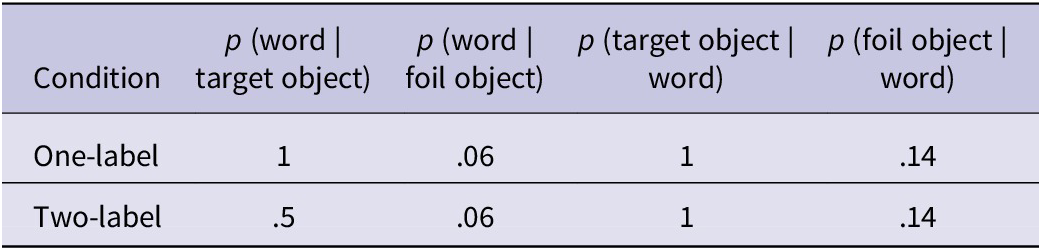
The conditional probabilities of a word given a target or foil object occurring, and a target or foil object occurring given a word, are shown in Table 1.
Conditional probabilities of words given objects and objects given words across the training trials
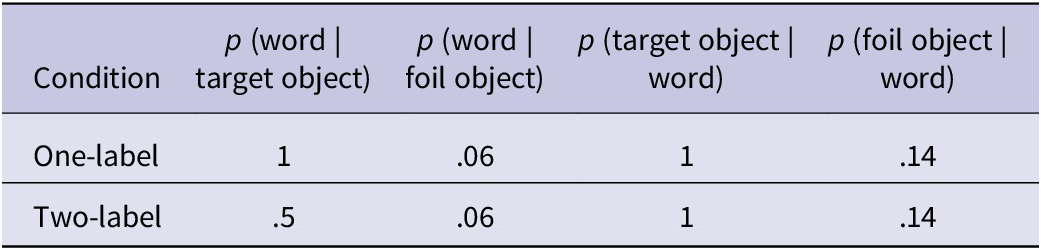
Table 1. Long description
The table consists of five columns and three rows including the header.
Header Row:
- Condition
- p (word | target object)
- p (word | foil object)
- p (target object | word)
- p (foil object | word)
Data Rows:
1. One-label condition: p (word | target object) is 1. p (word | foil object) is .06. p (target object | word) is 1. p (foil object | word) is .14.
2. Two-label condition: p (word | target object) is .5. p (word | foil object) is .06. p (target object | word) is 1. p (foil object | word) is .14.
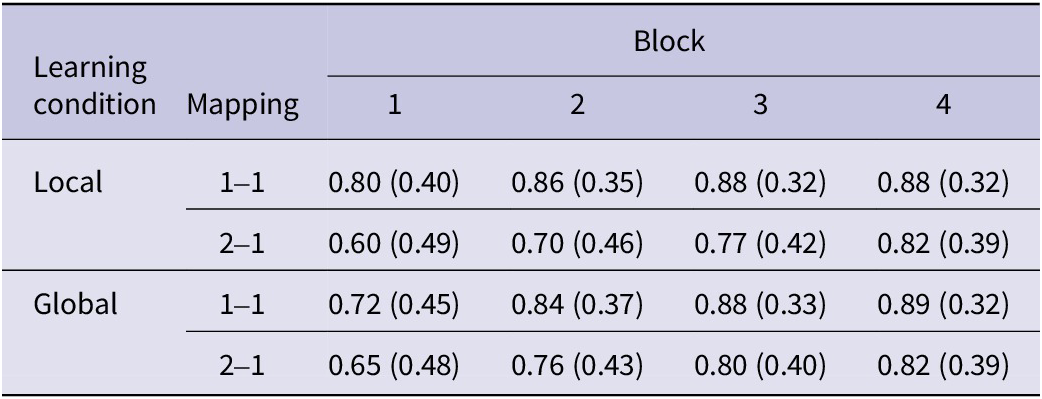
Proportion correct values by block and mapping for local and global learning condition, as shown in Figure 2
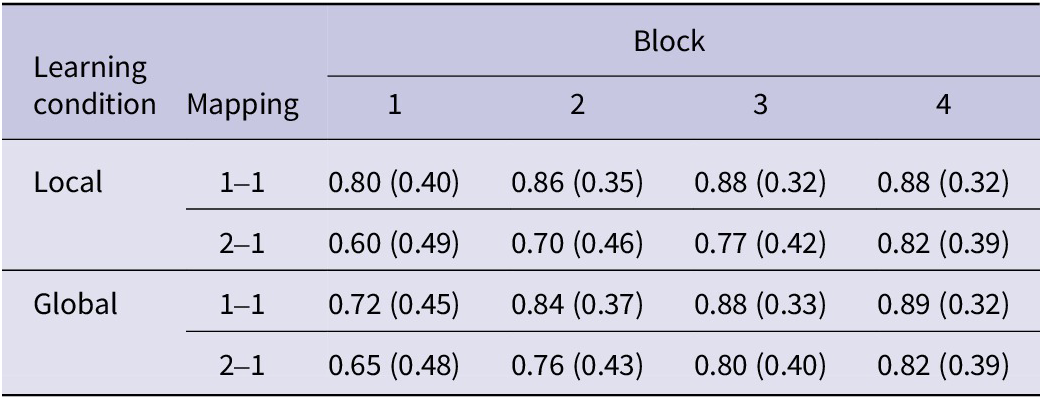
Table 2. Long description
The table is organized by Learning condition, Mapping, and Block (1 through 4). Values are presented as means with standard deviations in parentheses.
* Local Learning Condition:
- 1-1 Mapping: Block 1 is 0.80, Block 2 is 0.86, Block 3 is 0.88, and Block 4 is 0.88.
- 2-1 Mapping: Block 1 is 0.60, Block 2 is 0.70, Block 3 is 0.77, and Block 4 is 0.82.
* Global Learning Condition:
- 1-1 Mapping: Block 1 is 0.72, Block 2 is 0.84, Block 3 is 0.88, and Block 4 is 0.89.
- 2-1 Mapping: Block 1 is 0.65, Block 2 is 0.76, Block 3 is 0.80, and Block 4 is 0.82.
Participants were randomly assigned to either a local or global learning experimental condition. This meant that exposure to the trials had a different order within the first three blocks of training.
For the local learning condition, participants were exposed to word–object mappings where the same target object occurred in a cluster during the training block. For the one-label mappings, the same word was repeated in two consecutive trials, then two trials later, it was repeated again in two more consecutive trials. For the two-label mappings, the participant heard either one label in two consecutive trials and then the other label for the same object in two consecutive trials two trials later, or each of the words labelling the same object in two consecutive trials, and then the same again two trials later. Thus, over a sequence of eight trials the participant saw the same object four times in two sets of pairs, and each of the two labels were used to refer to it twice for two-to-one mappings, or the label was heard four times for the one-to- one mappings.
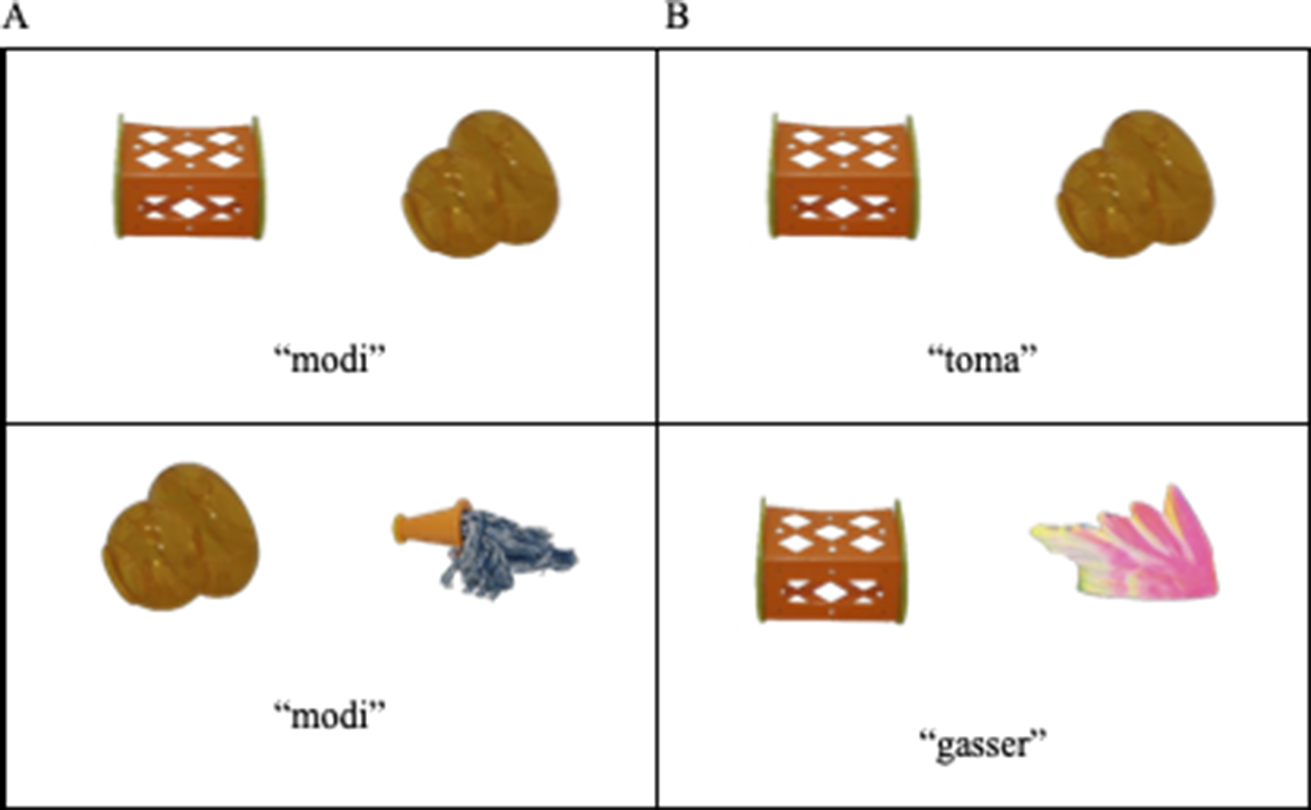
For the global learning condition, all of the trials were randomised in order, such that the repetition of objects across sequential trials was lower in likelihood. Figure 1 provides an illustration of two consecutive trials in the local and global learning conditions respectively.
Example of two consecutive trials in the local learning condition for (A) one-label and (B) two-label word–object mappings.
After three blocks of training, all participants were given the final block under global learning conditions – such that objects occurring on consecutive trials was low in likelihood. This meant that the final block of training was the same for participants in both exposure conditions, and ensured that we could test whether differences in exposure to local or global learning conditions had a longer term effect, or whether it only assisted participants proximally, in selecting referents during the cluster of repeating trials.
After each block of training, participants had the opportunity to take a short break. The experiment was presented using PsychoPy (Peirce et al., Reference Peirce, Gray, Simpson, MacAskill, Sogo, Kastman and Lindeløv2019), and testing took place in a quiet place on a laptop using headphones.
3. Results
Analyses were pre-registered: https://osf.io/ruq43/?view_only=e7a9402b99e3402d8544a4b9fad5153b
Accuracy of selection of the target object in each trial was analysed using a series of general linear mixed effects models (GLMEs; using lme4 package v.1.1-31 in R v.4.2.2). Accuracy was the dependent variable, with random effects of participant and of the word. Analyses and model comparison were conducted in accordance with the pre-registered analysis.
We began with a baseline model which contained only random effects. The most complex random effects structure that converged and was not singular was constructed, however, due to lack of convergence for more complex models, the final baseline model contained only intercepts (and no slopes). Then, each of the fixed main effects were entered, followed by two-way interactions among the fixed effects. Each of the effects was tested for its contribution to accounting for variance in the dependent variable using log-likelihood comparisons (Barr, Reference Barr2013). All main effects were included in the final model, and if an interaction effect contributed significantly to explaining variance then it was retained, otherwise it was removed and the next interaction effect was then tested. The final model contained all the main fixed effects and the significant interaction effects.
We constructed models to test overall performance throughout training, and then models for only the final training block.Footnote 1 We report each of these in the following sub-sections.
3.1. All training trials
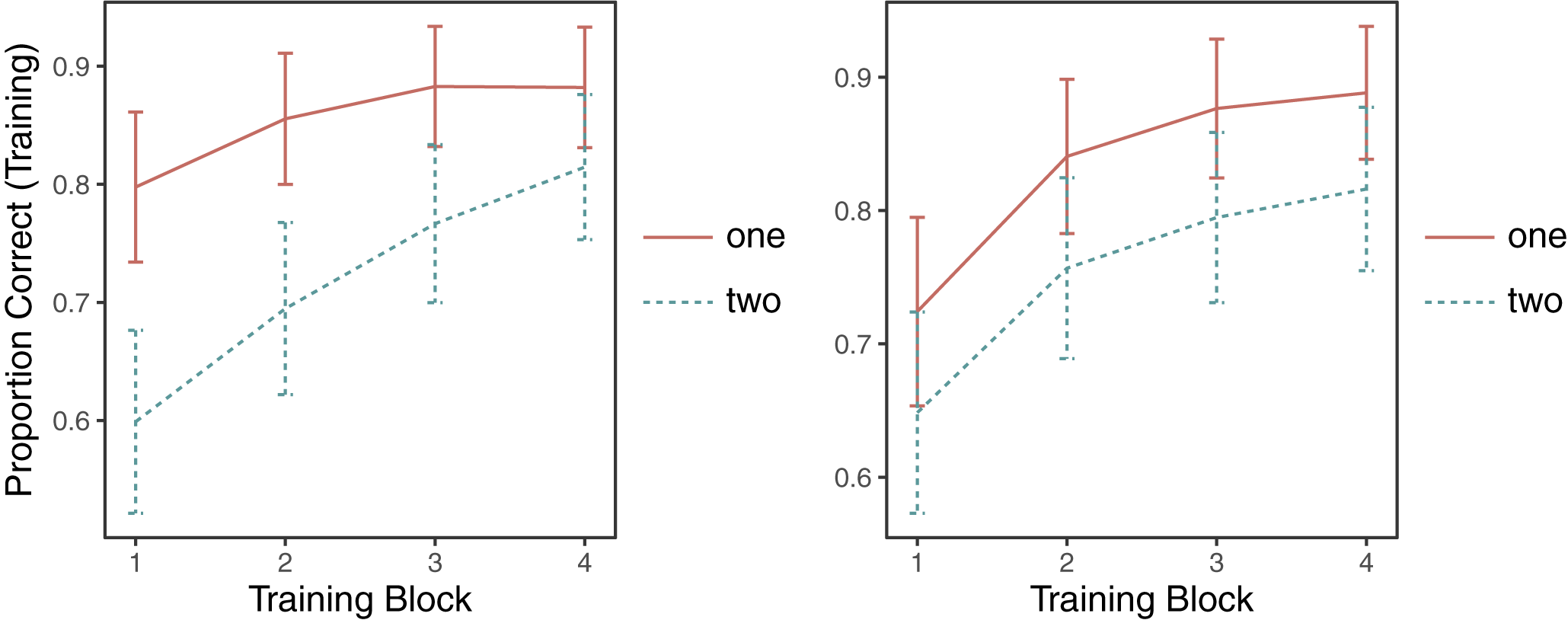
In order to determine whether participants performed on the task above chance, we assessed the intercept in the baseline model. This effect was significant, z = 9.106, p < .001, indicating that over all trials across all the conditions, accuracy was significantly above chance. Figure 2 shows the accuracy for each of the four training blocks by mapping type, for the local and global conditions, and means and standard deviations of proportions correct are shown in Table 2.
Proportion correct during training for the one-to-one and two-to-one mappings for (A) local and (B) global training conditions. Error bars show standard error of the mean.
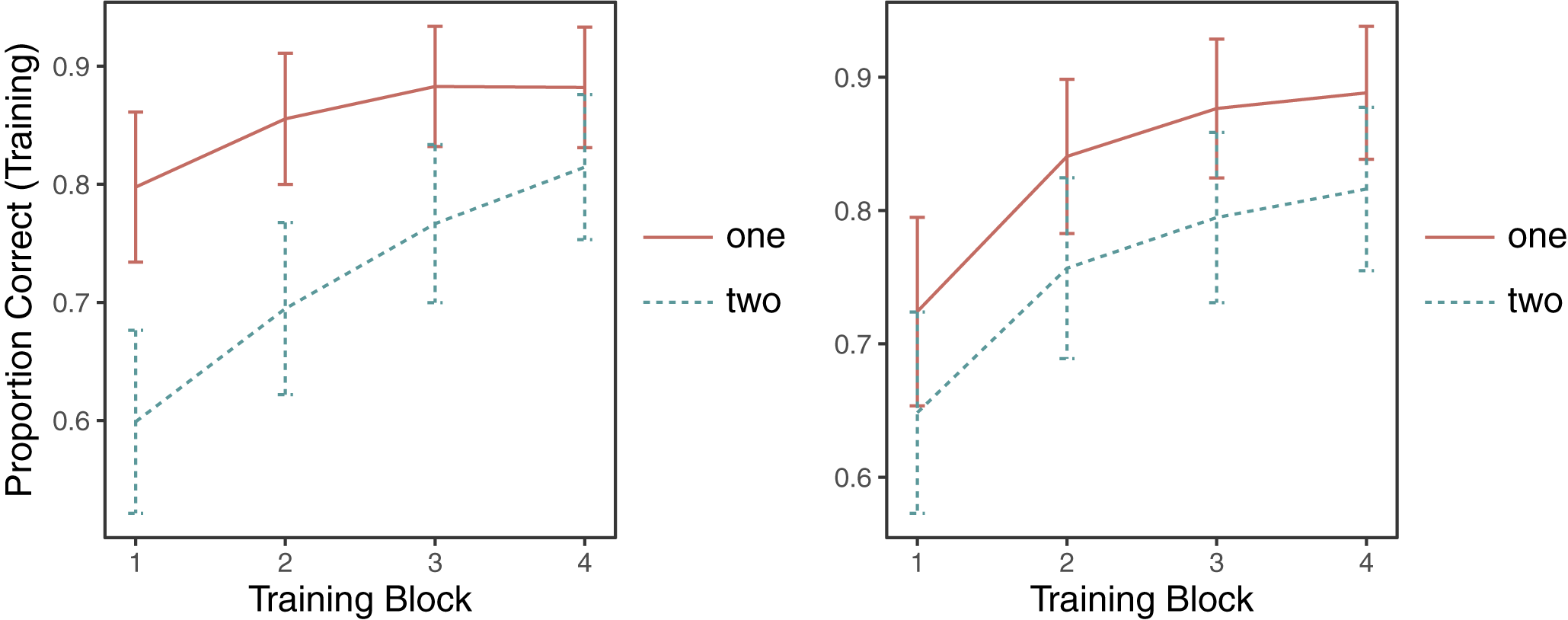
Figure 2. Long description
A two-panel line graph. Both panels share a Y-axis labeled Proportion Correct (Training) ranging from 0.6 to 0.9 and an X-axis labeled Training Block with values 1, 2, 3, and 4.
Panel A (Local Condition):
* The ‘one’ mapping (solid red line) starts at approximately 0.8 in block 1 and shows an asymptotic increase, leveling off near 0.88 by block 4.
* The ‘two’ mapping (dashed teal line) starts lower at 0.6 in block 1 and shows a linear increase, reaching approximately 0.82 by block 4.
* The ‘one’ mapping maintains higher accuracy than the ‘two’ mapping throughout all blocks.
Panel B (Global Condition):
* The ‘one’ mapping (solid red line) starts at approximately 0.73 in block 1 and increases to approximately 0.89 by block 4.
* The ‘two’ mapping (dashed teal line) starts at approximately 0.65 in block 1 and increases to approximately 0.82 by block 4.
* Similar to panel A, the ‘one’ mapping consistently outperforms the ‘two’ mapping, though the gap is narrower in block 1 compared to the local condition.
Both panels include vertical error bars representing the standard error of the mean at each data point.
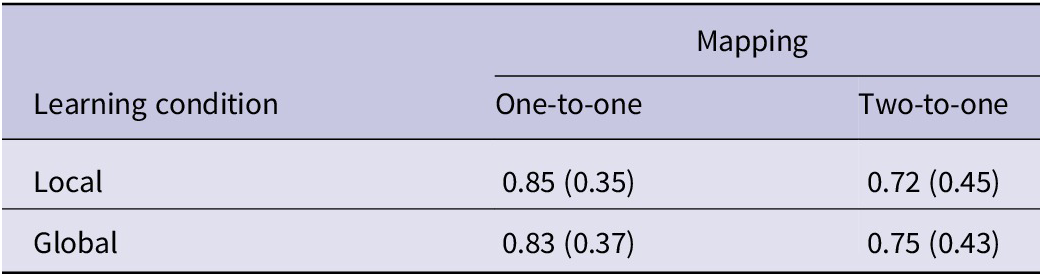
Proportion correct mean and SD for local and global conditions for one-to-one and two-to-one mappings, as illustrated in Figure 3
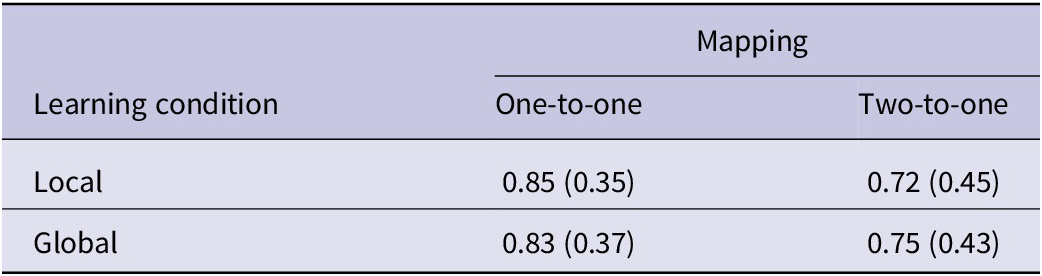
Table 3. Long description
The table is organized into three columns. The first column lists the Learning condition, while the second and third columns represent the Mapping types: One-to-one and Two-to-one.
* Local learning condition: One-to-one mapping has a mean of 0.85 and S D of 0.35. Two-to-one mapping has a mean of 0.72 and S D of 0.45.
* Global learning condition: One-to-one mapping has a mean of 0.83 and S D of 0.37. Two-to-one mapping has a mean of 0.75 and S D of 0.43.
We then tested whether performance improved as a consequence of training by testing the effect of block. This resulted in significant improvement to model fit, χ2(1) = 607.85, p < .001, indicating improvement in accuracy as the training progressed. Thus, participants were able to learn on the task.
The effect of whether the objects were named with one or two labels also significantly contributed to explaining variance in responses, χ2(1) = 5.738, p = .017, with two label objects resulting in lower accuracy than one label objects.
There was no significant improvement resulting from including whether training was local or global, χ2(1) = 0.504, p = .478, nor was there a significant improvement in fit when taking into account whether participants were classified as monolingual or bilingual, χ2(1) = 1.394, p = .238.
In order to determine whether there was a different trajectory of learning for the one or two labelled objects over the course of the study, we tested the influence of the interaction between block and one or two label condition, which was not significant, χ2(1) = 1.664, p = .197.
We also tested whether the local versus global training conditions differed over the course of the study by testing the interaction between block and local or global training condition, which was again not significant, χ2(1) = 0.183, p = .669.
Whether a participant was monolingual or bilingual also had no different effect over training block, χ2(1) = 0.802, p = .370, nor was there an effect of monolingual or bilingual language background on learning from one versus two labels, χ2(1) = 0.056, p = .813, nor did monolingual or bilingual background influence learning under local or global conditions, χ2(1) = 0.056, p = .813.
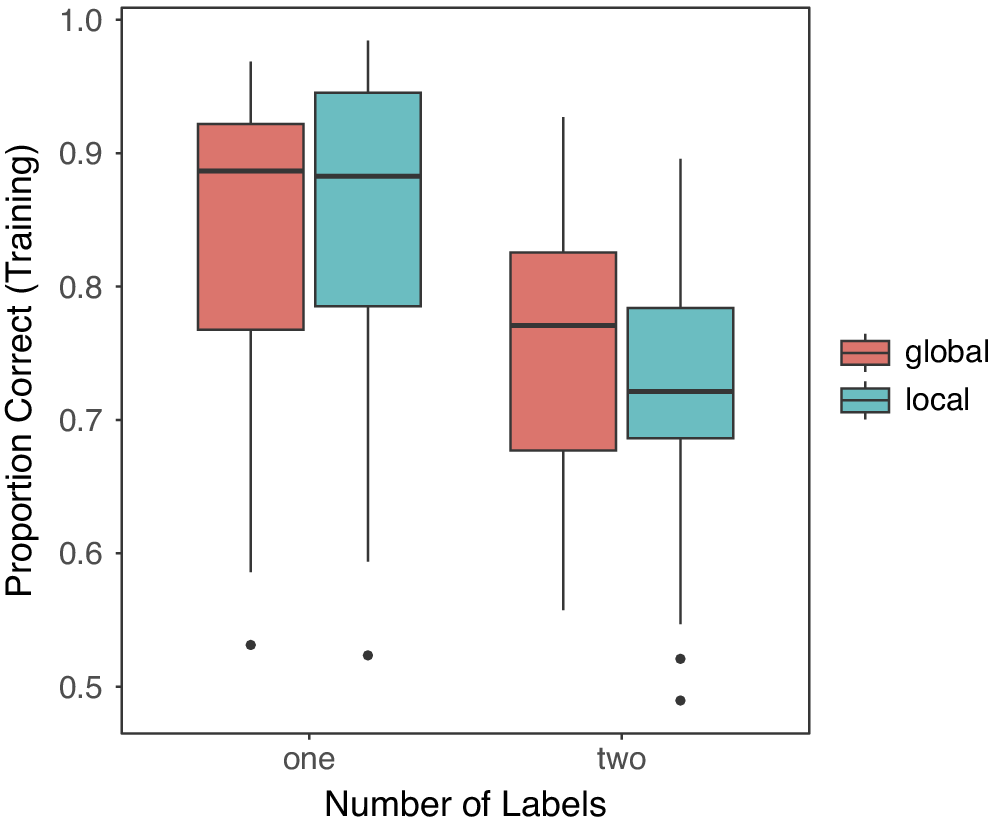
However, there was a significant impact of local versus global conditions on learning one versus two label objects, χ2(1) = 30.587, p < .001. The interaction is shown in Figure 3 (means and SDs are also reported in Table 3), and the final model is shown in Table 4. Pairwise comparisons indicated that there was no significant difference between local and global for one-to-one mappings, estimate = −0.14, SE = 0.15, z = 0.93, p = .352, nor for two-to-one mappings, estimate = 0.24, SE = 0.14, z = 1.74, p = .083, but that there was a significant difference between one-to-one and two-to-one mappings for the local condition, estimate = 0.86, SE = 0.26, z = 3.34, p < .001, but not for the global condition, estimate = 0.48, SE = 0.26, z = 1.86, p = .062. Thus, the interaction was due to the local condition exacerbating the difference in learning between one-to-one and two-to-one mappings, compared to the global condition. The lower accuracy of learning the two-to-one mappings compared to one-to-one mappings (as noted, earlier, in the main effect of mapping) was thus only observed when participants were being exposed to local co-occurrences of both labels for an object.
Interaction between local versus global training conditions on accuracy for learning one and two label objects.
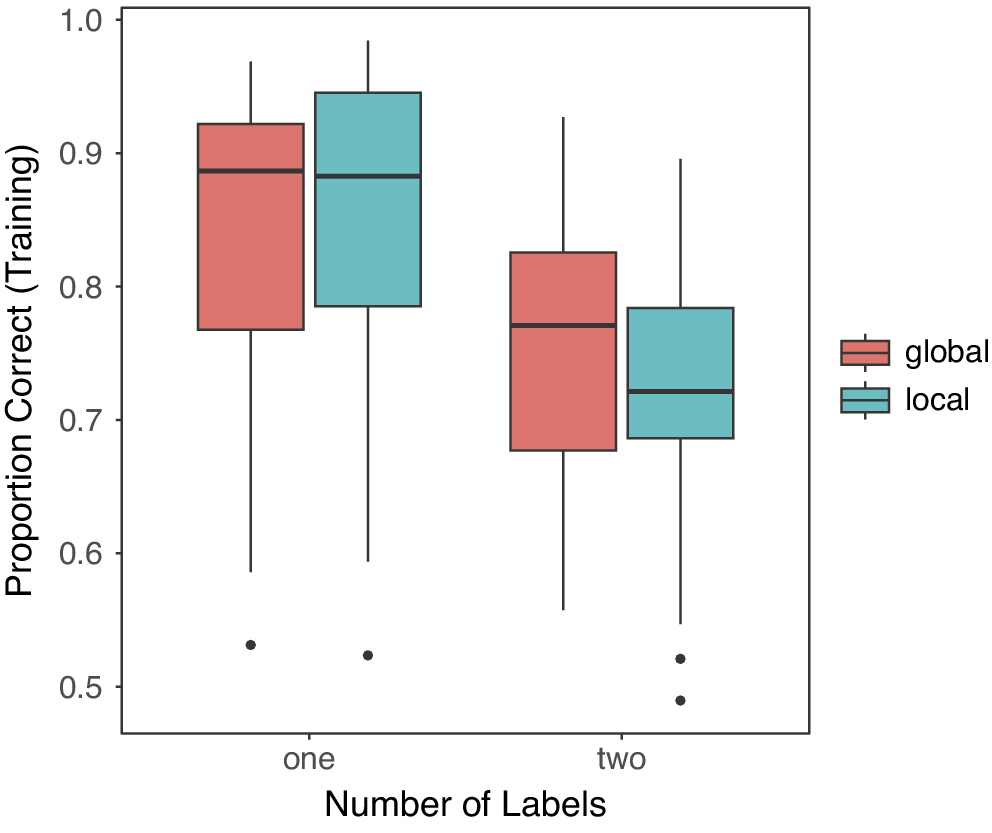
Figure 3. Long description
The y-axis is labeled Proportion Correct (Training) and ranges from 0.5 to 1.0. The x-axis is labeled Number of Labels with two categories: one and two. A legend to the right identifies red boxes as global and teal boxes as local.
* For the one label category: The global red box has a median near 0.89 with an interquartile range from approximately 0.77 to 0.92. The local teal box has a similar median near 0.88 but a slightly higher upper quartile reaching 0.95. Both have outliers near 0.53.
* For the two label category: Performance drops significantly. The global red box has a median near 0.77 with an interquartile range from 0.68 to 0.83. The local teal box shows the lowest performance with a median near 0.72 and an interquartile range from 0.69 to 0.79. Outliers for this group are clustered around 0.50.
Overall, the global condition maintains higher accuracy than the local condition when two labels are involved, whereas they are nearly equal for one label.
Final model for the analysis of all training trials (bold indicates significant effects)
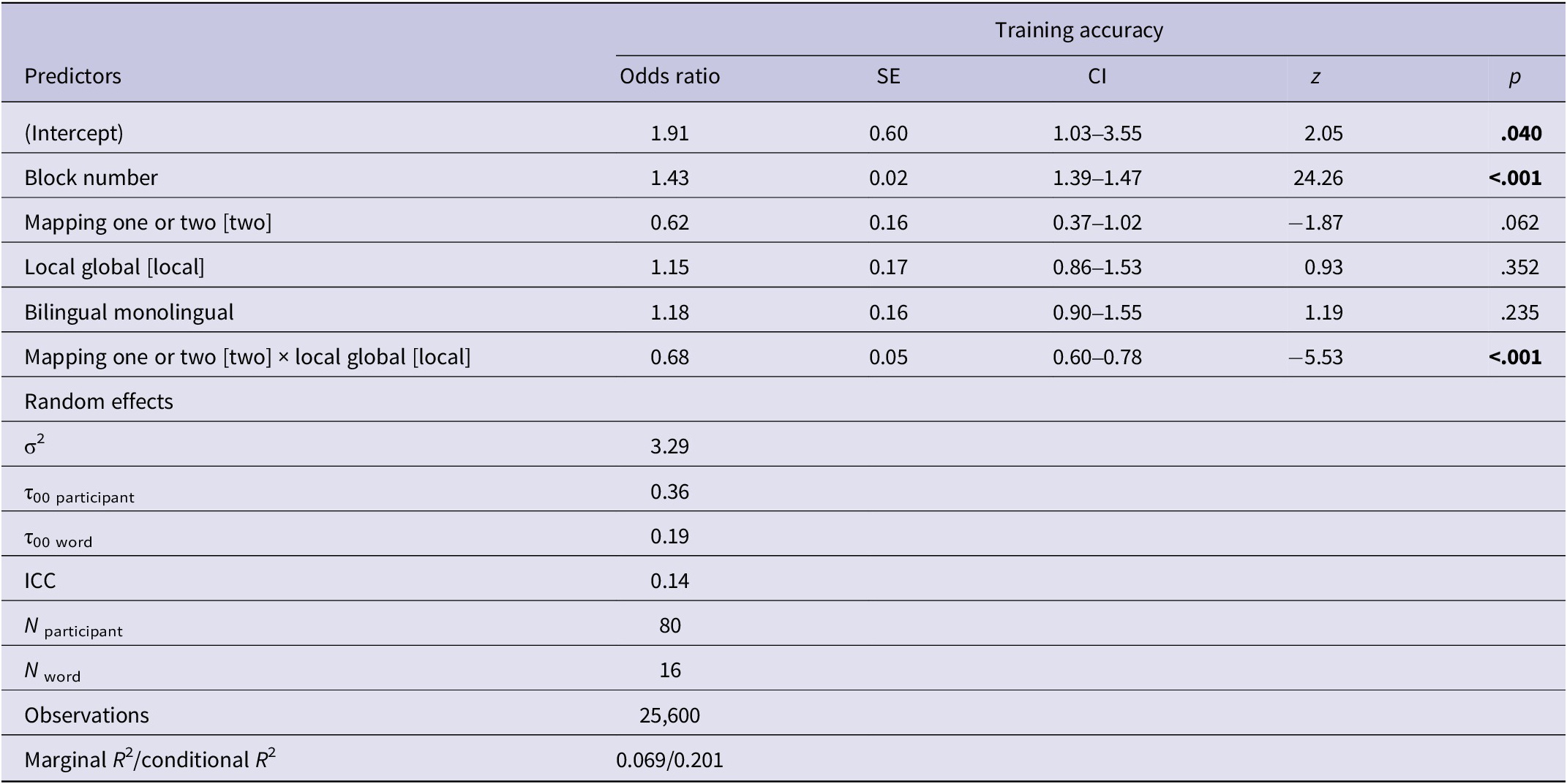
Table 4. Long description
The table presents training accuracy data across six columns: Predictors, Odds ratio, S E, C I, z, and p.
Fixed Effects:
* (Intercept): Odds ratio 1.91, S E 0.60, C I 1.03–3.55, z 2.05, p .040.
* Block number: Odds ratio 1.43, S E 0.02, C I 1.39–1.47, z 24.26, p less than .001.
* Mapping one or two [two]: Odds ratio 0.62, S E 0.16, C I 0.37–1.02, z minus 1.87, p .062.
* Local global [local]: Odds ratio 1.15, S E 0.17, C I 0.86–1.53, z 0.93, p .352.
* Bilingual monolingual: Odds ratio 1.18, S E 0.16, C I 0.90–1.55, z 1.19, p .235.
* Mapping one or two [two] times local global [local]: Odds ratio 0.68, S E 0.05, C I 0.60–0.78, z minus 5.53, p less than .001.
Random Effects:
* sigma super 2: 3.29.
* tau sub 00 participant: 0.36.
* tau sub 00 word: 0.19.
* I C C: 0.14.
* N participant: 80.
* N word: 16.
* Observations: 25,600.
* Marginal R super 2 / conditional R super 2: 0.069 / 0.201.
Syntax in R: glmer (accuracy ~ block_number + mapping_oneortwo + local_global + bilingual_monolingual + mapping_oneortwo:local_global + (1 | participant) + (1 | word), family = binomial).
Final model results for the analysis of the final block of training trials (bold indicates significant effects)
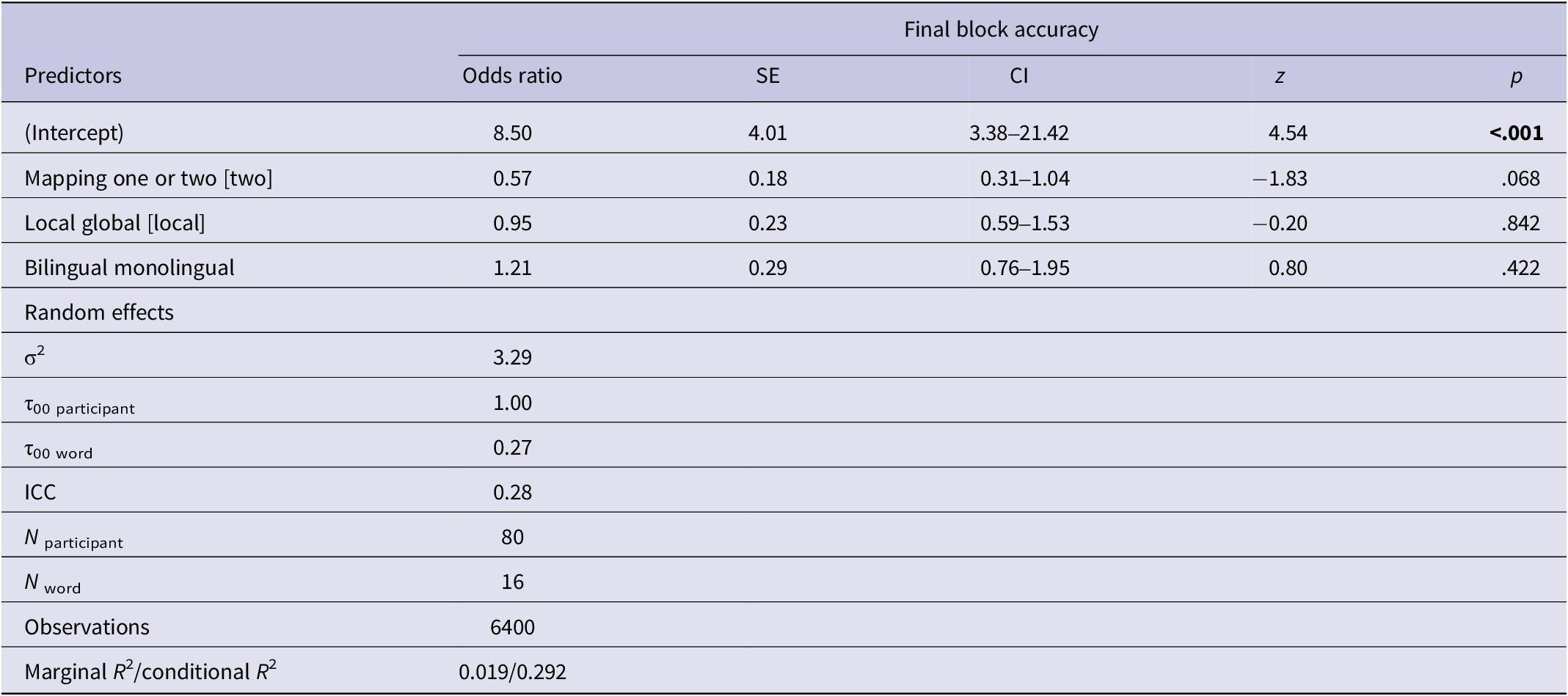
Table 5. Long description
The table is divided into two main sections: Predictors and Random effects.
Predictors section (columns: Odds ratio, S E, C I, z, p):
* (Intercept): Odds ratio 8.50, S E 4.01, C I 3.38–21.42, z 4.54, p < .001.
* Mapping one or two [two]: Odds ratio 0.57, S E 0.18, C I 0.31–1.04, z -1.83, p .068.
* Local global [local]: Odds ratio 0.95, S E 0.23, C I 0.59–1.53, z -0.20, p .842.
* Bilingual monolingual: Odds ratio 1.21, S E 0.29, C I 0.76–1.95, z 0.80, p .422.
Random effects section:
* sigma super 2: 3.29.
* tau sub 00 participant: 1.00.
* tau sub 00 word: 0.27.
* I C C: 0.28.
* N sub participant: 80.
* N sub word: 16.
* Observations: 6400.
* Marginal R super 2 / conditional R super 2: 0.019 / 0.292.
Footer text includes the R syntax: glmer (accuracy ~ mapping_oneortwo + local_global + bilingual_monolingual + (1 | participant) + (1 | word), family = binomial).
Syntax in R: glmer (accuracy ~ mapping_oneortwo + local_global + bilingual_monolingual + (1 | participant) + (1 | word), family = binomial).
3.2. Final training block analysis
In order to determine whether the effect of different training conditions had a proximal or distal effect on learning, we analysed the effect of language background, one or two label mapping and whether the participant experienced local or global training in the previous two blocks of training, on just the final block of training, when the exposure conditions were global for both groups.
For the baseline model, the intercept was significant, z = 1.993, p < .001, again indicating that performance was above chance across all groups in this final training block.
There was no significant influence of one versus two labels for the objects, χ2(1) = 2.999, p = .083, nor of whether training was local or global for the first three training blocks, χ2(1) = 0.006, p = .939, nor was there a significant improvement in fit when taking into account whether participants were classified as monolingual or bilingual, χ2(1) = 0.636, p = .425.
The effect of monolingual or bilingual language background did not significantly interact with learning from one versus two labels, χ2(1) = 0.385, p = .535, nor with learning from local or global conditions in the first three blocks of training, χ2(1) = 0.041, p = .840.
The interaction between local versus global conditions on learning one versus two label objects was also not significant, χ2(1) = 0.057, p = .812. Thus, this interaction was only significant during the actual trials where the exposure conditions were different, and there was no longer term influence of this earlier exposure on participants’ acquisition of the word–object mappings.
The final model for the final block of training trials, containing only the fixed effects, is shown in Table 5.
4. Discussion
Word learning in monolingual environments is a complex task, requiring navigating variability, change and ambiguity in the environment and determining how the language maps onto different environmental features. In bilingual environments, the complexity is further increased by the occurrence of more than one label for nearly every property of the environment, distributed across languages. How language learners accomplish this task requires at least a combination of observational and experimental studies to determine the challenges, and the learning mechanisms then to be identified that apply to these challenges. In this study, we focused on one aspect of monolingual natural language environments – burstiness, where words tend to be repeated in local co-occurrence clusters – and determined how this burstiness might affect learners in bilingual environments.
Our first prediction was that learners would be able to acquire both one-to-one mappings and two-to-one mappings, but that the latter would be more difficult than the former, due to the fact that learners’ biases to apply mutual exclusivity is required to be relaxed for the two-to-one mappings (Kalashnikova et al., Reference Kalashnikova, Mattock and Monaghan2015). This prediction was confirmed, replicating previous studies showing greater difficulty of two-to-one mappings in cross-situational learning (Benitez et al., Reference Benitez, Yurovsky and Smith2016; Benitez & Li, Reference Benitez and Li2024; Chan & Monaghan, Reference Chan and Monaghan2019; Li & Benitez, Reference Li and Benitezin press; Poepsel & Weiss, Reference Poepsel and Weiss2016).
Our second prediction was that local co-occurrences would be advantageous for learning one-to-one mappings compared to global co-occurrences, where repetitions of individual words were more separated. The local condition involved repetitions of the same referent in consecutive trials, whereas the global condition had trials presented in a randomised order, distributed over training, thus repetitions of particular words occurred more rarely in the global condition. Local co-occurrences reflect naturalistic (monolingual) speech where repetitions of linguistic structures are likely in close proximity (Frank, Tenenbaum, & Fernald, Reference Frank, Tenenbaum and Fernald2013; Slone et al., Reference Slone, Abney, Smith and Yu2023; Snow, Reference Snow1972), and has been previously shown to be conducive to word learning from cross-situational statistics (Onnis et al., Reference Onnis, Edelmann and Waterfall2011). However, we did not find any overall evidence that there was an advantage of the local co-occurrences compared to the global co-occurrences in our study (see Figure 2), with proportion correct for local and global co-occurrences almost identical for the one-to-one mappings.
This discrepancy with Onnis et al. (Reference Onnis, Edelmann and Waterfall2011) could be due to differences in design of the studies. In Onnis et al. (Reference Onnis, Edelmann and Waterfall2011), participants heard two words and saw referents for both those words in each trial. In our paradigm, participants heard one word and saw two referents, one of which related to the word. Thus, participants in our study were faced with unresolved ambiguity in each trial – one referent is not named in the trial – whereas in Onnis et al.’s (Reference Onnis, Edelmann and Waterfall2011) design, all ambiguity could be resolved once the mappings were beginning to be learned. Furthermore, in Onnis et al.’s (Reference Onnis, Edelmann and Waterfall2011) third study, an increase in the number of mappings to be learned led to no evidence of a difference between local and global co-occurrence conditions in terms of learning, thus, increased complexity of the task may obscure the benefits of local co-occurrences for learning one-to-one mappings.
Yet, the key novelty of our study was to investigate how local and global co-occurrences affect learning under conditions more closely resembling a bilingual language learner, that is, when there are two labels for each referent. In this case, we did find an effect of the learning condition: the significant interaction between local and global co-occurrences and one-to-one and two-to-one conditions was driven by the effect of ‘burstiness’ (Altmann et al., Reference Altmann, Pierrehumbert and Motter2009) on the two-to-one mappings. This interaction was due to two-to-one mappings being learned less accurately than one-to-one mappings when those labels were used in close contiguity to one another but no difference when those labels were separated in usage. Conversely, these results indicate conditions under which two labels for the same object can be learned more or less effectively than one-to-one mappings. The disadvantage for acquiring two labels for the same object over one label objects is diminished if those labels were used more distantly in time, than if they occurred close together in the language environment. Hence, the local advantage for one-to-one mappings observed by Onnis et al. (Reference Onnis, Edelmann and Waterfall2011) was reversed for the two-to-one mappings in our study.
Code-switching and language mixing are ubiquitous features of multilingual language environments (Bail et al., Reference Bail, Morini and Newman2015; Heredia & Altarriba, Reference Heredia and Altarriba2001; Orena et al., Reference Orena, Byers-Heinlein and Polka2020; Orena & Polka, Reference Orena and Polka2019), and we suggest that mixing of two languages in the same context likely introduces situations where co-occurring words from different languages label the same referent in the environment, that is, instances of label mixing. Our study results isolate one potential reason for why two-to-one mappings in close proximity (i.e., in language mixing) might be disadvantageous for learning (Byers-Heinlein, Reference Byers-Heinlein2012): the reason being that there is interference between the two labels.
However, we do not yet have a full account for why the extent of language mixing in bilingual children’s linguistic environments sometimes has an effect (as in Byers-Heinlein, Reference Byers-Heinlein2012) and sometimes does not (as in David & Wei, Reference David and Wei2008; De Houwer, Reference De Houwer2007; Place & Hoff, Reference Place and Hoff2011). Nor do we have a full understanding of the precise distribution of two-to-one mappings in language mixing – it may be that there is avoidance of labelling the same referent in two languages, though Tsui, Gonzalez-Barrero, Schott, and Byers-Heinlein’s (Reference Tsui, Gonzalez-Barrero, Schott and Byers-Heinlein2022) finding that children seek out translation equivalents points to their likely co-occurrence.
It is important to note that the disadvantage of local co-occurrences for learning two-to-one mappings was only during the actual training on the language, and in the analysis of the final training block (where there was a larger gap between occurrences of the same referent) there was no evidence of a significant interaction. Thus, inhibitory effects of two-to-one mappings in local co-occurrences may not have a long-term impact on learning, only affecting the initial acquisition stages of learning rather than retention of word–object mappings (Horst & Samuelson, Reference Horst and Samuelson2008).
The third prediction of our study examined the role of language background on learning one-to-one and two-to-one mappings under the local and global co-occurrence conditions. We found no effects of language background on learning the different mapping types, nor of the effect of the learning conditions. Our study thus did not replicate previous demonstrations that bilinguals were better at acquiring two-to-one mappings than were monolinguals from cross-situational statistics (e.g., Benitez et al., Reference Benitez, Yurovsky and Smith2016; Weiss, Schwob, & Lebkuecher, Reference Weiss, Schwob and Lebkuecher2020). However, a critical difference in the design of our study compared to Benitez et al. (Reference Benitez, Yurovsky and Smith2016) was that the two labels for the same referent were phonotactically distinct in Benitez et al.’s (Reference Benitez, Yurovsky and Smith2016) study, but were similar in syllabic structure in our study. Using a similar paradigm, Li and Benitez (Reference Li and Benitezin press) found no effect of language background when labels were not phonotactically distinct, at least in terms of segmental phonology.
Under what conditions, then, is a bilingual advantage found for word learning? Kaushanskaya and Marian (Reference Kaushanskaya and Marian2009) and Kaushanskaya (Reference Kaushanskaya2012) found a bilingual advantage for acquiring novel words explicitly under one-to-one mapping conditions when the phonology was unfamiliar, or when the phonology resembled one of the languages that the bilinguals spoke. Escudero et al. (Reference Escudero, Mulak, Fu and Singh2016) showed that this advantage was also found when learning implicitly from cross-situational statistics, though Ge, Rato, Rebuschat, and Monaghan (Reference Ge, Rato, Rebuschat and Monaghan2024) replicated this finding for heritage language bilinguals only when the language resembled one of the natural languages. Yet, contextual information about speakers may enhance bilingual word learning still further. Crespo and Kaushanskaya (Reference Crespo and Kaushanskayain press) found a bilingual advantage for learning one-to-one word–referent mappings from multiple speakers, again indicating greater sensitivity to phonological forms and their variations in bilinguals. Furthermore, a bilingual advantage is observed for two-to-one mappings when there is clear information that the speakers (Kalashnikova et al., Reference Kalashnikova, Mattock and Monaghan2015; MacDonald, Yurovsky, & Frank, Reference MacDonald, Yurovsky and Frank2017) or the language spoken (Benitez et al., Reference Benitez, Yurovsky and Smith2016; Tuninetti, Mulak, & Escudero, Reference Tuninetti, Mulak and Escudero2020) are distinct.
Providing further cues to both speaker and language differences for two-to-one mappings may further modulate the effect of local and global co-occurrences for word learning under mixed language conditions. The range and richness of these language contextual cues may be vital in providing further support and scaffolding for language mixing. In our study, we showed that, without these additional cues, learning two labels for one object was substantially more difficult than learning one label for each object when these labels were intermingled. Speakers of different languages are likely to be distinguished not only in the labels they use, as was the case in our study design, but also in terms of a range of language-specific and speaker-diverse effects, such as phonology, prosody or social identity of speakers. The situation of our study is akin to children in a bilingual environment with speakers using the same phonology, phonotactics and prosody for the alternative labels, and our study highlights the substantial challenge that such context-free language mixing environment might entail. As Benitez et al. (Reference Benitez, Yurovsky and Smith2016) showed, when there is a distinction in even just one of these features – that is, phonotactics – bilinguals tend to show an advantage over monolinguals in using that cue to support acquisition of two-to-one labels. Examining how adding these cues in supporting learning – and determining which are most useful and most critical – is a point for future methodological investigation.
A further limitation of the distinction between monolingual and bilingual participants in our study was the richness of the measure of additional language experience. We employed the same measure as Poepsel and Weiss (Reference Poepsel and Weiss2016), however, a more nuanced and in-depth reflection of language background and variation (van Dijk, Kroesbergen, Blom, & Leseman, Reference van Dijk, Kroesbergen, Blom and Leseman2019) may enable us to determine more precisely how different language experience affects word learning under different contexts.
5. Conclusion
We have shown that the distributions of words in the linguistic environment have an impact on whether learners are able to acquire more than one label for a referent from cross-situational statistics. We showed that local co-occurrences of two different labels for a single referent impairs learning compared to more distributed occurrences of those labels over learning. We suggest that this is one challenge that multilingual children growing up in environments where language mixing is widespread need to face in acquiring vocabularies in multiple languages.
Supplementary material
The supplementary material for this article can be found at http://doi.org/10.1017/S136672892510059X.
Data availability statement
The anonymised data, analysis scripts and pre-registration of the analysis can be found at https://osf.io/ruq43/?view_only=e7a9402b99e3402d8544a4b9fad5153b.
Competing interests
The authors declare that no competing interests exist.
Appendix Stimuli – words
Familiar
bed chair carrot cup flower fork hat pear
Novel – from the NOUN Database
modi /məʊdi/
poip /pɔɪp/
shill /ʃɪl/
sprock /sprɒk/
tannin /tænin/
teebu /tibu/
toma /təʊmə/
yosp /yɒsp/
bem /bɛm/
blicket /blɪkɪt/
doff /dɒf/
fiffin /fɪfɪn/
gasser /gæsə/
glark /glak/
jefa /jifə/
lorp /lɔp/
Familiar – from the TarrLab Object Databank
BED CHAR4 CARO2 CUP2 SFLWR FORK
Unfamiliar – from the NOUN Database
2001 2011
2002 2016 2027
2005 2021 2028.



 Open access

