




From about 1870, major improvements in global transport, communications and payments systems enabled rapid expansion in international trade, investment and migration.Footnote 1 A major aspect of this trade was in commodities and natural resources moving from Europe’s colonies, especially the agricultural products and minerals that fed and clothed expanding populations and provided the raw materials for the industries of the second Industrial Revolution.Footnote 2 For most European colonists around the world, nature, environment and landscape were resources to be exploited for profit. For a minority, however, nature could also be enjoyed, studied and shared. This was reflected in an important but largely hidden aspect of global trade and connections in this period – the trade in natural-history specimens.
The international trade in natural-history specimens, though, was not new in this period. As scholars of natural history, including Paula Findlen, have noted, the trade and exchange of botanical specimens had been a well-established practice in Europe since at least the sixteenth century.Footnote 3 Expanding zones of colonial settlement in the eighteenth and nineteenth centuries, however, provided new opportunities for travel, scientific discoveries and long-distance trading. The building of state-funded, mass audience, educational and systematic museums, along with major advances in preservation and taxonomy, provided the institutional and taxonomic support necessary for the zoological trade’s rapid nineteenth-century growth and expansion, which is the focus of our research. Problems of storage, transport and logistics had been more easily solved for dried plants, seeds and even living plant specimens.Footnote 4 Zoological trading of both ‘wet’ specimens in spirits and ‘dry’ skin and bone specimens came with its own material and logistical challenges, which by the mid-nineteenth century were well on the way to being solved. Like botanical specimens before them, preserved animal specimens moved around the world to become well-travelled ‘boundary objects’ with tangled social lives and complex histories as they criss-crossed geographies and moved between economies, value systems and knowledge frameworks.Footnote 5
Our interest lies in contributing to an evolving literature that widens the scope of standard studies of natural-history collecting by focusing on what happens between museums as much as within a single organization and location. Shapin has observed that ‘we need to understand not only how knowledge is made in specific places but also how transactions occur between places’.Footnote 6 The work of Coote et al. in particular has shifted analytical focus from the operation of social and personal networks in natural history, and laid the groundwork for a more materialist and economic-geographic perspective on which we now build.Footnote 7 Recent data-rich work by Driver, Nesbitt and Cornish on the dispersal of botany collections from Kew is another model for the potential of this approach.Footnote 8 Our study pioneers the application of extensive and comparative data analysis to the investigation of the museum zoology trade. Working with theories of value from economics, social theory and anthropology, we examine how specimen value was created, negotiated and mobilized on a global scale, and how it changed over distance and time.
To calls for geographic studies of global science, we add both an Australian and a postcolonial perspective. The ‘discovery’ of many species new to European science created enormous interest in adding these creatures to the museums of the colonizing powers. However, the trade was never a one-way flow of specimens from the colonial periphery to the metropolitan centre and our quantification and description of the geographical and institutional breadth of Australia’s museum exchange systems throws fresh light on the scientific, economic and social reach of the Australian colonies before 1914. In this, our findings contribute to an understanding of colonial natural history as much more than an extractive industry serving the scientific institutions and commercial entities of the global North. Colonial museums were important local political, civic and scientific actors; enthusiastic, knowledgeable and active participants in the global trade in zoological specimens; and an essential part of the development of the dream of one worldwide ‘relational museum’.Footnote 9
Our focus is the zoological trade to and from Australia, and on one mode of transaction – exchange – in the final three decades of the nineteenth century, a period when civics, politics and public natural history grew more closely entwined. We close our study in 1900 at the end of this brief exchange boom. Drawing on extensive data-driven research into all natural-history specimen exchanges recorded by the Australian Museum in Sydney, the National Museum of Victoria in Melbourne and the Queensland Museum in Brisbane, we present an outline of trading activity by the three largest natural-history museums in colonial Australia. Ville, Wright and Philp have discussed the decision matrix between exchange, purchase and donations that collectors had to make.Footnote 10 In our study, we focus on a closer understanding of the economic, social and cultural factors that encouraged exchange. Anthropologists have argued that material exchange was commonly grounded in a personal relationship, negotiated between individuals and involving the measure, exchange and valuation of trust, reputation and knowledge alongside specimens and objects.Footnote 11 We show that the exchange trade was made possible by trade infrastructure, museum systematization and institutional settings, but was conditioned by a complex combination of personal, local, institutional, economic, global and imperial dimensions. At the same time, more capitalist forms of transaction and institutions were emerging in the commercial part of the natural-history trade in the final decades of the nineteenth century, as Rieppel has shown.Footnote 12 This co-evolution of capitalist and premodern forms of transaction – trade and exchange – has received support from Margócsy in his study of shell collecting in the Pacific islands.Footnote 13
Zoology and mineralogy claimed most attention and resources at the major Australian museums in this era, with ethnographic collecting and trade a relatively minor activity until the mid-1880s. Exchange of ethnological specimens fell largely outside the remit of the museums’ formal exchange activities. Australia’s unusual fauna was still novel and relatively unknown in these decades, and there were exciting discoveries still to be made for those who became part of the trade. Demand for animal specimens was high. Reflecting the decimation of First Nations populations and cultural practices in south-east Australia in the first century of European settlement in Australia and the attitudes of most early colonizers, these museums and their curators showed little interest in knowing, collecting or recording Australian First Nations’ cultures.Footnote 14 While the early museum curators did not differentiate as sharply between ‘natural-history’ objects and ‘Indigenous objects’ as their successors, the overwhelming focus of the exchange trade nevertheless remained with faunal specimens. The trade increased markedly in the late 1880s, primarily focused on Pacific cultural material; however, ethnographic acquisition was mostly centred on commercial trading houses and auctions.Footnote 15 Botany was primarily the work of botanical gardens in Sydney, Brisbane and Melbourne whose exchange networks were driven as much by the commercial trade – for-profit seed and plant collectors, domestic nurseries and agricultural supply, acclimatization movements and the imperative for a reliable food supply for the colony’s growing population – as they were by scientific description and public display.
The paper proceeds by offering a summary of the history and context of the three museums that comprise the study and outlining our methodology and data. We then present our data, analysing the overall patterns of the exchange trade, including the changing geographical emphases and types of specimen exchanged. Following this, we explore the various factors that led the museums to pursue the exchange trade. In our conclusion, we explain the significance of this study and suggest several further directions for future research in this emerging field.
Establishing Australia’s natural-history museums
Australia’s public museums were among the first such institutions to be founded in Britain’s burgeoning overseas empire from the early nineteenth century.Footnote 16 At a time of rapid expansion in museums of natural history and the global museum profession, these pioneering museums were all loosely modelled on the British Museum and maintained ongoing links to imperial natural history and scientists through personal and social-scientific networks and scientific collaborations. Like their imperial cousins, the Australian museums responded to international developments in natural science and biology and the consolidation of what Samuel Alberti calls ‘museum nature’ in Britain and Europe.Footnote 17 However, reflecting the well-established polycentrism of Australian colonial science, their connections were far wider than their metropolitan counterparts.Footnote 18 Also, these three museums were far from homogeneous. Each museum reflected colonial Australia’s distinctive struggle to come to terms with the continent’s nature.Footnote 19 They also mirror the particular local politics and economics of the time each museum was founded, different state identities and natural environments, collection priorities, audiences, and the personalities and processes of the men who governed and ran them. Colonial museum administrators could borrow and adapt the imperial form of the museum, but in a colony with few existing private natural-history collections and no private funding sources, trustees and curators at each museum had to work with limited government support and innovate to grow collections, networks and influence from scratch. Each museum accordingly developed its own contingent processes and means for collection growth and knowledge production, circulation and dissemination, including the useful tool of formal museum specimen exchange.
The Australian Museum (AM) was the first public museum in Australia and was founded by a coterie of scientific gentlemen in Sydney in the colony of New South Wales (NSW) in 1827. It did not have purpose-built premises until the 1850s, when the colonial parliaments of eastern Australia attained self-government and associated enhanced revenue-raising powers, and it was only then that the museum’s collection-building activities and broader civic mission could begin in earnest. Always cash-strapped and understaffed, donations were the AM’s most common acquisition method and the museum received and processed thousands of small-lot donations every year. Donations could become duplicate specimens and therefore available for exchange.Footnote 20 The museum also employed its own staff for strategic collecting, both for its own collections and display and to provide specimens for exchange. Governed by a group of wealthy colonial collectors, from its earliest days the museum’s curators – German-born Gerard Krefft (1864–74) and Edward Ramsay (1874–94) – sought to use exchange to build both international collections and external networks and relationships. For each man, prestige, obligation, friendship and scientific authority were all traded along with the more tangible specimen assets. Krefft’s focus was European, using his transnational German-language networks and cultivating a diverse group of influential curators and scientists at the British Museum. For Ramsay, connections were closer to home, reflecting his deeper roots in Sydney’s familial, social and scientific networks.
To the south, the younger colony of Victoria expanded rapidly following the 1850s gold rush boom that coincided with separation from NSW in 1851. Prosperous and assertive, the colonial government endowed a natural-history museum in Melbourne in 1854. In 1857 Professor Frederick McCoy became the first director and moved the collections to Melbourne University, where it reopened as the National Museum of Victoria (NMV) in 1864. McCoy showed limited interest in exchange and preferred to use his colony’s gold rush riches to build the museum’s international collections by targeted purchases of specimens, books and journals from overseas museums and dealers. Over the years from 1874 to 1900, McCoy’s NMV preferred purchase transactions to inward exchange for the museum. McCoy utilized exchange for trade with local counterparts in museums across Australia and the Pacific. For him, exchange was a tool for collection management, especially for reducing stocks of duplicate and excess specimens.
The colony of Queensland, extending into the biodiverse tropical north of the continent, separated from NSW in 1859. The Queensland Museum (QM) was founded as a one-room museum in the fledgling capital city, Brisbane, in 1862, with its first purpose-built edifice completed in 1879. It was initially a smaller, more modest endeavour than its southern counterparts. Without stable funding or deep scientific networks, the QM’s zoological collections for the years from 1873 to 1900 were largely built from donations and field collections, compared with inward exchange and purchase. Its ambitions were comprehensive – to have a representation of every species on display – but in its first decades its collection management practice seems to have been somewhat chaotic and haphazard. However, under the scientific leadership of Charles de Vis (curator from 1882 to 1911) and the field collecting work of Kendall Broadbent, the museum increased its trading and built a significant scientific output, especially of insects, tropical birds and mammals.Footnote 21
It is against this institutional and political backdrop that the overall exchange trade in natural-history specimens proceeded. We now describe the parameters of the exchange trade of each museum, particularly the composition of specimens, the geographical patterns of trading, and fluctuations in the trade’s dimensions over three decades.
A note on data and methods
Each of the three natural-history museums possesses a wealth of rich data about their trading transactions for our period, especially in annual reports that list what they traded, when, how much and with whom. Our focus is on their exchange trade data, which was tabulated into Excel spreadsheets for each museum to create our database for analysis. The AM data also included its exchange registers, curators’ reports and trustees’ minutes, while the QM data included exchange registers and correspondence registers. The AM collection data begin from 1860, reflecting the museum’s older provenance, while the data begin in 1874 for the NMV and 1873 for the QM.
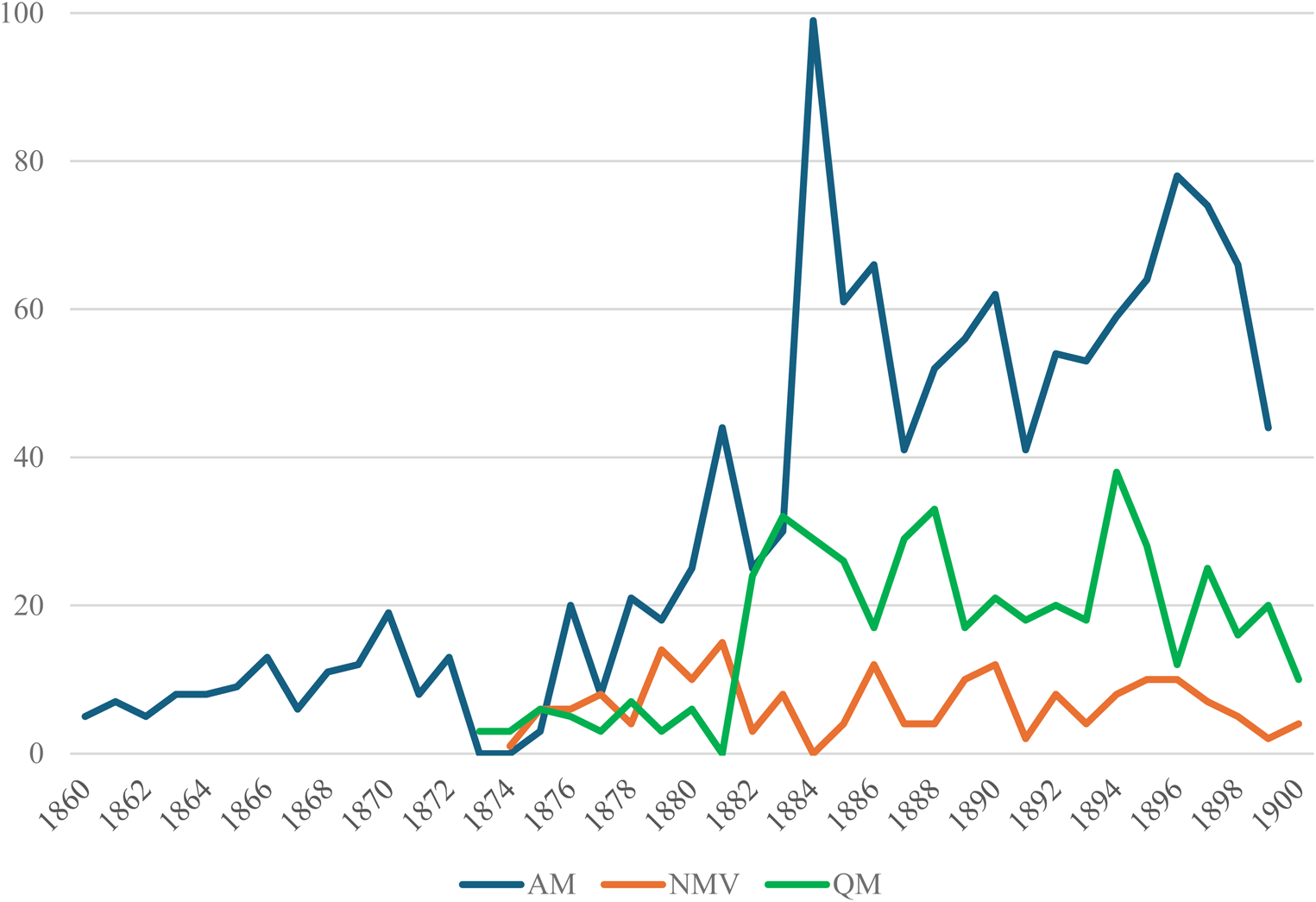
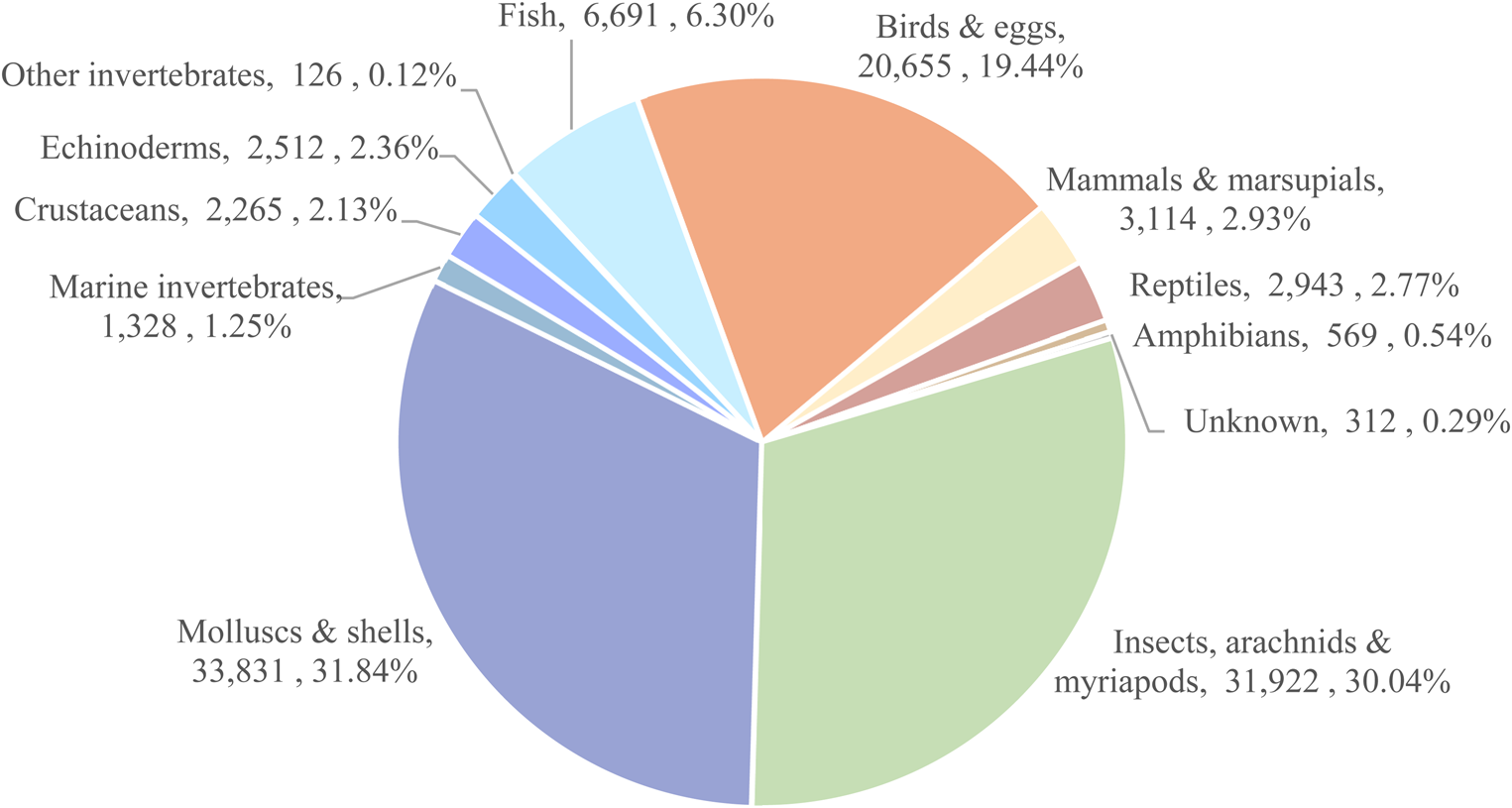
It was not possible to determine the exact quantity of specimens exchanged for every transaction, since they were sometimes listed in an indeterminate way (‘one box of butterflies’, ‘one collection of beetles’). This occurred for approximately 6 per cent of total recorded specimens. The total specimen count is therefore an underestimate. The overwhelming majority of specimens exchanged (83 per cent) were of fauna (Figure 1), but mineralogical specimens were also evident, as were other sections of the museums’ collections, notably ethnology and publications. The database records exchanges covering the final quarter of the nineteenth century, with slight variations reflecting the AM’s early beginnings: AM (1860–99), NMV (1874–1900), and QM (1873–1900).
Specimens exchanged (inwards and outwards) by type, by the Australian Museum, the National Museum of Victoria and the Queensland Museum, 1860–1900.
Patterns of exchange
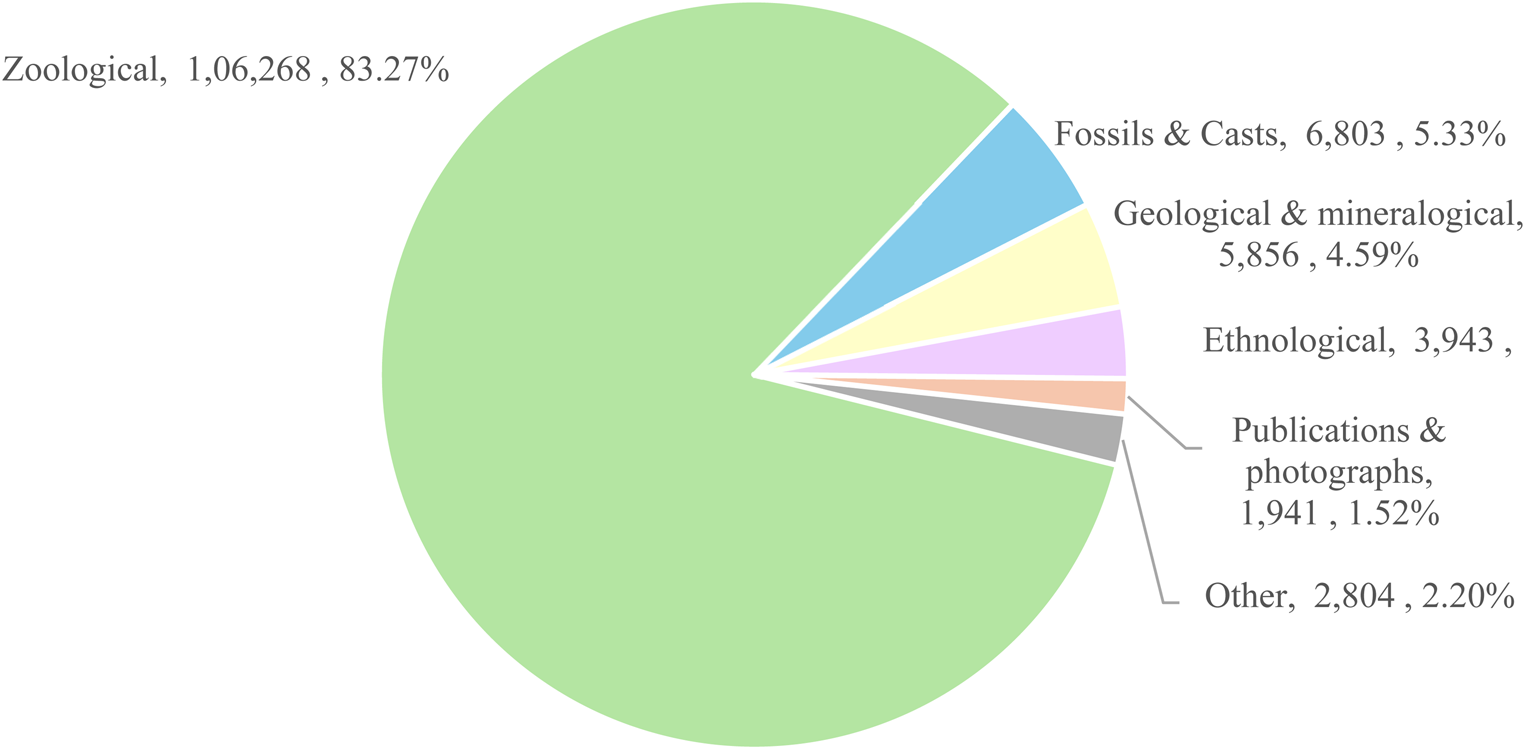
All three museums conducted a substantial exchange trade. This involved more than 128,295 specimens across 1,938 transactions, of which the 909 inward-bound transactions nearly balanced 1,029 going outwards (Table 1). The AM, as the largest of the three museums, was busiest, leveraging its plentiful donations to conduct more and larger exchanges. On average, it exchanged 2,550 specimens in 31 transactions annually (average 83 specimens per transaction), compared with 651 items in 17 transactions by the QM (average 39) and 296 items in 7 transactions (average 44) by the NMV. The AM transacted with a total of 442 exchange partners, the QM with 213 and the NMV with 75.
The exchange trade by total transactions and total specimens.
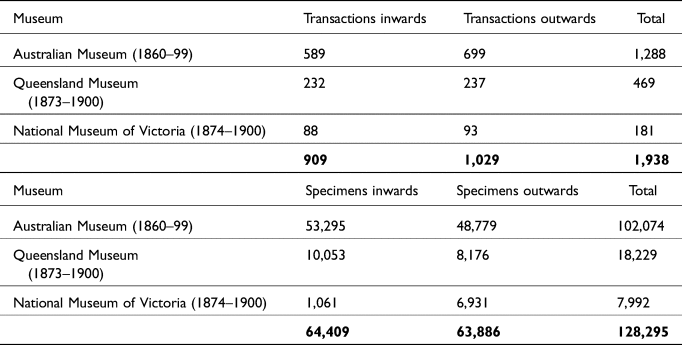
The exchange trade fluctuated over time and each museum experienced significant year-to-year vicissitudes and major peaks around particular events (Figure 2). For example, the NMV’s exchange trade rose sharply in 1881 as a result of opportunities to complete major deals at the 1880–1 Melbourne International Exhibition. The AM’s trade peaked in the mid-1880s after the Sydney International Exhibition (1879) and attempts to replenish the cultural-object collections after substantial losses resulting from a devastating fire in 1882. Curator Edward Ramsay’s participation in the International Fisheries Exhibition in London in 1883 also resulted in several extensive exchanges. The QM experienced smaller peaks in the late 1870s, mid-1880s and mid-1890s, mostly due to several large exchanges with European partners. Each museum suffered a significant fall in exchanges during the economic depression of the early 1890s. The exchange trade did not persist long into the twentieth century. By the 1920s exchange was no longer a common strategic collection tool at Australia’s museums.
Exchange trade (inwards and outwards) for the Australian Museum, the National Museum of Victoria and the Queensland Museum, 1860–1900 (number of exchange transactions).
Specimen composition of the exchange trade
A wide range of specimens endemic to Australia was offered for exchange by the three museums. Perhaps not surprisingly, the largest numbers were of shells and insects – particularly Coleoptera (beetles) and Lepidoptera (butterflies and moths) – with birds and birds’ eggs as a distant third (Figure 3). While shells were the most important form of specimen traded by the AM and the QM, insects dominated the NMV’s exchange trade, reflecting, in particular, the large Coleoptera and Lepidoptera donations to several European governments after the 1880–1 Melbourne International Exhibition.
Natural-history specimens exchanged (inwards and outwards), by type, by the Australian Museum, the National Museum of Victoria and the Queensland Museum, 1860–1900.
Australia’s iconic mammals and birds were always in demand alongside rarer animals that had niche, and sometimes fleeting, high scientific exchange value. At the AM, prestige items included Australian megafauna fossils and, for a brief period in the 1870s, the sensational, newly discovered ‘living fossil’, the Australian lungfish, Ceratodus forsteri.Footnote 22 For the AM, the exchange value of these sought-after scientific oddities was in large part the enhanced scientific credibility and the chance to form relationships with the Victorian era’s most prominent men of science, including Louis Agassiz and Richard Owen. For the QM, dugongs (marine mammals from its warm coastal waters) were a significant exchange commodity, with at least eleven dugongs or dugong skeletons sent out between 1880 and 1888 when the late Victorian period saw a heightened interest in the creatures in British popular-scientific circles.Footnote 23 Large and diverse collections of species were received from a range of local and overseas museums in return for these in-demand items.Footnote 24
Exchange geographies
More than half of all exchange transactions (59 per cent) took place within the Australasian colonies. This comprised 23 per cent within the museum’s city, 7 per cent elsewhere within the same colony (that is, intra-colonial), and 28 per cent with intercolonial exchange partners in other Australasian colonies (including New Zealand). Interactions, movement and communications among the six Australian colonies and New Zealand were substantial in the late nineteenth century, and colonists used the term ‘intercolonial’ to describe such interactions. As such, it is useful to conceive of Australasian exchanges as distinct from longer-distance trading.Footnote 25 The remaining 41 per cent of transactions comprised the broader intercontinental trade.
Many intra-colonial and intercolonial exchanges were with other museums, universities and educational institutions (particularly schools of arts and of mines) that were keen to expand their collections for research, education and public-display purposes. Within each museum, up to one-fifth of local exchanges were with museum trustees, staff (past and present) and other close associates of the museum. That the first-established AM conducted more of its local and colonial transactions internally reflected its early appointment of scientific staff and the tight integration of the city’s networks of science, power and politics into its governance functions through the appointment of museum trustees. Partly, exchange was designed to circumvent a ban on staff trading in natural-history specimens. It also provided an insider-trading opportunity for trustees to acquire specimens newly received into the museum. By contrast, the younger QM had to cast the collection net beyond its tiny professional and social networks of staff and trustees. Outside the museum itself, local exchanges also built social and political capital. Each museum had tangled connections with prominent colonial figures with a stake in natural history, be they local collection holders, government officials, university professionals or the growing community of enthusiastic amateurs.Footnote 26 The Macleay and Waterhouse families were prominent exchange partners in Sydney; the NMV’s exchange partners included government entomologist Charles French Jr and Dudley le Souëf, director of the Melbourne Zoo.Footnote 27 the QM’s prominent colonial partners included colonial dignitary Archibald Meston, landowner and historian Nehemiah Bartley and Toowoomba botanist Carl Hartmann.
Intercolonial exchanges provided the opportunity to develop professional networks but were also motivated by specimen diversity across the expansive geographies of the Australasian colonies. Regionally specific, often iconic, specimens that recur in the exchanges included dugongs (Queensland), lyrebirds (Victoria and NSW), thylacines and Tasmanian devils (Tasmania), and quokkas (WA). As early as 1858, when AM curator G.F. Angas could not afford to send his own collector to Tasmania, he wrote to Dr Milligan at the Tasmanian Museum, asking for ‘rare Tasmanian shells which we do not possess … for Exchange with foreign Museums’.Footnote 28 Although rivalry existed between the Sydney and Melbourne museums, the example points to the significant cooperation in collection building. Scientific circles were small and tight-knit, with professional staff moving between museums and taking part in the same scientific societies and international exhibitions. Collectors often worked for several museums at once and traders operated across the colonies.
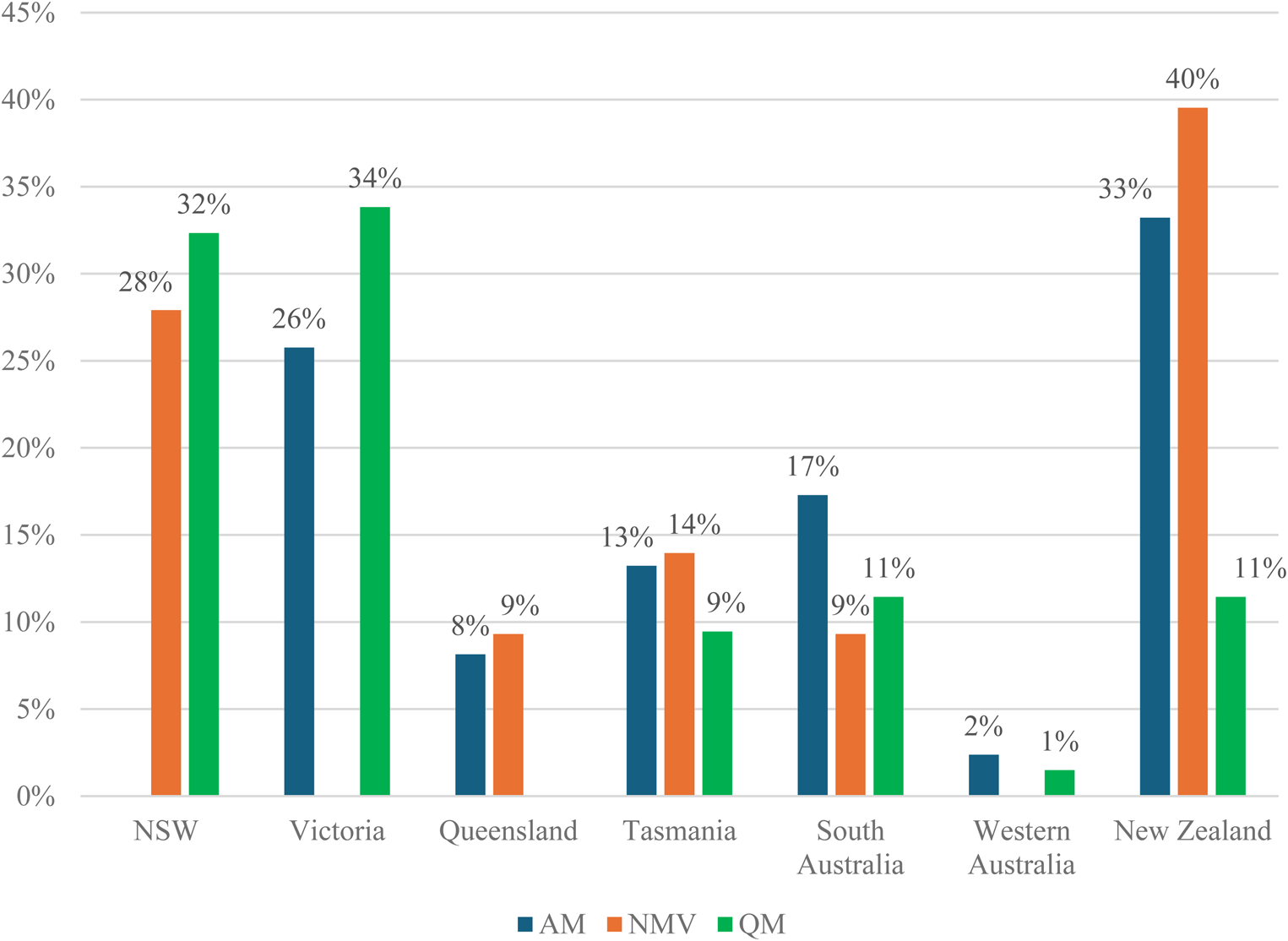
The location of intercolonial exchange partners is indicated in Figure 4. Some differences emerge between the museums. New Zealand, with its relative proximity and well-established network of museums and professional scientists and collectors, was the most prominent location of intercolonial exchange partners for the AM and the NMV. Major international exhibitions in New Zealand in 1882 and 1889 provided good exchange opportunities, but, for the AM especially, trans-Tasman exchanges were continuing relationships. For the latecomer QM, NSW and Victoria were more important exchange locations. The AM was the QM’s largest exchange partner, reflecting the historic closeness of the two colonies and their shared staff and collectors, in contrast to the more competitive relationship between the AM and the NMV.Footnote 29 Julius Haast’s Canterbury Museum in Christchurch was one of the largest exchange partners for each museum, illustrating just how important personal connections were for long-term exchange relationships. The Tasmanian Museum and the South Australian Museum were also significant partners particularly for the AM, which sometimes used these exchanges to bolster the range of its collections of ‘duplicates’ for future sought-after international exchange. Specimens from New Guinea can be found scattered throughout the exchange registers. Birds of paradise – skins, feathers and living birds – had been highly valued and traded from the islands for centuries, but British scientific interest in the islands of Melanesia grew rapidly with the incursion of missionary, government and commercial interests from the 1870s.Footnote 30 Queensland had a close relationship with the island territory to its immediate north for reasons of geographical proximity, commercial shipping and geopolitics. Charles de Vis maintained a close eye on the Melanesian territory, arranging for collections, transactions and purchases with various parties throughout the 1880s and 1890s.Footnote 31 Exchange partners in this period included Charles Kowald (birds and ethnological specimens, 1889–94) and administrator and lieutenant governor of British New Guinea William Macgregor (ethnological specimens, birds 1894).Footnote 32
Intercolonial exchange transactions (inwards and outwards) for the Australian Museum, the National Museum of Victoria and the Queensland Museum, 1860–1900 (%). Note: exchanges within the museum’s home colony are not included. The y axis shows the percentage of the given museum’s total intercolonial exchange transactions that were concluded with exchange partners in other colonies.
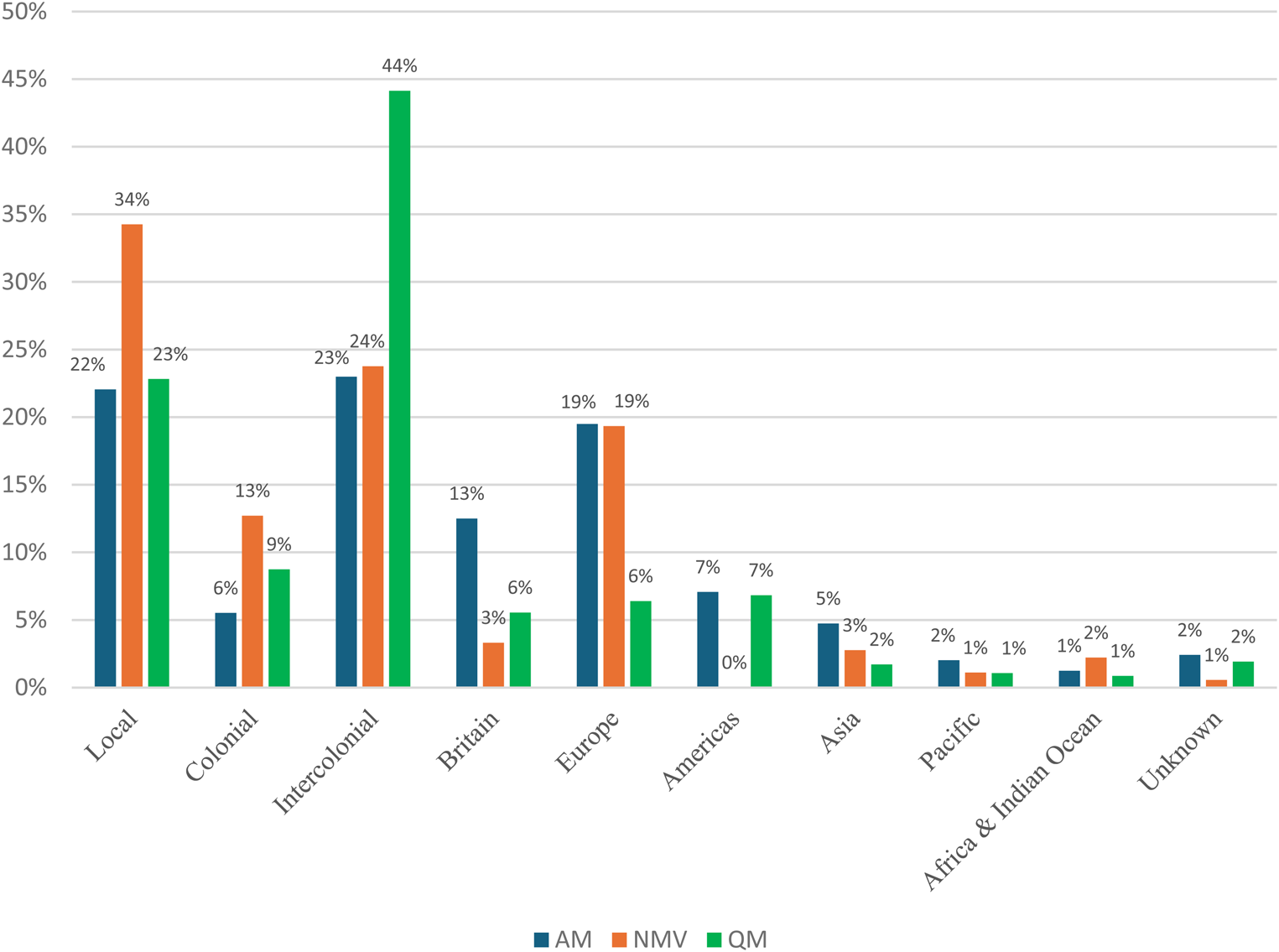
The intercontinental trade was particularly with collectors in continental Europe, Britain and the Americas. These were more complex transactions, requiring substantial museum resources to negotiate and finance. They were also more risky to complete and required greater reservoirs of trust, but they provided outstanding opportunities to build both collections and connections. The longer-distance trades were frequently larger; measured by total specimens, the intercontinental share was the majority of the exchange trade (63 per cent), with continental Europe being the dominant destination. European exchanges accounted for 16 per cent of total exchange transactions and 35 per cent of specimens. The largest and most important European exchanges took place with partners in Paris, Berlin, Vienna, Brussels, Florence and Marseille. Despite the colonial connection, Britain was less important, accounting for just 10 per cent of transactions and 6 per cent of specimens exchanged. With their well-established museums and scientific societies, London and Cambridge were the location for the majority of British exchange partners, transactions and specimens exchanged. Exchanges with British colonies (Canada and Newfoundland, India, Hong Kong, Singapore, the South African colonies, several Pacific Islands) amounted to 5 per cent of total transactions and 10 per cent of specimens.
The geographic picture varied among the three museums (Figure 5). The AM’s global trade was the largest and most geographically diverse. The QM’s exchange trade, while also internationally diverse, relied more heavily on trading within the Australasian colonies. This might be explained by its being a more recent institution that was seeking to establish local connections first, or because its directors did not have a specimen reservoir from which to trade more widely. NMV’s geographic spread was the narrowest of the three institutions since its European exchanges were mostly confined to trades following the 1880–1 Melbourne Exhibition and it had no exchanges with the Americas, unlike the other two museums. The Americas, especially the USA and Canada, provided a fruitful zone of exchange for the AM and the QM. Here there were fewer but larger transactions. Prominent exchange partners clustered around areas with reputable museums and universities, especially in New England, Washington, DC, New York and La Plata in Argentina.
Global exchange (inwards and outwards) transactions by the Australian Museum, the National Museum of Victoria and the Queensland Museum, 1860–1900 (%).
This complex pattern of exchange trading was driven by a range of motives to which we turn in the following section.
The benefits of exchange trading
In economic terms, the main requirement of exchange is the double coincidence of wants. In the absence of money as a common medium of exchange, each party must be able to offer a good or service wanted by the other and of approximately equal value.Footnote 33 Museums seeking to build a natural-history collection and contribute to the creation of natural-history knowledge were able to negotiate comparative value and exchange their reserves of local specimens in return for different specimens located in the vicinity of the trading partner. Their pursuit of negotiation was undergirded by contemporary theories of price and value, which emphasized the subjectivity of buyer and seller preferences over the earlier classicist notion that price reflected the inherent cost of production.Footnote 34
At the transaction level, negotiating exchanges relied on personal connection, communication and a relationship built on trust. Trust-based relationships have been historicized through the deployment and measurement of the concept of social capital, which evaluates the manner in which individuals and organizations commit resources to building connections. In nineteenth-century Australia, strong veins of social capital running through close-knit rural communities were targeted by rural businesses seeking to build customer loyalty.Footnote 35
Cultivating museum network connections through exchange relationships was discussed at the very first meeting of the AM’s new independent body of trustees in 1836, although actual specimen exchanges were few for the next twenty years.Footnote 36 Intention finally met systematic action when the museum’s first gallery opened in 1857 and a form letter was sent out to sixty potential exchange partners in museums across Britain and its colonies, Europe and North America.Footnote 37 The annual reports of the NMV confirm that this kind of activity mattered for them too. In 1875, the NMV committee reported that ‘considerable progress’ had been made ‘in completing arrangements with the trustees and directors of the museums in the neighbouring colonies and New Zealand for exchanges of duplicate specimens’; the museum had received ‘assurance of kindly cooperation in all matters that can advance the knowledge of Natural History’.Footnote 38 In exchange, building and maintaining relationships with museum peers was as important a goal as the creation of complete series of animals or display collections.
A key benefit of the exchange trade was the direct monetary cost saving it promised compared with purchasing specimens. Through exchange, museums could also bypass the costs and complexities of the foreign-exchange and payments mechanisms of international trade, even though the introduction of the gold standard and the growth of international financial intermediaries had reduced the costs and risks of long-distance trading by the late nineteenth century.Footnote 39 All the museums operated to limited budgets and were particularly cash-strapped during the economic downturn of the 1890s. At the AM, budgets dropped precipitously, from eleven thousand to four thousand pounds in just one year, 1892. While the annual expenditure of the NMV had been £2,500 in 1870, it had dropped to £1,800 by 1890.Footnote 40 At the QM the 1890 chairman’s report lamented the ‘small sum at our disposal for the purchase of specimens’.Footnote 41 However, exchange transactions were not without cost, since specimen preparation, exchange negotiations and organizing shipping and logistics could take up significant museum staff time and resources. As the QM chairman’s report noted in 1898, ‘Exchanges have been almost precluded by the inability of our few officers to spare from more urgent needs the time required for this mode of increase.’Footnote 42
Exchange could also be a tool for collection management. As Catherine Nichols’s work shows, tracking the practice of disposal is as important as studying acquisitions for a full view of collection formation.Footnote 43 Exchange could help manage growing, often overcrowded, and poorly described collections by removing low-value, unwanted and duplicate specimens, many of them donations. In 1871, the newly appointed NMV trustees were keen to dispose of the extensive, uncatalogued, duplicate specimens that had built up during Frederick McCoy’s long tenure. The Sectional Committee for the museum reported that they had obtained the ‘power to exchange duplicates of specimens with other similar institutions’.Footnote 44 However, recognizing the high transaction costs of both donations and exchange, the committee also resolved to limit the number of donations accepted, ‘unless such as might appear desirable for making exchanges with similar institutions or, perhaps, to fill up gaps in the scientific series’.Footnote 45
While the exchange trade therefore came with clear benefits – low cost, complementary trading, reputation building and collection management – it was not without its challenges. Compared with commercial trading, where prices were rarely negotiable and relative value was set through prices, achieving the variable and personal double coincidence of wants in exchange was often quite challenging. Building major collections was a complex business and museums around the world were in different stages of development from one another and sometimes emphasized alternative collection preferences. Although Australian fauna was in high demand, Australia’s colonial museums were not well known internationally, and sometimes had to cultivate relationships with generosity and from a weak bargaining position. This was especially true for trades with the British Museum (Natural History Museum) in London. The British Museum rarely entered exchange relationships, preferring that supplicant colonial museums instead ‘present’ their treasures for scientific assessment, classification, naming and storage. The AM sent a stream of its best specimens to London, demanding little in return beyond access to important networks. In 1867 when Richard Owen suggested to the BM trustees that it would be ‘desirable and highly expedient’ to agree to a request from AM curator Gerard Krefft for fossil casts in return for his thousands of Australian megafauna fossils, the trustees denied the exchange and instead insisted that Krefft should follow the usual practice of paying for the casts.Footnote 46 But Krefft was a patient and creative user of specimen supply networks to achieve his personal and museum goals. By 1871, British Museum curator Albert Gunther noted that ‘it was through Krefft’s assiduous correspondence’ that the Australian Museum ‘became the first to receive an exchange of specimens from the British Museum, a reward for its many contributions’.Footnote 47 Conversely, within the bounds of the Australian colonies, the larger museums and their curators could use their relative size, prestige and network access to drive a hard bargain with their less established local peers. Amateur enthusiasts could be vulnerable too: in the early 1890s, the QM received three times the quantity of minerals it sent to W.P. Tower of Toowong in Brisbane, and twice the number of birds’ eggs it sent to W. White of Adelaide. Nor did all intercontinental trades involve exchanging cheap local specimens given the existence of secondary trading and the broad field-collecting reach of museums in Europe and North America both via organized expeditions and through extensive, worldwide networks of individual collectors.Footnote 48 Delays in completing an exchange transaction were common. Sometimes, the opportunity was missed entirely as the relative scientific rarity, popularity, availability and therefore value of different specimens could shift quite rapidly.
Where possible, museums were prepared to be patient and wait for the opportunity for an advantageous trade; building a collection was a long game and ‘dynastic’ curators remained in office for many years.Footnote 49 Just as they made lists of the most desirable exchange partners, museums also kept wish lists of specimens they were seeking to acquire, known as ‘desiderata’, and used their personal and institutional networks in the museum world to make known the specimens they were targeting and what they might offer in return. In 1871, the NMV distributed lists of their available duplicates in order to stimulate exchanges.Footnote 50 Three years later, it reported that ‘[c]onsiderable progress’ had been made ‘in completing arrangements with the trustees and directors of the museums in the neighbouring colonies and New Zealand for exchanges of duplicate specimens’.Footnote 51 At the International Fisheries Exhibition in London in 1883, AM curator Edward Ramsay was so overwhelmed with requests from possible exchange partners that he kept an account-style exchange journal ledger in an attempt to balance the specimen scales and record desiderata for all parties.Footnote 52 The correspondence registers of the Queensland Museum are replete with reports of the museum exchanging lists of desiderata with prospective exchange partners around the world. This sometimes occurred in conjunction with exchange activity; for instance, in December 1887, Professor Enrico Hillyer Giglioli of Florence’s Museo Zoologico di Vertebrata reported the safe arrival of a box of specimens from Brisbane; he requested a list of desiderata from the museum in order to help him compile an appropriate return exchange.Footnote 53 Nine months later, Giglioli was still chasing up this list.Footnote 54 He eventually forwarded a box containing eighteen skeletons of European, North African and South American mammals, birds and reptiles.
Negotiating exchange values was sometimes complex and time-consuming for natural-history items, especially as trading was relatively thin, specimens were of varying quality, and shifts in relative pricing occurred frequently. Museums did discuss prices and they had information available to them from their commercial trading activities, scientific expertise and knowledge networks from which to draw comparisons of value between items. Since exchanges between international museums often involved large numbers of specimens in each transaction, the problem of agreed value was amplified by the need to derive a price or value for each of many items. This could be a substantial task. Sometimes, field documentation and labels were missing or lost, reducing the museum-scientific value of individual specimens. Large exchanges, therefore, usually relied instead on a broader sense of ‘fair value’ across the transaction, rather than attaching a precise price to each item. For example, the Queensland Museum negotiated a finely balanced exchange of around five hundred specimens with the Canadian doctor and amateur naturalist John Hutchison Garnier between 1883 and 1885.Footnote 55 A lengthy correspondence was required to determine a fair trade. Garnier ultimately sent 522 specimens in exchange for the QM’s 489. There was a close equivalence of specimens: 249 Canadian birds for 330 Australian birds, forty-four Canadian mammals for thirty-six Australian mammals, eighty-seven Canadian reptiles for ninety-seven Australian reptiles. Even the special rare items and quirky demonstrations of local colour were finely balanced: Queensland sent three crocodiles, one kangaroo skull and a bowerbird nest in exchange for an extinct gigantic deer, a set of antlers of the same, a rawhide lasso and a sample of saplings cut by a beaver.
In some cases, exchanges were negotiated alongside donations and purchases, with items switching transaction categories based on supply, demand and the progress of negotiations. For example, over two decades from 1878 the AM managed a mix of transaction types with collector and trader James Dall in New Zealand. Highly sought-after and high-value Māori ethnographic objects had established commercial trade value and had to be purchased by the AM but Dall was willing to enter exchange negotiations to build his personal ornithological collection and consolidate relations with museum curator Edward Ramsay. Exchange was also used in this relationship to continue and conclude negotiations when sale prices could not be agreed. Deftly switching between financial value systems and symbolic valuation through exchange mechanisms, in 1887 the cash-strapped AM told Dall that the monetary prices he wanted for his birds were too high, ‘but if you are willing to take exchanges for them they will be accepted’.Footnote 56 When there was no double coincidence of wants, nor agreement on values, exchange negotiations sometimes failed. In 1884, when he failed in negotiating an exchange of Australian specimens with the Indian Museum in Calcutta after the International Exhibition held there, AM curator Edward Ramsay donated the collection to the museum to save the return freight costs to Sydney.Footnote 57
As the examples of protracted negotiations with Calcutta, Giglioli and Dall illustrate, while exchange promised lower direct costs, it also implied higher transaction costs – those of searching, negotiating and completing a contract between seller and buyer – compared with a commercial sale.Footnote 58 The principal way in which exchange trade addressed the transaction costs impediment was through a focus on personal and professional networks. By building stocks of social capital, these connections mitigated all three elements of transaction costs. Search costs were reduced through enhanced information dissemination and sharing in networks, negotiation was truncated by mutual trust, and the need for close monitoring was therefore also unnecessary in many cases. Many exchanges were based on personal and professional contacts, which created confidence that the other party would provide an accurate description of the condition of the goods they were trading over long distances, and especially in light of the heterogeneity and variable quality of natural-history specimens.
Exchanges were often prolonged, with one party initiating the trade and relying on good faith that the other would eventually reciprocate the exchange to complete the contract. Avner Offer calls this the ‘economy of regard’, where the gift and market economies interact, and where price signals are muffled by economies of regard, goodwill and trust.Footnote 59 Sometimes, it was simply not possible to achieve a balanced exchange value for a transaction involving large numbers of specimens being traded in either direction and agreeing the terms of exchange operated within far more flexible boundaries than price-based trading. In these cases, an unequal contract occurred that introduced a ‘deferred obligation’ in the knowledge that one party was in debt to the other to be resolved through a future transaction. For such open-ended arrangements to operate effectively, a high degree of trust was needed among men and between their museums. This is what Offer calls ‘the dynamics of reciprocity’. Exchange is not just an economic transaction but ‘a good in itself’, usually in the form of a personal (and/or an institutional) relationship.Footnote 60
In this museum exchange economy, even when an exchange failed, it might eventually succeed. If a trade failed en route, such as through damage or destruction of the specimens, the sender was often prepared to provide replacements, given the low cost of finding a substitute and the desire to maintain the bonds of the trading relationship. In March 1894, for instance, the Queensland Museum responded promptly to send replacements when several eggs exchanged with the Grafton naturalist and long-term trading partner S.W. Jackson arrived broken.Footnote 61 Newer bonds lacking the depth of social capital could be more brittle; when T. Ryan of the south-east Queensland town of Kingston reported that a collection of shells arrived in ‘worthless condition’, the exchange was called off and no further transactions were recorded.Footnote 62
Many of the features of successful exchange trading relied on a system of relational governance embedded in the personal and professional networks of the natural-history, museum and scientific worlds. Personal networks in the natural-history world were complex and tangled. Many curators and trustees built their own collections and traded privately with each other outside the formal business of the museums they represented. Exchange, with its informality and lack of recorded financial transactions, provided the ideal cover to reduce trading visibility and the risk that personal collecting might be seen as conflicting with the best interests of the museum they represented. Krefft knew that person-to-person exchange trading gave him a freer hand not dependent on the approval of the AM’s trustees, of financial donors and of economic fluctuations. In a carefully curated and tightly targeted exchange relationship, he could cultivate his scientific networks and enhance his own scientific reputation at the same time as strategically adding to the museum’s collections. Krefft was a canny trader of the megafauna fossils he excavated at Wellington Caves in the 1860s, using them to establish and enhance his relationship with palaeontologist and Natural History Museum director Richard Owen over the next decade as they debated the teeth and diet of the giant herbivores.Footnote 63 However, Krefft’s circumventions of museum channels and his cultivation of personal exchange relationships outside the purview and influence of trustees created tensions, leading to the setting up of a committee in 1869 to tighten internal controls and monitor and approve all exchange transactions.
More happily, the example of the marine biologist William Aitcheson Haswell demonstrates the ways in which personal connections could cross institutional lines. Haswell served as curator of the Queensland Museum in 1880. He returned to an academic post in Sydney in 1882, but he continued to serve as an important broker of natural-history connections for the institution, drawing on his extensive global connections.Footnote 64 In 1881 he forwarded to the QM notes inquiring after exchanges of specimens from Harvard biologist Alexander Agassiz, Norwegian naturalist Hans Esmark, and the Hamburg Museum of Natural History.Footnote 65 At the AM, the institution’s well-travelled trustees, with their extended business and scientific networks, were also conduits for exchange transactions. When Cambridge-educated trustee Archibald Liversidge travelled to Europe in 1878 he took with him museum funds for the purchase of books, specimens and models, and the mandate to negotiate future exchange relationships with his English contacts.Footnote 66
Not only did successful exchange trading draw upon network resources, but it also created, promoted and strengthened such connections, for example where deferred obligations prolonged interaction, or the exchange of specimens was also an exchange of scientific knowledge and prestige. The inference here might be that exchange trading was motivated by several factors. Most obviously, it facilitated the building of scientific collections and the knowledge associated with the acquired specimen since the underlying value of a specimen lay in knowledge of its provenance as well as its condition and rarity. While some exchanges involved a cornucopia of different items with limited information about each, others were infused with richer knowledge, particularly where extended discussion ensued among museum scientists about specific items that were being added to a collection. At the same time, exchanges could also be motivated by the desire to build strong connections, networks and social capital, as an end in itself that would enhance the reputation of the individual and the institution. In some cases, the circle was completed when strengthened networks in turn facilitated future collection and knowledge development. For the canny colonial curator, successful exchange transactions expanded their roles outside the museum – as go-betweens, traders, negotiators, balancers of scales and arbiters of value.Footnote 67
An important example of the use of exchange trading to build connections and reputations took the form of exchange diplomacy. Leading museums were important demonstrations of national institutions whose standing and international reach constituted a form of soft geopolitical engagement between states. Some exchanges were facilitated through formal diplomatic institutions, such as embassies and other consular bodies. The NSW agent general in London for most of the 1880s, Saul Samuel, was able to assist through his imperial-bureaucratic networks and his background in pastoralism, business and trade. Mobile colonial bureaucrats moved around the world, creating transverse networks across languages, empires and geographies.Footnote 68 For example, colonial administrator William Denison had a keen interest in natural history and set up and encouraged local scientific infrastructures wherever he was posted, first to Hobart (Tasmania), then Sydney, Norfolk Island and finally Madras. Officials at all levels of government were well aware that an interest in natural history had a networking bonus.Footnote 69
However, it was at international exhibitions – the Victorian era’s spectacular declarations of imperial and national pride and power that also served as venues for popular entertainment and commercial and scientific knowledge exchange – that most major diplomatic specimen exchanges occurred. Participation in these exhibitions was government-led, with museums asked to contribute local display content.Footnote 70 A museum’s treasures were on display before acquisitive eyes that assessed specimens in terms of their comparative worth and exchange value. Exhibitions provided an opportunity for naturalists, curators and colonial dignitaries to view representative specimens of the territories that might contain future exchange partners. They were also important social and diplomatic events, where scientists, agents general, politicians and commercial elites rubbed shoulders in a convivial atmosphere.Footnote 71 The AM sent collections and traded nature at numerous European exhibitions stretching back to Paris in 1851. As noted above, Ramsay’s participation in the International Fisheries Exhibition in London in 1883 was the major exchange event for the AM in this period. The NMV, too, established relationships with the delegations of various nations present at the Melbourne International Exhibition in 1880, and sent large collections of Australian fauna to the governments of Austria, Germany, the Netherlands, France, Belgium, Italy and Japan in the following year. These seven exchanges comprised a total of 4,721 specimens, or 68 per cent of all outgoing specimens from the museum over the years covered in this study. The fact that many of these exchanges were imbalanced or not immediately reciprocated demonstrates their use as tools of soft diplomacy alongside their collection gains.
Building collections and strengthening connections
The growth of the natural-history trade in the second half of the nineteenth century occurred in the wake of the spread of public museums and popular natural-history pursuits, commercial dealing and even diplomatic intervention. Facilitated by empire and the growth of international trading infrastructures, the trade took on global proportions, particularly in the exchange of zoological specimens. The ambitions of newly established Australian museums were deeper than their pockets and therefore exchange became a key part of their collecting strategy. However, exchange trading was not only motivated by economic and financial considerations, nor was its geography dictated solely by empire.
The conclusions reached in this paper build on and extend the evolving literature to examine a broad array of influences on the motivations and directions of natural-history trading that expanded both collections and connections. By analysing a particular form of natural history, in zoology, and a specific form of trade, in exchange, our work extends and enriches the recent literature’s interest in the mobility of different specimens and how they were traded.
In the process, we have provided the first detailed and comparative analysis of the exchange dimensions of the trade in the nineteenth century, through the lens of the three most prominent Australian natural-history museums of the period. The exchange trade provided a series of benefits: lower direct costs, complementary demands for specimens, and opportunities for collection management. But there were also costs, particularly the complex negotiation of comparative values. The response to this problem revealed another motive of exchange: making connections and strengthening reputations – personal, organizational and even national. Our study therefore brings the economic, the anthropological and the colonial together with more traditional studies of the history of scientific collecting.
This paper has suggested several directions for further research. The distinction between collection-building activities in different areas of the natural-history trade is an important point of debate and worthy of further investigation. The generation of dense and active exchanges that we have outlined was comparatively short-lived. This suggests the historical contingency of the phenomena under consideration: a temporary era of economic globalization, the institutional development of colonial natural-history collections, and the particular events (such as exhibitions) and personnel (for example, the dynastic curators) that contributed to a period of particularly vigorous natural-history exchange. By the beginning of the twentieth century, the era of hyper-mobile specimens was ending. The status, meaning and use of museum animal specimens were changing, affecting the sorts and volume of specimens available for exchange.
The legacies of the decades-long nineteenth-century boom in exchange transactions are still felt at the world’s natural-history museums in the many unprovenanced and poorly described specimens that flowed through the exchange system. Many of these specimens came into collections with little more than a species identification and the name of the exchange partner. This was compounded by the limited and basic cataloguing done within Australia’s museums until the end of the nineteenth century. Addressing these historical data deficits is an important motivation for future research.
Acknowledgements
The authors are grateful to the editor and two anonymous referees for their valuable feedback on the paper. This paper forms part of a broader project that seeks to recover and reconstruct the data histories and worldwide travels of specimens collected, kept and traded by museums in the nineteenth century – Reconstructing Museum Specimen Data through the Pathways of Global Commerce project – for which we acknowledge the financial support of the Australian Research Council as part of Linkage Project 160101761.


 Open access

