


Appropriate food, energy and nutrient intakes for children under the age of 5 years are vital for their current and future health. Intakes of nutrients such as Fe, Zn and vitamin A have specific impacts on health and development. The prevention of obesity in the early childhood period is also enormously important since this can powerfully affect health and well-being in later childhood. Furthermore, children who are obese are likely to become obese adults and suffer greatly increased risk of CVD, diabetes and many cancers(Reference Bundred, Kitchiner and Buchan1–Reference Caballero5).
Given the opportunity and exposure to a healthy diet, children can learn to eat well(Reference Thomas, Sutcliffe and Harden6). It is therefore crucial that pre-school children are provided with nutritionally balanced meals (including snacks and drinks) and that messages about healthy eating are conveyed to parents. This is particularly true if children are to develop the knowledge, understanding and skills needed to make appropriate food choices and develop positive attitudes to a healthy diet(Reference Thomas, Sutcliffe and Harden6).
Young children who attend child-care settings each day may receive the majority of their energy and nutrients outside the family home(7). In England, the number of children attending full day care increased threefold between 1997 and 2006(8). Typically a child attending full day care can spend 10 h per d, 5 d per week for 48 weeks per year in an early years setting. Therefore, child-care settings have a responsibility to ensure that children have adequate energy and nutrient intakes as well as the right environment to promote positive attitudes to a healthy lifestyle.
The Department of Health (DH) in England has published a number of policy documents, service frameworks and toolkits in response to the increase in obesity, especially among children(9–Reference Swanton and Frost12). In 2008 the DH published Healthy Weight, Healthy Lives (13), highlighting a need for work across early years. This statutory guidance states ‘Children should be provided with healthy meals and other healthy snacks and drinks as appropriate’ (p. 27) but gives no further details. Similarly, while new nutrient-based standards for school lunches have been in force for primary and secondary schools since September 2008 and 2009 respectively(14), guidance for under-5s’ child-care settings recommends only that the food and drinks provided should be healthy and nutritious(15).
In 1998 the public health nutrition charity the Caroline Walker Trust (CWT) published the first nutritional and practical guidelines around eating in the UK for pre-school child care, ‘Eating well for under-5s in child care’. The CWT provides an extensive range of resources and guidance concerning healthy eating. The ‘Eating well for under-5s in child care’ publication is specifically for day-care settings and provides nutritional and practical advice for infants, toddlers and pre-school children. Table 2 in the present paper provides an overview of the scope and content of this resource; it is also downloadable at http://www.cwt.org.uk/publications.htmlunder5 together with a learning materials publication for people working with under-5s in child care.
The CWT guidelines were subsequently updated and re-launched in 2006(Reference Crawley16); they are now seen as the ‘gold standard’ for school meals(17) and the main reference for early years nutrition in the UK(18, 19). Comprehensive guides have been produced by the Scottish Executive(20), the Welsh Assembly(21) and the Health Promotion Agency of Northern Ireland(22). All such guidelines summarise and apply basic nutritional information available to all, and then add information from best practice on how to encourage healthy eating from experts in the field, in particular the CWT. The DH for England has not as yet produced such written guidance. However, there is activity at regional level and at local primary care trusts (PCT) and local authorities in England.
Given the increased attention directed at developing ways to encourage healthy eating in pre-schools and the as yet uneven approach to statutory guidance, the current paper aims to determine the extent to which national and local UK guidelines for the early years sector address key recommendations based on the CWT healthy eating guidelines for under-5s. This is achieved in two stages: (i) a mixed-method literature review to identify new evidence to augment the CWT ‘Eating well for under-5s in child care’ guidelines (Phase 1); and (ii) an assessment of healthy eating guidelines for the early years sector produced by local to national-level government, using the CWT guidelines as the ‘gold standard’ (Phase 2).
Methods
Phase 1
Review of literature
This review of the literature was not intended to be a formal systematic review. The methods used were devised to be as rigorous and systematic as possible. The review was considered appropriate to identify and collate any new evidence concerning healthy eating practices given that the CWT guidelines were published over 4 years ago.
Inclusion criteria
Documents were considered for inclusion if they made recommendations for interventions to encourage healthy eating in pre-school settings, based on convincing evidence presented in the document. Published and unpublished quantitative and qualitative studies and systematic reviews were eligible, provided that they met the required quality standards (detailed in the ‘Quality assessment’ section).
The following subjects were included: children aged between 2 and 5 years, AND (experiences of eating in pre-school child-care settings OR facilitators, barriers and potential barriers to enabling the provision of healthy food OR policy and practice recommendations to improve healthy eating in pre-school settings). Literature relating to dental health or breast-feeding and weaning were excluded. While dental caries and infant feeding are both important issues, they did not fall within the focus of the present paper to evaluate practical guidance on the ways to encourage young children to eat healthily.
Other criteria for inclusion were: published 1999 to June 2009; written in English; and undertaken in a high-income country.
Search methods
The search was conducted using PubMed, Scopus and a hand search. Key search terms included ‘food’, ‘nutrition’, ‘diet’, ‘pre-school’, ‘under-five’, ‘child*’, ‘nursery’, ‘day care’, ‘children's centre’, ‘kindergarten’, ‘policy’, ‘practice’, ‘strategy’, ‘guidelines’ and ‘recommendations’. These were refined in the first instance in PubMed as MeSH terms and then adapted for Scopus. The terms ‘dental health promotion’, ‘dental caries and oral health’, ‘breastfeeding’ and ‘weaning’ were excluded.
Quality assessment
For quality assessment purposes, documents were divided into three main types: (i) published studies; (ii) systematic reviews; and (iii) published online reports of surveys.
Published studies were systematically assessed by M.G. for risk of bias in eight areas as appropriate to the type of study: (i) sample size; (ii) randomisation; (iii) response; (iv) follow-up; (v) measurement instrument; (vi) measurement observer; (vii) sample characteristics; and (viii) incentives. From this systematic assessment, an overall qualitative judgement of risk of bias was made and only those studies judged to have a low risk of bias were included.
Systematic reviews were assessed by K.A. and selected for inclusion if they had a clear systematic approach in terms of search strategy, inclusion criteria, outcomes of interest, quality assessment and data extraction, and a clear presentation of findings and conclusions.
Published online survey reports were assessed by K.B. and were included if they were particularly relevant to the question their methods clearly stated.
Phase 2
Evaluation of local, regional and national guidelines for supporting healthy eating in under-5s
Selected guidelines were independently assessed by two authors (K.B. and F.L.-W.) for inclusion of each of the key and sub-key recommendations identified through Phase 1, using a checklist as a guide. The comprehensiveness of the recommendations rather than the clarity and quality was assessed. It was felt that the latter variables would require a qualitative assessment of how the recommendations were implemented in practice.
The Scottish Executive(20) and Welsh Assembly(21) guidelines were included to represent the national level, as England does not as yet have national-level guidelines and the Northern Ireland guidelines(22) were published prior to the updated CWT guidelines. Guidelines from North West England included one produced at regional level and four produced by local authorities or PCT in Merseyside. In order to maintain anonymity, the reference numbers for the regional and local-level guidelines have not been used when presenting the results in Table 3.
Results and analysis
Phase 1
Results
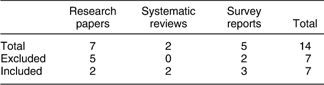
Seventy-five documents were retrieved through the search. Of these, sixty were excluded because they addressed compliance with nutritional and food-based standards only and not practical guidance to encourage healthy eating. One document looked at a specific intervention using a social marketing tool and was deemed too narrow to be included(Reference Winters23). The remaining fourteen documents(Reference Benjamin, Haines and Ball24–Reference Williams, Strobino and Bollella39)Footnote * assessed interventions to encourage healthy eating in pre-school settings and were therefore provisionally included and assessed for quality; these included seven study documents, two systematic reviews and five surveys. Following assessment of quality, two published studies(Reference Fitzgibbon, Stolley and Dyer26, Reference Matwiejczyk, McWhinnie and Colmer29) were excluded because they provided insufficient detail to adequately assess their methods and three were excluded because they were assessed as having a high risk of bias(Reference Benjamin, Haines and Ball24, 27, Reference Romaine, Mann and Kienapple34). Seven documents were finally included in the review. These included two published studies by Talvia et al. and Williams et al.(Reference Talvia, Lagström and Räsänen36–Reference Williams, Strobino and Bollella39); two systematic reviews by Campbell and Hesketh and the Mother and Infant Research Unit(Reference Campbell and Hesketh25, 30); and three surveys published online. The latter included two reports from the Office for Standards in Education (Ofsted), Starting Early and Food for Thought (31, 32). These surveys were included because of the important statutory role this body plays in early years settings. A baseline survey conducted by a local authority in the region(35) was also included as it was deemed to be of particular relevance to local authorities and PCT in the North West.
Table 1 summarises the number of documents initially identified as relevant and the number excluded following quality assessment.
Number of documents selected for review
Analysis
A qualitative thematic approach(Reference Green and Thorogood40) to analysis was used to develop the key themes relating to encouraging healthy eating in pre-school settings. Word documents were created of the recommendations from each of the seven documents. These were uploaded into the software NVivo 8 (QSR International (UK) Ltd, Southport, UK) for coding. The CWT guidelines were analysed separately using the same process. The included CWT guidelines, reports and studies were then further explored under each key theme to identify sub-themes.
The seven included documents(Reference Campbell and Hesketh25, 30–32, 35–Reference Williams, Strobino and Bollella39) and the CWT ‘Eating well for under-5s in child care’ guidelines were analysed by K.B. and F.L.-W. to identify key themes relating to recommendations to promote healthy eating in pre-school settings.
Once saturation(Reference Ritchie, Lewis and Elam41) was achieved, a final list of overarching themes was established: (i) role of government; (ii) early years setting policy/guidelines; (iii) training; (iv) menu planning; (v) parents; (vi) atmosphere and encouragement; (vii) learning through food; (viii) sustainability; and (ix) equal opportunities, and sub-themes within the themes. Given the focused nature of the literature review there were no major differences between the themes identified by K.B. and F.L.-W. The identified themes and sub-themes are presented in Table 2.
Key themes and sub-themes for developing a healthy eating environment in pre-school settings
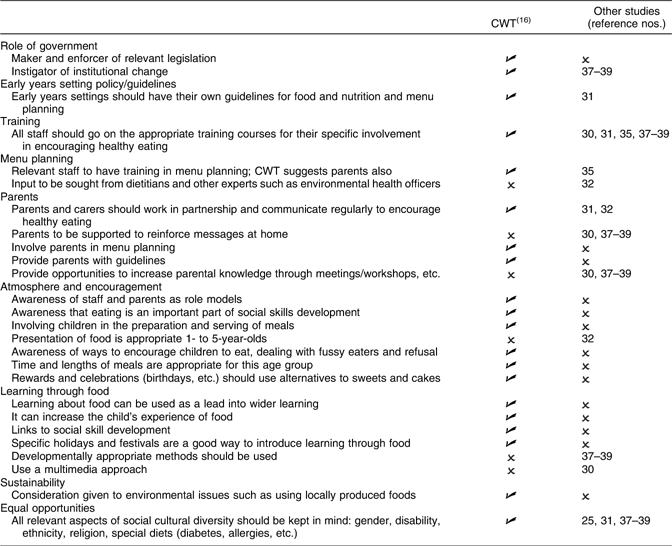
CWT, Caroline Walker Trust; ✓, theme/sub-theme is included in the guidelines;  , theme/sub-theme is not included in the CWT guidelines or addressed in the studies.
An important finding from the exercise of identifying key recommendations from the seven studies(Reference Campbell and Hesketh25, 30–32, 35–Reference Williams, Strobino and Bollella39) was the confirmation of the continuing relevance of the CWT guidelines. There were only a few areas where the evidence from the reviewed documents added to the CWT guidelines: menu planning advice could be sought from dietitians and other experts(32); nurseries could provide opportunities to increase parental knowledge(30, Reference Williams, Bollella and Strobino37–Reference Williams, Strobino and Bollella39); food should be presented appropriately for under-5s(32); developmentally appropriate early years methods should be used to encourage learning(32); and linked to this, a need for a multimedia approach to be taken(30). While these are all relevant recommendations they confirm the salience of the CWT guidelines.
Phase 2
Evaluation of local, regional and national guidelines for supporting healthy eating in under-5s
England does not as yet have national-level guidelines. The Northern Ireland guidelines(22) were published in 2005 prior to the CWT guidelines in 2006. Therefore the Scottish Executive(20) and Welsh Assembly(21) guidelines were included to represent the national level. The guidelines from the North West included one produced at regional level and four produced by local authorities or PCT in Merseyside. Each guideline was independently assessed by K.B. and F.L.-W. for evidence of the key and sub-key recommendations.
The findings from the evaluation are reported under each of the key recommendations, with Table 3 indicating whether a specific set of guidelines included a particular sub-recommendation. Occasionally, sub-themes appear to be repeated across key recommendations; this is in order to emphasise particular aspects, e.g. involving parents in menu planning.
Evaluation of local, regional and national guidelines for supporting healthy eating in under-5s
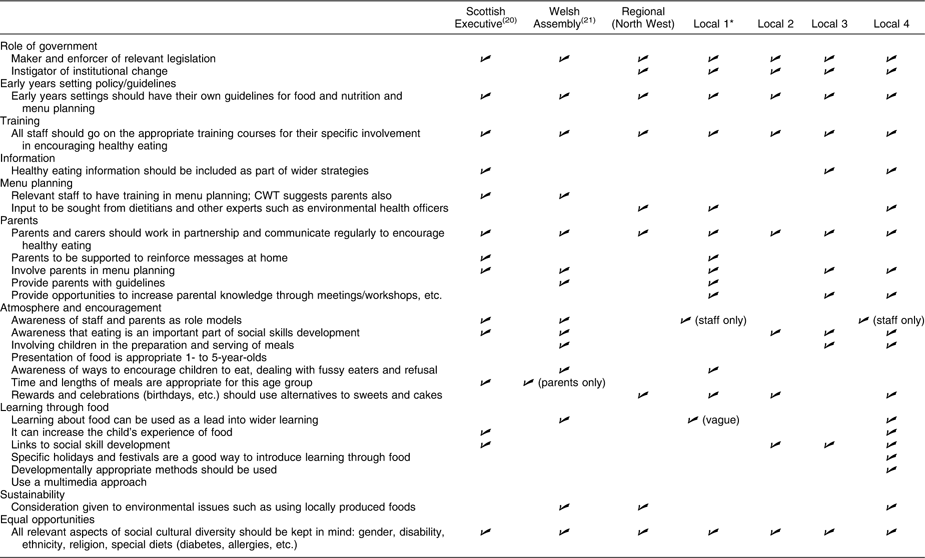
CWT, Caroline Walker Trust; ✓, theme/sub-theme is included in the guidelines.
*In order to maintain anonymity, the term ‘local’ has been used for the guidelines produced by the four North West primary care trusts and/or local governments.
Role of government
All seven guidelines report that government should create and enforce relevant legislation. In terms of instigating institutional change, only the regional and local-level guidelines suggest that governmental agencies should take on this role.
Early years setting policy/guidelines
All the guidelines recommend that early years settings develop their own healthy eating guidelines/policies. In addition, some of the guidelines at national level and the local guidelines give further practical support including an example of an appropriate policy.
Training
All guidelines at national, regional and local level identify training for staff as important, although some state this more explicitly than others. The Welsh guidelines, for example, give details of relevant training courses such as the Open Colleges network courses. These guidelines also have a checklist of questions such as ‘Do you have a nutrition and oral health training policy?’ and ‘Have staff had advice and guidance on nutrition in early years?’
Menu planning
Only the national-level guidelines explicitly state the need for staff to receive training in menu planning. Input from dietitians and other experts is recommended by the regional and the first local guideline regarding special dietary requirements. The fourth local guideline names such experts as their partners in developing healthy eating in early years settings.
Parents
All government levels recommend that early years settings and parents should work together and communicate regularly to encourage healthy eating in young children. The Scottish national and the third and fourth local guidelines identify the importance of communication, whether this is between parents and the early years providers and/or between the relevant statutory services. Most of the guidelines propose that the settings can support parents’ own knowledge and awareness of healthy eating and through this encourage healthy eating in the home environment. The fourth local guideline aims ‘to raise awareness of health eating, promote oral health and food safety issues amongst parents/carers…’ and expects as an outcome that parents and the setting will work closer together using a consistent approach to healthy eating. The first, third and fourth local guidelines encourage parental learning via parents evenings and/or specific workshops.
Atmosphere and encouragement
As shown in Table 3, no sub-recommendation was fully covered by all guidelines. With regard to the need for the timing and length of meal times to be appropriate to this age, only the national guidelines indicate this is relevant. The regional and three out of the four local guidelines mention the need to use alternatives to sweets and cakes for rewards and celebrations. Only the Welsh and the first local guideline discuss ways to encourage fussy eaters. None of the guidelines raise the importance of presenting food in age-appropriate ways.
Learning through food
Interestingly, given all of the guidelines had been developed to link into the Department for Children, Schools and Families (DCSF; now the Department for Education) Early Years Foundation Stage (EYFS) strategy(15), only the fourth local guideline appears to have a wider vision for food-related learning. A key learning focus would seem to be the role meal times can play in social skill development; however, this is raised only by the Welsh, second, third and fourth local guidelines. Again despite the connection with EYFS, none of the guidelines mention using a multimedia approach to encourage healthy eating with young children.
Sustainability
In terms of environmental sustainability (e.g. carbon footprint and sustainable fishing) only three guidelines include this, those being the Welsh national, regional and fourth local. Regarding sustainability in terms of the balance between cost, quality and quantity, this is noted by just the second and fourth local guidelines.
Equal opportunities
All of the guidelines are in agreement that equal opportunities are important across a comprehensive range of factors including gender, ethnicity, disability, religion and specific health-related needs.
Discussion
The assessment of governmental guidelines suggests that all nine key recommendations of the CWT guidelines are deemed relevant by all levels of government at local, regional and national level. This was reassuring. However, there was much less consensus on which sub-themes to include and the depth of detail of the guidance. There seems to be unanimous agreement that all early years settings need to have their own healthy eating guidelines/policies, staff need training and that equal opportunities is addressed. In some cases recommendations were backed up with extra information such as an example of a healthy eating policy or details of training courses. This additional input may act as an extra lever to support settings in their healthy eating aspirations. Specific training in menu planning is suggested by both national guidelines, while other guidance notes the need for input from dietitians and other experts.
There was a consensus across the government guidelines about the need for regular communication and co-operation between the early years setting and parents/carers. Interestingly, a significant finding from the associated primary study(Reference Lloyd-Williams, Bristow and Motswama42) indicates that clear regular communication between the local PCT and Ofsted inspectors is important to prevent conflicting messages.
Apart from the need to communicate regularly with parents there is some agreement that the early years setting may have a wider role in supporting parents to reinforce appropriate messages and practice in the home. This is in line with the recommendations from three of the seven studies in Phase 1(Reference Campbell and Hesketh25, 30, Reference Williams, Bollella and Strobino37–Reference Williams, Strobino and Bollella39) and the associated research(Reference Lloyd-Williams, Bristow and Motswama42). However further research would be needed to ascertain the feasibility of such an initiative.
Written recommendations alone are not likely to have the impact to enable practitioners to find ways to encourage children to eat at meal times. Therefore it is perhaps understandable that the government guidelines varied in terms of the emphasis on what is appropriate to include. For the national guidelines it was age-appropriate timing and length of meal times, with regional and local guidelines mentioning using alternative rewards to sweets and cakes for celebrations. How to encourage children who are being fussy at meal times is clearly something that requires demonstration and practice, and cannot be conveyed in the written word only. However, only two of the guidelines mention ways to encourage fussy eaters to eat and none mention food presentation. This needs further consideration, as does the potential for guidelines to be linked to a dedicated set of interactive learning materials. Assessment of the format of the guidelines was not within the scope of the present paper. However, the authors suggest that research is needed to explore what is the most effective format to encourage guidelines to be implemented.
Despite the explicit association with education and learning through EYFS(15), the potential for food and meal times to be an integral part of a young child's progress towards Key Stage competencies, including social skills development, were explored by only some of the guidelines. This is another area in which further research involving collaborations between the DH and the Department for Education could yield improvements in healthy eating knowledge, attitudes and behaviour, with possible long-term influence on current cohorts of under-5s and future generations.
While safeguarding the environment may not be the concern of governmental guidelines in the short term, it would seem to be something that all levels of government need to promote and again represents an area where different governmental departments need to be working together more concertedly.
While we attempted to be systematic in conducting the review of the literature herein, there is no claim that a systematic review process was adopted. Indeed given the wide range of studies, surveys and reports included it would not have been possible to keep to the narrow criteria of a traditional systematic review. Once the final seven studies were identified a qualitative process was employed to look for emerging themes that could be integrated with the CWT 2006 healthy eating for under-5s guidance to make a list of key and sub-key recommendations. No inference is intended to suggest this is necessarily a definitive list; alternatively we suggest that all of the key recommendations have merit. The process enabled a reasonable degree of confidence when it came to Phase 2 of the paper to assess the extent to which the recommendations were included in national, regional and local healthy eating guidelines in early years settings.
Conclusions
To our knowledge, the present paper is the first to determine the extent to which national and local governmental guidelines developed in the UK address the key recommendations arising from the CWT ‘Eating well for under-5s in child care’ guidelines(Reference Crawley16). All reviewed guidelines included the nine key recommendations; however, there was sporadic cover of sub-key themes. Given the pertinence of both the key and sub-recommendations it would seem important that all be included in government guidelines. Furthermore, a clear process for communication with and support for parents in encouraging healthy eating needs to be stated in guidelines. More detail is also needed on how to work with children who are reluctant to eat. Recommendations should also link into research on developing a second layer of guidance in the form of appropriate interactive materials. This evaluation has also drawn attention for more work to be done on ways food and meal times can be made more central to young children's wider learning, as well as to development of social skills. This would require greater collaboration between the DH and Department for Education.
Acknowledgements
This paper is the original work of the authors, has not been published elsewhere and is not being considered for publication by another journal. The research to which this paper is related was supported by the Liverpool Institute of Health Research (formerly MerseyBeat). There are no known conflicts of interest. K.B. researched, reviewed and analysed the literature; S.C. read and made editorial comments; K.A. and M.G. assessed the quality of the research literature and made editorial comments; F.L.-W. contributed to the analysis and made editorial comments. The authors would like to thank all the members of the research steering committee for their invaluable advice.



