




1. Introduction
要 yào in Mandarin has multiple senses. Many reference works list over ten entries (e.g., Lǚ Reference Lǚ1980, Zhóngbiān guóyǔ cídiǎn xiūdìng běn, Zhōnghuá yǔwén dà cídiǎn).Footnote 1 Its lexical origin dates back to Old Chinese and its grammatical uses and developments have received considerable attention in the literature, especially modal(-adjacent) ones (e.g., Lu Reference Lu1997, Yu Reference Yu1998, Ma Reference Ma2002, R. Li Reference Li2004, Peyraube and Li Reference Peyraube, Ming and Xing2012, S. Jiang Reference Jiang, Guangshun, Chappell, Djamouri and Wiebusch2013, Hsu et al. Reference Hsu, Wang and Kai-Ming2015, W. Kuo Reference Kuo2015, LaBarge Reference LaBarge and van Gelderen2016, M. Li Reference Li2016). However, despite the wealth of literature on the synchrony and diachrony of yào, its uses in certain types of complement clause have not been described or analyzed in detail. Such uses resemble mandative should in English: the main verb of the complement clause typically has the kind of semantics that triggers mandative should in English, and yáo and should may be deontic or epistemic modals in main clauses. Verbs that trigger mandative should are traditionally called suasive verbs and are functionally deontic (Berg et al. Reference Berg, Zingler and Lohmann2020) and directive, similar to the imperative (Hoffman Reference Hoffmann1997). Example (1a) illustrates mandative should, which may alternate with the subjunctive in (1b), the indicative in (1c), or the to-infinitive in (1d).

Based on Greenbaum and Quirk (Reference Greenbaum and Quirk1990: 44)
Similarly, yào in the complement clause in (2), from the Academia Sinica Balanced Corpus of Chinese, may alternate with a zero-marked complement clause and be rendered into mandative should or to-infinitive in English.

Note that the parallel between yào and should does not extend to mirative should (Arigne Reference Arigne2017, Celle Reference Celle and Guentchéva2018). Furthermore, the alternation exemplified above is not unconstrained. For what motivates the alternation involving mandative should, see Hoffman (Reference Hoffmann1997), Berg et al. (Reference Berg, Zingler and Lohmann2020), and references cited therein; for the yào-zero alternation, if we draw a parallel with the subjunctive-infinitive alternation, following Givón’s observation (Reference Givón1994: 283) that “the infinitive invariably signals stronger manipulation, and the subjunctive weaker”, we may assume that a yào-marked complement clause expresses a slightly weaker directive force than a zero-marked one. Despite this contrast, the semantics of yào involved in the alternation seems very light. Observing that the variants in (1a–c) are not fully equivalent, Berg et al. (Reference Berg, Zingler and Lohmann2020: 236) also note that “the meaning differences appear to be rather minor”. Omissibility will be used as an intuition-based heuristic diagnosis for weak semantics here (but note that it could be tested and established experimentally in future work): the semantics of yào is weak if the overall intended message is not significantly impacted by its omission and if there are instances where a yào-marked complement clause and a zero-marked one have the same main verb and express comparable messages.
According to Bybee et al. (Reference Bybee, Perkins and Pagliuca1994), mandative should likely originates from a harmonious relationship between the deontic (or directive) meaning of the main verb and that of should in the complement clause. Related research has also suggested that modals may develop functions specific to subordinate clauses (e.g., Givón Reference Givón1994; van der Auwera and Plungian Reference van der Auwera and Plungian1998; Narrog Reference Narrog2012a, Reference Narrog2012b; Peltola Reference Peltola, Hilpert, Cappelle and Depraetere2021). Such functions may be called subjunctive (as mandative should is), but will be henceforth referred to as textual, as neither Mandarin nor its historical varieties likely possess any category that may be clearly designated as the subjunctive. The subjunctive-like yào is textual in that, like mandative should, it signals a harmonious relationship between the main verb and the complement clause. This relationship may be specifically termed interclausal modal cohesion, following Peltola (Reference Peltola, Hilpert, Cappelle and Depraetere2021): yào marks the deontic modality shared between the main clause and its complement clause. We may hypothesize that textual yào has undergone a unidirectional development, as the literature has proposed (e.g., Bybee et al. Reference Bybee, Perkins and Pagliuca1994, Traugott Reference Traugott, Minkova and Stockwell2002).
Due to the lack of previous research on textual yào, this article begins with a corpus-based, descriptive component in order to establish its synchronic and diachronic distribution. Based on the qualitative corpus investigation, it is proposed that synchronically, textual yào falls into three types, depending on its relationship with the main verb. Diachronically, it is hypothesized that two of the types share a similar origin in complement clauses negated by prohibitives, while the third one likely has an additional origin in similar modal expressions in complement clauses. On the basis of the synchronic distribution of textual yào and its hypothesized diachrony, I propose that there is a contentful-procedural (lexical-grammatical) dimension to textual markers: two types of textual yào form multi-word lexical expressions with their main verbs and thus are more contentful (lexical), even though the largest and oldest type, similar to mandative should, is more procedural (grammatical). It is therefore not the case, as one would assume on the basis of the literature on textual markers and the subjunctive, that what is originally a main-clause modal unidirectionally becomes more and more procedural as it occurs more frequently in complement clauses. Depending on the relationship with the main verb that the modal enters into, it may also become more contentful, as part of a multi-word expression composed of the main verb and the modal. This observation is in line with a constructional perspective (e.g., Traugott and Trousdale Reference Traugott and Trousdale2013, Trousdale Reference Trousdale2014), where change does not necessarily involve unidirectional movement towards the procedural end: “what we observe […] is that the new unit has developed either a procedural function […] or a contentful function […] or a combination of both” (Traugott and Trousdale Reference Traugott and Trousdale2013: 157).
The article is structured as follows. Section 2 reviews the literature on yào; section 3 introduces the type of construction in which textual yào occurs; section 4 discusses the corpora and methodology used; section 5 presents the results of the corpus work and categorizes textual yào into types in Present-Day Mandarin; section 6 hypothesizes the diachronic origins of textual yào; and section 7 discusses the implications of the history of textual yào. Section 8 concludes.
2. The literature on yào
In the grammaticalization tradition, the focus has been on the origins and developments of the grammatical senses of yào, particularly modal(-adjacent) ones, such as volitional ‘want’, deontic ‘have to’, epistemic ‘will’, immediate future ‘be about to’, and conditional ‘if’ (Lu Reference Lu1997, Yu Reference Yu1998, Ma Reference Ma2002, R. Li Reference Li2004, Peyraube and Li Reference Peyraube, Ming and Xing2012, S. Jiang Reference Jiang, Guangshun, Chappell, Djamouri and Wiebusch2013, Hsu et al. Reference Hsu, Wang and Kai-Ming2015, W. Kuo Reference Kuo2015, LaBarge Reference LaBarge and van Gelderen2016, M. Li Reference Li2016).Footnote 2 Examples in (3) illustrate these senses.

(Hsu et al. Reference Hsu, Wang and Kai-Ming2015: 56, 66)
The exact developmental sequence is somewhat controversial. There are multiple accounts of its conditional sense and the related conditional connective yàoshì ‘if’ (< yào + shì ‘be’): the volitional and epistemic senses, and to a lesser extent the deontic one, have all been put forward as the sources of conditional yào(shì) (Ōta Reference Ōta1958, Yu Reference Yu1998, Ma Reference Ma2002, S. Jiang Reference Jiang, Guangshun, Chappell, Djamouri and Wiebusch2013, Hsu et al. Reference Hsu, Wang and Kai-Ming2015), as reviewed in Y. Kuo (Reference Kuo2020b). Previous studies also differ as to which of the bewildering range of lexical sources should be regarded as the starting point in the evolution of its more grammatical meanings. For example, Peyraube and Li (Reference Peyraube, Ming and Xing2012: 163–164) propose that senses such as ‘request’, ‘invite’, and ‘ask’ give rise to the volitional sense ‘want’, which then turns into the epistemic sense ‘will’. LaBarge (Reference LaBarge and van Gelderen2016: 400–404) presents a more nuanced picture: in addition to ‘want’, senses such as ‘meet’, ‘force’, ‘subdue’, and ‘submit’ are involved in the developments of the deontic and epistemic senses. W. Kuo (Reference Kuo2015: 11–17) also suggests a multiple-source scenario: the ultimate lexical origin of ‘waist’ in Old Chinese (Lu Reference Lu1997) and its derived adjectival sense of ‘important’ (Ma Reference Ma2002) and verbal sense of ‘summarize’ all play a role. Moreover, W. Kuo (Reference Kuo2015: 24–30) hypothesizes that yào develops its volitional and (immediate) future senses under the analogical influence of yù ‘want; be about to’, which is phonologically and semantically similar to yào, and that these two senses of yào are thus etymologically unrelated to its other senses. Nevertheless, the overall history is clear and follows general trends in grammaticalization: the more lexical meanings predate and give rise to the more grammatical ones.
The uses of yào in complement clauses of certain predicates and their histories are generally overlooked in much of the literature (be it descriptive or theoretical), including by book-length studies (e.g., M. Li Reference Li2016, X. Chen Reference Chen2017). Some exceptions are found in the generative literature, where its occurrence and that of other modals in such clauses have been used in discussions about whether some predicates are non-finite or whether the (non-)finite distinction exists at all in the syntax of (Present-Day) Mandarin (e.g., Xu Reference Xu1985–Reference Xu1986), as reviewed in Hu et al. (Reference Hu, Pan and Liejiong2001). For example, (4) shows that yào occurs in complement clauses of what would usually be called control predicates. Yào does not contribute much to each sentence, as suggested by the translations.

(Based on Hu et al. Reference Hu, Pan and Liejiong2001: 1123; characters and tone marks added)
Such examples are the focus of this article: the aims are to establish the synchronic distribution and properties of yào in such clauses and hypothesize its diachronic origins.
3. The pivotal construction
The starting point of the investigation is the so-called pivotal construction in Mandarin (Peng Reference Peng2017) in the framework of Construction Grammar (e.g., Goldberg Reference Goldberg1995). Examples in (4) are instances of this construction. There are two main reasons for taking a constructional perspective and using Peng (Reference Peng2017) as a reference point. First, theoretically, this article follows the usage-based tradition in assuming that language is domain-general and that linguistic structure is shaped by usage (e.g., Bybee Reference Bybee2010, Schmid Reference Schmid2020). Referring to quàn and bī in (4) as control predicates, rather than as parts of the pivotal construction, would imply (though not necessarily entail) a generative perspective where a silent pronoun such as pro is posited in the complement clause, which is a highly domain-specific analysis that is not compatible with the domain-general view on language in usage-based linguistics. Second, Peng’s (Reference Peng2017) diachronic investigation of the pivotal construction contains a presumably representative list of verbs that occur within it, which is useful in establishing the synchronic and diachronic distributions of yào in the construction’s complement clause.
Peng (Reference Peng2017: 1–2) attributes the origin of the term ‘pivotal construction’ to Chao (Reference Chao2010) and remarks that the pivotal construction has “two verbs; the object of the first verb is simultaneously the subject of the second verb”, which may be represented as (subject) + (main) verb + pivot noun (phrase) + vp.Footnote 3 There are three subtypes: the manipulative, the cause-complement, and the descriptive, respectively illustrated in (5).

(Based on Peng Reference Peng2017: 2−4)
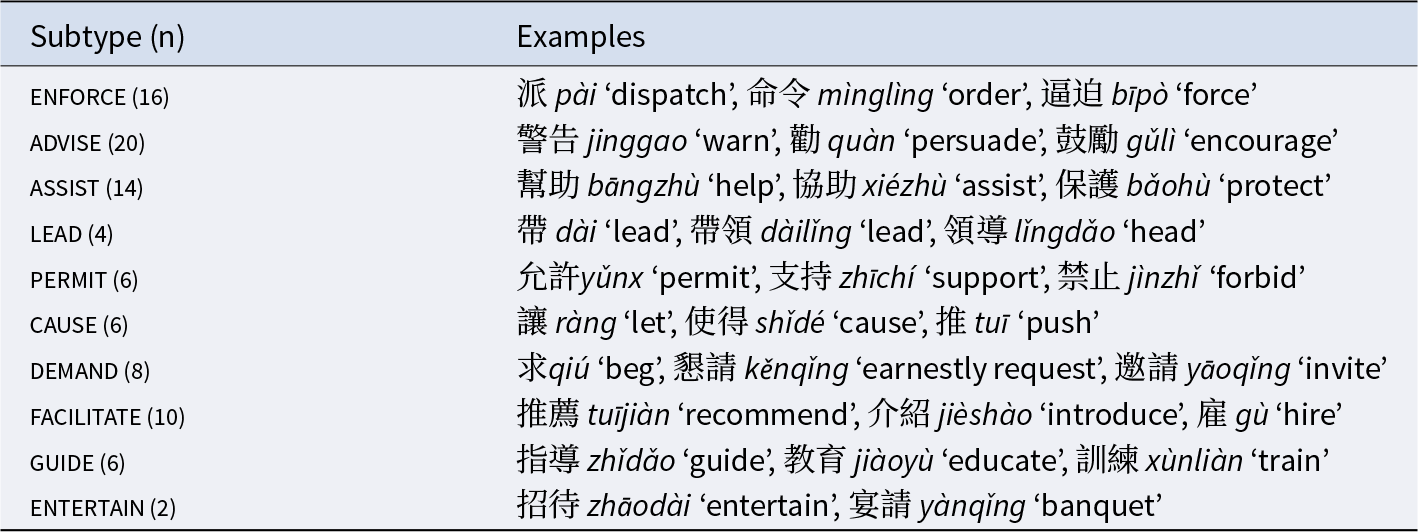
The manipulative pivotal construction is the relevant subtype: it is the context where yào occurs as part of the complement clause, but contributes comparatively little to the overall meaning. The semantics of the manipulative pivotal construction is characterized as follows: “the subject of the main verb manipulates (anticipates, facilitates, or blocks) the pivot n’s involvement in the action or state denoted by the complement verb” (Peng Reference Peng2017: 3). The construction may be further categorized into subtypes on the basis of the semantics of the main verb. Peng (Reference Peng2017) proposes ten subtypes, summarized in Table 1, where ‘n’ indicates the number of representative verbs listed by Peng; see Peng (Reference Peng2017: 72, 82) for a more detailed description.
Subtypes of representative main verbs in the manipulative pivotal construction

Finally, the manipulative pivotal construction has a causative semantics, but most of the verbs are not categorized as cause by Peng. For Peng, cause pertains to general causation, typically expressed by ràng ‘let’ and shǐ(dé) ‘cause’, and includes verbs whose semantics outside the pivotal construction is also likely causative.
4. Data and methodology
Each of the 92 verbs listed by Peng (Reference Peng2017) as representative main verbs in the manipulative pivotal construction was queried in the Academia Sinica Balanced Corpus of Modern Chinese, which represents the Taiwanese variety of Present-Day Mandarin. Additional queries for words morphologically composed of 求 qíu ‘beg’ were also conducted. Such queries were conducted by using the wildcard function (e.g., *求 and 求*, where the star sign stood for any morpheme, retrieved all words within which 求 preceded or followed a morpheme). Even though words composed of 求 qíu are not particularly rare, Peng only lists qíu, possibly for reasons of space. Search results were examined if one of the words following the queried verb was yào, including instances where it immediately followed modifiers (e.g., yīdìng ‘absolutely’ and qiānwàn ‘by all means’) and negators (e.g., bù ‘not’). Bú yào means ‘do not want’, if yào is a main verb of volition. Bú yào may also function as a prohibitive marker, meaning ‘do not'. Bù undergoes tone sandhi, becoming bú, in front of any morpheme carrying the fourth tone, such as yào.
No comparable list of verbs exists, as far as I am aware, for Early Mandarin (7th–19th centuries CE). To reconstruct the diachrony of yào in the manipulative pivotal construction, main verbs that synchronically may take yào as part of the complement clause were used as the basis for the diachronic investigation. Such main verbs, their morphological variants and (near-)synonyms were queried for in the Academia Sinica Corpus of Early Mandarin, again using the wildcard function where relevant.
Neither of these two corpora are the largest in size or the most extensive in scope: for comparison, the Balanced Corpus of Modern Chinese includes 17.6 million characters, while the Present-Day Mandarin section of the Center for Chinese Linguistics (CCL) Corpus features 4.7 billion characters and a more comprehensive Pre-Present-Day Mandarin section. However, the two Academia Sinica Corpora were chosen as the main sources of data because they are fully segmented and tagged for parts of speech (unlike the CCL Corpus), which facilitates searching for relevant instances of main verbs that appear in multiple argument structure constructions or have multiple senses. For example, 使 shǐ ‘make' totals over 5,000 instances in Early Mandarin, and they were retrieved and examined only if they were tagged as ‘VL’ (for ‘causative verb’). Even with this functionality, however, querying for yào would not have been practical. Among the various tags available for yào, ‘VK’ (for ‘stative verb’) in Early Mandarin and ‘D’ (for ‘adverb’) in Present-Day Mandarin are closest to what we are examining here, but they nevertheless yield over 15,000 instances in Early Mandarin and over 20,000 in Present-Day Mandarin. While a portion of these could have been sampled, it was more thorough to examine all main verbs rather than simply a sample of yào. Additional searches in the Academia Sinica Corpus of Old Chinese and the CCL Corpus were also conducted, but not as systematically, in order to slightly expand the synchronic and diachronic scopes.
Some instances resembled the manipulative pivotal construction only superficially and were therefore excluded from further investigation. For example, (6a) has the pivotal form (subject) + v + pivot noun + vp, where yào is part of the vp, but not the pivotal meaning. The subject of the second verb zhòngshì ‘focus’ is understood as the same as that of the preceding manipulative verb yāoqiú ‘demand’, whereas in the pivotal construction, the subjects of the v and the vp are distinct, unless in reflexive contexts, as in (6b), where the noun is reflexive (i.e., co-referential with both of the subjects of the vp and the v).

As the focus is on textual yào as part of the complement clause, instances where yào was used as a lexical verb were also discarded, as in (7). Yào in (7a–b) is a main verb meaning ‘ask’ or ‘want’. The first yào in (7c) is a volitional verb tinged with conditionality, as it is used in the protasis, and the second is part of the prohibitive bú yào ‘do not’. Similar to (6a), the subjects of the verb yào and the preceding verb are co-referential, but the noun is not reflexive in (7a–b).

5. Synchronic properties and distribution
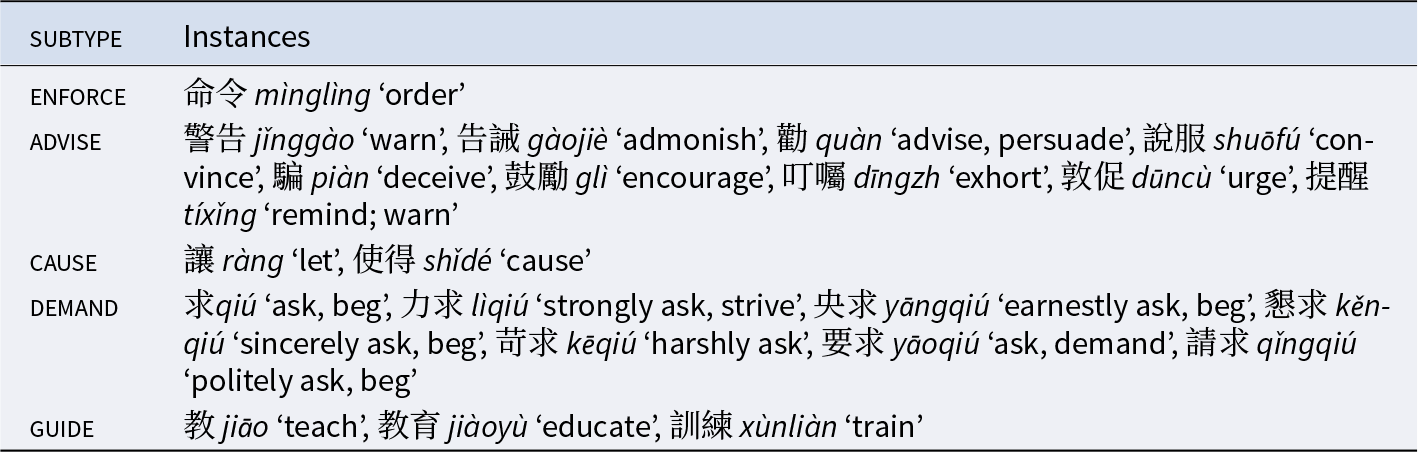
In what follows, some examples of textual yào are presented, and its uses and distribution are examined. Table 2 lists the 22 manipulative verbs that may take yào in the complement clause in Present-Day Mandarin and their subtype according to Peng’s (Reference Peng2017) classification.
Main verbs with yào in the complement clause in Present-Day Mandarin

The main verbs in Table 2 may be grouped into three types, according to the relationship between yào and the main verb: guide, cause, and the largest, default, which comprises all verbs that are neither a guide verb nor a cause verb. In all three types, as with all manipulative verbs in general, the complement clause may be marked by no modal. The three types thus have a contrast between zero-marked and yào-marked complement clauses.
In the default type, yào is typically harmonious with the directivity and deonticity of the main verb – as expected if we assume the parallel between yào and mandative should – and as such, yào is semantically light. What little it does express is expressed by the main verb as well. Directivity, as intended here, refers to the function of directive speech acts (Searle Reference Searle1979), which is to get the referent of the noun to do what the complement clause describes. Deonticity is defined generally here; it may pertain to the permission or obligation placed by the subject on the noun or the moral urgency, responsibility, or even just social appropriateness of the action (or state) described by the main verb as well as the complement clause.Footnote 4 For example, the sentences in (8) are deontic.

A variant on this characterization is piàn ‘deceive’, as it cannot be said to be socially appropriate. Example (9) is the only instance where the main verb of yào is piàn. Nevertheless, directivity and deonticity in terms of obligation are still present.

The guide type is much smaller, comprised of only jiāo ‘teach’, jiàoyù ‘educate’, and xùnliàn ‘train’. In this type, yào is also harmonious with the main verb, but it is not semantically as light as it is in the non-guide type. This is because yào actually specifies the deonticity of the main verb, which, unlike main verbs in the default type, is not always deontic. For example, (10) shows that jiāo ‘teach’ and jiàoyù ‘educate’ are deontic: what is taught is morally good and socially acceptable. In this kind of deontic context, yào may occur.

By contrast, (11) shows that jiāo ‘teach’ may be non-deontic: what is taught is simply skills and yào does not occur in this kind of non-deontic context.Footnote 5

One could add yào to the complement clauses in (11), but the interpretation would then be that there is some obligation, urgency, or moral imperative associated with ‘ride a bike’, ‘swim’, and ‘use Taiwan dollars’. For example, any of the examples in (11) could use yào in a context where the action is vital for one’s survival or health.
Similar to jiāo, xùnliàn ‘train’ is not inherently deontic, and yào occurs in contexts where xùnliàn is deontic, as in (12a), but not in contexts where it is non-deontic and has only the skill-imparting sense, as in (12b–c), which are unlikely to be associated with any obligation or moral imperative. One might perceive a hint of one of these in ‘train them to play football’, but it is doubtful anyone would find them in ‘train dolphins to perform’.

Note that the guide type does not require the presence of yào to express deonticity. As seen in (13), it may be deontic without yào, but adding yào to these examples would not be inappropriate.

Even before examining any data, the cause type perhaps stands out immediately: ràng ‘let’ and shǐdé ‘cause’, being general causative verbs, are semantically more schematic than the other main verbs. In the corpus, all instances of yào with ràng and some with shǐdé as the main verb co-occur with other markers, particularly quantifiers, such as 所有 suǒyǒu ‘every; all’, 每 měi ‘each’, 都 dōu ‘all’, 就 jiù ‘then, as soon as’, and 還 hái ‘still’. This suggests a different function of yào, which will not be examined in more detail.Footnote 6 What is more similar to the kind of textual yào found in the other two types includes examples in (14), where shǐdé leaves the type of causation unspecified; it is yào that specifies it. Shǐdé… yào essentially means ‘require’ or even ‘force’, with the exact deontic force dependent on the context. Compare (15), where shǐdé also lets the following modal néng(gòu) ‘can, be able to’ specify the type of causation; shǐdé… néng(gòu) means ‘enable’.


The contrast between (14) and (15) shows that the modal following shǐdé specifies the type of causation. In force dynamic terms (Talmy Reference Talmy1988), shǐdé… yào signals positive compulsion and shǐdé… néng(gòu), positive enablement (Sweetser Reference Sweetser1990).
In sum, the main verbs with which textual yào co-occurs may be divided into three types, depending on the relationship between the main verb and textual yào. In all three types, yào and the main verb are harmonious in terms of directivity and deonticity, but in the guide type, yào additionally specifies the deonticity of the main verb, which is not necessarily inherently deontic. In the cause type, yào specifies the exact type of causation signalled by the construction.
6. Diachronic origins
Projecting from the synchronic distribution (see Table 2) back into Early Mandarin yielded the results summarized in Table 3.
Main verbs with yào in the complement clause in Early Mandarin

Of the three types default, guide, and cause, only cause is absent in Early Mandarin. The other two types also occur considerably less often in Early Mandarin than Present-Day Mandarin. This is in line with the overall expansion of the pivotal construction, which has included more verb types over time (Peng Reference Peng2017). In what follows, section 6.1 hypothesizes the origin of the default and guide types of textual yào (i.e., textual yào whose main verb belongs to the default or the guide type). Section 6.2 derives a synchronic implicational hierarchy from the diachronic hypothesis. Section 6.3 hypothesizes the origin of the cause type of yào.
6.1 Origin of the default and guide types
Sentences in (16) illustrate advise, enforce (both of which are the default type) and guide.

The earliest attested main verb taking textual yào in its complement clause, quàn, of the advise type, as in (16a), is particularly noteworthy for the diversity of prohibitive markers attested in its complement clause: 莫 mò, 勿 wù, 休 xiū, 不要 bú yào, 休要 xiū yào, and 別 bié, illustrated in (17).

The other verbs in the default and guide types also take complement clauses negated by prohibitives, but none has the same range of prohibitives.Footnote 7

The diversity of prohibitives associated with quàn is especially pronounced when compared to the demand verb qiú ‘ask, beg’, which only takes prohibitive bú yào and its morphological fusion bié ‘do not’ (L. Jiang Reference Jiang1991, Feng and Wang Reference Feng and Qun2006), as in (19), but not textual yào in its complement clause.

Interestingly, if textual yào is attested in the complement clause of a main verb, a prohibitive is also attested in the clause, but not vice versa. That is, the occurrence of textual yào implicates that of a prohibitive. It is thus hypothesized that the default and guide types of textual yào (i.e., yào whose main verb is a non-cause verb) originate from complement clauses that are negated by prohibitives. The development of textual yào is thus likely a case of analogical extension. While the majority of manipulative verbs, both synchronically and diachronically, leave the non-negated complement clause unmarked, some allow it to be marked by yào, by analogy with the fact that the negated complement clause is marked by a prohibitive. Initially the analogical relation likely holds only between yào and mò in the complement clause of quàn, as in (16a) and (17a), since the other cases of textual yào are not attested until later.Footnote 8 However, thanks to the rise of prohibitives that are morphologically similar to yào, such as bú yào and bié, the analogy becomes more transparent, which likely facilitates the spread of textual yào to more verbs, such as qiú ‘ask, beg’, which evolves from taking bú yào and bié but not textual yào in Early Mandarin, to doing so in Present-Day Mandarin.
If this hypothetical scenario is true, it is perhaps not accidental that diachronically, the complement clause of quàn is where we find more types of prohibitives than elsewhere and where textual yào first occurs. We would expect that the analogy between textual yào and the prohibitive is most likely to occur in a context where the prohibitive is particularly frequent, as is suggested by the diachronic high-type frequency of the prohibitive associated with quàn. Furthermore, the prohibitive is very often face-threatening. Therefore, new strategies may frequently emerge to express the prohibitive because they come across as less face-threatening than old strategies (Van Olmen Reference Van Olmen2010, Devos and Van Olmen Reference Devos and Van Olmen2013). The diachronic high type frequency of the prohibitive in the complement clause of quàn also suggests that it is a context where face work is at play. A new marker like textual yào is thus more likely to emerge to introduce more functional contrast (namely different degrees of directive force, cf. Givón’s Reference Givón1994 subjunctive-infinitive contrast) in this context than elsewhere.
This hypothesis accounts for the directivity and deonticity associated with textual yào: prohibitives are also associated with such functions by default, as their intended purposes are to direct the pivotal noun away from the action or state referred to by the complement clause and place varying degrees of restriction on it. The functional similarity between textual, subjunctive-like yào and the prohibitive also has crosslinguistic (near-)parallels, which further strengthens the hypothesis. The subjunctive and the prohibitive are functionally similar and compatible, in that the negative version of the former may express the latter and the former may be required in the context of the latter (Aikhenvald Reference Aikhenvald2010, Devos and Van Olmen Reference Devos and Van Olmen2013). The fact that qiú in Early Mandarin takes only prohibitives in its complement clause, but not textual yào, is not evidence against this hypothesis. It is simply that users have not generalized the use of textual yào to include the complement clause of qiú, which is not surprising, as generalizations are often verb-based (Croft Reference Croft, Cuyckens, Berg, Dirven and Panthe2003, Iwata Reference Iwata2008, Boas Reference Boas2010).
6.2 A synchronic implicational hierarchy
The hypothesis would suggest that, if synchrony reflects diachrony, a main verb able to take textual yào in its complement clause in Present-Day Mandarin should also be able to take a prohibitive, as the former originates from the latter, but that a main verb able to take a prohibitive would not necessarily allow textual yào in its complement clause. That is, the historical development of textual yào may have resulted in a synchronic implicational hierarchy, whereby the occurrence of textual yào implies that of a prohibitive, but not vice versa. In other words, textual yào is more ‘marked’ than a prohibitive. A strong version of the synchronic implicational hierarchy would state more specifically that the occurrence of textual yào implicates that of prohibitive bú yào (as they are morphologically similar), but not vice versa. This might seem to contradict the typological generalization holding that a negative clause is more marked than an affirmative one, but it does not in fact do so. Within the manipulative pivotal construction, the default, unmarked strategy is zero-marking.
Even the strong version of the implicational hierarchy seems largely correct, as most of the main verbs (17 out of 22) in Present-Day Mandarin take textual yào and prohibitive bú yào in complement clauses. Sentences in (20) illustrate prohibitive bú yào in complement clauses whose main verbs are the guide type.

The five exceptions that allow for textual yào but not prohibitive bú yào are: mìnglìng ‘order’, kēqiú ‘harshly ask’, yāngqiú ‘earnestly ask’, piàn ‘deceive’, and xùnliàn ‘train’. However, upon closer inspection, the non-occurrences of bú yào in the complement clauses of most of these verbs may not be genuine exceptions.
The complement clause of mìnglìng ‘order’ is negated by bù néng ‘cannot’, as in (21). Bù néng ‘cannot’ is also a prohibitive, and thus (21) is an exception only to the strong version of the hierarchy. The hypothesis, which gives rise to the hierarchy in its weak version, postulates a diachronic connection between textual yào and a prohibitive, which may or may not be bú yào.

The complement clauses of kēqiú ‘harshly ask’ and yāngqiú ‘earnestly ask’ do not take any prohibitive, which may be attributed to the size of the corpus, where kēqiú and yāngqiú in general are infrequent. Occurring respectively only 21 and 27 times, kēqiú and yāngqiú are less frequent than the other demand verbs: kěnqiú ‘sincerely ask’ (38 times), lìqiú ‘strongly ask’ (40), qiú ‘ask’ (111), qǐngqiú ‘politely ask’ (268), and yāoqiú ‘ask, demand’ (3,035).Footnote 9 Kēqiú in the manipulative pivotal construction is especially infrequent, occurring only three times, while yāngqiú occurs 21 times. Semantically, there does not seem to be any reason why yāngqiú could not replace kěnqiú ‘sincerely ask’ in (22), as they are largely synonymous.

The cases of kēqiú ‘harshly ask’ and yāngqiú ‘earnestly ask’ could perhaps be explained by a semantic constraint: as the semantics of these main verbs is strong, it is not possible for their complement clauses to be negated. But semantically similar verbs, as in (22), suggest that this proposal ought to be interpreted more stochastically: the stronger the semantics of the main verb, the less likely the complement clause is to be negated. As attractive as the proposal is, it is beyond the scope of this article.
The final exceptions are piàn ‘deceive’ and xùnliàn ‘train’. As a verb, piàn occurs 239 times and xùnliàn 336 times, neither of which is particularly infrequent. Note that xùnliàn in the skill-imparting sense, which does not take textual yào in the first place, as in (12b–c), may have its complement clause negated by bù ‘not’, as in (23).

The fact that piàn ‘deceive’ and xùnliàn in its deontic sense both take textual yào, as in (9) and (12a), but no prohibitive, may suggest a further generalization of textual yào: it is no longer constrained by its diachronic source in negated complement clauses, at least for some speakers, and therefore it may occur in complement clauses of main verbs that do not typically take negated complement clauses.
Finally, an investigation into the CCL Corpus uncovered that kēqiú, yāngqiú, piàn, and xùnliàn may take complement clauses negated by prohibitives, as in (24). Therefore, the absence of such data in the Balanced Corpus may indeed be attributed to the size of the corpus, amongst other potential reasons.

6.3 Origin of the cause type
As no verb of the cause type takes yào in its complement clause in Early Mandarin, any hypothesis regarding the origin of this type of yào is inevitably more speculative than data-based hypotheses, but there are three plausible ones. The first is the same hypothesis as proposed in section 6.1, originating from complement clauses negated by prohibitives. The non-attestation of yào in the cause type may be an artefact of the size of the corpus. Second, yào associated with the cause type is related to other modals that occur in complement clauses of cause verbs, in light of some additional data from the Academia Sinica Corpus of Old Chinese (8th–1st centuries BCE). Third, the first and second hypotheses both play a role.
The following data suggest that the second hypothesis is plausible. In Early Mandarin, shǐ ‘make’ may take modals such as néng ‘can; be able to’ in its complement clause, whether non-negated or negated, as in (25).

Shǐ… néng ‘make… able’ and shǐ… yào ‘make… have to’ are structural parallels: both néng and yào are modals. It is thus possible that the former is one of the diachronic sources of the latter. We can also compare their Present-Day parallels, shǐdé… yào and shǐdé… néng(gòu) in (14)–(15).
Interestingly, while shǐ does not seem to take any deontic modal in its complement clause in Early Mandarin, it does in Old Chinese, as in (26).

Such Old Chinese examples suggest that modals in complement clauses of general causative verbs may have a long history, but as this article focuses on the history of yào, a more thorough investigation lies outside its scope.
7. Discussion
Section 7.1 situates the history of textual yào in the literature on textualization, unidirectionality, and the contentful-procedural continuum in order to draw a parallel between textual yào and the subjunctive in section 7.2, which, however, argues that its history cannot be conceptualized as unidirectional, despite the many similarities to the subjunctive, whose development has been claimed to be unidirectional. Section 7.3 connects the analysis to recent trends in Diachronic Construction Grammar.
7.1 Textualization, unidirectionality, and the contentful-procedural continuum
Textual markers signal relationships between units of text or discourse. Their development is referred to as ‘textualization’ (Traugott Reference Traugott2022) or ‘(increased) text/discourse-orientation’ (Narrog Reference Narrog2012a, Reference Narrog2012b), which has been hypothesized as ‘late-stage’ in that it typically happens to markers that have already undergone certain changes, such as subjectification and intersubjectification. The process is also closely associated with grammaticalization and unidirectionality; see Traugott (Reference Traugott, Minkova and Stockwell2002), Narrog (Reference Narrog2012a, Reference Narrog2012b), Y. Kuo (Reference Kuo2020a), and Traugott (Reference Traugott2022) for reviews. That is, textualization, like grammaticalization, is hypothetically unidirectional: a textual marker may become more grammatical, but does not become less so.
Being textual markers, subjunctive markers, alternatively referred to as markers of ‘subordinating’ or ‘subordinate’ mood, are also said to be results of unidirectional, late-stage processes. For example, Bybee et al. (Reference Bybee, Perkins and Pagliuca1994: 213) remark: “the subordinating uses show up very late on the grammaticization paths […] the only further development for such grams is their gradual loss from the language”. (See also Narrog Reference Narrog2012b: 179–183). As this quote implies, the subjunctive can be referred to as grammatical in addition to being characterized as textual. More recently, the lexical-grammatical continuum has been conceptualized by Traugott and Trousdale (Reference Traugott and Trousdale2013) as the contentful-procedural continuum, which will be adopted here. Procedural meaning signals linguistic relations (including, but not limited to, textual relations), while contentful meaning is referential. Subjunctive markers are procedural.
On the basis of the literature, one could hypothesize that textual yào’s resemblance to a subjunctive marker means that it is also procedural and that its history is also unidirectional: it becomes more procedural as it occurs in more complement clauses. However, section 7.2 argues that while this is indeed the case for one type of textual yào, the other two types, though both textual and procedural, are more contentful, and that the history of textual yào as a whole thus also involves increases in contentful meaning. That is, while markers may be textual, some may be more contentful (or procedural), and diachronically textualization may be positioned on the contentful-procedural continuum, without necessarily being unidirectionally procedural.
7.2 Textual yào as procedural and contentful
The default type of textual yào resembles mandative should: both are abstract and harmonious with the main verb and they are to a certain extent omissible. Other modals in complement clauses have also been noted for their relative omissibility, such as pouvoir ‘can’ in French and pitää ‘should’ in Finnish (Peltola Reference Peltola, Hilpert, Cappelle and Depraetere2021: 150). Like mandative should, this type of yào occurs in complement clauses that pertain to unrealized events and whose main verbs are directive and deontic. The parallel between yào and the subjunctive goes even further. Crosslinguistically, Givón (Reference Givón1994) has hypothesized that subjunctive markers originate from the epistemic context of low certainty and/or the deontic context of weak manipulation, these being contexts where epistemic modality, deontic modality, and subjunctivity, all shades of irrealis, resemble each other. Textual yào resembles the subjunctive through its similar origin: it is first attested in the complement clause of quàn, of the default type, whose deontic semantics is relatively weak, varying between ‘advise’ and ‘persuade’. (For how the speech act of ‘advise’ is weakly deontic, see Searle Reference Searle1969 and Y. Kuo Reference Kuo2022a.)
Given the many similarities between the default type of yào and subjunctive markers, one may regard its function as procedural: it marks the relational notion of clause type, namely the complement clause of a number of manipulative verbs where it occurs. The function of these verbs may also be conceptualized more specifically as interclausal (modal) cohesion, as used by Peltola (Reference Peltola, Hilpert, Cappelle and Depraetere2021) to refer to the function of pouvoir ‘can’ and pitää ‘should’: they signal the modal identity (specifically, deonticity) shared between the main clause and its complement clause.
However, even though the default type of textual yào is the first attested type and thus presumably the first developed one, the other two types (guide and cause) of textual yào cannot be simply described as only procedural or more procedural than the default type. The other two types of yào specify the semantics of the main verb to the extent that it plays a role in determining the semantics of the whole construction and consequently has a stronger semantics and a lower degree of omissibility. That is, given a guide or cause verb in the manipulative pivotal construction and yào in the complement clause, the main verb and yào form a multi-word lexical expression.
In the case of a guide verb, ‘guide… yào’, as in (10), is distinct from its counterpart (i.e., the skill-imparting sense of guide), which neither occurs with yào nor encodes deonticity, as in (11): deonticity is specified (not merely highlighted) as part of the expression, but the counterpart has no such specification. There is thus a contrast between the deontic ‘guide… yào’ and the non-deontic, merely skill-imparting aspect of a guide verb. Another way of framing the contrast is that yào brings out the distinction between the deontic and non-deontic senses of guide verbs.
In the case of a cause verb, ‘cause… yào’, as in (14), specifies the type of causation that the construction conveys. The relative significance of yào in this expression is especially obvious when a similar multi-word expression such as ‘cause… néng(gòu)’ is considered, as in (15). The modal in the complement clause plays a decisive role in signalling the exact type of causation: positive compulsion (a kind of deonticity) in the case of yào and positive enablement in the case of néng(gòu).
Note that both types of yào nevertheless signal interclausal modal cohesion, just like the default type, and as such all three are textual and procedural. It is not the case that the guide or cause type of yào is disharmonious with the main verb; they are harmonious with the specific, deontic aspect of the main verb that is otherwise not specified. (See (13), where a guide verb expresses deonticity without the specification of yào.) What brings about the difference between the types is how yào interacts with the main verb. The default type of yào is not contentful, because it contributes little lexical content to default verbs, which are inherently deontic. The other two types are more contentful because they contribute to deontic aspects of guide and cause verbs that are otherwise unspecified. That the guide and cause types of yào have both procedural and contentful meanings is in line with Traugott and Trousdale’s (Reference Traugott and Trousdale2013) observation that such meanings may co-exist from a constructional perspective.
In short, all three types of yào are textual, by virtue of occurring in complement clauses, where they signal interclausal modal cohesion; as such, they are procedural. Given that textual and subjunctive markers are claimed to result from unidirectional development, one would expect the history of textual yào to be unidirectional and thus involve increases only in procedural meaning and not in contentful meaning. However, the guide and cause types of yào, though diachronically later and by hypothesis more procedural, are actually more contentful than the default type.
7.3 Towards a non-linear view
The analysis presented here suggests that textual or discourse-oriented (post-)modality may be procedural or contentful, depending on the type of relationship that a modal expression enters into with the main verb in the construction. This suggestion ultimately points to a non-unidirectional, or at least non-linear perspective on change, if we generalize over the history of yào: a grammatical item like a modal is not on a unidirectional trajectory towards more procedural meaning; rather, the direction depends on the specific contextual interaction the item is involved in. This perspective is compatible with studies in Diachronic Construction Grammar, which have shifted the focus away from conceptualizing change linearly (Trousdale Reference Trousdale2014, Torrent Reference Torrent, Barðdal, Smirnova, Sommerer and Gildea2015, Fischer Reference Fischer, Sylvie, Breban and Lozano2018, Y. Kuo Reference Kuo2020b). Such studies emphasize the multidimensional nature of language, showing that change may be implicated at various levels and therefore is not easily reducible to a cline-like representation, as such a representation may obscure formal and functional details and correspondences (e.g., Hilpert Reference Hilpert2008, Trousdale Reference Trousdale2014, Traugott Reference Traugott, Barðdal, Smirnova, Sommerer and Gildea2015, Y. Kuo Reference Kuo2020a).
For example, Traugott (Reference Traugott, Minkova and Stockwell2002: 27) identifies contracted auxiliaries in English as results of late-stage processes, which may be represented as clines (e.g., will > ’ll and would > ’d). While these clines are not inaccurate at some level of generalization (e.g., frequent items undergo reduction; Bybee Reference Bybee2010), they gloss over many details. In fact, the contracted forms have formal and functional properties that cannot be derived from their full forms; therefore, they constitute parts of constructions that are distinct from constructions in which their full forms occur (Daugs Reference Daugs, Hilpert, Cappelle and Depraetere2021). For example, the enclitic ’d cannot be used emphatically and, compared to would, “exhibits a relative preference for mental/emotive verbs (e.g. know, love)” (Daugs Reference Daugs, Hilpert, Cappelle and Depraetere2021: 34), amongst other distinctive preferences. Examining future constructions with the same lexical sources, whose developments thus have been subsumed under the same clines, Hilpert (Reference Hilpert2008) also shows that their usage patterns are too diverse to be captured fully by clines.
Similarly, the analysis of yào presented here highlights the importance of construction-specificity: a fuller understanding of yào can only be achieved if we examine in detail its interactions with specific construction types, which correspond to types of the main verb (default, guide, and cause). While such interactions might to a certain extent be reduced to a unidirectional or linear account in other cases (e.g., would > ’d), they cannot be in the case of yào: it does not become more and more procedural as it occurs in more types of complement clause. It follows that postmodal development – whereby a modal develops a function, such as interclausal modal cohesion, beyond modality proper – may not be equated to increases in procedural meaning exclusively.
In challenging the unidirectionality hypothesis from a constructional perspective, this study is part of a recent trend identified by Hilpert et al. (Reference Hilpert, Cappelle, Depraetere, Martin, Cappelle and Depraetere2021: 3): “[…] constructional research is eager to take up and test hypotheses from grammaticalization theory. At the same time, a recurring result seems to be that proposed generalizations need to be reconsidered in the light of cases that do not follow the general trend.” See also Y. Kuo (Reference Kuo2024) for how regularity in grammatical change may be non-unidirectional from a constructional perspective.
A defender of unidirectionality would perhaps argue that the guide and cause types of yào may have a history independent of the default type, as has been hypothesized for the cause type in section 6, and that the existence of the guide and cause types does not therefore deny the unidirectionality of the default type. Indeed, one could also hypothesize that the guide type of yào is not related to the default type. Even though both have their origins in negated complement clauses, the actual processes may be independent. Furthermore, for the history of textual yào to be a strong case against unidirectionality, it would perhaps require evidence that the default type has become contentful. Nevertheless, there is no denying that, first, all three types of textual yào have their ultimate origins in main clauses; second, at least the default and guide types of yào, and potentially the cause type as well, have their immediate origins in negated complement clauses; and third, the cause type of yào may have an additional immediate origin in similar modals in complement clauses. This means that, regardless of how each type is (un)related, they ultimately develop their textual uses from main clause uses and more immediately from complement clause uses, which, since the guide and cause types are contentful, challenges a strong version of unidirectionality whereby the development of textual meaning is unidirectionally procedural. Therefore, a finer distinction should be made with respect to postmodal textualization or discourse orientation: what is originally a main-clause modal may become textual and, at the same time, more contentful and/or procedural. Again, this distinction would be difficult to make on a strictly unidirectional view, but it is much more compatible with a multidimensional view. See also Traugott (Reference Traugott2022: 4) for how textual, non-subjunctive markers may be contentful or procedural.
8. Conclusions
This article has proposed that textual yào originates from complement clauses negated by prohibitives. Depending on its relationship with the main verb of the complement clause, textual yào may be categorized into three types. While the largest type is fairly procedural, bearing similarities to subjunctive markers such as mandative should, the other two types are more contentful in that they form multi-word lexical expressions with the main verbs. On the basis of these types of textual yào, it is proposed that a modal may become textual and at the same time procedural or contentful. That is, textualization or increased discourse orientation may involve increases in both contentful and procedural meanings.
For future research, since the synchronic and diachronic distributions of textual yào are likely much wider than presented in this article, additional insights might be achieved through the use of a more comprehensive list of verbs or a larger corpus. Furthermore, it was briefly noted that textual yào whose main verb is ràng ‘let’ co-occurs with quantifiers. Modals are quantifiers in many approaches, and therefore the interaction between yào and quantifiers is not entirely unexpected. Indeed, quantifier(-related) uses of yào, especially comparative ones, have not gone unnoticed in functional and formal approaches (e.g., Yu Reference Yu1998, Xie Reference Xie2022). But their diachrony and properties in complement clauses remain to be investigated in more detail. Any analysis of such quantifier(-related) uses may fall outside modality proper; as such, this would be an especially interesting topic to explore with respect to postmodal development.
Acknowledgements
I would like to thank the editors and reviewers for their insightful comments. All remaining errors are my own.


 Open access

