





1. Introduction
Event typology has long been a major focus in cognitive typology (Batoréo & Ferrari, Reference Batoréo and Ferrari2016; Feist & Duffy, Reference Feist and Duffy2020; Ji & Hohenstein, Reference Ji and Hohenstein2014a, Reference Ji and Hohenstein2014b, Reference Ji and Hohenstein2018; Naidu et al., Reference Naidu, Zlatev, van De Weijer, Devylder, Duggirala and Blomberg2018; Slobin, Reference Slobin, Strömqvist and Verhoeven2004; Talmy, Reference Talmy1991, Reference Talmy2000a, Reference Talmy2000b; among others). One of the most renowned and influential typological models is the ‘motion event typology’ formulated by Talmy (Reference Talmy1991, Reference Talmy2000a, Reference Talmy2000b), according to which all languages can either be verb-framed (e.g., the Romance languages) or satellite-framed (e.g., the Germanic languages), based on their predominant means to express the semantic component ‘path’: either in the main verb or the satellite to the verb (typically a prefix or verbal particle). Elegant and simple as it is, this bifurcation has provoked both extensive research and critical challenges over the past decades (cf. Slobin, Reference Slobin, Strömqvist and Verhoeven2004; Croft et al., Reference Croft, Barðdal, Hollmann, Sotirova, Taoka and Boas2010; Li, Reference Li2018, Reference Li2019, Reference Li2020, Reference Liu, Li, Su, Xu and Yang2023; Li & Liu, Reference Li and Liu2021; etc.). One key problem is that the two-way typology is built mostly on the basis of synchronic analysis, largely neglecting the diachronic aspect of language typology (Li, Reference Li2018). To fill in this gap, Li (Reference Li2018) first applied Talmyan motion event typology to account for the grammaticalization of Chinese directional complements from Archaic Chinese (BCE 1600–24) to Modern Chinese (1912-present), and put forward The Macro-event Hypothesis:
The Macro-event Hypothesis: A language can generally use a construction in which one clause is in a certain syntactic relation with another clause to represent, correspondingly, a situation in which one event is in a certain semantic relation with another event. Some semantic relations, such as manner and cause, are privileged, while others, such as an if-then conditional, are not. For the privileged cases, some languages can use a single clause to represent the entire situation as a single larger event—termed “macro-event.” In such cases, human cognition can treat the same situation either more analytically as discrete simpler events with a connection, or more synthetically as a unitary integrated complex event. This dichotomy might alternatively be viewed as a continuum in several aspects. With corresponding semantic gradations, there might exist syntactic gradations from a double to a single clause representation and, within the single clause, from less to more grammaticalized for some constituents. Diachronically, a language might then progressively change its representation of a privileged relation from having solely a highly analytic one to also having a highly synthetic one. On this basis, languages may fall into two major categories: macro-event languages and non-macro-event languages, which then might be further divided into four distinctive types, respectively: steady state macro-event languages versus conflated macro-event languages, and steady state non-macro-event languages versus deconflated non-macro-event languages.
(Li, Reference Li and Li2023, p. 139)
The hypothesis can be summarized as languages may generally fall into two broad categories: macro-event type languages and non-macro-event type languages. According to Talmy (Reference Talmy1991, Reference Talmy2000b, Chapter 3), the cognitive process of event integration is the conceptual integration or conflation of two events into a unitary event that, more analytically, would be conceptualized as an event complex, termed ‘macro-event’. In languages, this process emerges as the expression of an event in a single clause that, more analytically, would be expressed by means of a more complex syntactic structure. In the context of the current Special Issue, we would like to ask what role event integration plays in the semantic change of Chinese causatives, taking the most prototypical analytic causative verb 使-shǐ-make (SHI henceforth) as an example. In addition, we will test The Macro-event Hypothesis of a continuum of grammaticalization in languages.
This paper is divided into six sections. Section 2 briefly sketches the typology of event integration (Section 2.1) and reviews previous studies on the synchrony and diachrony of SHI (Section 2.2). Section 3 proffers an introduction to the data and method. Section 4 first reports some general results (Section 4.1), followed by a description of the prototypicality change of SHI (Section 4.2) as well as its semasiological change (Section 4.3). In Section 5, the interaction between grammaticalization and event integration is discussed by distinguishing the lexical and the grammatical use of verbal SHI (Section 5.1), and by zooming in on the constructional grammaticalization that verbal SHI has undergone (Section 5.2). Finally, Section 6 provides concluding remarks.
2. Literature review
2.1. Typology of event integration
Talmy’s (Reference Talmy1991, Reference Talmy2000b, Chapter 3) typology of event integration, based on how an event complex is integrated into one clause, looks at which constituent encodes a particular semantic notion, namely path. The event complex, or macro-event, comprises two major components, a framing event and a co-event, together with the support relation (e.g., manner/cause) between them. The framing event offers “for the whole macro-event the overarching conceptual framework or reference frame within which the other included activities are conceived of as taking place”, represents “the upshot relative to the whole macro-event”, and determines the overall temporal and spatial frameworks, the argument structure, and the syntactic complement structure (Talmy, Reference Talmy2000b, p. 219). Hence, the framing event is the main event and has a framing function relative to the co-event. Verb-framed languages typically encode the core schema of a framing event in the verb root and express a co-event component in the satellite. In contrast, satellite-framed languages characteristically use a satellite to express the core schema, encoding the co-event component in the verb. This dichotomy not only works in the event domain of motion but also functions in state change, realization, temporal contouring, and action correlation.
There is a huge amount of literature concerning single-language and cross-linguistic studies on motion typology (Aske, Reference Aske, Hall, Meacham and Shapiro1989; Ji & Hohenstein, Reference Ji and Hohenstein2014a, Reference Ji and Hohenstein2014b, Reference Ji and Hohenstein2018; Naidu et al., Reference Naidu, Zlatev, van De Weijer, Devylder, Duggirala and Blomberg2018; Slobin, Reference Slobin, Shibatani and Thompson1996; Zlatev & Yangklang, Reference Zlatev, Yangklang, Strömqvist and Verhoeven2004; among others), but only a few studies center on state change and realization (Du et al., Reference Du, Li and Xu2020; Kou & Hohenstein, Reference Kou and Hohenstein2020, Reference Kou and Hohenstein2021; Levin & Rappaport Hovav, Reference Levin and Rappaport Hovav1991). It is worth noting that there has been relatively little investigation into the full range of macro-event. Li (Reference Li2018, Reference Li2019, Reference Li2020, Reference Li and Li2023) and Li and Liu (Reference Li and Liu2021) filled this gap by demonstrating how the Chinese language in the past and at present encodes the five types of macro-event with the full set of 11 simplex directional complements, and, more importantly, how event integration involved in the diachronic change of these directional complements. Li (Reference Li2018) first argued that macro-event results from the integration of two simpler events through grammaticalization in Mandarin. Following this spirit, Li (Reference Li2020, Reference Li and Li2023) developed the Talmyan two-way typology and formulated The Macro-event Hypothesis. Theoretically, the hypothesis extends the event integration theory by setting up a diachronic conceptual framework that can be used to explore how streams of action are identified by the human mind and are combined into linguistic representations, illustrated by Chinese data. Methodologically, prior research into these topics in Chinese is mostly introspection based, lacking empirical data. In contrast, Li (Reference Li2018, Reference Li2019, Reference Li2020), Li & Liu (Reference Li and Liu2021), and Liu & Li (Reference Liu, Li, Su, Xu and Yang2023) employed a large amount of authentic data, presenting more convincing results and offering an ideal context for examination. To our knowledge, there has been no empirical work on The Macro-event Hypothesis.
Additionally, in studies on event integration thus far, a neglected, though we assume an important, line of research is Givón (Reference Givón2001, Reference Givón2009). Drawing on the isomorphism between the syntax and the semantics of verbal complements in English, Givón (Reference Givón2001, Reference Givón2009, p. 64) illustrated the functional and structural features of clause union syntactically, and event integration (also semantic bonding) semantically, forming a complementation scale. The semantic gradation of event integration is subsumed under three major features: (1) referential integration: the sharing of referents between the two events; (2) temporal integration: simultaneity or direct temporal adjacency of the two events; and (3) spatial integration: the sharing of the same location between the two events. Other widely discussed features, such as successful (versus unrealized) causation, intentional (versus accidental) causation, or direct (versus indirect) causation, are relevant primarily because they imply directly or indirectly either co-temporality or co-spatiality of the two events (Givón, Reference Givón2001, Chapter 12). Syntactically, six main syntactic devices that code clause union were proposed: (1) expression of the co-referent argument: zero versus present; (2) grammatical relations: integrated single set versus two distinct sets; (3) adjacency of the two verbs: co-lexicalization versus separation; (4) finite verb morphology: presence versus absence on the complement verb; (5) adjacency of the two clauses: presence versus absence of a complementizer; and (6) intonation contours: joint versus separate (Givón, Reference Givón2009, pp. 65–66). It is argued that the stronger the semantic bond between the two events is, the more extensive will be the syntactic integration of the two clauses into a single though complex clause (Givón, Reference Givón2001, p. 40). Considering that the functional and structural analysis of event integration exhibited by English complementation may offer new insights into event integration in Chinese, in this study, we will attend to the Givónian semantic features of event integration when necessary.
2.2. The synchrony and diachrony of SHI in Chinese
An analytic causative is a two-verb structure that expresses a predicate of cause and a predicate of effect, for example, cause, make, have, and get in English (Gilquin, Reference Gilquin2010); doen ‘do’ and laten ‘let’ in Dutch (Kemmer & Verhagen, Reference Kemmer and Verhagen1994; Levshina et al., Reference Levshina, Geeraerts and Speelman2013a, Reference Levshina, Geeraerts and Speelman2013b, Reference Levshina, Geeraerts, Speelman, Glynn and Robinson2014; Verhagen & Kemmer, Reference Verhagen and Kemmer1997); få ‘get’, komma ‘come’, ha ‘have’, förmå ‘induce’, and låta ‘let’ in Modern Swedish (Rawoens, Reference Rawoens2011); etc. According to Shibatani (Reference Shibatani1976) and Talmy (Reference Talmy and Shibatani1976, Reference Talmy2000a, p. 494), the first predicate constitutes the causing event, and the second represents the caused event. In analytic causative constructions, other constituents besides the two verbs are CAUSER, CAUSEE, and PATIENT (if present).
In Mandarin, SHI is the prototypical member of analytic causatives. Other peripheral ones include 令-lìng-order, 让-ràng-make, let, and 叫-jiào-ask (Lyu, 1942/Reference Lyu2002, pp. 92–97; Pulleyblank, Reference Pulleyblank1995; Xu, Reference Xu, Wu and Hong2003, Reference Xu2006; Cao, Reference Cao2011; Shi, Reference Shi2021; Liu & Li, Reference Liu, Li, Su, Xu and Yang2023). The canonical syntactic pattern of Mandarin analytic causative construction is [NP1 + SHI/LING/RANG/JIAO+NP2 + VP]. In the matrix clause, NP1 (the CAUSER) is the subject of the causative verb, and NP2 (the CAUSEE) is the object of the causative verb as well as the subject of VP in the embedded clause. The CAUSEE undergoes change or influence and VP denotes the final result/state stemming from the CAUSEE. From Archaic to Contemporary Chinese, among analytic causatives, SHI is particularly intriguing because it is the only one that survived the change of the Chinese language; meanwhile, it is also the one that is pervasively used to express causativity, be it in the past or at present, suggesting that it is an ideal indicator of the development of Chinese.
Despite extensive research on analytic causatives in Chinese, the diachronic change of SHI received little attention as its causative meaning had formed even in Archaic Chinese (Xu, Reference Xu, Wu and Hong2003, p. 232). There are eight documented diachronic studies on the grammaticalization of SHI from a lexical verb to a causative: Xu (Reference Xu, Wu and Hong2003, Reference Xu2006), Chang (Reference Chang2005, Reference Chang2006), Cao (Reference Cao2011), Liu (Reference Liu2011), Liu (Reference Liu2016), and Shi (Reference Shi2021). These studies have two shortcomings in common. First, none of them provides a full picture of the semantic development of SHI from Archaic to Contemporary Chinese. The second is as the frequency distribution of SHI over time was not obtained, the authors summarized the change in SHI in terms of their assumptions, resulting in conflicting views. For instance, Xu (Reference Xu, Wu and Hong2003, Reference Xu2006, pp. 133–138) proposed that causative SHI originated from its lexical meaning ‘to send’, and Chang (Reference Chang2005, Reference Chang2006) and Liu (Reference Liu2016) argued against this view and held that causative SHI developed from multiple sources, including the lexical meaning ‘to send’, ‘to appoint’, and their subcategories (‘to order’ and ‘to allow’). Cao (Reference Cao2011) and Liu (Reference Liu2011) avoided this dispute and attended to the development of SHI for a certain period of time in Chinese history. Specifically, Cao (Reference Cao2011) centered on the conditions for grammaticalization, the mechanisms (metaphor and subjectification), the process, and the results of grammaticalization of SHI from Old Chinese to Middle Chinese. Liu (Reference Liu2011) drew on data from one work, 太平经 ‘Scripture of the Great Peace’, and discussed the role pragmatics plays in the emergence of causative SHI and its development from the Qin dynasty to the Donghan dynasty (221 BCE–220 CE). To our knowledge, Shi (Reference Shi2021) is the first work that brought together the diachronic change of SHI and the ‘synthetic-to-analytic’ development of the Chinese language. Based on an investigation of the use of SHI in two Chinese classics, 左传 ‘Zuo’s Commentary on Spring and Autumn Annals’ and 战国策 ‘Strategies of the Warring States’, Shi (Reference Shi2021) hypothesized that SHI underwent three types of change: (1) change of categorical meaning from lexical syntheticity to analyticity ([SHI NP1 PREP NP2] → [SHI NP1 SHI-PREP NP2]); (2) change of categorical meaning from pragmatic syntheticity to analyticity ([SHI Ønon-indexed VP] → [SHI NPgeneral name VP]); and (3) change in register (formal contexts→oral contexts). The two mechanisms involved are grammaticalization and the separation of semantic components (Shi, Reference Shi2021). To summarize, in existing research, no consensus has been reached on the semantic change of SHI, including the origin of its grammaticalization, the conditions for and the mechanisms of its grammaticalization, and the essence of its semantic change (e.g., grammaticalization in Xu (Reference Xu, Wu and Hong2003, Reference Xu2006) versus poly-grammaticalization in Chang (Reference Chang2005)).
In this study, from an event integration perspective, we aim to fill these gaps by adopting a usage-based approach and quantitatively examining the development of SHI throughout Chinese history.
3. Data and method
3.1. Data source, periodization, and data retrieval
This study uses data stemming from the Center for Chinese Linguistics Corpus, Peking University (henceforth CCL) (Zhan et al., Reference Zhan, Guo and Chen2003, Reference Zhan, Guo, Chang, Chen and Chen2019). CCL spans about 3,000 years and starts with one of the earliest dynasties in Chinese history, the Zhou dynasty (1100 BCE). It subsumes two subcorpora: the Classical Chinese corpus and the Modern Chinese corpus. The former covers the period from the Zhou dynasty to the early years of the Republican era (the 1920s) with 163,662,943 characters, and the latter comprises modern Chinese (1930s–1949) and contemporary Chinese (1949–present) with 509,913,589 characters. Texts in CCL cover various genres, including political essays, fiction, drama, biography, etc.
Given the wide temporal span and the large amount of data, periodization is methodologically desirable. In this study, we followed Jing-Schmidt and Peng (Reference Jing-Schmidt and Peng2016) in periodization and divided Chinese into five periods: Archaic Chinese (1100 BCE–25 CE), Medieval Chinese (25 CE–907 CE), Early Mandarin (907 CE–1644 CE), Early Modern Chinese (1644 CE–1920s), and Modern Chinese (1940s–present). A preliminary inspection of the data revealed that the tokens of SHI increased much more rapidly from the early years of the 20th century, compared to that in preceding periods. Therefore, we further divided Modern Chinese into two subperiods: Modern Chinese (1930s–1949) and Contemporary Chinese (1949–present). Table 1 presents an overview of the data, including the raw frequency, randomly sampled frequency, and cleaned frequency of concordances in the six subcorpora. It is observable that the dataset is too large to be directly submitted to manual annotation; hence, we set 1000 as a threshold and applied random sampling to data in each period, and then we checked each concordance and discarded noises in which SHI indicates proper names. Repeated hits were also deleted.
Frequency distribution of SHI across the subcorpora of CCL

3.2. Data annotation
The 5962 instances were then coded in terms of the semantics of SHI. Table 2 provides an overview of the tagging scheme with illustrating examples.
Variable, its levels, and illustrating examples

Once the coder (also the first author) finished up the annotation, two colleagues checked through the dataset. Disagreements were resolved afterward based on re-examinations of the relevant concordances as well as consultations of available secondary commentaries and annotations.
In analyzing the data, we took the distribution of cleaned frequency and proportion as the point of departure. As Hilpert (Reference Hilpert, Hoffmann and Trousdale2013, p. 462) states, “[A] look at raw frequencies is a common starting point for analyses of constructional change.” A focus on the general frequency evolution allows us to go beyond the particular level of the individual sense and to make generalizations on the level of overarching semantic categories as well as reveal more general underlying tendencies in semantic change (Jansegers & Gries, Reference Jansegers and Gries2020).
4. Results
In this section, we start with presenting the proportion distribution of SHI in the six stages regarding each sense/meaning (Section 4.1), then zoom in on its change in prototypicality (Section 4.2), and provide a description of its semasiological change (Section 4.3).
4.1. General results
Based on the raw frequencies of SHI regarding its 12 senses, we calculated its proportion distribution in the six subcorpora of CCL, as shown in Fig. 1.
Proportion distribution of the 12 senses of SHI over time.

In Fig. 1, the block represents the proportion of the corresponding sense in the occurrences in each stage, indicating the token frequency of each sense. At first glance, the use of SHI to represent officials and its two verbal uses (v_causative and v_send) prevail in all 12 senses across time. A full view of the token frequency of each sense over time is presented in Appendix 1. Among the 5962 hits, there are 3899 instances in which SHI is used as a verb (2198 for causative use and 1701 for lexical/concrete verbal uses), 1723 instances where SHI serves as a noun, 329 instances where SHI is a conjunction, and 11 cases for idiomatic use.
4.2. The prototypicality change of SHI
To capture the trajectory of the semantic development of SHI, it is helpful to figure out its prototypicality in different stages. Figure 2 visualizes the proportion distribution of the conjunctional (CONJ), nominal (NOUN), concrete verbal (CONC.V), causative verbal (CAUS.V), and idiomatic (IDIOM) uses of SHI in the six stages.
Proportion distribution of the five categorical uses of SHI over time.

It can be seen from Fig. 2 that at the very beginning (Archaic Chinese), SHI is predominately used either as a verb with lexical meanings (47.89%) or as a causative (41.47%), far more frequent than its conjunctional (4.32%) and nominal (6.33%) uses. From the second to the fifth stage, however, the cases of SHI used as a noun increase greatly, taking over 30% of instances in both Medieval Chinese and Early Modern Chinese, and even over 45% in Early Mandarin and Modern Chinese. When it comes to the last stage, Contemporary Chinese, the proportion of its nominal use drops back to less than 7%. Different from the sharp increase as well as decrease in its nominal use, the conjunctional and idiomatic use of SHI over time remains low, viz., below 10% and 1%, respectively. Figure 3 demonstrates the change in proportion of each conceptual category from stage 1 to stage 6.
The changing trend regarding the five categorical uses of SHI over time.
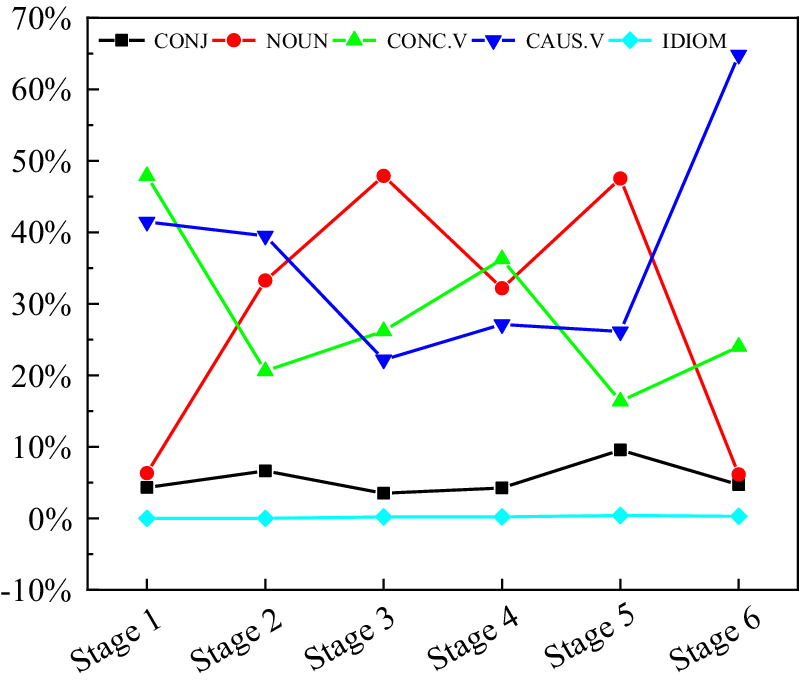
In a usage-based model of semantics, we can operationalize the prototypicality of a lexical item’s senses as the relative frequency of each sense (cf. Liu, Reference Liu2023; Soares Da Silva, Reference Soares Da Silva2012). In other words, relative frequency manifests the structural weight of a certain sense. Therefore, by computing the relative frequency of each sense of SHI in every stage and integrating results from Figs. 2 and 3, we propose that in Archaic Chinese and Contemporary Chinese, the concrete verbal sense (especially ‘to send’) and the causative sense are the corresponding prototypical sense, whereas from Medieval Chinese to Modern Chinese, the prototypicality of SHI becomes diversified in that three categories (NOUN, CONC.V, and CAUS.V) together dominate in frequency, though they all change with fluctuations. If claims have to be made, the prototypical meaning in Medieval Chinese is the causative meaning, in Early Mandarin and Modern Chinese is the nominal one (especially ‘official’), and in Early Modern Chinese is the concrete verbal meaning (‘to send’ and ‘to use’ in particular). In contrast, the conjunctional and idiomatic meanings are not the prototypical meaning at all times.
The multi-functional behavior of SHI represents a typical case of grammaticalization, with a full verb acquiring the role of conjunction and expressing abstract meanings. We assume that the semantic change process was by no means abrupt and might be intertwined with the different meanings of SHI. Xu (Reference Xu, Wu and Hong2003, Reference Xu2006) first dealt with the semantic change of SHI, but she only sketched the shift from ‘to send’ meaning to ‘if’ meaning and paid no attention to the interaction between various senses of SHI. In the next section, we will present a more complete description of the semasiological change of SHI.
4.3. The semasiological change of SHI
Evaluating a grammaticalization process involves a dimension of semasiological salience (or prototypicality) and a dimension of onomasiological salience (or entrenchment) (Soares da Silva, Reference Soares Da Silva2012). The semasiological perspective starts from the word or (grammatical) construction and looks at its meanings or functions, whereas the onomasiological perspective starts from the concept or function and looks at the different words or (grammatical) constructions.
Figure 4 presents a global linear delineation of the semasiological change of SHI over the six stages. The black dot represents the emergence of a sense; the line following the black dot represents the duration of the sense; and the line on the left of a black dot that links it to another line indicates the origin of a senseFootnote 1. In this way, Fig. 4 demonstrates the time when a specific sense of SHI emerges or disappears and its duration in the history of the Chinese.
The semasiological change of SHI over time.

In Fig. 4, the development of SHI as a verb is the most noticeable since the verbal meanings are active in change. The trajectory of its change regarding the various verbal uses can be characterized as by and large inconstant. To illustrate, from Medieval Chinese to Modern Chinese, the proportion of SHI used to express concrete verbal meanings decreased and was accompanied by a slight decrease in its causative use. Presumably prior to Contemporary Chinese, nevertheless, the former is narrowed down to one sense (‘to use’) and low in frequency, while the latter is abundantly attested. Hence, compared with that in previous stages, the semantic division and boundary in Contemporary Chinese between the causative and non-causative uses of SHI are more clear-cut.
Up to now, we have traced the evolution of SHI in Chinese exclusively based on its token frequency. The development of SHI matches the well-known tendency typical of polysemic entities, that is, to extend their more concrete, physical meanings toward more abstract domains (Sweetser, Reference Sweetser1990).
5. Grammaticalization and event integration
Let us now analyze the grammaticalization of verbal SHI more closely. In this section, we examine the gradual grammaticalization of verbal SHI at two levels: that of the lexical meaning of causative SHI, that is, the degree of semantic bleaching, and that of the constructional structure and meaning in terms of event integration.
5.1. Distinguishing the lexical and grammatical use of verbal SHI
We set out to characterize the division of labor that operates between the lexical/concrete and grammatical/causative use of SHI by detailing its distributional profile. The proportion of the two conceptual categories and their change over time are displayed in Fig. 5.
The proportion of the concrete verbal and causative use of SHI over time.

From Fig. 5, it can be observed that the proportion of lexical use of SHI outnumbers that of causative SHI in Archaic Chinese, Early Mandarin, and Early Modern Chinese, while the latter surpasses the former in Medieval Chinese, Modern Chinese, and Contemporary Chinese. The decrease in its lexical use from occupying over 45% in Archaic Chinese to less than 25% in Contemporary Chinese is in tandem with the drastic surge of its grammatical use in Contemporary Chinese, which occupies over 64% of all cases. In fact, the lexical use not only decreases in frequency and proportion in Contemporary Chinese but also in the versatility of sense the instances can express. To illustrate, in Archaic Chinese and Medieval Chinese, the lexical cases have the meaning ‘to appoint’, ‘to send’, ‘to serve’, and ‘to use’, and from Early Mandarin to Modern Chinese, the instances can additionally express another meaning, ‘to indulge’. In Contemporary Chinese, nevertheless, on the one hand, the meaning ‘to appoint’ and ‘to indulge’ disappear, and on the other, there are only 11 cases where SHI means ‘to send’, 1 case with ‘to serve’ meaning, and 227 cases with ‘to use’ meaning, versus 645 causative instances. Figure 6 displays the changing trend of the lexical and grammatical use of SHI.
The changing trend of the lexical and grammatical use of SHI over time.

From Figure 6, one can see that the decline in the use of ‘to send’ from stage 1 to stage 6 is steep when compared to the fluctuation of other lexical senses. In fact, SHI in Contemporary Chinese is rarely used to express its lexical meaning on its own as it did in the history of Chinese. Currently, to express ‘to send/serve/use’, we are inclined to use disyllabic verbs, for example, 驱使 qū shǐ ‘to order about’, 出使 chū shǐ ‘to serve as an envoy’, 使用 shǐ yòng ‘to use’, etc. In contrast, causative SHI in Contemporary Chinese can either be used on its own or in alternatives including 使得 shǐ dé ‘to make’, 致使 zhì shǐ ‘to cause’, etc.
In semantic change, the basic distinction between a lexical and grammatical element is that the latter has little meaning by itself, and its function is to provide extra information about the former (Correia Saavedra, Reference Correia Saavedra2021, p. 135). In this sense, SHI loses some features of its literal meaning when used as a causative. Specifically, the shift from the agentive meaning ‘to send/appoint/use’ to the (non-)agentive meaning ‘to make/cause’ implies semantic bleaching, that is, a weakening of the CAUSER’s power that transfers from the CAUSER to the CAUSEE (compare example f with example k in Table 2). As discussed in Section 2.2, Xu (Reference Xu, Wu and Hong2003, Reference Xu2006, pp. 133–138) posited that causative SHI was grammaticalized from lexical SHI with the meaning ‘to send’, whereas Chang (Reference Chang2005) and Liu (Reference Liu2016) stated that causative SHI developed from multiple sources. Based on our observation, it is more likely that causative SHI is intertwined with its most dominant lexical meaning, ‘to send’, rather than with the peripheral meaning ‘to appoint’. As will be detailed below, the two main senses of SHI, ‘to send’ and ‘to make’, vary greatly in structural features and exhibit functional shifts.
5.2. SENDING versus MAKING: constructional grammaticalization and event integration
Already at the early stage of Archaic Chinese, SHI was predominantly used to express the meaning ‘to send’ and ‘to make’, with the form [NP1 + SHI + NP2 + VP]. To capture its semantic change displayed by the two constructions (abbreviated as SENDcxn and MAKEcxn) across time, we compare their productivity in terms of two metrics: the type frequency (V) and the hapax legomena (V1) of VPs in SENDcxn and MAKEcxn (cf. Desagulier, Reference Desagulier2022). V refers to the number of VP types the two constructions can host, and V1, originally inspired by quantitative works in morphology, is the number of hapax legomena of a given morphological category. It should be pointed out that the motivation for centering on the collocation of SENDcxn and MAKEcxn lies in Construction Grammar (Croft, Reference Croft2001; Goldberg, Reference Goldberg1995, Reference Goldberg2006), particularly the tenet that syntactic constructions and their verbs are intrinsically connected. Here we track the frequency of V and V1 of VPs in SENDcxn and MAKEcxn in each stage, as diagrammed in Figs. 7 and 8. In Table 3 we list the top 10 most frequently used VPs in SENDcxn and MAKEcxn in each stage, with their frequencies in brackets. Note that for SENDcxn in stage 5 and stage 6, the most frequently used VPs include a number of hapax legomenon that cannot be ranked and therefore are unlisted.
Distribution of V and V1 of VPs in SENDcxn in the six stages.

Distribution of V and V1 of VPs in MAKEcxn in the six stages.

The top 10 most frequently used VPs in SENDcxn and MAKEcxn in each stage

From Figure 7 to Figure 8, one can see that the change in the count of V and V1 of VPs in SENDcxn and MAKEcxn is consistent with the change in the frequency of two constructions (see Section 5.1). From stage 1 to stage 6, MAKEcxn becomes more productive while SENDcxn decreases in productivity. In fact, the two-verb structure shared by the two constructions is ubiquitous in human language (recall Section 2.2). Of the two constructions, MAKEcxn comprises two events: a causing event and a caused event. SHI in MAKEcxn expresses the notion of cause, therefore being conceptually dependent on the second verb which encodes the caused event (Kemmer & Verhagen, Reference Kemmer and Verhagen1994). As Langacker (Reference Langacker1991, p. 408) stated, analytic causative constructions profile the energy input or instigating force codified in the CAUSER, responsible for the occurrence of the caused event. In discussing the stages of grammaticalization of analytic causatives in Romance languages, Soares da Silva (Reference Soares Da Silva2012) relied on the binding force of causatives (Givón, Reference Givón1980) and the degree of event integration and causal independence (CAUSEE’s autonomy and CAUSER’s control) (Talmy, Reference Talmy2000b). Following Soares da Silva (Reference Soares Da Silva2012), we examine the grammaticalization of SHI at two levels: (1) the lexical meaning of causative SHI, namely the degree of semantic bleaching, and (2) the constructional structure and meaning in terms of event integration.
Regarding the degree of semantic bleaching, as discussed in Section 5.1, there is semantic bleaching in SENDcxn, from which MAKEcxn originated. Of MAKEcxn per se throughout the six stages, the most grammaticalized version is the one in which SHI presents the highest degree of semantic bleaching and the construction presents the highest degree of event integration. Hence, MAKEcxn exhibits the correlation formulated by Givón (Reference Givón1980) between the semantics of the complement-taking verb and the syntax of the verb-plus-complement construction, as a result of the binding force of the main verb. For SENDcxn, with the constructional meaning ‘to send/order sb. to do sth.’, SHI in the construction is strictly interpersonal, implying that the object will perform the action required by the subject; thus, SHI keeps its literal meaning and argument selection restrictions, including that the two participants are animate, the subject is superior to the object in social status, and the complement event is irrealis (Cao, Reference Cao2011; Xu, Reference Xu, Wu and Hong2003, Reference Xu2006), see examples of SENDcxn from stage 1 to stage 5 in (1)–(5):

It can be seen in examples (1)–(5) that SHI did not grammaticalize. Another piece of evidence comes from Table 3, where the top 10 most frequently used VPs in SENDcxn are all action verbs that refer to the action the subject requires the object to perform in the near future (Chang, Reference Chang2005; Shi, Reference Shi2021). In SENDcxn, the subject, the object, and the relationship between them are quite restricted. Specifically, the two participants in the instances are mostly animate, definite, and volitional and possess a ‘superior–subordinate’ relationship. As the constructional meaning is the subject sends/orders about the object to perform an action, in construing the complement scene denoted by the VP, one needs to take the whole of the complement event as the target of the subject’s instigating force, implying that the complement event is irrealis. To summarize, the complement event encoded in VP in SENDcxn is construed with great independence and is of a low degree of event integration with the main event represented by SHI.
Compared with SENDcxn, semantic bleaching, or the loss of the degree of control exerted by the agentive subject (Langacker, Reference Langacker, Blank and Koch1999), is obvious in MAKEcxn. MAKEcxn applies fewer restrictions to the subject, the object, and the relationship between them. Early in stage 2, the subject/CAUSER in MAKEcxn can be events, instead of animate entities, and the CAUSEE is extended to material objects. The ‘superior–subordinate’ relationship between the two no longer exists. The VP in complement/caused event in MAKEcxn not only includes action verbs but also contains psychological/mental verbs, and is later extended to adjectives (see Table 3). Our finding here corrects and improves Xu (Reference Xu, Wu and Hong2003, Reference Xu2006)’s statement, that during the semantic change of SHI, two conditions play roles: (1) the VP in the caused event is no longer restricted to denote concrete actions, and (2) the agency has to be weakened from both CAUSER and CAUSEE. In addition, our data reveal that the cause-and-effect relationship between the causing and caused event represented by SHI and VP/AP respectively in MAKEcxn is in any case obvious and salient. See examples of MAKEcxn from stage 1 to stage 6 in (6)–(11):

In examples (6) to (11), MAKEcxn profiles a single causal activity in which a single energy source, the CAUSER, exerts influence on the CAUSEE. In event perception and event representation, MAKEcxn is mapped onto a mono-clausal structure (Talmy, Reference Talmy2000a, Chapter 8; Talmy, Reference Talmy2000b, Chapter 3), thus being of a high degree of event integration. Previous studies (Smith, Reference Smith, Jazayery, Palomé and Winter1970; Shibatani, Reference Shibatani1976; McCawley, Reference McCawley and Cole1978, p. 26; Dowty, Reference Dowty1979; Comrie, Reference Comrie and Shopen1985, Croft, Reference Croft1991; Kemmer & Verhagen, Reference Kemmer and Verhagen1994; Levin & Rappaport Hovav, Reference Levin and Rappaport Hovav1994) have pointed out that causal chains that can be described by single-clause expressions tend to express direct causation between the CAUSER and CAUSEE. Table 4 systematizes the main structural and semantic features that iconically codify in SENDcxn and MAKEcxn.
Main features of SENDcxn and MAKEcxn

The semantic change of SHI from SENDcxn to MAKEcxn not only testifies The Macro-event Hypothesis of a continuum of grammaticalization in languages but also furthers the hypothesis by revealing the process of semantic gradation taking place in the history of Chinese. In Talmy’s (Reference Talmy2000b, Chapter 3) terms, in MAKEcxn, the logical subject of the caused event, namely the CAUSEE, loses control over its own activity, resulting in a greater degree of structural integration of events and a more direct causal relationship between the events. Therefore, in terms of grammaticalization, there is a significant increase from SENDcxn to MAKEcxn: MAKEcxn in stage 6 represents the highest degree of constructional grammaticalization while SENDcxn in stage 1 is the lowest. Put simply, the increasing cline of constructional integration and grammaticalization is as follows: SENDcxn > MAKEcxn. Currently, there is no clear answer regarding how long it takes for an element to grammaticalize (cf. Narrog & Heine, Reference Narrog and Heine2011, p. 8). In this study, it is observed that SHI in Archaic Chinese has already been used as a causative, meaning that it has undergone grammaticalization before the period under discussion. As time goes on, its lexical verbal uses become narrowed and the causative use expands, meaning that SHI is still grammaticalizing.
6. Conclusions
A few conclusions may be drawn from this diachronic analysis of SHI in Chinese. Firstly, the multi-functional behavior of SHI represents a typical case of grammaticalization, with a full verb acquiring the role of conjunction and expressing abstract meanings. Secondly, the semantic division and boundary of the causative and non-causative uses of SHI in Contemporary Chinese are the most clear-cut. Thirdly, the complement event encoded in VP in SENDcxn is construed with greater independence and is of a lower degree of event integration with the main event represented by SHI. In contrast, SHI in MAKEcxn shows a greater level of semantic bleaching, and MAKEcxn as a whole profiles a single causal activity, thus having a higher degree of event integration. The predominant use of causative SHI in Contemporary Chinese as well as its demise in expressing ‘to send’ meaning on its own exhibits the functional shift of verbal SHI over time. Fourthly, our results verify The Macro-event Hypothesis of a continuum of grammaticalization in language, and more importantly, first reveal the process of semantic gradation in Chinese. The constructional grammaticalization of SHI in SENDcxn and MAKEcxn suggests that event integration is key to language change.
Talmy’s (Reference Talmy1991, Reference Talmy2000b) influential work on event typology provides strong arguments for the typology of the Romance and Germanic languages and thereby significantly extends the ways that can be used to examine and account for the typology of a language. The purpose of this paper is to apply the event integration theory and its latest development, the Macro-event Hypothesis, to account for the diachronic development of Chinese, particularly to expound on the semantic change of SHI from a full verb to a causative marker in the history of Chinese. Different from previous studies which look into the diachrony of SHI only by enumerating its partial change with sporadic instances, we take a holistic view of its form, meaning, and change across different stages based on a large amount of authentic data. This study is the first one to take a corpus-based long-term perspective on the diachrony of SHI, and to explain its functional shift based on event integration theory.
Further research on the role of event integration in language change is obviously necessary. We suggest three research topics. First, more quantitative corpus analyses are needed to confirm the motivating force of event integration in constructional grammaticalization suggested here. A second research topic consists in elaborating on the various degrees of event integration in different stages of language change, for instance, by setting up a hierarchical event integration model. Finally, it is important to figure out whether event integration is of psychological reality in language processing in the human mind.
Acknowledgements
We would like to thank Xiaofang Wu, Yu Shen, Jin Cao, and ZIfan Li for their discussions on data annotation, Meili Liu for her suggestions about data sampling, and Elizabeth Traugott for editing an early draft of this paper. Additionally, we extend our gratitude to the two anonymous reviewers for their insightful comments.
Data availability statement
The datasets analyzed during the current study are available at https://osf.io/tpu6r/.
Competing interest
The authors declare none.
Appendix 1


 Open access

