

Although much of the history of women's suffrage has focused on the American and British struggles of the early twentieth century, a newer generation of interdisciplinary scholars is exploring its global trajectory. Fundamental to these cross-cultural comparisons is the establishment of an international timeline of women's suffrage; its order at once shapes and is shaped by its historiography. According to the currently dominant chronology, “Female suffrage began with the 1893 legislation in New Zealand” (Ramirez, Soysal, and Shanahan Reference Ramirez, Soysal and Shanahan1997: 738; see also Grimshaw Reference Grimshaw1987 [1972]: xiv). In this timeline, “Australia was next to act, in 1902” (ibid.). Despite the geographical location of New Zealand and Australia in greater Southeast Asia, the narrative that accompanies this timeline portrays “first world” women as leading the struggle for suffrage and “third world” women as following their example.Footnote 1 As Ramirez, Soysal, and Shanahan write, “A smaller early wave of suffrage extensions between 1900 and 1930 occurred mostly in European states. A second, more dramatic wave occurred after 1930” (ibid.). Similarly, Patricia Grimshaw writes, “It was principally in the English-speaking world, in the United States, in Britain and its colonial dependencies, and in the Scandinavian countries that sustained activity for women's political enfranchisement occurred. Other countries eventually followed suit” (1987: xiv).
In this timeline, Thailand is listed as having granted female suffrage in 1932 (e.g., Daley and Nolan Reference Daley and Nolan1994: 350; Ramirez, Soysal, and Shanahan Reference Ramirez, Soysal and Shanahan1997: 743–44). However, although 1932 marks the first time Thai men and women could vote in elections for their newly created parliament, it does not mark the first time Thai women could vote. As I was stunned to discover in the course of conducting research on village voting laws, formal provisions for female suffrage in village elections in Thailand date to the Local Administration Act of 1897. In effect nationally, this hitherto overlooked act arguably establishes Thailand's right to claim to be the second country in the world to enact female suffrage. More significantly, women in New Zealand and most other “first world” countries follow a pattern in which they gained voting rights only after an extended political struggle, and only after men. By contrast, Thailand is the first major country in the world in which women and men achieved the vote on an equal basis simultaneously and without any record of controversy.
In her book Engendering Democracy, Anne Phillips notes that only recently have scholars begun to draw connections between democracy and feminism; she remarks on the irony that not only could ancient Greeks conceive of democracy without any qualms about excluding women, but “early liberals could talk of human beings as equals without any inkling that they might all expect to vote” (1991: 1). If in the Western countries the struggle for democratic suffrage was historically gendered, Thailand provides an alternative paradigm in which suffrage was never gendered. As the disparity between Thailand's 1932 date on the international timeline and its actual establishment of female suffrage in 1897 reveals, the timeline has prioritized the dates of national elections over local-level electoral politics, and has thereby obscured this alternative worldview from study.
This essay, divided into four main parts, explores the historical context of Thailand's ungendered suffrage and its implications for our understanding of the global history of women's suffrage more broadly. In the first section I outline how the inclusion of female suffrage in the 1897 Act reveals Thailand's independent indigenous historical trajectory in the face of colonial pressures. I then explore evidence regarding the presence of a Western suffrage movement in nineteenth-century Thailand, concluding that the possible familiarity of the Thai court with the suffrage controversies is insufficient to explain the country's early adoption of universal suffrage. In the third part, I argue that universal suffrage in Thailand, rather than merely resulting from movements emanating in “the West,” instead emerged from the indigenous position of women embedded in a matrilineal kinship system. A final section considers the challenges the Thai case offers to both the criteria underlying the prevailing timeline and its attendant Eurocentric historiography. Arguing for the importance of an “eastern” village-based perspective to countermand the prevailing Western, urban-based perspective, I conclude by suggesting that external patrilineal colonizing forces may have thwarted rather than expanded the indigenous matrilineal political positions of women in greater Southeast Asia.
COLONIALISM AND THAILAND'S INDEPENDENT TRAJECTORY
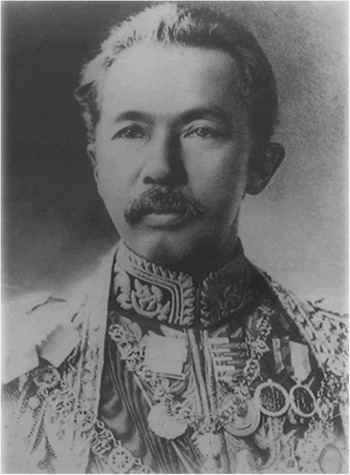
Women's suffrage in Thailand can be dated at least as far back as the Ministry of Interior's Local Administrative Act of May 1897 (Phraraachabanyat 1897 [BE 2440]). The Ministry of the Interior was created in 1894 at the behest of King Chulalongkorn (r. 1868–1919), as part of the king's far-reaching administrative reforms. The king, concerned to safeguard the country against the colonial advances by the French in Indochina and by the British in Burma and Malaya, appointed his half-brother, Prince Damrong Rajanuphab (1862–1943), as Thailand's first minister of the interior in 1894 (see image 1).Footnote 2 Prince Damrong proceeded to establish the framework for Thailand's contemporary administrative division into provinces, districts, sub-districts, and villages. Although national, provincial, and district levels of government were to be staffed by salaried bureaucrats, villagers were to elect their own village heads.Footnote 3 Clause no. 9 of the 1897 Act defined the villagers who were eligible to vote as residents “whose house or houseboat was located in that village,” and specified that residents included both males and females (raasadorn chai ying).
Prince Damrong Rajanuphab, ca. 1890s (Source: Wikipedia).
How village suffrage came to be included in the 1897 Act awaits further study.Footnote 4 According to prevailing historical narrative, Prince Damrong copied his administrative structure from the model of British colonial administration in Burma and Malaya (Tej 1977: 134; Girling Reference Girling1981: 46; Loos Reference Loos2006: 6; Riggs Reference Riggs1966: 137; Vickery Reference Vickery1970: 873–75).Footnote 5 Both King Chulalongkorn and Prince Damrong were definitely interested in European administrative practices. King Chulalongkorn made his first overseas trip “to observe British administration in Singapore and that of the Dutch on Java” in March 1871. The king toured the major cities of British India in 1872, stopping in Malaya, Singapore, Java, and Burma; in 1890 he visited Singapore; in 1896 he visited Java; and in 1897 he took an eight-month trip to Europe (Wyatt Reference Wyatt1969: 40–41, 196–97; Wilson Reference Wilson1962: 6–7). Prince Damrong visited Burma in 1890–1891, and again in 1892 en route to Europe (Wyatt Reference Wyatt1969: 138). Three other princes who were closely involved in administrative reforms had also visited Burma by 1892, and in 1893 Prince Damrong sent a close associate to observe the British administration in Burma and Malaya first hand (Tej 1977: 134).
However, a consideration of female suffrage reveals significant differences in Thailand's electoral design. The colonial countries that had the greatest influence in the neighboring regions of Southeast Asia were the Netherlands, Britain, and France. None had established universal suffrage in their own countries by this point. Women only gained equal voting rights in the Netherlands in 1919, in Britain in 1928, and in France in 1944; women in their Southeast Asian colonies also achieved suffrage later.Footnote 6 Furthermore, in the two colonies thought to have influenced Prince Damrong the most—Malaya and Burma—female suffrage was granted in a general trajectory which mirrored England itself: suffrage was gendered, and granted first in municipalities rather than in rural villages.Footnote 7
At the time Prince Damrong became Minister of Interior, the British were still in the process of expanding their presence in the Malayan peninsula and so this region is unlikely to have provided a model for the 1897 Act. Although they occupied Singapore in 1819 and gained control of the Straits Settlements in 1826, the British only took control of the four Federated Malay States in 1895, and the five Unfederated Malay States in 1909. Furthermore, the British administered these states indirectly through the local rajahs. The first election in Malaya of which I am aware was for three out of five seats in the Municipal Council of George Town (Penang) in 1857,Footnote 8 but Malayan women did not gain full suffrage until 1955. Given the emphasis on indirect rule, British colonial rule in the Malayan peninsula explains neither the importance of village-level elections nor the inclusion of women in Thailand's 1897 Act.
Unlike Malaya, the British had gained direct administrative control of Burma before 1897. Their annexation of Burma proceeded in three main stages, beginning in 1826 with the conquest of lower Burma and ending with the incorporation of upper Burma in 1886. Initially the British maintained indirect rule. The electoral principle appears to have been first introduced in Burma in 1882; towns in British Burma received the vote before the countryside did. Under the British Burma Municipal Act of 1874, seven Burmese towns were constituted as municipalities, but the members of the initial municipal committee were nominated by the provincial government. In 1882, as Donnison explains, “the elective principle was introduced in regard to these seven municipalities, although a proportion of the members was still nominated” (1953: 34). According to Hall, “only in Rangoon, with its relatively large European element and educated Asian community, was the system reasonably successful” (1970: 739). This Act underwent subsequent revisions and women were included in the Rangoon electorate by 1912.Footnote 9
As the British consolidated their administrative control, Donnison presumes that “life in the villages went on much as it had ever done” (1953: 35; see also Hall Reference Hall1970: 616, 730). The earliest evidence of the formalization of rural government can be found in the Upper Burma Village Regulation of 1887 and the countrywide Burma Village Act of 1889 issued when Sir Charles Crosthwaite served as chief commissioner of Burma. Drawing upon British colonial strategy in India that emphasized the village as the basic political unit, Crosthwaite sought to weaken the power of the town heads (myothugis) and other intermediate leaders by strengthening village leadership. The town heads were eliminated and replaced by civil servants (myo-ok), under whose charge villages were placed (1970: 731–32). The 1889 Burma Village Act stated that deputy commissioners were to appoint village headman, having regard “to any established customs which may exist respecting the right of nomination or succession or otherwise.” The Act did not provide guidelines for formally elected leaders, let alone any provisions specifying female suffrage.Footnote 10 As in Malaya, and England itself, suffrage in colonial Burma was gendered and institutionalized in municipalities before villages. Thus, external colonial pressures may have contributed to the Thai court's desire for administrative reform, but cannot explain Prince Damrong's inclusion of female suffrage. The Prince followed an indigenous trajectory with regard to his key provisions—formalized village elections and female suffrage—independent of British or any other European colonial models.Footnote 11
EVIDENCE OF WESTERN SUFFRAGE INFLUENCE: THE WOMEN'S CHRISTIAN TEMPERANCE UNION
If Prince Damrong did not copy the British colonial administrative system, then what might explain his extraordinary position on women's suffrage at a time when most women around the world were not yet voting? The Thai court had a long history of interaction with foreigners, among whom American missionaries were particularly important. The diary of Dr. Dan Beach Bradley, one of the earliest American missionaries to Thailand, provides insight into the court's longstanding cosmopolitanism. He described his visit in 1835 to the palace of a half-brother of King Rama III, as follows: “The Prince is excessively fond of English customs and adopts them in many particulars. His table is furnished with articles imported from England.… He is major-general of the King's artillery and is training a company of Siamese to drill in the style of the English as well as dress like them” (Feltus Reference Feltus1936: 9).
In this section, I will review the evidence regarding the extent to which foreigners residing in Thailand were involved in the international suffrage movement. Against the view of Scott Barmé and others that Thais were not exposed to early Western feminists (2002: 18), I will argue that the majority of American missionaries were likely pro-suffrage, that many of these pro-suffrage missionaries had very close relations with the court, and that Prince Damrong and other members of the court may well have been aware of the suffrage controversy.
Evidence of Pro-Suffrage Foreigners
Although I have encountered no explicitly pro-suffrage statements, Donald Lord avows, “Most of the missionaries to Thailand were progressive in their attitude towards women” (1964: 20).Footnote 12 That the issue was current among foreigners in nineteenth-century Thailand is ironically revealed in an anti-suffrage remark of one American missionary, Noah McDonald: “Woman knows her place in Siam, and there are no such unfrocked specimens of the sex there, as Elizabeth Cady Stanton, Lucretia Mott, and others” (Reference McDonald1999 [1871]: 66).Footnote 13 However, the likelihood that many, if not most, American Protestant missionaries favored suffrage can be inferred from their support for such key organizations as the Women's Christian Temperance Union (WCTU) and its international branch, the World Women's Christian Temperance Union (WWCTU). Founded in 1885, the WWCTU was the largest and single most important mass organization in the international movement for women's suffrage (see esp. Tyrell Reference Tyrell1991).Footnote 14 The WCTU had its beginnings in the United States in 1874, emerging out of the vortex of abolitionist, temperance, and suffrage movements of the early nineteenth century. Although the organization initially prioritized temperance, the election of Ms. Francis Willard in 1879 brought women's suffrage into the organization's wide-ranging agenda of social justice issues; Willard believed strongly that women “could not protect their homes and families from liquor and other vices, without a voice in public affairs” (Grimshaw Reference Grimshaw1987: 28; see also Tyrell Reference Tyrell1991; Rushing Reference Rushing2003; Mezvinsky Reference Mezvinsky1959; Willard and Livermore Reference Willard and Livermore1967 [1893]: 777–81).
Seeking to support women throughout the world, Willard appointed international ambassadors.Footnote 15 The first two of these were Mrs. Mary Clement Leavitt and Miss Jessie Ackermann, both of whom played an important role in the early global history of suffrage. Described by Willard as “our white ribbon Stanley,” Leavitt left the United States in 1884, embarking on an international journey that took her to five continents and spanned a period of eight years (Tyrell Reference Tyrell1991: 1). A former Boston schoolteacher, Leavitt “produced the spark which set off a suffrage campaign in New Zealand” in 1885 (Grimshaw Reference Grimshaw1987: 27). Ackermann followed in her footsteps in 1888, in turn founding the Australian National Union of the WCTU and becoming its first president in 1891 (Rushing Reference Rushing2003: 9, 17).Footnote 16 While on their round-the-world journeys, both Leavitt and Ackermann made stops in Thailand in March 1887 and December 1889, respectively. Leavitt used her visit to found a Thai chapter of the WCTU.
An account by Leavitt published in the WCTU's weekly newspaper, the Union Signal, suggests that the missionary family whose members were likely the most influential in the establishment of the Thai WCTU chapter were the Bradleys. Leavitt's initial contact in Thailand was with Mrs. Sarah Blachly Bradley and her daughter (see image 2).Footnote 17 Mrs. Bradley was the widow of the famed missionary doctor Daniel Beach Bradley. Dr. Bradley (1804–1873) had close links to the court that dated back to 1835. In addition to his medical work, he founded a newspaper and is credited with developing a Siamese printing press. Born in New York, Dr. Bradley's attitudes towards suffrage are implied by his activities. During his medical training, he founded a young people's temperance society, wrote his thesis on the history of alcohol, and also attended meetings of the American Anti-Slavery Society and the American Peace Society (Feltus Reference Feltus1936: i–iii).Footnote 18 He is also known to have met Charles Finney, a revivalist preacher who supported women's education; Finney later became president of Oberlin College, one of the first colleges in the United States to educate women, and the college where the Bradleys sent their children to be educated. Bradley's views about the status of women are more explicitly revealed in his account of his first meeting in 1836 with the future King Mongkut, then a monk residing at a temple. Bradley records in his diary: “I made him a professional visit this evening, taking Mrs. Bradley with me.… I apprehended that I might meet with difficulty in my introduction to him from having my wife with me as the priests, most especially those high in rank, have peculiar conscientious scruples about being in the presence of women. But I thought it would be well to … give one of the most influential men in the Kingdom to understand that neither myself nor American gentlemen generally regard females as our inferiors” (ibid.: 26).
Sarah Blachly Bradley, ca. 1880s (McFarland Reference McFarland1999, following p. 36).
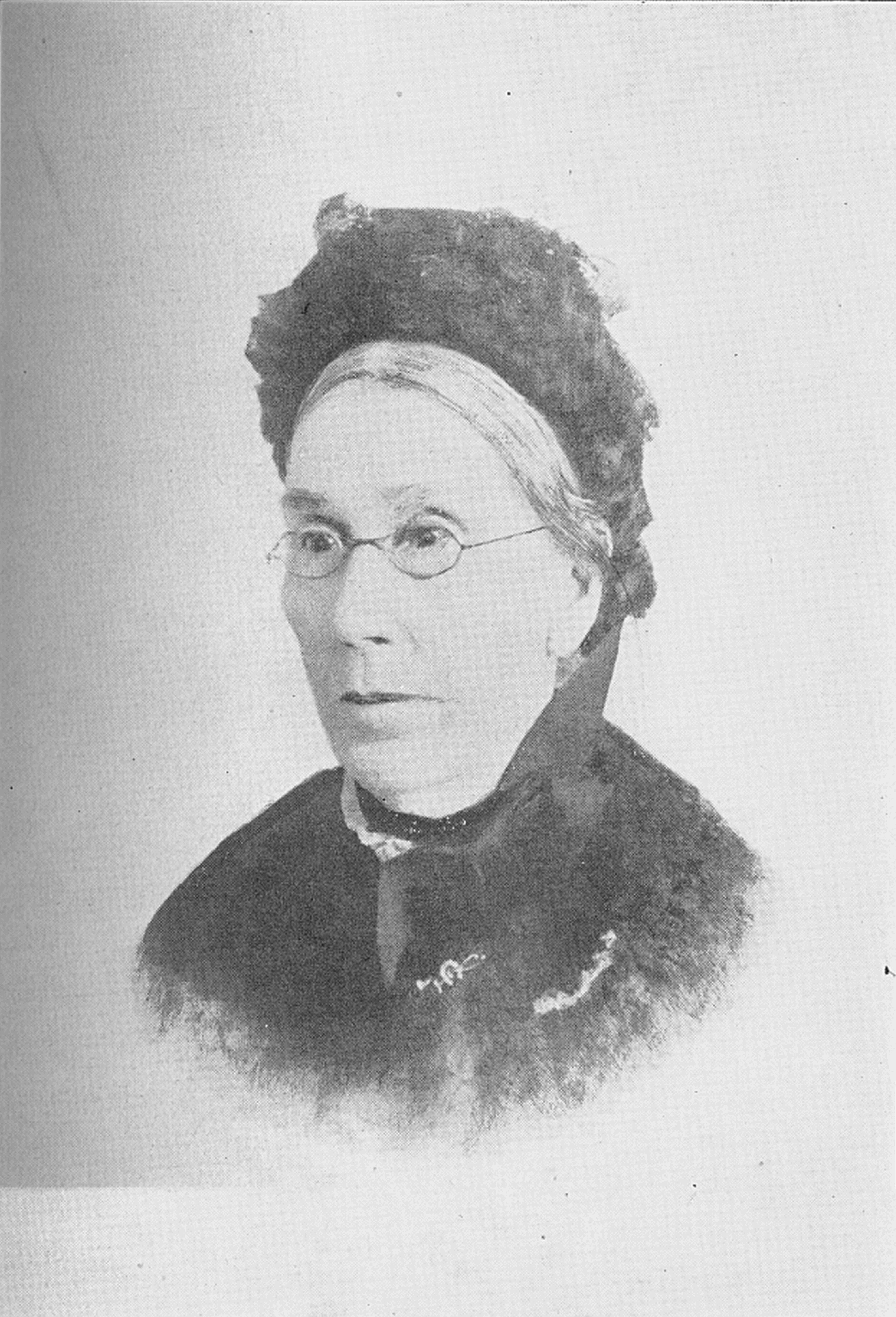
That Sarah Blachly Bradley (1818–1893) served as the initial liaison for the Willard-led WCTU intimates the likelihood of her own pro-suffrage views; her strong support of temperance and abolitionism provides corroborating evidence. Sarah was Dr. Bradley's second wife, having married him in 1848 when he returned to the United States after the death of his first wife.Footnote 19 One of the first women in the United States to earn a Bachelors degree, Sarah had graduated from Oberlin in 1845. She and her husband joined the American Missionary Association, “then working for the negroes in the USA” (McFarland Reference McFarland1999 [1928]: 22), and arrived in Thailand in 1850. Her views and those of Dr. Bradley regarding temperance are revealed in their joint refusal to attend dinner parties at which alcohol was served (Feltus Reference Feltus1936: 16). Described as a woman “with a mind of her own” (Lord Reference Lord1964: 178), she was well known to members of the court since she served as a tutor for women in the palace and often accompanied her husband in his visits there.
A second missionary family that appears to have played a particularly important role in the founding of the WCTU in Thailand is the McFarlands. At the time of Leavitt's visit, they were living in Bangkok, and Mrs. Jane Hays McFarland became treasurer of the Bangkok chapter. Jane and her husband, Dr. Samuel G. McFarland, both Presbyterians, had arrived in Thailand in 1860 and established the first upcountry mission in Petchaburi in 1861. With the support of the local governor, they opened a school; the governor's son and children of other officials were among their first students. In 1865, Mrs. McFarland founded an industrial school for girls and women, drawing upon funds provided by King Chulalongkorn and other members of the nobility (McFarland Reference McFarland1999: 98–99, 212). That Mrs. McFarland had a particular consciousness of women's issues is reflected in her concerted efforts to reach female students. As explained in an historical account of the Petchaburi mission, “Mrs. McFarland felt distressed to see the utter lack of even the most elementary knowledge of books on the part of the female population…. When sewing machines were first introduced into Siam by the missionaries, Mrs. McFarland introduced them into Petchaburi and it later became known as ‘sewing machine town.’ In this modest way the first instruction of women and girls was begun in Petchaburi” (ibid.: 94–95).Footnote 20 During the American Civil War, the McFarlands were known to be strong supporters of the north, intimating their likely views on slavery (ibid.: 94). In 1878, they moved to Bangkok to assist in founding a boys' school, called Suan Anan, for the sons of the nobility (ibid.: 67, 99).
Upon arriving in Thailand, Leavitt, and Mrs. and Miss Bradley first traveled to Petchaburi since, “Mrs. Bradley thought it best to go to Petchaburee, ninety miles away, at once, and work in Bangkok on my return” (Union Signal, 2 June 1887). Although the McFarlands had already moved to Bangkok at the time of Leavitt's visit, they had evidently left a cohort of like-minded missionaries in Petchaburi. Leavitt describes how she was “most cordially received” by members of the American Presbyterian mission there, then comprised of Dr. Eugene P. and Mrs. Emily Wilson Cross Dunlap, Miss Jennie Small, Miss Mary Lovina Cort, and Miss Jennie Nielson (ibid.).Footnote 21 In the two days she spent in Petchaburi, Leavitt spoke twice to native Christians and once to the children from the schools. Before she left, she “formed a W.C.T.U., the six missionary ladies all joining.” Thus the first members of the WCTU in Thailand were Emily Dunlap, Jennie Small, Mary Cort, Jennie Nielson, Miss Bradley, and Mrs. Bradley. She added, “Siamese women will be admitted as soon as they have had a little more instruction.”Footnote 22 Leavitt subsequently appointed Cort as the national president.
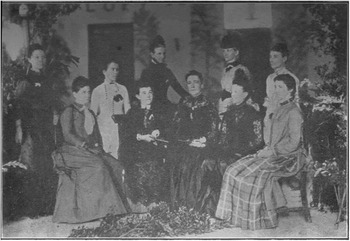
Leavitt then traveled to Bangkok where she records, “I spoke in all the preaching stations, in all the schools, and twice in the British Consular Chapel to the general public, and organized a W.C.T.U., taking in several ladies of the foreign community outside the missionary circle” (Union Signal, 9 June 1887). She then founded a Bangkok chapter, noting, “Mrs. Captain Loftus, an English lady, was elected president of the Bangkok union, Mrs. Wachter, secretary, and Mrs. McFarland, treasurer” (Union Signal, 2 June 1887).Footnote 23 A photo taken in 1889 with Ms. Ackermann shows some additional members of the Bangkok chapter of the WCTU; almost all of them were Presbyterian missionary women with longstanding connections to Thailand (see image 3). The lead role played by Presbyterian Church women in the formation of the WCTU in the United States suggests that support for suffrage may well have been widespread throughout the larger Presbyterian missionary community in Thailand.
Jessie Ackermann and WCTU members in Bangkok, 1889 (McFarland 1999, following p. 83). The members are, sitting left to right: Miss Mary H. McDonald, Miss Elizabeth (Lizzie) Eakin, Miss Jessie Ackermann, Mrs. Loftus (Captain A. J.) and Miss Van Emmon (later Mrs. Christian Berger). Standing left to right: Mrs. David J. Collins, Miss Mary Stokes (later Mrs. J. B. Dunlap), Mrs. Jane Hays (Samuel G.) McFarland, Mrs. Jennie Nielson (T. Heyward) Hays, and Mrs. Belbin. Eakin, Emmon, Collins, Stokes, McFarland, and Hays were all Presbyterians. (For details see McFarland Reference McFarland1999.)
Once founded, apparently the Thai WCTU “flourished greatly” (McFarland Reference McFarland1999: 68–69). The Thai chapter can be traced back to1862 when the “first of a series of social meetings of a social and improving character, superintended by the ladies of Bangkok,” was held at the British Consulate. In 1866, a Ladies Bazaar Association was organized for charitable purposes (ibid.). The Ladies Bazaar Society was apparently attacked by some missionaries, but “[m]ost of the Brethren however, including Bradley, approved of the social work done by the Ladies Bazaar Society” (Lord Reference Lord1964: 177). In 1869, this society also organized a Library Association.Footnote 24 Once established, the Thai WCTU chapter's activities included introducing aerated waters and running a Sailors' Rest project (McFarland Reference McFarland1999: 68–69; Reference McFarland and McCracken1958: 121). Members of the branch also likely contributed to collecting signatures for the famous Polyglot Petition. Although it called for the prohibition of the “Drink Traffic and Opium Trade,” Willard and others in the WCTU leadership saw the petition drive as part of a broader strategy to discuss women's issues, including suffrage (Mezvinsky Reference Mezvinsky1959: 77). As round-the-world ambassadors, both Leavitt and Ackermann spearheaded the international effort, carrying the petition with them on their travels. By 1895, over seven million signatures had been collected written in fifty different languages (ibid.: 78). Although this petition is in storage in Evanston, Illinois and not accessible at present, I believe future study will reveal Thai signatures; it is known to contain Sri Lankan, Chinese, and “a list of Burmese signatures that looks like bunches of tangled worms” (Gordon Reference Gordon and Evanston1924: 61).Footnote 25
The extent to which Leavitt and Ackermann included suffrage in their public lectures or private discussions during their brief stays in Thailand is unclear. According to Rushing, Ackermann was “wise enough to pick her battles,” and in China she apparently initially omitted suffrage work from her mission (2003: 54). The Bangkok Times of 18 December 1889 reported, “While earnestly advocating the cause of Temperance, Miss Ackermann states that Woman's Suffrage forms no part of her program. By making this avowal we feel sure that the lady will claim the respect and attention of Bangkok people” (ibid.: 54). Nonetheless, given Miss Willard's positions on suffrage and the suffrage activities of Leavitt and Ackermann in New Zealand and Australia, respectively, it is hard to believe that suffrage was far from the agenda of these WCTU ambassadors and their first supporters in Thailand.
Determining Court Knowledge of Suffrage
It is possible that, despite their personal views, the missionaries never explicitly discussed suffrage, perhaps because it seemed irrelevant in an absolute monarchy or it may have been a low priority in light of their other concerns. However, the close connections between these pro-suffrage American missionaries and the court suggest the possibility that the court was aware of the global controversies over suffrage. In an introduction he wrote for a centenary volume, Prince Damrong highlighted many of his own close ties with Protestant missionaries. He commented that his contact began from his birth, since as a baby he was vaccinated against smallpox by a medical missionary; he added wryly that he still had “the marks of that contact” (McFarland Reference McFarland1999: 2).Footnote 26 As a student he read texts published by Dr. Bradley and paid frequent visits to the homes of the Chandlers (Baptist missionaries), the Bradleys, and the McFarlands to practice his English (ibid.: 2–5). As a close advisor of the king, Prince Damrong attended audiences granted to foreigners, “and it was such occasions which increased my friendship with the missionaries who came to interpret”; these English interpreters to the government included a son of Dr. Bradley (ibid.: 5–6).Footnote 27 As an officer of the King's Bodyguard, Prince Damrong accompanied the king on most of his trips around the country. He met the McFarlands for the first time in Petchaburi. When Damrong became minister of education, he asked Dr. McFarland to serve as headmaster in the government-run Suan Anan school under his department (ibid.: 5). The McFarlands' son, Edwin, became Prince Damrong's secretary in the Ministry of Education (McFarland Reference McFarland and McCracken1958: 76). In addition to the McFarlands, Damrong also mentions the Presbyterian missionaries Dr. J. A. Eakin, Dr. E. P. Dunlap, and Miss E. S. Cole as assisting in his educational efforts (McFarland Reference McFarland1999: 14); the wives of Drs. Eakin and Dunlap were early members of the Thai chapter of the WCTU. There is also evidence indicating that Prince Damrong personally met Jessie Ackermann.Footnote 28
Significantly, both Leavitt and Ackermann were granted royal audiences with King Chulalongkorn. However well known these two women may have been in the United States, that they had audiences on their first trips to Thailand was probably the result of close relations between the WCTU supporters and the Thai court. Leavitt mentions that she saw the king briefly while she was at Petchaburi, and noted that he had given several “thousands of dollars” to support the mission work there, “a portion to schools, another to the hospital, a third for an old woman's home to be built there, under the care of the unmarried ladies of the mission” (Union Signal, 9 June 1887).Footnote 29 Mrs. Leavitt was accompanied to her official audience by Mrs. Bradley's son, an English interpreter for the court. Although she does not mention suffrage, she said of her audience with the King, “He seemed much pleased at the account of what we have done and hope to do, threw out some very shrewd remarks, but kept me talking most of the time. The audience lasted half an hour, and then I was dismissed as graciously as I was received.” She noted that about “twenty princes, brothers of the king, were standing in a group at the lower end near the entrance.” Since Prince Damrong was a close attendant of the king, it is entirely possible that he was present. Like Leavitt, Ackermann also formed a favorable impression of the king, describing him as “a most intelligent man who speaks three different languages and has quite a knowledge of the outside world” (1896: 188). Providing further details of her “hour of pleasant conversation” with the king, she comments, “He was thoroughly informed on the latest phases of the woman question, and seemed to know of all the efforts that were being put forth by them for their own elevation and the betterment of the world” (ibid.: 193–94).Footnote 30
Even if neither Leavitt nor Ackermann raised suffrage during their audiences with King Chulalongkorn, the King and other members of the court may have learned about the contemporary debates on suffrage through their close ties to missionaries who became involved with the WCTU. The Thai court's introduction to the Western debates over women's suffrage might well trace back to Dr. Bradley and his first wife, Emelie. Before ascending to the throne, Prince Mongkut spent many years as a Buddhist monk (from 1824–1851), during which time he studied English with Dr. Bradley and other missionaries (Moffat Reference Moffat1961: 20). The court's awareness of the temperance controversy can be dated back to at least 1864, when King Mongkut held two birthday celebrations, one without alcohol for the benefit of the American missionaries (Lord Reference Lord1967: 335). Their shared concern for women's well being may well have been behind King Mongkut's efforts to change women's birthing practices.Footnote 31
Beyond King Mongkut, female members of the court may also have been exposed to the issue of suffrage. Less than three months after he became king in 1851, Mongkut asked the Protestant missions “to furnish a Preceptress for the Royal females” (Moffat Reference Moffat1961: 164). Of the three missionary women who taught classes in the royal palace for three years, one was Sarah Bradley. Their royal students included twenty-one young wives and several royal sisters (ibid.: 165). Although discussions of suffrage cannot be documented, there is evidence indicating that discussions of polygyny (the practice of a man having multiple wives) and religious differences did occur among these women of the court.Footnote 32
In addition to American missionaries, the court may also have been exposed to suffrage debates through the famous governess Anna Leonowens, whom King Mongkut hired to teach the royal princes and princesses in the palace from 1862–1867. Although her views on suffrage at this time are not known, Leonowens became an outspoken advocate for women's suffrage during her later years; in 1895, while living in Halifax, Canada, she served as president of the Women's Suffrage Association (Morgan Reference Morgan2008: 202; Dow Reference Dow1991: 108–13). Nonetheless, her strong anti-polygyny and anti-slavery views were already formed by the time she served as a royal governess. Her assignments to her royal students included translating Harriet Beecher Stowe's Uncle Tom's Cabin (Dow Reference Dow1991: 32).Footnote 33 Among her students was the young and future King Chulalongkorn, a playmate of her own son Louis. She records several anti-slavery discussions with royal children, including a discussion with Chulalongkorn about the philosophies of Abraham Lincoln. She appears to have formed a particularly warm bond with Chulalongkorn, perhaps feeling especial compassion for him since his mother had died just before Anna's arrival in Bangkok (Dow Reference Dow1991: 40; see also Morgan Reference Morgan2008: 154, 161). When King Chulalongkorn traveled to Europe in 1897, Anna met him again in London, in August. He evidently proudly informed her that one of his Queens was serving as regent in his absence (Dow Reference Dow1991: 122).
However, even explicit discussions of suffrage between pro-suffrage foreigners and members of the Thai court would not explain Prince Damrong's inclusion of female suffrage in the 1897 Act. Although the courts of King Mongkut and King Chulalongkorn appreciated many of the skills offered by the missionaries and other foreigners, they did not blindly follow foreign exhortations. The missionaries were critical of many Thai practices, including alcohol consumption, opium addiction, gambling, slavery, polygyny, and Buddhism. The Thai court accepted many Western medical and educational practices and gradually ended slavery, but it continued to distribute tax monopolies in alcohol, opium, and gambling, maintained its practice of polygyny, and resolutely defended Buddhism against Christian missionizing. Jessie Ackermann records various encounters in which indigenous statesmen throughout Asia indicated their skepticism regarding Christianity and other foreign values.Footnote 34 Furthermore, if the Thai court was aware of the position of the WCTU supporters regarding suffrage, it was also aware that neither the United States nor European countries had established female suffrage and that the subject was considered controversial. The global circulation of contested ideas does not determine their adoption.
OF HAREMS AND MATRILOCAL KINSHIP
An understanding of Prince Damrong's remarkable inclusion of female suffrage entails an appreciation of the broader social kinship system in which he was embedded. If indeed Prince Damrong should be viewed as an early Thai feminist countering an overarching patriarchal ideology, the issue of women's suffrage would have been controversial. However, as Tamara Loos has noted in her pioneering essay on women's suffrage in 1932, what is most remarkable is the lack of controversy over women's right to vote (Reference Loos, Edwards and Roces2004). Records certainly exist of other internal court conflicts; the issue of polygyny alone provoked considerable discussion (Loos Reference Loos2006: 120–23; Barmé Reference Barmé2002: 21–23). That historians have not noted any debates over the inclusion of women as eligible voters suggests that Prince Damrong was not so much an early feminist as simply a member of Thai society, reflecting a matrilineal political ethos in which it was considered normal for women to be equal and respected partners. A brief consideration of the roles of Queen Saowapha, other court women, and ordinary village women provides evidence of their strong political positions in a predominantly matrilineal society.
At the time of the 1897 Act, Queen Saowapha was serving as regent for the eight months while King Chulalongkorn was visiting Europe (see image 4) (Wyatt Reference Wyatt1969: 196; Smith Reference Smith1982 [1957]: 105). Not only does her role as regent provide evidence of King Chulalongkorn's trust in her, but it may also be directly relevant for Thailand's early provision for women's suffrage. Prince Damrong had close ties to Queen Saowapha. His private secretary was Phraya Wisut Suriyasak. Not only were Damrong and Wisut married to sisters, but also Wisut's sister was “Queen Saowapha's closest retainer” (see Wyatt Reference Wyatt1969: 199). Prince Damrong and Queen Saowapha's close working relationship can be dated back at least to 1890 when he was in charge of the Hospital Department. With the Queen's sponsorship and monies, Prince Damrong cooperated with the Queen in promoting Western practices of birthing, and together they organized a school of midwifery at the home of Lady Plien Bhaskarawongs in 1896 (McFarland Reference McFarland and McCracken1958: 98–100; Smith Reference Smith1982: 60).
Queen Saowapha, ca. 1890s. (Source: Wikipedia).
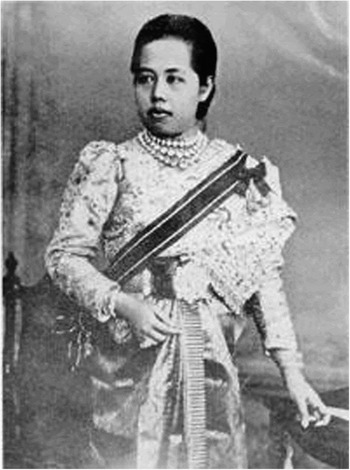
Of King Chulalongkorn's many wives, Queen Saowapha and her two elder sisters, Queen Sunantha Kumarirat and Queen Sawangwatthana were the most powerful. Queen Saowapha's (1863–1919) influence over the women in the Palace and beyond after she became First Queen in 1895 has been described as “enormous” (Smith Reference Smith1982: 59, 72). Ten years younger than Chulalongkorn, she became his wife at the age of sixteen and bore him nine children; her oldest son became King Vajiravudh and her youngest became King Prajadhipok (ibid.: 69). Her early influence can be seen in the fact that she was the first to break from the traditional birthing practice with the deliveries of her own children, a practice her father King Mongkut had tried to end earlier without success (ibid.: 59; McFarland Reference McFarland and McCracken1958: 98). Already as a young queen, she saw a need to train Siamese midwives in Western birthing methods and in 1883 she sent four young girls to England to study midwifery (Smith Reference Smith1982: 59). Upon the death of an infant son in 1886, she requested that the lumber used in the cremation rites be reused to build a hospital in her son's name: Siriraj Hospital opened in 1888 (McFarland Reference McFarland and McCracken1958: 68–69). While regent, Queen Saowapha also decided to build a medical school, which she and the king opened in 1900 (ibid.: 139).
Queen Saowapha and her sisters had a longstanding interest in education. Queen Sunantha had wanted to establish a girls' school (ibid.: 73; see also Wyatt Reference Wyatt1969). After her tragic death in a drowning accident, the king erected a school named Sunanthalai College in her memory.Footnote 35 During Queen Saowapha's regency, “education received an added impetus” and several day schools for girls were opened (McFarland Reference McFarland1999: 78–79). Dr. Malcolm Smith, who served as her physician in her old age, has left one of the most detailed accounts of this queen. Noting her interest in “the world outside her own country,” Smith found Queen Saowapha “remarkably well informed” (1982: 104). He writes, “Her knowledge of the surviving royal houses of Europe was astonishingly complete. She knew their family trees far better than I did, and spoke of some of the people almost as if they were her own relations.… She could talk well on a variety of subjects” (ibid.: 104).
The nineteenth-century practice of polygyny, common among elite families, horrified most Christian missionaries. In addition to concubines, King Mongkut had thirty-five wives; King Chulalongkorn had thirty-six.Footnote 36 The prevailing image of the Siamese harem, popularized in the west by Anna Leonowens herself, was of women who led “stifled, repressed, loveless and terror-filled lives as possessions of the king” (Hong Reference Hong1999: 313). Although the attitude towards polygyny among Thai women clearly changed in the twentieth century (see Loos Reference Loos2006; Barmé Reference Barmé2002), Smith maintains that in the nineteenth century among the public at large there was “never any movement on the part of Siamese women in favour of monogamy,” and adds that being chosen to enter the court “was a source of pleasure and gratification.” He comments specifically that Queen Saowapha “saw nothing wrong with the practice, nor did her sister.” Principal wives apparently even preferred polygyny because it “relieved them of household drudgery” (Smith Reference Smith1982: 145–46). As Suwadee Tanaprasitpatana points out, “having been freed from the manual work which was the duty of common women, some of the women in the Inner Palace were able to pay attention to ‘male knowledge’ to the extent that some of them became outstanding poets” (Reference Tanaprasitpatana1989: 59). For all her criticisms of polygyny, even Anna Leonowens portrays the life of palace women in idyllic terms (Reference Leonowens1988 [1870]: 168).Footnote 37
The inner palace was a veritable city replete with shops and gardens. Inhabited by some three thousand women, the inner palace had its own administrative hierarchy. As Smith explains, “Each Queen had her own household of between 200 and 300 women. Her ladies-in-waiting, recruited mainly from the daughters of noblemen, but who were sometimes princesses of lower rank, had also their own servants. Each minor wife had a fairly large retinue; if she became a mother it increased. Each one had a separate establishment, the size of which was in proportion to her rank” (1982: 56–57).
Indeed a position in the inner court appears to have been desirable, and an avenue for political and social advancement not just for a woman's relatives, but also for the woman herself. As Smith explains, “With their training in Court manners and the domestic arts, they were much sought after” (ibid.: 70). Lord adds, “Many progressive Thai leaders were also aware that the only place their daughters could receive an education in Thailand was at the royal harem; an education which often increased the marriage potential of the king's maids of honor and even enhanced the status of the king's concubines who could resign and seek a more personal relationship with another man” (1964: 210). Prince Damrong noted that “most of the king's daughters achieved literacy,” as did many other women of the inner court (Suwadee Reference Tanaprasitpatana1989: 66).Footnote 38 Princess Varasethasuda, one of the daughters of King Rama III, became a noted intellectual of her day (ibid.: 66–67). According to Leonowens' description, even court slaves were literate (1988: 168). Smith writes, “So highly was this Palace training valued that it was the custom of the princes at that period to send their small sons and daughters to live with ‘The Inside’ and acquire its traditions” (1982: 77). The inner palace was in effect the central locus of political education.
A more recent wave of scholarship is beginning to explore the role of women in the inner court, and is revealing them to have been well educated, well informed, and influential in their own rights (e.g., Hong Reference Hong1998, Reference Hong1999; Loos Reference Loos2005; Reference Loos2006; Suwadee Reference Tanaprasitpatana1989). Countering the view of court women as “passive subjects of the Court,” Lysa Hong concludes that “politics and power were ever present in the harem” (1998: 341; 1999: 337, 324). Court women were no less cosmopolitan than the queens. In a rare description of a woman of rank, Bradley observed the interest of Luang Nai Sit's wife in learning English in 1836, adding, “She like her husband is very fond of courting the society of Europeans and Americans” (Feltus Reference Feltus1936: 13–14).Footnote 39 In addition to the opportunities for educational advancement, serving in the inner palace was also an opportunity for economic security and even economic gain. All the women of the inner court received their own salaries, depending on their rank (Smith Reference Smith1982: 38). Many women of the inner court, from the queens on down, were highly entrepreneurial. Queens Saowapha and Sawangwatthana were both involved in money lending and other investments (Suwadee Reference Tanaprasitpatana1989: 163). Queen Saowapha, in particular, was described as having amassed considerable wealth, from both her state annuity and her own private income “mainly derived from property” (Smith Reference Smith1982: 109).
Scholars have noted that polygyny was of political significance for royal administration. Thus Stanley Tambiah concludes that “the high king's multiple marriages and unions assumed and validated his rights over the constituent units of his polity,” unifying his kingdom “by means of his queens, concubines, and ladies-in-waiting” (1976: 116–17; see also Loos Reference Loos2006: 102, 110–18). More than merely symbolically representing political unity, court women linked the court to the villages of the kingdom through their extended matrilineal kinship networks. Indeed, women played important roles not only in court, but also at every level of Thai society down to the village. As the anthropologist John DeYoung wrote, “The social position of the Thai peasant woman is powerful: she has long had a voice in village governmental affairs” (Reference De Young1966: 24; see also Bowie Reference Bowie2008a).
The strength of women's positions in village political affairs is due in large part to the widespread tendency of Thai villagers to follow matrilocal (uxorilocal) post-marriage residence. As explained by Phya Anuman Rajadhon (Reference Anuman Rajadhon1888–1969), widely considered the founder of Thai anthropology, it is the custom “for the young man to leave the home of his parents, that is, to marry out of his own home and into his wife's home” (1988 [1954]: 286). Matrilocality in turn leads to the formation of de facto matrilineages. Upon marriage, a new couple usually lives in the same home as part of an extended household with the wife's parents, siblings, and maternal grandparents. Their neighbors are likely to be members of the same matriline. Far from an independent political actor, the uxorilocal husband is embedded in a domestic political economy in which he is often dependent on his wife's parents for his home, land, ploughs, buffaloes, and other agricultural necessities. The wife's matriline generally provides the primary kinship network through which needed labor and other resources are mobilized (see Bowie Reference Bowie2008a). Historically, a man upon marriage changed his allegiance to the lord of his wife's parents (Hallett Reference Hallett1890: 131).Footnote 40
In addition to mobilizing labor and other resources through matrilines, village women also exercise considerable economic control in their own right. As early as 1693, Simon de la Loubere remarked, “The wives of the people managing all the trade do enjoy a perfect liberty” (in Van Esterik Reference Van Esterik2000: 43). Women also play a key role in village markets. In 1934, James Andrews estimated that every village household sent at least one of its women to the market every morning (Reference Andrews1935: 136). As DeYoung observed, marketing village women “produce a sizeable portion of the family cash income, and they not only handle the household money, but usually act as the family treasurer and hold the purse strings” (1966: 24; see Bowie Reference Bowie1992). Given their control over financial transactions, women also play a primary role in deciding whether or not to extend credit to relatives and other villagers. A woman's economic position is further safeguarded by traditional laws that ensure to varying degrees that, in cases of divorce, a woman had “control of the property that she may have brought to the family and of what she may have accumulated during her married life” (Suwadee Reference Tanaprasitpatana1989: 58).
Evidence Regarding Court Attitudes toward Women
A closer look at the missionary accounts suggests that the Thai did not have a problem with treating foreign women as equals. When Dr. Bradley brought his wife to his 1836 meeting with the future King Mongkut who was then ordained as a Buddhist priest, Bradley himself recounts, “Our reception was very pleasant. The priest had us seated at a table, where he presently came and took a seat on the opposite side, not seeming to be embarrassed in the least by the presence of Mrs. Bradley” (Feltus Reference Feltus1936: 26). In subsequent visits with Prince Mongkut, Bradley's wife was often by his side and received as his equal (Lord Reference Lord1967: 334). After Mongkut became king in 1851, “missionary women were not only given public recognition, but at state affairs they were given seats of honor” (ibid.: 334). Even after Dr. Bradley died, Sarah Blachly Bradley was given the seat of honor at King Chulalongkorn's left at state dinners (ibid.: 334).Footnote 41
King Chulalongkorn's interactions with Leavitt and Ackermann were equally gracious. Leavitt describes her reception as follows: “We ascended a few steps, between two rows of men, guards, officials, I know not whom, and as we entered the audience room a handsome, smiling gentleman advanced to meet us. I remembered my manners well enough to curtsey three times as I advanced, and the last time was over His Majesty's hand, for he presented his, led me forward to a chair, and seated himself opposite. Then I sat down” (Union Signal, 2 June 1887: 8). Ackermann writes, “When I entered the king walked half way across the room to greet me, which was really done in a most democratic way; he then motioned me to a seat nearby” (1896: 193).
Although foreigners often remark on their surprise at the courteous reception of foreign women, their denunciations of polygyny often hide evidence regarding the indigenous position of women. Given the significance of women in the court and in villages in which matrilineal kinship patterns prevailed, it is quite likely that Thai men assumed that women were important figures in their own right. Prince Damrong grew up in a court surrounded by powerful women, one of whom was serving as regent at the time of the 1897 Act. Thus, whatever his exposure to the suffrage debates, his decision to extend suffrage to both village men and women likely emerged from his confidence, as a member of Thai society, in women's abilities at every level from the village to the court.
CHALLENGING THE HISTORIOGRAPHY OF SUFFRAGE
In its narrow focus on suffrage, this essay has oversimplified the complexities of electoral politics and gender hierarchies in Thailand. Gendered paradoxes of purity and pollution remain between the historical sacred spaces of the harem into which no adult male except the monarch could enter and the contemporary sacred spaces of the Theravada Buddhist clergy into which no female may ordain. Although women have been able to vote since at least 1897, women could hold elected village offices only after 1982 (for discussion of the role of women in village electoral politics, see Bowie Reference Bowie2008a). As elsewhere, in Thailand questions can also be raised about the broader relationship between suffrage and democracy, be they village elections held under the rule of absolute monarchy or national elections held under the specter of military dictatorships. Nonetheless, to the extent that female equality is measured by voting rights, the historiography of the suffrage timeline becomes important and a narrow focus on the history of suffrage in Thailand becomes provocative.
Repositioning Thailand at 1897 on the international suffrage timeline encourages a richer understanding of the position of women in nineteenth-century Thai history and raises new issues for study that were hitherto obscured. Thai feminists have accepted the 1932 date both because of an urban disregard for village politics (which continues today) and because it fits with the dominant narrative celebrating 1932 as the inception of democracy.Footnote 42 Recognition of the 1897 date invites a reconsideration of the extent to which the 1932 coup liberated women; raises new questions regarding the views of Prince Damrong, Queen Saowapha, and other members of the court on the position of women; and encourages a reengagement with the political role of women at both the court and village levels. Furthermore, by shifting the focus from the date at which the first parliamentary elections were held to the date at which ungendered suffrage was first achieved, the interpretation of Thailand shifts from one in which it is viewed as “copying” Western models of democracy to one in which it becomes a pioneer on the global stage.
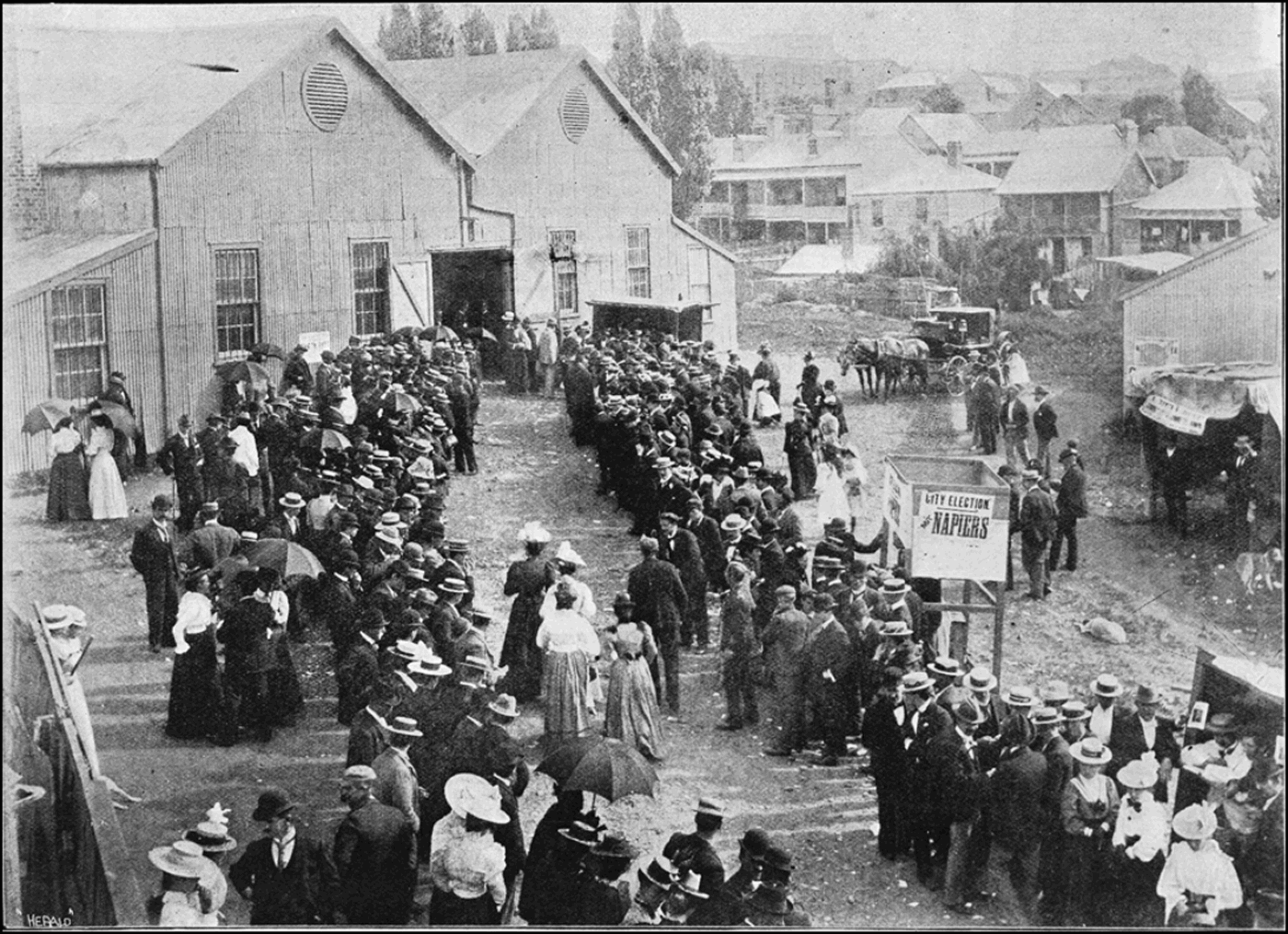
This interpretive disjuncture also raises questions about the criteria by which the prevailing international timeline are determined. Despite New Zealand's apparent claim, other timelines of female suffrage have been constructed (see image 5). Some scholars begin their timelines with Sweden in 1718 when female taxpayers had suffrage until 1771; others begin with France (Wiki/Corsica; Wiki/Timeline).Footnote 43 Caroline Daley and Melanie Nolan list seven locations that offered suffrage to women before New Zealand, beginning with New Jersey in 1776–1807 and the Pitcairn Islands in 1838 (1994: 349–52).Footnote 44 Acknowledging difficulties ranging from determining “whether the dates given were for the year women's suffrage was granted, or the year it was first exercised” to the complication that often “the suffrage won was limited to a particular group of women,” Daley and Nolan note that it is “very difficult to ascertain when women in a particular country gained the right to vote” (ibid.: 349; see also Markoff Reference Markoff2003: 109–10). The cases of Sweden and New Jersey, among others, reveal the difficulty of determining how to list regions in which women's suffrage is revoked and regained subsequently. Furthermore, the eclectic mix of remote islands, states, territories, and colonies discloses the political complexity of determining the relevant geographical definition of “country.” However, as the case of Thailand attests, the focus on national or parliamentary elections has further distorted the international historiographical narrative of women's suffrage.
“Lady Voters” approaching polling booth in Auckland, New Zealand, 6 December 1899. With permission from Sir George Grey Special Collections, Auckland City Libraries, Reference: A12353.
National Elections versus National Equality
Although attaining female suffrage in national elections is often seen as the final phase in the establishment of democracy, local suffrage has often proven no less difficult, and has even post-dated national electoral rights. In Australia, women gained voting rights in national elections in 1902, but were not able to vote in all state elections until 1908 (Markoff Reference Markoff2003: 91). Similarly, although women in Switzerland gained the right to vote in national elections in 1971, they did not have the right to vote in all internal cantonal elections until 1990 (see Bendix Reference Bendix1992). Writing of Egypt and Uganda, Laila Shukry El-Hamamsy avows, “women are more active on the national level, especially in the larger urban centers, than they are on the provincial or village level where traditional conceptions of the role of women still strongly hold” (1959: 479). Mahmood Mamdani points to the bifurcated political dynamics of the rural and urban areas as a result of colonialism in Africa, contrasting the development of a form of civil society in the urban centers and the intensification of authoritarian “decentralized despotism” in the rural areas (1996). Unlike countries where greater constraints exist for women's participation in local politics than national politics, Thailand provides an interesting case of a society in which “women are traditionally active on the village level” (El-Hamamsy Reference El-Hamamsy1959: 479; see also Arghiros Reference Arghiros2001; Bowie Reference Bowie2008a). That women first voted in national parliamentary elections after 1932 had nothing to do with the struggle for female enfranchisement, but it marked Thailand's transition from an absolute to a constitutional monarchy.
Positioning countries together by national dates contributes to an interpretation that they somehow share a homogeneous historical trajectory. On the current timeline, Brazil, Uruguay, and Thailand are listed as gaining suffrage in 1932, yet the characters of women's political participation in these three countries reveal significant differences. Women in Brazil and Uruguay had to wait until 1932 not only for national suffrage but also for local suffrage (Hahner Reference Hahner1990: 156).Footnote 45 Unlike the British and American temperance movement, in Uruguay the suffrage movement was linked to the conditions of female workers in the meatpacking plants, textile factories, and other workplaces; its growth contributed to support for socialist and communist political parties (Lavrin Reference Lavrin1995: 326, 344). By contrast, in Brazil the pressure for women's suffrage came from the daughters of the elite and the middle classes (Hahner Reference Hahner1990: 129, 151). Accepting property and literacy requirements, which remained in place until 1985, the Brazilian suffrage movement centered on patriotic activities such as the promotion of the Red Cross and nursing in support of the “campaign for a well-trained army” (ibid.: 130). Unlike the “strongly masculine” political climate in these two Roman Catholic countries, in Thailand, public political philosophy never included debates about how the right to vote might “pervert” women or make them “dangerous” (Lavrin Reference Lavrin1995: 321, 327; see also Hahner Reference Hahner1990). Thus these two Latin American countries produced different but gendered suffrage patterns, both of them distinct from the ungendered suffrage pattern of Thailand.
Even when historiographies of suffrage have included local politics, the attention has been focused on municipal rather than village politics. In Europe, the feudal tension between the aristocracy and the bourgeoisie contributed to an ideology in which cities are seen as free and therefore more democratic; as Riggs explains, “It has perhaps been normal in Western countries for self-government to find its most vital expression in the autonomy of municipalities” (1966: 182–83). The English pattern seems to exemplify the regnant assumptions. In England, municipal councils emerged gradually in the wake of the 1835 Municipal Corporations Act, but female ratepayers were granted the vote in boroughs only after 1869 (narrowed to unmarried women ratepayers in 1872; see Hollis Reference Hollis1987: 7). Rural males finally gained the vote in the Third Reform Act of 1884; rural women had to wait until 1894 to vote in local elections but were not yet eligible to vote for parliamentary candidates (Hollis Reference Hollis1987: 8). This urban ideological bias may well underlie the tendency of colonies to develop representative elections in municipalities before rural areas.Footnote 46 Nonetheless, in several countries women's suffrage was more strongly supported in rural than in urban areas (see Markoff Reference Markoff2003: 92; Ray Reference Ray1918: 469).
Although the prevailing narrative assumes that national elections are more important than local elections to the development of democracy, there is no necessary correlation between national elections and democracy. As John Markoff explains, “We can find instances where significant democratic practice at the national level coexists with widespread village despotisms”; the reverse is also true (Reference Markoff1999: 662). However, as the growing literature on decentralization attests, strong democracies must be founded on strong local participation. Noting the importance of local politics, Muhlberger and Paine point out that “humanity possesses a long history of government by discussion, in which groups of people sharing common interests make decisions that affect their lives through debate and consultation, and often enough by voting” (Reference Muhlberger and Paine1993: 27). Rather than assuming that equal suffrage in national-level elections is the end-stage in the development of democratic institutions, more attention should be paid to the differential dynamics of gender relations at all levels of electoral politics if our understanding of democracy is to be fully engendered.
Reversing the Gaze
Shifting Thailand's position in the international timeline of women's suffrage from 1932 to 1897 challenges the historiographical narrative in which “suffragism is conceived of as having its center in England and the United States, reaching out from there first to the remaining countries of Europe, then to the rest of the world” (DuBois Reference DuBois2000: 540; Phillips Reference Phillips1991: 120). Ramirez, Soysal, and Shanahan have gone so far as to posit that suffrage emerged in “Western” countries first because of the gradual “diffusion of a gender-neutral model of citizenship in which universal suffrage is a central element” (1997: 736). As they elaborate, “Women's franchise movements arose from contradictions between the abstract individual and the gendered boundaries separating the public domain and the familial domain. These contradictions were most evident in the West, where the rights of the individual citizen had been developed earlier and more extensively.” In their view, suffrage spread because, “The dominant status of the West increased the attractiveness of the social and political models that initially developed there” (ibid.: 736).
As a newer generation of scholars are beginning to show, the Eurocentric narrative suffers from three main problems. Firstly, it obscures the historical reality in which many European countries were very slow to grant female franchise. Indeed, noting a pattern in which earlier gender-neutral language was replaced by explicit gendered restrictions, John Markoff has argued that in France and elsewhere “the age of democracy began with the systematic disfranchisement of women” (2003: 85–90). Full and permanent female suffrage was not granted in France until 1944, Italy in 1945, Belgium in 1948, Greece in 1952, Switzerland in 1971, Portugal in 1975, and Spain in 1976.Footnote 47 Reversing the prevailing argument, Markoff asserts, “Women's suffrage was pioneered in lesser places in the geography of wealth and power and then advanced to more central locations” (ibid.: 90).
Secondly, the prevailing narrative, based in the patrilineal societies of Europe, obscures the very different gender ideologies of matrilineal societies characteristic of much of greater Southeast Asia.Footnote 48 Foreign travelers and scholars alike have long remarked on the “pan-Southeast Asian pattern of female autonomy” (Reid Reference Reid1988: 153) and “the importance of the role conferred on women and of relationships in the maternal line” (Andaya Reference Andaya2000: 1; see also Van Esterik Reference Van Esterik1982: 1). As Niel Gunson writes, “Although male-female relationships varied considerably throughout the pagan Malayan and Polynesian worlds the status of chiefly women can be shown to have been equal if not superior to that of chiefly men” (Reference Gunson1987: 139). In summarizing this literature, Barbara Andaya concludes, “The evidence has persuaded me that one can approach Southeast Asia as a region where attitudes toward gender, though subject to constant renegotiation, were historically favorable to women” (Andaya Reference Andaya2006: 9; see Atkinson and Errington Reference Atkinson and Errington1990; Blackwood Reference Blackwood2000; Brenner Reference Brenner1998; Carsten Reference Carsten1997; Lepowsky Reference Lepowsky1993; Ong and Peletz Reference Ong and Peletz1995; Peletz Reference Peletz1996; Van Esterik Reference Van Esterik1982; Weiner Reference Weiner1976).Footnote 49 Several of the earliest known regions to grant suffrage were in greater Southeast Asia; in addition to New Zealand, Thailand, and Australia, suffrage was granted in the Pitcairn Islands in 1838, the Sandwich Islands in 1889, Cook Islands in 1893, and even in New Zealand, Maori women gained the formal right to vote before immigrant white women (Markoff Reference Markoff2003: 94, 96; Grimshaw Reference Grimshaw2000: 560–3). Increasingly, Ellen DuBois and others are beginning to encourage a “Pacific perspective,” arguing that the history of women's suffrage “thus looks more varied, more complex, and more open-ended that it does from a Eurocentric point of view” (DuBois Reference DuBois2000: 540; see also Markoff Reference Markoff2003: 105). The study of ungendered suffrage in Thailand suggests that early suffrage did not take place in the Pacific region simply because of its geographical distance from the bourgeois democracies of Europe, as Markoff asserts, but also because of a matrilineal heritage shared widely throughout greater Southeast Asia.
Thirdly this Eurocentric narrative has blurred the role of Western colonialism in imposing a gendered politics in societies that were historically more gender-neutral. In the Pacific Islands, “colonial administrations codified customs, causing them to be more rigidly enforced than in the past” (Meleisea Reference Meleisea, Daley and Nolan1994: 108). In some Pacific Islands the colonial authorities changed the rules of inheritance. As Penelope Schoeffel Meleisea explains, “In Micronesia the German administration replaced the matrilineal transmission of land, titles and property of Pohnpei with a patrilineal system which effectively disinherited women. A similar situation occurred in Tonga when missionary-inspired late-nineteenth-century land reforms dispossessed women of land rights” (1994: 108). In Hawai`i, American involvement “removed a queen and other high-born Hawaiian women from positions of authority” (Grimshaw Reference Grimshaw2000: 571; Linnekin Reference Linnekin1990; Merry Reference Merry2000; see also Gailey Reference Gailey1987; Stoler Reference Stoler1985; Tiffany Reference Tiffany1983).Footnote 50
A comparison of the history of female suffrage in Burma and Thailand provides some insight into the likely impact of colonialism in similarly matrilineal societies. Like Thailand, in village Burma “the husband is brought to the girl's parents' house and made to do his share towards supporting the household” (Shway Yoe Reference Yoe1963 [1882]: 55; see also Nash Reference Nash1965: 51; Spiro Reference Spiro1977: 81–84). Writing in 1826, Thomas Trant noted that Burmese women “know how to read and write, and enter with the greatest warmth into the news and politics of the day” (Reference Trant1827: 209).Footnote 51 The noted nineteenth-century British scholar-diplomat, Sir James George Scott (Shway Yoe), wrote, “a married Burmese woman is much more independent than any European even in the most advanced states (Shway Yoe Reference Yoe1963: 52). He continues, “All the money and possessions which a girl brings with her on marriage are kept carefully separate for the benefit of her children or heirs, and she carries her property away with her if she is divorced, besides anything she may have added to it in the interim by her own trading or by inheritance” (ibid.: 52). More significantly, Victor Purcell remarked, “Until (and for sometime after) the introduction of British rule, the chieftainship in some villages descended in the female line” (Reference Purcell1959: 292; Koenig Reference Koenig1990: 41, 50, 145).
The history of women's suffrage in Burma remains to be written. Nonetheless, some accounts from the period of British colonial rule indicate both Burmese men and women pressed for the inclusion of female suffrage but were resisted by the ruling British officials.Footnote 52 Significant protests were catalyzed by the clause in the Reform Act of 1919 that debarred women from becoming members of the legislature (Mya Sein Reference Mya Sein1972). Noting the support of Burmese men throughout this period of anti-colonial struggle, Mi Mi Khaing writes, “It has been said of Burma that she has no feminist movements because none have been necessary; the women have always had all the rights they wanted. But it goes further than that. Burmese men take a sincere pride in the achievements of a woman who can successfully invade spheres outside her domestic tasks” (Reference Khaing1956 [1946]: 100–1; see also Mya Sein Reference Mya Sein1972). Thus in colonial societies, a realm of ungendered indigenous political cooperation may lie hidden in the dates on an international timeline.
Inverting the gaze on women's suffrage from an urban-based Western perspective to a village-based Southeast Asian perspective reveals problematic assumptions underlying the international timeline. The teleological assumption of the primacy of national or parliamentary elections has obscured the greater difficulty women may face in local-level electoral politics, blurred the tremendous historical variation in women's participation in local politics, marginalized village politics, and ignored the importance of local politics for a fully engendered democracy. The attendant narrative in which women's rights are portrayed as emanating from Europe has, in turn, concealed the late dates of suffrage in many European countries, obscured the early dates of suffrage in many countries in greater Southeast Asia, and blurred the negative impact of colonialism on the position of women, particularly in matrilineal societies. Thailand's ignored history of ungendered suffrage challenges us to envision a more nuanced narrative, thereby enriching our comparative analyses of how democracy is variously engendered.



